Aimathic
Login | English | Deutsch

Free math worksheets

Build your own math worksheets from 21,000 problems for grades 3 to 12, from fractions to calculus. Every problem includes step-by-step solutions.

Fractions on a number line

Click problems to add them to your worksheet.

5317273
What fractions are marked by points \(A\), \(B\), \(C\), and \(D\) on the number line? Write each value as a fraction in simplest form or as a mixed number.
Figure for problem 531727

Hints

- Count the equal intervals from \(0\) to \(1\) to find the size of one step. - Count ticks from \(0\) to each point. - Simplify fractions and write values greater than \(1\) as mixed numbers if helpful.

Solution

1. The interval from \(0\) to \(1\) is divided into \(8\) equal parts, so each tick represents \(\frac{1}{8}\). 2. Point \(A\) is at the third tick: \(A=\frac{3}{8}\). 3. Point \(B\) is at the sixth tick: \(B=\frac{6}{8}=\frac{3}{4}\). 4. Point \(C\) is one eighth past \(1\): \(C=1\frac{1}{8}\). 5. Point \(D\) is six eighths past \(1\): \(D=1\frac{6}{8}=1\frac{3}{4}\).

Answer

A) \(\frac{3}{8}\) B) \(\frac{3}{4}\) C) \(1\frac{1}{8}\) D) \(1\frac{3}{4}\)
5317323
Points \(P\), \(Q\), and \(R\) are marked on the number line. a) Into how many equal parts is the interval from \(0\) to \(1\) divided? What fraction does one step represent? b) What values are marked by \(P\), \(Q\), and \(R\)? Write each as a fraction in simplest form or as a mixed number.
Figure for problem 531732

Hints

- Count the equal intervals from \(0\) to \(1\). - Count steps from \(0\) to each point. - Simplify fractions and use a mixed number for a point greater than \(1\).

Solution

1. The interval from \(0\) to \(1\) is divided into \(8\) equal parts, so one step represents \(\frac{1}{8}\). 2. Point \(P\) is at \(\frac{2}{8}=\frac{1}{4}\). 3. Point \(Q\) is at \(\frac{7}{8}\). 4. Point \(R\) is at \(\frac{11}{8}=1\frac{3}{8}\).

Answer

a) \(8\) equal parts; one step is \(\frac{1}{8}\) b) \(P=\frac{1}{4}\), \(Q=\frac{7}{8}\), \(R=1\frac{3}{8}\)
5318413
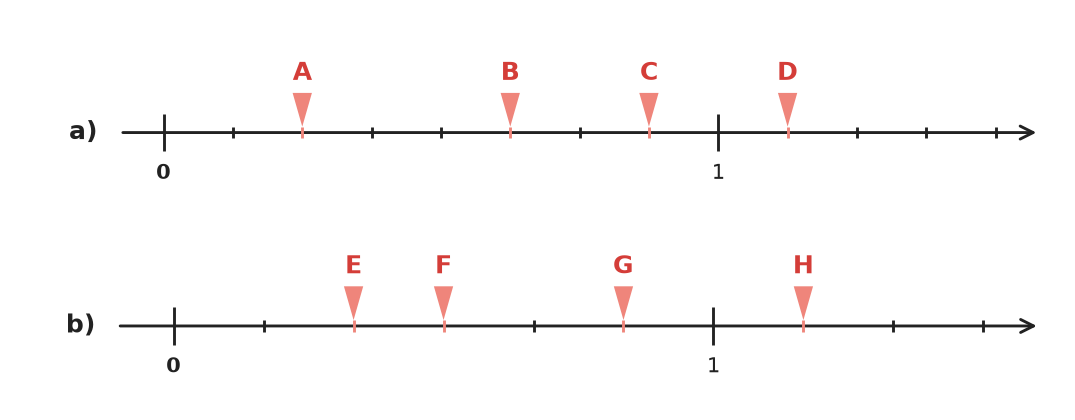
Find the fraction marked by each letter on the two number lines. Write every fraction in simplest form. For values greater than \(1\), also write a mixed number.
Figure for problem 531841

Hints

- Count the equal intervals from \(0\) to \(1\) on each number line. - Use that count as the denominator for one step. - Count steps to each letter, simplify, and convert values greater than \(1\) to mixed numbers.

Solution

1. In a), the interval from \(0\) to \(1\) is divided into eighths. Therefore, \(A=\frac{2}{8}=\frac{1}{4}\), \(B=\frac{5}{8}\), \(C=\frac{7}{8}\), and \(D=\frac{9}{8}=1\frac{1}{8}\). 2. In b), the interval from \(0\) to \(1\) is divided into sixths. Therefore, \(E=\frac{2}{6}=\frac{1}{3}\), \(F=\frac{3}{6}=\frac{1}{2}\), \(G=\frac{5}{6}\), and \(H=\frac{7}{6}=1\frac{1}{6}\).

Answer

a) \(A=\frac{1}{4}\), \(B=\frac{5}{8}\), \(C=\frac{7}{8}\), \(D=\frac{9}{8}=1\frac{1}{8}\) b) \(E=\frac{1}{3}\), \(F=\frac{1}{2}\), \(G=\frac{5}{6}\), \(H=\frac{7}{6}=1\frac{1}{6}\)
5351463
What fractions or mixed numbers are marked on the number lines? Give the value for each letter.
Figure for problem 535146

Hints

- Count the equal intervals between consecutive whole numbers on each line. - That count gives the denominator for one step. - Count steps to each marker and combine them with the whole number when needed.

Solution

1. In a), each step is \(\frac{1}{4}\), so \(A=1\frac{1}{4}\). 2. In b), each step is \(\frac{1}{3}\), so \(B=3\frac{2}{3}\) and \(C=4\frac{1}{3}\). 3. In c), each step is \(\frac{1}{6}\), so \(D=10\frac{5}{6}\). 4. In d), each step is \(\frac{1}{8}\), so \(E=\frac{5}{8}\).

Answer

a) \(A=1\frac{1}{4}\) b) \(B=3\frac{2}{3}\), \(C=4\frac{1}{3}\) c) \(D=10\frac{5}{6}\) d) \(E=\frac{5}{8}\)

All problems may be used, copied and printed free of charge for school and tutoring, including paid tutoring. Commercial adaptations as well as publication or redistribution on the internet are not permitted.