

Aimathic
Login | English | Deutsch

Free Math Worksheets

Build your own math worksheets from 21,000 problems for grades 3 to 12, from fractions to calculus. Every problem includes step-by-step solutions.

Understand division by two-digit numbers

Click problems to add them to your worksheet.

5179115
A bakery has \(96\) dinner rolls. A baker puts exactly \(12\) rolls in each bag. How many bags can the baker fill?

Hints

- Think of division as finding a missing factor. - What number multiplied by \(12\) equals \(96\)? - Check your quotient by multiplying it by \(12\).

Solution

1. Divide the total number of rolls by the number in each bag: \(96 \div 12\). 2. Use multiplication to find the quotient. Since \(12 \times 8 = 96\), it follows that \(96 \div 12 = 8\).

Answer

The baker can fill \(8\) bags.
5100055
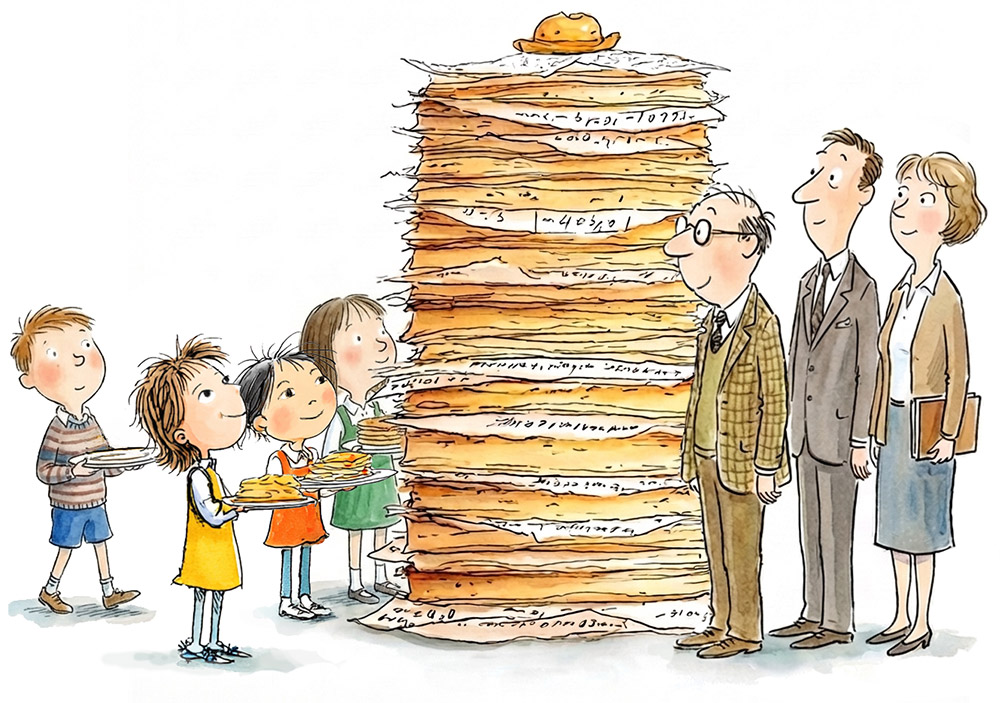
A traffic jam is about \(1000\) feet long. About how many cars are in the traffic jam if each car is about \(15\) feet long and there is about a \(5\)-foot gap between cars? a) \(40\) b) \(50\) c) \(60\) d) \(80\)

Hints

- First estimate the space used by one car and one gap. - Divide the length of the traffic jam by that amount. - Choose the matching answer.

Solution

1. Find the space needed for one car and its gap: \(15 + 5 = 20\) feet. 2. Divide the total length by the space per car: \(1000 \div 20 = 50\).

Answer

b) \(50\)
5179125
A flower shop has \(150\) tulips to arrange in bouquets. a) How many bouquets can the florist make if each bouquet has \(15\) tulips? b) How many bouquets can the florist make if each bouquet has \(25\) tulips instead?

Hints

- For part a, what number multiplied by \(15\) equals \(150\)? - For part b, break \(150\) into numbers that are easy to divide by \(25\). - Check each quotient by multiplication.

Solution

1. For part a, divide the total number of tulips by the number in each bouquet: \(150 \div 15\). Since \(15 \times 10 = 150\), the quotient is \(10\). 2. For part b, calculate \(150 \div 25\). 3. Break \(150\) into compatible numbers: \(150 = 100 + 50\). 4. Divide each part: \(100 \div 25 = 4\) and \(50 \div 25 = 2\). Add the partial quotients: \(4 + 2 = 6\).

Answer

a) The florist can make \(10\) bouquets. b) The florist can make \(6\) bouquets.
5188455
An elementary school has \(240\) students going on a field trip. a) How many students are in each group if the school makes \(10\) equal groups? b) How many groups are formed if each group has \(20\) students?

Hints

- Decide what each divisor represents in the two parts. - For part a, share the students equally among \(10\) groups. - For part b, count how many groups of \(20\) are in \(240\).

Solution

1. For part a, divide the number of students by the number of groups: \(240 \div 10 = 24\). 2. For part b, divide the number of students by the size of each group: \(240 \div 20 = 12\).

Answer

a) Each group has \(24\) students. b) The school forms \(12\) groups.
5188465
A produce seller has \(450\) apples to pack into crates. The seller says, “If I put \(50\) apples in each crate, I will need fewer than \(10\) crates.” Is the seller correct? Justify your answer with a calculation.

Hints

- First find the exact number of crates needed. - Divide \(450\) by \(50\). - Compare your quotient with \(10\).

Solution

1. Divide the total number of apples by the number in each crate: \(450 \div 50 = 9\). 2. Compare the result with \(10\): \(9 < 10\). 3. The seller is correct because exactly \(9\) crates are needed.

Answer

Yes. The seller needs exactly \(9\) crates, and \(9 < 10\).
5189075
A plant nursery ships bulbs in boxes that hold exactly \(25\) bulbs each. How many boxes are needed to ship \(175\) bulbs? Show your reasoning with repeated addition or a division equation.

Hints

- Count by \(25\) until you reach \(175\). - Write a multiplication or division equation for the equal groups. - Check that the number of boxes times \(25\) equals \(175\).

Solution

1. Divide the total number of bulbs by the number in each box: \(175 \div 25\). 2. Repeated addition reaches \(175\) in \(7\) equal steps: \(25 + 25 + 25 + 25 + 25 + 25 + 25 = 175\). 3. Therefore, \(175 \div 25 = 7\).

Answer

The nursery needs \(7\) boxes.
5200645
A gardener plants \(800\) tulip bulbs in rows of \(20\) bulbs each. How many rows are needed?

Hints

- Divide the total number of bulbs by \(20\). - Simplify the division by dividing both numbers by \(10\). - Check the quotient by multiplying it by \(20\).

Solution

1. Divide the total number of bulbs by the number in each row: \(800 \div 20\). 2. Divide both numbers by \(10\) to write an equivalent division problem: \(80 \div 2 = 40\). 3. Therefore, \(800 \div 20 = 40\).

Answer

The gardener needs \(40\) rows.
5200655
A school cafeteria receives \(600\) small juice boxes. The juice boxes are packed \(50\) to a carton. How many cartons are delivered?

Hints

- Divide the total number of juice boxes by \(50\). - Simplify by dividing both numbers by \(10\). - Check that the number of cartons times \(50\) equals \(600\).

Solution

1. Divide the total number of juice boxes by the number in each carton: \(600 \div 50\). 2. Divide both numbers by \(10\): \(60 \div 5 = 12\). 3. Therefore, \(600 \div 50 = 12\).

Answer

The school receives \(12\) cartons.
5176665
Lucas collects \(25\) pinecones per hour for a science craft project. Mia helps and collects \(15\) pinecones per hour. a) How many pinecones do they collect together in \(3\) hours? b) How many hours must they collect together to gather \(200\) pinecones?

Hints

- First find how many pinecones they collect together in one hour. - Once you know the hourly rate, how can you find the amount for three hours? - How many groups of the one-hour amount make \(200\)?

Solution

1. Find their combined hourly rate: \(25 + 15 = 40\) pinecones per hour. 2. Find the number collected in three hours: \(3 \times 40 = 120\). 3. Find the time needed to collect two hundred pinecones: \(200 \div 40 = 5\) hours.

Answer

a) They collect \(120\) pinecones in \(3\) hours. b) They must collect together for \(5\) hours.
5176845
A school library has \(145\) nonfiction books. It has \(25\) fewer adventure books than nonfiction books. The adventure books are placed equally on shelves that hold \(30\) books each. How many shelves are needed for the adventure books?

Hints

- First find the total number of adventure books. - Which operation finds a quantity that is a given amount less than another quantity? - Once you know the total, divide it into groups of \(30\).

Solution

1. Find the number of adventure books: \(145 - 25 = 120\). 2. Divide by the number of books each shelf holds: \(120 \div 30 = 4\).

Answer

The library needs \(4\) shelves for the adventure books.
5177435
At a zoo, the penguins are fed \(120\) small fish each day. The seals receive \(40\) more fish than the penguins. The fish for the seals are placed in buckets that hold exactly \(20\) fish each. How many buckets are needed for the seals?

Hints

- First find how many fish the seals receive altogether. - Once you know the total, divide the fish among the buckets. - Think about how multiples of \(20\) can help.

Solution

1. Find the number of fish for the seals: \(120 + 40 = 160\). 2. Divide by the number of fish in each bucket: \(160 \div 20 = 8\).

Answer

The zoo needs \(8\) buckets for the seals.
5188755
A division problem can sometimes be solved in two steps by factoring the divisor. Fill in each missing divisor, then find the quotient. a) \(5600 \div 14 = 5600 \div 7 \div \square\) b) \(4500 \div 15 = 4500 \div 5 \div \square\) c) \(6400 \div 16 = 6400 \div \square \div 2\) d) \(9000 \div 18 = 9000 \div 9 \div \square\)

Hints

- Write each two-digit divisor as a product of two one-digit factors. - Divide by one factor and then by the other factor. - Check by multiplying the quotient by the original divisor.

Solution

1. Part a: Since \(14 = 7 \times 2\), the missing divisor is \(2\). Then \(5600 \div 7 = 800\) and \(800 \div 2 = 400\). 2. Part b: Since \(15 = 5 \times 3\), the missing divisor is \(3\). Then \(4500 \div 5 = 900\) and \(900 \div 3 = 300\). 3. Part c: Since \(16 = 8 \times 2\), the missing divisor is \(8\). Then \(6400 \div 8 = 800\) and \(800 \div 2 = 400\). 4. Part d: Since \(18 = 9 \times 2\), the missing divisor is \(2\). Then \(9000 \div 9 = 1000\) and \(1000 \div 2 = 500\).

Answer

a) Missing divisor: \(2\); quotient: \(400\) b) Missing divisor: \(3\); quotient: \(300\) c) Missing divisor: \(8\); quotient: \(400\) d) Missing divisor: \(2\); quotient: \(500\)
5188765
Lucas and Mia are calculating \(6000 \div 12\). Lucas calculates \(6000 \div 6 \div 2\). Mia calculates \(6000 \div 2 \div 6\). a) Explain why both methods give the correct quotient. b) Find the quotient using each method. c) How could Lucas calculate \(8400 \div 14\) in two steps? Write and evaluate his division expression.

Hints

- Write \(12\) as a product of the two divisors used by Lucas and Mia. - Carry out the divisions in the order shown and compare the quotients. - Factor \(14\) into two one-digit factors.

Solution

1. Part a: Both students factor \(12\) as \(6 \times 2\). Dividing successively by \(6\) and \(2\), in either order, is equivalent to dividing by \(12\). 2. Part b, Lucas: \(6000 \div 6 = 1000\), and \(1000 \div 2 = 500\). 3. Part b, Mia: \(6000 \div 2 = 3000\), and \(3000 \div 6 = 500\). 4. Part c: Since \(14 = 7 \times 2\), Lucas can calculate \(8400 \div 7 \div 2 = 1200 \div 2 = 600\).

Answer

a) Both methods work because \(12 = 6 \times 2\), and the two factors may be used as successive divisors in either order. b) Both methods give \(500\). c) \(8400 \div 7 \div 2 = 1200 \div 2 = 600\)
5192775
Write three different division equations with quotient \(9\) and remainder \(4\). Briefly explain the condition the divisor must satisfy.

Hints

- Use the relationship \(\text{dividend} = \text{divisor} \times \text{quotient} + \text{remainder}\). - Choose a divisor first, then work backward to find the dividend. - A remainder must be less than the divisor.

Solution

1. For a quotient of \(9\) and remainder \(4\), the dividend must have the form \(9d + 4\), where the divisor \(d\) is greater than \(4\). 2. Choose \(d = 5\): \(9 \times 5 + 4 = 49\), so \(49 \div 5 = 9\text{ R }4\). 3. Choose \(d = 10\): \(9 \times 10 + 4 = 94\), so \(94 \div 10 = 9\text{ R }4\). 4. Choose \(d = 20\): \(9 \times 20 + 4 = 184\), so \(184 \div 20 = 9\text{ R }4\). 5. The divisor must be greater than the remainder, so \(d > 4\).

Answer

One possible set is \(49 \div 5 = 9\text{ R }4\), \(94 \div 10 = 9\text{ R }4\), and \(184 \div 20 = 9\text{ R }4\). The divisor must be greater than \(4\).
5211015
A toy factory packages \(120\) marbles equally in \(6\) bags. How many bags of the same size are needed to package \(180\) marbles?

Hints

- First find how many marbles fit in one bag. - How many groups of that size make \(180\) marbles? - Dividing both numbers by \(10\) may make the second division easier.

Solution

1. Find the number of marbles in one bag: \(120 \div 6 = 20\). 2. Divide the new total by the number in one bag: \(180 \div 20 = 9\).

Answer

The factory needs \(9\) bags.
5212305
A school fundraiser has \(600\) prizes to pack into boxes. a) How many boxes are needed if each box holds \(20\) prizes? b) How many boxes are needed if each box holds \(60\) prizes? c) Explain why packing \(60\) prizes per box requires fewer boxes than packing \(20\) prizes per box.

Hints

- Divide \(600\) by each box capacity. - Simplify each division by removing a common factor of \(10\). - Explain how a larger group size affects the number of groups.

Solution

1. For part a, divide: \(600 \div 20 = 30\). 2. For part b, divide: \(600 \div 60 = 10\). 3. A box holding \(60\) prizes has a greater capacity than one holding \(20\), so the same total is divided into fewer groups.

Answer

a) \(30\) boxes are needed. b) \(10\) boxes are needed. c) Fewer boxes are needed because each larger box holds more prizes.
5178925
A treasure chest weighs \(950\,\text{g}\) altogether. The empty chest weighs \(350\,\text{g}\). Inside are \(4\) large gold coins that each weigh \(60\,\text{g}\). The rest of the contents are small silver coins that each weigh \(40\,\text{g}\). How many coins are in the chest altogether?

Hints

- Find the weight of the contents by subtracting the empty chest's weight. - How much do all the gold coins weigh? - How much weight remains for the silver coins? - How many silver coins have that total weight?

Solution

1. Find the weight of the contents: \(950\,\text{g} - 350\,\text{g} = 600\,\text{g}\). 2. Find the total weight of the gold coins: \(4 \times 60\,\text{g} = 240\,\text{g}\). 3. Find the weight of the silver coins: \(600\,\text{g} - 240\,\text{g} = 360\,\text{g}\). 4. Find the number of silver coins: \(360\,\text{g} \div 40\,\text{g} = 9\). 5. Find the total number of coins: \(4 + 9 = 13\).

Answer

The treasure chest contains \(13\) coins altogether.
5193215
Two digits are missing from this division equation with a remainder. Find them. \(3\square5 \div 1\square = 23\) remainder \(6\)

Hints

- Rewrite the division using multiplication and the remainder. - Use the ones digits to determine the missing digit in the divisor. - Check that the remainder is less than the divisor.

Solution

1. Use the relationship \(\text{dividend} = \text{divisor} \times \text{quotient} + \text{remainder}\). 2. The product of the divisor and \(23\) must end in \(9\), because adding the remainder \(6\) then gives a number ending in \(5\). 3. Since the ones digit of \(23\) is \(3\), the missing ones digit of the divisor must be \(3\), because \(3 \times 3\) ends in \(9\). 4. Compute \(13 \times 23 = 299\), and add the remainder: \(299 + 6 = 305\). 5. Therefore, the missing digits are \(0\) and \(3\).

Answer

\(305 \div 13 = 23\) remainder \(6\)

All problems may be used, copied and printed free of charge for school and tutoring, including paid tutoring. Commercial adaptations as well as publication or redistribution on the internet are not permitted.