Aimathic
Login | English | Deutsch

Free math worksheets

Build your own math worksheets from 28,000 problems for grades 3 to 12, from fractions to calculus. Every problem includes step-by-step solutions.

Divide whole number by unit fraction

Click problems to add them to your worksheet.

5408445
A \(4\)-mile trail is divided into intervals that are each \(\frac{1}{8}\) mile long. How many intervals are in the entire trail?

Hints

- Think about how many eighths make one whole mile. - Then extend that count to all of the miles on the trail.

Solution

1. The question asks how many groups of \(\frac{1}{8}\) are in \(4\), so use \(4\div\frac{1}{8}\). 2. Each mile contains \(8\) eighth-mile intervals, so \(4\) miles contain \(4\times8=32\) intervals.

Answer

There are \(32\) intervals.
5408495
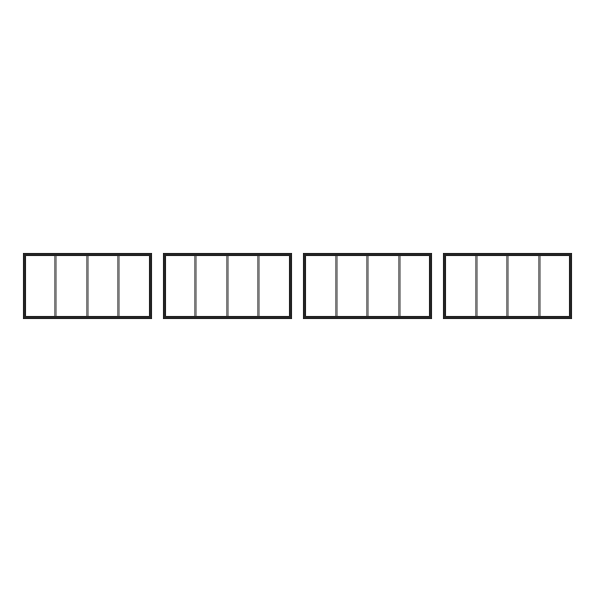
Each equal piece in the model is used for one snack. How many snacks can be made from all the loaves shown?
Figure for problem 540849

Hints

- Count how many equal sixth-size pieces make one whole. - Use the same number of pieces for each whole loaf.

Solution

1. Each whole loaf contains \(6\) pieces of size \(\frac{1}{6}\). 2. Two whole loaves contain \(2\times6=12\) such pieces, so \(2\div\frac{1}{6}=12\).

Answer

\(12\) snacks can be made.
5408595
A maker has \(3\) meters of ribbon. Each bookmark needs \(\frac{1}{12}\) meter. How many bookmarks can be made?

Hints

- Think about how many twelfths make one whole meter. - Repeat that amount for each meter of ribbon.

Solution

1. The number of bookmarks is the number of \(\frac{1}{12}\)-meter pieces in \(3\) meters: \(3\div\frac{1}{12}\). 2. Each meter contains \(12\) such pieces, so \(3\times12=36\).

Answer

\(36\) bookmarks can be made.
5408845
Compare \(2\div\frac{1}{3}\) and \(2\div\frac{1}{5}\). Which quotient is greater? Explain using the size of the unit-fraction divisor.

Hints

- Compare the sizes of one third and one fifth. - Ask which size piece would fit more times into the same two wholes.

Solution

1. \(2\div\frac{1}{3}=6\) because there are \(3\) thirds in each whole. 2. \(2\div\frac{1}{5}=10\) because there are \(5\) fifths in each whole. 3. Smaller pieces fit more times into the same total, so dividing by \(\frac{1}{5}\) gives the greater quotient.

Answer

\(2\div\frac{1}{5}=10\) is greater than \(2\div\frac{1}{3}=6\).
5409025
A \(7\)-yard roll of ribbon is cut into pieces that are each \(\frac{1}{4}\) yard long. How many pieces are made? Explain why the answer is greater than \(7\).

Hints

- Think about how many pieces of the stated size fit in one whole yard. - Extend that count to all of the whole yards. - Consider how using pieces smaller than one whole affects the number of pieces.

Solution

1. The number of pieces is \(7\div\frac{1}{4}\). 2. Each whole yard contains \(4\) quarter-yard pieces, so \(7\) yards contain \(7\times4=28\) pieces. 3. The quotient is greater than \(7\) because each whole yard is split into several pieces smaller than one yard.

Answer

\(28\) pieces. The count is greater than \(7\) because each yard contains \(4\) quarter-yard pieces.
5409435
The multiplication fact \(18\times\frac{1}{6}=3\) is true. Use it to write and explain a whole-number ÷ unit-fraction equation.

Hints

- Interpret the multiplication as a group count times a group size. - Reverse that relationship to find the number of groups from the total.

Solution

1. Eighteen groups of size \(\frac{1}{6}\) make a total of \(3\). 2. Therefore the number of sixth-size groups in \(3\) is \(18\). 3. The division equation is \(3\div\frac{1}{6}=18\).

Answer

\(3\div\frac{1}{6}=18\).
5409635
Four whole granola bars are cut into pieces that are each \(\frac{1}{7}\) of a bar. Without listing the pieces one by one, determine how many pieces there are altogether. Write a division equation and explain why the quotient is larger than \(4\).

Hints

- Ask how many pieces of the given size fit in one whole first. - Then extend that count to all four wholes. - Think about why counting pieces smaller than a whole gives more groups than the number of wholes.

Solution

1. The number of pieces is represented by \(4\div\frac{1}{7}\). 2. Each whole contains \(7\) one-seventh pieces, so \(4\) wholes contain \(4\times7=28\) pieces. 3. The quotient is larger than \(4\) because the groups being counted are smaller than one whole.

Answer

\(4\div\frac{1}{7}=28\), so there are \(28\) pieces.
5410095
A workshop lasts \(5\) hours and is divided into sessions that each last \(\frac{1}{4}\) hour. How many sessions fit in the workshop? Explain what the quotient counts.

Hints

- First think about how many quarter-hours fit in one hour. - Extend that count to all \(5\) hours. - Keep track of what is being counted by the quotient.

Solution

1. The number of sessions is \(5\div\frac{1}{4}\). 2. Each hour contains \(4\) quarter-hour sessions, so \(5\) hours contain \(5\times4=20\) sessions. 3. The quotient counts sessions, not hours.

Answer

\(20\) sessions fit in the workshop.
5410415
Explain \(2\div\frac{1}{11}=22\) using repeated unit fractions. How many copies of \(\frac{1}{11}\) make one whole, and how does that lead to the quotient for \(2\) wholes?

Hints

- Start by asking how many copies of the unit fraction make exactly one whole. - Then scale that count to the number of wholes in the dividend. - The quotient counts copies of the unit fraction.

Solution

1. Eleven copies of \(\frac{1}{11}\) make one whole because \(11\times\frac{1}{11}=1\). 2. Two wholes therefore contain \(2\times11=22\) copies of \(\frac{1}{11}\). 3. Thus \(2\div\frac{1}{11}=22\).

Answer

There are \(22\) copies of \(\frac{1}{11}\) in \(2\) wholes.
5408685
Nora says \(5\div\frac{1}{9}=\frac{5}{9}\). Explain why her answer is not reasonable, then find the correct quotient.

Hints

- Estimate whether the quotient should be larger or smaller than the whole number. - Think about how many ninths fit in one whole before considering all five wholes.

Solution

1. Dividing \(5\) wholes into pieces of size \(\frac{1}{9}\) should produce more than \(5\) pieces, not a value less than \(1\). 2. Each whole contains \(9\) ninths, so \(5\) wholes contain \(5\times9=45\) ninths. 3. Therefore \(5\div\frac{1}{9}=45\).

Answer

The correct quotient is \(45\).
5408775
Find the positive whole number \(n\) so that \(3\div\frac{1}{n}=24\). Explain what \(n\) means.

Hints

- Think about how many \(\frac{1}{n}\) pieces fit in one whole. - Relate the total number of pieces in three wholes to the given quotient.

Solution

1. If one whole is divided into \(n\) equal unit-fraction pieces, then \(3\) wholes contain \(3n\) pieces. 2. Set \(3n=24\), giving \(n=8\). 3. The divisor is \(\frac{1}{8}\), so there are \(24\) eighths in \(3\) wholes.

Answer

\(n=8\), so the divisor is \(\frac{1}{8}\).
5408925
Which expressions have a quotient of \(18\)? Select all that apply. A) \(2\div\frac{1}{9}\) B) \(3\div\frac{1}{6}\) C) \(6\div\frac{1}{3}\) D) \(4\div\frac{1}{4}\)

Hints

- For each expression, think about how many copies of the unit fraction make one whole. - Scale that count by the whole-number dividend.

Solution

1. A gives \(2\times9=18\). 2. B gives \(3\times6=18\). 3. C gives \(6\times3=18\). 4. D gives \(4\times4=16\), so it does not match.

Answer

A, B, and C.
5409095
A shipment contains \(35\) packets, and each packet weighs \(\frac{1}{7}\) pound. The total weight is a whole number of pounds. What is the total weight? Relate your answer to a division equation with \(35\) as the quotient.

Hints

- Think about how many packets make one whole pound. - Group the packet count into complete pounds. - Use your total to write the related division statement.

Solution

1. Seven packets of \(\frac{1}{7}\) pound make \(1\) pound. 2. Group \(35\) packets into groups of \(7\): \(35\div7=5\) groups, so the total weight is \(5\) pounds. 3. This means \(5\div\frac{1}{7}=35\): there are \(35\) one-seventh-pound packets in \(5\) pounds.

Answer

\(5\) pounds, and \(5\div\frac{1}{7}=35\).
5409185
You know \(6\div\frac{1}{5}=30\). Without starting over, use that fact to find \(3\div\frac{1}{5}\) and \(12\div\frac{1}{5}\). Explain the relationship among the quotients.

Hints

- The unit-fraction group size stays the same in all three expressions. - Think about what happens to the number of equal groups when the total amount is halved or doubled.

Solution

1. Halving the whole-number dividend from \(6\) to \(3\) halves the group count: \(30\div2=15\). 2. Doubling the dividend from \(6\) to \(12\) doubles the group count: \(30\times2=60\). 3. Therefore \(3\div\frac{1}{5}=15\) and \(12\div\frac{1}{5}=60\).

Answer

\(3\div\frac{1}{5}=15\) and \(12\div\frac{1}{5}=60\).
5409255
Without guessing, compare \(4\div\frac{1}{6}\) and \(6\div\frac{1}{4}\). Which quotient is greater, or are they equal? Explain.

Hints

- For each expression, count how many divisor-sized pieces fit in one whole. - Then scale by the number of wholes.

Solution

1. Four wholes contain \(4\times6=24\) sixths. 2. Six wholes contain \(6\times4=24\) fourths. 3. Both quotients are \(24\), so they are equal.

Answer

The quotients are equal; both are \(24\).
5409355
A whole-number length is greater than \(0\) mile but less than \(5\) miles. It is divided into pieces that are each \(\frac{1}{4}\) mile long. Which possible whole-number lengths make more than \(10\) pieces? Show how you reason from the number of fourths in each whole.

Hints

- Determine how many quarter-mile pieces are in one whole mile. - Test each allowed whole-number length and compare its piece count with \(10\).

Solution

1. One whole mile contains \(4\) quarter-mile pieces. 2. For lengths of \(1\), \(2\), \(3\), and \(4\) miles, the piece counts are \(4\), \(8\), \(12\), and \(16\). 3. The counts greater than \(10\) come from lengths of \(3\) miles and \(4\) miles.

Answer

The possible lengths are \(3\) miles and \(4\) miles.
5409495
Compare \(2\div\frac{1}{7}\) and \(7\div\frac{1}{2}\). Find both quotients and explain why they are equal.

Hints

- Count how many divisor-sized pieces fit in one whole for each expression. - Multiply that count by the number of wholes.

Solution

1. Two wholes contain \(2\times7=14\) sevenths. 2. Seven wholes contain \(7\times2=14\) halves. 3. Both divisions count \(14\) unit-fraction groups.

Answer

Both quotients are \(14\).
5409715
A theater has \(3\) yards of decorative cord. It cuts the cord into pieces that are each \(\frac{1}{6}\) yard long, then sets aside \(4\) pieces for repairs. How many pieces remain for decorating?

Hints

- First determine how many pieces of the given fractional length fit in all \(3\) yards. - Only after finding the total number of pieces should you account for the pieces set aside.

Solution

1. Find the total number of pieces: \(3\div\frac{1}{6}=18\). 2. Subtract the \(4\) pieces set aside: \(18-4=14\). 3. Therefore \(14\) pieces remain for decorating.

Answer

\(14\) pieces remain.
5409775
A student says the model represents \(2\div\frac{1}{12}=12\). Use the model to explain the mistake and find the correct quotient.
Figure for problem 540977

Hints

- Count how many twelfths make one whole before considering both circles. - Ask whether the student’s answer accounts for every whole shown in the model.

Solution

1. One whole contains \(12\) pieces of size \(\frac{1}{12}\). 2. There are \(2\) wholes, so there are \(2\times12=24\) such pieces. 3. Therefore \(2\div\frac{1}{12}=24\). The student counted the twelfths in only one whole.

Answer

The correct quotient is \(24\). The student counted only one whole instead of both wholes.
5409865
Without calculating first, decide which quotient is greater: \(3\div\frac{1}{8}\) or \(4\div\frac{1}{10}\). Explain your prediction, then find both quotients to check.

Hints

- Compare both the number of wholes and the size of the unit-fraction pieces being counted. - Smaller pieces fit more times into a whole. - After predicting, count how many of each unit fraction make one whole and scale up.

Solution

1. The second expression starts with more wholes and counts smaller pieces, so it should have the larger quotient. 2. \(3\div\frac{1}{8}=3\times8=24\). 3. \(4\div\frac{1}{10}=4\times10=40\). 4. Since \(40>24\), the prediction is confirmed.

Answer

\(4\div\frac{1}{10}\) is greater; the quotients are \(24\) and \(40\).
5409935
A camp kitchen has \(5\) gallons of drink mix. It fills bottles that each hold \(\frac{1}{8}\) gallon, then packs the bottles into crates that hold \(6\) bottles each. How many full crates can be packed, and how many bottles are left over?

Hints

- First determine how many fractional-size bottles can be filled from all the drink mix. - After you know the bottle count, group those bottles by the crate capacity. - Keep the two division steps separate because they answer different questions.

Solution

1. Find the number of bottles: \(5\div\frac{1}{8}=40\). 2. Pack the \(40\) bottles in groups of \(6\): \(40=6\times6+4\). 3. Therefore there are \(6\) full crates and \(4\) bottles left over.

Answer

\(6\) full crates can be packed, with \(4\) bottles left over.
5410015
A \(7\)-foot strip is cut into \(63\) equal pieces. Each piece has a length that is a unit fraction of a foot. What is the length of each piece? Explain using a whole-number ÷ unit-fraction equation.

Hints

- First find how many of the equal pieces come from one foot. - A foot divided into that many equal pieces gives the unit-fraction length. - Use the unit fraction in a division equation to check the total piece count.

Solution

1. Divide the total piece count by the number of feet: \(63\div7=9\). So each foot contains \(9\) equal pieces. 2. If one foot is split into \(9\) equal pieces, each piece is \(\frac{1}{9}\) foot long. 3. Check with the required division equation: \(7\div\frac{1}{9}=63\).

Answer

Each piece is \(\frac{1}{9}\) foot long.
5410175
Which of these quotients equal \(30\)? Select all that apply and explain without relying on a calculator. a) \(3\div\frac{1}{10}\) b) \(5\div\frac{1}{6}\) c) \(6\div\frac{1}{5}\)

Hints

- For each divisor, ask how many of those unit-fraction pieces make one whole. - Multiply that count by the number of wholes in the dividend. - Look for different factor pairs that produce the same total count.

Solution

1. a) Each whole contains \(10\) tenths, so \(3\) wholes contain \(3\times10=30\) tenths. 2. b) Each whole contains \(6\) sixths, so \(5\) wholes contain \(5\times6=30\) sixths. 3. c) Each whole contains \(5\) fifths, so \(6\) wholes contain \(6\times5=30\) fifths. 4. All three quotients equal \(30\).

Answer

a), b), and c) all equal \(30\).
5410255
Three ropes are \(1\) foot, \(2\) feet, and \(3\) feet long. All three are cut into pieces that are each \(\frac{1}{6}\) foot long. How many pieces are made altogether? Solve by combining the whole-number lengths first.

Hints

- The pieces are all the same size, so the rope lengths can be combined before dividing. - Think about how many sixths fit in one foot, then in the total number of feet.

Solution

1. Combine the rope lengths: \(1+2+3=6\) feet. 2. Count one-sixth-foot pieces in the total length: \(6\div\frac{1}{6}=36\). 3. Therefore \(36\) pieces are made.

Answer

\(36\) pieces are made altogether.
5410335
A maker cuts \(8\) feet of cord into \(\frac{1}{4}\)-foot pieces and \(6\) feet of another cord into \(\frac{1}{3}\)-foot pieces. Which cord produces more pieces, and how many more?

Hints

- Find how many fractional-size pieces fit in each whole-number length. - Compare the two resulting piece counts only after solving both divisions. - The final question asks for the difference between the counts.

Solution

1. The first cord produces \(8\div\frac{1}{4}=32\) pieces. 2. The second cord produces \(6\div\frac{1}{3}=18\) pieces. 3. The first cord produces \(32-18=14\) more pieces.

Answer

The \(8\)-foot cord produces more pieces, by \(14\) pieces.
5410525
A \(9\)-foot roll is cut into pieces that are each \(\frac{1}{12}\) foot long. One third of all the pieces are used for a model. How many pieces are used?

Hints

- First determine how many unit-fraction pieces fit in the full roll. - The second step uses the stated fraction of that piece count. - Keep length units separate from the final count of pieces.

Solution

1. Find the total number of pieces: \(9\div\frac{1}{12}=108\). 2. Find one third of the pieces: \(\frac{1}{3}\times108=36\). 3. Therefore \(36\) pieces are used.

Answer

\(36\) pieces are used.
5410605
Checkpoint markers are placed at the start of a \(6\)-mile route, every \(\frac{1}{8}\) mile, and at the end. How many \(\frac{1}{8}\)-mile intervals are there? How many checkpoint markers are there? Explain why the two counts differ.

Hints

- First find how many one-eighth-mile lengths fit in \(6\) miles. - Distinguish spaces between markers from the marker locations themselves. - A row of intervals has one more endpoint than interval.

Solution

1. The number of intervals is \(6\div\frac{1}{8}=48\). 2. The first marker is at the start before any interval is traveled. 3. Each of the \(48\) intervals ends at another marker, so there are \(48+1=49\) markers. 4. The marker count is one greater than the interval count because markers include both endpoints.

Answer

There are \(48\) intervals and \(49\) checkpoint markers. The markers include both the starting and ending points.
5410685
A \(2\)-yard roll is first cut into pieces that are each \(\frac{1}{12}\) yard long. A second roll of the same length is cut into pieces that are twice as long, \(\frac{1}{6}\) yard. How does doubling the piece length affect the number of pieces? Find both counts.

Hints

- Count how many of each unit-fraction size fit in one whole yard first. - The total length stays fixed while the piece size changes. - Compare the two final counts to describe the effect of doubling the divisor size.

Solution

1. With \(\frac{1}{12}\)-yard pieces, the count is \(2\div\frac{1}{12}=24\). 2. With \(\frac{1}{6}\)-yard pieces, the count is \(2\div\frac{1}{6}=12\). 3. Doubling the piece length halves the number of pieces that fit in the same total length.

Answer

The first roll makes \(24\) pieces and the second makes \(12\). Doubling the piece length halves the piece count.
5410865
A \(2\)-yard strip is cut into pieces that are each \(\frac{1}{7}\) yard long. Five pieces are used. How much of the original strip remains? Give the remaining length in yards.

Hints

- First count how many unit-fraction pieces fit in the full strip. - Subtract the number of pieces used. - Convert the remaining piece count back into a length using the size of one piece.

Solution

1. The strip makes \(2\div\frac{1}{7}=14\) pieces. 2. After \(5\) pieces are used, \(14-5=9\) pieces remain. 3. Nine pieces of length \(\frac{1}{7}\) yard total \(9\times\frac{1}{7}=\frac{9}{7}=1\frac{2}{7}\) yards.

Answer

\(1\frac{2}{7}\) yards remain.
5411015
Find these quotients and explain why all three have the same value: a) \(1\div\frac{1}{12}\) b) \(2\div\frac{1}{6}\) c) \(3\div\frac{1}{4}\)

Hints

- For each divisor, determine how many of those unit fractions make one whole. - Multiply that count by the whole-number dividend. - Look for the common total created by different factor pairs.

Solution

1. a) One whole contains \(12\) twelfths, so the quotient is \(12\). 2. b) Each whole contains \(6\) sixths, so \(2\) wholes contain \(2\times6=12\) sixths. 3. c) Each whole contains \(4\) fourths, so \(3\) wholes contain \(3\times4=12\) fourths. 4. In each expression, the number of wholes times the number of unit-fraction pieces per whole equals \(12\).

Answer

a) \(12\) b) \(12\) c) \(12\)
5411105
A machine cuts a \(10\)-foot roll into pieces that are each \(\frac{1}{8}\) foot long. Its display reports that it made \(18\) pieces. Use a multiplication check to show why the report is impossible, then find the correct number of pieces.

Hints

- Multiply the reported count by the length of one piece to test the claim. - Determine how many eighth-foot pieces make one whole foot. - Rebuild the original \(10\)-foot length to check the corrected count.

Solution

1. If there were \(18\) pieces, their total length would be \(18\times\frac{1}{8}=\frac{18}{8}=2\frac{1}{4}\) feet, not \(10\) feet. 2. Each whole foot contains \(8\) pieces of length \(\frac{1}{8}\) foot. 3. Ten feet contain \(10\times8=80\) pieces, so \(10\div\frac{1}{8}=80\). 4. Check: \(80\times\frac{1}{8}=10\) feet.

Answer

The report is impossible because \(18\) pieces total only \(2\frac{1}{4}\) feet. The correct count is \(80\) pieces.
5411315
Calculate \(5\div\frac{1}{9}\) and \(4\div\frac{1}{11}\), then compare the quotients. Explain why a rough estimate based only on both denominators being close to \(10\) could not reliably decide this close comparison.

Hints

- Use estimation only to recognize that the two answers should be close. - For each expression, count the unit-fraction pieces in one whole and then in all the wholes. - Compare the exact counts and explain why their small difference matters.

Solution

1. Both divisors are unit fractions with denominators close to \(10\), and the dividends differ by only \(1\). A rough estimate would place both quotients near the mid-forties, so it would not settle which is greater. 2. \(5\div\frac{1}{9}=45\), because \(5\) wholes contain \(5\times9\) ninths. 3. \(4\div\frac{1}{11}=44\), because \(4\) wholes contain \(4\times11\) elevenths. 4. Therefore the first quotient is greater by \(1\). Exact calculation is needed for this near-tie.

Answer

\(5\div\frac{1}{9}=45\) and \(4\div\frac{1}{11}=44\). The first is greater by \(1\); rough estimation alone does not resolve the near-tie.
5411365
For any whole-number length of ribbon, compare cutting it into \(\frac{1}{4}\)-yard pieces with cutting the same length into \(\frac{1}{8}\)-yard pieces. Explain without choosing a particular ribbon length why the second cut always makes twice as many pieces.

Hints

- Compare how many fourths and eighths fit in one whole yard. - The same whole-number length is used for both cuts. - A relationship that holds for each yard also holds for all the yards together.

Solution

1. Each whole yard contains \(4\) pieces of length \(\frac{1}{4}\) yard. 2. Each whole yard contains \(8\) pieces of length \(\frac{1}{8}\) yard. 3. Every yard therefore contributes twice as many eighth-yard pieces as fourth-yard pieces. 4. Because the same number of whole yards is used in both cases, the total eighth-yard piece count is always twice the fourth-yard piece count.

Answer

The \(\frac{1}{8}\)-yard cut always makes twice as many pieces because each yard contains \(8\) eighths but only \(4\) fourths.
5411425
You know \(3\div\frac{1}{16}=48\). Use that fact to find \(12\div\frac{1}{16}\) without starting the counting process over. Explain the relationship between the dividends and quotients.

Hints

- Compare the new dividend with the dividend in the known fact. - The divisor stays the same, so the number of unit-fraction groups scales with the number of wholes. - Apply the same scale factor to the known quotient.

Solution

1. The dividend \(12\) is \(4\) times the dividend \(3\). 2. With the same unit-fraction divisor, multiplying the number of wholes by \(4\) multiplies the group count by \(4\). 3. Therefore \(12\div\frac{1}{16}=4\times48=192\).

Answer

\(12\div\frac{1}{16}=192\).
5410785
Compare these two divisions: \(2\div\frac{1}{4}\) and \(4\div\frac{1}{8}\). The whole-number amount doubles while the unit-fraction piece size is cut in half. Find both quotients and explain why the second quotient is four times the first.

Hints

- Think separately about the effect of doubling the total amount and making each piece half as large. - Each change affects how many groups fit. - Compare the final counts after considering both effects.

Solution

1. \(2\div\frac{1}{4}=8\), because each whole contains \(4\) fourths. 2. \(4\div\frac{1}{8}=32\), because each whole contains \(8\) eighths. 3. Doubling the total amount doubles the group count, and halving the piece size doubles the count again. 4. Therefore the second quotient is \(2\times2=4\) times the first: \(32=4\times8\).

Answer

The quotients are \(8\) and \(32\). The second is four times the first.
5411395
A \(4\)-yard roll is cut into equal pieces. Each piece is a unit fraction of a yard, and the roll makes more than \(20\) but fewer than \(30\) pieces. What are all possible piece lengths? Explain using the number of unit-fraction pieces in each yard.

Hints

- Let the denominator of the unit-fraction piece tell how many pieces fit in one yard. - List the multiples of \(4\) that are strictly between \(20\) and \(30\). - Use each possible total piece count to determine the piece length.

Solution

1. If each piece is \(\frac{1}{d}\) yard, then one yard contains \(d\) pieces and \(4\) yards contain \(4d\) pieces. 2. The piece count must be strictly between \(20\) and \(30\). 3. The multiples of \(4\) in that interval are \(24\) and \(28\). 4. A count of \(24\) means \(d=6\), and a count of \(28\) means \(d=7\). 5. Therefore the possible piece lengths are \(\frac{1}{6}\) yard and \(\frac{1}{7}\) yard.

Answer

The possible piece lengths are \(\frac{1}{6}\) yard and \(\frac{1}{7}\) yard.

All problems may be used, copied and printed free of charge for school and tutoring, including paid tutoring. Commercial adaptations as well as publication or redistribution on the internet are not permitted.