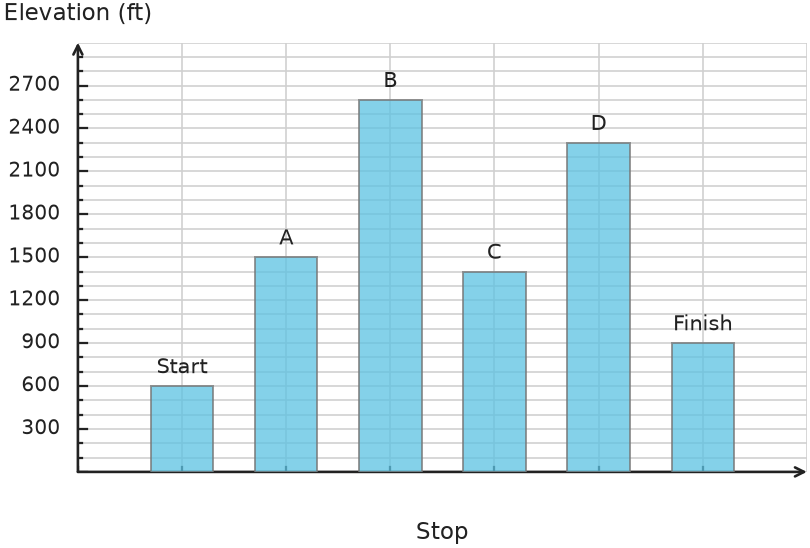
A hiking group is planning a route through the mountains. The bar graph shows the elevation of each stop in feet.
a) Read the elevations of the six stops from the graph.
b) Find the elevation change between each pair of consecutive stops. Use a negative sign for a descent.
c) Find the sum of all the elevation changes from part b).
d) A hiker says, “The finish is only \(300\,\text{ft}\) above the start, so we climb only \(300\,\text{ft}\) in all.” Explain why this statement is incorrect.
Hints
- Read each bar using the y-axis scale.
- Subtract each elevation from the next elevation in route order.
- Add the signed changes for the net change.
- Add only positive changes to find total ascent.
- Descents affect net change but not the amount already climbed.
Solution
1. The elevations are Start, \(600\,\text{ft}\); A, \(1500\,\text{ft}\); B, \(2600\,\text{ft}\); C, \(1400\,\text{ft}\); D, \(2300\,\text{ft}\); Finish, \(900\,\text{ft}\).
2. The consecutive changes are \(1500-600=+900\,\text{ft}\), \(2600-1500=+1100\,\text{ft}\), \(1400-2600=-1200\,\text{ft}\), \(2300-1400=+900\,\text{ft}\), and \(900-2300=-1400\,\text{ft}\).
3. Their sum is \(900+1100-1200+900-1400=300\,\text{ft}\), which is the net change from start to finish.
4. Total climbing includes only the positive changes: \(900+1100+900=2900\,\text{ft}\). Descents reduce the net change but do not erase the climbing already completed.
Answer
a) Start: \(600\,\text{ft}\); A: \(1500\,\text{ft}\); B: \(2600\,\text{ft}\); C: \(1400\,\text{ft}\); D: \(2300\,\text{ft}\); Finish: \(900\,\text{ft}\)
b) \(+900\,\text{ft}\), \(+1100\,\text{ft}\), \(-1200\,\text{ft}\), \(+900\,\text{ft}\), \(-1400\,\text{ft}\)
c) \(+300\,\text{ft}\)
d) The route includes \(2900\,\text{ft}\) of total ascent. The \(300\,\text{ft}\) value is only the net elevation change.


