Aimathic
Login | English | Deutsch

Free Math Worksheets

Build your own math worksheets from 21,000 problems for grades 3 to 12, from fractions to calculus. Every problem includes step-by-step solutions.

Solve two-step linear equations

Click problems to add them to your worksheet.

5279357
Determine whether the given value is a solution of each equation. 1) \(7x - 5 = 16\) for \(x = 3\) 2) \(18 - 3x = 6\) for \(x = 4\) 3) \(2(x + 4) = 10\) for \(x = 1\) 4) \(4x + 1 = 2x + 9\) for \(x = 5\)

Hints

- Substitute the proposed value for every occurrence of \(x\). - Evaluate the left and right sides separately. - The value is a solution only when both sides are equal.

Solution

1. Substitute \(x = 3\): \(7 \cdot 3 - 5 = 16\). The equation is true, so \(3\) is a solution. 2. Substitute \(x = 4\): \(18 - 3 \cdot 4 = 6\). The equation is true, so \(4\) is a solution. 3. Substitute \(x = 1\): \(2(1 + 4) = 10\). The equation is true, so \(1\) is a solution. 4. Substitute \(x = 5\): the left side is \(4 \cdot 5 + 1 = 21\), while the right side is \(2 \cdot 5 + 9 = 19\). The equation is false, so \(5\) is not a solution.

Answer

1) Yes 2) Yes 3) Yes 4) No
5112937
Solve each equation for \(x\). Then state whether each solution is a positive integer \((\mathbb{N})\), an integer \((\mathbb{Z})\), or a rational number \((\mathbb{Q})\). List every set that contains the solution. a) \(2x + 5 = -9\) b) \(4x - 3 = -15\) c) \(3x - 4 = 29\)

Hints

- Use inverse operations to isolate \(x\). - Check the sign of each solution carefully. - Every positive integer is also an integer, and every integer is also rational.

Solution

1. For a), \(2x + 5 = -9\), so \(2x = -14\) and \(x = -7\). This value is in \(\mathbb{Z}\) and \(\mathbb{Q}\). 2. For b), \(4x - 3 = -15\), so \(4x = -12\) and \(x = -3\). This value is in \(\mathbb{Z}\) and \(\mathbb{Q}\). 3. For c), \(3x - 4 = 29\), so \(3x = 33\) and \(x = 11\). This value is in \(\mathbb{N}\), \(\mathbb{Z}\), and \(\mathbb{Q}\).

Answer

a) \(x = -7\); \(\mathbb{Z}\) and \(\mathbb{Q}\) b) \(x = -3\); \(\mathbb{Z}\) and \(\mathbb{Q}\) c) \(x = 11\); \(\mathbb{N}\), \(\mathbb{Z}\), and \(\mathbb{Q}\)
5121357
Solve each equation for \(x\). Show the inverse operations in order. a) \(3(x + 1.2) = 15\) b) \(\frac{18.6 - x}{4} = 3.5\)

Hints

- Treat the expression inside the grouping symbols as one quantity at first. - Undo the outer operation before the inner operation. - Multiplication and division are inverse operations. - Check each answer in the original equation.

Solution

1. For a), divide by \(3\): \(x + 1.2 = 5\). Subtract \(1.2\): \(x = 3.8\). 2. For b), multiply by \(4\): \(18.6 - x = 14\). Subtract \(18.6\): \(-x = -4.6\). Multiply by \(-1\): \(x = 4.6\).

Answer

a) \(x = 3.8\) b) \(x = 4.6\)
5125207
Solve each equation using inverse operations. a) \(5x + 14 = 39\) b) \(18 - 2x = 10\) c) \(\frac{x}{3} + 5 = 12\)

Hints

- Identify the operation performed last on the variable. - Undo addition or subtraction before undoing multiplication or division. - Perform the same inverse operation on both sides. - Follow the sign rules when dividing by a negative number.

Solution

1. For a), subtract \(14\): \(5x = 25\). Divide by \(5\): \(x = 5\). 2. For b), subtract \(18\): \(-2x = -8\). Divide by \(-2\): \(x = 4\). 3. For c), subtract \(5\): \(\frac{x}{3} = 7\). Multiply by \(3\): \(x = 21\).

Answer

a) \(x = 5\) b) \(x = 4\) c) \(x = 21\)
5125217
Solve each equation for \(x\). a) \(4(x + 2) = 28\) b) \(12 = 3x + 21\) c) \(15 - 5x = 35\)

Hints

- In part a, you can divide before working inside the parentheses. - Perform each operation on both sides of the equation. - Pay close attention to a negative coefficient on the variable. - Substitute each result to check it.

Solution

1. For a), divide by \(4\): \(x + 2 = 7\). Subtract \(2\): \(x = 5\). 2. For b), subtract \(21\): \(-9 = 3x\). Divide by \(3\): \(x = -3\). 3. For c), subtract \(15\): \(-5x = 20\). Divide by \(-5\): \(x = -4\).

Answer

a) \(x = 5\) b) \(x = -3\) c) \(x = -4\)
5125237
Solve each equation for the indicated variable. a) \(5x + 12 = 37\) b) \(18 - 3y = 6\) c) \(4z - 4 = 12\) d) \(2x + 7 = -11\)

Hints

- Isolate the variable term before dividing. - Perform the same operation on both sides of the equation. - Follow the sign rules when a variable has a negative coefficient.

Solution

1. For a), subtract \(12\): \(5x = 25\). Divide by \(5\): \(x = 5\). 2. For b), subtract \(18\): \(-3y = -12\). Divide by \(-3\): \(y = 4\). 3. For c), add \(4\): \(4z = 16\). Divide by \(4\): \(z = 4\). 4. For d), subtract \(7\): \(2x = -18\). Divide by \(2\): \(x = -9\).

Answer

a) \(x = 5\) b) \(y = 4\) c) \(z = 4\) d) \(x = -9\)
5125267
Solve each equation using equivalent operations on both sides. a) \(6x + 14 = 50\) b) \(18 - 4y = 2\) c) \(0.5z - 3 = 4.5\) d) \(\frac{2}{3}b + 4 = 10\)

Hints

- Isolate the variable term before dividing. - Follow the sign rules when dividing by a negative number. - Multiplying by a reciprocal can undo multiplication by a fraction. - Apply each operation to both sides.

Solution

1. For a), subtract \(14\): \(6x = 36\). Divide by \(6\): \(x = 6\). 2. For b), subtract \(18\): \(-4y = -16\). Divide by \(-4\): \(y = 4\). 3. For c), add \(3\): \(0.5z = 7.5\). Divide by \(0.5\): \(z = 15\). 4. For d), subtract \(4\): \(\frac{2}{3}b = 6\). Multiply by \(\frac{3}{2}\): \(b = 9\).

Answer

a) \(x = 6\) b) \(y = 4\) c) \(z = 15\) d) \(b = 9\)
5182427
I am thinking of a number. I divide it by \(4\) and then add \(15\). The result is \(30\). What is my number?

Hints

- Work backward from the result. - Undo the last operation first. - Use inverse operations for addition and division. - Check by applying the original steps.

Solution

1. Undo the addition: \(30 - 15 = 15\). 2. Undo the division by multiplying: \(15 \cdot 4 = 60\). 3. Check: \(60 \div 4 + 15 = 30\).

Answer

The number is \(60\).
5182437
I am thinking of a number. Three times the number plus \(140\) equals \(500\). What is the number?

Hints

- Work backward from \(500\). - Undo the addition before undoing the multiplication. - Translate the riddle into an equation with a variable. - Check your solution in the original statement.

Solution

1. Undo the addition: \(500 - 140 = 360\). 2. Divide by \(3\): \(360 \div 3 = 120\). 3. Check: \(3 \cdot 120 + 140 = 500\).

Answer

The number is \(120\).
5183587
I am thinking of a number. I multiply it by \(6\) and then add \(4\). The result is \(40\). What is the number?

Hints

- Work backward from \(40\). - Undo the addition first, then the multiplication. - Use inverse operations. - Check your number by following the original steps.

Solution

1. Undo the addition: \(40 - 4 = 36\). 2. Undo the multiplication: \(36 \div 6 = 6\). 3. Check: \(6 \cdot 6 + 4 = 40\).

Answer

The number is \(6\).
5183597
I am thinking of a number. I divide it by \(2\), then subtract \(50\), and get \(200\). What is the number?

Hints

- Work backward from \(200\). - Undo the subtraction first. - Undo halving by doubling.

Solution

1. Undo the subtraction: \(200 + 50 = 250\). 2. Undo division by \(2\): \(250 \cdot 2 = 500\). 3. Check: \(500 \div 2 - 50 = 200\).

Answer

The number is \(500\).
5185407
Solve for \(x\). a) \(-5000+x=-3500\) b) \(x-2000=-10{,}000\)

Hints

- Use inverse operations to isolate \(x\). - Perform the same operation on both sides of the equation. - Substitute each answer into the original equation to check it.

Solution

1. In a), add \(5000\) to both sides: \(x=-3500+5000=1500\). 2. In b), add \(2000\) to both sides: \(x=-10{,}000+2000=-8000\).

Answer

a) \(x=1500\) b) \(x=-8000\)
5185557
A magician starts with a number, multiplies it by \(4\), and then subtracts \(24\). The result is \(100\). What was the starting number?

Hints

- Reverse the magician's steps. - Undo subtraction before undoing multiplication. - Check by applying the original operations.

Solution

1. Undo the subtraction: \(100 + 24 = 124\). 2. Undo the multiplication: \(124 \div 4 = 31\). 3. Check: \(4 \cdot 31 - 24 = 100\).

Answer

The starting number was \(31\).
5185647
I am thinking of a number. Three times the number plus \(120\) equals \(300\). What is the number?

Hints

- Work backward from \(300\). - Undo the addition first. - Undo multiplication by \(3\) using division. - Check your answer.

Solution

1. Undo the addition: \(300 - 120 = 180\). 2. Divide by \(3\): \(180 \div 3 = 60\). 3. Check: \(3 \cdot 60 + 120 = 300\).

Answer

The number is \(60\).
5185657
A magician starts with a number, subtracts \(50\), and then divides the result by \(5\). The final result is \(40\). What was the starting number?

Hints

- Work backward from \(40\). - Undo division by \(5\) first. - Then undo subtraction of \(50\).

Solution

1. Undo the division: \(40 \cdot 5 = 200\). 2. Undo the subtraction: \(200 + 50 = 250\). 3. Check: \((250 - 50) \div 5 = 40\).

Answer

The starting number was \(250\).
5186237
Solve for \(x\). a) \(4x + 6 = 30\) b) \(9x - 5 = 40\) c) \(7x + 3 = 52\)

Hints

- Solve each equation by working backward. - Undo addition or subtraction first. - Then undo multiplication by dividing. - Check each solution by substitution.

Solution

1. In a), subtract \(6\): \(4x = 24\). Then divide by \(4\): \(x = 6\). 2. In b), add \(5\): \(9x = 45\). Then divide by \(9\): \(x = 5\). 3. In c), subtract \(3\): \(7x = 49\). Then divide by \(7\): \(x = 7\).

Answer

a) \(x = 6\) b) \(x = 5\) c) \(x = 7\)
5190737
Three times a number is \(20\) less than \(200\). What is the number?

Hints

- First find the number that is \(20\) less than \(200\). - Translate “three times a number” into an equation. - Use division to undo multiplication by \(3\).

Solution

1. Find the value that is \(20\) less than \(200\): \(200 - 20 = 180\). 2. Solve \(3x = 180\): \(x = 180 \div 3 = 60\).

Answer

The number is \(60\).
5190797
I am thinking of a number. Twice the number plus \(40\) equals \(100\). What is the number?

Hints

- Work backward from \(100\). - Undo addition before undoing multiplication. - Check the solution in the original statement.

Solution

1. Subtract \(40\): \(2x = 60\). 2. Divide by \(2\): \(x = 30\).

Answer

The number is \(30\).
5193767
A number is increased by \(120\) and then decreased by \(50\). The result is \(600\). What is the number?

Hints

- Work backward from \(600\). - Undo the last operation first. - Check your number by applying the original operations.

Solution

1. Write the equation \(x + 120 - 50 = 600\). 2. Undo the subtraction: \(600 + 50 = 650\). 3. Undo the addition: \(650 - 120 = 530\). 4. Check: \(530 + 120 - 50 = 600\).

Answer

The number is \(530\).
5193827
I am thinking of a number. I double it and then subtract \(150\). The result is \(450\). What is the number? Explain your reasoning.

Hints

- Work backward from \(450\). - Undo subtraction by adding. - Undo doubling by dividing by \(2\). - Check by following the original steps.

Solution

1. Undo the subtraction: \(450 + 150 = 600\). 2. Undo the doubling: \(600 \div 2 = 300\). 3. Check: \(2 \cdot 300 - 150 = 450\).

Answer

The number is \(300\).
5193997
Luke starts with a number, subtracts \(245\), and then adds \(112\). The result is \(500\). What is his starting number?

Hints

- Work backward from \(500\). - Undo adding \(112\) by subtracting \(112\). - Undo subtracting \(245\) by adding \(245\). - Write the operations as a chain.

Solution

1. Undo the addition: \(500 - 112 = 388\). 2. Undo the subtraction: \(388 + 245 = 633\). 3. Check: \(633 - 245 + 112 = 500\).

Answer

The starting number is \(633\).
5194007
A number plus \(325\) has the same value as \(900 - 150\). Find the number.

Hints

- Evaluate \(900 - 150\) first. - Write an equation with a variable. - Use subtraction to find the missing addend. - Check both sides of the equation.

Solution

1. Evaluate the right side: \(900 - 150 = 750\). 2. Solve \(x + 325 = 750\): \(x = 750 - 325 = 425\).

Answer

The number is \(425\).
5194077
Evaluate the right side first, and then solve for \(x\). 1) \(x - 150 = 400 + 100\) 2) \(800 - x = 250 + 50\) 3) \(x + 220 = 900 - 300\) 4) \(1000 - x = 120 + 180\)

Hints

- Simplify the numerical expression first. - Replace that side with its value. - Then use an inverse operation to isolate \(x\). - Check each solution.

Solution

1. \(400 + 100 = 500\), so \(x - 150 = 500\) and \(x = 650\). 2. \(250 + 50 = 300\), so \(800 - x = 300\) and \(x = 500\). 3. \(900 - 300 = 600\), so \(x + 220 = 600\) and \(x = 380\). 4. \(120 + 180 = 300\), so \(1000 - x = 300\) and \(x = 700\).

Answer

1) \(x = 650\) 2) \(x = 500\) 3) \(x = 380\) 4) \(x = 700\)
5196477
A number minus \(257\) has the same value as \(135 + 165\). Find the number.

Hints

- Evaluate \(135 + 165\) first. - Write an equation with a variable. - Use addition to undo subtraction.

Solution

1. Evaluate the right side: \(135 + 165 = 300\). 2. Solve \(x - 257 = 300\): \(x = 300 + 257 = 557\).

Answer

The number is \(557\).
5196697
I am thinking of a number. Four times the number plus \(120\) equals \(920\). What is the number?

Hints

- Work backward from \(920\), starting with the last operation. - Undo adding \(120\), then undo multiplication by \(4\). - Check your solution by following the original steps.

Solution

1. Subtract \(120\): \(4x = 800\). 2. Divide by \(4\): \(x = 200\). 3. Check: \(4 \cdot 200 + 120 = 920\).

Answer

The number is \(200\).
5203367
A mystery number is increased by \(120\). The result is then divided by \(3\), giving \(100\). What is the mystery number?

Hints

- Work backward from \(100\). - Undo division by \(3\) first. - Then undo the increase of \(120\). - Check your result in the original steps.

Solution

1. Undo the division by multiplying: \(100 \cdot 3 = 300\). 2. Undo the addition by subtracting: \(300 - 120 = 180\). 3. Check: \((180 + 120) \div 3 = 300 \div 3 = 100\).

Answer

The mystery number is \(180\).
5203587
Three times a number is \(40\) less than \(250\). What is the number?

Hints

- First determine the exact value of three times the number. - Translate “\(40\) less than \(250\)” into a calculation. - Use division as the inverse of multiplication to find the number. - Check the result against both conditions.

Solution

1. Find the value of three times the number: \(250 - 40 = 210\). 2. Divide by \(3\): \(210 \div 3 = 70\). 3. Check: \(3 \cdot 70 = 210\), and \(210\) is \(40\) less than \(250\).

Answer

The number is \(70\).
5203607
Subtract a number from \(1000\). The result is the same as \(120 + 130\). What number was subtracted?

Hints

- First evaluate \(120 + 130\). - Write the situation step by step as an equation. - Treat the unknown as the missing number being subtracted in \(1000 - x\). - Ask what must be removed from \(1000\) to reach the calculated result.

Solution

1. Simplify the known expression: \(120 + 130 = 250\). 2. Write the equation \(1000 - x = 250\). 3. Solve for the subtracted number: \(x = 1000 - 250 = 750\). 4. Check: \(1000 - 750 = 250\).

Answer

The number is \(750\).
5208677
Find the missing number. \(260 + x = 900 - 140\) Is the missing number greater than or less than \(400\)? Explain.

Hints

- Simplify the expression on the right first. - Write the resulting simpler equation. - Isolate \(x\) using subtraction. - Compare your result with \(400\).

Solution

1. Simplify the right side: \(900 - 140 = 760\). 2. Solve \(260 + x = 760\) by subtracting \(260\): \(x = 760 - 260 = 500\). 3. Since \(500 > 400\), the missing number is greater than \(400\).

Answer

The missing number is \(500\). It is greater than \(400\).
5208887
A number minus \(360\) equals \(150 + 90\). What is the number?

Hints

- Evaluate \(150 + 90\) first. - Then use addition to undo subtracting \(360\). - Check your answer in the original statement.

Solution

1. Simplify the known expression: \(150 + 90 = 240\). 2. Write the equation \(x - 360 = 240\). 3. Add \(360\) to both sides: \(x = 240 + 360 = 600\). 4. Check: \(600 - 360 = 240\).

Answer

The number is \(600\).
5208897
In a subtraction equation, the starting number is \(720\). The difference is twice \(110\). What number is subtracted?

Hints

- First find twice \(110\). - Then write a subtraction equation with the unknown in the subtracted position. - Check your answer.

Solution

1. Find the difference: \(2 \cdot 110 = 220\). 2. Write \(720 - x = 220\). 3. Solve for the number subtracted: \(x = 720 - 220 = 500\). 4. Check: \(720 - 500 = 220\).

Answer

The number subtracted is \(500\).
5211977
Eight times a number equals \(200 + 120\). What is the number?

Hints

- Evaluate \(200 + 120\) first. - Translate “eight times a number” into an equation. - Use division to undo multiplication by \(8\).

Solution

1. Simplify the known expression: \(200 + 120 = 320\). 2. Write \(8x = 320\). 3. Divide by \(8\): \(x = 320 \div 8 = 40\). 4. Check: \(8 \cdot 40 = 320\).

Answer

The number is \(40\).
5211987
I am thinking of a number. I divide it by \(4\), then subtract \(80\), and get \(20\). What is the number?

Hints

- Work backward from the final result. - Undo the subtraction first. - Then undo division by \(4\). - Check the original sequence.

Solution

1. Work backward from \(20\). 2. Undo subtracting \(80\): \(20 + 80 = 100\). 3. Undo dividing by \(4\): \(100 \cdot 4 = 400\). 4. Check: \(400 \div 4 - 80 = 100 - 80 = 20\).

Answer

The number is \(400\).
5224647
Consider \(4y - 3 = 17\). a) Solve for \(y\). b) Substitute \(y = 4\) and determine whether it is also a solution. Justify your answer.

Hints

- Isolate the variable term before dividing. - Substitute the proposed value into the original equation. - A value is a solution only when both sides are equal.

Solution

1. Add \(3\): \(4y = 20\). 2. Divide by \(4\): \(y = 5\). 3. For \(y = 4\), the left side is \(4 \cdot 4 - 3 = 13\). 4. Since \(13 \ne 17\), \(y = 4\) is not a solution.

Answer

a) \(y = 5\) b) \(y = 4\) is not a solution because the left side equals \(13\), not \(17\).
5224747
Solve each equation using equivalent operations. a) \(5x - 12 = 18\) b) \(7 - 2y = 13\) c) \(\frac{1}{2}z + 4 = 1\) d) \(1.2w - 0.4 = 2\)

Hints

- Move the constant term away from the variable term first. - Divide by the coefficient of the variable. - Follow the sign rules when dividing by a negative number. - Apply each operation to both sides.

Solution

1. For a), add \(12\): \(5x = 30\). Divide by \(5\): \(x = 6\). 2. For b), subtract \(7\): \(-2y = 6\). Divide by \(-2\): \(y = -3\). 3. For c), subtract \(4\): \(\frac{1}{2}z = -3\). Multiply by \(2\): \(z = -6\). 4. For d), add \(0.4\): \(1.2w = 2.4\). Divide by \(1.2\): \(w = 2\).

Answer

a) \(x = 6\) b) \(y = -3\) c) \(z = -6\) d) \(w = 2\)
5224837
Solve each equation. Which equations have the same solution? 1) \(4x - 2.8 = 5.2\) 2) \(15 - 3x = 6\) 3) \(0.5x + 1.5 = 2.5\)

Hints

- Solve each equation independently. - Isolate the variable term before dividing. - Compare the three final values.

Solution

1. For equation 1), add \(2.8\): \(4x = 8\). Divide by \(4\): \(x = 2\). 2. For equation 2), subtract \(15\): \(-3x = -9\). Divide by \(-3\): \(x = 3\). 3. For equation 3), subtract \(1.5\): \(0.5x = 1\). Divide by \(0.5\): \(x = 2\). 4. Equations 1) and 3) both have solution \(x = 2\).

Answer

1) \(x = 2\) 2) \(x = 3\) 3) \(x = 2\) Equations 1) and 3) have the same solution.
5224977
In a quiz game, every correct answer is worth the same number of points. Marie answers \(6\) questions correctly and earns a bonus of \(25\) points, for a total score of \(145\) points. How many points is each correct answer worth?

Hints

- Use a variable for the points per correct answer. - Write an expression that combines the question points and the bonus. - Remove the bonus before dividing by the number of correct answers.

Solution

1. Let \(x\) be the points earned for each correct answer. 2. Write the equation \(6x + 25 = 145\). 3. Subtract the bonus: \(6x = 120\). 4. Divide by \(6\): \(x = 20\).

Answer

Each correct answer is worth \(20\) points.
5226667
Solve each equation for \(x\). 1) \(3x + 9 = 0\) 2) \(-2x - 4 = 6\) 3) \(15 = 4x - 5\) 4) \(10 - x = 13\)

Hints

- Move the constant term away from the variable term first. - Divide by the coefficient of \(x\). - Apply each operation to both sides. - Remember that \(-x\) means \(-1 \cdot x\).

Solution

1. Subtract \(9\): \(3x = -9\). Divide by \(3\): \(x = -3\). 2. Add \(4\): \(-2x = 10\). Divide by \(-2\): \(x = -5\). 3. Add \(5\): \(20 = 4x\). Divide by \(4\): \(x = 5\). 4. Subtract \(10\): \(-x = 3\). Multiply by \(-1\): \(x = -3\).

Answer

1) \(x = -3\) 2) \(x = -5\) 3) \(x = 5\) 4) \(x = -3\)
5227817
Solve each equation. a) \(15z - 6z - 14 = 4\) b) \(4w + 7w - 5 = 50\)

Hints

- Combine like terms before solving. - Use an inverse operation to remove the constant term. - Divide by the variable coefficient at the end.

Solution

1. For a), combine like terms: \(9z - 14 = 4\). 2. Add \(14\): \(9z = 18\). Divide by \(9\): \(z = 2\). 3. For b), combine like terms: \(11w - 5 = 50\). 4. Add \(5\): \(11w = 55\). Divide by \(11\): \(w = 5\).

Answer

a) \(z = 2\) b) \(w = 5\)
5227837
Solve each equation. 1) \(4x + 7x - 2x = 81\) 2) \(15 + 3y - 6 = 24\) 3) \(10z - 4 - 3z = 31\)

Hints

- Combine terms that contain the same variable. - Combine constant terms separately. - Isolate the variable term before dividing. - Apply each operation to both sides.

Solution

1. Combine like terms: \(9x = 81\). Divide by \(9\): \(x = 9\). 2. Combine the constants: \(3y + 9 = 24\). Subtract \(9\): \(3y = 15\). Divide by \(3\): \(y = 5\). 3. Combine like terms: \(7z - 4 = 31\). Add \(4\): \(7z = 35\). Divide by \(7\): \(z = 5\).

Answer

1) \(x = 9\) 2) \(y = 5\) 3) \(z = 5\)
5227917
Solve each equation. 1) \(6x - 14 + 4x + 9 = 25\) 2) \(-3y + 20 - 5y - 8 = 36\)

Hints

- Combine variable terms and constant terms separately. - Isolate the variable term before dividing. - Track negative signs carefully. - Check each solution in the original equation.

Solution

1. Combine like terms: \(10x - 5 = 25\). 2. Add \(5\): \(10x = 30\). Divide by \(10\): \(x = 3\). 3. Combine like terms: \(-8y + 12 = 36\). 4. Subtract \(12\): \(-8y = 24\). Divide by \(-8\): \(y = -3\).

Answer

1) \(x = 3\) 2) \(y = -3\)
5227957
Solve \(15x - 8 - 4x + 2 = 27\) for \(x\).

Hints

- Combine the terms containing \(x\) first. - Combine the constant terms. - Isolate the variable term before dividing. - Use division to undo multiplication by \(11\).

Solution

1. Combine like terms: \(11x - 6 = 27\). 2. Add \(6\) to both sides: \(11x = 33\). 3. Divide both sides by \(11\): \(x = 3\).

Answer

\(x = 3\)
5230777
Solve each equation for \(x\). 1) \(6(x + 4) = 51\) 2) \(9(x - 12) = 18\) 3) \(4(3x + 2) = 56\) 4) \(0.4(x - 5) = 2\)

Hints

- Divide by the factor outside the parentheses first. - Use the inverse operation to remove the constant inside the parentheses. - Keep the equation balanced at every step. - Check each answer by substitution.

Solution

1. Divide by \(6\): \(x + 4 = 8.5\). Subtract \(4\): \(x = 4.5\). 2. Divide by \(9\): \(x - 12 = 2\). Add \(12\): \(x = 14\). 3. Divide by \(4\): \(3x + 2 = 14\). Subtract \(2\): \(3x = 12\). Divide by \(3\): \(x = 4\). 4. Divide by \(0.4\): \(x - 5 = 5\). Add \(5\): \(x = 10\).

Answer

1) \(x = 4.5\) 2) \(x = 14\) 3) \(x = 4\) 4) \(x = 10\)
5237597
Anna, Beth, and Clara collect a total of \(120\,\text{lb}\) of paper for a school recycling drive. Anna collects \(10\,\text{lb}\) more than Beth and \(10\,\text{lb}\) less than Clara. How many pounds does each person collect?

Hints

- Use Anna’s amount as the variable so the other two amounts are easy to express. - Add the three expressions and set the sum equal to the total. - Check the result by adding all three amounts.

Solution

1. Let \(x\) be the number of pounds Anna collects. 2. Beth collects \(x - 10\), and Clara collects \(x + 10\). 3. Write the total equation \(x + (x - 10) + (x + 10) = 120\). 4. Combine like terms: \(3x = 120\). 5. Divide by \(3\): \(x = 40\). 6. Beth collects \(40 - 10 = 30\,\text{lb}\), and Clara collects \(40 + 10 = 50\,\text{lb}\). 7. Check: \(40 + 30 + 50 = 120\).

Answer

Anna collected \(40\,\text{lb}\), Beth collected \(30\,\text{lb}\), and Clara collected \(50\,\text{lb}\).
5237717
Lucas, Mia, and Noah have \(200\) trading cards altogether. Lucas has \(20\) more cards than Mia, and Noah has twice as many cards as Mia. How many cards does each person have?

Hints

- Use Mia’s card count as the base value. - Express the other two card counts in terms of Mia’s count. - Add the three expressions and set the sum equal to \(200\). - Check that the three answers total \(200\).

Solution

1. Let \(x\) be the number of cards Mia has. 2. Lucas has \(x + 20\), and Noah has \(2x\). 3. Write the total equation \(x + (x + 20) + 2x = 200\). 4. Combine like terms: \(4x + 20 = 200\). 5. Subtract \(20\): \(4x = 180\). Divide by \(4\): \(x = 45\). 6. Lucas has \(45 + 20 = 65\) cards, and Noah has \(2 \cdot 45 = 90\) cards.

Answer

Mia has \(45\) cards, Lucas has \(65\) cards, and Noah has \(90\) cards.
5239037
Solve each equation for \(x\). a) \(\frac{2x}{5} + \frac{x}{4} = 13\) b) \(\frac{7x}{6} - \frac{x}{2} = 8\)

Hints

- Find a common denominator for each equation. - Multiply every term on both sides by that denominator. - Combine the terms containing \(x\) after clearing the fractions.

Solution

1. For a), multiply every term by \(20\): \(8x + 5x = 260\). 2. Combine like terms: \(13x = 260\). Divide by \(13\): \(x = 20\). 3. For b), multiply every term by \(6\): \(7x - 3x = 48\). 4. Combine like terms: \(4x = 48\). Divide by \(4\): \(x = 12\).

Answer

a) \(x = 20\) b) \(x = 12\)
5239797
Lucas makes \(24\,\text{cups}\) of nonalcoholic fruit punch using orange juice, apple juice, and lemon juice. He uses three times as much orange juice as lemon juice and \(4\,\text{cups}\) more apple juice than lemon juice. How many cups of each juice are in the punch?

Hints

- Use the lemon-juice amount as the base value. - Translate “three times as much” and “\(4\,\text{cups}\) more” into expressions. - Add the three amounts to equal \(24\,\text{cups}\).

Solution

1. Let \(x\) be the number of cups of lemon juice. 2. The amount of orange juice is \(3x\), and the amount of apple juice is \(x + 4\). 3. Write the total-volume equation \(x + 3x + (x + 4) = 24\). 4. Combine like terms: \(5x + 4 = 24\). 5. Subtract \(4\): \(5x = 20\). Divide by \(5\): \(x = 4\). 6. The punch contains \(3 \cdot 4 = 12\,\text{cups}\) of orange juice and \(4 + 4 = 8\,\text{cups}\) of apple juice.

Answer

The punch contains \(4\,\text{cups}\) of lemon juice, \(12\,\text{cups}\) of orange juice, and \(8\,\text{cups}\) of apple juice.
5241097
In \(y = k(x - 5) + 8\), the known values are \(y = 3\) and \(k = 0.25\). Identify the remaining unknown variable and find its value.

Hints

- Identify which symbol has no assigned value. - Substitute the known values into the equation. - Undo the operations in reverse order. - Dividing by \(0.25\) is equivalent to multiplying by \(4\).

Solution

1. The remaining unknown variable is \(x\). 2. Substitute the known values: \(3 = 0.25(x - 5) + 8\). 3. Subtract \(8\): \(-5 = 0.25(x - 5)\). 4. Divide by \(0.25\): \(-20 = x - 5\). 5. Add \(5\): \(x = -15\).

Answer

The unknown variable is \(x\), and \(x = -15\).
5374017
The array represents the equation \(7x - 7 = 42\). Find \(x\) and explain the role of the gray row.
Figure for problem 537401

Hints

- Undo the subtraction before undoing the multiplication. - Use the array dimensions to determine the value of \(x\). - Explain which dots are removed and which remain.

Solution

1. The full array has \(49\) dots arranged in \(7\) rows of \(7\). 2. The gray row contains the \(7\) dots that are subtracted, leaving \(42\) blue dots. 3. Thus \(7 \cdot 7 - 7 = 42\), so \(x = 7\).

Answer

\(x = 7\). The gray row represents the \(7\) dots being subtracted.
5106387
Find the value of \(x\) that makes each equation true. a) \(5 \frac{1}{2}-x=2 \frac{3}{4}\) b) \(\left(x+1 \frac{1}{3}\right)-2 \frac{1}{6}=3\)

Hints

- Treat the unknown as a variable and use inverse operations. - In part a), how can you isolate the number being subtracted? - In part b), simplify the constant terms before isolating \(x\). - Use a common denominator when an equation contains unlike fractions.

Solution

1. For a), add \(x\) to both sides and subtract \(2 \frac{3}{4}\) from both sides: \(x=5 \frac{1}{2}-2 \frac{3}{4}=2 \frac{3}{4}\). 2. For b), combine the constant terms: \(1 \frac{1}{3}-2 \frac{1}{6}=\frac{8}{6}-\frac{13}{6}=-\frac{5}{6}\). The equation becomes \(x-\frac{5}{6}=3\). 3. Add \(\frac{5}{6}\) to both sides: \(x=3 \frac{5}{6}\).

Answer

a) \(x=2 \frac{3}{4}\) b) \(x=3 \frac{5}{6}\)
5106727
Find the value of \(\square\) that makes each equation true. a) \(\square+12.45=30.1\) b) \(45.6-\square=12.78\) c) \((\square+2.5)-1.2=5.8\)

Hints

- Use inverse operations to isolate the unknown. - For part b), think about how to find a missing subtrahend. - In part c), undo the outside operation first.

Solution

1. For a), \(\square=30.10-12.45=17.65\). 2. For b), \(\square=45.60-12.78=32.82\). 3. For c), first undo the subtraction: \(\square+2.5=5.8+1.2=7.0\). Then \(\square=7.0-2.5=4.5\).

Answer

a) \(17.65\) b) \(32.82\) c) \(4.5\)
5111007
Find the missing numerator \(x\) so the equation is true: \(\frac{1}{6}+\frac{x}{4}=\frac{11}{12}\) Explain how you found \(x\).

Hints

- Rewrite all fractions with denominator \(12\). - What expression appears in the numerator of the second equivalent fraction? - Solve the resulting equation for \(x\).

Solution

1. Rewrite the fractions with denominator \(12\): \(\frac{1}{6}=\frac{2}{12}\) and \(\frac{x}{4}=\frac{3x}{12}\). 2. The numerator equation is \(2+3x=11\). 3. Subtract \(2\): \(3x=9\). Divide by \(3\): \(x=3\). 4. Check: \(\frac{1}{6}+\frac{3}{4}=\frac{2}{12}+\frac{9}{12}=\frac{11}{12}\).

Answer

\(x=3\)
5112557
Find the missing number in each equation. a) \(2\Box+(-1.5)=-6.5\) b) \((-0.2)\cdot\Box+0.4=1.4\) c) \(\Box\div(-10)+0.5=0.75\) d) \(0.8-2\Box=1.6\)

Hints

- Undo addition or subtraction before undoing multiplication or division. - Apply the same operation to both sides. - Check each result by substitution.

Solution

1. For a), add \(1.5\): \(2\Box=-5\). Divide by \(2\): \(\Box=-2.5\). 2. For b), subtract \(0.4\): \((-0.2)\cdot\Box=1\). Divide by \(-0.2\): \(\Box=-5\). 3. For c), subtract \(0.5\): \(\Box\div(-10)=0.25\). Multiply by \(-10\): \(\Box=-2.5\). 4. For d), subtract \(0.8\): \(-2\Box=0.8\). Divide by \(-2\): \(\Box=-0.4\).

Answer

a) \(-2.5\) b) \(-5\) c) \(-2.5\) d) \(-0.4\)
5112737
Find the number that makes each equation true. a) \(2\Box+1.5=-2.5\) b) \(-2.4+6\Box=-4.8\) c) \(\Box\cdot\left(-\frac{2}{3}\right)+1=5\)

Hints

- Undo addition or subtraction before undoing multiplication. - Apply the same operation to both sides. - Substitute each result to check it.

Solution

1. For a), subtract \(1.5\): \(2\Box=-4\). Divide by \(2\): \(\Box=-2\). 2. For b), add \(2.4\): \(6\Box=-2.4\). Divide by \(6\): \(\Box=-0.4\). 3. For c), subtract \(1\): \(\Box\cdot\left(-\frac{2}{3}\right)=4\). Divide by \(-\frac{2}{3}\): \(\Box=4\cdot\left(-\frac{3}{2}\right)=-6\).

Answer

a) \(-2\) b) \(-0.4\) c) \(-6\)
5112957
Solve each equation for \(x\). Then state whether the solution is a positive integer \((\mathbb{N})\), an integer \((\mathbb{Z})\), or a rational number \((\mathbb{Q})\). List every set that contains the solution. a) \(-1.5x + 2 = 2.75\) b) \(0.5x - 1 = 2\) c) \(-x - 1.2 = 2.4\)

Hints

- Isolate the variable term before dividing. - Use the sign rules for multiplication and division. - A terminating decimal is a rational number.

Solution

1. For a), subtract \(2\): \(-1.5x = 0.75\). Divide by \(-1.5\): \(x = -0.5 = -\frac{1}{2}\). This value is in \(\mathbb{Q}\) only. 2. For b), add \(1\): \(0.5x = 3\). Divide by \(0.5\): \(x = 6\). This value is in \(\mathbb{N}\), \(\mathbb{Z}\), and \(\mathbb{Q}\). 3. For c), add \(1.2\): \(-x = 3.6\). Multiply by \(-1\): \(x = -3.6 = -\frac{18}{5}\). This value is in \(\mathbb{Q}\) only.

Answer

a) \(x = -0.5 = -\frac{1}{2}\); \(\mathbb{Q}\) b) \(x = 6\); \(\mathbb{N}\), \(\mathbb{Z}\), and \(\mathbb{Q}\) c) \(x = -3.6 = -\frac{18}{5}\); \(\mathbb{Q}\)
5116317
Solve each equation for \(z\). Pay attention to parentheses and signs. a) \(-15+(z-10)=5\) b) \(30-(z+5)=15\) c) \((z+4)+(-12)=-20\)

Hints

- Simplify each side before isolating the variable. - A subtraction sign before parentheses changes the signs inside. - Check each solution by substitution.

Solution

1. For a), simplify: \(-15+z-10=5\), so \(z-25=5\) and \(z=30\). 2. For b), distribute the subtraction: \(30-z-5=15\), so \(25-z=15\) and \(z=10\). 3. For c), simplify: \(z+4-12=-20\), so \(z-8=-20\) and \(z=-12\).

Answer

a) \(z=30\) b) \(z=10\) c) \(z=-12\)
5117147
Solve each equation for \(x\). a) \(x-\left(-\frac{1}{6}\right)=-\frac{2}{3}-\frac{1}{2}\) b) \(-0.75-x=\frac{1}{8}+\left(-\frac{5}{8}\right)\)

Hints

- Simplify double negative signs. - Combine fractions using a common denominator. - If the coefficient of \(x\) is \(-1\), multiply both sides by \(-1\).

Solution

1. For a), the left side is \(x+\frac{1}{6}\), and the right side is \(-\frac{7}{6}\). Thus \(x=-\frac{7}{6}-\frac{1}{6}=-\frac{4}{3}\). 2. For b), the right side is \(-\frac{4}{8}=-0.5\). Then \(-0.75-x=-0.5\), so \(-x=0.25\) and \(x=-0.25\).

Answer

a) \(x=-\frac{4}{3}\), or \(x=-1\frac{1}{3}\) b) \(x=-0.25\), or \(x=-\frac{1}{4}\)
5117157
Solve each equation for \(x\). Simplify the expressions step by step. a) \(x+\frac{3}{10}=-0.5-\left(\frac{1}{5}-0.4\right)\) b) \(-\left(-\frac{2}{3}\right)=x-\frac{1}{4}+\left(-\frac{5}{12}\right)\)

Hints

- Simplify expressions inside parentheses first. - Pay attention to a negative sign before parentheses. - Convert between fractions and decimals when useful.

Solution

1. For a), \(\frac{1}{5}-0.4=0.2-0.4=-0.2\). The right side is \(-0.5-(-0.2)=-0.3\). Thus \(x+0.3=-0.3\), so \(x=-0.6\). 2. For b), the left side is \(\frac{2}{3}\). On the right, \(-\frac{1}{4}-\frac{5}{12}=-\frac{3}{12}-\frac{5}{12}=-\frac{2}{3}\). Thus \(\frac{2}{3}=x-\frac{2}{3}\), so \(x=\frac{4}{3}\).

Answer

a) \(x=-0.6\), or \(x=-\frac{3}{5}\) b) \(x=\frac{4}{3}\), or \(x=1\frac{1}{3}\)
5117417
Find the number that makes the equation true. \((-12.4+\Box)\div0.5=-10\)

Hints

- Undo the division first. - Determine the required value of the expression in parentheses. - Then use addition to isolate the missing number.

Solution

1. Multiply both sides by \(0.5\): \(-12.4+\Box=-5\). 2. Add \(12.4\): \(\Box=7.4\).

Answer

\(7.4\)
5117847
A number puzzle says: “Start with a number \(x\). Add \(-8\), then subtract \(14\). The result is \(-10\).” Find \(x\) by reversing the steps.

Hints

- Work backward from the final result. - Undo each operation in reverse order. - Subtracting \(-8\) is the same as adding \(8\).

Solution

1. Start at \(-10\) and undo subtraction of \(14\): \(-10+14=4\). 2. Undo addition of \(-8\): \(4-(-8)=12\). 3. Therefore, \(x=12\).

Answer

\(x=12\)
5121897
Luke and Sarah compare their bank balances. Luke deposits \(\$15.50\) and then pays \(\$40.00\) for a video game. Sarah deposits \(\$25.00\) and then pays \(\$10.50\) for a book. After these transactions, each account has a balance of \(\$5.00\). a) Find each person's starting balance. b) Who had a negative balance before the transactions? Explain briefly.

Hints

- Write a separate equation for each person. - Work backward from the same ending balance. - Keep careful track of deposits and payments. - Interpret a negative starting value in context.

Solution

1. Let \(x\) be Luke's starting balance. Write \(x + 15.50 - 40.00 = 5.00\). 2. Simplify: \(x - 24.50 = 5.00\), so \(x = 29.50\). 3. Let \(y\) be Sarah's starting balance. Write \(y + 25.00 - 10.50 = 5.00\). 4. Simplify: \(y + 14.50 = 5.00\), so \(y = -9.50\). 5. A negative account balance represents money owed, so Sarah had the negative starting balance.

Answer

a) Luke's starting balance was \(\$29.50\), and Sarah's starting balance was \(-\$9.50\). b) Sarah had a negative balance because her starting balance was less than \(\$0\).
5125177
Find the solution set \(S\) for each equation when the domain is the positive integers \(\{1, 2, 3, \ldots\}\). a) \(4x - 7 = 13\) b) \(3x + 12 = 5\) c) \(2x + 1 = 8\) d) \(15 - 5x = 10\)

Hints

- Solve each equation without considering the domain first. - Then check whether the result is in \(\{1, 2, 3, \ldots\}\). - If the result is outside the stated domain, the solution set is empty. - Substitute any accepted solution to verify it.

Solution

1. For a), \(4x - 7 = 13\), so \(4x = 20\) and \(x = 5\). Since \(5\) is a positive integer, \(S = \{5\}\). 2. For b), \(3x + 12 = 5\), so \(3x = -7\) and \(x = -\frac{7}{3}\). This is not a positive integer, so \(S = \varnothing\). 3. For c), \(2x + 1 = 8\), so \(2x = 7\) and \(x = 3.5\). This is not a positive integer, so \(S = \varnothing\). 4. For d), \(15 - 5x = 10\), so \(-5x = -5\) and \(x = 1\). Since \(1\) is a positive integer, \(S = \{1\}\).

Answer

a) \(S = \{5\}\) b) \(S = \varnothing\) c) \(S = \varnothing\) d) \(S = \{1\}\)
5125187
Find the solution set \(S\) for each equation when the domain is the integers \(\mathbb{Z}\). a) \(3x + 12 = 15\) b) \(5x - 8 = 7\) c) \(2x + 9 = 2\) d) \(4x - 2 = 8\)

Hints

- Solve each two-step equation first. - Integers include negative whole numbers, zero, and positive whole numbers. - A noninteger result is not in the stated domain. - Use the empty-set symbol when no value in the domain solves the equation.

Solution

1. For a), \(3x + 12 = 15\), so \(3x = 3\) and \(x = 1\). Since \(1 \in \mathbb{Z}\), \(S = \{1\}\). 2. For b), \(5x - 8 = 7\), so \(5x = 15\) and \(x = 3\). Since \(3 \in \mathbb{Z}\), \(S = \{3\}\). 3. For c), \(2x + 9 = 2\), so \(2x = -7\) and \(x = -3.5\). Since \(-3.5 \notin \mathbb{Z}\), \(S = \varnothing\). 4. For d), \(4x - 2 = 8\), so \(4x = 10\) and \(x = 2.5\). Since \(2.5 \notin \mathbb{Z}\), \(S = \varnothing\).

Answer

a) \(S = \{1\}\) b) \(S = \{3\}\) c) \(S = \varnothing\) d) \(S = \varnothing\)
5125197
A student claims, “The equation \(2x + 6 = 11\) has no solution.” Determine when the claim is correct by finding the solution set \(S\) for each domain. 1. The integers \(\mathbb{Z}\) 2. The rational numbers \(\mathbb{Q}\)

Hints

- Solve the equation before considering either domain. - Decide whether the result is an integer or a rational number. - An equation may have a numerical solution that is excluded by a stated domain. - Use the empty set when no value in the domain works.

Solution

1. Solve the equation: \(2x + 6 = 11\), so \(2x = 5\) and \(x = 2.5\). 2. For the integer domain, \(2.5 \notin \mathbb{Z}\). Therefore, \(S = \varnothing\), and the student’s claim is correct. 3. For the rational-number domain, \(2.5 \in \mathbb{Q}\). Therefore, \(S = \{2.5\}\), and the student’s claim is not correct.

Answer

1. Over \(\mathbb{Z}\), \(S = \varnothing\), so the claim is correct. 2. Over \(\mathbb{Q}\), \(S = \{2.5\}\), so the claim is not correct.
5125227
Solve each equation. Pay close attention to signs and decimals. a) \(0.5x - 4 = 1\) b) \(7 - 1.5x = 13\) c) \(2(3x + 4) = -4\)

Hints

- Isolate the variable term first. - Use decimal points and track negative signs carefully. - For a grouped expression, undo the outer operation first. - Check each solution in the original equation.

Solution

1. For a), add \(4\): \(0.5x = 5\). Divide by \(0.5\): \(x = 10\). 2. For b), subtract \(7\): \(-1.5x = 6\). Divide by \(-1.5\): \(x = -4\). 3. For c), divide by \(2\): \(3x + 4 = -2\). Subtract \(4\): \(3x = -6\). Divide by \(3\): \(x = -2\).

Answer

a) \(x = 10\) b) \(x = -4\) c) \(x = -2\)
5125247
Solve each equation. Pay close attention to grouping symbols and signs. a) \(2(x - 5) = 14\) b) \(7x - 3x + 8 = 20\) c) \(15 = 3(y + 2)\) d) \(5 - (x - 2) = 10\)

Hints

- Simplify each side before isolating the variable. - A minus sign before parentheses changes the signs inside. - In some equations, dividing first removes the grouping symbols efficiently.

Solution

1. For a), divide by \(2\): \(x - 5 = 7\). Add \(5\): \(x = 12\). 2. For b), combine like terms: \(4x + 8 = 20\). Subtract \(8\), then divide by \(4\): \(x = 3\). 3. For c), divide by \(3\): \(5 = y + 2\). Subtract \(2\): \(y = 3\). 4. For d), remove the parentheses: \(5 - x + 2 = 10\). Then \(7 - x = 10\), so \(-x = 3\) and \(x = -3\).

Answer

a) \(x = 12\) b) \(x = 3\) c) \(y = 3\) d) \(x = -3\)
5125477
Determine whether each pair of equations is equivalent, meaning that the equations have the same solution set. Justify your answer by identifying a valid transformation or by solving both equations. a) \(7x - 14 = 21\) and \(x - 2 = 3\) b) \(3(a + 4) = 15\) and \(3a + 4 = 15\)

Hints

- Try transforming the first equation into the second using the same operation on both sides. - When distributing, multiply every term inside the parentheses. - You may solve both equations and compare their solution sets.

Solution

1. For a), divide every term in \(7x - 14 = 21\) by \(7\). This gives \(x - 2 = 3\), exactly the second equation. Both equations have solution \(x = 5\), so they are equivalent. 2. For b), distributing in the first equation gives \(3a + 12 = 15\), not \(3a + 4 = 15\). The first equation has solution \(a = 1\), while the second has solution \(a = \frac{11}{3}\). Therefore, they are not equivalent.

Answer

a) Yes. The equations are equivalent. b) No. The equations are not equivalent.
5125487
Determine whether the second equation in each pair was obtained from the first by a valid equivalent transformation. a) \(12 - 4y = 8\) and \(4y = 4\) b) \(\frac{z}{2} + 5 = 11\) and \(z + 5 = 22\)

Hints

- Apply an operation to every term on both sides of an equation. - Multiplying by \(2\) must affect both terms on the left in part b. - Solving both equations can confirm whether their solution sets match.

Solution

1. For a), subtract \(12\) from both sides of the first equation to get \(-4y = -4\). Multiplying both sides by \(-1\) gives \(4y = 4\). The transformation is valid, and both equations have solution \(y = 1\). 2. For b), multiplying the first equation by \(2\) must multiply every term on both sides. The correct result is \(z + 10 = 22\), not \(z + 5 = 22\). The transformation is not valid.

Answer

a) Yes, the equations are equivalent. b) No, the equations are not equivalent.
5125507
The original equation is \(5x - 10 = 15\). For each equation below, decide whether it has the same solution set as the original. Briefly justify each decision. a) \(5x = 25\) b) \(x - 10 = 3\) c) \(x - 2 = 3\) d) \(5x - 25 = 0\)

Hints

- An equivalent transformation must be applied to both sides and to every affected term. - Solve the original equation first. - You can test whether each new equation has the same solution.

Solution

1. The original equation gives \(5x = 25\), so \(x = 5\). 2. For a), adding \(10\) to both sides gives \(5x = 25\). This is equivalent. 3. For b), only the term \(5x\) was divided by \(5\). Dividing the entire left side would give \(x - 2\), not \(x - 10\). This equation has solution \(x = 13\), so it is not equivalent. 4. For c), dividing every term of the original equation by \(5\) gives \(x - 2 = 3\). This is equivalent. 5. For d), subtracting \(15\) from both sides gives \(5x - 25 = 0\). This is equivalent.

Answer

a) Yes; add \(10\) to both sides. b) No; the entire left side was not divided by \(5\). c) Yes; divide every term by \(5\). d) Yes; subtract \(15\) from both sides.
5128037
Write an equation and solve the number riddle: “Twice a number \(x\), increased by the difference between \(15.4\) and \(8.4\), equals \(25\).” What is \(x\)?

Hints

- How can you represent twice a number? - Which operation is indicated by “increased by”? - Evaluate the fixed difference before solving the equation.

Solution

1. Translate the statement into an equation: \(2x + (15.4 - 8.4) = 25\). 2. Evaluate the difference: \(15.4 - 8.4 = 7\). 3. Simplify: \(2x + 7 = 25\). 4. Subtract \(7\): \(2x = 18\). 5. Divide by \(2\): \(x = 9\).

Answer

The equation is \(2x + (15.4 - 8.4) = 25\), and \(x = 9\).
5141247
Consider two equations. Equation A: \(5x - 8 = 12\) Equation B: \(2(x + 1) = 10\) a) Solve both equations and show that they have the same solution. b) What number belongs in the box so \(4x + \square = 20\) has that same solution?

Hints

- Solve Equations A and B separately. - A known solution makes an equation true when substituted. - Substitute \(x = 4\) into the equation with the missing number.

Solution

1. For Equation A, add \(8\): \(5x = 20\). Divide by \(5\): \(x = 4\). 2. For Equation B, divide by \(2\): \(x + 1 = 5\). Subtract \(1\): \(x = 4\). 3. Substitute \(x = 4\) into \(4x + \square = 20\): \(16 + \square = 20\). Subtract \(16\): \(\square = 4\).

Answer

a) Both equations have solution \(x = 4\). b) The missing number is \(4\).
5142217
Find the value of \(\Box\) that makes each equation true. a) \(12.5-\Box+2.5=10\) b) \(\frac{3}{8}+\Box-\frac{1}{8}=\frac{7}{8}\) c) \(0.4\cdot\Box+0.8=2.8\) d) \(\frac{\Box}{4}-0.5=1.5\)

Hints

- Combine known terms before isolating the box. - Undo addition or subtraction first, then undo multiplication or division. - Write fractions with a common denominator when needed.

Solution

1. For part a), combine the known terms: \(12.5+2.5=15\). Then \(15-\Box=10\), so \(\Box=5\). 2. For part b), combine the known fractions: \(\frac{3}{8}-\frac{1}{8}=\frac{2}{8}\). Then \(\Box=\frac{7}{8}-\frac{2}{8}=\frac{5}{8}\). 3. For part c), subtract \(0.8\): \(0.4\cdot\Box=2\). Divide by \(0.4\): \(\Box=5\). 4. For part d), add \(0.5\): \(\frac{\Box}{4}=2\). Multiply by \(4\): \(\Box=8\).

Answer

a) \(5\) b) \(\frac{5}{8}\) c) \(5\) d) \(8\)
5142237
Find the value of \(\Box\) in each equation. Pay attention to the relationship between fractions and decimals. a) \(\frac{3}{4}+\Box-0.25=1\) b) \(2(\Box+1.5)=7\) c) \(10-\frac{\Box}{2}=8.5\)

Hints

- Rewrite the equation so that the box is isolated on one side. - Follow the order of operations when working with parentheses or a fraction bar. - Converting fractions to decimals may make the calculations easier.

Solution

1. For part a), \(\frac{3}{4}=0.75\), and \(0.75-0.25=0.5\). The equation becomes \(0.5+\Box=1\), so \(\Box=0.5\). 2. For part b), divide both sides by \(2\): \(\Box+1.5=3.5\). Subtract \(1.5\): \(\Box=2\). 3. For part c), isolate the fraction: \(\frac{\Box}{2}=10-8.5=1.5\). Multiply by \(2\): \(\Box=3\).

Answer

a) \(0.5\), or \(\frac{1}{2}\) b) \(2\) c) \(3\)
5142417
In each equation, \(k\) is unknown. Find \(k\) so the stated value of \(x\) is a solution. a) \(7x - k = 15\) when \(x = 4\) b) \(k(x + 2) = 24\) when \(x = 6\) c) \(x + k = 2x - 5\) when \(x = 10\)

Hints

- Substitute the stated solution for \(x\). - After substitution, solve the resulting equation for \(k\). - Check that the original equation is true with both values inserted.

Solution

1. For a), substitute \(x = 4\): \(7 \cdot 4 - k = 15\). Then \(28 - k = 15\), so \(k = 13\). 2. For b), substitute \(x = 6\): \(k(6 + 2) = 24\). Then \(8k = 24\), so \(k = 3\). 3. For c), substitute \(x = 10\): \(10 + k = 20 - 5\). Then \(10 + k = 15\), so \(k = 5\).

Answer

a) \(k = 13\) b) \(k = 3\) c) \(k = 5\)
5182337
Find the missing integer. a) \(\square-10=-3\) b) \(-5-\square=2\) c) \(\square-(-8)=5\) d) \(4-\square=-6\)

Hints

- Use inverse operations to isolate the missing value. - Rewrite subtracting a negative as addition. - Check each answer by substitution.

Solution

1. In a), \(x-10=-3\), so \(x=7\). 2. In b), \(-5-x=2\), so \(-x=7\) and \(x=-7\). 3. In c), \(x+8=5\), so \(x=-3\). 4. In d), \(4-x=-6\), so \(-x=-10\) and \(x=10\).

Answer

a) \(7\) b) \(-7\) c) \(-3\) d) \(10\)
5182797
Find the integer that belongs in each box. a) The sum of \(\square\) and \(-30\) is \(-75\). b) The difference of \(-20\) and \(\square\) is \(10\).

Hints

- Translate each sentence into an equation. - Use inverse operations to isolate the unknown. - Substitute your answer back into the equation to check it.

Solution

1. In a), solve \(x+(-30)=-75\). Adding \(30\) to both sides gives \(x=-45\). 2. In b), solve \(-20-y=10\). Adding \(20\) gives \(-y=30\), so \(y=-30\).

Answer

a) \(-45\) b) \(-30\)
5182957
Answer each question. a) What is the result when \(750\) is subtracted from \(-250\)? b) What number must be subtracted from \(-120\) to get \(-50\)? c) What number must \(45\) be subtracted from to get \(-100\)?

Hints

- Identify the starting number and the number being subtracted. - Represent each missing number with a variable. - Use inverse operations to solve the equations. - Check each result in the original statement.

Solution

1. In a), \(-250-750=-1000\). 2. In b), solve \(-120-x=-50\). Then \(-x=70\), so \(x=-70\). 3. In c), solve \(x-45=-100\). Add \(45\) to both sides to get \(x=-55\).

Answer

a) \(-1000\) b) \(-70\) c) \(-55\)
5185867
Find the value of \(\square\): \(\square - 45 + 120 = 500\).

Hints

- Work backward from \(500\) one operation at a time. - Use the inverse operation at each step. - You may also combine \(-45 + 120\) before solving.

Solution

1. Undo adding \(120\): \(500 - 120 = 380\). 2. Undo subtracting \(45\): \(380 + 45 = 425\). 3. Check: \(425 - 45 + 120 = 500\).

Answer

\(\square = 425\)
5185877
Solve for \(x\): \(1200 - (x + 150) = 700\).

Hints

- Treat the entire expression in parentheses as one unknown quantity first. - What must be subtracted from \(1200\) to get \(700\)? - Once you know the value of the parentheses, solve for \(x\).

Solution

1. Treat the expression in parentheses as one quantity. Since \(1200 - 700 = 500\), the equation becomes \(x + 150 = 500\). 2. Subtract \(150\): \(x = 500 - 150 = 350\). 3. Check: \(1200 - (350 + 150) = 1200 - 500 = 700\).

Answer

\(x = 350\)
5186147
Solve each equation. a) \(7 \cdot 6 - x = 30\) b) \(9 \cdot 4 + x = 50\) c) \(8x - 14 = 50\) d) \(5x + 27 = 52\)

Hints

- Evaluate any numerical product first. - Use inverse operations to isolate \(x\). - Check each solution in the original equation.

Solution

1. a) Evaluate \(7 \cdot 6 = 42\). Then \(42 - x = 30\), so \(x = 12\). 2. b) Evaluate \(9 \cdot 4 = 36\). Then \(36 + x = 50\), so \(x = 14\). 3. c) Add \(14\) to both sides: \(8x = 64\). Divide by \(8\): \(x = 8\). 4. d) Subtract \(27\) from both sides: \(5x = 25\). Divide by \(5\): \(x = 5\).

Answer

a) \(x = 12\) b) \(x = 14\) c) \(x = 8\) d) \(x = 5\)
5186247
Luke says, “When I multiply my number \(x\) by \(6\) and add \(4\), I get \(40\).” Sara says, “When I subtract \(3\) from five times my number \(y\), I get \(32\).” Find both numbers. Who chose the greater number?

Hints

- Write one equation for each person. - Remember that “five times a number” means multiply the number by \(5\). - Undo addition or subtraction before undoing multiplication. - Compare the two solutions.

Solution

1. For Luke, solve \(6x + 4 = 40\): \(6x = 36\), so \(x = 6\). 2. For Sara, solve \(5y - 3 = 32\): \(5y = 35\), so \(y = 7\). 3. Since \(7 > 6\), Sara chose the greater number.

Answer

Luke chose \(6\). Sara chose \(7\). Sara chose the greater number.
5186617
Find the number that makes each equation true. a) \(\square+(-1500)=-4000\) b) \(-2800-\square=-1200\) c) \(5400+\square=2100\) d) \(\square-(-750)=-250\)

Hints

- Represent each blank with a variable. - Use inverse operations to isolate the variable. - Substitute each answer into the original equation to verify it.

Solution

1. In a), \(x=-4000-(-1500)=-2500\). 2. In b), solve \(-2800-x=-1200\), which gives \(x=-1600\). 3. In c), \(x=2100-5400=-3300\). 4. In d), \(x+750=-250\), so \(x=-1000\).

Answer

a) \(-2500\) b) \(-1600\) c) \(-3300\) d) \(-1000\)
5189157
Find the number that makes each equation true. a) \(\square+64=20\) b) \(-15+\square=-40\) c) \(50-\square=85\)

Hints

- Isolate the missing number using inverse operations. - Pay attention to subtracting negative values. - Substitute each answer to verify it.

Solution

1. In part a), \(20-64=-44\). 2. In part b), \(-40-(-15)=-25\). 3. In part c), if \(50-x=85\), then \(-x=35\), so \(x=-35\).

Answer

a) \(-44\) b) \(-25\) c) \(-35\)
5189167
Solve each equation. a) \(-30-x=15\) b) \(x+42=-18\) c) \(-12+x=-50\)

Hints

- Use inverse operations to isolate the variable. - In part a), account for the negative coefficient on \(x\). - Check each solution in the original equation.

Solution

1. In part a), add \(30\) to both sides to get \(-x=45\), so \(x=-45\). 2. In part b), subtract \(42\): \(x=-18-42=-60\). 3. In part c), add \(12\): \(x=-50+12=-38\).

Answer

a) \(x=-45\) b) \(x=-60\) c) \(x=-38\)
5190807
Luke says, “When I double my number and subtract \(20\), I get \(80\).” Sarah says, “When I divide my number by \(2\) and add \(20\), I get \(80\).” Who chose the greater number?

Hints

- Find Luke’s starting number first. - Then find Sarah’s starting number. - Work backward from \(80\) for both equations. - Compare the two solutions.

Solution

1. For Luke, solve \(2x - 20 = 80\): \(2x = 100\), so \(x = 50\). 2. For Sarah, solve \(y \div 2 + 20 = 80\): \(y \div 2 = 60\), so \(y = 120\). 3. Since \(120 > 50\), Sarah chose the greater number.

Answer

Luke chose \(50\), and Sarah chose \(120\). Sarah chose the greater number.
5191567
Solve each equation. a) \(4(x + 8) = 40\) b) \(6(x - 2) = 36\) c) \(3x + 15 = 45\) d) \(4x + 7 = 31\)

Hints

- Undo the operation outside the parentheses first. - Use inverse operations to isolate \(x\). - Check each solution in the original equation.

Solution

1. a) Divide by \(4\): \(x + 8 = 10\). Then subtract \(8\): \(x = 2\). 2. b) Divide by \(6\): \(x - 2 = 6\). Then add \(2\): \(x = 8\). 3. c) Subtract \(15\): \(3x = 30\). Then divide by \(3\): \(x = 10\). 4. d) Subtract \(7\): \(4x = 24\). Then divide by \(4\): \(x = 6\).

Answer

a) \(x = 2\) b) \(x = 8\) c) \(x = 10\) d) \(x = 6\)
5192247
Solve each equation. a) \(6 \cdot (x + 5) = 72\) b) \((x - 12) \cdot 4 = 48\) c) \(60 \div x + 15 = 21\)

Hints

- Undo the outside operation first. - Continue using inverse operations until \(x\) is isolated. - Check each solution in the original equation.

Solution

1. a) Divide both sides by \(6\): \(x + 5 = 12\). Subtract \(5\): \(x = 7\). 2. b) Divide both sides by \(4\): \(x - 12 = 12\). Add \(12\): \(x = 24\). 3. c) Subtract \(15\): \(60 \div x = 6\). Therefore, \(x = 10\), because \(60 \div 10 = 6\).

Answer

a) \(x = 7\) b) \(x = 24\) c) \(x = 10\)
5195247
Solve each equation. a) \(2(x + 18) = 50\) b) \(2(x - 3) = 34\) c) \(5(x - 4) = 25\)

Hints

- Undo the multiplication outside the parentheses first. - Then use addition or subtraction to isolate \(x\). - Check each solution by substitution.

Solution

1. a) Divide by \(2\): \(x + 18 = 25\). Subtract \(18\): \(x = 7\). 2. b) Divide by \(2\): \(x - 3 = 17\). Add \(3\): \(x = 20\). 3. c) Divide by \(5\): \(x - 4 = 5\). Add \(4\): \(x = 9\).

Answer

a) \(x = 7\) b) \(x = 20\) c) \(x = 9\)
5199577
Find the missing value in each subtraction equation. Use the relationship \(\text{starting number}-\text{number subtracted}=\text{difference}\). a) \(-40-25=\square\) b) \(15-\square=-10\) c) \(\square-60=-100\)

Hints

- When the difference is missing, subtract directly. - When one of the numbers is missing, write an equation. - Use inverse operations and check each answer in the original equation.

Solution

1. For a), \(-40-25=-65\). 2. For b), solve \(15-b=-10\), which gives \(b=25\). 3. For c), solve \(c-60=-100\), which gives \(c=-40\).

Answer

a) \(-65\) b) \(25\) c) \(-40\)
5208817
Find each missing number. a) \(450 + 280 - x = 600\) b) \(x - 140 + 320 = 550\) c) \(800 - 330 - 170 = x\) d) \(260 + 390 + x = 1000\)

Hints

- Simplify the known terms first. - Use inverse operations to isolate the unknown. - Work one operation at a time. - Substitute each value to check it.

Solution

1. a) Combine the known terms: \(450 + 280 = 730\). Then \(730 - x = 600\), so \(x = 130\). 2. b) Undo adding \(320\): \(550 - 320 = 230\). Then undo subtracting \(140\): \(230 + 140 = 370\). 3. c) Compute in order: \(800 - 330 = 470\), and \(470 - 170 = 300\). 4. d) Combine the known addends: \(260 + 390 = 650\). Then \(x = 1000 - 650 = 350\).

Answer

a) \(x = 130\) b) \(x = 370\) c) \(x = 300\) d) \(x = 350\)
5217587
Find the missing integer in each equation. a) \(\square+(-35)=-60\) b) \(-45-\square=-15\) c) \(\square-(-20)=5\)

Hints

- Represent each blank with a variable. - Use inverse operations to isolate the variable. - Rewrite subtraction of a negative number as addition before solving.

Solution

1. In a), \(x=-60-(-35)=-25\). 2. In b), solve \(-45-y=-15\), which gives \(y=-30\). 3. In c), \(z+20=5\), so \(z=-15\).

Answer

a) \(-25\) b) \(-30\) c) \(-15\)
5217687
A number \(x\) has \(-15\) added to it and then \(22\) added. The final result is \(4\). Find \(x\).

Hints

- Write the steps as an equation. - Combine the known integer changes first. - Undo the remaining addition.

Solution

1. Write \(x+(-15)+22=4\). 2. Combine the known terms: \(-15+22=7\), so \(x+7=4\). 3. Subtract \(7\): \(x=4-7=-3\).

Answer

\(x=-3\)
5224687
Solve each number riddle by writing an equation. 1) Adding \(17\) to twice a number \(n\) gives \(45\). 2) Subtracting an unknown number \(z\) from \(100\) gives the same result as four times \(18\). 3) Multiplying the sum of a number \(k\) and \(2\frac{1}{5}\) by \(5\) gives \(25\).

Hints

- Follow the order of operations described in each statement. - A sum that is multiplied needs parentheses. - Simplify fixed numerical expressions before isolating the variable.

Solution

1. Write \(2n + 17 = 45\). Subtract \(17\): \(2n = 28\). Divide by \(2\): \(n = 14\). 2. Write \(100 - z = 4 \cdot 18\). Simplify to \(100 - z = 72\), so \(z = 100 - 72 = 28\). 3. Write \(5\left(k + 2.2\right) = 25\). Divide by \(5\): \(k + 2.2 = 5\). Subtract \(2.2\): \(k = 2.8\).

Answer

1) \(n = 14\) 2) \(z = 28\) 3) \(k = 2.8\), or \(2\frac{4}{5}\)
5224847
Solve the equation step by step. Then substitute your solution into the original equation to check it. \(\frac{2}{3}x + \frac{1}{2} = 2\frac{1}{6}\)

Hints

- How can you rewrite the mixed number as an improper fraction? - Which term should you remove first to isolate the variable term? - How do you divide by a fraction? - How can substitution verify your solution?

Solution

1. Rewrite the mixed number: \(2\frac{1}{6} = \frac{13}{6}\). 2. Subtract \(\frac{1}{2}\) from both sides: \(\frac{2}{3}x = \frac{13}{6} - \frac{3}{6} = \frac{10}{6} = \frac{5}{3}\). 3. Divide by \(\frac{2}{3}\): \(x = \frac{5}{3} \div \frac{2}{3} = \frac{5}{3} \cdot \frac{3}{2} = \frac{5}{2} = 2.5\). 4. Check by substitution: \(\frac{2}{3} \cdot \frac{5}{2} + \frac{1}{2} = \frac{5}{3} + \frac{1}{2} = \frac{10}{6} + \frac{3}{6} = \frac{13}{6} = 2\frac{1}{6}\). The equation is true.

Answer

\(x = \frac{5}{2} = 2.5\)
5224857
A piggy bank contains some money. Doubling the original amount, adding half of the original amount, and then adding another \(\$12\) gives a total of \(\$107\). How much money was originally in the piggy bank?

Hints

- Use a variable for the original amount. - Express double the amount and half the amount algebraically. - Combine the variable terms before solving.

Solution

1. Let \(x\) be the original amount of money. 2. Write the equation \(2x + 0.5x + 12 = 107\). 3. Combine like terms: \(2.5x + 12 = 107\). 4. Subtract \(12\): \(2.5x = 95\). 5. Divide by \(2.5\): \(x = 38\).

Answer

The piggy bank originally contained \(\$38\).
5225077
A balance scale is level. The left pan holds four identical boxes of candy and an \(8\,\text{oz}\) weight. The right pan holds a \(3\,\text{lb}\) weight. How many ounces does each box of candy weigh?

Hints

- Convert both sides of the scale to the same unit. - Represent the four identical boxes with a variable term. - A level scale means the expressions on both sides are equal. - Remove the known weight before dividing among the four boxes.

Solution

1. Convert the right-side weight to ounces: \(3\,\text{lb} = 48\,\text{oz}\). 2. Let \(x\) be the weight of one candy box in ounces. Write \(4x + 8 = 48\). 3. Subtract \(8\): \(4x = 40\). 4. Divide by \(4\): \(x = 10\).

Answer

Each box of candy weighs \(10\,\text{oz}\).
5226817
Solve each linear equation. 1) \(-5x + 12 = -18\) 2) \(\frac{a}{8} - 3.2 = -4.7\) 3) \(2\frac{1}{4}y + 7 = 2.5\)

Hints

- First isolate the term containing the variable. - Track the sign when dividing by a negative number. - You may rewrite a mixed number as a fraction or decimal. - Use the inverse of the operation applied to the variable.

Solution

1. Subtract \(12\): \(-5x = -30\). Divide by \(-5\): \(x = 6\). 2. Add \(3.2\): \(\frac{a}{8} = -1.5\). Multiply by \(8\): \(a = -12\). 3. Rewrite \(2\frac{1}{4}\) as \(2.25\). Subtract \(7\): \(2.25y = -4.5\). Divide by \(2.25\): \(y = -2\).

Answer

1) \(x = 6\) 2) \(a = -12\) 3) \(y = -2\)
5227827
Solve for each variable. a) \(3.5k + 1.5k - 4.2 = 15.8\) b) \(20 - 6m + 2m = 8\)

Hints

- Combine the variable terms first. - Track the signs carefully in part b). - Isolate the variable term before dividing.

Solution

1. For a), combine like terms: \(5k - 4.2 = 15.8\). 2. Add \(4.2\): \(5k = 20\). Divide by \(5\): \(k = 4\). 3. For b), combine like terms: \(20 - 4m = 8\). 4. Subtract \(20\): \(-4m = -12\). Divide by \(-4\): \(m = 3\).

Answer

a) \(k = 4\) b) \(m = 3\)
5227927
Solve for each variable. 1) \(0.4z - 15 + 1.6z + 7 = -12\) 2) \(22 - 5k - 30 + 9k - 2k = 14\)

Hints

- Group terms containing the same variable. - Combine constant terms separately. - Treat decimal coefficients the same way as whole-number coefficients. - Substitute your answers to check them.

Solution

1. Combine like terms: \(2z - 8 = -12\). 2. Add \(8\): \(2z = -4\). Divide by \(2\): \(z = -2\). 3. Combine like terms: \(2k - 8 = 14\). 4. Add \(8\): \(2k = 22\). Divide by \(2\): \(k = 11\).

Answer

1) \(z = -2\) 2) \(k = 11\)
5228217
Two adjacent angles form a straight angle, so their measures add to \(180^\circ\). One angle is \(44^\circ\) greater than the other. Find both angle measures by writing and solving an equation.

Hints

- Recall the sum of two angles that form a straight angle. - Represent the smaller angle with a variable. - Express the larger angle using the given difference. - Add the two expressions and solve.

Solution

1. Let \(x\) degrees be the smaller angle. The larger angle is \(x + 44\) degrees. 2. Their sum is \(180^\circ\), so \(x + (x + 44) = 180\). 3. Combine like terms: \(2x + 44 = 180\). 4. Subtract \(44\): \(2x = 136\). 5. Divide by \(2\): \(x = 68\). 6. The larger angle is \(68^\circ + 44^\circ = 112^\circ\).

Answer

The angle measures are \(68^\circ\) and \(112^\circ\).
5228317
The sum of four consecutive integers is \(66\). Use an equation to find the four integers.

Hints

- Express each integer after the first in terms of \(x\). - Add the four expressions and set their sum equal to \(66\). - Combine like terms before solving.

Solution

1. Let \(x\) be the first integer. 2. The next three integers are \(x + 1\), \(x + 2\), and \(x + 3\). 3. Write the equation \(x + (x + 1) + (x + 2) + (x + 3) = 66\). 4. Combine like terms: \(4x + 6 = 66\). 5. Subtract \(6\): \(4x = 60\). 6. Divide by \(4\): \(x = 15\). 7. The integers are \(15\), \(16\), \(17\), and \(18\).

Answer

The four integers are \(15\), \(16\), \(17\), and \(18\).
5228327
The sum of three consecutive odd integers is \(105\). A student claims, “When you divide the sum of three consecutive odd integers by \(3\), the result is always the middle integer.” Test the claim in this case by finding the three integers.

Hints

- Consecutive odd integers differ by \(2\). - Let the middle integer be \(m\), then express the integers before and after it. - Add the three expressions and compare the middle value with \(105 \div 3\).

Solution

1. Let \(m\) be the middle odd integer. 2. The previous and next odd integers are \(m - 2\) and \(m + 2\). 3. Write the equation \((m - 2) + m + (m + 2) = 105\). 4. The constants cancel, giving \(3m = 105\). 5. Divide by \(3\): \(m = 35\). 6. The integers are \(33\), \(35\), and \(37\). 7. Since \(105 \div 3 = 35\), the claim is correct for this case.

Answer

The integers are \(33\), \(35\), and \(37\). The claim is correct in this case because \(105 \div 3 = 35\), the middle integer.
5228627
Three consecutive odd integers have a sum of \(153\). a) Use an equation to find the three integers. b) Explain why three consecutive even integers can never have a sum of \(153\).

Hints

- Consecutive odd integers differ by \(2\). - For part b, determine whether a sum of even numbers is even or odd. - Compare that result with the parity of \(153\).

Solution

1. Let \(x\) be the smallest odd integer. The next two are \(x + 2\) and \(x + 4\). 2. Write \(x + (x + 2) + (x + 4) = 153\). 3. Combine like terms: \(3x + 6 = 153\). 4. Subtract \(6\): \(3x = 147\). Divide by \(3\): \(x = 49\). 5. The three integers are \(49\), \(51\), and \(53\). 6. Three even integers always have an even sum. Since \(153\) is odd, it cannot be the sum of three even integers.

Answer

a) The integers are \(49\), \(51\), and \(53\). b) The sum of three even integers is even, but \(153\) is odd, so this is impossible.
5228767
A \(100\,\text{in.}\) rope is cut into three pieces. The first piece is twice as long as the second piece. The third piece is exactly \(5\,\text{in.}\) shorter than the first piece. Find the length of each piece.

Hints

- Let the second piece be \(x\) so the other two pieces are easy to express. - The three piece lengths must add to the original rope length. - Combine the three expressions into one equation.

Solution

1. Let \(x\) be the length of the second piece in inches. 2. The first piece is \(2x\), and the third piece is \(2x - 5\). 3. Write the total-length equation \(2x + x + (2x - 5) = 100\). 4. Combine like terms: \(5x - 5 = 100\). 5. Add \(5\): \(5x = 105\). Divide by \(5\): \(x = 21\). 6. The first piece is \(2 \cdot 21 = 42\,\text{in.}\), the second is \(21\,\text{in.}\), and the third is \(42 - 5 = 37\,\text{in.}\).

Answer

The three pieces are \(42\,\text{in.}\), \(21\,\text{in.}\), and \(37\,\text{in.}\) long.
5228857
A school library receives \(280\) new items. There are twice as many novels as nonfiction books, and there are \(40\) more graphic novels than nonfiction books. How many items are in each category?

Hints

- Use the nonfiction count as a convenient base value \(x\). - Translate “twice as many” and “\(40\) more” into expressions. - Add the three category expressions and set the sum equal to \(280\).

Solution

1. Let \(x\) be the number of nonfiction books. 2. The number of novels is \(2x\), and the number of graphic novels is \(x + 40\). 3. Write the total equation \(x + 2x + (x + 40) = 280\). 4. Combine like terms: \(4x + 40 = 280\). 5. Subtract \(40\): \(4x = 240\). Divide by \(4\): \(x = 60\). 6. There are \(60\) nonfiction books, \(2 \cdot 60 = 120\) novels, and \(60 + 40 = 100\) graphic novels.

Answer

There are \(60\) nonfiction books, \(120\) novels, and \(100\) graphic novels.
5229387
A hiking group travels a total of \(46\,\text{miles}\) over three days. On the second day, the group hikes \(1.5\) times the distance from the first day. On the third day, the group hikes \(2\,\text{miles}\) less than on the second day. Find the distance hiked each day.

Hints

- Use a variable for the first-day distance. - Express \(1.5\) times that distance for the second day. - Use the second-day expression to write the third-day distance. - Add all three daily distances to equal \(46\,\text{miles}\).

Solution

1. Let \(x\) be the distance hiked on the first day. 2. The second-day distance is \(1.5x\), and the third-day distance is \(1.5x - 2\). 3. Write the total equation \(x + 1.5x + (1.5x - 2) = 46\). 4. Combine like terms: \(4x - 2 = 46\). 5. Add \(2\): \(4x = 48\). Divide by \(4\): \(x = 12\). 6. The second-day distance is \(1.5 \cdot 12 = 18\,\text{miles}\), and the third-day distance is \(18 - 2 = 16\,\text{miles}\).

Answer

The group hiked \(12\,\text{miles}\) on the first day, \(18\,\text{miles}\) on the second day, and \(16\,\text{miles}\) on the third day.
5229397
In a triangle, side \(b\) is twice as long as side \(a\). Side \(c\) is \(5\,\text{in.}\) shorter than side \(b\). The perimeter is \(45\,\text{in.}\). Find the lengths of sides \(a\), \(b\), and \(c\).

Hints

- Represent side \(a\) with a variable. - Express sides \(b\) and \(c\) using that variable. - Add the three side expressions to form the perimeter equation. - Solve the resulting two-step equation.

Solution

1. Let \(x\) inches be the length of side \(a\). 2. Then side \(b\) is \(2x\), and side \(c\) is \(2x - 5\). 3. Use the perimeter: \(x + 2x + (2x - 5) = 45\). 4. Combine like terms: \(5x - 5 = 45\). 5. Add \(5\) and divide by \(5\): \(5x = 50\), so \(x = 10\). 6. The side lengths are \(a = 10\,\text{in.}\), \(b = 20\,\text{in.}\), and \(c = 15\,\text{in.}\).

Answer

The side lengths are \(a = 10\,\text{in.}\), \(b = 20\,\text{in.}\), and \(c = 15\,\text{in.}\).
5237727
Three bags of flour weigh \(10.5\,\text{lb}\) altogether. Bag A weighs twice as much as Bag B. Bag C weighs \(1.5\,\text{lb}\) less than Bag A. Find the weight of each bag.

Hints

- Use Bag B’s weight as the variable. - Bag C is compared directly with Bag A, not Bag B. - Add all three weight expressions to equal \(10.5\,\text{lb}\). - Include the correct units in the final answer.

Solution

1. Let \(x\) be the weight of Bag B in pounds. 2. Bag A weighs \(2x\), and Bag C weighs \(2x - 1.5\). 3. Write the total-weight equation \(2x + x + (2x - 1.5) = 10.5\). 4. Combine like terms: \(5x - 1.5 = 10.5\). 5. Add \(1.5\): \(5x = 12\). Divide by \(5\): \(x = 2.4\). 6. Bag A weighs \(2 \cdot 2.4 = 4.8\,\text{lb}\), and Bag C weighs \(4.8 - 1.5 = 3.3\,\text{lb}\).

Answer

Bag A weighs \(4.8\,\text{lb}\), Bag B weighs \(2.4\,\text{lb}\), and Bag C weighs \(3.3\,\text{lb}\).
5239807
A cycling group plans a three-day, \(180\,\text{mile}\) trip. The second-day distance will be twice the first-day distance. The third-day distance will be \(15\,\text{miles}\) shorter than the second-day distance. a) Write an equation to find the first-day distance \(x\). b) Find the distance for each day. c) Without solving again, explain how the equation from part a would change if the third-day distance were instead \(10\,\text{miles}\) longer than the first-day distance.

Hints

- The third-day distance in parts a and b is compared with the second-day distance. - Add the three daily expressions to equal the total distance. - In part c, change only the expression for the third day.

Solution

1. For part a, the three daily distances are \(x\), \(2x\), and \(2x - 15\). Write \(x + 2x + (2x - 15) = 180\). 2. Combine like terms: \(5x - 15 = 180\). 3. Add \(15\): \(5x = 195\). Divide by \(5\): \(x = 39\). 4. The second-day distance is \(2 \cdot 39 = 78\,\text{miles}\), and the third-day distance is \(78 - 15 = 63\,\text{miles}\). 5. For part c, replace the third-day expression with \(x + 10\). The new equation is \(x + 2x + (x + 10) = 180\), or \(4x + 10 = 180\).

Answer

a) \(x + 2x + (2x - 15) = 180\) b) The first-day distance is \(39\,\text{miles}\), the second-day distance is \(78\,\text{miles}\), and the third-day distance is \(63\,\text{miles}\). c) The equation becomes \(x + 2x + (x + 10) = 180\), or \(4x + 10 = 180\).
5319647
The four number walls below use nonnegative integers. In each wall, every brick is the sum of the two bricks directly below it. 1. Determine which walls can be completed using nonnegative integers. Complete every wall that can be solved. 2. For each wall that cannot be completed, explain why no nonnegative integer can be used for the bottom middle brick.
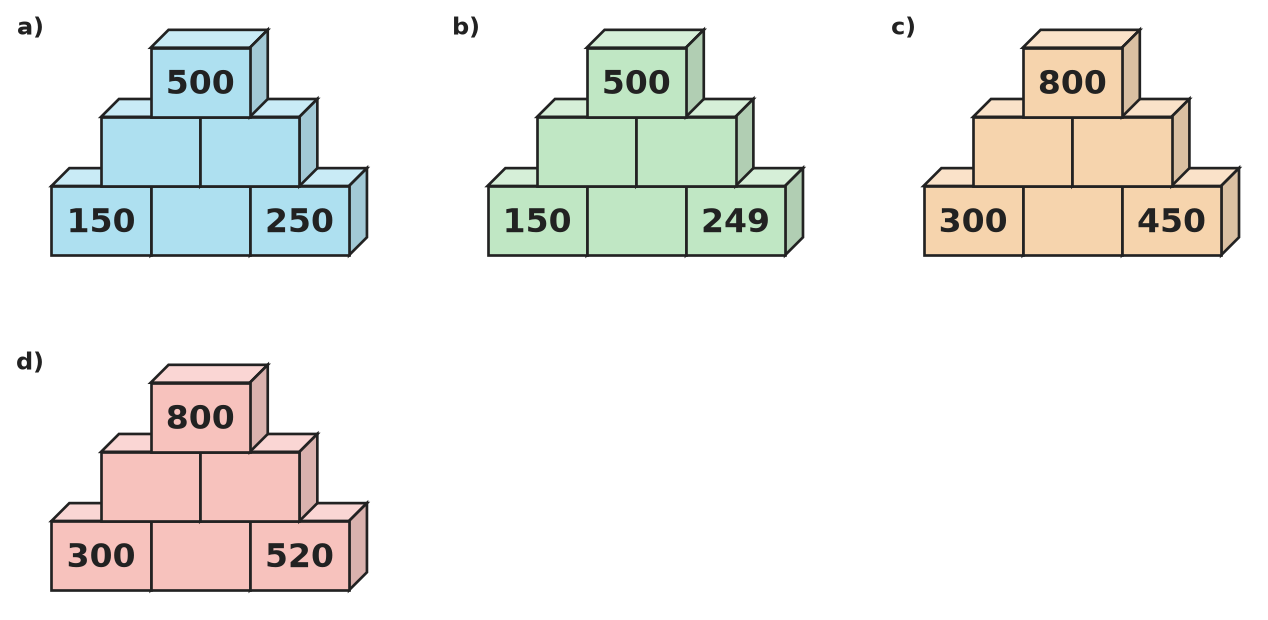
Figure for problem 531964

Hints

- Express the top brick in terms of the three bottom bricks. - The two outside bottom bricks each contribute once to the top, while the middle bottom brick contributes twice. - Subtract the outside bricks from the top. The remainder must equal twice the middle brick. - Check whether the remainder is divisible by \(2\) and gives a nonnegative result. - Also check whether the sum of the two outside bricks already exceeds the top brick.

Solution

1. Let the bottom row be \(a\), \(b\), and \(c\), and let the top be \(T\). Then \(T = a + 2b + c\), so \(2b = T - a - c\). 2. Wall a): \(2b = 500 - 150 - 250 = 100\), so \(b = 50\). The middle row is \(200\) and \(300\). 3. Wall b): \(2b = 500 - 150 - 249 = 101\). This would give \(b = 50.5\), which is not a nonnegative integer, so the wall cannot be completed under the stated condition. 4. Wall c): \(2b = 800 - 300 - 450 = 50\), so \(b = 25\). The middle row is \(325\) and \(475\). 5. Wall d): \(2b = 800 - 300 - 520 = -20\), so \(b = -10\). This is not nonnegative, so the wall cannot be completed under the stated condition.

Answer

1. Walls a) and c) can be completed. a) Bottom middle: \(50\); middle row: \(200\), \(300\) c) Bottom middle: \(25\); middle row: \(325\), \(475\) 2. Walls b) and d) cannot be completed using nonnegative integers. b) The equation gives \(2b = 101\), so \(b = 50.5\), which is not an integer. d) The equation gives \(2b = -20\), so \(b = -10\), which is not nonnegative.

5217357
Use \(\text{dividend} = \text{divisor} \cdot \text{quotient} + \text{remainder}\) to find \(x\). a) \(x \div 5 = 24\text{ R }2\) b) \(130 \div x = 18\text{ R }4\) c) \(212 \div 7 = 30\text{ R }x\)

Hints

- Translate each division statement into the dividend formula. - Isolate \(x\) using inverse operations. - Check that every remainder is less than its divisor.

Solution

1. Write \(x = 5 \cdot 24 + 2\). Then \(x = 122\). 2. Write \(130 = 18x + 4\). Subtract \(4\): \(126 = 18x\). Divide by \(18\): \(x = 7\). 3. Write \(212 = 7 \cdot 30 + x\). Since \(7 \cdot 30 = 210\), \(x = 2\).

Answer

a) \(x = 122\) b) \(x = 7\) c) \(x = 2\)

All problems may be used, copied and printed free of charge for school and tutoring, including paid tutoring. Commercial adaptations as well as publication or redistribution on the internet are not permitted.

