Aimathic
Login | English | Deutsch

Free math worksheets

Build your own math worksheets from 30,000+ problems for grades 3 to 12, from fractions to AP Calculus. Every problem comes with step-by-step solutions.

Volume of spheres

Click problems to add them to your worksheet.

5512518
Find the exact volume of the sphere shown.
Figure for problem 551251

Hints

- Read the radius from the diagram. - Use the sphere volume formula. - Keep \(\pi\) in the exact answer.

Solution

From the diagram, the radius is \(3\,\text{cm}\). Using \(V=\frac{4}{3}\pi r^3\), \(V=\frac{4}{3}\pi\cdot3^3=36\pi\,\text{cm}^3\).

Answer

\(36\pi\,\text{cm}^3\)
5522058
A sphere has radius \(r\). Write a formula for its volume.

Hints

- Think about the standard volume relationship for a sphere rather than a surface-area formula. - Check that the radius appears with the power expected for a three-dimensional measurement.

Solution

1. The volume formula for a sphere is \(V=\frac{4}{3}\pi r^3\).

Answer

\(V=\frac{4}{3}\pi r^3\)
5512528
A sphere has diameter \(10\,\text{cm}\). Find its exact volume in terms of \(\pi\).

Hints

- Convert the diameter to a radius first. - The radius is cubed in the sphere volume formula. - Leave \(\pi\) in the exact answer.

Solution

The radius is \(10\div2=5\,\text{cm}\). Then \(V=\frac{4}{3}\pi r^3=\frac{4}{3}\pi\cdot5^3=\frac{500\pi}{3}\,\text{cm}^3\).

Answer

\(\frac{500\pi}{3}\,\text{cm}^3\)
5512538
Find the exact volume of the sphere shown. The labeled measurement is the diameter.
Figure for problem 551253

Hints

- Decide whether the displayed measurement is a radius or a diameter. - Convert the diameter to a radius before substituting. - The radius is cubed in the sphere volume formula.

Solution

From the diagram, the diameter is \(12\,\text{cm}\), so the radius is \(6\,\text{cm}\). Therefore, \(V=\frac{4}{3}\pi\cdot6^3=288\pi\,\text{cm}^3\).

Answer

\(288\pi\,\text{cm}^3\)
5522068
A hemispherical container has an interior shaped exactly like half of a sphere with interior radius \(6\,\text{cm}\). Find its capacity exactly in cubic centimeters in terms of \(\pi\).

Hints

- Find the volume of the corresponding full sphere first. - Use the fact that a hemisphere is one of two equal halves of a sphere.

Solution

1. A full sphere of radius \(6\,\text{cm}\) has volume \(V=\frac{4}{3}\pi\cdot6^3=288\pi\,\text{cm}^3\). 2. A hemisphere has half that volume, so \(V=144\pi\,\text{cm}^3\).

Answer

\(144\pi\,\text{cm}^3\)
5512548
A sphere has volume \(288\pi\,\text{cm}^3\). Find its radius and diameter.

Hints

- Substitute the known volume into the sphere formula. - Isolate \(r^3\) before taking a cube root. - Once the radius is known, relate it to the diameter.

Solution

Substitute into \(V=\frac{4}{3}\pi r^3\): \(288\pi=\frac{4}{3}\pi r^3\). Cancel \(\pi\) and multiply by \(\frac{3}{4}\): \(r^3=216\). Thus \(r=6\,\text{cm}\), so the diameter is \(12\,\text{cm}\).

Answer

Radius: \(6\,\text{cm}\); diameter: \(12\,\text{cm}\)
5512558
Sphere B has three times the radius of sphere A. Without choosing numerical radii, determine how many times as large sphere B's volume is as sphere A's volume. Explain from the volume formula.

Hints

- Keep the original radius as a variable. - Replace the new radius by \(3r\) in the sphere formula. - Pay attention to the exponent on the radius.

Solution

Let sphere A have radius \(r\), so \(V_A=\frac{4}{3}\pi r^3\). Sphere B has radius \(3r\), so \(V_B=\frac{4}{3}\pi(3r)^3=27\left(\frac{4}{3}\pi r^3\right)=27V_A\). Therefore, tripling the radius multiplies the volume by \(27\).

Answer

Sphere B has \(27\) times the volume of sphere A.
5512568
The solid glass ornament shown is spherical. Find its volume to the nearest tenth of a cubic centimeter.
Figure for problem 551256

Hints

- Read the sphere's radius from the diagram. - Cube the radius before multiplying by the remaining factors. - Round only the final volume.

Solution

From the diagram, the radius is \(4.5\,\text{cm}\). Then \(V=\frac{4}{3}\pi(4.5)^3=121.5\pi\,\text{cm}^3\approx381.7\,\text{cm}^3\).

Answer

About \(381.7\,\text{cm}^3\)
5522078
Sphere B has exactly \(8\) times the volume of sphere A. If the radius of sphere B is \(k\) times the radius of sphere A, find \(k\).

Hints

- Represent the new radius as a scale factor times the original radius. - Track how that scale factor is affected by the exponent in the sphere volume formula. - Work backward from the given volume factor.

Solution

1. Sphere volume is proportional to the cube of the radius, so the volume scale factor is \(k^3\). 2. Since the volume factor is \(8\), \(k^3=8\). 3. Therefore, \(k=2\).

Answer

\(k=2\)
5512578
A sphere and a cylinder are shown. a) Show that the two displayed solids have equal volume. b) For a sphere and cylinder with any common radius \(r\), what cylinder height \(h\) makes their volumes equal?
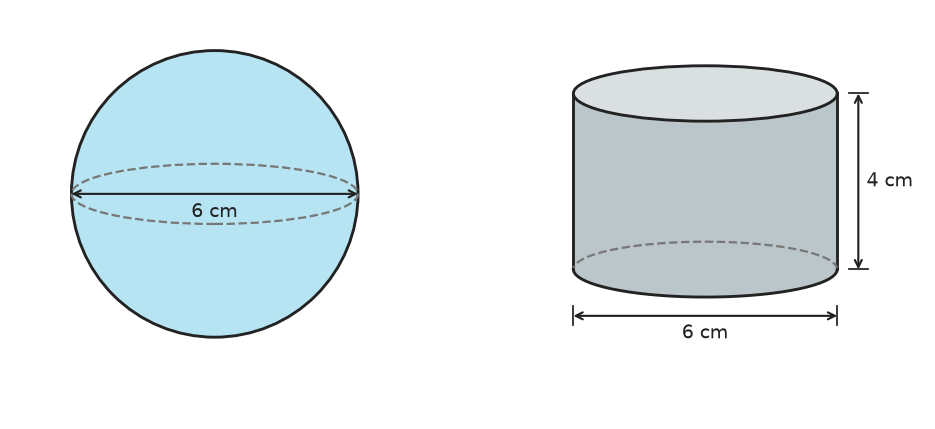
Figure for problem 551257

Hints

- Read the dimensions from the two solids before computing either volume. - Use the sphere and cylinder volume formulas separately. - For part b, set the two general formulas equal. - Cancel only factors that are nonzero for a genuine solid.

Solution

1. From the diagram, both solids have radius \(3\,\text{cm}\), and the cylinder has height \(4\,\text{cm}\). The sphere volume is \(\frac{4}{3}\pi\cdot3^3=36\pi\,\text{cm}^3\). The cylinder volume is \(\pi\cdot3^2\cdot4=36\pi\,\text{cm}^3\), so they are equal. 2. Set the general volumes equal: \(\frac{4}{3}\pi r^3=\pi r^2h\). For \(r>0\), cancel \(\pi r^2\) to get \(h=\frac{4}{3}r\).

Answer

a) Both volumes are \(36\pi\,\text{cm}^3\). b) \(h=\frac{4}{3}r\)

All problems may be used, copied and printed free of charge for school and tutoring, including paid tutoring. Commercial adaptations as well as publication or redistribution on the internet are not permitted.