Aimathic
Login | English | Deutsch

Free math worksheets

Build your own math worksheets from 30,000+ problems for grades 3 to 12, from fractions to AP Calculus. Every problem comes with step-by-step solutions.

Average rate of change

Click problems to add them to your worksheet.

5512689
The table gives two values of a function \(f\). <table><tr><td>\(x\)</td><td>\(1\)</td><td>\(4\)</td></tr><tr><td>\(f(x)\)</td><td>\(2\)</td><td>\(8\)</td></tr></table> Find the average rate of change of \(f\) from \(x=1\) to \(x=4\).

Hints

- Compare how much the output changes with how much the input changes. - Keep the two differences in the same order. - Your result should describe output change per one unit of input change.

Solution

1. The change in the function value is \(8-2=6\). 2. The change in the input is \(4-1=3\). 3. The average rate of change is \(\frac{6}{3}=2\).

Answer

\(2\)
5512699
Let \(f(x)=-3x+7\). Find the average rate of change of \(f\) on the interval \([-2,4]\). Then compare your result with the slope of the line.

Hints

- Evaluate the function at both endpoints of the interval. - Form one ratio using the change in outputs and the corresponding change in inputs. - After calculating, compare the result with the coefficient of \(x\).

Solution

1. Evaluate the endpoints: \(f(-2)=13\) and \(f(4)=-5\). 2. The average rate of change is \(\frac{-5-13}{4-(-2)}=\frac{-18}{6}=-3\). 3. The slope of \(f(x)=-3x+7\) is also \(-3\). For a linear function, the average rate of change over any interval equals its slope.

Answer

The average rate of change is \(-3\), which is the same as the slope of the line.
5512709
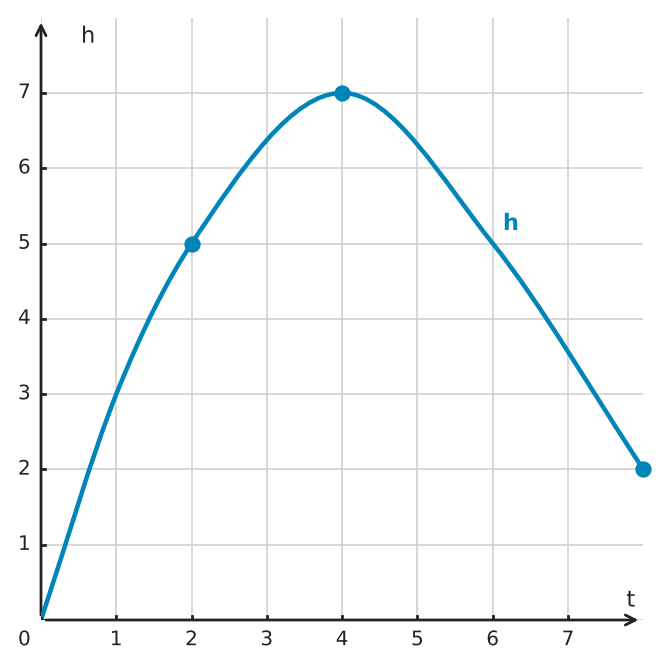
The graph of \(g\) is shown. Find the average rate of change of \(g\) from \(x=-1\) to \(x=3\). Interpret the result as a change in \(g(x)\) for each \(1\)-unit increase in \(x\).
Figure for problem 551270

Hints

- Read the two graph values at the stated input endpoints. - Compare vertical change with the corresponding horizontal change. - Use the sign of your result when describing whether the graph rises or falls on average.

Solution

1. From the graph, \(g(-1)=1\) and \(g(3)=9\). 2. The average rate of change is \(\frac{9-1}{3-(-1)}=\frac{8}{4}=2\). 3. Over this interval, \(g(x)\) increases by an average of \(2\) units for each \(1\)-unit increase in \(x\).

Answer

The average rate of change is \(2\). On average, \(g(x)\) increases by \(2\) units for each \(1\)-unit increase in \(x\).
5512719
A water tank is being filled. The table shows the volume \(V\), in gallons, at several times \(t\), in minutes. <table><tr><td>\(t\) (minutes)</td><td>\(0\)</td><td>\(2\)</td><td>\(8\)</td></tr><tr><td>\(V(t)\) (gallons)</td><td>\(90\)</td><td>\(140\)</td><td>\(290\)</td></tr></table> Find the average rate of change of the tank volume from \(t=2\) to \(t=8\). Include units and interpret the result in context.

Hints

- Use only the two table entries at the endpoints of the requested interval. - Keep track of which quantity is the output and which is the input when forming the rate. - The units of the rate come from output units divided by input units.

Solution

1. From the table, \(V(2)=140\) and \(V(8)=290\). 2. The average rate of change is \(\frac{290-140}{8-2}=\frac{150}{6}=25\,\text{gallons per minute}\). 3. From minute \(2\) through minute \(8\), the amount of water in the tank increases by an average of \(25\) gallons per minute.

Answer

\(25\,\text{gallons per minute}\). From minute \(2\) to minute \(8\), the tank gains an average of \(25\) gallons of water each minute.
5512729
A function \(f\) has an average rate of change of \(-1.5\) from \(x=2\) to \(x=8\). If \(f(2)=10\), find \(f(8)\).

Hints

- Write the definition of average rate of change using the two stated input values. - Treat the unknown endpoint output as the missing quantity in that ratio. - Check whether the negative rate is consistent with the direction of the output change.

Solution

1. The input changes by \(8-2=6\). 2. An average rate of change of \(-1.5\) means \(\frac{f(8)-f(2)}{6}=-1.5\). 3. Substitute \(f(2)=10\): \(\frac{f(8)-10}{6}=-1.5\). 4. Therefore, \(f(8)-10=-9\), so \(f(8)=1\).

Answer

\(f(8)=1\)
5512739
A function satisfies \(f(2)=5\) and \(f(6)=13\). A student writes \(\frac{f(2)-f(6)}{6-2}=\frac{5-13}{4}=-2\) and concludes that the average rate of change from \(x=2\) to \(x=6\) is \(-2\). Identify the error and give the correct average rate of change.

Hints

- Check whether the output difference and input difference describe movement in the same direction along the interval. - Try writing both changes from the left endpoint to the right endpoint. - A second valid setup can be made by reversing both differences, not just one.

Solution

1. The student reversed the order of the output difference but did not reverse the order of the input difference. Corresponding changes must use the same direction. 2. Using increasing input order gives \(\frac{f(6)-f(2)}{6-2}=\frac{13-5}{4}=2\). 3. Equivalently, reversing both differences gives the same value: \(\frac{5-13}{2-6}=2\).

Answer

The numerator and denominator changes were taken in inconsistent directions. The correct average rate of change is \(2\).
5512749
A function \(p\) is represented by the table. <table><tr><td>\(x\)</td><td>\(0\)</td><td>\(2\)</td><td>\(5\)</td></tr><tr><td>\(p(x)\)</td><td>\(1\)</td><td>\(7\)</td><td>\(10\)</td></tr></table> a) Find the average rate of change on \([0,2]\). b) Find the average rate of change on \([2,5]\). c) Could all three points in the table lie on one linear function? Justify your answer.

Hints

- Treat each interval separately and use its own pair of endpoint values. - Compare the two rates after calculating them. - Recall what must be constant about the rate of change of a linear function.

Solution

1. On \([0,2]\), the average rate of change is \(\frac{7-1}{2-0}=3\). 2. On \([2,5]\), the average rate of change is \(\frac{10-7}{5-2}=1\). 3. A single linear function has the same rate of change on every interval. Because \(3\neq1\), the three points cannot all lie on one linear function.

Answer

a) \(3\) b) \(1\) c) No. The two intervals have different average rates of change, so the three points are not collinear.
5512759
The graph of \(h\) and the table for \(k\) are shown for the interval \([0,5]\). <table><tr><td>\(x\)</td><td>\(0\)</td><td>\(2\)</td><td>\(5\)</td></tr><tr><td>\(k(x)\)</td><td>\(4\)</td><td>\(2\)</td><td>\(-1\)</td></tr></table> a) Find the average rate of change of \(h\) and of \(k\) on \([0,5]\). b) A linear function \(m\) has an average rate of change on \([0,5]\) exactly halfway between the two rates from part a). If \(m(0)=3\), find \(m(5)\).
Figure for problem 551275

Hints

- For each function, use only its values at the two endpoints of the full interval. - “Halfway between” two rates refers to their numerical midpoint. - Once the rate for \(m\) is known, connect it to the total output change over an input change of \(5\).

Solution

1. From the graph, \(h(0)=1\) and \(h(5)=8\). Thus, the average rate of change of \(h\) is \(\frac{8-1}{5-0}=\frac{7}{5}=1.4\). 2. From the table, \(k(0)=4\) and \(k(5)=-1\). Thus, the average rate of change of \(k\) is \(\frac{-1-4}{5-0}=-1\). 3. The rate halfway between \(1.4\) and \(-1\) is \(\frac{1.4+(-1)}{2}=0.2\). 4. Over an input change of \(5\), \(m\) changes by \(0.2\cdot5=1\). Since \(m(0)=3\), \(m(5)=4\).

Answer

a) \(h\): \(1.4\); \(k\): \(-1\) b) \(m(5)=4\)

All problems may be used, copied and printed free of charge for school and tutoring, including paid tutoring. Commercial adaptations as well as publication or redistribution on the internet are not permitted.