Aimathic
Login | English | Deutsch

Free Math Worksheets

Build your own math worksheets from 21,000 problems for grades 3 to 12, from fractions to calculus. Every problem includes step-by-step solutions.

Factor quadratic expressions

Click problems to add them to your worksheet.

5131039
Consider the equation \(x^2 - 1 = 3\). a) Rewrite the equation in standard form and factor it. b) Find the solution set. c) If the two sides are interpreted as \(f(x) = x^2 - 1\) and \(g(x) = 3\), what do the solutions represent geometrically?

Hints

- Move all terms to one side. - Recognize a difference of squares. - Equal function outputs correspond to graph intersections.

Solution

1. Rewrite the equation with all terms on one side: \(x^2 - 4 = 0\). 2. Factor the difference of squares: \((x - 2)(x + 2) = 0\). 3. Therefore, \(x = -2\) or \(x = 2\). 4. Geometrically, these values are the x-coordinates of the intersection points of the graphs of \(f\) and \(g\).

Answer

a) \(x^2 - 4 = 0\), so \((x - 2)(x + 2) = 0\) b) \(\{-2, 2\}\) c) They are the x-coordinates of the graphs’ intersection points.
5142849
Factor out the greatest common factor, and then use the zero-product property to find each solution set. a) \(14x^2 - 21x = 0\) b) \(0.5x^2 + 4x = 0\)

Hints

- A product equals zero when at least one factor equals zero. - Find the greatest common factor of the terms in each equation. - Check the factorization by multiplying.

Solution

1. For part a, factor out \(7x\): \(7x(2x - 3) = 0\). 2. Apply the zero-product property: \(7x = 0\) or \(2x - 3 = 0\). Thus, \(x = 0\) or \(x = \frac{3}{2}\). 3. For part b, factor out \(0.5x\): \(0.5x(x + 8) = 0\). 4. Apply the zero-product property: \(0.5x = 0\) or \(x + 8 = 0\). Thus, \(x = 0\) or \(x = -8\).

Answer

a) \(x \in \left\{0, \frac{3}{2}\right\}\) b) \(x \in \{-8, 0\}\)
5155259
Solve \(x^2 - 16 = 0\) by factoring over the real numbers.

Hints

- Rewrite the constant as a perfect square. - Use the difference-of-squares pattern. - Apply the zero-product property after factoring.

Solution

1. Recognize a difference of squares: \(x^2 - 16 = x^2 - 4^2\). 2. Factor: \((x - 4)(x + 4) = 0\). 3. Apply the zero-product property: \(x = 4\) or \(x = -4\).

Answer

\(x \in \{-4, 4\}\)
5228889
Find the real zeros of each function. If a function has no real zeros, briefly explain why. a) \(p(x)=2x^2-12x+10\) b) \(q(x)=x^2+4\) c) \(r(x)=5x^2-10x\)

Hints

- Choose an efficient method for each expression, such as factoring or reasoning about squares. - Simplify by factoring out a common factor first. - Use the zero-product property after factoring. - Consider the possible values of \(x^2\) for real \(x\).

Solution

1. For \(p\), factor out \(2\): \(2(x^2-6x+5)=2(x-1)(x-5)\). By the zero-product property, the zeros are \(x=1\) and \(x=5\). 2. For \(q\), \(x^2+4=0\) would require \(x^2=-4\). No real number has a negative square, so there are no real zeros. 3. For \(r\), factor: \(5x^2-10x=5x(x-2)\). By the zero-product property, the zeros are \(x=0\) and \(x=2\).

Answer

a) \(x=1\) and \(x=5\) b) No real zeros, because \(x^2=-4\) has no real solution. c) \(x=0\) and \(x=2\)
5238139
Find the zeros of each quadratic function. Choose an efficient method, such as using factored form, factoring out \(x\), factoring a trinomial, or isolating \(x^2\). a) \(f(x) = (x - 6)(x + 4)\) b) \(g(x) = x^2 - 5x\) c) \(h(x) = x^2 - 4x - 12\) d) \(k(x) = 4x^2 - 16\)

Hints

- Identify the form of each quadratic before choosing a method. - Use the zero-product property when an expression is factored. - Look for a greatest common factor. - Factor a trinomial when two integers have the required sum and product. - If the equation contains only \(x^2\) and a constant, isolate \(x^2\).

Solution

1. For a), use the zero-product property: \(x - 6 = 0\) or \(x + 4 = 0\). The zeros are \(x = 6\) and \(x = -4\). 2. For b), factor out \(x\): \(x(x - 5) = 0\). The zeros are \(x = 0\) and \(x = 5\). 3. For c), factor the trinomial: \(x^2 - 4x - 12 = (x - 6)(x + 2)\). The zeros are \(x = 6\) and \(x = -2\). 4. For d), factor or isolate \(x^2\): \(4x^2 - 16 = 4(x - 2)(x + 2)\). The zeros are \(x = 2\) and \(x = -2\).

Answer

a) \(x = -4\), \(x = 6\) b) \(x = 0\), \(x = 5\) c) \(x = -2\), \(x = 6\) d) \(x = -2\), \(x = 2\)
5250859
Solve each equation by moving all terms to one side and factoring. a) \(6x^2 - 4x = 2x^2 + 8x\) b) \(0.4x^2 + 3x = 1.4x^2 - 2x\)

Hints

- Move all terms to one side so the other side is \(0\). - Factor out the greatest common factor. - Apply the zero-product property.

Solution

1. For part a, move all terms to the left: \(4x^2 - 12x = 0\). 2. Factor: \(4x(x - 3) = 0\). Thus, \(x = 0\) or \(x = 3\). 3. For part b, move all terms to one side: \(-x^2 + 5x = 0\). 4. Factor: \(-x(x - 5) = 0\). Thus, \(x = 0\) or \(x = 5\).

Answer

a) \(x \in \{0, 3\}\) b) \(x \in \{0, 5\}\)
5280799
1. Factor \(x^2 - 4x - 21\) completely. 2. Explain how the signs in the linear factors relate to the zeros of the quadratic.

Hints

- Find a factor pair of \(-21\) whose sum is \(-4\). - Set each linear factor equal to zero. - Compare a zero \(r\) with its factor \(x - r\).

Solution

1. Find two numbers whose product is \(-21\) and whose sum is \(-4\): \(-7\) and \(3\). 2. Therefore, \(x^2 - 4x - 21 = (x - 7)(x + 3)\). 3. The zeros are \(7\) and \(-3\). A zero \(r\) corresponds to the factor \(x - r\), so the zero \(-3\) produces the factor \(x - (-3) = x + 3\).

Answer

1. \((x - 7)(x + 3)\) 2. Each zero \(r\) gives a factor \(x - r\), so the sign of the number in the factor is opposite the sign of the zero.
5280999
Find each solution set by factoring out the greatest common factor. a) \(7x^2 + 21x = 0\) b) \(0.5x^2 = 2x\)

Hints

- Move all terms to one side when necessary. - Factor out the greatest common factor containing \(x\). - Apply the zero-product property.

Solution

1. For part a, factor: \(7x(x + 3) = 0\). Thus, \(x = 0\) or \(x = -3\). 2. For part b, move all terms to one side: \(0.5x^2 - 2x = 0\). 3. Factor: \(0.5x(x - 4) = 0\). Thus, \(x = 0\) or \(x = 4\).

Answer

a) \(x \in \{-3, 0\}\) b) \(x \in \{0, 4\}\)
5101159
Factor the expression completely: \(45n^2 - 60n + 15\).

Hints

- First factor out the greatest common factor. - Then factor the remaining quadratic trinomial. - Check your result by multiplying the factors.

Solution

1. Factor out the greatest common factor: \(45n^2 - 60n + 15 = 15(3n^2 - 4n + 1)\). 2. Factor the trinomial: \(3n^2 - 4n + 1 = (3n - 1)(n - 1)\). 3. Therefore, \(45n^2 - 60n + 15 = 15(3n - 1)(n - 1)\).

Answer

\(15(3n - 1)(n - 1)\)
5101169
Factor the expression completely: \(-8b^2 + 20b + 12\).

Hints

- Look for a common numerical factor first. - Consider factoring out a negative common factor so the leading term inside the parentheses is positive. - Check your result by multiplying the factors.

Solution

1. Factor out \(-4\): \(-8b^2 + 20b + 12 = -4(2b^2 - 5b - 3)\). 2. Factor the trinomial: \(2b^2 - 5b - 3 = (2b + 1)(b - 3)\). 3. Therefore, \(-8b^2 + 20b + 12 = -4(2b + 1)(b - 3)\).

Answer

\(-4(2b + 1)(b - 3)\)
5101179
Factor the expression completely: \(12z^2 - 30z + 12\).

Hints

- First factor out the greatest common factor. - Then factor the remaining quadratic trinomial. - Multiply the factors to check your work.

Solution

1. Factor out the greatest common factor: \(12z^2 - 30z + 12 = 6(2z^2 - 5z + 2)\). 2. Factor the trinomial: \(2z^2 - 5z + 2 = (2z - 1)(z - 2)\). 3. Therefore, \(12z^2 - 30z + 12 = 6(2z - 1)(z - 2)\).

Answer

\(6(2z - 1)(z - 2)\)
5101189
Factor the expression completely: \(20y^2 + 10y - 30\).

Hints

- Begin by factoring out the greatest common factor. - Use the signs of the constant and middle terms to choose the signs in the binomial factors. - Check by multiplying the factors.

Solution

1. Factor out the greatest common factor: \(20y^2 + 10y - 30 = 10(2y^2 + y - 3)\). 2. Factor the trinomial: \(2y^2 + y - 3 = (2y + 3)(y - 1)\). 3. Therefore, \(20y^2 + 10y - 30 = 10(2y + 3)(y - 1)\).

Answer

\(10(2y + 3)(y - 1)\)
5101199
Factor the expression completely: \(18x^2 - 12x - 6\).

Hints

- Factor out the greatest common factor first. - Then find two binomial factors whose product gives the remaining trinomial. - Make sure the expression is fully factored, and check by multiplying.

Solution

1. Factor out the greatest common factor: \(18x^2 - 12x - 6 = 6(3x^2 - 2x - 1)\). 2. Factor the trinomial: \(3x^2 - 2x - 1 = (3x + 1)(x - 1)\). 3. Therefore, \(18x^2 - 12x - 6 = 6(3x + 1)(x - 1)\).

Answer

\(6(3x + 1)(x - 1)\)
5146009
Consider the equation \((x - 4)^2 = 3(x - 4)\). a) A student divides both sides by \(x - 4\) and obtains \(x - 4 = 3\). What value of \(x\) does the student find? b) Explain why this method does not produce every solution. c) Find the complete solution set by moving all terms to one side and factoring.

Hints

- Test the value that makes \(x - 4\) equal to zero in the original equation. - Ask when division by \(x - 4\) is not allowed. - Move all terms to one side and look for a common binomial factor.

Solution

1. For part a, solving \(x - 4 = 3\) gives \(x = 7\). 2. Dividing by \(x - 4\) assumes that \(x - 4 \ne 0\). This excludes \(x = 4\), even though \(x = 4\) makes both sides of the original equation equal to zero. 3. Move all terms to one side: \((x - 4)^2 - 3(x - 4) = 0\). 4. Factor out \(x - 4\): \((x - 4)((x - 4) - 3) = 0\), so \((x - 4)(x - 7) = 0\). 5. Apply the zero-product property: \(x = 4\) or \(x = 7\).

Answer

a) \(x = 7\) b) Dividing by \(x - 4\) discards the case \(x - 4 = 0\). Division by zero is undefined, and \(x = 4\) is a solution of the original equation. c) \(x \in \{4, 7\}\)
5146129
Solve each equation by factoring. Rewrite the equation first when needed. a) \(2x^2 - 18x = 0\) b) \(3(x - 1)^2 - 27 = 0\) c) \(0.5x^2 - x - 4 = 0\) d) \((2x - 4)(x + 5) = 0\)

Hints

- Look for a greatest common factor or a difference of squares. - Clear a decimal coefficient if that makes the trinomial easier to factor. - After factoring, use the zero-product property.

Solution

1. For part a, factor out \(2x\): \(2x(x - 9) = 0\). Thus, \(x = 0\) or \(x = 9\). 2. For part b, factor out \(3\) and use the difference of squares: \(3((x - 1)^2 - 9) = 3(x - 4)(x + 2) = 0\). Thus, \(x = 4\) or \(x = -2\). 3. For part c, multiply by \(2\): \(x^2 - 2x - 8 = 0\). Factor: \((x - 4)(x + 2) = 0\). Thus, \(x = 4\) or \(x = -2\). 4. For part d, apply the zero-product property: \(2x - 4 = 0\) or \(x + 5 = 0\). Thus, \(x = 2\) or \(x = -5\).

Answer

a) \(x \in \{0, 9\}\) b) \(x \in \{-2, 4\}\) c) \(x \in \{-2, 4\}\) d) \(x \in \{-5, 2\}\)
5146389
For each equation, identify the most efficient factoring pattern—difference of squares, greatest common factor, or trinomial factoring. Briefly justify your choice and find the solution set. 1. \(x^2 - 144 = 0\) 2. \(2x^2 + 10x = 0\) 3. \(x^2 - 2x - 15 = 0\)

Hints

- Check whether the constant is a perfect square and the middle term is missing. - Check whether every term has a common factor. - For a trinomial, look for two numbers whose product is the constant term and whose sum is the coefficient of \(x\).

Solution

1. The first equation is a difference of squares: \(x^2 - 144 = (x - 12)(x + 12)\). Therefore, \(x = -12\) or \(x = 12\). 2. The second equation has a greatest common factor of \(2x\): \(2x(x + 5) = 0\). Therefore, \(x = -5\) or \(x = 0\). 3. The third equation is a factorable trinomial: \(x^2 - 2x - 15 = (x - 5)(x + 3)\). Therefore, \(x = -3\) or \(x = 5\).

Answer

1. Difference of squares; \(x \in \{-12, 12\}\) 2. Greatest common factor; \(x \in \{-5, 0\}\) 3. Trinomial factoring; \(x \in \{-3, 5\}\)
5152519
A right triangle has hypotenuse \(13\,\text{cm}\). One leg is exactly \(7\,\text{cm}\) longer than the other. Write and solve an equation to find both leg lengths.

Hints

- Represent the longer leg in terms of the shorter leg. - Substitute both expressions into the Pythagorean theorem. - Factor the resulting quadratic and reject any negative length.

Solution

1. Let the shorter leg be \(a\). Then the longer leg is \(a+7\). 2. Apply the Pythagorean theorem: \(a^2+(a+7)^2=13^2\). 3. Simplify: \(2a^2+14a-120=0\), so \(a^2+7a-60=0\). 4. Factor: \((a+12)(a-5)=0\). The positive solution is \(a=5\,\text{cm}\). 5. The other leg is \(5+7=12\,\text{cm}\).

Answer

The legs are \(5\,\text{cm}\) and \(12\,\text{cm}\).
5250769
For each equation, write an equivalent quadratic equation with \(0\) on one side. Factor over the real numbers when possible, and find the real solution set. a) \(4x^2 - 7 = 2x^2 + 11\) b) \(\frac{1}{3}x^2 + 10 = 1\) c) \((x - 5)(x + 5) = 11\) d) \(0.5x^2 = 0.005\)

Hints

- Move all terms to one side and simplify. - Look for a difference of squares. - If the equation becomes \(x^2 + k = 0\) with \(k > 0\), consider whether real factors exist.

Solution

1. For part a, simplify to \(2x^2 - 18 = 0\), then divide by \(2\): \(x^2 - 9 = 0\). Factor: \((x - 3)(x + 3) = 0\). Thus, \(x = -3\) or \(x = 3\). 2. For part b, simplify to \(\frac{1}{3}x^2 + 9 = 0\), then multiply by \(3\): \(x^2 + 27 = 0\). This quadratic does not factor over the real numbers and has no real solution. 3. For part c, expand the difference of squares: \(x^2 - 25 = 11\), so \(x^2 - 36 = 0\). Factor: \((x - 6)(x + 6) = 0\). Thus, \(x = -6\) or \(x = 6\). 4. For part d, write \(0.5x^2 - 0.005 = 0\), then divide by \(0.5\): \(x^2 - 0.01 = 0\). Factor: \((x - 0.1)(x + 0.1) = 0\). Thus, \(x = -0.1\) or \(x = 0.1\).

Answer

a) \(x \in \{-3, 3\}\) b) \(\varnothing\) c) \(x \in \{-6, 6\}\) d) \(x \in \{-0.1, 0.1\}\)
5250799
Consider \(\frac{x^2}{p} - p = 0\), where \(p \ne 0\). a) Find the solution set when \(p = 5\). b) Rewrite the equation as a difference of squares and show that it has exactly two distinct real solutions for every \(p \ne 0\). c) Give the solution set in terms of \(p\).

Hints

- Clear the denominator by multiplying by \(p\). - Recognize the resulting difference of squares. - Use the condition \(p \ne 0\) to justify that the two roots are different.

Solution

1. Multiply the equation by \(p\): \(x^2 - p^2 = 0\). 2. Factor the difference of squares: \((x - p)(x + p) = 0\). 3. Therefore, \(x = p\) or \(x = -p\). Since \(p \ne 0\), these solutions are distinct. 4. For \(p = 5\), the solutions are \(x = 5\) and \(x = -5\).

Answer

a) \(x \in \{-5, 5\}\) b) \((x - p)(x + p) = 0\), so the two distinct solutions are \(x = p\) and \(x = -p\). c) \(x \in \{-p, p\}\)
5250869
Solve each equation over the real numbers by simplifying and factoring. a) \(\frac{2}{3}x^2 + x = \frac{1}{6}x^2 - 2x\) b) \(2x(x + 4) = x^2 + 3x\)

Hints

- Move every term to one side and combine like terms. - Clear fractions if that makes the equation easier to read. - When there is no constant term, factor out \(x\).

Solution

1. For part a, move all terms to the left: \(\frac{1}{2}x^2 + 3x = 0\). 2. Factor: \(x\left(\frac{1}{2}x + 3\right) = 0\). Thus, \(x = 0\) or \(x = -6\). 3. For part b, expand and simplify: \(2x^2 + 8x = x^2 + 3x\), so \(x^2 + 5x = 0\). 4. Factor: \(x(x + 5) = 0\). Thus, \(x = 0\) or \(x = -5\).

Answer

a) \(x \in \{-6, 0\}\) b) \(x \in \{-5, 0\}\)
5250939
Simplify each equation, write it with \(0\) on one side, and solve by factoring. 1) \(x(x - 12) = 4(16 - 3x)\) 2) \((x - 3)(x + 3) + (x - 4)(x + 4) = 7\)

Hints

- Expand or use the difference-of-squares pattern to simplify each side. - Move all terms to one side. - Look for a difference of squares before applying the zero-product property.

Solution

1. For equation 1, expand: \(x^2 - 12x = 64 - 12x\). Add \(12x\) to both sides: \(x^2 - 64 = 0\). 2. Factor the difference of squares: \((x - 8)(x + 8) = 0\). Thus, \(x = -8\) or \(x = 8\). 3. For equation 2, use the difference-of-squares pattern: \(x^2 - 9 + x^2 - 16 = 7\). 4. Simplify: \(2x^2 - 32 = 0\), then divide by \(2\): \(x^2 - 16 = 0\). 5. Factor: \((x - 4)(x + 4) = 0\). Thus, \(x = -4\) or \(x = 4\).

Answer

1) \(x \in \{-8, 8\}\) 2) \(x \in \{-4, 4\}\)
5250949
Solve each equation over the real numbers by rewriting it in standard form and factoring. 1) \(3x(x - 4) = x^2 - 2x\) 2) \((x - 2)^2 = 3x - 2\)

Hints

- Expand each product or square carefully. - Move all terms to one side and combine like terms. - Factor the resulting quadratic and use the zero-product property.

Solution

1. For equation 1, expand and simplify: \(3x^2 - 12x = x^2 - 2x\), so \(2x^2 - 10x = 0\). 2. Factor: \(2x(x - 5) = 0\). Thus, \(x = 0\) or \(x = 5\). 3. For equation 2, expand and simplify: \(x^2 - 4x + 4 = 3x - 2\), so \(x^2 - 7x + 6 = 0\). 4. Factor: \((x - 1)(x - 6) = 0\). Thus, \(x = 1\) or \(x = 6\).

Answer

1) \(x \in \{0, 5\}\) 2) \(x \in \{1, 6\}\)
5251199
Simplify the equation, write it with \(0\) on one side, and solve by factoring over the real numbers: \((3x - 1)^2 - (x + 2)^2 + (2x - 5)(2x + 5) = 4x^2 - 10x + 4\).

Hints

- Expand the squared binomials and the difference of squares. - Distribute the negative sign before combining like terms. - After simplifying, look for a difference of squares.

Solution

1. Expand the expressions: \(9x^2 - 6x + 1 - (x^2 + 4x + 4) + 4x^2 - 25 = 4x^2 - 10x + 4\). 2. Combine like terms: \(12x^2 - 10x - 28 = 4x^2 - 10x + 4\). 3. Move all terms to one side: \(8x^2 - 32 = 0\). 4. Divide by \(8\) and factor: \(x^2 - 4 = (x - 2)(x + 2) = 0\). 5. Therefore, \(x = -2\) or \(x = 2\).

Answer

\(x \in \{-2, 2\}\)
5251209
Expand, simplify, and solve the equation by factoring: \((x - 3)^2 + (x + 2)^2 = (x - 4)(x + 4) + 2x + 34\).

Hints

- Expand each square and product carefully. - Move all terms to one side and combine like terms. - Factor the resulting trinomial and use the zero-product property.

Solution

1. Expand both sides: \(x^2 - 6x + 9 + x^2 + 4x + 4 = x^2 - 16 + 2x + 34\). 2. Combine like terms: \(2x^2 - 2x + 13 = x^2 + 2x + 18\). 3. Move all terms to one side: \(x^2 - 4x - 5 = 0\). 4. Factor: \((x - 5)(x + 1) = 0\). 5. Therefore, \(x = 5\) or \(x = -1\).

Answer

\(x \in \{-1, 5\}\)
5281009
Consider \(3x^2 + px = 0\), where \(p\) is real. a) Find the solutions in terms of \(p\). b) For what value of \(p\) is \(x = -4\) a solution?

Hints

- Factor out \(x\). - Check when the two solution expressions coincide. - For part b, substitute the given value of \(x\) into the original equation.

Solution

1. Factor: \(x(3x + p) = 0\). 2. Therefore, \(x = 0\) or \(x = -\frac{p}{3}\). 3. When \(p = 0\), these expressions give the same solution, \(x = 0\). When \(p \ne 0\), they are distinct. 4. For part b, substitute \(x = -4\): \(3(-4)^2 + p(-4) = 0\). 5. Simplify: \(48 - 4p = 0\), so \(p = 12\).

Answer

a) For \(p \ne 0\), \(x \in \left\{0, -\frac{p}{3}\right\}\). For \(p = 0\), \(x = 0\). b) \(p = 12\)
5371759
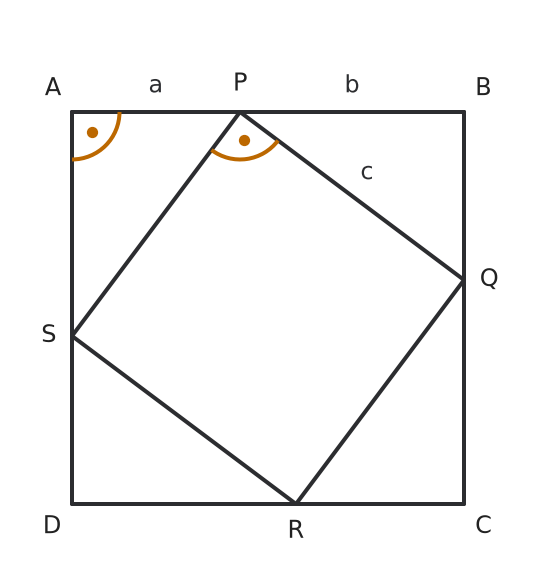
A square with side length \(c=5\,\text{cm}\) is inscribed in a larger square so that four congruent right triangles are formed at the corners. The legs of each triangle have lengths \(a\) and \(b\). The area of the larger square is \(49\,\text{cm}^2\). Find \(a\) and \(b\).
Figure for problem 537175

Hints

- Find the side length of the larger square from its area. - Write one equation using \(a+b\). - Write a second equation using the Pythagorean theorem. - Substitute and factor the resulting quadratic.

Solution

1. The larger square has side length \(\sqrt{49}=7\,\text{cm}\), so \(a+b=7\). 2. In each right triangle, the inner square’s side is the hypotenuse, so \(a^2+b^2=5^2=25\). 3. Substitute \(b=7-a\): \(a^2+(7-a)^2=25\). 4. Simplify: \(2a^2-14a+24=0\), so \(a^2-7a+12=0\). 5. Factor: \((a-3)(a-4)=0\). Thus the leg lengths are \(3\,\text{cm}\) and \(4\,\text{cm}\).

Answer

The legs are \(3\,\text{cm}\) and \(4\,\text{cm}\), in either order.

All problems may be used, copied and printed free of charge for school and tutoring, including paid tutoring. Commercial adaptations as well as publication or redistribution on the internet are not permitted.