Aimathic
Login | English | Deutsch

Free Math Worksheets

Build your own math worksheets from 21,000 problems for grades 3 to 12, from fractions to calculus. Every problem includes step-by-step solutions.

Discriminant and root nature

Click problems to add them to your worksheet.

5101369
Use the discriminant to determine whether each parabola has its vertex on the x-axis. a) \(f(x) = x^2 + 7x + 12.25\) b) \(g(x) = x^2 - 2.4x + 1.44\) c) \(h(x) = x^2 + x + 1\)

Hints

- A vertex on the x-axis corresponds to one repeated real zero. - Calculate \(b^2 - 4ac\) for each function. - Compare each discriminant with \(0\).

Solution

1. A quadratic has its vertex on the x-axis exactly when it has one repeated real zero, so its discriminant is \(0\). 2. For \(f\), \(D = 7^2 - 4 \cdot 1 \cdot 12.25 = 49 - 49 = 0\). Its vertex is on the x-axis. 3. For \(g\), \(D = (-2.4)^2 - 4 \cdot 1 \cdot 1.44 = 5.76 - 5.76 = 0\). Its vertex is on the x-axis. 4. For \(h\), \(D = 1^2 - 4 \cdot 1 \cdot 1 = -3\). Its vertex is not on the x-axis.

Answer

a) Yes b) Yes c) No
5101379
Determine which functions represent parabolas that touch the x-axis at exactly one point. a) \(f(x) = x^2 + \frac{2}{3}x + \frac{1}{9}\) b) \(g(x) = x^2 - \frac{4}{5}x + \frac{4}{25}\) c) \(h(x) = x^2 + \frac{1}{2}x + \frac{1}{2}\)

Hints

- Use the same discriminant test for all three functions. - Work with exact fractions. - A zero discriminant means one repeated x-intercept.

Solution

1. A parabola touches the x-axis at exactly one point when its discriminant is \(0\). 2. For \(f\), \(D = \left(\frac{2}{3}\right)^2 - 4 \cdot 1 \cdot \left(\frac{1}{9}\right) = 0\). 3. For \(g\), \(D = \left(-\frac{4}{5}\right)^2 - 4 \cdot 1 \cdot \left(\frac{4}{25}\right) = 0\). 4. For \(h\), \(D = \left(\frac{1}{2}\right)^2 - 4 \cdot 1 \cdot \left(\frac{1}{2}\right) = -\frac{7}{4}\). 5. Therefore, \(f\) and \(g\) touch the x-axis once, while \(h\) has no real x-intercepts.

Answer

a) \(f\) touches the x-axis at exactly one point. b) \(g\) touches the x-axis at exactly one point. c) \(h\) does not; it has no real x-intercepts.
5101389
Use the discriminant to determine whether each parabola has its vertex on the x-axis. a) \(f(x) = x^2 + 10x + 25\) b) \(g(x) = x^2 - 4x + 3\) c) \(h(x) = x^2 + 5x + 6.25\)

Hints

- Calculate \(b^2 - 4ac\) for each function. - A zero discriminant means the graph has one repeated x-intercept. - Compare the result for each function with \(0\).

Solution

1. A parabola has its vertex on the x-axis exactly when the discriminant is \(0\). 2. For \(f\), \(D = 10^2 - 4 \cdot 1 \cdot 25 = 0\), so the vertex is on the x-axis. 3. For \(g\), \(D = (-4)^2 - 4 \cdot 1 \cdot 3 = 4\), so the vertex is not on the x-axis. 4. For \(h\), \(D = 5^2 - 4 \cdot 1 \cdot 6.25 = 0\), so the vertex is on the x-axis.

Answer

a) Yes b) No c) Yes
5146299
Use the discriminant to determine which parabolas touch the x-axis at exactly one point. a) \(f(x) = x^2 + 12x + 36\) b) \(g(x) = x^2 - 7x + 12\) c) \(h(x) = x^2 - x + 0.25\)

Hints

- Recall what a zero discriminant means. - Calculate \(b^2 - 4ac\) for each function. - Compare each result with \(0\).

Solution

1. A parabola touches the x-axis at exactly one point when its discriminant is \(0\). 2. For \(f\), \(D = 12^2 - 4 \cdot 1 \cdot 36 = 144 - 144 = 0\), so the graph touches the x-axis once. 3. For \(g\), \(D = (-7)^2 - 4 \cdot 1 \cdot 12 = 49 - 48 = 1\), so the graph crosses the x-axis at two points. 4. For \(h\), \(D = (-1)^2 - 4 \cdot 1 \cdot 0.25 = 1 - 1 = 0\), so the graph touches the x-axis once.

Answer

a) \(f\) touches the x-axis at exactly one point. b) \(g\) does not; it crosses the x-axis at two points. c) \(h\) touches the x-axis at exactly one point.
5152839
Use the discriminant to determine the number of real zeros of each quadratic function. Do not calculate the zeros. a) \(f(x) = x^2 - 6x + 9\) b) \(g(x) = 0.5x^2 + 2x + 5\) c) \(h(x) = -x^2 + 4x - 1\)

Hints

- Identify \(a\), \(b\), and \(c\) carefully for each function. - Calculate \(b^2 - 4ac\). - Use only the sign of the discriminant; the zeros themselves are not required.

Solution

1. For \(f\), \(D = (-6)^2 - 4 \cdot 1 \cdot 9 = 36 - 36 = 0\), so there is one real zero. 2. For \(g\), \(D = 2^2 - 4 \cdot 0.5 \cdot 5 = 4 - 10 = -6\), so there are no real zeros. 3. For \(h\), \(D = 4^2 - 4 \cdot (-1) \cdot (-1) = 16 - 4 = 12\), so there are two real zeros.

Answer

a) One real zero b) No real zeros c) Two real zeros
5153139
Determine the number of real solutions of each quadratic equation without solving completely. Justify each answer using the discriminant. a) \(x^2 - 10x + 25 = 0\) b) \(-2x^2 + 4x - 5 = 0\) c) An equation has \(b^2 = 49\) and \(4ac = 50\). d) An equation has discriminant \(D = 12.5\).

Hints

- Calculate or identify the discriminant in each case. - A positive, zero, or negative discriminant gives a different number of real solutions. - The actual solution values are not needed.

Solution

1. For a), \(D = (-10)^2 - 4 \cdot 1 \cdot 25 = 100 - 100 = 0\), so there is one real solution. 2. For b), \(D = 4^2 - 4 \cdot (-2) \cdot (-5) = 16 - 40 = -24\), so there are no real solutions. 3. For c), \(D = b^2 - 4ac = 49 - 50 = -1\), so there are no real solutions. 4. For d), \(D = 12.5 > 0\), so there are two distinct real solutions.

Answer

a) One real solution b) No real solutions c) No real solutions d) Two distinct real solutions
5265419
Use the discriminant to determine the number of real solutions of \(\frac{1}{2}x^2 + 3x + 5 = 0\).

Hints

- Identify the three coefficients. - Substitute them into \(b^2 - 4ac\). - Interpret the sign of the result.

Solution

1. The coefficients are \(a = \frac{1}{2}\), \(b = 3\), and \(c = 5\). 2. The discriminant is \(D = 3^2 - 4 \cdot \frac{1}{2} \cdot 5 = 9 - 10 = -1\). 3. Since \(D < 0\), the equation has no real solutions.

Answer

The discriminant is \(-1\), so there are no real solutions.
5334329
The graph shows two quadratic functions, \(f\) and \(g\). State the sign of the discriminant for \(f(x) = 0\) and \(g(x) = 0\). Justify each answer from the graph.
Figure for problem 533432

Hints

- Count the x-intercepts of each graph. - Relate the number of real zeros to the sign of the discriminant.

Solution

1. The graph of \(f\) crosses the x-axis twice, so \(f(x) = 0\) has two distinct real solutions. Therefore, \(D > 0\). 2. The graph of \(g\) has no x-intercepts, so \(g(x) = 0\) has no real solutions. Therefore, \(D < 0\).

Answer

For \(f\), \(D > 0\). For \(g\), \(D < 0\).
5145159
Find the nonzero real value of \(k\) for which \(kx^2 + 12x + 18 = 0\) has exactly one real solution.

Hints

- Use the condition for exactly one real solution. - Identify \(a\), \(b\), and \(c\) in terms of \(k\). - Set the discriminant equal to \(0\) and solve.

Solution

1. A quadratic equation has exactly one real solution when its discriminant is \(0\). 2. Here, \(a = k\), \(b = 12\), and \(c = 18\), so \(D = 12^2 - 4 \cdot k \cdot 18 = 144 - 72k\). 3. Set the discriminant equal to zero: \(144 - 72k = 0\). 4. Solve: \(k = 2\).

Answer

\(k = 2\)
5145179
The function \(h_a\) is defined by \(h_a(x) = x^2 + ax + a\). Find all values of \(a\) for which its graph touches the x-axis at exactly one point.

Hints

- Relate touching the x-axis once to the number of real zeros. - Write the discriminant in terms of \(a\). - Factor the resulting equation in \(a\).

Solution

1. A quadratic graph touches the x-axis at exactly one point when its discriminant is \(0\). 2. For \(x^2 + ax + a = 0\), the discriminant is \(D = a^2 - 4 \cdot 1 \cdot a = a^2 - 4a\). 3. Set the discriminant equal to zero: \(a^2 - 4a = 0\). 4. Factor: \(a(a - 4) = 0\). 5. Therefore, \(a = 0\) or \(a = 4\).

Answer

\(a = 0\) or \(a = 4\)
5145349
Consider the quadratic equation \(x^2 + 6x + q = 0\), where \(q\) is a real number. Determine the values of \(q\) for which the equation has: a) exactly two real solutions. b) exactly one real solution. c) no real solutions. Justify each answer using the discriminant.

Hints

- Calculate \(b^2 - 4ac\) in terms of \(q\). - Match positive, zero, and negative discriminants with the possible numbers of real solutions. - Solve each resulting inequality or equation for \(q\).

Solution

1. For \(x^2 + 6x + q = 0\), the discriminant is \(D = 6^2 - 4 \cdot 1 \cdot q = 36 - 4q = 4(9 - q)\). 2. For exactly two real solutions, require \(D > 0\): \(4(9 - q) > 0\), so \(q < 9\). 3. For exactly one real solution, require \(D = 0\): \(4(9 - q) = 0\), so \(q = 9\). 4. For no real solutions, require \(D < 0\): \(4(9 - q) < 0\), so \(q > 9\).

Answer

a) \(q < 9\) b) \(q = 9\) c) \(q > 9\)
5145399
Use the discriminant to determine the number of real solutions of each equation. Give the solutions when they exist. a) \(x^2 + 25 = 0\) b) \((x - \sqrt{2})^2 = 0\) c) \(3x^2 - 12 = 0\)

Hints

- Write each equation in standard form before identifying \(a\), \(b\), and \(c\). - Use the sign of the discriminant to determine the number of real solutions. - After classifying an equation, solve it by the most efficient method.

Solution

1. For a), \(D = 0^2 - 4 \cdot 1 \cdot 25 = -100\). Since \(D < 0\), there are no real solutions. 2. For b), expand to \(x^2 - 2\sqrt{2}x + 2 = 0\). Then \(D = (-2\sqrt{2})^2 - 4 \cdot 1 \cdot 2 = 8 - 8 = 0\), so there is one real solution. From \(x - \sqrt{2} = 0\), the solution is \(x = \sqrt{2}\). 3. For c), \(D = 0^2 - 4 \cdot 3 \cdot (-12) = 144\), so there are two real solutions. Solving \(3x^2 = 12\) gives \(x^2 = 4\), so \(x = -2\) or \(x = 2\).

Answer

a) No real solutions b) One real solution: \(x = \sqrt{2}\) c) Two real solutions: \(x = -2\) and \(x = 2\)
5145409
A student claims, “An equation of the form \(x^2 = a\) always has exactly two real solutions.” Evaluate the claim. Distinguish among the possible cases for \(a\), and give an example for each case. Then determine the condition on \(c\) for which \(f(x) = x^2 + c\) has no real zeros. Use discriminants to justify your conclusions.

Hints

- Rewrite \(x^2 = a\) in standard form and express its discriminant in terms of \(a\). - Consider separately when \(a\) is negative, zero, or positive. - Apply the same discriminant test to \(x^2 + c = 0\).

Solution

1. Rewrite \(x^2 = a\) as \(x^2 - a = 0\). Its discriminant is \(D = 0^2 - 4 \cdot 1 \cdot (-a) = 4a\). 2. If \(a < 0\), then \(D < 0\), so there are no real solutions. For example, \(x^2 = -4\) has no real solutions. 3. If \(a = 0\), then \(D = 0\), so there is exactly one real solution, \(x = 0\). 4. If \(a > 0\), then \(D > 0\), so there are two real solutions. For example, \(x^2 = 9\) has \(x = -3\) and \(x = 3\). 5. The zeros of \(f(x) = x^2 + c\) satisfy \(x^2 + c = 0\), whose discriminant is \(D = -4c\). There are no real zeros when \(-4c < 0\), which is equivalent to \(c > 0\).

Answer

The claim is false. If \(a < 0\), there are no real solutions; if \(a = 0\), there is one real solution; and if \(a > 0\), there are two real solutions. The function \(f(x) = x^2 + c\) has no real zeros when \(c > 0\).
5146309
Consider the family of functions \(f_k(x) = x^2 + kx + 9\). Find all values of \(k\) for which the vertex lies on the \(x\)-axis. For each value, state the vertex.

Hints

- What must the discriminant equal when a quadratic has exactly one real zero? - Why does a vertex on the \(x\)-axis correspond to exactly one real zero? - After finding \(k\), can you rewrite each quadratic as a perfect square?

Solution

1. If the vertex lies on the \(x\)-axis, the quadratic has exactly one real zero, so its discriminant is \(0\). 2. Set the discriminant equal to zero: \(k^2 - 4 \cdot 1 \cdot 9 = 0\), so \(k^2 - 36 = 0\). 3. Thus, \(k = 6\) or \(k = -6\). 4. For \(k = 6\), \(f_6(x) = x^2 + 6x + 9 = (x + 3)^2\), so the vertex is \((-3, 0)\). For \(k = -6\), \(f_{-6}(x) = x^2 - 6x + 9 = (x - 3)^2\), so the vertex is \((3, 0)\).

Answer

\(k = 6\) gives vertex \((-3, 0)\), and \(k = -6\) gives vertex \((3, 0)\).
5146399
Consider the quadratic equation \(x^2 - 8x + c = 0\). a) Find the value of \(c\) for which the equation has exactly one real solution. Give that solution. b) Use the discriminant to determine the number of real solutions when \(c = 20\).

Hints

- Write the discriminant in terms of \(c\). - Set the discriminant equal to \(0\) for exactly one real solution. - Substitute \(c = 20\) into the same discriminant expression.

Solution

1. For \(x^2 - 8x + c = 0\), the discriminant is \(D = (-8)^2 - 4 \cdot 1 \cdot c = 64 - 4c\). 2. For exactly one real solution, set \(D = 0\): \(64 - 4c = 0\), so \(c = 16\). 3. When \(c = 16\), the equation is \(x^2 - 8x + 16 = 0\), or \((x - 4)^2 = 0\). Thus, the repeated solution is \(x = 4\). 4. When \(c = 20\), \(D = 64 - 4 \cdot 20 = -16\). Since \(D < 0\), the equation has no real solutions.

Answer

a) \(c = 16\), and the solution is \(x = 4\). b) There are no real solutions.
5146499
The height of a basketball is modeled by \(h(t) = -16t^2 + 32t + 4\), where \(h\) is measured in feet and \(t\) is the number of seconds after the ball is released. a) Use the discriminant to determine whether the ball reaches a height of \(21\,\text{ft}\). b) Determine how many times the ball is exactly \(20\,\text{ft}\) above the ground.

Hints

- Set the height function equal to each target height. - Move all terms to one side before calculating the discriminant. - Use the sign of the discriminant to determine the number of times.

Solution

1. For part a), set \(h(t) = 21\): \(-16t^2 + 32t + 4 = 21\), so \(-16t^2 + 32t - 17 = 0\). 2. The discriminant is \(D = 32^2 - 4 \cdot (-16) \cdot (-17) = 1024 - 1088 = -64\). Since \(D < 0\), the ball does not reach \(21\,\text{ft}\). 3. For part b), set \(h(t) = 20\): \(-16t^2 + 32t + 4 = 20\), so \(-16t^2 + 32t - 16 = 0\). 4. The discriminant is \(D = 32^2 - 4 \cdot (-16) \cdot (-16) = 1024 - 1024 = 0\). Therefore, the ball is at \(20\,\text{ft}\) at exactly one time.

Answer

a) No; the discriminant is \(-64\). b) The ball is at \(20\,\text{ft}\) at exactly one time.
5152319
Consider the equation \(2x^2 - c = 0\). a) Find the solution set when \(c = 50\). b) Find the exact solutions when \(c = 10\). c) Use the discriminant to explain how the number of real solutions depends on whether \(c > 0\), \(c = 0\), or \(c < 0\).

Hints

- Substitute the given value of \(c\) before solving parts a) and b). - For part c), write the discriminant in terms of \(c\). - Relate the sign of the discriminant to the number of real solutions.

Solution

1. When \(c = 50\), \(2x^2 - 50 = 0\), so \(x^2 = 25\). Thus, \(x = -5\) or \(x = 5\). 2. When \(c = 10\), \(2x^2 - 10 = 0\), so \(x^2 = 5\). Thus, \(x = -\sqrt{5}\) or \(x = \sqrt{5}\). 3. For \(2x^2 - c = 0\), the discriminant is \(D = 0^2 - 4 \cdot 2 \cdot (-c) = 8c\). 4. If \(c > 0\), then \(D > 0\), so there are two real solutions. If \(c = 0\), then \(D = 0\), so there is one real solution. If \(c < 0\), then \(D < 0\), so there are no real solutions.

Answer

a) \(\{-5, 5\}\) b) \(x = -\sqrt{5}\) or \(x = \sqrt{5}\) c) Two real solutions when \(c > 0\), one real solution when \(c = 0\), and no real solutions when \(c < 0\).
5153119
Consider \(2x^2 + 8x + c = 0\), where \(c\) is a real number. a) Calculate the discriminant when \(c = 5\). How many real solutions does the equation have? b) Find the value of \(c\) for which the equation has exactly one real solution. c) Give one possible value of \(c\) for which the equation has no real solutions.

Hints

- Write the discriminant as an expression in \(c\). - Use \(D = 0\) for exactly one real solution. - Use \(D < 0\) to choose a value for part c).

Solution

1. The discriminant is \(D = 8^2 - 4 \cdot 2 \cdot c = 64 - 8c\). 2. When \(c = 5\), \(D = 64 - 8 \cdot 5 = 24\). Since \(D > 0\), the equation has two real solutions. 3. For exactly one real solution, set \(D = 0\): \(64 - 8c = 0\), so \(c = 8\). 4. For no real solutions, require \(D < 0\): \(64 - 8c < 0\), so \(c > 8\). One possible value is \(c = 10\).

Answer

a) \(D = 24\); two real solutions b) \(c = 8\) c) One possible value is \(c = 10\).
5153129
Consider the equations (I) \(x^2 - 6x + 9 = 0\) (II) \(x^2 - 6x + 8 = 0\) a) Solve equation (I) by writing the left side as a perfect square. b) Solve equation (II) using the quadratic formula. c) Use the discriminant to explain why equation (I) has one real solution while equation (II) has two distinct real solutions.

Hints

- Check whether equation (I) is a perfect-square trinomial. - For equation (II), identify \(a\), \(b\), and \(c\). - Recall how the sign of the discriminant determines the number of real solutions.

Solution

1. For part a, \(x^2 - 6x + 9 = (x - 3)^2\). Therefore, \((x - 3)^2 = 0\), so \(x = 3\). 2. For part b, use \(a = 1\), \(b = -6\), and \(c = 8\): \(x = \frac{6 \pm \sqrt{(-6)^2 - 4 \cdot 1 \cdot 8}}{2} = \frac{6 \pm 2}{2}\). Thus, \(x = 4\) or \(x = 2\). 3. For equation (I), the discriminant is \((-6)^2 - 4 \cdot 1 \cdot 9 = 0\), so there is one repeated real solution. 4. For equation (II), the discriminant is \((-6)^2 - 4 \cdot 1 \cdot 8 = 4\), which is positive, so there are two distinct real solutions.

Answer

a) \(x = 3\) b) \(x \in \{2, 4\}\) c) Equation (I) has discriminant \(0\), while equation (II) has a positive discriminant.
5228879
Use the discriminant to analyze each quadratic function. State the number of real zeros and find the zeros when they exist. a) \(f(x)=x^2+10x+21\) b) \(g(x)=-3(x+1)^2-6\) c) \(h(x)=0.5x^2-4x+8\)

Hints

- Compute \(b^2-4ac\) for each quadratic. - A positive discriminant gives two real zeros, a zero discriminant gives one distinct real zero, and a negative discriminant gives no real zeros. - After determining the number of real zeros, use an efficient method to find them when they exist.

Solution

1. For \(f\), the discriminant is \(b^2-4ac=10^2-4\cdot 1\cdot 21=16>0\), so there are two real zeros. Factoring gives \((x+3)(x+7)=0\), so the zeros are \(x=-3\) and \(x=-7\). 2. Write \(g(x)=-3x^2-6x-9\). Its discriminant is \(b^2-4ac=(-6)^2-4\cdot(-3)\cdot(-9)=-72<0\), so there are no real zeros. 3. For \(h\), the discriminant is \(b^2-4ac=(-4)^2-4\cdot 0.5\cdot 8=0\), so there is one distinct real zero. Multiplying \(0.5x^2-4x+8=0\) by \(2\) gives \(x^2-8x+16=(x-4)^2=0\), so the zero is \(x=4\) with multiplicity \(2\).

Answer

a) Two real zeros: \(x=-7\) and \(x=-3\) b) No real zeros c) One distinct real zero: \(x=4\), with multiplicity \(2\)
5250759
Consider \(3x^2 - 12 = k\), where \(k\) is a real number. a) Find the solution set when \(k = 15\). b) Find the value of \(k\) for which the equation has exactly one real solution. Justify your answer. c) Find all values of \(k\) for which the equation has no real solutions.

Hints

- Substitute \(k = 15\) before solving part a). - Rewrite the general equation in standard form. - Use the sign of its discriminant for parts b) and c).

Solution

1. When \(k = 15\), \(3x^2 - 12 = 15\), so \(3x^2 = 27\) and \(x^2 = 9\). Thus, \(x = -3\) or \(x = 3\). 2. Rewrite the general equation as \(3x^2 - (k + 12) = 0\). Its discriminant is \(D = 12(k + 12)\). 3. Exactly one real solution occurs when \(D = 0\), so \(k = -12\). Then \(x = 0\). 4. There are no real solutions when \(D < 0\), so \(k + 12 < 0\), or \(k < -12\).

Answer

a) \(\{-3, 3\}\) b) \(k = -12\) c) \(k < -12\)
5250809
Consider \(cx^2 - 18 = 0\), where \(c\) is a real number. a) Find the value of \(c\) for which \(x = 3\) is a solution. Then find the second solution for that value of \(c\). b) Explain why the equation has no solution when \(c = 0\). c) Find all values of \(c\) for which the equation has no real solution.

Hints

- Substitute the given solution into the equation in part a). - Treat \(c = 0\) separately before dividing by \(c\). - For \(c \ne 0\), determine when \(\frac{18}{c}\) is negative.

Solution

1. Substitute \(x = 3\): \(c(3)^2 - 18 = 0\), so \(9c = 18\) and \(c = 2\). 2. When \(c = 2\), \(2x^2 - 18 = 0\), so \(x^2 = 9\). The second solution is \(x = -3\). 3. When \(c = 0\), the equation becomes \(-18 = 0\), which is false for every value of \(x\). 4. For \(c \ne 0\), the equation is \(x^2 = \frac{18}{c}\). It has no real solution when \(\frac{18}{c} < 0\), which occurs when \(c < 0\). 5. Including the separate case \(c = 0\), the equation has no real solution for \(c \le 0\).

Answer

a) \(c = 2\); the second solution is \(x = -3\). b) The equation becomes the false statement \(-18 = 0\). c) \(c \le 0\)
5251049
Determine whether each equation has real solutions. Find the solutions when they exist, and justify when no real solution exists. (1) \(\frac{x^2 + 1}{5} + \frac{2x^2 - 2}{3} = 3\) (2) \(\frac{x^2 + 1}{5} - \frac{2x^2 - 2}{3} = 3\)

Hints

- Clear the fractions by multiplying by a common denominator. - Distribute the subtraction sign carefully in equation (2). - Use the sign of the isolated value of \(x^2\) to determine whether real solutions exist.

Solution

1. For equation (1), multiply by \(15\): \(3(x^2 + 1) + 5(2x^2 - 2) = 45\). 2. Simplify: \(13x^2 - 7 = 45\), so \(x^2 = 4\). Therefore, \(x = -2\) or \(x = 2\). 3. For equation (2), multiply by \(15\): \(3(x^2 + 1) - 5(2x^2 - 2) = 45\). 4. Simplify: \(-7x^2 + 13 = 45\), so \(x^2 = -\frac{32}{7}\). 5. A real number cannot have a negative square, so equation (2) has no real solution.

Answer

(1) \(x \in \{-2, 2\}\) (2) \(\varnothing\)
5254499
The family of functions is \(f_k(x) = x^2 - 6x + k\), where \(k\) is a real number. a) Write the discriminant of \(x^2 - 6x + k = 0\) in terms of \(k\). b) Find the value of \(k\) for which the function has exactly one real zero. Give the vertex for this case. c) Determine the number of real zeros when \(k = 10\), and explain what this means about the graph’s position relative to the x-axis.

Hints

- Use the standard discriminant \(b^2 - 4ac\). - Set the discriminant equal to \(0\) for one real zero. - Use the opening direction to interpret a negative discriminant graphically.

Solution

1. The discriminant is \(D = (-6)^2 - 4 \cdot 1 \cdot k = 36 - 4k\). 2. For exactly one real zero, set \(D = 0\): \(36 - 4k = 0\), so \(k = 9\). 3. When \(k = 9\), \(f_k(x) = x^2 - 6x + 9 = (x - 3)^2\), so the vertex is \((3, 0)\). 4. When \(k = 10\), \(D = 36 - 4 \cdot 10 = -4\). Therefore, there are no real zeros. 5. The parabola opens upward, so having no real zeros means its entire graph lies above the x-axis.

Answer

a) \(D = 36 - 4k\) b) \(k = 9\); vertex \((3, 0)\) c) No real zeros; the graph lies entirely above the x-axis.
5265399
Consider \(5x^2 + d = 20\), where \(d\) is a rational number. Determine the values of \(d\) for which the equation has: a) exactly two real solutions. b) exactly one real solution. c) no real solutions. Justify your conclusions.

Hints

- Put the equation in standard form. - Express its discriminant in terms of \(d\). - Match each sign of the discriminant with the number of real solutions.

Solution

1. Write the equation in standard form: \(5x^2 + d - 20 = 0\). 2. Its discriminant is \(D = 0^2 - 4 \cdot 5 \cdot (d - 20) = 20(20 - d)\). 3. For exactly two real solutions, require \(D > 0\), so \(d < 20\). 4. For exactly one real solution, require \(D = 0\), so \(d = 20\). Then \(x = 0\). 5. For no real solutions, require \(D < 0\), so \(d > 20\).

Answer

a) \(d < 20\) b) \(d = 20\) c) \(d > 20\)
5265409
A student claims, “If \(a(x^2 + 1) = b\) and \(a\) and \(b\) are positive rational numbers, then the equation always has at least one real solution.” Determine whether the claim is true. If it is false, state a condition under which there is no real solution and give a numerical counterexample.

Hints

- Write the equation in standard quadratic form. - Calculate the discriminant in terms of \(a\) and \(b\). - Use the facts that \(a > 0\) and a real solution requires a nonnegative discriminant.

Solution

1. Expand and write the equation in standard form: \(ax^2 + a - b = 0\). 2. Since \(a > 0\), this is a quadratic equation with discriminant \(D = 0^2 - 4a(a - b) = 4a(b - a)\). 3. A real solution exists when \(D \ge 0\). Because \(a > 0\), this requires \(b - a \ge 0\), or \(b \ge a\). 4. Therefore, the claim is false. There is no real solution when \(b < a\). 5. For example, let \(a = 2\) and \(b = 1\). Then \(2(x^2 + 1) = 1\), which gives \(x^2 = -\frac{1}{2}\), so there is no real solution.

Answer

The claim is false. There is no real solution when \(b < a\). One counterexample is \(2(x^2 + 1) = 1\).
5265429
Consider \(x^2 - 10x + c = 0\). a) Find the value of \(c\) for which the equation has exactly one real solution. b) Explain how the number of real solutions changes when \(c\) is greater than the value from part a).

Hints

- Express the discriminant in terms of \(c\). - Set it equal to \(0\) in part a). - Determine the sign of the discriminant when \(c\) is greater than the value you found in part a).

Solution

1. The discriminant is \(D = (-10)^2 - 4 \cdot 1 \cdot c = 100 - 4c\). 2. For exactly one real solution, set \(D = 0\): \(100 - 4c = 0\), so \(c = 25\). 3. If \(c > 25\), then \(4c > 100\), so \(D = 100 - 4c < 0\). 4. Therefore, when \(c > 25\), the equation has no real solutions.

Answer

a) \(c = 25\) b) For \(c > 25\), the equation has no real solutions.
5269399
Find all values of \(m\) for which \(4x^2 + (m + 3)x + 25\) can be written as the square of a binomial. Use the discriminant.

Hints

- Connect a perfect-square binomial with a repeated zero. - Set the discriminant equal to \(0\). - Remember both possibilities when taking the square root.

Solution

1. A quadratic expression is a perfect-square binomial when it has one repeated zero, so its discriminant is \(0\). 2. Here, \(D = (m + 3)^2 - 4 \cdot 4 \cdot 25 = (m + 3)^2 - 400\). 3. Set \(D = 0\): \((m + 3)^2 = 400\). 4. Therefore, \(m + 3 = 20\) or \(m + 3 = -20\). 5. Thus, \(m = 17\) or \(m = -23\). For these values, the expressions are \((2x + 5)^2\) and \((2x - 5)^2\), respectively.

Answer

\(m = 17\) or \(m = -23\)
5269409
Find the value of \(k\) for which \(f(x) = (k - 1)x^2 + 2kx + (k + 3)\) is a perfect square of the form \(a(x - x_0)^2\). Justify your answer using the discriminant.

Hints

- Set up the discriminant in terms of \(k\). - Simplify before solving \(D = 0\). - Verify that the leading coefficient is nonzero and factor the final expression.

Solution

1. A nonconstant quadratic is a perfect square of a linear expression when its discriminant is \(0\). 2. Calculate \(D = (2k)^2 - 4(k - 1)(k + 3)\). 3. Simplify: \(D = 4k^2 - 4(k^2 + 2k - 3) = -8k + 12\). 4. Set \(D = 0\): \(-8k + 12 = 0\), so \(k = \frac{3}{2}\). 5. The leading coefficient is then \(k - 1 = \frac{1}{2} \ne 0\), and \(f(x) = \frac{1}{2}x^2 + 3x + \frac{9}{2} = \frac{1}{2}(x + 3)^2\).

Answer

\(k = \frac{3}{2}\)
5269479
Find the values of \(k\) for which \(x^2 + kx + 25 = 0\) has: a) exactly one real solution. b) two distinct real solutions. c) no real solutions.

Hints

- Write the discriminant as an expression in \(k\). - Use \(D = 0\), \(D > 0\), and \(D < 0\) for the three cases. - Solve the resulting equations and inequalities.

Solution

1. The discriminant is \(D = k^2 - 4 \cdot 1 \cdot 25 = k^2 - 100\). 2. For exactly one real solution, \(D = 0\), so \(k = -10\) or \(k = 10\). 3. For two distinct real solutions, \(D > 0\), so \(k < -10\) or \(k > 10\). 4. For no real solutions, \(D < 0\), so \(-10 < k < 10\).

Answer

a) \(k = -10\) or \(k = 10\) b) \(k < -10\) or \(k > 10\) c) \(-10 < k < 10\)
5281299
Consider a quadratic function of the form \(f(x) = x^2 + px + q\). 1) What condition on \(p\) and \(q\) makes the graph touch the \(x\)-axis at exactly one point? Justify your answer using the discriminant or completing the square. 2) Find \(p\) and \(q\) so that the vertex is exactly \((5, 0)\). 3) Explain why every function of this form has a minimum and never a maximum.

Hints

- When does a quadratic equation have exactly one real solution? - How is a vertex on the \(x\)-axis related to the number of zeros? - What does the sign of the leading coefficient tell you about a parabola? - How does \((x - h)^2 + k\) expand into standard form?

Solution

1. The graph touches the \(x\)-axis at exactly one point when the quadratic equation has one real solution. Therefore, its discriminant must be zero: \(p^2 - 4q = 0\). Equivalently, \(q = \frac{p^2}{4}\). 2. A vertex at \((5, 0)\) gives \(f(x) = (x - 5)^2 = x^2 - 10x + 25\). Thus, \(p = -10\) and \(q = 25\). 3. The leading coefficient is \(1 > 0\), so the parabola opens upward. Its vertex is therefore a minimum, and the function has no maximum because its values increase without bound.

Answer

1) \(p^2 - 4q = 0\), equivalently \(q = \frac{p^2}{4}\) 2) \(p = -10\) and \(q = 25\) 3) The positive leading coefficient makes the parabola open upward, so its vertex is a minimum and there is no maximum.
5288419
Let \(f_t(x)=x^2+tx+16\), where \(t\) is real. Determine the number of real zeros of \(f_t\) for each possible value of \(t\).

Hints

- Use the discriminant to determine the number of real roots. - Compare \(t^2\) with \(64\). - Solve the resulting equality and inequalities carefully.

Solution

1. The discriminant of \(x^2+tx+16=0\) is \(D=t^2-4\cdot 1\cdot 16=t^2-64\). 2. There are two distinct real zeros when \(D>0\): \(t^2>64\), so \(t<-8\) or \(t>8\). 3. There is one repeated real zero when \(D=0\): \(t^2=64\), so \(t=-8\) or \(t=8\). 4. There are no real zeros when \(D<0\): \(t^2<64\), so \(-8<t<8\).

Answer

Two real zeros for \(t<-8\) or \(t>8\) One repeated real zero for \(t=-8\) or \(t=8\) No real zeros for \(-8<t<8\)
5288429
Let \(g_k(x)=-x^2+4x+k\), where \(k\) is real. Determine how many x-intercepts the graph has for each possible value of \(k\).

Hints

- Set the function equal to \(0\) and compute the discriminant. - The sign of the discriminant determines the number of x-intercepts. - Solve each condition for \(k\).

Solution

1. Set \(g_k(x)=0\): \(-x^2+4x+k=0\). The discriminant is \(D=4^2-4\cdot(-1)\cdot k=16+4k\). 2. There are two x-intercepts when \(D>0\): \(16+4k>0\), so \(k>-4\). 3. There is one x-intercept when \(D=0\): \(16+4k=0\), so \(k=-4\). 4. There are no x-intercepts when \(D<0\): \(16+4k<0\), so \(k<-4\).

Answer

Two x-intercepts for \(k>-4\) One x-intercept for \(k=-4\) No x-intercepts for \(k<-4\)
5322789
The graph shows three quadratic functions, \(f\), \(g\), and \(h\). a) From the graph, determine the number of real solutions of \(f(x) = 0\), \(g(x) = 0\), and \(h(x) = 0\). For each equation, state whether its discriminant is positive, negative, or zero. Explain your reasoning. b) The function \(f\) is given by \(f(x) = -x^2 + 4x - 2\). Calculate the discriminant of \(f(x) = 0\) and compare it with your answer from part a).
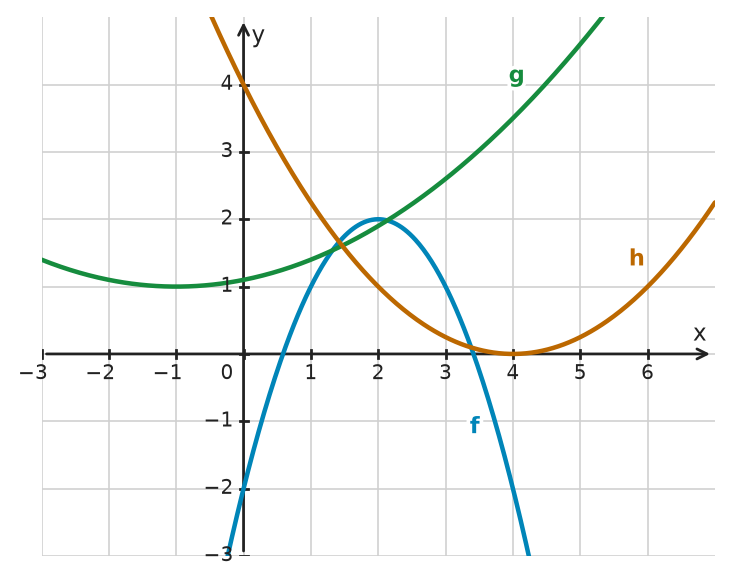
Figure for problem 532278

Hints

- Count each graph’s x-intercepts. - Connect two, one, or zero x-intercepts with the sign of the discriminant. - For part b), identify \(a\), \(b\), and \(c\) from the equation.

Solution

1. The graph of \(f\) crosses the x-axis twice, so \(f(x) = 0\) has two real solutions and \(D > 0\). 2. The graph of \(g\) stays above the x-axis, so \(g(x) = 0\) has no real solutions and \(D < 0\). 3. The graph of \(h\) touches the x-axis once, so \(h(x) = 0\) has one real solution and \(D = 0\). 4. For \(f(x) = -x^2 + 4x - 2\), \(D = 4^2 - 4 \cdot (-1) \cdot (-2) = 16 - 8 = 8\). 5. Since \(8 > 0\), the calculation agrees with the two x-intercepts shown in the graph.

Answer

a) \(f\): two real solutions and \(D > 0\) \(g\): no real solutions and \(D < 0\) \(h\): one real solution and \(D = 0\) b) \(D = 8\), which agrees with the graph.

5145169
The functions are given by \(f(x) = x^2 + 4x + 7\) and \(g_t(x) = -x^2 + t\). Find all values of \(t\) for which the graphs touch or intersect.

Hints

- Set the two function expressions equal. - Put the resulting equation in standard quadratic form. - Determine when its discriminant is nonnegative.

Solution

1. Set the function values equal: \(x^2 + 4x + 7 = -x^2 + t\). 2. Write the resulting quadratic equation in standard form: \(2x^2 + 4x + (7 - t) = 0\). 3. Its discriminant is \(D = 4^2 - 4 \cdot 2 \cdot (7 - t) = 16 - 56 + 8t = 8t - 40\). 4. The graphs have at least one common point when \(D \ge 0\). 5. Solve \(8t - 40 \ge 0\): \(t \ge 5\).

Answer

The graphs touch or intersect for \(t \ge 5\).
5146459
Consider the family of parabolas \(p_k(x) = 2x^2 + kx + 8\), where \(k\) is any real number. a) Find the value of \(k\) for which the vertex lies on the \(y\)-axis. b) Find all values of \(k\) for which the parabola touches the \(x\)-axis at exactly one point. What does this mean about the location of the vertex?

Hints

- What must the vertex's \(x\)-coordinate be to lie on the \(y\)-axis? - How many real zeros does a quadratic have when its graph only touches the \(x\)-axis? - Which expression determines the number of real solutions of a quadratic equation?

Solution

1. The vertex of \(ax^2 + bx + c\) has \(x\)-coordinate \(-\frac{b}{2a}\). Here, \(x_v = -\frac{k}{4}\). For the vertex to lie on the \(y\)-axis, set \(-\frac{k}{4} = 0\), giving \(k = 0\). 2. A quadratic touches the \(x\)-axis at exactly one point when its discriminant is \(0\). Set \(k^2 - 4 \cdot 2 \cdot 8 = 0\). 3. Then \(k^2 - 64 = 0\), so \(k = 8\) or \(k = -8\). 4. In each case, the single point where the parabola touches the \(x\)-axis is the vertex, so the vertex lies on the \(x\)-axis.

Answer

a) \(k = 0\) b) \(k = 8\) or \(k = -8\); in either case, the vertex lies on the \(x\)-axis.
5150599
Consider the quadratic equation \(x^2 - x - 5 = 0\). a) Find both solutions in exact form using the quadratic formula. b) Multiply the two exact solutions to verify that their product is \(-5\). c) What value should replace \(-5\) so that the equation has exactly one real solution?

Hints

- Use the quadratic formula with the coefficients from the equation. - Multiply the conjugate radical expressions using the difference-of-squares pattern. - A quadratic has exactly one real solution when its discriminant equals zero.

Solution

1. For part a, use \(a = 1\), \(b = -1\), and \(c = -5\): \(x = \frac{-(-1) \pm \sqrt{(-1)^2 - 4 \cdot 1 \cdot (-5)}}{2 \cdot 1} = \frac{1 \pm \sqrt{21}}{2}\). 2. For part b, multiply the solutions: \(\frac{1 + \sqrt{21}}{2} \cdot \frac{1 - \sqrt{21}}{2} = \frac{1 - 21}{4} = -5\). 3. For part c, write the equation as \(x^2 - x + c = 0\). It has exactly one real solution when the discriminant is zero: \((-1)^2 - 4 \cdot 1 \cdot c = 0\). 4. Solve \(1 - 4c = 0\), giving \(c = \frac{1}{4}\). Therefore, \(-5\) must be replaced by \(\frac{1}{4}\).

Answer

a) \(x = \frac{1 + \sqrt{21}}{2}\) or \(x = \frac{1 - \sqrt{21}}{2}\) b) The product is \(-5\). c) Replace \(-5\) with \(\frac{1}{4}\).
5153159
Consider \(x^2 + px + 9 = 0\), where \(p\) is a real number. Find all values of \(p\) for which the equation has: a) exactly one real solution. b) no real solutions. c) two distinct real solutions.

Hints

- Express the discriminant in terms of \(p\). - Match each required number of real solutions with a sign condition on the discriminant. - Solve the resulting quadratic inequalities carefully.

Solution

1. The discriminant is \(D = p^2 - 4 \cdot 1 \cdot 9 = p^2 - 36\). 2. For exactly one real solution, require \(D = 0\): \(p^2 - 36 = 0\), so \(p = -6\) or \(p = 6\). 3. For no real solutions, require \(D < 0\): \(p^2 < 36\), so \(-6 < p < 6\). 4. For two distinct real solutions, require \(D > 0\): \(p^2 > 36\), so \(p < -6\) or \(p > 6\).

Answer

a) \(p = -6\) or \(p = 6\) b) \(-6 < p < 6\) c) \(p < -6\) or \(p > 6\)
5251039
Consider the equation \(\frac{3x^2 + 5}{4} - \frac{2x^2 - 1}{3} = 2\). a) Find the real solution set. b) Find the value of \(c\) for which \(\frac{3x^2 + 5}{4} - \frac{2x^2 - 1}{3} = c\) has exactly one real solution.

Hints

- Multiply by the least common denominator to clear the fractions. - Combine the \(x^2\)-terms carefully. - For part b, use the condition that a quadratic has exactly one real solution when its discriminant is zero.

Solution

1. For part a, multiply by \(12\): \(3(3x^2 + 5) - 4(2x^2 - 1) = 24\). 2. Simplify: \(9x^2 + 15 - 8x^2 + 4 = 24\), so \(x^2 = 5\). 3. Therefore, \(x = \pm\sqrt{5}\). 4. For part b, multiply the parameter equation by \(12\): \(x^2 + 19 = 12c\), so \(x^2 + 19 - 12c = 0\). 5. This quadratic has exactly one real solution when its discriminant is zero: \(0^2 - 4 \cdot 1 \cdot (19 - 12c) = 0\). 6. Solve \(19 - 12c = 0\): \(c = \frac{19}{12}\).

Answer

a) \(x \in \{-\sqrt{5}, \sqrt{5}\}\) b) \(c = \frac{19}{12}\)
5255869
Consider the system with parameter \(k\): \(\begin{cases}x + y = 12 \\ xy = k\end{cases}\) a) Find the ordered-pair solutions when \(k = 32\). b) Find the value of \(k\) for which the system has exactly one ordered-pair solution. Justify your answer using the discriminant.

Hints

- Build a quadratic whose roots have the given sum and product. - Use the standard discriminant \(b^2 - 4ac\). - A quadratic has one real root when its discriminant is zero.

Solution

1. Numbers with sum \(12\) and product \(k\) are the roots of \(z^2 - 12z + k = 0\). 2. For part a, set \(k = 32\): \(z^2 - 12z + 32 = 0\). Factor: \((z - 8)(z - 4) = 0\). Thus, the ordered pairs are \((8, 4)\) and \((4, 8)\). 3. For part b, the discriminant is \((-12)^2 - 4 \cdot 1 \cdot k = 144 - 4k\). 4. Exactly one real root occurs when \(144 - 4k = 0\), so \(k = 36\). 5. In that case, the repeated root is \(6\), and the only ordered-pair solution is \((6, 6)\).

Answer

a) \(\{(8, 4), (4, 8)\}\) b) \(k = 36\), giving the single ordered pair \((6, 6)\).
5256659
Find the values of \(k\) for which \(x^2 + (k - 2)x + (k + 1) = 0\) has no real solutions, exactly one real solution, or two distinct real solutions.

Hints

- Write the discriminant as a quadratic expression in \(k\). - Factor that expression. - Use a sign chart or the zeros of the factored expression to solve each inequality.

Solution

1. The discriminant is \(D = (k - 2)^2 - 4 \cdot 1 \cdot (k + 1)\). 2. Simplify: \(D = k^2 - 4k + 4 - 4k - 4 = k^2 - 8k = k(k - 8)\). 3. Exactly one real solution occurs when \(D = 0\), so \(k = 0\) or \(k = 8\). 4. No real solutions occur when \(D < 0\). The product \(k(k - 8)\) is negative between its zeros, so \(0 < k < 8\). 5. Two distinct real solutions occur when \(D > 0\), so \(k < 0\) or \(k > 8\).

Answer

No real solutions: \(0 < k < 8\) Exactly one real solution: \(k = 0\) or \(k = 8\) Two distinct real solutions: \(k < 0\) or \(k > 8\)
5267499
Consider the family of parabolas \(f_a(x)=(x-a)^2+2a\), where \(a\in\mathbb R\). a) Find an equation for the locus of all vertices in the family. b) Determine the set of points \((x, y)\) in the coordinate plane that do not lie on any graph in the family.

Hints

- Read each vertex directly from vertex form. - Eliminate the parameter to find the vertex locus. - For a fixed point \((x, y)\), treat the equation as a quadratic equation in \(a\). - Use the discriminant to decide when a real parameter value exists.

Solution

1. The equation is in vertex form, so the vertex of \(f_a\) is \((a, 2a)\). Eliminating \(a\) gives \(y=2x\). This is the locus of the vertices. 2. A fixed point \((x, y)\) lies on a graph in the family exactly when \(y=(x-a)^2+2a\) has a real solution for \(a\). Rearranging gives \(a^2+(2-2x)a+x^2-y=0\). Its discriminant is \(\Delta=(2-2x)^2-4(x^2-y)=4(1-2x+y)\). A real value of \(a\) exists exactly when \(\Delta\ge0\), which is equivalent to \(y\ge2x-1\). Therefore, no graph in the family passes through points satisfying \(y<2x-1\).

Answer

a) \(y=2x\) b) All points \((x, y)\) such that \(y<2x-1\).
5269249
Find all values of \(k\) for which \(x^2 + kx + (k + 3)\) is positive for every real value of \(x\).

Hints

- Use the positive leading coefficient and the absence of real zeros. - Write and factor the discriminant as an expression in \(k\). - Determine where the factored expression is negative.

Solution

1. The leading coefficient is positive, so the expression is positive for every real \(x\) exactly when the corresponding parabola has no real zeros. 2. Its discriminant is \(D = k^2 - 4 \cdot 1 \cdot (k + 3) = k^2 - 4k - 12\). 3. Require \(D < 0\): \(k^2 - 4k - 12 < 0\). 4. Factor: \((k - 6)(k + 2) < 0\). 5. This product is negative between its zeros, so \(-2 < k < 6\).

Answer

\(-2 < k < 6\)
5269489
Determine the number of real solutions of \((a - 2)x^2 + 4x + 1 = 0\) for each value of the real parameter \(a\). Include the case in which the equation is no longer quadratic.

Hints

- First identify when the coefficient of \(x^2\) is \(0\). - Treat that linear case separately. - For all other values, use the discriminant.

Solution

1. If \(a = 2\), the quadratic term disappears and the equation becomes \(4x + 1 = 0\). It has one solution, \(x = -\frac{1}{4}\). 2. If \(a \ne 2\), the equation is quadratic. Its discriminant is \(D = 4^2 - 4 \cdot (a - 2) \cdot 1 = 24 - 4a\). 3. When \(D = 0\), \(24 - 4a = 0\), so \(a = 6\). The quadratic has one repeated real solution. 4. When \(D > 0\), \(a < 6\). Excluding the linear case \(a = 2\), the equation has two distinct real solutions for \(a < 6\) and \(a \ne 2\). 5. When \(D < 0\), \(a > 6\), so there are no real solutions.

Answer

One real solution: \(a = 2\) or \(a = 6\) Two distinct real solutions: \(a < 6\) and \(a \ne 2\) No real solutions: \(a > 6\)
5343799
The graph shows a quadratic function \(f\). Consider the family \(g_k(x) = kx^2 - 4\), where \(k \ne 0\). Determine algebraically all values of \(k\) for which the graphs of \(f\) and \(g_k\) have no common points.
Figure for problem 534379

Hints

- Use the vertex and one point to determine \(f\). - Set \(f(x)\) equal to \(g_k(x)\). - Treat a possible linear case separately, then require a negative discriminant.

Solution

1. From the graph, \(f\) has vertex \((2, 2)\) and passes through \((0, 0)\). 2. Write \(f(x) = a(x - 2)^2 + 2\). Substituting \((0, 0)\) gives \(0 = 4a + 2\), so \(a = -\frac{1}{2}\). Thus, \(f(x) = -\frac{1}{2}(x - 2)^2 + 2 = -\frac{1}{2}x^2 + 2x\). 3. Set the functions equal: \(-\frac{1}{2}x^2 + 2x = kx^2 - 4\). 4. Rearrange: \(\left(k + \frac{1}{2}\right)x^2 - 2x - 4 = 0\). 5. If \(k = -\frac{1}{2}\), the equation is linear and has a real solution. Otherwise, its discriminant is \(D = (-2)^2 - 4 \cdot \left(k + \frac{1}{2}\right) \cdot (-4) = 16k + 12\). 6. No common points require \(D < 0\): \(16k + 12 < 0\), so \(k < -\frac{3}{4}\).

Answer

\(k < -\frac{3}{4}\)
5343809
The graph shows a quadratic function \(f\). A family of lines is defined by \(h_m(x)=m(x-2)\), where \(m\in\mathbb{R}\). Determine all values of \(m\) for which the line \(h_m\) does not intersect the parabola.
Figure for problem 534380

Hints

- Determine the equation of the parabola from its vertex and another point. - Notice the common point through which every line in the family passes. - A substitution for \(x-2\) can simplify the intersection equation. - Use the discriminant condition for a quadratic equation with no real solutions.

Solution

1. The parabola has vertex \((2,1)\) and passes through \((0,2)\). Write \(f(x)=a(x-2)^2+1\). Substituting \((0,2)\) gives \(2=4a+1\), so \(a=0.25\). Thus, \(f(x)=0.25(x-2)^2+1\). 2. Set the functions equal: \(0.25(x-2)^2+1=m(x-2)\). 3. Let \(u=x-2\). The equation becomes \(0.25u^2-mu+1=0\). 4. Its discriminant is \(D=(-m)^2-4 \cdot 0.25 \cdot 1=m^2-1\). 5. There are no intersections when \(D<0\). Therefore, \(m^2-1<0\), which gives \(-1<m<1\).

Answer

\(-1<m<1\)
5325899
The graph shows a quadratic function \(p\). Find all quadratic functions \(h\) that satisfy both conditions: A) The graph of \(h\) has vertex \((0, 5)\). B) The graphs of \(h\) and \(p\) have no common point.
Figure for problem 532589

Hints

- Use the vertex and one additional point to determine \(p\). - Write the general vertex form for \(h\). - Set the functions equal and require the resulting equation to have no real solution.

Solution

1. From the graph, \(p\) has vertex \((2, 1)\) and passes through \((0, 3)\). 2. Write \(p(x) = a_p(x - 2)^2 + 1\). Substituting \((0, 3)\) gives \(3 = 4a_p + 1\), so \(a_p = \frac{1}{2}\). Thus, \(p(x) = \frac{1}{2}(x - 2)^2 + 1 = \frac{1}{2}x^2 - 2x + 3\). 3. A quadratic with vertex \((0, 5)\) has the form \(h(x) = ax^2 + 5\), where \(a \ne 0\). 4. Common points would satisfy \(ax^2 + 5 = \frac{1}{2}x^2 - 2x + 3\), or \(\left(a - \frac{1}{2}\right)x^2 + 2x + 2 = 0\). 5. If \(a = \frac{1}{2}\), this equation is linear and has a solution. If \(a \ne \frac{1}{2}\), its discriminant is \(D = 2^2 - 4 \cdot \left(a - \frac{1}{2}\right) \cdot 2 = 8 - 8a\). 6. The graphs have no common point when \(D < 0\), so \(8 - 8a < 0\), which gives \(a > 1\).

Answer

\(h(x) = ax^2 + 5\) for \(a > 1\)

All problems may be used, copied and printed free of charge for school and tutoring, including paid tutoring. Commercial adaptations as well as publication or redistribution on the internet are not permitted.