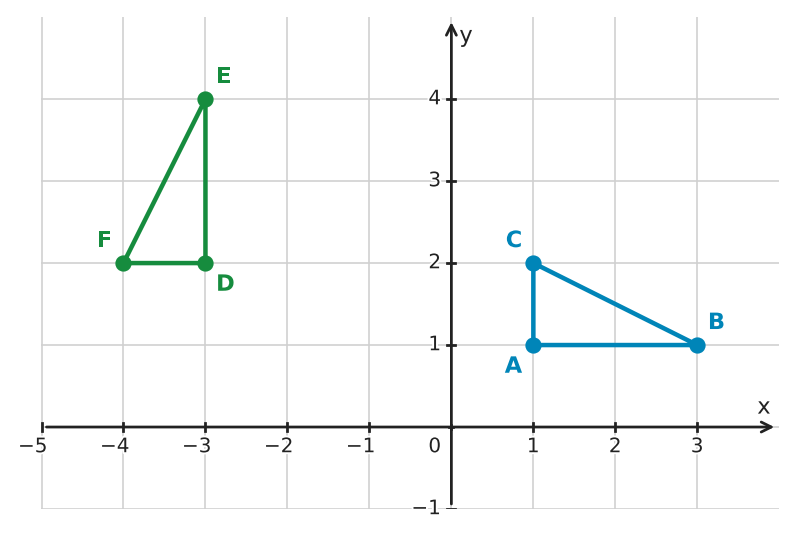
The blue triangle \(ABC\) is mapped to the green triangle \(DEF\), with \(A\) matching \(D\), \(B\) matching \(E\), and \(C\) matching \(F\).
a) Find the center, angle, and direction of a single rotation that maps the triangles. Check all three vertices.
b) Find a different way to map the triangles: rotate about the origin, then translate. Give the angle, direction, and translation vector.
c) Explain why a single translation or a single reflection cannot map \(ABC\) to \(DEF\) with this matching order.
Hints
- Compare one side of the original triangle with its matching side to work out how much it has turned.
- For a single rotation, the unknown center must stay the same distance from a point and its image.
- For the second description, see how far the rotated image of one vertex is from its target; then check the other two.
- What happens to the direction of a side or to clockwise/counterclockwise order under each type of move?
Solution
1. Read \(A=(1,1)\), \(B=(3,1)\), \(C=(1,2)\), \(D=(-3,2)\), \(E=(-3,4)\), and \(F=(-4,2)\). The vector \(AB=\langle2,0\rangle\) becomes \(DE=\langle0,2\rangle\), so the rotation is \(90^\circ\) counterclockwise.
2. If its center is \(S=(h,k)\), rotating \(A\) about \(S\) gives \((h-(1-k),\;k+(1-h))\). Set this equal to \(D=(-3,2)\). Then \(h+k=-2\) and \(k-h=1\), so \(S=(-\frac{3}{2},-\frac{1}{2})\).
3. Relative to \(S\), the vectors to \(B\) and \(C\) are \(\langle\frac{9}{2},\frac{3}{2}\rangle\) and \(\langle\frac{5}{2},\frac{5}{2}\rangle\). Quarter-turns give \(E=(-3,4)\) and \(F=(-4,2)\), so the single rotation works for all vertices.
4. For the second description, rotate about the origin by \(90^\circ\) counterclockwise: \(A'=(-1,1)\), \(B'=(-1,3)\), and \(C'=(-2,1)\). The common translation vector to \(D,E,F\) is \(\langle-2,1\rangle\).
5. A translation keeps \(AB\) horizontal, while \(DE\) is vertical. A reflection reverses orientation, but the ordered triangles \(ABC\) and \(DEF\) both run counterclockwise. Neither single move works.
Answer
a) Rotate \(90^\circ\) counterclockwise about \(S=(-\frac{3}{2},-\frac{1}{2})\). It sends \(A\to D\), \(B\to E\), and \(C\to F\).
b) Rotate \(90^\circ\) counterclockwise about the origin, then translate by \(\langle-2,1\rangle\).
c) A translation cannot turn a horizontal side vertical. A reflection would reverse the triangle's orientation, but the matching triangles have the same orientation.