Aimathic
Login | English | Deutsch

Free Math Worksheets

Build your own math worksheets from 21,000 problems for grades 3 to 12, from fractions to calculus. Every problem includes step-by-step solutions.

Proportional parts in similar figures

Click problems to add them to your worksheet.

53688110
In a right triangle, leg \(b=12\,\text{cm}\) and hypotenuse \(c=20\,\text{cm}\). Altitude \(CD\) to the hypotenuse creates segment \(q\) adjacent to leg \(b\). Find \(q\).
Figure for problem 536881

Hints

- Use the geometric-mean relationship connecting a leg, the hypotenuse, and the adjacent hypotenuse segment.

Solution

1. The similar triangles formed by the altitude give \(b^2=cq\). 2. Substitute: \(12^2=20q\). 3. Solve: \(q=\frac{144}{20}=7.2\,\text{cm}\).

Answer

\(q=7.2\,\text{cm}\)
51241010
An equilateral triangle has side length \(12\,\text{cm}\). The midpoints of its three sides are connected, dividing the triangle into four smaller triangles. a) Classify the four smaller triangles. b) Find the perimeter of one smaller triangle. c) What fraction of the original triangle’s perimeter is the perimeter of one smaller triangle?

Hints

- What does the triangle midsegment theorem say about a segment joining two side midpoints? - How does each new side length compare with the original side length? - Use the perimeter formula for an equilateral triangle.

Solution

1. A segment joining two side midpoints of a triangle is parallel to the third side and half its length. Each new segment therefore has length \(12\,\text{cm} \div 2 = 6\,\text{cm}\). 2. Every smaller triangle has three sides of length \(6\,\text{cm}\), so all four are equilateral. 3. The perimeter of one smaller triangle is \(3 \cdot 6\,\text{cm} = 18\,\text{cm}\). 4. The original perimeter is \(3 \cdot 12\,\text{cm} = 36\,\text{cm}\). Thus, \(\frac{18}{36} = \frac{1}{2}\).

Answer

a) All four smaller triangles are equilateral. b) The perimeter of one smaller triangle is \(18\,\text{cm}\). c) Its perimeter is \(\frac{1}{2}\) of the original perimeter.
51479710
A triangle has side lengths \(4.5\,\text{cm}\), \(6\,\text{cm}\), and \(7.5\,\text{cm}\). A similar triangle has a perimeter of \(54\,\text{cm}\). Find the three side lengths of the second triangle.

Hints

- How do the perimeters of similar triangles compare? - What scale factor is determined by the two perimeters? - How does the scale factor affect every corresponding side length?

Solution

1. The perimeter of the first triangle is \(P_1=4.5\,\text{cm}+6\,\text{cm}+7.5\,\text{cm}=18\,\text{cm}\). 2. The scale factor is the perimeter ratio: \(k=\frac{P_2}{P_1}=\frac{54}{18}=3\). 3. Multiply each side length by \(3\): \(4.5\,\text{cm}\cdot3=13.5\,\text{cm}\), \(6\,\text{cm}\cdot3=18\,\text{cm}\), and \(7.5\,\text{cm}\cdot3=22.5\,\text{cm}\).

Answer

The side lengths of the second triangle are \(13.5\,\text{cm}\), \(18\,\text{cm}\), and \(22.5\,\text{cm}\).
51480110
Two regular pentagons are similar. The smaller pentagon has an area of \(18\,\text{cm}^2\), and the larger pentagon has an area of \(162\,\text{cm}^2\). Find the scale factor \(k\) that maps the smaller pentagon to the larger pentagon. Then state the ratio of a side length of the larger pentagon to the corresponding side length of the smaller pentagon.

Hints

- How are the area ratio and the side-length ratio related for similar figures? - What happens to area when every side length is doubled or tripled? - How can you use the area ratio to find the scale factor for lengths?

Solution

1. The ratio of the areas is \(\frac{A_{\text{large}}}{A_{\text{small}}}=\frac{162\,\text{cm}^2}{18\,\text{cm}^2}=9\). 2. For similar figures, the area ratio equals the square of the scale factor, so \(k^2=9\). 3. Since a scale factor is positive, \(k=\sqrt{9}=3\). 4. Therefore, every side length of the larger pentagon is three times the corresponding side length of the smaller pentagon.

Answer

The scale factor is \(k=3\). The ratio of a side length of the larger pentagon to the corresponding side length of the smaller pentagon is \(3\) to \(1\).
51485410
Two rays start at point \(Z\). Points \(A\) and \(B\) lie on the first ray, and points \(C\) and \(D\) lie on the second ray. The distances are \(ZA=3.5\,\text{cm}\), \(AB=5.25\,\text{cm}\), \(ZC=4.2\,\text{cm}\), and \(CD=6.3\,\text{cm}\). Determine whether \(AC\) and \(BD\) are parallel. Justify your answer using the converse of the Triangle Proportionality Theorem.

Hints

- First find \(ZB\) and \(ZD\). - Compare the fractions of the full ray lengths cut off by the inner segment. - What does the converse of the Triangle Proportionality Theorem imply when those ratios are equal?

Solution

1. Find the full distances from \(Z\): \(ZB=3.5+5.25=8.75\,\text{cm}\) and \(ZD=4.2+6.3=10.5\,\text{cm}\). 2. Compare the ratios: \(\frac{ZA}{ZB}=\frac{3.5}{8.75}=0.4\) and \(\frac{ZC}{ZD}=\frac{4.2}{10.5}=0.4\). 3. Because the two rays are divided proportionally, the converse of the Triangle Proportionality Theorem shows that \(AC\parallel BD\).

Answer

Yes. Since \(\frac{ZA}{ZB}=\frac{ZC}{ZD}=0.4\), the converse of the Triangle Proportionality Theorem gives \(AC\parallel BD\).
51487910
A surveyor uses an X-shaped sighting configuration to find a river’s width \(x\). Points \(A\), \(S\), and \(C\) are collinear, points \(B\), \(S\), and \(D\) are collinear, and \(AB\parallel CD\). Segment \(AB\) spans the river. The measured lengths are \(SA=24\,\text{m}\), \(SC=8\,\text{m}\), and \(CD=6\,\text{m}\). Find the river width \(AB\).

Hints

- Identify the two intersecting lines through \(S\). - Identify the two parallel segments and the two similar triangles. - Compare the parallel sides with their corresponding distances from \(S\).

Solution

1. Because \(AB\parallel CD\), triangles \(\triangle SAB\) and \(\triangle SCD\) are similar by AA. 2. Corresponding sides are proportional: \(\frac{AB}{CD}=\frac{SA}{SC}\). 3. Substitute the measurements: \(\frac{x}{6}=\frac{24}{8}=3\). 4. Therefore, \(x=3\cdot6=18\,\text{m}\).

Answer

The river is \(18\,\text{m}\) wide.
51537010
A square poster is enlarged by increasing its side length by \(40\%\). a) By what percent does the poster’s area increase? b) A decorative cube is enlarged using the same linear scale factor. By what percent does its volume increase?

Hints

- Convert the percent increase in length to a linear scale factor. - Square the factor for area and cube it for volume. - Subtract \(100\%\) to find the percent increase.

Solution

1. A \(40\%\) increase in length gives a linear scale factor of \(k=1.4\). 2. For part a), the area factor is \(1.4^2=1.96\), so the area increase is \(96\%\). 3. For part b), the volume factor is \(1.4^3=2.744\), so the volume increase is \(174.4\%\).

Answer

a) The area increases by \(96\%\). b) The volume increases by \(174.4\%\).
51539010
Two rays start at \(S\). Points \(A\) and \(B\) lie on one ray, with \(A\) between \(S\) and \(B\). Points \(C\) and \(D\) lie on the other ray, and \(AC\parallel BD\). The full length is \(SB=15\,\text{cm}\), and \(AC\) to \(BD\) has a ratio of \(2\) to \(5\). Find \(SA\) and \(AB\).

Hints

- Match the distances from \(S\) with the corresponding parallel segments. - Use the given ratio to find \(SA\). - Subtract \(SA\) from \(SB\) to find \(AB\).

Solution

1. The triangles formed by the parallel segments are similar, so \(\frac{SA}{SB}=\frac{AC}{BD}=\frac{2}{5}\). 2. Therefore, \(SA=15\cdot\frac{2}{5}=6\,\text{cm}\). 3. Since \(A\) lies between \(S\) and \(B\), \(AB=SB-SA=15-6=9\,\text{cm}\).

Answer

\(SA=6\,\text{cm}\) and \(AB=9\,\text{cm}\)
51539810
A solid has a volume of \(250\,\text{cm}^3\). A similar larger solid is created using a linear scale factor of \(k=\frac{6}{5}\). Find the volume of the larger solid.

Hints

- Volume scales with the cube of the linear factor. - Cube the numerator and denominator of the fraction. - Simplify before multiplying.

Solution

1. Volume scales by the cube of the linear factor: \(V_{\text{new}}=250\left(\frac{6}{5}\right)^3\). 2. Since \(\left(\frac{6}{5}\right)^3=\frac{216}{125}\), \(V_{\text{new}}=250\cdot\frac{216}{125}=2\cdot216=432\,\text{cm}^3\).

Answer

\(432\,\text{cm}^3\)
51554710
Two similar triangles \(ABC\) and \(A_2B_2C_2\) have corresponding bases and altitudes. In triangle \(ABC\), the base is \(c=12.5\,\text{cm}\) and the corresponding altitude is \(h_c=8\,\text{cm}\). In triangle \(A_2B_2C_2\), the corresponding altitude is \(h_{c,2}=6\,\text{cm}\). Find the corresponding base length \(c_2\).

Hints

- What is the ratio of the two corresponding altitudes? - Does the same ratio apply to the corresponding bases? - Write a proportion with the unknown base as the only variable.

Solution

1. Corresponding lengths in similar triangles have the same ratio: \(\frac{c_2}{c}=\frac{h_{c,2}}{h_c}\). 2. Substitute the values: \(\frac{c_2}{12.5}=\frac{6}{8}=0.75\). 3. Solve for \(c_2\): \(c_2=0.75\cdot12.5\,\text{cm}=9.375\,\text{cm}\).

Answer

\(c_2=9.375\,\text{cm}\)
51560410
Two rays start at \(S\) and are crossed by two parallel lines. On the first ray, the nearer parallel line meets the ray at \(A\), and the farther parallel line meets it at \(B\). The lengths are \(SA=4.0\,\text{cm}\) and \(AB=6.0\,\text{cm}\). The segment between the rays on the nearer parallel line has length \(a=3.0\,\text{cm}\). Find the length \(b\) of the corresponding segment on the farther parallel line.

Hints

- First find the full distance \(SB\). - Match the parallel segment lengths with the distances measured from \(S\). - Set up a proportion using corresponding lengths.

Solution

1. The full distance to the farther parallel line is \(SB=SA+AB=4.0+6.0=10.0\,\text{cm}\). 2. The two triangles are similar, so \(\frac{a}{b}=\frac{SA}{SB}\). 3. Substitute the values: \(\frac{3.0}{b}=\frac{4.0}{10.0}\). 4. Solve for \(b\): \(b=\frac{3.0\cdot10.0}{4.0}=7.5\,\text{cm}\).

Answer

\(b=7.5\,\text{cm}\)
53636810
In the diagram, \(g\parallel h\), and the rays start at \(Z\). Complete each proportion by replacing \(x\) and \(y\) with segment labels or sums of adjacent labeled segments from the diagram. Do not reuse the ratio already shown on the left. Give all possible answers when more than one is valid. a) \(\frac{a}{a+b}=\frac{x}{y}\) b) \(\frac{c}{d}=\frac{x}{y}\) c) \(\frac{e}{f}=\frac{x}{y}\)
Figure for problem 536368

Hints

- Identify which labeled segments correspond across the two rays. - Compare distances measured from \(Z\) when using the parallel segment lengths. - Equivalent proportions can produce more than one correct expression.

Solution

1. Corresponding distances from \(Z\) and the parallel segment lengths are proportional: \(\frac{a}{a+b}=\frac{c}{c+d}=\frac{e}{f}\). Therefore, in part a), either \(x=c\), \(y=c+d\), or \(x=e\), \(y=f\). 2. The segments between the two parallel lines are proportional to the nearer distances from \(Z\): \(\frac{c}{d}=\frac{a}{b}\). Therefore, in part b), \(x=a\) and \(y=b\). 3. From \(\frac{e}{f}=\frac{a}{a+b}=\frac{c}{c+d}\), part c) has two valid forms.

Answer

a) \(x=c\), \(y=c+d\), or \(x=e\), \(y=f\) b) \(x=a\), \(y=b\) c) \(x=a\), \(y=a+b\), or \(x=c\), \(y=c+d\)
53637310
A forester uses a \(2\,\text{m}\)-tall sighting pole to estimate the height \(h\) of an observation tower. From point \(S\) on level ground, the pole is \(3\,\text{m}\) away and the tower is \(24\,\text{m}\) away. The top of the pole and the top of the tower lie on the same line of sight from \(S\). Find the tower height \(h\).
Figure for problem 536373

Hints

- Identify the two vertical, parallel segments. - Compare each height with its distance from \(S\). - Use a proportion based on the two similar triangles.

Solution

1. The pole and tower are parallel vertical segments, so the two right triangles with vertex \(S\) are similar by AA. 2. Corresponding heights and horizontal distances are proportional: \(\frac{2}{3}=\frac{h}{24}\). 3. Solve: \(h=24\cdot\frac{2}{3}=16\,\text{m}\).

Answer

The observation tower is \(16\,\text{m}\) tall.
53637610
In the diagram, \(g\parallel h\). Find \(BD\). The given lengths are \(ZA=4\,\text{cm}\), \(AC=6\,\text{cm}\), and \(ZB=5\,\text{cm}\).
Figure for problem 536376

Hints

- Find the full distance \(ZC\). - Compare corresponding distances from \(Z\) to the two parallel lines. - After finding \(ZD\), subtract \(ZB\).

Solution

1. The full distance on the lower ray is \(ZC=ZA+AC=4+6=10\,\text{cm}\). 2. Because \(g\parallel h\), corresponding distances from \(Z\) are proportional: \(\frac{ZA}{ZC}=\frac{ZB}{ZD}\). 3. Substitute the values: \(\frac{4}{10}=\frac{5}{ZD}\), so \(ZD=\frac{5\cdot10}{4}=12.5\,\text{cm}\). 4. Therefore, \(BD=ZD-ZB=12.5-5=7.5\,\text{cm}\).

Answer

\(BD=7.5\,\text{cm}\)
53637710
In the diagram, \(AC\parallel BD\). Find the missing lengths \(x\) and \(y\).
Figure for problem 536377

Hints

- Identify the intersection point \(S\). - Find the ratio of the known distances from \(S\). - Apply the same ratio to the other line and to the parallel segments.

Solution

1. Corresponding distances from \(S\) are proportional: \(\frac{SA}{SB}=\frac{SC}{SD}\). 2. From the first line, \(\frac{SA}{SB}=\frac{5}{10}=0.5\). 3. Therefore, \(\frac{x}{6}=0.5\), so \(x=3\). 4. The parallel segment lengths have the same ratio: \(\frac{AC}{BD}=\frac{SA}{SB}\). 5. Thus, \(\frac{4}{y}=0.5\), so \(y=8\).

Answer

\(x=3\) and \(y=8\)
53638510
In the diagram, \(CD\parallel AB\). The lengths are \(ZC=4\,\text{cm}\), \(CA=2\,\text{cm}\), and \(CD=3\,\text{cm}\). Find \(x=AB\).
Figure for problem 536385

Hints

- Find the full distance \(ZA\). - Compare the two parallel segment lengths with the corresponding distances from \(Z\). - Solve the resulting proportion for \(x\).

Solution

1. The full distance is \(ZA=ZC+CA=4+2=6\,\text{cm}\). 2. Because \(CD\parallel AB\), the corresponding lengths are proportional: \(\frac{ZC}{ZA}=\frac{CD}{AB}\). 3. Substitute the values: \(\frac{4}{6}=\frac{3}{x}\). 4. Cross-multiply: \(4x=18\), so \(x=4.5\,\text{cm}\).

Answer

\(x=4.5\,\text{cm}\)
53638610
The three lines \(g\), \(h\), and \(k\) cross two rays that start at \(Z\). Use the labeled distances to determine which of the three lines are parallel.
Figure for problem 536386

Hints

- Use the converse of the Triangle Proportionality Theorem. - Compare the distances from \(Z\) to each line on both rays. - Equal corresponding ratios indicate parallel lines.

Solution

1. For lines \(g\) and \(h\), compare the distances from \(Z\) on the two rays: \(\frac{3.0}{2.0}=1.5\) and \(\frac{6.0}{4.0}=1.5\). Because the ratios are equal, the converse of the Triangle Proportionality Theorem gives \(g\parallel h\). 2. For line \(k\), the distances from \(Z\) are \(9.0\) and \(5.5\), and \(\frac{9.0}{5.5}\ne1.5\). 3. Therefore, \(k\) is not parallel to either \(g\) or \(h\).

Answer

\(g\parallel h\). Line \(k\) is not parallel to either of the other two lines.
53639210
In the diagram, \(g\parallel h\). Find the missing lengths \(x\) and \(y\).
Figure for problem 536392

Hints

- Match the corresponding intervals on the two rays. - Find the total distance \(SB\). - Compare the parallel segment lengths using distances measured from \(S\).

Solution

1. Corresponding segments between the parallel lines are proportional to the nearer distances from \(S\): \(\frac{y}{5}=\frac{6}{4}\). 2. Therefore, \(y=5\cdot\frac{6}{4}=7.5\). 3. The total distance on the lower ray is \(SB=4+6=10\). 4. The parallel segment lengths are proportional to the corresponding distances from \(S\): \(\frac{x}{3}=\frac{10}{4}\). 5. Therefore, \(x=3\cdot\frac{10}{4}=7.5\).

Answer

\(x=7.5\) and \(y=7.5\)
53639610
In the diagram, \(g\parallel h\). Use proportional segments to find \(x=CD\).
Figure for problem 536396

Hints

- Match the corresponding segments on the two rays. - Set up a proportion using the intervals before and between the parallel lines. - Solve the proportion for \(x\).

Solution

1. The given lengths are \(ZA=3\,\text{cm}\), \(AB=4.5\,\text{cm}\), and \(ZC=4\,\text{cm}\). 2. Corresponding segments on the two rays are proportional: \(\frac{ZA}{AB}=\frac{ZC}{CD}\). 3. Substitute the values: \(\frac{3}{4.5}=\frac{4}{x}\). 4. Solve for \(x\): \(x=\frac{4\cdot4.5}{3}=6\,\text{cm}\).

Answer

\(x=6\,\text{cm}\)
53640710
In the diagram, the two segments connecting the rays are parallel. Find \(x\) and \(y\).
Figure for problem 536407

Hints

- Find the ratio of the two parallel connecting segments. - Use full distances measured from \(Z\). - Express each full distance as the known first segment plus the unknown segment.

Solution

1. The nearer and farther connecting segments have lengths \(3\,\text{cm}\) and \(9\,\text{cm}\), so their ratio is \(\frac{1}{3}\). 2. On the lower ray, \(\frac{4}{4+x}=\frac{1}{3}\). Thus, \(12=4+x\), so \(x=8\,\text{cm}\). 3. On the upper ray, \(\frac{5}{5+y}=\frac{1}{3}\). Thus, \(15=5+y\), so \(y=10\,\text{cm}\).

Answer

\(x=8\,\text{cm}\) and \(y=10\,\text{cm}\)
53641510
In the diagram, \(g\parallel h\). The distances from the intersection point \(Z\) to the parallel lines are labeled \(p\), \(q\), \(r\), and \(s\), and the parallel segments are labeled \(u\) and \(v\). Which proportions are correct? A: \(\frac{p}{q}=\frac{r}{s}\) B: \(\frac{u}{v}=\frac{p}{q}\) C: \(\frac{p}{r}=\frac{q}{s}\) D: \(\frac{p}{q}=\frac{s}{r}\)
Figure for problem 536415

Hints

- Match corresponding distances on the two intersecting lines. - Relate the parallel segment lengths to the distances from \(Z\). - Use cross-multiplication to test equivalent proportions.

Solution

1. Corresponding distances from \(Z\) are proportional, so \(\frac{p}{q}=\frac{r}{s}\). Statement A is correct. 2. The parallel segment lengths have the same ratio as corresponding distances from \(Z\), so \(\frac{u}{v}=\frac{p}{q}\). Statement B is correct. 3. From \(\frac{p}{q}=\frac{r}{s}\), cross-multiplication gives \(ps=qr\), which is equivalent to \(\frac{p}{r}=\frac{q}{s}\). Statement C is correct. 4. Statement D reverses the ratio on the right and is not generally true.

Answer

A, B, and C
53641710
In the diagram, the segments labeled \(g\) and \(h\) are parallel. Find the missing length in each case. a) \(a=3\,\text{cm}\), \(a_1=4.5\,\text{cm}\), \(b=2\,\text{cm}\). Find \(b_1\). b) \(a=4\,\text{cm}\), \(a_1=10\,\text{cm}\), \(x=3.2\,\text{cm}\). Find \(y\).
Figure for problem 536417

Hints

- Identify corresponding distances on the crossed lines. - Decide whether each part compares ray distances or parallel segment lengths. - Solve the appropriate proportion for the missing value.

Solution

1. For a), corresponding distances from \(Z\) satisfy \(\frac{a}{a_1}=\frac{b}{b_1}\). 2. Substitute the values: \(\frac{3}{4.5}=\frac{2}{b_1}\), so \(b_1=\frac{2\cdot4.5}{3}=3\,\text{cm}\). 3. For b), the parallel segment lengths satisfy \(\frac{x}{y}=\frac{a}{a_1}\). 4. Substitute the values: \(\frac{3.2}{y}=\frac{4}{10}\), so \(y=\frac{3.2\cdot10}{4}=8\,\text{cm}\).

Answer

a) \(b_1=3\,\text{cm}\) b) \(y=8\,\text{cm}\)
53641810
A \(12\,\text{cm}\)-tall object is placed \(20\,\text{cm}\) in front of the pinhole of a camera. The screen is \(15\,\text{cm}\) behind the pinhole. Find the height \(h\) of the image formed on the screen.
Figure for problem 536418

Hints

- Identify the rays from the top and bottom of the object through the pinhole to the screen. - Identify the two similar triangles with vertex at the pinhole. - Compare image height with object height and image distance with object distance.

Solution

1. The object and image form similar triangles with the pinhole as their common vertex. 2. The ratio of image height to object height equals the ratio of image distance to object distance: \(\frac{h}{12}=\frac{15}{20}\). 3. Solve: \(h=12\cdot\frac{15}{20}=12\cdot0.75=9\,\text{cm}\).

Answer

The image height is \(9\,\text{cm}\).
53642510
Lines \(AC\) and \(BD\) intersect at \(Z\), and \(AB\parallel CD\). The given lengths are \(ZA=5\,\text{cm}\), \(ZC=12.5\,\text{cm}\), \(ZD=15\,\text{cm}\), and \(AB=4\,\text{cm}\). Find \(ZB\) and \(CD\).
Figure for problem 536425

Hints

- Identify the similar triangles on opposite sides of \(Z\). - Match corresponding distances from \(Z\). - Use the same scale factor for the parallel segment lengths.

Solution

1. Since \(AB\parallel CD\), \(\triangle ZAB\sim\triangle ZCD\). 2. Corresponding distances satisfy \(\frac{ZB}{ZD}=\frac{ZA}{ZC}=\frac{5}{12.5}=0.4\). Therefore, \(ZB=15\cdot0.4=6\,\text{cm}\). 3. The parallel segment lengths satisfy \(\frac{CD}{AB}=\frac{ZC}{ZA}=\frac{12.5}{5}=2.5\). Therefore, \(CD=4\cdot2.5=10\,\text{cm}\).

Answer

\(ZB=6\,\text{cm}\) and \(CD=10\,\text{cm}\)
53642810
In the diagram, lines \(g\) and \(h\) are parallel. All lengths are in centimeters. a) Find the length \(b = BD\). b) Find the total length \(ZD\).
Figure for problem 536428

Hints

- Identify the two similar triangles with vertex \(Z\). - Find the scale factor using the two horizontal distances. - Apply the same scale factor to corresponding segments.

Solution

1. The similar triangles have scale factor \(\frac{ZB}{ZA} = \frac{4 + 6}{4} = 2.5\). 2. Corresponding parallel segments satisfy \(\frac{BD}{AC} = 2.5\). Thus, \(b = 2.5(5) = 12.5\,\text{cm}\). 3. Corresponding distances from \(Z\) satisfy \(\frac{ZD}{ZC} = 2.5\). Thus, \(ZD = 2.5(3.2) = 8\,\text{cm}\).

Answer

a) \(b = 12.5\,\text{cm}\) b) \(ZD = 8\,\text{cm}\)
53684610
The midpoints of the sides of triangle \(ABC\) form the medial triangle \(A_1B_1C_1\). The perimeter of triangle \(ABC\) is \(42\,\text{cm}\). Find the perimeter of triangle \(A_1B_1C_1\).
Figure for problem 536846

Hints

- How does each side of the medial triangle compare with the corresponding side of the original triangle? - If every side length is halved, what happens to the perimeter?

Solution

1. Each side of the medial triangle is a midsegment of triangle \(ABC\). 2. A triangle midsegment is parallel to the third side and half its length. 3. Therefore, the medial triangle has scale factor \(\frac{1}{2}\) relative to the original triangle. 4. Its perimeter is \(\frac{1}{2}\cdot42\,\text{cm}=21\,\text{cm}\).

Answer

\(21\,\text{cm}\)
53687810
In right triangle \(ABC\), altitude \(CD\) to hypotenuse \(AB\) divides the hypotenuse into \(AD=p=9\,\text{cm}\) and \(DB=q=16\,\text{cm}\). Find the altitude \(h=CD\) and the hypotenuse \(c=AB\).
Figure for problem 536878

Hints

- The altitude is the geometric mean of the two hypotenuse segments. - Add the two segments to find the entire hypotenuse.

Solution

1. The hypotenuse is the sum of its two segments: \(c=p+q=9+16=25\,\text{cm}\). 2. The similar triangles formed by the altitude give \(h^2=pq\). 3. Substitute: \(h^2=9\cdot 16=144\), so \(h=12\,\text{cm}\).

Answer

\(h=12\,\text{cm}\) and \(c=25\,\text{cm}\)
53692610
Triangles \(ABC\) and \(A_1B_1C_1\) are similar, and \(\frac{AC}{A_1C_1}=1.5\). Triangle \(A_1B_1C_1\) has side lengths \(A_1B_1=6\), \(B_1C_1=8\), and \(A_1C_1=10\). Find the side lengths \(x=AB\), \(y=BC\), and \(z=AC\) of triangle \(ABC\).
Figure for problem 536926

Hints

- Match corresponding sides in the two triangles. - The ratio of one pair of corresponding sides is the same for every pair.

Solution

1. The scale factor from \(A_1B_1C_1\) to \(ABC\) is \(k=1.5\). 2. Multiply each corresponding side length by \(1.5\): \(x=1.5\cdot6=9\), \(y=1.5\cdot8=12\), and \(z=1.5\cdot10=15\).

Answer

\(x=9\), \(y=12\), and \(z=15\)
53693110
Triangle \(ABC\) has side lengths in the ratio \(3\) to \(4\) to \(5\), and triangle \(A_1B_1C_1\) is similar to triangle \(ABC\). In triangle \(A_1B_1C_1\), \(b_1=16\). Find \(x=a_1\) and \(y=c_1\).
Figure for problem 536931

Hints

- Which ratio number corresponds to the side of length \(16\)? - Find the length represented by one ratio part. - Multiply that value by the other two ratio numbers.

Solution

1. Because the triangles are similar, the side lengths of \(A_1B_1C_1\) are also in the ratio \(3\) to \(4\) to \(5\). The side \(b_1=16\) corresponds to \(4\) equal ratio parts. 2. One ratio part has length \(16\div4=4\). 3. Therefore, \(x=a_1=3\cdot4=12\) and \(y=c_1=5\cdot4=20\).

Answer

\(x=12\) and \(y=20\)
53704610
Triangles \(ABC\) and \(DEF\) are similar. It is given that \(AB=5\,\text{cm}\), \(DE=10\,\text{cm}\), and the area of \(\triangle ABC\) is \(15\,\text{cm}^2\). Find the area \(x\) of \(\triangle DEF\).
Figure for problem 537046

Hints

- First find the linear scale factor from the corresponding side lengths. - How does the area of a similar figure change when each length is multiplied by \(k\)? - Apply the area scale factor to the known area.

Solution

1. The linear scale factor from \(\triangle ABC\) to \(\triangle DEF\) is \(k=\frac{DE}{AB}=\frac{10}{5}=2\). 2. Areas of similar figures scale by the square of the linear scale factor, so the area factor is \(k^2=2^2=4\). 3. Therefore, \(x=15\cdot4=60\,\text{cm}^2\).

Answer

\(x=60\,\text{cm}^2\)
53705210
In the diagram, \(AC\parallel BD\). The given lengths are \(SA=8\), \(AB=12\), and \(AC=6\). Find \(x=BD\).
Figure for problem 537052

Hints

- Find the full distance \(SB\). - Compare the parallel segments with the corresponding distances from \(S\).

Solution

1. The full distance is \(SB=SA+AB=8+12=20\). 2. The parallel segment lengths are proportional to the distances from \(S\): \(\frac{BD}{AC}=\frac{SB}{SA}\). 3. Thus, \(\frac{x}{6}=\frac{20}{8}=2.5\), so \(x=15\).

Answer

\(x=15\)
53705510
In triangle \(ABC\), points \(D\), \(E\), and \(F\) are the midpoints of the sides. The side lengths of the medial triangle \(DEF\) are \(7\,\text{cm}\), \(8\,\text{cm}\), and \(9\,\text{cm}\). Find the perimeter \(x\) of \(\triangle ABC\).
Figure for problem 537055

Hints

- How does the length of a triangle midsegment compare with the parallel side? - How does doubling every side length affect the perimeter?

Solution

1. Each side of a medial triangle is half the length of the parallel side of the original triangle. 2. Therefore, the side lengths of \(\triangle ABC\) are \(2\cdot7=14\,\text{cm}\), \(2\cdot8=16\,\text{cm}\), and \(2\cdot9=18\,\text{cm}\). 3. The perimeter is \(x=14+16+18=48\,\text{cm}\).

Answer

\(x=48\,\text{cm}\)
53708410
In trapezoid \(ABCD\), \(AB\parallel CD\), and the diagonals intersect at \(S\). The parallel sides have lengths \(AB=9\,\text{cm}\) and \(CD=6\,\text{cm}\). Also, \(AS=6\,\text{cm}\). Find \(SC\).
Figure for problem 537084

Hints

- Identify the similar triangles formed by the diagonals and parallel bases. - Match the diagonal segments with the corresponding bases. - Solve the resulting proportion.

Solution

1. Since \(AB\parallel CD\), \(\triangle ABS\sim\triangle CDS\). 2. Corresponding sides satisfy \(\frac{AS}{SC}=\frac{AB}{CD}\). 3. Substitute the values: \(\frac{6}{SC}=\frac{9}{6}=1.5\). 4. Therefore, \(SC=6\div1.5=4\,\text{cm}\).

Answer

\(SC=4\,\text{cm}\)
53708510
The triangles in panels a) and b) are similar. The ratio of the perimeter of \(\triangle ABC\) to the perimeter of \(\triangle DEF\) is \(2\) to \(5\). In panel a), \(AB=6\,\text{cm}\). Find the corresponding side length \(DE\) in panel b).
Figure for problem 537085

Hints

- How does a perimeter ratio compare with the ratio of corresponding side lengths? - Use the order of the two perimeters to determine the correct scale factor.

Solution

1. For similar figures, the ratio of the perimeters equals the ratio of corresponding side lengths. 2. Therefore, \(\frac{DE}{AB}=\frac{5}{2}\). 3. Thus, \(DE=6\cdot\frac{5}{2}=15\,\text{cm}\).

Answer

\(DE=15\,\text{cm}\)
53719010
In triangle \(ABC\), \(M\) is the midpoint of \(BC\). Through \(M\), one line parallel to \(AB\) meets \(AC\) at \(E\), and another line parallel to \(AC\) meets \(AB\) at \(F\). Given \(AB=16\,\text{m}\) and \(AC=20\,\text{m}\), find the perimeter of quadrilateral \(AFME\).
Figure for problem 537190

Hints

- Apply the triangle midsegment theorem to each segment through \(M\). - How long is a midsegment compared with the side parallel to it? - Add the four side lengths of \(AFME\).

Solution

1. Since \(M\) is the midpoint of \(BC\) and \(ME\parallel AB\), the triangle midsegment theorem gives \(ME=\frac{1}{2}AB=8\,\text{m}\) and \(AE=\frac{1}{2}AC=10\,\text{m}\). 2. Since \(MF\parallel AC\), the same theorem gives \(MF=\frac{1}{2}AC=10\,\text{m}\) and \(AF=\frac{1}{2}AB=8\,\text{m}\). 3. Therefore, the perimeter is \(8+10+8+10=36\,\text{m}\).

Answer

\(36\,\text{m}\)
53719610
In trapezoid \(ABCD\), the parallel bases have lengths \(AB=18\,\text{cm}\) and \(CD=9\,\text{cm}\). Two points divide each leg into three equal parts. Corresponding division points are connected by segments \(s_1\) and \(s_2\), each parallel to the bases. Segment \(s_1\) is closer to \(CD\) than \(s_2\). Find the lengths of \(s_1\) and \(s_2\).
Figure for problem 537196

Hints

- Compare the lengths of the two bases. - Parallel cross-sections change by equal amounts when the legs are divided into equal parts. - Divide the difference between the base lengths into three equal changes.

Solution

1. The difference between the base lengths is \(18-9=9\,\text{cm}\). 2. Because the legs are divided into three equal parts and the cross-sections are parallel to the bases, the cross-section length increases by equal amounts. The increase per step is \(9\div3=3\,\text{cm}\). 3. One step from \(CD\), \(s_1=9+3=12\,\text{cm}\). 4. Two steps from \(CD\), \(s_2=9+2\cdot3=15\,\text{cm}\).

Answer

\(s_1=12\,\text{cm}\) and \(s_2=15\,\text{cm}\)
51015710
Two similar triangles \(D_1\) and \(D_2\) are given. Triangle \(D_1\) has side lengths \(3\,\text{cm}\), \(4\,\text{cm}\), and \(5\,\text{cm}\). Triangle \(D_2\) has an area of \(54\,\text{cm}^2\). Find the area of \(D_1\) and the scale factor \(k\) from \(D_1\) to \(D_2\).

Hints

- First determine whether the triangle with side lengths \(3\), \(4\), and \(5\) is a right triangle. - Then find the ratio of the two areas. - How do you obtain the length scale factor from an area ratio?

Solution

1. Triangle \(D_1\) is a right triangle because \(3^2+4^2=9+16=25=5^2\). 2. Its area is \(A_1=\frac{1}{2}\cdot3\,\text{cm}\cdot4\,\text{cm}=6\,\text{cm}^2\). 3. The area ratio is \(\frac{A_2}{A_1}=\frac{54}{6}=9\). 4. Since \(\frac{A_2}{A_1}=k^2\), the positive scale factor is \(k=\sqrt{9}=3\).

Answer

The area of \(D_1\) is \(6\,\text{cm}^2\). The scale factor from \(D_1\) to \(D_2\) is \(k=3\).
51404210
Similar triangles \(ABC\) and \(A_1B_1C_1\) are given. The area of \(\triangle A_1B_1C_1\) is \(2.25\) times the area of \(\triangle ABC\). What is the ratio of the corresponding height \(h_{a,1}\) to \(h_a\)? Briefly justify your answer.

Hints

- How is an area factor related to a linear scale factor? - Is a height a linear measurement or an area measurement? - Which operation reverses squaring?

Solution

1. For similar figures, the area factor is the square of the linear scale factor: \(k^2=2.25\). 2. Therefore, \(k=\sqrt{2.25}=1.5\). 3. Corresponding heights are linear measurements, so they scale by \(k\). Thus, \(\frac{h_{a,1}}{h_a}=1.5=\frac{3}{2}\).

Answer

The ratio of \(h_{a,1}\) to \(h_a\) is \(3\) to \(2\).
51479210
A scale model of a cube-shaped water tower has an edge length of \(30\,\text{cm}\). The actual tower has an edge length of \(12\,\text{m}\). a) Find the scale factor \(k\) from the actual tower to the model. b) How many times as large is the surface area of the actual tower as the surface area of the model? c) The model holds \(27\,\text{L}\). Find the capacity of the actual tower in cubic meters.

Hints

- Convert both edge lengths to the same unit first. - Surface area scales with the square of the linear factor. - Volume scales with the cube of the linear factor. - Recall the relationship between liters and cubic meters.

Solution

1. Convert to the same unit: \(12\,\text{m}=1200\,\text{cm}\). The scale factor from the actual tower to the model is \(k=\frac{30}{1200}=\frac{1}{40}=0.025\). 2. Surface area scales by the square of the linear factor. From the model to the actual tower, the linear factor is \(40\), so the surface-area factor is \(40^2=1600\). 3. Volume scales by the cube of the linear factor, so the volume factor is \(40^3=64{,}000\). 4. The actual capacity is \(27\cdot64{,}000=1{,}728{,}000\,\text{L}\). Since \(1000\,\text{L}=1\,\text{m}^3\), this is \(1728\,\text{m}^3\).

Answer

a) \(k=\frac{1}{40}=0.025\) b) The actual surface area is \(1600\) times the model’s surface area. c) \(1728\,\text{m}^3\)
51479410
Rectangle \(R_1\) has side lengths \(a=4\,\text{cm}\) and \(b=6\,\text{cm}\). Rectangle \(R_2\) is similar to \(R_1\) and has a perimeter of \(40\,\text{cm}\). Find the side lengths of \(R_2\) and the ratio of the area of \(R_2\) to the area of \(R_1\).

Hints

- How do the perimeters of similar figures compare with their corresponding side lengths? - What happens to the perimeter when every side length is multiplied by the same factor? - How is the area scale factor related to the length scale factor?

Solution

1. The perimeter of \(R_1\) is \(P_1=2\cdot(4\,\text{cm}+6\,\text{cm})=20\,\text{cm}\). 2. Perimeters of similar figures scale by the same factor as corresponding lengths, so \(k=\frac{P_2}{P_1}=\frac{40}{20}=2\). 3. The side lengths of \(R_2\) are \(a_2=2\cdot4\,\text{cm}=8\,\text{cm}\) and \(b_2=2\cdot6\,\text{cm}=12\,\text{cm}\). 4. Areas scale by the square of the scale factor. Therefore, \(\frac{A_2}{A_1}=k^2=2^2=4\).

Answer

The side lengths of \(R_2\) are \(8\,\text{cm}\) and \(12\,\text{cm}\). The ratio of the area of \(R_2\) to the area of \(R_1\) is \(4\) to \(1\).
51479810
Two triangles are similar. The first triangle has side lengths \(8\,\text{cm}\), \(12\,\text{cm}\), and \(15\,\text{cm}\). The second triangle has two known side lengths, \(10\,\text{cm}\) and \(18.75\,\text{cm}\). Find the third side length of the second triangle.

Hints

- Corresponding side lengths of similar figures have a constant ratio. - Test which sides correspond by comparing the given lengths. - Ordering the side lengths from least to greatest can help identify corresponding sides.

Solution

1. Match the shortest known side of the second triangle to the shortest side of the first triangle: \(k=\frac{10}{8}=1.25\). 2. Check the longest sides: \(15\,\text{cm}\cdot1.25=18.75\,\text{cm}\). The correspondence is consistent. 3. The unknown side corresponds to the \(12\,\text{cm}\) side of the first triangle. 4. Its length is \(12\,\text{cm}\cdot1.25=15\,\text{cm}\).

Answer

The third side of the second triangle is \(15\,\text{cm}\).
51481010
A rectangle with side lengths \(a=4\,\text{cm}\) and \(b=9\,\text{cm}\) is similar to a second rectangle whose area is \(144\,\text{cm}^2\). Find the side lengths \(a_1\) and \(b_1\) of the second rectangle.

Hints

- How does area change when every side length is multiplied by the same factor? - First find the area of the original rectangle. - How is the area ratio related to the length scale factor for similar figures?

Solution

1. The area of the first rectangle is \(A=ab=4\,\text{cm}\cdot9\,\text{cm}=36\,\text{cm}^2\). 2. The ratio of the areas is \(\frac{A_1}{A}=\frac{144\,\text{cm}^2}{36\,\text{cm}^2}=4\). 3. For similar figures, the area ratio equals \(k^2\), where \(k\) is the length scale factor. Thus, \(k^2=4\), so \(k=\sqrt{4}=2\). 4. The side lengths of the second rectangle are \(a_1=4\,\text{cm}\cdot2=8\,\text{cm}\) and \(b_1=9\,\text{cm}\cdot2=18\,\text{cm}\).

Answer

The side lengths of the second rectangle are \(a_1=8\,\text{cm}\) and \(b_1=18\,\text{cm}\).
51481310
Two triangles are similar. The first triangle has side lengths \(4.5\,\text{cm}\), \(6\,\text{cm}\), and \(9\,\text{cm}\). The longest side of the second triangle is \(13.5\,\text{cm}\). Find the other two side lengths of the second triangle.

Hints

- Which side of the first triangle corresponds to the given side of the second triangle? - How does a dilation change every side length? - What ratio gives the scale factor?

Solution

1. The longest side of the first triangle is \(9\,\text{cm}\), so it corresponds to the \(13.5\,\text{cm}\) side. 2. The scale factor is \(k=\frac{13.5}{9}=1.5\). 3. The side corresponding to \(4.5\,\text{cm}\) is \(4.5\,\text{cm}\cdot1.5=6.75\,\text{cm}\). 4. The side corresponding to \(6\,\text{cm}\) is \(6\,\text{cm}\cdot1.5=9\,\text{cm}\).

Answer

The other two side lengths are \(6.75\,\text{cm}\) and \(9\,\text{cm}\).
51482610
Right triangle \(D_1\) has leg lengths \(a_1=5\,\text{cm}\) and \(b_1=12\,\text{cm}\). A second right triangle \(D_2\) is similar to \(D_1\) and has an area of \(120\,\text{cm}^2\). Find the scale factor \(k\) from \(D_1\) to \(D_2\), and find the two leg lengths and the hypotenuse of \(D_2\).

Hints

- How do you find the area of a right triangle from its leg lengths? - How is the area ratio related to the length scale factor? - Multiply corresponding side lengths by the same scale factor. - Use the Pythagorean theorem to find the hypotenuse.

Solution

1. The area of \(D_1\) is \(A_1=\frac{1}{2}\cdot5\,\text{cm}\cdot12\,\text{cm}=30\,\text{cm}^2\). 2. The area ratio is \(\frac{A_2}{A_1}=\frac{120}{30}=4\). 3. Since the area ratio equals \(k^2\), the positive scale factor is \(k=\sqrt{4}=2\). 4. The legs of \(D_2\) are \(a_2=2\cdot5\,\text{cm}=10\,\text{cm}\) and \(b_2=2\cdot12\,\text{cm}=24\,\text{cm}\). 5. The hypotenuse is \(c_2=\sqrt{10^2+24^2}\,\text{cm}=\sqrt{676}\,\text{cm}=26\,\text{cm}\).

Answer

The scale factor is \(k=2\). Triangle \(D_2\) has legs of \(10\,\text{cm}\) and \(24\,\text{cm}\), and a hypotenuse of \(26\,\text{cm}\).
51482710
A large zoo aquarium holds \(12\,\text{m}^3\) of water. A scale model is built at a scale of \(1:20\). Find the model’s volume in cubic centimeters.

Hints

- Cube the linear scale factor to obtain the volume scale factor. - Convert cubic meters to cubic centimeters after finding the model volume.

Solution

1. The linear scale factor from the aquarium to the model is \(k=\frac{1}{20}\). 2. The volume scale factor is \(k^3=\left(\frac{1}{20}\right)^3=\frac{1}{8000}\). 3. The model’s volume is \(12\div8000=0.0015\,\text{m}^3\). 4. Since \(1\,\text{m}^3=1{,}000{,}000\,\text{cm}^3\), the model’s volume is \(0.0015\cdot1{,}000{,}000=1500\,\text{cm}^3\).

Answer

\(1500\,\text{cm}^3\)
51482810
A modern sculpture has a volume of \(270\,\text{m}^3\). A geometrically similar model has a volume of \(10\,\text{dm}^3\). a) Find the model scale in the form \(1:n\). b) The model’s surface area is \(25\,\text{dm}^2\). Find the surface area of the actual sculpture in square meters.

Hints

- Convert both volumes to the same unit. - Take a cube root to move from the volume ratio to the linear ratio. - Square the linear factor to obtain the surface-area factor. - Convert square decimeters to square meters.

Solution

1. Convert the actual volume: \(270\,\text{m}^3=270{,}000\,\text{dm}^3\). 2. The actual-to-model volume ratio is \(\frac{270000}{10}=27{,}000\). 3. If the actual-to-model linear factor is \(n\), then \(n^3=27{,}000\). Thus, \(n=30\), so the model scale is \(1:30\). 4. Surface area scales by the square of the linear factor. The actual surface area is \(25\cdot30^2=22{,}500\,\text{dm}^2\). 5. Since \(100\,\text{dm}^2=1\,\text{m}^2\), this is \(225\,\text{m}^2\).

Answer

a) \(1:30\) b) \(225\,\text{m}^2\)
51482910
A standard shipping box holds \(80\,\text{L}\). a) For a special edition, every edge length is doubled. Find the new capacity in liters. b) Explain how doubling every edge length changes the amount of material needed for the box’s surface. c) A different box should hold exactly twice the original volume, or \(160\,\text{L}\). By what factor should every edge length be multiplied? Round to the nearest hundredth.

Hints

- Volume scales with the cube of the linear factor. - Surface area scales with the square of the linear factor. - Use a cube root when the desired volume factor is known.

Solution

1. For part a), the linear factor is \(2\), so the volume factor is \(2^3=8\). The new capacity is \(80\cdot8=640\,\text{L}\). 2. For part b), surface area scales by the square of the linear factor. Since \(2^2=4\), the material needed is multiplied by \(4\). 3. For part c), let the linear factor be \(k\). Doubling the volume requires \(k^3=2\), so \(k=\sqrt[3]{2}\approx1.26\).

Answer

a) \(640\,\text{L}\) b) The material needed is multiplied by \(4\). c) The edge lengths should be multiplied by approximately \(1.26\).
51483410
Right triangle \(ABC\) has legs \(a=6\,\text{cm}\) and \(b=8\,\text{cm}\), with the right angle at \(C\). A second triangle \(A_2B_2C_2\) is similar to \(ABC\). The hypotenuse \(c_2\) of the second triangle has the same length as the longer leg \(b\) of the original triangle. a) Find the hypotenuse \(c\) of triangle \(ABC\). b) Find the ratio of the area of \(A_2B_2C_2\) to the area of \(ABC\). c) Find the leg lengths \(a_2\) and \(b_2\) of the second triangle.

Hints

- Which side of the first triangle corresponds to the hypotenuse of the second triangle? - Find the missing side of the first triangle before calculating the scale factor. - How is the area ratio related to the length scale factor?

Solution

1. By the Pythagorean theorem, \(c=\sqrt{6^2+8^2}=\sqrt{100}=10\,\text{cm}\). 2. Since \(c_2=8\,\text{cm}\), the scale factor from \(ABC\) to \(A_2B_2C_2\) is \(k=\frac{8}{10}=0.8\). 3. The area ratio is \(k^2=(0.8)^2=0.64=\frac{16}{25}\). 4. The new legs are \(a_2=0.8\cdot6\,\text{cm}=4.8\,\text{cm}\) and \(b_2=0.8\cdot8\,\text{cm}=6.4\,\text{cm}\).

Answer

a) \(c=10\,\text{cm}\) b) The area ratio of \(A_2B_2C_2\) to \(ABC\) is \(16\) to \(25\). c) \(a_2=4.8\,\text{cm}\) and \(b_2=6.4\,\text{cm}\)
51484010
Triangle \(ABC\) has circumradius \(R=4.5\,\text{cm}\) and side length \(c=7.2\,\text{cm}\). A similar triangle \(A_2B_2C_2\) is constructed with circumradius \(R_2=6.0\,\text{cm}\). a) Find the scale factor \(k\). b) Find the corresponding side length \(c_2\). c) Find the ratio of the area of the second circumcircle to the area of the first circumcircle.

Hints

- Do circumradii scale in the same way as corresponding side lengths? - How can two corresponding radii be used to find the scale factor? - How are area ratios related to length scale factors?

Solution

1. Corresponding linear measures of similar figures have the same scale factor, so \(k=\frac{R_2}{R}=\frac{6.0}{4.5}=\frac{4}{3}\). 2. The corresponding side length is \(c_2=kc=\frac{4}{3}\cdot7.2\,\text{cm}=9.6\,\text{cm}\). 3. Circle areas scale by the square of the radius scale factor. Therefore, \(\frac{A_{\text{circle},2}}{A_{\text{circle},1}}=k^2=\left(\frac{4}{3}\right)^2=\frac{16}{9}\).

Answer

a) \(k=\frac{4}{3}\) b) \(c_2=9.6\,\text{cm}\) c) The circumcircle area ratio is \(16\) to \(9\).
51484310
Two similar scale models of a sailboat have heights of \(25\,\text{cm}\) and \(40\,\text{cm}\). The smaller model has a volume of \(1.2\,\text{dm}^3\). Find the volume of the larger model in liters.

Hints

- Find the linear scale factor from the two heights. - Cube the linear factor to obtain the volume factor. - Recall the relationship between cubic decimeters and liters.

Solution

1. The linear scale factor from the smaller model to the larger model is \(k=\frac{40}{25}=1.6\). 2. Volume scales by the cube of the linear factor: \(V_2=1.2\cdot1.6^3=1.2\cdot4.096=4.9152\,\text{dm}^3\). 3. Since \(1\,\text{dm}^3=1\,\text{L}\), the volume is \(4.9152\,\text{L}\).

Answer

\(4.9152\,\text{L}\)
51484510
Triangle \(ABC\) has side lengths \(a=3\,\text{cm}\), \(b=4\,\text{cm}\), and \(c=5\,\text{cm}\). Triangle \(A_2B_2C_2\) has corresponding side lengths \(a_2=7.5\,\text{cm}\), \(b_2=10\,\text{cm}\), and \(c_2=12.5\,\text{cm}\). a) Show that the triangles are similar and state the scale factor \(k\) from \(ABC\) to \(A_2B_2C_2\). b) Find the perimeter ratio \(\frac{P_2}{P_1}\) and the area ratio \(\frac{A_2}{A_1}\). Compare each ratio with \(k\).

Hints

- Compare all three pairs of corresponding side lengths. - How do perimeters scale for similar figures? - How do areas scale for similar figures? - Check whether the first triangle is a right triangle to simplify the area calculation.

Solution

1. The corresponding side-length ratios are \(\frac{7.5}{3}=2.5\), \(\frac{10}{4}=2.5\), and \(\frac{12.5}{5}=2.5\). Therefore, the triangles are similar by SSS with \(k=2.5\). 2. The perimeters are \(P_1=3+4+5=12\,\text{cm}\) and \(P_2=7.5+10+12.5=30\,\text{cm}\). 3. Thus, \(\frac{P_2}{P_1}=\frac{30}{12}=2.5=k\). 4. Because \(3^2+4^2=5^2\), the first triangle is right. Its area is \(A_1=\frac{1}{2}\cdot3\cdot4=6\,\text{cm}^2\). The second triangle is also right, with area \(A_2=\frac{1}{2}\cdot7.5\cdot10=37.5\,\text{cm}^2\). 5. Therefore, \(\frac{A_2}{A_1}=\frac{37.5}{6}=6.25=(2.5)^2=k^2\).

Answer

a) The triangles are similar by SSS, and \(k=2.5\). b) \(\frac{P_2}{P_1}=2.5=k\), and \(\frac{A_2}{A_1}=6.25=k^2\).
51484610
A surveyor wants to find the width of a river without crossing it. Points \(A\) and \(B\) are \(20\,\text{m}\) apart along one bank. A tree at point \(C\) is directly across the river from \(A\), so \(AC\perp AB\). The surveyor extends \(AB\) past \(B\) to point \(E\), where \(BE=5\,\text{m}\). From \(E\), the surveyor walks perpendicular to \(AB\) to point \(D\), where \(D\), \(B\), and \(C\) are collinear. The surveyor measures \(ED=4\,\text{m}\). Find the river width \(AC\) using similar triangles. Briefly explain why the triangles are similar.

Hints

- Identify the two right triangles formed by the measurements and the line of sight. - Identify the pair of vertical angles at \(B\). - Match the corresponding sides of the similar triangles. - Use a proportion to find \(AC\).

Solution

1. Consider \(\triangle BED\) and \(\triangle BAC\). 2. Angles \(\angle BED\) and \(\angle BAC\) are right angles. Angles \(\angle EBD\) and \(\angle ABC\) are vertical angles, so they are congruent. Therefore, \(\triangle BED\sim\triangle BAC\) by AA. 3. Corresponding sides are proportional: \(\frac{AC}{ED}=\frac{AB}{BE}\). 4. Substitute the measurements: \(\frac{AC}{4}=\frac{20}{5}=4\). 5. Therefore, \(AC=16\,\text{m}\).

Answer

The river is \(16\,\text{m}\) wide. The triangles are similar by AA because each has a right angle and the angles at \(B\) are vertical angles.
51484710
Similar triangles \(D_1\) and \(D_2\) have areas \(A_1=24\,\text{cm}^2\) and \(A_2=150\,\text{cm}^2\). The perimeter of the smaller triangle \(D_1\) is \(P_1=24\,\text{cm}\). a) Find the scale factor \(k\) from \(D_1\) to \(D_2\). b) Find the perimeter \(P_2\) of the larger triangle. c) A side of \(D_1\) is \(a_1=6\,\text{cm}\). Find the corresponding side \(a_2\) in \(D_2\). d) A median of \(D_1\) has length \(m_1\). Explain the ratio between the corresponding median \(m_2\) in \(D_2\) and \(m_1\).

Hints

- How is the area ratio related to \(k\)? - How do perimeters and side lengths change once \(k\) is known? - Does a dilation scale only the sides, or every length in the figure? - Is a median a length or an area?

Solution

1. The area ratio is \(\frac{A_2}{A_1}=\frac{150}{24}=6.25\). 2. Since \(k^2=6.25\), the positive scale factor is \(k=\sqrt{6.25}=2.5\). 3. Perimeters scale by \(k\), so \(P_2=2.5\cdot24\,\text{cm}=60\,\text{cm}\). 4. Corresponding side lengths scale by \(k\), so \(a_2=2.5\cdot6\,\text{cm}=15\,\text{cm}\). 5. A dilation scales every length, including medians, by \(k\). Therefore, \(\frac{m_2}{m_1}=2.5\).

Answer

a) \(k=2.5\) b) \(P_2=60\,\text{cm}\) c) \(a_2=15\,\text{cm}\) d) \(\frac{m_2}{m_1}=2.5\)
51486510
A pinhole camera is \(25\,\text{cm}\) deep. It forms a \(15\,\text{cm}\)-tall image of a \(12\,\text{m}\)-tall house. a) How far is the camera from the house? b) The house is replaced by a tree that is twice as far from the camera. How tall must the tree be to form another \(15\,\text{cm}\)-tall image? c) In general, what happens to the image height if the camera depth is decreased while the object height and object distance stay the same?

Hints

- The object and its image form a pair of similar triangles. - Compare each height with its corresponding distance from the pinhole. - Use consistent units in each proportion. - Write image height as a function of camera depth to analyze part c.

Solution

1. The object and image form similar triangles, so \(\frac{h}{b}=\frac{G}{g}\), where \(h\) is image height, \(b\) is camera depth, \(G\) is object height, and \(g\) is object distance. 2. For part a, use centimeters: \(G=1200\,\text{cm}\), \(h=15\,\text{cm}\), and \(b=25\,\text{cm}\). Then \(\frac{15}{25}=\frac{1200}{g}\). 3. Since \(\frac{15}{25}=0.6\), \(g=1200\div0.6=2000\,\text{cm}=20\,\text{m}\). 4. For part b, the new distance is \(40\,\text{m}\). Keeping \(h\) and \(b\) unchanged gives the same scale factor, so \(\frac{G_2}{40}=0.6\). Thus, \(G_2=0.6\cdot40=24\,\text{m}\). 5. For part c, \(h=\frac{Gb}{g}\). With \(G\) and \(g\) fixed, decreasing \(b\) decreases \(h\) proportionally.

Answer

a) \(20\,\text{m}\) b) \(24\,\text{m}\) c) The image height decreases in direct proportion to the camera depth.
51486810
Two rectangles have these dimensions: Rectangle \(R_1\): \(12\,\text{cm} \times 18\,\text{cm}\) Rectangle \(R_2\): \(16\,\text{cm} \times 24\,\text{cm}\) a) Use calculations to determine whether \(R_1\) and \(R_2\) are similar. b) Rectangle \(R_1\) is cut in half by a line parallel to its shorter side, creating two congruent rectangles. Are the smaller rectangles similar to \(R_1\)? Justify your answer by comparing side-length ratios. c) Suppose the shorter side of \(R_1\) remains \(12\,\text{cm}\). How long would its longer side need to be for the rectangle to be similar to either of its halves?

Hints

- Compare each rectangle by dividing its longer side by its shorter side. - Which side changes when the rectangle is cut as described? - Let the unknown longer side be a variable and write a proportion between the original rectangle and a rotated half.

Solution

1. For part a, \(\frac{18}{12}=1.5\) and \(\frac{24}{16}=1.5\). The corresponding side-length ratios are equal, and both figures are rectangles, so \(R_1\) and \(R_2\) are similar. 2. Cutting \(R_1\) as described produces rectangles with side lengths \(12\,\text{cm}\) and \(9\,\text{cm}\). Their longer-side-to-shorter-side ratio is \(\frac{12}{9}=\frac{4}{3}\approx1.33\), which is not equal to the original ratio \(1.5\). The halves are not similar to \(R_1\). 3. Let \(x\) be the required longer side. A half has side lengths \(12\) and \(\frac{x}{2}\), and it must correspond to the original after rotation. Set \(\frac{x}{12}=\frac{12}{x/2}\). Then \(\frac{x}{12}=\frac{24}{x}\), so \(x^2=288\). Since a length is positive, \(x=\sqrt{288}=12\sqrt{2}\approx16.97\,\text{cm}\).

Answer

a) Yes. Both rectangles have a longer-side-to-shorter-side ratio of \(1.5\). b) No. Each half has ratio \(\frac{4}{3}\approx1.33\), while the original has ratio \(1.5\). c) The longer side must be \(12\sqrt{2}\,\text{cm}\approx16.97\,\text{cm}\).
51486910
A \(2\,\text{m}\)-tall fence stands \(12\,\text{m}\) in front of a house wall. An observer stands \(3\,\text{m}\) in front of the fence, and the observer’s eyes are \(1.60\,\text{m}\) above the ground. From this position, the fence blocks part of the wall from view. Up to what height on the wall is the view blocked by the fence?

Hints

- Use the side-view geometry of the observer, fence, and wall. - Use the observer’s eye as the common vertex of the similar triangles. - Compare height differences measured from eye level, not from the ground. - Find the observer’s total distance from the wall.

Solution

1. The observer is \(3+12=15\,\text{m}\) from the wall. 2. Measure vertical changes from eye level. At the fence, the vertical change is \(2-1.60=0.40\,\text{m}\) over a horizontal distance of \(3\,\text{m}\). 3. Similar triangles give \(\frac{0.40}{3}=\frac{h-1.60}{15}\), where \(h\) is the blocked height on the wall. 4. Since \(15\div3=5\), \(h-1.60=0.40\cdot5=2\). 5. Therefore, \(h=3.60\,\text{m}\).

Answer

The fence blocks the wall up to a height of \(3.60\,\text{m}\).
51487010
Two cylindrical pillars stand one behind the other. The nearer pillar has a diameter of \(1.20\,\text{m}\), and the farther pillar has a diameter of \(1.80\,\text{m}\). The centers of the pillars are \(6\,\text{m}\) apart. From a top view, an observer stands on the line through both centers, with the smaller pillar between the observer and the larger pillar. How far from the center of the smaller pillar must the observer stand for the smaller pillar to exactly block the larger one from view?

Hints

- Use the top-view geometry with the smaller pillar between the observer and the larger pillar. - A sightline tangent to a circle is perpendicular to the radius at the point of tangency. - Compare each radius with the distance from the observer to the corresponding center.

Solution

1. The pillar radii are \(r_1=0.60\,\text{m}\) and \(r_2=0.90\,\text{m}\). 2. Let \(x\) be the distance from the observer to the center of the smaller pillar. The distance to the center of the larger pillar is \(x+6\). 3. When the pillars have the same apparent width, the right triangles formed by a sightline and a radius to each point of tangency are similar. Therefore, \(\frac{r_1}{x}=\frac{r_2}{x+6}\). 4. Substitute: \(\frac{0.60}{x}=\frac{0.90}{x+6}\). 5. Cross-multiply: \(0.60(x+6)=0.90x\), so \(0.60x+3.60=0.90x\). 6. Thus, \(3.60=0.30x\), and \(x=12\,\text{m}\).

Answer

The observer must stand \(12\,\text{m}\) from the center of the smaller pillar.
51487110
A photographer wants a \(12\,\text{cm}\)-long model car to appear the same size in a photograph as a \(4.80\,\text{m}\)-long real car in the background. a) If the model is \(80\,\text{cm}\) from the camera lens, how far from the lens must the real car be? b) The real car is then moved \(10\,\text{m}\) farther from the lens. How many centimeters, and in which direction, must the photographer move the model so the two cars still appear the same size?

Hints

- Convert all lengths to the same unit before writing a proportion. - For equal apparent sizes, compare each object’s length with its distance from the lens. - In part b, decide whether the model must move closer to or farther from the lens when the real car moves farther away.

Solution

1. For part a, convert the real car’s length to centimeters: \(4.80\,\text{m}=480\,\text{cm}\). 2. Objects have the same apparent size when their lengths are proportional to their distances from the lens: \(\frac{12}{80}=\frac{480}{d}\). 3. Solve: \(12d=80\cdot480\), so \(d=3200\,\text{cm}=32\,\text{m}\). 4. For part b, the real car’s new distance is \(32+10=42\,\text{m}=4200\,\text{cm}\). 5. Let \(m\) be the model’s new distance. Then \(\frac{12}{m}=\frac{480}{4200}\). 6. Solve: \(480m=12\cdot4200\), so \(m=105\,\text{cm}\). 7. The model must move \(105-80=25\,\text{cm}\) farther from the lens.

Answer

a) \(32\,\text{m}\) b) Move the model \(25\,\text{cm}\) farther from the lens.
51487210
A flashlight is placed on a table, with its point-like light source at tabletop height. A \(20\,\text{cm}\)-tall ruler stands vertically on the table. The ruler casts a \(1\,\text{m}\)-tall shadow on a vertical wall, measured upward from the tabletop. The wall is \(2\,\text{m}\) beyond the ruler. a) Find the distance from the light source to the ruler. b) Explain, using geometric terms, why similar triangles can be used in this situation.

Hints

- Identify the light source, ruler, wall, and the ray reaching the top of the shadow. - Find the total distance from the light source to the wall. - Compare the ruler height and shadow height with their distances from the light source. - Identify the equal angles that establish AA similarity.

Solution

1. Convert the ruler height to meters: \(20\,\text{cm}=0.20\,\text{m}\). 2. Let \(x\) be the distance from the light source to the ruler. The distance from the light source to the wall is \(x+2\). 3. The ruler and wall form corresponding vertical sides of similar triangles, so \(\frac{0.20}{x}=\frac{1}{x+2}\). 4. Cross-multiply: \(0.20(x+2)=x\), so \(0.20x+0.40=x\). 5. Therefore, \(0.40=0.80x\), and \(x=0.50\,\text{m}\). 6. The triangles are similar by AA: both contain a right angle because the ruler and wall are perpendicular to the tabletop, and they share the angle formed by the tabletop and the light ray from the source to the top of the shadow.

Answer

a) \(0.50\,\text{m}\), or \(50\,\text{cm}\) b) The triangles are similar by AA because the ruler and wall are parallel vertical segments and the light rays begin at the same point.
51487410
Jordan wants to find the height of a bell tower. Jordan places a small mirror flat on level ground and moves until the top of the tower is visible at the center of the mirror. Jordan measures an eye height of \(1.70\,\text{m}\), a distance of \(2.50\,\text{m}\) from Jordan’s feet to the center of the mirror, and a distance of \(45\,\text{m}\) from the mirror to the base of the tower. a) Find the height of the bell tower. b) What property of reflection makes it possible to use similar triangles? c) What assumption about the ground between Jordan and the tower is required?

Hints

- Identify the two right triangles that meet at the mirror. - Recall the relationship between the angle of incidence and the angle of reflection. - Match each vertical height with its horizontal distance from the mirror. - Consider how sloped or uneven ground would affect the angles and measured distances.

Solution

1. The person-mirror triangle and the tower-mirror triangle are right triangles. 2. By the law of reflection, the angle of incidence equals the angle of reflection. Together with the right angles made with level ground, this establishes AA similarity. 3. Let \(h\) be the tower height. Corresponding sides give \(\frac{h}{45}=\frac{1.70}{2.50}\). 4. Solve: \(h=45\cdot\frac{1.70}{2.50}=45\cdot0.68=30.6\,\text{m}\). 5. The calculation assumes the ground is level, so the measured ground distances are horizontal and both vertical heights are perpendicular to the same line.

Answer

a) \(30.6\,\text{m}\) b) The angle of incidence equals the angle of reflection. c) The ground must be level between Jordan and the tower.
51487510
A vertical \(6.0\,\text{m}\)-tall post would cast a \(9.0\,\text{m}\)-long shadow on level ground. A vertical wall stands \(6.0\,\text{m}\) from the post and interrupts the shadow. At what height on the wall does the edge of the post’s shadow end?

Hints

- First consider where the shadow would end if the wall were not present. - Use the geometry of the post, wall, ground, and the ray that forms the shadow’s edge. - Identify the large and small similar triangles. - Use the remaining horizontal distance from the wall to the tip of the full shadow.

Solution

1. Without the wall, the shadow would reach the ground \(9.0\,\text{m}\) from the post. 2. The wall is \(9.0-6.0=3.0\,\text{m}\) from the tip of the full ground shadow. 3. The small triangle beside the wall is similar to the triangle formed by the post and its full shadow. Therefore, \(\frac{h}{3.0}=\frac{6.0}{9.0}\). 4. Solve: \(h=3.0\cdot\frac{6.0}{9.0}=2.0\,\text{m}\).

Answer

The edge of the shadow ends \(2.0\,\text{m}\) above the ground on the wall.
51488010
A \(5.00\,\text{m}\)-tall streetlight casts the shadow of a \(1.60\,\text{m}\)-tall person. The person stands \(4.25\,\text{m}\) from the base of the light pole. a) Find the shadow length \(s\). b) Without further calculation, explain how the shadow length changes if the person takes two steps toward the streetlight.

Hints

- Identify the streetlight, person, shadow, and the ray from the light to the tip of the shadow. - The large triangle’s base includes both the pole-to-person distance and the shadow length. - Write a proportion in which \(s\) appears in two places. - Think about how the base of the large triangle changes when the person moves toward the pole.

Solution

1. The large triangle has height \(5.00\,\text{m}\) and base \(4.25+s\). The smaller similar triangle has height \(1.60\,\text{m}\) and base \(s\). 2. Write a proportion: \(\frac{5.00}{4.25+s}=\frac{1.60}{s}\). 3. Cross-multiply: \(5.00s=1.60(4.25+s)\). 4. Simplify: \(5.00s=6.80+1.60s\), so \(3.40s=6.80\). 5. Therefore, \(s=2.00\,\text{m}\). 6. If the person moves toward the streetlight, the horizontal distance from the pole decreases. The corresponding similar triangle becomes narrower, so the shadow becomes shorter.

Answer

a) \(s=2.00\,\text{m}\) b) The shadow becomes shorter.
51488210
Consider two isosceles trapezoids \(T_1\) and \(T_2\). Trapezoid \(T_1\) has bases \(a_1=10\,\text{cm}\) and \(c_1=6\,\text{cm}\) and legs \(b_1=4\,\text{cm}\). Trapezoid \(T_2\) has bases \(a_2=15\,\text{cm}\) and \(c_2=11\,\text{cm}\) and legs \(b_2=4\,\text{cm}\). a) Find the base angles along the longer base of each trapezoid. What do you notice? b) Determine whether the trapezoids are similar. Justify your answer numerically.

Hints

- Draw altitudes to form right triangles at the ends of each trapezoid. - Similar figures must have proportional corresponding side lengths. - Compare all types of corresponding sides.

Solution

1. Dropping altitudes creates right triangles whose horizontal legs have length \(\frac{a-c}{2}\). Thus, \(\cos(\alpha)=\frac{a-c}{2b}\). 2. For \(T_1\), \(\cos(\alpha_1)=\frac{10-6}{2\cdot 4}=\frac{1}{2}\), so \(\alpha_1=60^\circ\). 3. For \(T_2\), \(\cos(\alpha_2)=\frac{15-11}{2\cdot 4}=\frac{1}{2}\), so \(\alpha_2=60^\circ\). Both trapezoids have angles \(60^\circ,60^\circ,120^\circ,120^\circ\). 4. Compare corresponding side ratios: \(\frac{15}{10}=1.5\), but \(\frac{11}{6}\approx 1.83\) and \(\frac{4}{4}=1\). 5. Because the corresponding side ratios are not equal, the trapezoids are not similar.

Answer

a) Both longer-base angles are \(60^\circ\). Each trapezoid has the same four angle measures. b) No. The corresponding side ratios are not constant: \(1.5\), approximately \(1.83\), and \(1\).
51520410
Three triangles \(D_1\), \(D_2\), and \(D_3\) are similar. The ratio of corresponding side lengths from \(D_1\) to \(D_2\) is \(1.5\). The area of \(D_3\) is four times the area of \(D_2\). Find the ratio of corresponding side lengths from \(D_1\) to \(D_3\).

Hints

- Express the areas of \(D_2\) and \(D_3\) in terms of the area of \(D_1\). - How do you obtain a length scale factor from an area ratio? - First determine the area ratio from \(D_1\) to \(D_2\).

Solution

1. The area ratio from \(D_1\) to \(D_2\) is \(\frac{A_2}{A_1}=(1.5)^2=2.25\). 2. Since \(A_3=4A_2\), \(A_3=4(2.25A_1)=9A_1\). 3. The length scale factor from \(D_1\) to \(D_3\) is \(k_{31}=\sqrt{\frac{A_3}{A_1}}=\sqrt{9}=3\).

Answer

The ratio of corresponding side lengths from \(D_1\) to \(D_3\) is \(3\) to \(1\).
51525510
In triangle \(ABC\), segment \(DE\) is drawn parallel to side \(AB\), with \(D\) on \(AC\) and \(E\) on \(BC\). The lengths are \(CD=6\,\text{cm}\) and \(DA=9\,\text{cm}\). a) Find the scale factor \(k\) that maps the larger triangle \(ABC\) to the smaller triangle \(DEC\). b) What is the ratio of the area of triangle \(DEC\) to the area of triangle \(ABC\)? c) Triangle \(ABC\) has an area of \(75\,\text{cm}^2\). Find the area of trapezoid \(ABED\).

Hints

- Find the entire length \(AC\). - Use corresponding side lengths measured from the shared vertex \(C\). - Square the linear scale factor to get the area factor. - Subtract the smaller triangle's area from the larger triangle's area.

Solution

1. The full side length is \(AC=CD+DA=6+9=15\,\text{cm}\). 2. Since \(DE\parallel AB\), the triangles are similar. The scale factor from \(\triangle ABC\) to \(\triangle DEC\) is \(k=\frac{CD}{CA}=\frac{6}{15}=0.4\). 3. The area factor is \(k^2=0.4^2=0.16=\frac{4}{25}\). 4. The area of \(\triangle DEC\) is \(75\cdot0.16=12\,\text{cm}^2\). 5. Therefore, the area of trapezoid \(ABED\) is \(75-12=63\,\text{cm}^2\).

Answer

a) \(k=0.4\) b) \(4\) to \(25\) c) \(63\,\text{cm}^2\)
51537110
Similar cylinders \(Z_1\) and \(Z_2\) are compared. The radius of \(Z_2\) is twice the radius of \(Z_1\). a) How many containers the size of \(Z_1\) would be needed to fill \(Z_2\)? b) By what percent is the lateral surface area of \(Z_2\) greater than that of \(Z_1\)? c) A third cylinder \(Z_3\), similar to \(Z_1\), has \(27\) times the volume of \(Z_1\). Find the linear scale factor \(k\) from \(Z_1\) to \(Z_3\), and state by what percent the total surface area increases.

Hints

- Similar solids use the same linear factor for all corresponding lengths. - Surface area scales with \(k^2\), and volume scales with \(k^3\). - Take a cube root when a volume factor is given. - Distinguish the new total percent from the percent increase.

Solution

1. Since the cylinders are similar, doubling the radius gives a linear scale factor of \(k=2\). 2. For part a), the volume factor is \(2^3=8\), so \(8\) containers the size of \(Z_1\) would fill \(Z_2\). 3. For part b), lateral surface area scales by \(2^2=4\), which is an increase of \(300\%\). 4. For part c), \(k^3=27\), so \(k=3\). Total surface area scales by \(3^2=9\), which is an increase of \(800\%\).

Answer

a) \(8\) containers b) \(300\%\) c) \(k=3\), and the total surface area increases by \(800\%\).
51538410
In triangle \(ABC\), segment \(DE\) is parallel to \(BC\), with \(D\) on \(AB\) and \(E\) on \(AC\). The lengths are \(AD=4\,\text{cm}\), \(DB=6\,\text{cm}\), and \(BC=15\,\text{cm}\). a) Find \(DE\). b) Find the ratio of the area of triangle \(ADE\) to the area of triangle \(ABC\). Justify your answer using the scale factor \(k\).

Hints

- Find the entire length \(AB\). - Use corresponding sides of the similar triangles to find the scale factor. - How are the areas of similar figures related to the linear scale factor?

Solution

1. The full side length is \(AB=AD+DB=4+6=10\,\text{cm}\). 2. Since \(DE\parallel BC\), \(\triangle ADE\sim\triangle ABC\). The scale factor from the larger triangle to the smaller triangle is \(k=\frac{AD}{AB}=\frac{4}{10}=0.4\). 3. Corresponding lengths scale by \(k\), so \(DE=15\cdot0.4=6\,\text{cm}\). 4. Areas scale by \(k^2\), so the area ratio is \(0.4^2=0.16=\frac{4}{25}\).

Answer

a) \(DE=6\,\text{cm}\) b) \(4\) to \(25\)
51538610
A scale model of a building has a volume of \(16\,\text{dm}^3\). The actual building has a volume of \(54\,\text{m}^3\). Find the scale of the model.

Hints

- Convert the two volumes to the same unit. - A scale describes a linear ratio, not a volume ratio. - Take the cube root of the volume factor.

Solution

1. Convert the actual volume: \(54\,\text{m}^3=54{,}000\,\text{dm}^3\). 2. Let \(k\) be the linear factor from the model to the actual building. Then \(k^3=\frac{54000}{16}=3375\). 3. Therefore, \(k=\sqrt[3]{3375}=15\), so the model scale is \(1:15\).

Answer

\(1:15\)
51539910
A container is enlarged proportionally. Its surface area is multiplied by a factor of \(2.25\). a) Find the linear scale factor \(k\). b) The original container holds \(400\,\text{mL}\). Find the capacity of the enlarged container.

Hints

- How can you recover the linear scale factor from an area factor? - How is the volume factor related to the linear scale factor? - Find \(k\) before calculating the new volume.

Solution

1. The surface-area factor is the square of the linear scale factor, so \(k^2=2.25\). 2. Therefore, \(k=\sqrt{2.25}=1.5\). 3. The volume factor is \(k^3=1.5^3=3.375\). 4. The enlarged capacity is \(400\cdot3.375=1350\,\text{mL}\).

Answer

a) \(k=1.5\) b) \(1350\,\text{mL}\)
51554810
Similar triangles \(T_1\) and \(T_2\) have areas and corresponding bases as follows: \(A_1=54\,\text{cm}^2\), \(g_1=9\,\text{cm}\), and \(g_2=12\,\text{cm}\). Find the area \(A_2\) of the second triangle.

Hints

- How does area change when every length is multiplied by a scale factor? - First find the scale factor from the corresponding bases. - Square the length scale factor to obtain the area scale factor.

Solution

1. The length scale factor is \(k=\frac{g_2}{g_1}=\frac{12}{9}=\frac{4}{3}\). 2. The area ratio is \(k^2=\left(\frac{4}{3}\right)^2=\frac{16}{9}\). 3. Therefore, \(A_2=A_1\cdot\frac{16}{9}=54\cdot\frac{16}{9}=96\,\text{cm}^2\).

Answer

\(A_2=96\,\text{cm}^2\)
51557410
Two similar polygons \(V\) and \(V'\) have corresponding side lengths \(a,b,c,\ldots\) and \(a',b',c',\ldots\). Explain why the ratio of their perimeters \(P\) and \(P'\) equals the ratio of any pair of corresponding side lengths; that is, \(\frac{P}{P'}=\frac{a}{a'}\).

Hints

- How is the perimeter of a polygon calculated? - What does similarity imply about corresponding side-length ratios? - How can each side of one polygon be written using a scale factor and the corresponding side of the other polygon? - What common factor can be factored from the perimeter sum?

Solution

1. Because \(V\) and \(V'\) are similar, all corresponding side-length ratios are equal: \(\frac{a}{a'}=\frac{b}{b'}=\frac{c}{c'}=\cdots=k\). 2. Therefore, \(a=ka'\), \(b=kb'\), \(c=kc'\), and so on. 3. The perimeter of \(V\) is \(P=a+b+c+\cdots\). 4. Substitute the expressions from Step 2: \(P=ka'+kb'+kc'+\cdots\). 5. Factor out \(k\): \(P=k(a'+b'+c'+\cdots)=kP'\). 6. Thus, \(\frac{P}{P'}=k\). Since \(\frac{a}{a'}=k\), it follows that \(\frac{P}{P'}=\frac{a}{a'}\).

Answer

Since each side length of \(V\) is \(k\) times its corresponding side length in \(V'\), \(P=\sum s_i=\sum(ks_i')=k\sum s_i'=kP'\). Therefore, \(\frac{P}{P'}=k=\frac{a}{a'}\).
51557510
A right triangle \(ABC\) has leg lengths \(a=6\,\text{cm}\) and \(b=8\,\text{cm}\). A similar triangle \(A_2B_2C_2\) has hypotenuse \(c_2=25\,\text{cm}\). Find the leg lengths \(a_2\) and \(b_2\) of the second triangle.

Hints

- Which side of the first triangle corresponds to the given side of the second triangle? - Use the Pythagorean theorem to find the first hypotenuse. - Apply the same scale factor to both legs.

Solution

1. The hypotenuse of the first triangle is \(c=\sqrt{6^2+8^2}=10\,\text{cm}\). 2. The scale factor is \(k=\frac{c_2}{c}=\frac{25}{10}=2.5\). 3. The corresponding legs are \(a_2=2.5\cdot6\,\text{cm}=15\,\text{cm}\) and \(b_2=2.5\cdot8\,\text{cm}=20\,\text{cm}\).

Answer

\(a_2=15\,\text{cm}\) and \(b_2=20\,\text{cm}\)
51560610
Two rays start at \(S\) and are crossed by two parallel lines \(g\) and \(h\). On the first ray, the distance from \(S\) to \(g\) is \(12\,\text{cm}\), and the distance from \(g\) to \(h\) is \(18\,\text{cm}\). On the second ray, the total distance from \(S\) to \(h\) is \(45\,\text{cm}\). Find: a) the distance \(b_1\) from \(S\) to \(g\) on the second ray; b) the distance \(b_2\) from \(g\) to \(h\) on the second ray.

Hints

- Find the total distance from \(S\) to \(h\) on the first ray. - Match corresponding distances on the two rays. - After finding \(b_1\), subtract it from the total length on the second ray.

Solution

1. On the first ray, the total distance from \(S\) to \(h\) is \(12+18=30\,\text{cm}\). 2. Corresponding distances on the rays are proportional, so \(\frac{b_1}{45}=\frac{12}{30}\). 3. Thus, \(b_1=45\cdot\frac{12}{30}=18\,\text{cm}\). 4. The remaining distance is \(b_2=45-18=27\,\text{cm}\).

Answer

a) \(b_1=18\,\text{cm}\) b) \(b_2=27\,\text{cm}\)
53636910
Lines \(g_1\) and \(g_2\) are parallel. Replace \(p\) and \(q\) as directed. a) In \(\frac{u}{v}=\frac{p}{q}\), choose \(p\) and \(q\) only from \(w\) and \(z\). b) In \(\frac{m}{n}=\frac{p}{q}\), choose \(p\) and \(q\) from \(u\), \(v\), \(w\), and \(z\). Give all valid pairs. c) In \(\frac{w}{p}=\frac{z}{q}\), choose \(p\) and \(q\) only from \(u\) and \(v\).
Figure for problem 536369

Hints

- Identify the intersection point \(S\). - Match the distances from \(S\) to the two parallel lines. - The ratio of the parallel segments matches the ratio of corresponding distances from \(S\).

Solution

1. Corresponding distances from \(S\) to the parallel lines are proportional: \(\frac{u}{v}=\frac{w}{z}\). Therefore, in part a), \(p=w\) and \(q=z\). 2. The parallel segment lengths have the same ratio as either pair of corresponding distances from \(S\): \(\frac{m}{n}=\frac{u}{v}=\frac{w}{z}\). Therefore, part b) has two valid answers. 3. Rearranging \(\frac{u}{v}=\frac{w}{z}\) gives \(\frac{w}{u}=\frac{z}{v}\). Therefore, in part c), \(p=u\) and \(q=v\).

Answer

a) \(p=w\), \(q=z\) b) \(p=u\), \(q=v\), or \(p=w\), \(q=z\) c) \(p=u\), \(q=v\)
53637410
Two diagonal braces cross at point \(Z\) in a scaffold. The horizontal beams \(AB\) and \(CD\) are parallel. The measurements are \(ZA=1.2\,\text{m}\), \(ZB=1.0\,\text{m}\), and \(ZC=2.4\,\text{m}\). 1. Find \(ZD\). 2. Find \(CD\) if \(AB=0.8\,\text{m}\).
Figure for problem 536374

Hints

- The crossing braces form two triangles with vertex \(Z\). - Match segments that lie on the same diagonal brace. - The ratio of the parallel beams equals the ratio of corresponding brace segments.

Solution

1. Since \(AB\parallel CD\), triangles \(\triangle ZAB\) and \(\triangle ZCD\) are similar by AA. 2. Corresponding brace segments satisfy \(\frac{ZA}{ZC}=\frac{ZB}{ZD}\). Substitute: \(\frac{1.2}{2.4}=\frac{1.0}{ZD}\). 3. Since \(\frac{1.2}{2.4}=\frac{1}{2}\), \(ZD=2.0\,\text{m}\). 4. Corresponding parallel beams satisfy \(\frac{AB}{CD}=\frac{ZA}{ZC}\). Substitute: \(\frac{0.8}{CD}=\frac{1.2}{2.4}=\frac{1}{2}\). 5. Therefore, \(CD=1.6\,\text{m}\).

Answer

1. \(ZD=2.0\,\text{m}\) 2. \(CD=1.6\,\text{m}\)
53637510
In the diagram, \(g\parallel h\). Find the marked lengths \(d\) and \(e\). The given values are \(a=12\), \(b=8\), \(c=6\), and \(f=15\). Here, \(a\) and \(f\) are the total distances from \(S\) to line \(g\).
Figure for problem 536375

Hints

- Distinguish the total ray lengths from the segments between the parallel lines. - Compare the parallel segment lengths using distances measured from \(S\). - Express the distance from \(S\) to \(h\) on the lower ray in terms of \(f\) and \(e\).

Solution

1. The parallel segment lengths are proportional to the corresponding distances from \(S\): \(\frac{c}{d}=\frac{b}{a}\). 2. Substitute the values: \(\frac{6}{d}=\frac{8}{12}\), so \(d=\frac{6\cdot12}{8}=9\). 3. On the lower ray, the distance from \(S\) to \(h\) is \(f-e\). Therefore, \(\frac{f-e}{f}=\frac{b}{a}\). 4. Substitute the values: \(\frac{15-e}{15}=\frac{8}{12}=\frac{2}{3}\). 5. Thus, \(15-e=10\), so \(e=5\).

Answer

\(d=9\) and \(e=5\)
53637810
On a sunny day, a \(1.60\,\text{m}\)-tall student stands so the tip of the student’s shadow coincides with the tip of a flagpole’s shadow. The student is \(2\,\text{m}\) from the common shadow tip and \(8\,\text{m}\) from the base of the flagpole. Find the flagpole height \(h\).
Figure for problem 536378

Hints

- Identify the two right triangles that share the same shadow tip. - Find the flagpole’s total shadow length. - Match each height with its corresponding shadow length. - Use the fact that the sun’s rays are parallel.

Solution

1. The flagpole’s full shadow length is \(2+8=10\,\text{m}\). 2. The student and flagpole form similar right triangles because the sun’s rays are parallel. 3. Corresponding heights and shadow lengths are proportional: \(\frac{h}{10}=\frac{1.60}{2}\). 4. Solve: \(h=10\cdot\frac{1.60}{2}=8\,\text{m}\).

Answer

The flagpole is \(8\,\text{m}\) tall.
53637910
In the diagram, \(p\parallel q\). The parallel segments have lengths \(a=6\) and \(b=9\). On the first intersecting line, the distances \(x\) and \(y\) satisfy \(y-x=2\). a) Find \(x\) and \(y\). b) On the second intersecting line, the distance from \(S\) to \(p\) is \(5\). Find the distance \(v\) from \(S\) to \(q\).
Figure for problem 536379

Hints

- Use the ratio of the parallel segments to relate \(x\) and \(y\). - Combine that proportion with \(y-x=2\). - The same ratio applies to the corresponding distances on the second intersecting line.

Solution

1. The ratio of the parallel segments is \(\frac{a}{b}=\frac{6}{9}=\frac{2}{3}\). 2. Corresponding distances from \(S\) have the same ratio, so \(\frac{x}{y}=\frac{2}{3}\). Thus, \(y=1.5x\). 3. Use the condition \(y-x=2\): \(1.5x-x=2\), so \(0.5x=2\) and \(x=4\). 4. Then \(y=x+2=6\). 5. On the second line, \(\frac{5}{v}=\frac{2}{3}\), so \(v=7.5\).

Answer

a) \(x=4\) and \(y=6\) b) \(v=7.5\)
53639010
In the diagram, \(g\), \(h\), and \(k\) are parallel and cross two rays that start at \(Z\). Complete each proportion with the missing label or expression. a) \(\frac{p}{q}=\frac{s}{\square}\) b) \(\frac{a}{b}=\frac{p}{\square}\) c) \(\frac{\square}{c}=\frac{s+t}{s+t+u}\) d) \(\frac{q}{r}=\frac{\square}{u}\)
Figure for problem 536390

Hints

- Separate the segments on the rays from the segments on the parallel lines. - Match corresponding intervals on the two rays. - When comparing parallel segment lengths, use distances measured from \(Z\).

Solution

1. Corresponding segments between the parallel lines are proportional, so \(\frac{p}{q}=\frac{s}{t}\). 2. The parallel segment lengths are proportional to the corresponding distances from \(Z\), so \(\frac{a}{b}=\frac{p}{p+q}\). 3. Comparing the second and third parallel segments gives \(\frac{b}{c}=\frac{s+t}{s+t+u}\). 4. Corresponding segments between the parallel lines are proportional, so \(\frac{q}{r}=\frac{t}{u}\).

Answer

a) \(t\) b) \(p+q\) c) \(b\) d) \(t\)
53639110
In the diagram, \(g\parallel h\). Complete each equation with the missing segment label. a) \(\frac{x}{y}=\frac{w}{\square}\) b) \(\frac{m}{n}=\frac{\square}{y}\) c) \(\frac{z}{n}=\frac{w}{\square}\) d) \(\frac{x+y}{y}=\frac{w+z}{\square}\)
Figure for problem 536391

Hints

- Match corresponding distances from the intersection point \(Z\). - Relate the parallel segment lengths to those distances. - Equivalent proportions can be formed by cross-multiplication or by adding \(1\) to both sides.

Solution

1. Corresponding distances from \(Z\) satisfy \(\frac{x}{y}=\frac{w}{z}\), so the missing label in part a) is \(z\). 2. The parallel segment lengths have the same ratio as corresponding distances from \(Z\): \(\frac{m}{n}=\frac{x}{y}\). The missing label in part b) is \(x\). 3. From \(\frac{m}{n}=\frac{w}{z}\), cross-multiplication gives \(mz=nw\), so \(\frac{z}{n}=\frac{w}{m}\). The missing label in part c) is \(m\). 4. Adding \(1\) to both sides of \(\frac{x}{y}=\frac{w}{z}\) gives \(\frac{x+y}{y}=\frac{w+z}{z}\). The missing label in part d) is \(z\).

Answer

a) \(z\) b) \(x\) c) \(m\) d) \(z\)
53639310
In the diagram, \(a\parallel b\). Find \(x\) and \(y\).
Figure for problem 536393

Hints

- Express each full distance from \(S\) as a sum of labeled segments. - Set up a proportion that contains only \(x\). - Use the same scale factor to compare the parallel segment lengths.

Solution

1. Corresponding distances from \(S\) are proportional: \(\frac{x+9}{x}=\frac{4+6}{4}\). 2. Thus, \(\frac{x+9}{x}=\frac{10}{4}=2.5\). Solving gives \(x+9=2.5x\), so \(x=6\). 3. The parallel segment lengths have the same ratio as the distances from \(S\): \(\frac{10}{y}=\frac{10}{4}\). 4. Therefore, \(y=4\).

Answer

\(x=6\) and \(y=4\)
53639410
Two intersecting lines cross the parallel lines \(g\) and \(h\). Find \(x\) and \(y\).
Figure for problem 536394

Hints

- In the crossed-line figure, match segments on opposite sides of \(S\). - First find the ratio of the parallel segment lengths. - Write a separate proportion for each unknown.

Solution

1. The ratio of the parallel segment lengths is \(\frac{16.8}{7}=2.4\). 2. Corresponding distances from \(S\) have the same ratio, so \(\frac{x}{5}=2.4\). Therefore, \(x=12\). 3. On the other intersecting line, \(\frac{12}{y}=2.4\). Therefore, \(y=5\).

Answer

\(x=12\) and \(y=5\)
53640610
In the diagram, the segments \(u\), \(v\), and \(w\) are parallel, and the two rays start at \(Z\). Replace \(x\), \(y\), and \(z\) with the correct segment label or sum of segment labels. a) \(\frac{a}{a+b}=\frac{d}{x}\) b) \(\frac{u}{w}=\frac{y}{a+b+c}\) c) \(\frac{v}{u}=\frac{z}{a}\)
Figure for problem 536406

Hints

- Identify the full distances measured from \(Z\). - Match corresponding intervals on the two rays. - Compare the parallel segment lengths using distances from \(Z\).

Solution

1. Corresponding distances from \(Z\) are proportional: \(\frac{a}{a+b}=\frac{d}{d+e}\). Therefore, \(x=d+e\). 2. The parallel segment lengths are proportional to the corresponding distances from \(Z\): \(\frac{u}{w}=\frac{a}{a+b+c}\). Therefore, \(y=a\). 3. Similarly, \(\frac{v}{u}=\frac{a+b}{a}\). Therefore, \(z=a+b\).

Answer

a) \(x=d+e\) b) \(y=a\) c) \(z=a+b\)
53640810
In the diagram, the connecting segment labeled \(6\,\text{cm}\) is parallel to the connecting segment labeled \(15\,\text{cm}\). Find \(x\) and \(y\).
Figure for problem 536408

Hints

- Find the ratio of the two parallel segments. - Match distances on opposite sides of \(Z\). - Write one proportion for each unknown.

Solution

1. The ratio of the parallel segments is \(\frac{6}{15}=0.4\). 2. Corresponding distances from \(Z\) have the same ratio, so \(\frac{4}{x}=0.4\). Therefore, \(x=10\,\text{cm}\). 3. On the other intersecting line, \(\frac{y}{12.5}=0.4\). Therefore, \(y=5\,\text{cm}\).

Answer

\(x=10\,\text{cm}\) and \(y=5\,\text{cm}\)
53641110
In the diagram, \(AC\parallel BD\). The given lengths are \(ZA=4\,\text{cm}\), \(AB=6\,\text{cm}\), \(ZC=6\,\text{cm}\), and \(AC=5\,\text{cm}\). Find \(x=CD\) and \(y=BD\).
Figure for problem 536411

Hints

- Find the full distance \(ZB\). - Use corresponding distances from \(Z\) to find \(x\). - Use the same ratio for the parallel segment lengths to find \(y\).

Solution

1. The full distance is \(ZB=ZA+AB=4+6=10\,\text{cm}\). 2. Corresponding distances from \(Z\) are proportional: \(\frac{ZA}{ZB}=\frac{ZC}{ZD}\). Thus, \(\frac{4}{10}=\frac{6}{6+x}\). 3. Solving gives \(4(6+x)=60\), so \(x=9\,\text{cm}\). 4. The parallel segment lengths have the same ratio: \(\frac{ZA}{ZB}=\frac{AC}{BD}\). Thus, \(\frac{4}{10}=\frac{5}{y}\). 5. Solving gives \(y=12.5\,\text{cm}\).

Answer

\(x=9\,\text{cm}\) and \(y=12.5\,\text{cm}\)
53641210
In the diagram, \(AC\parallel BD\). The given lengths are \(AS=3\,\text{cm}\), \(SB=4.5\,\text{cm}\), \(CS=2\,\text{cm}\), and \(AC=2.4\,\text{cm}\). Find \(u=SD\) and \(v=BD\).
Figure for problem 536412

Hints

- Identify the similar triangles formed by the crossed lines and the parallel segments. - Match distances measured from \(S\) to find \(u\). - Use the same scale factor for the parallel segments to find \(v\).

Solution

1. Since \(AC\parallel BD\), \(\triangle ASC\sim\triangle BSD\). 2. Corresponding distances satisfy \(\frac{SA}{SB}=\frac{SC}{SD}\). Thus, \(\frac{3}{4.5}=\frac{2}{u}\), so \(u=3\,\text{cm}\). 3. The parallel segment lengths satisfy \(\frac{SA}{SB}=\frac{AC}{BD}\). Thus, \(\frac{3}{4.5}=\frac{2.4}{v}\), so \(v=3.6\,\text{cm}\).

Answer

\(u=3\,\text{cm}\) and \(v=3.6\,\text{cm}\)
53641910
In the diagram, \(g\parallel h\). The given lengths are \(a=4.5\,\text{cm}\), \(b=7.5\,\text{cm}\), and \(e=6\,\text{cm}\). In addition, \(SA+SC=16\,\text{cm}\). Find \(c\) and \(f\).
Figure for problem 536419

Hints

- Find the scale factor from the two parallel segment lengths. - Express \(SD\) as \(e+f\). - Use \(SA+SC=16\,\text{cm}\) together with the scale factor to form an equation for \(c\).

Solution

1. The scale factor from the nearer parallel segment to the farther one is \(\frac{b}{a}=\frac{7.5}{4.5}=\frac{5}{3}\). 2. On the upper ray, \(SD=e+f\), and \(\frac{SD}{SB}=\frac{5}{3}\). Thus, \(\frac{6+f}{6}=\frac{5}{3}\), so \(f=4\,\text{cm}\). 3. On the lower ray, \(SA=c\), and the condition gives \(SA+SC=c+SC=16\). 4. Since \(\frac{SC}{SA}=\frac{5}{3}\), \(SC=\frac{5}{3}c\). Therefore, \(c+\frac{5}{3}c=16\). 5. Solving \(\frac{8}{3}c=16\) gives \(c=6\,\text{cm}\).

Answer

\(c=6\,\text{cm}\) and \(f=4\,\text{cm}\)
53642110
In right trapezoid \(ABCD\), \(AB\parallel CD\), \(AB=12\,\text{cm}\), \(CD=4\,\text{cm}\), and angles \(A\) and \(D\) are right angles. Diagonals \(AC\) and \(BD\) intersect at \(S\). Find the perpendicular distance from \(S\) to side \(AD\).
Figure for problem 536421

Hints

- Use the parallel bases to identify similar triangles. - Determine how the diagonals divide each other. - Relate the distance from \(S\) to \(AD\) to the base \(AB\) using similar triangles.

Solution

1. Because \(AB\parallel CD\), \(\triangle ABS\sim\triangle CDS\). The ratio of the bases is \(\frac{CD}{AB}=\frac{4}{12}=\frac{1}{3}\). 2. Therefore, the diagonal is divided so that \(SD\) to \(SB\) has a ratio of \(1\) to \(3\). Thus, \(\frac{SD}{DB}=\frac{1}{4}\). 3. In triangle \(DAB\), the segment through \(S\) perpendicular to \(AD\) is parallel to \(AB\). Similar triangles give \(\frac{x}{AB}=\frac{SD}{DB}=\frac{1}{4}\). 4. Therefore, \(x=12\cdot\frac{1}{4}=3\,\text{cm}\).

Answer

\(3\,\text{cm}\)
53642210
In the diagram, \(AB\parallel DF\) and \(AC\parallel BF\). The given lengths are \(AD=4\,\text{cm}\), \(DC=6\,\text{cm}\), and \(EF=5\,\text{cm}\). Find \(DE\) and \(AB\).
Figure for problem 536422

Hints

- Identify the parallelogram formed by the two pairs of parallel sides. - Find the full length \(AC\). - Use the similar triangles \(DCE\) and \(ACB\). - Express \(AB\) in terms of \(DE\) before solving.

Solution

1. Since \(D\) lies on \(AC\), \(AD\parallel BF\). Together with \(AB\parallel DF\), this makes \(ABFD\) a parallelogram. Therefore, \(AB=DF=DE+EF=DE+5\). 2. The full side length is \(AC=AD+DC=4+6=10\,\text{cm}\). 3. Since \(DE\parallel AB\), \(\triangle DCE\sim\triangle ACB\). Thus, \(\frac{DE}{AB}=\frac{DC}{AC}=\frac{6}{10}=0.6\). 4. Substitute \(AB=DE+5\): \(DE=0.6(DE+5)\). 5. Solving gives \(0.4DE=3\), so \(DE=7.5\,\text{cm}\). 6. Therefore, \(AB=7.5+5=12.5\,\text{cm}\).

Answer

\(DE=7.5\,\text{cm}\) and \(AB=12.5\,\text{cm}\)
53642410
In triangle \(ABC\), side \(AB\) is extended past \(B\) to point \(D\). A line through \(D\), parallel to \(AC\), meets the extension of \(BC\) at \(E\). The given lengths are \(AB=6\,\text{cm}\), \(AC=12\,\text{cm}\), \(BC=12\,\text{cm}\), and \(BD=3\,\text{cm}\). Find \(BE\) and \(DE\).
Figure for problem 536424

Hints

- Identify the two similar triangles formed by the parallel segments. - Find the scale factor using \(BD\) and \(BA\). - Apply that factor to the corresponding sides \(BC\) and \(AC\).

Solution

1. Since \(DE\parallel AC\), \(\triangle BDE\sim\triangle BAC\). 2. The scale factor from \(\triangle BAC\) to \(\triangle BDE\) is \(\frac{BD}{BA}=\frac{3}{6}=0.5\). 3. Therefore, \(BE=0.5\cdot BC=0.5\cdot12=6\,\text{cm}\). 4. Also, \(DE=0.5\cdot AC=0.5\cdot12=6\,\text{cm}\).

Answer

\(BE=6\,\text{cm}\) and \(DE=6\,\text{cm}\)
53642910
In the diagram, lines \(g\) and \(h\) are parallel. All lengths are in centimeters. a) Find the unknown lengths \(x\) and \(y\). b) By what factor must the area of \(\triangle SAB\) be multiplied to obtain the area of \(\triangle SCD\)?
Figure for problem 536429

Hints

- Identify the two similar triangles. - Use corresponding sides to find the linear scale factor. - Square the linear scale factor to obtain the area factor.

Solution

1. Triangles \(SAB\) and \(SCD\) are similar. Their scale factor is \(k = \frac{CD}{AB} = \frac{6}{2.4} = 2.5\). 2. Since \(\frac{SC}{SA} = 2.5\), \(y = 2(2.5) = 5\,\text{cm}\). 3. Since \(\frac{SD}{SB} = 2.5\), \(x = \frac{7.5}{2.5} = 3\,\text{cm}\). 4. Areas scale by \(k^2\), so the area factor is \(2.5^2 = 6.25\).

Answer

a) \(x = 3\,\text{cm}\); \(y = 5\,\text{cm}\) b) \(6.25\)
53644110
In the diagram, \(AB\parallel CD\parallel EF\). Points \(A\), \(Z\), \(D\), and \(F\) are collinear, and points \(B\), \(Z\), \(C\), and \(E\) are collinear. The given lengths are \(ZA=3\,\text{cm}\), \(ZB=4\,\text{cm}\), \(ZC=6\,\text{cm}\), \(AB=2\,\text{cm}\), and \(ZE=9\,\text{cm}\). Find \(ZD\), \(CD\), \(ZF\), and \(EF\).
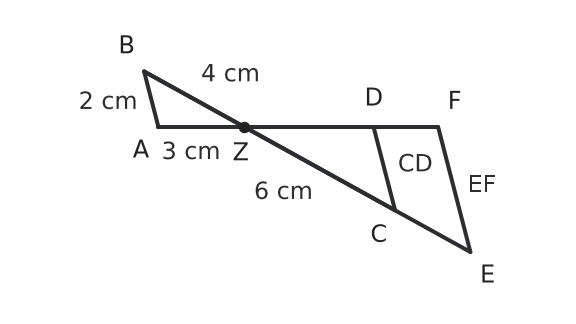
Figure for problem 536441

Hints

- First use the pair \(AB\parallel CD\). - Apply the same scale factor to the corresponding parallel segments. - Then use the pair \(CD\parallel EF\) to find the remaining values.

Solution

1. From \(AB\parallel CD\), \(\frac{ZA}{ZD}=\frac{ZB}{ZC}\). Thus, \(\frac{3}{ZD}=\frac{4}{6}\), so \(ZD=4.5\,\text{cm}\). 2. The parallel segment lengths use the same ratio: \(\frac{AB}{CD}=\frac{ZA}{ZD}\). Thus, \(\frac{2}{CD}=\frac{3}{4.5}\), so \(CD=3\,\text{cm}\). 3. From \(CD\parallel EF\), \(\frac{ZD}{ZF}=\frac{ZC}{ZE}\). Thus, \(\frac{4.5}{ZF}=\frac{6}{9}\), so \(ZF=6.75\,\text{cm}\). 4. The parallel segment lengths satisfy \(\frac{CD}{EF}=\frac{ZC}{ZE}\). Thus, \(\frac{3}{EF}=\frac{6}{9}\), so \(EF=4.5\,\text{cm}\).

Answer

\(ZD=4.5\,\text{cm}\), \(CD=3\,\text{cm}\), \(ZF=6.75\,\text{cm}\), and \(EF=4.5\,\text{cm}\)

53646810
Triangle \(ABC\) is right at \(C\), and altitude \(CD\) meets hypotenuse \(AB\). Let \(AC=b=12\,\text{cm}\), \(AD=p=9.6\,\text{cm}\), \(DB=q\), and \(AB=c\). a) Find the hypotenuse \(c\). b) Find \(q\) and the other leg \(a\). c) Find the altitude \(h_c=CD\).
Figure for problem 536468

Hints

- The altitude to the hypotenuse creates three similar right triangles. - Use the relationship between a leg, its adjacent hypotenuse segment, and the entire hypotenuse. - After finding the full hypotenuse, subtract to find the other segment, then use the similarity relationships for the remaining lengths.

Solution

1. The similar triangles formed by the altitude give \(b^2=cp\). Thus, \(c=\frac{b^2}{p}=\frac{12^2}{9.6}=15\,\text{cm}\). 2. Since \(c=p+q\), \(q=15-9.6=5.4\,\text{cm}\). 3. Use \(a^2=cq\): \(a^2=15\cdot 5.4=81\), so \(a=9\,\text{cm}\). 4. Use \(h_c^2=pq\): \(h_c^2=9.6\cdot 5.4=51.84\), so \(h_c=7.2\,\text{cm}\).

Answer

a) \(c=15\,\text{cm}\) b) \(q=5.4\,\text{cm}\); \(a=9\,\text{cm}\) c) \(h_c=7.2\,\text{cm}\)
53656110
Right triangle \(ABC\) has a right angle at \(C\), hypotenuse \(c=7.5\,\text{cm}\), and leg \(a=4.5\,\text{cm}\). Altitude \(CD\) divides the hypotenuse into \(DB=p\) and \(AD=q\). Find \(p\), \(q\), and the altitude \(h=CD\).
Figure for problem 536561

Hints

- The altitude to the hypotenuse creates three similar right triangles. - Relate the given leg to its adjacent hypotenuse segment and the full hypotenuse. - The two hypotenuse segments add to \(c\), and the altitude is the geometric mean of those segments.

Solution

1. The similar triangles formed by the altitude give \(a^2=cp\). Thus, \(p=\frac{4.5^2}{7.5}=2.7\,\text{cm}\). 2. Since \(p+q=c\), \(q=7.5-2.7=4.8\,\text{cm}\). 3. The altitude relationship is \(h^2=pq\). Therefore, \(h=\sqrt{2.7\cdot 4.8}=\sqrt{12.96}=3.6\,\text{cm}\).

Answer

\(p=2.7\,\text{cm}\), \(q=4.8\,\text{cm}\), and \(h=3.6\,\text{cm}\)
53657010
Right triangle \(ABC\) has legs \(a=5\,\text{cm}\) and \(b=12\,\text{cm}\). Altitude \(CD\) divides hypotenuse \(AB\) into \(DB=p\) and \(AD=q\). Find \(p\), \(q\), and \(h=CD\). Round to the nearest hundredth of a centimeter.
Figure for problem 536570

Hints

- First find the hypotenuse with the Pythagorean theorem. - Use the similar-triangle relationships to find the two hypotenuse segments. - Check that \(p+q=c\).

Solution

1. Find the hypotenuse: \(c=\sqrt{5^2+12^2}=13\,\text{cm}\). 2. The similar triangles give \(a^2=cp\), so \(p=\frac{25}{13}\,\text{cm}\approx 1.92\,\text{cm}\). 3. Similarly, \(b^2=cq\), so \(q=\frac{144}{13}\,\text{cm}\approx 11.08\,\text{cm}\). 4. The altitude satisfies \(h^2=pq\). Using exact values, \(h=\sqrt{\frac{25}{13}\cdot\frac{144}{13}}=\frac{60}{13}\,\text{cm}\approx 4.62\,\text{cm}\).

Answer

\(p\approx 1.92\,\text{cm}\), \(q\approx 11.08\,\text{cm}\), and \(h\approx 4.62\,\text{cm}\)
53664410
In \(\triangle ABC\), point \(K\) is the midpoint of \(AB\). Point \(P\) lies on \(BC\), but \(P\) is not its midpoint. Can \(KP\) be parallel to \(AC\)? Explain.
Figure for problem 536644

Hints

- Recall the converse relationship in the Triangle Midsegment Theorem. - What must be true about \(P\) if a segment through midpoint \(K\) is parallel to \(AC\)?

Solution

1. Suppose \(KP \parallel AC\). 2. By the converse relationship in the Triangle Midsegment Theorem, a line through the midpoint of one side of a triangle that is parallel to a second side must meet the third side at its midpoint. 3. Since \(K\) is the midpoint of \(AB\), point \(P\) would have to be the midpoint of \(BC\). 4. This contradicts the given information. Therefore, \(KP \not\parallel AC\).

Answer

No. If \(KP \parallel AC\), then \(P\) would have to be the midpoint of \(BC\), contrary to the given condition.
53686710
In trapezoid \(ABCD\), the parallel bases have lengths \(AB=20\) and \(CD=5\). The diagonals intersect at \(S\). Find the ratio of the area of triangle \(CDS\) to the area of triangle \(ABS\).
Figure for problem 536867

Hints

- Why are the two triangles similar? - How is the area ratio related to the ratio of corresponding side lengths?

Solution

1. Because \(AB\parallel CD\), alternate interior angles show that \(\triangle CDS\sim\triangle ABS\) by AA. 2. The length scale factor from triangle \(ABS\) to triangle \(CDS\) is \(k=\frac{CD}{AB}=\frac{5}{20}=\frac{1}{4}\). 3. Areas of similar figures scale by the square of the length scale factor, so \(\frac{A_{CDS}}{A_{ABS}}=k^2=\left(\frac{1}{4}\right)^2=\frac{1}{16}\).

Answer

The area ratio of triangle \(CDS\) to triangle \(ABS\) is \(1\) to \(16\).
53687010
In the diagram, \(g\parallel h\). The segment lengths are \(ZA=3\), \(AB=x\), \(ZC=x\), and \(CD=12\). Find the positive value of \(x\).
Figure for problem 536870

Hints

- Set up a proportion in which \(x\) appears twice. - Cross-multiply to obtain a quadratic equation. - Choose the solution that is valid for a length.

Solution

1. Corresponding intervals on the two rays are proportional: \(\frac{AB}{ZA}=\frac{CD}{ZC}\). 2. Substitute the values: \(\frac{x}{3}=\frac{12}{x}\). 3. Cross-multiplication gives \(x^2=36\). 4. Since a length is positive, \(x=6\).

Answer

\(x=6\)
53687210
In the diagram, \(g\parallel h\). The total length \(ZD\) is \(16\), and \(ZA=5\) and \(AB=3\). Find \(x=ZC\) and \(y=CD\).
Figure for problem 536872

Hints

- Use proportional corresponding intervals on the two rays. - Use the total-length equation \(x+y=16\). - Express one variable in terms of the other before solving.

Solution

1. Corresponding intervals on the two rays are proportional: \(\frac{x}{5}=\frac{y}{3}\), so \(x=\frac{5}{3}y\). 2. The two unknown segments make the total length: \(x+y=16\). 3. Substitute: \(\frac{5}{3}y+y=16\), so \(\frac{8}{3}y=16\) and \(y=6\). 4. Therefore, \(x=16-6=10\).

Answer

\(x=10\) and \(y=6\)
53692710
Triangles \(ABC\) and \(A_1B_1C_1\) are similar. In triangle \(ABC\), \(AB=12\) and \(AC=18\). In triangle \(A_1B_1C_1\), \(A_1B_1=4\) and \(B_1C_1=5\). Find \(x=BC\) and \(y=A_1C_1\).
Figure for problem 536927

Hints

- Which pair of corresponding sides has both lengths given? - Use that pair to find the scale factor between the triangles. - Decide whether to multiply or divide by the scale factor for each unknown side.

Solution

1. Use the known pair of corresponding sides to find the scale factor from \(A_1B_1C_1\) to \(ABC\): \(k=\frac{AB}{A_1B_1}=\frac{12}{4}=3\). 2. Since \(BC\) corresponds to \(B_1C_1\), \(x=3\cdot5=15\). 3. Since \(AC\) corresponds to \(A_1C_1\), \(18=3y\), so \(y=6\).

Answer

\(x=15\) and \(y=6\)
53692910
Triangles \(ABC\) and \(A_1B_1C_1\) are similar. The side lengths of \(\triangle ABC\) are \(6\), \(8\), and \(10\). The perimeter of \(\triangle A_1B_1C_1\) is \(48\). Find the side lengths \(x\), \(y\), and \(z\) of \(\triangle A_1B_1C_1\).
Figure for problem 536929

Hints

- How are the perimeters of similar figures related to their scale factor? - First find the perimeter of the smaller triangle. - Compare the two perimeters, then apply that factor to each side.

Solution

1. The perimeter of \(\triangle ABC\) is \(6+8+10=24\). 2. The ratio of the perimeters equals the scale factor: \(k=\frac{48}{24}=2\). 3. Multiply each side length of \(\triangle ABC\) by \(2\): \(x=2\cdot6=12\), \(y=2\cdot8=16\), and \(z=2\cdot10=20\).

Answer

\(x=12\), \(y=16\), and \(z=20\)
53703510
In right triangle \(ABC\), altitude \(CD\) divides hypotenuse \(AB\) into segments \(AD=p\) and \(DB=q\). The hypotenuse is \(13\,\text{cm}\), and \(p=4\,\text{cm}\). Find the altitude \(h=CD\).
Figure for problem 537035

Hints

- First find the missing hypotenuse segment. - The altitude is the geometric mean of the two hypotenuse segments.

Solution

1. The other hypotenuse segment is \(q=13-4=9\,\text{cm}\). 2. The similar triangles formed by the altitude give \(h^2=pq\). 3. Thus, \(h=\sqrt{4\cdot 9}=6\,\text{cm}\).

Answer

\(h=6\,\text{cm}\)
53703610
In right triangle \(ABC\), leg \(a=8\,\text{cm}\) and hypotenuse \(c=10\,\text{cm}\). Altitude \(CD\) divides the hypotenuse into segment \(q\) adjacent to leg \(a\) and the remaining segment \(p\). Find \(q\) and the altitude \(h=CD\).
Figure for problem 537036

Hints

- Relate the given leg to the full hypotenuse and its adjacent segment. - After finding both hypotenuse segments, use their geometric mean to find the altitude. - Check that the two segments add to \(10\,\text{cm}\).

Solution

1. The similar triangles give \(a^2=cq\), so \(q=\frac{8^2}{10}=6.4\,\text{cm}\). 2. The other segment is \(p=10-6.4=3.6\,\text{cm}\). 3. The altitude satisfies \(h^2=pq\), so \(h=\sqrt{3.6\cdot 6.4}=4.8\,\text{cm}\).

Answer

\(q=6.4\,\text{cm}\) and \(h=4.8\,\text{cm}\)
53703810
Triangle \(ABC\) has area \(144\,\text{cm}^2\). Segment \(DE\) is parallel to \(AB\), with \(D\) on \(AC\) and \(E\) on \(BC\). The area of the smaller triangle \(DEC\) is \(81\,\text{cm}^2\). Find the ratio \(CD\) to \(CA\).
Figure for problem 537038

Hints

- Why are \(\triangle DEC\) and \(\triangle ABC\) similar? - How is the area ratio of similar figures related to their linear scale factor? - Use a square root to move from the area ratio to the side-length ratio. - Is area proportional to length or to the square of length?

Solution

1. Because \(DE\parallel AB\), \(\triangle DEC\sim\triangle ABC\) by AA. 2. The area ratio equals the square of the linear scale factor: \(\frac{81}{144}=k^2\). 3. Therefore, \(k=\sqrt{\frac{81}{144}}=\frac{9}{12}=\frac{3}{4}\). 4. Since \(CD\) corresponds to \(CA\), the ratio \(CD\) to \(CA\) is \(3\) to \(4\).

Answer

The ratio \(CD\) to \(CA\) is \(3\) to \(4\).
53704910
Two similar figures have areas of \(27\,\text{cm}^2\) and \(75\,\text{cm}^2\). A side of the smaller figure is \(9\,\text{cm}\) long. Find the corresponding side length \(x\) of the larger figure.
Figure for problem 537049

Hints

- Simplify the area ratio before taking its square root. - How is the length scale factor related to the area ratio of similar figures?

Solution

1. The area ratio is \(k^2=\frac{75}{27}=\frac{25}{9}\). 2. Since the length scale factor is positive, \(k=\sqrt{\frac{25}{9}}=\frac{5}{3}\). 3. The corresponding side length is \(x=9\,\text{cm}\cdot\frac{5}{3}=15\,\text{cm}\).

Answer

\(x=15\,\text{cm}\)
53705410
In triangle \(ABC\), \(DE\parallel BC\). The lengths are \(AD=x\), \(AB=x+2\), \(AE=6\), and \(AC=10\). Find \(x\).
Figure for problem 537054

Hints

- Write a proportion using corresponding sides of the similar triangles. - Cross-multiply to clear the fractions.

Solution

1. Similar triangles give \(\frac{AD}{AB}=\frac{AE}{AC}\). 2. Substitute the expressions: \(\frac{x}{x+2}=\frac{6}{10}\). 3. Cross-multiply: \(10x=6(x+2)\). 4. Solve: \(10x=6x+12\), so \(4x=12\) and \(x=3\).

Answer

\(x=3\)
53705710
In triangle \(ABC\), points \(D\) and \(E\) are the midpoints of \(AB\) and \(AC\), respectively, and \(DE\parallel BC\). The area of \(\triangle ADE\) is \(10\,\text{cm}^2\). Find the area \(x\) of \(\triangle ABC\).
Figure for problem 537057

Hints

- What is the linear scale factor from half a side length to the full side length? - How does area change when all lengths are doubled?

Solution

1. Because \(D\) and \(E\) are midpoints, the linear scale factor from \(\triangle ADE\) to \(\triangle ABC\) is \(2\). 2. The area scale factor is \(2^2=4\). 3. Therefore, \(x=10\cdot4=40\,\text{cm}^2\).

Answer

\(x=40\,\text{cm}^2\)
53705810
A segment parallel to \(BC\) intersects \(AB\) at \(D\) and \(AC\) at \(E\). The ratio \(AD\) to \(AB\) is \(1\) to \(3\). The area of \(\triangle ADE\) is \(5\,\text{cm}^2\). Find the area \(x\) of quadrilateral \(BCED\).
Figure for problem 537058

Hints

- Use the side-length ratio to find the area scale factor between the two similar triangles. - After finding the area of the whole triangle, subtract the area of the smaller triangle.

Solution

1. The linear scale factor from \(\triangle ADE\) to \(\triangle ABC\) is \(3\). 2. The area scale factor is \(3^2=9\), so the area of \(\triangle ABC\) is \(5\cdot9=45\,\text{cm}^2\). 3. Subtract the area of the smaller triangle: \(x=45-5=40\,\text{cm}^2\).

Answer

\(x=40\,\text{cm}^2\)
53706110
Similar triangles \(ABC\) and \(DEF\) have areas \(12\,\text{cm}^2\) and \(27\,\text{cm}^2\), respectively. The sum of their perimeters is \(45\,\text{cm}\). Find \(x=P_{ABC}\) and \(y=P_{DEF}\).
Figure for problem 537061

Hints

- How can you obtain a linear scale factor from an area ratio? - Perimeters scale by the same factor as corresponding side lengths.

Solution

1. The area ratio is \(\frac{27}{12}=\frac{9}{4}\). 2. The linear scale factor is the square root of the area ratio: \(k=\sqrt{\frac{9}{4}}=\frac{3}{2}=1.5\). 3. Perimeters scale by the same linear factor, so \(y=1.5x\). 4. Use the perimeter sum: \(x+1.5x=45\), so \(2.5x=45\) and \(x=18\,\text{cm}\). 5. Then \(y=45-18=27\,\text{cm}\).

Answer

\(x=18\,\text{cm}\) and \(y=27\,\text{cm}\)
53707410
In trapezoid \(ABCD\), \(AB\parallel CD\). Diagonal \(AC\) divides the trapezoid into similar triangles with \(\triangle ABC\sim\triangle CAD\). Given \(CD=4\) and \(AB=9\), find \(x=AC\).
Figure for problem 537074

Hints

- Write a proportion using corresponding sides of the similar triangles. - Use the order in the similarity statement to match the vertices.

Solution

1. From \(\triangle ABC\sim\triangle CAD\), corresponding sides give \(\frac{AB}{AC}=\frac{AC}{CD}\). 2. Substitute the known values: \(\frac{9}{x}=\frac{x}{4}\). 3. Then \(x^2=9\cdot4=36\). Since a length is positive, \(x=6\).

Answer

\(x=6\)
53707510
In quadrilateral \(PQRS\), \(PQ\parallel RS\). Diagonal \(QS\) forms similar triangles with \(\triangle PQS\sim\triangle QSR\). Given \(PQ=8\), \(RS=18\), and \(QR=15\), find \(x=QS\) and \(y=PS\).
Figure for problem 537075

Hints

- Write proportions using corresponding sides of the similar triangles. - Use the order of the vertices in the similarity statement to match the sides.

Solution

1. Corresponding sides give \(\frac{PQ}{QS}=\frac{QS}{RS}\). 2. Substitute the known values: \(\frac{8}{x}=\frac{x}{18}\). Then \(x^2=144\), so \(x=12\). 3. Another pair of corresponding sides gives \(\frac{PS}{QR}=\frac{PQ}{QS}\). 4. Thus, \(\frac{y}{15}=\frac{8}{12}=\frac{2}{3}\), so \(y=10\).

Answer

\(x=12\) and \(y=10\)
53707610
In triangle \(PQR\), point \(S\) lies on \(PQ\), and \(\angle PRS\cong\angle PQR\). Given \(PS=9\) and \(PR=12\), find \(x=PQ\) and \(y=SQ\).
Figure for problem 537076

Hints

- Which two triangles share one angle and have another pair of congruent angles? - Use their similarity to write a proportion for the full length \(PQ\).

Solution

1. Triangles \(PRS\) and \(PQR\) share the angle at \(P\), and \(\angle PRS\cong\angle PQR\). Therefore, \(\triangle PRS\sim\triangle PQR\) by AA. 2. Corresponding sides give \(\frac{PQ}{PR}=\frac{PR}{PS}\). 3. Substitute: \(\frac{x}{12}=\frac{12}{9}\). Then \(9x=144\), so \(x=16\). 4. Therefore, \(y=SQ=PQ-PS=16-9=7\).

Answer

\(x=16\) and \(y=7\)
53708110
Right triangle \(ABC\) has \(\angle C=90^\circ\), \(AC=8\,\text{cm}\), and \(BC=6\,\text{cm}\). Point \(D\) lies on \(AC\) with \(AD=5\,\text{cm}\). From \(D\), a perpendicular segment is drawn to hypotenuse \(AB\), meeting it at \(E\). Find \(DE\).
Figure for problem 537081

Hints

- First find the hypotenuse of the large right triangle. - Which smaller triangle shares an angle with \(\triangle ABC\) and also has a right angle? - Write a proportion using corresponding sides.

Solution

1. Use the Pythagorean theorem to find the hypotenuse: \(AB=\sqrt{8^2+6^2}=10\,\text{cm}\). 2. Triangles \(ADE\) and \(ABC\) share \(\angle A\), and \(\angle AED\) and \(\angle ACB\) are right angles. Therefore, \(\triangle ADE\sim\triangle ABC\) by AA. 3. Corresponding sides give \(\frac{DE}{BC}=\frac{AD}{AB}\). 4. Thus, \(\frac{DE}{6}=\frac{5}{10}\), so \(DE=3\,\text{cm}\).

Answer

\(DE=3\,\text{cm}\)
53708910
The triangles in panels a) and b) are similar. It is given that \(\angle M\cong\angle C\) and \(\angle N\cong\angle A\). Find \(x\) and \(y\).
Figure for problem 537089

Hints

- Use the marked angles to match corresponding vertices. - Find the scale factor from the pair of known corresponding sides. - Write a separate proportion for each unknown.

Solution

1. The angle information gives the correspondence \(M\leftrightarrow C\), \(N\leftrightarrow A\), and \(K\leftrightarrow B\). Thus, \(\triangle KMN\sim\triangle BCA\). 2. Using corresponding sides \(KN\) and \(BA\), the scale factor from panel b) to panel a) is \(\frac{5}{10}=0.5\). 3. Since \(MN\) corresponds to \(CA\), \(\frac{y}{12}=0.5\), so \(y=6\). 4. Since \(KM\) corresponds to \(BC\), \(\frac{x}{x+3}=0.5\). Solving gives \(x=3\).

Answer

\(x=3\) and \(y=6\)
53709110
In the diagram, \(MQ\parallel LN\), and the two transversals intersect at \(O\). The lengths are \(MO=12\) and \(OL=8\). Also, \(x=MQ\), \(y=LN\), and \(x+y=20\). Find \(x\) and \(y\). Then find \(ON\) if \(QO=15\).
Figure for problem 537091

Hints

- Identify the similar triangles on opposite sides of \(O\). - Combine the side ratio with \(x+y=20\). - Use the same similarity ratio for \(QO\) and \(ON\).

Solution

1. Since \(MQ\parallel LN\), \(\triangle MOQ\sim\triangle LON\). 2. Corresponding sides satisfy \(\frac{x}{y}=\frac{MO}{OL}=\frac{12}{8}=1.5\), so \(x=1.5y\). 3. Use \(x+y=20\): \(1.5y+y=20\), so \(2.5y=20\) and \(y=8\). 4. Therefore, \(x=12\). 5. Also, \(\frac{QO}{ON}=\frac{MO}{OL}=1.5\). Thus, \(\frac{15}{ON}=1.5\), so \(ON=10\).

Answer

\(x=12\), \(y=8\), and \(ON=10\) units
53709410
In the right triangle shown, \(EF\parallel BC\). Find the unknown lengths \(x\) and \(y\).
Figure for problem 537094

Hints

- Use the Pythagorean Theorem in the smaller right triangle. - Find the full base of the larger triangle. - Use similarity to compare corresponding legs.

Solution

1. Because \(EF\parallel BC\), \(\triangle AEF\sim\triangle ABC\). 2. In right triangle \(AEF\), apply the Pythagorean Theorem: \(y=\sqrt{15^2-12^2}=\sqrt{81}=9\) units. 3. The full base of the larger triangle is \(AC=6+9=15\) units. 4. Corresponding legs satisfy \(\frac{x}{12}=\frac{15}{9}\). 5. Therefore, \(x=12\cdot\frac{15}{9}=20\) units.

Answer

\(x=20\) units and \(y=9\) units
53709810
In the trapezoid shown, \(TF\parallel SE\), and the diagonals intersect at \(O\). Find \(x\) and \(y\).
Figure for problem 537098

Hints

- Identify the similar triangles formed by the diagonals and parallel bases. - Find the scale factor using the known diagonal segments. - Apply that factor to the corresponding base and diagonal segment.

Solution

1. Since \(TF\parallel SE\), \(\triangle FOT\sim\triangle SOE\). 2. The scale factor from the larger triangle to the smaller triangle is \(k=\frac{OF}{SO}=\frac{10}{16}=0.625\). 3. Therefore, \(x=TF=40\cdot0.625=25\) units. 4. Also, \(y=TO=24\cdot0.625=15\) units.

Answer

\(x=25\) units and \(y=15\) units
53710010
In triangle \(ADC\), \(MN\parallel DC\). Find \(x\), \(y\), and \(z\).
Figure for problem 537100

Hints

- Find the scale factor using \(AM\) and \(AD\). - Apply it to the full side \(AC\). - Use the same factor for the parallel sides \(MN\) and \(DC\).

Solution

1. Since \(MN\parallel DC\), \(\triangle AMN\sim\triangle ADC\). 2. The scale factor from the larger triangle to the smaller triangle is \(\frac{AM}{AD}=\frac{10}{10+5}=\frac{2}{3}\). 3. Thus, \(\frac{x}{18}=\frac{2}{3}\), so \(x=12\) units. 4. Therefore, \(y=18-12=6\) units. 5. Also, \(\frac{14}{z}=\frac{2}{3}\), so \(z=21\) units.

Answer

\(x=12\) units, \(y=6\) units, and \(z=21\) units
53710910
In the diagram, \(DE\parallel AC\). Find \(x\) and \(y\).
Figure for problem 537109

Hints

- Use the ratio of the parallel sides to find the similarity scale factor. - Express each full side as the sum of its two labeled parts. - Solve one proportion for each unknown.

Solution

1. Similar triangles give \(\frac{DE}{AC}=\frac{BD}{BA}\). 2. Substitute the labeled lengths: \(\frac{15}{25}=\frac{x}{x+8}\). 3. Solve: \(0.6(x+8)=x\), so \(0.4x=4.8\) and \(x=12\) units. 4. The same scale factor gives \(\frac{BE}{BC}=0.6\). Thus, \(\frac{y}{y+10}=0.6\). 5. Solving gives \(0.4y=6\), so \(y=15\) units.

Answer

\(x=12\) units and \(y=15\) units
53712810
In right triangle \(ABC\), \(\angle C=90^\circ\). Altitude \(CD\) is drawn to hypotenuse \(AB\). a) Explain why \(\triangle ACD\sim\triangle ABC\). b) Find \(CD\) when \(AC=6\,\text{cm}\) and \(BC=8\,\text{cm}\).
Figure for problem 537128

Hints

- Which angles in the two triangles are congruent? - Use the Pythagorean theorem to find the hypotenuse of the large triangle. - Match corresponding sides before writing a proportion.

Solution

1. For part a), \(\angle ADC\) and \(\angle ACB\) are right angles, and the triangles share \(\angle A\). Therefore, \(\triangle ACD\sim\triangle ABC\) by AA. 2. Use the Pythagorean theorem in \(\triangle ABC\): \(AB=\sqrt{6^2+8^2}=10\,\text{cm}\). 3. Corresponding sides give \(\frac{CD}{BC}=\frac{AC}{AB}\). 4. Therefore, \(CD=\frac{6\cdot8}{10}=4.8\,\text{cm}\).

Answer

a) \(\triangle ACD\sim\triangle ABC\) by AA because they share \(\angle A\) and each has a right angle. b) \(CD=4.8\,\text{cm}\)
53712910
In triangle \(ABC\), altitude \(AD\) is drawn to \(BC\), and altitude \(BE\) is drawn to line \(AC\). a) Identify two similar triangles that share vertex \(C\), and justify their similarity. b) Find \(AD\) when \(AC=10\,\text{cm}\), \(BC=15\,\text{cm}\), and \(BE=6\,\text{cm}\).
Figure for problem 537129

Hints

- Look for triangles containing the given and unknown altitudes. - Which right angles are formed by the altitudes? - Which angle at \(C\) belongs to both triangles? - Match corresponding sides before writing a proportion.

Solution

1. For part a), triangles \(ADC\) and \(BEC\) each have a right angle and share the angle at \(C\). Therefore, \(\triangle ADC\sim\triangle BEC\) by AA. 2. Corresponding sides give \(\frac{AD}{AC}=\frac{BE}{BC}\). 3. Therefore, \(AD=\frac{6\cdot10}{15}=4\,\text{cm}\).

Answer

a) \(\triangle ADC\sim\triangle BEC\) by AA because both are right triangles and share the angle at \(C\). b) \(AD=4\,\text{cm}\)
53713010
Rectangle \(PQRS\) is inscribed in triangle \(ABC\). Side \(PQ\) lies on base \(AB\), and vertices \(S\) and \(R\) lie on \(AC\) and \(BC\). The triangle has base \(AB=15\,\text{cm}\) and height \(10\,\text{cm}\). The rectangle has height \(4\,\text{cm}\). a) Name a smaller triangle in the diagram that is similar to \(\triangle ABC\). b) Find the width \(SR\) of the rectangle.
Figure for problem 537130

Hints

- Which side of the rectangle is parallel to \(AB\)? - Find the height of the triangle above the rectangle. - Use corresponding heights and bases of the similar triangles.

Solution

1. Since opposite sides of a rectangle are parallel, \(SR\parallel AB\). Therefore, \(\triangle SRC\sim\triangle ABC\) by AA. 2. The height of \(\triangle SRC\) is \(10-4=6\,\text{cm}\). 3. Corresponding bases and heights are proportional: \(\frac{SR}{AB}=\frac{6}{10}\). 4. Thus, \(SR=15\cdot\frac{6}{10}=9\,\text{cm}\).

Answer

a) \(\triangle SRC\) b) \(SR=9\,\text{cm}\)
53713110
Two vertical poles stand on level ground. The shorter pole \(AB\) is \(2\,\text{m}\) tall, and the taller pole \(CD\) is \(5\,\text{m}\) tall. From a point \(S\) on the ground, the tops \(B\) and \(D\) lie on the same line of sight. The distance from \(S\) to the base \(A\) of the shorter pole is \(3\,\text{m}\). a) Explain why \(\triangle SAB\) and \(\triangle SCD\) are similar. b) Find the distance \(AC\) between the poles.
Figure for problem 537131

Hints

- View the picture as two nested right triangles. - Identify the shared angle and the right angles. - Use the ratio of the pole heights to find the total distance \(SC\). - Subtract \(SA\) to find only the distance between the poles.

Solution

1. Both triangles are right triangles because the poles are perpendicular to the ground. They also share the angle at \(S\). Therefore, \(\triangle SAB\sim\triangle SCD\) by AA. 2. Corresponding heights and ground distances are proportional: \(\frac{CD}{AB}=\frac{SC}{SA}\). 3. Substitute: \(\frac{5}{2}=\frac{SC}{3}\), so \(SC=3\cdot\frac{5}{2}=7.5\,\text{m}\). 4. The distance between the poles is \(AC=SC-SA=7.5-3=4.5\,\text{m}\).

Answer

a) The triangles are similar by AA because each has a right angle and they share the angle at \(S\). b) \(AC=4.5\,\text{m}\)
53719110
A triangular garden bed is shaped like \(\triangle ABC\). Point \(M\) is the midpoint of \(BC\), and a border through \(M\), parallel to \(AB\), meets \(AC\) at \(N\). This creates the smaller triangular bed \(MNC\). What is the ratio of the area of \(\triangle MNC\) to the area of \(\triangle ABC\)?
Figure for problem 537191

Hints

- Why are the small and large triangles similar? - What fraction of \(BC\) is \(MC\)? - Square the linear scale factor to obtain the area ratio.

Solution

1. Because \(MN\parallel AB\), \(\triangle MNC\sim\triangle BAC\) by AA. 2. Since \(M\) is the midpoint of \(BC\), the linear scale factor from the large triangle to the small triangle is \(\frac{MC}{BC}=\frac{1}{2}\). 3. The area ratio is the square of the linear scale factor: \(\left(\frac{1}{2}\right)^2=\frac{1}{4}\). 4. Therefore, the ratio of the small area to the large area is \(1\) to \(4\).

Answer

\(1\) to \(4\)
53721410
In right triangle \(ABC\), altitude \(CD\) to hypotenuse \(AB\) divides the hypotenuse into \(AD=p\) and \(DB=q\). Given \(q=1.8\,\text{cm}\) and \(h=CD=2.4\,\text{cm}\): a) Find \(p\). b) Find legs \(a=BC\) and \(b=AC\).
Figure for problem 537214

Hints

- Use the geometric-mean relationship between the altitude and the two hypotenuse segments. - After finding \(p\), apply the Pythagorean theorem in each smaller right triangle.

Solution

1. The similar triangles give \(h^2=pq\), so \(p=\frac{2.4^2}{1.8}=3.2\,\text{cm}\). 2. In right triangle \(BCD\), \(a=\sqrt{2.4^2+1.8^2}=\sqrt{9}=3\,\text{cm}\). 3. In right triangle \(ACD\), \(b=\sqrt{2.4^2+3.2^2}=\sqrt{16}=4\,\text{cm}\).

Answer

a) \(p=3.2\,\text{cm}\) b) \(a=3\,\text{cm}\); \(b=4\,\text{cm}\)
53721610
Two rays start at point \(Z\) and are intersected by two parallel segments, as shown. Find the missing lengths \(x\) and \(y\).
Figure for problem 537216

Hints

- Identify the complete distances from \(Z\) to the farther parallel segment. - Use a proportion involving distances measured from \(Z\) to find \(x\). - Then compare the lengths of the parallel segments to their distances from \(Z\).

Solution

1. The distances from \(Z\) to the two parallel segments are proportional on both rays: \(\frac{ZA}{ZC}=\frac{ZB}{ZD}\). 2. Substitute \(ZA=5\), \(ZC=5+3=8\), \(ZB=4\), and \(ZD=4+x\): \(\frac{5}{8}=\frac{4}{4+x}\). 3. Cross-multiply: \(5(4+x)=32\), so \(20+5x=32\), \(5x=12\), and \(x=2.4\,\text{cm}\). 4. The parallel segments are proportional to their distances from \(Z\): \(\frac{AB}{CD}=\frac{ZA}{ZC}\). 5. Substitute: \(\frac{6}{y}=\frac{5}{8}\). Cross-multiplying gives \(5y=48\), so \(y=9.6\,\text{cm}\).

Answer

\(x=2.4\,\text{cm}\) and \(y=9.6\,\text{cm}\)
51483710
Two similar triangles have perimeters in the ratio \(3\) to \(5\). The area of the larger triangle is \(100\,\text{cm}^2\) greater than the area of the smaller triangle. Find the areas \(A_1\) and \(A_2\) of the two triangles.

Hints

- What does the perimeter ratio tell you about the length scale factor? - How is the area ratio related to the length scale factor? - Write an equation using the \(100\,\text{cm}^2\) difference between the areas.

Solution

1. The length scale factor from the smaller triangle to the larger triangle is \(k=\frac{5}{3}\). 2. Therefore, \(\frac{A_2}{A_1}=k^2=\left(\frac{5}{3}\right)^2=\frac{25}{9}\). 3. The area difference gives \(A_2-A_1=100\). 4. Substitute \(A_2=\frac{25}{9}A_1\): \(\frac{25}{9}A_1-A_1=100\), so \(\frac{16}{9}A_1=100\). 5. Thus, \(A_1=\frac{100\cdot9}{16}=56.25\,\text{cm}^2\). 6. The larger area is \(A_2=56.25\,\text{cm}^2+100\,\text{cm}^2=156.25\,\text{cm}^2\).

Answer

\(A_1=56.25\,\text{cm}^2\) and \(A_2=156.25\,\text{cm}^2\)
51485610
In trapezoid \(ABCD\), \(AB\parallel CD\), and diagonals \(AC\) and \(BD\) intersect at \(S\). The length of \(AB\) is \(1.5\) times the length of \(CD\), and \(AC=15\,\text{cm}\). a) Explain why triangles \(ABS\) and \(CDS\) are similar. b) Find \(AS\) and \(CS\). c) Find the ratio of the area of triangle \(ABS\) to the area of triangle \(CDS\). Briefly justify your answer.

Hints

- Use the parallel bases and the vertical angles at \(S\) to compare the triangles. - The diagonal segments have the same ratio as the corresponding parallel sides. - Use the corresponding side-length ratio to split the full diagonal into \(AS\) and \(CS\). - How do the areas of similar figures compare to their corresponding side lengths?

Solution

1. Since \(AB\parallel CD\), alternate interior angles give two pairs of congruent angles. The vertical angles at \(S\) are also congruent, so \(\triangle ABS\sim\triangle CDS\) by AA. 2. Corresponding sides are proportional: \(\frac{AS}{CS}=\frac{AB}{CD}=1.5=\frac{3}{2}\). 3. Let \(AS=3x\) and \(CS=2x\). Since \(AS+CS=15\), \(5x=15\), so \(x=3\). 4. Thus, \(AS=9\,\text{cm}\) and \(CS=6\,\text{cm}\). 5. The area ratio of similar triangles is the square of the side-length ratio: \(\left(\frac{3}{2}\right)^2=\frac{9}{4}\).

Answer

a) \(\triangle ABS\sim\triangle CDS\) by AA because \(AB\parallel CD\) and the angles at \(S\) are vertical angles. b) \(AS=9\,\text{cm}\) and \(CS=6\,\text{cm}\) c) The area ratio is \(9\) to \(4\).
51486610
A large rectangular display has side lengths \(a\) and \(b\), where \(b\) is the longer side. It is cut into three congruent smaller rectangles by cuts parallel to the shorter side \(a\). Each smaller rectangle is similar to the original large rectangle. Find the exact ratio of the original side lengths \(b\) to \(a\).

Hints

- What equation describes equal side-length ratios for similar rectangles? - What are the side lengths of each smaller rectangle after the longer side is divided into three equal parts? - Which side of a smaller rectangle corresponds to the longer side of the original rectangle? - Set the two longer-side-to-shorter-side ratios equal.

Solution

1. The original rectangle has side-length ratio \(\frac{b}{a}\). Dividing the longer side \(b\) into three equal parts produces smaller rectangles with side lengths \(a\) and \(\frac{b}{3}\). 2. Each smaller rectangle is similar to the original after a \(90^\circ\) rotation. Therefore, the ratio of the longer side to the shorter side satisfies \(\frac{b}{a}=\frac{a}{b/3}\). 3. Rewrite the equation as \(\frac{b}{a}=\frac{3a}{b}\). Multiplying by \(ab\) gives \(b^2=3a^2\). 4. Divide by \(a^2\) to obtain \(\frac{b^2}{a^2}=3\). Since side lengths are positive, \(\frac{b}{a}=\sqrt{3}\).

Answer

The ratio of the longer side to the shorter side is \(\sqrt{3}\) to \(1\).
51486710
An A0 sheet of paper has an area of exactly \(1\,\text{m}^2\). For every international A-series paper size, the ratio of the longer side to the shorter side is \(\sqrt{2}\) to \(1\). a) Find the side lengths of an A0 sheet in centimeters. Round each length to the nearest tenth. b) An A4 sheet is produced by halving an A0 sheet along its longer side four times in succession. What is the area of an A4 sheet in square centimeters? c) Without doing additional calculations, explain why an A4 sheet is similar to an A0 sheet.

Hints

- How can you represent the two side lengths when their ratio is known? - What happens to area each time a rectangle is cut in half? - What side-length relationship must similar rectangles have? - How many A4 sheets have the same total area as one A0 sheet?

Solution

1. Let \(x\) be the shorter side in centimeters. Then the longer side is \(\sqrt{2}x\). Since \(1\,\text{m}^2=10{,}000\,\text{cm}^2\), \(x(\sqrt{2}x)=10{,}000\). Thus, \(x^2=\frac{10000}{\sqrt{2}}\), so \(x\approx84.1\,\text{cm}\). The longer side is \(\sqrt{2}x\approx118.9\,\text{cm}\). 2. Each halving cuts the area in half. After four halvings, the area is \(\frac{1}{2^4}=\frac{1}{16}\) of the original area. Therefore, the A4 area is \(\frac{10000\,\text{cm}^2}{16}=625\,\text{cm}^2\). 3. Halving the longer side changes dimensions in the ratio \(\sqrt{2}:1\) to dimensions in the ratio \(1:\frac{\sqrt{2}}{2}\). Rotating the smaller rectangle gives a longer-side-to-shorter-side ratio of \(\frac{1}{\sqrt{2}/2}=\sqrt{2}\). The side-length ratio and all right angles are preserved, so each new sheet is similar to the previous one and A4 is similar to A0.

Answer

a) The side lengths are approximately \(84.1\,\text{cm}\) and \(118.9\,\text{cm}\). b) The area of an A4 sheet is \(625\,\text{cm}^2\). c) Each halving preserves the \(\sqrt{2}\)-to-\(1\) side-length ratio after the new rectangle is rotated, so A4 and A0 are similar.
51536910
In right triangle \(ABC\), the right angle is at \(C\). Altitude \(CD\) is drawn to hypotenuse \(AB\). Leg \(a=BC\) is \(6\,\text{cm}\), and the hypotenuse \(c=AB\) is \(10\,\text{cm}\). a) Explain why triangle \(BDC\) is similar to triangle \(ABC\). b) Use the similarity to find the length \(q=BD\).

Hints

- Compare the angles in the two triangles. - Identify the hypotenuse and the leg adjacent to \(\angle B\) in each triangle. - Write a proportion using a leg and the hypotenuse in both triangles.

Solution

1. Triangles \(BDC\) and \(ABC\) are both right triangles because \(\angle BDC=90^\circ\) and \(\angle BCA=90^\circ\). They also share \(\angle B\). Therefore, they are similar by AA. 2. In the large triangle, the ratio of the leg adjacent to \(\angle B\) to the hypotenuse is \(\frac{a}{c}\). In the smaller triangle, the corresponding ratio is \(\frac{q}{a}\). 3. Set the ratios equal: \(\frac{q}{a}=\frac{a}{c}\), so \(q=\frac{a^2}{c}\). 4. Substitute the values: \(q=\frac{6^2}{10}\,\text{cm}=3.6\,\text{cm}\).

Answer

a) The triangles are similar by AA because they share \(\angle B\) and both have a right angle. b) \(q=3.6\,\text{cm}\)
51537210
An artist makes two similar solid-bronze sculptures. The smaller sculpture has a mass of \(15\,\text{kg}\) and a surface area of \(0.8\,\text{m}^2\). The larger sculpture has a surface area of \(1.8\,\text{m}^2\). a) Find the linear scale factor \(k\) from the smaller sculpture to the larger sculpture. b) Find the mass of the larger sculpture. Assume both sculptures are made from the same material. c) A third similar sculpture has twice the mass of the smallest sculpture. By what percent is its surface area greater than that of the smallest sculpture? Round to the nearest tenth of a percent.

Hints

- Use the surface-area ratio to find \(k^2\), then take a square root. - For objects made from the same material, mass scales with volume. - Move from a volume factor to a linear factor with a cube root. - Square the linear factor to obtain the surface-area factor.

Solution

1. For part a), the surface-area factor is \(\frac{1.8}{0.8}=2.25\), so \(k=\sqrt{2.25}=1.5\). 2. For part b), mass is proportional to volume when the material is the same. The volume factor is \(1.5^3=3.375\), so the larger mass is \(15\cdot3.375=50.625\,\text{kg}\). 3. For part c), doubling the mass gives a volume factor of \(2\), so the linear factor is \(\sqrt[3]{2}\). 4. The surface-area factor is \(\left(\sqrt[3]{2}\right)^2=\sqrt[3]{4}\approx1.5874\). The increase is approximately \(58.7\%\).

Answer

a) \(k=1.5\) b) \(50.625\,\text{kg}\) c) The surface area is approximately \(58.7\%\) greater.
51538710
The surface area of a solid increases by exactly \(125\%\) during a proportional enlargement. By what percent does the volume increase?

Hints

- An increase of \(125\%\) gives what new total percent? - Use the surface-area factor to find the linear factor. - Cube the linear factor to obtain the volume factor. - Distinguish the new total percent from the percent increase.

Solution

1. A surface-area increase of \(125\%\) means the new surface area is \(225\%\), or \(2.25\) times the original. Thus, \(k^2=2.25\). 2. The linear scale factor is \(k=\sqrt{2.25}=1.5\). 3. The volume factor is \(k^3=1.5^3=3.375\). 4. The new volume is \(337.5\%\) of the original, so the increase is \(237.5\%\).

Answer

The volume increases by \(237.5\%\).
51554910
In trapezoid \(ABCD\), \(AB\parallel CD\), and diagonals \(AC\) and \(BD\) intersect at \(S\). Triangles \(ABS\) and \(CDS\) are similar. The bases have lengths \(AB=12\,\text{cm}\) and \(CD=8\,\text{cm}\). The perpendicular distance from \(S\) to \(CD\) is \(h_2=4\,\text{cm}\). Find the height \(H\) of the trapezoid.

Hints

- The diagonals form two similar triangles on opposite sides of \(S\). - Which altitudes correspond to the bases \(AB\) and \(CD\)? - How do the two partial heights combine to form the trapezoid height?

Solution

1. Corresponding altitudes of similar triangles have the same ratio as corresponding bases: \(\frac{h_1}{h_2}=\frac{AB}{CD}\). 2. Substitute the values: \(\frac{h_1}{4}=\frac{12}{8}=1.5\), so \(h_1=6\,\text{cm}\). 3. Point \(S\) lies between the parallel bases, so the trapezoid height is the sum of the two perpendicular distances: \(H=h_1+h_2=6\,\text{cm}+4\,\text{cm}=10\,\text{cm}\).

Answer

\(H=10\,\text{cm}\)
51557910
Right triangle \(ABC\) has legs \(AC=6\,\text{cm}\) and \(BC=8\,\text{cm}\). Segment \(DE\) is parallel to hypotenuse \(AB\), with \(D\) on \(AC\) and \(E\) on \(BC\). This creates a smaller triangle \(DEC\) similar to \(ABC\). The area of triangle \(DEC\) is \(25\%\) of the area of triangle \(ABC\). Find the length of \(DE\) and the perimeter of trapezoid \(ABED\).

Hints

- Use the Pythagorean theorem to find \(AB\). - How is the area ratio related to the length scale factor? - Which four segments form the perimeter of trapezoid \(ABED\)?

Solution

1. The hypotenuse of the large triangle is \(AB=\sqrt{6^2+8^2}=10\,\text{cm}\). 2. The area ratio is \(0.25\), so the positive length scale factor from \(ABC\) to \(DEC\) is \(k=\sqrt{0.25}=0.5\). 3. The small triangle has side lengths \(DC=0.5\cdot6\,\text{cm}=3\,\text{cm}\), \(EC=0.5\cdot8\,\text{cm}=4\,\text{cm}\), and \(DE=0.5\cdot10\,\text{cm}=5\,\text{cm}\). 4. The remaining side segments are \(AD=6\,\text{cm}-3\,\text{cm}=3\,\text{cm}\) and \(BE=8\,\text{cm}-4\,\text{cm}=4\,\text{cm}\). 5. The trapezoid perimeter is \(AB+BE+ED+DA=10+4+5+3=22\,\text{cm}\).

Answer

\(DE=5\,\text{cm}\), and the perimeter of trapezoid \(ABED\) is \(22\,\text{cm}\).
53638010
In the diagram, \(PQ\parallel SU\), \(PR\parallel QU\), and \(ST\parallel PQ\). Point \(S\) lies on \(PR\), and point \(T\) lies on \(QR\). The given lengths are \(PQ=15\,\text{cm}\), \(ST=10\,\text{cm}\), \(RS=12\,\text{cm}\), and \(RT=8\,\text{cm}\). Find \(TQ\) and \(QU\).
Figure for problem 536380

Hints

- Identify the parallelogram and use its congruent opposite sides. - Use the similar triangles \(RST\) and \(RPQ\). - Find each full side before subtracting the known segment.

Solution

1. Because \(PQ\parallel SU\) and \(PR\parallel QU\), quadrilateral \(PQUS\) is a parallelogram. Therefore, \(QU=PS\). 2. Since \(ST\parallel PQ\), \(\triangle RST\sim\triangle RPQ\). Thus, \(\frac{ST}{PQ}=\frac{RT}{RQ}=\frac{10}{15}=\frac{2}{3}\). 3. Solve \(\frac{8}{RQ}=\frac{2}{3}\) to get \(RQ=12\,\text{cm}\). Therefore, \(TQ=RQ-RT=12-8=4\,\text{cm}\). 4. Also, \(\frac{RS}{RP}=\frac{2}{3}\). Since \(RS=12\,\text{cm}\), \(RP=18\,\text{cm}\). 5. Then \(PS=RP-RS=18-12=6\,\text{cm}\), so \(QU=6\,\text{cm}\).

Answer

\(TQ=4\,\text{cm}\) and \(QU=6\,\text{cm}\)
53638410
Two vertical posts, one \(4\,\text{m}\) tall and the other \(12\,\text{m}\) tall, stand on level ground. A cable runs from the top of each post to the base of the other post. At what height above the ground do the cables cross?
Figure for problem 536384

Hints

- Identify the posts, cables, and crossing point. - Use the smaller similar triangles formed by each cable and the vertical through the crossing point. - Express the crossing height using each post height. - The final height does not depend on the distance between the posts.

Solution

1. Let \(d\) be the distance between the posts, \(x\) the horizontal distance from the left post to the crossing point, and \(h\) the crossing height. 2. From the similar triangles along the cable descending from the \(4\,\text{m}\) post, \(\frac{h}{4}=\frac{d-x}{d}\). 3. From the similar triangles along the cable rising to the \(12\,\text{m}\) post, \(\frac{h}{12}=\frac{x}{d}\). 4. Add the equations: \(\frac{h}{4}+\frac{h}{12}=\frac{d-x+x}{d}=1\). 5. Thus, \(h\left(\frac{1}{4}+\frac{1}{12}\right)=1\), so \(\frac{h}{3}=1\) and \(h=3\,\text{m}\).

Answer

The cables cross \(3\,\text{m}\) above the ground.
53638810
The diagram shows two rays starting at \(Z\). A circle centered at \(C\) intersects the lower ray at \(D_1\) and \(D_2\), and \(AB\parallel CD_1\). Explain why the equality \(\frac{ZA}{ZC}=\frac{AB}{CD_2}\) does not imply that \(AB\parallel CD_2\).
Figure for problem 536388

Hints

- What does the circle tell you about \(CD_1\) and \(CD_2\)? - Write the proportion that follows from \(AB\parallel CD_1\). - Compare the directions of \(AB\) and \(CD_2\).

Solution

1. Since \(AB\parallel CD_1\), proportionality gives \(\frac{ZA}{ZC}=\frac{AB}{CD_1}\). 2. Both \(D_1\) and \(D_2\) lie on the circle centered at \(C\), so \(CD_1=CD_2\). 3. Replacing \(CD_1\) with the equal length \(CD_2\) gives \(\frac{ZA}{ZC}=\frac{AB}{CD_2}\). 4. However, the diagram shows that \(CD_2\) has a different direction from \(AB\), so the segments are not parallel. Equal ratios of this form are therefore not sufficient to prove parallelism.

Answer

Because \(CD_1=CD_2\), the proportion remains true when \(CD_1\) is replaced by \(CD_2\). However, \(CD_2\) is not parallel to \(AB\), so this proportion alone is not a valid converse condition for parallel lines.
53644210
The diagram shows two adjacent squares, each with side length \(a\). Consider triangles \(ABS\) and \(FDS\). a) Are triangles \(ABS\) and \(FDS\) similar? Justify your answer. b) Find the area of triangle \(ABS\) in terms of \(a\).
Figure for problem 536442

Hints

- Which angles are congruent because \(AB\parallel FD\)? - To find area, you need a base and its perpendicular height. - A coordinate system can be used to find the height of \(S\) above \(AB\). - Write equations for lines \(AD\) and \(FB\).

Solution

1. Segments \(AB\) and \(FD\) are parallel. Also, \(A,S,D\) are collinear and \(F,S,B\) are collinear. Therefore, \(\angle SAB\cong\angle SDF\) and \(\angle SBA\cong\angle SFD\), so the triangles are similar by AA. 2. Place \(A=(0, 0)\), \(B=(a, 0)\), \(F=(0, a)\), and \(D=(2a, a)\). Line \(AD\) has equation \(y=\frac{1}{2}x\), and line \(FB\) has equation \(y=-x+a\). 3. At their intersection, \(\frac{1}{2}x=-x+a\), so \(x_S=\frac{2}{3}a\) and \(y_S=\frac{1}{3}a\). 4. Triangle \(ABS\) has base \(AB=a\) and height \(\frac{1}{3}a\). Thus, its area is \(\frac{1}{2}\cdot a\cdot\frac{1}{3}a=\frac{1}{6}a^2\).

Answer

a) Yes. The triangles are similar by AA. b) The area of triangle \(ABS\) is \(\frac{1}{6}a^2\).
53693210
Similar triangles \(ABC\) and \(A_1B_1C_1\) have perimeters \(39\,\text{cm}\) and \(26\,\text{cm}\), respectively. In triangle \(A_1B_1C_1\), the side lengths \(a_1\) and \(b_1\) are in the ratio \(2\) to \(3\). In the larger triangle, \(c=15\,\text{cm}\). Find \(a_1\), \(b_1\), and \(c_1\).
Figure for problem 536932

Hints

- Use the ratio of the perimeters to find the scale factor between the triangles. - Apply that factor to \(c\) to find \(c_1\). - Split the remaining part of the smaller perimeter in the given ratio.

Solution

1. The scale factor from \(\triangle ABC\) to \(\triangle A_1B_1C_1\) is the ratio of the perimeters: \(k=\frac{26}{39}=\frac{2}{3}\). 2. The corresponding side is \(c_1=\frac{2}{3}\cdot15=10\,\text{cm}\). 3. The other two sides have a combined length of \(26-10=16\,\text{cm}\). 4. Let \(a_1=2t\) and \(b_1=3t\). Then \(5t=16\), so \(t=3.2\). 5. Thus, \(a_1=2\cdot3.2=6.4\,\text{cm}\) and \(b_1=3\cdot3.2=9.6\,\text{cm}\).

Answer

\(a_1=6.4\,\text{cm}\), \(b_1=9.6\,\text{cm}\), and \(c_1=10\,\text{cm}\)
53703710
Point \(M\) lies inside triangle \(ABC\). Through \(M\), three lines are drawn, each parallel to one side of the triangle. The three shaded triangles have areas \(4\,\text{cm}^2\), \(9\,\text{cm}^2\), and \(25\,\text{cm}^2\). Find the area of \(\triangle ABC\).
Figure for problem 537037

Hints

- Why is each shaded triangle similar to the large triangle? - How does an area ratio relate to the corresponding linear scale factor? - Think about how corresponding side segments from the three smaller triangles combine to make one full side of the large triangle. - What happens to area when all lengths are multiplied by a scale factor?

Solution

1. Each shaded triangle is similar to \(\triangle ABC\) because its sides are parallel to the corresponding sides of \(\triangle ABC\). 2. Let the area of \(\triangle ABC\) be \(S\). For similar figures, each linear scale factor equals the square root of the corresponding area ratio. 3. The corresponding side segments of the three shaded triangles can be translated to partition one side of \(\triangle ABC\), so their linear scale factors add to \(1\). Therefore, \(\frac{\sqrt{4}}{\sqrt{S}}+\frac{\sqrt{9}}{\sqrt{S}}+\frac{\sqrt{25}}{\sqrt{S}}=1\). 4. Thus, \(\sqrt{S}=2+3+5=10\), so \(S=10^2=100\,\text{cm}^2\).

Answer

\(100\,\text{cm}^2\)
53705010
Similar triangles \(T_1\) and \(T_2\) have a side-length ratio of \(4\) to \(3\) from the larger triangle \(T_2\) to the smaller triangle \(T_1\). The difference between their areas is \(S_2-S_1=28\,\text{cm}^2\). Find \(x=S_1\) and \(y=S_2\).
Figure for problem 537050

Hints

- Square the side-length ratio to obtain the area ratio. - Express one area in terms of the other, then use the given difference.

Solution

1. The linear scale factor from \(T_1\) to \(T_2\) is \(\frac{4}{3}\), so \(\frac{S_2}{S_1}=\left(\frac{4}{3}\right)^2=\frac{16}{9}\). Thus, \(S_2=\frac{16}{9}S_1\). 2. Use the area difference: \(\frac{16}{9}S_1-S_1=28\). 3. Then \(\frac{7}{9}S_1=28\), so \(S_1=36\,\text{cm}^2\). 4. Therefore, \(S_2=36+28=64\,\text{cm}^2\).

Answer

\(x=36\,\text{cm}^2\) and \(y=64\,\text{cm}^2\)
53707010
In triangle \(ABC\), segment \(DE\) is parallel to \(AC\). The side is divided so that \(BD:DA = 1:2\). The area of quadrilateral \(ADEC\) is \(40\) square units. Find the area \(x\) of triangle \(ABC\).
Figure for problem 537070

Hints

- Find the ratio of \(BD\) to the entire side \(BA\). - Similar-figure areas scale by the square of the side-length scale factor.

Solution

1. Since \(BD:DA = 1:2\), the ratio \(BD:BA\) is \(1:3\). 2. Because \(DE \parallel AC\), \(\triangle BDE \sim \triangle BAC\) with linear scale factor \(\frac{1}{3}\). 3. The area scale factor is \(\left(\frac{1}{3}\right)^2 = \frac{1}{9}\), so the small triangle has area \(\frac{x}{9}\). 4. The quadrilateral has area \(x - \frac{x}{9} = \frac{8x}{9}\). 5. Solve \(\frac{8x}{9} = 40\): \(x = 40 \cdot \frac{9}{8} = 45\).

Answer

\(x = 45\) square units
53707910
In triangle \(PQR\), \(PS\) is an altitude to \(QR\), and \(\angle QPS\cong\angle PRQ\). If \(QS=4\) and \(SR=9\), find the altitude \(x=PS\).
Figure for problem 537079

Hints

- Compare the two right triangles formed by the altitude. - Use the given angle congruence to establish AA similarity.

Solution

1. Triangles \(QPS\) and \(PSR\) are right triangles. Since \(S\) lies on \(QR\), \(\angle PRQ=\angle PRS\). 2. The given angle congruence therefore gives \(\angle QPS\cong\angle PRS\), so \(\triangle QPS\sim\triangle PRS\) by AA. 3. Corresponding sides give \(\frac{QS}{PS}=\frac{PS}{SR}\). 4. Substitute: \(\frac{4}{x}=\frac{x}{9}\). Then \(x^2=36\), so \(x=6\).

Answer

\(x=6\)
53708210
Parallel lines \(g\) and \(h\) are \(10\,\text{cm}\) apart. Two transversals intersect at point \(P\) between the lines. The transversals cut off a \(12\,\text{cm}\) segment on \(g\) and an \(8\,\text{cm}\) segment on \(h\). Find the perpendicular distance from \(P\) to line \(h\).
Figure for problem 537082

Hints

- Identify the two similar triangles formed by the transversals and parallel lines. - The two perpendicular distances add to \(10\,\text{cm}\). - Relate the distances using the ratio of the two base lengths.

Solution

1. The two triangles with vertex \(P\) and bases on the parallel lines are similar. 2. Let \(d_g\) be the distance from \(P\) to \(g\), and let \(d_h\) be the distance from \(P\) to \(h\). Then \(d_g+d_h=10\). 3. Corresponding heights and bases have the same ratio: \(\frac{d_g}{d_h}=\frac{12}{8}=1.5\). 4. Thus, \(d_g=1.5d_h\). Substitute into the sum: \(1.5d_h+d_h=10\). 5. Therefore, \(2.5d_h=10\), so \(d_h=4\,\text{cm}\).

Answer

\(4\,\text{cm}\)
53708610
In triangle \(ABC\), point \(D\) lies on \(BC\), and \(\angle BAD\cong\angle BCA\). Given \(BD=3\,\text{cm}\) and \(DC=9\,\text{cm}\), find \(AB\).
Figure for problem 537086

Hints

- Find the full length \(BC\). - Identify two triangles with two pairs of congruent angles. - Use the similarity statement to match corresponding sides correctly.

Solution

1. The full side length is \(BC=BD+DC=3+9=12\,\text{cm}\). 2. Triangles \(ABD\) and \(CBA\) share the angle at \(B\), and it is given that \(\angle BAD\cong\angle BCA\). Therefore, \(\triangle ABD\sim\triangle CBA\) by AA. 3. Corresponding sides give \(\frac{AB}{BC}=\frac{BD}{AB}\). 4. Thus, \(\frac{AB}{12}=\frac{3}{AB}\), so \(AB^2=36\). Since a length is positive, \(AB=6\,\text{cm}\).

Answer

\(AB=6\,\text{cm}\)
53708710
In triangle \(ABC\), \(BD\) bisects \(\angle B\), and \(\angle CBD\cong\angle A\). On side \(AC\), \(CD=4\,\text{cm}\) and \(DA=5\,\text{cm}\). Find \(x=BC\) and \(y=AB\).
Figure for problem 537087

Hints

- Use the angle bisector and the given angle congruence to identify an isosceles triangle. - Find two triangles with two pairs of congruent angles. - Match corresponding sides carefully, and use \(AC=CD+DA\).

Solution

1. Since \(BD\) bisects \(\angle B\), \(\angle ABD\cong\angle CBD\). The given condition then implies \(\angle ABD\cong\angle A\), so \(\triangle ABD\) is isosceles and \(BD=AD=5\,\text{cm}\). 2. Triangles \(BCD\) and \(ACB\) share the angle at \(C\), and \(\angle CBD\cong\angle A\). Therefore, \(\triangle BCD\sim\triangle ACB\) by AA. 3. Since \(AC=4+5=9\,\text{cm}\), corresponding sides give \(\frac{BC}{AC}=\frac{CD}{BC}\). Thus, \(\frac{x}{9}=\frac{4}{x}\), so \(x=6\,\text{cm}\). 4. Also, \(\frac{BD}{AB}=\frac{CD}{BC}\). Hence, \(\frac{5}{y}=\frac{4}{6}\), so \(y=7.5\,\text{cm}\).

Answer

\(x=6\,\text{cm}\) and \(y=7.5\,\text{cm}\)
53709210
Trapezoid \(ABCD\) has parallel sides \(BC=x\) and \(AD=y\). Its diagonals intersect at \(O\). The ratio of the area of triangle \(BOC\) to the area of triangle \(AOD\) is \(1\) to \(9\), and \(x+y=20\,\text{cm}\). Find \(x\) and \(y\). Then find \(OD\) if \(BO=4\,\text{cm}\).
Figure for problem 537092

Hints

- Identify the similar triangles formed by the diagonals and parallel bases. - Take the square root of the area ratio to find the linear ratio. - Combine the linear ratio with \(x+y=20\,\text{cm}\).

Solution

1. Since \(BC\parallel AD\), \(\triangle BOC\sim\triangle AOD\). 2. The area ratio is the square of the linear ratio. Since the area ratio from the smaller triangle to the larger triangle is \(1\) to \(9\), the linear scale factor is \(\sqrt{9}=3\). 3. Therefore, \(y=3x\). Using \(x+y=20\), \(x+3x=20\), so \(x=5\,\text{cm}\) and \(y=15\,\text{cm}\). 4. The corresponding diagonal segments use the same factor: \(OD=3\cdot BO=3\cdot4=12\,\text{cm}\).

Answer

\(x=5\,\text{cm}\), \(y=15\,\text{cm}\), and \(OD=12\,\text{cm}\)
53709610
In the figure, \(\angle MNL\cong\angle MKN\). Find \(x\) and \(y\).
Figure for problem 537096

Hints

- Which two triangles share the angle at \(M\)? - Use the given angle congruence to establish similarity. - Match corresponding sides before writing each proportion.

Solution

1. Triangles \(MNL\) and \(MKN\) share the angle at \(M\), and \(\angle MNL\cong\angle MKN\). Therefore, \(\triangle MNL\sim\triangle MKN\) by AA. 2. Since \(MK=9+7=16\), corresponding sides give \(\frac{MN}{ML}=\frac{MK}{MN}\), or \(\frac{x}{9}=\frac{16}{x}\). 3. Thus, \(x^2=144\), so \(x=12\). 4. Also, \(\frac{NL}{KN}=\frac{ML}{MN}\), so \(\frac{y}{20}=\frac{9}{12}=\frac{3}{4}\). Therefore, \(y=15\).

Answer

\(x=12\) and \(y=15\)
53710210
In triangle \(RKT\), point \(E\) lies on \(RT\), and \(\angle RKE\cong\angle RTK\). Find \(x=RE\) and \(y=KE\).
Figure for problem 537102

Hints

- Identify two triangles with a shared angle and the given pair of congruent angles. - Match corresponding sides before writing the proportions.

Solution

1. Triangles \(RKE\) and \(RTK\) share the angle at \(R\), and \(\angle RKE\cong\angle RTK\). Therefore, \(\triangle RKE\sim\triangle RTK\) by AA. 2. Corresponding sides give \(\frac{RE}{RK}=\frac{RK}{RT}\). Thus, \(\frac{x}{15}=\frac{15}{25}\), so \(x=9\). 3. Also, \(\frac{KE}{KT}=\frac{RK}{RT}\). Thus, \(\frac{y}{20}=\frac{15}{25}\), so \(y=12\).

Answer

\(x=9\) and \(y=12\)
53710610
Two right triangles meet at point \(O\). The angle between their hypotenuses at \(O\) is a right angle. Use the figure to find \(x\) and \(y\).
Figure for problem 537106

Hints

- Use the right angles to identify another pair of congruent acute angles. - Write a proportion for the unknown leg \(x\). - Use the Pythagorean theorem to find the hypotenuse \(y\).

Solution

1. The right angles at \(R\) and \(L\), together with the right angle between \(KO\) and \(OM\), imply that \(\angle RKO\cong\angle MOL\). Therefore, \(\triangle KRO\sim\triangle OLM\) by AA. 2. Corresponding legs give \(\frac{KR}{RO}=\frac{OL}{LM}\), so \(\frac{x}{15}=\frac{8}{6}\). Thus, \(x=20\). 3. In right triangle \(KRO\), \(y=KO=\sqrt{20^2+15^2}=25\).

Answer

\(x=20\) and \(y=25\)
53706710
Right triangle \(KNM\) has a segment \(EF\parallel KN\), and \(EF=NF\). The hypotenuse is divided so that \(KE=40\) and \(EM=30\). Find the perimeter \(x=P_{KNM}\).
Figure for problem 537067

Hints

- First find the full hypotenuse \(KM\). - Use the similar triangles to express \(EF\), \(FM\), and \(NF\). - Combine \(EF=NF\) with the Pythagorean Theorem.

Solution

1. The hypotenuse is \(KM=40+30=70\). 2. Since \(EF\parallel KN\), \(\triangle EFM\sim\triangle KNM\), with scale factor \(\frac{EM}{KM}=\frac{30}{70}=\frac{3}{7}\). 3. Therefore, \(EF=\frac{3}{7}KN\) and \(FM=\frac{3}{7}NM\). Thus, \(NF=NM-FM=\frac{4}{7}NM\). 4. Since \(EF=NF\), \(\frac{3}{7}KN=\frac{4}{7}NM\), so \(KN=\frac{4}{3}NM\). 5. Apply the Pythagorean Theorem: \(NM^2+\left(\frac{4}{3}NM\right)^2=70^2\). 6. This gives \(\frac{25}{9}NM^2=4900\), so \(NM=42\) and \(KN=56\). 7. The perimeter is \(42+56+70=168\).

Answer

\(x=168\) units

All problems may be used, copied and printed free of charge for school and tutoring, including paid tutoring. Commercial adaptations as well as publication or redistribution on the internet are not permitted.

