Aimathic
Login | English | Deutsch

Free Math Worksheets

Build your own math worksheets from 21,000 problems for grades 3 to 12, from fractions to calculus. Every problem includes step-by-step solutions.

Special right triangles and Pythagorean applications

Click problems to add them to your worksheet.

53678010
In a right triangle, one acute angle is \(30^\circ\). The leg opposite the \(30^\circ\) angle is \(4\,\text{cm}\). Find the hypotenuse \(c\).
Figure for problem 536780

Hints

- Recall the side-length relationship in a \(30^\circ\text{-}60^\circ\text{-}90^\circ\) triangle. - The shortest side is opposite the \(30^\circ\) angle.

Solution

1. In a \(30^\circ\text{-}60^\circ\text{-}90^\circ\) triangle, the side opposite \(30^\circ\) is half the hypotenuse. 2. Therefore, \(c=2\cdot 4\,\text{cm}=8\,\text{cm}\).

Answer

\(c=8\,\text{cm}\)
53678410
A right triangle has one acute angle of \(45^\circ\). One leg is \(6\,\text{cm}\) long. How long is the other leg? Explain.
Figure for problem 536784

Hints

- Find the measure of the third angle. - What type of triangle has two congruent angles? - What does that imply about the opposite sides?

Solution

1. The third angle is \(180^\circ-90^\circ-45^\circ=45^\circ\). 2. Because the two acute angles are congruent, the triangle is isosceles. 3. The legs opposite those congruent angles are equal, so the other leg is also \(6\,\text{cm}\).

Answer

The other leg is \(6\,\text{cm}\) because the triangle is a \(45^\circ\text{-}45^\circ\text{-}90^\circ\) triangle.
53678510
An isosceles right triangle has legs of length \(5\,\text{cm}\). Find the hypotenuse \(c\). Give an exact value and a decimal approximation.
Figure for problem 536785

Hints

- Use the Pythagorean theorem. - Remember that the two legs of an isosceles right triangle are congruent.

Solution

1. Both legs are \(5\,\text{cm}\), so the Pythagorean theorem gives \(c^2=5^2+5^2=50\). 2. Therefore, \(c=\sqrt{50}=5\sqrt{2}\,\text{cm}\approx 7.07\,\text{cm}\).

Answer

\(c=5\sqrt{2}\,\text{cm}\approx 7.07\,\text{cm}\)
53678710
A right triangle has a hypotenuse of \(10\,\text{cm}\) and an acute angle of \(45^\circ\). Find the altitude \(h\) from the right angle to the hypotenuse.
Figure for problem 536787

Hints

- Use the symmetry of a \(45^\circ\text{-}45^\circ\text{-}90^\circ\) triangle. - What happens to the hypotenuse when the altitude is drawn from the right angle?

Solution

1. The triangle is a \(45^\circ\text{-}45^\circ\text{-}90^\circ\) triangle. 2. By symmetry, the altitude to the hypotenuse bisects the hypotenuse into two \(5\,\text{cm}\) segments. 3. Each smaller triangle is also a \(45^\circ\text{-}45^\circ\text{-}90^\circ\) triangle, so its legs are equal. Therefore, \(h=5\,\text{cm}\).

Answer

\(h=5\,\text{cm}\)
53644410
Leon tries to find the diagonal \(d\) of a rectangle with side lengths \(12\) inches and \(9\) inches. He writes \(d = \sqrt{12^2 + 9^2} = 12 + 9 = 21\,\text{in}.\) Explain Leon’s error and find the correct diagonal length.
Figure for problem 536444

Hints

- A square root does not distribute over addition. - Add the squares before taking the square root. - Check whether the proposed diagonal satisfies the triangle inequality.

Solution

1. Leon incorrectly distributed the square root over a sum. In general, \(\sqrt{a^2 + b^2} \ne a + b\). 2. Apply the Pythagorean theorem: \(d^2 = 12^2 + 9^2 = 144 + 81 = 225\). 3. Therefore, \(d = \sqrt{225} = 15\,\text{in}.\)

Answer

Leon incorrectly treated \(\sqrt{12^2 + 9^2}\) as \(12 + 9\). The correct diagonal is \(15\,\text{in}.\)
53645710
A rhombus-shaped mosaic tile has diagonals \(e=4.8\,\text{cm}\) and \(f=1.4\,\text{cm}\). Find its side length \(s\).
Figure for problem 536457

Hints

- Which lengths form the legs of a right triangle inside the rhombus? - Use half of each diagonal. - Apply the Pythagorean theorem.

Solution

1. The diagonals of a rhombus are perpendicular bisectors. Their half-lengths are \(2.4\,\text{cm}\) and \(0.7\,\text{cm}\). 2. A side is the hypotenuse of the resulting right triangle, so \(s^2=2.4^2+0.7^2=5.76+0.49=6.25\). 3. Therefore, \(s=\sqrt{6.25}=2.5\,\text{cm}\).

Answer

The side length is \(2.5\,\text{cm}\).
53646110
The right trapezoid shown has bases \(a=5\,\text{m}\) and \(c=2\,\text{m}\), and height \(h=4\,\text{m}\). Find the slanted side length \(s\).
Figure for problem 536461

Hints

- Divide the trapezoid into a rectangle and a right triangle. - Find the short horizontal leg of the right triangle from the base lengths. - Apply the Pythagorean theorem to the right triangle.

Solution

1. The horizontal leg of the right triangle is the difference of the base lengths: \(5-2=3\,\text{m}\). 2. The vertical leg is the height, \(4\,\text{m}\). 3. Apply the Pythagorean theorem: \(s^2=3^2+4^2=9+16=25\), so \(s=5\,\text{m}\).

Answer

The slanted side has length \(s=5\,\text{m}\).
53660210
Find the height \(h\) of an equilateral triangle with side length \(9\,\text{cm}\).
Figure for problem 536602

Hints

- The altitude of an equilateral triangle lands at the midpoint of the opposite side. - Use the Pythagorean theorem in one of the two right triangles.

Solution

1. The altitude of an equilateral triangle bisects the base, so one leg of the resulting right triangle is \(4.5\,\text{cm}\), and the hypotenuse is \(9\,\text{cm}\). 2. By the Pythagorean theorem, \(h^2=9^2-4.5^2=81-20.25=60.75\). 3. Therefore, \(h=\sqrt{60.75}=\frac{9\sqrt{3}}{2}\,\text{cm}\approx 7.79\,\text{cm}\).

Answer

The height is \(\frac{9\sqrt{3}}{2}\,\text{cm}\), or approximately \(7.79\,\text{cm}\).
53660310
An isosceles triangle has a base of length \(10\,\text{cm}\) and two congruent sides of length \(13\,\text{cm}\). Find the altitude \(h\) to the base.
Figure for problem 536603

Hints

- Draw the altitude to the base. - Determine the length of half the base. - Use the Pythagorean theorem in one of the right triangles.

Solution

1. In an isosceles triangle, the altitude to the base bisects the base, creating a right triangle with one leg \(5\,\text{cm}\) long and hypotenuse \(13\,\text{cm}\). 2. Apply the Pythagorean theorem: \(h^2+5^2=13^2\). 3. Thus \(h^2=169-25=144\), so \(h=12\,\text{cm}\).

Answer

The altitude is \(h=12\,\text{cm}\).
53667310
In isosceles right triangle \(ABC\), the right angle is at \(C\). Altitude \(CD\) to hypotenuse \(AB\) is \(8\,\text{cm}\) long. Find the length of \(AB\).
Figure for problem 536673

Hints

- What are the two acute angles in an isosceles right triangle? - What kinds of triangles are formed by drawing the altitude to the hypotenuse? - Use the symmetry of the original triangle.

Solution

1. An isosceles right triangle has two \(45^\circ\) angles. 2. The altitude from the right angle to the hypotenuse divides the triangle into two congruent \(45^\circ\text{-}45^\circ\text{-}90^\circ\) triangles. 3. In triangle \(ACD\), the legs are equal, so \(AD=CD=8\,\text{cm}\). 4. By symmetry, \(DB=8\,\text{cm}\). 5. Therefore, \(AB=AD+DB=8+8=16\,\text{cm}\).

Answer

\(AB=16\,\text{cm}\)
53686610
Right trapezoid \(ABCD\) has \(\angle A = \angle D = 90^{\circ}\), \(\angle B = 45^{\circ}\), \(AB = 18\,\text{cm}\), and \(CD = 12\,\text{cm}\). Find the height \(AD\).
Figure for problem 536866

Hints

- Decompose the trapezoid into a rectangle and a triangle. - Identify the special right triangle. - Use the difference of the base lengths.

Solution

1. Draw the perpendicular from \(C\) to \(AB\), meeting \(AB\) at \(E\). 2. Quadrilateral \(AECD\) is a rectangle, so \(AE = CD = 12\,\text{cm}\). 3. Therefore, \(EB = AB - AE = 18 - 12 = 6\,\text{cm}\). 4. Triangle \(EBC\) is a \(45^{\circ}\text{-}45^{\circ}\text{-}90^{\circ}\) triangle, so its legs are congruent. Thus \(CE = EB = 6\,\text{cm}\). 5. Since \(AD = CE\), the trapezoid’s height is \(6\,\text{cm}\).

Answer

The height \(AD\) is \(6\,\text{cm}\).
53697710
A square has side length \(8\,\text{cm}\). Find its circumradius \(R\) and inradius \(r\). Round to the nearest hundredth of a centimeter.
Figure for problem 536977

Hints

- Draw the square's diagonals and locate the common center. - The incircle touches the side midpoints, and the circumcircle passes through the vertices.

Solution

1. The inradius is half the side length: \(r=\frac{8}{2}=4\,\text{cm}\). 2. The square's diagonal is \(8\sqrt{2}\,\text{cm}\), and the circumradius is half the diagonal. 3. Therefore, \(R=\frac{8\sqrt{2}}{2}=4\sqrt{2}\,\text{cm}\approx 5.66\,\text{cm}\).

Answer

\(R\approx 5.66\,\text{cm}\) and \(r=4.00\,\text{cm}\)
53716310
In right triangle \(ABC\), hypotenuse \(c\) is twice as long as leg \(a\). a) Find the two acute angles \(\alpha\), opposite side \(a\), and \(\beta\), opposite side \(b\). b) Justify your answer by describing the figure formed when the triangle is reflected across leg \(b\).
Figure for problem 537163

Hints

- What happens to the shorter leg when the triangle is reflected? - What kind of triangle has three equal side lengths? - What are the angle measures in an equilateral triangle? - How does the reflection split an angle of the larger triangle?

Solution

1. Reflecting the triangle across leg \(b\) forms a larger triangle with two sides of length \(c\). Its base consists of two segments of length \(a\), so the base has length \(2a\). 2. Since \(c = 2a\), all three sides of the larger triangle have length \(2a\). The larger triangle is equilateral. 3. Every angle in an equilateral triangle measures \(60^{\circ}\). Therefore, \(\beta = 60^{\circ}\). 4. Angle \(\alpha\) is half of a \(60^{\circ}\) angle, so \(\alpha = 30^{\circ}\).

Answer

a) \(\alpha = 30^{\circ}\) and \(\beta = 60^{\circ}\). b) The reflection forms an equilateral triangle because each side has length \(c = 2a\).
51499910
In \(\triangle ABC\), side lengths \(a\), \(b\), and \(c\) are opposite angles \(A\), \(B\), and \(C\), respectively. The side lengths satisfy \(b = \sqrt{c^2 - a^2}\). a) Which angle must be the right angle? Name it by its vertex. b) Find \(b\) when \(a = 8\,\text{cm}\) and \(c = 17\,\text{cm}\). c) Suppose the triangle is also isosceles and \(c\) remains the longest side. Let \(\ell\) represent the length of either leg. Write an equation relating \(c\) and \(\ell\).

Hints

- Rewrite the given equation so that it has the form “leg squared plus leg squared equals hypotenuse squared.” - The right angle is opposite the hypotenuse. - In an isosceles right triangle, the two legs have equal lengths.

Solution

1. Squaring \(b = \sqrt{c^2 - a^2}\) gives \(b^2 = c^2 - a^2\), which rearranges to \(a^2 + b^2 = c^2\). Therefore, \(c\) is the hypotenuse and \(\angle C\) is the right angle. 2. Substitute the given values: \(b = \sqrt{17^2 - 8^2} = \sqrt{289 - 64} = \sqrt{225} = 15\). Thus, \(b = 15\,\text{cm}\). 3. In an isosceles right triangle, the legs are equal, so \(a = b = \ell\). Then \(\ell^2 + \ell^2 = c^2\), or \(2\ell^2 = c^2\). Because side lengths are positive, \(c = \ell\sqrt{2}\), equivalently \(\ell = \frac{c}{\sqrt{2}}\).

Answer

a) \(\angle C\) is the right angle. b) \(b = 15\,\text{cm}\). c) \(c = \ell\sqrt{2}\), equivalently \(2\ell^2 = c^2\).
51500010
Consider the equation \(z^2=(3x)^2+(4x)^2\), where \(x\) is a positive real number. a) Simplify the right side as much as possible. b) Find the ratio \(\frac{z}{x}\). c) If the right triangle has area \(54\,\text{cm}^2\), find \(x\) and the hypotenuse \(z\).

Hints

- Apply the power rules to \((3x)^2\) and \((4x)^2\). - Use the two legs to write the area of the right triangle. - The ratio \(\frac{z}{x}\) asks how many times as large \(z\) is as \(x\).

Solution

1. Expand and combine like terms: \(z^2=9x^2+16x^2=25x^2\). 2. Since \(x>0\) and \(z>0\), \(z=5x\), so \(\frac{z}{x}=5\). 3. The area is \(\frac{1}{2}(3x)(4x)=6x^2\). Set \(6x^2=54\), giving \(x^2=9\) and \(x=3\,\text{cm}\). 4. Then \(z=5x=15\,\text{cm}\).

Answer

a) \(z^2=25x^2\) b) \(\frac{z}{x}=5\) c) \(x=3\,\text{cm}\) and \(z=15\,\text{cm}\)
51500310
An isosceles right triangle has area \(32\,\text{cm}^2\). Find the lengths of all three sides.

Hints

- Express the area using the two congruent legs. - Find the leg length before using the Pythagorean theorem. - Give the hypotenuse in exact radical form and as a decimal approximation.

Solution

1. Let each leg have length \(a\). The area is \(\frac{1}{2}a^2\), so \(\frac{1}{2}a^2=32\). 2. Then \(a^2=64\), and because a length is positive, \(a=8\,\text{cm}\). 3. The hypotenuse satisfies \(c^2=8^2+8^2=128\), so \(c=8\sqrt{2}\,\text{cm}\approx 11.31\,\text{cm}\).

Answer

The legs are each \(8\,\text{cm}\), and the hypotenuse is \(8\sqrt{2}\,\text{cm}\approx 11.31\,\text{cm}\).
51500510
An isosceles triangle has a base of length \(16\,\text{cm}\) and an altitude to the base of \(15\,\text{cm}\). Find the perimeter.

Hints

- Draw the altitude and determine half the base. - Use the Pythagorean theorem to find one congruent side. - Then add all three side lengths.

Solution

1. The altitude bisects the base, so each half is \(8\,\text{cm}\). 2. Each congruent side is the hypotenuse of a right triangle with legs \(8\,\text{cm}\) and \(15\,\text{cm}\): \(s^2=8^2+15^2=289\), so \(s=17\,\text{cm}\). 3. The perimeter is \(16+2\cdot 17=50\,\text{cm}\).

Answer

The perimeter is \(50\,\text{cm}\).
51500910
A triangle has side lengths \(x\), \(x+2\), and \(10\), measured in centimeters. a) Find the value of \(x\) that makes the triangle a right triangle when the side of length \(10\,\text{cm}\) is the hypotenuse. b) Determine whether there is a value of \(x\) that makes the side of length \(x+2\) the hypotenuse and the side of length \(10\,\text{cm}\) a leg. Find that value.

Hints

- Write a separate Pythagorean equation for each specified hypotenuse. - Use the distributive property or a binomial-square pattern when expanding \((x+2)^2\). - Reject any solution that cannot represent a positive side length.

Solution

1. a) Set up the Pythagorean equation \(x^2 + (x+2)^2 = 10^2\). Expanding and simplifying gives \(2x^2 + 4x - 96 = 0\), or \(x^2 + 2x - 48 = 0\). Factoring gives \((x+8)(x-6)=0\), so \(x=-8\) or \(x=6\). A side length must be positive, so \(x=6\). The side lengths are \(6\,\text{cm}\), \(8\,\text{cm}\), and \(10\,\text{cm}\). 2. b) Set up \(x^2 + 10^2 = (x+2)^2\). Expanding gives \(x^2 + 100 = x^2 + 4x + 4\), so \(96 = 4x\) and \(x=24\). The side lengths are \(10\,\text{cm}\), \(24\,\text{cm}\), and \(26\,\text{cm}\), which form a right triangle.

Answer

a) \(x=6\). b) Yes. \(x=24\).
51501110
A rectangle has diagonal \(26\,\text{cm}\) and one side \(10\,\text{cm}\). A square also has diagonal \(26\,\text{cm}\). Which figure has the greater area? Justify your answer with calculations.

Hints

- Find the rectangle’s missing side before finding its area. - Relate a square’s diagonal to two congruent side lengths. - Compare the two areas.

Solution

1. For the rectangle, the missing side is \(\sqrt{26^2-10^2}=\sqrt{576}=24\,\text{cm}\), so its area is \(10\cdot 24=240\,\text{cm}^2\). 2. For the square, \(d^2=s^2+s^2=2s^2\). Therefore, its area is \(s^2=\frac{26^2}{2}=338\,\text{cm}^2\). 3. Since \(338>240\), the square has the greater area.

Answer

The square has the greater area: \(338\,\text{cm}^2\), compared with \(240\,\text{cm}^2\) for the rectangle.
51501710
Find the area of an isosceles triangle with base \(2.4\,\text{cm}\) and congruent sides of length \(37\,\text{mm}\).

Hints

- Convert the side lengths to the same unit. - The altitude bisects the base. - Use the Pythagorean theorem to find the altitude before finding the area.

Solution

1. Convert the congruent side length: \(37\,\text{mm}=3.7\,\text{cm}\). 2. The altitude bisects the base, so half the base is \(1.2\,\text{cm}\). 3. Find the altitude: \(h^2=3.7^2-1.2^2=13.69-1.44=12.25\), so \(h=3.5\,\text{cm}\). 4. The area is \(A=\frac{1}{2}\cdot 2.4\cdot 3.5=4.2\,\text{cm}^2\).

Answer

The area is \(4.2\,\text{cm}^2\).
51502610
An isosceles triangle has a base of length \(c = 12\,\text{cm}\). The altitude to the base has length \(h_c = 6\,\text{cm}\). Use calculations to show that the triangle must be a right triangle. Where is the right angle located?

Hints

- Into what two smaller triangles does the altitude divide the isosceles triangle? - What are the leg lengths of each smaller triangle? - Use the converse of the Pythagorean theorem on the three sides of the original triangle.

Solution

1. In an isosceles triangle, the altitude to the base also bisects the base. Each half of the base is \(6\,\text{cm}\). 2. Each smaller right triangle therefore has two legs of length \(6\,\text{cm}\). If \(s\) is either congruent side of the original triangle, then \(s^2 = 6^2+6^2=72\). 3. For the original triangle, \(s^2+s^2=72+72=144\), and \(c^2=12^2=144\). By the converse of the Pythagorean theorem, the original triangle is right. 4. The side of length \(12\,\text{cm}\) is the hypotenuse, so the right angle is at the vertex opposite the base.

Answer

The triangle is right because the two congruent sides satisfy \(s^2+s^2=72+72=144=12^2\). The right angle is at the vertex opposite the \(12\,\text{cm}\) base.
51502710
A square is inscribed in a circle of radius \(5\,\text{cm}\), so all four vertices lie on the circle. Find the area of the square.

Hints

- Relate the square’s diagonal to the circle’s diameter. - Use the Pythagorean theorem to express the area \(s^2\) directly.

Solution

1. A diagonal of the square is a diameter of the circle, so \(d=2\cdot 5=10\,\text{cm}\). 2. If the side length is \(s\), then \(d^2=s^2+s^2=2s^2\). 3. Therefore, the square’s area is \(s^2=\frac{10^2}{2}=50\,\text{cm}^2\).

Answer

The area is \(50\,\text{cm}^2\).
51503010
Two isosceles triangles each have congruent sides of length \(10\,\text{cm}\). The first has base angles of \(30^\circ\), and the second has base angles of \(60^\circ\). Compare their areas. Use right triangles and the Pythagorean theorem in your reasoning.

Hints

- An altitude divides each isosceles triangle into two right triangles. - In the first half-triangle, use the \(30^\circ\)-\(60^\circ\)-\(90^\circ\) relationship to get one leg, then use the Pythagorean theorem. - Find the base and altitude of each triangle separately.

Solution

1. In the first triangle, the altitude creates a \(30^\circ\)-\(60^\circ\)-\(90^\circ\) triangle with hypotenuse \(10\,\text{cm}\). The short leg, which is the altitude, is \(5\,\text{cm}\). Then the Pythagorean theorem gives half the base as \(\sqrt{10^2-5^2}=5\sqrt{3}\,\text{cm}\), so the base is \(10\sqrt{3}\,\text{cm}\). 2. Its area is \(A_1=\frac{1}{2}\cdot 10\sqrt{3}\cdot 5=25\sqrt{3}\,\text{cm}^2\). 3. The second triangle is equilateral, so its base is \(10\,\text{cm}\). The altitude bisects the base, so the Pythagorean theorem gives \(h=\sqrt{10^2-5^2}=5\sqrt{3}\,\text{cm}\). 4. Its area is \(A_2=\frac{1}{2}\cdot 10\cdot 5\sqrt{3}=25\sqrt{3}\,\text{cm}^2\). 5. Therefore, the two areas are equal.

Answer

Both triangles have area \(25\sqrt{3}\,\text{cm}^2\approx 43.30\,\text{cm}^2\).
51503110
An isosceles triangle has congruent sides of length \(s = 12\,\text{cm}\) and a base of length \(c = 17\,\text{cm}\). a) Use the converse of the Pythagorean theorem to determine whether the triangle is right. b) Determine whether the vertex angle opposite the base is acute or obtuse. Justify your answer. c) Find the altitude \(h_c\) to the base.

Hints

- Compare the sum of the squares of the congruent sides with the square of the base. - Use that comparison to classify the angle opposite the longest side. - Draw the altitude to the base. What happens to the base of an isosceles triangle?

Solution

1. a) Compare \(12^2+12^2=144+144=288\) with \(17^2=289\). Since the values are not equal, the triangle is not right. 2. b) Because \(17^2>12^2+12^2\), the angle opposite the \(17\,\text{cm}\) side is obtuse. 3. c) In an isosceles triangle, the altitude to the base bisects the base. Each half is \(8.5\,\text{cm}\). Using either smaller right triangle, \(h_c=\sqrt{12^2-8.5^2}=\sqrt{144-72.25}=\sqrt{71.75}=\frac{\sqrt{287}}{2}\,\text{cm}\approx8.47\,\text{cm}\).

Answer

a) The triangle is not right because \(12^2+12^2=288\ne289=17^2\). b) The vertex angle is obtuse because \(17^2>12^2+12^2\). c) \(h_c=\frac{\sqrt{287}}{2}\,\text{cm}\approx8.47\,\text{cm}\).
51503610
In a right triangle, leg \(b\) is twice as long as leg \(a\). The hypotenuse is \(5\sqrt{5}\,\text{cm}\). Find \(a\) and \(b\).

Hints

- Express the longer leg in terms of the shorter leg. - Substitute that expression into the Pythagorean theorem. - Square all factors in expressions such as \(2a\) and \(5\sqrt{5}\).

Solution

1. Let \(b=2a\). Substitute into the Pythagorean theorem: \(a^2+(2a)^2=(5\sqrt{5})^2\). 2. Then \(5a^2=125\), so \(a^2=25\). Since a length is positive, \(a=5\,\text{cm}\). 3. Therefore, \(b=2a=10\,\text{cm}\).

Answer

\(a=5\,\text{cm}\) and \(b=10\,\text{cm}\)
51503810
A square has diagonal \(d_Q=10\,\text{cm}\). A rectangle has the same area as the square, and one side of the rectangle is \(4\,\text{cm}\). Find the rectangle’s diagonal \(d_R\). Round to the nearest hundredth of a centimeter.

Hints

- Find the square’s area from its diagonal. - Use the equal area to find the rectangle’s other side. - Then apply the Pythagorean theorem.

Solution

1. The square’s area is \(A=\frac{d_Q^2}{2}=\frac{10^2}{2}=50\,\text{cm}^2\). 2. The rectangle has the same area, so its other side is \(\frac{50}{4}=12.5\,\text{cm}\). 3. Its diagonal is \(d_R=\sqrt{4^2+12.5^2}=\sqrt{172.25}\,\text{cm}\approx 13.12\,\text{cm}\).

Answer

\(d_R\approx 13.12\,\text{cm}\)
51504010
An isosceles triangle has congruent sides of length \(17\,\text{cm}\) and an altitude to the base of \(15\,\text{cm}\). Find the base length \(c\) and area \(A\).

Hints

- The altitude divides the isosceles triangle into two congruent right triangles. - Find half the base first, then double it. - Use the base and altitude to find the area.

Solution

1. The altitude bisects the base. If half the base is \(x\), then \(x^2=17^2-15^2=64\), so \(x=8\,\text{cm}\). 2. Therefore, \(c=2\cdot 8=16\,\text{cm}\). 3. The area is \(A=\frac{1}{2}\cdot 16\cdot 15=120\,\text{cm}^2\).

Answer

\(c=16\,\text{cm}\) and \(A=120\,\text{cm}^2\)
51504110
The front gable of a house is an isosceles triangle with base \(12\,\text{ft}\) and area \(48\,\text{ft}^2\). Find the length of each sloping roof beam and the perimeter of the gable.

Hints

- Use the area and base to find the altitude. - The altitude bisects the base. - Use a right triangle to find a sloping side.

Solution

1. Use the area to find the altitude: \(48=\frac{1}{2}\cdot 12\cdot h\), so \(h=8\,\text{ft}\). 2. The altitude bisects the base. Each roof beam has length \(s=\sqrt{8^2+6^2}=10\,\text{ft}\). 3. The perimeter is \(12+2\cdot 10=32\,\text{ft}\).

Answer

Each roof beam is \(10\,\text{ft}\) long, and the perimeter is \(32\,\text{ft}\).
51504710
A mountain road has a constant \(8\%\) grade. On a topographic map with a scale of \(1{:}25{,}000\), the horizontal projection of this road segment is \(5.6\,\text{cm}\) long. Find the elevation change between the endpoints and the actual length of the road segment, in meters.

Hints

- What does an \(8\%\) grade tell you about rise compared with horizontal run? - Convert the map length to the actual horizontal distance first. - The road itself is the hypotenuse of the right triangle.

Solution

1. Convert the map distance to the horizontal ground distance: \(5.6\,\text{cm}\cdot 25{,}000=140{,}000\,\text{cm}=1400\,\text{m}\). 2. An \(8\%\) grade means \(\frac{\text{rise}}{\text{run}}=0.08\). Therefore, the elevation change is \(h=0.08(1400)=112\,\text{m}\). 3. The road is the hypotenuse of a right triangle: \(L=\sqrt{1400^2+112^2}\approx 1404.47\,\text{m}\).

Answer

The elevation change is \(112\,\text{m}\), and the road segment is approximately \(1404.47\,\text{m}\) long.
51504910
A square has side length \(a\). a) Find the area of a new square whose side length equals the diagonal of the original square. Express the result in terms of \(a\). b) A third square should have three times the area of the original square. Use the Pythagorean theorem to explain how to construct its side length from side \(a\) and diagonal \(d\) of the original square.

Hints

- Use the Pythagorean theorem to relate a square’s side length and diagonal. - The area of a square is the square of its side length. - Express \(3a^2\) as a sum involving \(a^2\) and \(d^2\). - Think of those two known lengths as the legs of a right triangle.

Solution

1. a) The diagonal of the original square satisfies \(d^2=a^2+a^2=2a^2\), so \(d=a\sqrt{2}\). A square with side length \(d\) has area \(d^2=2a^2\). 2. b) A square with three times the original area needs side length \(a\sqrt{3}\), because \((a\sqrt{3})^2=3a^2\). 3. Since \(d^2=2a^2\), a right triangle with legs \(a\) and \(d\) has hypotenuse \(h\) satisfying \(h^2=a^2+d^2=a^2+2a^2=3a^2\). Thus, \(h=a\sqrt{3}\), so this hypotenuse is the required side length.

Answer

a) The new area is \(2a^2\). b) Construct a right triangle with legs \(a\) and \(d=a\sqrt{2}\). Its hypotenuse has length \(a\sqrt{3}\), which is the side length of a square with area \(3a^2\).
51505110
New square areas can be constructed by using the side lengths of existing squares as the legs of right triangles. A base square \(Q_1\) has side length \(s\). Square \(Q_2\) has twice the area of \(Q_1\), and square \(Q_3\) has three times the area of \(Q_1\). Use the Pythagorean theorem to show that a square whose side length is the hypotenuse of a right triangle with the side lengths of \(Q_2\) and \(Q_3\) as its legs has exactly five times the area of \(Q_1\).

Hints

- Write the areas of \(Q_1\), \(Q_2\), and \(Q_3\) in terms of \(s\). - Relate each square’s side length to its area. - Apply the Pythagorean theorem to the two side lengths used as legs. - Remember that the square of the new side length is also the area of the new square.

Solution

1. The areas are \(A_1=s^2\), \(A_2=2s^2\), and \(A_3=3s^2\). Therefore, the side lengths of \(Q_2\) and \(Q_3\) are \(s_2=s\sqrt{2}\) and \(s_3=s\sqrt{3}\). 2. Let \(h\) be the hypotenuse of a right triangle with legs \(s_2\) and \(s_3\). Then \(h^2=s_2^2+s_3^2=2s^2+3s^2=5s^2\). 3. A square with side length \(h\) has area \(h^2=5s^2=5A_1\). Therefore, its area is five times the area of \(Q_1\).

Answer

The new square has area \(5s^2\), which is exactly five times the area \(s^2\) of \(Q_1\).
51508810
A square has side length \(a\). A diagonal forms two right triangles. Use one triangle to derive the exact values of \(\sin(45^\circ)\), \(\cos(45^\circ)\), and \(\tan(45^\circ)\). Show the main steps and simplify each result.

Hints

- What type of triangles are formed by a diagonal of a square? - Find the diagonal in terms of \(a\). - Use the right-triangle definitions of sine, cosine, and tangent.

Solution

1. By the Pythagorean theorem, the diagonal is \(d=\sqrt{a^2+a^2}=a\sqrt{2}\). 2. The diagonal divides the square into two \(45^\circ\)-\(45^\circ\)-\(90^\circ\) triangles. 3. Therefore, \(\sin(45^\circ)=\frac{a}{a\sqrt{2}}=\frac{1}{\sqrt{2}}=\frac{\sqrt{2}}{2}\). 4. Similarly, \(\cos(45^\circ)=\frac{a}{a\sqrt{2}}=\frac{\sqrt{2}}{2}\). 5. Finally, \(\tan(45^\circ)=\frac{a}{a}=1\).

Answer

\(\sin(45^\circ)=\frac{\sqrt{2}}{2}\), \(\cos(45^\circ)=\frac{\sqrt{2}}{2}\), and \(\tan(45^\circ)=1\)
51513510
An equilateral triangle with side length \(a\) is divided by an altitude \(h\) into two right triangles. a) Find \(h\) in terms of \(a\). b) Use \(a\) and \(h\) to find the exact values of \(\tan(30^\circ)\) and \(\tan(60^\circ)\). c) Use your results to verify \(\tan(90^\circ-\alpha)=\frac{1}{\tan(\alpha)}\) when \(\alpha=30^\circ\).

Hints

- Consider the altitude, which divides the equilateral triangle into two special right triangles. - Use the Pythagorean theorem to find the altitude. - Apply the tangent definition for each acute angle.

Solution

1. In one half of the equilateral triangle, \(h^2+\left(\frac{a}{2}\right)^2=a^2\). Thus, \(h=\frac{\sqrt{3}}{2}a\). 2. For the \(30^\circ\) angle, \(\tan(30^\circ)=\frac{a/2}{(\sqrt{3}/2)a}=\frac{1}{\sqrt{3}}=\frac{\sqrt{3}}{3}\). 3. For the \(60^\circ\) angle, \(\tan(60^\circ)=\frac{(\sqrt{3}/2)a}{a/2}=\sqrt{3}\). 4. Since \(90^\circ-30^\circ=60^\circ\), \(\frac{1}{\tan(30^\circ)}=\frac{1}{1/\sqrt{3}}=\sqrt{3}=\tan(60^\circ)\).

Answer

a) \(h=\frac{\sqrt{3}}{2}a\) b) \(\tan(30^\circ)=\frac{\sqrt{3}}{3}\) and \(\tan(60^\circ)=\sqrt{3}\) c) \(\tan(60^\circ)=\frac{1}{\tan(30^\circ)}=\sqrt{3}\)
51544710
A rectangular prism has base dimensions \(12\,\text{cm}\) by \(9\,\text{cm}\) and space diagonal \(17\,\text{cm}\). Find the height \(h\).

Hints

- Find the diagonal of the rectangular base first. - Then use that diagonal and the height as the legs of a second right triangle.

Solution

1. The base diagonal is \(d_G=\sqrt{12^2+9^2}=15\,\text{cm}\). 2. The base diagonal, height, and space diagonal form a right triangle: \(h^2=17^2-15^2=64\). 3. Therefore, \(h=8\,\text{cm}\).

Answer

\(h=8\,\text{cm}\)
51544910
A square garden bed has area \(18\,\text{ft}^2\). A circular flower bed is inscribed so that it touches all four sides at their midpoints. Find the square’s diagonal and the circle’s area. Round to the nearest hundredth.

Hints

- Relate the square’s area directly to the square of its diagonal. - The circle’s diameter equals the square’s side length. - Use \(A=\pi r^2\) for the circle.

Solution

1. If the square side is \(a\), then \(a^2=18\). The diagonal satisfies \(d^2=2a^2=36\), so \(d=6.00\,\text{ft}\). 2. The circle’s diameter is \(a\), so \(r=\frac{a}{2}\). Therefore, \(r^2=\frac{a^2}{4}=\frac{18}{4}=4.5\). 3. The circle’s area is \(\pi r^2=4.5\pi\,\text{ft}^2\approx 14.14\,\text{ft}^2\).

Answer

The square’s diagonal is \(6.00\,\text{ft}\), and the circle’s area is approximately \(14.14\,\text{ft}^2\).
51545110
A thin rod is \(13\,\text{in.}\) long. It will be shipped in a rectangular box that is \(4\,\text{in.}\) long and \(3\,\text{in.}\) wide. What is the minimum height of the box if the rod must fit exactly along the box's space diagonal?

Hints

- Think about the longest segment inside a rectangular prism. - Relate the three edge lengths to the space diagonal. - Write an equation in which the height is the only unknown.

Solution

1. For a rectangular prism with space diagonal \(d\), \(d^2=l^2+w^2+h^2\). 2. Substitute the known values: \(13^2=4^2+3^2+h^2\). 3. Simplify: \(169=16+9+h^2\), so \(h^2=144\). 4. Take the positive square root: \(h=\sqrt{144}=12\,\text{in.}\).

Answer

The box must be at least \(12\,\text{in.}\) high.
51545210
A rectangular prism has a square base, a height of \(7\,\text{cm}\), and a space diagonal of \(9\,\text{cm}\). Find the side length \(a\) of the square base.

Hints

- What does a square base tell you about its two side lengths? - Write the space-diagonal equation with only one unknown. - Remember that the same base edge appears twice in the equation.

Solution

1. Because the base is a square, its length and width are both \(a\). 2. Use the space-diagonal relationship: \(9^2=a^2+a^2+7^2\). 3. Simplify: \(81=2a^2+49\), so \(2a^2=32\) and \(a^2=16\). 4. Take the positive square root: \(a=4\,\text{cm}\).

Answer

The side length of the square base is \(4\,\text{cm}\).
51545310
A cube has a space diagonal of \(12\,\text{cm}\). a) Find the cube's edge length \(a\). Round to the nearest hundredth of a centimeter. b) Find the length of a face diagonal \(d\). c) Find the ratio of the space diagonal to the edge length.

Hints

- What is special about all the edges of a cube? - Simplify the space-diagonal formula when all three edge lengths are equal. - For part c, work symbolically with \(a\) instead of using a decimal value.

Solution

1. For a cube, the space diagonal satisfies \(12^2=3a^2\). Thus, \(a^2=48\) and \(a=4\sqrt{3}\,\text{cm}\approx 6.93\,\text{cm}\). 2. A face diagonal satisfies \(d^2=2a^2\). Since \(a^2=48\), \(d=\sqrt{96}\,\text{cm}=4\sqrt{6}\,\text{cm}\approx 9.80\,\text{cm}\). 3. In general, the space diagonal of a cube is \(a\sqrt{3}\), so the ratio of the space diagonal to the edge length is \(\sqrt{3}:1\approx 1.73:1\).

Answer

a) \(a=4\sqrt{3}\,\text{cm}\approx 6.93\,\text{cm}\) b) \(d=4\sqrt{6}\,\text{cm}\approx 9.80\,\text{cm}\) c) The ratio is \(\sqrt{3}:1\approx 1.73:1\).
51559010
A rectangular shipping box has inside dimensions \(20\,\text{in.}\times 30\,\text{in.}\times 50\,\text{in.}\). An artist wants to ship a very thin glass rod that is \(62\,\text{in.}\) long. Determine whether the rod will fit completely inside the box when placed along the space diagonal. Round the diagonal to the nearest tenth of an inch.

Hints

- What is the longest possible segment inside a rectangular prism? - You can apply the Pythagorean theorem first to a base diagonal and then again with the height. - Sketch the box and the rod's position.

Solution

1. The longest segment inside the rectangular prism is its space diagonal. 2. Use the three-dimensional Pythagorean relationship: \(d=\sqrt{20^2+30^2+50^2}\). 3. Simplify: \(d=\sqrt{400+900+2500}=\sqrt{3800}\approx 61.6\,\text{in.}\). 4. Because \(61.6\,\text{in.}<62\,\text{in.}\), the box is too short even along its space diagonal.

Answer

No. The box's space diagonal is approximately \(61.6\,\text{in.}\), which is shorter than the \(62\,\text{in.}\) rod.
51559110
An isosceles trapezoid has bases of \(12\,\text{cm}\) and \(6\,\text{cm}\) and a height of \(4\,\text{cm}\). Find the length of a diagonal. Round to the nearest hundredth of a centimeter.

Hints

- Divide the trapezoid into a rectangle and two right triangles. - Find the horizontal distance from one lower vertex to the foot of the opposite altitude. - Identify a right triangle in which the diagonal is the hypotenuse.

Solution

1. In an isosceles trapezoid, the difference between the base lengths is split equally on the two sides: \(\frac{12-6}{2}=3\,\text{cm}\). 2. The horizontal leg of the right triangle containing a diagonal is \(6+3=9\,\text{cm}\). 3. Apply the Pythagorean theorem: \(d^2=9^2+4^2=97\). 4. Therefore, \(d=\sqrt{97}\,\text{cm}\approx 9.85\,\text{cm}\).

Answer

The diagonal is approximately \(9.85\,\text{cm}\) long.
51559210
A square garden bed has diagonal length \(d\). It is enlarged so that its area is exactly nine times the original area. Determine the scale factor for the side length and for the diagonal length. Justify your conclusions for any square.

Hints

- Express the area of a square in terms of its side length. - Determine how a ninefold area change affects the side length. - Relate the diagonal to the side length using the Pythagorean theorem. - Use variables to show that the result holds for any square.

Solution

1. Let the original side length be \(s\). Its area is \(s^2\), and its diagonal is \(d=s\sqrt{2}\). 2. If the new area is nine times the original area, then \(s_{\text{new}}^2=9s^2\). Because lengths are positive, \(s_{\text{new}}=3s\), so the side length is multiplied by \(3\). 3. The new diagonal is \(d_{\text{new}}=s_{\text{new}}\sqrt{2}=3s\sqrt{2}=3d\). Therefore, the diagonal is also multiplied by \(3\).

Answer

Both the side length and the diagonal length are multiplied by \(3\).
51559310
An isosceles right triangular sail has hypotenuse length \(c\). A larger sail is made with both legs twice as long as the corresponding legs of the original sail. Use the Pythagorean theorem to determine how the hypotenuse length and the area change.

Hints

- Recall the area formula for a triangle. - In an isosceles right triangle, the two legs have equal lengths. - Write a Pythagorean equation before and after the legs are doubled. - Consider what happens to a squared length when the length is doubled.

Solution

1. Let each original leg have length \(a\). Then \(c^2=a^2+a^2=2a^2\), so \(c=a\sqrt{2}\). 2. After both legs are doubled, the new hypotenuse is \(c_{\text{new}}=\sqrt{(2a)^2+(2a)^2}=\sqrt{8a^2}=2a\sqrt{2}=2c\). 3. The original area is \(A=\frac{1}{2}a^2\). The new area is \(A_{\text{new}}=\frac{1}{2}(2a)(2a)=2a^2=4A\).

Answer

The hypotenuse length doubles, and the area becomes four times as large.
51559810
An equilateral triangle has side length \(s\). An altitude divides it into two mirror-image right triangles. a) Explain why each right triangle has angle measures \(30^\circ\), \(60^\circ\), and \(90^\circ\). b) Find the altitude in terms of \(s\). c) Use the triangle to derive the exact values of \(\sin(60^\circ)\) and \(\cos(60^\circ)\).

Hints

- Recall the angle measures in an equilateral triangle. - Determine how the altitude divides the base and vertex angle. - Use the Pythagorean theorem, then apply the definitions of sine and cosine.

Solution

1. An equilateral triangle has three \(60^\circ\) angles. The altitude is perpendicular to the base and bisects the vertex angle, creating angles of \(30^\circ\), \(60^\circ\), and \(90^\circ\). 2. The altitude \(h\) bisects the base, so \(h^2+\left(\frac{s}{2}\right)^2=s^2\). Thus, \(h=\frac{\sqrt{3}}{2}s\). 3. For the \(60^\circ\) angle, \(\sin(60^\circ)=\frac{h}{s}=\frac{\sqrt{3}}{2}\). 4. Also, \(\cos(60^\circ)=\frac{s/2}{s}=\frac{1}{2}\).

Answer

a) Each half has angles \(30^\circ\), \(60^\circ\), and \(90^\circ\). b) \(h=\frac{\sqrt{3}}{2}s\) c) \(\sin(60^\circ)=\frac{\sqrt{3}}{2}\) and \(\cos(60^\circ)=\frac{1}{2}\)
51560010
A square plate has diagonal length \(d=12\,\text{cm}\). Find the side length \(s\) in two ways: 1. Use the Pythagorean theorem. 2. Use \(\sin(45^\circ)=\frac{\sqrt{2}}{2}\). Give the exact value and a decimal rounded to the nearest hundredth of a centimeter.

Hints

- The diagonal forms a \(45^\circ\)-\(45^\circ\)-\(90^\circ\) triangle. - Apply the Pythagorean theorem to the two equal legs. - In the trigonometric method, identify the side opposite the \(45^\circ\) angle.

Solution

1. By the Pythagorean theorem, \(s^2+s^2=12^2\), so \(2s^2=144\) and \(s=6\sqrt{2}\,\text{cm}\). 2. In one half of the square, \(\sin(45^\circ)=\frac{s}{12}\). Thus, \(s=12\cdot\frac{\sqrt{2}}{2}=6\sqrt{2}\,\text{cm}\). 3. Numerically, \(s\approx 8.49\,\text{cm}\).

Answer

\(s=6\sqrt{2}\,\text{cm}\approx 8.49\,\text{cm}\)
53334810
On a map, one coordinate unit represents \(1\) mile. A straight hiking trail connects overlooks \(M(-4, 3)\) and \(N(2, -1)\). a) Find the direct distance between the overlooks. b) An axis-aligned right triangle \(MNP\) is used to show the east-west and north-south changes. Give coordinates for one possible point \(P\). c) Find the perimeter and area of triangle \(MNP\).
Figure for problem 533348

Hints

- Find the horizontal and vertical coordinate differences. - Use the Pythagorean theorem for the diagonal distance. - Combine one point’s x-coordinate with the other point’s y-coordinate to locate \(P\).

Solution

1. The horizontal change is \(|2 - (-4)| = 6\), and the vertical change is \(|-1 - 3| = 4\). 2. By the Pythagorean theorem, \(MN = \sqrt{6^2 + 4^2} = \sqrt{52} = 2\sqrt{13} \approx 7.21\) miles. 3. One possible right-angle vertex is \(P(2, 3)\). Another is \(P(-4, -1)\). 4. The perimeter is \(6 + 4 + \sqrt{52} \approx 17.21\) miles. 5. The area is \(\frac{1}{2}(6)(4) = 12\) square miles.

Answer

a) \(MN = 2\sqrt{13} \approx 7.21\) miles b) \(P(2, 3)\), or \(P(-4, -1)\) c) Perimeter \(\approx 17.21\) miles; area \(= 12\) square miles
53645310
A circle has radius \(r=13\,\text{cm}\). A chord is \(d=5\,\text{cm}\) from the center. Find the full chord length \(s\), and explain how the Pythagorean theorem applies.
Figure for problem 536453

Hints

- Identify the right triangle formed by a radius, the center-to-chord distance, and part of the chord. - The distance from a point to a line segment is measured perpendicularly. - A perpendicular from the center of a circle bisects a chord. - Apply the Pythagorean theorem to one half of the diagram.

Solution

1. The perpendicular segment from the center to a chord bisects the chord. Thus, the radius \(r\), distance \(d\), and half-chord \(\frac{s}{2}\) form a right triangle. 2. Apply the Pythagorean theorem: \(13^2=5^2+\left(\frac{s}{2}\right)^2\). 3. Then \(\left(\frac{s}{2}\right)^2=169-25=144\), so \(\frac{s}{2}=12\,\text{cm}\). 4. Therefore, \(s=2\cdot12=24\,\text{cm}\).

Answer

The chord length is \(s=24\,\text{cm}\).
53645410
A chord in a circle is \(30\,\text{cm}\) long. The circle has radius \(r=17\,\text{cm}\). Find the perpendicular distance \(d\) from the center of the circle to the chord.
Figure for problem 536454

Hints

- Identify the right angle in the diagram. - A perpendicular from the center of a circle bisects a chord. - The radius is the hypotenuse of the smaller right triangle. - Use half of the chord length in the calculation.

Solution

1. The perpendicular from the center to the chord bisects the chord, so half of the chord is \(15\,\text{cm}\). 2. The radius is the hypotenuse of a right triangle whose legs are \(d\) and \(15\,\text{cm}\). 3. Apply the Pythagorean theorem: \(d^2+15^2=17^2\). 4. Then \(d^2=289-225=64\), so \(d=\sqrt{64}=8\,\text{cm}\).

Answer

The distance is \(d=8\,\text{cm}\).
53645610
In a rhombus, diagonal \(f\) is twice as long as diagonal \(e\). Express the side length \(s\) using only \(e\).
Figure for problem 536456

Hints

- How do the diagonals of a rhombus divide each other? - Substitute \(f=2e\) before applying the Pythagorean theorem. - Use half of each diagonal as a leg of the right triangle.

Solution

1. The diagonals of a rhombus are perpendicular bisectors of each other. A side of the rhombus is the hypotenuse of a right triangle with legs \(\frac{e}{2}\) and \(\frac{f}{2}\). 2. Since \(f=2e\), \(\frac{f}{2}=e\). 3. Apply the Pythagorean theorem: \(s^2=\left(\frac{e}{2}\right)^2+e^2=\frac{e^2}{4}+\frac{4e^2}{4}=\frac{5e^2}{4}\). 4. Because \(s>0\), \(s=\frac{\sqrt{5}}{2}e\).

Answer

\(s=\frac{\sqrt{5}}{2}e\)
53646010
A rhombus-shaped flower bed has side length \(s=10\,\text{m}\). One diagonal has length \(f=12\,\text{m}\). Find the area \(A\) of the bed.
Figure for problem 536460

Hints

- What additional length is needed to use the rhombus area formula? - Find the missing diagonal from the side length and half of the known diagonal. - Use the formula \(A=\frac{ef}{2}\).

Solution

1. The diagonals of a rhombus are perpendicular bisectors. One half of diagonal \(f\) is \(6\,\text{m}\). 2. Let \(\frac{e}{2}\) be half of the other diagonal. In the right triangle, \(\left(\frac{e}{2}\right)^2+6^2=10^2\). 3. Thus, \(\left(\frac{e}{2}\right)^2=64\), so \(\frac{e}{2}=8\,\text{m}\) and \(e=16\,\text{m}\). 4. The area of a rhombus is \(A=\frac{ef}{2}\). Therefore, \(A=\frac{16\cdot12}{2}=96\,\text{m}^2\).

Answer

The area is \(96\,\text{m}^2\).
53646210
In a right trapezoid, the shorter base is \(c=7\,\text{cm}\), the height is \(h=12\,\text{cm}\), and the slanted side is \(s=13\,\text{cm}\). Find the longer base \(a\).
Figure for problem 536462

Hints

- Divide the trapezoid into a rectangle and a right triangle. - Relate the two base lengths to the horizontal leg of the triangle. - Use the Pythagorean theorem to find that horizontal leg.

Solution

1. The slanted side is the hypotenuse of a right triangle with vertical leg \(12\,\text{cm}\). Let \(x\) be its horizontal leg. 2. Then \(x^2=13^2-12^2=169-144=25\), so \(x=5\,\text{cm}\). 3. The longer base is \(a=c+x=7+5=12\,\text{cm}\).

Answer

The longer base is \(a=12\,\text{cm}\).
53646410
An isosceles trapezoid has legs of length \(10\,\text{m}\), a height of \(8\,\text{m}\), and an upper base of length \(c=5\,\text{m}\). Find the length of the lower base \(a\).
Figure for problem 536464

Hints

- Draw perpendiculars from the upper base to the lower base. - Use the Pythagorean theorem to find one horizontal section. - Remember that an isosceles trapezoid has one matching section on each side.

Solution

1. Dropping perpendiculars from the endpoints of the upper base creates two congruent right triangles. In each triangle, the hypotenuse is \(10\,\text{m}\) and the vertical leg is \(8\,\text{m}\). 2. Let \(x\) be the horizontal leg. Then \(x^2=10^2-8^2=100-64=36\), so \(x=6\,\text{m}\). 3. The lower base contains the upper base and two horizontal legs: \(a=5+2\cdot 6=17\,\text{m}\).

Answer

The lower base has length \(a=17\,\text{m}\).
53647010
In triangle \(ABC\), altitude \(CD\) has length \(4\,\text{cm}\) and divides side \(AB\) into \(AD=p=2\,\text{cm}\) and \(DB=q=8\,\text{cm}\). The diagram is not drawn to scale. a) Find the length of side \(a=BC\). b) Determine whether \(a^2=qc\), where \(c=AB\). c) Determine whether triangle \(ABC\) is right at \(C\). Justify your answer.
Figure for problem 536470

Hints

- Use the Pythagorean theorem in the two smaller right triangles. - The full length \(c\) is the sum of \(p\) and \(q\). - Compare \(a^2+b^2\) with \(c^2\). - Use the converse of the Pythagorean theorem to decide whether the angle at \(C\) is right.

Solution

1. In right triangle \(BCD\), \(a^2=4^2+8^2=80\), so \(a=\sqrt{80}\,\text{cm}=4\sqrt{5}\,\text{cm}\approx 8.94\,\text{cm}\). 2. The full base is \(c=p+q=2+8=10\,\text{cm}\). Therefore, \(qc=8\cdot 10=80=a^2\), so the relationship holds. 3. In right triangle \(ACD\), \(b^2=4^2+2^2=20\). 4. Since \(a^2+b^2=80+20=100=c^2\), the converse of the Pythagorean theorem shows that triangle \(ABC\) is right at \(C\).

Answer

a) \(a=4\sqrt{5}\,\text{cm}\approx 8.94\,\text{cm}\) b) Yes. \(a^2=80\) and \(qc=8\cdot 10=80\). c) Yes. Since \(a^2+b^2=80+20=100=c^2\), triangle \(ABC\) is right at \(C\).
53647110
An isosceles triangle has a base of length \(10x\) and two congruent sides of length \(13x\). a) Write a formula for the area \(A\) in terms of \(x\). b) Find \(x\) if the area is \(240\,\text{cm}^2\).
Figure for problem 536471

Hints

- Draw the altitude from the vertex to create two right triangles. - Use the Pythagorean theorem to express the altitude in terms of \(x\). - Use the triangle area formula. - For part b, set your area expression equal to the given area.

Solution

1. Draw the altitude to the base. In an isosceles triangle, it bisects the \(10x\) base into two segments of length \(5x\). 2. Use the Pythagorean theorem to find the altitude \(h\): \(h^2=(13x)^2-(5x)^2=144x^2\). Since lengths are positive, \(h=12x\). 3. The area is \(A=\frac{1}{2}\cdot 10x\cdot 12x=60x^2\). 4. For an area of \(240\,\text{cm}^2\), solve \(60x^2=240\). Then \(x^2=4\), so \(x=2\,\text{cm}\).

Answer

a) \(A=60x^2\) b) \(x=2\,\text{cm}\)
53647210
The diagram shows a right trapezoid with parallel sides of lengths \(12k\) and \(7k\), and a slanted side of length \(13k\). a) Write a formula for the area \(A\) in terms of \(k\). b) Find \(k\) if the area is \(456\,\text{cm}^2\).
Figure for problem 536472

Hints

- Draw a height that creates a right triangle. - Find the short horizontal leg from the difference of the parallel side lengths. - Use the trapezoid area formula after finding the height. - For part b, set your area expression equal to the given area.

Solution

1. Draw the height to form a right triangle. Its horizontal leg is \(12k-7k=5k\), and its hypotenuse is \(13k\). 2. By the Pythagorean theorem, \(h^2=(13k)^2-(5k)^2=144k^2\). Since lengths are positive, \(h=12k\). 3. The trapezoid area is \(A=\frac{12k+7k}{2}\cdot 12k=114k^2\). 4. For an area of \(456\,\text{cm}^2\), solve \(114k^2=456\). Then \(k^2=4\), so \(k=2\,\text{cm}\).

Answer

a) \(A=114k^2\) b) \(k=2\,\text{cm}\)
53647310
A flower bed is shaped like an isosceles trapezoid. Its parallel sides are \(15\,\text{m}\) and \(9\,\text{m}\) long, and each leg is \(5\,\text{m}\) long. 1. Find the height \(h\) of the flower bed. 2. Find its area \(A\).
Figure for problem 536473

Hints

- Draw heights from both endpoints of the shorter base. - Find the length of one small horizontal section. - Use the Pythagorean theorem to find the height. - Then apply the trapezoid area formula.

Solution

1. Drawing the two heights creates two congruent right triangles. Each horizontal leg has length \(\frac{15-9}{2}=3\,\text{m}\). 2. In either right triangle, \(h^2+3^2=5^2\). Thus \(h^2=16\), so \(h=4\,\text{m}\). 3. Use the trapezoid area formula: \(A=\frac{15+9}{2}\cdot 4=48\,\text{m}^2\).

Answer

1. \(h=4\,\text{m}\) 2. \(A=48\,\text{m}^2\)
53647410
A building lot is shaped like a right trapezoid. Its parallel sides are \(14\,\text{m}\) and \(8\,\text{m}\) long, and its slanted side is \(10\,\text{m}\) long. 1. Find the height \(h\) of the lot. 2. Find its area \(A\).
Figure for problem 536474

Hints

- Draw the height to create a right triangle. - Find the triangle’s horizontal leg from the parallel side lengths. - Use the Pythagorean theorem to find the height. - Then use the trapezoid area formula.

Solution

1. Drawing the height creates a right triangle. Its horizontal leg is the difference of the base lengths: \(14-8=6\,\text{m}\). 2. The slanted side is the hypotenuse, so \(h^2+6^2=10^2\). Thus \(h^2=64\), and \(h=8\,\text{m}\). 3. The area is \(A=\frac{14+8}{2}\cdot 8=88\,\text{m}^2\).

Answer

1. \(h=8\,\text{m}\) 2. \(A=88\,\text{m}^2\)
53649010
An isosceles right triangle has legs of length \(a\), hypotenuse \(d\), and two \(45^\circ\) angles. Use the triangle to derive the exact values of \(\sin(45^\circ)\) and \(\cos(45^\circ)\).
Figure for problem 536490

Hints

- Find the hypotenuse in terms of \(a\). - Apply the right-triangle definitions of sine and cosine. - Rationalize the denominator.

Solution

1. By the Pythagorean theorem, \(d^2=a^2+a^2=2a^2\), so \(d=a\sqrt{2}\). 2. Therefore, \(\sin(45^\circ)=\frac{a}{a\sqrt{2}}=\frac{1}{\sqrt{2}}=\frac{\sqrt{2}}{2}\). 3. Because the legs are equal, the cosine ratio is the same: \(\cos(45^\circ)=\frac{a}{a\sqrt{2}}=\frac{\sqrt{2}}{2}\).

Answer

\(\sin(45^\circ)=\frac{\sqrt{2}}{2}\) and \(\cos(45^\circ)=\frac{\sqrt{2}}{2}\)
53649110
An equilateral triangle has side length \(s\). Drawing altitude \(h\) creates two \(30^\circ\)-\(60^\circ\)-\(90^\circ\) triangles. Use the figure to derive the exact value of \(\tan(60^\circ)\).
Figure for problem 536491

Hints

- First find the altitude in terms of \(s\). - Identify the opposite and adjacent legs relative to \(60^\circ\). - Substitute the lengths into the tangent ratio and simplify.

Solution

1. The altitude bisects the base, so one right triangle has hypotenuse \(s\) and one leg \(\frac{s}{2}\). 2. By the Pythagorean theorem, \(h=\sqrt{s^2-\left(\frac{s}{2}\right)^2}=\frac{\sqrt{3}}{2}s\). 3. Relative to the \(60^\circ\) angle, \(h\) is opposite and \(\frac{s}{2}\) is adjacent. 4. Thus, \(\tan(60^\circ)=\frac{(\sqrt{3}/2)s}{s/2}=\sqrt{3}\).

Answer

\(\tan(60^\circ)=\sqrt{3}\)
53683310
Square \(ABCD\) has side length \(8\,\text{cm}\). Point \(P\) is on \(\overline{AB}\) with \(AP=2\,\text{cm}\), point \(Q\) is on \(\overline{BC}\) with \(BQ=2\,\text{cm}\), point \(R\) is on \(\overline{CD}\) with \(CR=2\,\text{cm}\), and point \(S\) is on \(\overline{DA}\) with \(DS=2\,\text{cm}\). Find the area of square \(PQRS\).
Figure for problem 536833

Hints

- View the figure as an inner square surrounded by four congruent right triangles. - Determine the two leg lengths of a corner triangle. - Use the Pythagorean theorem to relate those legs to a side of the inner square.

Solution

1. The inner square leaves four congruent right triangles at the corners of the outer square. 2. Each right triangle has legs \(2\,\text{cm}\) and \(8-2=6\,\text{cm}\). 3. A side \(s\) of the inner square is the hypotenuse of one corner triangle, so \(s^2=2^2+6^2=40\). 4. Because the area of a square is the square of its side length, the area of \(PQRS\) is \(40\,\text{cm}^2\).

Answer

The area of square \(PQRS\) is \(40\,\text{cm}^2\).
53687910
A right triangle has legs \(a=8\,\text{cm}\) and \(b=6\,\text{cm}\). Find the altitude \(h\) from the right angle to the hypotenuse.
Figure for problem 536879

Hints

- First find the hypotenuse. - Write two area formulas for the same triangle, using each possible base-height pair.

Solution

1. Find the hypotenuse: \(c=\sqrt{8^2+6^2}=10\,\text{cm}\). 2. Compute the area in two ways: \(A=\frac{1}{2}ab\) and \(A=\frac{1}{2}ch\). 3. Set the expressions equal: \(\frac{1}{2}\cdot 8\cdot 6=\frac{1}{2}\cdot 10\cdot h\). 4. Thus, \(24=5h\), so \(h=4.8\,\text{cm}\).

Answer

\(h=4.8\,\text{cm}\)
53697510
An equilateral triangle has side length \(12\,\text{cm}\). Find its circumradius \(R\) and inradius \(r\). Round to the nearest hundredth of a centimeter.
Figure for problem 536975

Hints

- In an equilateral triangle, the centroid, incenter, and circumcenter are the same point. - That point divides each median in a \(2:1\) ratio.

Solution

1. The triangle's height is \(h=\frac{12\sqrt{3}}{2}=6\sqrt{3}\,\text{cm}\). 2. In an equilateral triangle, the common center divides each median in a \(2:1\) ratio. 3. Thus, \(R=\frac{2}{3}h=4\sqrt{3}\,\text{cm}\approx 6.93\,\text{cm}\). 4. Also, \(r=\frac{1}{3}h=2\sqrt{3}\,\text{cm}\approx 3.46\,\text{cm}\).

Answer

\(R\approx 6.93\,\text{cm}\) and \(r\approx 3.46\,\text{cm}\)
53697910
A regular hexagon has side length \(6\,\text{cm}\). Find its circumradius \(R\) and inradius \(r\). Round to the nearest hundredth of a centimeter.
Figure for problem 536979

Hints

- Divide the regular hexagon into six congruent equilateral triangles. - Use the side relationships in an equilateral triangle.

Solution

1. A regular hexagon can be divided into six equilateral triangles, so the circumradius equals the side length: \(R=6\,\text{cm}\). 2. The inradius is the altitude of one equilateral triangle: \(r=\frac{6\sqrt{3}}{2}=3\sqrt{3}\,\text{cm}\approx 5.20\,\text{cm}\).

Answer

\(R=6.00\,\text{cm}\) and \(r\approx 5.20\,\text{cm}\)
53699610
Find the area of an equilateral triangle with side length \(4\,\text{cm}\).
Figure for problem 536996

Hints

- Draw an altitude to one side of the equilateral triangle. - What are the side lengths of either resulting right triangle? - Find the altitude first, then use the triangle area formula.

Solution

1. Drawing an altitude creates two right triangles with hypotenuse \(4\,\text{cm}\) and one leg \(2\,\text{cm}\). 2. The altitude is \(h=\sqrt{4^2-2^2}=\sqrt{12}=2\sqrt{3}\,\text{cm}\). 3. The area is \(A=\frac{1}{2}\cdot 4\cdot 2\sqrt{3}=4\sqrt{3}\,\text{cm}^2\approx 6.93\,\text{cm}^2\).

Answer

\(A=4\sqrt{3}\,\text{cm}^2\approx 6.93\,\text{cm}^2\)
53700010
An isosceles triangle has two congruent sides of length \(10\,\text{cm}\) and a base of length \(12\,\text{cm}\). Find its area.
Figure for problem 537000

Hints

- The altitude of an isosceles triangle bisects the base. - Use the Pythagorean theorem to find the altitude.

Solution

1. The altitude bisects the base, so each half is \(6\,\text{cm}\). 2. Use the Pythagorean theorem to find the altitude: \(h^2=10^2-6^2=64\), so \(h=8\,\text{cm}\). 3. The area is \(A=\frac{1}{2}\cdot 12\cdot 8=48\,\text{cm}^2\).

Answer

The area is \(48\,\text{cm}^2\).
53716210
A \(12\,\text{ft}\) ladder leans against a vertical wall. The angle between the ladder and the horizontal ground is \(60^\circ\). a) Find the angle between the ladder and the wall. b) Find the distance from the foot of the ladder to the wall. Use the \(30^\circ\text{-}60^\circ\text{-}90^\circ\) triangle relationship and briefly explain. c) How high up the wall does the ladder reach? Round to the nearest hundredth of a foot.
Figure for problem 537162

Hints

- Recall the side relationships in a \(30^\circ\text{-}60^\circ\text{-}90^\circ\) triangle. - Use the triangle angle sum. - Use the Pythagorean theorem for the remaining side.

Solution

1. The wall and ground form a right angle, so the angle between the ladder and wall is \(180^\circ-90^\circ-60^\circ=30^\circ\). 2. In a \(30^\circ\text{-}60^\circ\text{-}90^\circ\) triangle, the side opposite \(30^\circ\) is half the hypotenuse. Thus, the ground distance is \(\frac{12}{2}=6\,\text{ft}\). 3. The height is \(h=\sqrt{12^2-6^2}=\sqrt{108}=6\sqrt{3}\,\text{ft}\approx 10.39\,\text{ft}\).

Answer

a) \(30^\circ\) b) \(6\,\text{ft}\), because the shorter leg is half the hypotenuse. c) \(6\sqrt{3}\,\text{ft}\approx 10.39\,\text{ft}\)
51501810
Two triangles have the following side lengths: Triangle 1: \(15\,\text{cm}\), \(36\,\text{cm}\), and \(39\,\text{cm}\) Triangle 2: \(25\,\text{cm}\), \(25\,\text{cm}\), and \(14\,\text{cm}\) Find the area of each triangle and determine which has the greater area.

Hints

- Test whether either triangle is right. - For the isosceles triangle, draw an altitude to the base. - Find both areas before comparing them.

Solution

1. For Triangle 1, \(15^2+36^2=1521=39^2\), so it is a right triangle. Its area is \(A_1=\frac{1}{2}\cdot 15\cdot 36=270\,\text{cm}^2\). 2. Triangle 2 is isosceles. Its altitude bisects the \(14\,\text{cm}\) base, so \(h^2=25^2-7^2=576\), giving \(h=24\,\text{cm}\). 3. Its area is \(A_2=\frac{1}{2}\cdot 14\cdot 24=168\,\text{cm}^2\). 4. Since \(270>168\), Triangle 1 has the greater area.

Answer

Triangle 1 has area \(270\,\text{cm}^2\); Triangle 2 has area \(168\,\text{cm}^2\). Triangle 1 has the greater area.
51502810
An isosceles triangle has a base of length \(b = 10\,\text{cm}\). Find the range of lengths for each congruent side \(s\) so that the vertex angle opposite the base is obtuse.

Hints

- First determine when two sides of length \(s\) can form a triangle with a \(10\,\text{cm}\) base. - Compare the square of the base with the sum of the squares of the congruent sides. - For an obtuse vertex angle, decide which side of that comparison must be larger.

Solution

1. The triangle inequality requires \(s+s>10\), so \(s>5\,\text{cm}\). 2. The vertex angle is opposite the base. For that angle to be obtuse, the square of the base must be greater than the sum of the squares of the congruent sides: \(10^2>s^2+s^2\). 3. Simplifying gives \(100>2s^2\), so \(s^2<50\). Because \(s\) is positive, \(s<\sqrt{50}=5\sqrt{2}\,\text{cm}\). 4. Combining the two conditions gives \(5\,\text{cm}<s<5\sqrt{2}\,\text{cm}\), or approximately \(5\,\text{cm}<s<7.07\,\text{cm}\).

Answer

The required range is \(5\,\text{cm}<s<5\sqrt{2}\,\text{cm}\), approximately \(5\,\text{cm}<s<7.07\,\text{cm}\).
51503210
An isosceles triangle has two congruent sides of length \(s = 10\,\text{cm}\). a) Find the range of possible base lengths \(b\) for which a triangle can be formed. b) Find the exact base length \(b\) that makes the vertex angle a right angle. c) Suppose the base is \(b = 14.1\,\text{cm}\). Is the triangle acute or obtuse? Justify your answer with calculations.

Hints

- Use the triangle inequality to determine the possible base lengths. - For a right vertex angle, the base would be the hypotenuse. - Compare the square of the base with the sum of the squares of the congruent sides.

Solution

1. a) The base must be positive, and the triangle inequality requires \(b<10+10\). Therefore, \(0\,\text{cm}<b<20\,\text{cm}\). 2. b) For a right vertex angle, the base is the hypotenuse, so \(10^2+10^2=b^2\). Thus, \(b=\sqrt{200}=10\sqrt{2}\,\text{cm}\). 3. c) Compare \(10^2+10^2=200\) with \(14.1^2=198.81\). Since \(200>198.81\), the vertex angle is acute. Because the base is the longest side, the vertex angle is the largest angle, so the entire triangle is acute.

Answer

a) \(0\,\text{cm}<b<20\,\text{cm}\). b) \(b=10\sqrt{2}\,\text{cm}\). c) The triangle is acute because \(10^2+10^2=200>198.81=14.1^2\).
51504210
An isosceles triangle has perimeter \(36\,\text{cm}\) and base \(10\,\text{cm}\). Determine whether its area is greater than or less than \(50\,\text{cm}^2\). Show your calculations.

Hints

- Use the perimeter to find each congruent side. - Find the altitude with the Pythagorean theorem. - Calculate the area before comparing.

Solution

1. Let each congruent side have length \(s\). Then \(10+2s=36\), so \(s=13\,\text{cm}\). 2. The altitude bisects the base, so \(h^2=13^2-5^2=144\), giving \(h=12\,\text{cm}\). 3. The area is \(A=\frac{1}{2}\cdot 10\cdot 12=60\,\text{cm}^2\). 4. Since \(60>50\), the area is greater than \(50\,\text{cm}^2\).

Answer

The area is \(60\,\text{cm}^2\), which is greater than \(50\,\text{cm}^2\).
51505310
Two screens have the same diagonal length of \(40\,\text{in.}\). One has aspect ratio \(4:3\), and the other has aspect ratio \(16:9\). Find the display area of each screen. Which screen has the greater area, and by how much?

Hints

- Represent each screen’s width and height using its aspect ratio. - Use the diagonal and the Pythagorean theorem to find the scale factor. - Multiply width by height, then compare the areas.

Solution

1. For the \(4:3\) screen, let the dimensions be \(4x\) and \(3x\). Then \(25x^2=40^2\), so \(x=8\). The dimensions are \(32\,\text{in.}\) by \(24\,\text{in.}\), and the area is \(768\,\text{in.}^2\). 2. For the \(16:9\) screen, let the dimensions be \(16k\) and \(9k\). Then \(337k^2=1600\), so its area is \(144k^2=\frac{230400}{337}\,\text{in.}^2\approx 683.68\,\text{in.}^2\). 3. The \(4:3\) screen has the greater area. The difference is \(768-683.68=84.32\,\text{in.}^2\).

Answer

The \(4:3\) screen has area \(768\,\text{in.}^2\); the \(16:9\) screen has area approximately \(683.68\,\text{in.}^2\). The difference is approximately \(84.32\,\text{in.}^2\).
52453610
Solve each geometry problem. 1) An equilateral triangle has a height of \(9\,\text{cm}\). Find its side length \(a\) and area \(A\). Round both answers to the nearest tenth. 2) An isosceles trapezoid has bases of \(20\,\text{cm}\) and \(8\,\text{cm}\). Each leg is \(10\,\text{cm}\). Find the height \(h\) and the length of a diagonal \(d\). Round to the nearest tenth of a centimeter when necessary.

Hints

- Sketch each figure and draw an altitude to create right triangles. - In the trapezoid, split the difference between the base lengths equally. - Identify the horizontal distance beneath a trapezoid diagonal. - In an equilateral triangle, the altitude bisects the opposite side.

Solution

1. The altitude of an equilateral triangle bisects its base. The resulting right triangle gives \(a^2=9^2+\left(\frac{a}{2}\right)^2\). 2. Solve: \(\frac{3}{4}a^2=81\), so \(a=\frac{18}{\sqrt{3}}=6\sqrt{3}\,\text{cm}\approx 10.4\,\text{cm}\). 3. The area is \(A=\frac{1}{2}ah=\frac{1}{2}\cdot 6\sqrt{3}\cdot 9=27\sqrt{3}\,\text{cm}^2\approx 46.8\,\text{cm}^2\). 4. For the trapezoid, the horizontal leg of each outer right triangle is \(\frac{20-8}{2}=6\,\text{cm}\). 5. The height is \(h=\sqrt{10^2-6^2}=8\,\text{cm}\). 6. A diagonal is the hypotenuse of a right triangle with legs \(8\,\text{cm}\) and \(8+6=14\,\text{cm}\). Thus, \(d=\sqrt{8^2+14^2}=\sqrt{260}\,\text{cm}\approx 16.1\,\text{cm}\).

Answer

1) \(a\approx 10.4\,\text{cm}\); \(A\approx 46.8\,\text{cm}^2\) 2) \(h=8\,\text{cm}\); \(d\approx 16.1\,\text{cm}\)
53645110
An isosceles trapezoid \(ABCD\) has base \(AB=a=14\,\text{cm}\), legs \(BC=b=13\,\text{cm}\) and \(DA=d=13\,\text{cm}\), and parallel side \(CD=c=4\,\text{cm}\). a) Find the height \(h\) and diagonal \(e=AC\). b) Find the area of \(\triangle ABC\). c) Use the side lengths to determine whether \(\triangle ABC\) is a right triangle.
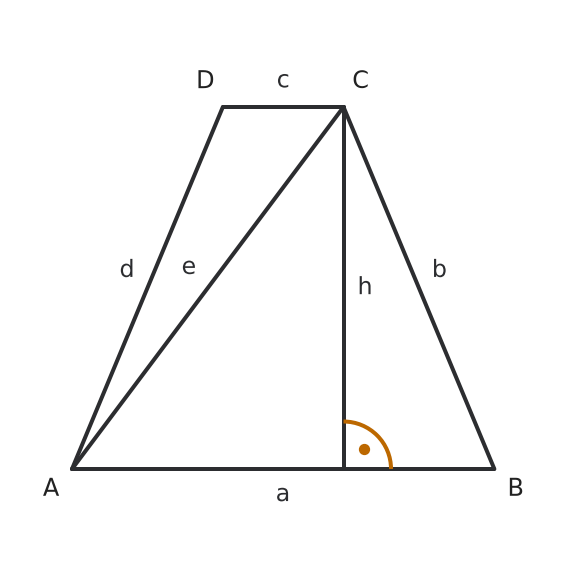
Figure for problem 536451

Hints

- Divide the isosceles trapezoid into right triangles. - Use the difference of the base lengths to find each horizontal offset. - Identify the horizontal segment that forms a right triangle with \(h\) and diagonal \(e\). - Use the converse of the Pythagorean theorem to test \(\triangle ABC\).

Solution

1. a) Because the trapezoid is isosceles, each horizontal offset is \(x=\frac{14-4}{2}=5\,\text{cm}\). 2. A leg is the hypotenuse of a right triangle with legs \(x\) and \(h\). Thus, \(h=\sqrt{13^2-5^2}=\sqrt{144}=12\,\text{cm}\). 3. For diagonal \(AC\), the horizontal distance is \(14-5=9\,\text{cm}\). Therefore, \(e=\sqrt{9^2+12^2}=\sqrt{225}=15\,\text{cm}\). 4. b) Using base \(AB=14\,\text{cm}\) and height \(12\,\text{cm}\), the area is \(\frac{1}{2}\cdot14\cdot12=84\,\text{cm}^2\). 5. c) The side lengths of \(\triangle ABC\) are \(13\), \(14\), and \(15\) centimeters. Since \(13^2+14^2=365\ne225=15^2\), the triangle is not right.

Answer

a) \(h=12\,\text{cm}\) and \(e=15\,\text{cm}\). b) \(84\,\text{cm}^2\). c) No. \(\triangle ABC\) is not right because \(13^2+14^2\ne15^2\).

53645210
Isosceles trapezoid \(ABCD\) has parallel bases \(AB=25\,\text{cm}\) and \(CD=7\,\text{cm}\) and height \(h=12\,\text{cm}\). a) Find the leg lengths \(b\) and \(d\) and the diagonal length \(e\). b) Determine whether triangle \(ABC\) is a right triangle. If it is, identify the vertex of the right angle.
Figure for problem 536452

Hints

- Sketch the trapezoid and label the known lengths. - Use the symmetry of an isosceles trapezoid to split the extra length of the longer base equally. - Identify the right triangles that contain a leg and a diagonal. - Use the converse of the Pythagorean theorem to test triangle \(ABC\).

Solution

1. The difference between the base lengths is split equally, so each outer horizontal segment is \(\frac{25-7}{2}=9\,\text{cm}\). 2. Each leg is the hypotenuse of a right triangle with legs \(9\,\text{cm}\) and \(12\,\text{cm}\): \(b=d=\sqrt{9^2+12^2}=15\,\text{cm}\). 3. The diagonal \(e=AC\) is the hypotenuse of a right triangle with legs \(25-9=16\,\text{cm}\) and \(12\,\text{cm}\): \(e=\sqrt{16^2+12^2}=20\,\text{cm}\). 4. Triangle \(ABC\) has side lengths \(15\), \(20\), and \(25\). Because \(15^2+20^2=25^2\), it is a right triangle. 5. The side \(AB\) is the hypotenuse, so the right angle is at \(C\).

Answer

a) \(b=d=15\,\text{cm}\); \(e=20\,\text{cm}\) b) Yes. Triangle \(ABC\) is right because \(15^2+20^2=25^2\). The right angle is at \(C\).
53646510
A kite has diagonals \(e=16\,\text{cm}\) and \(f=21\,\text{cm}\). Diagonal \(f\) is the line of symmetry and bisects diagonal \(e\). One shorter side has length \(a=10\,\text{cm}\). Find the length of a longer side \(b\).
Figure for problem 536465

Hints

- Identify the right triangles formed by the perpendicular diagonals. - First find the part of diagonal \(f\) in the triangle containing side \(a\). - Subtract that length from \(f\), then use the remaining part to find \(b\).

Solution

1. The diagonals of a kite are perpendicular. Because \(f\) bisects \(e\), each half of \(e\) is \(8\,\text{cm}\). 2. Let \(f_1\) be the part of diagonal \(f\) in the right triangle with hypotenuse \(10\,\text{cm}\). Then \(f_1^2=10^2-8^2=36\), so \(f_1=6\,\text{cm}\). 3. The remaining part is \(f_2=21-6=15\,\text{cm}\). 4. The longer side is the hypotenuse of a right triangle with legs \(8\,\text{cm}\) and \(15\,\text{cm}\): \(b^2=8^2+15^2=289\). Therefore, \(b=17\,\text{cm}\).

Answer

The longer side has length \(b=17\,\text{cm}\).
53646610
A kite has side lengths \(a=13\,\text{cm}\) and \(b=20\,\text{cm}\). The diagonal that divides the kite into two isosceles triangles is \(24\,\text{cm}\) long. Find the length of the other diagonal \(d\).
Figure for problem 536466

Hints

- Draw both diagonals and identify which one is bisected. - The unknown diagonal is made of one leg from each of two right triangles. - Find those two parts separately with the Pythagorean theorem.

Solution

1. The line-of-symmetry diagonal is perpendicular to and bisects the \(24\,\text{cm}\) diagonal, so each half is \(12\,\text{cm}\). 2. Let the two parts of diagonal \(d\) be \(d_1\) and \(d_2\). 3. In the triangle with hypotenuse \(13\,\text{cm}\), \(d_1^2=13^2-12^2=25\), so \(d_1=5\,\text{cm}\). 4. In the triangle with hypotenuse \(20\,\text{cm}\), \(d_2^2=20^2-12^2=256\), so \(d_2=16\,\text{cm}\). 5. Therefore, \(d=d_1+d_2=5+16=21\,\text{cm}\).

Answer

The other diagonal has length \(d=21\,\text{cm}\).
53646710
In triangle \(ABC\), altitude \(CD\) divides side \(AB\) into \(AD=p\) and \(DB=q\). Let \(AB=c\), \(BC=a\), and \(AC=b\). The diagram is not drawn to scale. Prove that if \(a^2=qc\) and \(b^2=pc\), then triangle \(ABC\) is a right triangle with the right angle at \(C\). Hint: Add the two given equations and use \(c=p+q\).
Figure for problem 536467

Hints

- What equation results when you add the two given equations? - Factor the common factor on the right side. - How are \(p\), \(q\), and \(c\) related? - Which converse theorem connects an equation involving three squared side lengths to a right angle?

Solution

1. Add the given equations: \(a^2+b^2=qc+pc\). 2. Factor the right side: \(a^2+b^2=c(q+p)\). 3. Because \(D\) lies on \(AB\), \(p+q=c\). 4. Substitute: \(a^2+b^2=c^2\). 5. By the converse of the Pythagorean theorem, triangle \(ABC\) is a right triangle with hypotenuse \(AB\). Therefore, the right angle is at \(C\).

Answer

Adding the equations gives \(a^2+b^2=c(p+q)\). Since \(p+q=c\), \(a^2+b^2=c^2\). By the converse of the Pythagorean theorem, triangle \(ABC\) is right at \(C\).
53646910
In triangle \(ABC\), altitude \(CD\) meets side \(AB\). Let \(AD=p\), \(DB=q\), \(AB=c\), \(BC=a\), and \(CD=h\). The diagram is not drawn to scale. A claim states: If \(a^2=qc\), then triangle \(ABC\) must be a right triangle with the right angle at \(C\). Prove the claim. First show that the condition implies \(h^2=pq\), and then use the converse of the Pythagorean theorem.
Figure for problem 536469

Hints

- Apply the Pythagorean theorem in right triangle \(BCD\). - Replace \(c\) with \(p+q\) in the given equation. - After finding \(h^2\), apply the Pythagorean theorem in right triangle \(ACD\). - Combine the resulting expressions for \(a^2\) and \(b^2\).

Solution

1. In right triangle \(BCD\), \(a^2=h^2+q^2\). 2. The given condition and \(c=p+q\) give \(a^2=qc=q(p+q)=pq+q^2\). 3. Equate the two expressions for \(a^2\): \(h^2+q^2=pq+q^2\). Therefore, \(h^2=pq\). 4. In right triangle \(ACD\), \(b^2=h^2+p^2=pq+p^2=p(p+q)=pc\). 5. Add the two leg equations: \(a^2+b^2=qc+pc=c(p+q)=c^2\). 6. By the converse of the Pythagorean theorem, triangle \(ABC\) is right at \(C\).

Answer

Since \(a^2=h^2+q^2\) and \(a^2=q(p+q)=pq+q^2\), it follows that \(h^2=pq\). Then \(b^2=h^2+p^2=pc\), so \(a^2+b^2=qc+pc=c^2\). Therefore, triangle \(ABC\) is right at \(C\).
53647610
A rectangular prism has width \(a=6\,\text{cm}\), depth \(b=4\,\text{cm}\), and height \(c=12\,\text{cm}\). a) Find the length of the segment from the front lower-left vertex \(A\) to the midpoint \(M\) of the back top edge. b) Find the surface area of the prism.
Figure for problem 536476

Hints

- Identify the horizontal, depth, and vertical changes from \(A\) to \(M\). - Apply the Pythagorean theorem twice, or use the three-dimensional distance relationship. - For surface area, add the areas of all six faces.

Solution

1. Using \(A\) as the origin, the displacement from \(A\) to \(M\) is \((3, 4, 12)\): half the width, the full depth, and the full height. 2. Apply the Pythagorean theorem in three dimensions: \(AM=\sqrt{3^2+4^2+12^2}=\sqrt{169}=13\,\text{cm}\). 3. The surface area is \(2(ab+bc+ac)=2(6\cdot 4+4\cdot 12+6\cdot 12)=288\,\text{cm}^2\).

Answer

a) \(AM=13\,\text{cm}\) b) \(288\,\text{cm}^2\)
53654910
Isosceles triangle \(ABC\) has equal sides \(AC=BC=2\) and vertex angle \(C=30^\circ\). Altitude \(AD\) is drawn to side \(BC\). a) Find the exact lengths \(AD\), \(CD\), and \(BD\). b) Use the Pythagorean theorem to find exact base length \(AB\). c) Use your result to find the exact value of \(\sin(75^\circ)\).
Figure for problem 536549

Hints

- Use the \(30^\circ\) angle in right triangle \(ADC\). - Subtract \(CD\) from the full equal side to find \(BD\). - Find the base angle of the isosceles triangle. - Use right triangle \(ABD\) to form the sine ratio.

Solution

1. In right triangle \(ADC\), \(AD=2\sin(30^\circ)=1\) and \(CD=2\cos(30^\circ)=\sqrt{3}\). 2. Since \(BC=2\), \(BD=2-\sqrt{3}\). 3. In right triangle \(ABD\), \(AB^2=AD^2+BD^2=1+(2-\sqrt{3})^2=8-4\sqrt{3}\). 4. Thus, \(AB=2\sqrt{2-\sqrt{3}}=\sqrt{6}-\sqrt{2}\). 5. The base angles of the isosceles triangle are \(75^\circ\). In triangle \(ABD\), \(\sin(75^\circ)=\frac{AD}{AB}=\frac{1}{\sqrt{6}-\sqrt{2}}=\frac{\sqrt{6}+\sqrt{2}}{4}\).

Answer

a) \(AD=1\), \(CD=\sqrt{3}\), and \(BD=2-\sqrt{3}\) b) \(AB=\sqrt{6}-\sqrt{2}\) c) \(\sin(75^\circ)=\frac{\sqrt{6}+\sqrt{2}}{4}\)
53655010
Right triangle \(ABC\) has a right angle at \(C\). Auxiliary right triangle \(BCD\) has \(\angle BCD=90^\circ\) and \(\angle BDC=30^\circ\). Point \(A\) lies on the extension of \(CD\) beyond \(D\), \(AD=BD\), and \(BC=1\). a) Explain why \(\alpha=15^\circ\). b) Find the exact lengths \(CD\), \(BD\), and \(AC\). c) Find the exact value of \(\tan(15^\circ)\).
Figure for problem 536550

Hints

- Use the base angles of isosceles triangle \(ABD\). - Apply the exterior angle theorem at \(D\). - Use the \(30^\circ\) right triangle to find \(CD\) and \(BD\). - Express \(AC\) as a sum of collinear segments.

Solution

1. Since \(AD=BD\), triangle \(ABD\) is isosceles. Exterior angle \(\angle BDC=30^\circ\) equals the sum of the two equal remote interior angles, so each is \(15^\circ\). Therefore, \(\alpha=15^\circ\). 2. In right triangle \(BCD\), \(CD=\frac{1}{\tan(30^\circ)}=\sqrt{3}\) and \(BD=\frac{1}{\sin(30^\circ)}=2\). 3. Since \(AD=2\), \(AC=AD+CD=2+\sqrt{3}\). 4. In right triangle \(ABC\), \(\tan(15^\circ)=\frac{BC}{AC}=\frac{1}{2+\sqrt{3}}=2-\sqrt{3}\).

Answer

a) \(\alpha=15^\circ\) b) \(CD=\sqrt{3}\), \(BD=2\), and \(AC=2+\sqrt{3}\) c) \(\tan(15^\circ)=2-\sqrt{3}\)
53678910
Right triangle \(ABC\) has a right angle at \(C\) and \(\angle A=30^\circ\). Point \(E\) lies on leg \(AC\), and \(\angle BEC=60^\circ\). Prove that \(AE=2EC\).
Figure for problem 536789

Hints

- Let \(EC=x\). - Use the side ratios of a \(30^\circ\text{-}60^\circ\text{-}90^\circ\) triangle to express \(BE\). - Find all three angles in triangle \(ABE\) and identify its special property.

Solution

1. Let \(EC=x\). Triangle \(BEC\) is a \(30^\circ\text{-}60^\circ\text{-}90^\circ\) triangle, so its hypotenuse is \(BE=2x\). 2. Because \(A\), \(E\), and \(C\) are collinear, \(\angle AEB=180^\circ-60^\circ=120^\circ\). 3. In triangle \(ABE\), \(\angle ABE=180^\circ-120^\circ-30^\circ=30^\circ\). 4. Since \(\angle EAB=\angle ABE=30^\circ\), triangle \(ABE\) is isosceles and \(AE=BE\). 5. Therefore, \(AE=BE=2x=2EC\).

Answer

Triangle \(BEC\) gives \(BE=2EC\), and triangle \(ABE\) is isosceles with \(AE=BE\). Therefore, \(AE=2EC\).
53686510
An isosceles trapezoid has perpendicular diagonals. Prove that its height \(h\) equals the length of its midsegment, \(m = \frac{a+c}{2}\), where \(a\) and \(c\) are the lengths of the two bases.
Figure for problem 536865

Hints

- Use the symmetry of the isosceles trapezoid at the intersection of the diagonals. - What special triangles are formed when the diagonals are perpendicular? - Relate the altitude to the hypotenuse in each isosceles right triangle.

Solution

1. Let \(S\) be the intersection of the diagonals. By the symmetry of an isosceles trapezoid, \(SA = SB\) and \(SC = SD\). 2. Since the diagonals are perpendicular, \(\triangle ASB\) and \(\triangle CSD\) are isosceles right triangles with hypotenuses \(AB = a\) and \(CD = c\). 3. In an isosceles right triangle, the altitude from the right-angle vertex to the hypotenuse has length one-half the hypotenuse. Therefore, the distance from \(S\) to \(AB\) is \(\frac{a}{2}\), and the distance from \(S\) to \(CD\) is \(\frac{c}{2}\). 4. These distances add to the trapezoid’s height: \(h = \frac{a}{2} + \frac{c}{2} = \frac{a+c}{2}\). 5. Since the trapezoid midsegment has length \(m = \frac{a+c}{2}\), it follows that \(h = m\).

Answer

The perpendicular diagonals create two isosceles right triangles whose altitudes are \(\frac{a}{2}\) and \(\frac{c}{2}\). Thus, \(h = \frac{a}{2} + \frac{c}{2} = \frac{a+c}{2} = m\).

All problems may be used, copied and printed free of charge for school and tutoring, including paid tutoring. Commercial adaptations as well as publication or redistribution on the internet are not permitted.