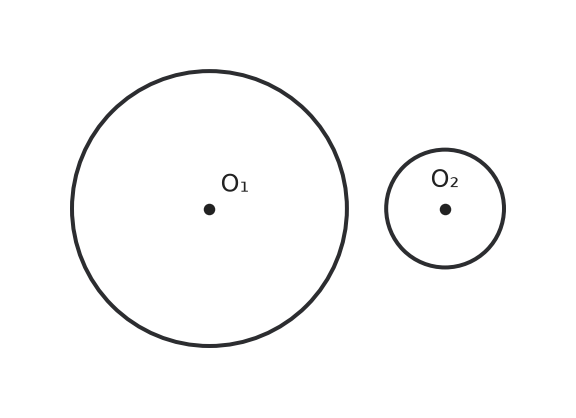
The circle centered at \(O_1\) has radius \(7\,\text{cm}\), and the circle centered at \(O_2\) has radius \(3\,\text{cm}\). Leah wants a line tangent to both circles, with both centers on the same side.
Her plan is to draw an auxiliary circle of radius \(10\,\text{cm}\) around \(O_1\). She would draw a tangent from \(O_2\) to that circle, then shift the line parallel until it touches the larger original circle.
a) Why would her method lead to the wrong kind of common tangent?
b) What radius should her auxiliary circle have instead? Explain how to use it to find the requested tangent lines.
Hints
- What does tangency tell you about the distance from a center to the tangent line?
- Think about which side of the tangent each center must lie on.
- When a line through \(O_2\) shifts, how do its distances from the two centers change?
Solution
1. A tangent from \(O_2\) to a circle of radius \(10\,\text{cm}\) around \(O_1\) is \(10\,\text{cm}\) from \(O_1\). Shifting it \(3\,\text{cm}\) toward \(O_1\) puts the two original centers on opposite sides of the new line. That constructs a common internal tangent, not the requested external tangent.
2. For both centers to remain on the same side, the auxiliary radius must be \(7-3=4\,\text{cm}\).
3. Construct the two tangents from \(O_2\) to the circle centered at \(O_1\) with radius \(4\,\text{cm}\). For each tangent, move a parallel copy \(3\,\text{cm}\) away from \(O_1\). The new line is \(7\,\text{cm}\) from \(O_1\) and \(3\,\text{cm}\) from \(O_2\), with both centers on the same side, so it touches both original circles.
Answer
a) A radius of \(10\,\text{cm}\) gives common internal tangents: the original centers end up on opposite sides of each tangent.
b) Use radius \(4\,\text{cm}\). Draw tangents from \(O_2\) to that auxiliary circle and move parallel copies \(3\,\text{cm}\) away from \(O_1\).