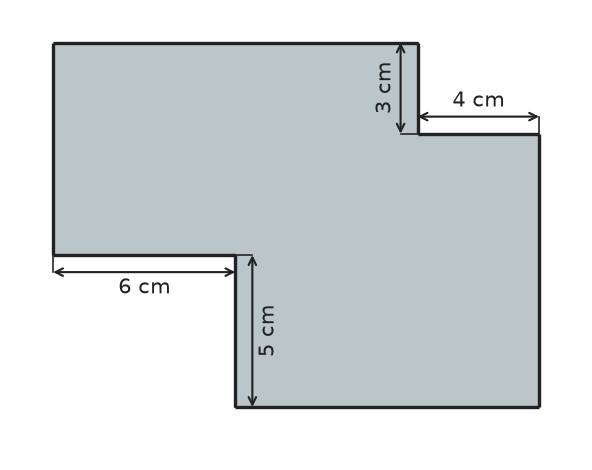
The irregular plate shown fits exactly inside a \(16\,\text{cm}\times12\,\text{cm}\) rectangle. The diagram labels the two rectangular corner cutouts. Find the plate's area in two different ways: first by subtracting the cutouts from the outer rectangle, and then by dividing the plate into horizontal strips. Show that the methods agree.
Hints
- For the subtraction method, start with the full bounding rectangle and remove each corner cutout once.
- For the strip method, use the cutout dimensions to determine the width of each horizontal layer of the plate.
- The two methods partition the same region differently, so their final totals should match.
Solution
1. By subtraction, the outer rectangle has area \(16\cdot12=192\,\text{cm}^2\). The cutouts have areas \(6\cdot5=30\,\text{cm}^2\) and \(4\cdot3=12\,\text{cm}^2\), so the plate area is \(192-30-12=150\,\text{cm}^2\).
2. By horizontal strips, the bottom strip is \(10\,\text{cm}\times5\,\text{cm}\), the middle strip is \(16\,\text{cm}\times4\,\text{cm}\), and the top strip is \(12\,\text{cm}\times3\,\text{cm}\).
3. Their total area is \(10\cdot5+16\cdot4+12\cdot3=50+64+36=150\,\text{cm}^2\).
4. Both decompositions give the same area, \(150\,\text{cm}^2\).
Answer
The plate has area \(150\,\text{cm}^2\). Both subtraction and horizontal-strip decomposition give this result.