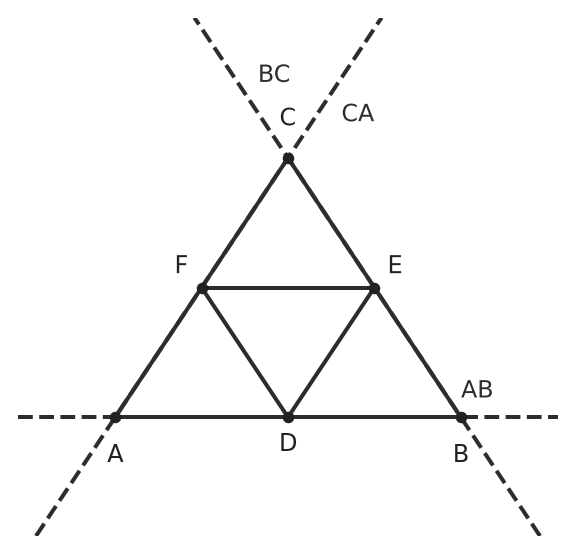
Points \(D\), \(E\), and \(F\) are the midpoints of the three sides of an unknown triangle \(ABC\), with \(D\) on \(\overline{AB}\), \(E\) on \(\overline{BC}\), and \(F\) on \(\overline{CA}\).
Describe how a geometry app can reconstruct triangle \(ABC\) using parallel lines, and prove that the reconstruction is unique.
Hints
- Use each side of the midpoint triangle to determine the direction of an unknown side.
- After creating the three side lines, identify parallelograms that contain \(D\), \(E\), and \(F\).
- Use opposite sides of those parallelograms to prove the midpoint equalities and then justify uniqueness.
Solution
1. In any triangle, the segment joining two side midpoints is parallel to the third side.
2. Through \(D\), the app creates the line parallel to \(EF\); this is line \(AB\).
3. Through \(E\), the app creates the line parallel to \(DF\); this is line \(BC\).
4. Through \(F\), the app creates the line parallel to \(DE\); this is line \(CA\).
5. Let \(A\) be the intersection of the first and third lines, \(B\) the intersection of the first and second, and \(C\) the intersection of the second and third.
6. Quadrilateral \(ADEF\) is a parallelogram because \(AD\parallel EF\) and \(AF\parallel DE\). Therefore, \(AD=EF\) and \(AF=DE\).
7. Quadrilateral \(DBEF\) is a parallelogram because \(DB\parallel EF\) and \(BE\parallel DF\). Therefore, \(DB=EF\) and \(BE=DF\).
8. Quadrilateral \(DECF\) is a parallelogram because \(DE\parallel CF\) and \(DF\parallel EC\). Therefore, \(EC=DF\) and \(CF=DE\).
9. Thus, \(AD=DB\), \(BE=EC\), and \(CF=FA\), so \(D\), \(E\), and \(F\) are the required side midpoints.
10. Each side line is uniquely determined by one given point and one required parallel direction, so their pairwise intersections and the reconstructed triangle are unique.
Answer
The app creates the three side lines through \(D\), \(E\), and \(F\), parallel respectively to \(EF\), \(DF\), and \(DE\). Their pairwise intersections are \(A\), \(B\), and \(C\). The parallelograms \(ADEF\), \(DBEF\), and \(DECF\) give \(AD=DB\), \(BE=EC\), and \(CF=FA\), so the given points are the side midpoints. The three uniquely determined side lines make the reconstruction unique.


