Lukas is studying the family of polynomial functions
\(f_n(x) = (x + 1)(x - 1)^n\),
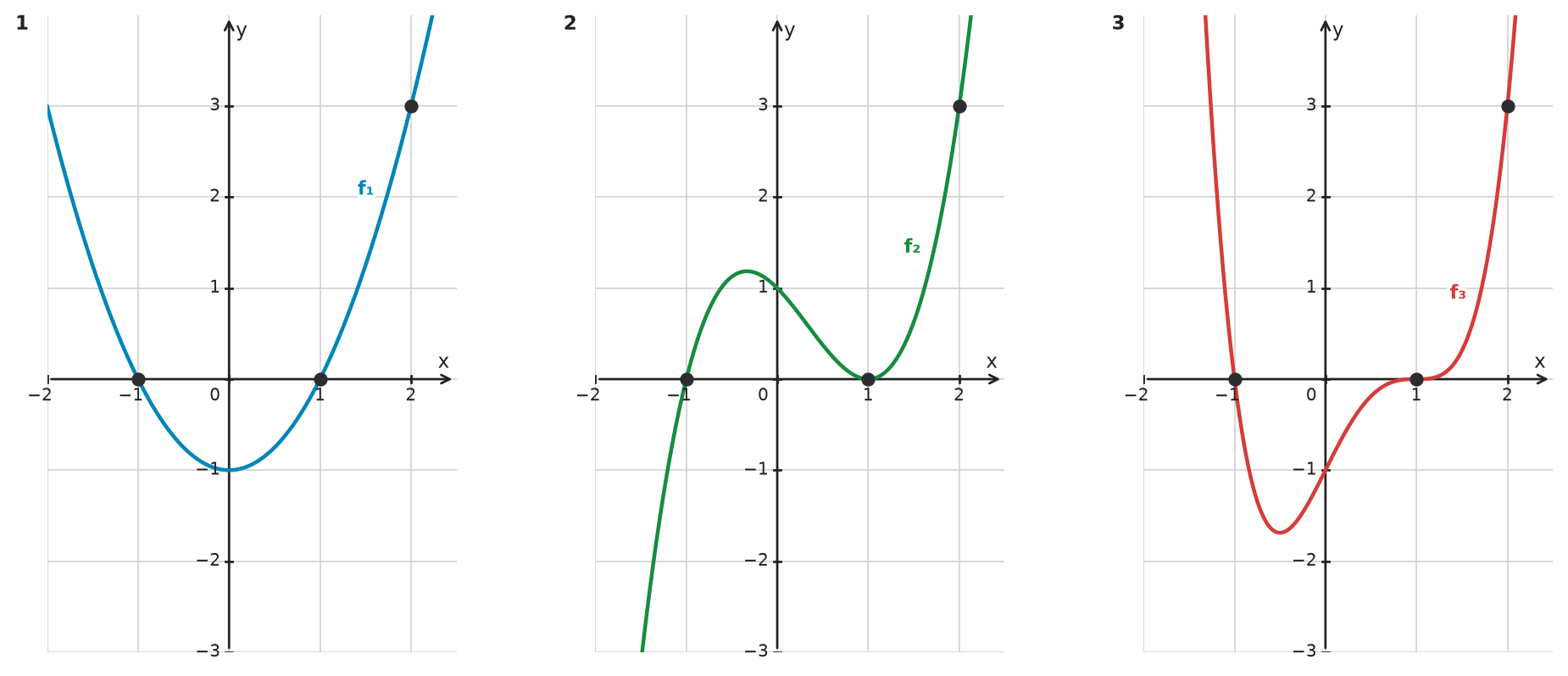
where \(n\) is a positive integer. The graphs of \(f_1\), \(f_2\), and \(f_3\) are shown.
a) Show algebraically that every graph in the family passes through \(P(-1, 0)\), \(Q(1, 0)\), and \(R(2, 3)\). Explain why there are no other points common to every graph.
b) Describe how the graph behaves at the zero \(x = 1\) as \(n\) changes from \(1\) to \(2\) to \(3\). State the general relationship between multiplicity and graph behavior at a zero.
c) Describe the behavior of \(f_4\) at \(x = 1\). Does the function change sign there? Compare its local behavior with \(f_2\).
Hints
- Substitute the x-coordinate of a point to check whether it lies on every graph.
- Evaluate \((x - 1)^n\) at \(x = 1\) and \(x = 2\).
- To rule out other common points, compare two members of the family with different exponents.
- Relate odd and even multiplicities to crossing and touching behavior.
- Near \(x = 1\), compare \(u^4\) and \(u^2\) for small values of \(|u|\).
Solution
1. Substitute each x-coordinate. For every positive integer \(n\), \(f_n(-1) = 0\), \(f_n(1) = 0\), and \(f_n(2) = 3\). Therefore, all graphs pass through \(P\), \(Q\), and \(R\).
2. Any point common to every graph must, in particular, lie on both \(f_1\) and \(f_2\). Solve \((x + 1)(x - 1) = (x + 1)(x - 1)^2\). This simplifies to \((x + 1)(x - 1)(x - 2) = 0\), so \(x = -1\), \(x = 1\), or \(x = 2\). These are exactly the three common points already found.
3. At \(x = 1\), the multiplicity is \(n\). For \(n = 1\), the graph crosses the x-axis with nonzero slope. For \(n = 2\), it touches the x-axis and does not change sign. For \(n = 3\), it crosses the x-axis with a horizontal tangent.
4. In general, a zero of odd multiplicity produces a sign change, while a zero of even multiplicity does not. Multiplicity greater than 1 produces a horizontal tangent at the zero.
5. For \(f_4\), \(x = 1\) is a zero of multiplicity 4, so the graph touches the x-axis without changing sign. Near \(x = 1\), \((x - 1)^4\) is smaller in magnitude than \((x - 1)^2\), so \(f_4\) stays closer to the x-axis and has flatter contact than \(f_2\).
Answer
a) Every graph contains \(P(-1, 0)\), \(Q(1, 0)\), and \(R(2, 3)\). Comparing \(f_1\) and \(f_2\) shows that no other x-values can be common to the entire family.
b) At \(x = 1\), \(f_1\) crosses with nonzero slope, \(f_2\) touches without crossing, and \(f_3\) crosses with a horizontal tangent. Odd multiplicity gives a sign change; even multiplicity does not.
c) The zero \(x = 1\) has multiplicity 4, so there is no sign change. Near the zero, \(f_4\) has flatter contact with the x-axis than \(f_2\).


