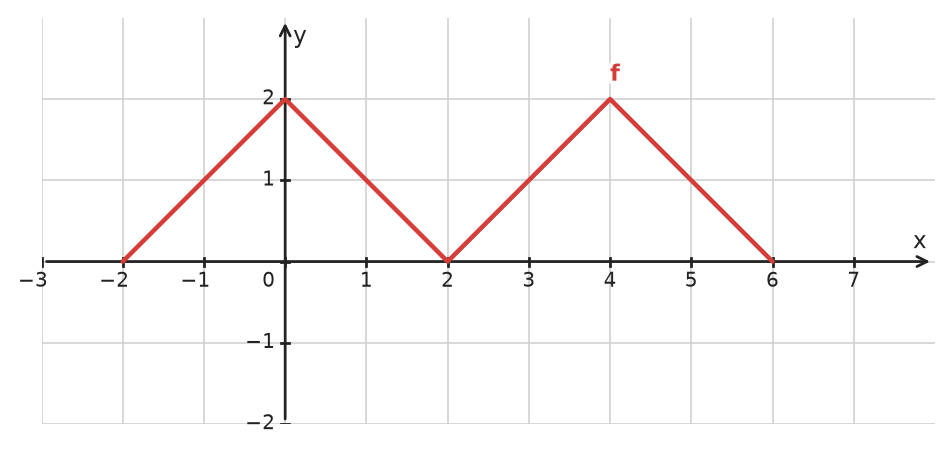
The graph of the piecewise linear function \(f\) is shown on the domain \([-2,6]\).
Use the interval convention \([-2,0)\), \([0,2)\), \([2,4)\), and \([4,6]\) for the four pieces of \(f\).
a) Read the graph and write a piecewise rule for \(f(x)\).
b) Let \(k(x)=f(2x)-1\). Write \(k\) as a piecewise-defined function, including the transformed interval conditions and its domain.
c) Let \(p(x)=0.5f(x-1)+1\). Write \(p\) as a piecewise-defined function, including the transformed interval conditions and its domain.
Hints
- First recover the line rule on each visible segment before applying either transformation.
- For an input transformation, transform the interval conditions as well as the formulas.
- In \(f(2x)\), ask which values of \(x\) make \(2x\) land in each original interval.
- In \(f(x-1)\), shift every breakpoint consistently with the input shift.
Solution
1. The four graph segments have slopes \(1,-1,1,-1\). Using the visible vertices gives \(f(x)=x+2\) on \([-2,0)\), \(f(x)=-x+2\) on \([0,2)\), \(f(x)=x-2\) on \([2,4)\), and \(f(x)=-x+6\) on \([4,6]\).
2. For \(k(x)=f(2x)-1\), transform each input interval by requiring \(2x\) to lie in the corresponding interval for \(f\). The breakpoints become \(-1,0,1,2,3\).
3. Substituting \(2x\) into each branch and subtracting \(1\) gives \(2x+1\), \(-2x+1\), \(2x-3\), and \(-2x+5\), respectively. Thus, the domain of \(k\) is \([-1,3]\).
4. For \(p(x)=0.5f(x-1)+1\), require \(x-1\) to lie in each original interval. The breakpoints become \(-1,1,3,5,7\).
5. Substituting \(x-1\) into each branch, multiplying by \(0.5\), and adding \(1\) gives \(0.5x+1.5\), \(-0.5x+2.5\), \(0.5x-0.5\), and \(-0.5x+4.5\), respectively. Thus, the domain of \(p\) is \([-1,7]\).
Answer
a) \(f(x)=\begin{cases}x+2&-2\le x<0\\-x+2&0\le x<2\\x-2&2\le x<4\\-x+6&4\le x\le6\end{cases}\)
b) \(k(x)=\begin{cases}2x+1&-1\le x<0\\-2x+1&0\le x<1\\2x-3&1\le x<2\\-2x+5&2\le x\le3\end{cases}\), domain \([-1,3]\)
c) \(p(x)=\begin{cases}0.5x+1.5&-1\le x<1\\-0.5x+2.5&1\le x<3\\0.5x-0.5&3\le x<5\\-0.5x+4.5&5\le x\le7\end{cases}\), domain \([-1,7]\)