Aimathic
Login | English | Deutsch

Free Math Worksheets

Build your own math worksheets from 21,000 problems for grades 3 to 12, from fractions to calculus. Every problem includes step-by-step solutions.

Solve radical equations

Click problems to add them to your worksheet.

52332511
Find each solution set over the real numbers. a) \(x^4 = 2401\) b) \(x^5 = -32\) c) \(x^6 = 4096\)

Hints

- Distinguish between even and odd exponents. - Consider how the sign of the right side affects the number of real solutions. - For an even exponent and a positive right side, include both positive and negative roots. - Odd roots of negative numbers are real.

Solution

1. For a), take the fourth root. Because the exponent is even and the right side is positive, there are two real solutions: \(x = \pm\sqrt[4]{2401} = \pm 7\). 2. For b), take the fifth root. An odd power equation has one real solution: \(x = \sqrt[5]{-32} = -2\). 3. For c), take the sixth root. Because the exponent is even and the right side is positive, there are two real solutions: \(x = \pm\sqrt[6]{4096} = \pm 4\).

Answer

a) \(\{-7, 7\}\) b) \(\{-2\}\) c) \(\{-4, 4\}\)
52332611
Find all real solutions. a) \(2x^4 = 162\) b) \(x^3 + 125 = 0\) c) \(x^4 + 16 = 0\)

Hints

- Isolate the power of \(x\) before taking a root. - Check whether the isolated equation can have real solutions. - An even power of a real number is always nonnegative. - Compare the number of real solutions for odd and even powers.

Solution

1. For a), divide by \(2\): \(x^4 = 81\). Taking fourth roots gives \(x = \pm 3\). 2. For b), subtract \(125\): \(x^3 = -125\). Taking the cube root gives \(x = -5\). 3. For c), subtract \(16\): \(x^4 = -16\). A fourth power of a real number cannot be negative, so there are no real solutions.

Answer

a) \(x = -3\) or \(x = 3\) b) \(x = -5\) c) No real solution
52332711
Let \(f(x) = x^n\) and let \(g(x) = c\) be a constant function. Determine the number of intersection points of the two graphs for each set of parameters. a) \(n = 4\), \(c = 15\) b) \(n = 6\), \(c = -1\) c) \(n = 3\), \(c = -27\) d) \(n = 10\), \(c = 0\)

Hints

- Compare the graphs of even- and odd-power functions. - Determine which outputs an even power can produce. - Think about how a horizontal line can intersect an even- or odd-power graph. - Consider both the parity of the exponent and the sign of the constant.

Solution

1. The number of intersection points equals the number of real solutions of \(x^n = c\). 2. For a), the exponent is even and \(c > 0\), so there are two real solutions and two intersection points. 3. For b), the exponent is even and \(c < 0\). An even power cannot be negative, so there are no real solutions and no intersection points. 4. For c), the exponent is odd. An odd-power equation has exactly one real solution for every real \(c\), so there is one intersection point. 5. For d), \(x^{10} = 0\) has only the solution \(x = 0\), so there is one intersection point.

Answer

a) \(2\) intersection points b) \(0\) intersection points c) \(1\) intersection point d) \(1\) intersection point
52533111
Without solving for \(x\) algebraically, explain why the equation has no real solution: \(\sqrt{x^2+25}=4\)

Hints

- Find the least possible value of \(x^2\). - Use that value to find the least possible radicand. - Use the principal square root to find the least possible value of the left side. - Compare the least possible value of the left side with \(4\).

Solution

1. For every real \(x\), \(x^2\ge0\), so \(x^2+25\ge25\). 2. Therefore, \(\sqrt{x^2+25}\ge\sqrt{25}=5\). 3. The left side can never equal \(4\), so the equation has no real solution.

Answer

There is no real solution because \(\sqrt{x^2+25}\ge5\) for every real \(x\), but the equation requires it to equal \(4\).
52534311
For each equation, explain why it has no real solution without solving algebraically for \(x\). a) \(\sqrt{x+12}=-5\) b) \(\sqrt{x-8}+\sqrt{2-x}=4\) c) \(10+\sqrt{x-1}=3\)

Hints

- Recall the range of the principal square-root function. - Determine the domain conditions for every radical. - In c), isolate the radical and inspect the required value. - Check whether the separate domain conditions overlap.

Solution

1. In a), a principal square root is always nonnegative, so it cannot equal \(-5\). 2. In b), the first radical requires \(x\ge8\), while the second requires \(x\le2\). No real number satisfies both conditions, so the equation has no real domain. 3. In c), isolating the radical would give \(\sqrt{x-1}=-7\), which is impossible because a principal square root is nonnegative.

Answer

a) No real solution; a square root cannot equal \(-5\). b) No real solution; the conditions \(x\ge8\) and \(x\le2\) cannot both hold. c) No real solution; the equation would require \(\sqrt{x-1}=-7\).
52538511
Solve over the real numbers: \(\sqrt{x+7}=x+1\).

Hints

- Square both sides, then solve the resulting quadratic equation. - A principal square root cannot be negative. - Check each candidate in the original equation.

Solution

1. Square both sides: \(x+7=(x+1)^2\). 2. Expand and rearrange: \(x^2+x-6=0\). 3. Factor: \((x+3)(x-2)=0\), so the candidates are \(x=-3\) and \(x=2\). 4. Check the original equation. For \(x=2\), both sides equal \(3\). For \(x=-3\), the left side is \(2\) and the right side is \(-2\), so \(-3\) is extraneous.

Answer

\(\{2\}\)
52539711
Solve over the real numbers: \(\sqrt{x+2}\cdot\sqrt{x-1}=\sqrt{10}\).

Hints

- Find the common domain of both radicals. - Square both sides to obtain a quadratic equation. - Check the candidates against the domain.

Solution

1. The domain requires \(x\ge1\). 2. Square both sides: \((x+2)(x-1)=10\). 3. Expand and rearrange: \(x^2+x-12=0\). 4. Factor: \((x+4)(x-3)=0\). The candidates are \(x=-4\) and \(x=3\). 5. Only \(x=3\) is in the domain, and \(\sqrt{5}\cdot\sqrt{2}=\sqrt{10}\).

Answer

\(\{3\}\)
52812311
Find the real solution set for each equation. Account for the domain or check your results. a) \(\sqrt{2x+7}=5\) b) \(\sqrt{x^2-9}=4\) c) \(\sqrt{x-3}=-1\)

Hints

- Square both sides when the isolated square root equals a nonnegative value. - Remember that solving \(x^2=a\) may produce two real values. - A principal square root cannot equal a negative number.

Solution

1. For part a, square both sides: \(2x+7=25\). Thus \(x=9\), and substitution confirms the solution. 2. For part b, square both sides: \(x^2-9=16\), so \(x^2=25\) and \(x=\pm5\). Both values satisfy the original equation. 3. For part c, a principal square root is never negative, so the equation has no real solution.

Answer

a) \(\{9\}\) b) \(\{-5,5\}\) c) \(\emptyset\)
52829311
Find all real zeros of the function \(f(x) = 0.5x^4 - 8\).

Hints

- What equation must be true at a zero of a function? - Isolate the fourth-power term before taking a root. - How many real solutions can \(x^n = a\) have when \(n\) is even? - Taking a fourth root reverses raising a number to the fourth power.

Solution

1. Set the function equal to zero: \(0.5x^4 - 8 = 0\). 2. Isolate the power: \(0.5x^4 = 8\), so \(x^4 = 16\). 3. Take the fourth root. Because the exponent is even, include both signs: \(x = \pm\sqrt[4]{16} = \pm 2\). 4. Therefore, the real zeros are \(x = -2\) and \(x = 2\).

Answer

The real zeros are \(x = -2\) and \(x = 2\).
52829411
The function \(g\) is defined by \(g(x) = -2x^3 - 250\). Find its real zero.

Hints

- What value must \(g(x)\) have at a zero? - Isolate the term containing the variable first. - Use the inverse operation for raising a number to the third power. - An odd root of a negative number is real.

Solution

1. Set the function equal to zero: \(-2x^3 - 250 = 0\). 2. Isolate the power: \(-2x^3 = 250\), so \(x^3 = -125\). 3. Take the cube root: \(x = \sqrt[3]{-125} = -5\). 4. Because an odd-power equation has one real solution, the only real zero is \(x = -5\).

Answer

The real zero is \(x = -5\).
53502811
How many real solutions does \(\sqrt{x}\sqrt{x+3}\sqrt{2-x}=0\) have? Use the graph of \(f(x)=\sqrt{x}\sqrt{x+3}\sqrt{2-x}\) to support your reasoning.
Figure for problem 535028

Hints

- List the zeros of the individual factors. - Find the intersection of the three radical-domain conditions. - Keep only candidate zeros that belong to the common domain.

Solution

1. The factors are individually zero at \(x=0\), \(x=-3\), and \(x=2\). 2. All three radicals must be defined at the same time. Their conditions are \(x\ge0\), \(x\ge-3\), and \(x\le2\), so the common domain is \([0, 2]\). 3. Of the three candidate values, only \(0\) and \(2\) lie in the domain. Both make the product zero. 4. Therefore, the equation has two real solutions.

Answer

\(2\) real solutions: \(x=0\) and \(x=2\)
53502911
How many real solutions does \(\sqrt{x-1}\sqrt{x-3}\sqrt{x-5}=0\) have? Use the graph of \(g(x)=\sqrt{x-1}\sqrt{x-3}\sqrt{x-5}\) to support your reasoning.
Figure for problem 535029

Hints

- Find the common domain of all three radicals. - List the zeros of the individual factors. - Check which candidate zeros belong to the common domain.

Solution

1. The individual factors are zero at \(x=1\), \(x=3\), and \(x=5\). 2. For all three radicals to be defined, \(x\ge1\), \(x\ge3\), and \(x\ge5\) must hold. The common domain is \([5, \infty)\). 3. Only \(x=5\) is both a candidate zero and an element of the domain. 4. Therefore, the equation has one real solution.

Answer

\(1\) real solution: \(x=5\)
53503111
How many real solutions does \((x-4)\sqrt{6-x}\sqrt{x-2}=0\) have? Use the graph of \(k(x)=(x-4)\sqrt{6-x}\sqrt{x-2}\) to support your reasoning.
Figure for problem 535031

Hints

- Find the common domain from the two radical conditions. - List the zeros supplied by all three factors. - Count the candidate zeros that lie in the domain.

Solution

1. The factors give the candidate zeros \(x=4\), \(x=6\), and \(x=2\). 2. The radical conditions are \(x\le6\) and \(x\ge2\), so the domain is \([2, 6]\). 3. All three candidate zeros lie in the domain and make the product zero. 4. Therefore, the equation has three real solutions.

Answer

\(3\) real solutions: \(x=2, 4, 6\)
52534411
A student solves \(\sqrt{x-3}=\sqrt{1-x}\) by squaring both sides: \(x-3=1-x\), so \(2x=4\) and \(x=2\). Check whether \(x=2\) is actually a solution. Justify your conclusion using the domain of the original equation.

Hints

- Substitute \(x=2\) into the original radicals. - Write the nonnegative-radicand condition for each side. - Check the domain before accepting a value obtained after squaring.

Solution

1. The left radical requires \(x-3\ge0\), so \(x\ge3\). 2. The right radical requires \(1-x\ge0\), so \(x\le1\). 3. No real number satisfies both conditions, so the original equation has an empty domain. 4. Therefore, \(x=2\) is not a solution. Substitution would produce \(\sqrt{-1}\), which is not real.

Answer

\(x=2\) is not a solution. The original equation has no real domain because it requires both \(x\ge3\) and \(x\le1\).
52535511
Solve over the real numbers: \(\sqrt{\frac{x+1}{x-3}}=\sqrt{\frac{x+5}{x-1}}\).

Hints

- Find where both radicands are nonnegative and both denominators are nonzero. - Square both sides to remove the radicals. - Solve the resulting rational equation, then check the answer in the original equation.

Solution

1. Determine the domain. The left radicand is nonnegative for \(x\in(-\infty, -1]\cup(3, \infty)\), and the right radicand is nonnegative for \(x\in(-\infty, -5]\cup(1, \infty)\). Their intersection is \(D=(-\infty, -5]\cup(3, \infty)\). 2. Square both sides: \(\frac{x+1}{x-3}=\frac{x+5}{x-1}\). 3. Cross-multiply: \((x+1)(x-1)=(x+5)(x-3)\). 4. Expand and solve: \(x^2-1=x^2+2x-15\), so \(14=2x\) and \(x=7\). 5. Since \(7\in D\), check it in the original equation: both sides equal \(\sqrt{2}\).

Answer

\(\{7\}\)
52535611
Solve the equation and give the real solution set: \(\sqrt{\frac{x}{x-1}}=\frac{\sqrt{6}}{\sqrt{x+1}}\).

Hints

- Account for every square root and denominator when finding the domain. - Square the entire equation. - Clear the fractions and solve the resulting quadratic equation. - Check both candidates in the original equation.

Solution

1. Determine the domain. The denominator \(\sqrt{x+1}\) requires \(x>-1\), and \(\frac{x}{x-1}\ge0\) requires \(x\in(-\infty, 0]\cup(1, \infty)\). Thus \(D=(-1, 0]\cup(1, \infty)\). 2. Square both sides: \(\frac{x}{x-1}=\frac{6}{x+1}\). 3. Cross-multiply: \(x(x+1)=6(x-1)\). 4. Expand and rearrange: \(x^2-5x+6=0\). Factor: \((x-2)(x-3)=0\), so \(x=2\) or \(x=3\). 5. Both values are in the domain and satisfy the original equation.

Answer

\(\{2,3\}\)
52536111
Solve over the real numbers: \(\sqrt{2x^2-7}=x+1\). Briefly explain why checking the possible solutions is necessary.

Hints

- Square both sides, then solve the resulting quadratic equation. - Remember that a principal square root is never negative. - Substitute every candidate into the original equation.

Solution

1. Square both sides: \(2x^2-7=(x+1)^2\). 2. Expand and rearrange: \(2x^2-7=x^2+2x+1\), so \(x^2-2x-8=0\). 3. Factor: \((x-4)(x+2)=0\). The candidates are \(x=4\) and \(x=-2\). 4. Check \(x=4\): \(\sqrt{2(4)^2-7}=5\) and \(4+1=5\), so it works. 5. Check \(x=-2\): \(\sqrt{2(-2)^2-7}=1\), but \(-2+1=-1\), so it is extraneous. 6. Squaring can make unequal expressions equal because it removes sign information, so every candidate must be checked.

Answer

\(\{4\}\). Checking is necessary because squaring can introduce extraneous solutions.
52536211
Consider the equation \(\sqrt{5x-1}=\frac{4x-2}{\sqrt{x+2}}\). a) Find its real domain \(D\). b) Find all real solutions.

Hints

- A square root in a denominator must be strictly positive. - Clear the radical denominator before squaring. - After solving the quadratic equation, check the sign condition and the original equation.

Solution

1. The radicands require \(5x-1\ge0\) and \(x+2\ge0\). Because \(\sqrt{x+2}\) is in the denominator, \(x+2>0\). Together, these conditions give \(D=[0.2, \infty)\). 2. Multiply by \(\sqrt{x+2}\): \(\sqrt{(5x-1)(x+2)}=4x-2\). 3. Square both sides: \((5x-1)(x+2)=(4x-2)^2\). 4. Expand and rearrange: \(5x^2+9x-2=16x^2-16x+4\), so \(11x^2-25x+6=0\). 5. Use the quadratic formula: \(x=\frac{25\pm\sqrt{361}}{22}=\frac{25\pm19}{22}\). The candidates are \(x=2\) and \(x=\frac{3}{11}\). 6. The left side after step 2 is nonnegative, so \(4x-2\) must also be nonnegative. The candidate \(x=\frac{3}{11}\) fails this condition and is extraneous. The value \(x=2\) satisfies the original equation.

Answer

a) \(D=[0.2, \infty)\) b) \(\{2\}\)
52536711
Solve the radical equation \(\sqrt{x+1}+\sqrt{2x+3}=5\). Explain why checking the candidates at the end is required.

Hints

- Find the domain first. - Isolate one radical before each squaring step. - Use the binomial formula carefully when squaring a difference. - Substitute every candidate into the original equation.

Solution

1. The domain requires \(x\ge-1\). 2. Isolate one radical: \(\sqrt{2x+3}=5-\sqrt{x+1}\). 3. Square and simplify: \(2x+3=25-10\sqrt{x+1}+x+1\), so \(x-23=-10\sqrt{x+1}\). 4. Square again: \((x-23)^2=100(x+1)\). This gives \(x^2-146x+429=0\). 5. Solve the quadratic: \(x=73\pm70\), so the candidates are \(x=3\) and \(x=143\). 6. Check the original equation. For \(x=3\), \(\sqrt{4}+\sqrt{9}=5\). For \(x=143\), \(\sqrt{144}+\sqrt{289}=29\ne5\). Therefore, \(143\) is extraneous. 7. Squaring is not reversible without sign restrictions, so it can introduce extraneous solutions.

Answer

\(\{3\}\). The candidate \(143\) is extraneous, which shows why every candidate must be checked.
52536811
Solve the equation over the real numbers and check each result: \(\sqrt{4x+1}-\sqrt{x-2}=3\).

Hints

- Isolate one radical before squaring. - Simplify the equation before the second squaring step. - Check every candidate in the original equation.

Solution

1. The domain requires \(x\ge2\). 2. Isolate one radical: \(\sqrt{4x+1}=3+\sqrt{x-2}\). 3. Square and simplify: \(4x+1=x+7+6\sqrt{x-2}\), so \(x-2=2\sqrt{x-2}\). 4. Square again: \((x-2)^2=4(x-2)\). This gives \(x^2-8x+12=0\). 5. Factor: \((x-2)(x-6)=0\), so the candidates are \(x=2\) and \(x=6\). 6. Check: for \(x=2\), \(\sqrt{9}-0=3\); for \(x=6\), \(\sqrt{25}-\sqrt{4}=3\). Both are valid.

Answer

\(\{2,6\}\)
52537111
Solve the radical equation \(\sqrt{x+1}+\frac{3}{\sqrt{x+1}}=\sqrt{2x+8}\).

Hints

- A square root in a denominator must be strictly positive. - Multiply by the radical denominator to simplify the equation. - Check the candidates against the domain and the original equation.

Solution

1. Since \(\sqrt{x+1}\) is in a denominator, the domain requires \(x+1>0\). The other radicand requires \(2x+8\ge0\). Thus \(D=(-1, \infty)\). 2. Multiply by \(\sqrt{x+1}\): \(x+1+3=\sqrt{(2x+8)(x+1)}\), so \(x+4=\sqrt{2x^2+10x+8}\). 3. Square both sides: \((x+4)^2=2x^2+10x+8\). 4. Expand and rearrange: \(x^2+2x-8=0\). Factor: \((x+4)(x-2)=0\), so the candidates are \(x=-4\) and \(x=2\). 5. The value \(-4\) is outside the domain. The value \(2\) satisfies the original equation.

Answer

\(\{2\}\)
52537211
Solve over the real numbers: \(\sqrt{5x-1}-\frac{2}{\sqrt{5x-1}}=\sqrt{x}\).

Hints

- Determine the domain before multiplying by the radical denominator. - After isolating a square root, the other side must be nonnegative. - Check the candidates after solving the quadratic equation.

Solution

1. The denominator requires \(5x-1>0\), and \(\sqrt{x}\) requires \(x\ge0\). Thus \(D=(0.2, \infty)\). 2. Multiply by \(\sqrt{5x-1}\): \(5x-3=\sqrt{x(5x-1)}=\sqrt{5x^2-x}\). 3. Because the right side is nonnegative, require \(5x-3\ge0\), or \(x\ge0.6\). Square both sides: \((5x-3)^2=5x^2-x\). 4. Expand and rearrange: \(20x^2-29x+9=0\). 5. Use the quadratic formula: \(x=\frac{29\pm\sqrt{121}}{40}=\frac{29\pm11}{40}\). The candidates are \(x=1\) and \(x=0.45\). 6. The value \(0.45\) fails the condition \(x\ge0.6\) and is extraneous. The value \(1\) satisfies the original equation.

Answer

\(\{1\}\)
52538611
Find all real solutions: \(\sqrt{3x+4}-\sqrt{x-3}=3\).

Hints

- Isolate one radical before squaring. - If a radical remains, isolate it and square again. - Check all candidates in the original equation.

Solution

1. The domain requires \(x\ge3\). 2. Isolate one radical: \(\sqrt{3x+4}=3+\sqrt{x-3}\). 3. Square and simplify: \(3x+4=x+6+6\sqrt{x-3}\), so \(x-1=3\sqrt{x-3}\). 4. Square again: \((x-1)^2=9(x-3)\). This gives \(x^2-11x+28=0\). 5. Factor: \((x-4)(x-7)=0\), so the candidates are \(x=4\) and \(x=7\). 6. Both satisfy the original equation: \(4-1=3\) when \(x=4\), and \(5-2=3\) when \(x=7\).

Answer

\(\{4,7\}\)
52538711
Solve over the real numbers: \(x^{\frac{1}{2}}+(x-3)^{\frac{1}{2}}=(2x+1)^{\frac{1}{2}}\).

Hints

- Find the common domain of all three radical expressions. - Square carefully and include the cross-product term. - Check candidates against the domain and the original equation.

Solution

1. The domain requires \(x\ge3\). 2. Square both sides: \(x+(x-3)+2\sqrt{x(x-3)}=2x+1\). 3. Simplify: \(2\sqrt{x^2-3x}=4\), so \(\sqrt{x^2-3x}=2\). 4. Square again: \(x^2-3x=4\), or \(x^2-3x-4=0\). 5. Factor: \((x-4)(x+1)=0\). The candidates are \(x=4\) and \(x=-1\). 6. Only \(x=4\) is in the domain, and substitution gives \(2+1=3\).

Answer

\(\{4\}\)
52538811
Solve over the real numbers: \((x+6)^{\frac{1}{2}}-(x+1)^{\frac{1}{2}}=(2x-5)^{\frac{1}{2}}\).

Hints

- Find the domain before squaring. - Rearrange so one side is a sum of nonnegative radical terms. - When a radical is isolated, the other side must also be nonnegative. - Check every candidate.

Solution

1. The domain requires \(x\ge2.5\). 2. Rewrite the equation as \(\sqrt{x+6}=\sqrt{2x-5}+\sqrt{x+1}\). 3. Square and isolate the remaining radical: \(x+6=3x-4+2\sqrt{(2x-5)(x+1)}\), so \(5-x=\sqrt{2x^2-3x-5}\). This also requires \(x\le5\). 4. Square again: \((5-x)^2=2x^2-3x-5\). Rearranging gives \(x^2+7x-30=0\). 5. Factor: \((x-3)(x+10)=0\). The candidates are \(x=3\) and \(x=-10\). 6. Only \(x=3\) satisfies the domain and sign conditions. Substitution gives \(3-2=1\).

Answer

\(\{3\}\)
52539311
Solve over the real numbers: \(\sqrt{x-3}+\sqrt{x+5}=\frac{8}{\sqrt{x-3}}\).

Hints

- Multiply by the radical denominator first. - Isolate the remaining radical before squaring. - Record the sign condition created when the radical is isolated. - Check the result in the original equation.

Solution

1. Because \(\sqrt{x-3}\) is in the denominator, the domain is \(x>3\). 2. Multiply by \(\sqrt{x-3}\): \(x-3+\sqrt{(x+5)(x-3)}=8\). 3. Isolate the radical: \(\sqrt{x^2+2x-15}=11-x\). This requires \(x\le11\). 4. Square: \(x^2+2x-15=(11-x)^2\). Simplifying gives \(24x=136\), so \(x=\frac{17}{3}\). 5. This value is in the domain and satisfies the original equation.

Answer

\(\left\{\frac{17}{3}\right\}\)
52539411
Consider the radical equation \(\sqrt{x+1}+\frac{6}{\sqrt{x+1}}=\sqrt{8x+1}\). a) Find the real domain \(D\). b) Find all candidate solutions. c) Determine which candidates belong to the solution set.

Hints

- A radical denominator must be strictly positive. - Multiply by the denominator before isolating and squaring the remaining radical. - Check candidates against the domain and the original equation.

Solution

1. The denominator requires \(x+1>0\), and the other radicand requires \(8x+1\ge0\). Thus \(D=[-0.125, \infty)\). 2. Multiply by \(\sqrt{x+1}\): \(x+7=\sqrt{(8x+1)(x+1)}=\sqrt{8x^2+9x+1}\). 3. Square both sides: \((x+7)^2=8x^2+9x+1\), which simplifies to \(7x^2-5x-48=0\). 4. Use the quadratic formula: \(x=\frac{5\pm37}{14}\). The candidates are \(x=3\) and \(x=-\frac{16}{7}\). 5. The value \(-\frac{16}{7}\) is outside the domain. The value \(3\) satisfies the original equation.

Answer

a) \(D=[-0.125, \infty)\) b) \(x=3\) and \(x=-\frac{16}{7}\) c) \(\{3\}\)
52539811
Solve the equation over the real numbers: \(\sqrt{3x+1}=\frac{x+3}{\sqrt{x-1}}\).

Hints

- A square root in a denominator must be strictly positive. - Clear the denominator, then square both sides. - Check the quadratic solutions against the domain.

Solution

1. Because \(\sqrt{x-1}\) is in the denominator, the domain is \(x>1\). 2. Multiply by \(\sqrt{x-1}\): \(\sqrt{(3x+1)(x-1)}=x+3\). 3. Square both sides: \((3x+1)(x-1)=(x+3)^2\). 4. Expand and simplify: \(3x^2-2x-1=x^2+6x+9\), so \(x^2-4x-5=0\). 5. Factor: \((x-5)(x+1)=0\). The candidates are \(x=5\) and \(x=-1\). 6. Only \(x=5\) is in the domain, and substitution gives \(4=\frac{8}{2}\).

Answer

\(\{5\}\)
52540311
Find all real solutions: \((x+1)^{\frac{1}{2}}+(x+6)^{\frac{1}{2}}=(5x+10)^{\frac{1}{2}}\).

Hints

- Find the domain first. - When squaring a sum, include the cross-product term. - Isolate the remaining radical before squaring again. - Check both candidates.

Solution

1. The domain requires \(x\ge-1\). 2. Square both sides: \(x+1+x+6+2\sqrt{(x+1)(x+6)}=5x+10\). 3. Isolate the remaining radical: \(2\sqrt{x^2+7x+6}=3x+3\). 4. Square again: \(4(x^2+7x+6)=(3x+3)^2\). Simplifying gives \(x^2-2x-3=0\). 5. Factor: \((x-3)(x+1)=0\), so the candidates are \(x=3\) and \(x=-1\). 6. Both satisfy the original equation: \(2+3=5\) for \(x=3\), and \(0+\sqrt{5}=\sqrt{5}\) for \(x=-1\).

Answer

\(\{-1,3\}\)
52540411
Solve over the real numbers: \((x+3)^{\frac{1}{2}}+(x+8)^{\frac{1}{2}}=(2x+1)^{\frac{1}{2}}\).

Hints

- Find the common domain first. - Square the sum carefully, including the cross-product term. - After isolating the remaining radical, compare the signs of both sides.

Solution

1. The common domain is \(x\ge-0.5\). 2. Square both sides: \(x+3+x+8+2\sqrt{(x+3)(x+8)}=2x+1\). 3. Simplify: \(2\sqrt{x^2+11x+24}=-10\), or \(\sqrt{x^2+11x+24}=-5\). 4. A principal square root cannot be negative, so the equation has no real solution.

Answer

\(\emptyset\)
52809511
Solve the equation over the real numbers: \(\frac{3}{4}\sqrt{2x}-5=\frac{7}{4}\sqrt{2x}-13\)

Hints

- Treat the repeated radical expression as one quantity and collect like terms. - Isolate the square root before squaring. - Subtract fractions using a common denominator when needed. - Check the resulting value in the original equation.

Solution

1. Collect the radical terms on one side and the constants on the other: \(\frac{7}{4}\sqrt{2x}-\frac{3}{4}\sqrt{2x}=13-5\). 2. This simplifies to \(\sqrt{2x}=8\). 3. Square both sides: \(2x=64\), so \(x=32\). 4. Substitution confirms that \(x=32\) satisfies the original equation.

Answer

\(\{32\}\)
52809611
Solve over the nonnegative real numbers: \(\sqrt{12x}+\sqrt{75x}=14\)

Hints

- Extract perfect-square factors from \(12\) and \(75\). - Combine the resulting like radical terms before squaring. - Isolate the remaining radical before squaring both sides. - Verify the solution in the original equation.

Solution

1. Simplify the radicals: \(\sqrt{12x}=2\sqrt{3x}\) and \(\sqrt{75x}=5\sqrt{3x}\). 2. Combine like radical terms: \(7\sqrt{3x}=14\), so \(\sqrt{3x}=2\). 3. Square both sides: \(3x=4\), giving \(x=\frac{4}{3}\). 4. The value is nonnegative and satisfies the original equation.

Answer

\(x=\frac{4}{3}\)
52812411
Analyze each radical equation. 1. Solve \(\sqrt{4x-5}=\sqrt{x+7}\). 2. Without solving an equation, explain why \(\sqrt{x-10}=\sqrt{4-x}\) has no real solution.

Hints

- A radicand of a real square root must be nonnegative. - For the second equation, compare the domain condition from each side. - For the first equation, square both sides and then check the radicands.

Solution

1. Square both sides of the first equation: \(4x-5=x+7\). Thus \(3x=12\) and \(x=4\). Both radicands equal \(11\), so the solution is valid. 2. For the second equation, \(\sqrt{x-10}\) requires \(x\ge10\), while \(\sqrt{4-x}\) requires \(x\le4\). No real number satisfies both conditions, so the common domain is empty.

Answer

1. \(x=4\) 2. No real solution; the domain conditions \(x\ge10\) and \(x\le4\) cannot both hold.
52813911
Solve over the real numbers: \(\sqrt{x+1}+\sqrt{x+6}=\frac{15}{\sqrt{x+6}}\).

Hints

- Clear the radical denominator first. - Isolate the remaining radical before squaring. - Record the sign condition on the other side and check the result.

Solution

1. The domain requires \(x\ge-1\). 2. Multiply by \(\sqrt{x+6}\): \(\sqrt{(x+1)(x+6)}+x+6=15\). 3. Isolate the radical: \(\sqrt{x^2+7x+6}=9-x\). This requires \(x\le9\). 4. Square both sides: \(x^2+7x+6=(9-x)^2\). Simplifying gives \(25x=75\), so \(x=3\). 5. The value \(3\) is in the domain and satisfies the original equation.

Answer

\(\{3\}\)
52814011
Solve over the real numbers: \(2\sqrt{x+3}-\sqrt{4x+1}=\frac{3}{\sqrt{x+3}}\).

Hints

- Find the domain before clearing the radical denominator. - Isolate one radical before squaring. - Check the result in the original equation.

Solution

1. The denominator requires \(x+3>0\), and the other radicand requires \(4x+1\ge0\). Thus \(D=[-0.25, \infty)\). 2. Multiply by \(\sqrt{x+3}\): \(2(x+3)-\sqrt{(4x+1)(x+3)}=3\). 3. Isolate the radical: \(\sqrt{4x^2+13x+3}=2x+3\). 4. Square both sides: \(4x^2+13x+3=(2x+3)^2\). Simplifying gives \(x=6\). 5. Substitution yields \(2\cdot3-5=\frac{3}{3}\), so \(x=6\) is valid.

Answer

\(\{6\}\)
52829711
The functions \(f\) and \(g\) are defined by \(f(x) = x^4 - c\) and \(g(x) = x^5 - c\), where \(c\) is a real constant. a) Find all real zeros of both functions when \(c = 16\). b) Find all real zeros of both functions when \(c = -32\). c) Determine the values of \(c\) for which \(f\) has exactly one real zero. Explain your reasoning and compare the result with the number of real zeros of \(g\).

Hints

- How many real solutions can \(x^n = a\) have when \(n\) is even? - How does the answer change when \(n\) is odd? - Compare the graphs of power functions with even and odd exponents. - Subtracting \(c\) shifts each power-function graph vertically.

Solution

1. When \(c = 16\), the equation \(f(x) = 0\) becomes \(x^4 = 16\). Its real solutions are \(x = -2\) and \(x = 2\). 2. For \(g\), the equation is \(x^5 = 16\), so \(x = \sqrt[5]{16} \approx 1.74\). 3. When \(c = -32\), the equation \(f(x) = 0\) becomes \(x^4 = -32\). An even power of a real number cannot be negative, so \(f\) has no real zeros. 4. For \(g\), the equation is \(x^5 = -32\), so \(x = \sqrt[5]{-32} = -2\). 5. In general, \(f(x) = 0\) is equivalent to \(x^4 = c\). It has two real solutions when \(c > 0\), one real solution when \(c = 0\), and no real solutions when \(c < 0\). Therefore, \(f\) has exactly one real zero only when \(c = 0\). 6. The function \(x^5\) is strictly increasing and takes every real value. Thus, \(x^5 = c\) has exactly one real solution for every \(c \in \mathbb{R}\), so \(g\) always has exactly one real zero.

Answer

a) \(f\): \(x = -2\), \(x = 2\); \(g\): \(x = \sqrt[5]{16} \approx 1.74\) b) \(f\): no real zeros; \(g\): \(x = -2\) c) \(f\) has exactly one real zero when \(c = 0\). The function \(g\) has exactly one real zero for every \(c \in \mathbb{R}\).
52829811
Consider these equations, where \(a \in \mathbb{R}\): (1) \(x^6 = a\) (2) \(x^7 = a\) a) Find the real solution set of each equation when \(a = 1\). b) Find the real solution set of each equation when \(a = -128\). c) For each equation, determine the values of \(a\) that produce exactly one real solution.

Hints

- Compare even and odd roots of positive and negative numbers. - Can a number raised to the sixth power be negative? - Compare the number of intersections of \(y = x^6\) and \(y = x^7\) with a horizontal line.

Solution

1. When \(a = 1\), equation (1) is \(x^6 = 1\). Its real solutions are \(x = -1\) and \(x = 1\), so \(S_1 = \{-1, 1\}\). Equation (2) is \(x^7 = 1\), which has the single real solution \(x = 1\), so \(S_2 = \{1\}\). 2. When \(a = -128\), equation (1) is \(x^6 = -128\). An even power of a real number cannot be negative, so \(S_1 = \varnothing\). Equation (2) is \(x^7 = -128\), so \(x = \sqrt[7]{-128} = -2\) and \(S_2 = \{-2\}\). 3. For equation (1), an even-power equation has two real solutions when \(a > 0\), exactly one real solution when \(a = 0\), and no real solutions when \(a < 0\). Therefore, equation (1) has exactly one real solution only for \(a = 0\). 4. For equation (2), the odd-power function \(x^7\) is strictly increasing and takes every real value. Therefore, equation (2) has exactly one real solution for every \(a \in \mathbb{R}\).

Answer

a) (1) \(S_1 = \{-1, 1\}\); (2) \(S_2 = \{1\}\) b) (1) \(S_1 = \varnothing\); (2) \(S_2 = \{-2\}\) c) Equation (1) has exactly one real solution when \(a = 0\). Equation (2) has exactly one real solution for every \(a \in \mathbb{R}\).
53265511
The graph shows a cubic polynomial function \(f\) defined for all real numbers. Define \(g(x)=\sqrt{f(x)}\) on its maximal real domain. a) Use the graph to explain why \(4\) is not in the domain of \(g\), and find \(g(2)\). b) Find all x-coordinates in \([-4, 4]\) where the graphs of \(f\) and \(g\) intersect.
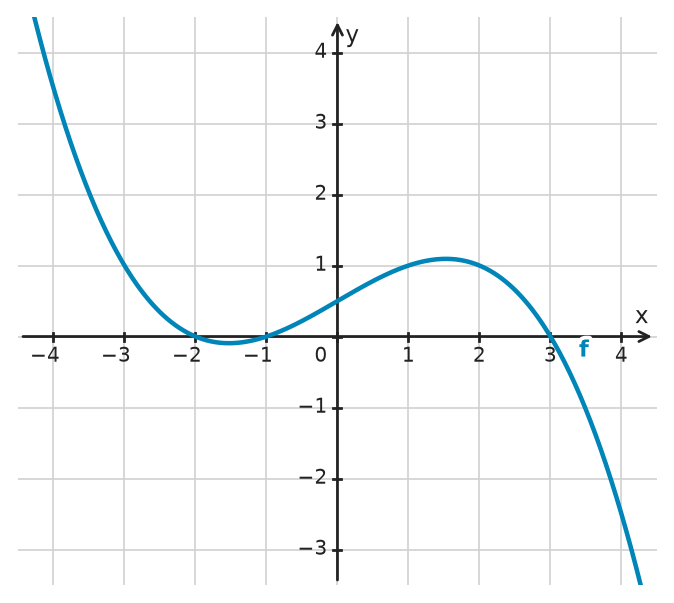
Figure for problem 532655

Hints

- A real square root requires a nonnegative radicand. - Read \(f(2)\) from the graph before applying the square root. - At an intersection, solve \(y=\sqrt{y}\) for possible function values \(y\). - Then read where \(f(x)\) has those values.

Solution

1. The function \(g\) is defined where \(f(x)\ge0\). From the graph, \(f(4)=-2.5<0\), so \(4\) is not in the domain of \(g\). 2. The graph shows \(f(2)=1\). Therefore, \(g(2)=\sqrt{1}=1\). 3. At an intersection, \(f(x)=\sqrt{f(x)}\), with \(f(x)\ge0\). Let \(y=f(x)\). Then \(y=\sqrt{y}\), so \(y^2=y\), which gives \(y=0\) or \(y=1\). 4. From the graph, \(f(x)=0\) at \(x=-2, -1, 3\), and \(f(x)=1\) at \(x=-3, 1, 2\). 5. Thus, the x-coordinates of the intersections are \(-3, -2, -1, 1, 2, 3\).

Answer

a) \(f(4)=-2.5<0\), so \(4\) is not in the domain of \(g\). Also, \(g(2)=1\). b) \(x\in\{-3, -2, -1, 1, 2, 3\}\)

53455711
The graph of \(f\) is shown. Define \(h(x)=\sqrt{f(x)}\). a) Use the graph to find the maximal real domain of \(h\). b) Find \(h(1)\). c) Find the x-coordinates of all points shared by the graphs of \(f\) and \(h\). Justify your answer algebraically.
Figure for problem 534557

Hints

- Determine where the graph of \(f\) is on or above the x-axis. - Read \(f(1)\) before applying the square root. - At a shared point, solve \(y=\sqrt{y}\) for possible output values.

Solution

1. The square root is defined where \(f(x)\ge0\). The graph is on or above the x-axis for \(0\le x\le2\), so the domain of \(h\) is \([0, 2]\). 2. The graph shows \(f(1)=1\), so \(h(1)=\sqrt{1}=1\). 3. At a shared point, \(f(x)=\sqrt{f(x)}\), with \(f(x)\ge0\). Let \(y=f(x)\). Then \(y=\sqrt{y}\), so \(y^2=y\), giving \(y=0\) or \(y=1\). 4. From the graph, \(f(x)=0\) at \(x=0, 2\), and \(f(x)=1\) at \(x=1\). Therefore, the shared points have x-coordinates \(0, 1, 2\).

Answer

a) \([0, 2]\) b) \(h(1)=1\) c) \(x=0, 1, 2\)
52537611
Solve over the real numbers, accounting for the domain: \(\frac{x}{\sqrt{1+x}-\sqrt{1-x}}-\frac{x}{\sqrt{1+x}+\sqrt{1-x}}=\frac{1}{2}\).

Hints

- Find the interval where both radicands are nonnegative, then exclude values that make a denominator zero. - Combine the fractions using the product of conjugates. - Simplify before solving the remaining radical equation.

Solution

1. The radicands require \(-1\le x\le1\). The first denominator is zero when \(x=0\), so \(D=[-1, 1]\setminus\{0\}\). 2. Combine the fractions. The common denominator is \((\sqrt{1+x}-\sqrt{1-x})(\sqrt{1+x}+\sqrt{1-x})=2x\). 3. The combined numerator is \(x(\sqrt{1+x}+\sqrt{1-x})-x(\sqrt{1+x}-\sqrt{1-x})=2x\sqrt{1-x}\). 4. Since \(x\ne0\), the left side simplifies to \(\sqrt{1-x}\). Thus \(\sqrt{1-x}=\frac{1}{2}\). 5. Square both sides: \(1-x=\frac{1}{4}\), so \(x=\frac{3}{4}\). This value is in the domain and satisfies the original equation.

Answer

\(\left\{\frac{3}{4}\right\}\)
52562611
Solve the system over the real numbers: \(\begin{cases}\frac{1}{\sqrt{x}} + \frac{1}{\sqrt{y}} = \frac{3}{4} \\ xy = 64\end{cases}\).

Hints

- Use the product equation to simplify \(\sqrt{xy}\). - Substitute new variables for \(\sqrt{x}\) and \(\sqrt{y}\). - Solve the resulting sum-and-product system, then square the values.

Solution

1. The denominators require \(x > 0\) and \(y > 0\). Therefore, \(\sqrt{xy} = 8\). 2. Combine the fractions: \(\frac{\sqrt{x} + \sqrt{y}}{\sqrt{xy}} = \frac{3}{4}\). Substitute \(\sqrt{xy} = 8\): \(\sqrt{x} + \sqrt{y} = 6\). 3. Let \(u = \sqrt{x}\) and \(v = \sqrt{y}\). Then \(u + v = 6\) and \(uv = 8\). 4. Substitute \(v = 6 - u\): \(u(6 - u) = 8\), so \(u^2 - 6u + 8 = 0\). 5. Factor: \((u - 2)(u - 4) = 0\). Thus, \((u, v) = (2, 4)\) or \((4, 2)\). 6. Since \(x = u^2\) and \(y = v^2\), the solutions are \((4, 16)\) and \((16, 4)\).

Answer

\(\{(4, 16), (16, 4)\}\)

All problems may be used, copied and printed free of charge for school and tutoring, including paid tutoring. Commercial adaptations as well as publication or redistribution on the internet are not permitted.

