Aimathic
Login | English | Deutsch

Free Math Worksheets

Build your own math worksheets from 21,000 problems for grades 3 to 12, from fractions to calculus. Every problem includes step-by-step solutions.

Graph rational functions

Click problems to add them to your worksheet.

51007212
The graph of \(y = \frac{12}{x + 2} + 3\) crosses the \(x\)-axis at \(x = a\) and the \(y\)-axis at \(y = b\). Which statement is true? a) \(a = -2\), \(b = 3\) b) \(a = -6\), \(b = 3\) c) \(a = -6\), \(b = 9\) d) \(a = -2\), \(b = 9\)

Hints

- What is the value of \(x\) where a graph crosses the \(y\)-axis? - What is the value of \(y\) where a graph crosses the \(x\)-axis? - Substitute those values into the equation one at a time.

Solution

1. Find the \(y\)-intercept by substituting \(x = 0\): \(y = \frac{12}{0 + 2} + 3 = 6 + 3 = 9\). Therefore, \(b = 9\). 2. Find the \(x\)-intercept by setting \(y = 0\): \(0 = \frac{12}{x + 2} + 3\). 3. Then \(-3 = \frac{12}{x + 2}\), so \(-3(x + 2) = 12\). Thus, \(x + 2 = -4\) and \(x = -6\). Therefore, \(a = -6\). 4. The correct choice is c).

Answer

c) \(a = -6\), \(b = 9\)
51291512
Consider the function \(h(x) = \frac{12}{x + 4} - 3\). a) Find the \(x\)-intercept. b) Find the \(y\)-intercept. c) For what value of \(x\) is \(h(x) = 1\)?

Hints

- At an \(x\)-intercept, the function value is \(0\). - At a \(y\)-intercept, the input is \(0\). - When solving the equation in part c), first isolate the fraction.

Solution

1. To find the \(x\)-intercept, set \(h(x) = 0\): \(0 = \frac{12}{x + 4} - 3\). Then \(3 = \frac{12}{x + 4}\), so \(3(x + 4) = 12\). Thus, \(x + 4 = 4\) and \(x = 0\). The \(x\)-intercept is \((0, 0)\). 2. To find the \(y\)-intercept, substitute \(x = 0\): \(h(0) = \frac{12}{0 + 4} - 3 = 3 - 3 = 0\). The \(y\)-intercept is also \((0, 0)\). 3. To solve \(h(x) = 1\), write \(1 = \frac{12}{x + 4} - 3\). Then \(4 = \frac{12}{x + 4}\), so \(4(x + 4) = 12\). Thus, \(x + 4 = 3\) and \(x = -1\).

Answer

a) The \(x\)-intercept is \((0, 0)\). b) The \(y\)-intercept is \((0, 0)\). c) \(x = -1\)
51324412
Consider the function \(g(x) = \frac{2}{x + 1} - 4\). a) Find the vertical asymptote. b) Find the y-intercept. c) Find the zero of the function. d) Describe how the graph of \(g\) is obtained from the graph of \(h(x) = \frac{2}{x}\).

Hints

- When does the denominator equal \(0\)? - What input gives a point on the y-axis? - What equation must be solved to find a zero? - In the form \(\frac{k}{x - x_0} + y_0\), how do \(x_0\) and \(y_0\) affect the graph?

Solution

1. The denominator is \(0\) when \(x + 1 = 0\), so the vertical asymptote is \(x = -1\). 2. Set \(x = 0\): \(g(0) = \frac{2}{1} - 4 = -2\). The y-intercept is \((0, -2)\). 3. Solve \(0 = \frac{2}{x + 1} - 4\). Then \(4 = \frac{2}{x + 1}\), so \(4(x + 1) = 2\). Therefore, \(x + 1 = 0.5\) and \(x = -0.5\). 4. Replacing \(x\) with \(x + 1\) translates the graph \(1\) unit left, and subtracting \(4\) translates it \(4\) units down.

Answer

a) \(x = -1\) b) \((0, -2)\) c) \(x = -0.5\) d) Translate the graph \(1\) unit left and \(4\) units down.
51326412
The graph of \(g\) is obtained by translating the graph of \(f(x) = \frac{1}{x}\) by \(3\) units left and \(2\) units up. a) Write the function rule for \(g\). b) Write the equations of the vertical and horizontal asymptotes of \(g\). c) Find the y-intercept of the graph of \(g\).

Hints

- How does a horizontal or vertical translation change a function rule? - Which input makes the denominator equal to \(0\)? - Which line does the graph approach as \(|x|\) becomes large? - What input gives the y-intercept?

Solution

1. Translating \(3\) units left replaces \(x\) with \(x + 3\), and translating \(2\) units up adds \(2\). Thus, \(g(x) = \frac{1}{x + 3} + 2\). 2. The denominator is \(0\) at \(x = -3\), so the vertical asymptote is \(x = -3\). The vertical translation gives the horizontal asymptote \(y = 2\). 3. Set \(x = 0\): \(g(0) = \frac{1}{3} + 2 = \frac{7}{3}\). The y-intercept is \(\left(0, \frac{7}{3}\right)\).

Answer

a) \(g(x) = \frac{1}{x + 3} + 2\) b) Vertical asymptote: \(x = -3\); horizontal asymptote: \(y = 2\) c) \(\left(0, \frac{7}{3}\right)\)
51327012
The function \(g(x) = \frac{3}{x + 1} + 2\) has domain \(\mathbb{R} \setminus \{-1\}\). Determine algebraically whether each point lies on the graph. If a point does not lie on the graph, state whether it is above or below the graph: \(P_1(2, 3)\), \(P_2(-2, 1)\), and \(P_3(0, 5)\).

Hints

- What relationship must a point satisfy to lie on a function graph? - Evaluate the function at each given \(x\)-coordinate. - Compare the given \(y\)-coordinate with the calculated function value.

Solution

1. For \(P_1\), \(g(2) = \frac{3}{2 + 1} + 2 = 3\). This equals the given \(y\)-coordinate, so \(P_1\) lies on the graph. 2. For \(P_2\), \(g(-2) = \frac{3}{-2 + 1} + 2 = -1\). Since the point has \(y = 1\) and \(1 > -1\), \(P_2\) lies above the graph. 3. For \(P_3\), \(g(0) = \frac{3}{0 + 1} + 2 = 5\). This equals the given \(y\)-coordinate, so \(P_3\) lies on the graph.

Answer

\(P_1(2, 3)\) and \(P_3(0, 5)\) lie on the graph. Point \(P_2(-2, 1)\) lies above the graph.
51328812
Consider \(f(x) = \frac{1}{x}\), \(g(x) = \frac{5}{x}\), and \(h(x) = -\frac{1}{x}\). a) Describe how the graph of \(g\) differs from the graph of \(f\), including the relative distance of corresponding points from the origin. b) Compare the graphs of \(f\) and \(h\). In which quadrants do their branches lie?

Hints

- Compare the outputs of \(f\) and \(g\) for the same nonzero input. - Determine how a negative sign in front of the entire function changes the graph. - Test one positive and one negative input to identify the quadrants.

Solution

1. For the same nonzero input, \(|g(x)| = \frac{5}{|x|}\) is five times \(|f(x)| = \frac{1}{|x|}\). Thus, the graph of \(g\) is a vertical stretch of the graph of \(f\), and corresponding points on \(g\) lie farther from the origin. 2. The graph of \(h(x) = -\frac{1}{x}\) is a reflection of the graph of \(f\) across the \(x\)-axis. It can also be viewed as a reflection across the \(y\)-axis. 3. The branches of \(f\) lie in Quadrants I and III, while the branches of \(h\) lie in Quadrants II and IV.

Answer

a) The graph of \(g\) is a vertical stretch of the graph of \(f\) by a factor of \(5\); corresponding points lie farther from the origin. b) The graph of \(h\) is a reflection of \(f\). The branches of \(f\) lie in Quadrants I and III, and the branches of \(h\) lie in Quadrants II and IV.
51329712
Consider the rational functions \(f(x) = \frac{8}{x + 2} - 2\) and \(g(x) = \frac{-6}{x - 3} - 1\). Find the \(x\)-intercept and the \(y\)-intercept of each graph.

Hints

- To find a \(y\)-intercept, substitute \(x = 0\). - At an \(x\)-intercept, the function value is \(0\). - Isolate the fraction before solving each equation.

Solution

1. For \(f\), substitute \(x = 0\): \(f(0) = \frac{8}{0 + 2} - 2 = 2\). Therefore, the \(y\)-intercept is \((0, 2)\). 2. Set \(f(x) = 0\): \(0 = \frac{8}{x + 2} - 2\). Then \(2 = \frac{8}{x + 2}\), so \(x + 2 = 4\) and \(x = 2\). Therefore, the \(x\)-intercept is \((2, 0)\). 3. For \(g\), substitute \(x = 0\): \(g(0) = \frac{-6}{0 - 3} - 1 = 1\). Therefore, the \(y\)-intercept is \((0, 1)\). 4. Set \(g(x) = 0\): \(0 = \frac{-6}{x - 3} - 1\). Then \(1 = \frac{-6}{x - 3}\), so \(x - 3 = -6\) and \(x = -3\). Therefore, the \(x\)-intercept is \((-3, 0)\).

Answer

\(f\): \(x\)-intercept \((2, 0)\); \(y\)-intercept \((0, 2)\). \(g\): \(x\)-intercept \((-3, 0)\); \(y\)-intercept \((0, 1)\).
51330012
Consider the function \(f(x) = \frac{4}{x - 1} + 2\). Find the coordinates of the \(x\)-intercept and the \(y\)-intercept.

Hints

- At a \(y\)-intercept, the input is \(0\). - At an \(x\)-intercept, the function value is \(0\). - Isolate the fraction before clearing the denominator.

Solution

1. To find the \(y\)-intercept, substitute \(x = 0\): \(f(0) = \frac{4}{0 - 1} + 2 = -4 + 2 = -2\). Therefore, the \(y\)-intercept is \((0, -2)\). 2. To find the \(x\)-intercept, set \(f(x) = 0\): \(0 = \frac{4}{x - 1} + 2\). 3. Then \(-2 = \frac{4}{x - 1}\), so \(-2(x - 1) = 4\). Thus, \(-2x + 2 = 4\), giving \(x = -1\). 4. Therefore, the \(x\)-intercept is \((-1, 0)\).

Answer

The \(x\)-intercept is \((-1, 0)\), and the \(y\)-intercept is \((0, -2)\).
51330112
Find the \(x\)-intercept and the \(y\)-intercept of \(h(x) = \frac{15}{x + 3} - 2.5\).

Hints

- At an \(x\)-intercept, the function value is \(0\). - At a \(y\)-intercept, the input is \(0\). - Keep track of the decimal value when you isolate the denominator.

Solution

1. To find the \(y\)-intercept, substitute \(x = 0\): \(h(0) = \frac{15}{0 + 3} - 2.5 = 5 - 2.5 = 2.5\). Therefore, the \(y\)-intercept is \((0, 2.5)\). 2. To find the \(x\)-intercept, set \(h(x) = 0\): \(0 = \frac{15}{x + 3} - 2.5\). 3. Then \(2.5 = \frac{15}{x + 3}\), so \(2.5(x + 3) = 15\). Thus, \(x + 3 = 6\), giving \(x = 3\). 4. Therefore, the \(x\)-intercept is \((3, 0)\).

Answer

The \(x\)-intercept is \((3, 0)\), and the \(y\)-intercept is \((0, 2.5)\).
51330312
Consider the rational function \(f(x) = \frac{8}{x - 2} - 1\). a) Find the \(x\)-intercept and the \(y\)-intercept of the graph. b) Determine algebraically whether \(P(6, 1)\) lies on the graph.

Hints

- Use \(x = 0\) to find the \(y\)-intercept and \(f(x) = 0\) to find the \(x\)-intercept. - A point lies on a graph when its coordinates satisfy the function equation. - Substitute the point's \(x\)-coordinate and compare the result with its \(y\)-coordinate.

Solution

1. For the \(y\)-intercept, substitute \(x = 0\): \(f(0) = \frac{8}{0 - 2} - 1 = -4 - 1 = -5\). Therefore, the \(y\)-intercept is \((0, -5)\). 2. For the \(x\)-intercept, set \(f(x) = 0\): \(0 = \frac{8}{x - 2} - 1\). Then \(1 = \frac{8}{x - 2}\), so \(x - 2 = 8\) and \(x = 10\). Therefore, the \(x\)-intercept is \((10, 0)\). 3. To test \(P(6, 1)\), evaluate \(f(6)\): \(f(6) = \frac{8}{6 - 2} - 1 = 2 - 1 = 1\). 4. The calculated value matches the point's \(y\)-coordinate, so \(P(6, 1)\) lies on the graph.

Answer

a) The \(x\)-intercept is \((10, 0)\), and the \(y\)-intercept is \((0, -5)\). b) Yes. Since \(f(6) = 1\), the point \(P(6, 1)\) lies on the graph.
51330612
Consider the functions \(f(x) = \frac{6}{x + 2} - 1.5\) and \(g(x) = \frac{-4}{x - 5} + 0.8\). Find the \(x\)-intercept and the \(y\)-intercept of each graph. Give each answer as an ordered pair.

Hints

- Substitute \(x = 0\) to find a \(y\)-intercept. - Set the function value equal to \(0\) to find an \(x\)-intercept. - Isolate the fraction before solving for \(x\).

Solution

1. For \(f\), substitute \(x = 0\): \(f(0) = \frac{6}{2} - 1.5 = 1.5\). Therefore, the \(y\)-intercept is \((0, 1.5)\). 2. Set \(f(x) = 0\): \(0 = \frac{6}{x + 2} - 1.5\). Then \(1.5 = \frac{6}{x + 2}\), so \(x + 2 = 4\) and \(x = 2\). Therefore, the \(x\)-intercept is \((2, 0)\). 3. For \(g\), substitute \(x = 0\): \(g(0) = \frac{-4}{-5} + 0.8 = 1.6\). Therefore, the \(y\)-intercept is \((0, 1.6)\). 4. Set \(g(x) = 0\): \(0 = \frac{-4}{x - 5} + 0.8\). Then \(-0.8 = \frac{-4}{x - 5}\), so \(x - 5 = 5\) and \(x = 10\). Therefore, the \(x\)-intercept is \((10, 0)\).

Answer

\(f\): \(x\)-intercept \((2, 0)\); \(y\)-intercept \((0, 1.5)\). \(g\): \(x\)-intercept \((10, 0)\); \(y\)-intercept \((0, 1.6)\).
51332812
Consider \(g(x) = \frac{6}{x - 3} - 2\). a) Describe the translations that transform the graph of \(p(x) = \frac{6}{x}\) into the graph of \(g\). b) Determine algebraically whether the graph of \(g\) passes through the origin. c) Find the value of \(x\) for which \(g(x) = 1\).

Hints

- How do changes inside and outside a function affect horizontal and vertical position? - What are the coordinates of the origin? - When a function value is given, which variable must be found?

Solution

1. Replacing \(x\) with \(x - 3\) translates the graph \(3\) units right, and subtracting \(2\) translates it \(2\) units down. 2. The origin is \((0, 0)\). Evaluate \(g(0) = \frac{6}{-3} - 2 = -4\). Since \(g(0) \ne 0\), the graph does not pass through the origin. 3. Solve \(1 = \frac{6}{x - 3} - 2\). Then \(3 = \frac{6}{x - 3}\), so \(x - 3 = 2\) and \(x = 5\).

Answer

a) Translate \(3\) units right and \(2\) units down. b) No, because \(g(0) = -4\). c) \(x = 5\)
51398712
The graph of \(f(x) = \frac{k}{x + 3} - 2\) passes through \(P(1, 1)\). Find \(k\).

Hints

- A point on the graph must satisfy the function equation. - Substitute the point's \(x\)-coordinate for \(x\) and its \(y\)-coordinate for \(f(x)\). - Isolate the parameter step by step.

Solution

1. Substitute the coordinates of \(P(1, 1)\): \(1 = \frac{k}{1 + 3} - 2\). 2. Then \(1 = \frac{k}{4} - 2\), so \(3 = \frac{k}{4}\). 3. Multiply by \(4\): \(k = 12\).

Answer

\(k = 12\)
52196112
Give one possible formula for a rational function \(f\) that satisfies both conditions. 1. The graph crosses the x-axis at \(x=5\). 2. The function has a vertical asymptote at \(x=-3\), with the same sign on both sides.

Hints

- An x-intercept comes from a numerator zero that is in the domain. - A vertical asymptote comes from a noncanceling denominator zero. - An even multiplicity produces the same sign on both sides of the asymptote. - Compare the behavior of \(\frac{1}{x}\) and \(\frac{1}{x^2}\).

Solution

1. An x-intercept at \(x=5\) requires the numerator factor \((x-5)\). 2. A vertical asymptote at \(x=-3\) without a sign change can be created by the even-power denominator factor \((x+3)^2\). 3. Therefore, one possible function is \(f(x)=\frac{x-5}{(x+3)^2}\).

Answer

One possible formula is \(f(x)=\frac{x-5}{(x+3)^2}\).
52197612
Consider \(k(x)=\frac{2x^2-18}{x^2+2}\). a) Find the domain and determine the graph's symmetry. b) Find all x- and y-intercepts. c) Describe the end behavior as \(x\to\infty\) and as \(x\to-\infty\). d) Find \(k(1)\) and \(k(4)\).

Hints

- Can the denominator ever equal \(0\)? - Compare \(k(-x)\) with \(k(x)\). - Set \(x=0\) for the y-intercept and set the numerator equal to \(0\) for x-intercepts. - Compare leading coefficients for the end behavior.

Solution

1. Since \(x^2+2>0\) for all real \(x\), the domain is \(\mathbb{R}\). Also, \(k(-x)=k(x)\), so the graph is symmetric about the y-axis. 2. The y-intercept is \(k(0)=-9\), so it is \((0, -9)\). For x-intercepts, solve \(2x^2-18=0\), giving \(x=\pm 3\). The x-intercepts are \((-3, 0)\) and \((3, 0)\). 3. The numerator and denominator have the same degree, so \(\lim_{x\to\pm\infty}k(x)=2\). The horizontal asymptote is \(y=2\). 4. \(k(1)=\frac{-16}{3}\), and \(k(4)=\frac{14}{18}=\frac{7}{9}\).

Answer

a) Domain: \(\mathbb{R}\); symmetric about the y-axis b) y-intercept: \((0, -9)\); x-intercepts: \((-3, 0)\) and \((3, 0)\) c) \(k(x)\to 2\) as \(x\to\pm\infty\); horizontal asymptote: \(y=2\) d) \(k(1)=-\frac{16}{3}\), \(k(4)=\frac{7}{9}\)
52198112
Find one rational function \(f\) whose domain is \(\mathbb{R}\setminus\{4\}\), whose horizontal asymptote is \(y=-2\), and whose graph has a vertical asymptote at \(x=4\) with a sign change across it.

Hints

- Use a denominator factor to exclude \(x=4\). - Use an odd multiplicity to create a sign change. - Match numerator and denominator degrees and leading coefficients to obtain \(y=-2\).

Solution

1. To exclude only \(x=4\) and create a sign-changing vertical asymptote, use the denominator factor \((x-4)\) to an odd power. Choose \(x-4\). 2. For horizontal asymptote \(y=-2\), use numerator and denominator polynomials of the same degree with leading-coefficient ratio \(-2\). 3. One example is \(f(x)=\frac{-2x}{x-4}\). At \(x=4\), the numerator equals \(-8\), so the factor does not cancel, and the vertical asymptote remains.

Answer

One possible formula is \(f(x)=\frac{-2x}{x-4}\).
52198312
Let \(f(x)=\frac{2x^2+18}{x^2-6x+9}\). a) State the domain of \(f\) and find \(f(0)\). b) Show algebraically that \(f\) has no x-intercepts.

Hints

- Find where the denominator is zero. - Substitute \(x=0\) directly to find the y-intercept value. - A rational function equals zero only when its numerator is zero. - Can a real number have a negative square?

Solution

1. Factor the denominator: \(x^2-6x+9=(x-3)^2\). Therefore, \(D_f=\mathbb{R}\setminus\{3\}\). 2. Evaluate the function at zero: \(f(0)=\frac{18}{9}=2\). 3. An x-intercept would require \(2x^2+18=0\), or \(x^2=-9\). 4. This equation has no real solution, so \(f\) has no x-intercepts.

Answer

a) \(D_f=\mathbb{R}\setminus\{3\}\), and \(f(0)=2\) b) The function has no x-intercepts because \(2x^2+18=0\) has no real solutions.
52198712
Consider \(f(x)=\frac{12}{x^2+3}\). a) Determine the graph's symmetry. b) Find \(f(-3)\), \(f(0)\), and \(f(3)\). c) Describe the end behavior as \(x\to\pm\infty\) and give the equation of the horizontal asymptote. d) Explain without further calculation why \(f\) has no x-intercepts.

Hints

- Compare \(f(-x)\) with \(f(x)\). - Substitute the given x-values directly. - What happens when a constant numerator is divided by a denominator that grows without bound? - When can a rational expression equal \(0\)?

Solution

1. Since \(f(-x)=f(x)\), the function is even and its graph is symmetric about the y-axis. 2. \(f(-3)=1\), \(f(0)=4\), and \(f(3)=1\). 3. The denominator has greater degree than the numerator, so \(\lim_{x\to\pm\infty}f(x)=0\). The horizontal asymptote is \(y=0\). 4. A rational function can equal \(0\) only when its numerator is \(0\). The numerator is the nonzero constant \(12\), so there are no x-intercepts.

Answer

a) Symmetric about the y-axis b) \(f(-3)=1\), \(f(0)=4\), \(f(3)=1\) c) \(f(x)\to 0\) as \(x\to\pm\infty\); horizontal asymptote: \(y=0\) d) No x-intercepts
52201412
For each \(t>0\), define \(g_t(x)=\frac{2x^2+t}{x^2+2t}\). a) Explain why the domain is all real numbers and why the function has no x-intercepts. b) Show that every graph passes through \((0, 0.5)\). c) Find \(\lim_{x\to\pm\infty}g_t(x)\), and explain why the result is the same for every value of \(t\).

Hints

- Use \(x^2\ge 0\) and \(t>0\) to determine the signs of the numerator and denominator. - Substitute \(x=0\). - Compare the leading coefficients or divide by \(x^2\).

Solution

1. Since \(t>0\), both \(x^2+2t\) and \(2x^2+t\) are positive for every real \(x\). Thus, the domain is \(\mathbb{R}\), and there are no x-intercepts. 2. Evaluate \(g_t(0)=\frac{t}{2t}=\frac{1}{2}=0.5\), so every graph passes through \((0, 0.5)\). 3. Divide the numerator and denominator by \(x^2\): \(g_t(x)=\frac{2+\frac{t}{x^2}}{1+\frac{2t}{x^2}}\). 4. As \(x\to\pm\infty\), the terms containing \(\frac{1}{x^2}\) approach \(0\), so the limit is \(2\). This value is independent of \(t\) because the leading coefficients are always \(2\) and \(1\).

Answer

a) Domain: \(\mathbb{R}\); no x-intercepts b) \(g_t(0)=0.5\) c) \(\lim_{x\to\pm\infty}g_t(x)=2\)
52268412
Let \(f(x)=0.5x^2+2\) and \(g(x)=\frac{1}{f(x)}\). 1) Give the range of each function. 2) Determine whether each graph is symmetric about the y-axis. 3) Compare the locations and types of the extrema of the two graphs.

Hints

- Use the vertex of the quadratic to find its minimum. - Determine what taking reciprocals does to the smallest and largest positive values. - Compare each function at \(-x\) and \(x\).

Solution

1. The function \(f\) has a global minimum of \(2\) at \(x=0\) and is unbounded above, so its range is \([2, \infty)\). 2. The reciprocal \(g\) has a global maximum of \(\frac{1}{2}\) at \(x=0\), is always positive, and approaches \(0\) without reaching it. Its range is \(\left(0, \frac{1}{2}\right]\). 3. Since \(f(-x)=f(x)\), \(f\) is even. Then \(g(-x)=\frac{1}{f(-x)}=\frac{1}{f(x)}=g(x)\), so \(g\) is also even. 4. Both extrema occur at \(x=0\), but \(f\) has a minimum at \((0, 2)\), while \(g\) has a maximum at \(\left(0, \frac{1}{2}\right)\).

Answer

1) Range of \(f\): \([2, \infty)\); range of \(g\): \(\left(0, \frac{1}{2}\right]\) 2) Both graphs are symmetric about the y-axis. 3) \(f\) has a minimum at \((0, 2)\); \(g\) has a maximum at \(\left(0, \frac{1}{2}\right)\).
52289312
The graphs of two functions intersect at certain points. The functions are \(f(x)=\frac{10}{x-3}\) and \(g(x)=x\). Find the coordinates of all intersection points algebraically.

Hints

- Set the two function expressions equal. - Clear the denominator, while keeping the excluded value in mind. - After finding each x-value, substitute it into either function to find the corresponding y-value. - Check that each x-value is in the domain.

Solution

1. Set the function values equal: \(\frac{10}{x-3}=x\), with \(x\neq 3\). 2. Multiply by \(x-3\): \(10=x(x-3)=x^2-3x\). 3. Rewrite in standard form: \(x^2-3x-10=0\). 4. Factor: \((x-5)(x+2)=0\), so \(x=5\) or \(x=-2\). 5. Since \(g(x)=x\), the corresponding y-values are \(5\) and \(-2\). Both x-values are in the domain of \(f\).

Answer

The intersection points are \((5, 5)\) and \((-2, -2)\).
52803612
Consider \(f(x) = \frac{24}{x - 4}\) for \(x > 4\). a) Find \(f(6)\), \(f(8)\), and \(f(12)\). Describe how \(f(x)\) changes as \(x\) increases. b) Without further calculation, explain whether \(f(x)\) can ever equal \(0\) or become negative while \(x > 4\).

Hints

- Substitute the given inputs and compare the outputs. - When does a rational expression equal \(0\)? - What is the sign of \(x - 4\) when \(x > 4\)? - What happens when a fixed positive numerator is divided by an increasing positive denominator?

Solution

1. Evaluate the function: \(f(6) = \frac{24}{6 - 4} = 12\), \(f(8) = \frac{24}{8 - 4} = 6\), and \(f(12) = \frac{24}{12 - 4} = 3\). 2. As \(x\) increases, the positive denominator increases, so the function values decrease. 3. A rational expression can equal \(0\) only when its numerator equals \(0\). Since the numerator is always \(24\), \(f(x)\) cannot equal \(0\). 4. For \(x > 4\), both numerator and denominator are positive, so \(f(x) > 0\). Therefore, the function cannot become negative on the stated domain.

Answer

a) \(f(6) = 12\), \(f(8) = 6\), and \(f(12) = 3\). The function values decrease as \(x\) increases. b) The function can be neither \(0\) nor negative for \(x > 4\).
53005112
Let \(f(x)=\frac{x^4-2x^2+5}{x^2}\), where \(x\neq 0\). 1) Find a quadratic function \(p\) whose graph approaches the graph of \(f\) as \(x\to\pm\infty\). 2) Show that the vertical difference between the graphs approaches \(0\) as \(|x|\) increases. 3) Use \(d(x)=f(x)-p(x)\) to determine whether the graph of \(f\) lies above or below the parabola.

Hints

- Divide each numerator term by the denominator. - Subtract the polynomial part from the original function. - Find the limit and sign of the remaining term.

Solution

1. Divide each numerator term by \(x^2\): \(f(x)=x^2-2+\frac{5}{x^2}\). Therefore, \(p(x)=x^2-2\). 2. The difference is \(d(x)=f(x)-p(x)=\frac{5}{x^2}\). 3. Since \(\lim_{x\to\pm\infty}\frac{5}{x^2}=0\), the vertical difference between the graphs approaches \(0\). 4. For every \(x\neq 0\), \(\frac{5}{x^2}>0\). Thus, \(f(x)>p(x)\), so the graph of \(f\) lies above the parabola throughout its domain.

Answer

1) \(p(x)=x^2-2\) 2) \(\lim_{x\to\pm\infty}(f(x)-p(x))=\lim_{x\to\pm\infty}\frac{5}{x^2}=0\) 3) The graph of \(f\) lies above \(p\) for every \(x\neq 0\).
53231912
The left panel shows the parent function \(f(x) = \frac{1}{x}\). The right panel shows a translated hyperbola \(g\). a) Read the equations of the vertical and horizontal asymptotes of \(g\). b) Describe the translation that transforms the graph of \(f\) into the graph of \(g\). c) Write the function rule for \(g\).
Figure for problem 532319

Hints

- Identify the dashed lines in the right panel. - Compare the asymptotes of the translated graph with those of the parent function. - How do horizontal and vertical translations change \(\frac{1}{x}\)? - Pay attention to the sign inside the denominator for a left translation.

Solution

1. The right graph approaches the vertical line \(x = -3\) and the horizontal line \(y = 2\), so these are its asymptotes. 2. The parent graph has asymptotes \(x = 0\) and \(y = 0\). Moving them to \(x = -3\) and \(y = 2\) translates the graph \(3\) units left and \(2\) units up. 3. Therefore, \(g(x) = \frac{1}{x + 3} + 2\).

Answer

a) Vertical asymptote: \(x = -3\); horizontal asymptote: \(y = 2\) b) Translate \(3\) units left and \(2\) units up. c) \(g(x) = \frac{1}{x + 3} + 2\)
53233312
The two panels show the graphs of rational functions \(g\) and \(h\). Each graph is a translation of the parent function \(f(x) = \frac{1}{x}\). The dashed lines are asymptotes. a) Find the equations of the vertical and horizontal asymptotes of \(g\). Then write a function rule for \(g\). b) Find the equations of the vertical and horizontal asymptotes of \(h\). Then write a function rule for \(h\).
Figure for problem 532333

Hints

- Identify the dashed vertical and horizontal lines in each panel. - Compare each pair of asymptotes with the asymptotes \(x = 0\) and \(y = 0\) of the parent function. - A horizontal translation changes the expression in the denominator. - A vertical translation adds or subtracts a number outside the fraction.

Solution

1. For \(g\), the graph approaches the vertical line \(x = -2\) and the horizontal line \(y = -1\). 2. Translating \(\frac{1}{x}\) left \(2\) units replaces \(x\) with \(x + 2\). Translating it down \(1\) unit subtracts \(1\). Therefore, \(g(x) = \frac{1}{x + 2} - 1\). 3. For \(h\), the graph approaches the vertical line \(x = 1\) and the horizontal line \(y = 2\). 4. Translating \(\frac{1}{x}\) right \(1\) unit replaces \(x\) with \(x - 1\). Translating it up \(2\) units adds \(2\). Therefore, \(h(x) = \frac{1}{x - 1} + 2\).

Answer

a) Asymptotes: \(x = -2\) and \(y = -1\); \(g(x) = \frac{1}{x + 2} - 1\) b) Asymptotes: \(x = 1\) and \(y = 2\); \(h(x) = \frac{1}{x - 1} + 2\)
53249112
Let \(f(x)=\frac{2x-6}{x-2}\), where \(x\neq 2\). Its graph and asymptotes are shown. a) Read the vertical and horizontal asymptotes from the figure. b) Find the x- and y-intercepts. c) Use a limit as \(x\to\infty\) to verify the horizontal asymptote.
Figure for problem 532491

Hints

- Read the dashed lines approached by the graph. - Set \(y=0\) for the x-intercept and \(x=0\) for the y-intercept. - Divide numerator and denominator by the highest power of \(x\).

Solution

1. From the figure, the vertical asymptote is \(x=2\), and the horizontal asymptote is \(y=2\). 2. For the x-intercept, set the numerator equal to zero: \(2x-6=0\), so \(x=3\). The x-intercept is \((3, 0)\). 3. For the y-intercept, evaluate \(f(0)=\frac{-6}{-2}=3\). The y-intercept is \((0, 3)\). 4. Divide numerator and denominator by \(x\): \(f(x)=\frac{2-\frac{6}{x}}{1-\frac{2}{x}}\). 5. Since \(\frac{1}{x}\to 0\) as \(x\to\infty\), \(\lim_{x\to\infty}f(x)=\frac{2}{1}=2\), confirming the horizontal asymptote \(y=2\).

Answer

a) Vertical asymptote: \(x=2\); horizontal asymptote: \(y=2\) b) X-intercept: \((3, 0)\); y-intercept: \((0, 3)\) c) \(\lim_{x\to\infty}f(x)=2\)
53314712
Which function rule matches the translated hyperbola shown in the graph? a) \(f(x) = \frac{1}{x - 1} + 2\) b) \(f(x) = -\frac{1}{x - 1} + 2\) c) \(f(x) = -\frac{1}{x + 1} + 2\) d) \(f(x) = -\frac{1}{x - 1} - 2\)
Figure for problem 533147

Hints

- First identify the vertical and horizontal asymptotes. - Use the asymptotes to determine the horizontal and vertical translations. - Test a point with integer coordinates to determine the sign of the numerator. - Notice which two regions formed by the asymptotes contain the branches.

Solution

1. The graph approaches the vertical line \(x = 1\) and the horizontal line \(y = 2\). Therefore, the function has the form \(f(x) = \frac{a}{x - 1} + 2\). 2. The point \((0, 3)\) lies on the graph. Substitute it into the function rule: \(3 = \frac{a}{0 - 1} + 2\). 3. Solving gives \(3 = -a + 2\), so \(a = -1\). 4. Thus, \(f(x) = -\frac{1}{x - 1} + 2\), which is choice b).

Answer

b) \(f(x) = -\frac{1}{x - 1} + 2\)
53315512
The dashed graph is the parent function \(f(x) = \frac{1}{x}\). The solid graph \(g\) is a translation of this function. Find the equations of the asymptotes of \(g\), and write a function rule for \(g\).
Figure for problem 533155

Hints

- Compare the center of the solid hyperbola with the center of the parent graph. - The horizontal asymptote determines the vertical translation. - The vertical asymptote determines the horizontal translation.

Solution

1. The solid graph approaches the vertical line \(x = -2\) and the horizontal line \(y = 2\), so these are its asymptotes. 2. Compared with \(f(x) = \frac{1}{x}\), the graph is translated \(2\) units left and \(2\) units up. 3. A translation \(2\) units left replaces \(x\) with \(x + 2\), and a translation \(2\) units up adds \(2\). Therefore, \(g(x) = \frac{1}{x + 2} + 2\). 4. For example, \(g(-1) = \frac{1}{-1 + 2} + 2 = 3\), which agrees with the graph.

Answer

The asymptotes are \(x = -2\) and \(y = 2\), and \(g(x) = \frac{1}{x + 2} + 2\).
53328312
Match each graph to the correct function rule. Justify your choices using the asymptotes. 1) \(y = \frac{1}{x - 2} + 1\) 2) \(y = -\frac{1}{x + 1} + 2\) 3) \(y = \frac{1}{x + 2} + 1\) 4) \(y = -\frac{1}{x - 1} + 2\)
Figure for problem 533283

Hints

- Read the vertical asymptote from the denominator shift. - Read the horizontal asymptote from the constant outside the fraction. - Use the branch orientation to determine the sign of the numerator. - Verify a proposed match with one point on the graph.

Solution

1. Graph a) has vertical asymptote \(x = 2\) and horizontal asymptote \(y = 1\). It matches rule 1), \(y = \frac{1}{x - 2} + 1\). 2. Graph b) has vertical asymptote \(x = -1\) and horizontal asymptote \(y = 2\). Its branches have the orientation produced by a negative numerator, so it matches rule 2), \(y = -\frac{1}{x + 1} + 2\).

Answer

a) 1) \(y = \frac{1}{x - 2} + 1\) b) 2) \(y = -\frac{1}{x + 1} + 2\)
53329612
Match each function rule to the correct graph. Justify each match using the asymptotes. 1) \(f_1(x) = \frac{1}{x + 2} - 1\) 2) \(f_2(x) = \frac{1}{x - 3} + 1\) 3) \(f_3(x) = \frac{1}{x + 1} + 2\) 4) \(f_4(x) = \frac{1}{x - 2} - 2\)
Figure for problem 533296

Hints

- For \(\frac{1}{x - h} + k\), the vertical asymptote is \(x = h\) and the horizontal asymptote is \(y = k\). - Read both asymptotes from each graph before choosing a function. - Pay attention to the sign inside the denominator.

Solution

1. Graph A has vertical asymptote \(x = 3\) and horizontal asymptote \(y = 1\). Therefore, it matches \(f_2(x) = \frac{1}{x - 3} + 1\). 2. Graph B has vertical asymptote \(x = -2\) and horizontal asymptote \(y = -1\). Therefore, it matches \(f_1(x) = \frac{1}{x + 2} - 1\). 3. Graph C has vertical asymptote \(x = 2\) and horizontal asymptote \(y = -2\). Therefore, it matches \(f_4(x) = \frac{1}{x - 2} - 2\). 4. Graph D has vertical asymptote \(x = -1\) and horizontal asymptote \(y = 2\). Therefore, it matches \(f_3(x) = \frac{1}{x + 1} + 2\).

Answer

A: 2) B: 1) C: 4) D: 3)
53329912
Consider the graphs of functions \(f\) and \(g\). a) Identify the horizontal and vertical asymptotes of each graph. b) Use the marked points \(P\) and \(Q\) to find each function in the form \(y = \frac{a}{x - x_0} + y_0\).
Figure for problem 533299

Hints

- First identify the horizontal and vertical lines each graph approaches. - Substitute the marked point into the transformed reciprocal-function form. - Check that the sign of \(a\) matches the branches of the graph.

Solution

1. For \(f\), the vertical asymptote is \(x = 1\), and the horizontal asymptote is \(y = 2\). Thus, \(f(x) = \frac{a}{x - 1} + 2\). 2. Substitute \(P(2, 3)\): \(3 = \frac{a}{2 - 1} + 2\), so \(a = 1\). Therefore, \(f(x) = \frac{1}{x - 1} + 2\). 3. For \(g\), the vertical asymptote is \(x = -2\), and the horizontal asymptote is \(y = -1\). Thus, \(g(x) = \frac{a}{x + 2} - 1\). 4. Substitute \(Q(0, -1.5)\): \(-1.5 = \frac{a}{2} - 1\), so \(a = -1\). Therefore, \(g(x) = -\frac{1}{x + 2} - 1\).

Answer

a) \(f\): vertical \(x = 1\), horizontal \(y = 2\) \(g\): vertical \(x = -2\), horizontal \(y = -1\) b) \(f(x) = \frac{1}{x - 1} + 2\); \(g(x) = -\frac{1}{x + 2} - 1\)
53330712
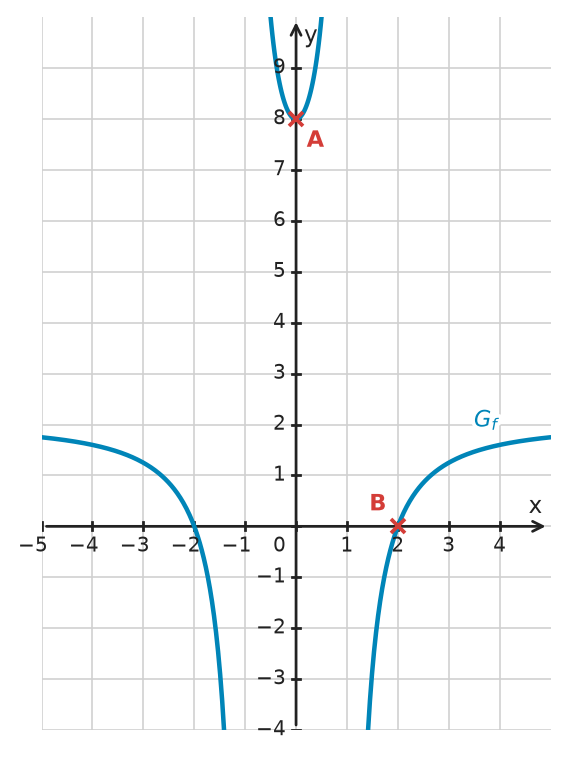
The graph of a rational function \(f\) is shown. Estimate the area of triangle \(NTO\), which is bounded by the coordinate axes and the segment joining the intercepts \(N\) and \(T\).
Figure for problem 533307

Hints

- Read the two intercepts from the graph. - The coordinate axes form the perpendicular legs of the triangle. - Use the area formula for a right triangle.

Solution

1. From the graph, the \(x\)-intercept is approximately \(N = (2, 0)\), and the \(y\)-intercept is approximately \(T = (0, 1)\). 2. Triangle \(NTO\) is a right triangle with leg lengths \(2\) and \(1\). 3. Its area is \(A = \frac{1}{2} \cdot 2 \cdot 1 = 1\) square unit.

Answer

The area of triangle \(NTO\) is approximately \(1\) square unit.
53332612
The graph approaches the y-axis and the horizontal line \(y = 2\). Use the marked point to determine the function rule in the form \(f(x) = \frac{a}{x} + c\).
Figure for problem 533326

Hints

- If the y-axis is the vertical asymptote, the denominator is \(x\). - The horizontal asymptote gives the value of \(c\). - Substitute the marked point to solve for \(a\).

Solution

1. Because the graph approaches the y-axis, the vertical asymptote is \(x = 0\), so the denominator remains \(x\). 2. The horizontal asymptote is \(y = 2\), so \(c = 2\). Thus, \(f(x) = \frac{a}{x} + 2\). 3. The marked point is \((1, -1)\). Substitute it: \(-1 = \frac{a}{1} + 2\). 4. Solving gives \(a = -3\). 5. Therefore, \(f(x) = -\frac{3}{x} + 2\).

Answer

\(f(x) = -\frac{3}{x} + 2\)
53358112
The parent function is \(f(x) = \frac{1}{x}\), and the graph of a translated function \(g\) is shown. Find the equations of the asymptotes, describe the translation, and write the function rule for \(g\).
Figure for problem 533581

Hints

- Identify the lines approached by the translated graph. - Compare the intersection of those asymptotes with the origin. - A right translation produces a minus sign inside the denominator.

Solution

1. The graph approaches the vertical line \(x = 1\) and the horizontal line \(y = 2\). 2. Compared with the parent function, the graph is translated \(1\) unit right and \(2\) units up. 3. A translation \(1\) unit right replaces \(x\) with \(x - 1\), and a translation \(2\) units up adds \(2\). 4. Therefore, \(g(x) = \frac{1}{x - 1} + 2\).

Answer

The asymptotes are \(x = 1\) and \(y = 2\). The graph is translated \(1\) unit right and \(2\) units up, so \(g(x) = \frac{1}{x - 1} + 2\).
53358312
The dashed graph is \(f(x)=\frac{1}{x^2}\). The red graph \(g\) is a translated version of \(f\). State the horizontal and vertical translations, and write the function rule for \(g\).
Figure for problem 533583

Hints

- Use the vertical asymptote to determine the horizontal translation. - Use the horizontal asymptote to determine the vertical translation. - Then update the parent function rule to match both shifts.

Solution

1. The vertical asymptote moves from \(x=0\) to \(x=-2\), so the graph shifts left \(2\) units. 2. The horizontal asymptote moves from \(y=0\) to \(y=-1\), so the graph shifts down \(1\) unit. 3. Replacing \(x\) with \(x+2\) shifts the graph left \(2\) units, and subtracting \(1\) shifts it down. 4. Therefore, \(g(x)=\frac{1}{(x+2)^2}-1\).

Answer

Shift left \(2\) units and down \(1\) unit; \(g(x)=\frac{1}{(x+2)^2}-1\)
53405112
The blue graph is the parent function \(f(x) = \frac{1}{x}\). The graphs \(g\) and \(h\) are translations of \(f\). Determine the function rules for \(g\) and \(h\).
Figure for problem 534051

Hints

- Identify the vertical and horizontal asymptotes of each translated graph. - Compare the intersection of each pair of asymptotes with the origin. - A horizontal translation changes the expression in the denominator.

Solution

1. The graph of \(g\) has vertical asymptote \(x = -2\) and horizontal asymptote \(y = 1\). Therefore, it is translated \(2\) units left and \(1\) unit up. 2. Thus, \(g(x) = \frac{1}{x + 2} + 1\). 3. The graph of \(h\) has vertical asymptote \(x = 3\) and horizontal asymptote \(y = -2\). Therefore, it is translated \(3\) units right and \(2\) units down. 4. Thus, \(h(x) = \frac{1}{x - 3} - 2\).

Answer

\(g(x) = \frac{1}{x + 2} + 1\) \(h(x) = \frac{1}{x - 3} - 2\)
53405212
The blue graph is \(f(x) = \frac{2}{x}\). The graphs \(g\) and \(h\) are translations of \(f\). Determine the function rules for \(g\) and \(h\).
Figure for problem 534052

Hints

- Identify the vertical and horizontal asymptotes of each translated graph. - Compare them with the asymptotes \(x = 0\) and \(y = 0\) of \(f\). - Verify a proposed rule with a point on the graph.

Solution

1. The graph of \(g\) has vertical asymptote \(x = 1\) and horizontal asymptote \(y = 0\). It is the graph of \(f\) translated \(1\) unit right. 2. Therefore, \(g(x) = \frac{2}{x - 1}\). 3. The graph of \(h\) has vertical asymptote \(x = -2\) and horizontal asymptote \(y = -1\). It is the graph of \(f\) translated \(2\) units left and \(1\) unit down. 4. Therefore, \(h(x) = \frac{2}{x + 2} - 1\).

Answer

\(g(x) = \frac{2}{x - 1}\) \(h(x) = \frac{2}{x + 2} - 1\)
53409412
The red graph \(g\) is a scaled version of the blue graph \(f(x)=\frac{2}{x^2+1}\). Describe the transformation and write \(g(x)\) in terms of \(f(x)\).
Figure for problem 534094

Hints

- Compare corresponding y-values at the same x-values. - Check whether the x-coordinates of key features remain unchanged. - A vertical scaling multiplies the entire function output.

Solution

1. The maximum value of \(f\) is \(2\), while the maximum value of \(g\) is \(1\). 2. At every x-value, the output of \(g\) is half the output of \(f\). For example, \(f(1)=1\) and \(g(1)=0.5\). 3. Therefore, the graph is vertically compressed by a factor of \(\frac{1}{2}\), and \(g(x)=\frac{1}{2}f(x)\).

Answer

Vertical compression by a factor of \(\frac{1}{2}\); \(g(x)=\frac{1}{2}f(x)\)
53411812
Two liquids cool in rooms that may have different ambient temperatures. Their temperatures \(T\), in degrees Celsius, after \(t\) minutes are modeled by \(g(t)=\frac{20t+180}{t+2}\) and \(h(t)=\frac{10t+160}{t+2}\). a) Decide which displayed graph, \(k\) or \(m\), represents each function. Use the initial temperature at \(t=0\). b) Find the horizontal asymptote of each function as \(t\to\infty\). Explain its physical meaning.
Figure for problem 534118

Hints

- Evaluate each function at \(t=0\). - Use the ratio of leading coefficients for the long-term temperature. - Interpret the limiting value in the cooling context.

Solution

1. The initial temperatures are \(g(0)=\frac{180}{2}=90\,\text{°C}\) and \(h(0)=\frac{160}{2}=80\,\text{°C}\). 2. Graph \(k\) starts at \(90\,\text{°C}\), so it represents \(g\). Graph \(m\) starts at \(80\,\text{°C}\), so it represents \(h\). 3. The ratio of leading coefficients gives \(\lim_{t\to\infty}g(t)=20\) and \(\lim_{t\to\infty}h(t)=10\). 4. Therefore, the horizontal asymptotes are \(T=20\,\text{°C}\) for \(g\) and \(T=10\,\text{°C}\) for \(h\). Each limiting temperature represents the ambient temperature of the room in which that liquid is cooling.

Answer

a) Graph \(k\) represents \(g\); Graph \(m\) represents \(h\). b) For \(g\): \(T=20\,\text{°C}\). For \(h\): \(T=10\,\text{°C}\). These values are the ambient room temperatures.
53413012
The three panels show the graphs of functions \(f\), \(g\), and \(h\). Match each function to the correct description, and briefly justify your choices. 1. The graph has a vertical asymptote at \(x=-2\) and a removable discontinuity at \(x=-1\). 2. The graph has a removable discontinuity at \(x=1\) and a vertical asymptote at \(x=2\). 3. The graph has vertical asymptotes at \(x=-2\) and \(x=2\), and a removable discontinuity at \(x=0\).
Figure for problem 534130

Hints

- First locate the vertical lines that the graph approaches. - Open circles mark removable discontinuities. - Use the x-axis scale to identify the exact x-values.

Solution

1. In panel a), graph \(f\) has a vertical asymptote at \(x=2\) and a hole at \(x=1\). Therefore, \(f\) matches description 2. 2. In panel b), graph \(g\) has a vertical asymptote at \(x=-2\) and a hole at \(x=-1\). Therefore, \(g\) matches description 1. 3. In panel c), graph \(h\) has vertical asymptotes at \(x=-2\) and \(x=2\), and a hole at \(x=0\). Therefore, \(h\) matches description 3.

Answer

Graph \(f\) in panel a): 2 Graph \(g\) in panel b): 1 Graph \(h\) in panel c): 3
53440812
The figure shows graphs p, q, and r from the family \(j_a(x)=\frac{a}{x^2+1}\). Find the value of \(a\) for each graph.
Figure for problem 534408

Hints

- Evaluate the function at \(x=0\). - Read the y-intercept of each graph. - For these functions, the y-intercept is also the extreme value.

Solution

1. At \(x=0\), \(j_a(0)=a\). Therefore, the y-intercept directly gives the parameter. 2. Graph p has y-intercept \(2\), so \(a=2\). Graph q has y-intercept \(4\), so \(a=4\). Graph r has y-intercept \(-1\), so \(a=-1\).

Answer

p) \(a=2\) q) \(a=4\) r) \(a=-1\)
53440912
The graph is a translated hyperbola. Determine a possible function rule for \(f\).
Figure for problem 534409

Hints

- Identify the horizontal line approached by the graph. - Determine where the graph has a vertical break. - Substitute a point with integer coordinates to find the numerator. - A vertical translation adds a constant outside the fraction.

Solution

1. The graph approaches the horizontal line \(y = 3\), so the function has the form \(f(x) = \frac{a}{x} + 3\). 2. The vertical asymptote is the y-axis, \(x = 0\), so no horizontal translation is needed. 3. The point \((1, 4)\) lies on the graph. Substitute it: \(4 = \frac{a}{1} + 3\). 4. Therefore, \(a = 1\), and \(f(x) = \frac{1}{x} + 3\).

Answer

One possible function rule is \(f(x) = \frac{1}{x} + 3\).
51287512
Consider the rational function \(g(x) = \frac{2x - 6}{x + 1}\). a) Use a graphing utility to estimate the intercepts of the graph with both coordinate axes. b) Verify both intercepts algebraically. c) Explain why the graph cannot have an \(x\)-intercept at \(x = -1\).

Hints

- A rational expression equals zero when its numerator is zero and its denominator is not zero. - Check what happens to the denominator when \(x = -1\). - To find the \(y\)-intercept algebraically, substitute \(x = 0\).

Solution

1. A graphing utility shows an estimated \(y\)-intercept of \((0, -6)\) and an estimated \(x\)-intercept of \((3, 0)\). 2. For the \(y\)-intercept, substitute \(x = 0\): \(g(0) = \frac{2(0) - 6}{0 + 1} = -6\). Therefore, the \(y\)-intercept is \((0, -6)\). 3. For the \(x\)-intercept, set the numerator equal to zero while requiring a nonzero denominator: \(2x - 6 = 0\), so \(x = 3\). Since \(3 + 1 \neq 0\), the \(x\)-intercept is \((3, 0)\). 4. At \(x = -1\), the denominator is \(-1 + 1 = 0\). The function is undefined there, so the graph has no point—and therefore no \(x\)-intercept—at \(x = -1\).

Answer

a) The estimated intercepts are \((0, -6)\) and \((3, 0)\). b) The exact \(y\)-intercept is \((0, -6)\), and the exact \(x\)-intercept is \((3, 0)\). c) At \(x = -1\), the denominator is zero, so the function is undefined and there is no point on the graph.
51322912
Two students discuss the graph of \(g(x) = \frac{-2}{x + 3}\). Lucas says, “Because the numerator is negative, the branches lie in Quadrants II and IV of the coordinate system formed by the asymptotes.” Sofia says, “The graph must pass through \(P(-1, -1)\).” a) Determine algebraically whether Sofia is correct. b) Decide whether Lucas correctly describes the orientation of the graph, and briefly justify your answer. c) Find the value of \(x\) for which \(g(x) = -0.5\).

Hints

- How can substitution determine whether a point lies on a graph? - How does the sign of the numerator affect the orientation of a reciprocal graph relative to its asymptotes? - How can you solve an equation when the variable appears in the denominator?

Solution

1. Evaluate the function at \(x = -1\): \(g(-1) = \frac{-2}{-1 + 3} = \frac{-2}{2} = -1\). Therefore, Sofia is correct. 2. Relative to the asymptotes \(x = -3\) and \(y = 0\), a negative numerator places the branches in Quadrants II and IV. Therefore, Lucas is correct. 3. Solve \(\frac{-2}{x + 3} = -0.5\). Multiplying by \(x + 3\) gives \(-2 = -0.5(x + 3)\). Dividing by \(-0.5\) gives \(4 = x + 3\), so \(x = 1\).

Answer

a) Yes. \(g(-1) = -1\). b) Lucas is correct. Since the numerator is negative, the branches lie in Quadrants II and IV relative to the asymptotes. c) \(x = 1\)
51323512
A rational function has the form \(f(x) = \frac{a}{x - h} + k\). Its vertical asymptote is \(x = 3\), its horizontal asymptote is \(y = 2\), and its graph passes through \(P(5, 3)\). Determine \(a\), \(h\), and \(k\), and write the function rule.

Hints

- The asymptotes determine \(h\) and \(k\) directly. - Substitute the given point after writing the function with an unknown \(a\). - Solve the resulting equation for \(a\).

Solution

1. The vertical asymptote \(x = 3\) gives \(h = 3\), and the horizontal asymptote \(y = 2\) gives \(k = 2\). 2. The function has the form \(f(x) = \frac{a}{x - 3} + 2\). 3. Substitute \(P(5, 3)\): \(3 = \frac{a}{5 - 3} + 2\). 4. This gives \(1 = \frac{a}{2}\), so \(a = 2\). 5. Therefore, \(f(x) = \frac{2}{x - 3} + 2\).

Answer

\(a = 2\), \(h = 3\), and \(k = 2\); \(f(x) = \frac{2}{x - 3} + 2\)
51326012
The parent function is \(h(x) = \frac{1}{x}\). A translated function \(g\) has asymptotes that intersect at \((-3, 2)\). a) Write the function rule for \(g\). b) Find the x-intercept of \(g\). c) Explain without calculating why the graph cannot intersect the line \(y = 2\).

Hints

- The intersection of the asymptotes gives the horizontal and vertical translations. - Set \(g(x) = 0\) to find the x-intercept. - Can a fraction with a nonzero numerator equal \(0\)?

Solution

1. The asymptote intersection \((-3, 2)\) means the vertical asymptote is \(x = -3\) and the horizontal asymptote is \(y = 2\). 2. Translating \(\frac{1}{x}\) \(3\) units left and \(2\) units up gives \(g(x) = \frac{1}{x + 3} + 2\). 3. To find the x-intercept, solve \(0 = \frac{1}{x + 3} + 2\). Then \(-2 = \frac{1}{x + 3}\), so \(-2(x + 3) = 1\). 4. Solving \(-2x - 6 = 1\) gives \(x = -3.5\). The x-intercept is \((-3.5, 0)\). 5. The line \(y = 2\) is the horizontal asymptote. Since \(\frac{1}{x + 3}\) can never equal \(0\), \(g(x)\) can never equal \(2\).

Answer

a) \(g(x) = \frac{1}{x + 3} + 2\) b) \((-3.5, 0)\) c) The term \(\frac{1}{x + 3}\) is never \(0\), so \(g(x)\) never equals \(2\).
51326312
Consider the function \(h(x) = -\frac{1}{x - 2} + 5\). a) Describe the reflections and translations that transform the graph of \(f(x) = \frac{1}{x}\) into the graph of \(h\). b) State the domain and range of \(h\). c) Find the value of \(x\) for which \(h(x) = 4\).

Hints

- What effect does each number in the function rule have on the parent graph? - Which input is excluded, and which output cannot occur? - Rearrange the equation one step at a time to isolate \(x\).

Solution

1. The negative sign reflects the graph across the x-axis. Replacing \(x\) with \(x - 2\) translates it \(2\) units right, and adding \(5\) translates it \(5\) units up. 2. The denominator cannot equal \(0\), so the domain is \(\mathbb{R} \setminus \{2\}\). The function cannot equal its horizontal asymptote, so the range is \(\mathbb{R} \setminus \{5\}\). 3. Solve \(4 = -\frac{1}{x - 2} + 5\). Then \(-1 = -\frac{1}{x - 2}\), so \(x - 2 = 1\) and \(x = 3\).

Answer

a) Reflect across the x-axis, translate \(2\) units right, and translate \(5\) units up. b) Domain: \(\mathbb{R} \setminus \{2\}\); range: \(\mathbb{R} \setminus \{5\}\) c) \(x = 3\)
51326712
Consider \(f(x) = \frac{3}{x}\) and \(g(x) = \frac{0.6}{x}\). a) Describe what the graphs have in common about their asymptotes and domains. b) For the same nonzero value of \(x\), which corresponding point lies closer to the origin? Explain using the numerators. c) Evaluate both functions at \(x = 1.5\).

Hints

- Determine which input makes each denominator zero. - Consider what happens to each output as \(|x|\) becomes large. - Compare the absolute values of the numerators for the same input. - Substitute \(x = 1.5\) directly.

Solution

1. Both denominators are zero at \(x = 0\), so each domain is \(\mathbb{R} \setminus \{0\}\). Both graphs have the vertical asymptote \(x = 0\) and the horizontal asymptote \(y = 0\). 2. For the same nonzero \(x\), \(|g(x)| = \frac{0.6}{|x|}\) is less than \(|f(x)| = \frac{3}{|x|}\). The points have the same \(x\)-coordinate, so the point on \(g\) lies closer to the origin. 3. Evaluate: \(f(1.5) = \frac{3}{1.5} = 2\), and \(g(1.5) = \frac{0.6}{1.5} = 0.4\).

Answer

a) Both domains are \(\mathbb{R} \setminus \{0\}\), and both graphs have asymptotes \(x = 0\) and \(y = 0\). b) For the same nonzero \(x\), the point on \(g\) lies closer to the origin because \(0.6 < 3\), so its \(y\)-coordinate has smaller absolute value. c) \(f(1.5) = 2\) and \(g(1.5) = 0.4\)
51326812
Consider \(h(x) = \frac{2}{x} + 4\) and \(k(x) = \frac{2}{x} - 1\). a) State the horizontal asymptote of each graph. b) Describe the vertical translation that maps the graph of \(h\) onto the graph of \(k\). c) Find the \(x\)-intercept of \(h\).

Hints

- The constant outside the fraction gives the horizontal asymptote. - Compare the two constant terms to determine the translation. - At an \(x\)-intercept, the function value is \(0\).

Solution

1. For a function of the form \(\frac{a}{x} + c\), the horizontal asymptote is \(y = c\). Therefore, the asymptotes are \(y = 4\) for \(h\) and \(y = -1\) for \(k\). 2. The change in the vertical shift is \(-1 - 4 = -5\). Therefore, translating the graph of \(h\) down \(5\) units produces the graph of \(k\). 3. Set \(h(x) = 0\): \(0 = \frac{2}{x} + 4\). Then \(-4 = \frac{2}{x}\), so \(x = -\frac{1}{2}\). The \(x\)-intercept is \(\left(-\frac{1}{2}, 0\right)\).

Answer

a) The horizontal asymptotes are \(y = 4\) for \(h\) and \(y = -1\) for \(k\). b) Translate the graph of \(h\) down \(5\) units. c) The \(x\)-intercept of \(h\) is \(\left(-\frac{1}{2}, 0\right)\).
51327112
The function \(h\) is defined by \(h(x) = \frac{k}{x - 4} - 3\). 1) Find \(k\), given that \(Q(6, 1)\) lies on the graph. 2) Using that value of \(k\), determine whether \(R(2, -5)\) lies above or below the graph of \(h\).

Hints

- If a point lies on a graph, its coordinates satisfy the function rule. - Rearrange the resulting equation to isolate \(k\). - Write the complete function rule before checking the second point. - Compare the point's \(y\)-coordinate with the function value at the same input.

Solution

1. Substitute \(Q(6, 1)\): \(1 = \frac{k}{6 - 4} - 3\). Then \(4 = \frac{k}{2}\), so \(k = 8\). 2. The function is \(h(x) = \frac{8}{x - 4} - 3\). 3. Evaluate at \(x = 2\): \(h(2) = \frac{8}{2 - 4} - 3 = -7\). 4. Since the point has \(y = -5\) and \(-5 > -7\), point \(R\) lies above the graph.

Answer

1) \(k = 8\) 2) Point \(R(2, -5)\) lies above the graph.
51327212
Consider \(f_1(x) = \frac{4}{x}\) and \(f_2(x) = \frac{4}{x - 2} + 1\). 1) Show algebraically that \(S(4, 1)\) lies on the graph of \(f_1\). 2) Determine whether \(S\) lies above, below, or on the graph of \(f_2\). 3) Find the \(x\)-coordinate of the point on the graph of \(f_2\) whose \(y\)-coordinate is \(5\).

Hints

- Substitute the known input into the appropriate function rule. - What does comparing two \(y\)-values at the same \(x\)-coordinate tell you about vertical position? - How can you solve an equation when the variable is in the denominator? - Check carefully which function is used in each part.

Solution

1. Evaluate \(f_1(4) = \frac{4}{4} = 1\). Therefore, \(S\) lies on the graph of \(f_1\). 2. Evaluate \(f_2(4) = \frac{4}{4 - 2} + 1 = 3\). Since the point has \(y = 1\) and \(1 < 3\), \(S\) lies below the graph of \(f_2\). 3. Solve \(5 = \frac{4}{x - 2} + 1\). Then \(4 = \frac{4}{x - 2}\), so \(x - 2 = 1\) and \(x = 3\).

Answer

1) \(f_1(4) = 1\), so \(S\) lies on the graph of \(f_1\). 2) \(S\) lies below the graph of \(f_2\), because \(f_2(4) = 3\) and \(1 < 3\). 3) \(x = 3\)
51328412
Consider \(f(x) = \frac{1}{x}\) and \(g(x) = \frac{-3}{x}\). Both graphs have the same asymptotes. a) In which quadrants do the branches of each graph lie? b) For the same nonzero value of \(x\), which corresponding point lies closer to the origin? Justify your answer using the numerator parameters.

Hints

- Test one positive and one negative input for each function. - A negative numerator reflects the graph across the \(x\)-axis. - Compare the absolute output values for the same nonzero input.

Solution

1. For \(f\), positive inputs give positive outputs and negative inputs give negative outputs. Therefore, its branches lie in Quadrants I and III. 2. For \(g\), positive inputs give negative outputs and negative inputs give positive outputs. Therefore, its branches lie in Quadrants II and IV. 3. For the same nonzero \(x\), \(|f(x)| = \frac{1}{|x|}\) and \(|g(x)| = \frac{3}{|x|}\). The points have the same \(x\)-coordinate, but the point on \(f\) has the smaller absolute \(y\)-coordinate. Therefore, the point on \(f\) is closer to the origin.

Answer

a) The branches of \(f\) lie in Quadrants I and III. The branches of \(g\) lie in Quadrants II and IV. b) For the same nonzero \(x\), the point on \(f\) lies closer to the origin because \(\frac{1}{|x|} < \frac{3}{|x|}\).
51328712
A rational function has the form \(f(x) = \frac{a}{x - h} + k\). Its vertical asymptote is \(x = 2\). The graph crosses the \(x\)-axis at \((4, 0)\) and the \(y\)-axis at \((0, -1)\). Find \(a\) and \(k\).

Hints

- Use the vertical asymptote to determine the horizontal shift \(h\). - Substitute each intercept into the function to create two equations. - Combine the equations to eliminate one variable.

Solution

1. The vertical asymptote \(x = 2\) gives \(h = 2\), so \(f(x) = \frac{a}{x - 2} + k\). 2. Substitute the \(x\)-intercept \((4, 0)\): \(0 = \frac{a}{4 - 2} + k\), so \(\frac{a}{2} + k = 0\). 3. Substitute the \(y\)-intercept \((0, -1)\): \(-1 = \frac{a}{0 - 2} + k\), so \(-\frac{a}{2} + k = -1\). 4. Add the two equations: \(2k = -1\), so \(k = -\frac{1}{2}\). 5. Substitute \(k = -\frac{1}{2}\) into \(\frac{a}{2} + k = 0\): \(\frac{a}{2} - \frac{1}{2} = 0\), so \(a = 1\).

Answer

\(a = 1\) and \(k = -\frac{1}{2}\)
51328912
A rational function has the form \(f(x) = \frac{a}{x - h} + k\). Its vertical asymptote is \(x = -2\), its horizontal asymptote is \(y = 1\), and its graph passes through \(P(0, 2)\). a) Find \(h\), \(k\), and \(a\). b) Write the complete function rule. c) Describe how the graph would change if \(a\) were \(-2\) instead of its value from part a).

Hints

- Read the horizontal and vertical shifts from the asymptotes. - Substitute the given point to determine the remaining parameter. - Changing the sign of the numerator parameter reflects the graph across its horizontal asymptote.

Solution

1. The vertical asymptote gives \(h = -2\), and the horizontal asymptote gives \(k = 1\). Thus, \(f(x) = \frac{a}{x + 2} + 1\). 2. Substitute \(P(0, 2)\): \(2 = \frac{a}{0 + 2} + 1\). Then \(1 = \frac{a}{2}\), so \(a = 2\). 3. Therefore, the function rule is \(f(x) = \frac{2}{x + 2} + 1\). 4. Replacing \(a = 2\) with \(a = -2\) changes the sign of the rational term. The graph is reflected across the horizontal asymptote \(y = 1\), so the branch orientation reverses.

Answer

a) \(h = -2\), \(k = 1\), and \(a = 2\). b) \(f(x) = \frac{2}{x + 2} + 1\) c) With \(a = -2\), the graph is reflected across \(y = 1\).
51329012
Consider \(f(x) = \frac{4}{x - 1} + 2\) and \(g(x) = \frac{-4}{x - 1} + 2\). a) State the asymptotes of both graphs. b) Find the \(y\)-intercept of each graph. c) Determine whether the graphs have a common point. If they do, find it; otherwise, justify why not.

Hints

- Compare the denominators and constant terms. - Substitute \(x = 0\) to find the \(y\)-intercepts. - Set the two function rules equal to test for intersections. - A contradiction means there is no common point.

Solution

1. Both functions have the denominator \(x - 1\) and the same vertical shift. Therefore, both graphs have the vertical asymptote \(x = 1\) and the horizontal asymptote \(y = 2\). 2. Evaluate \(f(0)\): \(f(0) = \frac{4}{-1} + 2 = -2\). Thus, the \(y\)-intercept of \(f\) is \((0, -2)\). 3. Evaluate \(g(0)\): \(g(0) = \frac{-4}{-1} + 2 = 6\). Thus, the \(y\)-intercept of \(g\) is \((0, 6)\). 4. To find a common point, solve \(\frac{4}{x - 1} + 2 = \frac{-4}{x - 1} + 2\). Subtracting \(2\) and multiplying by \(x - 1\) gives \(4 = -4\), a contradiction. 5. Therefore, the graphs have no common point. They are reflections of each other across \(y = 2\).

Answer

a) Both graphs have asymptotes \(x = 1\) and \(y = 2\). b) The \(y\)-intercepts are \((0, -2)\) for \(f\) and \((0, 6)\) for \(g\). c) The graphs have no common point because solving \(f(x) = g(x)\) leads to the contradiction \(4 = -4\).
51329312
Consider \(f(x) = \frac{4}{x - 1} + 3\). One line of symmetry is \(s: y = x + 2\). a) Verify algebraically that \(Q(2, 7)\) lies on the graph of \(f\). b) Reflecting \(Q\) across line \(s\) gives \(R(5, 4)\). Use symmetry to explain why \(R\) must also lie on the hyperbola, and then verify this by substitution.

Hints

- What equation must the coordinates of a point satisfy to lie on a graph? - What happens to a figure when it is reflected across one of its own lines of symmetry? - How can substitution verify the reflected point?

Solution

1. Evaluate \(f(2) = \frac{4}{2 - 1} + 3 = 7\). Therefore, \(Q\) lies on the graph. 2. A reflection across a line of symmetry maps every point of the graph to another point on the same graph. Since \(Q\) lies on the hyperbola, its reflected point \(R\) must also lie on it. 3. Verify by substitution: \(f(5) = \frac{4}{5 - 1} + 3 = 4\). This matches the \(y\)-coordinate of \(R\).

Answer

a) \(f(2) = 7\), so \(Q\) lies on the graph. b) Symmetry implies that the reflection \(R\) also lies on the graph, and \(f(5) = 4\) confirms it.
51329812
A rational function has the form \(f(x) = \frac{a}{x + 1} + c\). Its graph crosses the \(y\)-axis at \((0, 3)\) and the \(x\)-axis at \((2, 0)\). Find \(a\) and \(c\), and write the complete function rule.

Hints

- Substitute the coordinates of each intercept into the general function rule. - The two substitutions create a system of two equations. - Eliminate one variable or express one variable in terms of the other.

Solution

1. Substitute the \(y\)-intercept \((0, 3)\): \(3 = \frac{a}{0 + 1} + c\), so \(a + c = 3\). 2. Substitute the \(x\)-intercept \((2, 0)\): \(0 = \frac{a}{2 + 1} + c\), so \(\frac{a}{3} + c = 0\). 3. Subtract the second equation from the first: \(a - \frac{a}{3} = 3\). Thus, \(\frac{2a}{3} = 3\), so \(a = 4.5\). 4. Substitute \(a = 4.5\) into \(\frac{a}{3} + c = 0\): \(1.5 + c = 0\), so \(c = -1.5\). 5. Therefore, the function rule is \(f(x) = \frac{4.5}{x + 1} - 1.5\).

Answer

\(a = 4.5\), \(c = -1.5\), and \(f(x) = \frac{4.5}{x + 1} - 1.5\)
51330212
The graph of \(g(x) = \frac{k}{x + 2} - 4\) passes through \(P(2, -1)\). a) Find the value of \(k\). b) Find the \(x\)-intercept and the \(y\)-intercept of \(g\).

Hints

- A point on the graph must satisfy the function equation. - Substitute the coordinates of \(P\) first to determine \(k\). - After finding \(k\), use \(x = 0\) for the \(y\)-intercept and \(g(x) = 0\) for the \(x\)-intercept.

Solution

1. Because \(P(2, -1)\) lies on the graph, substitute \(x = 2\) and \(g(x) = -1\): \(-1 = \frac{k}{2 + 2} - 4\). 2. Then \(3 = \frac{k}{4}\), so \(k = 12\). 3. The function is \(g(x) = \frac{12}{x + 2} - 4\). For the \(y\)-intercept, substitute \(x = 0\): \(g(0) = \frac{12}{2} - 4 = 2\). Therefore, the \(y\)-intercept is \((0, 2)\). 4. For the \(x\)-intercept, set \(g(x) = 0\): \(0 = \frac{12}{x + 2} - 4\). Then \(4 = \frac{12}{x + 2}\), so \(4(x + 2) = 12\). Thus, \(x = 1\). 5. Therefore, the \(x\)-intercept is \((1, 0)\).

Answer

a) \(k = 12\) b) The \(x\)-intercept is \((1, 0)\), and the \(y\)-intercept is \((0, 2)\).
51330412
Consider the functions \(f(x) = \frac{4}{x - 2} + 2\) and \(g(x) = \frac{-4}{x + 2} - 2\). Find the \(x\)-intercept and the \(y\)-intercept of each graph. Then compare the locations of the intercepts.

Hints

- Find both intercepts for each function systematically. - If substituting \(x = 0\) gives a function value of \(0\), the graph passes through the origin. - Compare the distances and coordinates of the intercepts relative to the origin.

Solution

1. For \(f\), substitute \(x = 0\): \(f(0) = \frac{4}{0 - 2} + 2 = 0\). Therefore, the \(y\)-intercept is \((0, 0)\). 2. Set \(f(x) = 0\): \(0 = \frac{4}{x - 2} + 2\). Then \(-2 = \frac{4}{x - 2}\), so \(-2(x - 2) = 4\), giving \(x = 0\). Thus, the \(x\)-intercept is also \((0, 0)\). 3. For \(g\), substitute \(x = 0\): \(g(0) = \frac{-4}{0 + 2} - 2 = -4\). Therefore, the \(y\)-intercept is \((0, -4)\). 4. Set \(g(x) = 0\): \(0 = \frac{-4}{x + 2} - 2\). Then \(2 = \frac{-4}{x + 2}\), so \(2(x + 2) = -4\), giving \(x = -4\). Thus, the \(x\)-intercept is \((-4, 0)\). 5. The graph of \(f\) passes through the origin. The two intercepts of \(g\) lie on the negative axes, each \(4\) units from the origin; they are reflections of each other across the line \(y = x\).

Answer

\(f\): Both intercepts are at \((0, 0)\). \(g\): The \(x\)-intercept is \((-4, 0)\), and the \(y\)-intercept is \((0, -4)\). Comparison: The graph of \(f\) passes through the origin. The intercepts of \(g\) are each \(4\) units from the origin and are reflections across \(y = x\).
51330712
A rational function has the form \(f(x) = \frac{a}{x - 4} + 2\), where \(a\) is a real number. a) Find the value of \(a\) that makes the graph pass through the origin \((0, 0)\). b) For this value of \(a\), determine whether the graph has any other intercepts. Justify your answer algebraically.

Hints

- Passing through the origin means that \(f(0) = 0\). - Use the known point to solve for the parameter. - After finding \(a\), solve for all \(x\)-intercepts and remember that every \(y\)-intercept has \(x = 0\).

Solution

1. Because the graph passes through \((0, 0)\), substitute \(x = 0\) and \(f(x) = 0\): \(0 = \frac{a}{0 - 4} + 2\). 2. Then \(0 = -\frac{a}{4} + 2\), so \(\frac{a}{4} = 2\) and \(a = 8\). 3. With \(a = 8\), the function is \(f(x) = \frac{8}{x - 4} + 2\). Its \(y\)-intercept is determined by the single input \(x = 0\), which already gives \((0, 0)\). 4. To check for another \(x\)-intercept, solve \(0 = \frac{8}{x - 4} + 2\). Then \(-2 = \frac{8}{x - 4}\), so \(x - 4 = -4\) and \(x = 0\). 5. Therefore, the origin is the only intercept of the graph.

Answer

a) \(a = 8\) b) No. The only \(x\)-intercept is \((0, 0)\), and \(x = 0\) can produce only one \(y\)-intercept, so there are no additional intercepts.
51330812
Compare the \(x\)-intercepts of \(f(x) = \frac{10}{x - 2} - 4\) and \(g(x) = \frac{10}{x - 4} - 2\). Which function has an \(x\)-intercept farther from the origin? Justify your answer by calculating both intercepts.

Hints

- Set each function equal to \(0\) to find its \(x\)-intercept. - The distance from the origin of a point \((x, 0)\) is \(|x|\). - Compare the absolute values of the two \(x\)-coordinates.

Solution

1. Set \(f(x) = 0\): \(0 = \frac{10}{x - 2} - 4\). Then \(4 = \frac{10}{x - 2}\), so \(x - 2 = 2.5\) and \(x = 4.5\). The \(x\)-intercept is \((4.5, 0)\). 2. Set \(g(x) = 0\): \(0 = \frac{10}{x - 4} - 2\). Then \(2 = \frac{10}{x - 4}\), so \(x - 4 = 5\) and \(x = 9\). The \(x\)-intercept is \((9, 0)\). 3. The distances from the origin are \(|4.5| = 4.5\) and \(|9| = 9\). Since \(9 > 4.5\), the \(x\)-intercept of \(g\) is farther from the origin.

Answer

The \(x\)-intercept of \(f\) is \((4.5, 0)\), and the \(x\)-intercept of \(g\) is \((9, 0)\). Therefore, the intercept of \(g\) is farther from the origin.
51331012
Consider the family of functions \(g_k(x) = \frac{k}{x - 2} + 3\), where \(k \neq 0\). a) Find the value of \(k\) that makes the graph cross the \(x\)-axis at \(x = 5\). b) For the value of \(k\) found in part a), find the \(y\)-intercept.

Hints

- At an \(x\)-intercept, the function value is \(0\). - Substitute the known input and output to solve for \(k\). - To find the \(y\)-intercept, substitute \(x = 0\).

Solution

1. An \(x\)-intercept at \(x = 5\) means that \((5, 0)\) lies on the graph. Substitute \(x = 5\) and \(g_k(x) = 0\): \(0 = \frac{k}{5 - 2} + 3\). 2. Then \(0 = \frac{k}{3} + 3\), so \(-3 = \frac{k}{3}\) and \(k = -9\). 3. The function is \(g(x) = \frac{-9}{x - 2} + 3\). For the \(y\)-intercept, substitute \(x = 0\): \(g(0) = \frac{-9}{0 - 2} + 3 = 4.5 + 3 = 7.5\). 4. Therefore, the \(y\)-intercept is \((0, 7.5)\).

Answer

a) \(k = -9\) b) The \(y\)-intercept is \((0, 7.5)\).
51331312
Consider the function \(g(x) = \frac{8}{x - d} + 2\). Its graph crosses the \(y\)-axis at \((0, -2)\). a) Find the value of \(d\). b) Find the \(x\)-intercept of the graph.

Hints

- At every point on the \(y\)-axis, the input is \(0\). - Use the known intercept to solve for the parameter before finding the other intercept. - At an \(x\)-intercept, the function value is \(0\).

Solution

1. Substitute the \(y\)-intercept \((0, -2)\): \(-2 = \frac{8}{0 - d} + 2\). 2. Then \(-4 = \frac{8}{-d}\). Multiplying by \(-d\) gives \(4d = 8\), so \(d = 2\). 3. The function is \(g(x) = \frac{8}{x - 2} + 2\). To find the \(x\)-intercept, set \(g(x) = 0\): \(0 = \frac{8}{x - 2} + 2\). 4. Then \(-2 = \frac{8}{x - 2}\), so \(-2(x - 2) = 8\). Thus, \(-2x + 4 = 8\), giving \(x = -2\). 5. Therefore, the \(x\)-intercept is \((-2, 0)\).

Answer

a) \(d = 2\) b) The \(x\)-intercept is \((-2, 0)\).
51331412
Consider the functions \(f(x) = \frac{4}{x - 2} + 1\) and \(h(x) = \frac{4}{x - 2} - 1\). a) Find the \(x\)-intercept and the \(y\)-intercept of each graph. b) Compare the intercepts. Why are the \(x\)-intercepts different even though the rational terms are identical?

Hints

- Calculate all four intercepts separately. - The constants outside the fractions produce vertical shifts. - Consider how moving a graph up or down changes where it crosses the \(x\)-axis.

Solution

1. For \(f\), substitute \(x = 0\): \(f(0) = \frac{4}{-2} + 1 = -1\). Therefore, the \(y\)-intercept is \((0, -1)\). 2. Set \(f(x) = 0\): \(0 = \frac{4}{x - 2} + 1\). Then \(-1 = \frac{4}{x - 2}\), so \(x - 2 = -4\) and \(x = -2\). Therefore, the \(x\)-intercept is \((-2, 0)\). 3. For \(h\), substitute \(x = 0\): \(h(0) = \frac{4}{-2} - 1 = -3\). Therefore, the \(y\)-intercept is \((0, -3)\). 4. Set \(h(x) = 0\): \(0 = \frac{4}{x - 2} - 1\). Then \(1 = \frac{4}{x - 2}\), so \(x - 2 = 4\) and \(x = 6\). Therefore, the \(x\)-intercept is \((6, 0)\). 5. The constants \(+1\) and \(-1\) shift the same parent graph vertically in opposite directions. Because each graph is at a different vertical position, it crosses the \(x\)-axis at a different input.

Answer

a) \(f\): \(x\)-intercept \((-2, 0)\), \(y\)-intercept \((0, -1)\); \(h\): \(x\)-intercept \((6, 0)\), \(y\)-intercept \((0, -3)\). b) The constants shift the graphs vertically in opposite directions, so the graphs cross the \(x\)-axis at different inputs.
51331512
Consider \(f(x) = \frac{4}{x + 2} - 1\). a) Write the equations of the vertical and horizontal asymptotes. b) Find the intercepts of the graph with the coordinate axes. c) Consider \(g(x) = \frac{4}{x + 2}\). Explain why the graph of \(g\) has no x-intercept, while the graph of \(f\) does.

Hints

- When can a rational expression equal \(0\)? - What happens to the function value as \(|x|\) becomes large? - Which input is excluded because it makes the denominator \(0\)? - How does the term \(-1\) translate the graph?

Solution

1. The denominator is \(0\) at \(x = -2\), so the vertical asymptote is \(x = -2\). The horizontal asymptote is \(y = -1\). 2. For the y-intercept, set \(x = 0\): \(f(0) = \frac{4}{2} - 1 = 1\). The y-intercept is \((0, 1)\). 3. For the x-intercept, solve \(0 = \frac{4}{x + 2} - 1\). Then \(1 = \frac{4}{x + 2}\), so \(x + 2 = 4\) and \(x = 2\). The x-intercept is \((2, 0)\). 4. The graph of \(g\) has horizontal asymptote \(y = 0\), and \(\frac{4}{x + 2}\) cannot equal \(0\) because its numerator is nonzero. The graph of \(f\) is translated \(1\) unit down, so it can cross the x-axis, as shown by its zero at \(x = 2\).

Answer

a) Vertical asymptote: \(x = -2\); horizontal asymptote: \(y = -1\) b) y-intercept: \((0, 1)\); x-intercept: \((2, 0)\) c) The expression \(\frac{4}{x + 2}\) cannot equal \(0\), but translating the graph down \(1\) unit produces the zero \(x = 2\) for \(f\).
51331712
Consider the functions \(f(x) = \frac{2}{x} + 3\) and \(g(x) = \frac{2}{x + 3}\). Analyze the intercepts of both graphs. One graph has no \(y\)-intercept, and the other has no \(x\)-intercept. Match each property to the correct function and justify your answer mathematically.

Hints

- To test for a \(y\)-intercept, determine whether \(x = 0\) is allowed and, if so, evaluate the function there. - A fraction equals \(0\) only when its numerator is \(0\) and its denominator is not \(0\). - Check the domain of each function.

Solution

1. For \(f(x) = \frac{2}{x} + 3\), the domain is \(\mathbb{R} \setminus \{0\}\). Because \(x = 0\) is not allowed, the graph has no \(y\)-intercept. 2. To find the \(x\)-intercept of \(f\), solve \(0 = \frac{2}{x} + 3\). Then \(-3 = \frac{2}{x}\), so \(x = -\frac{2}{3}\). Thus, the \(x\)-intercept is \(\left(-\frac{2}{3}, 0\right)\). 3. For \(g(x) = \frac{2}{x + 3}\), substitute \(x = 0\): \(g(0) = \frac{2}{3}\). Thus, the \(y\)-intercept is \(\left(0, \frac{2}{3}\right)\). 4. The equation \(\frac{2}{x + 3} = 0\) has no solution because a fraction can equal zero only when its numerator is zero, and the numerator is the nonzero constant \(2\). Therefore, \(g\) has no \(x\)-intercept.

Answer

\(f\) has no \(y\)-intercept because \(x = 0\) is excluded from its domain. Its \(x\)-intercept is \(\left(-\frac{2}{3}, 0\right)\). \(g\) has the \(y\)-intercept \(\left(0, \frac{2}{3}\right)\) and no \(x\)-intercept because its numerator is never zero.
51332012
The function \(h(x) = \frac{12}{x - 3} + q\) has an \(x\)-intercept at \(x = 7\). a) Find \(q\), and then find the \(y\)-intercept of \(h\). b) Explain mathematically why \(j(x) = \frac{12}{x - 3}\), which corresponds to \(q = 0\), has no \(x\)-intercept.

Hints

- At the given \(x\)-intercept, substitute the input and use a function value of \(0\). - A fraction equals \(0\) only when its numerator equals \(0\). - After finding \(q\), substitute \(x = 0\) to find the \(y\)-intercept.

Solution

1. An \(x\)-intercept at \(x = 7\) means \(h(7) = 0\). Substitute: \(0 = \frac{12}{7 - 3} + q = 3 + q\), so \(q = -3\). 2. The function is \(h(x) = \frac{12}{x - 3} - 3\). Substitute \(x = 0\): \(h(0) = \frac{12}{-3} - 3 = -7\). Therefore, the \(y\)-intercept is \((0, -7)\). 3. An \(x\)-intercept of \(j\) would require \(\frac{12}{x - 3} = 0\). A fraction can equal zero only when its numerator is zero, but the numerator is the nonzero constant \(12\). Therefore, the equation has no solution and \(j\) has no \(x\)-intercept.

Answer

a) \(q = -3\), and the \(y\)-intercept is \((0, -7)\). b) The equation \(\frac{12}{x - 3} = 0\) has no solution because its numerator is the nonzero constant \(12\).
51332212
A rational function has the form \(g(x) = \frac{a}{x + d} + c\). Its vertical asymptote is \(x = -1\), its horizontal asymptote is \(y = 4\), and its graph crosses the \(y\)-axis at \((0, 1)\). Find \(a\) and write the complete function rule.

Hints

- Use the vertical asymptote to determine the denominator shift. - Use the horizontal asymptote to determine the vertical shift. - Substitute the given \(y\)-intercept to solve for \(a\).

Solution

1. The vertical asymptote \(x = -1\) means \(-d = -1\), so \(d = 1\). 2. The horizontal asymptote \(y = 4\) gives \(c = 4\). Therefore, \(g(x) = \frac{a}{x + 1} + 4\). 3. Substitute the \(y\)-intercept \((0, 1)\): \(1 = \frac{a}{0 + 1} + 4\). 4. Thus, \(1 = a + 4\), so \(a = -3\). 5. The complete function rule is \(g(x) = \frac{-3}{x + 1} + 4\).

Answer

\(a = -3\), and \(g(x) = \frac{-3}{x + 1} + 4\)
51332312
A rational function has the form \(h(x) = \frac{a}{x - h_0} + k\). Its vertical and horizontal asymptotes intersect at \((2, -1)\), and its graph has an \(x\)-intercept at \(x = 4\). Find the complete function rule.

Hints

- The coordinates of the asymptote intersection give the horizontal and vertical shifts. - An \(x\)-intercept has a function value of \(0\). - Substitute all known values into the general form to solve for the scale factor.

Solution

1. The asymptote intersection \((2, -1)\) gives \(h_0 = 2\) and \(k = -1\). Therefore, \(h(x) = \frac{a}{x - 2} - 1\). 2. The \(x\)-intercept at \(x = 4\) means that \((4, 0)\) lies on the graph. Substitute: \(0 = \frac{a}{4 - 2} - 1\). 3. Then \(1 = \frac{a}{2}\), so \(a = 2\). 4. Therefore, the function rule is \(h(x) = \frac{2}{x - 2} - 1\).

Answer

\(h(x) = \frac{2}{x - 2} - 1\)
51332512
The graph of \(g(x) = \frac{k}{x + 4} - 2\) crosses the \(y\)-axis at \((0, 1)\). a) Find the value of \(k\). b) Find the \(x\)-intercept of the graph.

Hints

- Substitute the coordinates of the known intercept to find the parameter. - At an \(x\)-intercept, the function value is \(0\). - Determine \(k\) before beginning part b).

Solution

1. Substitute the \(y\)-intercept \((0, 1)\): \(1 = \frac{k}{0 + 4} - 2\). 2. Then \(3 = \frac{k}{4}\), so \(k = 12\). 3. The function is \(g(x) = \frac{12}{x + 4} - 2\). To find the \(x\)-intercept, set \(g(x) = 0\): \(0 = \frac{12}{x + 4} - 2\). 4. Then \(2 = \frac{12}{x + 4}\), so \(2(x + 4) = 12\). Thus, \(x + 4 = 6\) and \(x = 2\). 5. Therefore, the \(x\)-intercept is \((2, 0)\).

Answer

a) \(k = 12\) b) The \(x\)-intercept is \((2, 0)\).
51332612
Consider the functions \(f(x) = \frac{4}{x - 2} + 2\) and \(g(x) = \frac{a}{x - 2} + 4\). a) Find the \(x\)-intercept of \(f\). b) Find the value of \(a\) that makes \(g\) have the same \(x\)-intercept as \(f\).

Hints

- First find the input where \(f(x) = 0\). - Having the same \(x\)-intercept means that \(g\) must also equal \(0\) at that input. - Substitute the intercept into \(g\) and solve for \(a\).

Solution

1. Set \(f(x) = 0\): \(0 = \frac{4}{x - 2} + 2\). 2. Then \(-2 = \frac{4}{x - 2}\), so \(-2(x - 2) = 4\). Thus, \(x - 2 = -2\) and \(x = 0\). The \(x\)-intercept of \(f\) is \((0, 0)\). 3. For \(g\) to have the same \(x\)-intercept, \(g(0) = 0\). Substitute: \(0 = \frac{a}{0 - 2} + 4\). 4. Then \(0 = -\frac{a}{2} + 4\), so \(\frac{a}{2} = 4\) and \(a = 8\).

Answer

a) The \(x\)-intercept of \(f\) is \((0, 0)\). b) \(a = 8\)
51332912
Consider \(f(x) = \frac{2}{x + 1} + 4\) and \(h(x) = \frac{2}{x - 2} + 1\). a) By how many units horizontally and vertically must the graph of \(f\) be translated to coincide with the graph of \(h\)? b) Find the point on the graph of \(f\) whose \(y\)-coordinate is \(6\).

Hints

- Compare the vertical and horizontal asymptotes of the two functions. - What translation moves the vertical asymptote from \(x = -1\) to \(x = 2\)? - A given \(y\)-coordinate is a given function value; solve for the corresponding input.

Solution

1. The vertical asymptote of \(f\) is \(x = -1\), and that of \(h\) is \(x = 2\). Moving from \(-1\) to \(2\) requires a translation of \(3\) units right. 2. The horizontal asymptote of \(f\) is \(y = 4\), and that of \(h\) is \(y = 1\). Moving from \(4\) to \(1\) requires a translation of \(3\) units down. 3. Solve \(6 = \frac{2}{x + 1} + 4\). Then \(2 = \frac{2}{x + 1}\), so \(x + 1 = 1\) and \(x = 0\). The point is \((0, 6)\).

Answer

a) Translate \(3\) units right and \(3\) units down. b) \((0, 6)\)
51334412
Consider \(g(x) = \frac{1}{x - 2} + 3\). Translate its graph so that the new vertical asymptote is the y-axis and the new horizontal asymptote is the x-axis. a) Describe the translation. b) Write the function rule for the translated function.

Hints

- Identify the current asymptotes. - Recall the equations of the coordinate axes. - Determine how far each asymptote must move to coincide with its corresponding axis.

Solution

1. The original vertical asymptote is \(x = 2\), and the original horizontal asymptote is \(y = 3\). 2. The y-axis has equation \(x = 0\), so the graph must move \(2\) units left. 3. The x-axis has equation \(y = 0\), so the graph must move \(3\) units down. 4. These translations undo the original shifts, giving the parent function \(g_{\text{new}}(x) = \frac{1}{x}\).

Answer

a) Translate \(2\) units left and \(3\) units down. b) \(g_{\text{new}}(x) = \frac{1}{x}\)
51334712
The graph of \(h(x) = \frac{24}{x + a} - 4\) crosses the \(y\)-axis at \((0, 2)\). a) Find the value of \(a\). b) Find the \(x\)-intercept. c) Explain mathematically why no point on the graph has a \(y\)-coordinate of \(-4\).

Hints

- Substitute the coordinates of the given \(y\)-intercept to find \(a\). - Set the function equal to \(0\) to find the \(x\)-intercept. - In part c), consider when a fraction can equal \(0\).

Solution

1. Substitute the \(y\)-intercept \((0, 2)\): \(2 = \frac{24}{0 + a} - 4\). 2. Then \(6 = \frac{24}{a}\), so \(a = 4\). 3. The function is \(h(x) = \frac{24}{x + 4} - 4\). To find the \(x\)-intercept, set \(h(x) = 0\): \(0 = \frac{24}{x + 4} - 4\). 4. Then \(4 = \frac{24}{x + 4}\), so \(4(x + 4) = 24\). Thus, \(x = 2\), and the \(x\)-intercept is \((2, 0)\). 5. To test whether \(h(x) = -4\), write \(-4 = \frac{24}{x + 4} - 4\). This simplifies to \(0 = \frac{24}{x + 4}\). 6. A fraction with a nonzero numerator cannot equal \(0\), so the equation has no solution. Therefore, the graph never reaches \(y = -4\).

Answer

a) \(a = 4\) b) The \(x\)-intercept is \((2, 0)\). c) Setting \(h(x) = -4\) gives \(\frac{24}{x + 4} = 0\), which has no solution because the numerator is nonzero.
51345512
Consider \(h_1(x) = \frac{4}{x - 2} + 1\) and \(h_2(x) = \frac{k}{x + 1}\). a) Find the \(y\)-intercept of \(h_1\). b) Find the value of \(k\) that makes \(h_2\) have the same \(y\)-intercept as \(h_1\). c) For the value of \(k\) found in part b), determine which function has no \(x\)-intercept. Justify your answer.

Hints

- First evaluate the first function at \(x = 0\). - Equal \(y\)-intercepts mean equal function values at \(x = 0\). - A rational expression can equal \(0\) only when its numerator is \(0\).

Solution

1. Substitute \(x = 0\) into \(h_1\): \(h_1(0) = \frac{4}{0 - 2} + 1 = -1\). Therefore, the \(y\)-intercept is \((0, -1)\). 2. For \(h_2\) to have the same \(y\)-intercept, require \(h_2(0) = -1\). Since \(h_2(0) = \frac{k}{1} = k\), it follows that \(k = -1\). 3. For \(h_1\), solve \(0 = \frac{4}{x - 2} + 1\). Then \(-1 = \frac{4}{x - 2}\), so \(x - 2 = -4\) and \(x = -2\). Thus, \(h_1\) has the \(x\)-intercept \((-2, 0)\). 4. For \(h_2(x) = \frac{-1}{x + 1}\), the numerator is the nonzero constant \(-1\). Therefore, the function can never equal \(0\), so \(h_2\) has no \(x\)-intercept.

Answer

a) The \(y\)-intercept of \(h_1\) is \((0, -1)\). b) \(k = -1\) c) \(h_2\) has no \(x\)-intercept because \(\frac{-1}{x + 1}\) cannot equal \(0\).
51397612
The graph of \(g(x) = \frac{a}{x + 3} + 4\) crosses the \(x\)-axis at \(x = -4\). a) Find the value of \(a\). b) Find the \(y\)-intercept.

Hints

- At an \(x\)-intercept, the output is \(0\). - Use the given intercept to solve for the parameter. - After finding \(a\), substitute \(x = 0\).

Solution

1. The \(x\)-intercept at \(x = -4\) means \(g(-4) = 0\). Substitute: \(0 = \frac{a}{-4 + 3} + 4\). 2. Then \(0 = -a + 4\), so \(a = 4\). 3. The function is \(g(x) = \frac{4}{x + 3} + 4\). Substitute \(x = 0\): \(g(0) = \frac{4}{3} + 4 = \frac{16}{3}\). 4. Therefore, the \(y\)-intercept is \(\left(0, \frac{16}{3}\right)\).

Answer

a) \(a = 4\) b) The \(y\)-intercept is \(\left(0, \frac{16}{3}\right)\).
51397712
Consider \(h_1(x) = \frac{2}{x - 1} - 1\) and \(h_2(x) = \frac{-2}{x - 1} + 1\). Determine algebraically whether the graphs have the same \(x\)-intercept and the same \(y\)-intercept. Support your conclusions with coordinates.

Hints

- Calculate the intercepts of each function separately. - Two intercepts are the same only when both coordinates match. - Track the signs carefully.

Solution

1. For \(h_1\), solve \(0 = \frac{2}{x - 1} - 1\). Then \(1 = \frac{2}{x - 1}\), so \(x - 1 = 2\) and \(x = 3\). Its \(x\)-intercept is \((3, 0)\). 2. For \(h_2\), solve \(0 = \frac{-2}{x - 1} + 1\). Then \(-1 = \frac{-2}{x - 1}\), so \(x - 1 = 2\) and \(x = 3\). Its \(x\)-intercept is also \((3, 0)\). 3. Evaluate at \(x = 0\): \(h_1(0) = \frac{2}{-1} - 1 = -3\), so its \(y\)-intercept is \((0, -3)\). 4. Also, \(h_2(0) = \frac{-2}{-1} + 1 = 3\), so its \(y\)-intercept is \((0, 3)\). 5. Therefore, the functions have the same \(x\)-intercept but different \(y\)-intercepts.

Answer

The graphs have the same \(x\)-intercept, \((3, 0)\). They have different \(y\)-intercepts: \((0, -3)\) for \(h_1\) and \((0, 3)\) for \(h_2\).
51398012
Consider \(g(x) = \frac{a}{x - 2} + 3\) and \(h(x) = \frac{-a}{x - 2} + 3\), where \(a \neq 0\). a) Describe how the two graphs are related. b) Find \(a\) so that the graph of \(g\) passes through \(Q(1, 1)\). c) For this value of \(a\), determine algebraically whether \(Q(1, 1)\) also lies on the graph of \(h\).

Hints

- Changing the sign of the numerator parameter reflects the graph across its horizontal asymptote. - Substitute the coordinates of \(Q\) into \(g\). - Test the same point in \(h\) by evaluating the function at its \(x\)-coordinate.

Solution

1. Both graphs have the vertical asymptote \(x = 2\) and horizontal asymptote \(y = 3\). Changing \(a\) to \(-a\) reflects the graph across \(y = 3\). 2. Substitute \(Q(1, 1)\) into \(g\): \(1 = \frac{a}{1 - 2} + 3\). Then \(1 = -a + 3\), so \(a = 2\). 3. With \(a = 2\), \(h(x) = \frac{-2}{x - 2} + 3\). Evaluate \(h(1)\): \(h(1) = \frac{-2}{-1} + 3 = 5\). 4. Since \(h(1) = 5 \neq 1\), the point \(Q(1, 1)\) does not lie on the graph of \(h\).

Answer

a) The graphs are reflections of each other across \(y = 3\). b) \(a = 2\) c) No. Since \(h(1) = 5\), the point \(Q(1, 1)\) is not on the graph of \(h\).
51398212
The graph of \(g(x) = \frac{a}{x - 2} + 4\) passes through the \(y\)-intercept \((0, 3)\). Find \(a\), and then find the \(x\)-intercept of the graph.

Hints

- Substitute the given \(y\)-intercept to find \(a\). - Write the complete function rule before finding the next intercept. - At an \(x\)-intercept, the function value is \(0\).

Solution

1. Substitute \((0, 3)\): \(3 = \frac{a}{0 - 2} + 4\). 2. Then \(-1 = -\frac{a}{2}\), so \(a = 2\). The function is \(g(x) = \frac{2}{x - 2} + 4\). 3. Set \(g(x) = 0\): \(0 = \frac{2}{x - 2} + 4\). Then \(-4 = \frac{2}{x - 2}\), so \(-4(x - 2) = 2\). 4. Thus, \(-4x + 8 = 2\), so \(-4x = -6\) and \(x = 1.5\). 5. Therefore, the \(x\)-intercept is \((1.5, 0)\).

Answer

\(a = 2\), and the \(x\)-intercept is \((1.5, 0)\).
51398912
A function has the form \(h(x) = \frac{a}{x} + c\), and its graph passes through \(A(2, 4)\) and \(B(4, 3)\). Find \(a\) and \(c\), and write the complete function rule.

Hints

- Two unknown parameters require two independent equations. - Substitute each point into the general function rule. - Subtract the equations to eliminate one parameter.

Solution

1. Substitute \(A(2, 4)\): \(4 = \frac{a}{2} + c\). 2. Substitute \(B(4, 3)\): \(3 = \frac{a}{4} + c\). 3. Subtract the second equation from the first: \(1 = \frac{a}{2} - \frac{a}{4} = \frac{a}{4}\). Therefore, \(a = 4\). 4. Substitute \(a = 4\) into \(4 = \frac{a}{2} + c\): \(4 = 2 + c\), so \(c = 2\). 5. The function rule is \(h(x) = \frac{4}{x} + 2\).

Answer

\(a = 4\), \(c = 2\), and \(h(x) = \frac{4}{x} + 2\)
51417512
A function has the form \(f(x) = \frac{a}{x + 4} - 2\), and its graph passes through \(P(0, 1.5)\). a) Find \(a\). b) Find the \(x\)-intercept of the graph.

Hints

- A point on the graph must satisfy the function equation. - Use the given point to determine the unknown parameter. - After finding the complete function rule, set the function equal to \(0\).

Solution

1. Substitute \(P(0, 1.5)\): \(1.5 = \frac{a}{0 + 4} - 2\). 2. Then \(3.5 = \frac{a}{4}\), so \(a = 14\). 3. The function is \(f(x) = \frac{14}{x + 4} - 2\). Set \(f(x) = 0\): \(0 = \frac{14}{x + 4} - 2\). 4. Then \(2 = \frac{14}{x + 4}\), so \(2(x + 4) = 14\). Thus, \(x + 4 = 7\) and \(x = 3\). 5. Therefore, the \(x\)-intercept is \((3, 0)\).

Answer

a) \(a = 14\) b) The \(x\)-intercept is \((3, 0)\).
51524112
Consider the family \(f(x) = \frac{6}{x} + q\). a) Find the \(x\)-intercept when \(q = -2\). b) Find \(q\) so that the graph passes through \(P(3, 4)\). c) Find the value of \(q\) for which the graph has no \(x\)-intercept. Justify your answer.

Hints

- At an \(x\)-intercept, the output is \(0\). - Substitute both coordinates of the given point. - Compare what happens when \(q = 0\) with what happens when \(q \neq 0\). - A rational expression with a nonzero constant numerator cannot equal \(0\).

Solution

1. When \(q = -2\), solve \(0 = \frac{6}{x} - 2\). Then \(2 = \frac{6}{x}\), so \(x = 3\). The \(x\)-intercept is \((3, 0)\). 2. For the graph to pass through \(P(3, 4)\), substitute \(x = 3\) and \(f(x) = 4\): \(4 = \frac{6}{3} + q\). Thus, \(4 = 2 + q\), so \(q = 2\). 3. An \(x\)-intercept requires \(0 = \frac{6}{x} + q\). If \(q \neq 0\), then \(x = -\frac{6}{q}\), so there is an \(x\)-intercept. 4. If \(q = 0\), the equation becomes \(0 = \frac{6}{x}\), which has no solution because the numerator is nonzero. Therefore, \(q = 0\) is the only value for which the graph has no \(x\)-intercept.

Answer

a) The \(x\)-intercept is \((3, 0)\). b) \(q = 2\) c) \(q = 0\), because \(\frac{6}{x}\) can never equal \(0\).
52180912
Let \(f(x)=\frac{10}{x-8}-2\), with domain \(\mathbb{R}\setminus\{8\}\). a) Find the vertical and horizontal asymptotes, and describe the monotonicity on each part of the domain. b) A horizontal band of total width \(0.4\) is centered on the horizontal asymptote. (1) Find the smallest threshold \(x_0\) such that every graph point with \(x>x_0\) is inside the band. (2) Find the largest threshold \(x_1\) such that every graph point with \(x<x_1\) is inside the band.

Hints

- Find the denominator zero and the limiting output at large \(|x|\). - Use the behavior of a reciprocal function to determine monotonicity on each branch. - Convert the band condition into an absolute-value inequality.

Solution

1. The denominator is zero at \(x=8\), so the vertical asymptote is \(x=8\). As \(|x|\to\infty\), the fraction approaches \(0\), so the horizontal asymptote is \(y=-2\). 2. The reciprocal term \(\frac{10}{x-8}\) is strictly decreasing on each interval \((-\infty, 8)\) and \((8, \infty)\). Therefore, \(f\) is strictly decreasing on each interval. 3. The band condition is \(|f(x)+2|<0.2\), or \(\left|\frac{10}{x-8}\right|<0.2\). 4. This is equivalent to \(|x-8|>50\), so \(x>58\) or \(x<-42\). 5. Thus, \(x_0=58\) and \(x_1=-42\).

Answer

a) Vertical asymptote: \(x=8\); horizontal asymptote: \(y=-2\). The function is strictly decreasing on \((-\infty, 8)\) and \((8, \infty)\). b) (1) \(x_0=58\) (2) \(x_1=-42\)
52184112
Show algebraically that vertically compressing the graph of \(f(x) = \frac{6}{x-4} + 2\) by a factor of \(0.5\), then shifting it up \(3\) units, produces the graph of \(g(x) = \frac{3}{x-4} + 4\). State the equations of the asymptotes of \(f\) and \(g\), and explain how the asymptotes change under the transformations.

Hints

- A vertical compression multiplies the entire function value, not just one term. - A vertical shift is added after the compression. - Identify which part of a rational function determines each asymptote. - Consider whether changing only outputs can move a vertical line.

Solution

1. Apply the vertical compression to the entire output: \(h(x) = 0.5f(x) = 0.5\left(\frac{6}{x-4}+2\right) = \frac{3}{x-4}+1\). 2. Shift the graph up \(3\) units: \(h(x)+3 = \frac{3}{x-4}+4 = g(x)\). 3. For \(f\), the denominator is zero at \(x=4\), so the vertical asymptote is \(x=4\). Since \(\frac{6}{x-4}\to 0\) as \(x\to\pm\infty\), the horizontal asymptote is \(y=2\). 4. For \(g\), the vertical asymptote is still \(x=4\), and the horizontal asymptote is \(y=4\). 5. The vertical asymptote does not move because the transformations change only output values. The horizontal asymptote changes from \(y=2\) to \(y=0.5\cdot 2+3=4\).

Answer

The transformation gives \(0.5f(x)+3 = \frac{3}{x-4}+4 = g(x)\). Asymptotes of \(f\): \(x=4\) and \(y=2\). Asymptotes of \(g\): \(x=4\) and \(y=4\). The vertical asymptote is unchanged. The horizontal asymptote is transformed by \(y\mapsto 0.5y+3\), so \(2\mapsto 4\).
52184212
The graph of \(f(x) = -\frac{1}{x+2}+5\) is vertically stretched by a factor of \(k\) and then shifted vertically by \(d\) units, producing the graph of \(g(x) = -\frac{4}{x+2}+12\). Find \(k\) and \(d\) algebraically. Also explain why \(f\) and \(g\) have the same vertical asymptote.

Hints

- Begin with \(g(x)=kf(x)+d\). - Compare the coefficient of the rational term and then compare the constant terms. - Identify the input value that makes the denominator zero. - Decide whether transformations applied outside the function change its domain.

Solution

1. Write the transformation as \(g(x)=kf(x)+d\): \(g(x)=k\left(-\frac{1}{x+2}+5\right)+d=-\frac{k}{x+2}+5k+d\). 2. Match the rational terms: \(-k=-4\), so \(k=4\). 3. Match the constant terms: \(5k+d=12\). Substituting \(k=4\) gives \(20+d=12\), so \(d=-8\). 4. Both functions are undefined at \(x=-2\). Vertical transformations change outputs but do not change the input value where the denominator is zero, so the vertical asymptote remains \(x=-2\).

Answer

The values are \(k=4\) and \(d=-8\). The vertical asymptote remains \(x=-2\) because vertical scaling and shifting do not change the zero of the denominator.
52185012
Let \(f(x)=\frac{1}{x}\). Rewrite \(g(x)=\frac{3}{2x+4}-1\) in the form \(g(x)=af(b(x+c))+d\). Then describe one sequence of transformations that produces the graph of \(g\) from the graph of \(f\).

Hints

- Factor the coefficient of \(x\) from the denominator. - Match the resulting input to the form \(b(x+c)\). - An input factor changes horizontal scale, while an outside factor changes vertical scale.

Solution

1. Factor the denominator: \(2x+4=2(x+2)\). 2. Then \(g(x)=3\left(\frac{1}{2(x+2)}\right)-1=3f(2(x+2))-1\). Thus, one representation has \(a=3\), \(b=2\), \(c=2\), and \(d=-1\). 3. Starting with the graph of \(f\), horizontally compress by a factor of \(\frac{1}{2}\), shift left \(2\) units, vertically stretch by a factor of \(3\), and shift down \(1\) unit.

Answer

One valid representation is \(g(x)=3f(2(x+2))-1\). Transformations: horizontally compress by a factor of \(\frac{1}{2}\); shift left \(2\) units; vertically stretch by a factor of \(3\); shift down \(1\) unit.
52186112
Let \(f(x)=\frac{1}{x}\). Apply the following two transformation sequences. Sequence A: First vertically compress the graph by a factor of \(0.5\), then shift it up \(2\) units. Sequence B: First shift the graph up \(2\) units, then vertically compress the entire graph by a factor of \(0.5\). Write the resulting functions \(g\) and \(h\), and show algebraically that their graphs are not identical.

Hints

- In each sequence, apply the second transformation to the result of the first. - A vertical compression multiplies the entire current output. - Check the two final rules at any allowed input, such as \(x=1\).

Solution

1. For Sequence A, first form \(0.5f(x)\), then add \(2\): \(g(x)=0.5\left(\frac{1}{x}\right)+2=\frac{0.5}{x}+2\). 2. For Sequence B, first form \(f(x)+2\), then multiply the entire output by \(0.5\): \(h(x)=0.5\left(\frac{1}{x}+2\right)=\frac{0.5}{x}+1\). 3. The constant terms differ, so \(g(x)\ne h(x)\) for every \(x\ne 0\). Therefore, the graphs are not identical.

Answer

\(g(x)=\frac{0.5}{x}+2\) and \(h(x)=\frac{0.5}{x}+1\). The functions are not identical because their constant terms differ.
52186512
Let \(f(x)=\frac{1}{x^2}\). The function \(g\) is defined by \(g(x)=1-\frac{4}{x^2-4x+4}\). Describe one sequence of reflections, stretches or compressions, and shifts that produces the graph of \(g\) from the graph of \(f\).

Hints

- Factor the quadratic expression in the denominator. - Rewrite \(g\) in the form \(af(x-c)+d\). - Match each parameter with its graphical effect. - Pay attention to the negative sign and the constant outside the fraction.

Solution

1. Factor the denominator: \(x^2-4x+4=(x-2)^2\). 2. Rewrite the rule as \(g(x)=-4\left(\frac{1}{(x-2)^2}\right)+1=-4f(x-2)+1\). 3. Shift the graph of \(f\) right \(2\) units. 4. Vertically stretch by a factor of \(4\) and reflect across the x-axis. 5. Shift up \(1\) unit.

Answer

Shift right \(2\) units, vertically stretch by a factor of \(4\), reflect across the x-axis, and shift up \(1\) unit.
52189112
Show algebraically that horizontally stretching the graph of \(f(x)=\frac{2}{x+4}-3\) by a factor of \(3\), then shifting it up \(4\) units, produces the graph of \(g(x)=\frac{6}{x+12}+1\). Explain how the transformations affect the vertical and horizontal asymptotes.

Hints

- A horizontal stretch changes the input of the function. - A vertical shift is added to the entire function value. - Use the zero of the denominator and the constant term to identify the asymptotes. - Decide which transformation affects each asymptote.

Solution

1. A horizontal stretch by a factor of \(3\) replaces \(x\) with \(\frac{x}{3}\): \(f\left(\frac{x}{3}\right)=\frac{2}{x/3+4}-3\). 2. Simplify: \(\frac{2}{x/3+4}-3=\frac{2}{(x+12)/3}-3=\frac{6}{x+12}-3\). 3. Shift up \(4\) units: \(f\left(\frac{x}{3}\right)+4=\frac{6}{x+12}+1=g(x)\). 4. The vertical asymptote \(x=-4\) is horizontally stretched to \(x=-12\). The horizontal asymptote \(y=-3\) shifts up to \(y=1\).

Answer

\(g(x)=f\left(\frac{x}{3}\right)+4=\frac{6}{x+12}+1\). The vertical asymptote changes from \(x=-4\) to \(x=-12\), and the horizontal asymptote changes from \(y=-3\) to \(y=1\).
52189212
Let \(h(x)=\frac{1}{x-2}+5\). The graph of \(h\) is first vertically stretched by a factor of \(4\), then shifted left \(3\) units. Write the rule for the resulting function \(k\), and explain the locations of its asymptotes using the transformations.

Hints

- A vertical stretch multiplies the entire function, including its constant term. - A shift left replaces \(x\) with \(x+3\). - Track the horizontal asymptote through the vertical stretch. - Track the vertical asymptote through the horizontal shift.

Solution

1. Vertically stretch the entire output: \(4h(x)=4\left(\frac{1}{x-2}+5\right)=\frac{4}{x-2}+20\). 2. Shift left \(3\) units by replacing \(x\) with \(x+3\): \(k(x)=\frac{4}{(x+3)-2}+20=\frac{4}{x+1}+20\). 3. The original vertical asymptote \(x=2\) shifts left \(3\) units to \(x=-1\). 4. The original horizontal asymptote \(y=5\) is vertically stretched by a factor of \(4\), so it becomes \(y=20\).

Answer

\(k(x)=\frac{4}{x+1}+20\). Its vertical asymptote is \(x=-1\), and its horizontal asymptote is \(y=20\).
52189712
The graph of \(g\) is a translation of the graph of \(f(x)=\frac{5}{x+3}\). The graph of \(g\) has vertical asymptote \(x=1\) and horizontal asymptote \(y=-4\). Find the horizontal and vertical shifts and write a rule for \(g\).

Hints

- Identify the asymptotes of the original function. - Compare each original asymptote with the corresponding new asymptote. - A horizontal shift changes the input, while a vertical shift changes the output. - Check which input makes the new denominator zero.

Solution

1. The graph of \(f\) has vertical asymptote \(x=-3\) and horizontal asymptote \(y=0\). 2. Moving the vertical asymptote from \(x=-3\) to \(x=1\) requires a shift right \(4\) units. 3. Moving the horizontal asymptote from \(y=0\) to \(y=-4\) requires a shift down \(4\) units. 4. Therefore, \(g(x)=f(x-4)-4=\frac{5}{(x-4)+3}-4=\frac{5}{x-1}-4\).

Answer

Shift right \(4\) units and down \(4\) units. The function is \(g(x)=\frac{5}{x-1}-4\).
52191312
Let \(f(x)=\frac{x^2-4x+3}{x^2-1}\). State the domain of \(f\) and find all x-intercepts.

Hints

- Which values make the denominator zero? - A rational function equals zero when its numerator is zero and its denominator is nonzero. - Check every numerator zero against the domain.

Solution

1. Factor the denominator: \(x^2-1=(x-1)(x+1)\). Therefore, the domain is \(D_f=\mathbb{R}\setminus\{-1, 1\}\). 2. Factor the numerator: \(x^2-4x+3=(x-1)(x-3)\). Its zeros are \(x=1\) and \(x=3\). 3. An x-intercept must be in the domain. Since \(x=1\) is excluded, it is not an x-intercept. The only x-intercept occurs at \(x=3\), giving the point \((3, 0)\).

Answer

The domain is \(D_f=\mathbb{R}\setminus\{-1, 1\}\). The only x-intercept is \((3, 0)\).
52191412
Find one rational function \(g\) that satisfies both conditions. 1. Its domain is \(\mathbb{R}\setminus\{3, 5\}\). 2. Its only zero is \(x=-2\). Give a possible formula for \(g(x)\), and briefly justify your choice.

Hints

- Use denominator factors to create the excluded domain values. - Use a numerator factor to create the required zero. - Make sure no numerator factor cancels a denominator factor. - More than one correct function may be possible.

Solution

1. To exclude exactly \(x=3\) and \(x=5\), choose the denominator \((x-3)(x-5)\). 2. To create exactly one zero at \(x=-2\), choose the numerator \(x+2\). 3. No factor cancels, and \(-2\) is in the domain. Therefore, one possible function is \(g(x)=\frac{x+2}{(x-3)(x-5)}\).

Answer

One possible formula is \(g(x)=\frac{x+2}{(x-3)(x-5)}\). The denominator excludes \(3\) and \(5\), and the numerator has its only zero at \(-2\).
52191512
Find the x-intercepts of each function. Account for the domain of each function. a) \(f(x)=\frac{2x+6}{x-3}\) b) \(g(x)=\frac{x^2-16}{x+4}\) c) \(h(x)=\frac{x^2-3x-10}{2x+5}\)

Hints

- When is a fraction equal to zero? - Which values are excluded by each denominator? - What happens when the same value makes both the numerator and denominator zero? - Factor each quadratic numerator when helpful.

Solution

1. For part a, set the numerator equal to zero: \(2x+6=0\), so \(x=-3\). The denominator is nonzero there, so the x-intercept is \((-3, 0)\). 2. For part b, factor the numerator: \(x^2-16=(x-4)(x+4)\). Its zeros are \(x=4\) and \(x=-4\), but \(x=-4\) is excluded because it makes the denominator zero. Thus, the only x-intercept is \((4, 0)\). 3. For part c, factor the numerator: \(x^2-3x-10=(x-5)(x+2)\). The zeros are \(x=5\) and \(x=-2\). The denominator is nonzero at both values, so the x-intercepts are \((5, 0)\) and \((-2, 0)\).

Answer

a) \((-3, 0)\) b) \((4, 0)\) c) \((5, 0)\) and \((-2, 0)\)
52191612
Find all x-intercepts of each function. a) \(p(x)=\frac{5}{x+2}-1\) b) \(q(x)=\frac{(x-1)(3x+2)}{x^2-9}\) c) \(r(x)=\frac{3x^2-12x+12}{x^2-4}\)

Hints

- Rewrite each equation so that one side equals zero. - When is a product equal to zero? - Check every candidate against the function’s domain. - What does it mean when a numerator zero is excluded by the denominator?

Solution

1. For part a, solve \(\frac{5}{x+2}-1=0\). Then \(\frac{5}{x+2}=1\), so \(x=3\). The denominator is nonzero, giving the x-intercept \((3, 0)\). 2. For part b, the numerator is zero when \(x-1=0\) or \(3x+2=0\). This gives \(x=1\) and \(x=-\frac{2}{3}\). Neither value is excluded by the denominator, so both are x-intercepts. 3. For part c, factor the numerator and denominator: \(3x^2-12x+12=3(x-2)^2\) and \(x^2-4=(x-2)(x+2)\). The only numerator zero is \(x=2\), but this value is excluded from the domain. Therefore, \(r\) has no x-intercepts.

Answer

a) \((3, 0)\) b) \((1, 0)\) and \(\left(-\frac{2}{3}, 0\right)\) c) No x-intercepts
52191712
A rational function has the form \(f(x)=\frac{a}{x-x_0}+y_0\). Its horizontal asymptote is \(y=4\), its vertical asymptote is \(x=-1\), and the point \(P=(1, 5)\) lies on its graph. Find \(a\), \(x_0\), and \(y_0\), and write the function rule.

Hints

- The horizontal translation and vertical translation determine the asymptotes. - Set the denominator equal to zero to locate the vertical asymptote. - Substitute the coordinates of the given point to find \(a\).

Solution

1. The horizontal asymptote \(y=4\) gives \(y_0=4\). 2. The vertical asymptote \(x=-1\) gives \(x_0=-1\). 3. Thus, \(f(x)=\frac{a}{x+1}+4\). Substitute \(P=(1, 5)\): \(5=\frac{a}{2}+4\). 4. Therefore, \(1=\frac{a}{2}\), so \(a=2\). The function is \(f(x)=\frac{2}{x+1}+4\).

Answer

\(a=2\), \(x_0=-1\), \(y_0=4\), and \(f(x)=\frac{2}{x+1}+4\)
52192212
Let \(g(x)=\frac{2x-6}{x^2-5x+6}\). State the domain of \(g\) and determine whether the function has any x-intercepts. Justify your answer.

Hints

- First find the zeros of the denominator. - What happens when the same value makes both the numerator and denominator zero? - An x-intercept must be a point where the function is defined and has output zero.

Solution

1. Factor the denominator: \(x^2-5x+6=(x-2)(x-3)\). Therefore, \(D_g=\mathbb{R}\setminus\{2, 3\}\). 2. Set the numerator equal to zero: \(2x-6=0\), so the only candidate is \(x=3\). 3. Since \(x=3\) is excluded from the domain, it cannot be an x-intercept. 4. Therefore, \(g\) has no x-intercepts.

Answer

\(D_g=\mathbb{R}\setminus\{2, 3\}\). The function has no x-intercepts because the only zero of the numerator, \(x=3\), is not in the domain.
52192412
Consider \(h(x)=\frac{5}{2x-8}-1.5\). Find all asymptotes and the exact x-intercept. Then describe how the graph can be obtained from a basic reciprocal graph of the form \(y=\frac{k}{x}\).

Hints

- Rewrite the denominator by factoring out \(2\). - The horizontal shift appears inside the denominator, while the vertical shift is outside the fraction. - Set the function equal to \(0\) to find the x-intercept.

Solution

1. The denominator is zero at \(x=4\), so the vertical asymptote is \(x=4\). 2. Since \(\frac{5}{2x-8}\to 0\) as \(x\to\pm\infty\), the horizontal asymptote is \(y=-1.5\). 3. To find the x-intercept, solve \(\frac{5}{2x-8}-1.5=0\). Then \(5=1.5(2x-8)\), so \(17=3x\) and \(x=\frac{17}{3}\). 4. Rewrite \(h(x)=\frac{2.5}{x-4}-1.5\). Starting with \(y=\frac{2.5}{x}\), shift the graph \(4\) units right and \(1.5\) units down.

Answer

Vertical asymptote: \(x=4\) Horizontal asymptote: \(y=-1.5\) x-intercept: \(\left(\frac{17}{3}, 0\right)\) Transformation: shift \(y=\frac{2.5}{x}\) right \(4\) units and down \(1.5\) units.
52192712
Let \(f(x)=\frac{x^2-1}{x^2-2x+1}\) and \(g(x)=\frac{x+1}{x-1}\). Determine whether each statement is true or false. Explain your reasoning. a) The functions \(f\) and \(g\) have the same domain. b) To find the x-intercepts of \(f\), it is sufficient to solve \(x^2-1=0\).

Hints

- A rational function is undefined where its denominator is zero. - Is a zero of the numerator automatically an x-intercept? - Compare the denominator zeros of the two functions. - Every x-intercept must lie in the domain.

Solution

1. For \(f\), the denominator is \((x-1)^2\), so \(x=1\) is excluded. For \(g\), the denominator is \(x-1\), so \(x=1\) is also excluded. Thus, both domains are \(\mathbb{R}\setminus\{1\}\). 2. Solving \(x^2-1=0\) gives the numerator zeros \(x=1\) and \(x=-1\). 3. The value \(x=1\) is not in the domain of \(f\), so it is not an x-intercept. Only \(x=-1\) gives an x-intercept. 4. Therefore, part a is true, while part b is false because numerator zeros must still be checked against the domain.

Answer

a) True. Both functions have domain \(\mathbb{R}\setminus\{1\}\). b) False. Solving the numerator equation gives \(x=1\) and \(x=-1\), but \(x=1\) is excluded from the domain. The only x-intercept is \((-1, 0)\).
52192812
Let \(h(x)=\frac{x^2-4x}{x^2-16}\). Determine whether each statement is true or false. Explain your reasoning. a) The domain is \(D_h=\mathbb{R}\setminus\{4\}\). b) The function has an x-intercept at \(x=0\). c) The function has exactly two x-intercepts.

Hints

- Factor the quadratic denominator to find every excluded value. - For an x-intercept, the numerator must be zero and the denominator must be nonzero. - Simplifying the expression does not restore values excluded from the original domain. - Check each numerator zero individually.

Solution

1. Factor the denominator: \(x^2-16=(x-4)(x+4)\). Therefore, \(D_h=\mathbb{R}\setminus\{-4, 4\}\), so statement a is false. 2. Factor the numerator: \(x^2-4x=x(x-4)\). Its zeros are \(x=0\) and \(x=4\). 3. The value \(x=0\) is in the domain, so \((0, 0)\) is an x-intercept. Statement b is true. 4. The value \(x=4\) is excluded from the domain, so it is not an x-intercept. The function has only one x-intercept, making statement c false.

Answer

a) False. \(D_h=\mathbb{R}\setminus\{-4, 4\}\). b) True. \((0, 0)\) is an x-intercept. c) False. The function has exactly one x-intercept because \(x=4\) is excluded from the domain.
52192912
Give one possible formula for a rational function \(f\) that satisfies all three conditions. - It has a removable discontinuity at \(x=1\). - It has a vertical asymptote at \(x=-2\), with opposite signs on the two sides. - Its horizontal asymptote is \(y=2\).

Hints

- A hole can be created with a common numerator and denominator factor. - A noncanceling denominator factor creates a vertical asymptote. - Use the degrees and leading coefficients to control the horizontal asymptote. - Use an odd multiplicity at the vertical asymptote to produce a sign change.

Solution

1. A removable discontinuity at \(x=1\) requires a common factor \((x-1)\) in the numerator and denominator. 2. A vertical asymptote with a sign change at \(x=-2\) can be created by including the factor \((x+2)\) to the first power in the denominator and not in the numerator. 3. To obtain the horizontal asymptote \(y=2\), use numerator and denominator polynomials of the same degree with leading-coefficient ratio \(2\). 4. One example is \(f(x)=\frac{2x(x-1)}{(x-1)(x+2)}\). It has the required hole, vertical asymptote, and horizontal asymptote.

Answer

One possible formula is \(f(x)=\frac{2x(x-1)}{(x-1)(x+2)}\).
52193012
Find one rational function \(f(x)=\frac{p(x)}{q(x)}\), where both \(p\) and \(q\) have degree \(2\), that satisfies all three conditions. - It has a double zero at \(x=-1\). - Its domain is all real numbers. - Its graph has y-intercept \(P=(0, 2)\).

Hints

- Represent a double zero with a squared numerator factor. - Choose a quadratic denominator that is always positive. - Use the y-intercept to determine the scale factor. - More than one correct function may be possible.

Solution

1. A double zero at \(x=-1\) requires \(p(x)=a(x+1)^2\). 2. For the domain to be all real numbers, choose a quadratic denominator with no real zeros, such as \(q(x)=x^2+1\). 3. The y-intercept condition gives \(2=f(0)=\frac{a(0+1)^2}{0^2+1}=a\), so \(a=2\). 4. Therefore, one possible function is \(f(x)=\frac{2(x+1)^2}{x^2+1}\).

Answer

One possible formula is \(f(x)=\frac{2(x+1)^2}{x^2+1}\).
52193112
For each part, give one possible formula for a rational function \(f\) with the stated features. a) The graph has an x-intercept at \(x=4\) and a vertical asymptote at \(x=-1\). b) The domain is \(\mathbb{R}\setminus\{-2, 2\}\), and the function has a zero at \(x=0\). c) The graph has no x-intercepts and has a vertical asymptote at \(x=5\), with the same sign on both sides.

Hints

- Numerator zeros produce x-intercepts when the denominator is nonzero. - Denominator zeros determine excluded domain values. - An even power in the denominator produces the same sign on both sides of a vertical asymptote. - A nonzero constant numerator has no zeros.

Solution

1. For part a, place \((x-4)\) in the numerator and \((x+1)\) in the denominator. One example is \(f(x)=\frac{x-4}{x+1}\). 2. For part b, use denominator factors \((x-2)(x+2)\) and numerator factor \(x\). One example is \(f(x)=\frac{x}{(x-2)(x+2)}=\frac{x}{x^2-4}\). 3. For part c, use a nonzero constant numerator so there are no zeros. A squared denominator factor creates a vertical asymptote without a sign change. One example is \(f(x)=\frac{1}{(x-5)^2}\).

Answer

a) \(f(x)=\frac{x-4}{x+1}\) b) \(f(x)=\frac{x}{x^2-4}\) c) \(f(x)=\frac{1}{(x-5)^2}\)
52193212
Find one possible rational function \(g\) for each set of conditions. a) The zeros are \(x=3\) and \(x=-3\), and the horizontal asymptote is \(y=2\). b) The function is undefined at \(x=1\), has no zeros, and passes through \(P=(0, 4)\). c) The graph is tangent to the x-axis at \(x=2\), and the y-axis is a vertical asymptote.

Hints

- Use numerator factors to create the required zeros and their multiplicities. - Use denominator factors to create excluded values and vertical asymptotes. - Use the ratio of leading coefficients to control a horizontal asymptote. - Substitute a given point to determine an unknown scale factor.

Solution

1. For part a, use numerator factors \((x-3)(x+3)\). To obtain horizontal asymptote \(y=2\), choose a denominator of the same degree with no common factors and make the leading-coefficient ratio \(2\). One example is \(g(x)=\frac{2(x^2-9)}{x^2+1}\). 2. For part b, a nonzero constant numerator gives no zeros, and the factor \((x-1)\) creates the excluded value. Let \(g(x)=\frac{c}{x-1}\). Since \(g(0)=4\), \(4=\frac{c}{-1}\), so \(c=-4\). Thus, \(g(x)=\frac{-4}{x-1}\). 3. For part c, tangency to the x-axis at \(x=2\) requires a double zero, so use \((x-2)^2\) in the numerator. The y-axis is \(x=0\), so place \(x\) in the denominator. One example is \(g(x)=\frac{(x-2)^2}{x}\).

Answer

a) \(g(x)=\frac{2(x^2-9)}{x^2+1}\) b) \(g(x)=\frac{-4}{x-1}\) c) \(g(x)=\frac{(x-2)^2}{x}\)
52194712
Consider \(f(x)=\frac{(x-2)^2}{x+1}\). a) Find the domain and the coordinates of all x- and y-intercepts. b) Show that \(f(x)=x-5+\frac{9}{x+1}\). Give the equation of the slant asymptote and justify it using the end behavior as \(x\to\pm\infty\).

Hints

- Exclude values that make the denominator \(0\). - Set \(x=0\) for the y-intercept and set the numerator equal to \(0\) for x-intercepts. - Use polynomial division to reveal the slant asymptote.

Solution

1. The denominator is zero at \(x=-1\), so the domain is \(\mathbb{R}\setminus\{-1\}\). 2. Evaluate \(f(0)=4\), so the y-intercept is \((0, 4)\). 3. The numerator is zero when \((x-2)^2=0\), so the x-intercept is \((2, 0)\). 4. Expanding and dividing gives \(\frac{x^2-4x+4}{x+1}=x-5+\frac{9}{x+1}\). 5. Since \(\frac{9}{x+1}\to 0\) as \(x\to\pm\infty\), the slant asymptote is \(y=x-5\).

Answer

a) Domain: \(\mathbb{R}\setminus\{-1\}\); y-intercept: \((0, 4)\); x-intercept: \((2, 0)\) b) Slant asymptote: \(y=x-5\)
52195112
Find a rational function \(f(x)=\frac{p(x)}{q(x)}\) such that \(f(x)\to-\infty\) as \(x\to\infty\) and the line \(x=5\) is a vertical asymptote.

Hints

- Choose the degrees and leading coefficients so the function decreases without bound. - Use a denominator factor to create the vertical asymptote. - It may help to begin with a polynomial plus a proper rational expression. - Check that the numerator is not zero at the vertical asymptote.

Solution

1. To make \(f(x)\to-\infty\), choose a rational function whose polynomial part has a negative leading term. Start with \(f(x)=-x+\frac{1}{x-5}\). 2. The denominator factor \((x-5)\) creates a vertical asymptote at \(x=5\), and the numerator of the fraction is nonzero there. 3. Write the expression as one rational function: \(f(x)=\frac{-x(x-5)+1}{x-5}=\frac{-x^2+5x+1}{x-5}\). 4. As \(x\to\infty\), the term \(-x\) dominates, so \(f(x)\to-\infty\). At \(x=5\), the numerator equals \(1\), so the vertical asymptote is not canceled.

Answer

One possible function is \(f(x)=\frac{-x^2+5x+1}{x-5}\).
52195212
Find one rational function \(f(x)=\frac{p(x)}{q(x)}\) with all three features. - Its horizontal asymptote is \(y=1.5\). - Its vertical asymptotes are \(x=-1\) and \(x=2\). - Its graph passes through the origin.

Hints

- Use the vertical asymptotes to construct the denominator. - Use equal numerator and denominator degrees for a nonzero horizontal asymptote. - Passing through the origin requires \(f(0)=0\). - Check that no denominator factor cancels.

Solution

1. To create vertical asymptotes at \(x=-1\) and \(x=2\), choose \(q(x)=(x+1)(x-2)=x^2-x-2\). 2. For horizontal asymptote \(y=1.5\), use a quadratic numerator with leading coefficient \(1.5\). 3. Passing through the origin requires the numerator to equal zero at \(x=0\). Choose \(p(x)=1.5x^2\). 4. Therefore, one possible function is \(f(x)=\frac{1.5x^2}{x^2-x-2}\). The numerator is nonzero at \(x=-1\) and \(x=2\), so both vertical asymptotes remain.

Answer

One possible formula is \(f(x)=\frac{1.5x^2}{x^2-x-2}\).
52195912
Consider \(f(x)=\frac{4x^2-16}{0.5x^2+2}\). a) Show that \(f\) is defined for every real number and that its graph has no vertical asymptotes. b) Determine whether the graph has symmetry about either coordinate axis or the origin. c) Find all x- and y-intercepts. d) Find the horizontal asymptote by analyzing \(f(x)\) as \(x\to\pm\infty\).

Hints

- Find the minimum possible value of the denominator. - Compare \(f(-x)\) with \(f(x)\) and \(-f(x)\). - Use \(x=0\) for the y-intercept and set the numerator equal to \(0\) for x-intercepts. - Compare leading coefficients for the end behavior.

Solution

1. Since \(0.5x^2+2\ge 2\) for every real \(x\), the denominator is never \(0\). Thus, the domain is all real numbers and there are no vertical asymptotes. 2. Because \(f(-x)=f(x)\), the function is even and the graph is symmetric about the y-axis. 3. The y-intercept is \(f(0)=-8\), so it is \((0, -8)\). For x-intercepts, solve \(4x^2-16=0\), giving \(x=\pm 2\). The x-intercepts are \((-2, 0)\) and \((2, 0)\). 4. The numerator and denominator have the same degree, so \(\lim_{x\to\pm\infty}f(x)=\frac{4}{0.5}=8\). The horizontal asymptote is \(y=8\).

Answer

a) Domain: \(\mathbb{R}\); no vertical asymptotes b) Symmetric about the y-axis c) y-intercept: \((0, -8)\); x-intercepts: \((-2, 0)\) and \((2, 0)\) d) Horizontal asymptote: \(y=8\)
52197512
Consider \(f(x)=\frac{x^2+1}{0.25x^2-4}\). a) Find the domain. b) Determine the graph's symmetry. c) Explain algebraically why the graph has no x-intercepts. d) Describe the behavior at each vertical asymptote and as \(x\to\pm\infty\).

Hints

- Set the denominator equal to \(0\) to find excluded values. - Compare \(f(-x)\) and \(f(x)\). - An x-intercept requires the numerator to equal \(0\). - Use one-sided sign analysis near each excluded value and compare leading coefficients for the end behavior.

Solution

1. Solve \(0.25x^2-4=0\). This gives \(x=\pm 4\), so the domain is \(\mathbb{R}\setminus\{-4, 4\}\). 2. Since \(f(-x)=f(x)\), the function is even and its graph is symmetric about the y-axis. 3. An x-intercept would require \(x^2+1=0\), which has no real solution. Therefore, there are no x-intercepts. 4. The numerator and denominator have the same degree, so \(\lim_{x\to\pm\infty}f(x)=\frac{1}{0.25}=4\). The horizontal asymptote is \(y=4\). 5. At \(x=4\), \(f(x)\to-\infty\) from the left and \(f(x)\to\infty\) from the right. By y-axis symmetry, at \(x=-4\), \(f(x)\to\infty\) from the left and \(f(x)\to-\infty\) from the right.

Answer

a) \(\mathbb{R}\setminus\{-4, 4\}\) b) Symmetric about the y-axis c) No x-intercepts because \(x^2+1>0\) for all real \(x\) d) Vertical asymptotes: \(x=-4\) and \(x=4\), with a sign change at each; horizontal asymptote: \(y=4\)
52197912
Find one rational function \(f\) with all three properties. 1. It has a zero at \(x=3\). 2. It has a vertical asymptote at \(x=-1\), with the same sign on both sides. 3. \(\lim_{x\to-1}f(x)=-\infty\).

Hints

- Use a numerator factor to create the zero. - Use an even-power denominator factor to avoid a sign change at the asymptote. - Check the signs of the numerator and denominator near \(x=-1\).

Solution

1. A zero at \(x=3\) requires the numerator factor \((x-3)\). 2. A vertical asymptote at \(x=-1\) without a sign change can be produced by the squared denominator factor \((x+1)^2\). 3. For \(f(x)=\frac{x-3}{(x+1)^2}\), the denominator approaches \(0\) through positive values as \(x\to-1\), while the numerator approaches \(-4\). Therefore, \(f(x)\to-\infty\), so all conditions are satisfied.

Answer

One possible formula is \(f(x)=\frac{x-3}{(x+1)^2}\).
52198212
Find one rational function \(h\) whose domain is \(\mathbb{R}\setminus\{0\}\), whose horizontal asymptote is \(y=1\), and whose graph has a vertical asymptote at \(x=0\) with the same sign on both sides. The graph must also pass through \(P=(2, 2)\).

Hints

- Use an even power in the denominator to avoid a sign change at the vertical asymptote. - Write the function as the horizontal-asymptote value plus a rational term that approaches zero. - Substitute the given point to determine the remaining parameter. - Check that the numerator is nonzero at \(x=0\).

Solution

1. A vertical asymptote at \(x=0\) without a sign change can be created with the denominator \(x^2\). 2. To build in the horizontal asymptote \(y=1\), use \(h(x)=1+\frac{a}{x^2}\). 3. Substitute \(P=(2, 2)\): \(2=1+\frac{a}{2^2}\). Thus, \(1=\frac{a}{4}\), so \(a=4\). 4. Therefore, \(h(x)=1+\frac{4}{x^2}=\frac{x^2+4}{x^2}\).

Answer

One possible formula is \(h(x)=\frac{x^2+4}{x^2}\).
52198412
Consider \(g(x)=\frac{x^2+5}{x^2+4x+6}\). a) State the domain of \(g\). b) Give the coordinates of the y-intercept. c) Explain mathematically why the graph has no x-intercepts.

Hints

- How can you determine whether a quadratic is ever zero? - What is the \(x\)-coordinate of every point on the y-axis? - What must be true of the numerator for a rational function to equal zero? - Can you find a positive lower bound for the numerator?

Solution

1. Complete the square in the denominator: \(x^2+4x+6=(x+2)^2+2\), which is positive for every real \(x\). Thus, \(D_g=\mathbb{R}\). 2. Evaluate \(g(0)\): \(g(0)=\frac{5}{6}\). Therefore, the y-intercept is \(\left(0, \frac{5}{6}\right)\). 3. The numerator satisfies \(x^2+5\geq 5>0\) for every real \(x\). Since it is never zero, the graph has no x-intercepts.

Answer

a) \(D_g=\mathbb{R}\) b) \(\left(0, \frac{5}{6}\right)\) c) There are no x-intercepts because \(x^2+5\) is positive for every real \(x\).
52198512
Consider \(f(x)=\frac{x}{x^2-4}\), \(g(x)=\frac{4x}{x^2-4}\), and \(h(x)=\frac{x^2+1}{x^2-4}\). a) Find the common domain and the equations of the vertical asymptotes shared by all three functions. b) Find \(f(3)\), \(g(3)\), \(h(3)\), \(f(0)\), \(g(0)\), and \(h(0)\). c) Describe the transformation that maps the graph of \(f\) to the graph of \(g\). d) Find the x-intercepts of each function.

Hints

- Factor the common denominator. - A rational function is zero when its numerator is zero and its denominator is nonzero. - Compare \(g(x)\) directly with \(f(x)\) to identify the transformation.

Solution

1. The common denominator factors as \((x-2)(x+2)\). No numerator cancels either factor, so the domain is \(\mathbb{R}\setminus\{-2, 2\}\), and the vertical asymptotes are \(x=-2\) and \(x=2\). 2. \(f(3)=\frac{3}{5}=0.6\), \(g(3)=\frac{12}{5}=2.4\), and \(h(3)=2\). Also, \(f(0)=0\), \(g(0)=0\), and \(h(0)=-\frac{1}{4}\). 3. Since \(g(x)=4f(x)\), the graph of \(g\) is a vertical stretch of the graph of \(f\) by a factor of \(4\). 4. The functions \(f\) and \(g\) have the x-intercept \((0, 0)\). The numerator \(x^2+1\) has no real zeros, so \(h\) has no x-intercepts.

Answer

a) Domain: \(\mathbb{R}\setminus\{-2, 2\}\); vertical asymptotes: \(x=-2\) and \(x=2\) b) \(f(3)=0.6\), \(g(3)=2.4\), \(h(3)=2\); \(f(0)=0\), \(g(0)=0\), \(h(0)=-\frac{1}{4}\) c) Vertical stretch by a factor of \(4\) d) \(f\) and \(g\): \((0, 0)\); \(h\): no x-intercepts
52198612
Consider \(p(x)=\frac{2}{x^2-9}\), \(q(x)=\frac{-2}{x^2-9}\), and \(r(x)=\frac{2x^2}{x^2-9}\). a) Determine whether each graph is symmetric about the y-axis. b) Find the horizontal asymptote of each function by analyzing the end behavior as \(x\to\pm\infty\). c) Describe the relationship between the graphs of \(p\) and \(q\).

Hints

- What happens when \(x\) is replaced by \(-x\) in an even power? - Compare the degrees and leading coefficients for the end behavior. - Multiplying all function values by \(-1\) produces which reflection?

Solution

1. Each formula contains only even powers of \(x\), so \(p(-x)=p(x)\), \(q(-x)=q(x)\), and \(r(-x)=r(x)\). All three graphs are symmetric about the y-axis. 2. For \(p\) and \(q\), the denominator has greater degree than the numerator, so both functions approach \(0\). Their horizontal asymptote is \(y=0\). 3. For \(r\), the numerator and denominator have the same degree, and the ratio of leading coefficients is \(2\). Its horizontal asymptote is \(y=2\). 4. Since \(q(x)=-p(x)\), the graph of \(q\) is the reflection of the graph of \(p\) across the x-axis.

Answer

a) All three graphs are symmetric about the y-axis. b) \(p\) and \(q\): \(y=0\); \(r\): \(y=2\) c) The graph of \(q\) is the reflection of the graph of \(p\) across the x-axis.
52198812
Consider \(g(x)=\frac{-10}{x^2+2}\). a) Show algebraically that the graph is symmetric about the y-axis. b) Find the y-intercept and \(g(2)\). c) Explain from the formula why the range of \(g\) is \([-5, 0)\). d) Describe the end behavior for large \(\lvert x\rvert\).

Hints

- Compare \(g(-x)\) with \(g(x)\). - Find the smallest possible denominator. - Use the signs of the numerator and denominator to determine whether the function can be positive or zero. - Consider what happens as the denominator becomes very large.

Solution

1. \(g(-x)=\frac{-10}{(-x)^2+2}=\frac{-10}{x^2+2}=g(x)\), so the graph is symmetric about the y-axis. 2. \(g(0)=-5\), so the y-intercept is \((0, -5)\). Also, \(g(2)=\frac{-10}{6}=-\frac{5}{3}\). 3. Since \(x^2+2\ge 2\), the denominator is positive and has its smallest value at \(x=0\). Thus, the minimum function value is \(-5\). All values are negative, and they approach but never equal \(0\). Therefore, the range is \([-5, 0)\). 4. As \(x\to\pm\infty\), the denominator grows without bound, so \(g(x)\to 0\).

Answer

a) \(g(-x)=g(x)\), so the graph is symmetric about the y-axis. b) y-intercept: \((0, -5)\); \(g(2)=-\frac{5}{3}\) c) Range: \([-5, 0)\) d) \(g(x)\to 0\) as \(x\to\pm\infty\)
52199312
Consider \(f(x)=\frac{x}{x^2-2.25}\). a) Determine the graph's symmetry and find \(f(0)\) and \(f(1)\). b) Find the domain and all vertical asymptotes. State whether the function changes sign across each vertical asymptote. c) Describe the end behavior as \(x\to\infty\) and as \(x\to-\infty\).

Hints

- Compare \(f(-x)\) with \(f(x)\) and \(-f(x)\). - Set the denominator equal to \(0\). - The multiplicity of a denominator zero helps determine whether the sign changes. - Compare the degrees for the end behavior.

Solution

1. Since \(f(-x)=-f(x)\), the function is odd and its graph is symmetric about the origin. 2. \(f(0)=0\), and \(f(1)=\frac{1}{1-2.25}=-0.8\). 3. Solve \(x^2-2.25=0\), giving \(x=\pm 1.5\). Thus, the domain is \(\mathbb{R}\setminus\{-1.5, 1.5\}\). 4. Each excluded value is a simple zero of the denominator and is not a zero of the numerator. Therefore, \(x=-1.5\) and \(x=1.5\) are vertical asymptotes, and the function changes sign across each one. 5. The denominator has greater degree than the numerator, so \(f(x)\to 0\) as \(x\to\pm\infty\).

Answer

a) Symmetric about the origin; \(f(0)=0\), \(f(1)=-0.8\) b) Domain: \(\mathbb{R}\setminus\{-1.5, 1.5\}\); vertical asymptotes: \(x=-1.5\) and \(x=1.5\), with a sign change at each c) \(f(x)\to 0\) as \(x\to\pm\infty\)
52199412
Consider \(g(x)=\frac{2x^2-2}{9-x^2}\). a) Show algebraically that the graph is symmetric about the y-axis. b) Find the domain and all vertical asymptotes. c) Find the horizontal asymptote. d) Find the x-intercepts.

Hints

- Replace \(x\) with \(-x\) to test symmetry. - Set the denominator equal to \(0\) to find excluded values. - Compare leading coefficients for the horizontal asymptote. - Set the numerator equal to \(0\) for x-intercepts.

Solution

1. Since \(g(-x)=g(x)\), the function is even and its graph is symmetric about the y-axis. 2. The denominator is zero when \(9-x^2=0\), so \(x=\pm 3\). The domain is \(\mathbb{R}\setminus\{-3, 3\}\), and the vertical asymptotes are \(x=-3\) and \(x=3\). 3. The numerator and denominator have the same degree. The ratio of leading coefficients is \(\frac{2}{-1}=-2\), so the horizontal asymptote is \(y=-2\). 4. Solve \(2x^2-2=0\), giving \(x=\pm 1\). Thus, the x-intercepts are \((-1, 0)\) and \((1, 0)\).

Answer

a) \(g(-x)=g(x)\), so the graph is symmetric about the y-axis. b) Domain: \(\mathbb{R}\setminus\{-3, 3\}\); vertical asymptotes: \(x=-3\) and \(x=3\) c) Horizontal asymptote: \(y=-2\) d) x-intercepts: \((-1, 0)\) and \((1, 0)\)
52199512
Find one possible formula for a rational function \(f\) whose graph has all three features. - A vertical asymptote at \(x=3\) - A horizontal asymptote at \(y=-1\) - A y-intercept at \(S_y=(0, 2)\)

Hints

- Use the vertical asymptote to choose a denominator factor. - Use the ratio of leading coefficients to obtain the horizontal asymptote. - Substitute \(x=0\) to use the y-intercept. - Check that no factor cancels at \(x=3\).

Solution

1. Use the form \(f(x)=\frac{ax+b}{x-3}\), which has a possible vertical asymptote at \(x=3\). 2. The horizontal asymptote is the ratio of leading coefficients, so \(a=-1\). 3. The y-intercept condition gives \(2=f(0)=\frac{b}{-3}\), so \(b=-6\). 4. Therefore, one possible function is \(f(x)=\frac{-x-6}{x-3}\). The numerator is nonzero at \(x=3\), so the vertical asymptote remains.

Answer

One possible formula is \(f(x)=\frac{-x-6}{x-3}\).
52199712
Consider \(f(x)=1.5x-3+\frac{6}{x-2}\). a) Find the domain and the vertical asymptote. b) Describe the end behavior as \(x\to\infty\) and as \(x\to-\infty\). Give the equation of the slant asymptote. c) Find the y-intercept.

Hints

- Find the value that makes the denominator \(0\). - What happens to the rational remainder as \(\lvert x\rvert\) becomes large? - The y-intercept occurs when \(x=0\).

Solution

1. The denominator is zero at \(x=2\), so the domain is \(\mathbb{R}\setminus\{2\}\), and the vertical asymptote is \(x=2\). 2. Since \(\frac{6}{x-2}\to 0\) as \(x\to\pm\infty\), the slant asymptote is \(y=1.5x-3\). 3. Therefore, \(f(x)\to\infty\) as \(x\to\infty\), and \(f(x)\to-\infty\) as \(x\to-\infty\). 4. Evaluate \(f(0)=-3+\frac{6}{-2}=-6\), so the y-intercept is \((0, -6)\).

Answer

a) Domain: \(\mathbb{R}\setminus\{2\}\); vertical asymptote: \(x=2\) b) \(f(x)\to\infty\) as \(x\to\infty\), and \(f(x)\to-\infty\) as \(x\to-\infty\); slant asymptote: \(y=1.5x-3\) c) y-intercept: \((0, -6)\)
52199812
Consider \(g(x)=\frac{x^2-5x+4}{x-3}\). a) Find the domain. b) Use polynomial division to find the equation of the slant asymptote. c) Find all x-intercepts.

Hints

- Exclude values that make the denominator \(0\). - Use polynomial division to reveal the slant asymptote. - Set the numerator equal to \(0\) and verify that the solutions are in the domain.

Solution

1. The denominator is zero at \(x=3\), so the domain is \(\mathbb{R}\setminus\{3\}\). 2. Polynomial division gives \(g(x)=x-2-\frac{2}{x-3}\). Therefore, the slant asymptote is \(y=x-2\). 3. Factor the numerator: \(x^2-5x+4=(x-1)(x-4)\). Neither zero is excluded from the domain, so the x-intercepts are \((1, 0)\) and \((4, 0)\).

Answer

a) \(\mathbb{R}\setminus\{3\}\) b) \(y=x-2\) c) \((1, 0)\) and \((4, 0)\)
52199912
Find one possible formula for a rational function \(h\) whose graph has all four features. 1. A vertical asymptote at \(x=4\) 2. A removable discontinuity at \(x=1\) 3. A horizontal asymptote at \(y=2\) 4. The point \(P=(0, 1)\) lies on the graph.

Hints

- A vertical asymptote comes from a noncanceling denominator factor. - A removable discontinuity comes from a common numerator and denominator factor. - Use the leading-coefficient ratio for the horizontal asymptote. - Substitute the given point to determine the remaining factor.

Solution

1. Use the denominator factors \((x-4)(x-1)\). The factor \((x-4)\) creates the vertical asymptote, and \((x-1)\) will be part of the removable discontinuity. 2. Include \((x-1)\) in the numerator so it cancels algebraically but remains excluded from the original domain. 3. To obtain horizontal asymptote \(y=2\), use a quadratic numerator with leading coefficient twice that of the denominator. Let \(h(x)=\frac{2(x-r)(x-1)}{(x-4)(x-1)}\). 4. Substitute \(P=(0, 1)\): \(1=\frac{2(0-r)(-1)}{(-4)(-1)}=\frac{r}{2}\), so \(r=2\). 5. Therefore, one possible function is \(h(x)=\frac{2(x-2)(x-1)}{(x-4)(x-1)}\).

Answer

One possible formula is \(h(x)=\frac{2(x-2)(x-1)}{(x-4)(x-1)}\).
52200012
Find one possible formula for a rational function \(h\) whose graph has all four features. 1. It is symmetric about the y-axis. 2. Its vertical asymptotes are \(x=-3\) and \(x=3\). 3. Its horizontal asymptote is \(y=-1\). 4. It is tangent to the x-axis at the origin.

Hints

- An even function is symmetric about the y-axis. - Use denominator factors for the two vertical asymptotes. - Tangency at an x-intercept requires an even-multiplicity zero. - Use the leading-coefficient ratio for the horizontal asymptote.

Solution

1. Symmetry about the y-axis suggests an even function containing only even powers of \(x\). 2. The vertical asymptotes suggest the denominator \((x-3)(x+3)=x^2-9\). 3. Tangency to the x-axis at the origin requires a zero of even multiplicity, so use the numerator factor \(x^2\). 4. To obtain horizontal asymptote \(y=-1\), the ratio of leading coefficients must be \(-1\). Therefore, choose numerator \(-x^2\). 5. One possible function is \(h(x)=\frac{-x^2}{x^2-9}\).

Answer

One possible formula is \(h(x)=\frac{-x^2}{x^2-9}\).
52200112
Consider \(f(x)=\frac{4}{x^2-25}+0.2\). a) Show that the graph is symmetric about the y-axis. b) Show that the x-intercepts occur at \(x=-\sqrt{5}\) and \(x=\sqrt{5}\), and verify that \((0, 0.04)\) lies on the graph. c) Find \(\lim_{x\to-\infty}f(x)\) and \(\lim_{x\to\infty}f(x)\). Give the equation of the horizontal asymptote.

Hints

- Compare \(f(-x)\) with \(f(x)\). - Set the function equal to \(0\) to find x-intercepts. - Substitute \(x=0\) to check the given point. - What happens to the rational term as \(\lvert x\rvert\) becomes large?

Solution

1. Since \(f(-x)=f(x)\), the function is even and its graph is symmetric about the y-axis. 2. Solve \(\frac{4}{x^2-25}+0.2=0\). Then \(4=-0.2(x^2-25)\), so \(x^2=5\), giving \(x=\pm\sqrt{5}\). 3. Evaluate \(f(0)=\frac{4}{-25}+0.2=-0.16+0.2=0.04\), so \((0, 0.04)\) lies on the graph. 4. As \(x\to\pm\infty\), \(\frac{4}{x^2-25}\to 0\). Therefore, both limits equal \(0.2\), and the horizontal asymptote is \(y=0.2\).

Answer

a) Symmetric about the y-axis b) x-intercepts: \((-\sqrt{5}, 0)\) and \((\sqrt{5}, 0)\); \(f(0)=0.04\) c) \(\lim_{x\to\pm\infty}f(x)=0.2\); horizontal asymptote: \(y=0.2\)
52200312
Consider \(f(x)=\frac{3x^2+9}{(2x-4)(2x+4)}\). a) Find the domain and all vertical asymptotes. b) Find the horizontal asymptote. c) Explain algebraically why the graph has no x-intercepts. d) Determine the graph's symmetry and find the y-intercept.

Hints

- Set each denominator factor equal to \(0\). - Compare the leading coefficients after expanding the denominator. - An x-intercept requires the numerator to equal \(0\). - Compare \(f(-x)\) with \(f(x)\), and use \(x=0\) for the y-intercept.

Solution

1. The denominator is zero at \(x=-2\) and \(x=2\). The numerator is nonzero at both values, so the domain is \(\mathbb{R}\setminus\{-2, 2\}\), and the vertical asymptotes are \(x=-2\) and \(x=2\). 2. Since \((2x-4)(2x+4)=4x^2-16\), the numerator and denominator have the same degree. The horizontal asymptote is \(y=\frac{3}{4}\). 3. An x-intercept would require \(3x^2+9=0\), or \(x^2=-3\), which has no real solution. 4. Because \(f(-x)=f(x)\), the graph is symmetric about the y-axis. Also, \(f(0)=\frac{9}{-16}=-\frac{9}{16}\), so the y-intercept is \(\left(0, -\frac{9}{16}\right)\).

Answer

a) Domain: \(\mathbb{R}\setminus\{-2, 2\}\); vertical asymptotes: \(x=-2\) and \(x=2\) b) Horizontal asymptote: \(y=\frac{3}{4}\) c) No x-intercepts d) Symmetric about the y-axis; y-intercept: \(\left(0, -\frac{9}{16}\right)\)
52200912
For \(k\neq 0\), consider the family \(f_k(x)=\frac{kx^2-9}{3x}\). a) Find the domain and determine the graph's symmetry. b) Find the vertical and slant asymptotes in terms of \(k\). c) Find the value of \(k\) for which \((3, 2)\) lies on the graph.

Hints

- Find the value that makes the denominator \(0\). - Compare \(f_k(-x)\) with \(f_k(x)\). - Divide each numerator term by \(3x\) to reveal the slant asymptote. - Substitute the coordinates of the given point.

Solution

1. The denominator is zero at \(x=0\), so the domain is \(\mathbb{R}\setminus\{0\}\). 2. Since \(f_k(-x)=-f_k(x)\), each graph is symmetric about the origin. 3. At \(x=0\), the numerator is \(-9\), so the vertical asymptote is \(x=0\). 4. Rewrite \(f_k(x)=\frac{k}{3}x-\frac{3}{x}\). Since \(-\frac{3}{x}\to 0\), the slant asymptote is \(y=\frac{k}{3}x\). 5. Use the point \((3, 2)\): \(2=\frac{9k-9}{9}=k-1\), so \(k=3\).

Answer

a) Domain: \(\mathbb{R}\setminus\{0\}\); symmetric about the origin b) Vertical asymptote: \(x=0\); slant asymptote: \(y=\frac{k}{3}x\) c) \(k=3\)
52201012
Consider the family \(g_{a,b}(x)=\frac{ax^2+bx+4}{2x}\), where \(a,b\in\mathbb{R}\). a) Show that \(x=0\) is a vertical asymptote for every choice of \(a\) and \(b\). b) Find \(a\) and \(b\) so that the graph has the slant asymptote \(y=1.5x+2\). c) Now let \(a=0\). Find the horizontal asymptote in terms of \(b\), and justify it with a limit.

Hints

- Evaluate the numerator at the excluded x-value. - Split the rational expression into separate terms. - Match the slope and constant term with the given line. - When \(a=0\), identify the term that approaches \(0\).

Solution

1. The denominator is zero at \(x=0\), while the numerator equals \(4\). Therefore, \(x=0\) is always a vertical asymptote. 2. Rewrite \(g_{a,b}(x)=\frac{a}{2}x+\frac{b}{2}+\frac{2}{x}\). Thus, the slant asymptote is \(y=\frac{a}{2}x+\frac{b}{2}\). 3. Match coefficients with \(y=1.5x+2\): \(\frac{a}{2}=1.5\) and \(\frac{b}{2}=2\). Hence, \(a=3\) and \(b=4\). 4. If \(a=0\), then \(g_{0,b}(x)=\frac{b}{2}+\frac{2}{x}\). Therefore, \(\lim_{x\to\pm\infty}g_{0,b}(x)=\frac{b}{2}\), and the horizontal asymptote is \(y=\frac{b}{2}\).

Answer

a) \(x=0\) b) \(a=3\), \(b=4\) c) Horizontal asymptote: \(y=\frac{b}{2}\)
52201312
For \(k\neq 0\), consider \(f_k(x)=\frac{x^2-4k^2}{x+k}\). a) Find the domain and the x-intercepts in terms of \(k\). b) Show that every graph intersects the y-axis at \((0, -4k)\). c) Describe the end behavior as \(x\to\infty\) and as \(x\to-\infty\). Explain which part of this behavior is independent of \(k\).

Hints

- Find where the denominator is \(0\) and where the numerator is \(0\). - Substitute \(x=0\) for the y-intercept. - Use polynomial division to identify the slant asymptote. - Separate the direction of the end behavior from the vertical position of the asymptote.

Solution

1. The denominator is zero at \(x=-k\), so the domain is \(\mathbb{R}\setminus\{-k\}\). 2. Solve \(x^2-4k^2=0\), giving \(x=2k\) and \(x=-2k\). Because \(k\neq 0\), neither value equals \(-k\). The x-intercepts are \((2k, 0)\) and \((-2k, 0)\). 3. Evaluate \(f_k(0)=\frac{-4k^2}{k}=-4k\), so the y-intercept is \((0, -4k)\). 4. Polynomial division gives \(f_k(x)=x-k-\frac{3k^2}{x+k}\). Thus, the slant asymptote is \(y=x-k\). 5. For every fixed nonzero \(k\), the remainder term approaches \(0\). Therefore, \(f_k(x)\to\infty\) as \(x\to\infty\), and \(f_k(x)\to-\infty\) as \(x\to-\infty\). These directions are independent of \(k\), although the asymptote's y-intercept depends on \(k\).

Answer

a) Domain: \(\mathbb{R}\setminus\{-k\}\); x-intercepts: \((2k, 0)\) and \((-2k, 0)\) b) y-intercept: \((0, -4k)\) c) \(f_k(x)\to\infty\) as \(x\to\infty\), and \(f_k(x)\to-\infty\) as \(x\to-\infty\); slant asymptote: \(y=x-k\)
52201512
Consider the family \(f_k(x)=\frac{kx^2-18}{(x-3)(x+2)}\), with domain \(\mathbb{R}\setminus\{-2, 3\}\). a) Find the horizontal asymptote in terms of \(k\). b) Show that \(f_k\) has no x-intercepts when \(k\le 0\). c) Find the value of \(k\) for which \(x=3\) is a removable discontinuity. Then find the coordinates of the hole.

Hints

- Compare leading coefficients for the horizontal asymptote. - Analyze when \(kx^2=18\) can have real solutions. - A removable discontinuity occurs when the same factor appears in the numerator and denominator. - Evaluate the simplified expression at the excluded x-value to locate the hole.

Solution

1. The numerator and denominator have the same degree, so \(\lim_{x\to\pm\infty}f_k(x)=k\). The horizontal asymptote is \(y=k\). 2. X-intercepts require \(kx^2-18=0\). If \(k=0\), this equation becomes \(-18=0\). If \(k<0\), then \(x^2=\frac{18}{k}<0\). Thus, there are no real x-intercepts for \(k\le 0\). 3. For \(x=3\) to be removable, the numerator must also be zero there: \(9k-18=0\), so \(k=2\). 4. For \(k=2\), \(f_2(x)=\frac{2(x-3)(x+3)}{(x-3)(x+2)}=\frac{2(x+3)}{x+2}\) for \(x\neq 3\). The limiting y-value is \(\frac{2(6)}{5}=\frac{12}{5}\). The hole is \(\left(3, \frac{12}{5}\right)\).

Answer

a) \(y=k\) b) No x-intercepts for \(k\le 0\) c) \(k=2\); hole: \(\left(3, \frac{12}{5}\right)\)
52201612
Consider the family \(g_a(x)=\frac{2x^2+a}{x^2-16}\), where \(a\in\mathbb{R}\). a) Show that every graph has the same horizontal asymptote, and give its equation. b) Assume the rational expression is fully reduced. Find all values of \(a\) for which \(g_a\) has exactly two x-intercepts. c) For \(a=0\), find all vertical asymptotes.

Hints

- Compare leading coefficients. - Determine when \(x^2=-\frac{a}{2}\) has two real solutions. - Check whether either denominator zero also makes the numerator zero. - For \(a=0\), test the numerator at \(x=\pm 4\).

Solution

1. The numerator and denominator have the same degree, and the ratio of leading coefficients is \(2\). Therefore, every graph has horizontal asymptote \(y=2\). 2. X-intercepts satisfy \(2x^2+a=0\), or \(x^2=-\frac{a}{2}\). There are exactly two real solutions when \(a<0\). 3. The denominator is zero at \(x=\pm 4\). To keep the expression fully reduced, the numerator cannot also be zero there. Since \(2(4^2)+a=32+a\), require \(a\neq-32\). Thus, \(a<0\) and \(a\neq-32\). 4. For \(a=0\), the numerator is nonzero at \(x=\pm 4\), so the vertical asymptotes are \(x=-4\) and \(x=4\).

Answer

a) \(y=2\) b) \(a<0\) and \(a\neq-32\) c) \(x=-4\) and \(x=4\)
52201712
Consider \(f(x)=\frac{1}{x-2}+2\) and \(g(x)=2-\frac{1}{x^2}\), each on its domain. Find the coordinates of all intersection points of their graphs.

Hints

- Set the two function expressions equal. - Subtract the common constant term first. - Clear the denominators while keeping track of excluded values. - Substitute each valid x-value into either function.

Solution

1. Set the functions equal: \(\frac{1}{x-2}+2=2-\frac{1}{x^2}\), with \(x\neq 0, 2\). 2. Subtract \(2\): \(\frac{1}{x-2}=-\frac{1}{x^2}\). 3. Clear the denominators to get \(x^2=-(x-2)\), so \(x^2+x-2=0\). 4. Factor: \((x+2)(x-1)=0\), giving \(x=-2\) and \(x=1\). Both are in the common domain. 5. Evaluate \(f(1)=1\) and \(f(-2)=\frac{7}{4}\).

Answer

The intersection points are \((1, 1)\) and \(\left(-2, \frac{7}{4}\right)\).
52201912
Consider \(f(x)=\frac{4}{x-3}\) and \(g(x)=\frac{-4}{(x-1)^2}\). a) Find all vertical and horizontal asymptotes of both graphs. b) Find all intersection points of the graphs.

Hints

- Find denominator zeros and compare degrees. - Set the two function expressions equal. - Clear denominators and solve the resulting quadratic equation. - Verify that each solution lies in both domains.

Solution

1. For \(f\), the vertical asymptote is \(x=3\), and the horizontal asymptote is \(y=0\). 2. For \(g\), the vertical asymptote is \(x=1\), and the horizontal asymptote is \(y=0\). 3. Set the functions equal: \(\frac{4}{x-3}=\frac{-4}{(x-1)^2}\), where \(x\neq 1, 3\). 4. Clear the denominators to get \((x-1)^2=-(x-3)\). This simplifies to \(x^2-x-2=0\), so \(x=2\) or \(x=-1\). 5. Evaluate \(f(2)=-4\) and \(f(-1)=-1\).

Answer

a) \(f\): vertical \(x=3\), horizontal \(y=0\); \(g\): vertical \(x=1\), horizontal \(y=0\) b) \((2, -4)\) and \((-1, -1)\)
52202612
A caterer charges \(\$25\) per guest plus a service fee: - \(\$600\) for fewer than \(80\) guests - \(\$300\) for \(80\) or more guests For events with at least \(100\) guests, the caterer also subtracts a \(\$150\) loyalty discount from the total bill. a) Define the average cost per guest, \(k(x)\), where \(x\) is a positive whole number of guests. b) Find the decrease in cost per guest when attendance increases from \(79\) to \(80\). c) For what number of guests is the average cost exactly \(\$35\)? d) Show algebraically that the average cost is less than \(\$27\) for every event with at least \(100\) guests.

Hints

- Divide each piece of the total-cost function by the number of guests. - Evaluate the correct formula on each side of the breakpoint at \(80\). - Solve the equation in the interval where its solution belongs. - For \(x\ge100\), compare \(\frac{150}{x}\) with \(\frac{150}{100}\).

Solution

1. The average cost is the total cost divided by \(x\): \(k(x)=25+\frac{600}{x}\) for \(1\le x<80\), \(k(x)=25+\frac{300}{x}\) for \(80\le x<100\), and \(k(x)=25+\frac{150}{x}\) for \(x\ge100\). 2. \(k(79)=25+\frac{600}{79}\approx32.59\), and \(k(80)=25+\frac{300}{80}=28.75\). Therefore, \(k(79)-k(80)=\frac{600}{79}-\frac{300}{80}\approx3.84\), so the decrease is about \(\$3.84\) per guest. 3. In the first interval, solve \(25+\frac{600}{x}=35\). Then \(\frac{600}{x}=10\), so \(x=60\), which satisfies \(x<80\). 4. For \(x\ge100\), \(\frac{150}{x}\le\frac{150}{100}=1.5\). Therefore, \(k(x)=25+\frac{150}{x}\le26.5<27\).

Answer

a) \(k(x)=25+\frac{600}{x}\) for \(1\le x<80\); \(k(x)=25+\frac{300}{x}\) for \(80\le x<100\); \(k(x)=25+\frac{150}{x}\) for \(x\ge100\) b) About \(\$3.84\) per guest c) \(60\) guests d) For \(x\ge100\), \(k(x)\le26.5<27\).
52202712
Determine the number of intersection points of the graphs in each pair. a) \(f(x)=\frac{x^2-2x+3}{x-2}\) and \(g(x)=2x-1\) b) \(f(x)=\frac{2}{x-1}+1\) and \(g(x)=\frac{x+3}{x+1}\)

Hints

- Set the function expressions equal. - Clear denominators while keeping track of excluded values. - Use the discriminant to determine the number of real solutions to a quadratic equation. - A contradiction means the graphs do not intersect.

Solution

1. For a), set the functions equal and clear the denominator: \(x^2-2x+3=(2x-1)(x-2)\). This simplifies to \(x^2-3x-1=0\). 2. The discriminant is \(13>0\), so the equation has two distinct real solutions. Neither solution is the excluded value \(x=2\). Therefore, there are two intersection points. 3. For b), rewrite the left side as \(\frac{x+1}{x-1}\), then set \(\frac{x+1}{x-1}=\frac{x+3}{x+1}\). 4. Cross-multiplication gives \((x+1)^2=(x+3)(x-1)\), which simplifies to the contradiction \(1=-3\). Therefore, there are no intersection points.

Answer

a) \(2\) intersection points b) \(0\) intersection points
52202912
Find all intersection points of \(f(x)=\frac{x^2-4x+3}{x-2}\) and \(g(x)=3x-9\).

Hints

- Set the two functions equal. - Clear the denominator and solve the resulting quadratic equation. - Check each solution against the domain. - Substitute valid x-values into the line to find the y-coordinates.

Solution

1. Set the functions equal, with \(x\neq 2\): \(\frac{x^2-4x+3}{x-2}=3x-9\). 2. Clear the denominator: \(x^2-4x+3=(3x-9)(x-2)\). 3. Simplify to \(2x^2-11x+15=0\), which factors as \((2x-5)(x-3)=0\). 4. Thus, \(x=\frac{5}{2}\) or \(x=3\). Both values are in the domain. 5. Evaluate \(g\left(\frac{5}{2}\right)=-\frac{3}{2}\) and \(g(3)=0\).

Answer

The intersection points are \(\left(\frac{5}{2}, -\frac{3}{2}\right)\) and \((3, 0)\).
52203012
Find all intersection points of \(f(x)=\frac{2}{x^2-1}\) and \(g(x)=\frac{1}{x-1}-1\).

Hints

- Identify all excluded x-values first. - Multiply by the least common denominator. - Check every algebraic solution against the original domains. - Substitute the valid x-value into either function.

Solution

1. The common domain excludes \(x=-1\) and \(x=1\). 2. Set the functions equal: \(\frac{2}{x^2-1}=\frac{1}{x-1}-1\). 3. Multiply by \((x-1)(x+1)\): \(2=x+1-(x^2-1)\). 4. Simplify to \(x^2-x=0\), so \(x=0\) or \(x=1\). 5. The value \(x=1\) is excluded. For \(x=0\), \(g(0)=-2\).

Answer

The only intersection point is \((0, -2)\).
52203112
An open-top cylindrical water tank must have volume \(2\,\text{m}^3\). a) Write the tank height \(h(r)\) as a function of the base radius \(r\), where \(h\) and \(r\) are measured in meters. b) The base material costs \(\$30\) per square meter, and the side material costs \(\$20\) per square meter. Write the total material cost \(K(r)\) as a function of \(r\). c) Analyze \(K(r)\) as \(r\to0^+\) and as \(r\to\infty\). Explain both results in context.

Hints

- Use \(V=\pi r^2h\) for the cylinder volume. - The open tank consists of one circular base and one lateral surface. - Identify which term of the cost function dominates at each end of the domain.

Solution

1. The volume equation is \(\pi r^2h=2\). Therefore, \(h(r)=\frac{2}{\pi r^2}\) for \(r>0\). 2. The base costs \(30\pi r^2\). The lateral area is \(2\pi rh\), so the side costs \(20(2\pi rh)=40\pi rh\). Substitute \(h(r)\): \(K(r)=30\pi r^2+40\pi r\left(\frac{2}{\pi r^2}\right)=30\pi r^2+\frac{80}{r}\). 3. As \(r\to0^+\), \(\frac{80}{r}\to\infty\), so \(K(r)\to\infty\). A very narrow tank must be extremely tall, making the side area very large. 4. As \(r\to\infty\), \(30\pi r^2\to\infty\), so \(K(r)\to\infty\). A very wide tank requires an extremely large base.

Answer

a) \(h(r)=\frac{2}{\pi r^2}\), \(r>0\) b) \(K(r)=30\pi r^2+\frac{80}{r}\), \(r>0\) c) \(K(r)\to\infty\) as \(r\to0^+\) and as \(r\to\infty\). The side cost dominates for very small \(r\), and the base cost dominates for very large \(r\).
52203512
Consider \(h(x)=\frac{2x^2-3x-1}{x-2}\). a) Find the domain and the vertical asymptote. b) Write \(h(x)=mx+t+\frac{c}{x-2}\), and find the slant asymptote. c) Determine whether the graph intersects its slant asymptote. d) Find the x-intercepts.

Hints

- Find the denominator zero and evaluate the numerator there. - Use polynomial division. - The graph meets its asymptote only when the remainder term is \(0\). - Set the numerator equal to \(0\) for x-intercepts.

Solution

1. The denominator is zero at \(x=2\), while the numerator equals \(1\), so the domain is \(\mathbb{R}\setminus\{2\}\), and the vertical asymptote is \(x=2\). 2. Polynomial division gives \(h(x)=2x+1+\frac{1}{x-2}\). Thus, the slant asymptote is \(y=2x+1\). 3. An intersection with the asymptote would require \(\frac{1}{x-2}=0\), which has no solution. 4. X-intercepts satisfy \(2x^2-3x-1=0\). The quadratic formula gives \(x=\frac{3\pm\sqrt{17}}{4}\).

Answer

a) Domain: \(\mathbb{R}\setminus\{2\}\); vertical asymptote: \(x=2\) b) \(h(x)=2x+1+\frac{1}{x-2}\); slant asymptote: \(y=2x+1\) c) No intersection with the slant asymptote d) x-intercepts: \(\left(\frac{3-\sqrt{17}}{4}, 0\right)\) and \(\left(\frac{3+\sqrt{17}}{4}, 0\right)\)
52203612
Consider \(k(x)=\frac{x^2-4}{x^2-1}\). a) Find the domain and all asymptotes. b) Show that \(k(x)=1-\frac{3}{x^2-1}\) for every \(x\) in the domain. c) Determine the graph's symmetry. d) Find the intervals on which the graph lies above its horizontal asymptote.

Hints

- Factor the denominator and compare leading coefficients. - Combine the terms in the proposed expression over a common denominator. - Compare \(k(-x)\) with \(k(x)\). - Use the sign of the remainder term to compare the graph with the asymptote.

Solution

1. The denominator is zero at \(x=\pm 1\), and the numerator is nonzero there. Thus, the domain is \(\mathbb{R}\setminus\{-1, 1\}\), and the vertical asymptotes are \(x=-1\) and \(x=1\). 2. The numerator and denominator have the same degree, so the horizontal asymptote is \(y=1\). 3. Also, \(1-\frac{3}{x^2-1}=\frac{x^2-1-3}{x^2-1}=\frac{x^2-4}{x^2-1}\). 4. Since \(k(-x)=k(x)\), the graph is symmetric about the y-axis. 5. The graph is above \(y=1\) when \(-\frac{3}{x^2-1}>0\). This occurs when \(x^2-1<0\), or \(-1<x<1\).

Answer

a) Domain: \(\mathbb{R}\setminus\{-1, 1\}\); vertical asymptotes: \(x=-1\), \(x=1\); horizontal asymptote: \(y=1\) b) \(k(x)=1-\frac{3}{x^2-1}\) c) Symmetric about the y-axis d) \((-1, 1)\)
52203712
Consider \(f(x)=\frac{2x+7}{x+3}\). a) Rewrite the function in the form \(f(x)=c+\frac{a}{x-x_0}\). b) Find the horizontal asymptote, vertical asymptote, and x-intercept. c) Explain which form of the function makes the horizontal asymptote easiest to identify and which form makes the x-intercept easiest to identify.

Hints

- Rewrite the numerator as a multiple of the denominator plus a remainder. - The constant outside the fraction determines the horizontal asymptote. - The numerator zero in the original form determines the x-intercept.

Solution

1. Rewrite the numerator as \(2x+7=2(x+3)+1\). Thus, \(f(x)=2+\frac{1}{x+3}\). 2. The vertical asymptote is \(x=-3\), and the horizontal asymptote is \(y=2\). 3. The x-intercept satisfies \(2x+7=0\), so \(x=-\frac{7}{2}\). 4. The form \(2+\frac{1}{x+3}\) displays the horizontal asymptote directly because the fractional term approaches \(0\). The original numerator-over-denominator form displays the x-intercept directly because it comes from the numerator zero.

Answer

a) \(f(x)=2+\frac{1}{x+3}\) b) Horizontal asymptote: \(y=2\); vertical asymptote: \(x=-3\); x-intercept: \(\left(-\frac{7}{2}, 0\right)\) c) The transformed form shows the horizontal asymptote most directly; the original form shows the x-intercept most directly.
52203812
A translated reciprocal graph has center of symmetry \(Z=(4, 3)\) and passes through \(P=(2, 5.5)\). a) Find its equation in the form \(h(x)=\frac{k}{x-x_0}+c\). b) Rewrite the function as one fraction in the form \(h(x)=\frac{Ax+B}{Cx+D}\). c) Find the x-intercept and y-intercept.

Hints

- The center coordinates determine the vertical and horizontal asymptotes. - Substitute the given point to find \(k\). - Combine the terms using a common denominator. - Set \(x=0\) for the y-intercept and set the numerator equal to zero for the x-intercept.

Solution

1. The center \(Z=(4, 3)\) gives the asymptotes \(x=4\) and \(y=3\). Therefore, \(h(x)=\frac{k}{x-4}+3\). 2. Substitute \(P=(2, 5.5)\): \(5.5=\frac{k}{2-4}+3\). Thus, \(2.5=\frac{k}{-2}\), so \(k=-5\). 3. Therefore, \(h(x)=\frac{-5}{x-4}+3=\frac{-5+3(x-4)}{x-4}=\frac{3x-17}{x-4}\). 4. For the y-intercept, \(h(0)=\frac{-17}{-4}=\frac{17}{4}=4.25\), giving \((0, 4.25)\). 5. For the x-intercept, solve \(3x-17=0\). Thus, \(x=\frac{17}{3}\), giving \(\left(\frac{17}{3}, 0\right)\).

Answer

a) \(h(x)=\frac{-5}{x-4}+3\) b) \(h(x)=\frac{3x-17}{x-4}\) c) x-intercept: \(\left(\frac{17}{3}, 0\right)\); y-intercept: \((0, 4.25)\)
52204712
Consider \(f(x)=\frac{1}{x-2}-\frac{1}{x+2}\), with domain \(\mathbb{R}\setminus\{-2, 2\}\). 1) Show that \(f(x)=\frac{4}{x^2-4}\). 2) Show that the graph is symmetric about the y-axis. 3) Find all vertical and horizontal asymptotes. 4) Find the y-intercept.

Hints

- Use the least common denominator. - Compare \(f(-x)\) with \(f(x)\). - Find denominator zeros and compare degrees. - Substitute \(x=0\) for the y-intercept.

Solution

1. Use the common denominator \((x-2)(x+2)\): \(f(x)=\frac{x+2-(x-2)}{(x-2)(x+2)}=\frac{4}{x^2-4}\). 2. Since \(f(-x)=\frac{4}{(-x)^2-4}=f(x)\), the graph is symmetric about the y-axis. 3. The denominator is zero at \(x=-2\) and \(x=2\), so these are vertical asymptotes. Since the denominator has greater degree than the numerator, the horizontal asymptote is \(y=0\). 4. Evaluate \(f(0)=\frac{4}{-4}=-1\), so the y-intercept is \((0, -1)\).

Answer

1) \(f(x)=\frac{4}{x^2-4}\) 2) Symmetric about the y-axis 3) Vertical asymptotes: \(x=-2\) and \(x=2\); horizontal asymptote: \(y=0\) 4) y-intercept: \((0, -1)\)
52204812
Consider \(g(x)=\frac{1}{x}-\frac{1}{x+4}\), with domain \(\mathbb{R}\setminus\{-4, 0\}\). 1) Show that \(g(x)=\frac{4}{x^2+4x}\). 2) Show that this can also be written as \(g(x)=\frac{4}{(x+2)^2-4}\). 3) Explain why the graph has no x-intercepts. 4) Find all vertical and horizontal asymptotes.

Hints

- Use a common denominator to subtract the fractions. - Complete the square in the quadratic denominator. - A rational expression is zero only when its numerator is zero. - Find denominator zeros and compare degrees.

Solution

1. Use the common denominator \(x(x+4)\): \(g(x)=\frac{x+4-x}{x(x+4)}=\frac{4}{x^2+4x}\). 2. Since \((x+2)^2-4=x^2+4x\), the second form is equivalent. 3. A rational expression equals \(0\) only when its numerator is \(0\). The numerator is the nonzero constant \(4\), so there are no x-intercepts. 4. The denominator is zero at \(x=-4\) and \(x=0\), so these are vertical asymptotes. Since the denominator has greater degree than the numerator, the horizontal asymptote is \(y=0\).

Answer

1) \(g(x)=\frac{4}{x^2+4x}\) 2) \(g(x)=\frac{4}{(x+2)^2-4}\) 3) No x-intercepts 4) Vertical asymptotes: \(x=-4\) and \(x=0\); horizontal asymptote: \(y=0\)
52204912
Let \(f(x)=\frac{6}{x^2+3}\) and \(g(x)=\frac{18}{(x+2)^2+3}\). 1. Describe how to obtain the graph of \(g\) from the graph of \(f\). 2. The graph of \(f\) is symmetric about the y-axis. Use the transformations to explain why the graph of \(g\) is symmetric about the line \(x=-2\).

Hints

- Compare the outside coefficient and the input in the two rules. - Decide whether a vertical stretch moves a vertical symmetry line. - A horizontal translation moves every vertical feature by the same amount. - Track the location of the original symmetry line.

Solution

1. Multiplying \(f\) by \(3\) gives \(3f(x)=\frac{18}{x^2+3}\), a vertical stretch by a factor of \(3\). 2. Replacing \(x\) with \(x+2\) shifts the graph left \(2\) units, producing \(g(x)=\frac{18}{(x+2)^2+3}\). 3. A vertical stretch does not move a vertical line of symmetry, so the symmetry line remains \(x=0\) after the stretch. 4. Shifting the graph left \(2\) units moves the symmetry line from \(x=0\) to \(x=-2\).

Answer

1. Vertically stretch by a factor of \(3\), then shift left \(2\) units. 2. The vertical stretch leaves the symmetry line at \(x=0\); the left shift moves it to \(x=-2\).
52205112
Consider \(f(x)=\frac{6-2x}{x+1}\). a) Find the domain and the horizontal and vertical asymptotes. b) Find the x- and y-intercepts. c) Define \(h(x)=f(x)+x\). Find all asymptotes of the graph of \(h\).

Hints

- Find the denominator zero and compare leading coefficients. - Use \(x=0\) for the y-intercept and set the numerator equal to \(0\) for the x-intercept. - Rewrite \(f\) as a constant plus a rational remainder before adding \(x\).

Solution

1. The denominator is zero at \(x=-1\), so the domain is \(\mathbb{R}\setminus\{-1\}\), and the vertical asymptote is \(x=-1\). 2. The numerator and denominator have the same degree, so the horizontal asymptote is \(y=-2\). 3. Evaluate \(f(0)=6\), so the y-intercept is \((0, 6)\). Solve \(6-2x=0\), giving the x-intercept \((3, 0)\). 4. Rewrite \(f(x)=-2+\frac{8}{x+1}\). Then \(h(x)=x-2+\frac{8}{x+1}\). 5. Therefore, \(h\) has vertical asymptote \(x=-1\) and slant asymptote \(y=x-2\).

Answer

a) Domain: \(\mathbb{R}\setminus\{-1\}\); vertical asymptote: \(x=-1\); horizontal asymptote: \(y=-2\) b) x-intercept: \((3, 0)\); y-intercept: \((0, 6)\) c) Vertical asymptote: \(x=-1\); slant asymptote: \(y=x-2\)
52205712
A cargo plane flies \(600\) miles to a destination and then immediately returns. The wind speed is constant at \(40\,\text{mph}\). Let \(x\), in miles per hour, be the plane's airspeed in still air. For \(x>40\), the total travel time is \(T(x)=\frac{600}{x+40}+\frac{600}{x-40}\) hours. a) Show that \(T(x)=\frac{1200x}{x^2-1600}\). b) Find the total travel time when the airspeed is \(160\,\text{mph}\) and when it is \(200\,\text{mph}\). Express each result in hours and minutes. c) Find the vertical and horizontal asymptotes relevant to the domain \(x>40\). d) Explain why the model cannot be used for \(0<x<40\).

Hints

- Add the two fractions using a common denominator. - Convert a decimal part of an hour to minutes by multiplying by \(60\). - Identify where a denominator approaches \(0\), and compare degrees for the end behavior. - Interpret the sign of the ground speed \(x-40\).

Solution

1. Use the common denominator \((x+40)(x-40)=x^2-1600\): \(T(x)=\frac{600(x-40)+600(x+40)}{x^2-1600}=\frac{1200x}{x^2-1600}\). 2. \(T(160)=\frac{1200\cdot160}{160^2-1600}=8\), so the trip takes \(8\) hours. 3. \(T(200)=\frac{1200\cdot200}{200^2-1600}=6.25\), so the trip takes \(6\) hours \(15\) minutes. 4. In the relevant domain, the vertical asymptote is \(x=40\). Since the denominator has greater degree than the numerator, the horizontal asymptote is \(y=0\). 5. If \(0<x<40\), then the plane's ground speed into the wind, \(x-40\), is negative. The plane cannot reach the destination against the wind, so the travel-time expression is not physically meaningful.

Answer

a) \(T(x)=\frac{1200x}{x^2-1600}\) b) At \(160\,\text{mph}\): \(8\) hours; at \(200\,\text{mph}\): \(6\) hours \(15\) minutes c) Vertical asymptote: \(x=40\); horizontal asymptote: \(y=0\) d) The headwind exceeds the plane's airspeed, so the plane cannot make forward progress on one leg.
52206312
Consider \(f(x)=\frac{2x^2}{x^2+1}\). 1) Show algebraically that the graph is symmetric about the y-axis. 2) Analyze the function as \(x\to\infty\) and give the equation of the horizontal asymptote. 3) Find all x-values for which \(f(x)=1.8\).

Hints

- Compare \(f(-x)\) with \(f(x)\). - Divide the numerator and denominator by \(x^2\). - Clear the denominator and solve the resulting quadratic equation.

Solution

1. \(f(-x)=\frac{2(-x)^2}{(-x)^2+1}=f(x)\), so the graph is symmetric about the y-axis. 2. Divide by \(x^2\): \(f(x)=\frac{2}{1+\frac{1}{x^2}}\). Therefore, \(\lim_{x\to\infty}f(x)=2\), and the horizontal asymptote is \(y=2\). 3. Solve \(\frac{2x^2}{x^2+1}=1.8\). This gives \(2x^2=1.8x^2+1.8\), so \(0.2x^2=1.8\), \(x^2=9\), and \(x=\pm 3\).

Answer

1) Symmetric about the y-axis 2) \(\lim_{x\to\infty}f(x)=2\); horizontal asymptote: \(y=2\) 3) \(x=-3\) and \(x=3\)
52206512
Consider \(f(x)=\frac{x^2-4}{x-1}\). a) Find the domain and all x- and y-intercepts. b) Show that \(f(x)=x+1-\frac{3}{x-1}\). c) Find all asymptotes. State whether the function changes sign across its vertical asymptote. d) Determine whether the graph is symmetric about the y-axis or the origin.

Hints

- Find the denominator zero and the numerator zeros. - Use polynomial division. - The multiplicity of the denominator factor helps determine the sign behavior at the vertical asymptote. - Test \(f(-x)=f(x)\) and \(f(-x)=-f(x)\).

Solution

1. The denominator is zero at \(x=1\), so the domain is \(\mathbb{R}\setminus\{1\}\). 2. Solve \(x^2-4=0\), giving x-intercepts \((-2, 0)\) and \((2, 0)\). Also, \(f(0)=4\), so the y-intercept is \((0, 4)\). 3. Polynomial division gives \(f(x)=x+1-\frac{3}{x-1}\). 4. The vertical asymptote is \(x=1\). Because the denominator factor has odd multiplicity and the numerator is nonzero at \(x=1\), the function changes sign across the asymptote. The slant asymptote is \(y=x+1\). 5. Since \(f(-x)\neq f(x)\) and \(f(-x)\neq-f(x)\), the graph is symmetric about neither the y-axis nor the origin.

Answer

a) Domain: \(\mathbb{R}\setminus\{1\}\); x-intercepts: \((-2, 0)\), \((2, 0)\); y-intercept: \((0, 4)\) b) \(f(x)=x+1-\frac{3}{x-1}\) c) Vertical asymptote: \(x=1\), with a sign change; slant asymptote: \(y=x+1\) d) No symmetry about the y-axis or the origin
52206612
Consider \(g(x)=\frac{x^2+3}{2x}\). a) Find the domain and show that the graph has no x-intercepts. b) Find the vertical and slant asymptotes. c) Determine the graph's symmetry. d) Find \(\lim_{x\to 0^+}g(x)\) and \(\lim_{x\to 0^-}g(x)\).

Hints

- Can \(x^2+3\) equal \(0\) for a real value of \(x\)? - Split the fraction into two terms. - Compare \(g(-x)\) with \(g(x)\). - Check the sign of the denominator on each side of \(0\).

Solution

1. The denominator is zero at \(x=0\), so the domain is \(\mathbb{R}\setminus\{0\}\). Since \(x^2+3>0\) for all real \(x\), there are no x-intercepts. 2. The vertical asymptote is \(x=0\). Rewrite \(g(x)=\frac{1}{2}x+\frac{3}{2x}\). Since the remainder term approaches \(0\), the slant asymptote is \(y=\frac{1}{2}x\). 3. Since \(g(-x)=-g(x)\), the graph is symmetric about the origin. 4. As \(x\to 0^+\), the numerator approaches \(3\) and the denominator approaches \(0\) through positive values, so \(g(x)\to\infty\). As \(x\to 0^-\), \(g(x)\to-\infty\).

Answer

a) Domain: \(\mathbb{R}\setminus\{0\}\); no x-intercepts b) Vertical asymptote: \(x=0\); slant asymptote: \(y=\frac{1}{2}x\) c) Symmetric about the origin d) \(\lim_{x\to 0^+}g(x)=\infty\), \(\lim_{x\to 0^-}g(x)=-\infty\)
52206712
Find one possible rational function \(f\) with all four features. - It has a zero at \(x=-3\). - It has a vertical asymptote at \(x=2\), with a sign change across it. - It has a vertical asymptote at \(x=-1\), with the same sign on both sides. - Its horizontal asymptote is the x-axis.

Hints

- Use a numerator factor for the zero. - Use an odd denominator multiplicity for a sign-changing vertical asymptote. - Use an even denominator multiplicity for no sign change. - Make the numerator degree smaller than the denominator degree to obtain horizontal asymptote \(y=0\).

Solution

1. Use the numerator factor \((x+3)\) to create the zero at \(x=-3\). 2. Use the first-power denominator factor \((x-2)\) to create a sign-changing vertical asymptote at \(x=2\). 3. Use the squared denominator factor \((x+1)^2\) to create a vertical asymptote without a sign change at \(x=-1\). 4. The numerator has degree \(1\), and the denominator has degree \(3\), so the horizontal asymptote is \(y=0\). 5. One possible function is \(f(x)=\frac{x+3}{(x-2)(x+1)^2}\).

Answer

One possible formula is \(f(x)=\frac{x+3}{(x-2)(x+1)^2}\).
52244712
Find all x-intercepts of each rational function. Account for each function’s domain. a) \(f(x)=\frac{x^4-5x^3}{x^2+4}\) b) \(g(x)=\frac{x^2-7x+10}{x-2}\) c) \(h(x)=\frac{x^4-17x^2+16}{x^2+1}\)

Hints

- A rational function equals zero when its numerator is zero and its denominator is nonzero. - Check the domain before accepting numerator zeros. - For an equation involving \(x^4\) and \(x^2\), try substituting \(u=x^2\). - Look for a common factor in each numerator.

Solution

1. For part a, the denominator is positive for every real \(x\). Factor the numerator: \(x^4-5x^3=x^3(x-5)\). The x-intercepts are \((0, 0)\) and \((5, 0)\). 2. For part b, \(x=2\) is excluded from the domain. Factor the numerator: \(x^2-7x+10=(x-2)(x-5)\). The candidate \(x=2\) is excluded, so the only x-intercept is \((5, 0)\). 3. For part c, the denominator is positive for every real \(x\). Set the numerator equal to zero and substitute \(u=x^2\): \(u^2-17u+16=0\), so \(u=1\) or \(u=16\). Therefore, \(x=\pm 1\) or \(x=\pm 4\).

Answer

a) \((0, 0)\) and \((5, 0)\) b) \((5, 0)\) c) \((-4, 0)\), \((-1, 0)\), \((1, 0)\), and \((4, 0)\)
52268312
Let \(f(x)=x^2-6x+11\) and \(g(x)=\frac{1}{f(x)}\). 1) Find and classify the extrema of both functions. 2) Describe the end behavior of \(f\) and \(g\) as \(x\to\pm\infty\). 3) Explain generally how the types of corresponding extrema of \(f\) and \(\frac{1}{f}\) are related when \(f(x)>0\) for all real \(x\).

Hints

- Write the quadratic in vertex form. - A positive reciprocal is largest when its denominator is smallest. - What happens to \(\frac{1}{f(x)}\) when \(f(x)\) becomes very large?

Solution

1. Complete the square: \(f(x)=(x-3)^2+2\). Therefore, \(f\) has a global minimum at \((3, 2)\). 2. The reciprocal \(g(x)=\frac{1}{(x-3)^2+2}\) is largest when its positive denominator is smallest. Thus, \(g\) has a global maximum at \(\left(3, \frac{1}{2}\right)\). 3. As \(x\to\pm\infty\), \(f(x)\to\infty\), so \(g(x)\to 0\). The horizontal asymptote of \(g\) is \(y=0\). 4. More generally, for positive function values, taking reciprocals reverses order. A local minimum of \(f\) becomes a local maximum of \(\frac{1}{f}\), and a local maximum becomes a local minimum.

Answer

1) \(f\): global minimum at \((3, 2)\); \(g\): global maximum at \(\left(3, \frac{1}{2}\right)\) 2) \(f(x)\to\infty\) and \(g(x)\to 0\) as \(x\to\pm\infty\) 3) For positive \(f\), minima and maxima switch when taking the reciprocal.
52418712
Consider \(f(x) = \frac{12}{x}\) and \(g(x) = \frac{24}{x}\), where \(x \neq 0\). a) Evaluate both functions for \(x \in \{1, 2, 3, 4, 6, 12\}\) and organize the results in a table. b) For the same positive input, which corresponding point is farther from the origin? Explain using the parameters. c) In which quadrants do the branches lie? Explain why the graphs never cross either coordinate axis.

Hints

- Compare the outputs when the denominator stays the same but the numerator doubles. - Determine the signs of the input and output in each branch. - A nonzero constant numerator prevents the function value from being \(0\). - Substituting \(x = 0\) would create division by zero.

Solution

1. Evaluate each function at the six given inputs. The outputs of \(g\) are twice the corresponding outputs of \(f\). 2. For every \(x > 0\), \(g(x) = 2f(x) > f(x)\). The points have the same positive \(x\)-coordinate, but the point on \(g\) has the larger \(y\)-coordinate, so it is farther from the origin. 3. Since both numerator parameters are positive, positive inputs give positive outputs and negative inputs give negative outputs. Thus, the branches lie in Quadrants I and III. 4. The graphs do not cross the \(y\)-axis because \(x = 0\) is excluded from the domain. They do not cross the \(x\)-axis because a fraction with a nonzero constant numerator cannot equal \(0\).

Answer

a) <table> <tr><td>\(x\)</td><td>\(1\)</td><td>\(2\)</td><td>\(3\)</td><td>\(4\)</td><td>\(6\)</td><td>\(12\)</td></tr> <tr><td>\(f(x)\)</td><td>\(12\)</td><td>\(6\)</td><td>\(4\)</td><td>\(3\)</td><td>\(2\)</td><td>\(1\)</td></tr> <tr><td>\(g(x)\)</td><td>\(24\)</td><td>\(12\)</td><td>\(8\)</td><td>\(6\)</td><td>\(4\)</td><td>\(2\)</td></tr> </table> b) For the same positive input, the point on \(g\) is farther from the origin because \(g(x) = 2f(x)\). c) The branches lie in Quadrants I and III. The graphs cannot cross the \(y\)-axis because \(x = 0\) is excluded, and they cannot cross the \(x\)-axis because their numerators are nonzero.
52457112
Consider \(f(x) = \frac{1}{x}\) and \(g(x) = \frac{a}{x}\). a) The graph of \(g\) passes through \(P(0.5, 8)\). Find \(a\). b) Describe how the graph of \(g\) is obtained from the graph of \(f\). c) If \(a\) were negative, in which quadrants would the branches of \(g\) lie? Justify your answer using signs.

Hints

- A point on the graph must satisfy the function equation. - Compare \(g(x)\) with \(f(x)\) after finding \(a\). - Determine the sign of the quotient when the numerator and denominator have opposite signs.

Solution

1. Substitute \(P(0.5, 8)\): \(8 = \frac{a}{0.5}\). Multiplying by \(0.5\) gives \(a = 4\). 2. Therefore, \(g(x) = \frac{4}{x} = 4f(x)\). The graph of \(g\) is a vertical stretch of the graph of \(f\) by a factor of \(4\). 3. If \(a < 0\), then \(x\) and \(g(x)\) have opposite signs. Positive inputs give negative outputs, placing one branch in Quadrant IV; negative inputs give positive outputs, placing the other branch in Quadrant II.

Answer

a) \(a = 4\) b) The graph of \(g\) is a vertical stretch of the graph of \(f\) by a factor of \(4\). c) For \(a < 0\), the branches lie in Quadrants II and IV because the input and output have opposite signs.
52627912
Let \(f(x)=\frac{x-2}{x+1}\). a) Find the domain, x-intercept, vertical asymptote, and horizontal asymptote of \(f\). b) Rewrite the function in the form \(f(x)=a+\frac{b}{x+1}\). Find \(a\) and \(b\). c) Describe how to transform the graph of \(y=\frac{1}{x}\) to obtain the graph of \(f\).

Hints

- Find the value that makes the denominator zero. - Compare the degrees and leading coefficients to find the horizontal asymptote. - Rewrite the numerator using \(x+1\). - In the form \(a\frac{1}{x-h}+k\), identify the reflection, stretch, and translations.

Solution

1. The denominator is zero at \(x=-1\), so the domain is \(\mathbb{R}\setminus\{-1\}\). 2. The numerator is zero at \(x=2\), so the x-intercept is \((2, 0)\). 3. Since the denominator is zero and the numerator is nonzero at \(x=-1\), the vertical asymptote is \(x=-1\). The numerator and denominator have the same degree, so the horizontal asymptote is the ratio of the leading coefficients: \(y=1\). 4. Rewrite the numerator as \(x-2=(x+1)-3\): \(f(x)=\frac{x+1-3}{x+1}=1-\frac{3}{x+1}\). Thus, \(a=1\) and \(b=-3\). 5. Starting with \(y=\frac{1}{x}\), stretch vertically by a factor of \(3\), reflect across the x-axis, shift left \(1\) unit, and shift up \(1\) unit.

Answer

a) Domain: \(\mathbb{R}\setminus\{-1\}\); x-intercept: \((2, 0)\); vertical asymptote: \(x=-1\); horizontal asymptote: \(y=1\) b) \(f(x)=1-\frac{3}{x+1}\), so \(a=1\) and \(b=-3\). c) Stretch vertically by a factor of \(3\), reflect across the x-axis, shift left \(1\) unit, and shift up \(1\) unit.
52737512
Let \(f(x)=\frac{x^2-4}{x^2-1}\). Find the domain and range of \(f\). Use the behavior near excluded values and as \(x\to\pm\infty\) to support your answer.

Hints

- Find the zeros of the denominator. - Rewrite the function as a constant plus a rational term. - Analyze the cases \(|x|>1\) and \(|x|<1\) separately. - Check the behavior near the excluded values and at infinity.

Solution

1. The denominator is zero at \(x=-1\) and \(x=1\), so the domain is \(\mathbb{R}\setminus\{-1, 1\}\). 2. Rewrite the function as \(f(x)=1-\frac{3}{x^2-1}\). For \(|x|>1\), the denominator \(x^2-1\) is positive, so \(f(x)<1\). The function approaches \(1\) as \(x\to\pm\infty\) and approaches \(-\infty\) from the outer sides of the vertical asymptotes. Thus, this part of the domain produces \((-\infty, 1)\). 3. For \(|x|<1\), write \(f(x)=1+\frac{3}{1-x^2}\). Since \(0<1-x^2\leq 1\), \(\frac{3}{1-x^2}\geq 3\), so \(f(x)\geq 4\). 4. The minimum value \(4\) occurs at \(x=0\), and \(f(x)\to\infty\) as \(x\to-1^+\) or \(x\to 1^-\). Therefore, the inner interval produces \([4, \infty)\). 5. Combining the two parts gives the range \((-\infty, 1)\cup[4, \infty)\).

Answer

Domain: \(\mathbb{R}\setminus\{-1, 1\}\) Range: \((-\infty, 1)\cup[4, \infty)\)
53008612
Consider the family \(f_a(x)=\frac{ax-3}{x-1}\), where \(a\in\mathbb{R}\setminus\{3\}\). a) Find the horizontal and vertical asymptotes. b) Show algebraically that for every allowed value of \(a\), the graph is symmetric about the intersection point \(S\) of its asymptotes.

Hints

- Find the denominator zero and compare leading coefficients. - Rewrite the function as a constant plus a reciprocal term. - Compare the function values at \(1+h\) and \(1-h\).

Solution

1. The denominator is zero at \(x=1\). Since \(a\neq 3\), the numerator at \(x=1\) is nonzero, so the vertical asymptote is \(x=1\). 2. The numerator and denominator have the same degree, so the horizontal asymptote is \(y=a\). Their intersection is \(S=(1, a)\). 3. Rewrite the function: \(f_a(x)=a+\frac{a-3}{x-1}\). 4. Let \(x=1+h\), where \(h\neq 0\). Then \(f_a(1+h)-a=\frac{a-3}{h}\), while \(f_a(1-h)-a=-\frac{a-3}{h}\). 5. Thus, points with x-coordinates equally spaced from \(1\) have y-values equally spaced on opposite sides of \(a\). Therefore, the graph is symmetric about \((1, a)\).

Answer

a) Vertical asymptote: \(x=1\); horizontal asymptote: \(y=a\) b) The graph is symmetric about \(S=(1, a)\).
53008812
Consider the family \(f_k(x)=\frac{kx^2+6x}{x-3}\), where \(k\in\mathbb{R}\). a) Find \(k\) so that \(x=3\) is a removable discontinuity. b) For \(k=1\), find the slant asymptote. c) Find a value of \(k\) for which the graph has a horizontal asymptote, and give its equation.

Hints

- A removable discontinuity requires a common numerator and denominator zero. - Use polynomial division for the slant asymptote. - Determine which parameter value removes the quadratic term.

Solution

1. For \(x=3\) to be a removable discontinuity, the numerator must also be zero there: \(9k+18=0\). Thus, \(k=-2\). 2. For \(k=1\), divide \(x^2+6x\) by \(x-3\): \(f_1(x)=x+9+\frac{27}{x-3}\). Therefore, the slant asymptote is \(y=x+9\). 3. A horizontal asymptote is possible when the quadratic numerator term disappears, so set \(k=0\). 4. Then \(f_0(x)=\frac{6x}{x-3}\). The numerator and denominator have the same degree, so the horizontal asymptote is \(y=6\).

Answer

a) \(k=-2\) b) \(y=x+9\) c) For \(k=0\), the horizontal asymptote is \(y=6\).
53216212
The graph shows a translated hyperbola with function rule \(f(x) = \frac{a}{x - d} + c\). a) Read the equations of the vertical and horizontal asymptotes from the graph. b) Find \(c\) and \(d\). c) Use an exact point on the graph, such as \(P(1, 0)\), to find \(a\). Then write the complete function rule.
Figure for problem 532162

Hints

- Which lines does the graph approach without reaching? - Which input makes the denominator \(0\), and how does that determine \(d\)? - What remains of the function as \(|x|\) becomes very large? - Substitute a clearly readable point to find \(a\).

Solution

1. The graph approaches the vertical line \(x = -2\) and the horizontal line \(y = 1\), so these are the asymptotes. 2. Since the vertical asymptote is \(x = d\), \(d = -2\). Since the horizontal asymptote is \(y = c\), \(c = 1\). 3. The function has the form \(f(x) = \frac{a}{x + 2} + 1\). 4. Substitute \(P(1, 0)\): \(0 = \frac{a}{1 + 2} + 1\). Then \(-1 = \frac{a}{3}\), so \(a = -3\). 5. Therefore, \(f(x) = -\frac{3}{x + 2} + 1\).

Answer

a) Vertical asymptote: \(x = -2\); horizontal asymptote: \(y = 1\) b) \(d = -2\) and \(c = 1\) c) \(a = -3\); \(f(x) = -\frac{3}{x + 2} + 1\)
53221612
The graph shows a translated hyperbola of the form \(f(x) = \frac{a}{x - d} + c\), where \(a \ne 0\). a) Read the equations of the vertical and horizontal asymptotes from the graph. b) Find \(c\) and \(d\). c) Use an exact point on the graph, such as \((4, 3)\), to find \(a\). Then write the complete function rule. d) Find the x- and y-intercepts of the graph.
Figure for problem 532216

Hints

- Identify the lines that the graph approaches. - How do those asymptotes determine \(c\) and \(d\)? - Substitute a clearly readable point to find \(a\). - Which input gives the y-intercept? - What equation gives the x-intercept?

Solution

1. The graph approaches the vertical line \(x = 2\) and the horizontal line \(y = 1\), so these are the asymptotes. 2. Therefore, \(d = 2\) and \(c = 1\), giving \(f(x) = \frac{a}{x - 2} + 1\). 3. Substitute \((4, 3)\): \(3 = \frac{a}{4 - 2} + 1\). Then \(2 = \frac{a}{2}\), so \(a = 4\). Thus, \(f(x) = \frac{4}{x - 2} + 1\). 4. For the y-intercept, set \(x = 0\): \(f(0) = \frac{4}{-2} + 1 = -1\), so the y-intercept is \((0, -1)\). 5. For the x-intercept, solve \(0 = \frac{4}{x - 2} + 1\). Then \(\frac{4}{x - 2} = -1\), so \(x - 2 = -4\) and \(x = -2\). The x-intercept is \((-2, 0)\).

Answer

a) Vertical asymptote: \(x = 2\); horizontal asymptote: \(y = 1\) b) \(d = 2\) and \(c = 1\) c) \(a = 4\); \(f(x) = \frac{4}{x - 2} + 1\) d) y-intercept: \((0, -1)\); x-intercept: \((-2, 0)\)
53221912
The graph represents a rational function of the form \(f(x) = \frac{a}{x - h} + k\), where \(a \ne 0\). a) Read the vertical and horizontal asymptotes from the graph. b) State the domain of \(f\). c) Use the asymptotes and a point on the graph to determine \(a\), \(h\), and \(k\). Write the function rule.
Figure for problem 532219

Hints

- Identify the vertical and horizontal values approached by the graph. - Exclude the x-value of the vertical asymptote from the domain. - Use the asymptotes to write the function with an unknown \(a\). - Substitute an integer-coordinate point to solve for \(a\).

Solution

1. The graph approaches the vertical line \(x = 2\) and the horizontal line \(y = -1\). 2. Therefore, the domain is \(\mathbb{R} \setminus \{2\}\), and the function has the form \(f(x) = \frac{a}{x - 2} - 1\). 3. The point \((3, 1)\) lies on the graph. Substitution gives \(1 = \frac{a}{3 - 2} - 1\). 4. Solving gives \(a = 2\). 5. Thus, \(h = 2\), \(k = -1\), and \(f(x) = \frac{2}{x - 2} - 1\).

Answer

a) Vertical asymptote: \(x = 2\); horizontal asymptote: \(y = -1\) b) \(\mathbb{R} \setminus \{2\}\) c) \(a = 2\), \(h = 2\), and \(k = -1\); \(f(x) = \frac{2}{x - 2} - 1\)
53222212
The graph shows a translated hyperbola with function rule \(f(x) = \frac{3}{x - d} + c\). a) Read the excluded input from the graph and state the vertical asymptote. Find \(d\). b) Read the horizontal asymptote from the graph. Find \(c\). c) Choose an exact point on the graph, such as \(P(3, 4)\) or \(Q(5, 2)\), and verify by substitution that it satisfies the function rule you found.
Figure for problem 532222

Hints

- What does the graph do far to the left and right? - What happens near the vertical line where the graph has a break? - How does the excluded input relate to the denominator? - How does the horizontal asymptote relate to the constant term? - Substitute a clearly readable point into the completed function rule.

Solution

1. The graph approaches the vertical line \(x = 2\), so the excluded input is \(x = 2\) and the vertical asymptote is \(x = 2\). 2. Since the denominator is \(x - d\), the vertical asymptote gives \(d = 2\). 3. The graph approaches the horizontal line \(y = 1\), so the horizontal asymptote is \(y = 1\) and \(c = 1\). 4. The function rule is \(f(x) = \frac{3}{x - 2} + 1\). 5. Using \(P(3, 4)\), \(f(3) = \frac{3}{3 - 2} + 1 = 4\), so the point satisfies the function rule.

Answer

a) Excluded input: \(x = 2\); vertical asymptote: \(x = 2\); \(d = 2\) b) Horizontal asymptote: \(y = 1\); \(c = 1\) c) For example, \(f(3) = \frac{3}{3 - 2} + 1 = 4\), so \(P(3, 4)\) lies on the graph.
53222512
The graph represents a rational function of the form \(f(x) = \frac{a}{x - h} + k\). The dashed lines are asymptotes. a) Find the equations of the vertical and horizontal asymptotes. b) Determine the function rule for \(f\). c) Find the y-intercept of the graph.
Figure for problem 532225

Hints

- Read the dashed vertical and horizontal lines. - Use the asymptotes to write the function with an unknown numerator. - Substitute a point on the graph to determine \(a\). - A y-intercept has x-coordinate \(0\).

Solution

1. The graph approaches the vertical line \(x = 3\) and the horizontal line \(y = 2\). 2. Therefore, \(h = 3\), \(k = 2\), and \(f(x) = \frac{a}{x - 3} + 2\). 3. The point \((4, 0)\) lies on the graph. Substitution gives \(0 = \frac{a}{4 - 3} + 2\), so \(a = -2\). 4. Thus, \(f(x) = -\frac{2}{x - 3} + 2\). 5. For the y-intercept, set \(x = 0\): \(f(0) = -\frac{2}{-3} + 2 = \frac{2}{3} + 2 = \frac{8}{3}\). 6. The y-intercept is \(\left(0, \frac{8}{3}\right)\), or approximately \((0, 2.67)\).

Answer

a) Vertical asymptote: \(x = 3\); horizontal asymptote: \(y = 2\) b) \(f(x) = -\frac{2}{x - 3} + 2\) c) \(\left(0, \frac{8}{3}\right)\), approximately \((0, 2.67)\)
53222612
The graph shows a translated hyperbola. a) Find the equations of the vertical and horizontal asymptotes. b) The function has the form \(f(x) = \frac{a}{x - d} + e\). Find \(a\), \(d\), and \(e\), and write the function rule. c) Find the x- and y-intercepts of the graph.
Figure for problem 532226

Hints

- Which lines does the graph approach without crossing? - How do the asymptotes determine the horizontal and vertical translations? - Use a point with integer coordinates to find the scale factor. - Check the intercepts algebraically against the graph.

Solution

1. The graph approaches the vertical line \(x = -2\) and the horizontal line \(y = 1\), so these are the asymptotes. 2. The asymptotes give \(d = -2\) and \(e = 1\). Thus, \(f(x) = \frac{a}{x + 2} + 1\). 3. Use the exact point \(P(-1, 3)\): \(3 = \frac{a}{-1 + 2} + 1\), so \(a = 2\). Therefore, \(f(x) = \frac{2}{x + 2} + 1\). 4. For the y-intercept, set \(x = 0\): \(f(0) = \frac{2}{2} + 1 = 2\). The y-intercept is \((0, 2)\). 5. For the x-intercept, solve \(0 = \frac{2}{x + 2} + 1\). Then \(\frac{2}{x + 2} = -1\), so \(x + 2 = -2\) and \(x = -4\). The x-intercept is \((-4, 0)\).

Answer

a) Vertical asymptote: \(x = -2\); horizontal asymptote: \(y = 1\) b) \(a = 2\), \(d = -2\), and \(e = 1\); \(f(x) = \frac{2}{x + 2} + 1\) c) y-intercept: \((0, 2)\); x-intercept: \((-4, 0)\)
53222812
The graph shows a translated hyperbola of the form \(f(x) = \frac{a}{x - d} + e\). a) Find the equations of the asymptotes and determine the function rule \(f(x)\). b) Read the x-intercept and y-intercept from the graph. c) Verify the intercepts from part b) algebraically.
Figure for problem 532228

Hints

- What do the dashed lines represent? - How do the asymptotes determine \(d\) and \(e\)? - Use a clearly readable point to find \(a\). - Read where the graph crosses each coordinate axis. - Verify an x-intercept by setting the function equal to \(0\), and verify a y-intercept by setting \(x = 0\).

Solution

1. The graph shows the vertical asymptote \(x = 2\) and the horizontal asymptote \(y = 2\), so \(d = 2\) and \(e = 2\). 2. Write \(f(x) = \frac{a}{x - 2} + 2\). Using the point \(P(3, -2)\), \(-2 = \frac{a}{3 - 2} + 2\), so \(a = -4\). Therefore, \(f(x) = -\frac{4}{x - 2} + 2\). 3. From the graph, the x-intercept is \((4, 0)\), and the y-intercept is \((0, 4)\). 4. For the x-intercept, solve \(0 = -\frac{4}{x - 2} + 2\). Then \(2 = \frac{4}{x - 2}\), so \(x - 2 = 2\) and \(x = 4\). 5. For the y-intercept, \(f(0) = -\frac{4}{-2} + 2 = 4\). Both calculations confirm the graph.

Answer

a) Asymptotes: \(x = 2\) and \(y = 2\); \(f(x) = -\frac{4}{x - 2} + 2\) b) x-intercept: \((4, 0)\); y-intercept: \((0, 4)\) c) Solving \(f(x) = 0\) gives \(x = 4\), and \(f(0) = 4\).
53222912
The graph of \(f(x) = \frac{6}{x + 2} - 1\) is shown. Its \(x\)-intercept \(N\), its \(y\)-intercept \(T\), and the origin \(O(0, 0)\) form a right triangle. a) Calculate the coordinates of \(N\) and \(T\). Show your work. b) Find the area of triangle \(NTO\).
Figure for problem 532229

Hints

- Substitute \(x = 0\) to find the \(y\)-intercept. - Set the function equal to \(0\) to find the \(x\)-intercept. - The triangle's legs lie along the coordinate axes. - Use the area formula for a right triangle.

Solution

1. To find \(T\), substitute \(x = 0\): \(f(0) = \frac{6}{0 + 2} - 1 = 2\). Therefore, \(T = (0, 2)\). 2. To find \(N\), set \(f(x) = 0\): \(\frac{6}{x + 2} - 1 = 0\). Then \(\frac{6}{x + 2} = 1\), so \(6 = x + 2\) and \(x = 4\). Therefore, \(N = (4, 0)\). 3. The legs of the right triangle lie on the coordinate axes and have lengths \(4\) and \(2\). 4. Its area is \(A = \frac{1}{2} \cdot 4 \cdot 2 = 4\) square units.

Answer

a) \(N = (4, 0)\) and \(T = (0, 2)\) b) The area of triangle \(NTO\) is \(4\) square units.
53223012
The graph shows a translated hyperbola of the form \(f(x) = \frac{a}{x - d} + e\), where \(a \ne 0\). a) Read the equations of the vertical and horizontal asymptotes. b) Find \(d\) and \(e\). c) Use either marked point \(P(4, 0)\) or \(Q(0, 2)\) to find \(a\), and write the complete function rule.
Figure for problem 532230

Hints

- What do the dashed lines represent? - How do horizontal and vertical translations determine \(d\) and \(e\)? - Substitute one marked point to form an equation for \(a\).

Solution

1. The dashed lines show the vertical asymptote \(x = 2\) and the horizontal asymptote \(y = 1\). 2. Therefore, \(d = 2\) and \(e = 1\), so \(f(x) = \frac{a}{x - 2} + 1\). 3. Substitute \(P(4, 0)\): \(0 = \frac{a}{4 - 2} + 1\). Then \(-1 = \frac{a}{2}\), so \(a = -2\). 4. The complete function rule is \(f(x) = -\frac{2}{x - 2} + 1\). Substituting \(Q(0, 2)\) gives the same value of \(a\).

Answer

a) Vertical asymptote: \(x = 2\); horizontal asymptote: \(y = 1\) b) \(d = 2\) and \(e = 1\) c) \(a = -2\); \(f(x) = -\frac{2}{x - 2} + 1\)
53223212
The graph shows a translated hyperbola \(f\) and a line \(g\), where \(f(x) = \frac{4}{x - 2} + 1\), with domain \(\mathbb{R} \setminus \{2\}\), and \(g(x) = x - 1\), with domain \(\mathbb{R}\). a) Read the intersection points of the two graphs from the image. b) Find algebraically the x- and y-intercepts of each graph. c) Verify the intersection points from part a) exactly.
Figure for problem 532232

Hints

- Locate where the red curve and blue line cross. - On the y-axis, \(x = 0\); on the x-axis, \(y = 0\). - Set the two function rules equal and clear the denominator. - An equation of the form \((x - d)^2 = c\) can have two real solutions.

Solution

1. From the graph, the two curves intersect at \((0, -1)\) and \((4, 3)\). 2. For \(f\), \(f(0) = \frac{4}{-2} + 1 = -1\), so its y-intercept is \((0, -1)\). Solving \(0 = \frac{4}{x - 2} + 1\) gives \(x = -2\), so its x-intercept is \((-2, 0)\). 3. For \(g\), \(g(0) = -1\), so its y-intercept is \((0, -1)\). Solving \(x - 1 = 0\) gives the x-intercept \((1, 0)\). 4. Set \(f(x) = g(x)\): \(\frac{4}{x - 2} + 1 = x - 1\). Then \(\frac{4}{x - 2} = x - 2\), so \(4 = (x - 2)^2\). 5. Thus, \(x - 2 = 2\) or \(x - 2 = -2\), giving \(x = 4\) or \(x = 0\). Substitution into \(g\) gives \((4, 3)\) and \((0, -1)\).

Answer

a) \((0, -1)\) and \((4, 3)\) b) For \(f\): y-intercept \((0, -1)\), x-intercept \((-2, 0)\). For \(g\): y-intercept \((0, -1)\), x-intercept \((1, 0)\). c) Solving \(\frac{4}{x - 2} + 1 = x - 1\) gives \(x = 0\) or \(x = 4\), confirming the two points.
53247812
The figure shows the graphs of two rational functions, \(f\) and \(g\), together with their dashed asymptotes. a) Find the vertical and horizontal asymptotes of each graph. b) Find a possible function rule for each graph in the forms \(f(x)=d+\frac{a}{x-x_0}\) and \(g(x)=e+\frac{b}{x-x_1}\).
Figure for problem 532478

Hints

- Read each vertical and horizontal dashed line from the coordinate grid. - Use the asymptotes to fill in the translations in the reciprocal-function form. - Substitute a clear point on each graph to find the remaining numerator constant. - Check the resulting rule against the displayed intercept.

Solution

1. For \(f\), the graph shows vertical asymptote \(x=-1\) and horizontal asymptote \(y=1\). Thus, \(f(x)=1+\frac{a}{x+1}\). 2. The graph passes through \((2, 0)\). Substituting gives \(0=1+\frac{a}{3}\), so \(a=-3\). Therefore, \(f(x)=1-\frac{3}{x+1}\). 3. For \(g\), the graph shows vertical asymptote \(x=2\) and horizontal asymptote \(y=-2\). Thus, \(g(x)=-2+\frac{b}{x-2}\). 4. The graph passes through \((4, 0)\). Substituting gives \(0=-2+\frac{b}{2}\), so \(b=4\). Therefore, \(g(x)=-2+\frac{4}{x-2}\).

Answer

a) For \(f\): vertical asymptote \(x=-1\), horizontal asymptote \(y=1\). For \(g\): vertical asymptote \(x=2\), horizontal asymptote \(y=-2\). b) \(f(x)=1-\frac{3}{x+1}\) and \(g(x)=-2+\frac{4}{x-2}\)
53248012
Match each displayed graph—Graph A, Graph B, and Graph C—to the correct function. One function will not be used. Justify each match using key features such as vertical asymptotes, horizontal asymptotes, symmetry, or intercepts. 1. \(f_1(x)=\frac{x+2}{x-1}\) 2. \(f_2(x)=-\frac{x}{x+2}\) 3. \(f_3(x)=\frac{1}{(x-1)^2}\) 4. \(f_4(x)=\frac{x-2}{x+1}\)
Figure for problem 532480

Hints

- First compare the vertical asymptotes. - Check whether each graph changes sign across its vertical asymptote. - Compare horizontal asymptotes and intercepts to distinguish the remaining choices.

Solution

1. Graph A has vertical asymptote \(x=1\), horizontal asymptote \(y=1\), and x-intercept \((-2, 0)\). These features match \(f_1(x)=\frac{x+2}{x-1}\). 2. Graph B has vertical asymptote \(x=-2\), horizontal asymptote \(y=-1\), and passes through \((0, 0)\). These features match \(f_2(x)=-\frac{x}{x+2}\). 3. Graph C has vertical asymptote \(x=1\) without a sign change, horizontal asymptote \(y=0\), and stays above the x-axis. These features match \(f_3(x)=\frac{1}{(x-1)^2}\). 4. The unused function is \(f_4\), which has vertical asymptote \(x=-1\) and x-intercept \((2, 0)\).

Answer

Graph A: \(f_1(x)=\frac{x+2}{x-1}\) Graph B: \(f_2(x)=-\frac{x}{x+2}\) Graph C: \(f_3(x)=\frac{1}{(x-1)^2}\) The unused function is \(f_4(x)=\frac{x-2}{x+1}\).
53248112
The figure shows two rational-function graphs, \(G_1\) and \(G_2\). The functions are \(f(x)=\frac{2x+4}{x-1}\) and \(g(x)=\frac{x-3}{x+2}\). a) Match \(G_1\) and \(G_2\) to \(f\) and \(g\). Justify your answer using x-intercepts and vertical asymptotes. b) Find the horizontal and vertical asymptotes of both functions. c) Give the domain and range of each function.
Figure for problem 532481

Hints

- Find numerator and denominator zeros for each function. - Rewrite each function as a constant plus a reciprocal term. - The vertical and horizontal asymptote values are excluded from the domain and range, respectively.

Solution

1. The function \(f\) has x-intercept \((-2, 0)\) and vertical asymptote \(x=1\), matching \(G_1\). The function \(g\) has x-intercept \((3, 0)\) and vertical asymptote \(x=-2\), matching \(G_2\). 2. Rewrite \(f(x)=2+\frac{6}{x-1}\). Its vertical asymptote is \(x=1\), and its horizontal asymptote is \(y=2\). 3. Rewrite \(g(x)=1-\frac{5}{x+2}\). Its vertical asymptote is \(x=-2\), and its horizontal asymptote is \(y=1\). 4. Therefore, the domain of \(f\) is \(\mathbb{R}\setminus\{1\}\), and its range is \(\mathbb{R}\setminus\{2\}\). The domain of \(g\) is \(\mathbb{R}\setminus\{-2\}\), and its range is \(\mathbb{R}\setminus\{1\}\).

Answer

a) \(G_1\) is the graph of \(f\), and \(G_2\) is the graph of \(g\). b) For \(f\): vertical asymptote \(x=1\), horizontal asymptote \(y=2\). For \(g\): vertical asymptote \(x=-2\), horizontal asymptote \(y=1\). c) Domain of \(f\): \(\mathbb{R}\setminus\{1\}\); range of \(f\): \(\mathbb{R}\setminus\{2\}\). Domain of \(g\): \(\mathbb{R}\setminus\{-2\}\); range of \(g\): \(\mathbb{R}\setminus\{1\}\).
53248412
Let \(f(x)=1-\frac{4}{x^2-1}\), and let its graph be \(G_f\). a) Find the domain and all vertical and horizontal asymptotes. b) Find the x-intercepts. c) Four graphs, \(G_1\), \(G_2\), \(G_3\), and \(G_4\), are shown. Use your results from parts a and b to identify \(G_f\).
Figure for problem 532484

Hints

- Find the zeros of the denominator. - Use end behavior to find the horizontal asymptote. - Solve \(f(x)=0\) and compare the resulting features with the graphs. - The y-intercept can distinguish graphs with the same asymptotes.

Solution

1. The denominator is zero when \(x^2-1=0\), so the domain is \(\mathbb{R}\setminus\{-1, 1\}\). 2. Since the numerator of the rational term is nonzero at \(x=\pm 1\), the vertical asymptotes are \(x=-1\) and \(x=1\). 3. Since \(\frac{4}{x^2-1}\to 0\) as \(x\to\pm\infty\), the horizontal asymptote is \(y=1\). 4. Set the function equal to zero: \(1-\frac{4}{x^2-1}=0\). Then \(x^2-1=4\), so \(x=\pm\sqrt{5}\). The x-intercepts are \((-\sqrt{5}, 0)\) and \((\sqrt{5}, 0)\). 5. The correct graph must have vertical asymptotes \(x=\pm 1\), horizontal asymptote \(y=1\), and x-intercepts near \(x=\pm 2.24\). Also, \(f(0)=5\). Only \(G_1\) has all these features.

Answer

a) Domain: \(\mathbb{R}\setminus\{-1, 1\}\); vertical asymptotes: \(x=-1\) and \(x=1\); horizontal asymptote: \(y=1\) b) X-intercepts: \((-\sqrt{5}, 0)\) and \((\sqrt{5}, 0)\) c) \(G_f=G_1\)
53248512
The figure shows two rational-function graphs: Graph A and Graph B. a) Read the horizontal and vertical asymptotes from each graph. b) Identify each discontinuity and state whether the graph changes sign across its vertical asymptote. c) Match each graph to one function. Justify your choices. \(t_1(x)=\frac{x+1}{x-1}\) \(t_2(x)=\frac{1}{x-1}+1\) \(t_3(x)=-\frac{1}{(x+2)^2}+2\) \(t_4(x)=\frac{1}{(x+2)^2}+2\)
Figure for problem 532485

Hints

- Read the x- and y-values approached by each graph. - Compare the one-sided behavior at each vertical asymptote. - Use a y-intercept to distinguish the first two choices. - Use the sign of the reciprocal-square term to distinguish the last two choices.

Solution

1. Graph A has vertical asymptote \(x=1\) and horizontal asymptote \(y=1\). It approaches opposite infinities on the two sides of \(x=1\), so it changes sign across the vertical asymptote. 2. Graph B has vertical asymptote \(x=-2\) and horizontal asymptote \(y=2\). It approaches \(-\infty\) from both sides of \(x=-2\), so it does not change sign across the vertical asymptote. 3. Graph A must be \(t_1\) or \(t_2\). Its y-intercept is \((0, -1)\). Since \(t_1(0)=-1\) and \(t_2(0)=0\), Graph A matches \(t_1\). 4. Graph B must be \(t_3\) or \(t_4\). Because it approaches \(-\infty\) near \(x=-2\), the reciprocal-square term must have a negative coefficient. Thus, Graph B matches \(t_3\).

Answer

a) Graph A: vertical asymptote \(x=1\), horizontal asymptote \(y=1\). Graph B: vertical asymptote \(x=-2\), horizontal asymptote \(y=2\). b) Graph A changes sign across \(x=1\). Graph B does not change sign across \(x=-2\). c) Graph A matches \(t_1\), and Graph B matches \(t_3\).
53248612
The graph of a rational function \(f\) is shown. a) Read the horizontal asymptote, vertical asymptote, and zero from the graph. b) Find a function rule in the form \(f(x)=a+\frac{b}{x-c}\). c) Find the x-coordinate where the graph intersects the line \(y=1\).
Figure for problem 532486

Hints

- Read the dashed lines and the x-intercept from the grid. - The asymptotes determine \(a\) and \(c\) in the given form. - Substitute the zero to find \(b\). - Set the function equal to \(1\) and solve.

Solution

1. From the graph, the horizontal asymptote is \(y=3\), the vertical asymptote is \(x=2\), and the zero is \(x=-1\). 2. Therefore, \(f(x)=3+\frac{b}{x-2}\). Use \(f(-1)=0\): \(0=3+\frac{b}{-3}\), so \(b=9\). Thus, \(f(x)=3+\frac{9}{x-2}\). 3. Set \(f(x)=1\): \(3+\frac{9}{x-2}=1\). Then \(\frac{9}{x-2}=-2\), so \(x-2=-4.5\) and \(x=-2.5\).

Answer

a) Horizontal asymptote: \(y=3\); vertical asymptote: \(x=2\); zero: \(x=-1\) b) \(f(x)=3+\frac{9}{x-2}\) c) \(x=-2.5\)
53248812
The figure shows the graph of a rational function \(f\) and the line \(g\). The point \(P(1, 3)\) lies on the graph of \(f\). a) Read the vertical and horizontal asymptotes of \(f\) from the figure. b) Use the asymptotes and \(P(1, 3)\) to find \(f\) in the form \(f(x)=\frac{a}{x-d}+e\). c) The line is \(g(x)=-x+2\). Find the two intersection points of the graphs. d) Explain geometrically or algebraically why \(h(x)=f(x)-1\) has no zeros for \(x\neq 2\).
Figure for problem 532488

Hints

- Use the asymptotes to identify \(d\) and \(e\). - Substitute the given point to find \(a\). - Set \(f(x)=g(x)\) to find intersections. - Simplify \(f(x)-1\) and examine its numerator.

Solution

1. The graph has vertical asymptote \(x=2\) and horizontal asymptote \(y=1\). Thus, \(d=2\) and \(e=1\). 2. Write \(f(x)=\frac{a}{x-2}+1\). Since \(P(1, 3)\) lies on the graph, \(3=\frac{a}{1-2}+1\), so \(a=-2\). Therefore, \(f(x)=-\frac{2}{x-2}+1\). 3. Set the functions equal: \(-\frac{2}{x-2}+1=-x+2\). Then \(-2=(-x+1)(x-2)=-x^2+3x-2\), so \(x(x-3)=0\). 4. The x-values are \(0\) and \(3\). Substituting into \(g\) gives the intersection points \((0, 2)\) and \((3, -1)\). 5. Since \(h(x)=f(x)-1=-\frac{2}{x-2}\), its numerator is never zero. Therefore, \(h\) has no zeros. Equivalently, the graph of \(f\) never reaches its horizontal asymptote \(y=1\).

Answer

a) Vertical asymptote: \(x=2\); horizontal asymptote: \(y=1\) b) \(f(x)=-\frac{2}{x-2}+1\) c) \((0, 2)\) and \((3, -1)\) d) \(h(x)=-\frac{2}{x-2}\), so it has no zeros.
53248912
The graph and its dashed asymptotes represent a rational function of the form \(f(x)=\frac{a}{(x-d)^2}+c\), where \(a>0\). a) Use the graph to determine \(a\), \(c\), and \(d\). Explain how the asymptotes and one point on the graph determine the parameters. b) Describe how to transform the graph of \(p(x)=\frac{1}{x^2}\) into the graph of \(f\). c) Find the zeros of \(f\).
Figure for problem 532489

Hints

- Identify the vertical and horizontal asymptotes first. - Connect the asymptotes to the parameters \(d\) and \(c\). - Substitute a clearly readable point to determine \(a\). - Relate each parameter to a transformation of \(\frac{1}{x^2}\). - Set the function equal to \(0\) to find its zeros.

Solution

1. The vertical asymptote is \(x=2\), so \(d=2\). The horizontal asymptote is \(y=-1\), so \(c=-1\). 2. The point \((0, 0)\) lies on the graph. Substituting it gives \(0=\frac{a}{(0-2)^2}-1=\frac{a}{4}-1\), so \(a=4\). 3. Therefore, \(f(x)=\frac{4}{(x-2)^2}-1\). 4. Starting with \(p(x)=\frac{1}{x^2}\), shift right \(2\) units, stretch vertically by a factor of \(4\), and shift down \(1\) unit. 5. To find the zeros, solve \(\frac{4}{(x-2)^2}-1=0\). Then \((x-2)^2=4\), so \(x-2=\pm2\). Thus, \(x=0\) or \(x=4\).

Answer

a) \(a=4\), \(c=-1\), and \(d=2\), so \(f(x)=\frac{4}{(x-2)^2}-1\) b) Shift right \(2\) units, stretch vertically by a factor of \(4\), and shift down \(1\) unit. c) \(x=0\) and \(x=4\)
53249212
Let \(g(x)=\frac{3x^2-12}{x^2+4}\), with domain \(\mathbb{R}\). The figure shows its graph. a) Show algebraically that the graph is symmetric about the y-axis. b) Find the end behavior as \(x\to\infty\) and give the horizontal asymptote. c) Find all x-values for which \(g(x)=2.4\).
Figure for problem 532492

Hints

- Compare \(g(-x)\) with \(g(x)\). - Divide by the highest power of \(x\) to find the end behavior. - Set the function equal to \(2.4\), clear the denominator, and solve the quadratic equation.

Solution

1. Since \(g(-x)=\frac{3(-x)^2-12}{(-x)^2+4}=g(x)\), the graph is symmetric about the y-axis. 2. Divide numerator and denominator by \(x^2\): \(g(x)=\frac{3-\frac{12}{x^2}}{1+\frac{4}{x^2}}\). Therefore, \(\lim_{x\to\infty}g(x)=3\), and the horizontal asymptote is \(y=3\). 3. Solve \(\frac{3x^2-12}{x^2+4}=2.4\). Multiplying by \(x^2+4\) gives \(3x^2-12=2.4x^2+9.6\). 4. Thus, \(0.6x^2=21.6\), so \(x^2=36\) and \(x=\pm 6\).

Answer

a) \(g(-x)=g(x)\), so the graph is symmetric about the y-axis. b) \(\lim_{x\to\infty}g(x)=3\); horizontal asymptote: \(y=3\) c) \(x=-6\) and \(x=6\)
53249312
The figure shows the graphs of two rational functions, \(f\) and \(g\). a) For \(f\), identify every discontinuity, classify each one as removable or infinite, and give the equation of the vertical asymptote. b) Do the same for \(g\). c) Give one possible rational expression for each function in the form \(y=\frac{u(x)}{v(x)}\).
Figure for problem 532493

Hints

- How can you distinguish a vertical asymptote from an open point on a graph? - Use the dashed vertical lines and open points to locate the discontinuities. - How is a vertical asymptote represented by a denominator factor? - What common factor must appear in the numerator and denominator to create a removable discontinuity? - First identify a simplified expression from the asymptote and key points on each graph.

Solution

1. For \(f\), the graph approaches a vertical line at \(x=1\), so \(x=1\) is an infinite discontinuity and the vertical asymptote is \(x=1\). The open point at \((3, 2.5)\) shows a removable discontinuity at \(x=3\). 2. The simplified graph of \(f\) matches \(\frac{x+2}{x-1}\). Including a common factor that creates the removable discontinuity gives one possible expression: \(f(x)=\frac{(x+2)(x-3)}{(x-1)(x-3)}=\frac{x^2-x-6}{x^2-4x+3}\). 3. For \(g\), the graph approaches a vertical line at \(x=-2\), so \(x=-2\) is an infinite discontinuity and the vertical asymptote is \(x=-2\). The open point at \((1, 0)\) shows a removable discontinuity at \(x=1\). 4. The simplified graph of \(g\) matches \(\frac{x-1}{x+2}\). Including a common factor that creates the removable discontinuity gives one possible expression: \(g(x)=\frac{(x-1)^2}{(x+2)(x-1)}=\frac{x^2-2x+1}{x^2+x-2}\).

Answer

a) For \(f\), \(x=1\) is an infinite discontinuity with vertical asymptote \(x=1\), and \(x=3\) is a removable discontinuity. b) For \(g\), \(x=-2\) is an infinite discontinuity with vertical asymptote \(x=-2\), and \(x=1\) is a removable discontinuity. c) One possible pair is \(f(x)=\frac{x^2-x-6}{x^2-4x+3}\) and \(g(x)=\frac{x^2-2x+1}{x^2+x-2}\).
53249412
Let \(f(x)=\frac{x^2-x-2}{x^2-4}\) and \(g(x)=\frac{2x^2-4x}{x^2-x-2}\). a) Find each domain and all vertical and horizontal asymptotes. b) Classify each discontinuity and find the coordinates of any holes. c) Match the functions to Graph A and Graph B. Justify your answer using key features.
Figure for problem 532494

Hints

- Factor all numerators and denominators. - A canceled denominator factor creates a hole; an uncanceled factor creates a vertical asymptote. - Use the simplified functions to find the hole coordinates. - Compare vertical and horizontal asymptotes with the displayed graphs.

Solution

1. Factor \(f\): \(f(x)=\frac{(x-2)(x+1)}{(x-2)(x+2)}\). Its domain is \(\mathbb{R}\setminus\{-2, 2\}\). After cancellation, \(f(x)=\frac{x+1}{x+2}\) for domain values. Thus, \(x=-2\) is a vertical asymptote, \(x=2\) is a removable discontinuity, and the horizontal asymptote is \(y=1\). 2. The hole in \(f\) has y-coordinate \(\frac{2+1}{2+2}=\frac{3}{4}\), so it is at \(\left(2, \frac{3}{4}\right)\). 3. Factor \(g\): \(g(x)=\frac{2x(x-2)}{(x-2)(x+1)}\). Its domain is \(\mathbb{R}\setminus\{-1, 2\}\). After cancellation, \(g(x)=\frac{2x}{x+1}\) for domain values. Thus, \(x=-1\) is a vertical asymptote, \(x=2\) is a removable discontinuity, and the horizontal asymptote is \(y=2\). 4. The hole in \(g\) has y-coordinate \(\frac{2\cdot 2}{2+1}=\frac{4}{3}\), so it is at \(\left(2, \frac{4}{3}\right)\). 5. Graph A matches \(f\) because it has vertical asymptote \(x=-2\), horizontal asymptote \(y=1\), and a hole at \(\left(2, \frac{3}{4}\right)\). Graph B matches \(g\) because it has vertical asymptote \(x=-1\), horizontal asymptote \(y=2\), and a hole at \(\left(2, \frac{4}{3}\right)\).

Answer

a) Domain of \(f\): \(\mathbb{R}\setminus\{-2, 2\}\), with asymptotes \(x=-2\) and \(y=1\). Domain of \(g\): \(\mathbb{R}\setminus\{-1, 2\}\), with asymptotes \(x=-1\) and \(y=2\). b) \(f\) has a hole at \(\left(2, \frac{3}{4}\right)\); \(g\) has a hole at \(\left(2, \frac{4}{3}\right)\). c) Graph A matches \(f\), and Graph B matches \(g\).
53249612
The graph \(G_f\) belongs to a rational function of the form \(f(x)=\frac{ax^2+b}{x^2-c}\), where \(a,b,c\in\mathbb{R}\). a) Find the domain and the vertical and horizontal asymptotes from the graph. b) Read the coordinates of the marked points \(A\) and \(B\). Use them and the asymptotes to find \(a\), \(b\), \(c\), and the function \(f\). c) Find all x- and y-intercepts.
Figure for problem 532496

Hints

- Use the vertical asymptotes to determine \(c\). - Use the horizontal asymptote to determine the leading-coefficient ratio. - Substitute a marked point to determine the remaining parameter. - Set the numerator equal to zero for x-intercepts.

Solution

1. The graph has vertical asymptotes at \(x=-1\) and \(x=1\), so the domain is \(\mathbb{R}\setminus\{-1, 1\}\), and \(c=1\). 2. The horizontal asymptote is \(y=2\). Since the ratio of leading coefficients is \(a\), this gives \(a=2\). 3. The marked points are \(A=(0, 8)\) and \(B=(2, 0)\). Substitute \(A\): \(8=\frac{b}{-1}\), so \(b=-8\). 4. Therefore, \(f(x)=\frac{2x^2-8}{x^2-1}\). The point \(B\) confirms the result because \(f(2)=0\). 5. The y-intercept is \((0, 8)\). For x-intercepts, solve \(2x^2-8=0\), giving \(x=\pm 2\). Thus, the x-intercepts are \((-2, 0)\) and \((2, 0)\).

Answer

a) Domain: \(\mathbb{R}\setminus\{-1, 1\}\); vertical asymptotes: \(x=-1\) and \(x=1\); horizontal asymptote: \(y=2\) b) \(A=(0, 8)\), \(B=(2, 0)\); \(a=2\), \(b=-8\), \(c=1\); \(f(x)=\frac{2x^2-8}{x^2-1}\) c) X-intercepts: \((-2, 0)\) and \((2, 0)\); y-intercept: \((0, 8)\)
53259512
The graph shows a rational function of the form \(f(x)=\frac{a}{x-d}+e\). Its vertical and horizontal asymptotes are dashed. a) Find \(d\) and \(e\) from the asymptotes. b) Use the point \(P=(2, 2)\) to find \(a\), and write the complete function rule.
Figure for problem 532595

Hints

- Read the two dashed asymptotes from the coordinate grid. - Match their locations to the horizontal and vertical translations in the function form. - Substitute the marked point to find the remaining parameter. - Check that the function value at \(x=2\) is \(2\).

Solution

1. The vertical asymptote is \(x=-2\), so \(d=-2\). 2. The horizontal asymptote is \(y=3\), so \(e=3\). 3. Thus, \(f(x)=\frac{a}{x+2}+3\). Substitute \(P=(2, 2)\): \(2=\frac{a}{4}+3\). 4. Therefore, \(-1=\frac{a}{4}\), so \(a=-4\). The function is \(f(x)=\frac{-4}{x+2}+3\).

Answer

a) \(d=-2\), \(e=3\) b) \(a=-4\), so \(f(x)=\frac{-4}{x+2}+3\)
53263912
The figure shows the graph of a function \(g\). Define \(f(x)=\frac{1}{g(x)}\) on its domain. Decide whether each statement is true or false, and justify your answer. 1) The domain of \(f\) is \(\mathbb{R}\setminus\{-2, 2\}\). 2) The graph of \(f\) has horizontal asymptote \(y=0\). 3) As \(x\to 2^+\), \(f(x)\to-\infty\). 4) The graph of \(f\) is symmetric about the y-axis.
Figure for problem 532639

Hints

- The reciprocal is undefined where \(g(x)=0\). - Consider what happens to a reciprocal when its denominator becomes very large. - Check the sign of \(g\) just to the right of \(x=2\). - Determine whether the symmetry of \(g\) is preserved by taking reciprocals.

Solution

1. Statement 1 is true. The graph shows that \(g(x)=0\) at \(x=-2\) and \(x=2\). Since these values make the denominator of \(f\) zero, the domain is \(\mathbb{R}\setminus\{-2, 2\}\). 2. Statement 2 is true. As \(x\to\pm\infty\), the graph shows \(g(x)\to\infty\), so \(\frac{1}{g(x)}\to 0\). Thus, \(y=0\) is a horizontal asymptote. 3. Statement 3 is false. Just to the right of \(x=2\), \(g(x)\) is positive and approaches \(0\). Therefore, \(f(x)=\frac{1}{g(x)}\to\infty\). 4. Statement 4 is true. The graph of \(g\) is symmetric about the y-axis, so \(g(-x)=g(x)\). Therefore, \(f(-x)=\frac{1}{g(-x)}=\frac{1}{g(x)}=f(x)\).

Answer

1) True 2) True 3) False; \(f(x)\to\infty\) as \(x\to 2^+\). 4) True
53267512
Match each function to Graph 1, Graph 2, or Graph 3. Justify each match using features such as discontinuities, asymptotes, symmetry, or intercepts. \(f(x)=\frac{2x-4}{x-1}\) \(g(x)=\frac{2x^2}{x^2-1}\) \(h(x)=\frac{2}{x^2+1}\)
Figure for problem 532675

Hints

- Count the vertical asymptotes of each function and graph. - Compare horizontal asymptotes and y-intercepts. - Check which functions are symmetric about the y-axis.

Solution

1. The function \(h\) has no discontinuities because \(x^2+1>0\) for every real \(x\). It has y-intercept \((0, 2)\) and horizontal asymptote \(y=0\). These features match Graph 1. 2. The function \(f\) has vertical asymptote \(x=1\), horizontal asymptote \(y=2\), and x-intercept \((2, 0)\). These features match Graph 2. 3. The function \(g\) has vertical asymptotes \(x=-1\) and \(x=1\), horizontal asymptote \(y=2\), and passes through \((0, 0)\). Since \(g(-x)=g(x)\), it is also symmetric about the y-axis. These features match Graph 3.

Answer

\(f\): Graph 2 \(g\): Graph 3 \(h\): Graph 1
53272312
The graph of a rational function \(f\) is shown. The point \(P=(3, 3)\) lies on the graph, and the dashed lines are asymptotes. a) Read the vertical and horizontal asymptotes from the graph. b) The function has the form \(f(x)=\frac{a}{x-d}+c\). Use the asymptotes to find \(d\) and \(c\), and then use \(P\) to find \(a\). c) Show by combining terms that the function can also be written as \(f(x)=\frac{x}{x-2}\).
Figure for problem 532723

Hints

- Read the dashed lines from the coordinate grid. - The asymptotes determine the horizontal and vertical translations. - Substitute the marked point to find \(a\). - Rewrite \(1\) with denominator \(x-2\) before adding.

Solution

1. The graph shows vertical asymptote \(x=2\) and horizontal asymptote \(y=1\). 2. Therefore, \(d=2\) and \(c=1\), so \(f(x)=\frac{a}{x-2}+1\). 3. Substitute \(P=(3, 3)\): \(3=\frac{a}{3-2}+1\). Thus, \(a=2\), and \(f(x)=\frac{2}{x-2}+1\). 4. Combine the terms: \(f(x)=\frac{2}{x-2}+\frac{x-2}{x-2}=\frac{x}{x-2}\).

Answer

a) Vertical asymptote: \(x=2\); horizontal asymptote: \(y=1\) b) \(d=2\), \(c=1\), \(a=2\), so \(f(x)=\frac{2}{x-2}+1\) c) \(\frac{2}{x-2}+1=\frac{2+x-2}{x-2}=\frac{x}{x-2}\)
53314812
The graph represents a function of the form \(f(x) = \frac{a}{x - b} + c\). Find the values of \(a\), \(b\), and \(c\).
Figure for problem 533148

Hints

- Use the vertical asymptote to find the value that makes the denominator zero. - Use the horizontal asymptote to determine the vertical translation. - After finding \(b\) and \(c\), substitute the coordinates of a clearly marked point to solve for \(a\).

Solution

1. The graph approaches the vertical line \(x = -2\). Since the denominator is zero when \(x = b\), it follows that \(b = -2\). 2. The graph approaches the horizontal line \(y = -1\), so \(c = -1\). 3. The function now has the form \(f(x) = \frac{a}{x + 2} - 1\). 4. The point \((1, 0)\) lies on the graph. Substitute it: \(0 = \frac{a}{1 + 2} - 1\). 5. Solving \(0 = \frac{a}{3} - 1\) gives \(a = 3\). 6. Therefore, \(a = 3\), \(b = -2\), and \(c = -1\), and the function is \(f(x) = \frac{3}{x + 2} - 1\).

Answer

\(a = 3\), \(b = -2\), and \(c = -1\); \(f(x) = \frac{3}{x + 2} - 1\)
53315612
The solid graph \(g\) was obtained from the dashed graph \(f(x) = \frac{1}{x}\) by reflections and translations. Describe the transformations and determine the function rule for \(g\).
Figure for problem 533156

Hints

- Read the new asymptotes to determine the translations. - Compare the branch orientation with the parent function. - Use the form \(\frac{a}{x - h} + k\).

Solution

1. The solid graph has the vertical asymptote \(x = 3\) and the horizontal asymptote \(y = -1\). 2. These asymptotes indicate a translation \(3\) units to the right and \(1\) unit down. 3. Relative to the new asymptotes, the branch orientation is reversed from the parent function. This indicates a reflection across the \(x\)-axis before the translations. 4. Therefore, the function rule is \(g(x) = -\frac{1}{x - 3} - 1\).

Answer

Reflect the graph of \(f\) across the \(x\)-axis, then translate it \(3\) units right and \(1\) unit down. The function rule is \(g(x) = -\frac{1}{x - 3} - 1\).
53315812
The red graph \(g\) is a transformation of the dashed graph \(f(x)=\frac{1}{x^2}\). Describe every transformation and write the function rule for \(g\).
Figure for problem 533158

Hints

- Compare the opening direction of the two rational graphs. - Locate the new vertical and horizontal asymptotes. - Use one point with integer coordinates to determine the vertical scale factor.

Solution

1. The vertical asymptote moves from \(x=0\) to \(x=2\), so the graph shifts right \(2\) units. The horizontal asymptote moves from \(y=0\) to \(y=3\), so the graph shifts up \(3\) units. 2. The branches approach negative infinity near \(x=2\), so the graph is reflected across the x-axis. 3. Write \(g(x)=\frac{a}{(x-2)^2}+3\). The point \((1, 1)\) lies on \(g\), so \(1=\frac{a}{(1-2)^2}+3=a+3\). Thus, \(a=-2\). 4. Therefore, \(g(x)=-\frac{2}{(x-2)^2}+3\). The factor \(-2\) represents a reflection across the x-axis and a vertical stretch by a factor of \(2\).

Answer

Reflect across the x-axis, stretch vertically by a factor of \(2\), shift right \(2\) units, and shift up \(3\) units; \(g(x)=-\frac{2}{(x-2)^2}+3\)
53328412
Use the displayed rational-function graph to answer the questions. a) Find the vertical and horizontal asymptotes. b) Find the y-intercept and x-intercept. c) Which rule describes the graph? I) \(f(x)=\frac{2x+4}{x-1}\) II) \(f(x)=\frac{x+2}{x-1}\) III) \(f(x)=\frac{2x-4}{x+1}\)
Figure for problem 533284

Hints

- Read the lines approached by the graph. - Read the axis crossings. - Check the asymptotes and intercepts of each candidate rule.

Solution

1. From the graph, the vertical asymptote is \(x=1\), and the horizontal asymptote is \(y=2\). 2. The graph crosses the y-axis at \((0, -4)\) and the x-axis at \((-2, 0)\). 3. Rule I has vertical asymptote \(x=1\), horizontal asymptote \(y=2\), x-intercept \((-2, 0)\), and y-intercept \((0, -4)\). Therefore, it matches every displayed feature. 4. Rule II has horizontal asymptote \(y=1\), and Rule III has vertical asymptote \(x=-1\), so neither matches.

Answer

a) Vertical asymptote: \(x=1\); horizontal asymptote: \(y=2\) b) Y-intercept: \((0, -4)\); x-intercept: \((-2, 0)\) c) I) \(f(x)=\frac{2x+4}{x-1}\)
53328612
The graph represents a function of the form \(f(x) = \frac{a}{x - x_0} + y_0\). a) Find the equations of the asymptotes. Use them to determine \(x_0\) and \(y_0\). b) Read a point from the graph and use it to find \(a\). Then write the complete function rule.
Figure for problem 533286

Hints

- The intersection of the asymptotes gives the translation parameters. - After finding \(x_0\) and \(y_0\), choose a point with integer coordinates and substitute it. - The placement of the branches relative to the asymptotes indicates the sign of \(a\).

Solution

1. The graph approaches the vertical line \(x = -1\), so \(x_0 = -1\). It approaches the horizontal line \(y = -3\), so \(y_0 = -3\). 2. The function now has the form \(f(x) = \frac{a}{x + 1} - 3\). 3. The point \((1, -1)\) lies on the graph. Substitute it: \(-1 = \frac{a}{1 + 1} - 3\). 4. Solving gives \(2 = \frac{a}{2}\), so \(a = 4\). 5. Therefore, the complete function rule is \(f(x) = \frac{4}{x + 1} - 3\).

Answer

a) Asymptotes: \(x = -1\) and \(y = -3\); \(x_0 = -1\) and \(y_0 = -3\) b) Using \((1, -1)\) gives \(a = 4\); \(f(x) = \frac{4}{x + 1} - 3\)
53329312
The graph represents a function of the form \(g(x) = \frac{a}{x - h} + k\). a) Find the equations of the vertical and horizontal asymptotes. b) Use the asymptotes to find \(h\) and \(k\). c) The graph passes through the origin \(O(0, 0)\). Use this point to find \(a\), and write the complete function rule. d) Find the input for which \(g(x) = -2\). Check your result on the graph.
Figure for problem 533293

Hints

- In the form \(\frac{a}{x - h} + k\), the asymptotes are \(x = h\) and \(y = k\). - Substitute the coordinates of the origin after finding \(h\) and \(k\). - To find an input for a given output, set the function equal to that output and solve for \(x\). - Compare your solution with the marked point on the graph.

Solution

1. The graph approaches the vertical line \(x = -2\) and the horizontal line \(y = -1\). 2. In the form \(g(x) = \frac{a}{x - h} + k\), the asymptotes are \(x = h\) and \(y = k\). Therefore, \(h = -2\) and \(k = -1\). 3. Substitute \((0, 0)\) into \(g(x) = \frac{a}{x + 2} - 1\): \(0 = \frac{a}{2} - 1\). Thus, \(a = 2\), and \(g(x) = \frac{2}{x + 2} - 1\). 4. Set \(g(x) = -2\): \(-2 = \frac{2}{x + 2} - 1\). Then \(-1 = \frac{2}{x + 2}\), so \(-(x + 2) = 2\) and \(x = -4\). 5. The point \((-4, -2)\) appears on the graph, confirming the result.

Answer

a) Vertical asymptote: \(x = -2\); horizontal asymptote: \(y = -1\) b) \(h = -2\) and \(k = -1\) c) \(a = 2\); \(g(x) = \frac{2}{x + 2} - 1\) d) \(x = -4\)
53329712
The three graphs have the form \(f(x) = \frac{a}{x + b} + c\). For each graph, determine \(a\), \(b\), and \(c\) using the asymptotes and one readable point.
Figure for problem 533297

Hints

- Use the vertical and horizontal asymptotes to find \(b\) and \(c\). - Remember that a right shift produces a minus sign in the denominator. - Substitute one exact point from each graph to find \(a\).

Solution

1. Graph A has vertical asymptote \(x = 2\), so \(b = -2\), and horizontal asymptote \(y = -1\), so \(c = -1\). Using \((3, 0)\): \(0 = \frac{a}{3 - 2} - 1\), so \(a = 1\). 2. Graph B has vertical asymptote \(x = -3\), so \(b = 3\), and horizontal asymptote \(y = 2\), so \(c = 2\). Using \((-2, 4)\): \(4 = \frac{a}{-2 + 3} + 2\), so \(a = 2\). 3. Graph C has vertical asymptote \(x = 1\), so \(b = -1\), and horizontal asymptote \(y = -2\), so \(c = -2\). Using \((2, -3)\): \(-3 = \frac{a}{2 - 1} - 2\), so \(a = -1\).

Answer

A: \(a = 1\), \(b = -2\), \(c = -1\) B: \(a = 2\), \(b = 3\), \(c = 2\) C: \(a = -1\), \(b = -1\), \(c = -2\)
53330012
The graph shows a translated hyperbola \(h\). a) Write the equations of its asymptotes. b) Determine the function rule for \(h\). c) Find the x-intercept of the function.
Figure for problem 533300

Hints

- Use the dashed lines to identify the horizontal and vertical translations. - Substitute the marked point to determine \(a\). - Set the function equal to \(0\) to find the x-intercept.

Solution

1. The graph approaches the vertical line \(x = 3\) and the horizontal line \(y = 1\). 2. Therefore, \(h(x)\) has the form \(h(x) = \frac{a}{x - 3} + 1\). 3. The point \((5, 2)\) lies on the graph. Substitution gives \(2 = \frac{a}{5 - 3} + 1\), so \(1 = \frac{a}{2}\) and \(a = 2\). 4. Thus, \(h(x) = \frac{2}{x - 3} + 1\). 5. To find the x-intercept, set \(h(x) = 0\): \(0 = \frac{2}{x - 3} + 1\). Then \(-1 = \frac{2}{x - 3}\), so \(-(x - 3) = 2\) and \(x = 1\). 6. The x-intercept is \((1, 0)\).

Answer

a) Vertical asymptote: \(x = 3\); horizontal asymptote: \(y = 1\) b) \(h(x) = \frac{2}{x - 3} + 1\) c) \((1, 0)\)
53330212
The graph represents a function of the form \(f(x) = \frac{a}{x - h} + k\). Determine the function rule.
Figure for problem 533302

Hints

- Use the vertical and horizontal asymptotes to find \(h\) and \(k\). - Remember that a vertical asymptote at a negative input produces a plus sign in the denominator. - Substitute a point from the graph to solve for \(a\). - Verify the rule with a second point if possible.

Solution

1. The vertical asymptote is \(x = -1.5\), so \(h = -1.5\). 2. The horizontal asymptote is \(y = 2.5\), so \(k = 2.5\). 3. The function has the form \(f(x) = \frac{a}{x + 1.5} + 2.5\). 4. The point \((-1, 3.5)\) lies on the graph. Substitute it: \(3.5 = \frac{a}{-1 + 1.5} + 2.5\). 5. This gives \(1 = \frac{a}{0.5}\), so \(a = 0.5\). 6. Therefore, \(f(x) = \frac{0.5}{x + 1.5} + 2.5\).

Answer

\(f(x) = \frac{0.5}{x + 1.5} + 2.5\)
53330412
Determine the function rule for the graph of \(g\).
Figure for problem 533304

Hints

- Use the vertical asymptote to determine the expression in the denominator. - Use the horizontal asymptote to determine the constant outside the fraction. - Substitute a point on the graph and solve for \(a\). - The locations of the branches relative to the asymptotes indicate whether \(a\) is positive or negative.

Solution

1. The graph approaches the vertical line \(x = -3\) and the horizontal line \(y = -2\). 2. Therefore, the function has the form \(g(x) = \frac{a}{x + 3} - 2\). 3. The point \((-4, 0)\) lies on the graph. Substitute it: \(0 = \frac{a}{-4 + 3} - 2\). 4. This gives \(2 = \frac{a}{-1}\), so \(a = -2\). 5. Thus, \(g(x) = -\frac{2}{x + 3} - 2\).

Answer

\(g(x) = -\frac{2}{x + 3} - 2\)
53330512
The graph represents a rational function \(f\). a) Determine the function rule. Use the asymptotes and a point with coordinates that can be read clearly from the graph. b) Estimate the x- and y-intercepts from the graph. c) Calculate the x-intercept and compare it with your estimate from part b).
Figure for problem 533305

Hints

- Use the vertical and horizontal asymptotes to write a rule with an unknown numerator. - Substitute a point that lies on grid lines to determine the numerator. - At the x-intercept, \(y = 0\); at the y-intercept, \(x = 0\). - Set the function equal to \(0\) to calculate the x-intercept.

Solution

1. The vertical asymptote is \(x = -2\), and the horizontal asymptote is \(y = 1\). Therefore, \(f(x) = \frac{a}{x + 2} + 1\). 2. The point \((-1, 2)\) lies on the graph. Substitution gives \(2 = \frac{a}{-1 + 2} + 1\), so \(a = 1\). Thus, \(f(x) = \frac{1}{x + 2} + 1\). 3. From the graph, the y-intercept is approximately \((0, 1.5)\), and the x-intercept is approximately \((-3, 0)\). 4. To calculate the x-intercept, solve \(0 = \frac{1}{x + 2} + 1\). Then \(-1 = \frac{1}{x + 2}\), so \(-(x + 2) = 1\) and \(x = -3\). 5. The exact x-intercept \((-3, 0)\) agrees with the estimate.

Answer

a) \(f(x) = \frac{1}{x + 2} + 1\) b) Approximately \((-3, 0)\) and \((0, 1.5)\) c) The exact x-intercept is \((-3, 0)\), which agrees with the graph.
53330612
The graph of \(g\) is a translated hyperbola. a) Determine a function rule in the form \(g(x) = \frac{a}{x - h} + k\). b) Find the intercepts of the graph with the coordinate axes. Briefly explain why an intercept does not exist, if applicable. c) Verify your answers from part b) algebraically.
Figure for problem 533306

Hints

- Identify the vertical and horizontal dashed lines. - If a coordinate axis is an asymptote, consider what that means for an intercept on that axis. - Substitute a point from the graph to determine \(a\). - For the y-intercept, check whether \(x = 0\) belongs to the domain.

Solution

1. The vertical asymptote is the y-axis, \(x = 0\), and the horizontal asymptote is \(y = -2\). Therefore, \(g(x) = \frac{a}{x} - 2\). 2. The point \((1, 2)\) lies on the graph. Substitution gives \(2 = \frac{a}{1} - 2\), so \(a = 4\). Thus, \(g(x) = \frac{4}{x} - 2\). 3. For the x-intercept, solve \(0 = \frac{4}{x} - 2\). Then \(2 = \frac{4}{x}\), so \(x = 2\). The x-intercept is \((2, 0)\). 4. A y-intercept would require \(x = 0\), but \(g(0)\) is undefined. Therefore, there is no y-intercept.

Answer

a) \(g(x) = \frac{4}{x} - 2\) b) x-intercept: \((2, 0)\); no y-intercept because \(x = 0\) is excluded c) Solving \(0 = \frac{4}{x} - 2\) gives \(x = 2\), while \(g(0)\) is undefined.
53330912
The function \(f(x) = \frac{12}{x - 4} + 1.5\) intersects the coordinate axes at points \(N\) and \(T\). Find the area of right triangle \(NTO\), where \(O\) is the origin.
Figure for problem 533309

Hints

- Set \(x = 0\) to find the y-intercept. - Set \(f(x) = 0\) to find the x-intercept. - Use the absolute values of the intercepts as the leg lengths.

Solution

1. Find the y-intercept by setting \(x = 0\): \(f(0) = \frac{12}{-4} + 1.5 = -1.5\). Thus, \(T = (0, -1.5)\). 2. Find the x-intercept by setting \(f(x) = 0\): \(0 = \frac{12}{x - 4} + 1.5\). Then \(-1.5 = \frac{12}{x - 4}\), so \(x - 4 = -8\) and \(x = -4\). Thus, \(N = (-4, 0)\). 3. The legs of the right triangle have lengths \(4\) and \(1.5\). Its area is \(A = \frac{1}{2}(4)(1.5) = 3\) square units.

Answer

The area of triangle \(NTO\) is \(3\) square units.
53331712
The graph of \(f(x) = \frac{-2}{x + 3} + 1\) is shown. a) Find the horizontal and vertical asymptotes. b) Describe the transformations that produce the graph of \(f\) from \(h(x) = \frac{1}{x}\). c) Find the x-intercept of \(f\).
Figure for problem 533317

Hints

- The vertical asymptote occurs where the denominator is zero. - The constant added outside the fraction determines the vertical shift. - Analyze the sign, scale factor, and translations one at a time. - Set the function equal to zero to find the x-intercept.

Solution

1. The denominator is zero at \(x = -3\), so the vertical asymptote is \(x = -3\). As \(|x|\) increases, \(\frac{-2}{x + 3}\) approaches \(0\), so the horizontal asymptote is \(y = 1\). 2. Starting from \(h(x) = \frac{1}{x}\), reflect across the x-axis, stretch vertically by a factor of \(2\), shift left \(3\) units, and shift up \(1\) unit. 3. Set \(f(x) = 0\): \(0 = \frac{-2}{x + 3} + 1\). Then \(\frac{2}{x + 3} = 1\), so \(x + 3 = 2\) and \(x = -1\).

Answer

a) Vertical asymptote: \(x = -3\); horizontal asymptote: \(y = 1\) b) Reflect across the x-axis, stretch vertically by \(2\), shift left \(3\), and shift up \(1\). c) The x-intercept is \((-1, 0)\).
53331812
Use the graph of \(g\). a) Write the equations of its vertical and horizontal asymptotes. b) Assume \(g(x) = \frac{a}{x - h} + k\). Use the asymptotes and the marked point to determine the function rule. c) A new function \(p\) is formed by translating the graph of \(g\) \(2\) units right and \(3\) units up. Write a function rule for \(p\).
Figure for problem 533318

Hints

- Read the dashed vertical and horizontal lines first. - Substitute the marked point after using the asymptotes to write the function with an unknown \(a\). - A translation right changes the input; a translation up changes the output. - Check the sign inside the denominator carefully.

Solution

1. The graph approaches the vertical line \(x = 2\) and the horizontal line \(y = -2\). 2. Therefore, \(g(x) = \frac{a}{x - 2} - 2\). 3. The marked point is \((3, -1)\). Substitution gives \(-1 = \frac{a}{3 - 2} - 2\), so \(a = 1\). Thus, \(g(x) = \frac{1}{x - 2} - 2\). 4. Translating \(2\) units right replaces \(x\) with \(x - 2\), and translating \(3\) units up adds \(3\). Therefore, \(p(x) = g(x - 2) + 3 = \frac{1}{(x - 2) - 2} - 2 + 3 = \frac{1}{x - 4} + 1\).

Answer

a) Vertical asymptote: \(x = 2\); horizontal asymptote: \(y = -2\) b) \(g(x) = \frac{1}{x - 2} - 2\) c) \(p(x) = \frac{1}{x - 4} + 1\)
53331912
The graph represents a function of the form \(f(x) = \frac{a}{x - h} + k\). Use the asymptotes to determine \(h\) and \(k\), and then use the marked point to find \(a\).
Figure for problem 533319

Hints

- The vertical asymptote gives \(h\). - The horizontal asymptote gives \(k\). - Substitute the marked point after finding \(h\) and \(k\).

Solution

1. The vertical asymptote is \(x = 2\), so \(h = 2\). 2. The horizontal asymptote is \(y = 1\), so \(k = 1\). The function has the form \(f(x) = \frac{a}{x - 2} + 1\). 3. The marked point is \((5, 2)\). Substitute it: \(2 = \frac{a}{5 - 2} + 1\). 4. This gives \(1 = \frac{a}{3}\), so \(a = 3\). 5. Therefore, \(f(x) = \frac{3}{x - 2} + 1\).

Answer

\(h = 2\), \(k = 1\), and \(a = 3\); \(f(x) = \frac{3}{x - 2} + 1\)
53332012
The graph represents a function of the form \(f(x) = \frac{a}{x - h} + k\). Determine \(a\), \(h\), and \(k\) from the graph.
Figure for problem 533320

Hints

- Use the vertical dashed line to find \(h\). - Use the horizontal dashed line to find \(k\). - Substitute the marked point to solve for \(a\).

Solution

1. The vertical asymptote is \(x = -3\), so \(h = -3\). 2. The horizontal asymptote is \(y = -1\), so \(k = -1\). The function has the form \(f(x) = \frac{a}{x + 3} - 1\). 3. The marked point is \((-1, -2)\). Substitute it: \(-2 = \frac{a}{-1 + 3} - 1\). 4. This gives \(-1 = \frac{a}{2}\), so \(a = -2\). 5. Therefore, \(f(x) = -\frac{2}{x + 3} - 1\).

Answer

\(a = -2\), \(h = -3\), and \(k = -1\); \(f(x) = -\frac{2}{x + 3} - 1\)
53332512
Use the graph to determine \(a\), \(h\), and \(k\) for \(f(x) = \frac{a}{x - h} + k\).
Figure for problem 533325

Hints

- The vertical asymptote gives the value of \(h\). - The horizontal asymptote gives the value of \(k\). - Substitute the marked point to determine \(a\).

Solution

1. The vertical asymptote is \(x = 3\), so \(h = 3\). 2. The horizontal asymptote is \(y = -4\), so \(k = -4\). The function has the form \(f(x) = \frac{a}{x - 3} - 4\). 3. The marked point is \((6, -2)\). Substitute it: \(-2 = \frac{a}{6 - 3} - 4\). 4. This gives \(2 = \frac{a}{3}\), so \(a = 6\). 5. Therefore, \(f(x) = \frac{6}{x - 3} - 4\).

Answer

\(a = 6\), \(h = 3\), and \(k = -4\); \(f(x) = \frac{6}{x - 3} - 4\)
53332812
Determine the function rule for the hyperbola shown.
Figure for problem 533328

Hints

- Read the asymptotes carefully; each grid interval represents \(0.5\) unit. - Use the vertical asymptote to write the denominator. - Substitute the marked point to determine the numerator.

Solution

1. The vertical asymptote is \(x = -2.5\), and the horizontal asymptote is \(y = -0.5\). 2. Therefore, the function has the form \(f(x) = \frac{a}{x + 2.5} - 0.5\). 3. The marked point is \((-1.5, 0.5)\). Substitute it: \(0.5 = \frac{a}{-1.5 + 2.5} - 0.5\). 4. This gives \(1 = \frac{a}{1}\), so \(a = 1\). 5. Thus, \(f(x) = \frac{1}{x + 2.5} - 0.5\).

Answer

\(f(x) = \frac{1}{x + 2.5} - 0.5\)
53333112
The graph represents a function of the form \(f(x) = \frac{a}{x - h} + k\). a) Find the equations of the vertical and horizontal asymptotes. b) Determine \(h\) and \(k\). c) Use a point with coordinates that can be read clearly from the graph to determine \(a\). Write the complete function rule. d) Find the x-intercept of \(f\).
Figure for problem 533331

Hints

- Identify the values approached by the graph vertically and horizontally. - In \(\frac{a}{x - h} + k\), the asymptotes are \(x = h\) and \(y = k\). - Substitute an integer-coordinate point to solve for \(a\). - At an x-intercept, the function value is \(0\).

Solution

1. The graph approaches the vertical line \(x = -3\) and the horizontal line \(y = -1\). 2. Therefore, \(h = -3\) and \(k = -1\), so \(f(x) = \frac{a}{x + 3} - 1\). 3. The point \((-2, 1)\) lies on the graph. Substitution gives \(1 = \frac{a}{-2 + 3} - 1\), so \(a = 2\). Thus, \(f(x) = \frac{2}{x + 3} - 1\). 4. To find the x-intercept, solve \(0 = \frac{2}{x + 3} - 1\). Then \(1 = \frac{2}{x + 3}\), so \(x + 3 = 2\) and \(x = -1\). 5. The x-intercept is \((-1, 0)\).

Answer

a) Vertical asymptote: \(x = -3\); horizontal asymptote: \(y = -1\) b) \(h = -3\) and \(k = -1\) c) \(a = 2\); \(f(x) = \frac{2}{x + 3} - 1\) d) \((-1, 0)\)
53333512
The graph shows a translated hyperbola \(f\) and a line \(g\). The hyperbola has the form \(f(x) = \frac{a}{x - h} + k\). a) Use the asymptotes and the marked point \(P(2, 5)\) to determine the function rule for \(f\). b) Read the coordinates of the two intersection points of \(f\) and \(g\). c) Determine algebraically whether \(Q(5, 3.5)\) lies on the graph of \(f\).
Figure for problem 533335

Hints

- Use the dashed lines to determine \(h\) and \(k\). - Substitute the marked point to solve for \(a\). - Intersection points are locations where the two graphs cross. - To test a point, substitute its x-coordinate and compare the output with its y-coordinate.

Solution

1. The vertical asymptote is \(x = 1\), so \(h = 1\). The horizontal asymptote is \(y = 3\), so \(k = 3\). Thus, \(f(x) = \frac{a}{x - 1} + 3\). 2. Substitute \(P(2, 5)\): \(5 = \frac{a}{2 - 1} + 3\). Therefore, \(a = 2\), and \(f(x) = \frac{2}{x - 1} + 3\). 3. From the graph, the two intersection points are \((0, 1)\) and \((3, 4)\). 4. Evaluate the function at \(x = 5\): \(f(5) = \frac{2}{5 - 1} + 3 = \frac{2}{4} + 3 = 3.5\). 5. Since the result equals the y-coordinate of \(Q\), the point \(Q(5, 3.5)\) lies on the graph of \(f\).

Answer

a) \(f(x) = \frac{2}{x - 1} + 3\) b) \((0, 1)\) and \((3, 4)\) c) Yes. Since \(f(5) = 3.5\), \(Q(5, 3.5)\) lies on the graph.
53345712
The graph represents \(f(x) = \frac{k}{x - d} + c\). a) Read the equations of the vertical and horizontal asymptotes. Use them to find \(d\) and \(c\). b) Use the marked point \(P(3, 3)\) to determine \(k\), and write the complete function rule. c) Find the y-intercept of the graph.
Figure for problem 533457

Hints

- Read the dashed lines that the graph approaches. - Use the marked point after substituting the asymptote values into the function form. - Every point on the y-axis has x-coordinate \(0\).

Solution

1. The vertical asymptote is \(x = 2\), so \(d = 2\). 2. The horizontal asymptote is \(y = 1\), so \(c = 1\). Thus, \(f(x) = \frac{k}{x - 2} + 1\). 3. Substitute \(P(3, 3)\): \(3 = \frac{k}{3 - 2} + 1\). Therefore, \(k = 2\), and \(f(x) = \frac{2}{x - 2} + 1\). 4. A y-intercept has \(x = 0\). Evaluate \(f(0) = \frac{2}{0 - 2} + 1 = -1 + 1 = 0\). 5. The y-intercept is \((0, 0)\).

Answer

a) Vertical asymptote: \(x = 2\); horizontal asymptote: \(y = 1\); \(d = 2\), \(c = 1\) b) \(k = 2\); \(f(x) = \frac{2}{x - 2} + 1\) c) \((0, 0)\)
53365412
The graph of a function of the form \(f(x) = \frac{a}{x^2} + c\) is shown. Use the horizontal asymptote and one readable point to determine \(a\) and \(c\).
Figure for problem 533654

Hints

- Read the horizontal asymptote to determine the vertical shift. - Choose a point with integer coordinates from the graph. - Substitute that point into the function rule to find \(a\).

Solution

1. The graph approaches \(y = 2\) as \(|x|\) becomes large, so the horizontal asymptote is \(y = 2\). Therefore, \(c = 2\). 2. The point \((1, 3)\) lies on the graph. Substitute it into \(f(x) = \frac{a}{x^2} + 2\): \(3 = \frac{a}{1^2} + 2\). 3. Thus, \(3 = a + 2\), so \(a = 1\).

Answer

\(a = 1\) and \(c = 2\)
53406412
The blue graph is \(f(x)=\frac{4}{x^2+1}\). The red graph has the form \(g(x)=f(b(x+c))\), where \(b>0\). Explain how \(b\) and \(c\) affect the graph. Use the displayed example to determine \(c\), decide whether \(b>1\) or \(0<b<1\), and find \(b\).
Figure for problem 534064

Hints

- Compare the locations of the maximum points. - Compare horizontal distances from each graph center at the same y-value. - Remember that multiplying the input by a number greater than \(1\) makes a graph narrower. - The horizontal scale factor is the reciprocal of \(b\).

Solution

1. The parameter \(c\) controls the horizontal shift. Because the maximum moves from \(x=0\) to \(x=2\), the graph shifts right \(2\) units, so \(c=-2\). 2. The parameter \(b\) controls horizontal scaling. If \(b>1\), the graph is horizontally compressed; if \(0<b<1\), it is horizontally stretched. 3. The blue graph has value \(2\) at \(x=-1\) and \(x=1\), one unit from its center. The red graph has value \(2\) at \(x=0\) and \(x=4\), two units from its center. 4. The horizontal distances doubled, so the horizontal stretch factor is \(2\). Therefore, \(b=\frac{1}{2}\), and \(0<b<1\).

Answer

\(c=-2\), so the graph shifts right \(2\) units. The red graph is wider, so \(0<b<1\). Specifically, \(b=\frac{1}{2}\), which gives a horizontal stretch factor of \(2\).
53407012
The graph of \(g\) is a transformation of \(f(x)=\frac{1}{x}\). Find a formula for \(g\).
Figure for problem 534070

Hints

- Identify the vertical and horizontal asymptotes of the transformed graph. - Use them to write \(g(x)=\frac{a}{x-h}+k\). - Substitute a clear point on the graph to find \(a\).

Solution

1. The parent function has asymptotes \(x=0\) and \(y=0\). The graph of \(g\) has asymptotes \(x=2\) and \(y=1\), so \(g(x)=\frac{a}{x-2}+1\). 2. The graph passes through \((3, 3)\). Substitute: \(3=\frac{a}{3-2}+1\), so \(a=2\). 3. Therefore, \(g(x)=\frac{2}{x-2}+1\).

Answer

\(g(x)=\frac{2}{x-2}+1\)
53410912
The figure shows two rational-function graphs, \(G_1\) and \(G_2\). The function rules are \(f(x)=\frac{2x-2}{x+1}\) and \(g(x)=\frac{x^2-1}{x^2-4}\). 1) Match each rule to its graph. Justify your answer using vertical asymptotes, horizontal asymptotes, symmetry, or x-intercepts. 2) Find the end behavior of \(f\) as \(x\to\infty\) and \(x\to-\infty\). Explain what this means for the graph.
Figure for problem 534109

Hints

- Find denominator zeros and numerator zeros for each function. - Compare the horizontal asymptotes and symmetry. - Divide numerator and denominator by \(x\) to find the end behavior of \(f\).

Solution

1. The function \(f\) has vertical asymptote \(x=-1\), horizontal asymptote \(y=2\), and x-intercept \((1, 0)\). These features match \(G_1\). 2. The function \(g\) has vertical asymptotes \(x=-2\) and \(x=2\), horizontal asymptote \(y=1\), and x-intercepts \((-1, 0)\) and \((1, 0)\). Since \(g(-x)=g(x)\), its graph is symmetric about the y-axis. These features match \(G_2\). 3. Divide the numerator and denominator of \(f\) by \(x\): \(f(x)=\frac{2-\frac{2}{x}}{1+\frac{1}{x}}\). 4. Therefore, \(\lim_{x\to\infty}f(x)=2\) and \(\lim_{x\to-\infty}f(x)=2\). The graph approaches the horizontal asymptote \(y=2\) at both ends.

Answer

1) \(f\) matches \(G_1\), and \(g\) matches \(G_2\). 2) \(\lim_{x\to\infty}f(x)=2\) and \(\lim_{x\to-\infty}f(x)=2\); the horizontal asymptote is \(y=2\).
53411012
The figure shows graphs \(G_a\) and \(G_b\). They represent \(h(x)=\frac{4}{x^2+1}-1\) and \(k(x)=\frac{x-1}{x-2}\). 1) Match each graph to its function. Briefly justify your answer. 2) Give the domain and range of \(h\). 3) Find the x-intercept of \(k\).
Figure for problem 534110

Hints

- Compare discontinuities and symmetry. - Find the largest value of \(h\) and its end behavior. - Set the numerator of \(k\) equal to zero.

Solution

1. The graph \(G_a\) has no discontinuities and is symmetric about the y-axis, so it matches \(h(x)=\frac{4}{x^2+1}-1\). The graph \(G_b\) has a vertical asymptote at \(x=2\), so it matches \(k(x)=\frac{x-1}{x-2}\). 2. Since \(x^2+1>0\) for every real \(x\), the domain of \(h\) is \(\mathbb{R}\). 3. The maximum value of \(h\) occurs at \(x=0\): \(h(0)=3\). As \(|x|\to\infty\), \(h(x)\to-1\), but \(h(x)>-1\) for every real \(x\). Therefore, the range is \((-1, 3]\). 4. The x-intercept of \(k\) occurs when \(x-1=0\), so it is \((1, 0)\).

Answer

1) \(h\) matches \(G_a\), and \(k\) matches \(G_b\). 2) Domain of \(h\): \(\mathbb{R}\); range of \(h\): \((-1, 3]\) 3) X-intercept of \(k\): \((1, 0)\)
53411212
The graph shows a rational function of the form \(g(x)=\frac{a}{x-x_0}+c\). a) Read the vertical and horizontal asymptotes, and state \(x_0\) and \(c\). b) Use a clear point on the graph, such as an intercept, to find \(a\). c) Find \(g(6)\).
Figure for problem 534112

Hints

- Read the dashed asymptotes from the coordinate grid. - Substitute an intercept with exact coordinates to find \(a\). - Evaluate the completed function at \(x=6\). - Check the axis scale before reading coordinates.

Solution

1. The graph shows vertical asymptote \(x=2\), so \(x_0=2\), and horizontal asymptote \(y=1\), so \(c=1\). Thus, \(g(x)=\frac{a}{x-2}+1\). 2. The graph passes through \((0, -1)\). Substituting gives \(-1=\frac{a}{-2}+1\), so \(a=4\). Therefore, \(g(x)=\frac{4}{x-2}+1\). 3. \(g(6)=\frac{4}{6-2}+1=2\).

Answer

a) Vertical asymptote: \(x=2\), so \(x_0=2\); horizontal asymptote: \(y=1\), so \(c=1\) b) \(a=4\), so \(g(x)=\frac{4}{x-2}+1\) c) \(g(6)=2\)
53411312
The graph of a rational function with a linear numerator and linear denominator is shown. Find a possible function rule \(f(x)\).
Figure for problem 534113

Hints

- Read the vertical and horizontal asymptotes. - Use the horizontal asymptote to determine the ratio of leading coefficients. - Use the x-intercept to find the remaining numerator constant.

Solution

1. The graph has vertical asymptote \(x=1\), so use denominator \(x-1\). 2. The horizontal asymptote is \(y=2\), so use a numerator with leading coefficient \(2\): \(f(x)=\frac{2x+b}{x-1}\). 3. The x-intercept is \(x=-2\), so \(2(-2)+b=0\). Therefore, \(b=4\). 4. Thus, \(f(x)=\frac{2x+4}{x-1}\). As a check, \(f(0)=-4\), which matches the graph.

Answer

\(f(x)=\frac{2x+4}{x-1}\)
53411412
The graph of a rational function \(f\) is symmetric about the y-axis. Assuming the function has the form \(f(x)=\frac{x^2+a}{x^2+b}\), find its function rule.
Figure for problem 534114

Hints

- Use the vertical asymptotes to determine the denominator constant. - Use the y-intercept to determine the numerator constant. - Check the horizontal asymptote using the leading coefficients.

Solution

1. The graph has vertical asymptotes at \(x=-1\) and \(x=1\). Since the denominator is \(x^2+b\), the equation \(1+b=0\) gives \(b=-1\). 2. The graph passes through \((0, -1)\). Therefore, \(-1=f(0)=\frac{a}{-1}\), so \(a=1\). 3. Thus, \(f(x)=\frac{x^2+1}{x^2-1}\). The equal leading coefficients also give horizontal asymptote \(y=1\), matching the graph.

Answer

\(f(x)=\frac{x^2+1}{x^2-1}\)
53411712
The coordinate plane shows three rational-function graphs labeled \(f\), \(g\), and \(h\). Match each graph to the correct function. Justify your choices using horizontal asymptotes and x-intercepts. 1. \(f_1(x)=\frac{x-2}{x-3}\) 2. \(f_2(x)=\frac{2x-2}{x-3}\) 3. \(f_3(x)=\frac{x-4}{x-3}\)
Figure for problem 534117

Hints

- First compare the horizontal asymptotes. - Then compare the numerator zeros with the graph x-intercepts. - All three functions have the same vertical asymptote.

Solution

1. All three functions have vertical asymptote \(x=3\). 2. The horizontal asymptotes of \(f_1\) and \(f_3\) are \(y=1\). The horizontal asymptote of \(f_2\) is \(y=2\). Since graph \(g\) approaches \(y=2\), it matches \(f_2\). Its x-intercept \((1, 0)\) confirms the match. 3. The x-intercept of \(f_1\) is \((2, 0)\), so graph \(f\) matches \(f_1\). 4. The x-intercept of \(f_3\) is \((4, 0)\), so graph \(h\) matches \(f_3\).

Answer

Graph \(f\): \(f_1(x)=\frac{x-2}{x-3}\) Graph \(g\): \(f_2(x)=\frac{2x-2}{x-3}\) Graph \(h\): \(f_3(x)=\frac{x-4}{x-3}\)
53411912
The coordinate plane shows the graphs of functions \(f\), \(g\), \(h\), and \(i\). a) Use the graph to solve \(f(x)=i(x)\) for \(x>0\). b) Points \(A\) and \(B\) are intersections of the graphs of \(g\) and \(h\). Write an equation whose solutions are the x-coordinates of these points. c) Write a function \(k\) whose zeros are exactly the zeros of \(h\) and \(i\). Use the product of the expressions for \(h\) and \(i\).
Figure for problem 534119

Hints

- Locate the intersection of the two named graphs. - Identify the function rules for the graphs that pass through \(A\) and \(B\). - The x-coordinates of intersection points satisfy an equation formed by setting the function expressions equal. - A product is zero when at least one factor is zero.

Solution

1. For \(x>0\), the graphs of \(f\) and \(i\) intersect at \(x=2\). 2. The x-coordinates of intersections of \(g\) and \(h\) satisfy \(g(x)=h(x)\). Therefore, \(0.5x^2-2=x-2\). 3. Since \(h(x)=x-2\), its zero is \(x=2\). Since \(i(x)=-x+4\), its zero is \(x=4\). Their product is \(k(x)=h(x)i(x)=(x-2)(-x+4)\), which has exactly those zeros.

Answer

a) \(x=2\) b) \(0.5x^2-2=x-2\) c) \(k(x)=(x-2)(-x+4)\)
53412112
The figure shows the graphs of two rational functions, \(f\) and \(g\). For each function, determine: 1. The location of the vertical asymptote. 2. Whether the graph changes sign across the vertical asymptote. 3. The equation of the horizontal asymptote.
Figure for problem 534121

Hints

- Locate the \(x\)-value where each graph increases or decreases without bound. - Compare the direction of the two branches on opposite sides of each vertical asymptote. - Identify the horizontal line each graph approaches as \(x\) becomes very large in magnitude.

Solution

1. For \(f\), the graph approaches a vertical line at \(x=-4\). It approaches \(-\infty\) from the left and \(+\infty\) from the right, so it changes sign across the vertical asymptote. As \(|x|\) increases, the graph approaches \(y=-3\). 2. For \(g\), the graph approaches a vertical line at \(x=3\). It approaches \(+\infty\) from both sides, so it does not change sign across the vertical asymptote. As \(|x|\) increases, the graph approaches \(y=1\).

Answer

For \(f\), the vertical asymptote is \(x=-4\), the graph changes sign across it, and the horizontal asymptote is \(y=-3\). For \(g\), the vertical asymptote is \(x=3\), the graph does not change sign across it, and the horizontal asymptote is \(y=1\).
53412312
The figure shows a rational function \(f(x)=\frac{a}{x-x_0}+y_0\) and a linear function \(g\). a) Find the function rule for \(f\). Read its asymptotes from the grid, and use the marked point \(P=(2, 5)\) to find \(a\). b) Find the equation of \(g\), which has intercepts \((0, 7)\) and \((7, 0)\). c) Find the intersection points of the two graphs.
Figure for problem 534123

Hints

- Use the vertical and horizontal asymptotes to determine the translations of \(f\). - Use the two intercepts to find the slope and y-intercept of \(g\). - At an intersection, the two function values are equal. - Clear the denominator and solve the resulting quadratic equation.

Solution

1. The asymptotes of \(f\) are \(x=1\) and \(y=1\), so \(f(x)=\frac{a}{x-1}+1\). 2. Substitute \(P=(2, 5)\): \(5=\frac{a}{2-1}+1\), so \(a=4\). Thus, \(f(x)=\frac{4}{x-1}+1\). 3. The line through \((0, 7)\) and \((7, 0)\) has slope \(-1\) and y-intercept \(7\), so \(g(x)=-x+7\). 4. Set the functions equal: \(\frac{4}{x-1}+1=-x+7\). Then \(4=(-x+6)(x-1)=-x^2+7x-6\), so \(x^2-7x+10=0\). 5. Factor: \((x-2)(x-5)=0\), giving \(x=2\) or \(x=5\). The corresponding y-values are \(5\) and \(2\). Therefore, the intersections are \((2, 5)\) and \((5, 2)\).

Answer

a) \(f(x)=\frac{4}{x-1}+1\) b) \(g(x)=-x+7\) c) \((2, 5)\) and \((5, 2)\)
53412412
The graph shows the functions \(f\) and \(g\). The rational function is \(f(x)=\frac{2}{x-1}+1\). The function \(g\) is quadratic, and its vertex \(S=(2, 3)\) is marked. a) Find the equation of \(g\) in vertex form, given that its graph passes through \(A=(0, -1)\). b) Use the graph to list all intersection points of the two functions. c) Verify by substitution that \(Q=(3, 2)\) lies on both graphs.
Figure for problem 534124

Hints

- Start with the vertex form \(g(x)=a(x-h)^2+k\). - Use the grid to read each intersection point. - Substitute the point’s x-coordinate into each function. - A point is an intersection when it satisfies both function equations.

Solution

1. Write \(g(x)=a(x-2)^2+3\). Since \(A=(0, -1)\) lies on the graph, \(-1=a(0-2)^2+3=4a+3\). Thus, \(a=-1\), so \(g(x)=-(x-2)^2+3\). 2. The graph shows the intersection points \((0, -1)\), \((2, 3)\), and \((3, 2)\). 3. For \(Q=(3, 2)\), \(f(3)=\frac{2}{3-1}+1=2\) and \(g(3)=-(3-2)^2+3=2\). Therefore, \(Q\) lies on both graphs.

Answer

a) \(g(x)=-(x-2)^2+3\) b) \((0, -1)\), \((2, 3)\), and \((3, 2)\) c) \(f(3)=2\) and \(g(3)=2\), so \(Q=(3, 2)\) lies on both graphs.
53412512
Consider the rational function \(f(x)=\frac{2x^2}{x^2-9}\). The figure shows part of its graph. 1. Find the domain of \(f\), and determine algebraically whether the graph has symmetry. 2. Write equations for all vertical and horizontal asymptotes. 3. Find the coordinates of all intercepts with the coordinate axes.
Figure for problem 534125

Hints

- Find the x-values that make the denominator zero. - Compare \(f(-x)\) with \(f(x)\). - Compare the degrees and leading coefficients of the numerator and denominator. - A rational expression is zero when its numerator is zero and its denominator is not zero.

Solution

1. The denominator is zero when \(x^2-9=0\), so \(x=-3\) or \(x=3\). Therefore, the domain is \((-\infty, -3)\cup(-3, 3)\cup(3, \infty)\). Also, \(f(-x)=\frac{2(-x)^2}{(-x)^2-9}=\frac{2x^2}{x^2-9}=f(x)\). Thus, \(f\) is even, and its graph is symmetric about the y-axis. 2. The vertical asymptotes are \(x=-3\) and \(x=3\). The numerator and denominator have the same degree, so the horizontal asymptote is the ratio of leading coefficients, \(y=2\). 3. Since \(f(0)=0\), the y-intercept is \((0, 0)\). For x-intercepts, set the numerator equal to zero: \(2x^2=0\), so \(x=0\). Therefore, the only intercept is \((0, 0)\).

Answer

1. Domain: \((-\infty, -3)\cup(-3, 3)\cup(3, \infty)\); \(f\) is even, so the graph is symmetric about the y-axis. 2. Vertical asymptotes: \(x=-3\) and \(x=3\); horizontal asymptote: \(y=2\) 3. The only intercept is \((0, 0)\).
53412712
Consider the rational functions \(f(x)=\frac{x^3-3x^2}{x-3}\) and \(g(x)=\frac{x+1}{x-3}\). Figures 1 and 2 show their graphs. a) Match each function to its graph. Justify your answer using the discontinuity at \(x=3\). b) Find the coordinates of the hole in the graph with a removable discontinuity.
Figure for problem 534127

Hints

- Factor the numerator and check whether a common factor cancels. - When both the numerator and denominator are zero, a removable discontinuity may occur. - When the denominator is zero but the numerator is not, the graph has a vertical asymptote. - Substitute the excluded x-value into the simplified expression to find the hole’s y-coordinate.

Solution

1. Both functions are undefined at \(x=3\). 2. For \(f\), factor the numerator: \(f(x)=\frac{x^2(x-3)}{x-3}=x^2\) for \(x\neq 3\). Therefore, its graph is the parabola \(y=x^2\) with a hole, which is Figure 2. 3. For \(g\), the numerator is \(3+1=4\) when \(x=3\), so the factor does not cancel. Therefore, \(x=3\) is a vertical asymptote, and \(g\) is shown in Figure 1. 4. The hole in the graph of \(f\) has y-coordinate \(3^2=9\), so it is at \((3, 9)\).

Answer

a) Figure 1 represents \(g\), and Figure 2 represents \(f\). b) The hole is at \((3, 9)\).
53412912
The graph of a rational function \(f\) is shown. a) Find the equation of the vertical asymptote and the coordinates of the removable discontinuity. b) Give one possible function rule in the form \(f(x)=\frac{(x-x_1)(x-x_2)}{(x-x_3)(x-x_4)}\).
Figure for problem 534129

Hints

- A vertical asymptote occurs where the graph grows without bound. - An open circle marks a removable discontinuity. - Use the x-intercept to create a numerator factor. - Use a common numerator and denominator factor to create the hole.

Solution

1. The graph grows without bound near \(x=1\), so the vertical asymptote is \(x=1\). 2. The open circle is at \((3, 2)\), so the graph has a removable discontinuity at \(x=3\). 3. The graph has an x-intercept at \(x=-1\) and horizontal asymptote \(y=1\). 4. Use \((x+1)\) in the numerator for the zero, \((x-1)\) in the denominator for the vertical asymptote, and a common factor \((x-3)\) for the hole. One possible function is \(f(x)=\frac{(x+1)(x-3)}{(x-1)(x-3)}\).

Answer

a) Vertical asymptote: \(x=1\); removable discontinuity: \((3, 2)\) b) \(f(x)=\frac{(x+1)(x-3)}{(x-1)(x-3)}\)
53413112
Let \(f(x)=\frac{12}{(x-8)^2+3}\) and \(h(x)=\frac{4}{x^2+3}\). 1) Describe how to transform the graph of \(h\) into the graph of \(f\). 2) Find the maximum point of \(f\) algebraically. 3) Prove that the graph of \(f\) is symmetric about the line \(x=8\).
Figure for problem 534131

Hints

- Rewrite \(f\) in terms of \(h\). - A positive fraction with a fixed numerator is largest when its denominator is smallest. - To prove symmetry about \(x=a\), compare \(f(a-z)\) and \(f(a+z)\).

Solution

1. Since \(f(x)=3h(x-8)\), shift the graph of \(h\) right \(8\) units and stretch it vertically by a factor of \(3\). 2. The denominator \((x-8)^2+3\) is minimized when \(x=8\). Then \(f(8)=\frac{12}{3}=4\), so the maximum point is \((8, 4)\). 3. For any real number \(z\), \(f(8-z)=\frac{12}{(-z)^2+3}=\frac{12}{z^2+3}\). 4. Also, \(f(8+z)=\frac{12}{z^2+3}\). Therefore, \(f(8-z)=f(8+z)\) for every real \(z\), proving symmetry about \(x=8\).

Answer

1) Shift right \(8\) units and stretch vertically by a factor of \(3\). 2) Maximum point: \((8, 4)\) 3) \(f(8-z)=f(8+z)=\frac{12}{z^2+3}\), so the graph is symmetric about \(x=8\).
53413212
Consider the function \(f(x)=1+\frac{2}{1+(x-5)^2}\). Its graph is shown. 1. Describe the transformations that produce the graph of \(f\) from the graph of \(g(x)=\frac{1}{1+x^2}\). 2. Find the equation of the horizontal asymptote of the graph of \(f\). 3. Prove that the graph is symmetric about a vertical line, and write the equation of that line.
Figure for problem 534132

Hints

- Compare the locations and heights of the maximum points. - Determine what happens to the fraction as \(|x|\) becomes large. - Compare \(f(5-h)\) and \(f(5+h)\).

Solution

1. Since \(f(x)=2g(x-5)+1\), translate the graph of \(g\) 5 units right, stretch it vertically by a factor of \(2\), and translate it 1 unit up. 2. As \(x\to\pm\infty\), the fraction \(\frac{2}{1+(x-5)^2}\) approaches \(0\). Therefore, \(f(x)\to1\), so the horizontal asymptote is \(y=1\). 3. For every real number \(h\), \(f(5-h)=1+\frac{2}{1+h^2}=f(5+h)\). Therefore, the graph is symmetric about the line \(x=5\).

Answer

1. Translate 5 units right, stretch vertically by a factor of \(2\), and translate 1 unit up. 2. \(y=1\) 3. The graph is symmetric about \(x=5\).
53413612
The graph of \(g(x)=\frac{2x^2-4}{x^2+1}\) is shown. a) Analyze the function as \(x\to-\infty\) and as \(x\to\infty\). Which horizontal line does the graph approach? b) Find the coordinates of all x- and y-intercepts. c) Find all x-values for which \(g(x)=1.4\).
Figure for problem 534136

Hints

- Compare the degrees and leading coefficients for the end behavior. - Set \(x=0\) for the y-intercept. - Set the numerator equal to \(0\) for the x-intercepts. - To solve \(g(x)=1.4\), clear the denominator first.

Solution

1. The numerator and denominator have the same degree, so \(\lim_{x\to\pm\infty}g(x)=\frac{2}{1}=2\). The horizontal asymptote is \(y=2\). 2. The y-intercept is \(g(0)=-4\), so it is \((0, -4)\). 3. For the x-intercepts, solve \(2x^2-4=0\). This gives \(x=\pm\sqrt{2}\), so the intercepts are \((-\sqrt{2}, 0)\) and \((\sqrt{2}, 0)\). 4. Solve \(\frac{2x^2-4}{x^2+1}=1.4\). Then \(2x^2-4=1.4x^2+1.4\), so \(0.6x^2=5.4\), \(x^2=9\), and \(x=\pm 3\).

Answer

a) \(g(x)\to 2\) as \(x\to\pm\infty\); horizontal asymptote: \(y=2\) b) y-intercept: \((0, -4)\); x-intercepts: \((-\sqrt{2}, 0)\) and \((\sqrt{2}, 0)\) c) \(x=-3\) and \(x=3\)
53413712
The graph of a rational function \(f\) is shown. a) Find the domain and range of \(f\). b) Write the equations of the vertical and horizontal asymptotes. c) Find a possible formula for \(f\). Use the points \(A=(0, 1.5)\) and \(B=(1.5, 0)\) shown on the graph.
Figure for problem 534137

Hints

- Identify the excluded x-value from the vertical asymptote. - Identify the excluded y-value from the horizontal asymptote. - Start with a translated reciprocal function that has the displayed asymptotes. - Substitute one marked point to determine the remaining parameter.

Solution

1. The graph has a vertical asymptote at \(x=2\), so the domain is \((-\infty, 2)\cup(2, \infty)\). 2. The graph has a horizontal asymptote at \(y=2\), and this value is not attained. Therefore, the range is \((-\infty, 2)\cup(2, \infty)\). 3. Use the form \(f(x)=\frac{a}{x-2}+2\). Substituting \(A=(0, 1.5)\) gives \(1.5=\frac{a}{-2}+2\), so \(a=1\). 4. Thus, \(f(x)=\frac{1}{x-2}+2=\frac{2x-3}{x-2}\). Checking \(B\), \(f(1.5)=\frac{1}{-0.5}+2=0\), as required.

Answer

a) Domain: \((-\infty, 2)\cup(2, \infty)\); range: \((-\infty, 2)\cup(2, \infty)\) b) Vertical asymptote: \(x=2\); horizontal asymptote: \(y=2\) c) One possible formula is \(f(x)=\frac{2x-3}{x-2}\).
53413812
The graph of a rational function \(g\) is shown. a) Find the domain of \(g\), and write the equations of all asymptotes. b) Find a simple possible formula for \(g\). Use the graph’s symmetry about the y-axis, its behavior near the vertical asymptotes, and the y-intercept \(S_y=(0, -0.5)\).
Figure for problem 534138

Hints

- Read the excluded x-values from the vertical asymptotes. - Use the horizontal asymptote to compare the leading terms of the numerator and denominator. - Symmetry about the y-axis suggests using only even powers of \(x\). - Substitute the y-intercept to determine the remaining constant.

Solution

1. The graph has vertical asymptotes at \(x=-2\) and \(x=2\), so the domain is \((-\infty, -2)\cup(-2, 2)\cup(2, \infty)\). The horizontal asymptote is \(y=2\). 2. Because the graph is symmetric about the y-axis and has vertical asymptotes at \(x=\pm 2\), use \(g(x)=\frac{2x^2+b}{x^2-4}\). The ratio of leading coefficients gives the horizontal asymptote \(y=2\). 3. Substituting \(S_y=(0, -0.5)\) gives \(-0.5=\frac{b}{-4}\), so \(b=2\). Therefore, one possible formula is \(g(x)=\frac{2x^2+2}{x^2-4}\).

Answer

a) Domain: \((-\infty, -2)\cup(-2, 2)\cup(2, \infty)\); vertical asymptotes: \(x=-2\) and \(x=2\); horizontal asymptote: \(y=2\) b) One possible formula is \(g(x)=\frac{2x^2+2}{x^2-4}\).
53439512
The figure shows a family of hyperbolas with the same shape but different vertical asymptotes. Find an equation for the family \(f_k(x)\).
Figure for problem 534395

Hints

- Identify the vertical asymptote of each reciprocal graph. - Use a horizontal shift of \(\frac{1}{x}\). - Substitute a clearly visible point to find the numerator.

Solution

1. A horizontally translated reciprocal function has the form \(f_k(x)=\frac{c}{x-k}\), with vertical asymptote \(x=k\). 2. The shown asymptotes are \(x=-3\), \(x=0\), and \(x=3\), which correspond to different values of \(k\). 3. The graph with asymptote \(x=0\) passes through \((1, 2)\), so \(2=\frac{c}{1}\) and \(c=2\). 4. Therefore, the family is \(f_k(x)=\frac{2}{x-k}\).

Answer

\(f_k(x)=\frac{2}{x-k}\)
53441112
The graph represents a function of the form \(f(x) = \frac{a}{x - h} + k\). Determine \(h\), \(k\), and \(a\), and write the function rule.
Figure for problem 534411

Hints

- Use the dashed vertical line to find \(h\). - Use the dashed horizontal line to find \(k\). - Substitute a point on the graph to solve for \(a\).

Solution

1. The vertical asymptote is \(x = -1\), so \(h = -1\). 2. The horizontal asymptote is \(y = -2\), so \(k = -2\). Thus, \(f(x) = \frac{a}{x + 1} - 2\). 3. The graph crosses the y-axis at \((0, -1)\). Substitute this point: \(-1 = \frac{a}{0 + 1} - 2\). 4. Solving gives \(a = 1\). 5. Therefore, \(f(x) = \frac{1}{x + 1} - 2\).

Answer

\(h = -1\), \(k = -2\), and \(a = 1\); \(f(x) = \frac{1}{x + 1} - 2\)
53441212
Find one possible function rule for the rational function shown. Also write the equations of its vertical and horizontal asymptotes.
Figure for problem 534412

Hints

- Read the two asymptotes from the graph. - Use a translated reciprocal-function form. - Substitute a clear point such as \((4, 3)\) to find the numerator constant.

Solution

1. The graph shows vertical asymptote \(x=3\) and horizontal asymptote \(y=1\). 2. Use the form \(f(x)=\frac{a}{x-3}+1\). 3. The graph passes through \((4, 3)\). Substituting gives \(3=\frac{a}{4-3}+1\), so \(a=2\). 4. Therefore, \(f(x)=\frac{2}{x-3}+1\).

Answer

Vertical asymptote: \(x=3\); horizontal asymptote: \(y=1\); one possible rule: \(f(x)=\frac{2}{x-3}+1\)
53448812
The figure shows three related graphs labeled p, q, and r. a) Match \(g(x)=\frac{4x}{x^2+1}\) to a graph and justify your choice. b) Find equations for the other two graphs. c) Give one possible family \(f_t(x)\) containing all three graphs.
Figure for problem 534488

Hints

- Use zeros and extrema to identify the unshifted graph. - Determine each horizontal shift. - Replace \(x\) with \(x-t\) to represent a horizontal translation.

Solution

1. The function \(g\) has its only zero at \(x=0\) and a local maximum at \((1, 2)\), so it is graph q. 2. Graph p is shifted \(3\) units left, giving \(\frac{4(x+3)}{(x+3)^2+1}\). 3. Graph r is shifted \(2\) units right, giving \(\frac{4(x-2)}{(x-2)^2+1}\). 4. A family describing horizontal shifts is \(f_t(x)=\frac{4(x-t)}{(x-t)^2+1}\).

Answer

a) Graph q b) p: \(\frac{4(x+3)}{(x+3)^2+1}\); r: \(\frac{4(x-2)}{(x-2)^2+1}\) c) \(f_t(x)=\frac{4(x-t)}{(x-t)^2+1}\)
53454012
Let \(P(x)=\frac{24}{(x-14)^2+2}\) model the power output, in kilowatts, of a small solar installation from 8:00 a.m. to 8:00 p.m., where \(x\) is the number of hours after midnight. a) Starting with \(h(x)=\frac{4}{x^2+2}\), describe the transformations that produce the graph of \(P\). Explain why the graph is symmetric about \(x=14\). b) The daily maximum output is \(12\,\text{kW}\). Find, to the nearest minute, the afternoon time when the output falls to \(25\%\) of its maximum.
Figure for problem 534540

Hints

- Express \(P\) as a transformed version of \(h\). - Find one quarter of the maximum output before setting up an equation. - Solving the squared equation produces a morning and an afternoon time. - Convert the decimal part of an hour to minutes by multiplying by \(60\).

Solution

1. Since \(P(x)=6h(x-14)\), shift the graph of \(h\) right \(14\) units and stretch it vertically by a factor of \(6\). 2. The graph of \(h\) is symmetric about the y-axis. Shifting it right \(14\) units moves the axis of symmetry to \(x=14\). 3. The maximum occurs at \(x=14\): \(P(14)=\frac{24}{2}=12\,\text{kW}\). 4. Twenty-five percent of \(12\,\text{kW}\) is \(3\,\text{kW}\). Solve \(\frac{24}{(x-14)^2+2}=3\). 5. This gives \((x-14)^2=6\), so \(x=14\pm\sqrt{6}\). The afternoon solution is \(x=14+\sqrt{6}\approx16.449\). 6. The decimal part represents \(0.449\cdot60\approx27\) minutes, so the output reaches \(3\,\text{kW}\) at approximately 4:27 p.m.

Answer

a) Shift right \(14\) units and stretch vertically by a factor of \(6\); the axis of symmetry is \(x=14\). b) Approximately 4:27 p.m.
53458012
Let \(f(x)=\frac{1}{x}\). The graph and dashed asymptotes show two transformations, \(g\) and \(h\), of \(f\). Describe the transformations and determine the function rules for \(g\) and \(h\).
Figure for problem 534580

Hints

- Compare each graph’s vertical and horizontal asymptotes with those of \(\frac{1}{x}\). - Use the quadrants containing the branches to identify a reflection. - Substitute a point with integer coordinates to determine a scale factor.

Solution

1. For \(g\), the vertical asymptote moves from \(x=0\) to \(x=-2\), so the graph shifts left \(2\) units. The horizontal asymptote moves from \(y=0\) to \(y=1\), so the graph shifts up \(1\) unit. 2. Therefore, \(g(x)=\frac{1}{x+2}+1\). 3. For \(h\), both asymptotes remain unchanged. The branches move to Quadrants II and IV, so the graph is reflected across the x-axis. 4. The point \((1, -2)\) lies on \(h\), so the reflected graph is also stretched vertically by a factor of \(2\). Therefore, \(h(x)=-\frac{2}{x}\).

Answer

\(g\): shift left \(2\) units and up \(1\) unit; \(g(x)=\frac{1}{x+2}+1\) \(h\): reflect across the x-axis and stretch vertically by a factor of \(2\); \(h(x)=-\frac{2}{x}\)
53472212
Consider the rational function \(g(x)=\frac{3x}{x^2+1}\). Its graph is shown. a) Use the function rule to determine the graph’s symmetry. b) Use the graph to find the coordinates of the two local extrema. c) Find the horizontal asymptote, and justify your answer using the limit as \(x\to\infty\).
Figure for problem 534722

Hints

- Compare \(g(-x)\) with \(g(x)\) and \(-g(x)\). - Locate the points where the graph changes direction. - Compare the degrees of the numerator and denominator.

Solution

1. \(g(-x)=\frac{-3x}{x^2+1}=-g(x)\). Therefore, \(g\) is odd, and its graph is symmetric about the origin. 2. From the graph, the local maximum is \((1, 1.5)\), and the local minimum is \((-1, -1.5)\). 3. The denominator has greater degree than the numerator, so \(\lim_{x\to\infty}\frac{3x}{x^2+1}=0\). Therefore, the horizontal asymptote is \(y=0\).

Answer

a) The graph is symmetric about the origin. b) Local maximum: \((1, 1.5)\); local minimum: \((-1, -1.5)\) c) \(y=0\)
53484012
Match each rational function to the corresponding graph labeled a through d. State the key features you used, such as vertical asymptotes, end behavior, or intercepts. \(g_1(x)=\frac{x^2-1}{x}\) \(g_2(x)=\frac{2}{x^2+1}\) \(g_3(x)=\frac{x-2}{x+2}\) \(g_4(x)=\frac{1}{(x-1)^2}\)
Figure for problem 534840

Hints

- Find the zeros of each denominator to identify possible vertical asymptotes. - Compare the functions’ end behavior to identify horizontal or slant asymptotes. - Find intercepts that distinguish functions with similar asymptotes. - Check whether each graph changes sign across a vertical asymptote.

Solution

1. Graph a matches \(g_1\). It has a vertical asymptote at \(x=0\), x-intercepts at \(x=-1\) and \(x=1\), and slant asymptote \(y=x\). 2. Graph b matches \(g_2\). It is symmetric about the y-axis, has no vertical asymptotes, has a maximum at \((0, 2)\), and approaches \(y=0\). 3. Graph c matches \(g_3\). It has a vertical asymptote at \(x=-2\), an x-intercept at \((2, 0)\), and horizontal asymptote \(y=1\). 4. Graph d matches \(g_4\). It stays above the x-axis and has a vertical asymptote at \(x=1\), approaching positive infinity from both sides.

Answer

\(g_1\to\text{a}\) \(g_2\to\text{b}\) \(g_3\to\text{c}\) \(g_4\to\text{d}\)
53484312
Match graphs a, b, and c to three of the five formulas below. Two formulas will not be used. Justify each match using zeros, vertical or horizontal asymptotes, symmetry, or end behavior. 1. \(f(x)=(x+1)e^{-x}\) 2. \(g(x)=\frac{x}{x-2}\) 3. \(h(x)=0.25x^3-x\) 4. \(i(x)=e^x-2\) 5. \(j(x)=\frac{x^2-1}{x^2+1}\)
Figure for problem 534843

Hints

- Find easy zeros directly from each formula. - Look for a graph with a vertical asymptote. - Use symmetry and end behavior to distinguish the remaining graphs.

Solution

1. Graph a has a zero at \(x=-1\) and approaches \(y=0\) as \(x\to\infty\). These features match \(f(x)=(x+1)e^{-x}\), formula (1). 2. Graph b has a vertical asymptote at \(x=2\), a zero at \(x=0\), and a horizontal asymptote at \(y=1\). These features match \(g(x)=\frac{x}{x-2}\), formula (2). 3. Graph c is an odd cubic with zeros at \(x=-2\), \(x=0\), and \(x=2\), since \(0.25x^3-x=0.25x(x-2)(x+2)\). These features match formula (3). 4. Therefore, formulas (4) and (5) are unused.

Answer

a \(\rightarrow\) (1) b \(\rightarrow\) (2) c \(\rightarrow\) (3) Unused: (4) and (5)
53486612
The graph of a rational function \(f(x)=\frac{ax+b}{x-c}\) is shown. Use its asymptotes and intercepts to find \(a\), \(b\), and \(c\).
Figure for problem 534866

Hints

- The vertical asymptote determines the denominator zero. - The horizontal asymptote determines the leading-coefficient ratio. - Substitute the y-intercept to find the remaining constant.

Solution

1. The vertical asymptote is \(x=2\), so \(c=2\). 2. The horizontal asymptote is \(y=3\). Since the numerator and denominator have the same degree, the ratio of leading coefficients is \(a=3\). 3. The y-intercept is \((0, 2)\). Therefore, \(2=f(0)=\frac{b}{-2}\), so \(b=-4\). 4. Thus, \(a=3\), \(b=-4\), and \(c=2\).

Answer

\(a=3\), \(b=-4\), \(c=2\)
53486912
The graph belongs to a rational function \(f(x)=\frac{ax+b}{x+c}\). a) Use the asymptotes and key points to find \(a\), \(b\), and \(c\). b) Check your result by calculating \(f(0)\) and comparing it with the graph.
Figure for problem 534869

Hints

- Read the vertical and horizontal asymptotes first. - Use the horizontal asymptote to determine the leading numerator coefficient. - Use the x-intercept to determine \(b\). - Substitute \(x=0\) to verify the y-intercept.

Solution

1. The vertical asymptote is \(x=-1\), so \(c=1\). 2. The horizontal asymptote is \(y=2\), so the leading-coefficient ratio gives \(a=2\). 3. The x-intercept is \(x=2\). Therefore, \(2\cdot 2+b=0\), so \(b=-4\). Thus, \(f(x)=\frac{2x-4}{x+1}\). 4. Check: \(f(0)=\frac{-4}{1}=-4\), which matches the y-intercept shown on the graph.

Answer

a) \(a=2\), \(b=-4\), \(c=1\) b) \(f(0)=-4\), matching the graph.
53487012
The graph of a function \(f(x)=\frac{a}{x-b}+c\) is shown. a) Read the asymptotes to find \(b\) and \(c\). b) Use a clear point on the graph to find \(a\). c) Where would the horizontal asymptote be after translating the entire graph 3 units down?
Figure for problem 534870

Hints

- Read the vertical and horizontal asymptotes from the graph. - Substitute a point with integer coordinates to find \(a\). - A vertical translation moves the horizontal asymptote by the same amount. - The origin is one convenient point on the graph.

Solution

1. The vertical asymptote is \(x=1\), so \(b=1\). The horizontal asymptote is \(y=2\), so \(c=2\). 2. The graph passes through the origin. Substitute \((0, 0)\): \(0=\frac{a}{0-1}+2=-a+2\). Therefore, \(a=2\), and \(f(x)=\frac{2}{x-1}+2\). 3. Translating the graph 3 units down also translates the horizontal asymptote 3 units down. Its new equation is \(y=2-3=-1\).

Answer

a) \(b=1\), \(c=2\) b) \(a=2\) c) \(y=-1\)
51326912
A function has the form \(p(x) = \frac{a}{x} + c\). Its graph has the horizontal asymptote \(y = -2\) and passes through \(A(4, -1)\). a) Find \(a\) and \(c\). b) Define \(q(x) = \frac{-a}{x} + c\) using the values from part a). Describe the locations of the branches of \(q\) compared with those of \(p\), relative to their asymptotes. c) Find the value of \(x\) for which \(p(x) = -1.5\).

Hints

- Read the vertical-shift parameter from the horizontal asymptote. - Use the given point to find the numerator parameter. - Changing the sign of the rational term reflects the graph across its horizontal asymptote. - Solve the equation in part c) for \(x\).

Solution

1. The horizontal asymptote gives \(c = -2\). 2. Substitute \(A(4, -1)\): \(-1 = \frac{a}{4} - 2\). Then \(1 = \frac{a}{4}\), so \(a = 4\). Thus, \(p(x) = \frac{4}{x} - 2\). 3. The function \(q(x) = \frac{-4}{x} - 2\) changes the sign of the rational term. Relative to the asymptote intersection \((0, -2)\), the branches of \(p\) lie in the upper-right and lower-left regions, while the branches of \(q\) lie in the upper-left and lower-right regions. The graph of \(q\) is the reflection of \(p\) across \(y = -2\). 4. Solve \(-1.5 = \frac{4}{x} - 2\). Then \(0.5 = \frac{4}{x}\), so \(x = 8\).

Answer

a) \(a = 4\), \(c = -2\), and \(p(x) = \frac{4}{x} - 2\). b) Relative to \((0, -2)\), the branches of \(p\) are upper right and lower left, while the branches of \(q\) are upper left and lower right. The graphs are reflections across \(y = -2\). c) \(x = 8\)
51327812
Let \(f(x) = \frac{1}{x - 4} + 2\). First reflect its graph across its own horizontal asymptote. Then translate the reflected graph \(3\) units left. Find the function rule for the resulting function \(g\), and state its asymptotes.

Hints

- Identify the horizontal asymptote before reflecting. - A reflection across the horizontal asymptote reverses the sign of the fraction term. - A translation left replaces \(x\) with \(x + d\). - Determine the new vertical asymptote from the final denominator.

Solution

1. The horizontal asymptote of \(f\) is \(y = 2\). 2. Reflecting across \(y = 2\) reverses the signed distance from that line. Therefore, the reciprocal term changes sign while the constant remains \(2\): \(r(x) = -\frac{1}{x - 4} + 2\). 3. Translating \(r\) \(3\) units left replaces \(x\) with \(x + 3\): \(g(x) = r(x + 3) = -\frac{1}{(x + 3) - 4} + 2 = -\frac{1}{x - 1} + 2\). 4. The denominator is zero at \(x = 1\), so the vertical asymptote is \(x = 1\). The horizontal asymptote remains \(y = 2\).

Answer

\(g(x) = -\frac{1}{x - 1} + 2\); vertical asymptote: \(x = 1\); horizontal asymptote: \(y = 2\)
51329112
Consider the function \(f(x) = \frac{2}{x + 3} - 1\). Its graph is a translated hyperbola. Find the equations of the two lines of symmetry of the graph.

Hints

- First find the intersection of the asymptotes. - What slopes do the lines of symmetry of a rectangular hyperbola have? - Use point-slope form for a line through the center.

Solution

1. The vertical asymptote is \(x = -3\), and the horizontal asymptote is \(y = -1\). Their intersection is the center \((-3, -1)\). 2. The two lines of symmetry pass through the center and have slopes \(1\) and \(-1\). 3. For slope \(1\), use point-slope form: \(y + 1 = x + 3\), so \(y = x + 2\). 4. For slope \(-1\), \(y + 1 = -(x + 3)\), so \(y = -x - 4\).

Answer

The lines of symmetry are \(y = x + 2\) and \(y = -x - 4\).
51329212
A hyperbola has lines of symmetry \(s_1: y = x - 2\) and \(s_2: y = -x + 6\). a) Find the intersection of the two lines. What is the significance of this point for the asymptotes of the hyperbola? b) Find the function rule in the form \(f(x) = \frac{k}{x - x_0} + y_0\), given that the graph passes through \(P(2, 1)\).

Hints

- How do you find the common point of two lines? - What does the intersection of the symmetry lines reveal about the center of the hyperbola? - Use the center to identify \(x_0\) and \(y_0\). - Substitute the known point to find \(k\).

Solution

1. Set the line equations equal: \(x - 2 = -x + 6\). Then \(2x = 8\), so \(x = 4\) and \(y = 2\). The intersection is \((4, 2)\). 2. This point is the center of the hyperbola and the intersection of its vertical and horizontal asymptotes. Thus, \(x_0 = 4\) and \(y_0 = 2\). 3. Write \(f(x) = \frac{k}{x - 4} + 2\). 4. Substitute \(P(2, 1)\): \(1 = \frac{k}{2 - 4} + 2\). Then \(-1 = \frac{k}{-2}\), so \(k = 2\). 5. Therefore, \(f(x) = \frac{2}{x - 4} + 2\).

Answer

a) The lines intersect at \((4, 2)\). This point is the center of the hyperbola and the intersection of its asymptotes. b) \(f(x) = \frac{2}{x - 4} + 2\)
51400112
Consider \(f(x) = \frac{18}{x}\) and \(g(x) = \frac{36}{x}\). a) Evaluate both functions at \(x = 3\). b) For a fixed output \(y_0 > 0\), let \(x_f\) satisfy \(f(x_f) = y_0\) and let \(x_g\) satisfy \(g(x_g) = y_0\). Find \(\frac{x_g}{x_f}\). c) In Quadrant I, compare the graphs for equal positive inputs and for equal positive outputs. Which graph is farther from the corresponding coordinate axis in each comparison?

Hints

- Substitute \(x = 3\) into each function. - In part b), solve both equations for \(x\) before forming the ratio. - Compare outputs for equal inputs and inputs for equal outputs separately.

Solution

1. Evaluate at \(x = 3\): \(f(3) = \frac{18}{3} = 6\), and \(g(3) = \frac{36}{3} = 12\). 2. Solve each equation for the input: \(x_f = \frac{18}{y_0}\) and \(x_g = \frac{36}{y_0}\). 3. Therefore, \(\frac{x_g}{x_f} = \frac{36/y_0}{18/y_0} = 2\). 4. For the same positive input, \(g(x) = 2f(x)\), so the point on \(g\) is twice as far above the \(x\)-axis. 5. For the same positive output, \(x_g = 2x_f\), so the point on \(g\) is twice as far to the right of the \(y\)-axis. This is a stretch, not a translation.

Answer

a) \(f(3) = 6\) and \(g(3) = 12\) b) \(\frac{x_g}{x_f} = 2\) c) For equal positive inputs, the graph of \(g\) is farther from the \(x\)-axis. For equal positive outputs, it is farther from the \(y\)-axis.
51524312
Consider the family \(f_k(x) = k - \frac{8}{x}\), where \(x \neq 0\). a) Find \(k\) so that the graph passes through \(A(4, 1)\). b) How many \(x\)-intercepts does the graph have? Analyze the cases \(k = 0\) and \(k \neq 0\). c) A student claims, “For some value of \(k\), \(f_k\) is a linear function.” Evaluate the claim mathematically.

Hints

- A rational expression with a nonzero constant numerator cannot equal \(0\). - Compare the cases \(k = 0\) and \(k \neq 0\) separately. - A linear function cannot contain the variable in a denominator.

Solution

1. Substitute \(A(4, 1)\): \(1 = k - \frac{8}{4} = k - 2\). Therefore, \(k = 3\). 2. An \(x\)-intercept satisfies \(0 = k - \frac{8}{x}\). 3. If \(k \neq 0\), then \(\frac{8}{x} = k\), so \(x = \frac{8}{k}\). Therefore, there is exactly one \(x\)-intercept. 4. If \(k = 0\), then the equation is \(0 = -\frac{8}{x}\), which has no solution because the numerator is nonzero. Therefore, there is no \(x\)-intercept. 5. The student's claim is false. Changing \(k\) only changes the vertical shift. The term \(-\frac{8}{x}\) remains for every \(k\), so the function is never linear.

Answer

a) \(k = 3\) b) If \(k \neq 0\), there is exactly one \(x\)-intercept at \(x = \frac{8}{k}\). If \(k = 0\), there is no \(x\)-intercept. c) The claim is false. The nonzero term \(-\frac{8}{x}\) remains for every value of \(k\), so the function is never linear.
52198012
Find one rational function \(f\) with all three properties. 1. Its only zeros are \(x=-5\) and \(x=3\). 2. It has a vertical asymptote at \(x=0\), with a sign change across the asymptote. 3. \(\lim_{x\to\infty}f(x)=4\) and \(\lim_{x\to-\infty}f(x)=4\).

Hints

- Use numerator factors for the two required zeros. - An odd denominator multiplicity produces a sign change at a vertical asymptote. - Match the degrees and leading coefficients to obtain the horizontal asymptote \(y=4\).

Solution

1. Use numerator factors \((x+5)\) and \((x-3)\) to create the required zeros. 2. Use an odd power of \(x\) in the denominator to create a vertical asymptote with a sign change at \(x=0\). 3. The numerator and denominator must have the same degree, with leading-coefficient ratio \(4\), to make both end limits equal \(4\). 4. One example is \(f(x)=\frac{4(x-3)(x+5)^2}{x^3}\). Its only zeros are \(-5\) and \(3\), its denominator has an odd-multiplicity zero at \(0\), and its leading-coefficient ratio is \(4\).

Answer

One possible formula is \(f(x)=\frac{4(x-3)(x+5)^2}{x^3}\).
52200812
A rational function \(h\) has exactly two zeros. Its graph has horizontal asymptote \(y=-0.5\) and exactly one vertical asymptote, \(x=3\). Find one possible formula for \(h\).

Hints

- A nonzero horizontal asymptote can be obtained with equal numerator and denominator degrees. - A repeated denominator zero can create exactly one vertical asymptote. - Choose two distinct numerator zeros that do not cancel the denominator factor. - Set the leading-coefficient ratio equal to \(-0.5\).

Solution

1. Choose numerator and denominator polynomials of degree \(2\) so the function can have two zeros and a nonzero horizontal asymptote. 2. To make \(x=3\) the only vertical asymptote, choose the denominator \((x-3)^2\). 3. The horizontal asymptote \(y=-0.5\) requires a numerator leading coefficient of \(-0.5\). 4. Choose two numerator zeros different from \(3\), such as \(0\) and \(1\). Then the numerator is \(-0.5x(x-1)=-0.5x^2+0.5x\). 5. Therefore, one possible function is \(h(x)=\frac{-0.5x^2+0.5x}{(x-3)^2}\).

Answer

One possible formula is \(h(x)=\frac{-0.5x^2+0.5x}{(x-3)^2}\).
52201812
Consider \(h(x)=\frac{x+1}{x-1}\) and \(k(x)=\frac{2x+2}{x+2}\), each on its domain. a) Find the vertical and horizontal asymptotes of both functions. b) Find all intersection points of their graphs.

Hints

- Denominator zeros identify possible vertical asymptotes. - Compare leading coefficients for horizontal asymptotes. - When solving the intersection equation, do not cancel \(x+1\) before considering \(x=-1\). - Check each solution against both domains.

Solution

1. For \(h\), the vertical asymptote is \(x=1\), and the horizontal asymptote is \(y=1\). 2. For \(k\), the vertical asymptote is \(x=-2\), and the horizontal asymptote is \(y=2\). 3. Set the functions equal: \(\frac{x+1}{x-1}=\frac{2(x+1)}{x+2}\). 4. One solution occurs when \(x+1=0\), giving \(x=-1\) and \(y=0\). 5. If \(x+1\neq 0\), cancel it and solve \(\frac{1}{x-1}=\frac{2}{x+2}\). Then \(x+2=2x-2\), so \(x=4\). 6. Evaluate \(h(4)=\frac{5}{3}\).

Answer

a) \(h\): vertical \(x=1\), horizontal \(y=1\); \(k\): vertical \(x=-2\), horizontal \(y=2\) b) \((-1, 0)\) and \(\left(4, \frac{5}{3}\right)\)
52202812
Consider the family \(f_a(x)=\frac{2a}{x+1}\) and the line \(g(x)=x-2\), where \(a\in\mathbb{R}\). Determine the number of intersection points of their graphs for each value of \(a\).

Hints

- Set the two function expressions equal and obtain a quadratic equation in \(x\). - Use the discriminant to classify the number of real roots. - Check whether the excluded value \(x=-1\) appears as a root for any parameter value.

Solution

1. Set the functions equal: \(\frac{2a}{x+1}=x-2\), with \(x\neq-1\). 2. Clear the denominator: \(2a=(x-2)(x+1)=x^2-x-2\). Thus, \(x^2-x-2-2a=0\). 3. The discriminant is \(\Delta=1+4(2+2a)=9+8a\). 4. If \(a<-\frac{9}{8}\), then \(\Delta<0\), so there are no intersections. If \(a=-\frac{9}{8}\), then \(\Delta=0\), so there is one intersection. If \(a>-\frac{9}{8}\), the quadratic has two real roots before domain restrictions are checked. 5. The excluded value \(x=-1\) is a root of the quadratic only when \(a=0\). For \(a=0\), the other root is \(x=2\), so there is one valid intersection. 6. Therefore, there are two intersections when \(a>-\frac{9}{8}\) and \(a\neq 0\).

Answer

If \(a<-\frac{9}{8}\): \(0\) intersection points If \(a=-\frac{9}{8}\) or \(a=0\): \(1\) intersection point If \(a>-\frac{9}{8}\) and \(a\neq 0\): \(2\) intersection points
52203212
A rectangular banner must have exactly \(18\,\text{ft}^2\) of printed area. The design leaves a \(0.5\,\text{ft}\) margin on both the left and right and a \(1\,\text{ft}\) margin on both the top and bottom. a) Let \(x>0\) be the width, in feet, of the printed area. Write the total height of the banner as a function of \(x\). b) Show that the total area of the banner is \(A(x)=\frac{2x^2+20x+18}{x}\) square feet. c) Find the vertical and slant asymptotes of \(A\). d) Find the printed widths for which the total banner area is exactly \(45\,\text{ft}^2\). Round to the nearest hundredth.

Hints

- Sketch the printed rectangle and all four margins. - Use the fixed printed area to express the printed height in terms of the width. - Add both horizontal and vertical margins to obtain the total dimensions. - Rewrite the area function as a linear expression plus a rational remainder.

Solution

1. If the printed height is \(y\), then \(xy=18\), so \(y=\frac{18}{x}\). Including the top and bottom margins, the total height is \(H(x)=\frac{18}{x}+2\). 2. The total width is \(x+1\). Therefore, \(A(x)=(x+1)\left(\frac{18}{x}+2\right)=2x+20+\frac{18}{x}=\frac{2x^2+20x+18}{x}\). 3. Since \(A(x)=2x+20+\frac{18}{x}\), the vertical asymptote is \(x=0\), and the slant asymptote is \(y=2x+20\). 4. Solve \(45=\frac{2x^2+20x+18}{x}\). This gives \(2x^2-25x+18=0\), so \(x=\frac{25\pm\sqrt{481}}{4}\). 5. Both solutions are positive: \(x\approx 0.77\) or \(x\approx 11.73\).

Answer

a) \(H(x)=\frac{18}{x}+2\), for \(x>0\) b) \(A(x)=\frac{2x^2+20x+18}{x}\) c) Vertical asymptote: \(x=0\); slant asymptote: \(y=2x+20\) d) \(x\approx 0.77\,\text{ft}\) or \(x\approx 11.73\,\text{ft}\)
52203312
Consider \(f_k(x)=\frac{x+k}{x-2}\) and \(g(x)=x-4\), where \(k\in\mathbb{R}\). Find all values of \(k\) for which the graphs have exactly one intersection point.

Hints

- Set the two function expressions equal and clear the denominator. - A quadratic has one repeated real solution when its discriminant is \(0\). - A second possibility occurs when one algebraic solution is excluded from the rational function's domain.

Solution

1. Set the functions equal, with \(x\neq 2\): \(\frac{x+k}{x-2}=x-4\). 2. Clear the denominator to obtain \(x^2-7x+8-k=0\). 3. One intersection occurs when the quadratic has one repeated root. Its discriminant is \(49-4(8-k)=17+4k\). Setting this equal to \(0\) gives \(k=-\frac{17}{4}\). The repeated root is \(x=\frac{7}{2}\), which is valid. 4. One intersection can also occur when the quadratic has two roots but one is the excluded value \(x=2\). Substituting \(x=2\) gives \(k=-2\). 5. For \(k=-2\), the quadratic factors as \((x-2)(x-5)=0\). Only \(x=5\) is valid, so there is exactly one intersection.

Answer

\(k=-\frac{17}{4}\) or \(k=-2\)
52207712
Let \(f(x)=\frac{3x}{x^2-4}\), with domain \(\mathbb{R}\setminus\{-2, 2\}\). Prove that the range of \(f\) is all real numbers.

Hints

- Treat an arbitrary output \(y\) as a fixed number and solve for \(x\). - Separate the case \(y=0\). - Use the discriminant of the resulting quadratic equation. - Check that the solutions cannot equal the excluded inputs.

Solution

1. Let \(y\) be an arbitrary real number and solve \(y=\frac{3x}{x^2-4}\) for \(x\). Clearing the denominator gives \(y(x^2-4)=3x\), or \(yx^2-3x-4y=0\). 2. If \(y=0\), the equation becomes \(-3x=0\), so \(x=0\), which is in the domain. 3. If \(y\ne0\), this is a quadratic equation in \(x\). Its discriminant is \(\Delta=(-3)^2-4\cdot y\cdot(-4y)=9+16y^2>0\). 4. Therefore, the equation has real solutions for every nonzero real \(y\). 5. Neither excluded input can be a solution: substituting \(x=2\) into \(y(x^2-4)=3x\) would give \(0=6\), and substituting \(x=-2\) would give \(0=-6\). 6. Thus, every real \(y\) has at least one allowed preimage, so the range is \(\mathbb{R}\).

Answer

For every \(y\in\mathbb{R}\), the equation \(y=\frac{3x}{x^2-4}\) has an allowed real solution. Therefore, the range is \(\mathbb{R}\).
52251212
Find all zeros of \(f(x)=\frac{x^4-10x^2+9}{x^2-2x-3}\), including the multiplicity of each zero.

Hints

- Determine the original domain before accepting any numerator zeros. - An equation in \(x^4\) and \(x^2\) can be solved using \(u=x^2\). - A rational function equals zero only when its numerator is zero and its denominator is nonzero. - Factor the numerator and denominator to identify canceled factors.

Solution

1. Factor the denominator: \(x^2-2x-3=(x-3)(x+1)\). Thus, the domain excludes \(x=3\) and \(x=-1\). 2. Set the numerator equal to zero. Using \(u=x^2\), solve \(u^2-10u+9=0\), which gives \(u=9\) or \(u=1\). 3. Substituting back gives the numerator zeros \(x=\pm 3\) and \(x=\pm 1\). 4. The values \(x=3\) and \(x=-1\) are excluded from the domain. Factoring the full expression gives \(\frac{(x-3)(x+3)(x-1)(x+1)}{(x-3)(x+1)}=(x+3)(x-1)\) on the original domain. 5. Therefore, the zeros are \(x=-3\) and \(x=1\), each with multiplicity \(1\).

Answer

\(x=-3\) has multiplicity \(1\), and \(x=1\) has multiplicity \(1\).
52285112
Let \(f(x)=\frac{1}{x}+2\), with \(x\neq 0\), and \(g(x)=x^3-x\). Determine the number of intersection points of their graphs.

Hints

- Set the functions equal and clear the denominator. - Look for a difference-of-squares structure in the resulting quartic. - Use discriminants to count the real roots of the quadratic factors. - Check the excluded value.

Solution

1. Set the functions equal: \(\frac{1}{x}+2=x^3-x\), with \(x\neq 0\). 2. Multiply by \(x\): \(1+2x=x^4-x^2\), so \(x^4-x^2-2x-1=0\). 3. Rewrite this as \(x^4-(x+1)^2=0\), then factor the difference of squares: \((x^2-x-1)(x^2+x+1)=0\). 4. The equation \(x^2-x-1=0\) has two real solutions because its discriminant is \(5\). The equation \(x^2+x+1=0\) has no real solutions because its discriminant is \(-3\). 5. Neither real solution is \(0\), so the graphs have exactly two intersection points.

Answer

The graphs have exactly \(2\) intersection points.
52626712
Consider the rational function \(f(x) = \frac{x + 3}{x - 1}\). 1) Rewrite the function in the form \(f(x) = \frac{k}{x - x_0} + y_0\). 2) Write the equations of the vertical and horizontal asymptotes. 3) Find the center of symmetry \(Z\) of the hyperbola. 4) Find the intersection points of the graph and the line of symmetry \(y = x\).

Hints

- Can the numerator be written as the denominator plus a constant? - Which input is excluded by the denominator? - What point is formed by the intersection of the asymptotes? - To find intersections with \(y = x\), set \(f(x) = x\).

Solution

1. Rewrite the numerator as \(x + 3 = (x - 1) + 4\): \(f(x) = \frac{(x - 1) + 4}{x - 1} = 1 + \frac{4}{x - 1}\). 2. Therefore, the vertical asymptote is \(x = 1\), and the horizontal asymptote is \(y = 1\). 3. Their intersection is the center of symmetry \(Z(1, 1)\). 4. Set \(f(x) = x\): \(\frac{x + 3}{x - 1} = x\). Then \(x + 3 = x(x - 1)\), so \(x^2 - 2x - 3 = 0\). Factoring gives \((x - 3)(x + 1) = 0\), so \(x = 3\) or \(x = -1\). The intersection points are \((3, 3)\) and \((-1, -1)\).

Answer

1) \(f(x) = \frac{4}{x - 1} + 1\) 2) Vertical asymptote: \(x = 1\); horizontal asymptote: \(y = 1\) 3) \(Z(1, 1)\) 4) \((3, 3)\) and \((-1, -1)\)
52628012
Let \(f(x)=x+\frac{4}{x}\) and \(g(x)=x+\frac{4}{x-2}\). A student claims that the graph of \(g\) is obtained by shifting the graph of \(f\) only \(2\) units to the right. a) Find the domain and asymptotes of \(f\). b) Check the claim algebraically. If it is false, give the translation vector \((x_0, y_0)\) that maps the graph of \(f\) onto the graph of \(g\).

Hints

- Replace \(x\) with \(x-2\) to represent a shift \(2\) units to the right. - Compare the resulting expression with \(g(x)\). - Compare the slant asymptotes to detect any vertical shift.

Solution

1. The denominator in \(f\) is zero at \(x=0\), so the domain is \(\mathbb{R}\setminus\{0\}\), and the vertical asymptote is \(x=0\). 2. Since \(\frac{4}{x}\to 0\) as \(x\to\pm\infty\), the slant asymptote is \(y=x\). 3. A shift \(2\) units to the right gives \(f(x-2)=(x-2)+\frac{4}{x-2}=x-2+\frac{4}{x-2}\). 4. Compare this with \(g(x)=x+\frac{4}{x-2}\). Since \(g(x)=f(x-2)+2\), the graph must also be shifted \(2\) units up. 5. Therefore, the claim is false, and the translation vector is \((2, 2)\).

Answer

a) Domain: \(\mathbb{R}\setminus\{0\}\); vertical asymptote: \(x=0\); slant asymptote: \(y=x\) b) The claim is false. The translation vector is \((2, 2)\).
53228212
The graph shows a translated rational function \(f(x)=\frac{2}{x-b}+c\) and a line \(g\). The dashed lines are the asymptotes of \(f\). a) Use the asymptotes to determine \(b\) and \(c\), and write the complete equation of \(f\). b) Determine the equation of \(g\) in the form \(g(x)=mx+n\). c) Calculate the coordinates of the intersections by solving the resulting rational equation.
Figure for problem 532282

Hints

- Use the dashed vertical and horizontal lines to identify the translations. - The vertical asymptote corresponds to the excluded x-value in \(x-b\). - Use two visible points to determine the line. - Set the functions equal and clear the denominator. - Factor the resulting quadratic equation.

Solution

1. The vertical asymptote is \(x=2\), so \(b=2\). The horizontal asymptote is \(y=1\), so \(c=1\). Therefore, \(f(x)=\frac{2}{x-2}+1\). 2. The line passes through \((0,-2)\) and \((2,0)\). Its slope is \(1\), and its y-intercept is \(-2\), so \(g(x)=x-2\). 3. Set the functions equal: \(\frac{2}{x-2}+1=x-2\), with \(x\ne2\). 4. Rearrange and clear the denominator: \(\frac{2}{x-2}=x-3\), so \(2=(x-3)(x-2)\). 5. Expand and simplify: \(x^2-5x+4=0\). Factor: \((x-1)(x-4)=0\), so \(x=1\) or \(x=4\). 6. Substituting into \(g\) gives \((1,-1)\) and \((4,2)\).

Answer

a) \(b=2\), \(c=1\), and \(f(x)=\frac{2}{x-2}+1\) b) \(g(x)=x-2\) c) \((1,-1)\) and \((4,2)\)
53410212
The figure shows the graphs of two rational functions, \(f\) and \(g\), along with their asymptotes. Find one possible rule for each function. Explain how the visible asymptotes and marked points determine your rules.
Figure for problem 534102

Hints

- Use each vertical asymptote to form the reciprocal denominator. - Use the horizontal or slant asymptote as the non-rational part of the rule. - Substitute one marked point to find the remaining coefficient.

Solution

1. For \(f\), the vertical asymptote is \(x=-3\), and the horizontal asymptote is \(y=2\). Use \(f(x)=2+\frac{k}{x+3}\). 2. The marked point \((-2, 3)\) lies on the graph, so \(3=2+\frac{k}{1}\), giving \(k=1\). Thus, \(f(x)=2+\frac{1}{x+3}\). 3. For \(g\), the vertical asymptote is \(x=4\). The slant asymptote passes through \((0, 1)\) and \((2, 0)\), so its slope is \(-\frac{1}{2}\), and its equation is \(y=-\frac{1}{2}x+1\). 4. Use \(g(x)=-\frac{1}{2}x+1+\frac{c}{x-4}\). The marked point \((5, -2)\) gives \(-2=-\frac{5}{2}+1+c\), so \(c=-\frac{1}{2}\). 5. Therefore, one possible rule is \(g(x)=-\frac{1}{2}x+1-\frac{1}{2(x-4)}\).

Answer

\(f(x)=2+\frac{1}{x+3}\) \(g(x)=-\frac{1}{2}x+1-\frac{1}{2(x-4)}\)
53411512
Let \(g(x)=\frac{3x^2}{x^2-9}\). a) Find all vertical and horizontal asymptotes. b) Determine algebraically whether the graph intersects its horizontal asymptote. c) Use the graph to find the range.
Figure for problem 534115

Hints

- Find the denominator zeros and compare leading coefficients. - Set the function equal to the horizontal-asymptote value. - Use the middle and outer branches separately to determine the range.

Solution

1. The denominator is zero at \(x=-3\) and \(x=3\), so the vertical asymptotes are \(x=-3\) and \(x=3\). 2. The numerator and denominator have the same degree, and the ratio of leading coefficients is \(3\). Thus, the horizontal asymptote is \(y=3\). 3. To test for an intersection, set \(g(x)=3\): \(\frac{3x^2}{x^2-9}=3\). This gives \(3x^2=3x^2-27\), which is impossible. Therefore, the graph does not intersect \(y=3\). 4. On \((-3, 3)\), the graph has a maximum at \((0, 0)\) and approaches \(-\infty\) near both vertical asymptotes, producing all values in \((-\infty, 0]\). 5. On the outer intervals, the graph approaches \(\infty\) near the vertical asymptotes and approaches \(3\) from above as \(|x|\to\infty\), producing \((3, \infty)\). 6. Therefore, the range is \((-\infty, 0]\cup(3, \infty)\).

Answer

a) Vertical asymptotes: \(x=-3\) and \(x=3\); horizontal asymptote: \(y=3\) b) The graph does not intersect \(y=3\). c) \((-\infty, 0]\cup(3, \infty)\)
53411612
The figure shows one graph from the family \(h_k(x)=\frac{x^2+kx}{x^2-4}\). a) Find the horizontal asymptote and read its intersection point with the graph. b) Find the corresponding value of \(k\). c) For which value of \(k\) does the function have a removable discontinuity at \(x=2\)?
Figure for problem 534116

Hints

- Compare the leading coefficients to find the horizontal asymptote. - Substitute the displayed intersection point. - For a hole at \(x=2\), require both numerator and denominator to be zero there.

Solution

1. Since the numerator and denominator have the same degree and leading coefficient, the horizontal asymptote is \(y=1\). The graph shows the intersection point \(S=(4, 1)\). 2. Substitute \(S\): \(\frac{16+4k}{12}=1\). Thus, \(16+4k=12\), so \(k=-1\). 3. A removable discontinuity at \(x=2\) requires the numerator to be zero there: \(2^2+2k=0\). Therefore, \(4+2k=0\), so \(k=-2\).

Answer

a) Horizontal asymptote: \(y=1\); intersection: \(S=(4, 1)\) b) \(k=-1\) c) \(k=-2\)

All problems may be used, copied and printed free of charge for school and tutoring, including paid tutoring. Commercial adaptations as well as publication or redistribution on the internet are not permitted.