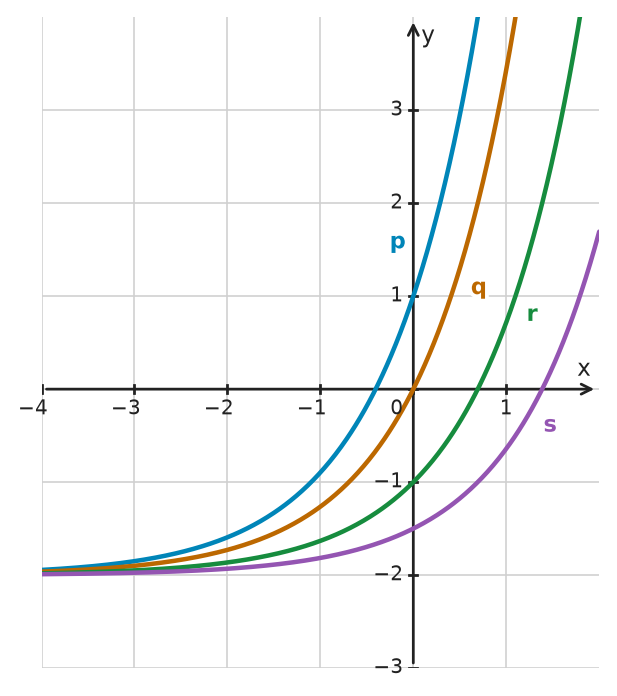
Consider the family of functions \(f_a(x)=ae^x-2\), where \(a>0\). The figure shows four graphs labeled p, q, r, and s.
a) Find the value of \(a\) for each graph.
b) Describe how increasing \(a\) changes the y-intercept and, at a fixed \(x\), the vertical distance from the horizontal asymptote.
c) State the horizontal asymptote shared by all four graphs and explain why it does not depend on \(a\).
Hints
- Evaluate the function at \(x=0\).
- Read each y-intercept from the graph.
- At the same x-value, compare each graph's vertical distance from \(y=-2\).
- What does \(e^x\) approach as \(x\to-\infty\)?
Solution
1. The y-intercept is \(f_a(0)=a-2\), so \(a\) equals the y-intercept plus \(2\).
2. Graph p has y-intercept \(1\), so \(a=3\). Graph q has y-intercept \(0\), so \(a=2\). Graph r has y-intercept \(-1\), so \(a=1\). Graph s has y-intercept \(-1.5\), so \(a=0.5\).
3. Increasing \(a\) raises the y-intercept. At a fixed \(x\), the vertical distance from the asymptote \(y=-2\) is \(ae^x\), so increasing \(a\) increases that distance by the same multiplicative factor.
4. As \(x\to-\infty\), \(e^x\to0\), so \(ae^x-2\to-2\) for every \(a>0\). Therefore, every graph has horizontal asymptote \(y=-2\).
Answer
a) p: \(a=3\); q: \(a=2\); r: \(a=1\); s: \(a=0.5\)
b) The y-intercept moves upward, and at any fixed \(x\), the vertical distance from \(y=-2\) increases in direct proportion to \(a\).
c) \(y=-2\); the term \(ae^x\) approaches \(0\) as \(x\to-\infty\) for every \(a>0\).