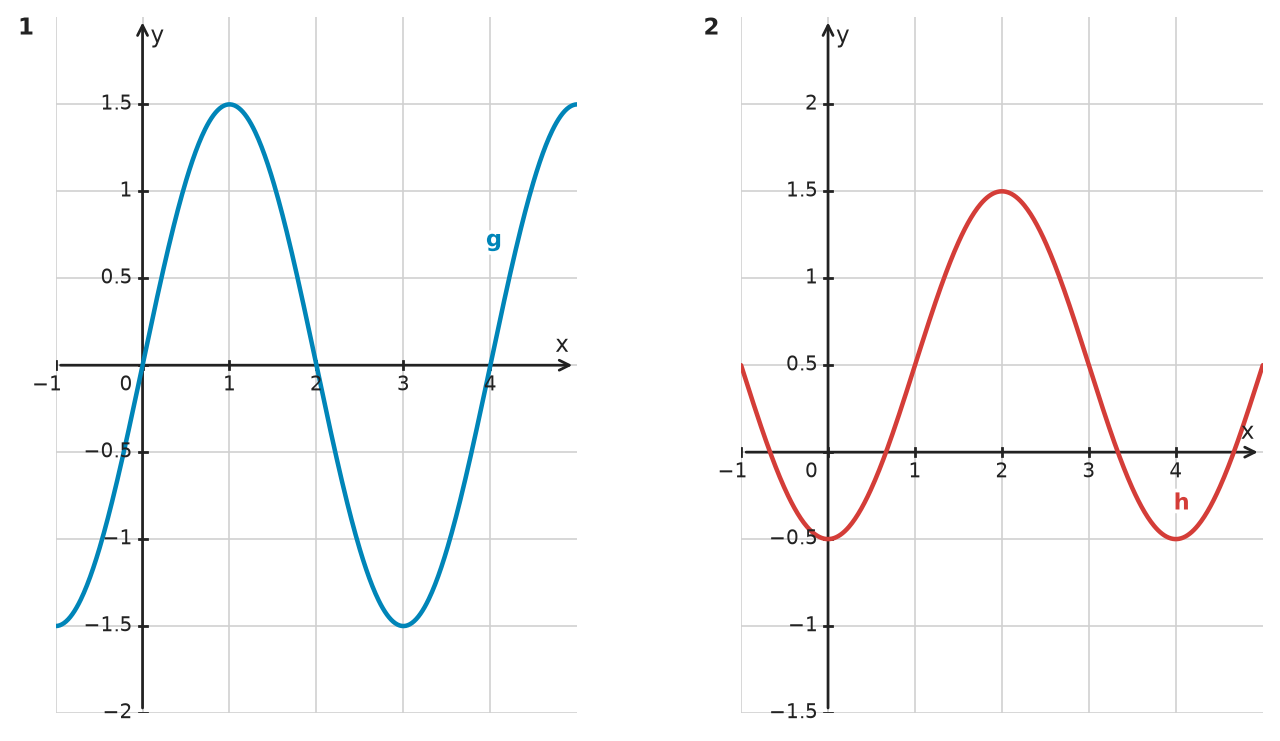
a) For graph \(g\) in Figure 1, find the amplitude, period, coefficient of \(x\), and an equation in the form \(g(x)=a\sin(bx)\).
b) For graph \(h\) in Figure 2, find the amplitude, period, coefficient of \(x\), vertical shift, and smallest positive horizontal shift to the right. Then write an equation in the form \(h(x)=a\sin(b(x-c))+d\).
Hints
- Use the midline and extrema to find amplitude and vertical shift.
- Find the period from corresponding points on consecutive cycles.
- Relate the coefficient of \(x\) to the period.
- An increasing midline crossing identifies the horizontal shift in a positive sine model.
Solution
1. For \(g\), the midline is \(y=0\), and the extrema are \(1.5\) units from the midline, so the amplitude is \(1.5\).
2. One complete cycle has length \(4\), so the period is \(4\), and \(b=\frac{2\pi}{4}=\frac{\pi}{2}\). Thus, \(g(x)=1.5\sin\left(\frac{\pi}{2}x\right)\).
3. For \(h\), the maximum is \(1.5\), and the minimum is \(-0.5\). Thus, the midline is \(d=0.5\), and the amplitude is \(1\).
4. Consecutive minima at \(x=0\) and \(x=4\) show that the period is \(4\), so \(b=\frac{\pi}{2}\).
5. The graph crosses its midline while increasing at \(x=1\), so the smallest positive shift to the right is \(c=1\). Therefore, \(h(x)=\sin\left(\frac{\pi}{2}(x-1)\right)+0.5\).
Answer
a) Amplitude \(1.5\), period \(4\), \(b=\frac{\pi}{2}\); \(g(x)=1.5\sin\left(\frac{\pi}{2}x\right)\)
b) Amplitude \(1\), period \(4\), \(b=\frac{\pi}{2}\), \(c=1\), \(d=0.5\); \(h(x)=\sin\left(\frac{\pi}{2}(x-1)\right)+0.5\)