Aimathic
Login | English | Deutsch

Free Math Worksheets

Build your own math worksheets from 21,000 problems for grades 3 to 12, from fractions to calculus. Every problem includes step-by-step solutions.

Angle addition and subtraction identities

Click problems to add them to your worksheet.

52183212
Let \(f(x)=\sin\left(\frac{1}{2}x+c\right)\). Find all \(c\in[0, 2\pi]\) for which \(f\) is even.

Hints

- Expand the shifted sine using an angle-addition identity. - Identify which resulting term is even and which is odd. - Set the coefficient of the odd term equal to \(0\).

Solution

1. An even function must satisfy \(f(-x)=f(x)\) for every \(x\). 2. Use the angle-addition identity: \(f(x)=\sin(c)\cos\left(\frac{x}{2}\right)+\cos(c)\sin\left(\frac{x}{2}\right)\). 3. The cosine term is even and the sine term is odd. For the entire function to be even, the coefficient of the odd term must be \(0\): \(\cos(c)=0\). 4. On \([0, 2\pi]\), this gives \(c=\frac{\pi}{2}\) or \(c=\frac{3\pi}{2}\). 5. These choices produce \(f(x)=\cos\left(\frac{x}{2}\right)\) and \(f(x)=-\cos\left(\frac{x}{2}\right)\), respectively, and both are even.

Answer

\(c\in\left\{\frac{\pi}{2}, \frac{3\pi}{2}\right\}\)
53230712
The graph shows two periodic functions \(f\) and \(g\) on \([-4, 4]\), where \(f(x)=\sin\left(\frac{\pi}{2}x\right)\). a) Describe how a horizontal shift of the graph of \(f\) can produce the graph of \(g\). Give two equivalent shifts, one left and one right. b) Write \(g\) in the form \(g(x)=\sin\left(\frac{\pi}{2}(x-d)\right)\) using the least positive shift \(d\). c) Verify at \(x=0\) and \(x=1\) that \(k(x)=\cos\left(\frac{\pi}{2}x\right)\) has the same values as \(g\). Then use an angle-addition identity to show that the expressions are equivalent for every \(x\).
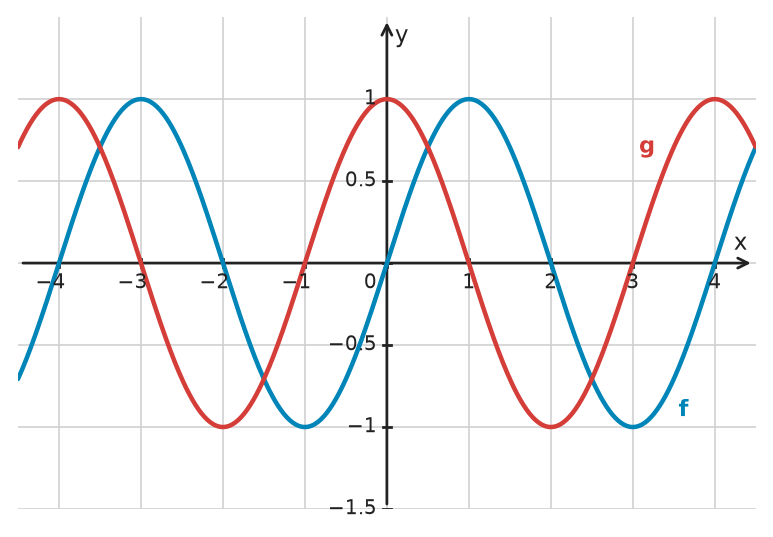
Figure for problem 532307

Hints

- Compare corresponding maximum points and zeros. - Recall how left and right shifts appear inside a function. - Determine the period of \(f(x)=\sin\left(\frac{\pi}{2}x\right)\). - Matching two values is only a check; use \(\sin\left(u+\frac{\pi}{2}\right)=\cos(u)\) for a general argument.

Solution

1. Comparing corresponding maximum points and zeros shows that \(g\) is obtained by shifting \(f\) left \(1\) unit. Since the period is \(4\), this is equivalent to shifting right \(3\) units. 2. The least positive right shift is \(d=3\), so \(g(x)=\sin\left(\frac{\pi}{2}(x-3)\right)\). 3. At \(x=0\), \(g(0)=\sin\left(-\frac{3\pi}{2}\right)=1\) and \(k(0)=\cos(0)=1\). At \(x=1\), \(g(1)=\sin(-\pi)=0\) and \(k(1)=\cos\left(\frac{\pi}{2}\right)=0\). 4. For every \(x\), \(g(x)=\sin\left(\frac{\pi}{2}x-\frac{3\pi}{2}\right)=\sin\left(\frac{\pi}{2}x+\frac{\pi}{2}\right)=\cos\left(\frac{\pi}{2}x\right)\), using periodicity and \(\sin\left(u+\frac{\pi}{2}\right)=\cos(u)\).

Answer

a) Shift left \(1\) unit or right \(3\) units. b) \(g(x)=\sin\left(\frac{\pi}{2}(x-3)\right)\), with \(d=3\) c) The values agree at \(x=0\) and \(x=1\), and the identity shows \(g(x)=\cos\left(\frac{\pi}{2}x\right)\) for all \(x\).

52183812
Let \(f(x)=\cos(x-b)+a\), where \(a, b\in\mathbb{R}\) and \(a\ne0\). Find all ordered pairs \((a, b)\) for which \(f\) is even. Then explain why \(f\) cannot be odd when \(a\ne0\).

Hints

- Expand \(\cos(x-b)\) and \(\cos(-x-b)\). - For an identity to hold for every \(x\), the coefficients of the variable trigonometric terms must satisfy the required conditions. - Test odd symmetry by adding \(f(-x)\) and \(f(x)\).

Solution

1. Even symmetry requires \(f(-x)=f(x)\). Using angle identities, \(f(-x)-f(x)=-2\sin(b)\sin(x)\). 2. This expression is \(0\) for every \(x\) exactly when \(\sin(b)=0\), so \(b=k\pi\) for some integer \(k\). The vertical shift \(a\) may be any nonzero real number. 3. Odd symmetry would require \(f(-x)+f(x)=0\) for every \(x\). But \(f(-x)+f(x)=2a+2\cos(b)\cos(x)\). 4. For this expression to vanish for every \(x\), both \(a=0\) and \(\cos(b)=0\) would be necessary. Since \(a\ne0\), \(f\) cannot be odd.

Answer

Even: \((a, k\pi)\), where \(a\in\mathbb{R}\setminus\{0\}\) and \(k\in\mathbb{Z}\) Odd: impossible when \(a\ne0\)
53405812
The graph of \(f(x)=\sin(2(x-c))\) is symmetric about the y-axis. a) Find the least positive value of \(c\). The graph shown uses this value. b) In general, determine the condition on \(c\) that makes \(\sin(b(x-c))\), where \(b \neq 0\), symmetric about the y-axis.
Figure for problem 534058

Hints

- An even graph has a maximum or minimum on the y-axis. - Identify whether the graph matches a cosine function or its reflection. - Read the value of the function at \(x=0\). - For part b, use an angle-subtraction formula and separate the even and odd components.

Solution

1. The graph has a minimum of \(-1\) at \(x=0\), so it is \(-\cos(2x)\). 2. Since \(\sin\left(2x-\frac{\pi}{2}\right)=-\cos(2x)\), set \(2(x-c)=2x-\frac{\pi}{2}\). This gives \(c=\frac{\pi}{4}\). 3. In general, use the subtraction formula: \(\sin(b(x-c))=\sin(bx)\cos(bc)-\cos(bx)\sin(bc)\). 4. The function is even exactly when the coefficient of the odd term \(\sin(bx)\) is zero. Thus, \(\cos(bc)=0\), so \(bc=\frac{\pi}{2}+k\pi\), where \(k\) is an integer. 5. Therefore, \(c=\frac{\pi/2+k\pi}{b}\).

Answer

a) \(c=\frac{\pi}{4}\) b) \(bc=\frac{\pi}{2}+k\pi\), so \(c=\frac{\pi/2+k\pi}{b}\), where \(k \in \mathbb{Z}\)

All problems may be used, copied and printed free of charge for school and tutoring, including paid tutoring. Commercial adaptations as well as publication or redistribution on the internet are not permitted.