Aimathic
Login | English | Deutsch

Free math worksheets

Build your own math worksheets from 28,000 problems for grades 3 to 12, from fractions to calculus. Every problem includes step-by-step solutions.

Conic sections in applications

Click problems to add them to your worksheet.

54372512
Two acoustic sensors are \(20\,\text{m}\) apart. A sound is reported to have reached one sensor \(0.070\,\text{s}\) before it reached the other. Use \(340\,\text{m/s}\) for the speed of sound. Could any source location produce this time difference? Justify your decision using the geometry of a hyperbola, and find the greatest possible arrival-time difference for these two sensors.

Hints

- Convert the time difference into a difference in travel distances. - Think about the largest possible difference between distances to two fixed points. - Use the sensor separation to determine the limiting delay.

Solution

1. A time difference of \(0.070\,\text{s}\) would require a difference in travel distances of \(340(0.070)=23.8\,\text{m}\). 2. For any point, the absolute difference of its distances from two fixed sensors cannot exceed the distance between the sensors. Here that maximum distance difference is \(20\,\text{m}\). 3. Because \(23.8>20\), no source location can produce the reported time difference. 4. The greatest possible time difference is \(\frac{20}{340}=\frac{1}{17}\,\text{s}\approx0.0588\,\text{s}\).

Answer

No. The reported delay would require a distance difference of \(23.8\,\text{m}\), which exceeds the \(20\,\text{m}\) separation of the sensors. The greatest possible arrival-time difference is \(\frac{1}{17}\,\text{s}\approx0.0588\,\text{s}\).
54373212
The diagram represents a solar cooker's parabolic cross section. Place the vertex at the origin and let the cooker open upward. Find the focal distance. A receiver is mounted \(0.80\,\text{m}\) above the vertex; determine how far and in which direction it must be moved to reach the focus.
Figure for problem 543732

Hints

- Use half the cooker’s width as the horizontal coordinate of a rim point. - Relate that point to the focal parameter in a vertical parabola. - Compare the calculated focus height with the current receiver height.

Solution

1. Model the cross section by \(x^2=4py\), where the focus is \((0, p)\). 2. The rim is \(0.90\,\text{m}\) from the axis and \(0.225\,\text{m}\) above the vertex, so \((0.90)^2=4p(0.225)\). 3. Solving gives \(p=0.90\,\text{m}\). 4. The receiver is at height \(0.80\,\text{m}\), which is \(0.10\,\text{m}\) below the focus. It must be raised by \(0.10\,\text{m}\).

Answer

The focal distance is \(0.90\,\text{m}\). The receiver must be moved upward by \(0.10\,\text{m}\).
54374612
The diagram models the boundary of an elliptical whispering gallery that is \(30\,\text{ft}\) long and \(18\,\text{ft}\) wide. Where should two listening points be placed to use the ellipse's reflection property? For any point on the wall, what is the total length of the two straight segments from one listening point to the wall point and then to the other listening point?
Figure for problem 543746

Hints

- Convert the full gallery dimensions to semi-axis lengths. - Use the relationship among an ellipse's semi-axes and focal distance. - Recall what quantity stays constant for every point on an ellipse.

Solution

1. The semi-major axis is \(a=15\), and the semi-minor axis is \(b=9\). 2. The focal distance satisfies \(c^2=a^2-b^2=225-81=144\), so \(c=12\). 3. The listening points should be placed at the foci \((-12, 0)\) and \((12, 0)\). 4. For every point on an ellipse, the sum of its distances to the two foci is \(2a\), which here is \(30\,\text{ft}\).

Answer

Place the listening points at \((-12, 0)\) and \((12, 0)\). The total two-segment path length is always \(30\,\text{ft}\).
54377912
A spacecraft follows one branch of a hyperbolic trajectory centered at the origin. The closest point of that branch to the center is \((5, 0)\), and the trajectory has eccentricity \(\frac{13}{5}\). Find a standard equation for the trajectory and the angles its incoming and outgoing asymptotic directions make with the positive x-axis.

Hints

- Use the closest branch point to determine the transverse semi-axis. - Convert eccentricity into focal distance, then find the remaining semi-axis. - Interpret asymptote slopes as long-range direction angles.

Solution

1. The vertex gives \(a=5\). The eccentricity gives \(c=ea=13\). 2. For a hyperbola, \(b^2=c^2-a^2=169-25=144\), so \(b=12\). 3. The standard equation is \(\frac{x^2}{25}-\frac{y^2}{144}=1\). The specified trajectory is the right branch, so \(x\ge5\). 4. The asymptotes are \(y=\pm\frac{b}{a}x=\pm\frac{12}{5}x\). 5. Their direction angles are \(\theta=\pm\arctan(\frac{12}{5})\approx\pm67.38^\circ\).

Answer

Trajectory: \(\frac{x^2}{25}-\frac{y^2}{144}=1\), restricted to the right branch \(x\ge5\) Asymptotic direction angles: \(\pm\arctan(\frac{12}{5})\approx\pm67.38^\circ\)
54378612
An aircraft hangar is \(150\,\text{ft}\) long. Its constant cross section is a semiellipse \(60\,\text{ft}\) wide and \(24\,\text{ft}\) high, as shown. Treat the hangar as a prism. Find its interior volume.
Figure for problem 543786

Hints

- Convert the full width and height into ellipse semi-axis lengths. - The cross section is half of a full ellipse. - Treat the hangar as a prism after finding the cross-sectional area.

Solution

1. The semiellipse has horizontal semi-axis \(a=30\,\text{ft}\) and vertical semi-axis \(b=24\,\text{ft}\). 2. Its cross-sectional area is half the area of a full ellipse: \(A=\frac{1}{2}\pi ab=\frac{1}{2}\pi(30)(24)=360\pi\,\text{ft}^2\). 3. Multiply by the hangar length: \(V=(360\pi)(150)=54{,}000\pi\,\text{ft}^3\). 4. Numerically, \(V\approx169{,}646\,\text{ft}^3\).

Answer

\(54{,}000\pi\,\text{ft}^3\approx169{,}646\,\text{ft}^3\)
54379312
A landscape crew marks an elliptical planting bed using two stakes \(20\,\text{ft}\) apart. A taut-string setup keeps the sum of the distances from the marking point to the two stakes equal to \(26\,\text{ft}\). Find the bed’s major-axis length, minor-axis length, and standard equation if the center is the origin and the stakes lie on the x-axis.

Hints

- Interpret the stakes as the two foci. - Relate their separation and the fixed distance sum to \(c\) and \(a\). - Use the standard ellipse relationship to find the remaining semi-axis.

Solution

1. The stakes are the foci, so \(2c=20\) and \(c=10\). 2. The constant focal-distance sum is \(2a=26\), so \(a=13\). 3. Then \(b^2=a^2-c^2=169-100=69\), so \(b=\sqrt{69}\). 4. The major-axis length is \(2a=26\,\text{ft}\), and the minor-axis length is \(2b=2\sqrt{69}\,\text{ft}\). 5. The equation is \(\frac{x^2}{169}+\frac{y^2}{69}=1\).

Answer

Major-axis length: \(26\,\text{ft}\) Minor-axis length: \(2\sqrt{69}\,\text{ft}\) Equation: \(\frac{x^2}{169}+\frac{y^2}{69}=1\)
54380012
A two-focus reflector uses the right branch of the hyperbola \(\frac{x^2}{9}-\frac{y^2}{16}=1\). In the ideal model, a ray directed toward one focus reflects toward the other. Find the two focal locations, their separation, and the distances from the right-hand vertex of the mirror to each focus.

Hints

- Determine the focal distance from the two hyperbola denominators. - Locate the vertex on the branch used by the reflector. - Compare the two vertex-to-focus distances with the hyperbola’s constant difference.

Solution

1. The hyperbola has \(a=3\) and \(b=4\), so \(c^2=a^2+b^2=25\) and \(c=5\). 2. The foci are \((-5, 0)\) and \((5, 0)\), separated by \(10\) units. 3. The right-hand vertex is \((3, 0)\). 4. Its distance to the right focus is \(5-3=2\), and its distance to the left focus is \(3-(-5)=8\). 5. The difference \(8-2=6\) equals \(2a\), consistent with the hyperbola’s defining property.

Answer

Foci: \((-5, 0)\), \((5, 0)\) Focal separation: \(10\) Distances from the right vertex: \(8\) to the left focus and \(2\) to the right focus
54381412
An engineering team is choosing conic models for three designs. a) A radio antenna should reflect incoming rays that are parallel to its axis toward one receiver. b) An acoustic room should reflect sound sent from one designated point toward a second designated point. c) A navigation boundary should contain all locations for which the difference between the distances to two beacons is constant. Match each design with a parabola, ellipse, or hyperbola. Briefly justify each choice using a defining or reflection property of the conic.

Hints

- Separate the optical or acoustic reflection conditions from the distance-locus condition. - Recall which conic has one focus and a single axis-directed reflection property. - Compare the sum and difference versions of the two-focus definitions.

Solution

1. A parabola reflects rays parallel to its axis toward its focus, so design a) uses a parabola. 2. An ellipse reflects a ray leaving one focus toward the other focus, so design b) uses an ellipse. 3. A hyperbola is the locus of points for which the absolute difference of the distances to two foci is constant, so design c) uses a hyperbola.

Answer

a) Parabola — parallel incoming rays reflect toward the focus. b) Ellipse — a ray from one focus reflects toward the other focus. c) Hyperbola — the absolute difference of the distances to the two foci is constant.
54382112
A circular roof opening has radius \(6\,\text{ft}\). Its plane is tilted \(60^\circ\) from horizontal about a line through its center. An architect makes an orthogonal plan-view projection of the opening onto a horizontal drawing plane. Place the center at the origin and the tilt axis along the x-axis. Write an equation for the projected boundary and find the projected area.

Hints

- Identify which direction is unchanged by the tilt. - Determine the projection factor for lengths perpendicular to the tilt axis. - Use the two projected semi-axis lengths to write the ellipse and find its area.

Solution

1. Orthogonal projection preserves lengths parallel to the tilt axis, so the projected semi-axis along the x-axis is \(6\,\text{ft}\). 2. Lengths perpendicular to the tilt axis are multiplied by \(\cos 60^\circ=\frac{1}{2}\), so the other projected semi-axis is \(6\cdot\frac{1}{2}=3\,\text{ft}\). 3. The projected boundary is the ellipse \(\frac{x^2}{36}+\frac{y^2}{9}=1\). 4. Its area is \(\pi ab=\pi(6)(3)=18\pi\,\text{ft}^2\).

Answer

Projected boundary: \(\frac{x^2}{36}+\frac{y^2}{9}=1\) Projected area: \(18\pi\,\text{ft}^2\)
54382812
A machinist cuts a right circular double cone whose generators make a \(30^\circ\) angle with its axis. For each cut below, the listed angle is the acute angle between the cutting plane and the cone's axis. <table> <tr><th>Cut</th><th>Plane-axis angle</th></tr> <tr><td>a)</td><td>\(90^\circ\)</td></tr> <tr><td>b)</td><td>\(50^\circ\)</td></tr> <tr><td>c)</td><td>\(30^\circ\)</td></tr> <tr><td>d)</td><td>\(20^\circ\)</td></tr> </table> Classify the conic section produced by each cut, assuming the plane is positioned so that it does not pass through the cone's vertex.

Hints

- Compare each plane-axis angle with the generator-axis angle. - Equality corresponds to a plane parallel to a generator. - Decide whether the plane cuts one nappe or both nappes.

Solution

1. A plane perpendicular to the axis produces a circle, so cut a) is a circle. 2. When the plane-axis angle is greater than the generator-axis angle but less than \(90^\circ\), the plane cuts one nappe in an ellipse. Thus, cut b) is an ellipse. 3. When the plane is parallel to a generator, the angles are equal and the section is a parabola. Thus, cut c) is a parabola. 4. When the plane-axis angle is less than the generator-axis angle, the plane cuts both nappes and produces a hyperbola. Thus, cut d) is a hyperbola.

Answer

a) circle b) ellipse c) parabola d) hyperbola
54384112
A fountain stream follows a parabolic path. In a vertical coordinate plane measured in meters, the water leaves the nozzle at \((0, 1)\) and reaches its highest point at \((3, 5)\). Find an equation for the path and determine where the water lands at pool level \(y=0\), using the positive x-coordinate.

Hints

- Start with a parabola written in vertex form. - Use the nozzle location to determine the remaining coefficient. - Set the height equal to zero and select the physically relevant solution.

Solution

1. Use vertex form \(y=a(x-3)^2+5\). 2. Substitute the nozzle point \((0, 1)\): \(1=9a+5\), so \(a=-\frac{4}{9}\). 3. The path is \(y=-\frac{4}{9}(x-3)^2+5\). 4. Set \(y=0\) to find the pool-level intersections: \((x-3)^2=\frac{45}{4}\). 5. Thus, \(x=3\pm\frac{3\sqrt{5}}{2}\). The positive landing coordinate is \(3+\frac{3\sqrt{5}}{2}\).

Answer

Path: \(y=-\frac{4}{9}(x-3)^2+5\) Landing point: \(\left(3+\frac{3\sqrt{5}}{2}, 0\right)\), approximately \((6.35, 0)\)
54385412
A Ferris wheel is modeled by a circle with radius \(18\,\text{ft}\) and center \(20\,\text{ft}\) above level ground. Let \(x\) be the rider's horizontal displacement from the centerline and let \(y\) be the rider's height above the ground, as shown. a) Write the circle's equation. b) Find the rider's two horizontal positions when the rider is \(29\,\text{ft}\) above the ground.
Figure for problem 543854

Hints

- Use the wheel's center and radius in the standard equation of a circle. - Substitute the specified height for \(y\) before solving for the horizontal coordinate. - The two square roots represent positions on opposite sides of the vertical centerline.

Solution

1. The circle has center \((0,20)\) and radius \(18\), so its equation is \(x^2+(y-20)^2=324\). 2. At a height of \(29\,\text{ft}\), substitute \(y=29\): \(x^2+9^2=324\). 3. Thus, \(x^2=243\), so \(x=\pm9\sqrt{3}\). 4. Therefore, the rider is about \(15.6\,\text{ft}\) to either side of the centerline.

Answer

a) \(x^2+(y-20)^2=324\) b) \(x=\pm9\sqrt{3}\,\text{ft}\), approximately \(15.6\,\text{ft}\) to either side of the centerline
54386112
A parabolic radio-telescope dish has focal length \(2\,\text{m}\), aperture radius \(3\,\text{m}\), vertex at the origin, and an upward-opening cross section, as shown. Find the dish depth at the rim and the receiver location. Then use the paraboloid-volume formula \(V=\frac{1}{2}\pi R^2d\) to find the dish's enclosed volume, where \(R\) is the aperture radius and \(d\) is the depth.
Figure for problem 543861

Hints

- Use the focal length to write the parabola's cross-sectional equation. - Evaluate the parabola at the aperture radius to find the depth. - Substitute the radius and depth into the supplied volume formula.

Solution

1. With focal length \(p=2\), the cross section is \(x^2=4py=8y\). 2. At the rim, \(x=3\), so the depth is \(d=y=\frac{9}{8}\,\text{m}\). 3. The receiver belongs at the focus, \((0, 2)\), which is \(2\,\text{m}\) above the vertex. 4. The volume is \(V=\frac{1}{2}\pi(3)^2\left(\frac{9}{8}\right)=\frac{81\pi}{16}\,\text{m}^3\).

Answer

Rim depth: \(\frac{9}{8}\,\text{m}\) Receiver location: \((0, 2)\) Volume: \(\frac{81\pi}{16}\,\text{m}^3\)
54387512
A circular pipe has inside radius \(4\,\text{in.}\). A planar cut through the pipe makes a \(30^\circ\) angle with the pipe's axis, producing an elliptical opening. Find the lengths of the major and minor axes of the opening and its area.

Hints

- One axis of the oblique cut remains the pipe's diameter. - Relate the elongated axis to its perpendicular projection. - Use the resulting semi-axis lengths in the ellipse area formula.

Solution

1. The minor axis is perpendicular to the direction of elongation and remains equal to the pipe diameter, so its length is \(8\,\text{in.}\). 2. Let \(L\) be the major-axis length. Its projection onto a plane perpendicular to the pipe axis equals the diameter: \(L\sin30^\circ=8\). 3. Therefore, \(L=16\,\text{in.}\). 4. The semi-axis lengths are \(a=8\,\text{in.}\) and \(b=4\,\text{in.}\). 5. The opening area is \(\pi ab=32\pi\,\text{in.}^2\).

Answer

Major axis: \(16\,\text{in.}\) Minor axis: \(8\,\text{in.}\) Area: \(32\pi\,\text{in.}^2\)
54388212
An inner running lane is modeled by an ellipse with semi-axes \(60\,\text{m}\) and \(40\,\text{m}\). The outer lane is modeled by a concentric ellipse with semi-axes \(64\,\text{m}\) and \(44\,\text{m}\), as shown. Use the perimeter approximation \(C\approx\pi\left[3(a+b)-\sqrt{(3a+b)(a+3b)}\right]\) to estimate both lap lengths and how much longer the outer-lane lap is.
Figure for problem 543882

Hints

- Apply the supplied approximation separately to the two pairs of semi-axes. - Keep the two perimeter calculations organized before subtracting. - Round only after evaluating each full expression.

Solution

1. For the inner lane, \(C_{\text{in}}\approx\pi\left[3(60+40)-\sqrt{(180+40)(60+120)}\right]\). 2. This simplifies to \(C_{\text{in}}\approx60\pi(5-\sqrt{11})\approx317.31\,\text{m}\). 3. For the outer lane, \(C_{\text{out}}\approx\pi\left[3(64+44)-\sqrt{(192+44)(64+132)}\right]\). 4. This simplifies to \(C_{\text{out}}\approx4\pi(81-7\sqrt{59})\approx342.21\,\text{m}\). 5. The difference is approximately \(342.21-317.31=24.90\,\text{m}\).

Answer

Inner-lane lap: approximately \(317.31\,\text{m}\) Outer-lane lap: approximately \(342.21\,\text{m}\) Outer-lane increase: approximately \(24.90\,\text{m}\)
54388912
A parabolic arch is \(24\,\text{ft}\) wide at its base and \(9\,\text{ft}\) high at its center. A centered rectangular doorway is \(8\,\text{ft}\) wide and \(6\,\text{ft}\) high, as shown. First verify that the doorway fits under the arch. Then use the parabolic-segment area formula \(A=\frac{2}{3}bh\) to find the remaining façade area after the doorway is removed.
Figure for problem 543889

Hints

- Build a vertex-form equation from the arch's width and height. - Check the arch height at the doorway's horizontal edges. - Subtract the rectangular area from the supplied parabolic-segment area.

Solution

1. Put the arch endpoints at \((-12, 0)\) and \((12, 0)\), with vertex \((0, 9)\). Its equation is \(y=9-\frac{x^2}{16}\). 2. The doorway's upper corners have \(x=\pm4\). At either coordinate, the arch height is \(9-\frac{16}{16}=8\,\text{ft}\). 3. Since \(8\,\text{ft}>6\,\text{ft}\), the doorway fits. 4. The parabolic-segment area is \(\frac{2}{3}(24)(9)=144\,\text{ft}^2\). 5. The doorway area is \((8)(6)=48\,\text{ft}^2\). 6. The remaining façade area is \(144-48=96\,\text{ft}^2\).

Answer

The arch height at each upper doorway corner is \(8\,\text{ft}\), which is above the \(6\,\text{ft}\)-high doorway, so the doorway fits. Remaining façade area: \(96\,\text{ft}^2\)
54390312
A research probe follows the elliptical orbit \(\frac{x^2}{100}+\frac{y^2}{64}=1\), where distances are measured in millions of miles. Use the diagram. Find the probe's possible positions when it is exactly \(10\) million miles from the star.
Figure for problem 543903

Hints

- Locate both foci from the semi-axis lengths. - Use the constant sum of focal distances before substituting coordinates. - What line contains points equidistant from the two foci?

Solution

1. The focal distance is \(c=\sqrt{100-64}=6\), so the star is at \((6, 0)\). 2. The sum of the distances from an ellipse point to the two foci is \(2a=20\). 3. If the distance to the right focus is \(10\), then the distance to the left focus is also \(10\). Therefore the point lies on the perpendicular bisector of the focal segment, so \(x=0\). 4. Substituting \(x=0\) into the ellipse gives \(\frac{y^2}{64}=1\), so \(y=\pm8\).

Answer

The probe can be at \((0, 8)\) or \((0, -8)\), in millions of miles.
54391712
An elliptical medical reflector has its center at the origin, foci \(30\,\text{cm}\) apart, and major-axis length \(50\,\text{cm}\), as shown. A treatment source is placed at one focus, and the target is placed at the other. a) Write the reflector's cross-sectional equation in standard form. b) Find the minor-axis length. c) State the constant total distance from any point on the reflector to the two foci.
Figure for problem 543917

Hints

- Halve the focal separation and major-axis length to obtain \(c\) and \(a\). - Use the ellipse relation \(a^2=b^2+c^2\) to find the other semi-axis. - The defining focal-distance sum of an ellipse equals its full major-axis length.

Solution

1. Half the focal separation is \(c=15\,\text{cm}\), and half the major-axis length is \(a=25\,\text{cm}\). 2. For an ellipse, \(a^2=b^2+c^2\), so \(b^2=625-225=400\) and \(b=20\,\text{cm}\). 3. The standard equation is \(\frac{x^2}{625}+\frac{y^2}{400}=1\). 4. The minor-axis length is \(2b=40\,\text{cm}\). 5. The sum of the focal distances is \(2a=50\,\text{cm}\).

Answer

a) \(\frac{x^2}{625}+\frac{y^2}{400}=1\) b) \(40\,\text{cm}\) c) \(50\,\text{cm}\)
54392412
The greenhouse roof is modeled by the upper half of \(\frac{x^2}{100}+\frac{y^2}{36}=1\), with distances in feet, as shown. a) A vertical support is installed at \(x=8\). Find its height from the ground to the roof. b) Find the total interior width of the greenhouse at height \(y=3\).
Figure for problem 543924

Hints

- Use the positive y-value because only the upper half models the roof. - For a horizontal cross section, substitute the given height and solve for both x-coordinates. - The total width is the distance between the left and right intersection coordinates.

Solution

1. Substitute \(x=8\): \(\frac{64}{100}+\frac{y^2}{36}=1\). 2. Since the roof is the upper half, \(y=\frac{18}{5}=3.6\). This is the support height. 3. For the width at \(y=3\), substitute \(y=3\): \(\frac{x^2}{100}+\frac{9}{36}=1\). 4. Thus, \(\frac{x^2}{100}=\frac{3}{4}\), so \(x=\pm5\sqrt{3}\). 5. The total width is \(5\sqrt{3}-(-5\sqrt{3})=10\sqrt{3}\,\text{ft}\approx17.3\,\text{ft}\).

Answer

a) \(\frac{18}{5}\,\text{ft}=3.6\,\text{ft}\) b) \(10\sqrt{3}\,\text{ft}\approx17.3\,\text{ft}\)
54395912
A circular logo is photographed with an orthographic camera while the logo's plane is tilted about one of its diameters. The projected image is an ellipse with major diameter \(12\,\text{cm}\) and minor diameter \(7.2\,\text{cm}\), as shown. Find the original circle's radius, the angle between the logo's plane and the image plane, and the area of the projected ellipse.
Figure for problem 543959

Hints

- One diameter is unchanged by the projection because it lies along the tilt axis. - Relate the shortened diameter to the original diameter with a trigonometric projection factor. - Use the two projected semi-axis lengths for the ellipse area.

Solution

1. Under orthographic projection, the diameter parallel to the tilt axis keeps its full length. Therefore the original circle's diameter is \(12\,\text{cm}\), so its radius is \(6\,\text{cm}\). 2. If \(\alpha\) is the angle between the two planes, the perpendicular diameter is shortened by the factor \(\cos\alpha\). 3. Thus \(12\cos\alpha=7.2\), so \(\cos\alpha=0.6\). 4. Therefore \(\alpha=\arccos(0.6)\approx53.1^\circ\). 5. The projected ellipse has semi-axes \(6\,\text{cm}\) and \(3.6\,\text{cm}\), so its area is \(\pi(6)(3.6)=21.6\pi\,\text{cm}^2\).

Answer

Original radius: \(6\,\text{cm}\) Tilt angle: \(\arccos(0.6)\approx53.1^\circ\) Projected area: \(21.6\pi\,\text{cm}^2\)
54397912
A semielliptical pedestrian underpass is \(30\,\text{ft}\) wide at ground level and \(5\,\text{ft}\) high at its center, as shown. Place the origin at the midpoint of the ground-level span. a) Write an equation for the complete ellipse and state the restriction that gives the arch. b) Find the arch height \(9\,\text{ft}\) from the center. c) Find the horizontal clearance width at a height of \(4\,\text{ft}\).
Figure for problem 543979

Hints

- Convert the full span and full vertical axis into semi-axis lengths for the ellipse model. - Substitute the given horizontal position and select the nonnegative y-value for the arch. - At the specified height, find both symmetric x-coordinates before computing the width.

Solution

1. The horizontal semi-axis is \(a=15\), and the vertical semi-axis is \(b=5\). 2. The complete ellipse is \(\frac{x^2}{225}+\frac{y^2}{25}=1\). The arch is its upper half, so \(y\ge0\). 3. At \(x=9\), \(\frac{81}{225}+\frac{y^2}{25}=1\). 4. Therefore \(\frac{y^2}{25}=\frac{16}{25}\), so \(y=4\) on the upper half. 5. At height \(y=4\), the same equation gives \(\frac{x^2}{225}=\frac{9}{25}\), so \(x=\pm9\). 6. The horizontal clearance width is \(9-(-9)=18\,\text{ft}\).

Answer

a) \(\frac{x^2}{225}+\frac{y^2}{25}=1\), with \(y\ge0\) for the arch b) \(4\,\text{ft}\) c) \(18\,\text{ft}\)
54371912
Two wildfire observation towers are located at \((-6, 0)\) and \((6, 0)\), with coordinates measured in miles. A lightning strike is \(8\) miles farther from the western tower than from the eastern tower. a) Write an equation for the branch of possible strike locations. b) Find the possible strike locations whose x-coordinate is \(10\).

Hints

- Interpret the fixed difference between distances to two fixed points as a conic condition. - Compare half the focal separation with half the stated distance difference. - Use which tower is farther away to select the correct branch before substituting the x-coordinate.

Solution

1. The towers are the foci, so \(c=6\). The constant difference of focal distances is \(2a=8\), so \(a=4\). 2. For a horizontal hyperbola, \(c^2=a^2+b^2\). Thus \(b^2=36-16=20\). 3. Because the strike is farther from the western tower, it lies on the eastern branch. The branch is part of \(\frac{x^2}{16}-\frac{y^2}{20}=1\) with \(x>0\). 4. Substituting \(x=10\) gives \(\frac{100}{16}-\frac{y^2}{20}=1\), so \(y^2=105\) and \(y=\pm\sqrt{105}\). 5. The two locations are \((10, \sqrt{105})\) and \((10, -\sqrt{105})\), approximately \((10, 10.25)\) and \((10, -10.25)\).

Answer

a) \(\frac{x^2}{16}-\frac{y^2}{20}=1\), restricted to the branch \(x>0\). b) \((10, \sqrt{105})\) and \((10, -\sqrt{105})\), approximately \((10, 10.25)\) and \((10, -10.25)\), in miles.
54373912
A probe follows an elliptical orbit. Its nearest and farthest distances from the attracting body, located at one focus, are \(7000\,\text{km}\) and \(13{,}000\,\text{km}\). Model the orbit with center at the origin and horizontal major axis. Find the orbit’s standard equation, focal locations, and eccentricity.

Hints

- Relate the two extreme distances from one focus to the semi-major axis and focal distance. - Add and subtract those two relationships. - Use the ellipse relationship among the two semi-axes and focal distance.

Solution

1. For a horizontal ellipse measured from the right focus, the nearest and farthest focal distances are \(a-c\) and \(a+c\). 2. Thus \(a-c=7000\) and \(a+c=13{,}000\). Adding gives \(a=10{,}000\), and subtracting gives \(c=3000\). 3. Then \(b^2=a^2-c^2=100{,}000{,}000-9{,}000{,}000=91{,}000{,}000\). 4. The equation is \(\frac{x^2}{100000000}+\frac{y^2}{91000000}=1\). 5. The foci are \((-3000, 0)\) and \((3000, 0)\), and the eccentricity is \(e=\frac{c}{a}=0.3\).

Answer

\(\frac{x^2}{100000000}+\frac{y^2}{91000000}=1\) Foci: \((-3000, 0)\) and \((3000, 0)\) Eccentricity: \(0.3\)
54375312
A suspension cable hangs above a level bridge deck. The towers are \(400\,\text{ft}\) apart, the cable is \(100\,\text{ft}\) above the deck at each tower, and its lowest point is \(20\,\text{ft}\) above the deck at the midpoint. Place the origin at the midpoint of the deck. Find the cable equation and the total length of vertical hangers installed at \(x=0\), \(x=\pm50\), \(x=\pm100\), and \(x=\pm150\), assuming each hanger runs from the deck to the cable.
Figure for problem 543753

Hints

- Use vertex form with the cable’s lowest point as the vertex. - Use one tower point to determine the remaining coefficient. - Evaluate the model at the listed symmetric positions before adding hanger lengths.

Solution

1. With the vertex at \((0, 20)\), write the cable as \(y=ax^2+20\). 2. A tower point is \((200, 100)\), so \(100=40{,}000a+20\), giving \(a=\frac{1}{500}\). 3. The cable equation is \(y=\frac{x^2}{500}+20\). 4. The hanger lengths are \(20\) at \(x=0\), \(25\) at \(x=\pm50\), \(40\) at \(x=\pm100\), and \(65\) at \(x=\pm150\). 5. Their total length is \(20+2(25+40+65)=280\,\text{ft}\).

Answer

Cable equation: \(y=\frac{x^2}{500}+20\) Total hanger length: \(280\,\text{ft}\)
54376012
A vertical cross section of a cooling tower is centered at its narrowest level. The tower is \(60\,\text{ft}\) wide at that level and \(100\,\text{ft}\) wide \(40\,\text{ft}\) above it. Find a hyperbola model and use it to predict the tower’s width \(60\,\text{ft}\) above the narrowest level.
Figure for problem 543760

Hints

- Use half-widths as x-coordinates in the cross-sectional model. - The narrowest width determines the transverse semi-axis. - After finding the remaining scale, evaluate the model at the requested height and double the positive x-value.

Solution

1. Use \(\frac{x^2}{a^2}-\frac{y^2}{b^2}=1\), where \(y\) measures height from the narrowest level. 2. The minimum half-width is \(a=30\), so \(a^2=900\). 3. The point \((50, 40)\) lies on the profile. Substitution gives \(\frac{2500}{900}-\frac{1600}{b^2}=1\), so \(b^2=900\). 4. The model is \(\frac{x^2}{900}-\frac{y^2}{900}=1\). 5. At \(y=60\), \(\frac{x^2}{900}-4=1\), so \(x=30\sqrt{5}\) on the right side. 6. The full width is \(2x=60\sqrt{5}\,\text{ft}\approx134.16\,\text{ft}\).

Answer

Model: \(\frac{x^2}{900}-\frac{y^2}{900}=1\) Predicted width \(60\,\text{ft}\) above the narrowest level: \(60\sqrt{5}\,\text{ft}\approx134.16\,\text{ft}\)
54376712
An elliptical tunnel entrance is \(40\,\text{ft}\) wide and \(12\,\text{ft}\) high at its center. A centered vehicle is \(14\,\text{ft}\) wide and \(11\,\text{ft}\) high. Determine whether the vehicle clears the tunnel and find the smallest vertical clearance above its top corners.
Figure for problem 543767

Hints

- Use half the entrance width and the center height as ellipse semi-axes. - Check the roof height directly above a top corner of the centered vehicle. - Compare that height with the vehicle height.

Solution

1. With the ellipse centered at ground level, its equation is \(\frac{x^2}{400}+\frac{y^2}{144}=1\), with \(y\ge0\). 2. The vehicle’s top corners are at \(x=\pm7\). 3. At \(x=7\), the tunnel height is \(y=12\sqrt{1-\frac{49}{400}}=\frac{3\sqrt{351}}{5}\approx11.241\,\text{ft}\). 4. This exceeds the vehicle height of \(11\,\text{ft}\), so the vehicle clears. 5. The smallest clearance occurs above the top corners and is \(\frac{3\sqrt{351}}{5}-11\approx0.241\,\text{ft}\).

Answer

Yes. The minimum vertical clearance is \(\frac{3\sqrt{351}}{5}-11\,\text{ft}\approx0.241\,\text{ft}\).
54380712
Two proposed arch models have the same endpoints \((-10, 0)\), \((10, 0)\) and the same center height \((0, 8)\). Model A is a parabola, and Model B is the upper half of an ellipse centered at the origin. Write both equations and compare their heights at \(x=6\). Which model gives more clearance there, and by how much?

Hints

- Fit each model from the shared center and endpoint data. - Evaluate both equations at the same horizontal location. - Compare the two resulting heights rather than only comparing their equations.

Solution

1. Model A has form \(y=8-ax^2\). Using \((10, 0)\) gives \(a=\frac{2}{25}\), so \(y=8-\frac{2}{25}x^2\). 2. Model B has semi-axes \(a=10\) and \(b=8\), so \(\frac{x^2}{100}+\frac{y^2}{64}=1\), with \(y\ge0\). 3. At \(x=6\), Model A has height \(8-\frac{72}{25}=\frac{128}{25}=5.12\). 4. Model B has height \(8\sqrt{1-\frac{36}{100}}=\frac{32}{5}=6.4\). 5. The semielliptical model is higher by \(\frac{32}{5}-\frac{128}{25}=\frac{32}{25}=1.28\).

Answer

Model A: \(y=8-\frac{2}{25}x^2\) Model B: \(\frac{x^2}{100}+\frac{y^2}{64}=1\), \(y\ge0\) At \(x=6\), Model B gives \(1.28\) more units of clearance.
54383512
A parabolic acoustic reflector has cross section \(y^2=16x\), with distances measured in meters. Its microphone is at the focus. A vertical plane wavefront is at \(x=12\), and a plane sound wave moving left reaches every height on that wavefront at the same instant. Show that every ray reflecting from a point \(P=(x, y)\) of the reflector with \(x\le12\) travels the same total distance from the wavefront to \(P\) and then to the microphone. Find that distance and the corresponding travel time if sound moves at \(343\,\text{m/s}\).
Figure for problem 543835

Hints

- Identify the focus and directrix from the parabola equation. - Express the incoming horizontal distance in terms of the reflection point’s x-coordinate. - Replace the focus distance using the defining property of a parabola.

Solution

1. The parabola has \(4p=16\), so its focus is \(F=(4, 0)\) and its directrix is \(x=-4\). 2. The incoming horizontal segment from the wavefront point \((12, y)\) to \(P=(x, y)\) has length \(12-x\). 3. By the focus–directrix definition of the parabola, \(PF\) equals the perpendicular distance from \(P\) to \(x=-4\), which is \(x+4\). 4. The total distance is \((12-x)+(x+4)=16\,\text{m}\), independent of \(P\). 5. The travel time is \(\frac{16}{343}\,\text{s}\approx0.0466\,\text{s}\), or approximately \(46.6\,\text{ms}\).

Answer

Every reflected path has total length \(16\,\text{m}\). Travel time: \(\frac{16}{343}\,\text{s}\approx0.0466\,\text{s}\), or approximately \(46.6\,\text{ms}\)
54384812
An elliptical cam has boundary \(\frac{x^2}{100}+\frac{y^2}{36}=1\) in coordinates fixed to the cam. Initially, the follower ray makes a \(30^\circ\) angle with the cam's major axis. The cam then rotates \(90^\circ\) while the follower direction remains fixed, so the angle has magnitude \(60^\circ\) in cam-fixed coordinates, as shown. Find the follower distance in each position and determine the change in the follower position.
Figure for problem 543848

Hints

- Represent a boundary point on the follower ray using polar-style coordinates centered at the ellipse's center. - Substitute the ray coordinates into the ellipse equation. - After the cam rotates, update the angle between the fixed follower direction and the major axis.

Solution

1. Along a ray making angle \(\theta\) with the major axis, write \((x, y)=(r\cos\theta,r\sin\theta)\). 2. Substitution gives \(r=\frac{1}{\sqrt{\frac{\cos^2\theta}{100}+\frac{\sin^2\theta}{36}}}\). 3. At \(\theta=30^\circ\), \(r=\frac{1}{\sqrt{\frac{3}{400}+\frac{1}{144}}}=\frac{30}{\sqrt{13}}\approx8.32\). 4. After a \(90^\circ\) rotation, the fixed follower direction makes an angle of \(60^\circ\) in magnitude with the major axis. 5. Thus, \(r=\frac{1}{\sqrt{\frac{1}{400}+\frac{3}{144}}}=\sqrt{\frac{300}{7}}=\frac{10\sqrt{21}}{7}\approx6.55\). 6. The follower moves inward by \(\frac{30}{\sqrt{13}}-\frac{10\sqrt{21}}{7}\approx1.77\) units.

Answer

Initial distance: \(\frac{30}{\sqrt{13}}\approx8.32\) units Distance after rotation: \(\frac{10\sqrt{21}}{7}\approx6.55\) units Inward change: approximately \(1.77\) units
54386812
An elliptical no-fly zone is centered at \((4,-2)\) and has horizontal semi-axis \(10\,\text{km}\) and vertical semi-axis \(6\,\text{km}\). A drone follows the straight path \(y=x\), as shown. Find the entry and exit points of the drone's path through the no-fly zone, and find the distance the drone travels inside the zone.
Figure for problem 543868

Hints

- Write the translated ellipse equation from the center and two semi-axis lengths. - Substitute the line equation into the ellipse and solve the resulting quadratic. - Use the distance formula between the two boundary crossings, keeping the exact fractional coordinates until the end.

Solution

1. The boundary of the no-fly zone is \(\frac{(x-4)^2}{100}+\frac{(y+2)^2}{36}=1\). 2. Substitute the flight path \(y=x\): \(\frac{(x-4)^2}{100}+\frac{(x+2)^2}{36}=1\). 3. Multiplying by \(900\) and simplifying gives \(17x^2+14x-328=0\). 4. The roots are \(x=4\) and \(x=-\frac{82}{17}\). Since \(y=x\), the boundary points are \((4,4)\) and \(\left(-\frac{82}{17},-\frac{82}{17}\right)\). 5. The change in each coordinate is \(4+\frac{82}{17}=\frac{150}{17}\). 6. The distance traveled inside the ellipse is \(\sqrt{\left(\frac{150}{17}\right)^2+\left(\frac{150}{17}\right)^2}=\frac{150\sqrt{2}}{17}\,\text{km}\approx12.5\,\text{km}\).

Answer

Entry and exit points: \(\left(-\frac{82}{17}, -\frac{82}{17}\right)\) and \((4, 4)\) Distance inside the zone: \(\frac{150\sqrt{2}}{17}\,\text{km}\approx12.5\,\text{km}\)
54389612
Two coastal tracking stations are located at \((-5,0)\) and \((5,0)\), with coordinates measured in kilometers. A vessel is on the right-hand locus where its distance from the left station is \(6\,\text{km}\) greater than its distance from the right station. At the reported moment, the vessel has y-coordinate \(12\), as shown. a) Write the standard equation of the vessel's hyperbolic locus. b) Find the vessel's coordinates and verify the stated distance difference.
Figure for problem 543896

Hints

- Half the constant focal-distance difference is \(a\), while half the station separation is \(c\). - Use the hyperbola relation \(c^2=a^2+b^2\) to determine the other denominator. - Substitute the reported y-coordinate and select the right-branch solution before checking both focal distances.

Solution

1. The foci are \((-5,0)\) and \((5,0)\), so \(c=5\). 2. The constant distance difference is \(6\), so \(2a=6\) and \(a=3\). 3. For a hyperbola, \(c^2=a^2+b^2\), so \(b^2=25-9=16\). 4. The locus is \(\frac{x^2}{9}-\frac{y^2}{16}=1\). 5. Substitute \(y=12\): \(\frac{x^2}{9}-9=1\), so \(x^2=90\). 6. The vessel is on the right branch, so \(x=3\sqrt{10}\). Its coordinates are \((3\sqrt{10},12)\). 7. Its distances to the left and right stations are \(5\sqrt{10}+3\) and \(5\sqrt{10}-3\), respectively, whose difference is \(6\,\text{km}\).

Answer

a) \(\frac{x^2}{9}-\frac{y^2}{16}=1\) b) \((3\sqrt{10}, 12)\); the focal distances are \(5\sqrt{10}+3\,\text{km}\) and \(5\sqrt{10}-3\,\text{km}\), differing by \(6\,\text{km}\)
54391012
A Cassegrain telescope uses a hyperbolic secondary-mirror cross section centered at the origin. The model has vertices \((-5,0)\) and \((5,0)\), and foci \((-13,0)\) and \((13,0)\), with coordinates measured in centimeters. The upper point \(P\) on the right branch has \(x=13\), as shown. a) Write the hyperbola's standard equation and asymptotes. b) Find the y-coordinate of \(P\). c) Find the distances from \(P\) to the two foci and verify the hyperbola's constant-difference property.
Figure for problem 543910

Hints

- Use the vertex and focus distances to determine \(a\), \(c\), and then \(b\). - Substitute the given x-coordinate and choose the positive y-value for the upper point. - Compute both focal distances and compare their difference with \(2a\).

Solution

1. The center-to-vertex distance is \(a=5\), and the focal distance is \(c=13\). 2. For a hyperbola, \(c^2=a^2+b^2\), so \(b^2=169-25=144\). 3. The standard equation is \(\frac{x^2}{25}-\frac{y^2}{144}=1\), and the asymptotes are \(y=\pm\frac{12}{5}x\). 4. At \(x=13\), \(\frac{169}{25}-\frac{y^2}{144}=1\). 5. Thus \(\frac{y^2}{144}=\frac{144}{25}\), so the upper point is \(P=\left(13,\frac{144}{5}\right)\). 6. The distance to the right focus \((13,0)\) is \(\frac{144}{5}\,\text{cm}\). 7. The distance to the left focus \((-13,0)\) is \(\sqrt{26^2+\left(\frac{144}{5}\right)^2}=\frac{194}{5}\,\text{cm}\). 8. Their difference is \(\frac{194}{5}-\frac{144}{5}=10\,\text{cm}=2a\), which verifies the constant-difference property.

Answer

a) \(\frac{x^2}{25}-\frac{y^2}{144}=1\); asymptotes \(y=\pm\frac{12}{5}x\) b) \(P=\left(13,\frac{144}{5}\right)\) c) Distances \(\frac{194}{5}\,\text{cm}\) and \(\frac{144}{5}\,\text{cm}\); difference \(10\,\text{cm}\)
54393112
A comet follows an elliptical orbit in a coordinate plane measured in astronomical units. The star is at one focus, placed at the origin. Along the x-axis, the comet's closest point to the star is \((2,0)\), and its farthest point is \((-18,0)\), as shown. a) Write the orbit equation in standard form. b) Find the eccentricity and the other focus.
Figure for problem 543931

Hints

- The midpoint of the nearest and farthest axial points is the ellipse center. - Use the star's location to find the center-to-focus distance \(c\). - Apply \(b^2=a^2-c^2\) and then compute \(e=\frac{c}{a}\).

Solution

1. The endpoints of the major axis are \((2,0)\) and \((-18,0)\), so the center is their midpoint, \((-8,0)\). 2. The semi-major axis is \(a=10\). 3. The star at the origin is \(8\) units from the center, so \(c=8\). 4. For an ellipse, \(b^2=a^2-c^2=100-64=36\). 5. The orbit equation is \(\frac{(x+8)^2}{100}+\frac{y^2}{36}=1\). 6. The eccentricity is \(e=\frac{c}{a}=\frac{4}{5}\). 7. The other focus is \(8\) units left of the center, at \((-16,0)\).

Answer

a) \(\frac{(x+8)^2}{100}+\frac{y^2}{36}=1\) b) Eccentricity: \(\frac{4}{5}\); other focus: \((-16, 0)\)
54393812
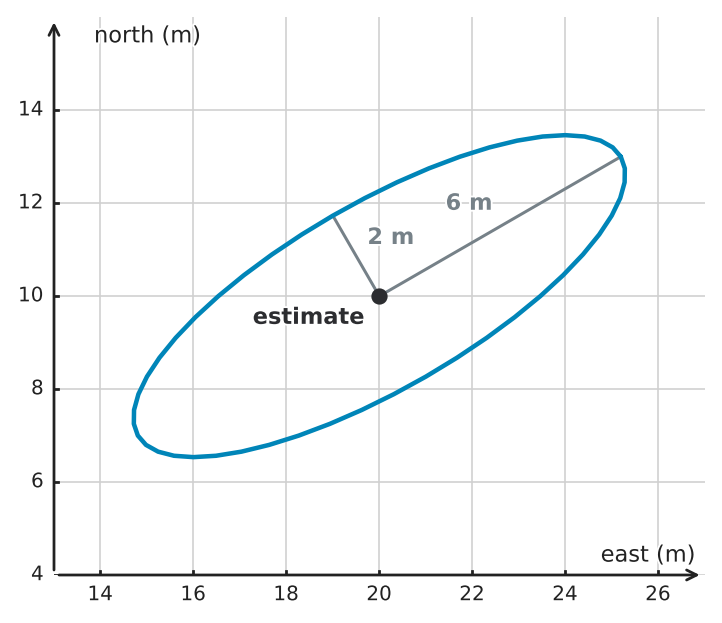
Use the diagram to classify each candidate position as inside, on, or outside the GPS uncertainty ellipse: a) \(A=(20+3\sqrt3, 13)\) b) \(B=(20+2\sqrt3, 12)\) c) \(C=\left(\frac{37}{2}, 10+\frac{3\sqrt3}{2}\right)\)
Figure for problem 543938

Hints

- Translate each candidate position so the reported estimate becomes the origin. - Resolve each translated vector along the major-axis and minor-axis directions. - Compare the resulting coordinates with the standard ellipse inequality.

Solution

1. Relative to the estimate, use principal coordinates \(u=(x-20)\cos30^\circ+(y-10)\sin30^\circ\) and \(v=-(x-20)\sin30^\circ+(y-10)\cos30^\circ\). 2. The uncertainty region is \(\frac{u^2}{36}+\frac{v^2}{4}\leq1\). 3. For \(A\), the relative vector is \((3\sqrt3, 3)\), giving \((u, v)=(6, 0)\). Thus \(\frac{u^2}{36}+\frac{v^2}{4}=1\), so \(A\) is on the ellipse. 4. For \(B\), the relative vector is \((2\sqrt3, 2)\), giving \((u, v)=(4, 0)\). Thus the value is \(\frac{16}{36}=\frac49<1\), so \(B\) is inside. 5. For \(C\), the relative vector is \(\left(-\frac32, \frac{3\sqrt3}{2}\right)\), giving \((u, v)=(0, 3)\). Thus the value is \(\frac94>1\), so \(C\) is outside.

Answer

a) \(A\) is on the uncertainty ellipse. b) \(B\) is inside the uncertainty ellipse. c) \(C\) is outside the uncertainty ellipse.

54394512
An elliptical lake is centered at the origin. It is \(26\,\text{km}\) wide from east to west and \(10\,\text{km}\) wide from north to south. A straight ferry route runs east to west along the line \(y=3\), as shown. a) Write a standard-form equation for the shoreline. b) Find the two shoreline points where the ferry route enters and leaves the lake. c) Find the route length across the lake and express it as a percentage of the lake's maximum east-west width.
Figure for problem 543945

Hints

- Convert each full lake dimension into a semi-axis length before writing the ellipse equation. - Substitute the ferry route's constant y-coordinate into the shoreline equation. - Compare the distance between the two intersection x-coordinates with the full major-axis length.

Solution

1. The semi-major axis is \(a=13\), and the semi-minor axis is \(b=5\). 2. The shoreline is modeled by \(\frac{x^2}{169}+\frac{y^2}{25}=1\). 3. On the ferry route, \(y=3\). Substitute: \(\frac{x^2}{169}+\frac{9}{25}=1\). 4. Then \(\frac{x^2}{169}=\frac{16}{25}\), so \(x=\pm\frac{52}{5}\). 5. The entry and exit points are \(\left(-\frac{52}{5}, 3\right)\) and \(\left(\frac{52}{5}, 3\right)\). 6. The route length across the lake is \(\frac{52}{5}-\left(-\frac{52}{5}\right)=\frac{104}{5}=20.8\,\text{km}\). 7. The maximum east-west width is \(26\,\text{km}\), so the percentage is \(\frac{20.8}{26}\cdot100\%=80\%\).

Answer

a) \(\frac{x^2}{169}+\frac{y^2}{25}=1\) b) \(\left(-\frac{52}{5}, 3\right)\) and \(\left(\frac{52}{5}, 3\right)\) c) \(20.8\,\text{km}\), which is \(80\%\) of the maximum east-west width
54395212
An elliptical whispering-gallery wall is modeled by \(\frac{x^2}{100}+\frac{y^2}{36}=1\), with distances measured in meters. A listener is at the left focus \(L=(-8, 0)\). The speaker should be at the right focus \((8, 0)\), but it is misplaced at \(S=(7, 0)\). The diagram shows boundary points \(A=(10, 0)\) and \(B=(0, 6)\). a) Find the broken-path lengths \(S\to A\to L\) and \(S\to B\to L\). b) By how much do the path lengths differ? c) Explain what the comparison shows about the misplaced speaker.
Figure for problem 543952

Hints

- Compute each broken path as the sum of two ordinary distances. - Compare the result with the constant focal-distance sum of the ellipse. - Use the comparison to explain why the exact focus location matters.

Solution

1. Through \(A=(10, 0)\), the speaker-to-wall distance is \(3\) and the wall-to-listener distance is \(18\), so the total path length is \(21\,\text{m}\). 2. Through \(B=(0, 6)\), the speaker-to-wall distance is \(\sqrt{(7-0)^2+(0-6)^2}=\sqrt{85}\). 3. The wall-to-listener distance is \(\sqrt{(0+8)^2+(6-0)^2}=10\). 4. The second total path length is \(10+\sqrt{85}\,\text{m}\). 5. The difference is \(21-(10+\sqrt{85})=11-\sqrt{85}\approx1.78\,\text{m}\). 6. If the speaker were at the right focus \((8, 0)\), every one-reflection broken path to the left focus would have length \(2a=20\,\text{m}\). The unequal lengths show that moving the speaker off the focus destroys the constant-path property.

Answer

a) Through \(A\): \(21\,\text{m}\); through \(B\): \(10+\sqrt{85}\,\text{m}\approx19.22\,\text{m}\) b) \(11-\sqrt{85}\,\text{m}\approx1.78\,\text{m}\) c) The speaker is not at a focus, so the broken path length to the other focus is no longer constant.
54397212
A space probe follows the right branch of the hyperbolic path \(\frac{x^2}{64}-\frac{y^2}{36}=1\), with distances measured in thousands of kilometers. A planet is located at the right focus \((10, 0)\), as shown. a) Find the probe's closest distance to the planet. b) Find the path's asymptotes and their direction angles relative to the positive x-axis. c) When the probe has \(x=20\), find its two possible y-coordinates and the distance between those two positions.
Figure for problem 543972

Hints

- Use \(c^2=a^2+b^2\) to relate the focus to the nearest vertex. - Read the asymptote slopes from the standard horizontal-hyperbola form. - Substitute the given x-coordinate and use symmetry for the two possible y-coordinates.

Solution

1. The hyperbola has \(a=8\), \(b=6\), and \(c=\sqrt{a^2+b^2}=10\), so the stated planet location is a focus. 2. The closest point on the right branch to the right focus is the right vertex \((8, 0)\). 3. The closest distance is \(c-a=10-8=2\) thousand kilometers. 4. The asymptotes are \(y=\pm\frac{b}{a}x=\pm\frac34x\). 5. Their direction angles are \(\theta=\pm\arctan\left(\frac34\right)\approx\pm36.9^\circ\). 6. At \(x=20\), \(\frac{400}{64}-\frac{y^2}{36}=1\). 7. Thus \(\frac{y^2}{36}=\frac{21}{4}\), so \(y=\pm3\sqrt{21}\). 8. The distance between the two positions is \(3\sqrt{21}-(-3\sqrt{21})=6\sqrt{21}\) thousand kilometers, approximately \(27.5\) thousand kilometers.

Answer

a) \(2\) thousand kilometers b) \(y=\pm\frac34x\); direction angles \(\pm\arctan\left(\frac34\right)\approx\pm36.9^\circ\) c) \(y=\pm3\sqrt{21}\); separation \(6\sqrt{21}\) thousand kilometers \(\approx27.5\) thousand kilometers
54398512
A headlight reflector has parabolic cross section \(y^2=12x\), with coordinates measured in centimeters and its lamp at the focus. The reflector is trimmed by the vertical line \(x=12\), as shown. Find the two rim points, the distance from the lamp to each rim point, and the angle subtended by the reflector opening at the lamp.
Figure for problem 543985

Hints

- Use the trimming line to find the two symmetric boundary points. - Locate the focus from the standard parabola coefficient. - Use a dot product between the two focus-to-rim vectors to find the included angle.

Solution

1. Since \(y^2=4ax\), the focal parameter is \(a=3\), so the lamp is at \(F=(3, 0)\). 2. At the trimming line \(x=12\), \(y^2=144\), so the rim points are \(R_1=(12, 12)\) and \(R_2=(12, -12)\). 3. Each focus-to-rim distance is \(FR_i=\sqrt{(12-3)^2+12^2}=\sqrt{225}=15\,\text{cm}\). 4. The vectors from the focus to the rim points are \(\mathbf v_1=(9, 12)\) and \(\mathbf v_2=(9, -12)\). 5. Their dot product is \(\mathbf v_1\cdot\mathbf v_2=81-144=-63\), and each vector has length \(15\). 6. If \(\phi\) is the opening angle at the lamp, then \(\cos\phi=\frac{-63}{225}=-\frac7{25}\). Thus \(\phi=\arccos\left(-\frac7{25}\right)\approx106.3^\circ\).

Answer

Rim points: \((12, 12)\) and \((12, -12)\) Distance from the lamp to either rim point: \(15\,\text{cm}\) Opening angle: \(\arccos\left(-\frac7{25}\right)\approx106.3^\circ\)
54399312
A machinist cuts the upper half of the circular cone \(z^2=x^2+y^2\), with \(z\ge0\), using the plane \(z=2+\frac{x}{2}\). Coordinates are measured in centimeters. Determine the equation of the cut edge as seen in a top view onto the \(xy\)-plane. Classify the conic, state its center and semi-axis lengths, and find the area enclosed by the top-view curve.

Hints

- Eliminate the height variable by combining the cone and plane equations. - Complete the square before classifying the projected curve. - Read the semi-axis lengths from standard form before computing area.

Solution

1. Points on the cut satisfy both equations, so substitute \(z=2+\frac{x}{2}\) into \(z^2=x^2+y^2\). 2. This gives \(\left(2+\frac{x}{2}\right)^2=x^2+y^2\), so \(\frac34x^2-2x+y^2-4=0\). 3. Complete the square in \(x\): \(\frac34\left(x-\frac43\right)^2+y^2=\frac{16}{3}\). 4. Dividing by \(\frac{16}{3}\) gives \(\frac{\left(x-\frac43\right)^2}{\frac{64}{9}}+\frac{y^2}{\frac{16}{3}}=1\). 5. This ellipse has \(-\frac43\le x\le4\), so \(z=2+\frac{x}{2}\ge\frac43>0\) everywhere on the curve. Thus every projected point belongs to the upper cone. 6. The top-view curve is an ellipse centered at \(\left(\frac43, 0\right)\), with horizontal semi-axis \(\frac83\) and vertical semi-axis \(\frac{4}{\sqrt3}\). 7. Its area is \(\pi\left(\frac83\right)\left(\frac{4}{\sqrt3}\right)=\frac{32\pi}{3\sqrt3}=\frac{32\pi\sqrt3}{9}\) square centimeters.

Answer

Top-view equation: \(\frac{\left(x-\frac43\right)^2}{\frac{64}{9}}+\frac{y^2}{\frac{16}{3}}=1\) Conic: ellipse Center: \(\left(\frac43, 0\right)\) Semi-axis lengths: \(\frac83\) and \(\frac{4}{\sqrt3}\) Area: \(\frac{32\pi\sqrt3}{9}\,\text{cm}^2\)

All problems may be used, copied and printed free of charge for school and tutoring, including paid tutoring. Commercial adaptations as well as publication or redistribution on the internet are not permitted.