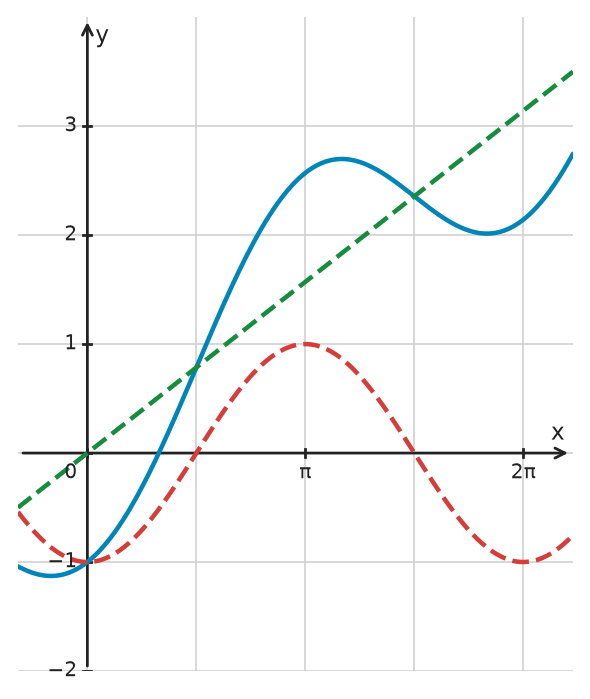
The figure shows three graphs labeled A, B, and C for the functions \(f(x)=0.5x-\cos x\), \(g(x)=0.5x\), and \(h(x)=-\cos x\).
a) Match each graph label to its function.
b) Find the coordinates of all points on the graph of \(f\) in \([0,2\pi]\) where the slope is \(0.5\).
c) Determine whether the graph of \(f\) has horizontal tangents. Give all such inputs if they exist.
Hints
- Compare the shapes and formulas of the three functions.
- Set the derivative equal to the desired slope in part b.
- A horizontal tangent requires the derivative to equal \(0\).
- Use the unit circle for the resulting sine equations.
Solution
1. Graph B is the line through the origin, so it represents \(g\). Graph C is the reflected cosine curve, so it represents \(h\). Their pointwise sum is graph A, which represents \(f\).
2. Since \(f'(x)=0.5+\sin x\), slope \(0.5\) occurs when \(\sin x=0\). On \([0,2\pi]\), the inputs are \(0\), \(\pi\), and \(2\pi\), giving points \((0,-1)\), \(\left(\pi,\frac{\pi}{2}+1\right)\), and \((2\pi,\pi-1)\).
3. Horizontal tangents satisfy \(\sin x=-\frac{1}{2}\), so \(x=\frac{7\pi}{6}+2\pi n\) or \(x=\frac{11\pi}{6}+2\pi n\), where \(n\in\mathbb{Z}\).
Answer
a) A: \(f\); B: \(g\); C: \(h\)
b) \((0,-1)\), \(\left(\pi,\frac{\pi}{2}+1\right)\), and \((2\pi,\pi-1)\)
c) \(x=\frac{7\pi}{6}+2\pi n\) or \(x=\frac{11\pi}{6}+2\pi n\), where \(n\in\mathbb{Z}\)


