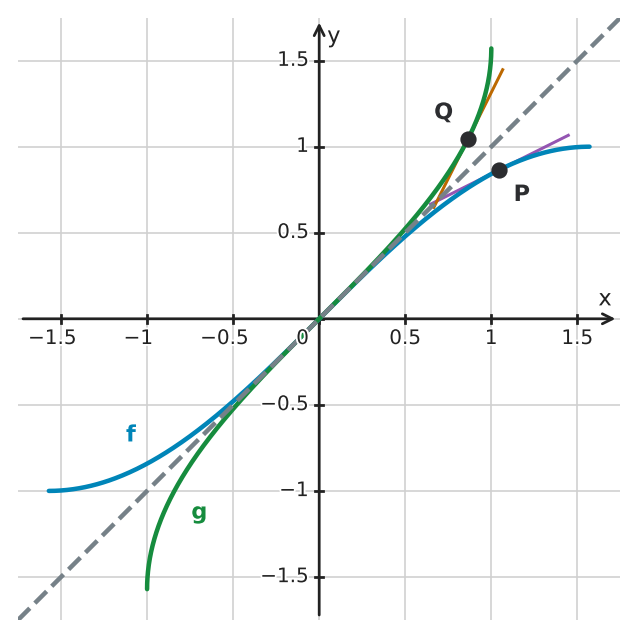
The figure shows \(f(x)=\sin x\) restricted to \(-\frac{\pi}{2}\le x\le\frac{\pi}{2}\), its inverse \(g=f^{-1}\), and the line \(y=x\). The point \(P\) on \(f\) has x-coordinate \(\frac{\pi}{3}\), and \(Q\) is its reflected point on \(g\). Short tangent segments are drawn at both points.
a) Find the exact coordinates of \(P\) and \(Q\).
b) Find the slope of the tangent to \(f\) at \(P\).
c) Without differentiating an explicit formula for \(g\), find the slope of the tangent to \(g\) at \(Q\).
d) Explain how the graph’s reflection across \(y=x\) is consistent with the two tangent slopes.
Hints
- Use the restricted sine function to determine the y-coordinate of \(P\).
- An inverse graph reflects each point by reversing its coordinates.
- Find the original tangent slope from the derivative of sine.
- For corresponding inverse points with nonzero slope, compare rise and run after reflection across \(y=x\).
Solution
1. a) Since \(f\left(\frac{\pi}{3}\right)=\sin\left(\frac{\pi}{3}\right)=\frac{\sqrt{3}}{2}\), \(P=\left(\frac{\pi}{3},\frac{\sqrt{3}}{2}\right)\). Reflection across \(y=x\) reverses coordinates, so \(Q=\left(\frac{\sqrt{3}}{2},\frac{\pi}{3}\right)\).
2. b) Since \(f^{\prime}(x)=\cos x\), the slope at \(P\) is \(f^{\prime}\left(\frac{\pi}{3}\right)=\frac{1}{2}\).
3. c) At corresponding inverse points, the nonzero tangent slopes are reciprocals. Therefore, \(g^{\prime}\left(\frac{\sqrt{3}}{2}\right)=\frac{1}{1/2}=2\).
4. d) Reflecting a nonvertical tangent line across \(y=x\) interchanges horizontal and vertical changes, so a slope of \(\frac{1}{2}\) becomes \(2\). The displayed tangent segments show this reciprocal steepness.
Answer
a) \(P=\left(\frac{\pi}{3},\frac{\sqrt{3}}{2}\right)\), \(Q=\left(\frac{\sqrt{3}}{2},\frac{\pi}{3}\right)\)
b) \(\frac{1}{2}\)
c) \(2\)
d) Reflection across \(y=x\) swaps rise and run, so the nonzero slopes are reciprocals.