Aimathic
Login | English | Deutsch

Free Math Worksheets

Build your own math worksheets from 21,000 problems for grades 3 to 12, from fractions to calculus. Every problem includes step-by-step solutions.

Higher-order derivatives

Click problems to add them to your worksheet.

52640712
Complete each differentiation task. 1) Given \(y=\frac{1}{4}x^4-\frac{5}{6}x^3+x^2\), find \(\frac{dy}{dx}\). 2) Find \(f''(x)\) for \(f(x)=\frac{1}{20}x^5-\frac{1}{2}x^3+7x\). 3) Find \(f''(2)\) for \(f(x)=\frac{1}{6}x^3-x^2+5x-1\).

Hints

- Apply the power rule to each term. - What does the double-prime notation mean? - To evaluate a derivative at a point, first find its formula and then substitute the input.

Solution

1. Differentiate term by term: \(\frac{dy}{dx}=x^3-\frac{5}{2}x^2+2x\). 2. First, \(f'(x)=\frac{1}{4}x^4-\frac{3}{2}x^2+7\). Differentiate again: \(f''(x)=x^3-3x\). 3. First, \(f'(x)=\frac{1}{2}x^2-2x+5\), so \(f''(x)=x-2\). Therefore, \(f''(2)=0\).

Answer

1) \(\frac{dy}{dx}=x^3-\frac{5}{2}x^2+2x\) 2) \(f''(x)=x^3-3x\) 3) \(f''(2)=0\)
52894512
Let \(f(x)=\frac{1}{4}x^4-x^3+5x^2-12\). Find \(f'\), \(f''\), \(f'''\), and \(f^{(4)}\) in order.

Hints

- Apply the power rule repeatedly. - Each differentiation lowers the degree of a nonconstant polynomial by \(1\). - Constant terms disappear when differentiated. - Use each derivative as the starting point for the next one.

Solution

1. First derivative: \(f'(x)=x^3-3x^2+10x\). 2. Second derivative: \(f''(x)=3x^2-6x+10\). 3. Third derivative: \(f'''(x)=6x-6\). 4. Fourth derivative: \(f^{(4)}(x)=6\).

Answer

\(f'(x)=x^3-3x^2+10x\) \(f''(x)=3x^2-6x+10\) \(f'''(x)=6x-6\) \(f^{(4)}(x)=6\)
52894612
Let \(g(x)=-0.1x^5+2x^3-x\). a) Find the third derivative \(g'''(x)\). b) Find \(g'''(2)\).

Hints

- Find the third derivative by differentiating three times in succession. - The notation \(g'''(2)\) means to evaluate the third derivative at \(x=2\). - Apply exponents before multiplication when evaluating.

Solution

1. Differentiate successively: \(g'(x)=-0.5x^4+6x^2-1\), \(g''(x)=-2x^3+12x\), and \(g'''(x)=-6x^2+12\). 2. Evaluate: \(g'''(2)=-6(2)^2+12=-12\).

Answer

a) \(g'''(x)=-6x^2+12\) b) \(g'''(2)=-12\)
52894712
Let \(f(x)=\frac{1}{6}x^3-2x^2+5x-1\). Find the first four derivatives \(f'\), \(f''\), \(f'''\), and \(f^{(4)}\).

Hints

- Each application of the power rule decreases a positive integer exponent by \(1\). - A constant term has derivative \(0\). - Keep constant coefficients when differentiating powers. - Obtain each higher derivative by differentiating the preceding derivative.

Solution

1. Differentiate once: \(f'(x)=\frac{1}{2}x^2-4x+5\). 2. Differentiate again: \(f''(x)=x-4\). 3. The third derivative is \(f'''(x)=1\). 4. The fourth derivative is \(f^{(4)}(x)=0\).

Answer

\(f'(x)=\frac{1}{2}x^2-4x+5\) \(f''(x)=x-4\) \(f'''(x)=1\) \(f^{(4)}(x)=0\)
52896012
Let \(g(x)=5\cos x\). a) Find \(g^{(51)}(x)\). b) Find the exact value of \(g^{(51)}(\pi)\).

Hints

- List derivatives of cosine until the pattern repeats. - Keep the constant factor \(5\). - Divide \(51\) by the cycle length and use the remainder. - Recall the exact value of \(\sin\pi\).

Solution

1. The derivatives of cosine repeat in a cycle of length \(4\): \(\cos x,-\sin x,-\cos x,\sin x,\cos x\). 2. The constant factor \(5\) remains unchanged. Since \(51=12\cdot4+3\), the 51st derivative matches the third derivative in the cycle: \(g^{(51)}(x)=5\sin x\). 3. Evaluate at \(x=\pi\): \(g^{(51)}(\pi)=5\sin\pi=0\).

Answer

a) \(g^{(51)}(x)=5\sin x\) b) \(g^{(51)}(\pi)=0\)
52897712
Let \(f(x)=\frac{1}{24}x^4-\frac{1}{2}x^2+3x\). Find \(f'\), \(f''\), \(f'''\), \(f^{(4)}\), and \(f^{(5)}\).

Hints

- Apply the power rule one derivative at a time. - Constant terms have derivative \(0\). - Keep constant coefficients when differentiating. - What is the derivative of a constant function?

Solution

1. \(f'(x)=\frac{1}{6}x^3-x+3\). 2. \(f''(x)=\frac{1}{2}x^2-1\). 3. \(f'''(x)=x\). 4. \(f^{(4)}(x)=1\). 5. \(f^{(5)}(x)=0\).

Answer

\(f'(x)=\frac{1}{6}x^3-x+3\) \(f''(x)=\frac{1}{2}x^2-1\) \(f'''(x)=x\) \(f^{(4)}(x)=1\) \(f^{(5)}(x)=0\)
52898112
Let \(f(x)=x^4+5x^3-2x+1\). 1) Find \(f'\), \(f''\), \(f'''\), and \(f^{(4)}\). 2) Which derivative is constant for every \(x\in\mathbb{R}\)? State its value. 3) Find \(f^{(5)}(x)\) and explain why.

Hints

- Apply the power rule to each term. - Constant terms disappear when differentiated. - At which derivative order does the variable disappear completely? - Track how the degree changes after each derivative.

Solution

1. Differentiate successively: \(f'(x)=4x^3+15x^2-2\), \(f''(x)=12x^2+30x\), \(f'''(x)=24x+30\), and \(f^{(4)}(x)=24\). 2. The fourth derivative is the constant function \(24\). 3. Since the derivative of a constant is \(0\), \(f^{(5)}(x)=0\).

Answer

1) \(f'(x)=4x^3+15x^2-2\), \(f''(x)=12x^2+30x\), \(f'''(x)=24x+30\), and \(f^{(4)}(x)=24\) 2) \(f^{(4)}(x)=24\) 3) \(f^{(5)}(x)=0\)
52899112
Let \(f(x)=2x^5-\frac{3}{2}x^4+8x^2-5x+12\). Find the first three derivatives.

Hints

- Apply the power rule to every term. - Constant terms disappear when differentiated. - Multiply each coefficient by the exponent before reducing the exponent by \(1\). - Use each derivative as the starting point for the next derivative.

Solution

1. Differentiate once: \(f'(x)=10x^4-6x^3+16x-5\). 2. Differentiate again: \(f''(x)=40x^3-18x^2+16\). 3. The third derivative is \(f'''(x)=120x^2-36x\).

Answer

\(f'(x)=10x^4-6x^3+16x-5\) \(f''(x)=40x^3-18x^2+16\) \(f'''(x)=120x^2-36x\)
52899212
Let \(h(x)=\frac{1}{60}x^5-\frac{1}{12}x^4+\frac{2}{3}x^3-\pi\). Find the first, second, and third derivatives.

Hints

- Treat fractions as constant coefficients. - The symbol \(\pi\) represents a constant. - Simplify fractions after each differentiation step. - Check every term after each application of the power rule.

Solution

1. The first derivative is \(h'(x)=\frac{1}{12}x^4-\frac{1}{3}x^3+2x^2\). 2. The second derivative is \(h''(x)=\frac{1}{3}x^3-x^2+4x\). 3. The third derivative is \(h'''(x)=x^2-2x+4\).

Answer

\(h'(x)=\frac{1}{12}x^4-\frac{1}{3}x^3+2x^2\) \(h''(x)=\frac{1}{3}x^3-x^2+4x\) \(h'''(x)=x^2-2x+4\)
52989512
Let \(f(x)=e^{5-2x}\). Find a formula for the nth derivative \(f^{(n)}(x)\).

Hints

- Compute the first few derivatives. - Identify the factor introduced by each use of the chain rule. - Track the alternating sign. - Express repeated multiplication with an exponent.

Solution

1. The first derivatives are \(f'(x)=-2e^{5-2x}\) and \(f''(x)=(-2)^2e^{5-2x}\). 2. Each differentiation multiplies the expression by the derivative of the exponent, which is \(-2\). Therefore, after \(n\) derivatives, \(f^{(n)}(x)=(-2)^ne^{5-2x}\).

Answer

\(f^{(n)}(x)=(-2)^ne^{5-2x}\)
52552312
Consider the family of quadratic functions \(f_k(x)=x^2-4kx+3k^2\), where \(k\in\mathbb{R}\). a) Find the x- and y-intercepts in terms of \(k\). b) Find \(f_k''(x)\).

Hints

- Substitute \(x=0\) to find the y-intercept. - Factor the quadratic to find its zeros. - Treat \(k\) as a constant when differentiating.

Solution

1. For the y-intercept, substitute \(x=0\): \(f_k(0)=3k^2\). Thus, the y-intercept is \((0, 3k^2)\). 2. Factor \(f_k(x)=(x-k)(x-3k)\). The x-intercepts are \((k, 0)\) and \((3k, 0)\). 3. When \(k=0\), both x-intercepts and the y-intercept coincide at the origin. 4. Differentiate twice: \(f_k'(x)=2x-4k\) and \(f_k''(x)=2\).

Answer

a) x-intercepts: \((k, 0)\) and \((3k, 0)\); y-intercept: \((0, 3k^2)\). When \(k=0\), all three listed intercepts coincide at \((0, 0)\). b) \(f_k''(x)=2\)
52552412
Consider the family of functions \(g_a(t)=\frac{1}{3}t^3-a^2t\), where \(a>0\). a) Find all intercepts with the coordinate axes. b) Find \(g_a''(t)\).

Hints

- Factor out \(t\) to find the zeros. - The origin can be an intercept with both axes. - Treat \(a\) as a constant while differentiating with respect to \(t\).

Solution

1. Since \(g_a(0)=0\), the graph passes through the origin, which is both a horizontal-axis and vertical-axis intercept. 2. Factor \(g_a(t)=t\left(\frac{1}{3}t^2-a^2\right)\). 3. The zeros are \(t=0\) and \(t=\pm\sqrt{3}a\). Thus, the horizontal-axis intercepts are \((0, 0)\), \((\sqrt{3}a, 0)\), and \((-\sqrt{3}a, 0)\). 4. Differentiate twice: \(g_a'(t)=t^2-a^2\) and \(g_a''(t)=2t\).

Answer

a) Horizontal-axis intercepts: \((0, 0)\), \((\sqrt{3}a, 0)\), and \((-\sqrt{3}a, 0)\); vertical-axis intercept: \((0, 0)\). b) \(g_a''(t)=2t\)
52559112
Let \(f(x)=\sin x\). 1. Find the first four derivatives \(f'\), \(f''\), \(f'''\), and \(f^{(4)}\). 2. Explain why the derivatives repeat in a cycle, and state the cycle length. 3. Use the cycle to find \(f^{(102)}(x)\).

Hints

- Differentiate repeatedly until the original function returns. - Count the number of derivatives in one full cycle. - Divide \(102\) by the cycle length. - Use the remainder to identify the matching derivative.

Solution

1. Differentiate repeatedly: \(f'(x)=\cos x\), \(f''(x)=-\sin x\), \(f'''(x)=-\cos x\), and \(f^{(4)}(x)=\sin x\). 2. The fourth derivative equals the original function, so the same four derivatives repeat. The cycle length is \(4\). 3. Since \(102=25\cdot 4+2\), the 102nd derivative matches the second derivative. Therefore, \(f^{(102)}(x)=-\sin x\).

Answer

1. \(f'(x)=\cos x\), \(f''(x)=-\sin x\), \(f'''(x)=-\cos x\), \(f^{(4)}(x)=\sin x\) 2. Cycle length: \(4\) 3. \(f^{(102)}(x)=-\sin x\)
52559212
Let \(g(x)=\cos x\). 1. Find the smallest positive integer \(n\) for which \(g^{(n)}(x)=-g(x)\). 2. Find \(g^{(55)}(x)\). 3. Find all integers \(n\) with \(1\le n\le 10\) for which \(g^{(n)}(0)=0\).

Hints

- Write the first few derivatives of cosine. - Use the four-step derivative cycle. - Reduce \(55\) modulo \(4\). - Compare odd- and even-order derivatives at \(x=0\).

Solution

1. The first two derivatives are \(g'(x)=-\sin x\) and \(g''(x)=-\cos x=-g(x)\). Therefore, the smallest positive integer is \(n=2\). 2. The derivatives repeat every four steps. Since \(55=13\cdot 4+3\), \(g^{(55)}\) matches the third derivative. Thus, \(g^{(55)}(x)=\sin x\). 3. Odd-order derivatives are \(\pm\sin x\), which equal \(0\) at \(x=0\). Even-order derivatives are \(\pm\cos x\), which equal \(\pm1\) at \(x=0\). Therefore, \(n\in\{1,3,5,7,9\}\).

Answer

1. \(n=2\) 2. \(g^{(55)}(x)=\sin x\) 3. \(n\in\{1,3,5,7,9\}\)
52567712
Let \(f_k(x) = (kx^2 - 1)\sin(x)\), where \(k \in \mathbb{R}\). Find formulas for \(f_k'(x)\) and \(f_k''(x)\).

Hints

- View the function as a product of two factors. - Apply the product rule to find the first derivative. - Treat \(k\) as a constant when differentiating. - Differentiate the first derivative again to obtain the second derivative. - Group the sine terms and the cosine terms in your final expression.

Solution

1. Let \(u(x) = kx^2 - 1\) and \(v(x) = \sin(x)\). Treat \(k\) as a constant, so \(u'(x) = 2kx\) and \(v'(x) = \cos(x)\). 2. Apply the product rule: \(f_k'(x) = 2kx\sin(x) + (kx^2 - 1)\cos(x)\). 3. Differentiate both terms again: \(\frac{d}{dx}[2kx\sin(x)] = 2k\sin(x) + 2kx\cos(x)\), \(\frac{d}{dx}[(kx^2 - 1)\cos(x)] = 2kx\cos(x) - (kx^2 - 1)\sin(x)\). 4. Combine like trigonometric terms: \(f_k''(x) = (2k - kx^2 + 1)\sin(x) + 4kx\cos(x)\).

Answer

\(f_k'(x) = 2kx\sin(x) + (kx^2 - 1)\cos(x)\) \(f_k''(x) = (2k - kx^2 + 1)\sin(x) + 4kx\cos(x)\)
52567812
Let \(g_a(t) = 5at^2\cos(t) - 2at^2\cos(t)\), where \(a \in \mathbb{R}\). Simplify the function first, then find \(g_a'(t)\) and \(g_a''(t)\).

Hints

- First check whether the two terms in the original function can be combined. - Use the product rule after simplifying. - Watch the signs when differentiating sine and cosine. - To find the second derivative, differentiate each term of the first derivative.

Solution

1. Combine like terms: \(g_a(t) = 3at^2\cos(t)\). 2. Let \(u(t) = 3at^2\) and \(v(t) = \cos(t)\). Then \(u'(t) = 6at\) and \(v'(t) = -\sin(t)\). 3. Apply the product rule: \(g_a'(t) = 6at\cos(t) - 3at^2\sin(t)\). 4. Differentiate both terms again: \(g_a''(t) = 6a\cos(t) - 6at\sin(t) - 6at\sin(t) - 3at^2\cos(t)\). 5. Combine like terms: \(g_a''(t) = (6a - 3at^2)\cos(t) - 12at\sin(t)\).

Answer

\(g_a'(t) = 6at\cos(t) - 3at^2\sin(t)\) \(g_a''(t) = (6a - 3at^2)\cos(t) - 12at\sin(t)\)
52570312
Let \(g\) be three times differentiable. For each function \(f\), find formulas for \(f'(x)\) and \(f''(x)\). a) \(f(x) = e^xg(x)\) b) \(f(x) = (x^2 + 1)g'(x)\)

Hints

- Which rule applies to a product of two functions? - Remember that the derivative of \(e^x\) is \(e^x\). - When finding the second derivative, apply the product rule again to every product term. - How does the order of a derivative of \(g\) change when you differentiate it once more?

Solution

1. For a), apply the product rule: \(f'(x) = e^xg(x) + e^xg'(x) = e^x(g(x) + g'(x))\). 2. Differentiate again: \(f''(x) = e^x(g(x) + g'(x)) + e^x(g'(x) + g''(x))\) \(= e^x(g(x) + 2g'(x) + g''(x))\). 3. For b), apply the product rule: \(f'(x) = 2xg'(x) + (x^2 + 1)g''(x)\). 4. Differentiate both terms: \(\frac{d}{dx}[2xg'(x)] = 2g'(x) + 2xg''(x)\), \(\frac{d}{dx}[(x^2 + 1)g''(x)] = 2xg''(x) + (x^2 + 1)g'''(x)\). Therefore, \(f''(x) = 2g'(x) + 4xg''(x) + (x^2 + 1)g'''(x)\).

Answer

a) \(f'(x) = e^x(g(x) + g'(x))\) and \(f''(x) = e^x(g(x) + 2g'(x) + g''(x))\) b) \(f'(x) = 2xg'(x) + (x^2 + 1)g''(x)\) and \(f''(x) = 2g'(x) + 4xg''(x) + (x^2 + 1)g'''(x)\)
52574012
Let \(u(x) = x^3\), \(v(x) = \cos(x)\), and \(f(x) = u(x)v(x)\). a) Find \(u'(x)\), \(u''(x)\), \(v'(x)\), and \(v''(x)\). b) Find \(f''(x)\) by applying the product rule twice to \(f(x) = x^3\cos(x)\). c) Verify your result using \(f''(x) = u''(x)v(x) + 2u'(x)v'(x) + u(x)v''(x)\).

Hints

- First find every required derivative of \(u\) and \(v\). - When differentiating \(f'(x)\), keep track of the minus sign and use parentheses. - In part c), substitute the derivatives from part a) directly into the given formula.

Solution

1. The required derivatives are \(u'(x) = 3x^2\), \(u''(x) = 6x\), \(v'(x) = -\sin(x)\), and \(v''(x) = -\cos(x)\). 2. First differentiate \(f\): \(f'(x) = 3x^2\cos(x) - x^3\sin(x)\). 3. Differentiate again: \(f''(x) = 6x\cos(x) - 3x^2\sin(x) - [3x^2\sin(x) + x^3\cos(x)]\) \(= 6x\cos(x) - 6x^2\sin(x) - x^3\cos(x)\). 4. Substituting into the formula gives \((6x)\cos(x) + 2(3x^2)(-\sin(x)) + x^3(-\cos(x))\) \(= 6x\cos(x) - 6x^2\sin(x) - x^3\cos(x)\), which matches the result from part b).

Answer

a) \(u'(x) = 3x^2\), \(u''(x) = 6x\), \(v'(x) = -\sin(x)\), and \(v''(x) = -\cos(x)\) b) \(f''(x) = 6x\cos(x) - 6x^2\sin(x) - x^3\cos(x)\) c) Substitution into the given formula produces the same expression as in part b).
52575112
Let \(f(x) = x\cos(x)\). 1. Find \(f'(x)\), \(f''(x)\), and \(f'''(x)\). 2. The derivatives of \(c(x) = \cos(x)\) repeat in a cycle. Identify \(c^{(40)}(x)\) and briefly explain why. 3. Continue the pattern from part 1, or use the generalized product rule, to find \(f^{(40)}(x)\).

Hints

- Apply the product rule to the first few derivatives and simplify each result. - Determine how many derivatives it takes for cosine to return to itself. - Look for a relationship between the derivative order and the coefficient of the trigonometric term. - Compare the term containing \(x\) with the corresponding derivative of cosine.

Solution

1. Apply the product rule repeatedly: \(f'(x) = \cos(x) - x\sin(x)\), \(f''(x) = -2\sin(x) - x\cos(x)\), \(f'''(x) = -3\cos(x) + x\sin(x)\). 2. The derivatives of cosine repeat every four derivatives: \(\cos(x), -\sin(x), -\cos(x), \sin(x), \cos(x)\). Since \(40\) is divisible by \(4\), \(c^{(40)}(x) = \cos(x)\). 3. Because all derivatives of \(x\) after the first are zero, the generalized product rule reduces to \(f^{(n)}(x) = x\,c^{(n)}(x) + n c^{(n-1)}(x)\). For \(n=40\), \(c^{(40)}(x)=\cos(x)\) and \(c^{(39)}(x)=\sin(x)\). Therefore, \(f^{(40)}(x) = x\cos(x) + 40\sin(x)\).

Answer

1. \(f'(x) = \cos(x) - x\sin(x)\); \(f''(x) = -2\sin(x) - x\cos(x)\); \(f'''(x) = -3\cos(x) + x\sin(x)\) 2. \(c^{(40)}(x) = \cos(x)\) because the derivative cycle has period \(4\). 3. \(f^{(40)}(x) = x\cos(x) + 40\sin(x)\)
52586912
Find the first and second derivatives of \(f(x)=(4-5x)^6\).

Hints

- Identify the inner and outer functions. - Include the derivative of the inner linear function. - Pay close attention to the negative sign. - Notice how the exponent changes with each derivative.

Solution

1. Apply the chain rule: \(f'(x)=6(4-5x)^5\cdot(-5)=-30(4-5x)^5\). 2. Differentiate again using the chain rule: \(f''(x)=-30\cdot 5(4-5x)^4\cdot(-5)\) \(=750(4-5x)^4\).

Answer

\(f'(x)=-30(4-5x)^5\) \(f''(x)=750(4-5x)^4\)
52587012
Find the first and second derivatives of \(f(x)=2\sin(x^2+1)\).

Hints

- Use the chain rule for the original composite function. - The first derivative is a product of two functions of \(x\). - Apply both the product rule and the chain rule when differentiating again. - Recall the derivatives of sine and cosine.

Solution

1. Apply the chain rule: \(f'(x)=2\cos(x^2+1)(2x)=4x\cos(x^2+1)\). 2. Differentiate the product \(4x\cos(x^2+1)\): \(f''(x)=4\cos(x^2+1)+4x[-\sin(x^2+1)(2x)]\). Therefore, \(f''(x)=4\cos(x^2+1)-8x^2\sin(x^2+1)\).

Answer

\(f'(x)=4x\cos(x^2+1)\) \(f''(x)=4\cos(x^2+1)-8x^2\sin(x^2+1)\)
52589512
Let \(f_a(x)=\sin(ax+1)\), where \(a\in\mathbb{R}\setminus\{0\}\). Find \(f_a''(x)\) and \(f_a^{(40)}(x)\).

Hints

- Apply the chain rule one derivative at a time. - Compute the first four derivatives and track both the sign and the trigonometric function. - The sine-cosine derivative cycle has length \(4\). - Check whether the requested derivative order is a multiple of the cycle length.

Solution

1. Differentiate using the chain rule: \(f_a'(x)=a\cos(ax+1)\). 2. Differentiate again: \(f_a''(x)=-a^2\sin(ax+1)\). 3. The derivatives repeat their trigonometric pattern every four derivatives: \(f_a^{(3)}(x)=-a^3\cos(ax+1)\), \(f_a^{(4)}(x)=a^4\sin(ax+1)\). Since \(40\) is divisible by \(4\), \(f_a^{(40)}(x)=a^{40}\sin(ax+1)\).

Answer

\(f_a''(x)=-a^2\sin(ax+1)\) \(f_a^{(40)}(x)=a^{40}\sin(ax+1)\)
52621112
For each family, find the first and second derivatives. a) \(f_k(x)=ke^{2x}+e^{-kx}\) b) \(h_a(x)=(x^2-a)e^x\)

Hints

- Identify where the sum, product, and chain rules are needed. - Include the derivative of each exponent. - Factor out \(e^x\) after using the product rule. - Treat each parameter as a constant.

Solution

1. For part a, apply the chain rule to each exponential term: \(f_k'(x)=2ke^{2x}-ke^{-kx}\). 2. Differentiate again: \(f_k''(x)=4ke^{2x}+k^2e^{-kx}\). 3. For part b, apply the product rule: \(h_a'(x)=2xe^x+(x^2-a)e^x=(x^2+2x-a)e^x\). 4. Differentiate again: \(h_a''(x)=(2x+2)e^x+(x^2+2x-a)e^x=(x^2+4x+2-a)e^x\).

Answer

a) \(f_k'(x)=2ke^{2x}-ke^{-kx}\), \(f_k''(x)=4ke^{2x}+k^2e^{-kx}\) b) \(h_a'(x)=(x^2+2x-a)e^x\), \(h_a''(x)=(x^2+4x+2-a)e^x\)
52621212
Consider the family of functions \(g_t(x)=(t-x)e^{tx}\), where \(t\in\mathbb{R}\setminus\{0\}\). a) Find \(g_t'(x)\) and \(g_t''(x)\). b) Find the x-value, in terms of \(t\), where the tangent line is horizontal.

Hints

- A horizontal tangent has slope \(0\). - Use both the product rule and the chain rule. - The exponential factor cannot be zero. - Factor out \(e^{tx}\) after differentiating.

Solution

1. Apply the product and chain rules: \(g_t'(x)=(t^2-tx-1)e^{tx}\). 2. Differentiate again: \(g_t''(x)=(t^3-t^2x-2t)e^{tx}\). 3. A horizontal tangent requires \(g_t'(x)=0\). 4. Since \(e^{tx}>0\), solve \(t^2-tx-1=0\). 5. Because \(t\neq0\), \(x=\frac{t^2-1}{t}=t-\frac{1}{t}\).

Answer

a) \(g_t'(x)=(t^2-tx-1)e^{tx}\), \(g_t''(x)=(t^3-t^2x-2t)e^{tx}\) b) \(x=t-\frac{1}{t}\)
52621512
Consider the family of functions \(f_k(x)=(kx+4)e^x\), where \(k\in\mathbb{R}\). For each condition, find the value of \(k\): 1. The graph passes through \((1, 5e)\). 2. \(f_k''(0)=2\).

Hints

- Substitute the point into the original function. - Use the product rule for a linear factor times \(e^x\). - Evaluate the second derivative at the specified x-value.

Solution

1. Substitute \((1, 5e)\): \((k+4)e=5e\), so \(k=1\). 2. Differentiate: \(f_k'(x)=(kx+k+4)e^x\). 3. Differentiate again: \(f_k''(x)=(kx+2k+4)e^x\). 4. Set \(f_k''(0)=2\): \(2k+4=2\), so \(k=-1\).

Answer

1. \(k=1\) 2. \(k=-1\)
52621612
Consider the family of functions \(g_a(x)=(x^2-a^2)e^x\), where \(a\in\mathbb{R}\). For each condition, find all values of \(a\): 1. The graph passes through \((0, -9)\). 2. \(g_a''(0)=-7\).

Hints

- Substitute the point into the original function. - Apply the product rule and factor out the exponential term. - An equation of the form \(a^2=c\) may have two real solutions.

Solution

1. The point condition gives \(g_a(0)=-a^2=-9\), so \(a^2=9\) and \(a=\pm3\). 2. Differentiate: \(g_a'(x)=(x^2+2x-a^2)e^x\). 3. Differentiate again: \(g_a''(x)=(x^2+4x+2-a^2)e^x\). 4. The condition \(g_a''(0)=-7\) gives \(2-a^2=-7\), so \(a^2=9\) and \(a=\pm3\).

Answer

1. \(a=3\) or \(a=-3\) 2. \(a=3\) or \(a=-3\)
52623112
Let \(f(x)=e^{4x}-e^{-4x}\). Find \(f^{(21)}(x)\).

Hints

- Differentiate the two exponential terms separately. - Look for the pattern in repeated derivatives of \(e^{ax}\). - Determine the sign of \((-4)^{21}\). - Factor out the common constant at the end.

Solution

1. For any positive integer \(n\), \(\frac{d^n}{dx^n}e^{ax}=a^ne^{ax}\). Therefore, \(f^{(n)}(x)=4^ne^{4x}-(-4)^ne^{-4x}\). 2. Since \(21\) is odd, \((-4)^{21}=-4^{21}\). Thus, \(f^{(21)}(x)=4^{21}e^{4x}+4^{21}e^{-4x}\) \(=4^{21}(e^{4x}+e^{-4x})\).

Answer

\(f^{(21)}(x)=4^{21}(e^{4x}+e^{-4x})\)
52640812
Let \(h(t)=t^2(6-t^2)\). 1) Find \(h'(t)\). 2) Find \(h''(t)\). 3) Find every value of \(t\) where \(h''(t)=0\).

Hints

- Would expanding the product make differentiation easier? - Set the second derivative equal to zero to find the requested values. - An equation involving a square can have two real solutions.

Solution

1. Expand first: \(h(t)=6t^2-t^4\). Then \(h'(t)=12t-4t^3\). 2. Differentiate again: \(h''(t)=12-12t^2\). 3. Solve \(12-12t^2=0\). This gives \(t^2=1\), so \(t=-1\) or \(t=1\).

Answer

1) \(h'(t)=12t-4t^3\) 2) \(h''(t)=12-12t^2\) 3) \(t=-1\) and \(t=1\)
52734912
Let \(f(x)=\frac{5x+2}{x-3}\). a) Find the second derivative \(f''(x)\). b) Explain why the x-axis is a horizontal asymptote of the graph of \(f''\). c) Identify the vertical asymptote of \(f''\) and determine whether the function changes sign across it.

Hints

- Rewrite the rational function as a constant plus a power of \(x-3\). - Apply the power rule twice. - Examine the end behavior of the second derivative. - Use the multiplicity of the denominator factor to determine the sign behavior near the vertical asymptote.

Solution

1. Rewrite the function as \(f(x)=5+\frac{17}{x-3}\). 2. Differentiate: \(f'(x)=-17(x-3)^{-2}=\frac{-17}{(x-3)^2}\). 3. Differentiate again: \(f''(x)=34(x-3)^{-3}=\frac{34}{(x-3)^3}\). 4. Since \(\lim_{x\to\pm\infty}\frac{34}{(x-3)^3}=0\), the x-axis, \(y=0\), is a horizontal asymptote. 5. The denominator is zero at \(x=3\), so \(x=3\) is a vertical asymptote. Because the denominator has odd multiplicity, \(f''\) changes sign across \(x=3\).

Answer

a) \(f''(x)=\frac{34}{(x-3)^3}\) b) \(\lim_{x\to\pm\infty}f''(x)=0\), so \(y=0\) is a horizontal asymptote. c) The vertical asymptote is \(x=3\), and \(f''\) changes sign across it.
52735012
Let \(g(x)=\frac{1}{(x+2)^2}\). a) Find the second derivative \(g''(x)\). b) Use limits as \(x\to\pm\infty\) to explain why the x-axis is an asymptote of the graph of \(g''\). c) Identify the vertical asymptote of \(g''\) and determine whether the function changes sign across it.

Hints

- Rewrite the function using a negative exponent. - Apply the power rule and chain rule twice. - Examine the end behavior of the second derivative. - Use the even exponent in the denominator to determine the sign on both sides of the vertical asymptote.

Solution

1. Rewrite the function as \(g(x)=(x+2)^{-2}\). 2. Differentiate: \(g'(x)=-2(x+2)^{-3}=\frac{-2}{(x+2)^3}\). 3. Differentiate again: \(g''(x)=6(x+2)^{-4}=\frac{6}{(x+2)^4}\). 4. Since \(\lim_{x\to\infty}g''(x)=0\) and \(\lim_{x\to-\infty}g''(x)=0\), the x-axis, \(y=0\), is a horizontal asymptote. 5. The denominator is zero at \(x=-2\), so \(x=-2\) is a vertical asymptote. Because the denominator has even multiplicity and the numerator is positive, \(g''(x)>0\) on both sides of the asymptote. Thus, there is no sign change.

Answer

a) \(g''(x)=\frac{6}{(x+2)^4}\) b) \(\lim_{x\to\pm\infty}g''(x)=0\), so \(y=0\) is a horizontal asymptote. c) The vertical asymptote is \(x=-2\), and \(g''\) does not change sign across it.
52735212
Let \(f(x)=\frac{1}{x-1}\). 1. Find the first derivative \(f'(x)\) and the second derivative \(f''(x)\). 2. State the order of the vertical asymptote at \(x=1\) for \(f\), \(f'\), and \(f''\). What general rule does this suggest for the order of the vertical asymptote of the \(m\)-th derivative \(f^{(m)}\)? 3. Analyze \(f''\) near \(x=1\). Does its graph change sign across the vertical asymptote? Justify your answer using the order of the asymptote.

Hints

- Use the power rule with negative exponents. - Compare the denominator exponent with the number of differentiations. - Recall how odd and even orders affect the signs on opposite sides of a vertical asymptote.

Solution

1. Rewrite \(f(x)=(x-1)^{-1}\). Then \(f'(x)=-(x-1)^{-2}=-\frac{1}{(x-1)^2}\). 2. Differentiate again: \(f''(x)=2(x-1)^{-3}=\frac{2}{(x-1)^3}\). 3. The vertical asymptote at \(x=1\) has order \(1\) for \(f\), order \(2\) for \(f'\), and order \(3\) for \(f''\). 4. This suggests that if the original function has a vertical asymptote of order \(n\), then its \(m\)-th derivative has order \(n+m\). Here, the order is \(1+m\). 5. Since \(f''\) has odd order \(3\), its graph changes sign across \(x=1\). Specifically, \(\lim_{x\to 1^-}f''(x)=-\infty\) and \(\lim_{x\to 1^+}f''(x)=+\infty\).

Answer

1. \(f'(x)=-\frac{1}{(x-1)^2}\) and \(f''(x)=\frac{2}{(x-1)^3}\) 2. The orders are \(1\), \(2\), and \(3\), respectively. In general, the \(m\)-th derivative has order \(n+m\); here it has order \(1+m\). 3. The graph of \(f''\) changes sign across the vertical asymptote \(x=1\) because the order \(3\) is odd.
52735512
Let \(f(x)=\frac{6-3x}{4x+2}\) on its maximal domain. a) Find the domain of \(f''\). Identify the vertical asymptote of \(f''\), and determine whether \(f''\) changes sign across it. Justify your answer. b) Find an equation of the tangent line to the graph of \(f\) at its x-intercept.

Hints

- Exclude values that make the denominator zero. - Apply the quotient rule before differentiating again. - An odd power in the denominator produces opposite signs on the two sides of the vertical asymptote. - Find the x-intercept from the numerator, then use point-slope form.

Solution

1. The denominator is zero at \(x=-\frac{1}{2}\), so the domains of \(f\) and its derivatives exclude that value. 2. Apply the quotient rule: \(f'(x)=\frac{-3(4x+2)-4(6-3x)}{(4x+2)^2}=\frac{-30}{(4x+2)^2}\). 3. Differentiate again: \(f''(x)=\frac{240}{(4x+2)^3}\). Therefore, the domain is \(\mathbb{R}\setminus\left\{-\frac{1}{2}\right\}\), and \(x=-\frac{1}{2}\) is a vertical asymptote. Because the denominator has odd power \(3\), \(f''\) changes sign across the asymptote. 4. The x-intercept satisfies \(6-3x=0\), so it is \((2,0)\). The slope there is \(f'(2)=\frac{-30}{10^2}=-\frac{3}{10}\). 5. Using point-slope form, \(y=-\frac{3}{10}(x-2)\), or \(y=-\frac{3}{10}x+\frac{3}{5}\).

Answer

a) \(D_{f''}=\mathbb{R}\setminus\left\{-\frac{1}{2}\right\}\). The vertical asymptote is \(x=-\frac{1}{2}\), and \(f''\) changes sign across it. b) \(y=-\frac{3}{10}x+\frac{3}{5}\).
52736112
Let \(f(x)=\frac{4x}{x^2+1}\). Find fully simplified expressions for \(f'(x)\) and \(f''(x)\).

Hints

- Apply the quotient rule to the original function. - Simplify the first derivative before differentiating again. - Use the chain rule when differentiating the squared denominator. - Factor before canceling common factors.

Solution

1. By the quotient rule, \(f'(x)=\frac{4(x^2+1)-4x(2x)}{(x^2+1)^2}\) \(=\frac{4-4x^2}{(x^2+1)^2}\). 2. Differentiate the first derivative using the quotient rule: \(f''(x)=\frac{-8x(x^2+1)^2-(4-4x^2)2(x^2+1)(2x)}{(x^2+1)^4}\). 3. Factor and cancel one factor of \(x^2+1\): \(f''(x)=\frac{-8x(x^2+1)-4x(4-4x^2)}{(x^2+1)^3}\). 4. Simplifying the numerator gives \(f''(x)=\frac{8x^3-24x}{(x^2+1)^3}\).

Answer

\(f'(x)=\frac{4-4x^2}{(x^2+1)^2}\) \(f''(x)=\frac{8x^3-24x}{(x^2+1)^3}\)
52736212
Let \(g(x)=\frac{x^2+2x}{x-1}\). Find fully simplified expressions for \(g'(x)\) and \(g''(x)\).

Hints

- Use the quotient rule for each derivative. - Simplify the first derivative before differentiating again. - Look for a common factor of \(x-1\) before expanding. - Apply the chain rule to the squared denominator.

Solution

1. By the quotient rule, \(g'(x)=\frac{(2x+2)(x-1)-(x^2+2x)}{(x-1)^2}\) \(=\frac{x^2-2x-2}{(x-1)^2}\). 2. Differentiate again: \(g''(x)=\frac{(2x-2)(x-1)^2-(x^2-2x-2)2(x-1)}{(x-1)^4}\). 3. Cancel one factor of \(x-1\): \(g''(x)=\frac{(2x-2)(x-1)-2(x^2-2x-2)}{(x-1)^3}\). 4. The numerator simplifies to \(6\), so \(g''(x)=\frac{6}{(x-1)^3}\).

Answer

\(g'(x)=\frac{x^2-2x-2}{(x-1)^2}\) \(g''(x)=\frac{6}{(x-1)^3}\)
52747512
A student tried to differentiate \(f(x)=\frac{2}{\sqrt[4]{x}}\) twice. Identify the errors and find the correct second derivative \(f''(x)\). Student work: 1. \(f(x)=2x^{\frac{1}{4}}\) 2. \(f'(x)=2\cdot\frac{1}{4}x^{-\frac{3}{4}}=0.5x^{-\frac{3}{4}}\) 3. \(f''(x)=0.5\left(-\frac{3}{4}\right)x^{-\frac{7}{4}}=-0.375\sqrt[7]{x^4}\)

Hints

- Decide whether the radical is in the numerator or denominator before choosing the sign of the exponent. - Apply the power rule one derivative at a time. - The denominator of a rational exponent determines the index of the radical. - Watch the signs when differentiating negative exponents.

Solution

1. The first line has the wrong sign on the exponent. Because the fourth root is in the denominator, \(f(x)=2x^{-\frac{1}{4}}\). 2. Differentiate correctly: \(f'(x)=2\left(-\frac{1}{4}\right)x^{-\frac{5}{4}}=-\frac{1}{2}x^{-\frac{5}{4}}\). 3. Differentiate again: \(f''(x)=-\frac{1}{2}\left(-\frac{5}{4}\right)x^{-\frac{9}{4}}=\frac{5}{8}x^{-\frac{9}{4}}=\frac{5}{8\sqrt[4]{x^9}}\). The student also converted \(x^{-\frac{7}{4}}\) incorrectly; it would equal \(\frac{1}{\sqrt[4]{x^7}}\), not \(\sqrt[7]{x^4}\).

Answer

The student used a positive exponent instead of a negative exponent when rewriting the reciprocal and later converted a negative rational exponent to radical form incorrectly. The correct result is \(f''(x)=\frac{5}{8}x^{-\frac{9}{4}}=\frac{5}{8\sqrt[4]{x^9}}\).
52747612
Let \(f(x)=6\sqrt[3]{x^2}-\frac{4}{x}\). Find \(f''(x)\), and write the result without rational exponents.

Hints

- First rewrite the radical and reciprocal as powers of \(x\). - Apply the power rule twice, one derivative at a time. - Be careful when subtracting \(1\) from fractional and negative exponents. - A negative rational exponent can be rewritten as a radical in the denominator.

Solution

1. Rewrite the function as \(f(x)=6x^{\frac{2}{3}}-4x^{-1}\). 2. Differentiate once: \(f'(x)=4x^{-\frac{1}{3}}+4x^{-2}\). 3. Differentiate again: \(f''(x)=-\frac{4}{3}x^{-\frac{4}{3}}-8x^{-3}\). 4. Rewrite without rational exponents: \(f''(x)=-\frac{4}{3\sqrt[3]{x^4}}-\frac{8}{x^3}\).

Answer

\(f''(x)=-\frac{4}{3\sqrt[3]{x^4}}-\frac{8}{x^3}\)
52753112
Let \(f(x)=\sqrt{100-x^2}\) on its largest real domain. a) Find \(f'(x)\) and \(f''(x)\). Give the domains \(D_f\), \(D_{f'}\), and \(D_{f''}\). b) Find the equation of the tangent line \(t\) to the graph of \(f\) at \(x_0=6\). c) The tangent line \(t\) and the coordinate axes form a right triangle. Find its area.

Hints

- Use the radicand condition for the original domain. - Apply the chain rule first and then differentiate again carefully. - Use the graph point and derivative value to write the tangent line. - Find the line's x- and y-intercepts to identify the triangle's legs. - The area of a right triangle is one-half the product of its leg lengths.

Solution

1. a) The radicand condition gives \(D_f=[-10,10]\). By the chain rule, \(f'(x)=-\frac{x}{\sqrt{100-x^2}}\), with \(D_{f'}=(-10,10)\). 2. Differentiate again: \(f''(x)=-\frac{100}{(100-x^2)^{\frac{3}{2}}}\), with \(D_{f''}=(-10,10)\). 3. b) At \(x=6\), \(f(6)=8\) and \(f'(6)=-\frac{3}{4}\). Therefore, \(t:y=-\frac{3}{4}x+\frac{25}{2}\). 4. c) The y-intercept is \(\left(0,\frac{25}{2}\right)\), and the x-intercept is \(\left(\frac{50}{3},0\right)\). 5. The triangle area is \(A=\frac{1}{2}\left(\frac{50}{3}\right)\left(\frac{25}{2}\right)=\frac{625}{6}\approx104.17\) square units.

Answer

a) \(f'(x)=-\frac{x}{\sqrt{100-x^2}}\); \(f''(x)=-\frac{100}{(100-x^2)^{\frac{3}{2}}}\); \(D_f=[-10,10]\); \(D_{f'}=D_{f''}=(-10,10)\) b) \(t:y=-\frac{3}{4}x+\frac{25}{2}\) c) \(A=\frac{625}{6}\approx104.17\) square units
52753712
Consider the family of functions \(f_k(x)=\sqrt{x^2+k}\), where \(k>0\). a) Find \(f_k'(x)\) and \(f_k''(x)\). b) Find \(k\) if \(f_k''(0)=0.25\). c) For \(k=12\), find the tangent line at \(x=2\).

Hints

- Use the chain rule for the square root. - Differentiate the first derivative carefully and simplify. - Evaluate the second derivative at \(x=0\). - Use the point-slope form of a tangent line.

Solution

1. Apply the chain rule: \(f_k'(x)=\frac{x}{\sqrt{x^2+k}}\). 2. Differentiate again: \(f_k''(x)=\frac{k}{(x^2+k)^{3/2}}\). 3. At \(x=0\), \(f_k''(0)=\frac{1}{\sqrt{k}}\). Set \(\frac{1}{\sqrt{k}}=\frac{1}{4}\), giving \(k=16\). 4. For \(k=12\), \(f_{12}(2)=4\) and \(f_{12}'(2)=\frac{1}{2}\). 5. The tangent line is \(y-4=\frac{1}{2}(x-2)\), or \(y=\frac{1}{2}x+3\).

Answer

a) \(f_k'(x)=\frac{x}{\sqrt{x^2+k}}\), \(f_k''(x)=\frac{k}{(x^2+k)^{3/2}}\) b) \(k=16\) c) \(y=\frac{1}{2}x+3\)
52754612
Consider the family of functions \(g_k(x)=\frac{1}{k}\sqrt{x^2+k^2}\), where \(k>0\). a) Find the maximal domain. b) Find \(g_k''(x)\). c) Find \(k\) so that \(g_k''(0)=4\).

Hints

- The radicand is always positive. - Differentiate the first derivative to obtain the second derivative. - Simplify before substituting \(x=0\). - Apply the condition \(k>0\).

Solution

1. Since \(x^2+k^2>0\) for every real \(x\), the domain is \(\mathbb{R}\). 2. The first derivative is \(g_k'(x)=\frac{x}{k\sqrt{x^2+k^2}}\). 3. Differentiate again and simplify: \(g_k''(x)=\frac{k}{(x^2+k^2)^{3/2}}\). 4. At \(x=0\), \(g_k''(0)=\frac{k}{k^3}=\frac{1}{k^2}\). 5. Set \(\frac{1}{k^2}=4\). Since \(k>0\), \(k=\frac{1}{2}\).

Answer

a) Domain: \(\mathbb{R}\) b) \(g_k''(x)=\frac{k}{(x^2+k^2)^{3/2}}\) c) \(k=\frac{1}{2}\)
52763112
Let \(f(x)=\ln(x^2+4)\). Find \(f''(x)\).

Hints

- Use the chain rule for the first derivative. - The first derivative is a quotient. - Track signs carefully when simplifying the numerator.

Solution

1. Apply the chain rule: \(f'(x)=\frac{2x}{x^2+4}\). 2. Differentiate using the quotient rule: \(f''(x)=\frac{2(x^2+4)-2x(2x)}{(x^2+4)^2}\). 3. Simplify: \(f''(x)=\frac{8-2x^2}{(x^2+4)^2}\).

Answer

\(f''(x)=\frac{8-2x^2}{(x^2+4)^2}\)
52763212
Let \(h(x)=\ln(e^x+1)\). Find \(h''(x)\).

Hints

- Find the first derivative using the chain rule. - Write the first derivative as a quotient. - Apply the quotient rule. - Simplify the exponential terms in the numerator.

Solution

1. Apply the chain rule: \(h'(x)=\frac{e^x}{e^x+1}\). 2. Differentiate using the quotient rule: \(h''(x)=\frac{e^x(e^x+1)-e^x(e^x)}{(e^x+1)^2}\). 3. Simplify the numerator: \(h''(x)=\frac{e^x}{(e^x+1)^2}\).

Answer

\(h''(x)=\frac{e^x}{(e^x+1)^2}\)
52894812
Let \(g(x)=2x^4-3x^2+7\). a) Find \(g''(x)\) and \(g^{(4)}(x)\). b) Find the least natural number \(n\) for which \(g^{(n)}(x)=0\) for every \(x\in\mathbb{R}\).

Hints

- A degree-\(4\) polynomial becomes a constant after four derivatives. - What is the derivative of a constant? - Differentiate successively and track how the polynomial degree changes.

Solution

1. Differentiate twice: \(g'(x)=8x^3-6x\) and \(g''(x)=24x^2-6\). 2. Continue: \(g'''(x)=48x\) and \(g^{(4)}(x)=48\). 3. Differentiating the nonzero constant once more gives \(g^{(5)}(x)=0\). Therefore, the least such natural number is \(n=5\).

Answer

a) \(g''(x)=24x^2-6\) and \(g^{(4)}(x)=48\) b) \(n=5\)
52896212
a) Let \(f(x)=ax^4\). The graph has slope \(20\) at \(x=1\). Find \(a\). b) Find \(g''(x)\) for \(g(x)=\frac{1}{6}x^3-5x^2+7\). c) A function \(k\) satisfies \(k''(x)=12x^2\). Give one possible formula for \(k(x)\).

Hints

- A graph's slope at a point is the value of its first derivative there. - The second derivative is the derivative of the first derivative. - For part c), work backward through two power-rule steps.

Solution

1. For part a), \(f'(x)=4ax^3\). The condition \(f'(1)=20\) gives \(4a=20\), so \(a=5\). 2. For part b), \(g'(x)=\frac{1}{2}x^2-10x\), so \(g''(x)=x-10\). 3. For part c), since \(\frac{d^2}{dx^2}(x^4)=12x^2\), one possible function is \(k(x)=x^4\). More generally, \(k(x)=x^4+Cx+D\).

Answer

a) \(a=5\) b) \(g''(x)=x-10\) c) One possible function is \(k(x)=x^4\).
52897112
Find the power function \(f(x)=ax^n\) whose second derivative is given. a) \(f''(x)=6x\) b) \(f''(x)=56x^6\) c) \(f''(x)=(k+2)(k+1)x^k\), where \(k\in\mathbb{N}\)

Hints

- Each derivative decreases the exponent of a power function by \(1\). - Reverse two power-rule steps to recover the original exponent. - Match both the exponent and coefficient in \(an(n-1)x^{n-2}\). - Track the coefficient produced by differentiating twice.

Solution

1. For \(f(x)=ax^n\), the second derivative is \(f''(x)=an(n-1)x^{n-2}\). 2. In part a), \(n-2=1\), so \(n=3\). Then \(a(3)(2)=6\), giving \(a=1\). Thus \(f(x)=x^3\). 3. In part b), \(n-2=6\), so \(n=8\). Then \(a(8)(7)=56\), giving \(a=1\). Thus \(f(x)=x^8\). 4. In part c), \(n-2=k\), so \(n=k+2\). Matching coefficients gives \(a=1\). Thus \(f(x)=x^{k+2}\).

Answer

a) \(f(x)=x^3\) b) \(f(x)=x^8\) c) \(f(x)=x^{k+2}\)
52897212
A power function \(f(x)=ax^n\) has second derivative \(f''(x)=1.5x^2\). 1) Find \(f(x)\). 2) Find \(f(2)\).

Hints

- Differentiating twice decreases the exponent by \(2\). - Use \(f''(x)=an(n-1)x^{n-2}\) to find the coefficient \(a\). - Substitute the given input into the function you find.

Solution

1. Since the exponent in the second derivative is \(2\), \(n-2=2\), so \(n=4\). 2. For \(f(x)=ax^4\), \(f''(x)=12ax^2\). Matching coefficients gives \(12a=1.5\), so \(a=\frac{1}{8}\). 3. Therefore, \(f(x)=\frac{1}{8}x^4\). 4. Evaluate: \(f(2)=\frac{1}{8}(2)^4=2\).

Answer

1) \(f(x)=\frac{1}{8}x^4\) 2) \(f(2)=2\)
52897812
Let \(g(x)=\frac{1}{120}x^5\). a) Find all derivatives through the derivative that is identically \(1\). b) What is \(g^{(n)}(x)\) for every \(n\geq6\)? Explain.

Hints

- Differentiate one step at a time and simplify the coefficients. - After how many derivatives does a degree-\(5\) power become constant? - Each derivative lowers the degree of a nonconstant polynomial by \(1\). - What are the derivatives of \(1\) and \(0\)?

Solution

1. Differentiate successively: \(g'(x)=\frac{1}{24}x^4\), \(g''(x)=\frac{1}{6}x^3\), \(g'''(x)=\frac{1}{2}x^2\), \(g^{(4)}(x)=x\), and \(g^{(5)}(x)=1\). 2. Since the derivative of \(1\) is \(0\), \(g^{(6)}(x)=0\). Every derivative of the zero function is also zero, so \(g^{(n)}(x)=0\) for all \(n\geq6\).

Answer

a) \(g'(x)=\frac{1}{24}x^4\), \(g''(x)=\frac{1}{6}x^3\), \(g'''(x)=\frac{1}{2}x^2\), \(g^{(4)}(x)=x\), and \(g^{(5)}(x)=1\) b) \(g^{(n)}(x)=0\) for every \(n\geq6\).
52898212
Investigate the higher derivatives of \(f(x)=x^5\). 1) Find \(f'\), \(f''\), \(f'''\), \(f^{(4)}\), and \(f^{(5)}\). 2) Compare the constant fifth derivative with \(5\cdot4\cdot3\cdot2\cdot1\). What do you notice? 3) Generalize: What constant value is the \(n\)th derivative of \(g(x)=x^n\)?

Hints

- Differentiate step by step and track how each coefficient is formed. - Leave the coefficient products unsimplified briefly to reveal a pattern. - What remains after differentiating \(x^n\) exactly \(n\) times?

Solution

1. Differentiate successively: \(f'(x)=5x^4\), \(f''(x)=20x^3\), \(f'''(x)=60x^2\), \(f^{(4)}(x)=120x\), and \(f^{(5)}(x)=120\). 2. The product \(5\cdot4\cdot3\cdot2\cdot1\) is \(120\), equal to the fifth derivative. 3. In general, the \(n\)th derivative of \(x^n\) is the constant \(n!=n(n-1)\cdots2\cdot1\).

Answer

1) \(f'(x)=5x^4\), \(f''(x)=20x^3\), \(f'''(x)=60x^2\), \(f^{(4)}(x)=120x\), and \(f^{(5)}(x)=120\) 2) Both values are \(120\). 3) \(g^{(n)}(x)=n!\)
52899312
Let \(f(x)=(x-2)(x+2)(x^2+4)\). Differentiate repeatedly to find the least order \(n\) for which \(f^{(n)}(x)=0\) for every \(x\in\mathbb{R}\). List all derivatives through \(f^{(n)}\).

Hints

- Simplify the original expression before differentiating. - Use the difference-of-squares identity. - Each derivative lowers the degree of a nonconstant polynomial by \(1\). - A polynomial becomes constant before its next derivative becomes zero.

Solution

1. Simplify: \(f(x)=(x^2-4)(x^2+4)=x^4-16\). 2. Differentiate successively: \(f'(x)=4x^3\), \(f''(x)=12x^2\), \(f'''(x)=24x\), \(f^{(4)}(x)=24\), and \(f^{(5)}(x)=0\). 3. Therefore, the least order is \(n=5\).

Answer

\(f'(x)=4x^3\) \(f''(x)=12x^2\) \(f'''(x)=24x\) \(f^{(4)}(x)=24\) \(f^{(5)}(x)=0\) The least order is \(n=5\).
52899412
Let \(g(x)=\frac{1}{6}x^3-5x^2+\pi^2\). a) Find every derivative in succession until the zero function is reached. b) A polynomial has degree \(d\). In general, which derivative is the first zero function? Justify your answer briefly.

Hints

- A term without \(x\) is constant. - The value \(\pi^2\) is a fixed number. - Test small-degree examples to identify the general pattern.

Solution

1. Since \(\pi^2\) is constant, the derivatives are \(g'(x)=\frac{1}{2}x^2-10x\), \(g''(x)=x-10\), \(g'''(x)=1\), and \(g^{(4)}(x)=0\). 2. Each derivative lowers a nonconstant polynomial's degree by \(1\). A degree-\(d\) polynomial has a nonzero constant \(d\)th derivative, so its \((d+1)\)th derivative is the first zero function.

Answer

a) \(g'(x)=\frac{1}{2}x^2-10x\), \(g''(x)=x-10\), \(g'''(x)=1\), and \(g^{(4)}(x)=0\) b) The \((d+1)\)th derivative is the first zero function.
52947712
Without expanding the original product first, find the first and second derivatives of \(f(x)=(x^3-2x)(x^2+4)\).

Hints

- Use the product rule on the two factors. - Differentiate each factor before substituting into the rule. - Differentiate the simplified first derivative to find the second derivative. - Check signs and exponents while combining like terms.

Solution

1. Let \(u(x)=x^3-2x\) and \(v(x)=x^2+4\). Then \(u'(x)=3x^2-2\) and \(v'(x)=2x\). 2. Apply the product rule: \(f'(x)=(3x^2-2)(x^2+4)+(x^3-2x)(2x)\). 3. Simplify: \(f'(x)=5x^4+6x^2-8\). 4. Differentiate again: \(f''(x)=20x^3+12x\).

Answer

\(f'(x)=5x^4+6x^2-8\) \(f''(x)=20x^3+12x\)
52947812
Let \(g(x)=(x^2-3x+5)^2\). Find \(g'(x)\) and \(g''(x)\) without expanding the original expression first.

Hints

- Apply the chain rule to the squared expression. - View the first derivative as a product when finding the second derivative. - Keep the factor from differentiating the outer square. - Expand only the expression needed to simplify the second derivative.

Solution

1. Apply the chain rule to the outer square and the inner function \(x^2-3x+5\): \(g'(x)=2(x^2-3x+5)(2x-3)\). 2. To find the second derivative, apply the product rule: \(g''(x)=2(2x-3)(2x-3)+2(x^2-3x+5)\cdot 2\). 3. Simplify: \(g''(x)=2(4x^2-12x+9)+4x^2-12x+20\) \(=12x^2-36x+38\).

Answer

\(g'(x)=2(x^2-3x+5)(2x-3)\) \(g''(x)=12x^2-36x+38\)
52949112
For \(f(x)=\frac{x^2-4}{x^2+4}\), use the quotient rule to find \(f'(x)\) and \(f''(x)\).

Hints

- Apply the quotient rule to find the first derivative. - Simplify the first derivative before differentiating again. - For the second derivative, write the denominator factor with a negative exponent and use the product and chain rules. - Combine the final terms over a common denominator.

Solution

1. Let \(u(x)=x^2-4\) and \(v(x)=x^2+4\). Then \(u'(x)=2x\) and \(v'(x)=2x\). 2. Apply the quotient rule: \(f'(x)=\frac{2x(x^2+4)-2x(x^2-4)}{(x^2+4)^2}=\frac{16x}{(x^2+4)^2}\). 3. Differentiate \(f'(x)=16x(x^2+4)^{-2}\) using the product and chain rules: \(f''(x)=16(x^2+4)^{-2}-64x^2(x^2+4)^{-3}\). 4. Write the terms over a common denominator and simplify: \(f''(x)=\frac{16(x^2+4)-64x^2}{(x^2+4)^3}=\frac{64-48x^2}{(x^2+4)^3}\).

Answer

\(f'(x)=\frac{16x}{(x^2+4)^2}\) \(f''(x)=\frac{64-48x^2}{(x^2+4)^3}\)
52949212
Find the first and second derivatives of \(f(x)=\frac{x^3}{x-1}\). Simplify each result and state the domain of the derivatives.

Hints

- Use the quotient rule for the first derivative. - Simplify before differentiating a second time. - When finding the second derivative, factor out a common \(x-1\) before expanding fully. - Keep track of the excluded value from the original denominator.

Solution

1. Apply the quotient rule to \(f\): \(f'(x)=\frac{3x^2(x-1)-x^3}{(x-1)^2}=\frac{2x^3-3x^2}{(x-1)^2}\). 2. Differentiate \(f'(x)=x^2(2x-3)(x-1)^{-2}\), or apply the quotient rule again. After combining terms, \(f''(x)=\frac{(6x^2-6x)(x-1)-2(2x^3-3x^2)}{(x-1)^3}\). 3. Simplify the numerator: \((6x^2-6x)(x-1)-2(2x^3-3x^2)=2x^3-6x^2+6x\). Thus, \(f''(x)=\frac{2x^3-6x^2+6x}{(x-1)^3}\). Both derivatives are defined for \(x\ne 1\).

Answer

\(f'(x)=\frac{2x^3-3x^2}{(x-1)^2}\) \(f''(x)=\frac{2x^3-6x^2+6x}{(x-1)^3}\) Both derivatives are defined for \(x\ne 1\).
52952512
Let \(f(x)=\frac{2}{x^2+4}\). Find \(f'(x)\) and \(f''(x)\).

Hints

- Rewrite the function using a negative exponent. - Use the chain rule for the first derivative. - Apply the product rule and chain rule when differentiating again.

Solution

1. Rewrite the function as \(f(x)=2(x^2+4)^{-1}\). By the chain rule, \(f'(x)=-2(x^2+4)^{-2}(2x)=-\frac{4x}{(x^2+4)^2}\). 2. Differentiate \(-4x(x^2+4)^{-2}\) using the product and chain rules: \(f''(x)=-4(x^2+4)^{-2}+(-4x)[-2(x^2+4)^{-3}(2x)]\) \(=-4(x^2+4)^{-2}+16x^2(x^2+4)^{-3}\). 3. Combine the terms: \(f''(x)=\frac{-4(x^2+4)+16x^2}{(x^2+4)^3}\) \(=\frac{12x^2-16}{(x^2+4)^3}\).

Answer

\(f'(x)=-\frac{4x}{(x^2+4)^2}\) \(f''(x)=\frac{12x^2-16}{(x^2+4)^3}\)
52952612
Find the first and second derivatives of \(f(x)=\cos(3x^2+1)\).

Hints

- Recall the derivative of cosine. - Multiply by the derivative of the inner function. - Use the product rule to find the second derivative. - Track the negative signs carefully.

Solution

1. By the chain rule, \(f'(x)=-\sin(3x^2+1)(6x)=-6x\sin(3x^2+1)\). 2. Differentiate the product using the product rule. The derivative of \(\sin(3x^2+1)\) is \(6x\cos(3x^2+1)\). Therefore, \(f''(x)=-6\sin(3x^2+1)-6x[6x\cos(3x^2+1)]\) \(=-6\sin(3x^2+1)-36x^2\cos(3x^2+1)\).

Answer

\(f'(x)=-6x\sin(3x^2+1)\) \(f''(x)=-6\sin(3x^2+1)-36x^2\cos(3x^2+1)\)
52988712
Let \(f(x)=ae^{kx}\), where \(a,k\in\mathbb{R}\). The graph passes through \(P(0, 5)\) and has slope \(-10\) there. 1. Find \(a\) and \(k\). 2. Find \(f''(x)\) for the resulting function. 3. Show that \(f''(x)=4f(x)\).

Hints

- Substitute the given point into the function. - Use the derivative to apply the slope condition. - Apply the chain rule each time you differentiate. - Compare the second derivative with the original function.

Solution

1. Since \(f(0)=a=5\), we have \(a=5\). 2. The first derivative is \(f'(x)=ake^{kx}\). The slope condition gives \(f'(0)=5k=-10\), so \(k=-2\). Thus \(f(x)=5e^{-2x}\). 3. Differentiate twice: \(f'(x)=-10e^{-2x}\) and \(f''(x)=20e^{-2x}\). 4. Since \(4f(x)=4(5e^{-2x})=20e^{-2x}\), it follows that \(f''(x)=4f(x)\).

Answer

1. \(a=5\), \(k=-2\) 2. \(f''(x)=20e^{-2x}\) 3. \(f''(x)=20e^{-2x}=4(5e^{-2x})=4f(x)\)
52988812
Let \(g(x)=e^{3x}+e^{-3x}\). 1. Find \(g'(x)\) and \(g''(x)\). 2. Verify that \(g''(x)=9g(x)\) for every real \(x\). 3. Predict \(g^{(4)}(x)\), and justify your answer using the pattern in the derivatives.

Hints

- Differentiate each exponential term separately. - Track the sign from differentiating \(e^{-3x}\). - Factor the second derivative to compare it with \(g\). - Use the effect of two successive derivatives to predict the fourth derivative.

Solution

1. Differentiate using the chain rule: \(g'(x)=3e^{3x}-3e^{-3x}\). Differentiating again gives \(g''(x)=9e^{3x}+9e^{-3x}\). 2. Factor out \(9\): \(g''(x)=9(e^{3x}+e^{-3x})=9g(x)\). 3. Applying two more derivatives introduces another factor of \(9\). Therefore, \(g^{(4)}(x)=9g''(x)=81g(x)\) \(=81e^{3x}+81e^{-3x}\).

Answer

1. \(g'(x)=3e^{3x}-3e^{-3x}\); \(g''(x)=9e^{3x}+9e^{-3x}\) 2. \(g''(x)=9g(x)\) 3. \(g^{(4)}(x)=81g(x)\)
52989312
Find the second derivative of each function. a) \(f(x)=0.5e^{4x-2}+x^3\) b) \(g(x)=10-e^{5-x}\) c) \(h(x)=e^x+e^{-x}\)

Hints

- Differentiate each function twice. - Use the chain rule for every nontrivial exponent. - Track signs when the exponent contains \(-x\). - Constant terms disappear after differentiation.

Solution

1. For part a, \(f'(x)=2e^{4x-2}+3x^2\), so \(f''(x)=8e^{4x-2}+6x\). 2. For part b, \(g'(x)=e^{5-x}\), so \(g''(x)=-e^{5-x}\). 3. For part c, \(h'(x)=e^x-e^{-x}\), so \(h''(x)=e^x+e^{-x}\).

Answer

a) \(f''(x)=8e^{4x-2}+6x\) b) \(g''(x)=-e^{5-x}\) c) \(h''(x)=e^x+e^{-x}\)
52989412
Let \(f(x)=ce^{0.5x}\), where \(c\in\mathbb{R}\). Find \(c\) so that \(f''(2)=e\).

Hints

- Find the second derivative before substituting the given x-value. - Apply the chain rule to the exponential function. - Set the resulting expression equal to the target value.

Solution

1. Differentiate twice: \(f'(x)=0.5ce^{0.5x}\) and \(f''(x)=0.25ce^{0.5x}\). 2. Substitute \(x=2\): \(f''(2)=0.25ce\). 3. Set \(0.25ce=e\). Since \(e\ne0\), \(0.25c=1\), so \(c=4\).

Answer

\(c=4\)
52991912
Find the first and second derivatives of each function. a) \(f(x)=5\cdot 1.2^x\) b) \(g(t)=0.5\cdot 4^t-t^2\) c) \(h(x)=k^2\cdot k^x-k\), where \(k>0\)

Hints

- Use the derivative rule for exponential functions with a constant base. - Differentiate each term separately. - Treat \(k\) as a constant. - Combine powers with the same base when useful.

Solution

1. Use \(\frac{d}{dx}a^x=(\ln a)a^x\). For part a, \(f'(x)=5(\ln 1.2)1.2^x\) and \(f''(x)=5(\ln 1.2)^2 1.2^x\). 2. For part b, \(g'(t)=0.5(\ln 4)4^t-2t\) and \(g''(t)=0.5(\ln 4)^2 4^t-2\). 3. Treat \(k\) as a positive constant. Since \(k^2k^x=k^{x+2}\), \(h'(x)=(\ln k)k^{x+2}\) and \(h''(x)=(\ln k)^2k^{x+2}\).

Answer

a) \(f'(x)=5(\ln 1.2)1.2^x\); \(f''(x)=5(\ln 1.2)^2 1.2^x\) b) \(g'(t)=0.5(\ln 4)4^t-2t\); \(g''(t)=0.5(\ln 4)^2 4^t-2\) c) \(h'(x)=(\ln k)k^{x+2}\); \(h''(x)=(\ln k)^2k^{x+2}\)
52992012
Find the first and second derivatives of each function. a) \(u(x)=\frac{3^x}{\ln 3}+\frac{3^{-x}}{\ln 3}\) b) \(v(x)=\pi^x-x^\pi+\frac{1}{\pi}\), for \(x>0\)

Hints

- Distinguish an exponential function from a power function. - Pull constant factors outside the derivative. - Use the chain rule for \(3^{-x}\). - The derivative of a constant is zero.

Solution

1. Differentiate the two terms in \(u\): \(u'(x)=\frac{(\ln 3)3^x-(\ln 3)3^{-x}}{\ln 3}=3^x-3^{-x}\). Therefore, \(u''(x)=(\ln 3)3^x+(\ln 3)3^{-x}\) \(=(\ln 3)(3^x+3^{-x})\). 2. In \(v\), \(\pi^x\) is exponential in \(x\), while \(x^\pi\) is a power of \(x\). Thus, \(v'(x)=(\ln\pi)\pi^x-\pi x^{\pi-1}\) and \(v''(x)=(\ln\pi)^2\pi^x-\pi(\pi-1)x^{\pi-2}\).

Answer

a) \(u'(x)=3^x-3^{-x}\); \(u''(x)=(\ln 3)(3^x+3^{-x})\) b) \(v'(x)=(\ln\pi)\pi^x-\pi x^{\pi-1}\); \(v''(x)=(\ln\pi)^2\pi^x-\pi(\pi-1)x^{\pi-2}\), for \(x>0\)
52992512
Let \(f(x)=4\cdot 3^{2x}\). a) Find \(f'(x)\) and \(f''(x)\). b) Find a formula for \(f^{(n)}(x)\). c) Solve \(f^{(n)}(x)=4(2\ln 3)^n\cdot 81\) for \(x\).

Hints

- Apply the chain rule to \(3^{2x}\). - Identify the repeated factor introduced by each derivative. - Write the nth derivative before solving the equation. - Cancel common nonzero factors and compare exponents.

Solution

1. By the chain rule, \(f'(x)=4(2\ln 3)3^{2x}=8(\ln 3)3^{2x}\). Differentiating again gives \(f''(x)=4(2\ln 3)^2 3^{2x}=16(\ln 3)^2 3^{2x}\). 2. Each differentiation introduces another factor of \(2\ln 3\). Therefore, \(f^{(n)}(x)=4(2\ln 3)^n3^{2x}\). 3. Substitute the formula and cancel the common nonzero factor \(4(2\ln 3)^n\): \(3^{2x}=81=3^4\). Hence, \(2x=4\), so \(x=2\).

Answer

a) \(f'(x)=8(\ln 3)3^{2x}\); \(f''(x)=16(\ln 3)^2 3^{2x}\) b) \(f^{(n)}(x)=4(2\ln 3)^n3^{2x}\) c) \(x=2\)
52992612
For each function, find the nth derivative, where \(n\in\mathbb{N}\). a) \(g(x)=\frac{5^x}{(\ln 5)^n}\) b) \(h(x)=e^{4x}+x^n\) c) \(k(x)=\frac{x^n}{n!}+e^{-x}\)

Hints

- Track the factor introduced by repeated differentiation of an exponential function. - Recall the nth derivative of \(x^n\). - Use the factorial definition to simplify coefficients. - Watch the alternating sign in repeated derivatives of \(e^{-x}\).

Solution

1. Each derivative of \(5^x\) introduces a factor of \(\ln 5\). After \(n\) derivatives, \(g^{(n)}(x)=\frac{(\ln 5)^n5^x}{(\ln 5)^n}=5^x\). 2. The nth derivative of \(e^{4x}\) is \(4^ne^{4x}\), and the nth derivative of \(x^n\) is \(n!\). Thus, \(h^{(n)}(x)=4^ne^{4x}+n!\). 3. The nth derivative of \(\frac{x^n}{n!}\) is \(1\). Each derivative of \(e^{-x}\) changes the sign, so \(k^{(n)}(x)=1+(-1)^ne^{-x}\).

Answer

a) \(g^{(n)}(x)=5^x\) b) \(h^{(n)}(x)=4^ne^{4x}+n!\) c) \(k^{(n)}(x)=1+(-1)^ne^{-x}\)
52994912
Find the first and second derivatives of each function. a) \(f(x)=\ln(5x-3)\) b) \(g(x)=\log_3x-4x\) c) \(h(t)=\ln(at+1)\), where \(a\in\mathbb{R}\setminus\{0\}\) is constant.

Hints

- Use the derivative of the natural logarithm. - Include the inner derivative for a linear logarithm input. - Rewrite a logarithm with base \(3\) using natural logarithms. - Treat \(a\) as a fixed constant.

Solution

1. For part a, apply the chain rule twice: \(f'(x)=\frac{5}{5x-3}\) and \(f''(x)=-\frac{25}{(5x-3)^2}\). 2. Rewrite \(\log_3x=\frac{\ln x}{\ln3}\). Then \(g'(x)=\frac{1}{x\ln3}-4\) and \(g''(x)=-\frac{1}{x^2\ln3}\). 3. Treat \(a\) as a constant: \(h'(t)=\frac{a}{at+1}\) and \(h''(t)=-\frac{a^2}{(at+1)^2}\).

Answer

a) \(f'(x)=\frac{5}{5x-3}\), \(f''(x)=-\frac{25}{(5x-3)^2}\) b) \(g'(x)=\frac{1}{x\ln3}-4\), \(g''(x)=-\frac{1}{x^2\ln3}\) c) \(h'(t)=\frac{a}{at+1}\), \(h''(t)=-\frac{a^2}{(at+1)^2}\)
52995012
Find the first and second derivatives of each function. a) \(f(x)=\ln(x^2+1)\) b) \(g(x)=x^2\ln x\) c) \(h(x)=\cos(\ln x)\)

Hints

- Apply the product rule in part b. - The first derivatives in parts a and c are quotients. - Include inner derivatives for logarithmic composites. - Simplify before differentiating a second time.

Solution

1. For part a, \(f'(x)=\frac{2x}{x^2+1}\). Using the quotient rule, \(f''(x)=\frac{2-2x^2}{(x^2+1)^2}\). 2. For part b, apply the product rule: \(g'(x)=2x\ln x+x\). Differentiating again gives \(g''(x)=2\ln x+3\). 3. For part c, apply the chain rule: \(h'(x)=-\frac{\sin(\ln x)}{x}\). Differentiating again gives \(h''(x)=\frac{\sin(\ln x)-\cos(\ln x)}{x^2}\).

Answer

a) \(f'(x)=\frac{2x}{x^2+1}\), \(f''(x)=\frac{2-2x^2}{(x^2+1)^2}\) b) \(g'(x)=2x\ln x+x\), \(g''(x)=2\ln x+3\) c) \(h'(x)=-\frac{\sin(\ln x)}{x}\), \(h''(x)=\frac{\sin(\ln x)-\cos(\ln x)}{x^2}\)
52997512
Let \(f(x)=\frac{e^{2x}-4}{e^x}+x^2\). Find and simplify \(f'(x)\) and \(f''(x)\).

Hints

- Split the fraction into separate terms before differentiating. - Rewrite reciprocal exponentials with negative exponents. - Differentiate each term separately. - Apply the chain rule to \(e^{-x}\).

Solution

1. Simplify the original function: \(f(x)=e^x-4e^{-x}+x^2\). 2. Differentiate term by term: \(f'(x)=e^x+4e^{-x}+2x\). 3. Differentiate again: \(f''(x)=e^x-4e^{-x}+2\).

Answer

\(f'(x)=e^x+4e^{-x}+2x\) \(f''(x)=e^x-4e^{-x}+2\)
52997612
Let \(g(x)=e^{5-2x^2}\). Find and simplify \(g'(x)\) and \(g''(x)\).

Hints

- Use the chain rule for the first derivative. - The first derivative is a product, so use the product rule next. - Apply the chain rule again to the exponential factor. - Factor out the common exponential when simplifying.

Solution

1. The derivative of the exponent \(5-2x^2\) is \(-4x\). By the chain rule, \(g'(x)=-4xe^{5-2x^2}\). 2. Differentiate the product using the product and chain rules: \(g''(x)=-4e^{5-2x^2}+(-4x)(-4x)e^{5-2x^2}\). 3. Factor the common exponential: \(g''(x)=(16x^2-4)e^{5-2x^2}\).

Answer

\(g'(x)=-4xe^{5-2x^2}\) \(g''(x)=(16x^2-4)e^{5-2x^2}\)
52997712
Find the first and second derivatives of each function. Factor out the exponential term in each result. a) \(f(x)=(5-2x)e^{2x}\) b) \(f(x)=(x^2+4x-1)e^{-x}\)

Hints

- Use the product rule for each derivative. - Apply the chain rule to the exponential factor. - Factor out the exponential term after each differentiation. - Watch the signs when differentiating \(e^{-x}\).

Solution

1. For a), apply the product rule: \(f'(x)=-2e^{2x}+(5-2x)(2e^{2x})\) \(=(8-4x)e^{2x}\). Differentiate again: \(f''(x)=-4e^{2x}+(8-4x)(2e^{2x})\) \(=(12-8x)e^{2x}\). 2. For b), \(f'(x)=(2x+4)e^{-x}-(x^2+4x-1)e^{-x}\) \(=(-x^2-2x+5)e^{-x}\). Differentiate again: \(f''(x)=(-2x-2)e^{-x}-(-x^2-2x+5)e^{-x}\) \(=(x^2-7)e^{-x}\).

Answer

a) \(f'(x)=(8-4x)e^{2x}\) and \(f''(x)=(12-8x)e^{2x}\) b) \(f'(x)=(-x^2-2x+5)e^{-x}\) and \(f''(x)=(x^2-7)e^{-x}\)
52998112
Find the first and second derivatives of \(f(x)=4\cdot 3^{2x}-0.5^x\).

Hints

- Use the derivative rule for \(a^x\). - Apply the chain rule to the exponent \(2x\). - Use \(\ln(0.5)=-\ln 2\). - Differentiate the first derivative term by term.

Solution

1. Differentiate the first term using the exponential rule and the chain rule: \(\frac{d}{dx}[4\cdot 3^{2x}]=8(\ln 3)3^{2x}\). For the second term, \(\frac{d}{dx}[-0.5^x]=-(\ln 0.5)0.5^x=(\ln 2)0.5^x\). Therefore, \(f'(x)=8(\ln 3)3^{2x}+(\ln 2)0.5^x\). 2. Differentiate again: \(f''(x)=16(\ln 3)^2 3^{2x}-(\ln 2)^2 0.5^x\).

Answer

\(f'(x)=8(\ln 3)3^{2x}+(\ln 2)0.5^x\) \(f''(x)=16(\ln 3)^2 3^{2x}-(\ln 2)^2 0.5^x\)
52998212
Let \(f(x)=5^{x-1}+2\cdot 0.1^{3x}-\frac{2}{3}x^3+7\). Find \(f'(x)\) and \(f''(x)\).

Hints

- Differentiate each term separately. - Use the chain rule for exponents that depend on \(x\). - The constant term disappears. - Track every factor introduced by the exponent \(3x\).

Solution

1. Differentiate each term: \(f'(x)=(\ln 5)5^{x-1}+6(\ln 0.1)0.1^{3x}-2x^2\). 2. Differentiate again. The chain rule introduces another factor of \(3\) in the second exponential term: \(f''(x)=(\ln 5)^2 5^{x-1}+18(\ln 0.1)^2 0.1^{3x}-4x\).

Answer

\(f'(x)=(\ln 5)5^{x-1}+6(\ln 0.1)0.1^{3x}-2x^2\) \(f''(x)=(\ln 5)^2 5^{x-1}+18(\ln 0.1)^2 0.1^{3x}-4x\)
53007512
Let \(f(x)=x\sin(2x)+\cos^2x\). Find the maximal domain of \(f\), then find and simplify \(f'(x)\) and \(f''(x)\). Use trigonometric identities where helpful.

Hints

- Identify the product and composite functions before differentiating. - Use the double-angle identity \(2\sin x\cos x=\sin(2x)\). - Include the inner derivative when differentiating \(\cos(2x)\) or \(\cos^2x\).

Solution

1. The linear and trigonometric expressions are defined for every real input, so \(D_f=\mathbb{R}\). 2. Differentiate using the product rule and chain rule: \(f'(x)=\sin(2x)+2x\cos(2x)-2\sin x\cos x\). Since \(2\sin x\cos x=\sin(2x)\), this simplifies to \(f'(x)=2x\cos(2x)\). 3. Differentiate again using the product rule: \(f''(x)=2\cos(2x)-4x\sin(2x)\).

Answer

\(D_f=\mathbb{R}\) \(f'(x)=2x\cos(2x)\) \(f''(x)=2\cos(2x)-4x\sin(2x)\)
53014712
Let \(f(x)=(x^2-4)\sin(x)\). 1) Determine whether the graph of \(f\) has y-axis symmetry or origin symmetry. 2) Find \(f'(x)\) and show algebraically that its graph has y-axis symmetry. 3) Prove generally that if a twice-differentiable function has origin symmetry, then its second derivative also has origin symmetry.

Hints

- Recall that sine is odd and cosine is even. - Apply the product rule to find the first derivative. - Use the chain rule when differentiating a function evaluated at \(-x\). - Track the parity after each differentiation.

Solution

1. Evaluate \(f(-x)\): \(f(-x)=(( -x)^2-4)\sin(-x)=-(x^2-4)\sin(x)=-f(x)\). Therefore, \(f\) is odd and its graph has origin symmetry. 2. By the product rule, \(f'(x)=2x\sin(x)+(x^2-4)\cos(x)\). Then \(f'(-x)=2(-x)\sin(-x)+(( -x)^2-4)\cos(-x)=2x\sin(x)+(x^2-4)\cos(x)=f'(x)\). Thus \(f'\) is even and its graph has y-axis symmetry. 3. Suppose \(f(-x)=-f(x)\). Differentiate both sides with respect to \(x\): \(-f'(-x)=-f'(x)\), so \(f'(-x)=f'(x)\). Differentiate again: \(-f''(-x)=f''(x)\), so \(f''(-x)=-f''(x)\). Therefore, the second derivative is odd and has origin symmetry.

Answer

1) \(f(-x)=-f(x)\), so the graph has origin symmetry. 2) \(f'(x)=2x\sin(x)+(x^2-4)\cos(x)\), and \(f'(-x)=f'(x)\), so its graph has y-axis symmetry. 3) Differentiating \(f(-x)=-f(x)\) twice gives \(f''(-x)=-f''(x)\), so the second derivative has origin symmetry.
53014812
Consider the family of functions \(f_k(x)=\cos(kx)\), where \(k\in\mathbb{R}\setminus\{0\}\). 1. Find \(f_k^{(4)}(x)\). 2. Find all values of \(k\) for which \(f_k^{(4)}(x)+20f_k^{(2)}(x)=-64f_k(x)\) for every real \(x\).

Hints

- Apply the chain rule at each differentiation step. - Compare the second and fourth derivatives with the original function. - Substitute the derivatives into the given equation and factor out \(\cos(kx)\). - Use a substitution for the equation containing only even powers of \(k\).

Solution

1. Differentiate repeatedly using the chain rule: \(f_k'(x)=-k\sin(kx)\), \(f_k^{(2)}(x)=-k^2\cos(kx)\), \(f_k^{(3)}(x)=k^3\sin(kx)\), and \(f_k^{(4)}(x)=k^4\cos(kx)\). 2. Substitute into the differential equation: \(k^4\cos(kx)-20k^2\cos(kx)=-64\cos(kx)\). Therefore, \((k^4-20k^2+64)\cos(kx)=0\) for every real \(x\). Since \(\cos(kx)\) is not identically zero, \(k^4-20k^2+64=0\). Let \(u=k^2\). Then \(u^2-20u+64=(u-16)(u-4)=0\). Thus, \(k^2=16\) or \(k^2=4\), giving \(k\in\{-4, -2, 2, 4\}\).

Answer

1. \(f_k^{(4)}(x)=k^4\cos(kx)\) 2. \(k\in\{-4, -2, 2, 4\}\)
53015512
Let \(f(x)=\sin x\). a) Find an equation of the tangent line to the graph of \(f\) at \(x_0=\frac{\pi}{3}\). b) Find the first four derivatives of \(f\). What relationship do you observe between \(f\) and \(f^{(4)}\)?

Hints

- The tangent line requires the function value and derivative value at the specified input. - Recall the derivative cycle for sine and cosine. - Track the signs during repeated differentiation. - Compare the fourth derivative with the original function.

Solution

1. The first derivative is \(f'(x)=\cos x\). At \(x_0=\frac{\pi}{3}\), \(f\left(\frac{\pi}{3}\right)=\frac{\sqrt{3}}{2}\) and \(f'\left(\frac{\pi}{3}\right)=\frac{1}{2}\). Therefore, the tangent line is \(t(x)=\frac{1}{2}\left(x-\frac{\pi}{3}\right)+\frac{\sqrt{3}}{2}\), or equivalently, \(t(x)=\frac{1}{2}x-\frac{\pi}{6}+\frac{\sqrt{3}}{2}\). 2. Repeated differentiation gives \(f'(x)=\cos x\), \(f^{(2)}(x)=-\sin x\), \(f^{(3)}(x)=-\cos x\), and \(f^{(4)}(x)=\sin x\). Thus, \(f^{(4)}(x)=f(x)\).

Answer

a) \(t(x)=\frac{1}{2}x-\frac{\pi}{6}+\frac{\sqrt{3}}{2}\) b) \(f'(x)=\cos x\), \(f^{(2)}(x)=-\sin x\), \(f^{(3)}(x)=-\cos x\), and \(f^{(4)}(x)=\sin x\). Therefore, \(f^{(4)}=f\).
53016612
Let \(g(x)=\cos x\). Find all \(x\in[0, 2\pi]\) such that \(g^{(15)}(x)=0.5\).

Hints

- List the derivative cycle of cosine. - Use the remainder when \(15\) is divided by \(4\). - Solve the resulting trigonometric equation using the unit circle.

Solution

1. The derivatives of cosine repeat in a cycle of length \(4\): \(\cos x,-\sin x,-\cos x,\sin x,\cos x\). 2. Since \(15=3\cdot4+3\), the 15th derivative matches the third derivative in the cycle: \(g^{(15)}(x)=\sin x\). 3. Solve \(\sin x=\frac{1}{2}\) on \([0, 2\pi]\). The solutions are \(x=\frac{\pi}{6}\) and \(x=\frac{5\pi}{6}\).

Answer

\(x=\frac{\pi}{6}\) and \(x=\frac{5\pi}{6}\)
53025912
Let \(f(x)=\frac{1}{2}(e^x+e^{-x})\). This function is called the hyperbolic cosine and is written \(\cosh(x)\). 1) Show algebraically that the graph has y-axis symmetry. 2) Find \(f'(x)\) and \(f''(x)\). State the relationship between \(f\) and its second derivative. 3) Find and classify the local extremum of \(f\).

Hints

- Use the definition of an even function. - Apply the chain rule to \(e^{-x}\). - Set the first derivative equal to zero. - Use the sign of the second derivative to classify the critical point.

Solution

1. Evaluate \(f(-x)\): \(f(-x)=\frac{1}{2}(e^{-x}+e^x)=f(x)\). Therefore, \(f\) is even and its graph has y-axis symmetry. 2. Differentiate: \(f'(x)=\frac{1}{2}(e^x-e^{-x})\) and \(f''(x)=\frac{1}{2}(e^x+e^{-x})\). Thus \(f''(x)=f(x)\). 3. Solve \(f'(x)=0\): \(e^x=e^{-x}\), so \(e^{2x}=1\) and \(x=0\). Since \(f''(0)=1>0\), the point is a local minimum. Its coordinates are \((0,1)\).

Answer

1) \(f(-x)=f(x)\), so the graph has y-axis symmetry. 2) \(f'(x)=\frac{1}{2}(e^x-e^{-x})\), \(f''(x)=\frac{1}{2}(e^x+e^{-x})\), and \(f''=f\). 3) Local minimum at \((0,1)\).
53266312
The figure shows three graphs, \(a\), \(b\), and \(c\). One graph represents a function, another represents its first derivative, and the third represents its second derivative. Identify which graph is the original function, the first derivative, and the second derivative. Justify your assignment step by step using relationships such as local extrema and zeros.
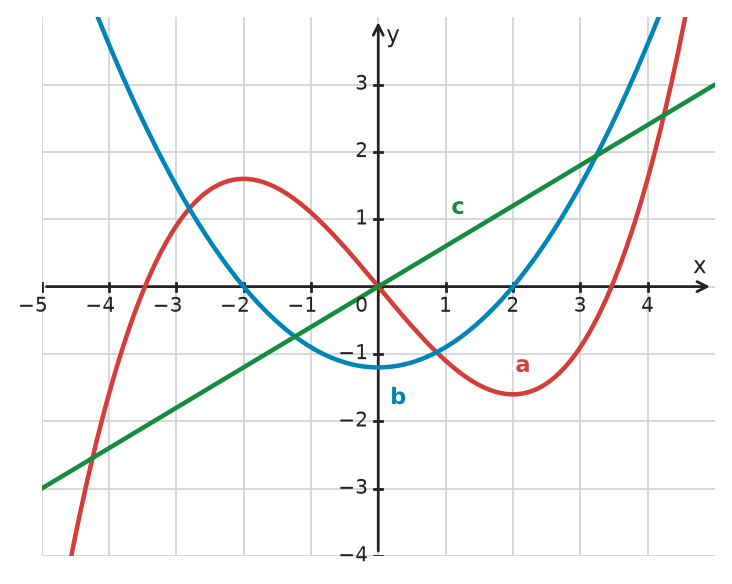
Figure for problem 532663

Hints

- Match local extrema of one graph with zeros of another. - Compare increasing and decreasing behavior with the sign of the derivative. - After matching one derivative pair, check whether the remaining graph is the derivative of the middle graph.

Solution

1. Graph \(a\) has a local maximum at \(x = -2\) and a local minimum at \(x = 2\). Graph \(b\) is zero at those same values, is negative between them, and is positive outside them. Therefore, \(b\) is the derivative of \(a\). 2. Graph \(b\) has a local minimum at \(x = 0\). Graph \(c\) is zero at \(x = 0\), is negative for \(x < 0\), and is positive for \(x > 0\). Therefore, \(c\) is the derivative of \(b\). 3. Thus, \(a\) is the original function, \(b\) is its first derivative, and \(c\) is its second derivative.

Answer

Graph \(a\) is the original function, graph \(b\) is the first derivative, and graph \(c\) is the second derivative.

53371012
The figure shows a blue graph and a green graph. One represents a function \(r\), and the other represents its derivative \(s = r'\). a) Identify which graph represents \(r\) and which represents \(s\). Justify your answer using increasing and decreasing behavior. b) Find the slope of \(r\) at \(x = 1\). Explain how to read the value directly from the figure. c) Find \(r''(1)\).
Figure for problem 533710

Hints

- Compare where the blue graph increases or decreases with the sign of the green graph. - The value of the derivative gives the slope of the original function. - The second derivative is the slope of the first derivative graph.

Solution

1. The blue graph increases for \(x < 3\) and decreases for \(x > 3\). The green graph is positive for \(x < 3\), zero at \(x = 3\), and negative for \(x > 3\). Therefore, the blue graph is \(r\), and the green graph is \(s = r'\). 2. The slope of \(r\) at \(x = 1\) is \(r'(1) = s(1) = 2\). 3. The second derivative \(r''(1)\) is the slope of the line \(s\). Using \((0, 3)\) and \((3, 0)\), the slope is \(\frac{0-3}{3-0} = -1\).

Answer

a) The blue graph is \(r\), and the green graph is \(s = r'\). b) \(r'(1) = 2\) c) \(r''(1) = -1\)
53380912
The graph shows the derivative \(f'\) of a function \(f\). Determine whether each statement is true or false, and briefly justify your answer. a) The function \(f\) has a local maximum at \(x = 0\). b) The graph of \(f\) is strictly decreasing on \([0, 2]\). c) \(f''(1) < 0\).
Figure for problem 533809

Hints

- Use the sign change of \(f'\) at \(x = 0\). - A function decreases where its derivative is negative. - The second derivative is the slope of the first derivative graph.

Solution

1. At \(x = 0\), \(f'\) changes from positive to negative, so \(f\) changes from increasing to decreasing and has a local maximum. Statement a) is true. 2. For \(0 < x < 2\), \(f'(x) < 0\), so \(f\) is strictly decreasing on \([0, 2]\). Statement b) is true. 3. The value \(f''(1)\) is the slope of the graph of \(f'\) at \(x = 1\). The derivative graph is decreasing there, so \(f''(1) < 0\). Statement c) is true.

Answer

a) True b) True c) True
52570412
Let \(g\) be three times differentiable. For each function \(f\), find formulas for \(f'(x)\) and \(f''(x)\). a) \(f(x) = \sin(x)g(x)\) b) \(f(x) = g(x)g'(x)\)

Hints

- Use the product rule for the product of a trigonometric function and \(g(x)\). - Recall the derivatives of sine and cosine. - When a factor is already a derivative, such as \(g'(x)\), differentiating raises its order by one. - For the second derivative in b), use the chain rule on \((g'(x))^2\).

Solution

1. For a), apply the product rule: \(f'(x) = \cos(x)g(x) + \sin(x)g'(x)\). 2. Differentiate both terms again: \(f''(x) = -\sin(x)g(x) + \cos(x)g'(x) + \cos(x)g'(x) + \sin(x)g''(x)\) \(= -\sin(x)g(x) + 2\cos(x)g'(x) + \sin(x)g''(x)\). 3. For b), apply the product rule: \(f'(x) = (g'(x))^2 + g(x)g''(x)\). 4. Differentiate again. By the chain rule, \(\frac{d}{dx}[(g'(x))^2] = 2g'(x)g''(x)\), and by the product rule, \(\frac{d}{dx}[g(x)g''(x)] = g'(x)g''(x) + g(x)g'''(x)\). Therefore, \(f''(x) = 3g'(x)g''(x) + g(x)g'''(x)\).

Answer

a) \(f'(x) = \cos(x)g(x) + \sin(x)g'(x)\) and \(f''(x) = -\sin(x)g(x) + 2\cos(x)g'(x) + \sin(x)g''(x)\) b) \(f'(x) = (g'(x))^2 + g(x)g''(x)\) and \(f''(x) = 3g'(x)g''(x) + g(x)g'''(x)\)
52573912
Suppose \(f(x) = u(x)v(x)w(x)\), where \(u\), \(v\), and \(w\) are twice differentiable. a) Apply the product rule twice to derive a general formula for \(f''(x)\) in terms of \(u\), \(v\), \(w\), and their derivatives. b) Use your formula from part a) to find \(f''(x)\) for \(f(x) = x^2e^x\sin(x)\).

Hints

- For three factors, differentiate one factor at a time while leaving the other two unchanged. - Differentiate each term of the first derivative separately to obtain the second derivative. - In part b), factor out the common term \(e^x\) before combining like trigonometric terms.

Solution

1. First differentiate the product of three functions: \(f'(x) = u'vw + uv'w + uvw'\). 2. Differentiate each term: \((u'vw)' = u''vw + u'v'w + u'vw'\), \((uv'w)' = u'v'w + uv''w + uv'w'\), \((uvw')' = u'vw' + uv'w' + uvw''\). 3. Combine like terms: \(f'' = u''vw + uv''w + uvw'' + 2(u'v'w + u'vw' + uv'w')\). 4. For \(u=x^2\), \(v=e^x\), and \(w=\sin(x)\), \(u'=2x\), \(u''=2\), \(v'=v''=e^x\), \(w'=\cos(x)\), and \(w''=-\sin(x)\). 5. Substitute into the formula: \(f''(x) = 2e^x\sin(x) + x^2e^x\sin(x) - x^2e^x\sin(x)\) \(+ 2[2xe^x\sin(x) + 2xe^x\cos(x) + x^2e^x\cos(x)]\). 6. Factor and combine terms: \(f''(x) = e^x[(2+4x)\sin(x) + (4x+2x^2)\cos(x)]\).

Answer

a) \(f'' = u''vw + uv''w + uvw'' + 2(u'v'w + u'vw' + uv'w')\) b) \(f''(x) = e^x[(2+4x)\sin(x) + (4x+2x^2)\cos(x)]\)
52589612
Let \(g_k(x)=(1-kx)^{12}\), where \(k\in\mathbb{R}\setminus\{0\}\). Find \(g_k''(x)\) and \(g_k^{(12)}(x)\).

Hints

- Apply the chain rule and include the derivative of \(1-kx\). - Track how the exponent changes after each derivative. - What happens when a degree-12 polynomial is differentiated 12 times? - Count how many factors of \(-k\) appear.

Solution

1. Apply the chain rule: \(g_k'(x)=12(1-kx)^{11}(-k)=-12k(1-kx)^{11}\). 2. Differentiate again: \(g_k''(x)=-12k\cdot 11(1-kx)^{10}(-k)\) \(=132k^2(1-kx)^{10}\). 3. Each derivative lowers the exponent by \(1\), multiplies by the current exponent, and contributes another factor of \(-k\). Therefore, \(g_k^{(12)}(x)=12!(-k)^{12}\). Since \(12\) is even and \(12!=479{,}001{,}600\), \(g_k^{(12)}(x)=479{,}001{,}600k^{12}\).

Answer

\(g_k''(x)=132k^2(1-kx)^{10}\) \(g_k^{(12)}(x)=479{,}001{,}600k^{12}\)
52623212
Let \(g(x)=(2x-1)e^x\). Differentiate several times to identify a pattern, then use the pattern to find \(g^{(100)}(x)\).

Hints

- Use the product rule for the first few derivatives. - Compare the linear factor in each result. - Identify what stays fixed and what changes with the derivative order. - Write a formula in terms of \(n\) before substituting \(100\).

Solution

1. Apply the product rule repeatedly: \(g'(x)=2e^x+(2x-1)e^x=(2x+1)e^x\), \(g''(x)=2e^x+(2x+1)e^x=(2x+3)e^x\), \(g'''(x)=2e^x+(2x+3)e^x=(2x+5)e^x\). 2. Each derivative increases the constant in the linear factor by \(2\). The pattern is \(g^{(n)}(x)=(2x+2n-1)e^x\). 3. Substitute \(n=100\): \(g^{(100)}(x)=(2x+200-1)e^x=(2x+199)e^x\).

Answer

\(g^{(100)}(x)=(2x+199)e^x\)
52743012
Let \(g(x)=2-\frac{3}{(x-4)^2}\), with domain \(\mathbb{R}\setminus\{4\}\). 1. Determine the intervals on which \(g\) is strictly increasing and strictly decreasing. 2. Determine the concavity of the graph. 3. Show that \(x=4\) is a vertical asymptote of every derivative \(g^{(n)}\) for each positive integer \(n\).

Hints

- Rewrite the rational term using a negative exponent. - Analyze signs separately on the two sides of the excluded value. - Track how the exponent changes with each derivative. - A vertical asymptote occurs when function magnitude grows without bound near a point.

Solution

1. The first derivative is \(g'(x)=\frac{6}{(x-4)^3}\). It is negative for \(x<4\) and positive for \(x>4\). Thus \(g\) is strictly decreasing on \((-\infty,4)\) and strictly increasing on \((4,\infty)\). 2. The second derivative is \(g''(x)=\frac{-18}{(x-4)^4}<0\) throughout the domain. Therefore, the graph is concave down on \((-\infty,4)\) and \((4,\infty)\). 3. Repeated differentiation gives \(g^{(n)}(x)=a_n(x-4)^{-(n+2)}=\frac{a_n}{(x-4)^{n+2}}\), where \(a_n\neq0\). As \(x\to4\), the denominator approaches \(0\) while the numerator remains nonzero, so \(|g^{(n)}(x)|\to\infty\). Therefore, \(x=4\) is a vertical asymptote of every positive-order derivative.

Answer

1. Strictly decreasing on \((-\infty,4)\); strictly increasing on \((4,\infty)\). 2. Concave down on \((-\infty,4)\) and \((4,\infty)\). 3. For every positive integer \(n\), \(g^{(n)}(x)=\frac{a_n}{(x-4)^{n+2}\!}\) with \(a_n\neq0\), so \(x=4\) is a vertical asymptote.
52744012
Evaluate whether each statement about derivatives of rational functions is always true. Sarah: “If a rational function has a vertical asymptote where its graph changes sign, then its derivative always has a vertical asymptote at the same location where the derivative does not change sign.” Leo: “If the derivative does not change sign across a vertical asymptote, then the original function cannot change sign across that asymptote.”

Hints

- A graph changes sign across a vertical asymptote exactly when the asymptote has odd order. - How does differentiating a negative power change its exponent? - Test the claims with simple examples such as \(f(x)=\frac{1}{x}\) and \(f(x)=\frac{1}{x^2}\).

Solution

1. Suppose \(f\) has a vertical asymptote of order \(k\) at \(x=x_0\). Its leading local behavior is proportional to \((x-x_0)^{-k}\), so the leading behavior of \(f'\) is proportional to \(-k(x-x_0)^{-(k+1)}\). Thus, differentiation increases the order by \(1\). 2. Sarah’s statement: If \(f\) changes sign across the asymptote, then \(k\) is odd. Therefore, \(k+1\) is even, so \(f'\) does not change sign across the asymptote. Sarah’s statement is true. 3. Leo’s statement: If \(f'\) does not change sign across the asymptote, then its order \(k+1\) is even. Hence, \(k\) is odd, which means \(f\) does change sign across the asymptote. Leo’s statement is false.

Answer

Sarah’s statement is true: an odd-order vertical asymptote of \(f\) becomes an even-order vertical asymptote of \(f'\). Leo’s statement is false: an even-order vertical asymptote of \(f'\) corresponds to an odd-order vertical asymptote of \(f\), so the original function does change sign across it.
52753812
Consider the family of functions \(g_a(x)=\sqrt{2x^2+a}\), where \(a>0\). a) Show that \(g_a''(x)=\frac{2a}{(2x^2+a)^{3/2}}\). b) Find all values of \(a\) for which \(g_a''(1)=0.5\). c) For \(a=1\), find the tangent line at \(x=2\).

Hints

- Differentiate in stages and combine terms over a common denominator. - Squaring can remove the power \(3/2\), but verify all resulting positive solutions. - Use the function value and derivative value to write the tangent equation.

Solution

1. Differentiate: \(g_a'(x)=\frac{2x}{\sqrt{2x^2+a}}\). 2. Differentiate again and simplify: \(g_a''(x)=\frac{2a}{(2x^2+a)^{3/2}}\). 3. Set \(\frac{2a}{(a+2)^{3/2}}=\frac{1}{2}\). Squaring the positive quantities gives \(16a^2=(a+2)^3\). 4. Rearranging and factoring gives \((a-2)(a^2-8a-4)=0\). The positive solutions are \(a=2\) and \(a=4+2\sqrt{5}\). 5. For \(a=1\), \(g_1(2)=3\) and \(g_1'(2)=\frac{4}{3}\). 6. The tangent line is \(y-3=\frac{4}{3}(x-2)\), or \(y=\frac{4}{3}x+\frac{1}{3}\).

Answer

a) \(g_a''(x)=\frac{2a}{(2x^2+a)^{3/2}}\) b) \(a=2\) or \(a=4+2\sqrt{5}\) c) \(y=\frac{4}{3}x+\frac{1}{3}\)
53007612
Let \(f(x)=\frac{\sin x-\cos x}{\sin x+\cos x}\). On the interval \([0, 2\pi]\): 1. Determine the domain of \(f\). 2. Find \(f'(x)\) and \(f''(x)\). Use trigonometric identities to write the derivatives in compact form.

Hints

- Find where the original denominator equals zero. - After applying the quotient rule, use \(\sin^2x+\cos^2x=1\). - Rewrite \((\sin x+\cos x)^2\) using a double-angle identity. - Differentiate the compact first-derivative form using the chain rule.

Solution

1. The denominator is zero when \(\sin x+\cos x=0\). On \([0, 2\pi]\), this occurs at \(x=\frac{3\pi}{4}\) and \(x=\frac{7\pi}{4}\). Therefore, \(D_f=[0, 2\pi]\setminus\left\{\frac{3\pi}{4},\frac{7\pi}{4}\right\}\). 2. Apply the quotient rule: \(f'(x)=\frac{(\cos x+\sin x)(\sin x+\cos x)-(\sin x-\cos x)(\cos x-\sin x)}{(\sin x+\cos x)^2}\). The numerator simplifies to \((\sin x+\cos x)^2+(\sin x-\cos x)^2=2\). Also, \((\sin x+\cos x)^2=1+\sin(2x)\). Hence, \(f'(x)=\frac{2}{1+\sin(2x)}\). 3. Differentiate using the chain rule: \(f''(x)=-2(1+\sin(2x))^{-2}\cdot 2\cos(2x)\) \(=\frac{-4\cos(2x)}{(1+\sin(2x))^2}\).

Answer

1. \(D_f=[0, 2\pi]\setminus\left\{\frac{3\pi}{4},\frac{7\pi}{4}\right\}\) 2. \(f'(x)=\frac{2}{1+\sin(2x)}\) \(f''(x)=\frac{-4\cos(2x)}{(1+\sin(2x))^2}\)
53024212
For \(k\in\mathbb R\setminus\{0\}\), let \(g_k(x)=(kx+1)e^x\). a) Find the coordinates and classification of the local extremum \(E_k\) in terms of \(k\). b) Show that all the extrema lie on the curve \(y=\frac{e^x}{x+1}\). c) Find a formula for the nth derivative \(g_k^{(n)}(x)\), and justify it.

Hints

- Differentiate once and solve the critical-point equation. - Eliminate \(k\) from the coordinates of the extremum. - Compute the first few derivatives and look for a pattern. - Use mathematical induction to justify the nth-derivative formula.

Solution

1. Differentiate: \(g_k'(x)=(kx+k+1)e^x\). The critical number satisfies \(kx+k+1=0\), so \(x=-1-\frac1k\). At this x-coordinate, \(y=-ke^{-1-1/k}\). Also, \(g_k''\left(-1-\frac1k\right)=ke^{-1-1/k}\). Therefore, the point is a local minimum when \(k>0\) and a local maximum when \(k<0\). 2. From \(x=-1-\frac1k\), solve for the parameter: \(k=-\frac1{x+1}\). Since the extremum value can be written as \(y=-ke^x\), substitution gives \(y=\frac{e^x}{x+1}\), with \(x\ne-1\). 3. For every integer \(n\ge0\), \(g_k^{(n)}(x)=(kx+nk+1)e^x\). The formula is true for \(n=0\). If it is true for some \(n\), then the product rule gives \(g_k^{(n+1)}(x)=\left(k+kx+nk+1\right)e^x=(kx+(n+1)k+1)e^x\). Therefore, the formula follows by induction.

Answer

a) \(E_k=\left(-1-\frac1k, -ke^{-1-1/k}\right)\). It is a local minimum for \(k>0\) and a local maximum for \(k<0\). b) \(y=\frac{e^x}{x+1}\), with \(x\ne-1\) c) \(g_k^{(n)}(x)=(kx+nk+1)e^x\), for integers \(n\ge0\).
53027412
For \(a>0\), let \(g_a(x)=\frac{a}{x^2+a}\). 1) Verify that \(g_a''(x)=\frac{6ax^2-2a^2}{(x^2+a)^3}\). 2) Find the value of \(a\) for which the equation \(g_a(x)=g_a''(x)\) has exactly two real solutions. 3) Find all values of \(a>0\) for which \(g_a(x)\ge g_a''(x)\) for every real \(x\).

Hints

- Differentiate using the product and chain rules, or rewrite the function with a negative exponent. - Substitute \(z=x^2\) after setting the function equal to its second derivative. - Relate positive solutions in \(z\) to pairs of real solutions in \(x\). - Use the discriminant and the signs of the roots of the quadratic in \(z\).

Solution

1. Differentiate twice: \(g_a'(x)=-2ax(x^2+a)^{-2}\), so \(g_a''(x)=-2a(x^2+a)^{-2}+8ax^2(x^2+a)^{-3}\) \(=\frac{6ax^2-2a^2}{(x^2+a)^3}\). 2. Because \(a>0\), the denominators are positive. Setting \(g_a(x)=g_a''(x)\) and simplifying gives \((x^2+a)^2=6x^2-2a\). Let \(z=x^2\), where \(z\ge0\). Then \(z^2+(2a-6)z+a^2+2a=0\). Its discriminant is \(\Delta=(2a-6)^2-4(a^2+2a)=36-32a\). If \(0<a<\frac98\), the quadratic has two distinct roots. Their product is \(a^2+2a>0\), and their sum is \(6-2a>0\), so both roots are positive. This gives four real values of \(x\). If \(a=\frac98\), the quadratic has the repeated positive root \(z=3-a=\frac{15}{8}\), which gives exactly two real solutions, \(x=\pm\sqrt{\frac{15}{8}}\). If \(a>\frac98\), there are no real roots in \(z\). Therefore, the required value is \(a=\frac98\). 3. The inequality is equivalent to \(q_a(z)=z^2+(2a-6)z+a^2+2a\ge0\) for every \(z\ge0\). If \(a\ge\frac98\), then \(\Delta\le0\), and the upward-opening quadratic is nonnegative for all real \(z\). If \(0<a<\frac98\), it has two positive roots and is negative between them. Therefore, \(a\ge\frac98\).

Answer

1) \(g_a''(x)=\frac{6ax^2-2a^2}{(x^2+a)^3}\) 2) \(a=\frac98\) 3) \(a\ge\frac98\)

All problems may be used, copied and printed free of charge for school and tutoring, including paid tutoring. Commercial adaptations as well as publication or redistribution on the internet are not permitted.