Let \(f\) be a cubic polynomial.
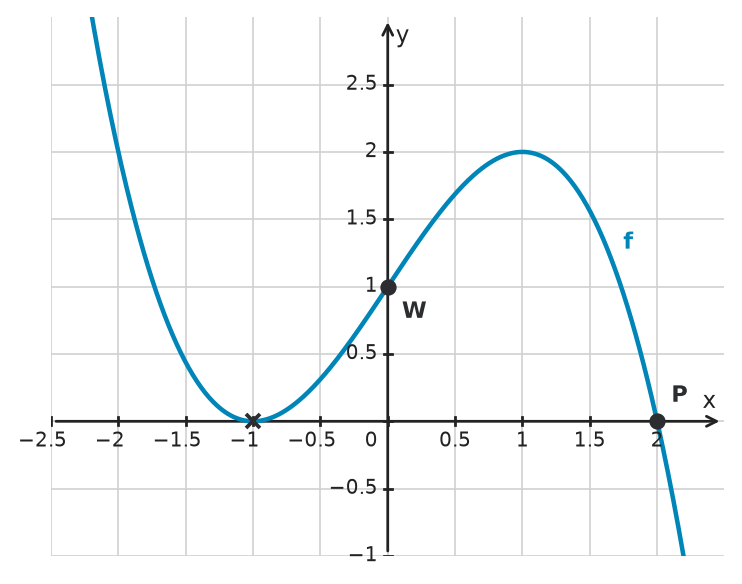
a) The graph has an inflection point at \(W(0, 1)\), a local extremum at \(x=-1\), and passes through \(P(2, 0)\). Find an equation for \(f\).
b) Determine whether the extremum at \(x=-1\) is a local maximum or a local minimum.
c) A student claims, “If a cubic polynomial has an inflection point at \(W(0, 1)\) and a local minimum at \(x=-1\), then its graph cannot pass through \(Q(2, 3)\).” Determine whether the claim is true and justify your answer.
Hints
- Use both coordinates of the inflection point to obtain conditions on the polynomial.
- A local extremum occurs where the first derivative is \(0\).
- Use the second derivative to classify the extremum.
- For part c, keep the leading coefficient as a parameter and determine what passing through \(Q\) would require.
Solution
1. Write \(f(x)=ax^3+bx^2+cx+d\).
2. Since \(W(0, 1)\) is an inflection point, \(f(0)=1\) and \(f''(0)=0\). Because \(f''(x)=6ax+2b\), these conditions give \(d=1\) and \(b=0\).
3. A local extremum at \(x=-1\) requires \(f'(-1)=0\). Since \(f'(x)=3ax^2+c\), \(3a+c=0\), so \(c=-3a\).
4. Using \(P(2, 0)\), \(0=f(2)=8a-6a+1=2a+1\). Thus, \(a=-\frac{1}{2}\) and \(c=\frac{3}{2}\). Therefore, \(f(x)=-\frac{1}{2}x^3+\frac{3}{2}x+1\).
5. Here \(f''(x)=-3x\), so \(f''(-1)=3>0\). The extremum is a local minimum.
6. For a cubic satisfying the conditions at \(W\) and having an extremum at \(x=-1\), the form is \(f(x)=ax^3-3ax+1\). Passing through \(Q(2, 3)\) would require \(3=2a+1\), so \(a=1\). Then \(f''(-1)=-6<0\), making the extremum a local maximum, not a local minimum. The claim is true.
Answer
a) \(f(x)=-\frac{1}{2}x^3+\frac{3}{2}x+1\)
b) The extremum is a local minimum because \(f''(-1)=3>0\).
c) The claim is true. Passing through \(Q(2, 3)\) would force \(a=1\), which gives \(f''(-1)=-6<0\) and therefore a local maximum at \(x=-1\).