Aimathic
Login | English | Deutsch

Free Math Worksheets

Build your own math worksheets from 21,000 problems for grades 3 to 12, from fractions to calculus. Every problem includes step-by-step solutions.

Fundamental theorem of calculus

Click problems to add them to your worksheet.

52458512
Evaluate each definite integral. a) \(\int_{-2}^{4}(x+1)\,dx\) b) \(\int_{0}^{5}(2-0.8t)\,dt\) c) \(\int_{4}^{1}(1.5u-3)\,du\)

Hints

- Find an antiderivative of each integrand. - Substitute the upper and lower limits carefully. - Pay special attention when the upper limit is less than the lower limit. - Integrate each term separately.

Solution

1. For a), an antiderivative is \(F(x)=\frac{1}{2}x^2+x\). Thus, \(F(4)-F(-2)=12-0=12\). 2. For b), an antiderivative is \(F(t)=2t-0.4t^2\). Thus, \(F(5)-F(0)=10-10=0\). 3. For c), an antiderivative is \(F(u)=0.75u^2-3u\). Thus, \(F(1)-F(4)=-2.25-0=-2.25\).

Answer

a) \(12\) b) \(0\) c) \(-2.25\)
52462912
Evaluate each integral in terms of the real parameter \(a\). a) \(\int_1^2(ax^3-a)\,dx\) b) \(\int_0^1(a+1)x^2\,dx\)

Hints

- Integrate with respect to \(x\), treating \(a\) as a constant. - Use the power rule. - Apply the upper and lower bounds carefully. - Terms containing a factor of \(0\) vanish at the lower bound in b).

Solution

1. For a), an antiderivative is \(F(x)=\frac{ax^4}{4}-ax\). Therefore, \(F(2)-F(1)=2a-\left(-\frac{3a}{4}\right)=\frac{11a}{4}\). 2. For b), an antiderivative is \(G(x)=\frac{a+1}{3}x^3\). Thus, \(G(1)-G(0)=\frac{a+1}{3}\).

Answer

a) \(\frac{11a}{4}\) b) \(\frac{a+1}{3}\)
52463012
Evaluate each integral in terms of the real parameter \(a\). a) \(\int_{-2}^{2}(ax^2+a^3)\,dx\) b) \(\int_1^4\frac{a}{\sqrt{x}}\,dx\)

Hints

- Rewrite the square-root denominator as a negative power. - Treat \(a\) as a constant. - Track signs carefully at the negative lower bound. - Symmetry can also simplify part a).

Solution

1. For a), an antiderivative is \(F(x)=\frac{ax^3}{3}+a^3x\). Evaluating from \(-2\) to \(2\) gives \(\frac{16a}{3}+4a^3\). 2. For b), write the integrand as \(ax^{-1/2}\). An antiderivative is \(G(x)=2a\sqrt{x}\). Therefore, \(G(4)-G(1)=4a-2a=2a\).

Answer

a) \(\frac{16a}{3}+4a^3\) b) \(2a\)
52463512
Use the Fundamental Theorem of Calculus to evaluate \(\int_{1}^{4}\left(\frac{1}{2}x^2-2\right)\,dx\).

Hints

- Apply the power rule to find an antiderivative. - Use upper-limit value minus lower-limit value. - Use parentheses when subtracting a negative value. - A constant factor can remain in front while you integrate.

Solution

1. An antiderivative of \(f(x)=\frac{1}{2}x^2-2\) is \(F(x)=\frac{1}{6}x^3-2x\). 2. Evaluate at the limits: \(F(4)=\frac{64}{6}-8=\frac{8}{3}\) and \(F(1)=\frac{1}{6}-2=-\frac{11}{6}\). 3. Therefore, \(F(4)-F(1)=\frac{8}{3}-\left(-\frac{11}{6}\right)=\frac{27}{6}=\frac{9}{2}=4.5\).

Answer

\(4.5\)
52463612
Use an antiderivative to evaluate \(\int_{-1}^{2}\left(\frac{1}{4}x^3+x\right)\,dx\).

Hints

- Apply the power rule term by term. - Remember how an even power affects a negative input. - Keep the result as a fraction until the final step. - Put the entire lower-limit value in parentheses when subtracting.

Solution

1. An antiderivative is \(F(x)=\frac{1}{16}x^4+\frac{1}{2}x^2\). 2. Evaluate at the limits: \(F(2)=1+2=3\) and \(F(-1)=\frac{1}{16}+\frac{1}{2}=\frac{9}{16}\). 3. Thus, \(F(2)-F(-1)=3-\frac{9}{16}=\frac{39}{16}=2.4375\).

Answer

\(\frac{39}{16}\), or \(2.4375\)
52464912
Let \(k\) be a real parameter. Use the Fundamental Theorem of Calculus to evaluate \(\int_{-1}^{2}(x^3-kx)\,dx\) in terms of \(k\).

Hints

- Treat \(k\) as a constant while integrating. - Use the power rule to find an antiderivative. - Be careful with even powers at the negative lower bound. - Subtract the entire lower-bound expression.

Solution

1. An antiderivative is \(F(x)=\frac{x^4}{4}-\frac{kx^2}{2}\). 2. Evaluate the endpoints: \(F(2)=4-2k\) and \(F(-1)=\frac{1}{4}-\frac{k}{2}\). 3. Subtract: \(F(2)-F(-1)=\frac{15}{4}-\frac{3k}{2}\).

Answer

\(\frac{15}{4}-\frac{3k}{2}\)
52465012
Let \(f(x)=ax^2+\frac{1}{x^2}\), where \(a\) is real. Evaluate \(\int_1^3 f(x)\,dx\) in terms of \(a\).

Hints

- Rewrite the reciprocal-square term using a negative exponent. - Treat \(a\) as a constant. - Find an antiderivative before applying the bounds. - Subtract the entire lower-bound expression.

Solution

1. Rewrite \(\frac{1}{x^2}\) as \(x^{-2}\). An antiderivative is \(F(x)=\frac{ax^3}{3}-\frac{1}{x}\). 2. Evaluate: \(F(3)=9a-\frac{1}{3}\) and \(F(1)=\frac{a}{3}-1\). 3. Subtract: \(F(3)-F(1)=\frac{26a}{3}+\frac{2}{3}\).

Answer

\(\frac{26a}{3}+\frac{2}{3}\)
52466212
Evaluate \(\int_{3}^{0}(4x^3-6x^2+2x-5)\,dx\).

Hints

- Pay attention to the order of the limits. - Integrate the polynomial term by term. - Check the value of the antiderivative at \(x=3\) carefully.

Solution

1. An antiderivative is \(F(x)=x^4-2x^3+x^2-5x\). 2. The endpoint values are \(F(0)=0\) and \(F(3)=81-54+9-15=21\). 3. Because the integral runs from \(3\) to \(0\), \(F(0)-F(3)=0-21=-21\).

Answer

\(-21\)
52467112
Let \(f\) be continuous and let \(F\) be an antiderivative of \(f\). Use the Fundamental Theorem of Calculus to justify why reversing the limits changes the sign of a definite integral: \(\int_a^b f(x) \, dx=-\int_b^a f(x) \, dx\).

Hints

- How do you evaluate a definite integral when an antiderivative is known? - Write each integral separately using \(F\). - Pay attention to the order of the limits when substituting into \(F\). - What happens to every sign inside brackets preceded by a minus sign?

Solution

1. By the Fundamental Theorem of Calculus, \(\int_a^b f(x)\,dx=F(b)-F(a)\). 2. Reversing the limits gives \(\int_b^a f(x)\,dx=F(a)-F(b)\). 3. Therefore, \(-\int_b^a f(x)\,dx=-[F(a)-F(b)]=F(b)-F(a)\), which equals \(\int_a^b f(x)\,dx\).

Answer

The Fundamental Theorem of Calculus gives \(\int_a^b f(x)\,dx=F(b)-F(a)\) and \(-\int_b^a f(x)\,dx=-[F(a)-F(b)]=F(b)-F(a)\). Thus the two expressions are equal.
52472012
Evaluate \(\int_{0}^{\frac{\pi}{2}}(3\sin(x)-2\cos(x))\,dx\).

Hints

- Recall which antiderivatives produce sine and cosine, including their signs. - Use the exact trigonometric values at \(0\) and \(\frac{\pi}{2}\). - Apply upper-limit value minus lower-limit value.

Solution

1. An antiderivative is \(F(x)=-3\cos(x)-2\sin(x)\). 2. At the upper limit, \(F\left(\frac{\pi}{2}\right)=-3\cdot0-2\cdot1=-2\). 3. At the lower limit, \(F(0)=-3\cdot1-2\cdot0=-3\). 4. Therefore, \(F\left(\frac{\pi}{2}\right)-F(0)=-2-(-3)=1\).

Answer

\(1\)
52473312
Find the real value of \(a\) that satisfies \(\int_0^\pi a\sin(0.5x)\,dx=10\).

Hints

- Account for the inner factor when integrating the sine function. - Use the exact cosine values at \(0\) and \(\frac{\pi}{2}\). - Form a linear equation in \(a\). - Solve after evaluating the integral.

Solution

1. An antiderivative is \(F(x)=-2a\cos(0.5x)\). 2. Apply the bounds: \([-2a\cos(0.5x)]_0^\pi=-2a\cos\left(\frac{\pi}{2}\right)+2a\cos(0)=2a\). 3. Solve \(2a=10\), giving \(a=5\).

Answer

\(a=5\)
52473412
Let \(f_k(x)=\frac{k}{x+2}\) for \(x\ge 0\). Find \(k\) so that \(\int_0^2 f_k(x)\,dx=\ln(16)\).

Hints

- Use the logarithmic antiderivative for \(\frac{1}{x+2}\). - Combine the difference of logarithms. - Rewrite \(16\) as a power of \(2\). - Compare the coefficients of \(\ln(2)\).

Solution

1. An antiderivative is \(F_k(x)=k\ln(x+2)\). 2. Apply the bounds: \(\int_0^2\frac{k}{x+2}\,dx=k(\ln(4)-\ln(2))=k\ln(2)\). 3. Since \(\ln(16)=\ln(2^4)=4\ln(2)\), \(k\ln(2)=4\ln(2)\), so \(k=4\).

Answer

\(k=4\)
52517912
Consider the family of cumulative distribution functions \(\Phi_{\mu,\sigma}\) for normal distributions. 1. Describe how the graph changes when \(\mu\) increases while \(\sigma\) remains constant. 2. Explain how increasing \(\sigma\) affects the maximum slope of the graph at \(x=\mu\). 3. For fixed \(\mu\), give the coordinates of the point where every graph in the family has the same function value, regardless of \(\sigma\).

Hints

- How does changing the value subtracted from \(x\) affect a graph horizontally? - The derivative of a cumulative distribution function is its density. - What cumulative probability lies at the mean of a symmetric normal distribution? - Use the symmetry of the normal curve.

Solution

1. Increasing \(\mu\) shifts the entire cumulative distribution graph to the right without changing its shape. 2. The derivative of the cumulative distribution function is the normal density. At \(x=\mu\), the slope is \(\frac{1}{\sigma\sqrt{2\pi}}\). Therefore, increasing \(\sigma\) decreases the maximum slope and makes the center of the graph less steep. 3. By symmetry, \(\Phi_{\mu,\sigma}(\mu)=0.5\) for every \(\sigma>0\). Thus, all graphs with fixed \(\mu\) pass through \((\mu, 0.5)\).

Answer

1. The graph shifts to the right. 2. The maximum slope decreases as \(\sigma\) increases. 3. \((\mu, 0.5)\)
52956712
Evaluate \(\int_{-1}^{2}(6x^2-2x+1)\,dx\). Show how you find an antiderivative and apply the Fundamental Theorem of Calculus.

Hints

- Apply the power rule to each term. - Use the Fundamental Theorem of Calculus to connect the antiderivative and the definite integral. - Use parentheses and check signs carefully when substituting the negative lower limit.

Solution

1. Using the power, sum, and constant multiple rules, an antiderivative is \(F(x)=2x^3-x^2+x\). 2. Evaluate the endpoint values: \(F(2)=16-4+2=14\) and \(F(-1)=-2-1-1=-4\). 3. Therefore, \(F(2)-F(-1)=14-(-4)=18\).

Answer

\(18\)
52956812
Evaluate \(\int_{0}^{4}\left(\frac{1}{8}x^3+\frac{3}{2}x^2-4\right)\,dx\). State the integration rules you use to find an antiderivative.

Hints

- Integrate the sum term by term. - Keep each constant multiple when applying the power rule. - Differentiate your antiderivative mentally to check that it gives the original integrand.

Solution

1. Using the power, sum, and constant multiple rules, an antiderivative is \(F(x)=\frac{1}{32}x^4+\frac{1}{2}x^3-4x\). 2. Evaluate: \(F(4)=8+32-16=24\) and \(F(0)=0\). 3. Therefore, \(F(4)-F(0)=24\).

Answer

\(24\). The antiderivative uses the power rule, constant multiple rule, and sum rule.
52956912
The variable of integration does not have to be \(x\). Evaluate \(\int_{1}^{2}(6u^2-4u+3)\,du\), and name the integration rules you use.

Hints

- Identify the variable named in the differential. - Integrate the polynomial term by term. - Evaluate the antiderivative at both limits. - Use the Fundamental Theorem of Calculus to subtract the endpoint values.

Solution

1. Using the power, constant multiple, and sum rules, an antiderivative is \(F(u)=2u^3-2u^2+3u\). 2. Evaluate: \(F(2)=16-8+6=14\) and \(F(1)=2-2+3=3\). 3. By the Fundamental Theorem of Calculus, \(F(2)-F(1)=14-3=11\).

Answer

The integral is \(11\). The rules used are the power rule, constant multiple rule, sum rule, and the Fundamental Theorem of Calculus.
52957012
Evaluate \(\int_{-1}^{2}(v^3-v)\,dv\), state the rules you use, and pay close attention to the signs at the limits.

Hints

- Use parentheses when substituting the negative lower limit. - Apply the power rule to each term. - Use the difference rule for the two terms. - Subtract the lower-limit value from the upper-limit value.

Solution

1. Using the power and difference rules, an antiderivative is \(F(v)=\frac{1}{4}v^4-\frac{1}{2}v^2\). 2. Evaluate: \(F(2)=4-2=2\) and \(F(-1)=\frac{1}{4}-\frac{1}{2}=-\frac{1}{4}\). 3. By the Fundamental Theorem of Calculus, \(F(2)-F(-1)=2-\left(-\frac{1}{4}\right)=\frac{9}{4}\).

Answer

The integral is \(\frac{9}{4}\), or \(2.25\). The rules used are the power rule, difference rule, and the Fundamental Theorem of Calculus.
52957112
Use the Fundamental Theorem of Calculus to evaluate \(\int_{0}^{4}(3t^2-2t)\,dt\).

Hints

- Use the power rule to find an antiderivative. - Substitute the upper limit first. - Evaluate the lower-limit value and subtract it.

Solution

1. An antiderivative is \(F(t)=t^3-t^2\). 2. Evaluate: \(F(4)=64-16=48\) and \(F(0)=0\). 3. Therefore, \(F(4)-F(0)=48\).

Answer

\(48\)
52957212
Evaluate \(\int_{-1}^{2}\left(\frac{1}{2}x^3-3x+1\right)\,dx\).

Hints

- Integrate the polynomial term by term. - Use parentheses when substituting the negative lower limit. - Recall that an even power of a negative number is positive. - Keep exact fractions until the final step.

Solution

1. An antiderivative is \(F(x)=\frac{1}{8}x^4-\frac{3}{2}x^2+x\). 2. Evaluate at the upper limit: \(F(2)=2-6+2=-2\). 3. Evaluate at the lower limit: \(F(-1)=\frac{1}{8}-\frac{3}{2}-1=-\frac{19}{8}\). 4. Therefore, \(F(2)-F(-1)=-2+\frac{19}{8}=\frac{3}{8}\).

Answer

\(\frac{3}{8}\), or \(0.375\)
52958112
Find the real value of \(k\) that satisfies \(\int_0^\pi(k\sin(x)+x)\,dx=\frac{\pi^2}{2}+4\).

Hints

- Treat \(k\) as a constant while integrating. - Use the exact cosine values at \(0\) and \(\pi\). - Set the evaluated integral equal to the given expression. - Solve the resulting linear equation.

Solution

1. An antiderivative is \(F(x)=-k\cos(x)+\frac{x^2}{2}\). 2. Apply the bounds: \(F(\pi)-F(0)=2k+\frac{\pi^2}{2}\). 3. Set this equal to the given value: \(2k+\frac{\pi^2}{2}=\frac{\pi^2}{2}+4\). Thus, \(2k=4\) and \(k=2\).

Answer

\(k=2\)
52968712
Evaluate \(\int_{0}^{\frac{\pi}{2}}(3\cos(x)-2x)\,dx\).

Hints

- Recall the antiderivative of cosine and use the power rule for \(x\). - Use radians for the trigonometric limit. - Subtract the lower-limit value from the upper-limit value.

Solution

1. An antiderivative is \(F(x)=3\sin(x)-x^2\). 2. At the upper limit, \(F\left(\frac{\pi}{2}\right)=3-\frac{\pi^2}{4}\). 3. Since \(F(0)=0\), the integral is \(3-\frac{\pi^2}{4}\).

Answer

\(3-\frac{\pi^2}{4}\)
52968812
Let \(f(x)=k\sin(x)-1\), where \(k\) is real. Find \(k\) so that \(\int_0^\pi f(x)\,dx=0\).

Hints

- Treat \(k\) as a constant. - Be careful with the sign when integrating sine. - Use the cosine values at \(0\) and \(\pi\). - Set the evaluated integral equal to \(0\).

Solution

1. An antiderivative is \(F(x)=-k\cos(x)-x\). 2. Apply the bounds: \(F(\pi)-F(0)=2k-\pi\). 3. Set the integral equal to \(0\): \(2k-\pi=0\), so \(k=\frac{\pi}{2}\).

Answer

\(k=\frac{\pi}{2}\)
52969112
Use the Fundamental Theorem of Calculus to evaluate each integral. a) \(\int_{0}^{3}(x^2-2)\,dx\) b) \(\int_{1}^{4}\frac{1}{\sqrt{x}}\,dx\) c) \(\int_{-2}^{2}x^3\,dx\)

Hints

- Apply the power rule to find antiderivatives. - Integrate sums and differences term by term. - Rewrite the radical as a rational power. - For part c), consider the symmetry of an odd function on a symmetric interval.

Solution

1. For a), an antiderivative is \(F(x)=\frac{1}{3}x^3-2x\). Thus, \(F(3)-F(0)=3\). 2. For b), rewrite the integrand as \(x^{-1/2}\). An antiderivative is \(F(x)=2\sqrt{x}\). Thus, \(F(4)-F(1)=4-2=2\). 3. For c), an antiderivative is \(F(x)=\frac{1}{4}x^4\). Thus, \(F(2)-F(-2)=4-4=0\).

Answer

a) \(3\) b) \(2\) c) \(0\)
52979712
Use the Fundamental Theorem of Calculus to evaluate \(\int_{-1}^{2}(4x^3-6x^2+2)\,dx\).

Hints

- Use the relationship between a definite integral and an antiderivative. - Apply the power rule term by term. - Use parentheses when substituting the negative lower limit. - Interpret \([F(x)]_a^b\) as \(F(b)-F(a)\).

Solution

1. An antiderivative is \(F(x)=x^4-2x^3+2x\). 2. Evaluate: \(F(2)=16-16+4=4\), and \(F(-1)=1+2-2=1\). 3. Therefore, \(F(2)-F(-1)=4-1=3\).

Answer

\(3\)
52980512
Use an appropriate antiderivative to evaluate \(\int_{1}^{3}(3x^2-4x+1)\,dx\).

Hints

- Apply the power rule to each polynomial term. - Evaluate the antiderivative at both limits. - Subtract the lower-limit value from the upper-limit value.

Solution

1. An antiderivative is \(F(x)=x^3-2x^2+x\). 2. Evaluate: \(F(3)=27-18+3=12\), and \(F(1)=1-2+1=0\). 3. Therefore, \(F(3)-F(1)=12\).

Answer

\(12\)
52980712
Let \(f(x)=x^2-a\). Find the real value of \(a\) so that \(\int_1^3f(x)\,dx=\frac{2}{3}\).

Hints

- Treat \(a\) as a constant while integrating. - Apply upper bound minus lower bound. - Form an equation in \(a\). - Solve the linear equation.

Solution

1. An antiderivative is \(F(x)=\frac{x^3}{3}-ax\). 2. Apply the bounds: \(F(3)-F(1)=\left(9-3a\right)-\left(\frac{1}{3}-a\right)=\frac{26}{3}-2a\). 3. Set this equal to \(\frac{2}{3}\): \(\frac{26}{3}-2a=\frac{2}{3}\), so \(2a=8\) and \(a=4\).

Answer

\(a=4\)
52980812
A continuous function \(f\) has the antiderivative \(F(x)=(x-2)e^x\). Use the Fundamental Theorem of Calculus directly to evaluate \(\int_{0}^{2}f(x)\,dx\).

Hints

- Use the Fundamental Theorem of Calculus with the given antiderivative. - You do not need to find an explicit formula for \(f\). - Recall that \(e^0=1\), and check the sign of the lower-limit value.

Solution

1. Since \(F\) is already given as an antiderivative, \(\int_{0}^{2}f(x)\,dx=F(2)-F(0)\). 2. Evaluate: \(F(2)=(2-2)e^2=0\), and \(F(0)=(0-2)e^0=-2\). 3. Therefore, \(F(2)-F(0)=0-(-2)=2\).

Answer

\(2\)
52994512
Find the exact value of \(\int_{1}^{e^2}\left(\frac{5}{x}-1\right)\,dx\).

Hints

- Recall which function has derivative \(\frac{1}{x}\). - Find the antiderivative term by term. - Apply the Fundamental Theorem of Calculus. - Simplify \(\ln(e^k)\) using logarithm properties.

Solution

1. On this positive interval, an antiderivative is \(F(x)=5\ln(x)-x\). 2. Evaluate: \(F(e^2)=5\ln(e^2)-e^2=10-e^2\), and \(F(1)=5\ln(1)-1=-1\). 3. Therefore, \(F(e^2)-F(1)=10-e^2-(-1)=11-e^2\).

Answer

\(11-e^2\)
52998712
Find the exact value of \(\int_{0}^{4}\left(\frac{1}{2}e^{0.25x}+2\right)\,dx\).

Hints

- Find an antiderivative for each term. - Account for the coefficient in the exponent when integrating \(e^{kx}\). - Evaluate at the upper and lower limits. - Recall that \(e^0=1\).

Solution

1. An antiderivative is \(F(x)=2e^{0.25x}+2x\), because differentiating \(2e^{0.25x}\) gives \(\frac{1}{2}e^{0.25x}\). 2. Evaluate: \(F(4)=2e+8\), and \(F(0)=2\). 3. Therefore, \(F(4)-F(0)=2e+6\).

Answer

\(2e+6\)
53017712
Use the Fundamental Theorem of Calculus to evaluate exactly: \(\int_0^2\frac{3x}{x^2+1}\,dx\).

Hints

- Compare the numerator with the derivative of the denominator. - Use the logarithmic antiderivative pattern. - Apply the Fundamental Theorem after finding an antiderivative. - Recall that \(\ln(1)=0\).

Solution

1. Since the derivative of \(x^2+1\) is \(2x\), an antiderivative is \(F(x)=\frac{3}{2}\ln(x^2+1)\). 2. Apply the Fundamental Theorem: \(\int_0^2\frac{3x}{x^2+1}\,dx=\left[\frac{3}{2}\ln(x^2+1)\right]_0^2\). 3. Evaluate: \(\frac{3}{2}\ln(5)-\frac{3}{2}\ln(1)=\frac{3}{2}\ln(5)\).

Answer

\(\frac{3}{2}\ln(5)\)
53443212
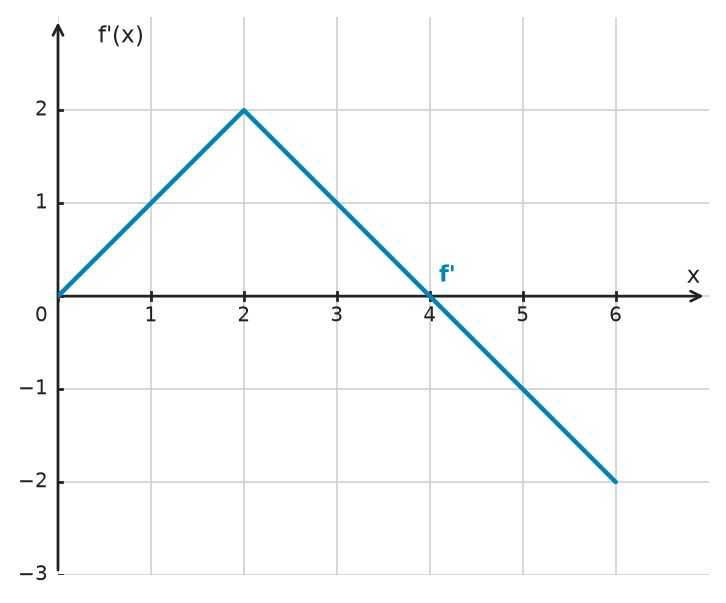
The graph of a linear function \(f\) is shown. Use the relationship between a definite integral and signed area to find \(F(4)-F(1)\) for any antiderivative \(F\) of \(f\).
Figure for problem 534432

Hints

- Use \(F(b)-F(a)=\int_a^b f(x)\,dx\). - Break the region into simple geometric shapes. - Areas below the x-axis count negatively.

Solution

1. By the Fundamental Theorem of Calculus, \(F(4)-F(1)=\int_1^4 f(x)\,dx\). 2. From \(x=1\) to \(x=3\), the graph forms a triangle above the x-axis with base \(2\) and height \(2\), so its area is \(\frac12\cdot2\cdot2=2\). 3. From \(x=3\) to \(x=4\), the graph forms a triangle below the x-axis with base \(1\) and height \(1\), so its signed area is \(-\frac12\). 4. Therefore, \(F(4)-F(1)=2-\frac12=\frac32\).

Answer

\(F(4)-F(1)=\frac32\)
53457412
The graph of \(f\) is shown. For a particular antiderivative \(F\), \(F(0)=1\). Use the graph to decide whether \(F(3)\) is greater than or less than \(1\). Justify your answer.
Figure for problem 534574

Hints

- Use \(F(3)-F(0)=\int_0^3f(x)\,dx\). - Determine the sign of the signed area under \(f\) on \([0,3]\). - Positive values of \(f\) make an antiderivative increase.

Solution

1. By the Fundamental Theorem of Calculus, \(F(3)=F(0)+\int_0^3 f(x)\,dx\). 2. The graph of \(f\) is above the x-axis on \([0,3)\) and equals \(0\) at \(x=3\). Therefore, \(\int_0^3 f(x)\,dx>0\). 3. Thus, \(F(3)=1+\int_0^3 f(x)\,dx>1\).

Answer

\(F(3)>1\)
53464212
Evaluate each definite integral. Use the provided graphs when helpful to interpret the result geometrically. a) \(\int_{-4}^{6}0.5\,dx\) b) \(\int_{0}^{4}(3-x)\,dx\) c) \(\int_{-2}^{3}(2t+1)\,dt\)
Figure for problem 534642

Hints

- Find an antiderivative for each integrand. - Apply \(F(b)-F(a)\). - For linear or constant functions, a geometric interpretation using rectangles, triangles, or trapezoids may help.

Solution

1. For a), an antiderivative is \(F(x)=0.5x\). Thus, \(F(6)-F(-4)=3-(-2)=5\). Geometrically, this is the area of a rectangle with width \(10\) and height \(0.5\). 2. For b), an antiderivative is \(F(x)=3x-\frac{1}{2}x^2\). Thus, \(F(4)-F(0)=12-8=4\). This is a net area because the line crosses the x-axis at \(x=3\). 3. For c), an antiderivative is \(F(t)=t^2+t\). Thus, \(F(3)-F(-2)=12-2=10\).

Answer

a) \(5\) b) \(4\) c) \(10\)
53466312
The graphs of a function \(f\) and one of its antiderivatives \(g\) are shown. Use the graph of \(g\) to find \(\int_0^3f(x)\,dx\).
Figure for problem 534663

Hints

- Use the graph of the antiderivative \(g\), not the graph of \(f\). - Read \(g(3)\) and \(g(0)\). - Apply the Fundamental Theorem of Calculus.

Solution

1. By the Fundamental Theorem of Calculus, \(\int_0^3f(x)\,dx=g(3)-g(0)\). 2. From the graph, \(g(3)=4\) and \(g(0)=1\). 3. Therefore, \(\int_0^3f(x)\,dx=4-1=3\).

Answer

\(3\)
53466712
Use the graph of the antiderivative \(g\) to find \(\int_{-2}^{2}f(x)\,dx\).
Figure for problem 534667

Hints

- Read the values of \(g\) at both integration limits. - Use \(\int_a^bf(x)\,dx=F(b)-F(a)\). - Equal endpoint values give an integral of \(0\).

Solution

1. By the Fundamental Theorem of Calculus, \(\int_{-2}^{2}f(x)\,dx=g(2)-g(-2)\). 2. The graph shows \(g(2)=0\) and \(g(-2)=0\). 3. Therefore, the integral is \(0-0=0\).

Answer

\(0\)
52458612
Let \(f(x)=-\frac{1}{4}x+1\). Evaluate \(I=\int_{0}^{8}f(x)\,dx\). Interpret the result as the net signed area between the graph of \(f\) and the \(x\)-axis on \([0,8]\).

Hints

- First evaluate the integral using an antiderivative. - Find where the graph crosses the \(x\)-axis. - Identify which part of the graph lies above the axis and which part lies below it. - Interpret what an integral value of zero means about the two signed-area contributions.

Solution

1. An antiderivative of \(f(x)=-\frac{1}{4}x+1\) is \(F(x)=-\frac{1}{8}x^2+x\). Therefore, \(I=F(8)-F(0)=\left(-\frac{1}{8}\cdot 64+8\right)-0=-8+8=0\). 2. The graph crosses the \(x\)-axis at \(x=4\). On \([0,4]\), the graph is above the axis and contributes signed area \(\int_{0}^{4}f(x)\,dx=2\). On \([4,8]\), it is below the axis and contributes signed area \(\int_{4}^{8}f(x)\,dx=-2\). These contributions cancel, so the net signed area is \(0\).

Answer

The integral is \(I=0\). The positive area above the \(x\)-axis on \([0,4]\) equals the magnitude of the negative area below the \(x\)-axis on \([4,8]\), so the net signed area is zero.
52460312
Evaluate each definite integral. Briefly interpret the result in part b) as a net area. a) \(\int_{-1}^{2}(x^2-2x-3)\,dx\) b) \(\int_{0}^{4}\left(\frac{1}{2}x^3-4x\right)\,dx\)

Hints

- Use the Fundamental Theorem of Calculus. - Evaluate the antiderivative at the upper limit and subtract its value at the lower limit. - Recall how portions of a graph below the x-axis contribute to a definite integral. - Consider what a net area of zero means.

Solution

1. For a), an antiderivative is \(F(x)=\frac{1}{3}x^3-x^2-3x\). Then \(F(2)=-\frac{22}{3}\) and \(F(-1)=\frac{5}{3}\), so \(F(2)-F(-1)=-\frac{22}{3}-\frac{5}{3}=-9\). 2. For b), an antiderivative is \(G(x)=\frac{1}{8}x^4-2x^2\). Since \(G(4)=0\) and \(G(0)=0\), the integral is \(0\). 3. A net area of \(0\) means that the positive and negative signed areas on \([0,4]\) have equal magnitudes and cancel.

Answer

a) \(-9\) b) \(0\). The signed areas above and below the x-axis on \([0,4]\) cancel.
52460412
Find the real value of \(k\) that satisfies \(\int_1^3(kx+1)\,dx=10\).

Hints

- Treat \(k\) as a constant while integrating. - Find an antiderivative first. - Apply the bounds and form an equation in \(k\). - Solve the resulting linear equation.

Solution

1. An antiderivative is \(F(x)=\frac{kx^2}{2}+x\). 2. Apply the Fundamental Theorem: \(F(3)-F(1)=\left(\frac{9k}{2}+3\right)-\left(\frac{k}{2}+1\right)=4k+2\). 3. Set the result equal to \(10\): \(4k+2=10\), so \(k=2\).

Answer

\(k=2\)
52464412
Find the derivative of each function. a) \(I(x)=\int_{x}^{10}\cos(z^2)\,dz\) b) \(A(u)=\int_{-2}^{u}\frac{e^s}{s+3}\,ds\), for \(u>-3\) c) \(F(y)=\int_{0}^{y}k\sin(x)\,dx\), where \(k\in\mathbb{R}\)

Hints

- Identify the function variable and the dummy variable of integration. - Reversing the limits changes the sign of an integral. - Apply the Fundamental Theorem of Calculus at the variable upper limit.

Solution

1. For a), reverse the limits: \(I(x)=-\int_{10}^{x}\cos(z^2)\,dz\). Therefore, \(\frac{dI}{dx}=-\cos(x^2)\). 2. For b), the Fundamental Theorem of Calculus gives \(\frac{dA}{du}=\frac{e^u}{u+3}\). 3. For c), treat \(k\) as a constant. Then \(\frac{dF}{dy}=k\sin(y)\).

Answer

a) \(\frac{dI}{dx}=-\cos(x^2)\) b) \(\frac{dA}{du}=\frac{e^u}{u+3}\) c) \(\frac{dF}{dy}=k\sin(y)\)
52464512
Three students evaluate \(\int_{-1}^{2}(2-3x^2)\,dx\) and obtain different results. Luke: \((2\cdot2-2^3)-(2\cdot(-1)-(-1)^3)=-4-(-1)=-3\) Maya: \((2\cdot(-1)-(-1)^3)-(2\cdot2-2^3)=-1-(-4)=3\) Tom: \((2\cdot2-2^3)-(2\cdot(-1)-1^3)=-4-(-3)=-1\) Determine who evaluated the integral correctly. For each of the other two students, describe the mathematical error.

Hints

- First verify the antiderivative. - Check the required order for subtracting endpoint values. - Use parentheses when substituting a negative number. - Review how an odd power affects a negative number.

Solution

1. An antiderivative is \(F(x)=2x-x^3\). 2. The endpoint values are \(F(2)=4-8=-4\) and \(F(-1)=-2-(-1)=-1\). 3. Therefore, \(F(2)-F(-1)=-4-(-1)=-3\), so Luke is correct. 4. Maya reversed the order of subtraction and computed \(F(-1)-F(2)\). 5. Tom substituted \(1^3\) instead of \((-1)^3\) at the lower limit, causing a sign error.

Answer

Luke is correct. Maya reversed the limits by computing \(F(-1)-F(2)\) instead of \(F(2)-F(-1)\). Tom used \(1^3\) instead of \((-1)^3\) when substituting the lower limit.
52464612
A student evaluates \(\int_{-2}^{-1}\frac{4}{x^3}\,dx\) as follows: 1. \(\int_{-2}^{-1}4x^{-3}\,dx\) 2. \(\left[-2x^{-2}\right]_{-2}^{-1}\) 3. \((-2\cdot(-1)^{-2})-(-2\cdot(-2)^{-2})\) 4. \((-2\cdot1)-(-2\cdot4)\) 5. \(-2+8=6\) Identify the first incorrect step. Correct the work from that point and give the value of the integral.

Hints

- Check each transformation separately. - Recall that \(a^{-n}=\frac{1}{a^n}\). - Pay close attention to both the negative base and the negative exponent. - After evaluating the antiderivative, subtract the lower-limit value from the upper-limit value.

Solution

1. Steps 1 through 3 are correct. The integrand is \(4x^{-3}\), and an antiderivative is \(-2x^{-2}\). 2. The first error is in step 4. The student used \((-2)^{-2}=4\), but \((-2)^{-2}=\frac{1}{(-2)^2}=\frac{1}{4}\). 3. Correcting the endpoint values gives \(F(-1)=-2\cdot1=-2\) and \(F(-2)=-2\cdot\frac{1}{4}=-\frac{1}{2}\). 4. Therefore, \(F(-1)-F(-2)=-2-\left(-\frac{1}{2}\right)=-\frac{3}{2}\).

Answer

The first error occurs in step 4 because \((-2)^{-2}=\frac{1}{4}\), not \(4\). The corrected value is \(-\frac{3}{2}\), or \(-1.5\).
52466112
Evaluate \(\int_{-2}^{1}(x-2)^2(x+1)\,dx\).

Hints

- Simplify the integrand before finding an antiderivative. - Use the binomial formula and the distributive property to expand the product. - When substituting the negative lower limit, check the signs of its powers carefully.

Solution

1. Expand the integrand: \((x-2)^2(x+1)=(x^2-4x+4)(x+1)=x^3-3x^2+4\). 2. An antiderivative is \(F(x)=\frac{1}{4}x^4-x^3+4x\). 3. Evaluate at the limits: \(F(1)=\frac{1}{4}-1+4=\frac{13}{4}\) and \(F(-2)=4+8-8=4\). 4. Therefore, \(F(1)-F(-2)=\frac{13}{4}-4=-\frac{3}{4}\).

Answer

\(-\frac{3}{4}\), or \(-0.75\)
52466312
Let \(F(x)=\ln(x^2+4)\). First verify that \(F\) is an antiderivative of the integrand in \(\int_{0}^{2}\frac{2x}{x^2+4}\,dx\). Then evaluate the integral.

Hints

- Differentiate \(F\) to check whether it is an antiderivative. - Use the chain rule for the logarithm of a function. - Apply the Fundamental Theorem of Calculus at the two limits. - Use a logarithm property to simplify the difference.

Solution

1. Differentiate using the chain rule: \(F'(x)=\frac{1}{x^2+4}\cdot2x=\frac{2x}{x^2+4}\). Therefore, \(F\) is an antiderivative of the integrand. 2. By the Fundamental Theorem of Calculus, \(\int_{0}^{2}\frac{2x}{x^2+4}\,dx=F(2)-F(0)\). 3. Evaluate: \(F(2)=\ln(8)\) and \(F(0)=\ln(4)\). 4. Thus, \(\ln(8)-\ln(4)=\ln\left(\frac{8}{4}\right)=\ln(2)\).

Answer

\(\ln(2)\)
52466412
Differentiate to verify that \(F(x)=(2x-1)e^x\) is an antiderivative of \(f(x)=(2x+1)e^x\). Then evaluate \(\int_{0}^{1}(2x+1)e^x\,dx\).

Hints

- Use the product rule to differentiate \(F\). - To verify an antiderivative, show that its derivative equals the integrand. - Evaluate the antiderivative at the upper and lower limits. - Use parentheses when subtracting the lower-limit value.

Solution

1. Differentiate \(F\) using the product rule: \(F'(x)=2e^x+(2x-1)e^x\). 2. Combine like terms: \(F'(x)=e^x(2+2x-1)=(2x+1)e^x=f(x)\). Therefore, \(F\) is an antiderivative of \(f\). 3. Apply the Fundamental Theorem of Calculus: \(\int_{0}^{1}f(x)\,dx=F(1)-F(0)\). 4. Since \(F(1)=e\) and \(F(0)=-1\), the integral is \(e-(-1)=e+1\).

Answer

\(e+1\)
52467212
Let \(f\) and \(g\) be continuous on \([a, b]\), with antiderivatives \(F\) and \(G\), respectively. Use the Fundamental Theorem of Calculus to prove the sum rule \(\int_a^b [f(x)+g(x)] \, dx=\int_a^b f(x) \, dx+\int_a^b g(x) \, dx\).

Hints

- Which function is an antiderivative of \(f+g\)? - Recall the derivative rule for a sum. - Apply the Fundamental Theorem of Calculus to each integral. - Rearrange the resulting terms so the two sides have the same form.

Solution

1. Since \((F+G)'=F'+G'=f+g\), the function \(F+G\) is an antiderivative of \(f+g\). 2. Apply the Fundamental Theorem of Calculus to the left side: \(\int_a^b [f(x)+g(x)]\,dx=[F(x)+G(x)]_a^b=F(b)+G(b)-F(a)-G(a)\). 3. Apply the theorem to the right side: \(\int_a^b f(x)\,dx+\int_a^b g(x)\,dx=[F(b)-F(a)]+[G(b)-G(a)]\). 4. Rearranging the right side gives \(F(b)+G(b)-F(a)-G(a)\), which is the same expression as the left side.

Answer

Because \(F+G\) is an antiderivative of \(f+g\), the left side equals \(F(b)+G(b)-F(a)-G(a)\). Evaluating the two integrals on the right gives \([F(b)-F(a)]+[G(b)-G(a)]\), which simplifies to the same expression.
52469712
Simplify the integrand first, and then evaluate \(\int_{1}^{2}\left(\sqrt{3x}\sqrt{12x}-\frac{4}{x^3}\right)\,dx\).

Hints

- Combine the square roots into one radical. - Rewrite the fraction using a negative exponent. - Apply the power rule to each term. - Use the Fundamental Theorem of Calculus to evaluate the definite integral.

Solution

1. On \([1,2]\), \(x>0\), so \(\sqrt{3x}\sqrt{12x}=\sqrt{36x^2}=6x\). Also, \(\frac{4}{x^3}=4x^{-3}\). Thus, the integrand is \(6x-4x^{-3}\). 2. An antiderivative is \(F(x)=3x^2+2x^{-2}=3x^2+\frac{2}{x^2}\). 3. Evaluate: \(F(2)=12+\frac{1}{2}=\frac{25}{2}\) and \(F(1)=3+2=5\). 4. Therefore, \(F(2)-F(1)=\frac{25}{2}-5=\frac{15}{2}=7.5\).

Answer

\(\frac{15}{2}\), or \(7.5\)
52469812
Use exponent properties to simplify the integrand, and then evaluate \(\int_{0}^{1}\frac{e^{3x}+e^x}{e^{2x}}\,dx\).

Hints

- Split the numerator so that each term is divided by the denominator. - Use the quotient rule for exponents with the same base. - Check the derivative of \(e^{-x}\) when finding an antiderivative. - Recall the value of a nonzero base raised to the zero power.

Solution

1. Split the fraction and subtract exponents: \(\frac{e^{3x}}{e^{2x}}+\frac{e^x}{e^{2x}}=e^x+e^{-x}\). 2. An antiderivative is \(F(x)=e^x-e^{-x}\). 3. Evaluate at the limits: \(F(1)=e-e^{-1}=e-\frac{1}{e}\) and \(F(0)=1-1=0\). 4. Therefore, the integral equals \(e-\frac{1}{e}\).

Answer

\(e-\frac{1}{e}\)
52470112
Use the Fundamental Theorem of Calculus to find the exact value of \(\int_{1}^{4}\left(\frac{3}{2}\sqrt{x}+\frac{2}{x^2}\right)\,dx\).

Hints

- Rewrite the radical and the fraction using rational and negative exponents. - Apply the power rule to find an antiderivative. - Evaluate at the upper limit and subtract the value at the lower limit. - Be careful when subtracting a negative endpoint value.

Solution

1. Rewrite the integrand as \(\frac{3}{2}x^{1/2}+2x^{-2}\). 2. An antiderivative is \(F(x)=x^{3/2}-2x^{-1}=x\sqrt{x}-\frac{2}{x}\). 3. Evaluate: \(F(4)=8-\frac{1}{2}=\frac{15}{2}\) and \(F(1)=1-2=-1\). 4. Thus, \(F(4)-F(1)=\frac{15}{2}-(-1)=\frac{17}{2}\).

Answer

\(\frac{17}{2}\), or \(8.5\)
52470212
Find the exact value of \(\int_{0}^{\pi}\left(\sin(x)-\frac{1}{3}e^x\right)\,dx\).

Hints

- Recall antiderivatives of sine and the exponential function. - Use the exact sine and cosine values at \(0\) and \(\pi\). - Recall that \(e^0=1\). - Subtract the entire lower-limit value carefully.

Solution

1. An antiderivative is \(F(x)=-\cos(x)-\frac{1}{3}e^x\). 2. At the upper limit, \(F(\pi)=1-\frac{1}{3}e^{\pi}\). 3. At the lower limit, \(F(0)=-1-\frac{1}{3}=-\frac{4}{3}\). 4. Therefore, \(F(\pi)-F(0)=1-\frac{1}{3}e^{\pi}+\frac{4}{3}=\frac{7-e^{\pi}}{3}\).

Answer

\(\frac{7-e^{\pi}}{3}\)
52471912
Evaluate \(\int_{1}^{4}\left(\frac{1}{\sqrt{x}}+\frac{2}{x^2}\right)\,dx\).

Hints

- Rewrite the radical and fraction using exponents. - Use the power rule to find an antiderivative. - Evaluate the antiderivative at the upper and lower limits. - Subtract the lower-limit value from the upper-limit value.

Solution

1. Rewrite the integrand as \(x^{-1/2}+2x^{-2}\). 2. An antiderivative is \(F(x)=2x^{1/2}-2x^{-1}=2\sqrt{x}-\frac{2}{x}\). 3. Evaluate: \(F(4)=4-\frac{1}{2}=\frac{7}{2}\) and \(F(1)=2-2=0\). 4. Therefore, \(F(4)-F(1)=\frac{7}{2}\).

Answer

\(\frac{7}{2}\), or \(3.5\)
52472912
Let \(f(x)=\ln(x)+2\) for \(x>0\). a) Differentiate to verify that \(F(x)=x\ln(x)+x\) is an antiderivative of \(f\). b) Use \(F\) to evaluate \(\int_{1}^{e}f(x)\,dx\).

Hints

- Use the product rule to differentiate \(x\ln(x)\). - Recall the derivative of \(\ln(x)\). - Use the antiderivative to evaluate the definite integral. - Recall the values of \(\ln(e)\) and \(\ln(1)\).

Solution

1. For a), use the product rule: \(F'(x)=\ln(x)+x\cdot\frac{1}{x}+1=\ln(x)+2=f(x)\). Thus, \(F\) is an antiderivative of \(f\). 2. For b), apply the Fundamental Theorem of Calculus: \(\int_{1}^{e}f(x)\,dx=F(e)-F(1)\). 3. Since \(F(e)=e\ln(e)+e=2e\) and \(F(1)=\ln(1)+1=1\), the integral is \(2e-1\).

Answer

a) \(F'(x)=\ln(x)+2=f(x)\), so \(F\) is an antiderivative of \(f\). b) \(2e-1\)
52473012
Let \(f(x)=\frac{\ln(x)}{x}\) for \(x>0\). a) Verify that \(F(x)=\frac{1}{2}(\ln(x))^2\) is an antiderivative of \(f\). b) Find the exact value of \(\int_{1}^{e^2}f(x)\,dx\).

Hints

- Apply the chain rule when differentiating the square of \(\ln(x)\). - Recall the derivative of \(\ln(x)\). - Simplify \(\ln(e^2)\) exactly. - Use the difference of the antiderivative values at the limits.

Solution

1. For a), differentiate using the chain rule: \(F'(x)=\frac{1}{2}\cdot2\ln(x)\cdot\frac{1}{x}=\frac{\ln(x)}{x}=f(x)\). Therefore, \(F\) is an antiderivative of \(f\). 2. For b), \(\int_{1}^{e^2}f(x)\,dx=F(e^2)-F(1)\). 3. Evaluate: \(F(e^2)=\frac{1}{2}(\ln(e^2))^2=\frac{1}{2}\cdot2^2=2\), and \(F(1)=0\). 4. The integral equals \(2\).

Answer

a) \(F'(x)=\frac{\ln(x)}{x}=f(x)\), so \(F\) is an antiderivative of \(f\). b) \(2\)
52478312
Find the positive integer \(a\) that satisfies \(\int_0^4\frac{8}{(x+a)^2}\,dx=1\).

Hints

- Rewrite the integrand using a negative exponent. - Apply the bounds to the antiderivative. - Clear the fractions in the resulting equation. - Use the condition that \(a\) is a positive integer.

Solution

1. An antiderivative is \(F(x)=-\frac{8}{x+a}\). 2. Apply the bounds: \(\frac{8}{a}-\frac{8}{a+4}=1\). 3. Combine the fractions: \(\frac{32}{a(a+4)}=1\), so \(a^2+4a-32=0\). 4. Factor: \((a-4)(a+8)=0\). The positive integer solution is \(a=4\).

Answer

\(a=4\)
52479912
Let \(f(x)=\cos\left(\frac{\pi}{3}x\right)\). a) Give two consecutive zeros of \(f\). b) Evaluate \(\int_{0}^{3}f(x)\,dx\). Explain why this value is not the total area between the graph of \(f\) and the \(x\)-axis on \([0,3]\).

Hints

- Recall where the cosine function equals zero. - Adapt the general cosine-zero formula to the argument in this function. - Reverse the chain rule when finding an antiderivative. - Determine where the graph is above and below the \(x\)-axis. - Distinguish between net signed area and total geometric area.

Solution

1. For a), solve \(\cos\left(\frac{\pi}{3}x\right)=0\). Since cosine is zero when its argument is \(\frac{\pi}{2}+k\pi\), \(\frac{\pi}{3}x=\frac{\pi}{2}+k\pi\), so \(x=\frac{3}{2}+3k\), where \(k\in\mathbb{Z}\). Two consecutive zeros are \(x=1.5\) and \(x=4.5\). 2. For b), an antiderivative is \(F(x)=\frac{3}{\pi}\sin\left(\frac{\pi}{3}x\right)\). Therefore, \(\int_{0}^{3}f(x)\,dx=\frac{3}{\pi}\left(\sin(\pi)-\sin(0)\right)=0\). 3. The graph is above the \(x\)-axis on \([0,1.5]\) and below it on \([1.5,3]\). The definite integral adds signed areas, so the equal positive and negative contributions cancel. Total geometric area would add their magnitudes instead.

Answer

a) Two consecutive zeros are, for example, \(x=1.5\) and \(x=4.5\). b) \(\int_{0}^{3}f(x)\,dx=0\). The graph lies both above and below the \(x\)-axis, so the definite integral gives net signed area rather than total geometric area.
52480012
Let \(g(x)=e^{0.5x}-e\). a) Find the zero of \(g\). b) Evaluate \(\int_{0}^{4}g(x)\,dx\). Explain, in terms of net signed area, why this value is not the total area between the graph and the \(x\)-axis on \([0,4]\).

Hints

- Solve the exponential equation by comparing exponents or taking logarithms. - Use the antiderivative rule for a function of the form \(e^{ax}\). - Determine the sign of the function on each side of its zero. - Recall how regions below the \(x\)-axis contribute to a definite integral.

Solution

1. For a), solve \(e^{0.5x}-e=0\). Then \(e^{0.5x}=e^1\), so \(0.5x=1\) and \(x=2\). 2. For b), an antiderivative is \(G(x)=2e^{0.5x}-ex\). Thus, \(\int_{0}^{4}g(x)\,dx=G(4)-G(0)=\left(2e^2-4e\right)-2=2e^2-4e-2\approx 1.90\). 3. The function is negative on \([0,2)\) and positive on \((2,4]\). The definite integral subtracts the area below the \(x\)-axis from the area above it. Total geometric area would require adding the absolute values of the two contributions.

Answer

a) The zero is \(x=2\). b) \(\int_{0}^{4}g(x)\,dx=2e^2-4e-2\approx 1.90\). This is net signed area, not total geometric area, because the function changes sign at \(x=2\).
52498912
Use the Fundamental Theorem of Calculus to find each exact value. a) \(\int_{-2}^{2}\left(\frac{1}{4}x^3-x\right)\,dx\) b) \(\int_{0}^{\ln(2)}e^{3x}\,dx\) c) \(\int_{0}^{\frac{\pi}{2}}(2\sin(x)-\cos(2x))\,dx\)

Hints

- In part a), consider the symmetry of the integrand. - For a linear expression in an exponent or angle, account for its derivative when finding an antiderivative. - Check signs carefully when integrating sine and cosine. - Use exponent and logarithm properties to simplify part b).

Solution

1. For a), an antiderivative is \(F(x)=\frac{1}{16}x^4-\frac{1}{2}x^2\). Because \(F(2)=F(-2)=-1\), the integral is \(0\). 2. For b), an antiderivative is \(F(x)=\frac{1}{3}e^{3x}\). Therefore, \(F(\ln(2))-F(0)=\frac{1}{3}e^{3\ln(2)}-\frac{1}{3}=\frac{8}{3}-\frac{1}{3}=\frac{7}{3}\). 3. For c), an antiderivative is \(F(x)=-2\cos(x)-\frac{1}{2}\sin(2x)\). Thus, \(F\left(\frac{\pi}{2}\right)-F(0)=0-(-2)=2\).

Answer

a) \(0\) b) \(\frac{7}{3}\) c) \(2\)
52507712
Use the Fundamental Theorem of Calculus to evaluate each integral. a) \(\int_{0}^{\frac{\pi}{2}}(2\cos(x)-\sin(x))\,dx\) b) \(\int_{1}^{2}\left(\frac{4}{x^3}+2\right)\,dx\) c) \(\int_{0}^{1}(e^{2x}+x)\,dx\)

Hints

- Recall antiderivative rules for powers, exponential functions, and trigonometric functions. - Evaluate the antiderivative at the upper limit and subtract its value at the lower limit. - In part b), rewrite the fraction using a negative exponent. - In part c), account for the coefficient in the exponent.

Solution

1. For a), an antiderivative is \(F(x)=2\sin(x)+\cos(x)\). Thus, \(F\left(\frac{\pi}{2}\right)-F(0)=2-1=1\). 2. For b), an antiderivative is \(F(x)=-2x^{-2}+2x=-\frac{2}{x^2}+2x\). Thus, \(F(2)-F(1)=\frac{7}{2}-0=\frac{7}{2}\). 3. For c), an antiderivative is \(F(x)=\frac{1}{2}e^{2x}+\frac{1}{2}x^2\). Thus, \(F(1)-F(0)=\left(\frac{1}{2}e^2+\frac{1}{2}\right)-\frac{1}{2}=\frac{1}{2}e^2\).

Answer

a) \(1\) b) \(\frac{7}{2}\) c) \(\frac{1}{2}e^2\)
52507812
Evaluate each integral. a) \(\int_{1}^{4}(3\sqrt{x}-1)\,dx\) b) \(\int_{e}^{e^2}\frac{2}{x}\,dx\) c) \(\int_{-1}^{1}(x^5-3x^2)\,dx\)

Hints

- Rewrite the radical as a power before using the power rule. - Recall the antiderivative of \(\frac{1}{x}\). - Use parentheses when substituting negative values into powers. - In part c), symmetry can simplify part of the integral.

Solution

1. For a), rewrite the integrand as \(3x^{1/2}-1\). An antiderivative is \(F(x)=2x^{3/2}-x\). Therefore, \(F(4)-F(1)=12-1=11\). 2. For b), an antiderivative is \(F(x)=2\ln(x)\) on the interval. Thus, \(F(e^2)-F(e)=4-2=2\). 3. For c), an antiderivative is \(F(x)=\frac{1}{6}x^6-x^3\). Therefore, \(F(1)-F(-1)=-\frac{5}{6}-\frac{7}{6}=-2\).

Answer

a) \(11\) b) \(2\) c) \(-2\)
52518012
Two normal random variables have cumulative distribution functions \(F_1=\Phi_{0,1}\) and \(F_2=\Phi_{5,2}\). 1. Describe the horizontal transformations that take the graph of \(F_1\) to the graph of \(F_2\). 2. Without using decimal approximations, explain why \(F_1\) is steeper at \(x=0\) than \(F_2\) is at \(x=5\). 3. State the limit of both functions as \(x\to\infty\), and interpret it in terms of probability.

Hints

- Express a general normal cumulative distribution function in terms of the standard normal function. - Compare the density values at each distribution's mean. - What cumulative probability is reached when the upper endpoint moves without bound? - A larger \(\sigma\) produces a wider distribution.

Solution

1. First stretch the graph horizontally by a factor of \(2\), producing \(\Phi_{0,1}\left(\frac{x}{2}\right)\). Then shift it \(5\) units to the right, giving \(F_2(x)=\Phi_{0,1}\left(\frac{x-5}{2}\right)\). 2. At the mean, the slope of a normal cumulative distribution function is \(\frac{1}{\sigma\sqrt{2\pi}}\). Since \(1<2\), \(F_1\) has the greater slope at its mean. 3. Both functions approach \(1\) as \(x\to\infty\). This represents the total probability of all possible values.

Answer

1. Stretch horizontally by a factor of \(2\), then shift \(5\) units right. 2. The slope at the mean is inversely proportional to \(\sigma\), so \(F_1\) is steeper. 3. The limit is \(1\), representing total probability.
52690212
Let \(g(x)=\frac{2}{x}+\frac{6}{x^2}\) for \(x>0\). a) Find an antiderivative \(G\) of \(g\). b) Use the Fundamental Theorem of Calculus to evaluate \(\int_{1}^{e}g(x)\,dx\).

Hints

- Rewrite the second fraction using a negative exponent. - The power rule does not apply to \(x^{-1}\); use a logarithm for that term. - Apply the Fundamental Theorem of Calculus using the two limits. - Recall the values of \(\ln(e)\) and \(\ln(1)\).

Solution

1. Rewrite \(g(x)=\frac{2}{x}+6x^{-2}\). 2. An antiderivative is \(G(x)=2\ln(x)-6x^{-1}=2\ln(x)-\frac{6}{x}\). 3. Apply the Fundamental Theorem of Calculus: \(\int_{1}^{e}g(x)\,dx=G(e)-G(1)\). 4. Since \(G(e)=2-\frac{6}{e}\) and \(G(1)=-6\), the value is \(2-\frac{6}{e}-(-6)=8-\frac{6}{e}\).

Answer

a) \(G(x)=2\ln(x)-\frac{6}{x}\) b) \(8-\frac{6}{e}\)
52957312
Use the Fundamental Theorem of Calculus to evaluate \(\int_{-1}^{2}(x+1)(x-2)^2\,dx\).

Hints

- Simplify the integrand before integrating. - Apply the power rule after expanding. - Check signs carefully when substituting the negative lower limit. - Use upper-limit value minus lower-limit value.

Solution

1. Expand the integrand: \((x+1)(x-2)^2=(x+1)(x^2-4x+4)=x^3-3x^2+4\). 2. An antiderivative is \(F(x)=\frac{1}{4}x^4-x^3+4x\). 3. Evaluate: \(F(2)=4-8+8=4\) and \(F(-1)=\frac{1}{4}+1-4=-\frac{11}{4}\). 4. Therefore, \(F(2)-F(-1)=4+\frac{11}{4}=\frac{27}{4}\).

Answer

\(\frac{27}{4}\), or \(6.75\)
52957412
Use the Fundamental Theorem of Calculus to evaluate \(\int_{0}^{\sqrt{6}}\left(\frac{1}{3}x^3-2x\right)\,dx\).

Hints

- Use the power rule to find an antiderivative. - Simplify powers of \(\sqrt{6}\) carefully. - Subtract the lower-limit value from the upper-limit value.

Solution

1. An antiderivative is \(F(x)=\frac{1}{12}x^4-x^2\). 2. At the upper limit, \(F(\sqrt{6})=\frac{1}{12}(\sqrt{6})^4-(\sqrt{6})^2=3-6=-3\). 3. Since \(F(0)=0\), the integral is \(F(\sqrt{6})-F(0)=-3\).

Answer

\(-3\)
52961312
Evaluate each definite integral. a) \(\int_{1}^{4}(x^2-4x+6)\,dx\) b) \(\int_{-2}^{2}(x^3-3x)\,dx\)

Hints

- Apply the Fundamental Theorem of Calculus. - Use the power rule to find each antiderivative. - Check signs carefully at a negative lower limit. - In part b), consider the symmetry of the integrand and interval.

Solution

1. For a), an antiderivative is \(F(x)=\frac{1}{3}x^3-2x^2+6x\). Since \(F(4)=\frac{40}{3}\) and \(F(1)=\frac{13}{3}\), the integral is \(9\). 2. For b), an antiderivative is \(G(x)=\frac{1}{4}x^4-\frac{3}{2}x^2\). Since \(G(2)=G(-2)=-2\), the integral is \(0\).

Answer

a) \(9\) b) \(0\)
52961412
Evaluate each integral. a) \(\int_{0}^{3}\left(\frac{1}{3}x^3-x^2+2\right)\,dx\) b) \(\int_{-1}^{2}(6x^2-2x-4)\,dx\)

Hints

- Find an antiderivative before substituting the limits. - When integrating \(x^n\), increase the exponent by one and divide by the new exponent. - Put the lower-limit value in parentheses when subtracting.

Solution

1. For a), an antiderivative is \(F(x)=\frac{1}{12}x^4-\frac{1}{3}x^3+2x\). Then \(F(3)-F(0)=\frac{15}{4}-0=\frac{15}{4}\). 2. For b), an antiderivative is \(G(x)=2x^3-x^2-4x\). Since \(G(2)=4\) and \(G(-1)=1\), the integral is \(3\).

Answer

a) \(\frac{15}{4}\), or \(3.75\) b) \(3\)
52968312
Let \(f(x)=x^4-2x^2\). 1. Find the first and second derivatives of \(f\). 2. Use the Fundamental Theorem of Calculus to find \(G(x)=\int_{1}^{x}f''(t)\,dt\). 3. Differentiate \(G\), compare the result with \(f''(x)\), and briefly explain how this illustrates that integration and differentiation are inverse processes.

Hints

- Apply the power rule for derivatives. - Recognize an antiderivative of the second derivative. - Use the Fundamental Theorem of Calculus at the limits \(1\) and \(x\). - Differentiate the result and compare it with the integrand.

Solution

1. The derivatives are \(f'(x)=4x^3-4x\) and \(f''(x)=12x^2-4\). 2. Since \(f'\) is an antiderivative of \(f''\), \(G(x)=f'(x)-f'(1)\). Because \(f'(1)=4-4=0\), \(G(x)=4x^3-4x\). 3. Differentiating gives \(G'(x)=12x^2-4=f''(x)\). Integrating a derivative recovers the original function up to a constant, and differentiating an accumulation function recovers its integrand.

Answer

1. \(f'(x)=4x^3-4x\); \(f''(x)=12x^2-4\) 2. \(G(x)=4x^3-4x\) 3. \(G'(x)=12x^2-4=f''(x)\)
52968512
Prove the constant multiple rule for definite integrals: \(\int_a^b kf(x) \, dx=k\int_a^b f(x) \, dx\), where \(k\in\mathbb{R}\). Use the Fundamental Theorem of Calculus and the corresponding derivative rule.

Hints

- Use the derivative rule for a constant multiple. - Identify an antiderivative of \(kf\) from an antiderivative of \(f\). - Apply the Fundamental Theorem at the endpoints. - Factor \(k\) from the resulting difference.

Solution

1. Let \(F\) be an antiderivative of \(f\), so \(F'(x)=f(x)\). 2. By the constant multiple rule for derivatives, \([kF(x)]'=kF'(x)=kf(x)\). Thus \(kF\) is an antiderivative of \(kf\). 3. By the Fundamental Theorem of Calculus, \(\int_a^b kf(x)\,dx=[kF(x)]_a^b=kF(b)-kF(a)\). 4. Factor out \(k\): \(k[F(b)-F(a)]=k\int_a^b f(x)\,dx\).

Answer

If \(F'=f\), then \((kF)'=kf\). Therefore, the Fundamental Theorem gives \(\int_a^b kf(x)\,dx=[kF(x)]_a^b=k[F(b)-F(a)]=k\int_a^b f(x)\,dx\).
52968612
Let \(f\) and \(g\) be continuous on \([a, b]\). Use the Fundamental Theorem of Calculus to prove \(\int_a^b[f(x)-g(x)] \, dx=\int_a^b f(x) \, dx-\int_a^b g(x) \, dx\).

Hints

- Differentiate the difference of two antiderivatives. - Use the derivative difference rule. - Apply the Fundamental Theorem to the difference. - Regroup the endpoint terms into two separate differences.

Solution

1. Let \(F'=f\) and \(G'=g\). By the difference rule for derivatives, \((F-G)'=F'-G'=f-g\). 2. Thus \(F-G\) is an antiderivative of \(f-g\). By the Fundamental Theorem, \(\int_a^b[f(x)-g(x)]\,dx=[F(x)-G(x)]_a^b\). 3. Expand the endpoint expression: \([F(b)-G(b)]-[F(a)-G(a)]\) \(=[F(b)-F(a)]-[G(b)-G(a)]\). 4. Applying the Fundamental Theorem to each difference gives the desired result.

Answer

Because \((F-G)'=f-g\), the Fundamental Theorem gives \(\int_a^b(f-g)\,dx=[F-G]_a^b=[F(b)-F(a)]-[G(b)-G(a)]=\int_a^b f\,dx-\int_a^b g\,dx\).
52968912
Evaluate \(\int_{1}^{4}\left(3x^2-\frac{4}{x^2}+\sqrt{x}\right)\,dx\).

Hints

- Rewrite the fraction and radical using negative and rational exponents. - Apply the power rule term by term. - Evaluate each endpoint carefully. - Use the Fundamental Theorem of Calculus.

Solution

1. Rewrite the integrand as \(3x^2-4x^{-2}+x^{1/2}\). 2. An antiderivative is \(F(x)=x^3+4x^{-1}+\frac{2}{3}x^{3/2}\). 3. Evaluate: \(F(4)=64+1+\frac{16}{3}=\frac{211}{3}\), and \(F(1)=1+4+\frac{2}{3}=\frac{17}{3}\). 4. Therefore, \(F(4)-F(1)=\frac{194}{3}\).

Answer

\(\frac{194}{3}\), or \(64\frac{2}{3}\)
52969012
Simplify the integrand, and then use an antiderivative to evaluate \(\int_{1}^{2}\frac{4x^4-3x^2+2}{2x^2}\,dx\).

Hints

- Simplify the rational expression before integrating. - Divide each term in the numerator by the denominator. - Rewrite the remaining reciprocal term with a negative exponent. - Use parentheses when subtracting the lower-limit value.

Solution

1. Divide each numerator term by \(2x^2\): \(\frac{4x^4-3x^2+2}{2x^2}=2x^2-\frac{3}{2}+x^{-2}\). 2. An antiderivative is \(F(x)=\frac{2}{3}x^3-\frac{3}{2}x-x^{-1}\). 3. Evaluate: \(F(2)=\frac{16}{3}-3-\frac{1}{2}=\frac{11}{6}\), and \(F(1)=\frac{2}{3}-\frac{3}{2}-1=-\frac{11}{6}\). 4. Therefore, \(F(2)-F(1)=\frac{11}{6}+\frac{11}{6}=\frac{11}{3}\).

Answer

\(\frac{11}{3}\), or \(3\frac{2}{3}\)
52969212
Evaluate each definite integral. a) \(\int_{1}^{2}\frac{3}{x^4}\,dx\) b) \(\int_{1}^{4}(x+\sqrt{x})\,dx\) c) \(\int_{0}^{2}(x^3-x)\,dx\)

Hints

- Rewrite reciprocal powers using negative exponents. - Treat \(\sqrt{x}\) as \(x^{1/2}\). - Apply the power rule term by term. - Check signs carefully when subtracting a negative antiderivative value.

Solution

1. For a), rewrite the integrand as \(3x^{-4}\). An antiderivative is \(F(x)=-x^{-3}\). Thus, \(F(2)-F(1)=-\frac{1}{8}-(-1)=\frac{7}{8}\). 2. For b), an antiderivative is \(F(x)=\frac{1}{2}x^2+\frac{2}{3}x^{3/2}\). Thus, \(F(4)-F(1)=\frac{40}{3}-\frac{7}{6}=\frac{73}{6}\). 3. For c), an antiderivative is \(F(x)=\frac{1}{4}x^4-\frac{1}{2}x^2\). Thus, \(F(2)-F(0)=2\).

Answer

a) \(\frac{7}{8}\) b) \(\frac{73}{6}\) c) \(2\)
52973912
Evaluate \(\int_{-1}^{2}(x^2-1)(x+2)\,dx\).

Hints

- Expand the product into a polynomial before integrating. - Apply the power rule term by term. - Check signs carefully when substituting a negative lower limit. - Use the Fundamental Theorem of Calculus.

Solution

1. Expand the integrand: \((x^2-1)(x+2)=x^3+2x^2-x-2\). 2. An antiderivative is \(F(x)=\frac{1}{4}x^4+\frac{2}{3}x^3-\frac{1}{2}x^2-2x\). 3. Evaluate: \(F(2)=\frac{10}{3}\), and \(F(-1)=\frac{13}{12}\). 4. Therefore, \(F(2)-F(-1)=\frac{40}{12}-\frac{13}{12}=\frac{9}{4}\).

Answer

\(\frac{9}{4}\), or \(2.25\)
52974012
Evaluate \(\int_{1}^{4}\left(\frac{3}{2\sqrt{t}}-\frac{2}{t^2}\right)\,dt\).

Hints

- Rewrite radicals and reciprocals using rational and negative exponents. - Integrate each term separately. - Check the signs produced by the power rule for negative exponents. - Differentiate your antiderivative to verify it before using the limits.

Solution

1. Rewrite the integrand as \(\frac{3}{2}t^{-1/2}-2t^{-2}\). 2. An antiderivative is \(F(t)=3t^{1/2}+2t^{-1}=3\sqrt{t}+\frac{2}{t}\). 3. Evaluate: \(F(4)=6+\frac{1}{2}=\frac{13}{2}\), and \(F(1)=3+2=5\). 4. Therefore, \(F(4)-F(1)=\frac{3}{2}\).

Answer

\(\frac{3}{2}\), or \(1.5\)
52979312
Let \(n\) be a positive integer and \(k>1\). Derive a formula for \(\int_1^k\sqrt[n]{x}\,dx\) in terms of \(k\) and \(n\).

Hints

- Rewrite the radical as a rational exponent. - Apply the power rule symbolically. - Remember that \(1\) raised to any real power is \(1\). - Use upper bound minus lower bound.

Solution

1. Rewrite the integrand: \(\sqrt[n]{x}=x^{1/n}\). 2. By the power rule, an antiderivative is \(F(x)=\frac{x^{1+1/n}}{1+1/n}=\frac{n}{n+1}x^{(n+1)/n}\). 3. Apply the bounds: \(\int_1^k\sqrt[n]{x}\,dx=\frac{n}{n+1}\left(k^{(n+1)/n}-1\right)\).

Answer

\(\int_1^k\sqrt[n]{x}\,dx=\frac{n}{n+1}\left(k^{(n+1)/n}-1\right)\)
52980012
Let \(f(x)=e^x+3x^2\). Find the area bounded by the graph of \(f\), the x-axis, and the lines \(x=0\) and \(x=1\). Show how the sum rule is used.

Hints

- Because the function is positive on the interval, its definite integral equals the area. - Find an antiderivative of each term separately. - Evaluate the antiderivative at \(1\) and \(0\).

Solution

1. Since \(f(x)>0\) on \([0,1]\), the area is \(A=\int_0^1\left(e^x+3x^2\right)\,dx\). 2. By the sum rule, an antiderivative is \(F(x)=e^x+x^3\). 3. Apply the fundamental theorem of calculus: \(A=F(1)-F(0)=(e+1)-1=e\).

Answer

\(e\) square units, or approximately \(2.718\) square units
52980112
Evaluate \(\int_{-1}^{2}f(x) \, dx\) for the piecewise-defined function \(f(x)=\begin{cases}e^{2x},&x\le 0\\1-x,&x>0.\end{cases}\)

Hints

- Split the interval where the function definition changes. - Evaluate each piece using its own antiderivative. - Add the two definite integrals.

Solution

1. Split the integral where the formula changes: \(\int_{-1}^{0}e^{2x}\,dx+\int_0^2(1-x)\,dx\). 2. The first part is \([\frac{1}{2}e^{2x}]_{-1}^{0}=\frac{1}{2}-\frac{1}{2e^2}\). 3. The second part is \([x-\frac{1}{2}x^2]_0^2=0\). 4. Therefore, the total is \(\frac{1}{2}-\frac{1}{2e^2}\approx 0.432\).

Answer

\(\frac{1}{2}-\frac{1}{2e^2}\approx 0.432\)
52995712
Let \(f(x)=\frac{2}{x}\). a) Evaluate \(I_1=\int_{1}^{e^2}f(x)\,dx\). b) Evaluate \(I_2=\int_{-e}^{-1}f(x)\,dx\). c) Use the symmetry and position of the graph of \(f\) to explain why \(I_1\) is positive and \(I_2\) is negative.

Hints

- Recall the antiderivative of the reciprocal function. - Use absolute value inside the logarithm for negative limits. - Simplify logarithms of powers of \(e\). - Relate the sign of a definite integral to whether the graph lies above or below the x-axis.

Solution

1. An antiderivative on either interval is \(F(x)=2\ln|x|\). 2. For a), \(I_1=2\ln(e^2)-2\ln(1)=4\). 3. For b), \(I_2=2\ln|-1|-2\ln|-e|=0-2=-2\). 4. The function is odd because \(f(-x)=-f(x)\). Its graph lies above the x-axis for \(x>0\) and below the x-axis for \(x<0\). Therefore, the signed area in part a) is positive, while the signed area in part b) is negative.

Answer

a) \(I_1=4\) b) \(I_2=-2\) c) The graph is symmetric about the origin. It is above the x-axis on the interval for \(I_1\) and below the x-axis on the interval for \(I_2\), so the integrals have opposite signs.
52996312
Use the Fundamental Theorem of Calculus to find each exact value. a) \(\int_{-e^2}^{-e}\frac{5}{x}\,dx\) b) \(\int_{0.5}^{2}\frac{1}{2x}\,dx\)

Hints

- Recall the general antiderivative of \(\frac{1}{x}\). - Keep the absolute value when logarithms involve negative limits. - Use logarithm properties to simplify the results. - Recall the values of \(\ln(e)\) and \(\ln(e^k)\).

Solution

1. For a), an antiderivative is \(F(x)=5\ln|x|\). Thus, \(F(-e)-F(-e^2)=5\ln(e)-5\ln(e^2)=5-10=-5\). 2. For b), an antiderivative is \(G(x)=\frac{1}{2}\ln|x|\). Thus, \(G(2)-G(0.5)=\frac{1}{2}\ln(2)-\frac{1}{2}\ln\left(\frac{1}{2}\right)=\ln(2)\).

Answer

a) \(-5\) b) \(\ln(2)\)
52998512
Find the exact value of \(\int_{2}^{4}\frac{x-2}{x^2}\,dx\).

Hints

- Split the fraction into simpler terms. - Recall which function has derivative \(\frac{1}{x}\). - Rewrite the second term with a negative exponent. - Use logarithm properties to combine the final expression.

Solution

1. Split and simplify the integrand: \(\frac{x-2}{x^2}=\frac{1}{x}-2x^{-2}\). 2. An antiderivative is \(F(x)=\ln(x)+\frac{2}{x}\) on \([2,4]\). 3. Evaluate: \(F(4)=\ln(4)+\frac{1}{2}\), and \(F(2)=\ln(2)+1\). 4. Therefore, \(F(4)-F(2)=\ln(4)-\ln(2)-\frac{1}{2}=\ln(2)-\frac{1}{2}\).

Answer

\(\ln(2)-\frac{1}{2}\)
52998612
Simplify the rational expression by division or by rewriting the numerator, and then evaluate \(\int_{0}^{1}\frac{2x+3}{x+2}\,dx\).

Hints

- Rewrite the numerator so it contains a multiple of the denominator. - Split the expression into a constant and a simple reciprocal term. - Recall the antiderivative of \(\frac{1}{x+k}\). - Use parentheses when subtracting the lower-limit value.

Solution

1. Rewrite the numerator: \(2x+3=2(x+2)-1\). Therefore, \(\frac{2x+3}{x+2}=2-\frac{1}{x+2}\). 2. An antiderivative is \(F(x)=2x-\ln(x+2)\) on \([0,1]\). 3. Evaluate: \(F(1)=2-\ln(3)\), and \(F(0)=-\ln(2)\). 4. Thus, \(F(1)-F(0)=2-\ln(3)+\ln(2)=2+\ln\left(\frac{2}{3}\right)\).

Answer

\(2+\ln\left(\frac{2}{3}\right)\)
52998812
Find the exact value of \(\int_{0}^{1}(e^x+e^{-x})^2\,dx\).

Hints

- Expand the squared binomial before integrating. - Use exponent properties to simplify \(e^xe^{-x}\). - Find an antiderivative of each resulting term. - Evaluate carefully at \(x=0\), where exponential terms equal \(1\).

Solution

1. Expand the square: \((e^x+e^{-x})^2=e^{2x}+2e^xe^{-x}+e^{-2x}=e^{2x}+2+e^{-2x}\). 2. An antiderivative is \(F(x)=\frac{1}{2}e^{2x}+2x-\frac{1}{2}e^{-2x}\). 3. Evaluate: \(F(1)=\frac{1}{2}e^2+2-\frac{1}{2}e^{-2}\), and \(F(0)=\frac{1}{2}-\frac{1}{2}=0\). 4. Therefore, the integral is \(\frac{1}{2}e^2+2-\frac{1}{2}e^{-2}\).

Answer

\(\frac{1}{2}e^2+2-\frac{1}{2}e^{-2}\)
53026012
Consider \(s(x)=\frac{1}{2}(e^x-e^{-x})\) and \(c(x)=\frac{1}{2}(e^x+e^{-x})\). 1. Use the derivative \(s'\) to explain why \(s\) is strictly increasing on \(\mathbb{R}\). 2. Substitute the definitions to prove that \(s(2x)=2s(x)c(x)\) for every real \(x\). 3. The graph of \(s\), the x-axis, and the line \(x=\ln(2)\) enclose a region in the first quadrant. Find its area.

Hints

- What sign must the derivative have for a function to be strictly increasing? - Multiply the two binomials and use a difference-of-squares identity. - Notice that \(c\) is an antiderivative of \(s\). - Use \(e^{\ln(a)}=a\) and \(e^{-\ln(a)}=\frac{1}{a}\).

Solution

1. \(s'(x)=\frac{1}{2}(e^x+e^{-x})\). Both exponential terms are positive for every real \(x\), so \(s'(x)>0\). Therefore, \(s\) is strictly increasing. 2. \(2s(x)c(x)=2\left[\frac{1}{2}(e^x-e^{-x})\right]\left[\frac{1}{2}(e^x+e^{-x})\right]\). Using the difference of squares, this becomes \(\frac{1}{2}(e^{2x}-e^{-2x})=s(2x)\). 3. Since \(s(x)\geq0\) on \([0,\ln(2)]\), the area is \(A=\int_0^{\ln(2)}s(x)\,dx\). An antiderivative of \(s\) is \(c\), so \(A=c(\ln(2))-c(0)\). 4. \(c(\ln(2))=\frac{1}{2}\left(2+\frac{1}{2}\right)=\frac{5}{4}\), and \(c(0)=1\). Therefore, \(A=\frac{5}{4}-1=\frac{1}{4}\).

Answer

1. \(s'(x)=\frac{1}{2}(e^x+e^{-x})>0\), so \(s\) is strictly increasing. 2. \(2s(x)c(x)=\frac{1}{2}(e^{2x}-e^{-2x})=s(2x)\) 3. \(A=\frac{1}{4}\) square units
53244412
Panel a) shows the graph of a function \(f\). Panel b) shows three curves labeled g, h, and k. One curve is a possible antiderivative \(F\) of \(f\). a) Identify the curve that represents \(F\). Justify your choice using critical points, zeros, and monotonicity. b) For the antiderivative \(F(x)=\frac{1}{4}x^3-\frac{3}{4}x^2+1\), calculate \(\int_0^2 f(x)\,dx\).
Figure for problem 532444

Hints

- Use \(F'=f\) to connect zeros of \(f\) with critical points of \(F\). - The sign of \(f\) tells whether \(F\) increases or decreases. - Compare those features with each candidate curve. - Use the Fundamental Theorem of Calculus for the definite integral.

Solution

1. Because \(F'=f\), the zeros of \(f\) at \(x=0\) and \(x=2\) must be critical points of \(F\). 2. The graph of \(f\) is positive for \(x<0\), negative for \(0<x<2\), and positive for \(x>2\). Therefore, \(F\) increases, then decreases, then increases. 3. Thus, \(F\) has a local maximum at \(x=0\) and a local minimum at \(x=2\). Only curve g has this behavior. 4. By the Fundamental Theorem of Calculus, \(\int_0^2 f(x)\,dx=F(2)-F(0)\). 5. \(F(2)=\frac{1}{4}(8)-\frac{3}{4}(4)+1=0\), and \(F(0)=1\). 6. Therefore, \(\int_0^2 f(x)\,dx=0-1=-1\).

Answer

a) Curve g b) \(-1\)
53261012
The graph of a function \(f\) is shown. a) An antiderivative \(F\) of \(f\) has a local maximum at some x-value. Use the graph to find that x-value and justify your answer. b) A particular antiderivative \(F_1\) satisfies \(F_1(0)=3\). The signed area between the graph of \(f\) and the x-axis on \([-2,0]\) is \(4\). Use this signed area to find \(F_1(-2)\).
Figure for problem 532610

Hints

- A local maximum occurs when the derivative changes from positive to negative. - Use the graph of \(f\) to locate that sign change. - Relate the given signed area to \(F_1(0)-F_1(-2)\). - Use the known value \(F_1(0)=3\).

Solution

1. A local maximum of \(F\) occurs where \(f=F'\) changes from positive to negative. The graph shows this sign change at \(x=1\). 2. By the Fundamental Theorem of Calculus, \(\int_{-2}^{0}f(x)\,dx=F_1(0)-F_1(-2)\). 3. The signed area on \([-2,0]\) is \(4\). Therefore, \(4=3-F_1(-2)\). 4. Solving gives \(F_1(-2)=-1\).

Answer

a) \(x=1\) b) \(F_1(-2)=-1\)
53269712
The graph of a function \(f\) is shown in blue, and the graph of one of its antiderivatives \(F\) is shown in red. Use the graph of \(F\) to evaluate \(\int_{0}^{2}f(x)\,dx\).
Figure for problem 532697

Hints

- Relate the definite integral of \(f\) to values of its antiderivative \(F\). - Identify the lower and upper limits in the integral. - Read \(F(0)\) and \(F(2)\) from the red graph. - Compute \(F(2)-F(0)\), paying attention to the sign.

Solution

1. By the Fundamental Theorem of Calculus, \(\int_{0}^{2}f(x)\,dx=F(2)-F(0)\). 2. From the red graph, \(F(2)=0\) and \(F(0)=2\). 3. Therefore, \(F(2)-F(0)=0-2=-2\).

Answer

\(-2\)
53274912
The graph shows the cumulative distribution functions \(F_1\) and \(F_2\) of two normal random variables \(X_1\) and \(X_2\). a) Estimate the mean \(\mu\) and standard deviation \(\sigma\) for each distribution from the graph. Briefly explain your method. b) Find the maximum value of each corresponding probability density function. Round to two decimal places. c) What does each maximum density value represent geometrically on the graph of its cumulative distribution function?
Figure for problem 532749

Hints

- What cumulative probability occurs at the mean of a normal distribution? - What cumulative probability occurs at \(\mu+\sigma\)? - How are a density function and its cumulative distribution function related? - What does a maximum derivative value mean for the original graph?

Solution

1. a) A normal cumulative distribution function satisfies \(F(\mu)=0.5\). Also, \(F(\mu+\sigma)\approx 0.8413\). From the graph, \(F_1(1)=0.5\) and \(F_1(2)\approx 0.8413\), so \(\mu_1=1\) and \(\sigma_1=1\). Also, \(F_2(4)=0.5\) and \(F_2(6)\approx 0.8413\), so \(\mu_2=4\) and \(\sigma_2=2\). 2. b) The maximum of a normal density is \(\frac{1}{\sigma\sqrt{2\pi}}\). Thus, the first maximum is \(\frac{1}{\sqrt{2\pi}}\approx 0.40\), and the second is \(\frac{1}{2\sqrt{2\pi}}\approx 0.20\). 3. c) Since \(F'(x)=f(x)\), the maximum density value is the maximum slope of the cumulative distribution graph. It is the slope of the tangent at the inflection point \((\mu, 0.5)\).

Answer

a) \(F_1\): \(\mu_1=1\), \(\sigma_1=1\); \(F_2\): \(\mu_2=4\), \(\sigma_2=2\) b) First density: approximately \(0.40\); second density: approximately \(0.20\) c) Each value is the maximum slope of the corresponding cumulative distribution function at \((\mu, 0.5)\).
53466512
Use the graph of the antiderivative \(F\) to evaluate \(\int_{0}^{3}f(x)\,dx\).
Figure for problem 534665

Hints

- Use the Fundamental Theorem of Calculus with the graphed antiderivative. - Read \(F(0)\) and \(F(3)\) from the graph. - Find the change in \(F\) between the two endpoints.

Solution

1. By the Fundamental Theorem of Calculus, \(\int_{0}^{3}f(x)\,dx=F(3)-F(0)\). 2. From the graph, \(F(3)=4\) and \(F(0)=4\). 3. Therefore, \(F(3)-F(0)=4-4=0\).

Answer

\(0\)
52968412
Let \(h\) be twice continuously differentiable, and define \(I(x)=\int_{a}^{x}h'(t)\,dt\). 1. Use the Fundamental Theorem of Calculus to write \(I(x)\) without an integral sign. 2. Find the derivative of \(I\), and justify your result. 3. Use parts 1 and 2 to illustrate both meanings of the statement “integration is the inverse of differentiation”: a) Integrating a derivative recovers the original function up to a constant. b) Differentiating an accumulation function recovers the original integrand.

Hints

- Apply the Fundamental Theorem of Calculus in general form. - Identify an antiderivative of \(h'\). - Treat \(a\) and \(h(a)\) as constants. - Compare the roles of antiderivatives and derivatives.

Solution

1. Since \(h\) is an antiderivative of \(h'\), \(I(x)=h(x)-h(a)\). 2. Because \(h(a)\) is constant with respect to \(x\), \(\frac{dI}{dx}=h'(x)\). 3. For a), integrating \(h'\) gives \(h(x)\) plus the constant \(-h(a)\). For b), differentiating the accumulation function gives its integrand \(h'(x)\).

Answer

1. \(I(x)=h(x)-h(a)\) 2. \(\frac{dI}{dx}=h'(x)\) 3. Integration recovers \(h\) up to a constant, and differentiation of \(I\) recovers \(h'\).
52973612
Evaluate \(\int_{0}^{2}\frac{x^2+2x+5}{x^2+2x+1}\,dx\).

Hints

- Compare the numerator and denominator. - Rewrite the denominator as a perfect square. - Split the rational expression into simpler terms. - Express \(\frac{k}{(x+a)^2}\) using a negative exponent before integrating.

Solution

1. Recognize that \(x^2+2x+1=(x+1)^2\), and rewrite the numerator as \(x^2+2x+5=(x+1)^2+4\). 2. Then the integrand becomes \(1+\frac{4}{(x+1)^2}=1+4(x+1)^{-2}\). 3. An antiderivative is \(F(x)=x-\frac{4}{x+1}\). 4. Evaluate: \(F(2)=2-\frac{4}{3}=\frac{2}{3}\), and \(F(0)=-4\). 5. Therefore, \(F(2)-F(0)=\frac{2}{3}+4=\frac{14}{3}\).

Answer

\(\frac{14}{3}\)

All problems may be used, copied and printed free of charge for school and tutoring, including paid tutoring. Commercial adaptations as well as publication or redistribution on the internet are not permitted.