Aimathic
Login | English | Deutsch

Free Math Worksheets

Build your own math worksheets from 21,000 problems for grades 3 to 12, from fractions to calculus. Every problem includes step-by-step solutions.

Area between curves

Click problems to add them to your worksheet.

51292012
Consider the quadratic function \(g(x) = -0.5(x - 2)^2 + 4.5\). The graph of \(g\) and the \(x\)-axis bound a region that lies entirely above the \(x\)-axis. Use a graphing utility to investigate the function. Find the \(x\)-intercepts and approximate the area of the region.

Hints

- Where does the graph cross the horizontal axis? - Use the parabola's symmetry to understand the bounded region. - Use your graphing utility's measurement or definite-integral feature.

Solution

1. Solve \(g(x)=0\): \(-0.5(x-2)^2+4.5=0\), so \((x-2)^2=9\). Thus, \(x=-1\) or \(x=5\). 2. The bounded region extends from \(x=-1\) to \(x=5\). 3. Use the graphing utility's definite-integral feature on \([-1, 5]\): \(\int_{-1}^{5}\left[-0.5(x-2)^2+4.5\right]\,dx\approx18\). 4. An exact check gives \(\left[-\frac{1}{6}(x-2)^3+4.5x\right]_{-1}^{5}=18\).

Answer

The \(x\)-intercepts are \((-1, 0)\) and \((5, 0)\). The area is approximately \(18\) square units.
51292112
The function \(h(x)=-0.1x^2+3.6\) is given. Its graph and the coordinate axes bound a region in the first quadrant. 1. Find the intercepts that form the boundary of the region. 2. Graph the function with a graphing utility and find the area of the region to two decimal places.

Hints

- Substitute \(x=0\) to find the vertical-axis intercept. - Solve \(h(x)=0\) and use the positive solution. - Use the definite-integral feature of your graphing utility.

Solution

1. The \(y\)-intercept is found from \(h(0)=3.6\), so it is \((0, 3.6)\). For the positive \(x\)-intercept, solve \(-0.1x^2+3.6=0\). Then \(x^2=36\), so \(x=6\). The intercept is \((6, 0)\). 2. The region lies under \(h\) from \(x=0\) to \(x=6\). Its area is \(\int_0^6(-0.1x^2+3.6)\,dx\). 3. Evaluating gives \(\left[-\frac{x^3}{30}+3.6x\right]_0^6=-7.2+21.6=14.4\).

Answer

1. The intercepts are \((0, 3.6)\) and \((6, 0)\). 2. The area is \(14.40\) square units.
52478812
The functions \(f(x)=2x+5\) and \(g(x)=x^2-2x+1\) are given. Find the area between their graphs over the interval \([0, 3]\). The graphs do not intersect in this interval.

Hints

- Which function has greater values on the interval? - Form an upper-minus-lower difference before integrating. - Pay close attention to signs when subtracting the quadratic expression. - Integrate the difference over the given interval.

Solution

1. Compare the functions to identify the upper graph: \(f(0)=5\) and \(g(0)=1\). Because the graphs do not intersect on \([0, 3]\), \(f(x)>g(x)\) throughout the interval. 2. Form the difference: \(f(x)-g(x)=(2x+5)-(x^2-2x+1)=-x^2+4x+4\). 3. The area is \(\int_0^3(-x^2+4x+4)\,dx\). 4. An antiderivative is \(-\frac{1}{3}x^3+2x^2+4x\). 5. Evaluate: \(\left[-\frac{1}{3}x^3+2x^2+4x\right]_0^3=-9+18+12=21\).

Answer

The area is \(21\) square units.
52954912
Let \(f(x)=x^2+2\). Find the area between the graph of \(f\) and the \(x\)-axis over the interval \([-1, 2]\).

Hints

- Use the power rule to find an antiderivative. - Use the endpoints \(-1\) and \(2\) as the limits of integration. - Apply the Fundamental Theorem of Calculus. - Be careful with signs when substituting the negative endpoint.

Solution

1. Since \(f(x)>0\), the area equals the definite integral \(\int_{-1}^{2}(x^2+2)\,dx\). 2. An antiderivative is \(F(x)=\frac{x^3}{3}+2x\). 3. Evaluate: \(F(2)=\frac{8}{3}+4=\frac{20}{3}\) and \(F(-1)=-\frac{1}{3}-2=-\frac{7}{3}\). 4. Therefore, \(A=F(2)-F(-1)=\frac{20}{3}+\frac{7}{3}=9\).

Answer

The area is \(9\) square units.
52955812
Let \(g(x)=3x^2+2x\). 1) Find the area under the graph of \(g\) on \([1, 2]\). 2) Find a formula for the area \(A\) under the graph on any interval \([a, b]\), where \(0\le a<b\).

Hints

- Verify that the function is nonnegative on the interval. - Use the power rule to find an antiderivative. - Apply upper bound minus lower bound. - Keep \(a\) and \(b\) symbolic in part 2.

Solution

1. Since \(g(x)\ge 0\) for \(x\ge 0\), the area is the definite integral. An antiderivative is \(G(x)=x^3+x^2\). 2. On \([1, 2]\), \(A=G(2)-G(1)=12-2=10\). 3. On \([a, b]\), \(A=G(b)-G(a)=b^3+b^2-a^3-a^2\).

Answer

1) \(A=10\) square units 2) \(A=b^3+b^2-a^3-a^2\)
52959712
Let \(f(x)=-x^2+2x+3\). Find the area of the region enclosed by its graph and the \(x\)-axis.

Hints

- Find where the graph intersects the \(x\)-axis. - Integrate between the two zeros. - Check that the graph is above the axis on that interval. - Use an antiderivative and the Fundamental Theorem of Calculus.

Solution

1. Factor: \(-x^2+2x+3=-(x-3)(x+1)\), so the zeros are \(x=-1\) and \(x=3\). 2. The function is nonnegative between the zeros, so \(A=\int_{-1}^{3}(-x^2+2x+3)\,dx\). 3. An antiderivative is \(F(x)=-\frac{x^3}{3}+x^2+3x\). 4. Evaluate: \(F(3)=9\) and \(F(-1)=-\frac{5}{3}\). Thus, \(A=9-\left(-\frac{5}{3}\right)=\frac{32}{3}\).

Answer

The area is \(\frac{32}{3}\approx10.67\) square units.
52959812
In the first quadrant, the graph of \(f(x)=x^3-4x^2+4x\) and the \(x\)-axis enclose a region. Find its area.

Hints

- Factor out \(x\) to find the zeros. - Use the two zeros in the first quadrant as integration limits. - Check the sign of the function between the zeros. - Integrate with the power rule.

Solution

1. Factor: \(f(x)=x(x-2)^2\). The relevant zeros are \(x=0\) and \(x=2\). 2. The function is nonnegative on \([0, 2]\), so \(A=\int_0^2(x^3-4x^2+4x)\,dx\). 3. An antiderivative is \(F(x)=\frac{x^4}{4}-\frac{4x^3}{3}+2x^2\). 4. Evaluate: \(A=F(2)-F(0)=4-\frac{32}{3}+8=\frac{4}{3}\).

Answer

The area is \(\frac{4}{3}\approx1.33\) square units.
52960712
Find the area enclosed by the graph of the piecewise function \(f(x)=\begin{cases}4-x^2&\text{for }x\le1\\4.5-1.5x&\text{for }x>1\end{cases}\) and the \(x\)-axis.

Hints

- Find the relevant zero of each piece. - Split the integral where the formula changes. - Check that both pieces are above the \(x\)-axis on the bounded interval. - Add the two definite integrals.

Solution

1. For \(x\le1\), solve \(4-x^2=0\). The relevant zero is \(x=-2\). 2. For \(x>1\), solve \(4.5-1.5x=0\). The zero is \(x=3\). 3. Split the integral at the definition change \(x=1\): \(A=\int_{-2}^{1}(4-x^2)\,dx+\int_1^3(4.5-1.5x)\,dx\). 4. The first integral is \(9\), and the second is \(3\). 5. Therefore, \(A=9+3=12\).

Answer

The area is \(12\) square units.
52979212
Let \(f(x)=x-3\). a) Evaluate \(\int_{0}^{5}f(x)\,dx\) using the geometric interpretation of a definite integral as net signed area. b) Find the total area between the graph of \(f\) and the \(x\)-axis on \([0,5]\).

Hints

- Find where the graph crosses the \(x\)-axis. - Identify the geometric shapes on each side of the zero. - Distinguish between net signed area and total geometric area.

Solution

1. The graph crosses the \(x\)-axis at \(x=3\). It lies below the axis on \([0,3]\) and above it on \([3,5]\). 2. The region below the axis is a right triangle with base \(3\) and height \(3\), so its area is \(\frac{1}{2}\cdot 3\cdot 3=4.5\). The region above the axis is a right triangle with base \(2\) and height \(2\), so its area is \(\frac{1}{2}\cdot 2\cdot 2=2\). 3. For a), the definite integral is the net signed area: \(\int_{0}^{5}f(x)\,dx=2-4.5=-2.5\). 4. For b), total area adds the magnitudes: \(A=2+4.5=6.5\) square units.

Answer

a) \(\int_{0}^{5}f(x)\,dx=-2.5\) b) The total area is \(6.5\) square units.
52988612
Let \(h(x)=e^x-e\). Find the area between the graph of \(h\) and the \(x\)-axis on \([1,2]\).

Hints

- Determine whether the graph is above or below the \(x\)-axis on the interval. - Treat \(e\) as a constant when finding an antiderivative. - Use a definite integral to calculate the area once the sign is known.

Solution

1. The equation \(e^x-e=0\) has the solution \(x=1\). For \(x\in[1,2]\), \(e^x\geq e\), so \(h(x)\geq 0\). Therefore, the area equals the definite integral. 2. An antiderivative is \(H(x)=e^x-ex\). 3. Thus, \(A=\int_{1}^{2}(e^x-e)\,dx=[e^x-ex]_{1}^{2}\) \(=(e^2-2e)-(e-e)=e^2-2e\) square units.

Answer

The area is \(e^2-2e\) square units.
52990612
Find the area under the graph of \(f(x)=3e^{-x}+x\) on \([0,2]\).

Hints

- Integrate the two terms separately. - Pay attention to the sign when finding an antiderivative of \(e^{-x}\). - Keep the constant factor attached to the exponential term.

Solution

1. On \([0,2]\), both \(3e^{-x}\) and \(x\) are nonnegative, so \(f(x)>0\). The area equals the definite integral. 2. An antiderivative is \(F(x)=-3e^{-x}+\frac{1}{2}x^2\). 3. Therefore, \(A=F(2)-F(0)\) \(=\left(-3e^{-2}+2\right)-(-3)\) \(=5-3e^{-2}\approx 4.594\) square units.

Answer

The area is \(5-3e^{-2}\approx 4.594\) square units.
52994612
The graph of \(f(x)=\frac{2}{x+3}\), the \(x\)-axis, and the vertical lines \(x=0\) and \(x=3\) enclose a region. Find its exact area.

Hints

- Relate the area under a positive graph to a definite integral. - Use the logarithmic antiderivative for a reciprocal linear expression. - Simplify a difference of logarithms with a logarithm property.

Solution

1. The function is positive on \([0,3]\), so the area is \(A=\int_{0}^{3}\frac{2}{x+3}\,dx\). 2. An antiderivative is \(F(x)=2\ln|x+3|\). 3. Apply the fundamental theorem of calculus: \(A=2\ln(6)-2\ln(3)\). 4. Using \(\ln(a)-\ln(b)=\ln\left(\frac{a}{b}\right)\), \(A=2\ln\left(\frac{6}{3}\right)=2\ln(2)\) square units.

Answer

\(2\ln(2)\) square units
53268512
The graph of the cubic function \(f(x)=0.5(x^3-3x^2-x+3)\) encloses two regions, \(A_1\) and \(A_2\), with the \(x\)-axis on \([-1,3]\), as shown. The region \(A_1\), above the \(x\)-axis, has area exactly \(2\) square units. a) The graph is symmetric about the point of inflection \(W(1,0)\). Use this symmetry to find the area of \(A_2\), and state the values of \(\int_{-1}^{1}f(x)\,dx\) and \(\int_{1}^{3}f(x)\,dx\). b) Evaluate \(\int_{-1}^{3}f(x)\,dx\). c) Find the total area of \(A_1\) and \(A_2\).
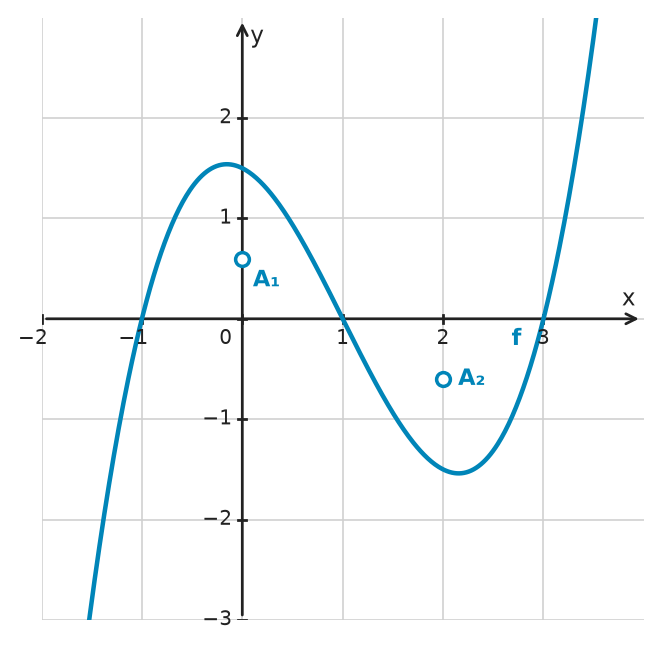
Figure for problem 532685

Hints

- Use point symmetry about \(W(1,0)\) to compare the two regions. - Distinguish between signed integral values and positive geometric areas. - Use interval additivity for the integral over \([-1,3]\). - Add the magnitudes of the two regions to find total area.

Solution

1. Point symmetry about \(W(1,0)\) maps the region \(A_1\) on \([-1,1]\) onto the congruent region \(A_2\) on \([1,3]\). Therefore, \(A_2\) also has area \(2\) square units. 2. Since \(A_1\) lies above the \(x\)-axis, \(\int_{-1}^{1}f(x)\,dx=2\). 3. Since \(A_2\) lies below the \(x\)-axis, \(\int_{1}^{3}f(x)\,dx=-2\). 4. By interval additivity, \(\int_{-1}^{3}f(x)\,dx=2+(-2)=0\). 5. The total geometric area is \(2+2=4\) square units.

Answer

a) The area of \(A_2\) is \(2\) square units; \(\int_{-1}^{1}f(x)\,dx=2\), and \(\int_{1}^{3}f(x)\,dx=-2\). b) \(\int_{-1}^{3}f(x)\,dx=0\). c) The total area is \(4\) square units.

53467912
The graph of \(f(x)=\sin(x)\) and the x-axis enclose a region on \([0,\pi]\). Find its area.
Figure for problem 534679

Hints

- Inspect the sine curve on the given interval. - Determine whether the graph is above or below the x-axis. - Recall an antiderivative of sine.

Solution

1. Since \(\sin(x)\geq0\) on \([0,\pi]\), the area is \(A=\int_{0}^{\pi}\sin(x)\,dx\). 2. An antiderivative is \(-\cos(x)\). 3. Therefore, \(A=[-\cos(x)]_{0}^{\pi}=-\cos(\pi)-(-\cos(0))=1-(-1)=2\).

Answer

\(2\) square units
53470012
For \(x\ge0\) and \(a>0\), let \(g_a(x)=ax^3\). The graph of \(g_a\), the x-axis, and the line \(x=2\) enclose a region. Find \(a\) so that the area of the region is exactly \(10\) square units.
Figure for problem 534700

Hints

- Identify the left and right boundaries of the region. - Treat \(a\) as a constant when integrating \(x^3\). - Solve the resulting linear equation for \(a\).

Solution

1. The region lies on \([0, 2]\), so \(A(a)=\int_0^2 ax^3\,dx\). 2. Evaluating gives \(A(a)=\left[\frac{a}{4}x^4\right]_0^2=\frac{a}{4}\cdot16=4a\). 3. Set \(4a=10\). Therefore, \(a=2.5\).

Answer

\(a=2.5\)
53474512
The graph shown is \(g(x)=2\cos(x)\). Find the area of the marked region on \(\left[-\frac{\pi}{2},\frac{\pi}{2}\right]\).
Figure for problem 534745

Hints

- Recall an antiderivative of cosine. - Use the exact sine values at \(\frac{\pi}{2}\) and \(-\frac{\pi}{2}\). - Evaluate the upper-limit value minus the lower-limit value.

Solution

1. The graph is nonnegative on the interval, so the area is \(A=\int_{-\pi/2}^{\pi/2}2\cos(x)\,dx\). 2. An antiderivative is \(2\sin(x)\). 3. Therefore, \(A=[2\sin(x)]_{-\pi/2}^{\pi/2}=2\sin\left(\frac{\pi}{2}\right)-2\sin\left(-\frac{\pi}{2}\right)=2-(-2)=4\).

Answer

\(4\) square units
52458812
Give an interval \([a, b]\) such that the region bounded by \(y=x^3\), the x-axis, and the lines \(x=a\) and \(x=b\) has area \(8\). Then represent that area with an integral.

Hints

- Distinguish signed integral from geometric area. - Use the odd symmetry of \(x^3\). - On an interval crossing the x-axis, use absolute value or split the integral. - Form an equation for the unknown endpoint.

Solution

1. Choose an interval symmetric about the origin, \([-c, c]\). Since \(x^3\) is odd, the two geometric regions have equal area. 2. The total area is \(2\int_0^c x^3\,dx=2\left[\frac{x^4}{4}\right]_0^c=\frac{c^4}{2}\). 3. Set \(\frac{c^4}{2}=8\). Then \(c^4=16\), so \(c=2\). 4. One valid interval is \([-2, 2]\), and the area can be written as \(\int_{-2}^{2}|x^3|\,dx\).

Answer

One possible interval is \([-2, 2]\), with area \(\int_{-2}^{2}|x^3|\,dx=8\).
52478712
Find the area between the graphs of \(f\) and \(g\) over each given interval. The graphs do not intersect in the specified interval. a) \(f(x)=\frac{4}{x+2}\), \(g(x)=1-0.5x\), and \(I=[0, 4]\) b) \(f(x)=e^x+1\), \(g(x)=e^{-x}\), and \(I=[0, 1]\)

Hints

- First determine which graph is above the other on each interval. - Use the integral of the upper function minus the lower function. - Recall antiderivatives for rational and exponential functions. - Use logarithm properties to simplify the result in part a).

Solution

1. For a), \(f(0)=2>g(0)=1\), so \(f\) is above \(g\) throughout the interval. The area is \(\int_0^4\left(\frac{4}{x+2}-1+0.5x\right)\,dx\). An antiderivative is \(4\ln(x+2)-x+0.25x^2\). Therefore, \(A=\left[4\ln(x+2)-x+0.25x^2\right]_0^4=4\ln(6)-4\ln(2)=4\ln(3)\approx4.394\). 2. For b), \(f(0)=2>g(0)=1\), so \(f\) is above \(g\). The area is \(\int_0^1(e^x+1-e^{-x})\,dx\). An antiderivative is \(e^x+x+e^{-x}\). Thus, \(A=\left[e^x+x+e^{-x}\right]_0^1=e+e^{-1}-1\approx2.086\).

Answer

a) \(A=4\ln(3)\approx4.394\) b) \(A=e+e^{-1}-1\approx2.086\)
52479012
For \(x>0\), the graph of \(f(x)=x-4\sqrt{x}+3\) and the \(x\)-axis bound a finite region. Find the area of this region.

Hints

- First find where the graph intersects the \(x\)-axis. - A substitution involving \(\sqrt{x}\) can simplify the equation for the zeros. - Rewrite the square root as a power before finding an antiderivative. - Check whether the function is above or below the axis between the zeros.

Solution

1. Find the zeros by substituting \(u=\sqrt{x}\). The equation \(x-4\sqrt{x}+3=0\) becomes \(u^2-4u+3=0\), so \(u=1\) or \(u=3\). Therefore, the zeros are \(x=1\) and \(x=9\). 2. An antiderivative is \(F(x)=\frac{1}{2}x^2-\frac{8}{3}x^{3/2}+3x\). 3. On \([1, 9]\), the function is below the \(x\)-axis. The signed integral is \(\left[F(x)\right]_1^9=-\frac{16}{3}\). 4. The geometric area is the absolute value, so \(A=\frac{16}{3}\).

Answer

The area is \(\frac{16}{3}\approx5.33\) square units.
52480112
Let \(f_k(x)=k\sqrt{x}\), where \(k>0\). The graph of \(f_k\), the x-axis, and the lines \(x=0\) and \(x=4\) enclose a region. 1) Find its area \(A(k)\) in terms of \(k\). 2) Find \(k\) when the area is \(32\).

Hints

- Express the area as a definite integral. - Rewrite the square root as a fractional power. - Treat \(k\) as a constant while integrating. - Set the area formula equal to \(32\).

Solution

1. Because \(f_k(x)\ge 0\) on \([0, 4]\), \(A(k)=\int_0^4k\sqrt{x}\,dx\). 2. Use the power rule: \(A(k)=\left[\frac{2k}{3}x^{3/2}\right]_0^4=\frac{2k}{3}\cdot 8=\frac{16k}{3}\). 3. Set the area equal to \(32\): \(\frac{16k}{3}=32\), so \(k=6\).

Answer

1) \(A(k)=\frac{16k}{3}\) 2) \(k=6\)
52480212
Let \(g_a(x)=ae^{0.5x}\), where \(a>0\). The graph of \(g_a\), the x-axis, and the lines \(x=0\) and \(x=2\) enclose a region. 1) Find its area \(A(a)\). 2) Find \(a\) when the area is \(4e-4\).

Hints

- Express the area as a definite integral. - Account for the linear exponent when integrating. - Factor the common expression in the area equation. - Isolate the parameter.

Solution

1. Since \(g_a(x)>0\), \(A(a)=\int_0^2ae^{0.5x}\,dx\). 2. An antiderivative is \(2ae^{0.5x}\), so \(A(a)=[2ae^{0.5x}]_0^2=2ae-2a=2a(e-1)\). 3. Set \(2a(e-1)=4(e-1)\). Since \(e-1\ne 0\), divide to obtain \(a=2\).

Answer

1) \(A(a)=2a(e-1)\) 2) \(a=2\)
52480712
The functions \(f(x)=x^2+4\) and \(g(x)=\frac{1}{2}x^2\) are given. Their graphs, the \(y\)-axis, and the vertical line \(x=k\), where \(k>0\), bound a region with area \(A(k)\). a) Write a formula for \(A(k)\). b) For what value of \(k\) does this area equal the area of a triangle with base \(k\) and height \(10\)?

Hints

- Determine which function is above the other. - Express the area between the graphs as a definite integral. - Recall the area formula for a triangle. - Set the two area expressions equal and use \(k>0\).

Solution

1. Since \(f(x)-g(x)=\frac{1}{2}x^2+4>0\), \(f\) is above \(g\). 2. The area function is \(A(k)=\int_0^k\left(\frac{1}{2}x^2+4\right)\,dx=\left[\frac{x^3}{6}+4x\right]_0^k=\frac{k^3}{6}+4k\). 3. The triangle's area is \(\frac{1}{2}\cdot k\cdot10=5k\). 4. Set the areas equal: \(\frac{k^3}{6}+4k=5k\). Because \(k>0\), divide by \(k\) to obtain \(\frac{k^2}{6}=1\). Thus, \(k=\sqrt{6}\).

Answer

a) \(A(k)=\frac{k^3}{6}+4k\) b) \(k=\sqrt{6}\)
52480812
Consider \(f(x)=2x^2+1\) and \(g(x)=x^2-2\). Their graphs bound a region from \(x=-t\) to \(x=t\), where \(t>0\). a) Write the area \(A(t)\) as a function of \(t\). b) Find the positive value of \(t\) for which this area equals the area of a rectangle with side lengths \(t\) and \(8\).

Hints

- Use symmetry about the \(y\)-axis to simplify the integral. - Integrate the difference between the upper and lower functions. - Write the rectangle's area in terms of \(t\). - Use the fact that \(t>0\) when solving the equation.

Solution

1. The difference is \(f(x)-g(x)=x^2+3>0\), so \(f\) is above \(g\). 2. Because the difference is even, \(A(t)=\int_{-t}^{t}(x^2+3)\,dx=2\int_0^t(x^2+3)\,dx\). Therefore, \(A(t)=2\left[\frac{x^3}{3}+3x\right]_0^t=\frac{2}{3}t^3+6t\). 3. The rectangle's area is \(8t\). Set the areas equal: \(\frac{2}{3}t^3+6t=8t\). 4. Since \(t>0\), divide by \(t\): \(\frac{2}{3}t^2+6=8\). Hence, \(t^2=3\), so \(t=\sqrt{3}\).

Answer

a) \(A(t)=\frac{2}{3}t^3+6t\) b) \(t=\sqrt{3}\)
52480912
Let \(f(x)=\ln(x)\). Find the area of the region enclosed by the graph of \(f\), the tangent line to the graph at \(x=e\), and the \(x\)-axis.

Hints

- First write the equation of the tangent line. - Find where the curve and the tangent line meet the \(x\)-axis. - Represent the region as a larger area minus a smaller area. - An antiderivative of \(\ln(x)\) can be found using integration by parts.

Solution

1. Since \(f(e)=1\) and \(f'(x)=\frac{1}{x}\), the tangent slope at \(x=e\) is \(\frac{1}{e}\). The tangent line is \(y-1=\frac{1}{e}(x-e)\), or \(y=\frac{x}{e}\). 2. The graph of \(f\) meets the \(x\)-axis at \(x=1\), and the tangent line meets it at \(x=0\). 3. Compute the area under the tangent line from \(0\) to \(e\), then subtract the area under \(f\) from \(1\) to \(e\): \( \int_0^e\frac{x}{e}\,dx-\int_1^e\ln(x)\,dx. \) The first integral is \(\frac{e}{2}\). Using an antiderivative \(x\ln(x)-x\), the second integral is \(1\). 4. Therefore, \(A=\frac{e}{2}-1\approx0.359\).

Answer

The area is \(\frac{e}{2}-1\approx0.359\) square units.
52483312
The function \(f(x)=2-\frac{18}{x^2}\) is defined for \(x\ne0\). Its graph is symmetric about the \(y\)-axis and has zeros at \(x=-3\) and \(x=3\). The horizontal line \(g\) has equation \(y=-16\). a) Verify algebraically that \(x=1\) is the \(x\)-coordinate of an intersection of \(g\) and the graph of \(f\). b) On each side of the \(y\)-axis, the graph of \(f\), the \(x\)-axis, the \(y\)-axis, and the line \(g\) bound a region. Find the combined area of the two regions.

Hints

- Find where the curve meets the \(x\)-axis and the line \(g\). - Use symmetry to calculate only one of the two regions. - Split one region into a rectangle and a curved part. - For the curved part, integrate \(0-f(x)\).

Solution

1. Substitute \(x=1\): \(f(1)=2-\frac{18}{1^2}=-16\). Therefore, \((1, -16)\) lies on both graphs. 2. For the right-hand region, the part from \(x=0\) to \(x=1\) is a rectangle between \(y=0\) and \(y=-16\), with area \(16\). 3. From \(x=1\) to \(x=3\), the curve lies below the \(x\)-axis. This part has area \(\int_1^3\left(0-f(x)\right)\,dx=\int_1^3\left(\frac{18}{x^2}-2\right)\,dx\). 4. An antiderivative is \(-\frac{18}{x}-2x\). Thus, \(\left[-\frac{18}{x}-2x\right]_1^3=(-12)-(-20)=8\). 5. The right-hand region has area \(16+8=24\). By symmetry, the combined area is \(2\cdot24=48\).

Answer

a) \(f(1)=-16\), so \(x=1\) is an intersection \(x\)-coordinate. b) The combined area is \(48\) square units.
52483912
Let \(f_k(x)=kx-x^2\), where \(k>0\). The graph of \(f_k\) and the x-axis enclose a region. 1) Find its area \(A(k)\). 2) Find \(k\) when the area is \(36\).

Hints

- Find the x-intercepts to determine the bounds. - Check where the graph lies above the x-axis. - Express the area as a definite integral. - Set the area formula equal to \(36\).

Solution

1. Factor to find the x-intercepts: \(f_k(x)=x(k-x)\), so the intercepts are \(x=0\) and \(x=k\). The function is nonnegative between them. 2. Therefore, \(A(k)=\int_0^k(kx-x^2)\,dx\) \(=\left[\frac{kx^2}{2}-\frac{x^3}{3}\right]_0^k=\frac{k^3}{6}\). 3. Set \(\frac{k^3}{6}=36\). Then \(k^3=216\), so \(k=6\).

Answer

1) \(A(k)=\frac{k^3}{6}\) 2) \(k=6\)
52484012
For \(a>0\), let \(g_a(x)=a^3x-ax^3\). The graph and the x-axis enclose one region in Quadrant I and another in Quadrant III. 1) Find the total area \(A(a)\) of both regions. 2) Find \(a\) when the total area is \(16\) square units.

Hints

- Find all x-intercepts. - Use the odd symmetry to compare the two regions. - Add geometric areas, not signed integrals. - Set the area formula equal to \(16\).

Solution

1. Factor: \(g_a(x)=ax(a^2-x^2)\), so the x-intercepts are \(-a\), \(0\), and \(a\). 2. The function is odd, so the two regions have equal area. On \([0, a]\), the function is nonnegative. Thus, \(A(a)=2\int_0^a(a^3x-ax^3)\,dx\). 3. Evaluate: \(A(a)=2\left[\frac{a^3x^2}{2}-\frac{ax^4}{4}\right]_0^a\) \(=2\left(\frac{a^5}{2}-\frac{a^5}{4}\right)=\frac{a^5}{2}\). 4. Set \(\frac{a^5}{2}=16\). Then \(a^5=32\), so \(a=2\).

Answer

1) \(A(a)=\frac{a^5}{2}\) 2) \(a=2\)
52499312
Given \(f(x)=x^3-2x\) and \(g(x)=x^2\), find the total area of all bounded regions enclosed by their graphs.

Hints

- Find all intersection points by setting the functions equal. - Three intersection points can create two bounded regions. - Check which graph is above the other on each interval. - Add the absolute values of the signed integrals.

Solution

1. Set the functions equal: \(x^3-2x=x^2\), so \(x(x^2-x-2)=x(x-2)(x+1)=0\). The intersection \(x\)-values are \(-1, 0,\) and \(2\). 2. Let \(h(x)=f(x)-g(x)=x^3-x^2-2x\). An antiderivative is \(H(x)=\frac{x^4}{4}-\frac{x^3}{3}-x^2\). 3. On \([-1, 0]\), \(f\) is above \(g\), and \(\int_{-1}^{0}h(x)\,dx=\frac{5}{12}\). 4. On \([0, 2]\), \(g\) is above \(f\), and \(\int_0^2h(x)\,dx=-\frac{8}{3}\), so this region has area \(\frac{8}{3}\). 5. The total area is \(\frac{5}{12}+\frac{8}{3}=\frac{37}{12}\).

Answer

The total area is \(\frac{37}{12}\approx3.083\) square units.
52501312
Let \(f(x)=x^3\) for \(x\ge0\). The graph of \(f\), the tangent line at \(P(a, f(a))\), where \(a>0\), and the \(y\)-axis enclose a region. Show algebraically that its area is \(A=\frac{3}{4}a^4\).

Hints

- Use the point-slope form of the tangent line at \(x=a\). - The \(y\)-axis makes \(x=0\) one integration boundary. - Determine which graph is above the other on \([0, a]\). - Integrate the difference using the power rule.

Solution

1. Since \(f'(x)=3x^2\), the tangent slope at \(x=a\) is \(3a^2\). The tangent line is \(t(x)=3a^2(x-a)+a^3=3a^2x-2a^3\). 2. On \([0, a]\), the cubic lies above its tangent line. Thus, \(A=\int_0^a\left[x^3-(3a^2x-2a^3)\right]\,dx\). 3. An antiderivative is \(\frac{x^4}{4}-\frac{3}{2}a^2x^2+2a^3x\). 4. Evaluating from \(0\) to \(a\) gives \(A=\frac{a^4}{4}-\frac{3}{2}a^4+2a^4=\frac{3}{4}a^4\).

Answer

\(A=\frac{3}{4}a^4\)
52501412
Let \(f(x)=e^x\). The tangent line \(t\) touches the graph at \(x=1\). Find the exact area enclosed by the graph, \(t\), and the \(y\)-axis.

Hints

- Write the tangent line using the function value and derivative at \(x=1\). - Identify the interval bounded by the \(y\)-axis and the point of tangency. - Integrate the curve minus the tangent line. - Leave \(e\) in the exact answer.

Solution

1. Since \(f(1)=e\) and \(f'(1)=e\), the tangent line is \(t(x)=e(x-1)+e=ex\). 2. The region extends from the \(y\)-axis, \(x=0\), to the point of tangency, \(x=1\). 3. Because \(e^x\ge ex\) on this interval, \(A=\int_0^1(e^x-ex)\,dx\). 4. Evaluate: \(\left[e^x-\frac{e}{2}x^2\right]_0^1=\left(e-\frac{e}{2}\right)-1=\frac{e}{2}-1\).

Answer

The exact area is \(\frac{e}{2}-1\) square units.
52503312
Let \(f(x)=\frac{18}{(x+1)^2}\). A line \(g\) passes through \((0, f(0))\) and lies above the graph of \(f\) for \(0<x\le2\). In the first quadrant, the graph of \(f\), the line \(g\), and the vertical line \(x=2\) enclose a region with area \(10\). Find an equation of \(g\).

Hints

- Use the known \(y\)-intercept to write \(g(x)=mx+b\). - Express the area between the line and the curve as a definite integral. - Use the given area to solve for the slope. - Use the stated graph order when setting up the area integral.

Solution

1. Since \(f(0)=18\), write the line as \(g(x)=mx+18\). 2. The area under \(f\) on \([0, 2]\) is \(\int_0^2\frac{18}{(x+1)^2}\,dx=\left[-\frac{18}{x+1}\right]_0^2=12\). 3. Since \(g\) lies above \(f\) on \([0,2]\), the enclosed area is \(\int_0^2(g(x)-f(x))\,dx=(2m+36)-12=2m+24\). 4. Set the area equal to \(10\): \(2m+24=10\), so \(m=-7\). 5. Therefore, \(g(x)=-7x+18\).

Answer

\(g(x)=-7x+18\)
52506512
Let \(f(x)=x^2\). For each \(k>0\), the graph of \(f\) and the line \(y=k^2\) enclose a region. a) Find the area \(A(k)\) as a function of \(k\). b) Find \(k\) when the area is \(36\).

Hints

- Find the intersections of \(y=x^2\) and \(y=k^2\). - Determine which graph is above the other. - Use symmetry about the \(y\)-axis. - Integrate with the power rule.

Solution

1. The intersections satisfy \(x^2=k^2\), so \(x=-k\) and \(x=k\). 2. The line is above the parabola between the intersections. Thus, \(A(k)=\int_{-k}^{k}(k^2-x^2)\,dx\). 3. Evaluate: \(\left[k^2x-\frac{x^3}{3}\right]_{-k}^{k}=\frac{4}{3}k^3\). 4. For an area of \(36\), solve \(\frac{4}{3}k^3=36\). Then \(k^3=27\), and because \(k>0\), \(k=3\).

Answer

a) \(A(k)=\frac{4}{3}k^3\) b) \(k=3\)
52506612
For \(a>1\), let \(f_a(x)=ae^{-x}\). The graph of \(f_a\), the \(y\)-axis, and the line \(y=1\) enclose a region in the first quadrant. Find its area as a function of \(a\).

Hints

- Find where \(ae^{-x}=1\). - Use \(a>1\) to determine which graph is above the other. - Integrate the difference between the curve and \(y=1\). - Simplify using \(e^{-\ln(a)}=\frac{1}{a}\).

Solution

1. Find the intersection with \(y=1\): \(ae^{-x}=1\), so \(e^{-x}=\frac{1}{a}\) and \(x=\ln(a)\). 2. Since \(a>1\), the curve is above \(y=1\) on \([0, \ln(a)]\). 3. Therefore, \(A(a)=\int_0^{\ln(a)}(ae^{-x}-1)\,dx\). 4. An antiderivative is \(-ae^{-x}-x\). Evaluating gives \(A(a)=\left[-ae^{-x}-x\right]_0^{\ln(a)}=-1-\ln(a)+a\). 5. Thus, \(A(a)=a-\ln(a)-1\).

Answer

\(A(a)=a-\ln(a)-1\)
52509512
Let \(f(x)=\frac{6}{x^4}\), defined for \(x\ne0\). a) Find the antiderivative \(F\) of \(f\) that satisfies \(F(1)=0\). b) The graph of \(f\), the \(x\)-axis, and the vertical lines \(x=1\) and \(x=k\), where \(k>1\), bound a region with area \(1.75\). Find \(k\).

Hints

- Use the power rule for antiderivatives. - Apply \(F(1)=0\) to determine the constant. - Represent the area with a definite integral from \(1\) to \(k\). - Solve the resulting equation for \(k>1\).

Solution

1. Integrate \(f(x)=6x^{-4}\): \(F(x)=-2x^{-3}+C=-\frac{2}{x^3}+C\). 2. Use \(F(1)=0\): \(-2+C=0\), so \(C=2\). Thus, \(F(x)=2-\frac{2}{x^3}\). 3. The area from \(x=1\) to \(x=k\) is \(\int_1^k\frac{6}{x^4}\,dx=\left[-\frac{2}{x^3}\right]_1^k=2-\frac{2}{k^3}\). 4. Set this equal to \(1.75=\frac{7}{4}\): \(2-\frac{2}{k^3}=\frac{7}{4}\). Then \(\frac{2}{k^3}=\frac{1}{4}\), so \(k^3=8\) and \(k=2\).

Answer

a) \(F(x)=2-\frac{2}{x^3}\) b) \(k=2\)
52509612
Let \(g(x)=\frac{4}{3\sqrt[3]{x}}\) for \(x>0\). a) Show that \(G(x)=2\sqrt[3]{x^2}\) is an antiderivative of \(g\). b) The graph of \(g\) and the \(x\)-axis bound a region over \([1, a]\), where \(a>1\), with area \(6\). Find \(a\).

Hints

- Rewrite cube roots using rational exponents. - Differentiate \(G\) to verify the antiderivative. - Use the Fundamental Theorem of Calculus for the area. - Use \(a>1\) when solving the power equation.

Solution

1. Rewrite \(G(x)=2x^{2/3}\). Then \(G'(x)=2\left(\frac{2}{3}\right)x^{-1/3}=\frac{4}{3\sqrt[3]{x}}=g(x)\). Therefore, \(G\) is an antiderivative of \(g\). 2. By the Fundamental Theorem of Calculus, \(\int_1^a g(x)\,dx=G(a)-G(1)=2a^{2/3}-2\). 3. Set the area equal to \(6\): \(2a^{2/3}-2=6\), so \(a^{2/3}=4\). 4. Raise both sides to the \(\frac{3}{2}\) power. Since \(a>1\), \(a=4^{3/2}=8\).

Answer

a) \(G'(x)=g(x)\), so \(G\) is an antiderivative of \(g\). b) \(a=8\)
52510112
For \(x\ge0\) and \(k>0\), let \(f_k(x)=k\sqrt{x}-x\). The graph of \(f_k\) and the \(x\)-axis enclose a region in the first quadrant. Find \(k\) when the area is \(13.5\).

Hints

- Find the zeros that determine the integration interval. - Rewrite the square root as a power before integrating. - Treat \(k\) as a constant during integration. - Set the area expression equal to \(13.5\).

Solution

1. Solve \(k\sqrt{x}-x=0\): \(\sqrt{x}(k-\sqrt{x})=0\), so the zeros are \(x=0\) and \(x=k^2\). 2. The function is nonnegative on \([0, k^2]\), so \(A=\int_0^{k^2}(k\sqrt{x}-x)\,dx\). 3. Evaluate: \(\left[\frac{2}{3}kx^{3/2}-\frac{x^2}{2}\right]_0^{k^2} =\frac{2}{3}k^4-\frac{1}{2}k^4=\frac{1}{6}k^4\). 4. Set \(\frac{1}{6}k^4=13.5\). Then \(k^4=81\), and because \(k>0\), \(k=3\).

Answer

\(k=3\)
52510212
For \(a>0\), let \(g_a(x)=a^2x-x^3\). The graph of \(g_a\) and the \(x\)-axis enclose two regions. Find \(a\) when their combined area is \(8\).

Hints

- Factor the function to find its zeros. - Check whether the function has symmetry. - Account for the region below the \(x\)-axis as positive area. - Set the total area expression equal to \(8\).

Solution

1. Factor: \(g_a(x)=x(a^2-x^2)\), so the zeros are \(x=-a, 0,\) and \(a\). 2. The function is odd, so the two bounded regions have equal area. On \([0, a]\), \(g_a(x)\ge0\). 3. The combined area is \(A=2\int_0^a(a^2x-x^3)\,dx\). 4. Evaluate: \(A=2\left[\frac{1}{2}a^2x^2-\frac{1}{4}x^4\right]_0^a =2\left(\frac{1}{4}a^4\right)=\frac{1}{2}a^4\). 5. Set \(\frac{1}{2}a^4=8\). Then \(a^4=16\), and because \(a>0\), \(a=2\).

Answer

\(a=2\)
52959112
Let \(f(x)=x^3-4x\). 1) Evaluate \(\int_{-1}^{3}(x^3-4x)\,dx\). 2) Find the total area between the graph of \(f\) and the \(x\)-axis on \([-1,3]\).

Hints

- Distinguish between a definite integral and total geometric area. - Find the zeros of the function within the interval. - Split the interval at those zeros. - Take the absolute value of any negative definite-integral contribution when finding total area.

Solution

1. An antiderivative is \(F(x)=\frac{1}{4}x^4-2x^2\). Therefore, \(\int_{-1}^{3}(x^3-4x)\,dx=F(3)-F(-1)=\frac{9}{4}-\left(-\frac{7}{4}\right)=4\). 2. The zeros are \(x=-2\), \(x=0\), and \(x=2\). The zeros in \([-1,3]\) are \(0\) and \(2\), so split the interval there. On \([-1,0]\), \(\int_{-1}^{0}f(x)\,dx=\frac{7}{4}\). On \([0,2]\), \(\int_{0}^{2}f(x)\,dx=-4\), so this region has area \(4\). On \([2,3]\), \(\int_{2}^{3}f(x)\,dx=\frac{25}{4}\). Thus, the total area is \(\frac{7}{4}+4+\frac{25}{4}=12\) square units.

Answer

1) \(\int_{-1}^{3}(x^3-4x)\,dx=4\) 2) The total area is \(12\) square units.
52959212
Let \(f(x)=(x^2-4)(x-1)\). Find the total area between the graph of \(f\) and the \(x\)-axis over \([-3, 3]\).

Hints

- Use the factored form to find the zeros. - Split the interval at every zero inside \([-3, 3]\). - Evaluate the definite integral on each subinterval. - Add the absolute values of the signed integrals.

Solution

1. Expand: \(f(x)=x^3-x^2-4x+4\). An antiderivative is \(F(x)=\frac{x^4}{4}-\frac{x^3}{3}-2x^2+4x\). 2. From the factored form, the zeros are \(x=-2, 1,\) and \(2\). Split the interval at these points. 3. The signed integrals are \(\int_{-3}^{-2}f(x)\,dx=-\frac{103}{12}\), \(\int_{-2}^{1}f(x)\,dx=\frac{45}{4}\), \(\int_{1}^{2}f(x)\,dx=-\frac{7}{12}\), and \(\int_{2}^{3}f(x)\,dx=\frac{47}{12}\). 4. Add their absolute values: \(A=\frac{103}{12}+\frac{135}{12}+\frac{7}{12}+\frac{47}{12} =\frac{292}{12}=\frac{73}{3}\).

Answer

The total area is \(\frac{73}{3}\approx24.33\) square units.
52959512
Find the total area between the graph of \(f(x)=\frac{1}{2}x^2-2\) and the \(x\)-axis over \([-1, 3]\).

Hints

- Find which zeros lie in the given interval. - Split the integral at each zero in the interval. - Determine where the function is above or below the \(x\)-axis. - Add positive geometric areas, not signed integrals.

Solution

1. Solve \(\frac{1}{2}x^2-2=0\). The zeros are \(x=-2\) and \(x=2\), but only \(x=2\) lies inside \([-1, 3]\). 2. Split the interval at \(x=2\). An antiderivative is \(F(x)=\frac{x^3}{6}-2x\). 3. On \([-1, 2]\), the function is below the axis: \(\int_{-1}^{2}f(x)\,dx=-\frac{9}{2}\). 4. On \([2, 3]\), the function is above the axis: \(\int_{2}^{3}f(x)\,dx=\frac{7}{6}\). 5. The total area is \(\frac{9}{2}+\frac{7}{6}=\frac{27}{6}+\frac{7}{6}=\frac{17}{3}\).

Answer

The total area is \(\frac{17}{3}\approx5.67\) square units.
52959612
Find the total area between the graph of \(f(x)=x^3-3x^2+2x\) and the \(x\)-axis over \([0, 2.5]\).

Hints

- Factor the function to find the zeros. - Use the zeros to split the interval. - Determine the sign of the function on each subinterval. - Add the absolute values of the definite integrals.

Solution

1. Factor: \(f(x)=x(x-1)(x-2)\), so the zeros in the interval are \(0, 1,\) and \(2\). 2. An antiderivative is \(F(x)=\frac{x^4}{4}-x^3+x^2\). 3. The signed integrals are \(\int_0^1f(x)\,dx=\frac{1}{4}\), \(\int_1^2f(x)\,dx=-\frac{1}{4}\), and \(\int_2^{2.5}f(x)\,dx=\frac{25}{64}\). 4. Add the absolute values: \(A=\frac{1}{4}+\frac{1}{4}+\frac{25}{64} =\frac{57}{64}=0.890625\).

Answer

The total area is \(\frac{57}{64}=0.890625\) square units.
52960312
Let \(f(x)=x^2-1\) and \(g(x)=1-x\). Find the total area between their graphs over \([-2, 2]\).

Hints

- Find all intersections in the interval. - Determine which graph is above the other on each subinterval. - Split the area integral where the graphs cross. - Integrate upper minus lower on each interval.

Solution

1. Set the functions equal: \(x^2-1=1-x\), so \(x^2+x-2=(x+2)(x-1)=0\). The intersections occur at \(x=-2\) and \(x=1\). 2. On \([-2, 1]\), \(g\) is above \(f\). On \([1, 2]\), \(f\) is above \(g\). 3. Therefore, \(A=\int_{-2}^{1}(g(x)-f(x))\,dx+\int_1^2(f(x)-g(x))\,dx\). 4. The first integral is \(\frac{9}{2}\), and the second is \(\frac{11}{6}\). 5. Thus, \(A=\frac{9}{2}+\frac{11}{6}=\frac{19}{3}\).

Answer

The total area is \(\frac{19}{3}\approx6.33\) square units.
52960412
Let \(f(x)=\sin(x)\) and \(g(x)=\cos(x)\). 1) Evaluate \(I_1=\int_{0}^{\pi}(f(x)-g(x))\,dx\). 2) Evaluate \(I_2=\int_{0}^{\pi}|f(x)-g(x)|\,dx\). 3) Interpret both results in terms of the area between the graphs of \(f\) and \(g\) on \([0,\pi]\).

Hints

- Compare integrating a difference with integrating the absolute value of that difference. - Find where sine and cosine intersect on \([0,\pi]\). - Determine which function is above the other on each subinterval. - Split the absolute-value integral where the sign of \(f(x)-g(x)\) changes.

Solution

1. \(I_1=\int_{0}^{\pi}(\sin(x)-\cos(x))\,dx=[-\cos(x)-\sin(x)]_{0}^{\pi}=2\). 2. The graphs intersect where \(\sin(x)=\cos(x)\). On \([0,\pi]\), this occurs at \(x=\frac{\pi}{4}\). 3. On \(\left[0,\frac{\pi}{4}\right]\), \(g(x)>f(x)\), and on \(\left[\frac{\pi}{4},\pi\right]\), \(f(x)>g(x)\). Therefore, \(I_2=\int_{0}^{\frac{\pi}{4}}(\cos(x)-\sin(x))\,dx+\int_{\frac{\pi}{4}}^{\pi}(\sin(x)-\cos(x))\,dx\). 4. Evaluating gives \(I_2=[\sin(x)+\cos(x)]_{0}^{\frac{\pi}{4}}+[-\cos(x)-\sin(x)]_{\frac{\pi}{4}}^{\pi}\) \(=(\sqrt{2}-1)+(1+\sqrt{2})=2\sqrt{2}\approx 2.83\). 5. The first integral is the signed difference between the two regions. The second integral adds both regions as positive quantities, so it is the total area between the graphs.

Answer

1) \(I_1=2\) 2) \(I_2=2\sqrt{2}\approx 2.83\) 3) \(I_1\) is the net signed difference, while \(I_2\) is the total geometric area between the graphs.
52960512
For \(k\in\mathbb{R}\), let \(f_k(x)=kx^2-x^3\). 1. Find the zeros of \(f_k\) in terms of \(k\). 2. The graph of \(f_k\) and the \(x\)-axis enclose a region with area \(6.75\). Find all possible values of \(k\).

Hints

- Factor the function to find its zeros. - The order of the zero locations depends on the sign of \(k\). - Use an absolute value for geometric area. - A fourth-power equation can have two real solutions.

Solution

1. Factor: \(f_k(x)=x^2(k-x)\). If \(k\ne0\), the zeros are \(x=0\), with multiplicity \(2\), and \(x=k\). If \(k=0\), then \(f_0(x)=-x^3\), so \(x=0\) is a triple zero. 2. For \(k\ne0\), the geometric area between the two distinct zeros is \(A=\left|\int_0^k(kx^2-x^3)\,dx\right|\). 3. Evaluate: \(\int_0^k(kx^2-x^3)\,dx =\left[\frac{kx^3}{3}-\frac{x^4}{4}\right]_0^k =\frac{k^4}{12}\). Because \(k^4\ge0\), \(A=\frac{k^4}{12}\). 4. Set \(\frac{k^4}{12}=6.75=\frac{27}{4}\). Then \(k^4=81\), so \(k=3\) or \(k=-3\).

Answer

1. If \(k\ne0\), \(x=0\) is a double zero and \(x=k\) is the other zero. If \(k=0\), \(x=0\) is a triple zero. 2. \(k=3\) or \(k=-3\)
52960612
For \(k\in\mathbb{R}\), let \(g_k(x)=x^2-k\). 1. Determine the values of \(k\) for which the graph of \(g_k\) and the \(x\)-axis enclose a region. Briefly describe how the graph's position relative to the \(x\)-axis depends on \(k\). 2. Find \(k\) when the enclosed area is \(\frac{32}{3}\).

Hints

- Determine when \(x^2-k=0\) has two distinct real solutions. - Track the vertex \((0, -k)\) as \(k\) changes. - Use symmetry to simplify the area integral. - Solve the resulting equation involving \(k^{3/2}\).

Solution

1. The graph is an upward-opening parabola with vertex \((0, -k)\). It has two zeros \(x=\pm\sqrt{k}\) only when \(k>0\), so a bounded region is enclosed only for \(k>0\). For \(k=0\), the graph only touches the axis. For \(k<0\), the graph lies above the axis. 2. For \(k>0\), the area is \(A=\int_{-\sqrt{k}}^{\sqrt{k}}(k-x^2)\,dx\). 3. By symmetry, \(A=2\int_0^{\sqrt{k}}(k-x^2)\,dx =2\left[kx-\frac{x^3}{3}\right]_0^{\sqrt{k}} =\frac{4}{3}k^{3/2}\). 4. Set \(\frac{4}{3}k^{3/2}=\frac{32}{3}\). Then \(k^{3/2}=8\), so \(k=4\).

Answer

1. A bounded region is enclosed only when \(k>0\). 2. \(k=4\)
52960812
Find the area between the graph of the piecewise function \(f(x)=\begin{cases}\sqrt{x+4}&\text{for }x\le0\\2\cos(0.5x)&\text{for }x>0\end{cases}\) and the \(x\)-axis over \([-4, \pi]\).

Hints

- Find the zero of each piece. - Split the integral where the formula changes. - Use the power rule for the square-root piece. - Account for the factor \(0.5\) when integrating the cosine piece.

Solution

1. The square-root piece is zero at \(x=-4\). The cosine piece is zero when \(0.5x=\frac{\pi}{2}\), so \(x=\pi\). 2. Split the integral at \(x=0\): \(A=\int_{-4}^{0}\sqrt{x+4}\,dx+\int_0^\pi2\cos(0.5x)\,dx\). 3. The first integral is \(\left[\frac{2}{3}(x+4)^{3/2}\right]_{-4}^{0}=\frac{16}{3}\). 4. The second integral is \(\left[4\sin(0.5x)\right]_0^\pi=4\). 5. Therefore, \(A=\frac{16}{3}+4=\frac{28}{3}\).

Answer

The area is \(\frac{28}{3}\approx9.33\) square units.
52960912
Let \(f(x)=-x^2+6x-5\) and \(g(x)=x^2-4x+3\). Find the area enclosed by their graphs.

Hints

- Find the intersection points by setting the functions equal. - Use the intersection \(x\)-values as integration limits. - Determine which graph is above the other. - Integrate the upper function minus the lower function.

Solution

1. Set the functions equal: \(-x^2+6x-5=x^2-4x+3\). This simplifies to \(x^2-5x+4=0\), so the intersections occur at \(x=1\) and \(x=4\). 2. On \([1, 4]\), \(f\) is above \(g\). Their difference is \(f(x)-g(x)=-2x^2+10x-8\). 3. The area is \(\int_1^4(-2x^2+10x-8)\,dx\). 4. An antiderivative is \(-\frac{2}{3}x^3+5x^2-8x\). 5. Evaluating gives \(\left[-\frac{2}{3}x^3+5x^2-8x\right]_1^4=9\).

Answer

The area is \(9\) square units.
52961512
Let \(f(x)=x^2-4x+5\) and \(g(x)=-x^2+8x-11\). Find the area enclosed by their graphs.

Hints

- Find where the two graphs intersect. - Identify which graph is above the other between the intersections. - Form the upper-minus-lower difference. - Integrate that difference over the bounded interval.

Solution

1. Set the functions equal: \(x^2-4x+5=-x^2+8x-11\). This gives \(x^2-6x+8=0\), so the intersections occur at \(x=2\) and \(x=4\). 2. On \([2, 4]\), \(g\) is above \(f\). Their difference is \(g(x)-f(x)=-2x^2+12x-16\). 3. The area is \(\int_2^4(-2x^2+12x-16)\,dx\). 4. An antiderivative is \(-\frac{2}{3}x^3+6x^2-16x\). 5. Evaluating gives \(\left[-\frac{2}{3}x^3+6x^2-16x\right]_2^4=\frac{8}{3}\).

Answer

The area is \(\frac{8}{3}\approx2.67\) square units.
52961612
Consider \(f(x)=x^3-4x^2+3x\) and \(g(x)=x-x^2\). Their graphs enclose more than one bounded region. Find the combined area of all such regions.

Hints

- Find all intersection points. - Three intersections can create two bounded regions. - Determine which graph is above on each interval. - Add the absolute values of the two signed integrals.

Solution

1. Set the functions equal: \(x^3-4x^2+3x=x-x^2\). This simplifies to \(x^3-3x^2+2x=x(x-1)(x-2)=0\). The intersection \(x\)-values are \(0, 1,\) and \(2\). 2. The difference is \(d(x)=f(x)-g(x)=x^3-3x^2+2x\), with antiderivative \(D(x)=\frac{x^4}{4}-x^3+x^2\). 3. On \([0, 1]\), \(\int_0^1d(x)\,dx=\frac{1}{4}\). 4. On \([1, 2]\), \(\int_1^2d(x)\,dx=-\frac{1}{4}\). 5. Add the absolute values: \(A=\frac{1}{4}+\frac{1}{4}=\frac{1}{2}\).

Answer

The combined area is \(\frac{1}{2}\) square unit.
52961712
Find \(k>0\) so that the graphs of \(f(x)=x^2-k\) and \(g(x)=k-x^2\) enclose a region with area \(72\).

Hints

- Find the intersection points in terms of \(k\). - Determine which parabola is above the other. - Use symmetry to simplify the integral. - Solve the resulting equation for \(k>0\).

Solution

1. Set the functions equal: \(x^2-k=k-x^2\), so \(x^2=k\). The intersections occur at \(x=\pm\sqrt{k}\). 2. On the bounded interval, \(g\) is above \(f\), and \(g(x)-f(x)=2k-2x^2\). 3. The area is \(A=\int_{-\sqrt{k}}^{\sqrt{k}}(2k-2x^2)\,dx\). 4. By symmetry, \(A=2\int_0^{\sqrt{k}}(2k-2x^2)\,dx=\frac{8}{3}k^{3/2}\). 5. Set \(\frac{8}{3}k^{3/2}=72\). Then \(k^{3/2}=27\), so \(k=9\).

Answer

\(k=9\)
52961912
Find the total area enclosed by the graph of \(f(x)=x^3-3x^2-x+3\) and the \(x\)-axis.

Hints

- Factor the polynomial to find all zeros. - Three zeros can create two bounded regions. - Evaluate the definite integral on each interval between consecutive zeros. - Add the absolute values of the signed integrals.

Solution

1. Factor by grouping: \(f(x)=(x^2-1)(x-3)=(x+1)(x-1)(x-3)\). The zeros are \(-1, 1,\) and \(3\). 2. An antiderivative is \(F(x)=\frac{x^4}{4}-x^3-\frac{x^2}{2}+3x\). 3. On \([-1, 1]\), \(\int_{-1}^{1}f(x)\,dx=4\). 4. On \([1, 3]\), \(\int_1^3f(x)\,dx=-4\), so this region has area \(4\). 5. The total area is \(4+4=8\).

Answer

The total area is \(8\) square units.
52962012
Let \(f(x)=\frac{1}{2}x^4-2x^2\). Find the total area enclosed by its graph and the \(x\)-axis.

Hints

- Find all zeros and note any repeated zero. - Use symmetry about the \(y\)-axis. - Determine whether the graph is above or below the axis between \(-2\) and \(2\). - Use the absolute value of the signed integral.

Solution

1. Factor: \(f(x)=\frac{1}{2}x^2(x^2-4)\). The zeros are \(x=-2\), \(x=0\) with multiplicity \(2\), and \(x=2\). 2. The function is even and lies below the \(x\)-axis on \((-2, 2)\), except at \(x=0\). 3. Therefore, \(A=2\left|\,\int_0^2\left(\frac{1}{2}x^4-2x^2\right)\,dx\right|\). 4. An antiderivative is \(\frac{x^5}{10}-\frac{2x^3}{3}\). The integral from \(0\) to \(2\) is \(-\frac{32}{15}\). 5. Thus, \(A=2\left(\frac{32}{15}\right)=\frac{64}{15}\).

Answer

The total area is \(\frac{64}{15}\approx4.27\) square units.
52962112
Let \(f(x)=\frac{1}{2}x^3-2x\). Find the area enclosed by the graph of \(f\) and its tangent line at \(P(-2, 0)\).

Hints

- Use the first derivative to find the tangent slope. - The point of tangency gives a repeated root of the difference between the curve and line. - Find the remaining intersection. - Integrate the upper graph minus the lower graph.

Solution

1. Since \(f'(x)=\frac{3}{2}x^2-2\), the tangent slope at \(x=-2\) is \(4\). The tangent line is \(t(x)=4(x+2)=4x+8\). 2. Solve \(f(x)=t(x)\): \(\frac{1}{2}x^3-2x=4x+8\), or \(x^3-12x-16=0\). The point of tangency \(x=-2\) is a double root, and the other intersection is \(x=4\). 3. On \([-2, 4]\), the tangent line is above the curve. Thus, \(A=\int_{-2}^{4}\left[(4x+8)-\left(\frac{1}{2}x^3-2x\right)\right]\,dx\). 4. Evaluate: \(\left[-\frac{x^4}{8}+3x^2+8x\right]_{-2}^{4}=48-(-6)=54\).

Answer

The area is \(54\) square units.
52962212
Let \(f(x)=-\frac{1}{4}x^3+\frac{3}{2}x^2\). The graph of \(f\) and its tangent line at \(P(4, 8)\) enclose a finite region. Find its area.

Hints

- Use the first derivative to find the tangent slope. - A zero slope gives a horizontal tangent line. - Use the repeated root at the point of tangency to find the other intersection. - Integrate the line minus the curve between the intersections.

Solution

1. Since \(f'(x)=-\frac{3}{4}x^2+3x\), \(f'(4)=0\). The tangent line is therefore \(t(x)=8\). 2. Solve \(f(x)=8\): \(-\frac{1}{4}x^3+\frac{3}{2}x^2=8\). The point of tangency \(x=4\) is a double root, and the other intersection is \(x=-2\). 3. On \([-2, 4]\), the tangent line is above the curve. Thus, \(A=\int_{-2}^{4}\left(8+\frac{1}{4}x^3-\frac{3}{2}x^2\right)\,dx\). 4. Evaluate: \(\left[8x+\frac{x^4}{16}-\frac{x^3}{2}\right]_{-2}^{4}=16-(-11)=27\).

Answer

The area is \(27\) square units.
52962512
Let \(f(x)=x^2-4x+4\). The graph of \(f\), its tangent line at \(x=4\), and the \(x\)-axis enclose a region. Find its area.

Hints

- Use the first derivative to write the tangent line. - Find where the parabola and tangent line meet the \(x\)-axis. - Sketch the three boundaries to identify the pieces of the region. - You can subtract the triangular area under the tangent from the area under the parabola.

Solution

1. Since \(f(4)=4\) and \(f'(x)=2x-4\), the tangent slope at \(x=4\) is \(4\). The tangent line is \(t(x)=4x-12\). 2. The parabola touches the \(x\)-axis at \(x=2\), and the tangent line crosses the \(x\)-axis at \(x=3\). 3. From \(x=2\) to \(x=3\), the region lies between the parabola and the \(x\)-axis. From \(x=3\) to \(x=4\), it lies between the parabola and the tangent line. 4. Equivalently, subtract the triangle under the tangent line from the area under the parabola: \(A=\int_2^4(x^2-4x+4)\,dx-\frac{1}{2}\cdot1\cdot4\). 5. The integral is \(\frac{8}{3}\), so \(A=\frac{8}{3}-2=\frac{2}{3}\).

Answer

The area is \(\frac{2}{3}\) square unit.
52963212
The tangent line to \(f(x)=x^4-4x^3\) at the origin and the graph of \(f\) enclose a region. Find its area.

Hints

- Use the first derivative to find the tangent slope at the origin. - Factor the function to find the other intersection with the tangent line. - Determine whether the graph is above or below the tangent. - Integrate the upper function minus the lower function.

Solution

1. Since \(f(0)=0\) and \(f'(0)=0\), the tangent line at the origin is \(y=0\). 2. Solve \(f(x)=0\): \(x^4-4x^3=x^3(x-4)=0\). The intersections are \(x=0\) and \(x=4\). 3. The graph lies below the \(x\)-axis on \((0, 4)\). Therefore, \(A=\int_0^4(0-f(x))\,dx=\int_0^4(-x^4+4x^3)\,dx\). 4. An antiderivative is \(-\frac{x^5}{5}+x^4\). 5. Evaluate: \(A=\left[-\frac{x^5}{5}+x^4\right]_0^4=\frac{256}{5}=51.2\).

Answer

The area is \(\frac{256}{5}=51.2\) square units.
52963312
Find \(c>0\) so that the line \(y=c\) and the graph of \(f(x)=\frac{1}{4}x^2\) enclose a region with area \(\frac{64}{3}\).

Hints

- Find the intersections in terms of \(c\). - Use symmetry about the \(y\)-axis. - Integrate the line minus the parabola. - Solve the resulting equation involving \(c^{3/2}\).

Solution

1. The intersections satisfy \(\frac{1}{4}x^2=c\), so \(x=\pm2\sqrt{c}\). 2. By symmetry, the area is \(A=2\int_0^{2\sqrt{c}}\left(c-\frac{1}{4}x^2\right)\,dx\). 3. Evaluate: \(A=2\left[cx-\frac{x^3}{12}\right]_0^{2\sqrt{c}} =\frac{8}{3}c^{3/2}\). 4. Set \(\frac{8}{3}c^{3/2}=\frac{64}{3}\). Then \(c^{3/2}=8\), so \(c=4\).

Answer

\(c=4\)
52963412
For \(k>0\), the graph of \(f(x)=kx^2\) and the line \(y=4\) enclose a region. Find \(k\) so that the area is \(16\).

Hints

- Find the intersections in terms of \(k\). - Use symmetry about the \(y\)-axis. - Integrate the line minus the parabola. - Solve the area equation for \(k>0\).

Solution

1. The intersections satisfy \(kx^2=4\), so \(x=\pm\frac{2}{\sqrt{k}}\). 2. The line is above the parabola between the intersections. By symmetry, \(A=2\int_0^{2/\sqrt{k}}(4-kx^2)\,dx\). 3. Evaluate: \(A=2\left[4x-\frac{kx^3}{3}\right]_0^{2/\sqrt{k}} =\frac{32}{3\sqrt{k}}\). 4. Set \(\frac{32}{3\sqrt{k}}=16\). Then \(3\sqrt{k}=2\), so \(k=\frac{4}{9}\).

Answer

\(k=\frac{4}{9}\)
52963512
The graph of \(f(x)=e^x\), the coordinate axes, and the line \(x=\ln(9)\) bound a region in the first quadrant. Find the vertical line that divides the region so that the area on the left is to the area on the right as \(1{:}3\).

Hints

- Find the total area first. - Convert the \(1{:}3\) ratio into a fraction of the total area. - Use an integral with an unknown upper limit. - Solve the exponential equation for that limit.

Solution

1. The total area is \(\int_0^{\ln(9)}e^x\,dx=\left[e^x\right]_0^{\ln(9)}=9-1=8\). 2. A \(1{:}3\) ratio means the left part is \(\frac{1}{4}\) of the total, so its area is \(2\). 3. Let the dividing line be \(x=k\). Then \(\int_0^k e^x\,dx=2\). 4. Thus, \(e^k-1=2\), so \(e^k=3\) and \(k=\ln(3)\). 5. The dividing line is \(x=\ln(3)\).

Answer

\(x=\ln(3)\)
52963612
The graph of \(f(x)=\frac{1}{x^2}\), the \(x\)-axis, and the lines \(x=1\) and \(x=4\) bound a region. A vertical line \(x=k\) divides the region into two parts so that the left area is twice the right area. Find \(k\).

Hints

- Find the total area over \([1, 4]\). - Convert the \(2{:}1\) ratio into a fraction of the total. - Use an integral with an unknown upper limit. - Solve the resulting rational equation.

Solution

1. The total area is \(\int_1^4x^{-2}\,dx=\left[-\frac{1}{x}\right]_1^4=\frac{3}{4}\). 2. A \(2{:}1\) ratio means the left part is \(\frac{2}{3}\) of the total, so its area is \(\frac{1}{2}\). 3. Therefore, \(\int_1^k x^{-2}\,dx=\frac{1}{2}\). 4. Evaluate: \(\left[-\frac{1}{x}\right]_1^k=1-\frac{1}{k}\). 5. Solve \(1-\frac{1}{k}=\frac{1}{2}\). Thus, \(k=2\).

Answer

\(k=2\)
52963912
The parabola \(f(x)=x^2-4x\) and a line \(g(x)=mx\) through the origin enclose a region. Find all values of \(m\) for which the area is \(36\).

Hints

- A line through the origin has equation \(y=mx\). - Find the intersections in terms of \(m\). - Use an absolute value because the order of the intersections depends on \(m\). - Solve the resulting absolute-value equation.

Solution

1. Set the functions equal: \(x^2-4x=mx\), so \(x[x-(m+4)]=0\). The intersections occur at \(x=0\) and \(x=m+4\). 2. The signed integral of \(g-f\) between the intersections is \(\int_0^{m+4}\left[(m+4)x-x^2\right]\,dx\). 3. Evaluating gives \(\frac{(m+4)^3}{6}\). Therefore, the geometric area is \(\left|\frac{(m+4)^3}{6}\right|\). 4. Set this equal to \(36\): \(|m+4|^3=216\), so \(|m+4|=6\). 5. Thus, \(m=2\) or \(m=-10\).

Answer

\(m=2\) or \(m=-10\)
52964012
The graph of \(f(x)=\sqrt{x}\) and a line \(g(x)=mx\), where \(m>0\), enclose a region in the first quadrant. Find \(m\) if the area is \(\frac{4}{3}\).

Hints

- Write the line as \(y=mx\). - Find the second intersection in terms of \(m\). - Integrate the curve minus the line. - Apply exponent rules carefully at the upper limit.

Solution

1. Solve \(\sqrt{x}=mx\). The intersections occur at \(x=0\) and \(x=\frac{1}{m^2}\). 2. On this interval, \(\sqrt{x}\) is above \(mx\). Thus, \(A=\int_0^{1/m^2}(\sqrt{x}-mx)\,dx\). 3. Evaluate: \(A=\left[\frac{2}{3}x^{3/2}-\frac{m}{2}x^2\right]_0^{1/m^2} =\frac{2}{3m^3}-\frac{1}{2m^3} =\frac{1}{6m^3}\). 4. Set \(\frac{1}{6m^3}=\frac{4}{3}\). Then \(m^3=\frac{1}{8}\), so \(m=\frac{1}{2}\).

Answer

\(m=\frac{1}{2}\)
52964312
A parabola has its maximum on the \(y\)-axis and crosses the \(x\)-axis at \(x=3\). The graph and the \(x\)-axis enclose an area of \(24\). Find the equation of the parabola.

Hints

- Use the form \(ax^2+c\) for a parabola symmetric about the \(y\)-axis. - Symmetry gives the second zero. - Express the enclosed area as a definite integral. - Use the area condition to determine the coefficient.

Solution

1. Because the axis of symmetry is the \(y\)-axis, write \(f(x)=ax^2+c\). 2. Since \(f(3)=0\), \(9a+c=0\), so \(c=-9a\). By symmetry, the other zero is \(x=-3\). 3. The enclosed area is \(\int_{-3}^{3}(ax^2-9a)\,dx=-36a\). 4. Set \(-36a=24\). Then \(a=-\frac{2}{3}\). 5. Therefore, \(c=-9a=6\), and \(f(x)=-\frac{2}{3}x^2+6\).

Answer

\(f(x)=-\frac{2}{3}x^2+6\)
52964512
A cubic function is symmetric about the origin and has a zero at \(x=3\). In the first quadrant, its graph and the \(x\)-axis enclose an area of \(4.5\). Find the function.

Hints

- An origin-symmetric cubic contains only odd powers. - Use the zero at \(x=3\) to relate the coefficients. - Integrate over the first-quadrant interval. - Use the required sign of the function to choose the coefficient's sign.

Solution

1. An origin-symmetric cubic has the form \(f(x)=ax^3+bx\). 2. Since \(f(3)=0\), \(27a+3b=0\), so \(b=-9a\). Thus, \(f(x)=ax^3-9ax\). 3. The first-quadrant region extends from \(x=0\) to \(x=3\). Its signed integral is \(\int_0^3(ax^3-9ax)\,dx=-\frac{81}{4}a\). 4. For the graph to be above the \(x\)-axis on \((0, 3)\), \(a<0\). Set \(-\frac{81}{4}a=\frac{9}{2}\). Then \(a=-\frac{2}{9}\). 5. Therefore, \(b=2\), and \(f(x)=-\frac{2}{9}x^3+2x\).

Answer

\(f(x)=-\frac{2}{9}x^3+2x\)
52964812
For \(k>0\), the graph of \(f(x)=x^3-kx^2-k^2x+k^3\) and the positive coordinate axes enclose a region in the first quadrant with area \(6\frac{2}{3}\). Find \(k\).

Hints

- Factor the function to find the positive zero. - Use the coordinate axes to identify the integration interval. - Integrate the function from \(0\) to the positive zero. - Use \(k>0\) when solving the fourth-power equation.

Solution

1. Factor: \(f(x)=(x-k)^2(x+k)\). The relevant positive zero is \(x=k\), and \(f(0)=k^3\). 2. The graph is above the \(x\)-axis on \([0, k]\), so \(A=\int_0^k(x^3-kx^2-k^2x+k^3)\,dx\). 3. Evaluate: \(A=\left[\frac{x^4}{4}-\frac{kx^3}{3}-\frac{k^2x^2}{2}+k^3x\right]_0^k =\frac{5}{12}k^4\). 4. Set \(\frac{5}{12}k^4=\frac{20}{3}\). Then \(k^4=16\). Since \(k>0\), \(k=2\).

Answer

\(k=2\)
52964912
For \(a>0\), let \(f_a(x)=x^2-ax\). a) Find the point \(P\) where the graph meets the positive \(x\)-axis. b) Find \(a\) so that the graph, its tangent line at \(P\), and the \(y\)-axis enclose an area of \(9\).

Hints

- Factor the function to find the positive zero. - Use the first derivative to write the tangent line. - The \(y\)-axis makes \(x=0\) one boundary. - Integrate the curve minus the tangent line.

Solution

1. Factor: \(f_a(x)=x(x-a)\). The positive zero is \(x=a\), so \(P=(a, 0)\). 2. Since \(f_a'(x)=2x-a\), the tangent slope at \(P\) is \(a\). The tangent line is \(t_a(x)=a(x-a)=ax-a^2\). 3. On \([0, a]\), \(f_a(x)-t_a(x)=x^2-2ax+a^2=(x-a)^2\ge0\). 4. The enclosed area is \(A=\int_0^a(x-a)^2\,dx=\frac{a^3}{3}\). 5. Set \(\frac{a^3}{3}=9\). Then \(a^3=27\), so \(a=3\).

Answer

a) \(P=(a, 0)\) b) \(a=3\)
52965012
For \(k>0\), let \(g_k(x)=k\sqrt{x}-x\). a) Find the positive \(x\)-intercept \(x_S\). b) The graph, its tangent line at \(S=(x_S, 0)\), and the \(y\)-axis enclose a region. Find \(k\) so that the area is \(\frac{4}{3}\).

Hints

- Solve \(g_k(x)=0\) for the positive intercept. - Differentiate the square-root term to find the tangent slope. - Integrate from the \(y\)-axis to the point of tangency. - Use \(k>0\) when solving the area equation.

Solution

1. Solve \(k\sqrt{x}-x=0\): \(\sqrt{x}(k-\sqrt{x})=0\). The positive zero is \(x_S=k^2\). 2. Since \(g_k'(x)=\frac{k}{2\sqrt{x}}-1\), the slope at \(x=k^2\) is \(-\frac{1}{2}\). The tangent line is \(t_k(x)=-\frac{1}{2}(x-k^2)=-\frac{1}{2}x+\frac{1}{2}k^2\). 3. On \([0, k^2]\), the tangent line is above the graph. Their difference is \(\frac{1}{2}x+\frac{1}{2}k^2-k\sqrt{x}\). 4. Integrating gives \(A=\int_0^{k^2}\left(\frac{1}{2}x+\frac{1}{2}k^2-k\sqrt{x}\right)\,dx =\frac{1}{12}k^4\). 5. Set \(\frac{1}{12}k^4=\frac{4}{3}\). Then \(k^4=16\), so \(k=2\).

Answer

a) \(x_S=k^2\) b) \(k=2\)
52965112
Evaluate \(\int_0^4\sqrt{x} \, dx\) geometrically by reflecting the graph of \(f(x)=x^2\), for \(x\ge 0\), across the line \(y=x\). Relate the desired area to the area under \(f\) inside an appropriate rectangle.

Hints

- Identify the endpoint of \(y=\sqrt{x}\) at \(x=4\). - Form the rectangle determined by that point and the coordinate axes. - Reflecting inverse graphs across \(y=x\) relates the two complementary areas. - Compute the simpler integral under \(y=x^2\) on \([0, 2]\).

Solution

1. The function \(g(x)=\sqrt{x}\) is the inverse of \(f(x)=x^2\) for \(x\ge 0\), so their graphs are reflections across \(y=x\). 2. The point \((4, 2)\) lies on \(g\). The rectangle with dimensions \(4\) by \(2\) has area \(8\). 3. Within this rectangle, the area under \(g\) from \(0\) to \(4\) and the area under \(f\) from \(0\) to \(2\) fill the rectangle. Thus \(\int_0^4\sqrt{x}\,dx=8-\int_0^2x^2\,dx\). 4. Since \(\int_0^2x^2\,dx=[\frac{1}{3}x^3]_0^2=\frac{8}{3}\), the desired value is \(8-\frac{8}{3}=\frac{16}{3}\).

Answer

\(\int_0^4\sqrt{x} \, dx=\frac{16}{3}\)
52969512
Let \(f(x)=x^3-6x^2+9x\) and \(g(x)=x\). Find the total area enclosed by their graphs.

Hints

- Set the functions equal to find all intersections. - Three intersections create two bounded regions. - Determine the sign of the difference on each interval. - Add the absolute values of the signed integrals.

Solution

1. Set the functions equal: \(x^3-6x^2+9x=x\), so \(x^3-6x^2+8x=x(x-2)(x-4)=0\). The intersection \(x\)-values are \(0, 2,\) and \(4\). 2. The difference is \(d(x)=f(x)-g(x)=x^3-6x^2+8x\), with antiderivative \(D(x)=\frac{x^4}{4}-2x^3+4x^2\). 3. On \([0, 2]\), \(\int_0^2d(x)\,dx=4\). 4. On \([2, 4]\), \(\int_2^4d(x)\,dx=-4\). 5. Therefore, the total area is \(|4|+|-4|=8\).

Answer

The total area is \(8\) square units.
52969912
Find the total area of all regions completely enclosed by the graph of \(f\) and the \(x\)-axis. \(f(x)=\frac{1}{2}x^3-2x\)

Hints

- Find where the graph crosses the \(x\)-axis. - Split the enclosed region at the zeros. - Remember that a definite integral can be negative, but geometric area is positive. - Look for symmetry that may simplify the work.

Solution

1. Factor to find the zeros: \(f(x)=\frac{1}{2}x(x^2-4)=\frac{1}{2}x(x-2)(x+2)\). The zeros are \(x=-2\), \(x=0\), and \(x=2\). 2. An antiderivative is \(F(x)=\frac{1}{8}x^4-x^2\). 3. On \([-2,0]\), \(\int_{-2}^{0}f(x)\,dx=F(0)-F(-2)=0-(2-4)=2\). 4. On \([0,2]\), \(\int_{0}^{2}f(x)\,dx=F(2)-F(0)=2-4=-2\). 5. Total area uses the magnitudes of both signed contributions: \(A=|2|+|-2|=4\) square units.

Answer

The total area is \(4\) square units.

52970012
Find the total area of all regions completely enclosed by the graph of \(f\) and the \(x\)-axis. \(f(x)=-x^4+5x^2-4\)

Hints

- Use a substitution such as \(u=x^2\) to find the zeros of the biquadratic function. - Determine where the graph is above and below the \(x\)-axis. - Use the function's symmetry to reduce the computation. - Add absolute values of signed integral contributions when finding total area.

Solution

1. Let \(u=x^2\). Then \(-u^2+5u-4=0\), or \((u-1)(u-4)=0\). Thus, \(x^2=1\) or \(x^2=4\), giving zeros \(x=-2\), \(x=-1\), \(x=1\), and \(x=2\). 2. The function is even, so compute the area on \([0,2]\) and double it. Split at \(x=1\). 3. An antiderivative is \(F(x)=-\frac{1}{5}x^5+\frac{5}{3}x^3-4x\). 4. On \([0,1]\), \(\int_{0}^{1}f(x)\,dx=-\frac{1}{5}+\frac{5}{3}-4=-\frac{38}{15}\). On \([1,2]\), \(\int_{1}^{2}f(x)\,dx=\frac{22}{15}\). 5. Therefore, \(A=2\left(\left|-\frac{38}{15}\right|+\left|\frac{22}{15}\right|\right)=2\left(\frac{60}{15}\right)=8\) square units.

Answer

The total area is \(8\) square units.
52974312
Let \(f(x)=x^3-2x^2-5x+6\) and \(g(x)=x^2-x-6\). Find the total area enclosed by their graphs.

Hints

- Factor the equation obtained by setting the functions equal. - More than two intersections may create multiple bounded regions. - Integrate the difference on each interval between intersections. - Add the absolute values of the signed results.

Solution

1. Set the functions equal: \(x^3-2x^2-5x+6=x^2-x-6\). The resulting equation is \(x^3-3x^2-4x+12=0=(x+2)(x-2)(x-3)\). The intersection \(x\)-values are \(-2, 2,\) and \(3\). 2. Let \(d(x)=f(x)-g(x)=x^3-3x^2-4x+12\). An antiderivative is \(D(x)=\frac{x^4}{4}-x^3-2x^2+12x\). 3. On \([-2, 2]\), \(\int_{-2}^{2}d(x)\,dx=32\). 4. On \([2, 3]\), \(\int_2^3d(x)\,dx=-\frac{3}{4}\). 5. The total area is \(32+\frac{3}{4}=\frac{131}{4}=32.75\).

Answer

The total area is \(\frac{131}{4}=32.75\) square units.
52974512
Find the total area enclosed by the graph of \(f(x)=x^3-4x^2+3x\) and the \(x\)-axis.

Hints

- Factor the polynomial before integrating. - Use consecutive zeros as boundaries of the enclosed regions. - Check the function's sign on each interval. - Convert negative signed integrals to positive areas.

Solution

1. Factor: \(f(x)=x(x-1)(x-3)\). The zeros are \(0, 1,\) and \(3\). 2. A convenient antiderivative is \(F(x)=\frac{x^4}{4}-\frac{4x^3}{3}+\frac{3x^2}{2}\). 3. Between \(0\) and \(1\), \(\int_0^1f(x)\,dx=\frac{5}{12}\). 4. Between \(1\) and \(3\), \(\int_1^3f(x)\,dx=-\frac{8}{3}\). 5. Adding the geometric areas gives \(A=\frac{5}{12}+\frac{8}{3}=\frac{37}{12}\).

Answer

The total area is \(\frac{37}{12}\approx3.083\) square units.
52974812
The graph of \(f(x)=\sqrt{x}\), the \(x\)-axis, and the line \(x=9\) bound a region in the first quadrant. A line through the origin, \(y=mx\), divides the region into two equal-area parts. Find \(m\).

Hints

- First find half of the total area under the curve. - The area below the line is a triangle if the line stays under the curve. - Use the triangle area formula. - Verify that the second intersection lies beyond \(x=9\).

Solution

1. The total area under the curve is \(\int_0^9\sqrt{x}\,dx=\left[\frac{2}{3}x^{3/2}\right]_0^9=18\). Each half must have area \(9\). 2. If the line remains below the curve on \([0, 9]\), the lower part is a triangle with base \(9\) and height \(9m\). Its area is \(\frac{1}{2}(9)(9m)=\frac{81}{2}m\). 3. Set \(\frac{81}{2}m=9\). Then \(m=\frac{2}{9}\). 4. Check the position of the line: \(\sqrt{x}=\frac{2}{9}x\) has intersections at \(x=0\) and \(x=\frac{81}{4}>9\). Thus, the line stays below the curve on the required interval.

Answer

\(m=\frac{2}{9}\)
52974912
Show that the graphs of \(f(x)=x^3-4x^2+10x\) and \(g(x)=5x^2-13x+15\) enclose two regions of equal area. Find the area of either region.

Hints

- Find all intersections of the two graphs. - Use the difference of the functions. - Evaluate the integral on each interval between consecutive intersections. - Compare the absolute values of the signed integrals.

Solution

1. Set the functions equal. Their difference is \(h(x)=f(x)-g(x)=x^3-9x^2+23x-15\). It factors as \((x-1)(x-3)(x-5)\), so the intersections occur at \(x=1, 3,\) and \(5\). 2. An antiderivative of \(h\) is \(H(x)=\frac{x^4}{4}-3x^3+\frac{23}{2}x^2-15x\). 3. On \([1, 3]\), \(\int_1^3h(x)\,dx=4\). 4. On \([3, 5]\), \(\int_3^5h(x)\,dx=-4\). 5. The signed integrals have equal absolute value, so both regions have area \(4\).

Answer

Each region has area \(4\) square units.
52975012
Let \(f(x)=x^3\) and \(g(x)=k^2x\), where \(k>0\). a) Show that the graphs always enclose two regions with equal area. b) Find \(k\) if the combined area of the two regions is \(8\).

Hints

- Find the intersections in terms of \(k\). - Check the symmetry of the difference function. - Compute one of the two regions. - Double that area and use the given total.

Solution

1. Set the functions equal: \(x^3=k^2x\), so \(x(x-k)(x+k)=0\). The intersections occur at \(x=-k, 0,\) and \(k\). 2. The difference \(h(x)=x^3-k^2x\) is odd. Therefore, the two regions are symmetric about the origin and have equal area. 3. The area of the right-hand region is \(\left|\int_0^k(x^3-k^2x)\,dx\right| =\left|\frac{k^4}{4}-\frac{k^4}{2}\right| =\frac{k^4}{4}\). 4. The combined area is \(\frac{k^4}{2}\). Set \(\frac{k^4}{2}=8\). Then \(k^4=16\), and since \(k>0\), \(k=2\).

Answer

a) Each region has area \(\frac{k^4}{4}\), so the two areas are equal. b) \(k=2\)
52975312
Let \(f(x)=-x^4+2x^2+3\). A single tangent line touches the graph at both local maxima. Find the area enclosed by the graph and this tangent line.

Hints

- Find the local maxima with the first and second derivatives. - Compare their function values. - The tangent line at a local maximum is horizontal. - Use symmetry to simplify the area integral.

Solution

1. The first derivative is \(f'(x)=-4x^3+4x=-4x(x-1)(x+1)\). The critical points are \(-1, 0,\) and \(1\). 2. Since \(f''(x)=-12x^2+4\), the points at \(x=\pm1\) are local maxima. Both have function value \(4\). 3. The common tangent line is therefore \(y=4\). 4. Solving \(f(x)=4\) gives \(x^4-2x^2+1=(x^2-1)^2=0\). The bounded region extends from \(x=-1\) to \(x=1\). 5. Its area is \(A=\int_{-1}^{1}\left[4-f(x)\right]\,dx =\int_{-1}^{1}(x^4-2x^2+1)\,dx =\frac{16}{15}\).

Answer

The area is \(\frac{16}{15}\approx1.07\) square units.
52975412
Let \(f(x)=x^3-3x^2+4\). Find the area enclosed by the graph of \(f\) and the tangent line at its local maximum.

Hints

- Locate the local maximum using derivatives. - The tangent at an extremum is horizontal. - Find where the tangent intersects the graph again. - Integrate the tangent line minus the function.

Solution

1. The first derivative is \(f'(x)=3x^2-6x=3x(x-2)\). The critical points are \(x=0\) and \(x=2\). 2. Since \(f''(x)=6x-6\) and \(f''(0)<0\), the local maximum occurs at \(x=0\), where \(f(0)=4\). 3. The tangent line is horizontal: \(y=4\). 4. Solve \(f(x)=4\): \(x^3-3x^2=0\), so \(x=0\) is the tangency point and \(x=3\) is the other intersection. 5. On \([0, 3]\), the tangent lies above the graph. Thus, \(A=\int_0^3\left[4-f(x)\right]\,dx =\int_0^3(-x^3+3x^2)\,dx =\frac{27}{4}\).

Answer

The area is \(\frac{27}{4}=6.75\) square units.
52975612
Let \(f(x)=\sqrt{x+1}\) on \([0, 3]\). a) Find the area between the graph of \(f\) and the \(x\)-axis. b) Find \(k\in(0, 3)\) so that the vertical line \(x=k\) divides the area into two equal parts. c) Find \(c\) so that the horizontal line \(y=c\) divides the area into two equal parts.

Hints

- Use the power rule for integration after writing the square root as a power. - For the vertical division, set an accumulation integral equal to half the total area. - For the horizontal division, first determine whether the line lies below the minimum value of the function. - A horizontal strip below the entire graph forms a rectangle.

Solution

1. The total area is \(A=\int_0^3\sqrt{x+1}\,dx =\left[\frac{2}{3}(x+1)^{3/2}\right]_0^3 =\frac{14}{3}\). 2. For the vertical division, \(\int_0^k\sqrt{x+1}\,dx=\frac{7}{3}\). Thus, \(\frac{2}{3}\left((k+1)^{3/2}-1\right)=\frac{7}{3}\), so \((k+1)^{3/2}=\frac{9}{2}\) and \(k=\left(\frac{9}{2}\right)^{2/3}-1\approx1.726\). 3. The minimum value of \(f\) on the interval is \(f(0)=1\). If \(c<1\), the area below \(y=c\) is a rectangle of area \(3c\). 4. Set \(3c=\frac{7}{3}\). Then \(c=\frac{7}{9}\), which is less than \(1\), so the rectangular-area model is valid.

Answer

a) \(A=\frac{14}{3}\) square units b) \(k=\left(\frac{9}{2}\right)^{2/3}-1\approx1.726\) c) \(c=\frac{7}{9}\approx0.778\)
52975712
Let \(f(x)=\frac{3}{16}x^4-\frac{3}{2}x^2+3\). The graph of \(f\) has two local minima. A line segment connects these two points. Find the area enclosed by the graph of \(f\) and the line segment.

Hints

- Find the local minima using the first and second derivatives. - Determine the equation of the segment joining the two minimum points. - Identify which graph is above the other between the endpoints. - Use symmetry to simplify the integral if helpful.

Solution

1. Differentiate: \(f'(x)=\frac{3}{4}x^3-3x=\frac{3}{4}x(x^2-4)\). The critical points are \(x=-2\), \(x=0\), and \(x=2\). 2. Since \(f''(x)=\frac{9}{4}x^2-3\) is positive at \(x=\pm2\), the local minima occur at \(x=-2\) and \(x=2\). 3. Both minima have value \(0\), so the connecting segment lies on \(y=0\). 4. The enclosed area is \(A=\int_{-2}^{2}\left(\frac{3}{16}x^4-\frac{3}{2}x^2+3\right)\,dx =\left[\frac{3}{80}x^5-\frac{1}{2}x^3+3x\right]_{-2}^{2} =\frac{32}{5}=6.4\).

Answer

The enclosed area is \(\frac{32}{5}=6.4\) square units.
52975912
Let \(f(x)=-x^3+3x^2\). a) Find the equation of the tangent line \(t\) to the graph of \(f\) at \(x=3\). b) Find the area enclosed by the graph of \(f\) and the tangent line \(t\).

Hints

- Find the tangent slope with the first derivative. - Use point-slope form for the tangent line. - Solve for all intersections of the curve and tangent line. - Integrate the upper function minus the lower function between the intersection points.

Solution

1. Since \(f(3)=0\) and \(f'(x)=-3x^2+6x\), the slope at \(x=3\) is \(f'(3)=-9\). Therefore, \(t(x)=-9(x-3)=-9x+27\). 2. Solve \(f(x)=t(x)\): \(-x^3+3x^2=-9x+27\), so \((x-3)^2(x+3)=0\). The graphs meet at \(x=-3\) and \(x=3\). 3. On \([-3, 3]\), the tangent line lies above the graph of \(f\). Thus, \(A=\int_{-3}^{3}\left[t(x)-f(x)\right]\,dx =\int_{-3}^{3}(x^3-3x^2-9x+27)\,dx\). 4. Evaluating gives \(A=108\), so the enclosed area is \(108\) square units.

Answer

a) \(t(x)=-9x+27\) b) \(A=108\) square units
52977512
Let \(f_a(x)=ax^2-x^3\), where \(a>0\). The graph and the x-axis enclose a region in Quadrant I. Find \(a\) when the area is \(6.75\) square units.

Hints

- Find the x-intercepts to determine the bounds. - Check the sign of the function between the intercepts. - Express the area as a definite integral. - Use \(a>0\) when solving the resulting equation.

Solution

1. Factor: \(f_a(x)=x^2(a-x)\), so the relevant x-intercepts are \(0\) and \(a\). The function is nonnegative on \([0, a]\). 2. The area is \(\int_0^a(ax^2-x^3)\,dx\) \(=\left[\frac{ax^3}{3}-\frac{x^4}{4}\right]_0^a=\frac{a^4}{12}\). 3. Set \(\frac{a^4}{12}=6.75=\frac{27}{4}\). Then \(a^4=81\). Since \(a>0\), \(a=3\).

Answer

\(a=3\)
52977612
For \(k>0\), let \(g_k(x)=x^3-k^2x\). The graph and the x-axis enclose a region in Quadrant IV. Find \(k\) when the area is \(4\) square units.

Hints

- Find the x-intercepts. - Identify where the graph lies below the x-axis. - Geometric area is the absolute value of the signed integral. - Use \(k>0\) when solving the power equation.

Solution

1. Factor: \(g_k(x)=x(x-k)(x+k)\). The Quadrant IV region lies on \([0, k]\), where the function is nonpositive. 2. Its area is \(A=-\int_0^k(x^3-k^2x)\,dx\) \(=-\left[\frac{x^4}{4}-\frac{k^2x^2}{2}\right]_0^k=\frac{k^4}{4}\). 3. Set \(\frac{k^4}{4}=4\). Then \(k^4=16\), and because \(k>0\), \(k=2\).

Answer

\(k=2\)
52977912
For \(k>0\), let \(f_k(x)=x(x-k)^2\). The graph and the x-axis enclose a bounded region. Find \(k\) when its area is \(6.75\) square units.

Hints

- Find where the graph intersects or touches the x-axis. - Check the sign of the function on the bounded interval. - Expand before integrating. - Use \(k>0\) when solving.

Solution

1. The x-intercepts are \(0\) and \(k\), with \(k\) a double intercept. The function is nonnegative on \([0, k]\). 2. The area is \(A=\int_0^k x(x-k)^2\,dx\) \(=\int_0^k(x^3-2kx^2+k^2x)\,dx=\frac{k^4}{12}\). 3. Set \(\frac{k^4}{12}=6.75=\frac{27}{4}\). Then \(k^4=81\), so \(k=3\).

Answer

\(k=3\)
52978012
For \(a>0\), let \(g_a(x)=a^2x-x^3\). The graph and the x-axis enclose two regions with a total area of \(40.5\) square units. Find \(a\).

Hints

- Test the function for odd symmetry. - Find all x-intercepts. - Use symmetry to double one region's area. - Use \(a>0\) when solving.

Solution

1. The function is odd, so the two regions have equal area. Its x-intercepts are \(-a\), \(0\), and \(a\). 2. On \([0, a]\), the function is nonnegative. Thus, \(A=2\int_0^a(a^2x-x^3)\,dx\) \(=2\left[\frac{a^2x^2}{2}-\frac{x^4}{4}\right]_0^a=\frac{a^4}{2}\). 3. Set \(\frac{a^4}{2}=40.5=\frac{81}{2}\). Then \(a^4=81\), so \(a=3\).

Answer

\(a=3\)
52978112
For \(a>0\), let \(f_a(x)=a^3x^2-ax^4\). The graph and the x-axis enclose a bounded region. Find \(a\) when its area is \(17\frac{1}{15}\) square units.

Hints

- Find the x-intercepts. - Use even symmetry. - Express the mixed number as an improper fraction. - Use \(a>0\) when solving the power equation.

Solution

1. Factor: \(f_a(x)=ax^2(a^2-x^2)\). The intercepts are \(-a\), \(0\), and \(a\), and the function is nonnegative on \([-a, a]\). 2. By even symmetry, \(A=2\int_0^a(a^3x^2-ax^4)\,dx\) \(=2\left[\frac{a^3x^3}{3}-\frac{ax^5}{5}\right]_0^a=\frac{4a^6}{15}\). 3. Since \(17\frac{1}{15}=\frac{256}{15}\), \(\frac{4a^6}{15}=\frac{256}{15}\). Thus \(a^6=64\), so \(a=2\).

Answer

\(a=2\)
52978512
For \(k>0\), let \(f_k(x)=x^2-\frac{x^3}{k}\). The graph and the x-axis enclose a region in Quadrant I. Find \(k\) when its area is \(18\) square units.

Hints

- Find the x-intercepts. - Check the sign on the bounded interval. - Treat \(k\) as a constant while integrating. - Set the area formula equal to \(18\).

Solution

1. Factor: \(f_k(x)=x^2\left(1-\frac{x}{k}\right)\), so the relevant x-intercepts are \(0\) and \(k\). The function is nonnegative on \([0, k]\). 2. The area is \(A=\int_0^k\left(x^2-\frac{x^3}{k}\right)\,dx\) \(=\left[\frac{x^3}{3}-\frac{x^4}{4k}\right]_0^k=\frac{k^3}{12}\). 3. Set \(\frac{k^3}{12}=18\). Then \(k^3=216\), so \(k=6\).

Answer

\(k=6\)
52978612
For \(a>0\), let \(f_a(x)=\frac{x^4}{a^2}-x^2\). The graph and the x-axis enclose two symmetric regions. Find \(a\) when their total area is \(7.2\) square units.

Hints

- Find all x-intercepts. - Use even symmetry. - Reverse the sign of the integral where the graph lies below the x-axis. - Add the two symmetric areas.

Solution

1. Factor: \(f_a(x)=x^2\left(\frac{x^2}{a^2}-1\right)\). The x-intercepts are \(-a\), \(0\), and \(a\). The function is nonpositive on \([-a, a]\). 2. By even symmetry, \(A=2\int_0^a\left(x^2-\frac{x^4}{a^2}\right)\,dx\) \(=2\left[\frac{x^3}{3}-\frac{x^5}{5a^2}\right]_0^a=\frac{4a^3}{15}\). 3. Set \(\frac{4a^3}{15}=7.2=\frac{36}{5}\). Then \(a^3=27\), so \(a=3\).

Answer

\(a=3\)
52978812
For \(k>0\), let \(g_k(x)=k^2x^2-x^4\). The graph and the x-axis enclose a bounded region. Find \(k\) when its area is \(64.8\) square units.

Hints

- Find the x-intercepts. - Use even symmetry. - Treat \(k\) as a constant during integration. - Solve the resulting fifth-power equation.

Solution

1. Factor: \(g_k(x)=x^2(k^2-x^2)\), so the intercepts are \(-k\), \(0\), and \(k\). The function is nonnegative on \([-k, k]\). 2. By even symmetry, \(A=2\int_0^k(k^2x^2-x^4)\,dx\) \(=2\left[\frac{k^2x^3}{3}-\frac{x^5}{5}\right]_0^k=\frac{4k^5}{15}\). 3. Set \(\frac{4k^5}{15}=64.8=\frac{324}{5}\). Then \(k^5=243\), so \(k=3\).

Answer

\(k=3\)
52980212
Evaluate \(\int_{0}^{3}|x^2-4|\,dx\) by splitting the interval where the expression inside the absolute value changes sign.

Hints

- Find where \(x^2-4\) changes sign. - Write the absolute-value expression separately on each subinterval. - Split the integral at the zero before evaluating.

Solution

1. The expression \(x^2-4\) is zero at \(x=2\) in \([0,3]\). 2. On \([0,2]\), \(x^2-4\leq 0\), so \(|x^2-4|=4-x^2\). On \([2,3]\), \(x^2-4\geq 0\), so \(|x^2-4|=x^2-4\). 3. Split the integral: \(\int_{0}^{3}|x^2-4|\,dx=\int_{0}^{2}(4-x^2)\,dx+\int_{2}^{3}(x^2-4)\,dx\). 4. The first integral is \([4x-\frac{1}{3}x^3]_{0}^{2}=\frac{16}{3}\). The second is \([\frac{1}{3}x^3-4x]_{2}^{3}=\frac{7}{3}\). 5. Therefore, \(\int_{0}^{3}|x^2-4|\,dx=\frac{16}{3}+\frac{7}{3}=\frac{23}{3}\).

Answer

\(\frac{23}{3}\)
52990512
Find the area between the graph of \(f(x)=e^{2x}-2e^x+3\) and the \(x\)-axis on \([0,1]\).

Hints

- Check whether the function can be zero or negative on the interval. - Use the antiderivative rule for exponential functions with a constant factor in the exponent. - Apply the fundamental theorem of calculus.

Solution

1. Rewrite the function as \(f(x)=(e^x-1)^2+2\). Since this is positive for every real \(x\), the graph lies above the \(x\)-axis on \([0,1]\). 2. An antiderivative is \(F(x)=\frac{1}{2}e^{2x}-2e^x+3x\). 3. Therefore, \(A=F(1)-F(0)\) \(=\left(\frac{1}{2}e^2-2e+3\right)-\left(\frac{1}{2}-2\right)\) \(=\frac{1}{2}e^2-2e+\frac{9}{2}\approx 2.758\) square units.

Answer

The area is \(\frac{1}{2}e^2-2e+\frac{9}{2}\approx 2.758\) square units.
52996812
Find the area enclosed by the graph of \(g(x)=\frac{5}{x-7}\), the \(x\)-axis, and the vertical lines \(x=2\) and \(x=6\).

Hints

- Determine whether the graph lies above or below the \(x\)-axis on the interval. - Use the logarithmic antiderivative for a reciprocal linear expression. - Take the magnitude of a negative definite integral when finding geometric area.

Solution

1. An antiderivative is \(G(x)=5\ln|x-7|\). 2. For every \(x\in[2,6]\), \(x-7<0\), so the graph lies below the \(x\)-axis. 3. The definite integral is \(\int_{2}^{6}\frac{5}{x-7}\,dx=[5\ln|x-7|]_{2}^{6}\) \(=5\ln(1)-5\ln(5)=-5\ln(5)\). 4. Because geometric area is positive, \(A=|-5\ln(5)|=5\ln(5)\approx 8.05\) square units.

Answer

The area is \(5\ln(5)\approx 8.05\) square units.
52999712
Let \(f(x)=e^{x-1}\) and \(g(x)=2-e^{1-x}\). a) Show algebraically that the graphs are tangent at \(x=1\). b) The graphs and the \(y\)-axis enclose a region. Find its area.

Hints

- Tangent graphs have the same function value and the same derivative at the point of contact. - The \(y\)-axis is the line \(x=0\). - Determine which graph is above the other on the interval. - Apply the chain rule when differentiating and integrating \(e^{1-x}\).

Solution

1. At \(x=1\), \(f(1)=g(1)=1\). 2. The derivatives are \(f'(x)=e^{x-1}\) and \(g'(x)=e^{1-x}\), so \(f'(1)=g'(1)=1\). Therefore, the graphs are tangent at \((1, 1)\). 3. On \([0, 1]\), \(f(x)\ge g(x)\). Thus, \(A=\int_0^1\left(e^{x-1}-2+e^{1-x}\right)\,dx\). 4. Evaluating, \(A=\left[e^{x-1}-2x-e^{1-x}\right]_0^1 =e-\frac{1}{e}-2\approx0.3504\).

Answer

a) \(f(1)=g(1)=1\) and \(f'(1)=g'(1)=1\), so the graphs are tangent at \((1, 1)\). b) \(A=e-\frac{1}{e}-2\approx0.3504\) square units
53007912
For \(a>0\), let \(f_a(x)=\frac{(x-a)(4a-x)}{x^2}\), where \(x>0\). The graph of \(f_a\) and the \(x\)-axis enclose a region. Find its area in terms of \(a\).

Hints

- Find the \(x\)-intercepts from the factors in the numerator. - Rewrite the rational expression as a sum of powers of \(x\). - Use logarithm properties to simplify the result. - Check that the function is positive between its intercepts.

Solution

1. The \(x\)-intercepts are \(x=a\) and \(x=4a\). 2. Rewrite the function: \(f_a(x)=-1+\frac{5a}{x}-\frac{4a^2}{x^2}\). 3. An antiderivative is \(F_a(x)=-x+5a\ln x+\frac{4a^2}{x}\). 4. Therefore, \(A=\int_a^{4a}f_a(x)\,dx =\left[-x+5a\ln x+\frac{4a^2}{x}\right]_a^{4a} =5a\ln4-6a =a(10\ln2-6)\).

Answer

The area is \(a(10\ln2-6)\) square units.
53008012
For \(k>0\), let \(f_k(x)=e^{x/k}-e\). The graph of \(f_k\), the \(x\)-axis, and the \(y\)-axis enclose a region in Quadrant IV. Find its area.

Hints

- Find where the graph meets each coordinate axis. - Determine the interval on which the graph is below the \(x\)-axis. - Account for the factor \(k\) when integrating \(e^{x/k}\). - Area must be positive even when the signed integral is negative.

Solution

1. The \(y\)-intercept is \((0, 1-e)\). The \(x\)-intercept satisfies \(e^{x/k}=e\), so \(x=k\). 2. The function is nonpositive on \([0, k]\). Therefore, \(A=\int_0^k\left(e-e^{x/k}\right)\,dx\). 3. An antiderivative is \(ex-ke^{x/k}\). Thus, \(A=\left[ex-ke^{x/k}\right]_0^k=0-(-k)=k\).

Answer

The area is \(k\) square units.
53010512
Let \(f(x)=\frac{x^2-9}{x+4}\). Find the area enclosed by the graph of \(f\) and the \(x\)-axis.

Hints

- Find the \(x\)-intercepts. - Check whether the graph is above or below the \(x\)-axis between them. - Use polynomial division before integrating. - Recall the antiderivative of \(\frac{1}{x+a}\).

Solution

1. The \(x\)-intercepts are \(x=-3\) and \(x=3\). 2. On \([-3, 3]\), \(f(x)\le0\). Therefore, \(A=\int_{-3}^{3}\frac{9-x^2}{x+4}\,dx\). 3. Polynomial division gives \(\frac{9-x^2}{x+4}=-x+4-\frac{7}{x+4}\). 4. Thus, \(A=\left[-\frac{x^2}{2}+4x-7\ln|x+4|\right]_{-3}^{3} =24-7\ln7\approx10.379\).

Answer

The area is \(24-7\ln7\approx10.379\) square units.
53010612
Find the area enclosed in Quadrant I by the graphs of \(f(x)=\frac{4}{x}\) and \(g(x)=5-x\).

Hints

- Find the intersections to determine the limits. - Decide which graph is above the other. - Integrate the upper function minus the lower function. - Use \(\int\frac{1}{x}\,dx=\ln|x|+C\).

Solution

1. Solve \(\frac{4}{x}=5-x\). This gives \(x^2-5x+4=0\), so the intersections occur at \(x=1\) and \(x=4\). 2. On \([1, 4]\), \(g(x)\ge f(x)\). Therefore, \(A=\int_1^4\left(5-x-\frac{4}{x}\right)\,dx\). 3. Evaluating, \(A=\left[5x-\frac{x^2}{2}-4\ln x\right]_1^4 =\frac{15}{2}-8\ln2\approx1.955\).

Answer

The area is \(\frac{15}{2}-8\ln2\approx1.955\) square units.
53015012
For \(t>0\), let \(g_t(x)=t(\sin x+\cos x)\). a) Between the consecutive zeros \(x=\frac{3\pi}{4}\) and \(x=\frac{7\pi}{4}\), the graph and the \(x\)-axis enclose a region. Find its area \(A_t\) in terms of \(t\). b) Find \(t\) when the area is \(4\sqrt2\) square units.

Hints

- Use a definite integral between the consecutive zeros. - Find antiderivatives of sine and cosine. - Use unit-circle values carefully. - Solve the resulting area equation for \(t\).

Solution

1. An antiderivative is \(G_t(x)=t(-\cos x+\sin x)\). 2. The function is nonpositive between the given zeros, so \(A_t=\left|\int_{3\pi/4}^{7\pi/4}g_t(x)\,dx\right|\). 3. Evaluating, \(A_t=\left|-t\sqrt2-t\sqrt2\right|=2\sqrt2\,t\). 4. Set \(2\sqrt2\,t=4\sqrt2\). Then \(t=2\).

Answer

a) \(A_t=2\sqrt2\,t\) b) \(t=2\)
53016812
Let \(g(x)=\sin x+\frac{1}{2}\sin(2x)\). a) Find all zeros of \(g\) on \([0, 2\pi]\). b) Find an antiderivative \(G\) of \(g\). c) Find the area between the graph of \(g\) and the \(x\)-axis on \([0, \pi]\).

Hints

- Rewrite \(\sin(2x)\) and factor out \(\sin x\). - A product is zero when at least one factor is zero. - Account for the inner factor \(2\) when integrating \(\sin(2x)\). - Check the sign of the function before treating the integral as area.

Solution

1. Using \(\sin(2x)=2\sin x\cos x\), \(g(x)=\sin x(1+\cos x)\). Thus, the zeros on \([0, 2\pi]\) are \(0\), \(\pi\), and \(2\pi\). 2. One antiderivative is \(G(x)=-\cos x-\frac{1}{4}\cos(2x)\). 3. Since \(g(x)\ge0\) on \([0, \pi]\), \(A=\int_0^\pi g(x)\,dx =\left[-\cos x-\frac{1}{4}\cos(2x)\right]_0^\pi=2\).

Answer

a) \(x=0, \pi, 2\pi\) b) \(G(x)=-\cos x-\frac{1}{4}\cos(2x)+C\) c) \(A=2\) square units
53017412
For \(k>0\), let \(f_k(x)=k\sin(2x)+2k\) on \([0, \pi]\). 1) Find the coordinates of the local extrema on the interval. 2) Find the area between the graph and the \(x\)-axis on \([0, \pi]\).

Hints

- Set the first derivative equal to zero. - Restrict the trigonometric solutions to the given interval. - Check whether the graph ever crosses the \(x\)-axis. - Account for the inner factor \(2\) when integrating \(\sin(2x)\).

Solution

1. The first derivative is \(f_k'(x)=2k\cos(2x)\). Setting it equal to zero gives \(x=\frac{\pi}{4}\) and \(x=\frac{3\pi}{4}\). 2. Since \(f_k''(x)=-4k\sin(2x)\), the point at \(x=\frac{\pi}{4}\) is a local maximum and the point at \(x=\frac{3\pi}{4}\) is a local minimum. Their coordinates are \(\left(\frac{\pi}{4}, 3k\right)\) and \(\left(\frac{3\pi}{4}, k\right)\). 3. Because \(f_k(x)\ge k>0\), the area is \(A=\int_0^\pi\left(k\sin(2x)+2k\right)\,dx\). 4. Therefore, \(A=\left[-\frac{k}{2}\cos(2x)+2kx\right]_0^\pi=2\pi k\).

Answer

1) Local maximum: \(\left(\frac{\pi}{4}, 3k\right)\); local minimum: \(\left(\frac{3\pi}{4}, k\right)\) 2) \(A=2\pi k\) square units
53020912
Let \(f(x)=x\) and \(g(x)=xe^{1-x^2}\). 1) Find all intersection points of the two graphs. 2) Find the exact total area enclosed by the graphs.

Hints

- Set the function values equal. - Look for symmetry about the origin. - Use substitution for the exponential integral. - Add the positive areas of both enclosed regions.

Solution

1. Solve \(x=xe^{1-x^2}\): \(x(1-e^{1-x^2})=0\). Thus, \(x=-1, 0, 1\), giving the points \((-1, -1)\), \((0, 0)\), and \((1, 1)\). 2. Both functions are odd, so the two enclosed regions have equal area. On \([0, 1]\), \(g(x)\ge f(x)\). 3. Hence, \(A=2\int_0^1\left(xe^{1-x^2}-x\right)\,dx\). 4. Since \(\int xe^{1-x^2}\,dx=-\frac{1}{2}e^{1-x^2}\), \(A=2\left[-\frac{1}{2}e^{1-x^2}-\frac{x^2}{2}\right]_0^1=e-2\).

Answer

1) \((-1, -1)\), \((0, 0)\), and \((1, 1)\) 2) \(A=e-2\approx0.718\) square units
53021012
Let \(f(x)=e^2x\) and \(g(x)=xe^x\). 1) Find the \(x\)-values where the graphs intersect. 2) Find the exact area enclosed by the graphs.

Hints

- Set the two function expressions equal. - Determine which graph is above the other between the intersections. - Use integration by parts for \(xe^x\). - Remember that \(e^0=1\) when evaluating the lower limit.

Solution

1. Solve \(e^2x=xe^x\): \(x(e^2-e^x)=0\). Thus, the intersections occur at \(x=0\) and \(x=2\). 2. On \([0, 2]\), \(f(x)\ge g(x)\). Therefore, \(A=\int_0^2\left(e^2x-xe^x\right)\,dx\). 3. Integration by parts gives \(\int xe^x\,dx=(x-1)e^x\). 4. Thus, \(A=\left[\frac{e^2x^2}{2}-(x-1)e^x\right]_0^2=e^2-1\).

Answer

1) \(x=0\) and \(x=2\) 2) \(A=e^2-1\approx6.389\) square units
53021312
For \(a>0\), let \(f_a(x)=a^2xe^{-ax}\). 1) Find the coordinates of the local maximum in terms of \(a\). 2) Find the area under the graph from \(x=0\) to the \(x\)-coordinate of the maximum. Show that this area is independent of \(a\).

Hints

- Use the product rule to differentiate. - Substitute \(u=ax\) in the area integral. - Use integration by parts for \(ue^{-u}\). - A parameter-independent result contains no \(a\).

Solution

1. The derivative is \(f_a'(x)=a^2(1-ax)e^{-ax}\). The critical point is \(x=\frac{1}{a}\), and the derivative changes from positive to negative there. Thus, the local maximum is \(\left(\frac{1}{a}, \frac{a}{e}\right)\). 2. The area is \(A=\int_0^{1/a}a^2xe^{-ax}\,dx\). 3. Let \(u=ax\). Then \(A=\int_0^1ue^{-u}\,du\). 4. Since \(\int ue^{-u}\,du=-(u+1)e^{-u}\), \(A=\left[-(u+1)e^{-u}\right]_0^1=1-\frac{2}{e}\). The result contains no \(a\), so the area is independent of the parameter.

Answer

1) Local maximum: \(\left(\frac{1}{a}, \frac{a}{e}\right)\) 2) \(A=1-\frac{2}{e}\approx0.264\) square units, independent of \(a\)
53021612
Let \(g(x)=x^4-6x^2+5\). a) Show that the graph has y-axis symmetry and find all x- and y-intercepts. b) The graph and the x-axis enclose a region above the x-axis between the two inner zeros. Find its area. c) Define \(h_c(x)=g(x)+c\), where \(c\in\mathbb{R}\). Find \(c\) so that the local minima of \(h_c\) lie on the x-axis.

Hints

- Compare \(g(-x)\) with \(g(x)\). - Substitute \(u=x^2\) to solve the quartic equation. - Test a point between the inner zeros to determine the sign of the function. - Adding \(c\) shifts every y-coordinate by the same amount.

Solution

1. Since \(g(-x)=g(x)\), the function is even and its graph has y-axis symmetry. The y-intercept is \((0,5)\). 2. To find the zeros, let \(u=x^2\). Then \(u^2-6u+5=0\), so \(u=1\) or \(u=5\). Thus the x-intercepts are \((-\sqrt{5},0)\), \((-1,0)\), \((1,0)\), and \((\sqrt{5},0)\). 3. Between the inner zeros, the function is positive. Therefore, the area is \(\int_{-1}^{1}(x^4-6x^2+5)\,dx\). An antiderivative is \(\frac{1}{5}x^5-2x^3+5x\), giving an area of \(\frac{32}{5}\) square units. 4. The derivative is \(g'(x)=4x(x^2-3)\). The local minima occur at \(x=\pm\sqrt{3}\), where \(g(x)=-4\). A vertical shift by \(c=4\) moves both minima to the x-axis.

Answer

a) The graph has y-axis symmetry. x-intercepts: \((-\sqrt{5},0)\), \((-1,0)\), \((1,0)\), \((\sqrt{5},0)\). y-intercept: \((0,5)\). b) \(\frac{32}{5}\) square units. c) \(c=4\).
53021812
Let \(g(x)=\frac{x}{x^2+4}\). a) Verify by differentiation that \(G(x)=\frac{1}{2}\ln(x^2+4)\) is an antiderivative of \(g\). b) In Quadrant I, the graph of \(g\), the \(x\)-axis, and the vertical line through the local maximum enclose a region. Find its area. c) Find \(k>2\) so that the area under \(g\) on \([2, k]\) is twice the area from part b).

Hints

- Apply the chain rule to \(G\). - Find the positive critical point of \(g\). - Use logarithm properties when evaluating the definite integrals. - Set the new accumulation equal to twice the first area.

Solution

1. By the chain rule, \(G'(x)=\frac{1}{2}\frac{2x}{x^2+4}=g(x)\). 2. Since \(g'(x)=\frac{4-x^2}{(x^2+4)^2}\), the positive local maximum occurs at \(x=2\). 3. The area is \(A=\int_0^2g(x)\,dx =\left[\frac{1}{2}\ln(x^2+4)\right]_0^2 =\frac{1}{2}\ln2\). 4. Set \(\int_2^kg(x)\,dx=\ln2\). Then \(\frac{1}{2}\ln\left(\frac{k^2+4}{8}\right)=\ln2\), so \(k^2=28\) and \(k=2\sqrt7\).

Answer

a) \(G'(x)=g(x)\) b) \(A=\frac{1}{2}\ln2\approx0.347\) square units c) \(k=2\sqrt7\approx5.292\)
53022312
For \(k>0\), let \(f_k(x)=x^3(k-x)\). a) Find the zeros and the coordinates of the local extremum in terms of \(k\). Classify the extremum. b) Find the area enclosed by the graph and the \(x\)-axis in Quadrant I. c) Find \(k\) when the area is \(51.2\) square units.

Hints

- Use the zero-product property. - Use the first and second derivatives to locate and classify the extremum. - Integrate between the two zeros. - Solve the resulting fifth-power equation.

Solution

1. The zeros are \(x=0\) and \(x=k\). 2. Since \(f_k'(x)=x^2(3k-4x)\), the nonzero critical point is \(x=\frac{3k}{4}\). 3. Because \(f_k''\left(\frac{3k}{4}\right)=-\frac{9k^2}{4}<0\), the point is a local maximum: \(\left(\frac{3k}{4}, \frac{27k^4}{256}\right)\). 4. The enclosed area is \(A(k)=\int_0^k(kx^3-x^4)\,dx=\frac{k^5}{20}\). 5. Solve \(\frac{k^5}{20}=51.2\). Then \(k^5=1024\), so \(k=4\).

Answer

a) Zeros: \(x=0\) and \(x=k\); local maximum: \(\left(\frac{3k}{4}, \frac{27k^4}{256}\right)\) b) \(A(k)=\frac{k^5}{20}\) c) \(k=4\)
53022912
Let \(f(x)=\frac{1}{3}x^3-x^2-3x\). a) Find the tangent line \(t\) to the graph of \(f\) at \(B(0, 0)\). b) The tangent line intersects the graph again at \(Q\). Find the coordinates of \(Q\). c) Find the area enclosed by the graph of \(f\) and the tangent line.

Hints

- Use the derivative to find the tangent slope at \(x=0\). - Set the function equal to the tangent line to find all intersections. - A repeated solution corresponds to the point of tangency. - Integrate the upper function minus the lower function between the intersection points.

Solution

1. Differentiate: \(f'(x)=x^2-2x-3\). Since \(f'(0)=-3\), the tangent line at the origin is \(t(x)=-3x\). 2. Solve \(f(x)=t(x)\): \(\frac{1}{3}x^3-x^2-3x=-3x\), so \(x^2\left(\frac{1}{3}x-1\right)=0\). Besides the tangent point \(x=0\), the other intersection occurs at \(x=3\). 3. Since \(t(3)=-9\), the second intersection is \(Q(3, -9)\). 4. On \([0, 3]\), \(t(x)-f(x)=x^2-\frac{1}{3}x^3\geq0\). Therefore, the enclosed area is \(A=\int_0^3\left(x^2-\frac{1}{3}x^3\right)dx\). 5. Evaluate: \(A=\left[\frac{1}{3}x^3-\frac{1}{12}x^4\right]_0^3=\frac{9}{4}=2.25\) square units.

Answer

a) \(t(x)=-3x\) b) \(Q(3, -9)\) c) \(A=\frac{9}{4}=2.25\) square units
53023212
Let \(f(x)=(3-x)e^x\). a) Find the coordinates of the local extremum and the inflection point. b) Verify that \(F(x)=(4-x)e^x\) is an antiderivative of \(f\). c) The graph of \(f\) and the coordinate axes enclose a region in the first quadrant. Find its area.

Hints

- Apply the product rule when differentiating. - Calculate both coordinates of each special point. - Verify an antiderivative by differentiating it. - Use the positive zero of \(f\) as the upper integration limit.

Solution

1. Differentiate: \(f'(x)=(2-x)e^x\) and \(f''(x)=(1-x)e^x\). The critical number is \(x=2\). Since \(f''(2)=-e^2<0\), there is a local maximum at \((2,e^2)\). 2. The second derivative is zero at \(x=1\), and \(f'''(1)=-e\ne0\), so the graph has an inflection point at \((1,2e)\). 3. Differentiate the proposed antiderivative: \(F'(x)=-e^x+(4-x)e^x=(3-x)e^x=f(x)\). 4. The positive x-intercept is \(x=3\). Therefore, the enclosed area is \(\int_0^3f(x)\,dx=F(3)-F(0)=e^3-4\approx16.086\) square units.

Answer

a) Local maximum: \((2,e^2)\). Inflection point: \((1,2e)\). b) \(F'(x)=f(x)\), so \(F\) is an antiderivative of \(f\). c) \(e^3-4\approx16.086\) square units.
53026212
Let \(g(x)=\frac{e^x-3}{e^x+3}\). a) Without using derivatives, explain why the graph of \(g\) crosses the \(x\)-axis at \(x=\ln(3)\). b) Show that \(G(x)=2\ln(e^x+3)-x\) is an antiderivative of \(g\). c) In the fourth quadrant, the graph of \(g\) and the coordinate axes enclose a region. Find its area.

Hints

- A fraction is zero when its numerator is zero and its denominator is not zero. - Differentiate the proposed antiderivative and simplify the result. - Determine whether the graph is above or below the \(x\)-axis on the enclosed interval. - Use logarithm properties to simplify the exact area.

Solution

1. For a), a fraction equals zero when its numerator equals zero and its denominator is nonzero. Since \(e^x-3=0\) gives \(e^x=3\), the zero is \(x=\ln(3)\). 2. For b), differentiate \(G\): \(G'(x)=2\cdot\frac{e^x}{e^x+3}-1=\frac{2e^x-(e^x+3)}{e^x+3}=\frac{e^x-3}{e^x+3}=g(x)\). 3. For c), the region extends from the \(y\)-axis, \(x=0\), to the zero \(x=\ln(3)\). On this interval, \(g(x)<0\), so \(A=-\int_{0}^{\ln(3)}g(x)\,dx=G(0)-G(\ln(3))\). 4. Evaluate the antiderivative: \(G(0)=2\ln(4)=\ln(16)\), and \(G(\ln(3))=2\ln(6)-\ln(3)=\ln(12)\). 5. Therefore, \(A=\ln(16)-\ln(12)=\ln\left(\frac{4}{3}\right)\approx 0.288\) square units.

Answer

a) \(g(\ln(3))=\frac{3-3}{3+3}=0\). b) \(G'(x)=g(x)\), so \(G\) is an antiderivative of \(g\). c) \(A=\ln\left(\frac{4}{3}\right)\approx 0.288\) square units.
53259612
The graph of \(f(x)=x^3-2x\) and the line \(g(x)=2x\) enclose two regions, as shown. Find the total area of the two regions.
Figure for problem 532596

Hints

- Find all intersections first. - Determine which graph is above the other on each subinterval. - Compute each positive area separately. - Add the two areas.

Solution

1. Solve \(f(x)=g(x)\): \(x^3-4x=x(x^2-4)=0\). The intersections occur at \(x=-2, 0, 2\). 2. On \([-2, 0]\), \(f(x)\ge g(x)\), and on \([0, 2]\), \(g(x)\ge f(x)\). 3. Therefore, \(A=\int_{-2}^{0}(x^3-4x)\,dx+\int_0^2(4x-x^3)\,dx=4+4=8\).

Answer

The total area is \(8\) square units.
53270412
The graph shows \(f(x)=-x^2+2x+3\) and \(g(x)=x^2-1\). Find the area enclosed by the two graphs.
Figure for problem 532704

Hints

- Set the functions equal to find the limits. - Determine which graph lies above the other. - Integrate the difference of the functions. - Evaluate the antiderivative at both limits.

Solution

1. Solve \(f(x)=g(x)\): \(x^2-x-2=0\), so \(x=-1\) and \(x=2\). 2. On \([-1, 2]\), \(f(x)\ge g(x)\). 3. Thus, \(A=\int_{-1}^{2}\left(-2x^2+2x+4\right)\,dx =\left[-\frac{2}{3}x^3+x^2+4x\right]_{-1}^{2}=9\).

Answer

The enclosed area is \(9\) square units.
53270512
The graphs of \(f\) and \(g\) are shown. The labeled areas are defined as follows: \(A_1\) is the area between \(f\) and the \(x\)-axis on \([0,1]\); \(A_2\) is the area between \(f\) and the \(x\)-axis on \([1,4]\); \(A_3\) is the area between \(g\) and the \(x\)-axis on \([0,2]\); and \(A_4\) is the area between \(f\) and \(g\) on \([0,3]\). Express each integral in terms of \(A_1\), \(A_2\), \(A_3\), or \(A_4\). a) \(I_1=\int_{0}^{4}f(x)\,dx\) b) \(I_2=\int_{0}^{2}g(x)\,dx\) c) \(I_3=\int_{0}^{3}f(x)\,dx-\int_{0}^{3}g(x)\,dx\)
Figure for problem 532705

Hints

- Determine where each graph is above or below the \(x\)-axis. - Use interval additivity for integrals spanning multiple regions. - Combine a difference of integrals with equal limits into one integral. - Recall how an integral represents area between two graphs when the upper graph is known.

Solution

1. For a), \(f\) is below the \(x\)-axis on \([0,1]\) and above it on \([1,4]\). Therefore, \(I_1=-A_1+A_2=A_2-A_1\). 2. For b), \(g\) is below the \(x\)-axis on \([0,2]\), so \(I_2=-A_3\). 3. For c), linearity gives \(I_3=\int_{0}^{3}(f(x)-g(x))\,dx\). Since \(f(x)\geq g(x)\) on \([0,3]\), this integral equals the area between the two graphs, \(A_4\). Thus, \(I_3=A_4\).

Answer

a) \(I_1=A_2-A_1\) b) \(I_2=-A_3\) c) \(I_3=A_4\)
53270612
Let \(f(x)=4-x^2\). The graph of \(f\) and the x-axis enclose a region. A triangle is inscribed in the region with vertices at the two x-intercepts and the vertex of the parabola, as shown. a) Find the coordinates of the x-intercepts and the vertex. Then find the area of the inscribed triangle. b) Use integration to find the area enclosed by the graph of \(f\) and the x-axis. c) What percent of the enclosed area is occupied by the triangle?
Figure for problem 532706

Hints

- Use the zeros and vertex of the parabola to identify the triangle vertices. - Use \(A=\frac{1}{2}bh\) for the triangle. - Integrate between the two x-intercepts to find the enclosed area. - Divide the triangle area by the total area and convert the ratio to a percent.

Solution

1. For a), solve \(4-x^2=0\) to get \(x=\pm2\). The x-intercepts are \((-2,0)\) and \((2,0)\), and the vertex is \((0,4)\). 2. The triangle has base \(4\) and height \(4\), so its area is \(A_T=\frac{1}{2}\cdot4\cdot4=8\). 3. For b), the function is nonnegative on \([-2,2]\), so the enclosed area is \(A=\int_{-2}^{2}(4-x^2)\,dx=\left[4x-\frac{1}{3}x^3\right]_{-2}^{2}=\frac{32}{3}\). 4. For c), \(\frac{A_T}{A}=\frac{8}{32/3}=\frac{3}{4}=75\%\).

Answer

a) The x-intercepts are \((-2,0)\) and \((2,0)\), the vertex is \((0,4)\), and the triangle has area \(8\) square units. b) \(\frac{32}{3}\) square units, or approximately \(10.67\) square units c) \(75\%\)
53271112
The graph shows a quadratic function \(f\) with vertex \(V(2, 3)\) and the tangent line \(t\) at \(P(4, 1.5)\). The tangent line, the graph of \(f\), and the \(y\)-axis enclose a region. a) Find \(f(x)\) and \(t(x)\). b) Find the area of the region.
Figure for problem 532711

Hints

- Use vertex form for the parabola. - Use the derivative to find the tangent slope. - The \(y\)-axis gives the left integration limit. - Integrate the tangent minus the parabola.

Solution

1. Write \(f(x)=a(x-2)^2+3\). Using \(P(4, 1.5)\) gives \(a=-\frac{3}{8}\), so \(f(x)=-\frac{3}{8}(x-2)^2+3\). 2. Since \(f'(x)=-\frac{3}{4}(x-2)\), the tangent slope at \(x=4\) is \(-\frac{3}{2}\). Thus, \(t(x)=-\frac{3}{2}x+\frac{15}{2}\). 3. On \([0, 4]\), the tangent lies above the parabola, and \(t(x)-f(x)=\frac{3}{8}(x-4)^2\). 4. Therefore, \(A=\int_0^4\frac{3}{8}(x-4)^2\,dx=8\).

Answer

a) \(f(x)=-\frac{3}{8}(x-2)^2+3\), \(t(x)=-\frac{3}{2}x+\frac{15}{2}\) b) \(A=8\) square units
53272712
The graph shows \(f(x)=-x^2+4\), \(g(x)=x-2\), and \(h(x)=-3x-6\). The three graphs enclose a region. Find its area.
Figure for problem 532727

Hints

- Find the pairwise intersections that form the boundary. - Identify where the lower boundary changes. - Split the area into two integrals. - Add the two positive areas.

Solution

1. The relevant intersections occur at \(x=-2\) for \(f\) and \(h\), at \(x=-1\) for \(g\) and \(h\), and at \(x=2\) for \(f\) and \(g\). 2. The lower boundary changes at \(x=-1\). Thus, \(A=\int_{-2}^{-1}\left[f(x)-h(x)\right]\,dx+\int_{-1}^{2}\left[f(x)-g(x)\right]\,dx\). 3. Evaluating, \(A=\frac{19}{6}+\frac{27}{2}=\frac{50}{3}\).

Answer

The area is \(\frac{50}{3}\approx16.667\) square units.
53272912
Let \(f(x)=-0.5x^3+0.5x^2+x\). On \([-1,2]\), the graph encloses one smaller region below the \(x\)-axis and one larger region above it. a) Express the total area \(A\) of the two regions using definite integrals. b) Find the exact value of \(A\) as a fraction.
Figure for problem 532729

Hints

- Find the zeros to determine where the enclosed regions begin and end. - Determine where the graph is above and below the \(x\)-axis. - Use absolute values or reverse the sign of a negative integral when calculating total area. - Apply the fundamental theorem of calculus to each subinterval.

Solution

1. Factor the function: \(f(x)=-\frac{1}{2}x(x^2-x-2)=-\frac{1}{2}x(x-2)(x+1)\). The zeros are \(x=-1\), \(x=0\), and \(x=2\). 2. The graph is below the \(x\)-axis on \([-1,0]\) and above it on \([0,2]\). Therefore, \(A=-\int_{-1}^{0}f(x)\,dx+\int_{0}^{2}f(x)\,dx\). 3. An antiderivative is \(F(x)=-\frac{1}{8}x^4+\frac{1}{6}x^3+\frac{1}{2}x^2\). 4. The first signed integral is \(\int_{-1}^{0}f(x)\,dx=F(0)-F(-1)=-\frac{5}{24}\), so the first region has area \(\frac{5}{24}\). 5. The second integral is \(\int_{0}^{2}f(x)\,dx=F(2)-F(0)=\frac{4}{3}=\frac{32}{24}\). 6. Thus, \(A=\frac{5}{24}+\frac{32}{24}=\frac{37}{24}\) square units.

Answer

a) \(A=-\int_{-1}^{0}f(x)\,dx+\int_{0}^{2}f(x)\,dx\) b) \(A=\frac{37}{24}\) square units.
53273012
Let \(f_a(x)=ax-x^2\), where \(a>0\). The graph and the x-axis enclose a region in Quadrant I. a) Show that the area is \(A_1=\frac{a^3}{6}\). b) A rectangle has width \(4\), its base lies on the x-axis, and it is centered on the parabola's axis of symmetry. Its top side passes through the vertex of the parabola, as shown. Find \(a\) so that the rectangle and the region under the parabola have equal areas.
Figure for problem 532730

Hints

- Find the x-intercepts to determine the area bounds. - Find the vertex and use its y-coordinate as the rectangle height. - Multiply the fixed width by the height. - Set the two area expressions equal.

Solution

1. The x-intercepts are \(0\) and \(a\). Therefore, \(A_1=\int_0^a(ax-x^2)\,dx\) \(=\left[\frac{ax^2}{2}-\frac{x^3}{3}\right]_0^a=\frac{a^3}{6}\). 2. The vertex occurs at \(x=\frac{a}{2}\), with height \(f_a\left(\frac{a}{2}\right)=\frac{a^2}{4}\). 3. The rectangle area is \(A_2=4\cdot\frac{a^2}{4}=a^2\). 4. Set the areas equal: \(\frac{a^3}{6}=a^2\). Since \(a>0\), divide by \(a^2\) to obtain \(a=6\).

Answer

a) \(A_1=\frac{a^3}{6}\) b) \(a=6\)
53273512
A wind-energy startup is designing a two-part emblem shown in the graph. Its boundaries for \(x\ge0\) are \(f(x)=-x^3+3x^2\) and \(g(x)=2x\). a) Find the intersection points for \(x\ge0\). b) Find the total area of the two enclosed regions. c) Explain algebraically why \(f\) is invertible on \([0, 2]\).
Figure for problem 532735

Hints

- Set the two function expressions equal. - Use the intersection values to split the interval. - Integrate upper graph minus lower graph on each part. - Use the sign of the first derivative to justify invertibility.

Solution

1. Solve \(f(x)=g(x)\): \(-x(x-1)(x-2)=0\). The intersection points are \((0, 0)\), \((1, 2)\), and \((2, 4)\). 2. On \([0, 1]\), \(g\ge f\), and on \([1, 2]\), \(f\ge g\). Hence, \(A=\int_0^1(g-f)\,dx+\int_1^2(f-g)\,dx =\frac{1}{4}+\frac{1}{4}=\frac{1}{2}\). 3. Since \(f'(x)=3x(2-x)>0\) for \(0<x<2\), \(f\) is strictly increasing on \([0, 2]\). Therefore, it is one-to-one and invertible there.

Answer

a) \((0, 0)\), \((1, 2)\), and \((2, 4)\) b) \(A=\frac{1}{2}\) square unit c) \(f'(x)>0\) for \(0<x<2\), so \(f\) is strictly increasing and invertible on \([0, 2]\).
53273612
Let \(f(x)=2\sin(x)-\sin(2x)\) for \(x\in[0,2\pi]\). The graph is shown. a) Find all zeros of \(f\) on \([0,2\pi]\). b) Evaluate \(\int_{0}^{2\pi}f(x)\,dx\) and interpret the result as net signed area. c) Find the total area between the graph of \(f\) and the \(x\)-axis on \([0,2\pi]\).
Figure for problem 532736

Hints

- Use a double-angle identity to factor the function. - Reverse the chain rule when integrating \(\sin(2x)\). - Interpret an integral value of zero in terms of positive and negative signed areas. - Split the total-area calculation at every interior zero.

Solution

1. For a), use \(\sin(2x)=2\sin(x)\cos(x)\): \(2\sin(x)-\sin(2x)=2\sin(x)(1-\cos(x))\). On \([0,2\pi]\), this expression is zero at \(x=0\), \(x=\pi\), and \(x=2\pi\). 2. For b), an antiderivative is \(F(x)=-2\cos(x)+\frac{1}{2}\cos(2x)\). Therefore, \(\int_{0}^{2\pi}f(x)\,dx=F(2\pi)-F(0)=-1.5-(-1.5)=0\). The positive and negative signed-area contributions cancel. 3. For c), split at \(x=\pi\). On \([0,\pi]\), \(\int_{0}^{\pi}f(x)\,dx=F(\pi)-F(0)=2.5-(-1.5)=4\). On \([\pi,2\pi]\), the signed integral is \(-4\), so that region also has area \(4\). The total area is \(4+4=8\) square units.

Answer

a) The zeros are \(x=0\), \(x=\pi\), and \(x=2\pi\). b) \(\int_{0}^{2\pi}f(x)\,dx=0\). The signed areas above and below the \(x\)-axis cancel. c) The total area is \(8\) square units.
53276912
Let \(f_a(x)=x^3-ax^2+ax\), where \(a\) is real. The figure shows \(f_1\) and \(f_2\). a) Show that the intersection points of consecutive graphs \(f_a\) and \(f_{a-1}\) do not depend on \(a\), and find them. b) Show that the area fully enclosed by \(f_a\) and \(f_{a-1}\) is independent of \(a\), and find the area.
Figure for problem 532769

Hints

- Set \(f_a(x)=f_{a-1}(x)\) and simplify. - Use the resulting x-values to find the intersection points. - Integrate the difference of the upper and lower functions. - Check whether the difference or bounds contain \(a\).

Solution

1. Set the functions equal. Their difference is \(f_a(x)-f_{a-1}(x)=x-x^2=x(1-x)\). Thus, the intersections occur at \(x=0\) and \(x=1\). 2. The corresponding y-values are \(0\) and \(1\), so the intersection points are \((0, 0)\) and \((1, 1)\), independent of \(a\). 3. On \([0, 1]\), \(x-x^2\ge 0\), so \(A=\int_0^1(f_a(x)-f_{a-1}(x))\,dx\) \(=\int_0^1(x-x^2)\,dx=\left[\frac{x^2}{2}-\frac{x^3}{3}\right]_0^1=\frac{1}{6}\). 4. Both the difference function and the bounds are independent of \(a\), so the area is also independent of \(a\).

Answer

a) The intersection points are \((0, 0)\) and \((1, 1)\). b) The enclosed area is \(\frac{1}{6}\) square unit and is independent of \(a\).
53277412
The graph shown represents a piecewise linear function \(f\) on \([-4,6]\). a) Use geometry to evaluate each integral directly from the graph. 1) \(I_1=\int_{-4}^{-1}f(x)\,dx\) 2) \(I_2=\int_{-1}^{3}f(x)\,dx\) 3) \(I_3=\int_{3}^{6}f(x)\,dx\) b) Evaluate \(\int_{-4}^{6}f(x)\,dx\) and interpret the result as net signed area. c) Find the total geometric area between the graph and the \(x\)-axis on \([-4,6]\). Compare it with the result from part b).
Figure for problem 532774

Hints

- Identify the triangles formed by the graph and the \(x\)-axis. - Use negative signs for regions below the \(x\)-axis when evaluating definite integrals. - Add the three signed integrals for part b). - Add absolute values for total geometric area in part c).

Solution

1. For a), the region on \([-4,-1]\) is a triangle above the \(x\)-axis with base \(3\) and height \(2\), so \(I_1=\frac{1}{2}\cdot 3\cdot 2=3\). 2. The region on \([-1,3]\) is a triangle below the \(x\)-axis with base \(4\) and height \(2\), so \(I_2=-\frac{1}{2}\cdot 4\cdot 2=-4\). 3. The region on \([3,6]\) is a triangle above the \(x\)-axis with base \(3\) and height \(2\), so \(I_3=3\). 4. For b), interval additivity gives \(\int_{-4}^{6}f(x)\,dx=3-4+3=2\). The positive area exceeds the magnitude of the negative area by \(2\) square units. 5. For c), total area adds magnitudes: \(A=|3|+|-4|+|3|=10\) square units. It is larger than the definite integral because the negative region is subtracted in the signed-area calculation but added in the total-area calculation.

Answer

a) 1) \(I_1=3\) 2) \(I_2=-4\) 3) \(I_3=3\) b) \(\int_{-4}^{6}f(x)\,dx=2\). The positive signed area is \(2\) square units greater than the magnitude of the negative signed area. c) The total area is \(10\) square units. It adds the magnitudes of all three regions instead of subtracting the region below the axis.
53440212
The graphs of \(f(x)=x^3-4x\) and \(g(x)=x^2-4\) enclose two regions on \([-2, 2]\). Find their total area.
Figure for problem 534402

Hints

- Find all intersections. - Split the interval where the upper graph changes. - Integrate upper minus lower on each subinterval.

Solution

1. Solve \(f(x)=g(x)\): \((x^2-4)(x-1)=0\), so \(x=-2, 1, 2\). 2. On \([-2, 1]\), \(f\ge g\), and on \([1, 2]\), \(g\ge f\). 3. Therefore, \(A=\int_{-2}^{1}(f-g)\,dx+\int_1^2(g-f)\,dx =\frac{45}{4}+\frac{7}{12} =\frac{71}{6}\).

Answer

The total area is \(\frac{71}{6}\approx11.833\) square units.
53449712
The cross section of a constructed observation hill is modeled for \(0\le x\le20\) by \(g(x)=10xe^{-0.2x}\), where \(x\) and \(g(x)\) are measured in meters. a) Find the coordinates of the hill's highest point. b) Find the cross-sectional area under the graph from \(x=0\) to \(x=15\).
Figure for problem 534497

Hints

- Find the maximum by analyzing the first derivative. - Use the product rule when differentiating. - The cross-sectional area is a definite integral. - Integration by parts is useful for \(xe^{ax}\).

Solution

1. a) \(g'(x)=(10-2x)e^{-0.2x}\). Since the exponential factor is positive, \(g'(x)=0\) at \(x=5\). The derivative changes from positive to negative there, and \(g(5)=50e^{-1}\approx18.39\). Thus, the highest point is \((5,50e^{-1})\approx(5,18.39)\). 2. b) Integration by parts gives an antiderivative \(G(x)=-50(x+5)e^{-0.2x}\). 3. Therefore, \(\int_0^{15}g(x)\,\text{d}x=250-1000e^{-3}\approx200.21\,\text{m}^2\).

Answer

a) \((5,50e^{-1})\approx(5,18.39)\) b) \(250-1000e^{-3}\,\text{m}^2\approx200.21\,\text{m}^2\)
53457012
A designer creates a decorative glass object with a teardrop-shaped cross section. The upper edge is \(f(x)=0.5\sqrt{x}(4-x)\), and the lower edge is \(g(x)=-f(x)\), for \(0\le x\le4\). Both coordinates are measured in inches. a) Find the area of the entire cross section. b) Find the acute angle at which the upper edge meets the x-axis at \(x=4\). c) Find the maximum height of the upper edge above the centerline.
Figure for problem 534570

Hints

- Integrate the upper function and use symmetry to obtain the full area. - Use the derivative to find the tangent slope at \(x=4\). - Set the derivative equal to zero to locate the maximum.

Solution

1. a) By symmetry, the area is \(2\int_0^4f(x)\,\text{d}x=2\left[\frac{4}{3}x^{3/2}-\frac{1}{5}x^{5/2}\right]_0^4=\frac{128}{15}\,\text{in}^2\approx8.53\,\text{in}^2\). 2. b) \(f'(x)=\frac{4-3x}{4\sqrt{x}}\), so \(f'(4)=-1\). Therefore, the acute angle with the x-axis satisfies \(\tan\alpha=1\), giving \(\alpha=45^\circ\). 3. c) Solve \(f'(x)=0\), giving \(x=\frac{4}{3}\). Then \(f\left(\frac{4}{3}\right)=\frac{8}{3\sqrt{3}}\,\text{in}\approx1.54\,\text{in}\).

Answer

a) \(\frac{128}{15}\,\text{in}^2\approx8.53\,\text{in}^2\) b) \(45^\circ\) c) \(\frac{8}{3\sqrt{3}}\,\text{in}\approx1.54\,\text{in}\)
53461712
Let \(f(x)=x^2-4\). The graph shows two regions, \(A_1\) and \(A_2\), between the graph and the \(x\)-axis on \([0,3]\). 1) Evaluate \(\int_{0}^{3}(x^2-4)\,dx\). 2) Find the total geometric area of the two regions. 3) Explain the difference between the two results.
Figure for problem 534617

Hints

- Find an antiderivative to evaluate the definite integral. - Find where the graph crosses the \(x\)-axis and split the interval there. - Use absolute values when adding geometric areas. - Compare signed area with total area.

Solution

1. An antiderivative is \(F(x)=\frac{1}{3}x^3-4x\). Thus, \(\int_{0}^{3}(x^2-4)\,dx=F(3)-F(0)=9-12=-3\). 2. The zero in \([0,3]\) is \(x=2\). The region below the axis has area \(A_1=\left|\int_{0}^{2}(x^2-4)\,dx\right|=\left|-\frac{16}{3}\right|=\frac{16}{3}\). The region above the axis has area \(A_2=\int_{2}^{3}(x^2-4)\,dx=\frac{7}{3}\). Therefore, the total area is \(A=\frac{16}{3}+\frac{7}{3}=\frac{23}{3}\approx 7.67\) square units. 3. The definite integral is net signed area, so the region below the \(x\)-axis contributes negatively. Total geometric area adds the magnitudes of both regions.

Answer

1) \(-3\) 2) The total area is \(\frac{23}{3}\approx 7.67\) square units. 3) The integral is net signed area, while total area adds the positive magnitudes of both regions.
53462612
The graph of \(f(x)=2\sin\left(\frac{\pi}{2}x\right)\) is shown. a) Write a definite integral for the area \(A\) between the graph and the \(x\)-axis on \([0,2]\). b) Without calculating, use the graph's point symmetry about the origin to explain why \(\int_{-2}^{2}f(x)\,dx=0\). c) Find the exact value of \(A\).
Figure for problem 534626

Hints

- Determine where the graph lies above or below the \(x\)-axis. - Relate point symmetry about the origin to the integral of an odd function on a symmetric interval. - Reverse the chain rule when integrating the sine function. - Use radian measure when evaluating the cosine values.

Solution

1. On \([0,2]\), the graph lies above the \(x\)-axis, so \(A=\int_{0}^{2}2\sin\left(\frac{\pi}{2}x\right)\,dx\). 2. The function is odd, so the graph has point symmetry about the origin. The signed-area contributions on \([-2,0]\) and \([0,2]\) have equal magnitudes and opposite signs. Therefore, \(\int_{-2}^{2}f(x)\,dx=0\). 3. An antiderivative is \(-\frac{4}{\pi}\cos\left(\frac{\pi}{2}x\right)\). Thus, \(A=-\frac{4}{\pi}\left(\cos(\pi)-\cos(0)\right)=\frac{8}{\pi}\approx 2.55\) square units.

Answer

a) \(A=\int_{0}^{2}2\sin\left(\frac{\pi}{2}x\right)\,dx\) b) The equal signed-area contributions on \([-2,0]\) and \([0,2]\) have opposite signs, so they cancel. c) \(A=\frac{8}{\pi}\approx 2.55\) square units.
53463012
The graph of \(g\) encloses three regions with the \(x\)-axis. Their areas are \(A=2.5\), \(B=5.0\), and \(C=1.5\). Evaluate the following. a) \(\int_{0}^{6}g(x)\,dx\) b) \(\int_{0}^{8}g(x)\,dx\) c) \(\int_{0}^{8}|g(x)|\,dx\) d) Explain the difference between the answers to b) and c).
Figure for problem 534630

Hints

- Identify which regions lie above and below the \(x\)-axis. - A definite integral uses signed contributions. - An absolute-value integral counts every region positively. - Compare net signed area with total geometric area.

Solution

1. On \([0,6]\), region \(A\) lies below the \(x\)-axis and region \(B\) lies above it. Thus, \(\int_{0}^{6}g(x)\,dx=-A+B=-2.5+5.0=2.5\). 2. On \([0,8]\), all three regions contribute: \(\int_{0}^{8}g(x)\,dx=-A+B-C=-2.5+5.0-1.5=1.0\). 3. The absolute-value integral makes every contribution nonnegative: \(\int_{0}^{8}|g(x)|\,dx=A+B+C=2.5+5.0+1.5=9.0\). 4. Part b) gives net signed area, while part c) gives total geometric area.

Answer

a) \(2.5\) b) \(1.0\) c) \(9.0\) d) Part b) subtracts regions below the \(x\)-axis, while part c) adds the magnitudes of all regions.
53467412
The graph labels four component regions \(A_1, A_2, A_3, A_4\). Express each area as a sum or difference of the labeled regions. I. The area between the graphs of \(f\) and \(g\) on \([-2, 0]\) II. The area between the graph of \(f\) and the \(x\)-axis on \([-2, 0]\) III. The area bounded by the graph of \(g\), the \(x\)-axis, and \(x=-2\)
Figure for problem 534674

Hints

- Examine each subinterval separately. - Combine the labeled pieces like parts of a puzzle. - Check whether the \(x\)-axis divides a requested region.

Solution

1. Region I consists of \(A_1\) and \(A_4\), so its area is \(A_1+A_4\). 2. Region II consists of \(A_2\) on the left and \(A_3+A_4\) on the right, so its area is \(A_2+A_3+A_4\). 3. Region III consists of \(A_1+A_2\) on the left and \(A_3\) on the right, so its area is \(A_1+A_2+A_3\).

Answer

I. \(A_1+A_4\) II. \(A_2+A_3+A_4\) III. \(A_1+A_2+A_3\)
53468012
Find the total area between the graph of \(f(x)=\cos(x)\) and the \(x\)-axis on \([0,\pi]\). Account for the \(x\)-intercept inside the interval.
Figure for problem 534680

Hints

- Find where the cosine graph crosses the \(x\)-axis. - Split the integral at that zero. - Use the magnitude of a negative integral when calculating geometric area.

Solution

1. The zero of cosine in \([0,\pi]\) is \(x=\frac{\pi}{2}\). 2. Split the area into a region above the axis on \(\left[0,\frac{\pi}{2}\right]\) and a region below the axis on \(\left[\frac{\pi}{2},\pi\right]\). 3. The first area is \(A_1=\int_{0}^{\frac{\pi}{2}}\cos(x)\,dx=[\sin(x)]_{0}^{\frac{\pi}{2}}=1\). 4. The second area is \(A_2=\left|\int_{\frac{\pi}{2}}^{\pi}\cos(x)\,dx\right|=|\sin(\pi)-\sin(\frac{\pi}{2})|=1\). 5. Therefore, the total area is \(A=1+1=2\) square units.

Answer

The total area is \(2\) square units.
53468112
Find the area between the graph of \(f(x)=(x-1)^2-1\) and the \(x\)-axis on \([0,3]\).
Figure for problem 534681

Hints

- Find the zeros of the function within the interval. - Split the area where the graph crosses the \(x\)-axis. - Use absolute values for regions below the axis.

Solution

1. Solve \((x-1)^2-1=0\). Then \((x-1)^2=1\), so the zeros are \(x=0\) and \(x=2\). 2. The graph lies below the \(x\)-axis on \([0,2]\) and above it on \([2,3]\). 3. An antiderivative is \(F(x)=\frac{1}{3}(x-1)^3-x\). The first region has area \(A_1=\left|F(2)-F(0)\right|=\left|-\frac{4}{3}\right|=\frac{4}{3}\). 4. The second region has area \(A_2=F(3)-F(2)=\frac{4}{3}\). 5. Therefore, the total area is \(A=\frac{4}{3}+\frac{4}{3}=\frac{8}{3}\approx 2.67\) square units.

Answer

The area is \(\frac{8}{3}\approx 2.67\) square units.
53468212
Find the area between the graph of \(f(x)=2-\sqrt{x}\) and the \(x\)-axis on \([0,9]\).
Figure for problem 534682

Hints

- Find where the function changes sign. - Rewrite the square root as a power when finding an antiderivative. - Count the region below the \(x\)-axis as positive geometric area.

Solution

1. Solve \(2-\sqrt{x}=0\). This gives \(x=4\). 2. The graph lies above the \(x\)-axis on \([0,4]\) and below it on \([4,9]\). 3. An antiderivative is \(F(x)=2x-\frac{2}{3}x^{3/2}\). The first area is \(A_1=F(4)-F(0)=8-\frac{16}{3}=\frac{8}{3}\). 4. The second signed integral is \(F(9)-F(4)=0-\frac{8}{3}=-\frac{8}{3}\), so the second region has area \(\frac{8}{3}\). 5. Therefore, the total area is \(A=\frac{8}{3}+\frac{8}{3}=\frac{16}{3}\approx 5.33\) square units.

Answer

The area is \(\frac{16}{3}\approx 5.33\) square units.
53468312
Find the area between the graph of \(f(x)=e^x-1\) and the \(x\)-axis on \([-1,1]\).
Figure for problem 534683

Hints

- Find where \(e^x-1\) crosses the \(x\)-axis. - Split the area at that zero. - Use the magnitude of the integral on the interval where the graph is below the axis.

Solution

1. Solve \(e^x-1=0\). The graph crosses the \(x\)-axis at \(x=0\). 2. The graph lies below the axis on \([-1,0]\) and above it on \([0,1]\). 3. An antiderivative is \(F(x)=e^x-x\). The first region has area \(A_1=\left|F(0)-F(-1)\right|=\left|1-\left(e^{-1}+1\right)\right|=\frac{1}{e}\). 4. The second region has area \(A_2=F(1)-F(0)=(e-1)-1=e-2\). 5. Therefore, \(A=e+\frac{1}{e}-2\approx 1.086\) square units.

Answer

The area is \(e+\frac{1}{e}-2\approx 1.086\) square units.
53468612
A decorative arch is modeled by \(g(x)=2\sin(0.5x)\) on \([0,2\pi]\), with lengths measured in meters. a) Find the exact cross-sectional area under the arch. b) A triangular support has vertices \(P(0,0)\), \(Q(2\pi,0)\), and the arch's highest point \(R(\pi,2)\). Find the triangle's area and the percentage of the total area under the arch that it covers.
Figure for problem 534686

Hints

- Account for the inner factor when integrating the sine function. - Use the maximum point of the sine curve as the triangle's third vertex. - Apply the triangle area formula. - Divide the triangle's area by the full area and convert to a percentage.

Solution

1. a) \(\int_0^{2\pi}2\sin(0.5x)\,\text{d}x=\left[-4\cos(0.5x)\right]_0^{2\pi}=8\,\text{m}^2\). 2. b) The triangle has base \(2\pi\,\text{m}\) and height \(2\,\text{m}\), so its area is \(\frac{1}{2}(2\pi)(2)=2\pi\,\text{m}^2\). 3. The covered percentage is \(\frac{2\pi}{8}(100\%)=25\pi\%\approx78.5\%\).

Answer

a) \(8\,\text{m}^2\) b) Triangle area: \(2\pi\,\text{m}^2\) Percentage covered: \(25\pi\%\approx78.5\%\)
53468712
Find the value of \(k>0\) so that, on the interval \([0, k]\), the area between the graph of \(f\) and the x-axis above the x-axis equals the area below the x-axis. a) \(f(x)=x^2-1\) b) \(f(x)=0.1x^3-0.8\)
Figure for problem 534687

Hints

- Think about what equal areas above and below the x-axis imply about a definite integral. - Use signed area rather than adding both areas as positive quantities. - Find an antiderivative of each function. - Evaluate from \(0\) to \(k\), then solve the resulting equation.

Solution

1. Equal areas above and below the x-axis mean that the signed area is zero, so \(\int_0^k f(x)\,dx=0\). 2. For part a, an antiderivative is \(F(x)=\frac{1}{3}x^3-x\). Therefore, \(\frac{1}{3}k^3-k=0\), or \(k\left(\frac{1}{3}k^2-1\right)=0\). 3. Since \(k>0\), \(k^2=3\), so \(k=\sqrt{3}\approx1.732\). 4. For part b, an antiderivative is \(F(x)=0.025x^4-0.8x\). Therefore, \(0.025k^4-0.8k=0\), or \(k(0.025k^3-0.8)=0\). 5. Since \(k>0\), \(k^3=32\), so \(k=\sqrt[3]{32}\approx3.175\).

Answer

a) \(k=\sqrt{3}\approx1.732\) b) \(k=\sqrt[3]{32}\approx3.175\)
53468912
The graph shows the even functions \(f(x)=4-\frac{1}{4}x^2\) and \(g(x)=\frac{1}{4}x^2-1\), with labeled regions \(A_1\) through \(A_6\) for \(x\ge0\). For each proposed area expression, state whether it is correct. If it is incorrect, explain the error and give the correct expression. (1) \(A_1=\int_0^2 f(x)\,dx\) (2) \(A_2=\int_2^{\sqrt{10}}(f(x)-g(x))\,dx\) (3) \(A_4=\int_0^2 g(x)\,dx\) (4) \(A_6=\int_{\sqrt{10}}^4(f(x)-g(x))\,dx\)
Figure for problem 534689

Hints

- Identify the upper and lower graph on each interval. - Remember that geometric area is positive. - Check the zeros and intersection points that define the limits.

Solution

1. (1) is correct because \(f(x)>0\) on \([0, 2]\). 2. (2) is correct because \(f(x)\ge g(x)\) on \([2, \sqrt{10}]\). 3. (3) is incorrect because \(g(x)<0\) on \([0, 2]\). The correct expression is \(A_4=-\int_0^2g(x)\,dx\). 4. (4) is incorrect because \(g(x)\ge f(x)\) on \([\sqrt{10}, 4]\). The correct expression is \(A_6=\int_{\sqrt{10}}^4(g(x)-f(x))\,dx\).

Answer

(1) Correct. (2) Correct. (3) Incorrect; \(A_4=-\int_0^2g(x)\,dx\). (4) Incorrect; \(A_6=\int_{\sqrt{10}}^4(g(x)-f(x))\,dx\).
53469812
Let \(f(x)=-x^2+4x\). The tangent line \(t\) touches the graph at \(Q(3, 3)\). Find the area between the graph and the tangent line on \([1, 3]\).
Figure for problem 534698

Hints

- Find the tangent equation with the derivative. - Determine which graph is above the other. - Integrate the difference on the given interval.

Solution

1. Since \(f'(x)=-2x+4\), the tangent slope at \(x=3\) is \(-2\). Thus, \(t(x)=-2x+9\). 2. The difference is \(t(x)-f(x)=(x-3)^2\ge0\). 3. Therefore, \(A=\int_1^3(x-3)^2\,dx=\frac{8}{3}\).

Answer

The area is \(\frac{8}{3}\approx2.667\) square units.
53469912
For each \(k>0\), let \(f_k(x)=k-x^2\). The graph and the x-axis enclose a region. a) Find the area \(A(k)\) of the region in terms of \(k\). b) Find the value of \(k\) for which the area is exactly \(36\) square units.
Figure for problem 534699

Hints

- Use the x-intercepts as the limits of integration. - Use symmetry about the y-axis. - Simplify \((\sqrt{k})^3\) as \(k\sqrt{k}\). - Raise both sides of an equation with exponent \(\frac{3}{2}\) to the \(\frac{2}{3}\) power.

Solution

1. The x-intercepts satisfy \(k-x^2=0\), so they are \(x=\pm\sqrt{k}\). 2. By symmetry, \(A(k)=2\int_0^{\sqrt{k}}(k-x^2)\,dx\). 3. Evaluating, \(A(k)=2\left[kx-\frac{x^3}{3}\right]_0^{\sqrt{k}}=2\left(k\sqrt{k}-\frac{k\sqrt{k}}{3}\right)=\frac{4}{3}k^{3/2}\). 4. Set \(\frac{4}{3}k^{3/2}=36\). Then \(k^{3/2}=27\), so \(k=27^{2/3}=9\).

Answer

a) \(A(k)=\frac{4}{3}k^{3/2}\) b) \(k=9\)
53474612
Find the area of the marked region enclosed by the graph of \(f(x)=\frac{1}{2}x^2-2\) and the x-axis.
Figure for problem 534746

Hints

- Find where the parabola intersects the x-axis. - Determine the sign of the function between the intercepts. - Use the absolute value of a negative definite integral to obtain a positive area.

Solution

1. Find the x-intercepts: \(\frac{1}{2}x^2-2=0\), so \(x^2=4\) and \(x=\pm2\). 2. The graph lies below the x-axis on \([-2,2]\), so the area is \(A=\left|\int_{-2}^{2}\left(\frac{1}{2}x^2-2\right)\,dx\right|\). 3. An antiderivative is \(F(x)=\frac{1}{6}x^3-2x\). 4. The definite integral is \(F(2)-F(-2)=-\frac{8}{3}-\frac{8}{3}=-\frac{16}{3}\). Therefore, the area is \(\frac{16}{3}\) square units.

Answer

\(\frac{16}{3}\) square units, or approximately \(5.33\) square units
53474712
Let \(h(x)=(x-2)^2-1\). The graph and the x-axis enclose a region on \([1,3]\). Find the area of the marked region.
Figure for problem 534747

Hints

- Determine whether the parabola lies above or below the x-axis on the interval. - Find an antiderivative by expanding or by integrating the shifted power. - Area is positive even when the definite integral is negative.

Solution

1. The endpoints are x-intercepts because \(h(1)=0\) and \(h(3)=0\). 2. The vertex is \((2,-1)\), so the graph lies below the x-axis on \([1,3]\). Therefore, \(A=\left|\int_{1}^{3}((x-2)^2-1)\,dx\right|\). 3. An antiderivative is \(H(x)=\frac{1}{3}(x-2)^3-x\). 4. The definite integral is \(H(3)-H(1)=-\frac{8}{3}-\left(-\frac{4}{3}\right)=-\frac{4}{3}\). Thus, the area is \(\frac{4}{3}\) square units.

Answer

\(\frac{4}{3}\) square units, or approximately \(1.33\) square units
53474812
The graph of \(p(x)=x^3-4x\) encloses two regions with the \(x\)-axis on \([-2,2]\). Find their total area.
Figure for problem 534748

Hints

- Find all zeros in the interval. - Split the total area at the interior zero. - Add the magnitudes of the two signed integral contributions.

Solution

1. Factor the function: \(p(x)=x(x^2-4)=x(x-2)(x+2)\). The zeros are \(x=-2\), \(x=0\), and \(x=2\). 2. An antiderivative is \(P(x)=\frac{1}{4}x^4-2x^2\). 3. The region on \([-2,0]\) lies above the axis and has area \(A_1=\int_{-2}^{0}p(x)\,dx=4\). 4. The signed integral on \([0,2]\) is \(-4\), so that region has area \(A_2=4\). 5. Therefore, the total area is \(A=4+4=8\) square units.

Answer

The total area is \(8\) square units.
53475112
Find the area enclosed by \(f(x)=\sqrt{x+1}\) and \(g(x)=\frac{1}{2}x+\frac{1}{2}\).
Figure for problem 534751

Hints

- Set the functions equal to find the limits. - Check any solutions introduced by squaring. - Integrate the upper function minus the lower function.

Solution

1. Solve \(\sqrt{x+1}=\frac{x+1}{2}\). The valid intersections are \(x=-1\) and \(x=3\). 2. On \([-1, 3]\), \(f(x)\ge g(x)\). 3. Thus, \(A=\int_{-1}^{3}\left(\sqrt{x+1}-\frac{x}{2}-\frac{1}{2}\right)\,dx =\frac{4}{3}\).

Answer

The enclosed area is \(\frac{4}{3}\approx1.333\) square units.
53476212
Let \(f_a(x)=a^2-x^2\), where \(a>0\). The graph and the x-axis enclose a region with area \(A(a)\). a) Show that \(A(a)=\frac{4}{3}a^3\). b) The rectangle shown has its base on the x-axis from one intercept to the other, and its top side passes through the vertex. Find \(a\) if the rectangle's area is \(18\) square units greater than \(A(a)\). The figure illustrates the construction using \(a=2\), not the value sought in part b).
Figure for problem 534762

Hints

- Use the intercepts to determine the rectangle width and the integration bounds. - The vertex y-coordinate gives the rectangle height. - Use even symmetry to simplify the integral. - Write an equation for the difference between the two areas.

Solution

1. The x-intercepts are \(-a\) and \(a\). Thus, \(A(a)=\int_{-a}^{a}(a^2-x^2)\,dx\) \(=\left[a^2x-\frac{x^3}{3}\right]_{-a}^{a}=\frac{4}{3}a^3\). 2. The rectangle has width \(2a\) and height \(a^2\), so its area is \(2a^3\). 3. Use the stated difference: \(2a^3-\frac{4}{3}a^3=18\). Thus, \(\frac{2}{3}a^3=18\), so \(a^3=27\) and \(a=3\).

Answer

a) \(A(a)=\frac{4}{3}a^3\) b) \(a=3\)
53476712
Let \(f(x)=x\cos x\). A portion of its graph is shown. a) Find all zeros on \([0, \pi]\). b) Find the area between the graph and the \(x\)-axis on \([0, \pi]\). c) Evaluate \(\int_0^\pi f(x)\,dx\) and explain why it differs from the area in part b).
Figure for problem 534767

Hints

- Solve the product equation \(x\cos x=0\). - Use integration by parts. - Split the interval where the function changes sign. - Distinguish geometric area from signed accumulation.

Solution

1. The zeros satisfy \(x=0\) or \(\cos x=0\). On \([0, \pi]\), they are \(x=0\) and \(x=\frac{\pi}{2}\). 2. Integration by parts gives \(\int x\cos x\,dx=x\sin x+\cos x\). 3. The positive area on \([0, \frac{\pi}{2}]\) is \(\frac{\pi}{2}-1\), and the area below the axis on \([\frac{\pi}{2}, \pi]\) has magnitude \(1+\frac{\pi}{2}\). Their sum is \(\pi\). 4. The signed integral is \(\int_0^\pi x\cos x\,dx=-2\). It subtracts the region below the \(x\)-axis, while geometric area adds its magnitude.

Answer

a) \(x=0\) and \(x=\frac{\pi}{2}\) b) \(A=\pi\) square units c) \(\int_0^\pi f(x)\,dx=-2\); signed integrals count area below the \(x\)-axis negatively.
53501912
The graph shows \(f(x)=-x^2+4\) and a line \(g\). a) Determine the equation of \(g\) from the graph. b) Find the area enclosed by the two graphs.
Figure for problem 535019

Hints

- Read two points from the line to find its slope and intercept. - Find the intersections of the two graphs. - Integrate the upper graph minus the lower graph.

Solution

1. The line passes through \((-2, 0)\) and \((0, 2)\), so its slope is \(1\) and its \(y\)-intercept is \(2\). Thus, \(g(x)=x+2\). 2. Solve \(-x^2+4=x+2\). The intersections occur at \(x=-2\) and \(x=1\). 3. On \([-2, 1]\), \(f(x)\ge g(x)\). Therefore, \(A=\int_{-2}^{1}(-x^2-x+2)\,dx =\frac{9}{2}\).

Answer

a) \(g(x)=x+2\) b) \(A=\frac{9}{2}=4.5\) square units
52479412
Find the total area of the bounded regions enclosed by the graphs of \(f(x)=\frac{4}{x^2}\) and \(g(x)=5-x^2\).

Hints

- First find all \(x\)-values where the graphs intersect. - A substitution can simplify the equation for the intersections. - Use the symmetry of the graphs to reduce the computation. - On a bounded interval, integrate the upper function minus the lower function.

Solution

1. Set the functions equal: \(\frac{4}{x^2}=5-x^2\). Multiplying by \(x^2\) gives \(x^4-5x^2+4=0\). 2. Let \(u=x^2\). Then \(u^2-5u+4=0\), so \(u=1\) or \(u=4\). Therefore, the intersection \(x\)-values are \(-2, -1, 1,\) and \(2\). 3. Both functions are even, so the two bounded regions have equal area. On \([1, 2]\), \(g(x)\) is above \(f(x)\). 4. One region has area \(\int_1^2\left(5-x^2-\frac{4}{x^2}\right)\,dx\). An antiderivative is \(5x-\frac{x^3}{3}+\frac{4}{x}\), so the area is \(\left[5x-\frac{x^3}{3}+\frac{4}{x}\right]_1^2=\frac{2}{3}\). 5. Doubling gives \(A=2\left(\frac{2}{3}\right)=\frac{4}{3}\).

Answer

The total area is \(\frac{4}{3}\) square units.
52481012
Let \(f(x)=\sqrt{x}-2\). Find the area of the region bounded by the graph of \(f\), the tangent line to the graph at \(x=1\), and the \(x\)-axis.

Hints

- Find the tangent line and the \(x\)-intercepts of both the curve and the line. - Sketch the three boundaries to determine where the upper boundary changes. - Split the area into integrals at the tangent line's \(x\)-intercept. - Integrate upper minus lower on each interval.

Solution

1. Since \(f(1)=-1\) and \(f'(x)=\frac{1}{2\sqrt{x}}\), the tangent slope at \(x=1\) is \(\frac{1}{2}\). Thus, the tangent line is \(t(x)=\frac{1}{2}x-\frac{3}{2}\). 2. The curve meets the \(x\)-axis at \(x=4\), and the tangent line meets the \(x\)-axis at \(x=3\). 3. From \(x=1\) to \(x=3\), the region lies between the tangent line and the curve. From \(x=3\) to \(x=4\), it lies between the \(x\)-axis and the curve. 4. Therefore, \(A=\int_1^3\left[\left(\frac{1}{2}x-\frac{3}{2}\right)-(\sqrt{x}-2)\right]\,dx+\int_3^4(2-\sqrt{x})\,dx=\frac{1}{3}\).

Answer

The area is \(\frac{1}{3}\) square unit.
52483412
The function \(f(x)=\frac{1}{2}x^2-8\) and the horizontal line \(g\) with equation \(y=-6\) are given. a) Find the zeros of \(f\) and the \(x\)-coordinates of the intersections of the graph of \(f\) with \(g\). b) In Quadrants II and III, the graph of \(f\), the \(x\)-axis, the \(y\)-axis, and \(g\) bound a region. Find its area.

Hints

- Solve two equations: \(f(x)=0\) and \(f(x)=-6\). - Identify the upper and lower boundary on each part of the interval. - Split the region into a rectangle and a curved part. - Because the curve is below the \(x\)-axis, integrate \(0-f(x)\).

Solution

1. Solve \(f(x)=0\): \(\frac{1}{2}x^2-8=0\), so \(x^2=16\) and \(x=\pm4\). 2. Solve \(f(x)=-6\): \(\frac{1}{2}x^2-8=-6\), so \(x^2=4\) and \(x=\pm2\). 3. On the left side, the region extends from \(x=-4\) to \(x=0\). From \(x=-2\) to \(x=0\), it is a rectangle between \(y=0\) and \(y=-6\), with area \(2\cdot6=12\). 4. From \(x=-4\) to \(x=-2\), the area between the \(x\)-axis and the curve is \(\int_{-4}^{-2}\left(8-\frac{1}{2}x^2\right)\,dx\). 5. Evaluate: \(\left[8x-\frac{x^3}{6}\right]_{-4}^{-2}=\frac{20}{3}\). 6. The total area is \(12+\frac{20}{3}=\frac{56}{3}\).

Answer

a) The zeros are \(x=-4\) and \(x=4\). The intersections with \(g\) have \(x\)-coordinates \(-2\) and \(2\). b) The area is \(\frac{56}{3}\approx18.67\) square units.
52485312
For \(f(x)=4-x^2\), the region between the graph and the \(x\)-axis is divided into two equal-area parts by a horizontal line \(y=c\). Find the exact value of \(c\).

Hints

- First find the total area between the parabola and the \(x\)-axis. - Describe the upper part of the region with an integral involving \(c\). - Find the intersection points of \(y=4-x^2\) and \(y=c\). - Use the symmetry of the parabola.

Solution

1. The graph meets the \(x\)-axis at \(x=-2\) and \(x=2\). The total area is \(\int_{-2}^{2}(4-x^2)\,dx=\frac{32}{3}\). 2. Each part must have area \(\frac{16}{3}\). Use the upper part, between the parabola and \(y=c\). 3. The line intersects the parabola where \(4-x^2=c\), so \(x=\pm\sqrt{4-c}\). 4. The upper area is \(\int_{-\sqrt{4-c}}^{\sqrt{4-c}}(4-x^2-c)\,dx=\frac{4}{3}(4-c)^{3/2}\). 5. Set this equal to \(\frac{16}{3}\): \(\frac{4}{3}(4-c)^{3/2}=\frac{16}{3}\). Thus, \((4-c)^{3/2}=4\), so \(4-c=4^{2/3}=\sqrt[3]{16}\). 6. Therefore, \(c=4-\sqrt[3]{16}=4-2\sqrt[3]{2}\).

Answer

\(c=4-\sqrt[3]{16}=4-2\sqrt[3]{2}\)
52485412
The graph of \(f(x)=x^2\) and the line \(y=4\) bound a region. A horizontal line \(y=c\), where \(0<c<4\), divides the region into two parts. Find \(c\) so that the upper part has twice the area of the lower part.

Hints

- Find the total area between the parabola and \(y=4\). - Determine what fraction of the total area is the lower part. - Express the lower part as an integral involving \(c\). - Solve the resulting equation for \(c\).

Solution

1. The parabola and \(y=4\) intersect at \(x=\pm2\). The total area is \(\int_{-2}^{2}(4-x^2)\,dx=\frac{32}{3}\). 2. Let \(A_{\text{lower}}\) be the lower part. Since the upper part is twice the lower part, \(3A_{\text{lower}}=\frac{32}{3}\), so \(A_{\text{lower}}=\frac{32}{9}\). 3. The line \(y=c\) intersects the parabola at \(x=\pm\sqrt{c}\). Therefore, \(A_{\text{lower}}=\int_{-\sqrt{c}}^{\sqrt{c}}(c-x^2)\,dx=\frac{4}{3}c^{3/2}\). 4. Set \(\frac{4}{3}c^{3/2}=\frac{32}{9}\). Then \(c^{3/2}=\frac{8}{3}\), so \(c=\left(\frac{8}{3}\right)^{2/3}=\sqrt[3]{\frac{64}{9}}\).

Answer

\(c=\left(\frac{8}{3}\right)^{2/3}=\sqrt[3]{\frac{64}{9}}\)
52588612
Consider \(f(x)=\frac{1}{2}e^x-x\) on \(I=[0, 2]\). Find the average rate of change of \(f\) on this interval and write the equation of the corresponding secant line. Then find the area between the graph of \(f\) and the secant line over \(I\).

Hints

- The average rate of change is the slope of the secant line. - Use either point-slope form or the known \(y\)-intercept to write the line. - Use concavity to decide which graph is above the other. - Integrate the difference between the secant line and the function.

Solution

1. The endpoint values are \(f(0)=\frac{1}{2}\) and \(f(2)=\frac{1}{2}e^2-2\). 2. The average rate of change is \(m=\frac{f(2)-f(0)}{2-0}=\frac{\frac{1}{2}e^2-\frac{5}{2}}{2}=\frac{1}{4}e^2-\frac{5}{4}\). 3. The secant line is \(s(x)=\left(\frac{1}{4}e^2-\frac{5}{4}\right)x+\frac{1}{2}\). 4. Since \(f''(x)=\frac{1}{2}e^x>0\), \(f\) is concave up, so its secant line lies above the graph on \([0, 2]\). 5. The area is \(A=\int_0^2\left[s(x)-f(x)\right]\,dx\). Simplifying the integrand gives \(\left(\frac{1}{4}e^2-\frac{1}{4}\right)x+\frac{1}{2}-\frac{1}{2}e^x\). 6. Evaluating the integral gives \(A=1\).

Answer

The average rate of change is \(\frac{1}{4}e^2-\frac{5}{4}\). The secant line is \(s(x)=\left(\frac{1}{4}e^2-\frac{5}{4}\right)x+\frac{1}{2}\). The area is \(1\) square unit.
52666612
For \(k>0\), consider \(h_k(x)=-\frac1k x^2+x\). 1) Find the zeros and the vertex \(S_k\) in terms of \(k\). 2) Show that all vertices \(S_k\) lie on one line, and give its equation. 3) The graph of \(h_k\) and the x-axis enclose a region. Find \(k\) so that the area of this region is \(36\) square units.

Hints

- Factor the quadratic to find its zeros. - The vertex lies midway between the zeros. - Eliminate \(k\) from the vertex coordinates. - Integrate the function between its zeros.

Solution

1. Factor: \(h_k(x)=x\left(1-\frac{x}{k}\right)\). The zeros are \(x=0\) and \(x=k\). The vertex lies halfway between them, at \(x=\frac{k}{2}\). Its y-coordinate is \(h_k\left(\frac{k}{2}\right)=\frac{k}{4}\). Thus, \(S_k=\left(\frac{k}{2}, \frac{k}{4}\right)\). 2. If \((x, y)=S_k\), then \(x=k/2\), so \(k=2x\). Therefore, \(y=\frac{k}{4}=\frac{x}{2}\). The vertex locus is \(y=0.5x\). 3. The enclosed area is \(A(k)=\int_0^k\left(-\frac1k x^2+x\right)\, \mathrm{d}x\) \(=\frac{k^2}{6}\). Set this equal to \(36\): \(\frac{k^2}{6}=36\). Since \(k>0\), \(k=\sqrt{216}=6\sqrt6\).

Answer

1) The zeros are \(0\) and \(k\), and \(S_k=\left(\frac{k}{2}, \frac{k}{4}\right)\). 2) The vertex locus is \(y=0.5x\). 3) \(k=6\sqrt6\approx14.7\)
52962612
Let \(f(x)=-x^2+6x-5\). The tangent line to the graph at \(x=2\), the graph of \(f\), and the \(x\)-axis enclose a region. Find its area.

Hints

- Use the first derivative to find the tangent line. - Find the relevant \(x\)-intercepts of the tangent line and parabola. - Identify where the lower boundary changes from the axis to the curve. - A triangle-minus-integral approach can simplify the calculation.

Solution

1. Since \(f(2)=3\) and \(f'(x)=-2x+6\), the tangent slope is \(f'(2)=2\). Thus, the tangent line is \(t(x)=2x-1\). 2. The tangent line crosses the \(x\)-axis at \(x=\frac{1}{2}\). The parabola has zeros at \(x=1\) and \(x=5\); the relevant zero is \(x=1\). 3. The region lies below the tangent line. From \(x=\frac{1}{2}\) to \(x=1\), the lower boundary is the \(x\)-axis. From \(x=1\) to \(x=2\), it is the parabola. 4. The triangle under the tangent line from \(x=\frac{1}{2}\) to \(x=2\) has area \(\frac{1}{2}\left(\frac{3}{2}\right)(3)=\frac{9}{4}\). 5. The area under the parabola from \(1\) to \(2\) is \(\int_1^2(-x^2+6x-5)\,dx=\frac{5}{3}\). 6. Therefore, \(A=\frac{9}{4}-\frac{5}{3}=\frac{7}{12}\).

Answer

The area is \(\frac{7}{12}\) square unit.
52962712
For \(a>0\), let \(f_a(x)=a(x^3-3x^2+4)\). The graph has a local minimum. The tangent line at that minimum and the graph enclose a region. Find \(a\) so that the area of the region is \(10.8\).

Hints

- Find the local minimum using the first and second derivatives. - The tangent line at a local minimum is horizontal. - Factor the function to find the other intersection with the tangent. - Express the enclosed area in terms of \(a\).

Solution

1. The first derivative is \(f_a'(x)=a(3x^2-6x)=3ax(x-2)\). The critical points are \(x=0\) and \(x=2\). 2. Since \(f_a''(x)=a(6x-6)\) and \(f_a''(2)=6a>0\), the local minimum occurs at \(x=2\). 3. Because \(f_a(2)=0\), the tangent line at the minimum is \(y=0\). 4. Factor: \(x^3-3x^2+4=(x-2)^2(x+1)\). The graph meets the tangent line at \(x=-1\) and \(x=2\). 5. The area is \(A=\int_{-1}^{2}a(x^3-3x^2+4)\,dx=\frac{27}{4}a\). 6. Set \(\frac{27}{4}a=10.8\). Therefore, \(a=1.6\).

Answer

\(a=1.6\)
52962812
For \(k>0\), let \(g_k(x)=k(-x^3+6x^2-9x)\). Each graph has a local maximum \(H\). The tangent line at \(H\) and the graph enclose a region. Find \(k\) so that the area of the region is \(108\).

Hints

- Use the first and second derivatives to locate the local maximum. - The tangent line at a local maximum is horizontal. - Factor the function to find the other intersection. - Integrate the tangent minus the graph.

Solution

1. The first derivative is \(g_k'(x)=k(-3x^2+12x-9)=-3k(x-1)(x-3)\). The critical points are \(x=1\) and \(x=3\). 2. Since \(g_k''(x)=k(-6x+12)\), \(g_k''(3)=-6k<0\), so the local maximum occurs at \(x=3\). 3. Because \(g_k(3)=0\), the tangent line is \(y=0\). 4. Factor: \(g_k(x)=-kx(x-3)^2\). The graph meets the tangent line at \(x=0\) and \(x=3\). 5. The graph lies below the tangent on \([0, 3]\), so \(A=\int_0^3[-g_k(x)]\,dx=\frac{27}{4}k\). 6. Set \(\frac{27}{4}k=108\). Therefore, \(k=16\).

Answer

\(k=16\)
52962912
Let \(f(x)=-x^3+12x\). a) Find the coordinates of the two local extrema. b) The tangent line at the local maximum is horizontal and intersects the graph at one other point. Find the area enclosed by the tangent line and the graph.

Hints

- Find where the first derivative is zero. - Use the second derivative to classify the critical points. - A horizontal tangent has equation \(y=f(x_0)\). - Use the repeated root at the tangency point to find the other intersection.

Solution

1. The first derivative is \(f'(x)=-3x^2+12\). Setting it equal to zero gives \(x=\pm2\). 2. Since \(f''(x)=-6x\), \(f''(2)<0\) and \(f''(-2)>0\). Thus, the local maximum is \((2, 16)\), and the local minimum is \((-2, -16)\). 3. The tangent line at the local maximum is \(y=16\). 4. Solve \(-x^3+12x=16\). The point of tangency \(x=2\) is a double root, and the other intersection is \(x=-4\). 5. The area is \(A=\int_{-4}^{2}\left[16-(-x^3+12x)\right]\,dx\). 6. Evaluate: \(\left[\frac{x^4}{4}-6x^2+16x\right]_{-4}^{2}=12-(-96)=108\).

Answer

a) Local maximum: \((2, 16)\); local minimum: \((-2, -16)\) b) The area is \(108\) square units.
52963012
Let \(g(x)=x^3-6x^2+9x\). Find the tangent line at each local extremum. Both tangent lines are horizontal, and each encloses a finite region with the graph. Show that the two regions have equal area.

Hints

- Find the two critical points and their function values. - Write the two horizontal tangent lines. - Find the second intersection for each tangent line. - Compute each area separately and compare the results.

Solution

1. The first derivative is \(g'(x)=3x^2-12x+9=3(x-1)(x-3)\). The critical points are \(x=1\) and \(x=3\). 2. The function values are \(g(1)=4\) and \(g(3)=0\). Thus, the horizontal tangent lines are \(y=4\) and \(y=0\). 3. For \(y=4\), \(g(x)-4=(x-1)^2(x-4)\). The bounded region extends from \(x=1\) to \(x=4\), and \(A_1=\int_1^4[4-g(x)]\,dx=\frac{27}{4}\). 4. For \(y=0\), \(g(x)=x(x-3)^2\). The bounded region extends from \(x=0\) to \(x=3\), and \(A_2=\int_0^3g(x)\,dx=\frac{27}{4}\). 5. Since \(A_1=A_2=\frac{27}{4}\), the two regions have equal area.

Answer

Both regions have area \(\frac{27}{4}=6.75\) square units, so their areas are equal.
52963712
The region bounded by \(y=x^2\), the \(x\)-axis, and \(x=2\) is divided into two equal-area parts by a horizontal line \(y=c\), where \(0<c<4\). Find \(c\).

Hints

- Find half of the total area. - Locate the intersection of \(y=c\) and \(y=x^2\). - Describe the lower part as an integral plus a rectangle. - Substitute \(u=\sqrt{c}\) to solve the resulting equation.

Solution

1. The total area is \(\int_0^2x^2\,dx=\frac{8}{3}\), so each part must have area \(\frac{4}{3}\). 2. The line \(y=c\) meets the parabola at \(x=\sqrt{c}\). 3. The area below \(y=c\) consists of the area under the parabola from \(0\) to \(\sqrt{c}\) and a rectangle from \(\sqrt{c}\) to \(2\): \(A_{\text{lower}}=\int_0^{\sqrt{c}}x^2\,dx+(2-\sqrt{c})c\). 4. Simplify: \(A_{\text{lower}}=\frac{1}{3}c^{3/2}+2c-c^{3/2} =2c-\frac{2}{3}c^{3/2}\). 5. Set this equal to \(\frac{4}{3}\): \(3c-c^{3/2}=2\). Let \(u=\sqrt{c}\). Then \(u^3-3u^2+2=0\). 6. Factor: \((u-1)(u^2-2u-2)=0\). The only solution with \(0<u<2\) is \(u=1\). Therefore, \(c=1\).

Answer

\(c=1\)
52963812
The graphs of \(f(x)=e^x\) and \(g(x)=e^{-x}\) bound a region over \([0, \ln(3)]\). A vertical line \(x=k\) divides the region into two equal-area parts. Find the exact value of \(k\).

Hints

- Find the total area and divide it by \(2\). - Use an integral with upper limit \(k\). - Substitute \(u=e^k\) after simplifying the equation. - Select the root that places \(k\) inside the original interval.

Solution

1. The total area is \(\int_0^{\ln(3)}(e^x-e^{-x})\,dx =\left[e^x+e^{-x}\right]_0^{\ln(3)} =\frac{4}{3}\). 2. Each part has area \(\frac{2}{3}\). Thus, \(\int_0^k(e^x-e^{-x})\,dx=\frac{2}{3}\). 3. Evaluating gives \(e^k+e^{-k}-2=\frac{2}{3}\), so \(e^k+e^{-k}=\frac{8}{3}\). 4. Let \(u=e^k\). Then \(u+\frac{1}{u}=\frac{8}{3}\), so \(3u^2-8u+3=0\). 5. The solutions are \(u=\frac{4\pm\sqrt{7}}{3}\). Because \(0<k<\ln(3)\), \(1<u<3\), so \(u=\frac{4+\sqrt{7}}{3}\). 6. Therefore, \(k=\ln\left(\frac{4+\sqrt{7}}{3}\right)\).

Answer

\(k=\ln\left(\frac{4+\sqrt{7}}{3}\right)\)
52964212
Let \(f(x)=x^2\). For \(k>0\), the points \(A(-k, k^2)\) and \(B(k, k^2)\) lie on the parabola. 1. Find the tangent lines at \(A\) and \(B\), and find their intersection \(C\). 2. Let \(A_1\) be the area of the parabolic segment bounded by the parabola and chord \(AB\). Find \(A_1\) in terms of \(k\). 3. Let \(A_2\) be the area bounded by the parabola and the two tangent lines. Find \(A_2\) in terms of \(k\). 4. Show that \(A_1{:}A_2\) is constant for all \(k>0\), and state the ratio.

Hints

- Use symmetry about the \(y\)-axis. - The tangent slopes at \(-k\) and \(k\) are opposites. - The chord \(AB\) is horizontal. - Split the tangent-bounded region at the \(y\)-axis.

Solution

1. Since \(f'(x)=2x\), the tangent slopes at \(x=-k\) and \(x=k\) are \(-2k\) and \(2k\). The tangent lines are \(y=-2kx-k^2\) and \(y=2kx-k^2\). They intersect at \(C(0, -k^2)\). 2. The chord \(AB\) is \(y=k^2\). Thus, \(A_1=\int_{-k}^{k}(k^2-x^2)\,dx=\frac{4}{3}k^3\). 3. By symmetry, \(A_2=2\int_0^k\left[x^2-(2kx-k^2)\right]\,dx =2\int_0^k(x-k)^2\,dx =\frac{2}{3}k^3\). 4. Therefore, \(A_1{:}A_2=\frac{4}{3}k^3{:}\frac{2}{3}k^3=2{:}1\).

Answer

1. Tangent lines: \(y=-2kx-k^2\) and \(y=2kx-k^2\); \(C(0, -k^2)\) 2. \(A_1=\frac{4}{3}k^3\) 3. \(A_2=\frac{2}{3}k^3\) 4. \(A_1{:}A_2=2{:}1\)
52964412
A polynomial \(f(x)=ax^3+bx^2\) has a local minimum at \(x=2\). Between its two distinct zeros, the graph and the \(x\)-axis enclose an area of \(6.75\). Find \(a\) and \(b\).

Hints

- Use the first-derivative condition at the local minimum. - Rewrite the polynomial so its zeros are visible. - Use the absolute value of the definite integral for area. - Use the second derivative to select the correct sign of \(a\).

Solution

1. The first derivative is \(f'(x)=3ax^2+2bx\). The condition \(f'(2)=0\) gives \(12a+4b=0\), so \(b=-3a\). 2. Thus, \(f(x)=ax^3-3ax^2=ax^2(x-3)\). The distinct zeros are \(x=0\) and \(x=3\). 3. The signed integral between the zeros is \(\int_0^3(ax^3-3ax^2)\,dx=-\frac{27}{4}a\). The area condition gives \(\left|-\frac{27}{4}a\right|=\frac{27}{4}\), so \(|a|=1\). 4. The second derivative is \(f''(x)=6ax+2b=6a(x-1)\). For a local minimum at \(x=2\), \(f''(2)=6a>0\), so \(a=1\). 5. Therefore, \(b=-3\).

Answer

\(a=1\) and \(b=-3\)
52964612
A fourth-degree polynomial is symmetric about the \(y\)-axis, passes through the origin, and has another zero at \(x=2\). Its graph and the \(x\)-axis enclose a total area of \(12.8\). The function also has a local maximum at \(x=0\). Find the polynomial.

Hints

- An even fourth-degree polynomial uses only even powers. - Use the conditions at \(x=0\) and \(x=2\). - Use the second derivative to determine the sign of the leading coefficient. - Use symmetry to express the total area.

Solution

1. Write an even fourth-degree polynomial as \(f(x)=ax^4+bx^2+c\). Since \(f(0)=0\), \(c=0\). 2. The condition \(f(2)=0\) gives \(16a+4b=0\), so \(b=-4a\). Thus, \(f(x)=ax^4-4ax^2\). 3. The second derivative is \(f''(x)=12ax^2-8a\). For a local maximum at \(x=0\), \(f''(0)=-8a<0\), so \(a>0\). 4. The zeros are \(-2, 0,\) and \(2\), and the two bounded regions are symmetric. Therefore, \(12.8=2\left|\int_0^2(ax^4-4ax^2)\,dx\right|\). 5. The integral is \(-\frac{64}{15}a\), so \(\frac{128}{15}a=12.8\). Thus, \(a=1.5\), and \(b=-6\). 6. Therefore, \(f(x)=1.5x^4-6x^2\).

Answer

\(f(x)=1.5x^4-6x^2\)
52965212
Use the reflection of the graph of \(f(x)=x^4\) across the line \(y=x\) to show that, for every \(b>0\), \(\int_0^b\sqrt[4]{x}\,dx=\frac{4}{5}b\sqrt[4]{b}\).

Hints

- Identify the rectangle formed by the inverse-function graphs. - Determine its side lengths. - Subtract the area under \(x^4\) from the rectangle. - Simplify \((\sqrt[4]{b})^5\).

Solution

1. The function \(g(x)=\sqrt[4]{x}\) is the inverse of \(f(x)=x^4\) on \([0, \infty)\). Their graphs are reflections across \(y=x\). 2. The rectangle with side lengths \(b\) and \(\sqrt[4]{b}\) has area \(b\sqrt[4]{b}\). 3. The two reflected regions partition this rectangle, so \(\int_0^b\sqrt[4]{x}\,dx=b\sqrt[4]{b}-\int_0^{\sqrt[4]{b}}x^4\,dx\). 4. Evaluate the second integral: \(\int_0^{\sqrt[4]{b}}x^4\,dx=\frac{1}{5}(\sqrt[4]{b})^5=\frac{1}{5}b\sqrt[4]{b}\). 5. Therefore, \(\int_0^b\sqrt[4]{x}\,dx=\frac{4}{5}b\sqrt[4]{b}\).

Answer

The rectangle has area \(b\sqrt[4]{b}\), and the reflected \(x^4\) region has area \(\frac{1}{5}b\sqrt[4]{b}\). Their difference is \(\frac{4}{5}b\sqrt[4]{b}\).
52965712
For \(k>0\), let \(f_k(x)=kx^2-x^3\). At a positive \(x\)-value, the graph has a local maximum. The tangent line at this maximum and the graph enclose a region. Find \(k\) so that the area is \(108\).

Hints

- Find the positive critical point with the first derivative. - The tangent at a local maximum is horizontal. - Use the repeated intersection at the point of tangency. - Integrate the tangent line minus the curve.

Solution

1. The first derivative is \(f_k'(x)=2kx-3x^2=x(2k-3x)\). The positive critical point is \(x=\frac{2k}{3}\), where \(f_k\left(\frac{2k}{3}\right)=\frac{4}{27}k^3\). 2. The tangent line at the local maximum is horizontal: \(t(x)=\frac{4}{27}k^3\). 3. Solving \(f_k(x)=t(x)\) gives the double root \(x=\frac{2k}{3}\) and the other intersection \(x=-\frac{k}{3}\). 4. The area is \(A=\int_{-k/3}^{2k/3}\left(\frac{4}{27}k^3-kx^2+x^3\right)\,dx =\frac{1}{12}k^4\). 5. Set \(\frac{1}{12}k^4=108\). Then \(k^4=1296\), so \(k=6\).

Answer

\(k=6\)
52965812
For \(k>0\), let \(g_k(x)=x^4-kx^3\). The graph has two inflection points, one of which is not the origin. The tangent line at that inflection point and the graph enclose a region. Find \(k\) so that the area is \(1.6\).

Hints

- Use the second derivative to find the nonzero inflection point. - Use the first derivative for the tangent slope. - Factor the difference between the graph and tangent line. - Use symmetry when evaluating the area integral.

Solution

1. The derivatives are \(g_k'(x)=4x^3-3kx^2\) and \(g_k''(x)=12x^2-6kx=6x(2x-k)\). The nonzero inflection point occurs at \(x=\frac{k}{2}\), with \(g_k\left(\frac{k}{2}\right)=-\frac{k^4}{16}\). 2. The tangent slope is \(g_k'\left(\frac{k}{2}\right)=-\frac{k^3}{4}\). Thus, the tangent line is \(t(x)=-\frac{k^3}{4}x+\frac{k^4}{16}\). 3. The difference factors as \(g_k(x)-t(x)=\left(x-\frac{k}{2}\right)^3\left(x+\frac{k}{2}\right)\). The intersections occur at \(x=-\frac{k}{2}\) and \(x=\frac{k}{2}\). 4. On this interval, the tangent line is above the graph. Therefore, \(A=\int_{-k/2}^{k/2}[t(x)-g_k(x)]\,dx\). The odd-power terms cancel over the symmetric interval, giving \(A=\frac{1}{20}k^5\). 5. Set \(\frac{1}{20}k^5=1.6\). Then \(k^5=32\), so \(k=2\).

Answer

\(k=2\)
52974412
Let \(f(x)=\frac{8}{x^2}\) and \(g(x)=9-x^2\). Their graphs bound two symmetric regions in Quadrants I and II. Find the exact combined area.

Hints

- Use a substitution after clearing the denominator in the intersection equation. - Use symmetry about the \(y\)-axis. - On the positive interval, identify the upper graph. - Integrate the difference using the power rule for \(x^{-2}\).

Solution

1. Set the functions equal: \(\frac{8}{x^2}=9-x^2\). After multiplying by \(x^2\), obtain \(x^4-9x^2+8=0\). Let \(u=x^2\). Then \(u^2-9u+8=0\), so \(u=1\) or \(u=8\). Thus, the intersections occur at \(x=\pm1\) and \(x=\pm2\sqrt{2}\). 2. By symmetry, calculate the right-hand region on \([1, 2\sqrt{2}]\), where \(g\) is above \(f\). 3. Its area is \(\int_1^{2\sqrt{2}}\left(9-x^2-\frac{8}{x^2}\right)\,dx\). An antiderivative is \(9x-\frac{x^3}{3}+\frac{8}{x}\). 4. The right-hand area is \(\frac{44\sqrt{2}-50}{3}\). Doubling gives \(A=\frac{88\sqrt{2}-100}{3}\).

Answer

The combined area is \(\frac{88\sqrt{2}-100}{3}\approx8.15\) square units.
52975512
Let \(f(x)=\frac{4}{x^2}\) for \(x>0\). a) Find the area under the graph of \(f\) on \([1, 4]\). b) The vertical line \(x=k\) divides this region into two equal-area parts. Find \(k\). c) The horizontal line \(y=c\) also divides the region into two equal-area parts. Find the exact value of \(c\).

Hints

- Use a definite integral to find the total area. - For the vertical division, choose an upper limit that gives half the total area. - For the horizontal division, identify where \(y=c\) intersects the curve. - Express the area below the horizontal line as a rectangle plus an area under the curve.

Solution

1. The total area is \(A=\int_1^4\frac{4}{x^2}\,dx=\left[-\frac{4}{x}\right]_1^4=3\). 2. For the vertical division, \(\int_1^k\frac{4}{x^2}\,dx=\frac{3}{2}\). Thus, \(4-\frac{4}{k}=\frac{3}{2}\), so \(k=\frac{8}{5}=1.6\). 3. For the horizontal division, let \(x_c\) be the intersection of \(y=c\) and the curve. Then \(c=\frac{4}{x_c^2}\), so \(x_c=\frac{2}{\sqrt c}\). 4. The area below \(y=c\) within the original region is \(c(x_c-1)+\int_{x_c}^4\frac{4}{x^2}\,dx=4\sqrt c-c-1\). Set this equal to \(\frac{3}{2}\). With \(u=\sqrt c\), \(u^2-4u+\frac{5}{2}=0\). The valid root is \(u=2-\frac{\sqrt6}{2}\), so \(c=u^2=\frac{11}{2}-2\sqrt6\approx0.601\).

Answer

a) \(A=3\) square units b) \(k=\frac{8}{5}=1.6\) c) \(c=\frac{11}{2}-2\sqrt6\approx0.601\)
52975812
Let \(g(x)=\frac{1}{2}x^4-3x^2+4\). a) Find the two inflection points, the equations of the tangent lines at those points, and the equation of the line through the two inflection points. b) The two tangent lines and the line through the inflection points form a triangle. The graph of \(g\) divides the triangle into two regions. Find the ratio of their areas.

Hints

- Use the second derivative to locate inflection points. - Use the first derivative to find the slopes of the tangent lines. - Find the triangle's area from its base and height. - One region is the area between the graph and the line through the inflection points.

Solution

1. Since \(g''(x)=6x^2-6\), the possible inflection points occur at \(x=\pm1\). Because \(g'''(\pm1)\ne0\), both are inflection points. Their coordinates are \((-1, \frac{3}{2})\) and \((1, \frac{3}{2})\). 2. Since \(g'(x)=2x^3-6x\), the tangent slopes are \(4\) at \(x=-1\) and \(-4\) at \(x=1\). The tangent lines are \(y=4x+\frac{11}{2}\) and \(y=-4x+\frac{11}{2}\). The line through the inflection points is \(y=\frac{3}{2}\). 3. The tangent lines meet at \((0, \frac{11}{2})\). The triangle has base \(2\) and height \(4\), so its area is \(4\). 4. The region between the graph and the base is \(A_1=\int_{-1}^{1}\left(g(x)-\frac{3}{2}\right)\,dx =\int_{-1}^{1}\left(\frac{1}{2}x^4-3x^2+\frac{5}{2}\right)\,dx =\frac{16}{5}\). 5. The other region has area \(A_2=4-\frac{16}{5}=\frac{4}{5}\). Therefore, \(A_1{:}A_2=\frac{16}{5}{:}\frac{4}{5}=4{:}1\).

Answer

a) Inflection points: \((-1, \frac{3}{2})\) and \((1, \frac{3}{2})\); tangent lines: \(y=4x+\frac{11}{2}\) and \(y=-4x+\frac{11}{2}\); connecting line: \(y=\frac{3}{2}\) b) The area ratio is \(4{:}1\).
52976412
A cubic polynomial \(f\) has a local minimum at the origin and another x-intercept at \(x=4\). The graph and the x-axis enclose an area of \(32\) square units in Quadrant I. Find \(f(x)\).

Hints

- Translate the local-minimum information into value and derivative conditions. - Use the second x-intercept to relate the coefficients. - Express the Quadrant I area as a definite integral. - Verify the second-derivative condition at the end.

Solution

1. Write \(f(x)=Ax^3+Bx^2+Cx+D\). Since the origin is a stationary point on the graph, \(f(0)=0\) and \(f'(0)=0\), so \(C=D=0\). 2. The intercept condition \(f(4)=0\) gives \(64A+16B=0\), so \(B=-4A\). Thus, \(f(x)=A(x^3-4x^2)\). 3. The enclosed area is \(\int_0^4f(x)\,dx=-\frac{64A}{3}=32\), so \(A=-\frac{3}{2}\). 4. Then \(B=6\), giving \(f(x)=-\frac{3}{2}x^3+6x^2\). Also, \(f''(0)=12>0\), confirming a local minimum.

Answer

\(f(x)=-\frac{3}{2}x^3+6x^2\)
52976612
An even quartic polynomial has a local maximum at \((0, 4.5)\) and an x-intercept at \((3, 0)\). The graph and the x-axis enclose an area of \(16.2\) square units on \([-3, 3]\). Find the polynomial.

Hints

- Use only even powers because the function is even. - Use the given points to determine two coefficient relationships. - Use symmetry to halve the area calculation. - Verify the local-maximum condition.

Solution

1. Because the function is even, write \(f(x)=Ax^4+Cx^2+E\). From \(f(0)=4.5\), \(E=4.5\). 2. The intercept \(f(3)=0\) gives \(81A+9C+4.5=0\), so \(C=-9A-0.5\). 3. By symmetry, the area condition is \(2\int_0^3f(x)\,dx=16.2\). Substitution and integration give \(2(-32.4A+9)=16.2\), so \(A=\frac{1}{36}\). 4. Then \(C=-\frac{3}{4}\). Therefore, \(f(x)=\frac{x^4}{36}-\frac{3x^2}{4}+\frac{9}{2}\). Since \(f''(0)=-\frac{3}{2}<0\), the point at \(x=0\) is a local maximum.

Answer

\(f(x)=\frac{x^4}{36}-\frac{3x^2}{4}+\frac{9}{2}\)
52978212
For \(k>0\), let \(g_k(x)=k-\frac{x^2}{k^2}\). The graph and the x-axis enclose a region. Find \(k\) when its area is \(\frac{128}{3}\) square units.

Hints

- Solve for the x-intercepts in terms of \(k\). - Use even symmetry to halve the integration work. - Apply exponent rules carefully at the variable bound. - Raise both sides to the reciprocal power when solving.

Solution

1. Solve \(k-\frac{x^2}{k^2}=0\): \(x=\pm k^{3/2}\). 2. By even symmetry, \(A=2\int_0^{k^{3/2}}\left(k-\frac{x^2}{k^2}\right)\,dx\). 3. Evaluate: \(A=2\left[kx-\frac{x^3}{3k^2}\right]_0^{k^{3/2}}=\frac{4}{3}k^{5/2}\). 4. Set \(\frac{4}{3}k^{5/2}=\frac{128}{3}\). Then \(k^{5/2}=32\), so \(k=32^{2/5}=4\).

Answer

\(k=4\)
52995412
Let \(f(x)=(2-x)e^{x/2}\). a) Find the equation of the tangent line at the inflection point of the graph of \(f\). b) Find the total area between the graph of \(f\) and the x-axis on \([0,4]\).

Hints

- An inflection point occurs where the concavity changes. - A tangent line is determined by a point and the derivative at that point. - Check whether the graph crosses the x-axis inside the interval before computing geometric area. - Integration by parts works well for a linear factor multiplied by an exponential factor.

Solution

1. Differentiate: \(f'(x)=-\frac{1}{2}xe^{x/2}\), \(f''(x)=\left(-\frac{1}{2}-\frac{1}{4}x\right)e^{x/2}\), and \(f'''(x)=\left(-\frac{1}{2}-\frac{1}{8}x\right)e^{x/2}\). 2. Solve \(f''(x)=0\). Since the exponential factor is positive, \(-\frac{1}{2}-\frac{1}{4}x=0\), so \(x=-2\). Also, \(f'''(-2)=-\frac{1}{4e}\ne0\), confirming an inflection point. Its coordinates are \(\left(-2,\frac{4}{e}\right)\). 3. The tangent slope is \(f'(-2)=\frac{1}{e}\). Using point-slope form, \(y-\frac{4}{e}=\frac{1}{e}(x+2)\), so the tangent line is \(y=\frac{1}{e}x+\frac{6}{e}\). 4. The graph crosses the x-axis at \(x=2\), so split the area there. An antiderivative is \(F(x)=(8-2x)e^{x/2}\). 5. The signed areas are \(\int_0^2f(x)\,dx=F(2)-F(0)=4e-8\) and \(\int_2^4f(x)\,dx=F(4)-F(2)=-4e\). 6. Therefore, the total area is \((4e-8)+4e=8e-8\approx13.746\) square units.

Answer

a) \(y=\frac{1}{e}x+\frac{6}{e}\). b) \(8e-8\approx13.746\) square units.
52999912
Let \(f(x)=2e^{0.5x}\). a) A tangent line \(t\) to the graph of \(f\) passes through \(P(2, 0)\). Find the point of tangency \(B\) and the equation of \(t\). b) The graph of \(f\), the tangent line \(t\), and the y-axis enclose a region. Find its area.

Hints

- Write the tangent line at a general x-value \(u\). - Use the coordinates of \(P\) to solve for \(u\). - Sketch or analyze concavity to decide which function is above the other. - Integrate the difference between the upper and lower functions over the enclosed interval.

Solution

1. Let the point of tangency have x-coordinate \(u\). Since \(f'(x)=e^{0.5x}\), the tangent line at \(u\) is \(y=e^{0.5u}(x-u)+2e^{0.5u}\). 2. Because the tangent passes through \(P(2, 0)\), \(0=e^{0.5u}(2-u)+2e^{0.5u}=e^{0.5u}(4-u)\). The exponential factor is positive, so \(u=4\). 3. The point of tangency is \(B(4, 2e^2)\), and the tangent line is \(t: y=e^2(x-4)+2e^2=e^2x-2e^2\). 4. Since \(f\) is concave up, its graph lies above its tangent line. The enclosed area is \(A=\int_0^4\left[2e^{0.5x}-(e^2x-2e^2)\right]dx\). 5. Evaluate: \(A=\left[4e^{0.5x}-\frac{1}{2}e^2x^2+2e^2x\right]_0^4=4e^2-4\approx25.56\) square units.

Answer

a) \(B(4, 2e^2)\); \(t: y=e^2x-2e^2\) b) \(A=4e^2-4\approx25.56\) square units
53004612
Consider the family of functions \(g_a(x)=(x-a)e^{0.5x}\), where \(a\in\mathbb{R}\). a) Find the local extremum and inflection point in terms of \(a\). b) Show that \(G_a(x)=(2x-2a-4)e^{0.5x}\) is an antiderivative of \(g_a\). c) For \(a>0\), the graph and the coordinate axes enclose a region in Quadrant IV. Find its area in terms of \(a\). d) Find \(a\) so that the tangent slope at the zero of \(g_a\) is \(e\).

Hints

- Use the product rule for the derivatives. - Differentiate the proposed antiderivative. - Use the intercepts to identify the integration interval. - The derivative at the zero gives the tangent slope.

Solution

1. The first derivative is \(g_a'(x)=(0.5x-0.5a+1)e^{0.5x}\). It is zero at \(x=a-2\). The second derivative there is positive, so the local minimum is \((a-2, -2e^{0.5a-1})\). 2. The second derivative is \(g_a''(x)=(0.25x-0.25a+1)e^{0.5x}\). It is zero at \(x=a-4\). Because the linear factor changes sign there and the exponential factor is positive, the inflection point is \((a-4, -4e^{0.5a-2})\). 3. Differentiating \(G_a\) gives \(G_a'(x)=(x-a)e^{0.5x}=g_a(x)\), so it is an antiderivative. 4. The zero is \(x=a\). On \([0,a]\), the graph is below the x-axis, so \(A=-\int_0^a g_a(x)\,dx=G_a(0)-G_a(a)=4e^{0.5a}-2a-4\). 5. The slope at the zero is \(g_a'(a)=e^{0.5a}\). Setting this equal to \(e\) gives \(a=2\).

Answer

a) Local minimum: \((a-2, -2e^{0.5a-1})\); inflection point: \((a-4, -4e^{0.5a-2})\) b) \(G_a'(x)=g_a(x)\) c) \(A=4e^{0.5a}-2a-4\) d) \(a=2\)
53009112
Let \(f(x)=\frac{3}{x}-\frac{3}{x-6}\). Find the area enclosed by the graph of \(f\) and the line \(y=3\).

Hints

- Solve for the intersections to obtain the integration limits. - Combine the rational terms if that makes the equation easier to solve. - Recall that an antiderivative of \(\frac{1}{x-a}\) is \(\ln|x-a|\). - Determine which function is above the other between the intersections.

Solution

1. Solve \(f(x)=3\): \(\frac{-18}{x(x-6)}=3\), so \(x^2-6x+6=0\). The intersection values are \(x=3-\sqrt3\) and \(x=3+\sqrt3\). 2. The line lies above the curve between these values. Therefore, \(A=\int_{3-\sqrt3}^{3+\sqrt3}\left(3-\frac{3}{x}+\frac{3}{x-6}\right)\,dx\). 3. An antiderivative is \(3x-3\ln|x|+3\ln|x-6|\). 4. Evaluating and simplifying gives \(A=6\sqrt3-6\ln(2+\sqrt3)\approx2.491\).

Answer

The area is \(6\sqrt3-6\ln(2+\sqrt3)\approx2.491\) square units.
53009412
Let \(f(x)=\frac{1}{4}x^2+\frac{4}{x+1}\). The graph of \(f\), the \(y\)-axis, and the tangent line at \(P(1, 2.25)\) enclose a region. Find its exact area.

Hints

- Use the derivative to find the tangent slope. - The \(y\)-axis gives one vertical boundary. - Determine which graph lies above the other on \([0, 1]\). - Integrate the difference term by term.

Solution

1. The derivative is \(f'(x)=\frac{1}{2}x-\frac{4}{(x+1)^2}\), so \(f'(1)=-\frac{1}{2}\). 2. The tangent line at \(P\) is \(t(x)=-\frac{1}{2}(x-1)+\frac{9}{4} =-\frac{1}{2}x+\frac{11}{4}\). 3. On \([0, 1]\), the curve lies above the tangent. Hence, \(A=\int_0^1\left(\frac{1}{4}x^2+\frac{4}{x+1}+\frac{1}{2}x-\frac{11}{4}\right)\,dx\). 4. Evaluating, \(A=\left[\frac{x^3}{12}+\frac{x^2}{4}-\frac{11x}{4}+4\ln(x+1)\right]_0^1 =4\ln2-\frac{29}{12}\).

Answer

The exact area is \(4\ln2-\frac{29}{12}\) square units, approximately \(0.356\).
53011512
Let \(f(x)=\frac{x^3-3x-2}{x^2}\), where \(x\ne0\). Find the area in Quadrant III bounded by the graph of \(f\), the line \(y=x\), and the \(x\)-axis.

Hints

- Find all pairwise intersections of the three boundaries. - Order the intersection values to identify where the lower boundary changes. - Split the area into two integrals. - Use upper function minus lower function in each interval.

Solution

1. The curve and line intersect when \(\frac{x^3-3x-2}{x^2}=x\), which gives \(x=-\frac{2}{3}\). 2. The relevant \(x\)-intercept of \(f\) is \(x=-1\), and \(y=x\) meets the \(x\)-axis at \(x=0\). 3. Split the area where the lower boundary changes: \(A=\int_{-1}^{-2/3}\left[-f(x)\right]\,dx+\int_{-2/3}^{0}(-x)\,dx\). 4. Since \(f(x)=x-\frac{3}{x}-\frac{2}{x^2}\), \(A=\left[-\frac{x^2}{2}+3\ln|x|-\frac{2}{x}\right]_{-1}^{-2/3} +\left[-\frac{x^2}{2}\right]_{-2/3}^{0} =\frac{3}{2}+3\ln\left(\frac{2}{3}\right)\approx0.284\).

Answer

The area is \(\frac{3}{2}+3\ln\left(\frac{2}{3}\right)\approx0.284\) square units.
53015712
Let \(f(x)=\tan(x)-\frac{4}{\pi}x\) on \(\left(-\frac{\pi}{2},\frac{\pi}{2}\right)\). a) Determine whether the graph has y-axis symmetry or origin symmetry, and state its vertical asymptotes. b) Show that the graph has exactly three x-intercepts. c) Find the coordinates of the local extrema, rounded to two decimal places. d) Find the exact area of the region enclosed by the graph and the x-axis for \(x\ge0\).

Hints

- Compare \(f(-x)\) with \(f(x)\) and \(-f(x)\). - Use the undefined inputs of the tangent function to locate vertical asymptotes. - Use familiar values such as \(\tan\left(\frac{\pi}{4}\right)\) to find zeros. - Recall the derivative of tangent and the antiderivative of \(\tan(x)\). - Determine which graph is above the other before setting up the area integral.

Solution

1. Since \(f(-x)=-\tan(x)+\frac{4}{\pi}x=-f(x)\), the function is odd and its graph has origin symmetry. The vertical asymptotes are \(x=-\frac{\pi}{2}\) and \(x=\frac{\pi}{2}\). 2. Direct substitution gives zeros at \(x=0\) and \(x=\frac{\pi}{4}\). By origin symmetry, \(x=-\frac{\pi}{4}\) is also a zero. On \(\left(0,\frac{\pi}{2}\right)\), \(f''(x)=\frac{2\sin(x)}{\cos^3(x)}>0\), so \(f\) is strictly convex there and can have at most two zeros on that side including \(x=0\). Therefore, these are the only three zeros. 3. The first derivative is \(f'(x)=\sec^2(x)-\frac{4}{\pi}\). Setting it equal to zero gives \(\cos(x)=\frac{\sqrt{\pi}}{2}\). Let \(\alpha=\arccos\left(\frac{\sqrt{\pi}}{2}\right)\approx0.48\). Since \(f''(\alpha)>0\), there is a local minimum at approximately \((0.48,-0.09)\). By origin symmetry, there is a local maximum at approximately \((-0.48,0.09)\). 4. On \(\left[0,\frac{\pi}{4}\right]\), the graph lies below the x-axis. Therefore, \(A=\int_0^{\pi/4}\left(\frac{4}{\pi}x-\tan(x)\right)\,dx\). An antiderivative is \(\frac{2}{\pi}x^2+\ln(\cos(x))\). Evaluating gives \(A=\frac{\pi}{8}-\frac{1}{2}\ln(2)\).

Answer

a) The graph has origin symmetry. The vertical asymptotes are \(x=-\frac{\pi}{2}\) and \(x=\frac{\pi}{2}\). b) The x-intercepts occur at \(x=-\frac{\pi}{4},0,\frac{\pi}{4}\). c) Local maximum: approximately \((-0.48,0.09)\). Local minimum: approximately \((0.48,-0.09)\). d) \(\frac{\pi}{8}-\frac{1}{2}\ln(2)\approx0.046\) square units.
53015912
Let \(f(x)=\sin(x)-\frac{1}{2}x+1\) on \([0,2\pi]\). a) Find and classify the interior local extrema. b) Find the coordinates of the inflection point in the interior of the domain. c) Find the equation of the tangent line \(t\) at \(x=\pi\). d) The graph of \(f\), the tangent line \(t\), and the y-axis enclose a region. Find its area.

Hints

- Find the zeros of the first derivative in the interior of the interval. - An inflection point requires a change in concavity. - A tangent line is determined by the derivative and the function value at the point of tangency. - Determine which graph is above the other before integrating their difference.

Solution

1. The first derivative is \(f'(x)=\cos(x)-\frac{1}{2}\). Its zeros on \([0,2\pi]\) are \(x=\frac{\pi}{3}\) and \(x=\frac{5\pi}{3}\). The second derivative is \(f''(x)=-\sin(x)\). Thus there is a local maximum at \(\left(\frac{\pi}{3},\frac{\sqrt{3}}{2}-\frac{\pi}{6}+1\right)\) and a local minimum at \(\left(\frac{5\pi}{3},-\frac{\sqrt{3}}{2}-\frac{5\pi}{6}+1\right)\). 2. In the interior of the domain, \(f''(x)=0\) at \(x=\pi\). Since \(f'''(\pi)=1\ne0\), the graph has an inflection point at \(\left(\pi,1-\frac{\pi}{2}\right)\). 3. The slope at \(x=\pi\) is \(f'(\pi)=-\frac{3}{2}\), and \(f(\pi)=1-\frac{\pi}{2}\). Therefore, \(t(x)=-\frac{3}{2}(x-\pi)+1-\frac{\pi}{2}=-\frac{3}{2}x+\pi+1\). 4. On \([0,\pi]\), the tangent line lies above the graph. Their difference is \(t(x)-f(x)=\pi-x-\sin(x)\). Therefore, the area is \(\int_0^\pi(\pi-x-\sin(x))\,dx=\frac{\pi^2}{2}-2\).

Answer

a) Local maximum: \(\left(\frac{\pi}{3},\frac{\sqrt{3}}{2}-\frac{\pi}{6}+1\right)\). Local minimum: \(\left(\frac{5\pi}{3},-\frac{\sqrt{3}}{2}-\frac{5\pi}{6}+1\right)\). b) \(\left(\pi,1-\frac{\pi}{2}\right)\). c) \(t(x)=-\frac{3}{2}x+\pi+1\). d) \(\frac{\pi^2}{2}-2\approx2.935\) square units.
53021412
For \(k>0\), let \(g_k(x)=\frac{x^2}{x^3+k^3}\) for \(x\ge0\). Let \(x_M\) be the \(x\)-coordinate of the local maximum. Show that the area under the graph on \([0, x_M]\) is independent of \(k\).

Hints

- Find the positive zero of the first derivative. - Compare the numerator with the derivative of the denominator. - Use an antiderivative of the form \(\ln(x^3+k^3)\). - Apply logarithm properties to cancel the parameter.

Solution

1. Differentiate: \(g_k'(x)=\frac{x(2k^3-x^3)}{(x^3+k^3)^2}\). For \(x>0\), the derivative is zero when \(x^3=2k^3\), so \(x_M=k\sqrt[3]{2}\). 2. The area is \(A=\int_0^{k\sqrt[3]{2}}\frac{x^2}{x^3+k^3}\,dx\). 3. An antiderivative is \(\frac{1}{3}\ln(x^3+k^3)\). Therefore, \(A=\frac{1}{3}\left[\ln(3k^3)-\ln(k^3)\right] =\frac{1}{3}\ln3\). 4. This value does not depend on \(k\).

Answer

\(x_M=k\sqrt[3]{2}\), and the area is \(\frac{1}{3}\ln3\approx0.366\) square units, independent of \(k\).
53021712
Let \(f(x)=\frac{(\ln x)^2}{x}\) for \(x>0\). a) Find the zero of \(f\) and the coordinates of its local maximum. b) Find the area under the graph from the zero to the \(x\)-coordinate of the local maximum. c) Find \(c\in(0, 1)\) so that the area under the graph on \([c, 1]\) equals the area from part b).

Hints

- Set the numerator equal to zero. - Factor the derivative to locate the critical points. - Substitute \(u=\ln x\) when integrating. - Remember that \(\ln c<0\) for \(0<c<1\).

Solution

1. The zero is \(x=1\). 2. Since \(f'(x)=\frac{\ln x(2-\ln x)}{x^2}\), the local maximum occurs at \(x=e^2\), with value \(\frac{4}{e^2}\). 3. An antiderivative is \(F(x)=\frac{1}{3}(\ln x)^3\). Thus, \(A=\int_1^{e^2}f(x)\,dx=\frac{8}{3}\). 4. Require \(\int_c^1f(x)\,dx=-\frac{1}{3}(\ln c)^3=\frac{8}{3}\). Then \(\ln c=-2\), so \(c=e^{-2}\).

Answer

a) Zero: \(x=1\); local maximum: \(\left(e^2, \frac{4}{e^2}\right)\) b) \(A=\frac{8}{3}\) square units c) \(c=e^{-2}\approx0.135\)
53026512
For \(a>0\), let \(f_a(x)=a\sin x+1\) on \([0, \pi]\). 1) Find the local maximum. 2) A quadratic function \(q_a\) passes through the maximum and through \((0, 1)\) and \((\pi, 1)\). Find \(q_a(x)\). 3) Find the area enclosed by the two graphs in terms of \(a\). 4) Find \(a\) when the area is \(1\) square unit.

Hints

- Locate the maximum of the sine function on the interval. - Use the three given points to determine the quadratic coefficients. - Integrate the upper graph minus the lower graph. - Set the area expression equal to \(1\).

Solution

1. The maximum occurs at \(x=\frac{\pi}{2}\), so it is \(\left(\frac{\pi}{2}, a+1\right)\). 2. Solving for the quadratic through the three points gives \(q_a(x)=-\frac{4a}{\pi^2}x^2+\frac{4a}{\pi}x+1\). 3. On \([0, \pi]\), \(q_a(x)\ge f_a(x)\). Therefore, \(A(a)=\int_0^\pi\left(q_a(x)-f_a(x)\right)\,dx =a\left(\frac{2\pi}{3}-2\right)\). 4. Set \(a\left(\frac{2\pi}{3}-2\right)=1\). Thus, \(a=\frac{3}{2\pi-6}\approx10.594\).

Answer

1) \(\left(\frac{\pi}{2}, a+1\right)\) 2) \(q_a(x)=-\frac{4a}{\pi^2}x^2+\frac{4a}{\pi}x+1\) 3) \(A(a)=a\left(\frac{2\pi}{3}-2\right)\) 4) \(a=\frac{3}{2\pi-6}\approx10.594\)
53026812
Let \(f(x)=x\sin x\) and \(g_k(x)=k\sin x\), where \(0<k<\pi\). a) Show that the graphs intersect at \(x=0\), \(x=k\), and \(x=\pi\) on \([0, \pi]\). b) Find \(k\) so that the two enclosed regions have equal area. c) For this value of \(k\), find the area of either region.

Hints

- Set the functions equal and factor. - Equal areas make the signed integral of the difference over the full interval equal to zero. - Use integration by parts for \(x\sin x\). - Identify the upper graph on the first subinterval.

Solution

1. Setting the functions equal gives \((x-k)\sin x=0\), so the intersections are \(x=0, k, \pi\). 2. Equal region areas imply \(\int_0^\pi\left(f(x)-g_k(x)\right)\,dx=0\). 3. Integration by parts gives \(\int_0^\pi x\sin x\,dx=\pi\), while \(\int_0^\pi\sin x\,dx=2\). Thus, \(\pi-2k=0\), so \(k=\frac{\pi}{2}\). 4. One region has area \(A=\int_0^{\pi/2}\left(\frac{\pi}{2}-x\right)\sin x\,dx =\frac{\pi}{2}-1\).

Answer

a) The intersections are \(x=0, k, \pi\). b) \(k=\frac{\pi}{2}\) c) \(A=\frac{\pi}{2}-1\approx0.571\) square units
53448712
Let \(g(x)=\frac{4e^x}{e^x+2}\). Its graph is shown. a) Describe the end behavior as \(x\to-\infty\) and \(x\to\infty\), and state the horizontal asymptotes. b) Find the coordinates of the graph’s only inflection point. c) Find the equation of the tangent line at the inflection point. d) Find the area bounded by the graph, the coordinate axes, and the line \(x=2\). You may use \(G(x)=4\ln(e^x+2)\) as an antiderivative of \(g\).
Figure for problem 534487

Hints

- Analyze the exponential term in each direction. - Apply the quotient rule and examine the sign of the second derivative. - A tangent line needs the point and the derivative there. - Use the stated boundaries as the integration limits. - Evaluate the given antiderivative at the endpoints.

Solution

1. As \(x\to-\infty\), \(e^x\to0\), so \(g(x)\to0\). As \(x\to\infty\), rewrite \(g(x)=\frac{4}{1+2e^{-x}}\), which approaches \(4\). The horizontal asymptotes are \(y=0\) and \(y=4\). 2. Differentiate: \(g'(x)=\frac{8e^x}{(e^x+2)^2}\) and \(g''(x)=\frac{8e^x(2-e^x)}{(e^x+2)^3}\). The second derivative is zero only when \(e^x=2\), so \(x=\ln(2)\). Its sign changes there, and \(g(\ln(2))=2\). Thus the inflection point is \((\ln(2),2)\). 3. The slope there is \(g'(\ln(2))=1\). Using point-slope form gives \(y-2=x-\ln(2)\), or \(y=x+2-\ln(2)\). 4. The function is positive, so the area is \(\int_0^2g(x)\,dx\). Using the given antiderivative, \(A=4\ln(e^2+2)-4\ln(3)=4\ln\left(\frac{e^2+2}{3}\right)\approx4.564\) square units.

Answer

a) \(g(x)\to0\) as \(x\to-\infty\), and \(g(x)\to4\) as \(x\to\infty\). The horizontal asymptotes are \(y=0\) and \(y=4\). b) \((\ln(2),2)\). c) \(y=x+2-\ln(2)\). d) \(4\ln\left(\frac{e^2+2}{3}\right)\approx4.564\) square units.
53468812
Find each enclosed area. a) \(f(x)=x^2+1\); tangent at \(x_0=2\); bounded also by the \(y\)-axis. b) \(f(x)=\frac{4}{x^2}-1\); tangent at \(x_0=1\); bounded also by the \(x\)-axis.
Figure for problem 534688

Hints

- Find each tangent equation first. - Identify all boundaries and intercepts. - Determine which graph is above the other. - In part b), account for the different \(x\)-intercepts.

Solution

1. a) Since \(f(2)=5\) and \(f'(2)=4\), the tangent is \(t(x)=4x-3\). The difference is \(f(x)-t(x)=(x-2)^2\). Thus, \(A=\int_0^2(x-2)^2\,dx=\frac{8}{3}\). 2. b) Since \(f(1)=3\) and \(f'(1)=-8\), the tangent is \(t(x)=-8x+11\). The curve meets the \(x\)-axis at \(x=2\), and the tangent meets it at \(x=\frac{11}{8}\). 3. The enclosed area is \(A=\int_1^2\left(\frac{4}{x^2}-1\right)\,dx-\int_1^{11/8}(-8x+11)\,dx =1-\frac{9}{16} =\frac{7}{16}\).

Answer

a) \(A=\frac{8}{3}\) square units b) \(A=\frac{7}{16}\) square unit
53484512
Consider the family of functions \(f_k(x)=(x-k)e^{0.5x}\), where \(k>0\). The figure shows the graph for \(k=2\). a) Find the coordinates of the local minimum in terms of \(k\). b) Show algebraically that every graph in the family has exactly one inflection point. c) The local minima lie on one curve. Find its equation and the domain of the locus. d) For \(k=2\), find the area in the fourth quadrant enclosed by the graph and the coordinate axes.
Figure for problem 534845

Hints

- Use the product rule and chain rule. - A local minimum can occur where the first derivative is zero. - For the locus, solve the x-coordinate for the parameter and substitute into the y-coordinate. - Determine whether the graph is above or below the x-axis before evaluating the area.

Solution

1. The product and chain rules give \(f_k'(x)=(0.5x-0.5k+1)e^{0.5x}\) and \(f_k''(x)=(0.25x-0.25k+1)e^{0.5x}\). 2. Because the exponential factor is positive, \(f_k'(x)=0\) gives \(x=k-2\). Then \(f_k(k-2)=-2e^{0.5k-1}\). Also, \(f_k''(k-2)=0.5e^{0.5k-1}>0\), so this point is a local minimum. 3. The equation \(f_k''(x)=0\) has the unique solution \(x=k-4\). The linear factor changes sign there while the exponential factor remains positive, so every graph has exactly one inflection point. 4. At a local minimum, \(x=k-2\), so \(k=x+2\). Since \(k>0\), the locus has \(x>-2\). Substitution gives \(y=-2e^{0.5x}\). 5. For \(k=2\), the graph lies below the x-axis from \(x=0\) to \(x=2\). Therefore, \(A=-\int_0^2(x-2)e^{0.5x}\,dx\). An antiderivative is \((2x-8)e^{0.5x}\), so \(A=4e-8\approx2.87\).

Answer

a) \((k-2, -2e^{0.5k-1})\) b) The unique inflection-point x-coordinate is \(x=k-4\). c) \(y=-2e^{0.5x}\) for \(x>-2\) d) \(A=4e-8\approx2.87\) square units
52976712
A quartic polynomial \(f(x)=x^4+ax^3+bx^2+cx+d\) has a stationary inflection point at \((0, 2)\). The tangent line there and the graph enclose an area of \(51.2\) square units. Find all possible formulas for \(f\).

Hints

- Translate a stationary inflection point into function and derivative conditions. - Find the tangent line at the given point. - Solve for the intersections of the line and curve. - Use an absolute value for geometric area. - Check the third derivative at the end.

Solution

1. A stationary inflection point at \((0, 2)\) requires \(f(0)=2\), \(f'(0)=0\), and \(f''(0)=0\). Thus, \(d=2\), \(c=0\), and \(b=0\), so \(f(x)=x^4+ax^3+2\). 2. The tangent line is \(y=2\). Its intersections with the graph satisfy \(x^4+ax^3=0\), or \(x^3(x+a)=0\). The distinct intersection values are \(0\) and \(-a\). 3. The enclosed area is \(\left|\int_0^{-a}(x^4+ax^3)\,dx\right|=\frac{|a|^5}{20}\). 4. Set \(\frac{|a|^5}{20}=51.2\). Then \(|a|^5=1024\), so \(a=4\) or \(a=-4\). 5. In both cases, the third derivative at \(0\) is nonzero, so both functions satisfy the stationary-inflection condition.

Answer

\(f(x)=x^4+4x^3+2\) or \(f(x)=x^4-4x^3+2\)

All problems may be used, copied and printed free of charge for school and tutoring, including paid tutoring. Commercial adaptations as well as publication or redistribution on the internet are not permitted.