Aimathic
Login | English | Deutsch

Grade 4 math worksheets

Build your own math worksheets from 35,000+ problems for grades 3 to 12, from fractions to AP Calculus. Every problem comes with step-by-step solutions.

Multi-step problems with multiplication and division

Learning goals

  • Represents a multi-step whole-number problem with equations.
  • Orders dependent calculations in a multi-step word problem.
  • Finds a unit value to calculate another quantity.
  • Computes intermediate and final values in multi-step whole-number problems.
  • Checks a multi-step whole-number word problem by estimation.

Click problems to add them to your worksheet.

Multi-step problems with multiplication and division 1
A librarian has \(14\) art books. She lends out \(6\), then plans to put the rest equally on two shelves. What number must she find before she can share the books? Find that number.

Hints

- What changes before the books go on the shelves? - What must be known before sharing books equally?

Solution

1. Before sharing the books equally, find how many are still available. 2. Subtract the books on loan: \(14 - 6 = 8\).

Answer

She must first find how many books are left: \(8\) books.
Multi-step problems with multiplication and division 2
A science club plants \(4\) rows of \(5\) seedlings. Later, \(3\) wilt. Before finding how many are still growing, what number must the club find first? Calculate it.

Hints

- Which event happened before any seedlings wilted? - How could the rows help you find the starting number of seedlings?

Solution

1. To find how many remain growing, the club first needs the number planted. 2. The club planted \(4 \times 5 = 20\) seedlings.

Answer

First find the number planted: \(20\) seedlings.
Multi-step problems with multiplication and division 3
A soccer coach has \(9\) balls and borrows \(7\) more. The coach plans to share all the balls equally among \(4\) bags. What number must the coach find before working out how many go in each bag? Find that number.

Hints

- Will the bags hold only the original balls, or also the borrowed ones? - What do all four bags have to share?

Solution

1. Before finding the number in each bag, the coach needs the full number of balls. 2. Add the original and borrowed balls: \(9 + 7 = 16\).

Answer

First find the total available: \(16\) balls.
Multi-step problems with multiplication and division 4
At a grocery store, \(3\) boxes of pasta cost \(\$6.00\). Leon wants to find the total cost of \(5\) boxes of the pasta and one jar of tomato sauce. Explain why he cannot find the total from the information given.

Hints

- List all the items Leon plans to buy. - Can you find the cost of the pasta? - Is the price known for every item? - What information is needed to add the complete total?

Solution

1. Find the price of one box of pasta: \(\$6.00 \div 3 = \$2.00\). 2. Find the price of five boxes: \(5 \times \$2.00 = \$10.00\). 3. The price of the jar of tomato sauce is not given. 4. Therefore, the total cost cannot be determined.

Answer

Leon cannot find the total because the price of the tomato sauce is missing.
Multi-step problems with multiplication and division 5
For a class party, Mr. Weber buys \(4\) cases of juice for \(\$14\) each and \(3\) large bags of pretzels for \(\$8\) each. He also spends \(\$6\) on decorations. The calculation tree shows how to find the total cost. a) Find the values for the empty boxes in the calculation tree. b) What is the total cost?
Figure for problem 535303

Hints

- Identify the operation at each branch of the tree. - Work from the starting numbers toward the final result. - Match each number in the word problem with its position in the tree.

Solution

1. The juice costs \(4\times\$14=\$56\). 2. The pretzels cost \(3\times\$8=\$24\). 3. The pretzels and decorations cost \(\$24+\$6=\$30\). 4. The total cost is \(\$56+\$30=\$86\).

Answer

a) The intermediate values are \(56\), \(24\), and \(30\). b) The total cost is \(\$86\).
Multi-step problems with multiplication and division 6
The diagram shows a rectangular prism with the three edge lengths that meet at one vertex. A rectangular prism has four edges of each of its three dimensions. a) What is the sum of the three labeled edge lengths? b) Find the total length of all the prism's edges.
Figure for problem 536286

Hints

- Read the three different edge lengths from the prism. - Use the stated fact about how often each dimension occurs among the edges. - Check that your final quantity is a length, not an area or volume.

Solution

1. Read the three dimensions from the diagram: \(5\,\text{cm}\), \(4\,\text{cm}\), and \(3\,\text{cm}\). 2. Their sum is \(5\,\text{cm}+4\,\text{cm}+3\,\text{cm}=12\,\text{cm}\). 3. There are four edges of each dimension, so the total edge length is \(4\times12\,\text{cm}=48\,\text{cm}\).

Answer

a) \(12\,\text{cm}\) b) \(48\,\text{cm}\)
Multi-step problems with multiplication and division 7
A school calendar covers \(5\) full weeks. The chart shows extra days off for vacation and snow. None falls on a weekend, and the two groups do not overlap. How many days do students attend school?
Figure for problem 537436

Hints

- How many weekend days are there in five full weeks? - Read both extra kinds of days off in the chart. - Count each day off once before finding the days at school.

Solution

1. Five full weeks contain \(5 \times 7 = 35\) days, including \(5 \times 2 = 10\) weekend days. 2. The chart shows \(3\) vacation days and \(2\) snow days. 3. Students attend for \(35 - 10 - 3 - 2 = 20\) days.

Answer

Students attend school on \(20\) days.
Multi-step problems with multiplication and division 8
A science club has \(7\) boxes of batteries with \(18\) batteries in each box. It uses \(25\) batteries during an experiment. Let \(x\) be the number of batteries left. Write one equation using \(x\) that represents the whole situation, then solve it.

Hints

- Identify the quantity before any batteries are used. - Your equation should include both actions from the story and the unknown \(x\). - Check that the equation's final value has the meaning “batteries left.”

Solution

1. The starting number of batteries is \(7\times18=126\). 2. The situation can be represented by \(7\times18-25=x\). 3. Therefore, \(x=126-25=101\).

Answer

\(7\times18-25=x\), so \(x=101\).
Multi-step problems with multiplication and division 9
A supply room has \(8\) full boxes of pencils with \(24\) pencils in each box, plus \(35\) loose pencils. Let \(p\) be the total number of pencils. Write one equation using \(p\) that represents the situation, then find \(p\).

Hints

- Separate the pencils into the boxed part and the loose part. - The equation should combine both parts into one total \(p\). - Check that the unknown represents the whole amount, not one box.

Solution

1. The boxed pencils total \(8\times24=192\). 2. The situation is represented by \(p=8\times24+35\). 3. Therefore, \(p=192+35=227\).

Answer

\(p=8\times24+35\), so \(p=227\).
Multi-step problems with multiplication and division 10
A baker puts \(36\) rolls equally on \(6\) trays, then removes \(2\) rolls from each tray. How many rolls are left on each tray?

Hints

- Picture how one tray looks before and after the baker removes rolls. - Can every tray have the same number of rolls at both times?

Solution

1. Each tray starts with \(36 \div 6 = 6\) rolls. 2. Removing \(2\) leaves \(6 - 2 = 4\) rolls on each tray.

Answer

\(4\) rolls on each tray: \(36 \div 6 = 6\), then \(6 - 2 = 4\).
Multi-step problems with multiplication and division 11
Two minibuses each carry \(7\) campers. At the campsite, \(3\) more campers join them. How many campers are there now?

Hints

- Think of the people who arrived in the vehicles and the people who joined later. - Can one count describe everyone from the beginning?

Solution

1. The minibuses carry \(2 \times 7 = 14\) campers. 2. After the others join, there are \(14 + 3 = 17\) campers.

Answer

\(17\) campers: \(2 \times 7 = 14\), then \(14 + 3 = 17\).
Multi-step problems with multiplication and division 12
Three boxes hold \(12\) colored pencils each. A teacher gives away \(7\) pencils. How many pencils are left? Show both steps.

Hints

- Are the boxes separate amounts or equal groups? - Will giving pencils away increase or decrease the count?

Solution

1. First find the total in the boxes: \(3 \times 12 = 36\). 2. Subtract the pencils given away: \(36 - 7 = 29\).

Answer

\(3 \times 12 = 36\) pencils at first; \(36 - 7 = 29\) pencils left.
Multi-step problems with multiplication and division 13
A cook bakes \(42\) rolls. She sets aside \(6\) for breakfast and packs the rest equally into \(4\) bags. How many rolls go in each bag? Show the two steps.

Hints

- Which rolls are set aside and not packed? - Would a bag's share depend on the rolls already set aside?

Solution

1. The rolls available for bags are \(42 - 6 = 36\). 2. Share the remaining rolls: \(36 \div 4 = 9\) per bag.

Answer

\(42 - 6 = 36\) rolls to pack; \(36 \div 4 = 9\) rolls per bag.
Multi-step problems with multiplication and division 14
A camp has \(4\) boxes with \(9\) pencils in each. The pencils are shared equally among \(6\) campers. How many pencils does each camper get? Show both steps.

Hints

- Are the campers sharing one box or the complete supply? - Would the answer change if the boxes were emptied into a single pile first?

Solution

1. Find the total: \(4 \times 9 = 36\) pencils. 2. Divide among the campers: \(36 \div 6 = 6\) pencils each.

Answer

\(4 \times 9 = 36\) pencils altogether; \(36 \div 6 = 6\) pencils per camper.
Multi-step problems with multiplication and division 15
A teacher has \(6\) boxes with \(8\) pencils in each. She takes \(3\) pencils from each box. Which calculation tree, a) or b), gives the total number of pencils left? Find that total.
Figure for problem 558914

Hints

- Look at how many pencils are removed from every box. - Compare what the two trees subtract before or after combining boxes. - Check your choice against one box first.

Solution

1. Each box has \(8 - 3 = 5\) pencils left. 2. Tree b) represents \(6 \times (8 - 3)\), giving \(6 \times 5 = 30\). 3. Tree a) subtracts only \(3\) pencils after counting all boxes, so it does not fit the story.

Answer

Tree b); \(30\) pencils.
Multi-step problems with multiplication and division 16
Five students each buy a \(\$7\) museum ticket. They pay with \(\$50\) altogether. How much change should they get? Show the two calculations.

Hints

- Would five tickets cost the same as one ticket? - Think about what the museum keeps and what the students get back.

Solution

1. The tickets cost \(5 \times \$7 = \$35\) altogether. 2. Subtract the cost from the payment: \(\$50 - \$35 = \$15\).

Answer

The tickets cost \(5 \times \$7 = \$35\). The change is \(\$50 - \$35 = \$15\).
Multi-step problems with multiplication and division 17
A fruit seller puts \(7\) pears in each of \(4\) baskets. The seller sells pears from the baskets until \(5\) remain in each. How many pears were sold?

Hints

- Think about what changed in one basket. - Would looking at just one basket tell you the total sold?

Solution

1. Each basket has \(7 - 5 = 2\) fewer pears. 2. Across \(4\) baskets, \(4 \times 2 = 8\) pears were sold.

Answer

\(8\) pears were sold: \(7 - 5 = 2\) from each basket, and \(4 \times 2 = 8\).
Multi-step problems with multiplication and division 18
A bus has \(45\) passengers after \(9\) people get on. Before they boarded, the bus carried three times as many people as a van. How many passengers were in the van?

Hints

- Was the bus carrying the same number of passengers at both times? - Does the three-times statement compare the van with the bus before or after the stop?

Solution

1. Before the new people boarded, the bus carried \(45 - 9 = 36\) passengers. 2. The van carried one-third as many: \(36 \div 3 = 12\) passengers.

Answer

\(12\) passengers.
Multi-step problems with multiplication and division 19
A runner completes \(3\) laps of \(4\,\text{km}\) each, then walks \(2\,\text{km}\) to cool down. Nico calculates \(3 \times (4 + 2) = 18\) kilometers. Explain his mistake and find the correct total distance.

Hints

- Which distance is repeated for every lap? - Is the cool-down distance repeated after every lap or added only at the end? - Use the story to decide where the multiplication stops and the addition begins.

Solution

1. The runner covers \(4\,\text{km}\) three times for the laps, but walks the extra \(2\,\text{km}\) only once. 2. The correct calculation is \(3 \times 4 + 2 = 14\) kilometers. 3. Nico's calculation repeats the cool-down walk three times.

Answer

\(14\,\text{km}\). The extra \(2\,\text{km}\) happens only once.
Multi-step problems with multiplication and division 20
An amusement park buys ride tokens with a total face value of \(\$6000\). Each token is worth \(\$3\). a) How many tokens does the park buy? b) The tokens are packed in boxes of \(5\). How many boxes are needed? c) Each token weighs \(4\,\text{g}\). What is the total mass of the tokens in kilograms?

Hints

- How does the value of one token relate to the total value? - How can the number of tokens help with the box count and the total mass? - Which unit is requested for the final mass?

Solution

1. The park buys \(6000\div3=2000\) tokens. 2. Packing \(5\) tokens per box needs \(2000\div5=400\) boxes. 3. The tokens have a total mass of \(2000\times4=8000\,\text{g}\). Since \(1000\,\text{g}=1\,\text{kg}\), that is \(8\,\text{kg}\).

Answer

a) \(2000\) tokens b) \(400\) boxes c) \(8\,\text{kg}\)
Multi-step problems with multiplication and division 21
Mr. Weber buys \(15\) packs of colored pencils for \(\$4\) each and \(20\) sketch pads for \(\$3\) each for the school art club. How much does he spend altogether?

Hints

- Find the cost of each group of supplies. - Then add the two costs. - Break the problem into smaller steps.

Solution

1. Find the cost of the colored pencils: \(15 \times 4 = 60\), so they cost \(\$60\). 2. Find the cost of the sketch pads: \(20 \times 3 = 60\), so they cost \(\$60\). 3. Add the two costs: \(\$60 + \$60 = \$120\).

Answer

Mr. Weber spends \(\$120\) altogether.
Multi-step problems with multiplication and division 22
A third-grade class visits a museum. There are \(25\) students and \(4\) adult chaperones. Admission costs \(\$6\) per student and \(\$9\) per chaperone. What is the total admission cost for the group?

Hints

- Find the cost for each group separately. - Use the different admission price for each group. - Add the two group costs.

Solution

1. Find the admission cost for the students: \(25 \times 6 = 150\), so the students cost \(\$150\). 2. Find the admission cost for the chaperones: \(4 \times 9 = 36\), so the chaperones cost \(\$36\). 3. Add the two costs: \(\$150 + \$36 = \$186\).

Answer

The total admission cost is \(\$186\).
Multi-step problems with multiplication and division 23
A gardener delivers \(8\) boxes with \(25\) flower bulbs in each box. Twenty bulbs are damaged and cannot be planted. The remaining bulbs are divided equally among \(6\) flower beds. How many bulbs are planted in each bed?

Hints

- First find the total number of bulbs. - Subtract the bulbs that cannot be used. - Equal sharing indicates division.

Solution

1. Find the total number delivered: \(8 \times 25 = 200\). 2. Remove the damaged bulbs: \(200 - 20 = 180\). 3. Divide the remaining bulbs equally: \(180 \div 6 = 30\).

Answer

\(30\) flower bulbs are planted in each bed.
Multi-step problems with multiplication and division 24
Paul has \(160\) marbles. He gives half of them to his younger brother. His brother then gives \(15\) marbles to a friend. How many marbles does Paul’s brother have left?

Hints

- First find how many marbles the brother receives. - Giving marbles away decreases his amount. - Solve the problem in two steps.

Solution

1. Find half of the marbles: \(160 \div 2 = 80\). 2. Subtract the marbles given to the friend: \(80 - 15 = 65\).

Answer

Paul’s brother has \(65\) marbles left.
Multi-step problems with multiplication and division 25
A movie theater has \(720\) seats. Half the seats are reserved for an afternoon show. Just before the show, the theater sells another \(85\) tickets for seats that were not reserved. How many seats are now reserved or sold?

Hints

- First find the count of reserved seats. - Decide whether the newly sold seats overlap the reserved seats. - Combine the nonoverlapping counts.

Solution

1. Half the seats are reserved: \(720 \div 2 = 360\). 2. The \(85\) new sales are for other seats, so add them: \(360 + 85 = 445\).

Answer

\(445\) seats are reserved or sold.
Multi-step problems with multiplication and division 26
A gardener has \(840\) flower bulbs. On Monday, the gardener plants exactly half of them. On Tuesday, the gardener plants another \(155\) bulbs. How many bulbs remain unplanted?

Hints

- Find the number left after Monday. - Planting more bulbs decreases the amount remaining. - The question asks for the bulbs not yet planted.

Solution

1. After half are planted, \(840 \div 2 = 420\) bulbs remain. 2. Subtract the bulbs planted Tuesday: \(420 - 155 = 265\).

Answer

\(265\) flower bulbs remain unplanted.
Multi-step problems with multiplication and division 27
A school library installs \(3\) new bookcases. Each bookcase holds exactly \(85\) books. Students have already placed \(140\) books on the new bookcases. How many more books can the bookcases hold altogether?

Hints

- First find how many books all three bookcases can hold. - Then subtract the books already on the shelves. - Use the capacity of one bookcase to find the total capacity.

Solution

1. Find the total capacity of the three bookcases: \(3 \times 85 = 255\). 2. Subtract the books already placed on the shelves: \(255 - 140 = 115\).

Answer

The bookcases can hold \(115\) more books.
Multi-step problems with multiplication and division 28
For a school fair, Ms. Miller buys \(5\) cases with \(12\) bottles of apple juice in each case and \(4\) cases with \(20\) bottles of water in each case. Guests drink \(85\) bottles during the fair. How many bottles are left?

Hints

- Find the number of juice bottles and water bottles separately. - Add to find the total number purchased. - Subtract the number that guests drank.

Solution

1. Find the number of juice bottles: \(5 \times 12 = 60\). 2. Find the number of water bottles: \(4 \times 20 = 80\). 3. Find the total number of bottles: \(60 + 80 = 140\). 4. Subtract the bottles that were consumed: \(140 - 85 = 55\).

Answer

There are \(55\) bottles left.
Multi-step problems with multiplication and division 29
A gardener has \(400\) tulip bulbs. The gardener plants \(6\) small beds with \(45\) bulbs in each bed. The remaining bulbs are divided equally between \(2\) large planters. How many bulbs go in each planter?

Hints

- First find the number planted in the small beds. - Subtract to find the number left. - Divide the remaining bulbs equally between two planters.

Solution

1. Find the number planted in the beds: \(6 \times 45 = 270\). 2. Find the number remaining: \(400 - 270 = 130\). 3. Divide equally between the planters: \(130 \div 2 = 65\).

Answer

Each planter receives \(65\) tulip bulbs.
Multi-step problems with multiplication and division 30
Two classes bake muffins for a school fair. One class fills \(4\) trays with \(12\) muffins on each tray. The other class bakes \(55\) muffins. Which class bakes more muffins, and how many more does it bake?

Hints

- Find the total number of muffins on the four trays. - Compare that total with \(55\). - Subtract to find the difference.

Solution

1. Find the number baked by the first class: \(4 \times 12 = 48\). 2. Compare the amounts: \(55 > 48\), so the second class bakes more. 3. Find the difference: \(55 - 48 = 7\).

Answer

The second class bakes more muffins. It bakes \(7\) more muffins.
Multi-step problems with multiplication and division 31
A gardener plants \(6\) flower beds with \(15\) red tulips in each bed and \(4\) flower beds with \(20\) yellow tulips in each bed. How many tulips does the gardener plant altogether?

Hints

- Find the total number of red tulips. - Find the total number of yellow tulips. - Add the two totals.

Solution

1. Find the number of red tulips: \(6 \times 15 = 90\). 2. Find the number of yellow tulips: \(4 \times 20 = 80\). 3. Add the two amounts: \(90 + 80 = 170\).

Answer

The gardener plants \(170\) tulips altogether.
Multi-step problems with multiplication and division 32
Students sell used toys at a school fundraiser. The school receives \(\$3\) for each toy sold. The table shows how many toys six classes sell. <table> <tr> <td>Class</td> <td>A</td> <td>B</td> <td>C</td> <td>D</td> <td>E</td> <td>F</td> </tr> <tr> <td>Toys sold</td> <td>34</td> <td>41</td> <td>38</td> <td>45</td> <td>42</td> <td>50</td> </tr> </table> a) How many toys do the six classes sell altogether? b) How much money does the school receive?

Hints

- First add the numbers in the table. - The school receives the same amount for each toy. - Multiply the total number of toys by \(3\).

Solution

1. Add the numbers of toys sold: \(34 + 41 + 38 + 45 + 42 + 50 = 250\). 2. Multiply by the amount received for each toy: \(250 \times 3 = 750\).

Answer

a) The classes sell \(250\) toys altogether. b) The school receives \(\$750\).
Multi-step problems with multiplication and division 33
Four teams collect boxes of recyclable materials for a school garden project. The school receives a \(\$2\) recycling credit for each box. <table> <tr> <td>Team</td> <td>Blue</td> <td>Yellow</td> <td>Green</td> <td>Red</td> </tr> <tr> <td>Boxes</td> <td>115</td> <td>122</td> <td>108</td> <td>135</td> </tr> </table> a) How many boxes do the four teams collect altogether? b) What is the total recycling credit?

Hints

- First add the numbers of boxes collected by all four teams. - Each box is worth \(\$2\). - Double the total number of boxes to find the credit.

Solution

1. Add the numbers of boxes: \(115 + 122 + 108 + 135 = 480\). 2. Multiply by the credit for each box: \(480 \times 2 = 960\).

Answer

a) The teams collect \(480\) boxes altogether. b) The school receives a \(\$960\) recycling credit.
Multi-step problems with multiplication and division 34
A trampoline park sells jump passes at these prices: <table> <tr><th>Number of passes</th><th>Price</th></tr> <tr><td>\(1\) pass</td><td>\(\$4\)</td></tr> <tr><td>\(3\) passes</td><td>\(\$10\)</td></tr> <tr><td>\(5\) passes</td><td>\(\$16\)</td></tr> </table> a) What is the least expensive way to buy exactly \(4\) passes, and how much does it cost? b) The Miller family needs exactly \(8\) passes. Find two different ways to buy them and calculate the price of each way.

Hints

- Combine the package sizes to make exactly the required number of passes. - Try more than one combination. - Add the prices and compare the totals.

Solution

1. For \(4\) passes, one \(3\)-pass package plus one single pass costs \(10 + 4 = 14\) dollars. This costs less than four single passes. 2. For \(8\) passes, one \(5\)-pass package plus one \(3\)-pass package costs \(16 + 10 = 26\) dollars. 3. Another way is two \(3\)-pass packages plus two single passes, which costs \(10 + 10 + 4 + 4 = 28\) dollars.

Answer

a) One \(3\)-pass package and one single pass cost \(\$14\). b) One \(5\)-pass package plus one \(3\)-pass package costs \(\$26\). Two \(3\)-pass packages plus two single passes cost \(\$28\).
Multi-step problems with multiplication and division 35
Solve each situation. a) A supply room has \(300\) notebooks on each of \(2\) shelves. Then \(150\) more notebooks are delivered. How many notebooks are in the supply room now? b) A school has \(800\) event flyers. Half are handed out in the morning, and \(60\) more are handed out in the afternoon. How many flyers remain?

Hints

- In each situation, identify what must be found before the final change can be applied. - Use the result of the first step as information for the second step. - Check that your final answer matches what is being counted after both changes.

Solution

1. The two shelves hold \(300 \times 2=600\) notebooks. After the delivery, there are \(600+150=750\) notebooks. 2. Half of \(800\) is \(400\), so \(400\) flyers remain after the morning. After \(60\) more are handed out, \(400-60=340\) flyers remain.

Answer

a) \(750\) notebooks b) \(340\) flyers
Multi-step problems with multiplication and division 36
Suppose you want to save exactly \(1000\) cents. a) How many dollars is that? b) You save one dime each day. How many days will it take to save \(1000\) cents? c) Is that more or less than half a year? Use \(182\) days for half a year.

Hints

- Use \(100\) cents in one dollar and \(10\) cents in one dime. - Divide the total number of cents by the amount saved each day. - Compare your number of days with \(182\).

Solution

1. Since \(100\) cents equals \(1\) dollar, \(1000 \div 100 = 10\). Therefore, \(1000\) cents is \(\$10\). 2. One dime is \(10\) cents. Divide the goal by the daily amount: \(1000 \div 10 = 100\) days. 3. Compare \(100\) and \(182\). Since \(100 < 182\), the saving time is less than half a year.

Answer

a) \(\$10\) b) \(100\) days c) Less than half a year
Multi-step problems with multiplication and division 37
Ms. Miller has a \(\$150\) classroom-supply budget. She buys \(7\) packages of construction paper for \(\$12\) each and \(6\) watercolor sets for \(\$9\) each. She uses the remaining money to buy glue sticks costing \(\$2\) each. How many glue sticks can she buy?

Hints

- Find the cost of the first two types of supplies. - Subtract that total from the budget. - Determine how many \(\$2\) glue sticks fit within the remaining amount.

Solution

1. Find the cost of the construction paper: \(7 \times \$12 = \$84\). 2. Find the cost of the watercolor sets: \(6 \times \$9 = \$54\). 3. Find the total spent: \(\$84 + \$54 = \$138\). 4. Find the money remaining: \(\$150 - \$138 = \$12\). 5. Find the number of glue sticks: \(\$12 \div \$2 = 6\).

Answer

Ms. Miller can buy \(6\) glue sticks.
Multi-step problems with multiplication and division 38
The Fisher family goes out for lunch. The menu lists these prices: <table><tr><th>Item</th><th>Price</th></tr><tr><td>Kids’ meal</td><td>\(\$5\)</td></tr><tr><td>Baked ziti</td><td>\(\$7\)</td></tr><tr><td>Turkey entrée</td><td>\(\$9\)</td></tr><tr><td>Soup of the day</td><td>\(\$4\)</td></tr><tr><td>Large salad</td><td>\(\$8\)</td></tr></table> The family has two adults and two children. Each child orders a kids’ meal. The adults order one turkey entrée and one baked ziti. All four people also order soup. Is \(\$50\) enough to pay the bill? Justify your answer.

Hints

- Find a subtotal for each group of ordered items. - Combine the subtotals before deciding whether the family has enough money. - Use the budget comparison to justify your conclusion.

Solution

1. The two kids’ meals cost \(2 \times \$5=\$10\). 2. The adults’ entrées cost \(\$9+\$7=\$16\). 3. Four soups cost \(4 \times \$4=\$16\). 4. The total bill is \(\$10+\$16+\$16=\$42\). 5. Since \(\$42<\$50\), \(\$50\) is enough, with \(\$50-\$42=\$8\) remaining.

Answer

Yes. The bill is \(\$42\), so \(\$50\) is enough and \(\$8\) remains.
Multi-step problems with multiplication and division 39
Tim and Anna visit a zoo gift shop. Each has saved \(\$25\). <table> <tr><td>Stuffed tiger</td><td>\(\$18\)</td></tr> <tr><td>Elephant figure</td><td>\(\$7\)</td></tr> <tr><td>Zoo puzzle</td><td>\(\$12\)</td></tr> <tr><td>Postcard set</td><td>\(\$4\)</td></tr> </table> Tim buys a stuffed tiger and a postcard set. Anna buys two zoo puzzles. Who spends more money? How much money does each person have left?

Hints

- Find each person's total spending separately. - Remember that Anna buys two identical items. - Subtract each total from \(\$25\) to find the money left. - Compare the two spending totals.

Solution

1. Tim spends \(\$18 + \$4 = \$22\) and has \(\$25 - \$22 = \$3\) left. 2. Anna spends \(2 \times \$12 = \$24\) and has \(\$25 - \$24 = \$1\) left. 3. Since \(\$24 > \$22\), Anna spends more.

Answer

Anna spends more. Tim has \(\$3\) left, and Anna has \(\$1\) left.
Multi-step problems with multiplication and division 40
Lucas lives \(70\,\text{m}\) from school. Each school day, he walks to school in the morning and walks home in the afternoon. How many meters does Lucas walk to and from school during a \(5\)-day school week?

Hints

- Determine how many times Lucas walks the route each school day. - Find his total walking distance for one day. - Use the daily distance to find the distance for all five days.

Solution

1. The distance Lucas walks each day is \(70\,\text{m} \times 2=140\,\text{m}\). 2. The distance for five days is \(140\,\text{m} \times 5=700\,\text{m}\).

Answer

Lucas walks \(700\,\text{m}\) during the school week.
Multi-step problems with multiplication and division 41
Sophie goes to music lessons twice each week. Her home is \(110\,\text{m}\) from the music school, and she walks both ways each time. How many meters does Sophie walk for music lessons over two weeks?

Hints

- Find the walking distance for one round trip. - Account for both lessons in one week. - Then extend the weekly distance across two weeks.

Solution

1. One round trip is \(110\,\text{m} \times 2=220\,\text{m}\). 2. Two lessons in one week require \(220\,\text{m} \times 2=440\,\text{m}\) of walking. 3. Over two weeks, Sophie walks \(440\,\text{m} \times 2=880\,\text{m}\).

Answer

Sophie walks \(880\,\text{m}\) over two weeks.
Multi-step problems with multiplication and division 42
A school bus trip costs \(\$13\) per student for \(24\) students. The school’s parent organization contributes \(\$100\) toward the total cost. How much must the students pay altogether?

Hints

- First find the bus cost for the entire class without the contribution. - Subtract the amount paid by the parent organization.

Solution

1. Find the full cost for \(24\) students: \(24 \times \$13 = \$312\). 2. Subtract the contribution: \(\$312 - \$100 = \$212\).

Answer

\(\$212\)
Multi-step problems with multiplication and division 43
Four siblings are saving for a trampoline that costs \(\$320\). Each child puts \(\$8\) into a shared savings jar every month. After how many months will they have enough money?

Hints

- How much do all four children save in one month? - How many monthly deposits of that amount are needed to reach \(\$320\)?

Solution

1. Find the amount the four children save each month: \(4 \times \$8 = \$32\). 2. Let \(m\) be the number of months. The total saved is \(\$32 \times m\). Since \(\$32 \times 10 = \$320\), \(m=10\). 3. They will reach the goal after \(10\) months.

Answer

They will have enough money after \(10\) months.
Multi-step problems with multiplication and division 44
A movie theater has \(15\) rows with \(20\) seats in each row. All seats are occupied, and \(180\) of the moviegoers are adults. A child’s ticket costs \(\$5.50\), and an adult’s ticket costs \(\$8.50\). The movie starts at \(3{:}30\) p.m. and lasts \(90\) minutes. How many children are in the theater?

Hints

- Find the total number of seats from the rows and seats per row. - What does it mean that all seats are occupied? - Subtract the number of adults from the total number of moviegoers. - Decide which details are not needed.

Solution

1. Find the total number of seats: \(15 \times 20 = 300\). 2. Because all seats are occupied, there are \(300\) moviegoers. 3. Subtract the number of adults: \(300-180=120\). 4. The ticket prices, start time, and movie duration are not needed.

Answer

There are \(120\) children in the theater.
Multi-step problems with multiplication and division 45
The Miller family is taking a ferry to an island. The family has \(2\) adults and \(3\) children. <table> <tr><th>Passenger</th><th>Price per person</th></tr> <tr><td>Adult</td><td>\(\$14\)</td></tr> <tr><td>Child</td><td>\(\$9\)</td></tr> </table> How much does the family pay altogether?

Hints

- Find the adult and child costs separately. - Multiply each price by the number of people. - Add the two subtotals.

Solution

1. The adult tickets cost \(2 \times \$14 = \$28\). 2. The child tickets cost \(3 \times \$9 = \$27\). 3. The total is \(\$28 + \$27 = \$55\).

Answer

The family pays \(\$55\) altogether.
Multi-step problems with multiplication and division 46
The Smith family of \(4\) compares two ways to travel to a vacation destination. <table> <tr><th>Transportation</th><th>Cost</th><th>Travel time</th></tr> <tr><td>Train</td><td>\(\$21\) per person</td><td>\(2\) hours</td></tr> <tr><td>Car</td><td>\(\$60\) total</td><td>\(4\) hours</td></tr> </table> How much money would the family save by driving instead of taking the train? How many hours of travel time would the family save by taking the train instead of driving?

Hints

- Find the total train cost for all \(4\) people. - Compare the train cost with the total car cost. - Subtract the travel times to find the time savings.

Solution

1. The train costs \(4 \times \$21 = \$84\) for the family. 2. Driving saves \(\$84 - \$60 = \$24\). 3. Taking the train saves \(4 - 2 = 2\) hours.

Answer

Driving saves \(\$24\). Taking the train saves \(2\) hours of travel time.
Multi-step problems with multiplication and division 47
A small cup of yogurt contains \(150\,\text{g}\) and costs \(\$2\). A large cup of the same yogurt contains \(450\,\text{g}\) and costs \(\$5\). How much more would it cost to buy \(450\,\text{g}\) in small cups?

Hints

- First determine how many small cups contain the same mass as one large cup. - Compare the cost of that many small cups with the large-cup price. - Make sure the two options contain equal amounts of yogurt before comparing prices.

Solution

1. Three small cups contain \(3 \times 150\,\text{g}=450\,\text{g}\). 2. Three small cups cost \(3 \times \$2=\$6\). 3. The difference is \(\$6-\$5=\$1\).

Answer

Buying \(450\,\text{g}\) in small cups would cost \(\$1\) more.
Multi-step problems with multiplication and division 48
A soccer club buys \(6\) new soccer balls at \(\$24\) each and one large goal net for \(\$155\). What is the total cost?

Hints

- Which cost occurs once, and which cost occurs for every ball? - First find the total cost of all the balls. - Then add the net’s price.

Solution

1. Find the cost of the soccer balls: \(6 \times \$24 = \$144\). 2. Add the cost of the goal net: \(\$144 + \$155 = \$299\).

Answer

\(\$299\)
Multi-step problems with multiplication and division 49
The Huber family buys \(4\) young apple trees at \(\$142\) each. The nursery charges a single \(\$75\) fee to deliver and plant all the trees. What is the total cost?

Hints

- First find the cost of the \(4\) trees. - The delivery and planting fee is charged only once. - Use multiplication, then addition.

Solution

1. Find the cost of the trees: \(4 \times \$142 = \$568\). 2. Add the delivery and planting fee: \(\$568 + \$75 = \$643\).

Answer

\(\$643\)
Multi-step problems with multiplication and division 50
For a school trip, \(26\) students each pay \(\$14\) for admission to an adventure park. The class also pays a single \(\$85\) bus fee. What is the total cost of the trip?

Hints

- Find the admission cost for all the students. - Add the one-time bus fee. - Written multiplication may help with the first step.

Solution

1. Find the total admission cost: \(26 \times \$14 = \$364\). 2. Add the bus fee: \(\$364 + \$85 = \$449\).

Answer

\(\$449\)
Multi-step problems with multiplication and division 51
During a one-minute observation at an animal-care center, a sensor records \(163\) breaths for one mouse and \(90\) breaths for one guinea pig. If those observed rates continue for \(10\) minutes, how many breaths would the two animals take altogether?

Hints

- Combine the two one-minute observations before extending them across time. - The problem asks what would happen if the observed rates stayed constant. - Check that the final quantity counts breaths for both animals over all \(10\) minutes.

Solution

1. The combined observed rate is \(163+90=253\) breaths per minute. 2. Over \(10\) minutes, the total is \(253 \times 10=2530\) breaths.

Answer

At those observed rates, the two animals would take \(2530\) breaths altogether in \(10\) minutes.
Multi-step problems with multiplication and division 52
During one minute at a veterinary training lab, monitors record \(24\) heartbeats for an elephant, \(36\) for a horse, and \(65\) for a person. If those rates continue for one hour, how many more heartbeats would the person have than the elephant and horse combined?

Hints

- Find the combined heartbeats of the two animals in one minute. - Convert the rates to totals over the same hour. - The question asks for a difference, not a multiplication factor.

Solution

1. The combined animal rate is \(24+36=60\) beats per minute. 2. Over one hour, the two animals have \(60\times60=3600\) heartbeats together. 3. The person has \(65\times60=3900\) heartbeats. 4. The difference is \(3900-3600=300\) heartbeats.

Answer

The person would have \(300\) more heartbeats in one hour.
Multi-step problems with multiplication and division 53
A veterinary simulator shows a hedgehog heart rate of \(98\) beats per minute while awake and \(18\) beats per minute during hibernation. Over \(20\) minutes, how many fewer heartbeats occur at the hibernation rate than at the awake rate?

Hints

- First compare the two one-minute rates. - Then extend that one-minute difference across the full time interval. - Check that the final answer is a difference in heartbeat counts, not a rate.

Solution

1. The difference in the two rates is \(98-18=80\) beats per minute. 2. Over \(20\) minutes, the difference is \(80 \times 20=1600\) beats.

Answer

The hibernation rate produces \(1600\) fewer heartbeats over \(20\) minutes.
Multi-step problems with multiplication and division 54
A mail carrier drives \(36\,\text{miles}\) each day from Monday through Friday. Her Saturday route is only \(15\,\text{miles}\). How many miles does she drive in \(4\) full weeks?

Hints

- Find the total distance for one week first. - Count how many days she drives the longer route and how many days she drives the shorter route. - Then multiply the weekly distance by \(4\).

Solution

1. Find the distance from Monday through Friday: \(5 \times 36 = 180\,\text{miles}\). 2. Add Saturday's route: \(180 + 15 = 195\,\text{miles}\) per week. 3. Find the distance for four weeks: \(195 \times 4 = 780\,\text{miles}\).

Answer

The mail carrier drives \(780\,\text{miles}\) in \(4\) weeks.
Multi-step problems with multiplication and division 55
An airport shuttle travels \(6\,\text{miles}\) one way between a hotel and the airport. Each day, it makes \(8\) complete round trips. How many miles does the shuttle travel in a \(30\)-day month?

Hints

- Find the distance of one complete round trip first. - Use the number of daily round trips to determine one day’s distance. - Extend the daily distance across the \(30\)-day month.

Solution

1. One round trip is \(6 \times 2=12\,\text{miles}\). 2. The daily distance is \(12 \times 8=96\,\text{miles}\). 3. The distance for \(30\) days is \(96 \times 30=2880\,\text{miles}\).

Answer

The shuttle travels \(2880\,\text{miles}\) in the month.
Multi-step problems with multiplication and division 56
A warehouse has \(4\) large shipping crates. Each shipping crate contains \(4\) wooden boxes. Each wooden box contains \(4\) metal cases. Each metal case holds \(4\) watches. a) How many watches are in one shipping crate? b) How many watches are in the warehouse altogether? c) How many containers—shipping crates, wooden boxes, and metal cases—are used altogether?

Hints

- Work from the smallest container up to one shipping crate. - Multiply the watches in one shipping crate by the number of shipping crates. - Count each type of container separately before adding them.

Solution

1. One shipping crate contains \(4\times 4\times 4=64\) watches. 2. With \(4\) shipping crates, the warehouse contains \(64\times 4=256\) watches. 3. There are \(4\) shipping crates, \(4\times 4=16\) wooden boxes, and \(16\times 4=64\) metal cases. 4. The total number of containers is \(4+16+64=84\).

Answer

a) \(64\) watches b) \(256\) watches c) \(84\) containers
Multi-step problems with multiplication and division 57
A farm has \(5\) barns. Each barn contains \(8\) haystacks. Each haystack is home to \(12\) mouse families, and each family has \(6\) baby mice. How many baby mice live in the haystacks altogether?

Hints

- Break the problem into smaller steps. - First find the total number of haystacks. - After finding the number of families, multiply by the number of baby mice in each family. - Work from the largest group, barns, down to the smallest group, baby mice.

Solution

1. Find the total number of haystacks: \(5\times 8=40\). 2. Find the total number of mouse families: \(40\times 12=480\). 3. Find the total number of baby mice: \(480\times 6=2880\).

Answer

There are \(2880\) baby mice altogether.
Multi-step problems with multiplication and division 58
A television costs \(\$565\) when paid for in full. A payment plan charges \(\$52\) per month for \(12\) months. How much more does the payment plan cost than paying in full?

Hints

- Find the total amount paid over all \(12\) months. - Use multiplication to combine the monthly payments. - Subtract the full-payment price from the payment-plan total.

Solution

1. Find the total cost of the payment plan: \(12 \times \$52 = \$624\). 2. Find the difference from the full-payment price: \(\$624 - \$565 = \$59\).

Answer

The payment plan costs \(\$59\) more.
Multi-step problems with multiplication and division 59
A museum sells \(312\) child tickets at \(\$6\) each and \(145\) adult tickets at \(\$9\) each during one morning. What is the museum’s total ticket revenue?

Hints

- Find how much each group of visitors pays in total. - Multiplication gives the revenue when the same price is paid many times. - Add the two revenue amounts.

Solution

1. Find the revenue from child tickets: \(312 \times \$6 = \$1872\). 2. Find the revenue from adult tickets: \(145 \times \$9 = \$1305\). 3. Add the two amounts: \(\$1872 + \$1305 = \$3177\).

Answer

The museum’s total ticket revenue is \(\$3177\).
Multi-step problems with multiplication and division 60
Ms. Meyer wants to borrow \(\$900\). She compares two payment plans: - Plan A: \(12\) monthly payments of \(\$78\) - Plan B: \(24\) monthly payments of \(\$40\) What is the total paid under each plan? Which plan costs less overall, and by how much?

Hints

- Find the total amount paid under each plan separately. - Compare the two totals rather than the monthly payment amounts alone. - Use the difference between the totals to quantify how much cheaper one plan is.

Solution

1. Plan A totals \(12 \times \$78=\$936\). 2. Plan B totals \(24 \times \$40=\$960\). 3. Plan A costs less because \(\$936<\$960\). 4. The difference is \(\$960-\$936=\$24\).

Answer

Plan A totals \(\$936\), and Plan B totals \(\$960\). Plan A costs \(\$24\) less.
Multi-step problems with multiplication and division 61
Lucas wants to buy a tablet for \(\$240\). He has saved \(\$60\). He plans to repay the remaining amount to his parents in monthly payments of \(\$20\). a) How much does Lucas still need to repay? b) How many months will it take him to repay the full amount? c) Lucas receives a \(\$25\) monthly allowance and wants to keep at least \(\$5\) each month after making a payment. Does the \(\$20\)-per-month plan meet his goal? Explain.

Hints

- Find the unpaid part of the tablet price before considering the monthly plan. - Relate the monthly payment amount to the unpaid balance to determine the number of months. - For part c), compare the amount left from one month’s allowance with Lucas’s stated minimum.

Solution

1. Lucas still needs to repay \(\$240-\$60=\$180\). 2. Since \(\$20 \times 9=\$180\), the repayment takes \(9\) months. 3. After each payment, Lucas keeps \(\$25-\$20=\$5\), so the plan meets his stated goal exactly.

Answer

a) \(\$180\) b) \(9\) months c) Yes. He keeps \(\$5\) each month, which meets his goal.
Multi-step problems with multiplication and division 62
Mia is saving for a violin that costs \(\$400\). She saves \(\$15\) each month and plans to buy it after exactly \(2\) years. a) How much will she save in \(24\) months? b) Will she have enough? If not, how much more does she need? c) How much would she need to save each month to have \(\$400\) after exactly \(20\) months?

Hints

- Multiply the monthly savings by the number of months. - Compare the result with the violin’s price. - Find the monthly amount that, when multiplied by \(20\), equals the goal.

Solution

1. Find the amount saved in \(24\) months: \(24 \times \$15 = \$360\). 2. Compare it with the goal: \(\$400 - \$360 = \$40\), so she is short by \(\$40\). 3. Use an inverse multiplication fact for \(20\) months: \(20 \times \$20 = \$400\), so she needs to save \(\$20\) per month.

Answer

a) Mia will save \(\$360\). b) No. She will need \(\$40\) more. c) She would need to save \(\$20\) per month.
Multi-step problems with multiplication and division 63
A warehouse has \(8\) pallets of marker sets. Each pallet holds \(25\) cartons. Each carton contains \(10\) boxes, and each box contains \(5\) markers. How many markers are in the warehouse altogether?

Hints

- Work through the nested groups one level at a time. - Use each intermediate total as the starting amount for the next grouping level. - Check that the final count refers to individual markers, not boxes or cartons.

Solution

1. The pallets hold \(8 \times 25=200\) cartons. 2. The cartons hold \(200 \times 10=2000\) boxes. 3. The boxes contain \(2000 \times 5=10{,}000\) markers.

Answer

The warehouse contains \(10{,}000\) markers.
Multi-step problems with multiplication and division 64
A grocery store lists these cheese prices: <table><tr><th>Type</th><th>Price per \(4\,\text{oz}\)</th></tr><tr><td>Alpine cheese</td><td>\(\$2\)</td></tr><tr><td>Edam</td><td>\(\$1\)</td></tr></table> Ms. Miller buys \(8\,\text{oz}\) of Alpine cheese and \(16\,\text{oz}\) of Edam. What is the total cost?

Hints

- Determine how many \(4\)-ounce portions are in each purchased amount. - Find each cheese cost separately before combining them. - Check that both purchased amounts are included in the final total.

Solution

1. Eight ounces of Alpine cheese is two \(4\)-ounce portions, so it costs \(2 \times \$2=\$4\). 2. Sixteen ounces of Edam is four \(4\)-ounce portions, so it costs \(4 \times \$1=\$4\). 3. The total cost is \(\$4+\$4=\$8\).

Answer

The total cost is \(\$8\).
Multi-step problems with multiplication and division 65
Goat cheese costs \(\$2\) per \(4\,\text{oz}\). Tim wants to buy \(16\,\text{oz}\) and has a \(\$10\) bill. Does he have enough money? If so, how much change will he receive?

Hints

- Relate \(16\,\text{oz}\) to the \(4\)-ounce price unit. - Find the total purchase price before comparing it with the money Tim has. - If the purchase is affordable, the remaining amount is the change.

Solution

1. Sixteen ounces contains four \(4\)-ounce portions, so the cheese costs \(4 \times \$2=\$8\). 2. Since \(\$8<\$10\), Tim has enough money. 3. His change is \(\$10-\$8=\$2\).

Answer

Yes. Tim has enough money and receives \(\$2\) in change.
Multi-step problems with multiplication and division 66
A family of two adults and three children is taking a ferry to an island. The fares are: - Adult: \(\$22\) - Child: \(\$11\) A family special says that when two adults pay full fare, each child’s fare is only \(\$8\). a) Find the family’s total fare with the special. b) How much does the family save compared with the regular fares?

Hints

- Find the adult and child costs under the family special separately. - To find the savings, compare the special price with the total using regular fares. - Keep track of which child fare applies in each calculation.

Solution

1. With the special, the two adult fares cost \(2 \times \$22 = \$44\), and the three child fares cost \(3 \times \$8 = \$24\). 2. The family’s total with the special is \(\$44 + \$24 = \$68\). 3. At the regular fares, the adults cost \(\$44\), and the children cost \(3 \times \$11 = \$33\), for a total of \(\$77\). 4. The savings are \(\$77 - \$68 = \$9\).

Answer

a) The total fare with the family special is \(\$68\). b) The family saves \(\$9\).
Multi-step problems with multiplication and division 67
Three adults and two children, ages 10 and 12, are taking a round-trip train ride. A one-way adult ticket costs \(\$84\). The train company’s family promotion has these rules: - Children under age 14 ride free with adult relatives. - The first adult pays full price. - Each additional adult pays half price. a) Find the total cost for the group’s one-way trip. b) Find the total cost for the round trip.

Hints

- Decide which travelers pay full price, half price, or no fare. - “Half price” means divide the full fare by \(2\). - A round trip includes two one-way trips.

Solution

1. The first adult pays \(\$84\). 2. Each of the other two adults pays half of \(\$84\): \(\$84 \div 2 = \$42\). 3. The children ride free, so the one-way total is \(\$84 + \$42 + \$42 = \$168\). 4. The round trip costs twice the one-way total: \(2 \times \$168 = \$336\).

Answer

a) The one-way trip costs \(\$168\). b) The round trip costs \(\$336\).
Multi-step problems with multiplication and division 68
The Rivera family is visiting an amusement park. The family has two adults and four children. The ticket prices are: - Adult ticket: \(\$45\) - Child ticket: \(\$30\) - Family pass: \(\$130\), covering two adults and up to three children Any additional child needs a regular child ticket. Find the least expensive total admission cost for the Rivera family.

Hints

- Calculate the cost of buying all individual tickets. - Then calculate the cost of one family pass plus the extra child ticket. - Compare the two totals.

Solution

1. Buying individual tickets would cost \(2 \times \$45 = \$90\) for the adults and \(4 \times \$30 = \$120\) for the children. 2. The individual-ticket total is \(\$90 + \$120 = \$210\). 3. A family pass covers the two adults and three children. One additional child ticket is needed, so this option costs \(\$130 + \$30 = \$160\). 4. Since \(\$160 < \$210\), the family pass plus one child ticket is less expensive.

Answer

The least expensive total admission cost is \(\$160\).
Multi-step problems with multiplication and division 69
A juice bar charges \(\$1\) for each \(4\,\text{fl oz}\) of apple juice, no matter how much someone buys. How much more does \(36\,\text{fl oz}\) cost than \(28\,\text{fl oz}\)?

Hints

- How many equal juice portions fit into each order? - Find the price of each order using the price per portion. - Compare the two total prices, not their amounts of juice.

Solution

1. The \(36\,\text{fl oz}\) order contains \(36\div4=9\) portions and costs \(\$9\). 2. The \(28\,\text{fl oz}\) order contains \(28\div4=7\) portions and costs \(\$7\). 3. The difference is \(\$9-\$7=\$2\).

Answer

The larger order costs \(\$2\) more.
Multi-step problems with multiplication and division 70
A farmers market sells strawberries in these packs: - \(10\,\text{oz}\) for \(\$4.20\) - \(5\,\text{oz}\) for \(\$2.25\) - \(1\,\text{oz}\) for \(\$0.50\) Maya buys one \(10\,\text{oz}\) pack, two \(5\,\text{oz}\) packs, and one \(1\,\text{oz}\) pack. She pays with \(\$10\). How much change does she get?

Hints

- Which listed price applies to more than one pack? - Find the total cost before thinking about the change. - Check your result against the money Maya pays.

Solution

1. Two \(5\,\text{oz}\) packs cost \(2 \times \$2.25 = \$4.50\). 2. All the packs cost \(\$4.20 + \$4.50 + \$0.50 = \$9.20\). 3. The change is \(\$10.00 - \$9.20 = \$0.80\).

Answer

Maya gets \(\$0.80\) in change.
Multi-step problems with multiplication and division 71
Two people are taking a round-trip train ride together. A one-way ticket costs \(\$50\) per person. The first traveler pays full price, and the second traveler pays half price for each one-way ticket. What is the total cost of all four one-way tickets?

Hints

- Find the round-trip cost for the first traveler. - Find half of the one-way fare for the second traveler. - Remember that each traveler needs a ticket in both directions.

Solution

1. The first traveler’s round-trip cost is \(2 \times \$50 = \$100\). 2. The second traveler’s one-way fare is half of \(\$50\): \(\$50 \div 2 = \$25\). 3. The second traveler’s round-trip cost is \(2 \times \$25 = \$50\). 4. The total cost is \(\$100 + \$50 = \$150\).

Answer

The tickets cost \(\$150\) in all.
Multi-step problems with multiplication and division 72
A one-way coach-class train ticket costs \(\$48\). A one-way first-class ticket costs the coach fare plus half of the coach fare. How much does one round-trip first-class ticket cost?

Hints

- Add half of the coach fare to the coach fare. - First find the one-way first-class fare. - A round trip includes two one-way tickets.

Solution

1. Half of the coach fare is \(\$48 \div 2 = \$24\). 2. A one-way first-class ticket costs \(\$48 + \$24 = \$72\). 3. A round-trip ticket costs \(2 \times \$72 = \$144\).

Answer

One round-trip first-class ticket costs \(\$144\).
Multi-step problems with multiplication and division 73
Compare these one-way train tickets: - To Boston, a coach ticket costs \(\$58\). A first-class ticket costs the coach price plus half of that price. - To Philadelphia, a coach ticket costs \(\$79\). Which costs more: the first-class ticket to Boston or the coach ticket to Philadelphia? By how much?

Hints

- Compare only the ticket types named in the question. - What extra amount is added to the Boston coach price? - Find the two full ticket prices before comparing them.

Solution

1. Half the Boston coach price is \(\$58 \div 2 = \$29\). 2. The Boston first-class ticket costs \(\$58 + \$29 = \$87\). 3. It costs \(\$87 - \$79 = \$8\) more than the Philadelphia coach ticket.

Answer

The first-class ticket to Boston costs \(\$8\) more.
Multi-step problems with multiplication and division 74
Admission to a community pool costs \(\$8\) for the first person in a group. Each additional person pays half that price. A group of \(5\) people has \(\$25\) for admission. Is that enough? If so, how much money remains?

Hints

- One person pays the full price; the other people all pay the same reduced price. - Find the group’s total admission cost before checking the budget. - If the budget is sufficient, compare it with the total cost to find what remains.

Solution

1. Each additional person pays \(\$8 \div 2=\$4\). 2. Four additional people cost \(4 \times \$4=\$16\). 3. The group’s total admission cost is \(\$8+\$16=\$24\). 4. Since \(\$24<\$25\), the group has enough money, with \(\$25-\$24=\$1\) remaining.

Answer

Yes. Admission costs \(\$24\), so \(\$1\) remains.
Multi-step problems with multiplication and division 75
At a historic fort, the first ticket in a family group costs \(\$14\). Each additional ticket costs half as much. A family pays \(\$42\) in all. How many people are in the family?

Hints

- Separate the first ticket from the additional tickets because they have different prices. - Use the total bill to determine how much was spent on the additional tickets. - Check your proposed family size by recomputing the complete ticket cost.

Solution

1. Each additional ticket costs \(\$14 \div 2=\$7\). 2. After the first ticket, \(\$42-\$14=\$28\) remains for additional tickets. 3. Since \(\$7 \times 4=\$28\), the family buys four additional tickets. 4. Including the first ticket, the family has \(1+4=5\) people.

Answer

The family has \(5\) people.
Multi-step problems with multiplication and division 76
A group of four people is comparing two bus-fare offers: - Offer A: Each person pays \(\$12\). - Offer B: The first person pays \(\$18\), and each additional person pays half of that fare. Which offer costs less for the group, and how much less does it cost?

Hints

- Work out the complete group cost for each offer before comparing them. - Offer B uses one price for the first traveler and a different repeated price for the others. - The final answer needs both the cheaper offer and the amount of the savings.

Solution

1. Offer A costs \(4 \times \$12=\$48\). 2. Under Offer B, each additional person pays \(\$18 \div 2=\$9\). 3. Offer B costs \(\$18+3 \times \$9=\$45\). 4. Offer B is cheaper, and the difference is \(\$48-\$45=\$3\).

Answer

Offer B costs \(\$3\) less.
Multi-step problems with multiplication and division 77
A rail company compares two trains for a new route: - Mountain Express: \(7\) cars with \(64\) seats in each car - Coastal Limited: \(5\) cars with \(92\) seats in each car Which train has more seats altogether, and what is the difference?

Hints

- Determine each train’s total capacity from its cars and seats per car. - Compare the two capacities only after both totals are known. - The final question also asks how far apart the two capacities are.

Solution

1. Mountain Express has \(7 \times 64=448\) seats. 2. Coastal Limited has \(5 \times 92=460\) seats. 3. Coastal Limited has more seats because \(460>448\). 4. The difference is \(460-448=12\) seats.

Answer

Coastal Limited has more seats. It has \(12\) more seats than Mountain Express.
Multi-step problems with multiplication and division 78
A circus convoy includes: - \(15\) standard trailers, each \(20\,\text{ft}\) long with sleeping space for \(4\) people - \(8\) deluxe trailers, each \(30\,\text{ft}\) long with sleeping space for \(7\) people - \(4\) equipment trailers, each \(40\,\text{ft}\) long with no sleeping spaces How long is the convoy if the trailers are lined up end to end? How many people can sleep in the trailers?

Hints

- All three trailer types count toward the total length, but only two provide sleeping spaces. - Read the capacity of each trailer type carefully. - Find each subtotal before adding the lengths and sleeping spaces.

Solution

1. Find the length of each type: \(15 \times 20\,\text{ft} = 300\,\text{ft}\), \(8 \times 30\,\text{ft} = 240\,\text{ft}\), and \(4 \times 40\,\text{ft} = 160\,\text{ft}\). 2. Add the lengths: \(300\,\text{ft} + 240\,\text{ft} + 160\,\text{ft} = 700\,\text{ft}\). 3. Find the sleeping spaces: \(15 \times 4 = 60\) and \(8 \times 7 = 56\). 4. Add the sleeping spaces: \(60 + 56 = 116\). The equipment trailers do not add sleeping spaces.

Answer

The convoy is \(700\,\text{ft}\) long, and \(116\) people can sleep in the trailers.
Multi-step problems with multiplication and division 79
During a break, Felix eats a fruit bar containing \(12\,\text{g}\) of sugar and drinks a carton of chocolate milk containing \(18\,\text{g}\) of sugar. One sugar cube has a mass of \(3\,\text{g}\). The total sugar is equal to how many sugar cubes?

Hints

- Add the sugar from the food and drink. - Determine how many groups of \(3\,\text{g}\) are in the total amount.

Solution

1. Find the total amount of sugar: \(12\,\text{g} + 18\,\text{g} = 30\,\text{g}\). 2. Divide by the mass of one sugar cube: \(30\,\text{g} \div 3\,\text{g} = 10\).

Answer

The total sugar is equal to \(10\) sugar cubes.
Multi-step problems with multiplication and division 80
Two soft drinks are compared. Super Sweet contains \(48\,\text{g}\) of sugar per bottle, and Fruit Mix contains \(36\,\text{g}\) per bottle. One sugar cube has a mass of \(3\,\text{g}\). What is the difference between the drinks in equivalent numbers of sugar cubes?

Hints

- Find the equivalent number of sugar cubes for each drink. - Then subtract the two results. - Another method is to find the difference in grams first.

Solution

1. Super Sweet contains the equivalent of \(48\,\text{g} \div 3\,\text{g} = 16\) sugar cubes. 2. Fruit Mix contains the equivalent of \(36\,\text{g} \div 3\,\text{g} = 12\) sugar cubes. 3. Find the difference: \(16 - 12 = 4\) sugar cubes.

Answer

The drinks differ by the equivalent of \(4\) sugar cubes.
Multi-step problems with multiplication and division 81
A town-square improvement project costs \(\$450{,}000\). A state grant pays \(\$360{,}000\). Three neighboring towns will share the remaining cost equally. How much must each town pay?

Hints

- Determine what part of the project cost is not covered by the grant. - The towns share only that remaining amount, not the full project cost. - Check that three equal shares reproduce the uncovered cost.

Solution

1. The amount not covered by the grant is \(\$450{,}000-\$360{,}000=\$90{,}000\). 2. Sharing that amount equally among three towns gives \(\$90{,}000 \div 3=\$30{,}000\) per town.

Answer

Each town must pay \(\$30{,}000\).
Multi-step problems with multiplication and division 82
Four families share the yearly costs of a community garden equally. a) Find the total yearly cost and each family’s share. b) Each family deposited \(\$19\) per month into a shared account. How much money should each family receive back at the end of the year? <table><tr><td>Expense</td><td>Yearly cost</td></tr><tr><td>Fence repair</td><td>\(\$456\)</td></tr><tr><td>Soil</td><td>\(\$192\)</td></tr><tr><td>Seeds</td><td>\(\$74\)</td></tr><tr><td>Garden tools</td><td>\(\$142\)</td></tr></table>

Hints

- Use all four expense rows to determine the amount the families actually need to cover. - Compare one family’s equal share with what that family deposited over the year. - Part b) depends on the share found in part a).

Solution

1. The yearly costs total \(\$456+\$192+\$74+\$142=\$864\). 2. Each family’s share is \(\$864 \div 4=\$216\). 3. Each family deposits \(12 \times \$19=\$228\) during the year. 4. Each family should receive \(\$228-\$216=\$12\) back.

Answer

a) The total cost is \(\$864\), and each family’s share is \(\$216\). b) Each family receives \(\$12\) back.
Multi-step problems with multiplication and division 83
Five classes are sharing the costs of a school festival equally. <table><tr><td>Drinks</td><td>\(\$115\)</td></tr><tr><td>Baking ingredients</td><td>\(\$240\)</td></tr><tr><td>Paper plates and napkins</td><td>\(\$35\)</td></tr><tr><td>Decorations</td><td>\(\$60\)</td></tr></table> How much must each class pay?

Hints

- Determine the complete cost before considering how it is shared. - Every class pays an equal share of the same total. - Check that five copies of your proposed share make the full festival cost.

Solution

1. The festival costs total \(\$115+\$240+\$35+\$60=\$450\). 2. Sharing the total equally among five classes gives \(\$450 \div 5=\$90\) per class.

Answer

Each class must pay \(\$90\).
Multi-step problems with multiplication and division 84
A school warehouse had some notebooks. It shipped \(350\) notebooks to each of \(3\) schools and donated another \(2000\) notebooks to a community center. After those shipments, \(4000\) notebooks remained. How many notebooks were in the warehouse at the start?

Hints

- Work from the quantities that left the warehouse and the quantity that remained. - Determine the combined number sent to the three schools before including the donation. - Check that subtracting all shipments from your starting amount leaves \(4000\).

Solution

1. The three school shipments used \(350 \times 3=1050\) notebooks. 2. Altogether, the warehouse sent out \(1050+2000=3050\) notebooks. 3. The starting amount was \(4000+3050=7050\) notebooks.

Answer

The warehouse started with \(7050\) notebooks.
Multi-step problems with multiplication and division 85
A school has between \(300\) and \(400\) raffle tickets, and the number of tickets is a multiple of \(25\). After \(150\) tickets are sold, the remaining tickets are divided equally between two booths. Each booth receives \(100\) tickets. How many tickets did the school have at first?

Hints

- Use the two equal booth amounts to reconstruct how many tickets remained after the sale. - Then account for the tickets that had already been sold. - Use the interval and multiple-of-\(25\) conditions as a final check.

Solution

1. The two booths receive \(100 \times 2=200\) tickets altogether after the sale. 2. The starting number was \(200+150=350\) tickets. 3. The check passes because \(350\) lies between \(300\) and \(400\), and \(25 \times 14=350\).

Answer

The school had \(350\) raffle tickets at first.
Multi-step problems with multiplication and division 86
The Schmidt family pays \(\$52\) each month toward its electricity bill. At the end of the year, the utility company determines that the actual yearly cost was \(\$595\). How much money should the family receive back?

Hints

- Determine how much the family paid over the entire year. - Compare the amount paid with the actual yearly cost. - A refund is the amount paid beyond what was actually owed.

Solution

1. The family pays \(12 \times \$52=\$624\) during the year. 2. The refund is \(\$624-\$595=\$29\).

Answer

The family should receive a refund of \(\$29\).
Multi-step problems with multiplication and division 87
A gym offers two payment options: \(\$26\) each month or one yearly payment of \(\$285\). How much money is saved in one year by choosing the yearly payment?

Hints

- Put both payment options on the same one-year time period before comparing them. - Determine the complete cost of the monthly option. - The savings are the difference between the two yearly totals.

Solution

1. Twelve monthly payments cost \(12 \times \$26=\$312\). 2. The yearly option saves \(\$312-\$285=\$27\).

Answer

The yearly payment saves \(\$27\).
Multi-step problems with multiplication and division 88
In a sample square meter of a cornfield, students count about \(8\) corn plants. They estimate about \(500\) kernels on each plant. A lab sample shows that \(1000\) kernels weigh about \(380\,\text{g}\). Based on these sample measurements, about how many grams of corn are represented by one square meter?

Hints

- Use the sample plant count and kernels-per-plant estimate to find a kernel total. - Relate that total to the given \(1000\)-kernel mass sample. - Keep approximation language in the final answer because the inputs are estimates.

Solution

1. The estimated number of kernels is \(8 \times 500=4000\). 2. Four groups of \(1000\) kernels make \(4000\) kernels. 3. The estimated mass is \(4 \times 380\,\text{g}=1520\,\text{g}\).

Answer

Based on the sample data, the estimated mass is about \(1520\,\text{g}\) per square meter.
Multi-step problems with multiplication and division 89
At a wildlife-care center, one elephant is given \(150\,\text{kg}\) of plant food each day. At the end of each day, \(75\,\text{kg}\) of that food remains uneaten. If the same amounts occur for \(7\) days, how many kilograms of plant food does the elephant eat during the week?

Hints

- Determine the amount actually eaten in one day from the amount offered and the amount left. - Use that daily result across all \(7\) days. - Check that the final amount counts food eaten, not food offered or left over.

Solution

1. The elephant eats \(150-75=75\,\text{kg}\) each day. 2. Over \(7\) days, it eats \(75 \times 7=525\,\text{kg}\).

Answer

The elephant eats \(525\,\text{kg}\) of plant food during the week.
Multi-step problems with multiplication and division 90
A large forest has \(34{,}000\) fir trees and \(16{,}000\) spruce trees. Together, these conifer trees are exactly one-tenth of the number of deciduous trees in the forest. How many conifer and deciduous trees are in the forest altogether?

Hints

- First find how many conifer trees there are altogether. - If the conifer count is one-tenth of the deciduous count, how many times as large is the deciduous count? - Find the number of deciduous trees. - What final operation combines the two groups?

Solution

1. Find the total number of conifer trees: \(34{,}000 + 16{,}000 = 50{,}000\). 2. The conifer count is one-tenth of the deciduous count, so the deciduous count is \(10\) times as great: \(10 \times 50{,}000 = 500{,}000\). 3. Add both groups: \(50{,}000 + 500{,}000 = 550{,}000\).

Answer

There are \(550{,}000\) trees in the forest altogether.
Multi-step problems with multiplication and division 91
Lucas and Maya are making wire-frame models. A cube has \(12\) equal edges. A rectangular prism has \(4\) edges of each of its three dimensions. Lucas makes a cube with edge length \(8\,\text{cm}\). Maya makes a rectangular prism with length \(10\,\text{cm}\), width \(6\,\text{cm}\), and height \(8\,\text{cm}\). a) Find the total length of wire Lucas needs. b) Find the total length of wire Maya needs. c) Compare the two amounts.

Hints

- Use the edge-count facts given in the problem rather than relying on memory about the solids. - Find the complete wire length for each model separately. - Compare the two totals only after both have been calculated.

Solution

1. Lucas needs \(12 \times 8\,\text{cm}=96\,\text{cm}\) of wire. 2. Maya needs \(4 \times 10\,\text{cm}+4 \times 6\,\text{cm}+4 \times 8\,\text{cm}=40\,\text{cm}+24\,\text{cm}+32\,\text{cm}=96\,\text{cm}\). 3. The two models require the same total length of wire.

Answer

a) \(96\,\text{cm}\) b) \(96\,\text{cm}\) c) The two models require the same amount of wire.
Multi-step problems with multiplication and division 92
A horse eats \(12\,\text{lb}\) of hay each day. A large bale weighs \(300\,\text{lb}\) and costs \(\$45\). a) How many pounds of hay does the horse eat in \(100\) days? b) How many bales are needed for \(100\) days? c) What is the total cost of the hay?

Hints

- Start with the horse’s daily amount. - Determine how many bale weights fit in the total amount. - Multiply the number of bales by the price per bale.

Solution

1. The horse eats \(12\,\text{lb} \times 100 = 1200\,\text{lb}\). 2. Since \(4 \times 300\,\text{lb} = 1200\,\text{lb}\), \(4\) bales are needed. 3. The cost is \(4 \times \$45 = \$180\).

Answer

a) \(1200\,\text{lb}\) b) \(4\) bales c) \(\$180\)
Multi-step problems with multiplication and division 93
A class has \(25\) students. Each student uses \(2\) sheets of paper per school day. A package of \(500\) sheets costs \(\$6\). a) How many sheets does the class use in one school day? b) How many sheets does the class use in \(20\) school weeks if each week has \(5\) school days? c) How many packages are needed for the \(20\) weeks, and what is their total cost?

Hints

- First find the paper used by the entire class in one day. - Find the total number of school days in \(20\) weeks. - Find how many groups of \(500\) sheets make the total by using multiplication.

Solution

1. The class uses \(25 \times 2 = 50\) sheets per day. 2. Twenty school weeks contain \(20 \times 5 = 100\) school days. 3. The class uses \(50 \times 100 = 5000\) sheets. 4. Since \(10 \times 500 = 5000\), the class needs \(10\) packages. 5. The total cost is \(10 \times \$6 = \$60\).

Answer

a) The class uses \(50\) sheets per day. b) The class uses \(5000\) sheets in \(20\) school weeks. c) The class needs \(10\) packages, costing \(\$60\) in all.
Multi-step problems with multiplication and division 94
A school studies water use. During one school day, one student uses about \(2\,\text{L}\) for drinking, \(4\,\text{L}\) for handwashing, and \(18\,\text{L}\) for toilet flushing. a) About how many liters of water does one student use in a school day? b) A class has \(22\) students. About how many liters does the class use in one day? c) About how many liters does the class use in a \(5\)-day school week?

Hints

- Add the three uses for one student. - Multiply by \(22\) students. - Multiply the daily class amount by \(5\) days. - Use approximation language because the per-student amounts are averages.

Solution

1. Estimate one student's daily use: \(2\,\text{L} + 4\,\text{L} + 18\,\text{L} \approx 24\,\text{L}\). 2. Estimate the class's daily use: \(22 \times 24\,\text{L} \approx 528\,\text{L}\). 3. Estimate the class's weekly use: \(5 \times 528\,\text{L} \approx 2640\,\text{L}\).

Answer

a) About \(24\,\text{L}\) b) About \(528\,\text{L}\) c) About \(2640\,\text{L}\)
Multi-step problems with multiplication and division 95
A four-person family uses \(1100\,\text{L}\) of water over a two-day weekend. On average, each person uses about \(45\,\text{L}\) per day for personal care and \(30\,\text{L}\) per day for toilet flushing. About how many liters does the family use for all other purposes during the weekend?

Hints

- Account for both the number of people and the number of days in each listed category. - Compare the combined known categories with the complete weekend total. - Keep approximation language because the category amounts are averages.

Solution

1. Personal-care use is about \(4 \times 2 \times 45\,\text{L}=360\,\text{L}\). 2. Toilet-flushing use is about \(4 \times 2 \times 30\,\text{L}=240\,\text{L}\). 3. Those known uses total about \(360\,\text{L}+240\,\text{L}=600\,\text{L}\). 4. The remaining use is about \(1100\,\text{L}-600\,\text{L}=500\,\text{L}\).

Answer

The family uses about \(500\,\text{L}\) of water for other purposes during the weekend.
Multi-step problems with multiplication and division 96
A bath uses about \(150\,\text{L}\) of water, while a shower uses about \(40\,\text{L}\). 1. About how many liters does one person save by showering instead of taking a bath? 2. A family of \(4\) showers once per day instead of taking baths. About how many liters does the family save in one day? 3. About how many liters does the family save in \(7\) days?

Hints

- Subtract the shower amount from the bath amount. - Multiply by \(4\) people for one day. - Multiply the daily family savings by \(7\) days. - Use approximation language because the starting amounts are estimates.

Solution

1. Estimate the savings for one person: \(150\,\text{L} - 40\,\text{L} \approx 110\,\text{L}\). 2. Estimate the family's daily savings: \(4 \times 110\,\text{L} \approx 440\,\text{L}\). 3. Estimate the weekly savings: \(440\,\text{L} \times 7 \approx 3080\,\text{L}\).

Answer

1. About \(110\,\text{L}\) 2. About \(440\,\text{L}\) 3. About \(3080\,\text{L}\)
Multi-step problems with multiplication and division 97
Here is Liam's daily water use: <table> <tr><td>Brushing teeth:</td><td>\(3\,\text{L}\)</td></tr> <tr><td>Showering:</td><td>\(45\,\text{L}\)</td></tr> <tr><td>Toilet flushing:</td><td>\(32\,\text{L}\)</td></tr> <tr><td>Food and drinks:</td><td>\(6\,\text{L}\)</td></tr> <tr><td>Other uses:</td><td>\(4\,\text{L}\)</td></tr> </table> 1. Find Liam's total water use for one day. 2. How many liters does Liam use during the entire month of June, which has \(30\) days? 3. Liam's older sister uses \(15\,\text{L}\) more than Liam each day. How many liters does she use in one week, which has \(7\) days?

Hints

- Add all the entries in the table for one day. - Multiply the daily amount by \(30\) for June. - For the last part, find the sister's daily amount before multiplying by \(7\).

Solution

1. Add Liam's daily amounts: \(3\,\text{L} + 45\,\text{L} + 32\,\text{L} + 6\,\text{L} + 4\,\text{L} = 90\,\text{L}\). 2. Find Liam's June use: \(90\,\text{L} \times 30 = 2700\,\text{L}\). 3. Find his sister's daily use: \(90\,\text{L} + 15\,\text{L} = 105\,\text{L}\). Then find her weekly use: \(105\,\text{L} \times 7 = 735\,\text{L}\).

Answer

1. Liam uses \(90\,\text{L}\) per day. 2. Liam uses \(2700\,\text{L}\) in June. 3. His sister uses \(735\,\text{L}\) in one week.
Multi-step problems with multiplication and division 98
A soccer team has \(22\) players and \(3\) coaches. After practice, everyone will eat pizza. An individual pizza costs \(\$8\). A family-size pizza feeds exactly \(5\) people and costs \(\$35\). a) Find the total cost if each person gets an individual pizza. b) How many family-size pizzas are needed for all \(25\) people? Find their total cost. c) Which option costs less, and how much money does it save? d) For the less expensive option, what is the cost per person?

Hints

- First find the total number of people. - Compare the total cost of the two ordering plans. - Find the savings by subtracting the lesser total from the greater total. - Use the cost and number served by one family-size pizza to find the per-person cost.

Solution

1. There are \(22+3=25\) people. 2. a) Individual pizzas cost \(25\times\$8=\$200\). 3. b) The team needs \(25\div5=5\) family-size pizzas. They cost \(5\times\$35=\$175\). 4. c) Family-size pizzas cost less. The savings are \(\$200-\$175=\$25\). 5. d) Each family-size pizza costs \(\$35\) for \(5\) people, so the cost per person is \(\$35\div5=\$7\).

Answer

a) \(\$200\) b) \(5\) family-size pizzas for \(\$175\) c) Family-size pizzas cost less and save \(\$25\). d) \(\$7\) per person
Multi-step problems with multiplication and division 99
A teacher is comparing admission options for a group of \(30\) people visiting a science museum. An individual ticket costs \(\$6\). A group ticket for up to \(10\) people costs \(\$52\). a) Find the cost of \(30\) individual tickets. b) Find the total cost of \(2\) group tickets and individual tickets for the remaining people. c) Find the cost of exactly \(3\) group tickets. d) Which option is least expensive?

Hints

- Find each plan's total cost separately. - For part b, determine how many people are not covered by the two group tickets. - Compare the three totals after calculating them.

Solution

1. a) Thirty individual tickets cost \(30\times\$6=\$180\). 2. b) Two group tickets cover \(20\) people and cost \(2\times\$52=\$104\). The remaining \(10\) individual tickets cost \(10\times\$6=\$60\). The total is \(\$104+\$60=\$164\). 3. c) Three group tickets cost \(3\times\$52=\$156\). 4. d) Compare \(\$180, \$164\), and \(\$156\). Three group tickets are least expensive.

Answer

a) \(\$180\) b) \(\$164\) c) \(\$156\) d) Three group tickets are least expensive.
Multi-step problems with multiplication and division 100
A bakery has \(250\,\text{kg}\) of flour. It uses \(40\,\text{kg}\) on Monday morning. The remaining flour will be divided equally among the next \(7\) days. How many kilograms will the bakery use each day?

Hints

- The seven-day plan applies only to the flour left after Monday morning. - Determine the amount available for those seven equal daily portions. - Check that seven copies of your daily amount use exactly the remaining flour.

Solution

1. The bakery has \(250\,\text{kg}-40\,\text{kg}=210\,\text{kg}\) remaining. 2. Sharing the remaining flour equally across seven days gives \(210\,\text{kg} \div 7=30\,\text{kg}\) per day.

Answer

The bakery will use \(30\,\text{kg}\) each day.
Multi-step problems with multiplication and division 101
A beekeeper has \(180\) jars of honey and keeps \(12\) jars for the family. The remaining jars are packed into boxes holding \(8\) jars each. How many full boxes can the beekeeper pack?

Hints

- First find the number of jars left for sale. - Then determine how many groups of \(8\) can be made. - Break apart \(168\) into convenient multiples of \(8\) if helpful.

Solution

1. Find the number of jars available for sale: \(180 - 12 = 168\). 2. Divide by the number of jars per box: \(168 \div 8 = 21\).

Answer

The beekeeper can pack \(21\) full boxes.
Multi-step problems with multiplication and division 102
A school library has \(120\) new nonfiction books on one shelf. One-fourth of the books are about animals. There are exactly \(15\) more books about space than books about animals. How many animal and space books are on the shelf altogether?

Hints

- First think about what one-fourth of a number means. - What operation can you use to find a fraction of a set? - Find the number of books in each category one at a time. - Read carefully to see how the number of space books is related to the number of animal books.

Solution

1. Find the number of animal books: \(\frac{1}{4} \times 120 = 30\). 2. Find the number of space books: \(30 + 15 = 45\). 3. Add the two categories: \(30 + 45 = 75\).

Answer

There are \(75\) animal and space books altogether.
Multi-step problems with multiplication and division 103
Lucas and Anna are working together on a \(500\)-piece puzzle. Lucas has already placed one-fifth of all the pieces correctly. Anna has placed \(35\) more pieces than Lucas. How many puzzle pieces still need to be placed?

Hints

- How many pieces did Lucas place if he completed one-fifth of the puzzle? - How many pieces did Anna place compared with Lucas? - How many pieces have they placed altogether? - What operation finds the number still missing from the whole puzzle?

Solution

1. Find the number of pieces Lucas placed: \(\frac{1}{5} \times 500 = 100\). 2. Find the number of pieces Anna placed: \(100 + 35 = 135\). 3. Find the total number already placed: \(100 + 135 = 235\). 4. Subtract from the total number of pieces: \(500 - 235 = 265\).

Answer

There are \(265\) puzzle pieces left to place.
Multi-step problems with multiplication and division 104
A nursery has \(160\) tulips and \(240\) daffodils. The flowers are arranged into bouquets with exactly \(8\) flowers in each bouquet. How many bouquets can be made altogether?

Hints

- The bouquets can use flowers from both types, so determine how many flowers are available altogether. - Relate the complete flower total to the fixed bouquet size. - Check that your number of bouquets accounts for all the flowers.

Solution

1. There are \(160+240=400\) flowers altogether. 2. Grouping \(400\) flowers into bouquets of \(8\) gives \(400 \div 8=50\) bouquets.

Answer

The nursery can make \(50\) bouquets.
Multi-step problems with multiplication and division 105
A fourth-grade class has collected \(\$60\) for a field trip. The class spends one-half of the money on the bus ride and one-fourth of the original total on museum tickets. The rest of the money will be used for ice cream. How much money is available for ice cream?

Hints

- First find one-half of \(\$60\). - Then find one-fourth of the original amount. - How much was spent on the bus and museum altogether? - What remains after subtracting those expenses from \(\$60\)?

Solution

1. Find the cost of the bus ride: \(\frac{1}{2} \times \$60 = \$30\). 2. Find the cost of the museum tickets: \(\frac{1}{4} \times \$60 = \$15\). 3. Subtract both expenses from the total: \(\$60 - \$30 - \$15 = \$15\).

Answer

The class has \(\$15\) available for ice cream.
Multi-step problems with multiplication and division 106
A bakery plans to make \(150\) dinner rolls in one day. In the morning, the baker makes one-fifth of the planned amount. In the afternoon, the baker makes \(12\) more rolls than in the morning. How many more rolls must be made to reach the goal of \(150\)?

Hints

- First find how many rolls were made in the morning. - Was the afternoon amount greater or less than the morning amount? - How many rolls were made altogether? - What operation finds how many more are needed to reach the goal?

Solution

1. Find the number of rolls made in the morning: \(\frac{1}{5} \times 150 = 30\). 2. Find the number made in the afternoon: \(30 + 12 = 42\). 3. Find the total number made: \(30 + 42 = 72\). 4. Subtract from the goal: \(150 - 72 = 78\).

Answer

The baker must make \(78\) more rolls.
Multi-step problems with multiplication and division 107
A sports club plans to buy \(8\) soccer balls for \(\$30\) each. The coach changes the plan and uses the same total amount to buy \(6\) higher-quality basketballs instead. How much does one basketball cost?

Hints

- What amount stays the same when the type of ball changes? - First find the total amount the club plans to spend. - Divide that amount equally among the six basketballs.

Solution

1. Find the total planned budget: \(8 \times \$30 = \$240\). 2. Divide the budget equally among six basketballs: \(\$240 \div 6 = \$40\).

Answer

One basketball costs \(\$40\).
Multi-step problems with multiplication and division 108
One crate contains \(40\) apples, and another crate contains \(30\) pears. One-half of the apples are used for a large pie. One-third of the pears are used for fruit sauce. How many pieces of fruit remain in the two crates altogether?

Hints

- First find how many apples and pears remain separately. - What does it mean mathematically to use one-half of a group? - What fraction remains after one-third is used? - How can you combine the remaining amounts from both crates?

Solution

1. Find the number of apples used: \(\frac{1}{2} \times 40 = 20\). 2. Find the number of pears used: \(\frac{1}{3} \times 30 = 10\). 3. Find the amounts remaining: \(40 - 20 = 20\) apples and \(30 - 10 = 20\) pears. 4. Add the remaining amounts: \(20 + 20 = 40\).

Answer

There are \(40\) pieces of fruit remaining altogether.
Multi-step problems with multiplication and division 109
Lucas and Sofia are saving for a gift. Lucas has \(\$120\), and Sofia has \(\$160\). Lucas contributes one-fourth of his money toward the gift. Sofia contributes one-eighth of her money. How much money do they have left altogether?

Hints

- How much money does each person keep after contributing to the gift? - Find each contribution separately. - What operation can you use to find one-fourth or one-eighth of an amount? - Remember to add the two remaining amounts at the end.

Solution

1. Find Lucas's contribution: \(\frac{1}{4} \times \$120 = \$30\). 2. Find Lucas's remaining money: \(\$120 - \$30 = \$90\). 3. Find Sofia's contribution: \(\frac{1}{8} \times \$160 = \$20\). 4. Find Sofia's remaining money: \(\$160 - \$20 = \$140\). 5. Add the remaining amounts: \(\$90 + \$140 = \$230\).

Answer

Together, they have \(\$230\) left.
Multi-step problems with multiplication and division 110
An elementary school has two fourth-grade classes. Class 4A has \(24\) students, and Class 4B has \(28\) students. One-fourth of the students in each class enter an art contest. The other students go to the gym for physical education. How many students go to the gym altogether?

Hints

- First find how many students from each class enter the contest. - How many students remain in each class after subtracting the contestants? - Could you also begin by finding the total number of students in both classes? - What operation finds one-fourth of a group?

Solution

1. In Class 4A, \(\frac{1}{4} \times 24 = 6\) students enter the contest, so \(24 - 6 = 18\) students go to the gym. 2. In Class 4B, \(\frac{1}{4} \times 28 = 7\) students enter the contest, so \(28 - 7 = 21\) students go to the gym. 3. Add the numbers going to the gym: \(18 + 21 = 39\).

Answer

A total of \(39\) students go to the gym.
Multi-step problems with multiplication and division 111
A school orders \(120\) drawing pads for \(6\) classes, with each class receiving the same number. How many drawing pads are needed to supply \(15\) classes at the same rate?

Hints

- How many pads does one class receive? - First divide the original total equally among the classes. - Once you know the amount for one class, how can you find the amount for fifteen classes?

Solution

1. Find the number of drawing pads for one class: \(120 \div 6 = 20\). 2. Find the number needed for fifteen classes: \(20 \times 15 = 300\).

Answer

The school needs \(300\) drawing pads.
Multi-step problems with multiplication and division 112
A bag contains only red and blue marbles. There are \(15\) blue marbles and four times as many red marbles. One-fifth of all the marbles are made of glass. How many glass marbles are in the bag?

Hints

- Use the comparison to find the red marble count. - Which marble colors are included in the total? - Split the complete set into five equal parts to find one-fifth.

Solution

1. There are \(4\times15=60\) red marbles. 2. The bag has \(15+60=75\) marbles altogether. 3. One-fifth of that total is \(75\div5=15\) glass marbles.

Answer

There are \(15\) glass marbles.
Multi-step problems with multiplication and division 113
For a school celebration, \(6\,\text{gal}\) of apple juice is delivered. Four times as much sparkling water as apple juice is provided. One-third of the total liquid is mixed in a large dispenser to make a fruit drink. How many gallons of fruit drink are in the dispenser? Is this amount greater or less than the amount of apple juice?

Hints

- First find the amount of sparkling water. - How much apple juice and sparkling water are available altogether? - How can you find one-third of the total amount? - Compare your result with the original amount of apple juice.

Solution

1. Find the amount of sparkling water: \(4 \times 6\,\text{gal} = 24\,\text{gal}\). 2. Find the total amount of liquid: \(6\,\text{gal} + 24\,\text{gal} = 30\,\text{gal}\). 3. Find one-third of the total: \(\frac{1}{3} \times 30\,\text{gal} = 10\,\text{gal}\). 4. Compare the amounts: \(10\,\text{gal} > 6\,\text{gal}\), so the fruit drink amount is greater.

Answer

There are \(10\,\text{gal}\) of fruit drink in the dispenser. This is greater than the \(6\,\text{gal}\) of apple juice.
Multi-step problems with multiplication and division 114
A store has \(18\) blue notebooks and \(12\) fewer green notebooks than blue notebooks. Each green notebook costs \(60\) cents. How much do all the green notebooks cost?

Hints

- First find the number of green notebooks. - Multiply that number by the cost of one notebook. - Express the total in dollars and cents.

Solution

1. Find the number of green notebooks: \(18 - 12 = 6\). 2. Find the total cost in cents: \(6 \times 60 = 360\) cents. 3. Convert to dollars: \(360\) cents is \(\$3.60\).

Answer

All the green notebooks cost \(\$3.60\).
Multi-step problems with multiplication and division 115
A school library has \(18\) shelves of adventure books. It has \(7\) fewer shelves of nonfiction books. Each nonfiction shelf holds \(40\) books. How many nonfiction books are in the library?

Hints

- First find the number of nonfiction shelves. - Then multiply the number of shelves by the number of books on each shelf. - Pay attention to which operation must come first.

Solution

1. Find the number of nonfiction shelves: \(18 - 7 = 11\). 2. Find the number of nonfiction books: \(11 \times 40 = 440\).

Answer

The library has \(440\) nonfiction books.
Multi-step problems with multiplication and division 116
Tim plants \(15\) rows of carrots with \(20\) carrots in each row. Lisa plants \(6\) fewer rows than Tim, with \(40\) carrots in each of her rows. Who has more carrots? Justify your answer with calculations.

Hints

- First find Lisa's number of rows. - Find each person's total number of carrots. - Compare the two totals.

Solution

1. Find Lisa's number of rows: \(15 - 6 = 9\). 2. Find Lisa's number of carrots: \(9 \times 40 = 360\). 3. Find Tim's number of carrots: \(15 \times 20 = 300\). 4. Compare: \(360 > 300\), so Lisa has more carrots.

Answer

Lisa has more carrots. She has \(360\) carrots, while Tim has \(300\).
Multi-step problems with multiplication and division 117
A farmer harvests \(120\,\text{kg}\) of potatoes and fills bags that each hold \(10\,\text{kg}\). The farmer sells each bag for \(\$7\). How much money does the farmer earn altogether?

Hints

- First find how many bags can be filled from the harvest. - Once you know the number of bags, how can you find the total revenue?

Solution

1. Find the number of full bags: \(120\,\text{kg} \div 10\,\text{kg} = 12\). 2. Find the total revenue: \(12 \times \$7 = \$84\).

Answer

The farmer earns \(\$84\) altogether.
Multi-step problems with multiplication and division 118
A class makes \(200\) greeting cards and bundles them into sets of \(5\) cards. The class sells each set for \(\$4\), then donates \(\$65\) of the money to an animal shelter. How much money remains for the class fund?

Hints

- How many sets are made when every set contains five cards? - First find the money earned from selling all the sets. - Which operation finds the amount left after the donation?

Solution

1. Find the number of card sets: \(200 \div 5 = 40\). 2. Find the total sales: \(40 \times \$4 = \$160\). 3. Subtract the donation: \(\$160 - \$65 = \$95\).

Answer

The class has \(\$95\) left for the class fund.
Multi-step problems with multiplication and division 119
A nursery delivers \(120\) seedlings for a school garden. The teachers plant \(30\) seedlings first. The remaining seedlings are shared equally among \(6\) classes for their own garden beds. How many seedlings does each class receive?

Hints

- First determine how many seedlings remain after the teachers plant some. - The remaining seedlings are split into \(6\) equal shares. - Use division after finding the remainder.

Solution

1. Find the number of seedlings remaining: \(120 - 30 = 90\). 2. Divide the remaining seedlings equally among the classes: \(90 \div 6 = 15\).

Answer

Each class receives \(15\) seedlings.
Multi-step problems with multiplication and division 120
A tennis club buys \(100\) new tennis balls. After the first practice, \(28\) balls are missing. The remaining balls are stored in cans that hold exactly \(4\) balls each. How many cans are needed?

Hints

- Find how many balls remain after the missing balls are removed from the total. - Each can holds the same number of balls. - Divide the remaining number of balls by the number that fits in one can.

Solution

1. Find the number of tennis balls remaining: \(100 - 28 = 72\). 2. Divide by the number of balls in each can: \(72 \div 4 = 18\).

Answer

The club needs \(18\) cans.
Multi-step problems with multiplication and division 121
Mia and Ben plant \(135\) flower bulbs in the school garden. Mia works for \(4\) hours, and Ben works for \(5\) hours. They plant bulbs at the same rate. How many bulbs does each student plant?

Hints

- How many hours do Mia and Ben work altogether? - Use the total bulbs and total hours to find the shared hourly rate. - Multiply the hourly rate by each student’s work time.

Solution

1. Find the total work time: \(4 + 5 = 9\) hours. 2. Find the number of bulbs planted per hour: \(135 \div 9 = 15\) bulbs per hour. 3. Find Mia’s share: \(4 \times 15 = 60\) bulbs. 4. Find Ben’s share: \(5 \times 15 = 75\) bulbs.

Answer

Mia plants \(60\) bulbs, and Ben plants \(75\) bulbs.
Multi-step problems with multiplication and division 122
Three fourth-grade classes share the cost of a charter bus. The bus costs \(\$480\). Each student should pay the same amount. - Class 4A has \(20\) students. - Class 4B has \(22\) students. - Class 4C has \(18\) students. a) How much should each class pay? b) How much should each student pay?

Hints

- Add the class sizes to find the total number of students. - Find the amount per student by using a multiplication fact with the total number of students. - Multiply the per-student cost by each class size.

Solution

1. The total number of students is \(20 + 22 + 18 = 60\). 2. Since \(60 \times \$8 = \$480\), the cost per student is \(\$8\). 3. Class 4A pays \(20 \times \$8 = \$160\). 4. Class 4B pays \(22 \times \$8 = \$176\). 5. Class 4C pays \(18 \times \$8 = \$144\). 6. The class totals check because \(\$160 + \$176 + \$144 = \$480\).

Answer

a) Class 4A pays \(\$160\), Class 4B pays \(\$176\), and Class 4C pays \(\$144\). b) Each student pays \(\$8\).
Multi-step problems with multiplication and division 123
Lucas collects seashells at the beach. He finds \(125\) shells in the morning. In the afternoon, he finds \(30\) more shells than he found in the morning. He divides all the shells equally among \(4\) bags. How many shells does he put in each bag?

Hints

- First find how many shells Lucas collects in the afternoon. - How many shells does he collect during the whole day? - What does “equally” tell you about the final operation? - Which operation separates a total into equal groups?

Solution

1. Find the number of shells collected in the afternoon: \(125 + 30 = 155\). 2. Find the total number of shells: \(125 + 155 = 280\). 3. Divide the shells equally among four bags: \(280 \div 4 = 70\).

Answer

Lucas puts \(70\) shells in each bag.
Multi-step problems with multiplication and division 124
A school cafeteria receives three crates of apples. The first crate contains \(240\) apples. The second crate contains \(60\) fewer apples than the first crate. The third crate contains \(30\) more apples than the second crate. All the apples are divided equally among \(3\) shelves. How many apples are placed on each shelf?

Hints

- Find the number of apples in each crate one at a time. - Pay attention to which crate is used for each comparison. - How many apples are there altogether? - To divide \(630\) by \(3\), consider the hundreds and tens separately.

Solution

1. Find the number of apples in the second crate: \(240 - 60 = 180\). 2. Find the number of apples in the third crate: \(180 + 30 = 210\). 3. Find the total number of apples: \(240 + 180 + 210 = 630\). 4. Divide equally among the three shelves: \(630 \div 3 = 210\).

Answer

Each shelf holds \(210\) apples.
Multi-step problems with multiplication and division 125
A school library receives \(150\) new nonfiction books. The librarian will place them in \(10\) shelf bins. The first \(4\) bins each receive \(12\) books. The remaining books will be divided equally among the other bins. How many books will go in each remaining bin?

Hints

- First find how many books are already in the first four bins. - Subtract to find how many books remain. - Determine how many empty bins are left. - Use division to share the remaining books equally.

Solution

1. Find the number of books placed in the first four bins: \(4\times 12=48\). 2. Find the number of books left: \(150-48=102\). 3. Find the number of remaining bins: \(10-4=6\). 4. Divide the remaining books equally: \(102\div 6=17\).

Answer

Each remaining bin will hold \(17\) books.
Multi-step problems with multiplication and division 126
A baker made \(160\) soft pretzels and plans to place them on \(10\) baking sheets. The first \(6\) sheets each hold \(15\) pretzels. The baker plans to put \(18\) pretzels on each of the remaining \(4\) sheets. Are there enough pretzels for this plan? Find how many pretzels are missing or left over.

Hints

- Find how many pretzels remain after filling the first six sheets. - Find how many pretzels the last four sheets require. - Compare the amount available with the amount needed. - If the amount needed is greater, the difference is the shortage.

Solution

1. The first six sheets use \(6\times 15=90\) pretzels. 2. The number left is \(160-90=70\). 3. The remaining four sheets would require \(4\times 18=72\) pretzels. 4. Since \(72-70=2\), the baker is short by \(2\) pretzels.

Answer

No. The baker needs \(2\) more pretzels.
Multi-step problems with multiplication and division 127
A bakery divides \(120\,\text{kg}\) of flour equally among \(3\) large bins. In the morning, the baker takes \(15\,\text{kg}\) of flour from the first bin. How many kilograms of flour remain in that bin?

Hints

- First find how much flour was in each bin. - What happens to the amount in one bin when some flour is used? - Remember that flour is taken from only one bin.

Solution

1. Find the amount of flour in each bin: \(120\,\text{kg} \div 3 = 40\,\text{kg}\). 2. Subtract the amount taken from the first bin: \(40\,\text{kg} - 15\,\text{kg} = 25\,\text{kg}\).

Answer

The first bin has \(25\,\text{kg}\) of flour remaining.
Multi-step problems with multiplication and division 128
A water tank contains \(450\,\text{L}\) of water. The water is divided equally among \(5\) troughs in a horse pasture. Two horses drink from the first trough. One drinks \(22\,\text{L}\), and the other drinks \(18\,\text{L}\). How many liters of water remain in the first trough?

Hints

- How much water is placed in each trough at the beginning? - How much water do the two horses drink altogether? - Subtract the total amount they drink from the amount in the first trough.

Solution

1. Find the amount of water in each trough: \(450\,\text{L} \div 5 = 90\,\text{L}\). 2. Find the total amount the horses drink: \(22\,\text{L} + 18\,\text{L} = 40\,\text{L}\). 3. Subtract the amount they drink: \(90\,\text{L} - 40\,\text{L} = 50\,\text{L}\).

Answer

The first trough has \(50\,\text{L}\) of water remaining.
Multi-step problems with multiplication and division 129
A school library receives \(150\) new nonfiction books and divides them equally among \(5\) shelves. On the first day, students check out \(12\) books from the top shelf. Then \(7\) donated books are added to the bottom shelf. How many nonfiction books are now on the top shelf, and how many are on the bottom shelf?

Hints

- How many books were on each shelf at the beginning? - For each shelf, decide whether books are added or removed. - The two shelves will have different answers.

Solution

1. Find the original number of books on each shelf: \(150 \div 5 = 30\). 2. Find the number remaining on the top shelf: \(30 - 12 = 18\). 3. Find the new number on the bottom shelf: \(30 + 7 = 37\).

Answer

The top shelf has \(18\) nonfiction books, and the bottom shelf has \(37\) nonfiction books.
Multi-step problems with multiplication and division 130
Two fourth-grade classes buy zoo tickets. - Class 4A pays \(\$120\) for \(20\) students. - Class 4B uses a group rate and pays \(\$100\) for \(25\) students. Find the price per student for each class. How much does each Class 4B student save compared with each Class 4A student?

Hints

- Use multiplication facts to find each class’s price per student. - Then subtract the smaller per-student price from the larger one. - Check each unit price by multiplying by the class size.

Solution

1. Since \(20 \times \$6 = \$120\), Class 4A pays \(\$6\) per student. 2. Since \(25 \times \$4 = \$100\), Class 4B pays \(\$4\) per student. 3. Each Class 4B student saves \(\$6 - \$4 = \$2\).

Answer

Class 4A pays \(\$6\) per student, and Class 4B pays \(\$4\) per student. Each Class 4B student saves \(\$2\).
Multi-step problems with multiplication and division 131
Leon and Sophie each saved \(\$25\) and go to a school-supply store. Leon buys \(3\) notebooks for \(\$4\) each. Sophie buys \(5\) glitter pens for \(\$2\) each. Who has more money left, and how much more?

Hints

- Find how much each person spends. - Subtract each spending amount from \(\$25\). - Compare the amounts left and find their difference.

Solution

1. Leon spends \(3 \times \$4 = \$12\), so he has \(\$25 - \$12 = \$13\) left. 2. Sophie spends \(5 \times \$2 = \$10\), so she has \(\$25 - \$10 = \$15\) left. 3. Since \(\$15 > \$13\), Sophie has more money left. 4. The difference is \(\$15 - \$13 = \$2\).

Answer

Sophie has more money left. She has \(\$2\) more than Leon.
Multi-step problems with multiplication and division 132
A zookeeper orders \(8\) bags of special elephant feed for \(\$45\) each. The zookeeper could spend the same total amount on bales of hay that cost \(\$9\) each. How many bales of hay could be bought?

Hints

- First find the total cost of the special feed. - How many times does the cost of one bale of hay fit into the total amount? - A related basic multiplication fact may help with \(360 \div 9\).

Solution

1. Find the total cost of the special feed: \(8 \times \$45 = \$360\). 2. Divide by the cost of one bale of hay: \(\$360 \div \$9 = 40\).

Answer

The zookeeper could buy \(40\) bales of hay.
Multi-step problems with multiplication and division 133
A set of \(6\) jump ropes costs \(\$24\). A teacher wants to buy \(9\) jump ropes at the same price per rope. How much will \(9\) jump ropes cost?

Hints

- First find the cost of one jump rope. - Then multiply the unit price by \(9\). - Check that your unit price gives the original cost for \(6\) ropes.

Solution

1. One jump rope costs \(\$24 \div 6 = \$4\). 2. Nine jump ropes cost \(9 \times \$4 = \$36\).

Answer

\(9\) jump ropes cost \(\$36\).
Multi-step problems with multiplication and division 134
A gardener planted \(48\) seedlings in \(4\) garden beds, using the same number in each bed. The gardener will plant \(3\) more beds with the same number of seedlings per bed. How many seedlings are needed for all \(7\) beds?

Hints

- How many seedlings went into one original bed? - The new beds will use the same number per bed. - You can find the total for all beds or add the new seedlings to those already planted.

Solution

1. Each original bed has \(48\div4=12\) seedlings. 2. All seven beds need \(7\times12=84\) seedlings. 3. As a check, the three new beds need \(3\times12=36\) seedlings, and \(48+36=84\).

Answer

The gardener needs \(84\) seedlings altogether.
Multi-step problems with multiplication and division 135
A school fair has \(8\,\text{gal}\) of lemonade. During the first break, students drink one-fourth of the lemonade. During the second break, they drink one-eighth of the original amount. How many gallons of lemonade remain after the second break?

Hints

- Find the amount drunk during each break separately. - Both fractions refer to the original \(8\,\text{gal}\). - How much lemonade was drunk altogether? - Subtract the total amount drunk from the original amount.

Solution

1. Find the amount drunk during the first break: \(\frac{1}{4} \times 8\,\text{gal} = 2\,\text{gal}\). 2. Find the amount drunk during the second break: \(\frac{1}{8} \times 8\,\text{gal} = 1\,\text{gal}\). 3. Find the total amount drunk: \(2\,\text{gal} + 1\,\text{gal} = 3\,\text{gal}\). 4. Subtract from the original amount: \(8\,\text{gal} - 3\,\text{gal} = 5\,\text{gal}\).

Answer

There are \(5\,\text{gal}\) of lemonade remaining.
Multi-step problems with multiplication and division 136
Paul and Sarah pack apples into bags. Paul packs \(8\) bags per hour, and Sarah packs \(12\) bags per hour. They must pack \(100\) bags and begin at \(8{:}00\) a.m. Sarah says, “If we work without a break, we will finish by \(12{:}00\) p.m.” Is Sarah correct? Justify your answer with calculations.

Hints

- Find how many bags they pack together in \(1\) hour. - Use that rate to find how many hours \(100\) bags take. - Add the needed hours to the start time and compare with noon.

Solution

1. Find their combined rate: \(8 + 12 = 20\) bags per hour. 2. Find the time needed: \(100 \div 20 = 5\) hours. 3. Add \(5\) hours to the start time: \(8{:}00\) a.m. plus \(5\) hours is \(1{:}00\) p.m. 4. Since \(1{:}00\) p.m. is later than \(12{:}00\) p.m., Sarah is not correct.

Answer

No. Together they pack \(20\) bags per hour, so \(100\) bags take \(5\) hours. They finish at \(1{:}00\) p.m.
Multi-step problems with multiplication and division 137
A gardener buys \(8\) young shrubs for a park for \(\$72\) altogether. Later, the gardener orders more shrubs of the same kind for another section of the park and spends \(\$117\). How many shrubs does the gardener order altogether?

Hints

- How much does one shrub cost? - Find how many shrubs can be bought for \(\$117\). - Remember that the question asks for the total from both orders.

Solution

1. Find the cost of one shrub: \(\$72 \div 8 = \$9\). 2. Find the number of shrubs in the second order: \(\$117 \div \$9 = 13\). 3. Add the shrubs from both orders: \(8 + 13 = 21\).

Answer

The gardener orders \(21\) shrubs altogether.
Multi-step problems with multiplication and division 138
A gardener has a \(32\,\text{ft}\) length of rope. First, she cuts off one-half of the rope. Then she cuts off one-fourth of the rope that remains. a) How long is the second piece she cuts off? b) How many feet of rope remain at the end?

Hints

- Does the second fraction refer to the original rope or only to the amount that remains? - Work one step at a time and record how much rope remains after each cut. - A drawing of a line divided into parts may help.

Solution

1. Find the length of the first piece: \(\frac{1}{2} \times 32\,\text{ft} = 16\,\text{ft}\). 2. After the first cut, \(32\,\text{ft} - 16\,\text{ft} = 16\,\text{ft}\) remain. 3. Find one-fourth of the remaining rope: \(\frac{1}{4} \times 16\,\text{ft} = 4\,\text{ft}\). 4. Subtract the second piece: \(16\,\text{ft} - 4\,\text{ft} = 12\,\text{ft}\).

Answer

a) The second piece is \(4\,\text{ft}\) long. b) \(12\,\text{ft}\) of rope remain.
Multi-step problems with multiplication and division 139
At a sporting goods store, \(4\) basketballs cost \(\$32\) altogether. Park Elementary School wants to buy \(9\) of the basketballs for physical education classes. A teacher pays with a \(\$100\) bill. How much change does the teacher receive?

Hints

- First find the cost of one basketball. - Once you know the unit price, find the cost of nine basketballs. - Subtract the total cost from the amount paid to find the change.

Solution

1. Find the cost of one basketball: \(\$32 \div 4 = \$8\). 2. Find the cost of nine basketballs: \(9 \times \$8 = \$72\). 3. Subtract the cost from the amount paid: \(\$100 - \$72 = \$28\).

Answer

The teacher receives \(\$28\) in change.
Multi-step problems with multiplication and division 140
A bakery makes \(250\) muffins for a school event. Of these, \(70\) muffins have chocolate decorations. The remaining muffins are divided equally among \(6\) large serving trays. How many muffins are placed on each tray?

Hints

- First find how many muffins remain after removing the chocolate-decorated muffins. - Which operation divides a quantity equally among several trays? - Break the problem into two steps.

Solution

1. Find the number of muffins without chocolate decorations: \(250 - 70 = 180\). 2. Divide the remaining muffins equally among the trays: \(180 \div 6 = 30\).

Answer

Each serving tray holds \(30\) muffins.
Multi-step problems with multiplication and division 141
A toy bin contains \(640\) building blocks. Of these, \(40\) blocks are broken and removed. Then \(120\) of the remaining blocks are used to build a large castle. All the blocks left are divided equally among \(8\) small bins. How many blocks are placed in each small bin?

Hints

- How many blocks remain after the broken ones are removed? - Next subtract the blocks used for the castle. - How many blocks are left for the small bins? - Divide that amount equally among the bins.

Solution

1. Find the number of unbroken blocks: \(640 - 40 = 600\). 2. Subtract the blocks used for the castle: \(600 - 120 = 480\). 3. Divide the remaining blocks equally among eight bins: \(480 \div 8 = 60\).

Answer

Each small bin holds \(60\) building blocks.
Multi-step problems with multiplication and division 142
A crate contains \(60\) pieces of fruit. One-half are apples, one-fifth are bananas, and the rest are pears. How many pears are in the crate?

Hints

- First find one-half of \(60\). - How can you find one-fifth of a number? - After finding the numbers of apples and bananas, how can you find the rest?

Solution

1. Find the number of apples: \(\frac{1}{2} \times 60 = 30\). 2. Find the number of bananas: \(\frac{1}{5} \times 60 = 12\). 3. Subtract the apples and bananas from the total: \(60 - 30 - 12 = 18\).

Answer

There are \(18\) pears in the crate.
Multi-step problems with multiplication and division 143
At an elementary school, \(120\) students take part in a charity run. One-fourth of the students run \(1\,\text{mi}\). One-third run \(2\,\text{mi}\). All the other students run \(3\,\text{mi}\). How many students run the \(3\,\text{mi}\) distance?

Hints

- How many students are one-fourth of the whole group? - Find the size of each group whose fraction is given. - What remains after subtracting those groups from the total? - The question asks for the number of students, not the distance.

Solution

1. Find the number who run \(1\,\text{mi}\): \(\frac{1}{4} \times 120 = 30\). 2. Find the number who run \(2\,\text{mi}\): \(\frac{1}{3} \times 120 = 40\). 3. Subtract the first two groups from the total: \(120 - 30 - 40 = 50\).

Answer

\(50\) students run the \(3\,\text{mi}\) distance.
Multi-step problems with multiplication and division 144
A garden center has \(120\) seedlings in a row. One-fourth of the seedlings are sunflowers, one-tenth are roses, and all the others are tulips. How many tulip seedlings are in the row?

Hints

- First find one-fourth of \(120\). - How can you find one-tenth of a number? - After finding the sunflower and rose seedlings, how can you find what remains?

Solution

1. Find the number of sunflower seedlings: \(\frac{1}{4} \times 120 = 30\). 2. Find the number of rose seedlings: \(\frac{1}{10} \times 120 = 12\). 3. Subtract both groups from the total: \(120 - 30 - 12 = 78\).

Answer

There are \(78\) tulip seedlings.
Multi-step problems with multiplication and division 145
Julia has a sticker album with \(240\) stickers. - One-eighth of the stickers show space scenes. - One-third show animals. - One-sixth show sports. - All the other stickers show smiley faces. How many smiley-face stickers does Julia have? Which of the four designs appears most often in her collection?

Hints

- Find the exact number in each of the three groups whose fractions are given. - What operation helps you find a fraction such as one-sixth of a set? - Compare all four group sizes to identify the design that appears most often.

Solution

1. Find the number of space stickers: \(\frac{1}{8} \times 240 = 30\). 2. Find the number of animal stickers: \(\frac{1}{3} \times 240 = 80\). 3. Find the number of sports stickers: \(\frac{1}{6} \times 240 = 40\). 4. Find the number of smiley-face stickers: \(240 - 30 - 80 - 40 = 90\). 5. Compare the groups: \(90 > 80 > 40 > 30\), so smiley faces appear most often.

Answer

Julia has \(90\) smiley-face stickers. Smiley faces appear most often.
Multi-step problems with multiplication and division 146
An ice cream shop has freezer space for \(100\) packages. The owner adds \(4\) boxes with \(12\) packages of vanilla ice cream in each box and \(3\) boxes with \(15\) packages of chocolate ice cream in each box. How many more packages can fit in the freezer?

Hints

- Find the number of packages of each flavor. - Add to find how many packages are in the freezer. - Subtract from the freezer's capacity.

Solution

1. Find the number of vanilla packages: \(4 \times 12 = 48\). 2. Find the number of chocolate packages: \(3 \times 15 = 45\). 3. Find the total number added: \(48 + 45 = 93\). 4. Find the remaining space: \(100 - 93 = 7\).

Answer

The freezer can hold \(7\) more packages.
Multi-step problems with multiplication and division 147
At a stationery store, \(4\) special notebooks cost \(\$12\) altogether. Ms. Weber wants to buy \(7\) of the notebooks. She wonders, “If I pay with \(\$25\), will I receive more or less than \(\$5\) in change?” Justify your answer with calculations.

Hints

- First find the cost of one notebook. - How much do all seven notebooks cost? - Subtract the total cost from the amount paid. - Compare the change with \(\$5\).

Solution

1. Find the cost of one notebook: \(\$12 \div 4 = \$3\). 2. Find the cost of seven notebooks: \(7 \times \$3 = \$21\). 3. Find the change: \(\$25 - \$21 = \$4\). 4. Compare the change with five dollars: \(\$4 < \$5\), so the change is less than \(\$5\).

Answer

Ms. Weber receives less than \(\$5\) in change because she receives exactly \(\$4\).
Multi-step problems with multiplication and division 148
A sports club orders new equipment. Four soccer balls cost \(\$40\) altogether, and the club orders \(12\) soccer balls. The club also buys \(5\) basketballs. Each basketball costs \(\$5\) more than one soccer ball. What is the total cost of the order?

Hints

- First determine the cost of one soccer ball. - How much more does one basketball cost? - Find the costs of the soccer balls and basketballs separately. - Add the two costs to find the total.

Solution

1. Find the cost of one soccer ball: \(\$40 \div 4 = \$10\). 2. Find the cost of one basketball: \(\$10 + \$5 = \$15\). 3. Find the cost of twelve soccer balls: \(12 \times \$10 = \$120\). 4. Find the cost of five basketballs: \(5 \times \$15 = \$75\). 5. Add the two costs: \(\$120 + \$75 = \$195\).

Answer

The total cost of the order is \(\$195\).
Multi-step problems with multiplication and division 149
An older machine packs \(198\) bags of cookies per hour. A new machine packs \(1648\) bags during an \(8\)-hour shift. How many more bags per hour does the new machine pack than the older machine?

Hints

- First find how many bags the new machine packs in one hour. - Then compare the two hourly rates. - The question asks for a difference, not the new machine’s full rate.

Solution

1. Find the new machine’s hourly rate: \(1648 \div 8 = 206\) bags per hour. 2. Find the difference between the hourly rates: \(206 - 198 = 8\) bags per hour.

Answer

The new machine packs \(8\) more bags per hour.
Multi-step problems with multiplication and division 150
A gym has \(8\) rows with \(15\) blue chairs in each row and \(6\) rows with \(14\) red chairs in each row. How many chairs are in the gym altogether?

Hints

- Find the total number of blue chairs. - Find the total number of red chairs. - Add the two totals.

Solution

1. Find the number of blue chairs: \(8 \times 15 = 120\). 2. Find the number of red chairs: \(6 \times 14 = 84\). 3. Add the two amounts: \(120 + 84 = 204\).

Answer

There are \(204\) chairs altogether.
Multi-step problems with multiplication and division 151
Three classes buy \(600\) sheets of craft paper for \(\$24\). Class 4A takes \(200\) sheets, Class 4B takes \(300\) sheets, and Class 4C takes the rest. How much should each class pay for its share?

Hints

- Find the cost of \(100\) sheets. - Determine how many sheets remain for Class 4C. - Express each class’s share as groups of \(100\) sheets.

Solution

1. The paper costs \(\$24 \div 6 = \$4\) for each group of \(100\) sheets. 2. Class 4A takes two groups of \(100\), so it pays \(2 \times \$4 = \$8\). 3. Class 4B takes three groups of \(100\), so it pays \(3 \times \$4 = \$12\). 4. Class 4C receives \(600 - 200 - 300 = 100\) sheets, so it pays \(\$4\).

Answer

Class 4A pays \(\$8\), Class 4B pays \(\$12\), and Class 4C pays \(\$4\).
Multi-step problems with multiplication and division 152
A school receives \(144\) new laptops. First, each of the school’s \(4\) computer labs receives \(16\) laptops. All the remaining laptops are divided equally among \(8\) classrooms. How many laptops does each classroom receive?

Hints

- How many laptops are placed in the computer labs altogether? - Find how many laptops remain after the labs receive theirs. - Which operation divides the remaining laptops equally among the classrooms?

Solution

1. Find the number of laptops placed in the computer labs: \(4 \times 16 = 64\). 2. Find the number of laptops remaining: \(144 - 64 = 80\). 3. Divide the remaining laptops equally among eight classrooms: \(80 \div 8 = 10\).

Answer

Each classroom receives \(10\) laptops.
Multi-step problems with multiplication and division 153
A fruit stand sells apples in two bags. The small bag weighs \(4\,\text{kg}\) and costs \(\$12\). The large bag weighs \(10\,\text{kg}\) and costs \(\$20\). Lucas claims, “Because the large bag costs more altogether, its price per kilogram is also higher.” Is Lucas correct? Calculate the price of \(1\,\text{kg}\) of apples in each bag.

Hints

- How can you find the price of one kilogram in each bag? - Does a higher total price always mean a higher unit price? - Find each unit price separately and compare them.

Solution

1. Find the price per kilogram for the small bag: \(\$12 \div 4 = \$3\) per kilogram. 2. Find the price per kilogram for the large bag: \(\$20 \div 10 = \$2\) per kilogram. 3. Since \(\$2 < \$3\), the large bag has the lower price per kilogram. Lucas is not correct.

Answer

Lucas is not correct. Apples cost \(\$3\) per kilogram in the small bag and \(\$2\) per kilogram in the large bag.
Multi-step problems with multiplication and division 154
Two swim teams practice three times each week. The Minnows practice for \(45\) minutes each time, and the Sharks practice for \(60\) minutes each time. Over \(4\) weeks, how many more minutes do the Sharks practice than the Minnows?

Hints

- Compare the teams’ practice times for one practice first. - Determine how that difference accumulates over all practices in one week. - Extend the weekly difference across four weeks.

Solution

1. The difference for one practice is \(60-45=15\) minutes. 2. The weekly difference is \(3 \times 15=45\) minutes. 3. Over four weeks, the difference is \(4 \times 45=180\) minutes.

Answer

The Sharks practice \(180\) more minutes over four weeks.
Multi-step problems with multiplication and division 155
A nursery ships flower seedlings in equal-sized packages. Four packages contain \(56\) seedlings altogether. A customer wants \(126\) seedlings and says, “I will need exactly twice as many packages as I would for \(56\) seedlings.” Is the customer correct? Support your answer with calculations.

Hints

- Identify what the customer is trying to compare. - First find the number of seedlings in one package. - Find twice the original number of packages. - Calculate the actual packages needed for \(126\) seedlings and compare.

Solution

1. Find the number of seedlings per package: \(56\div 4=14\). 2. Find the packages needed for \(126\) seedlings: \(126\div 14=9\). 3. Twice the original \(4\) packages would be \(4\times 2=8\) packages. 4. Since \(9\neq 8\), the customer is incorrect.

Answer

No. The customer needs \(9\) packages, but twice \(4\) packages is only \(8\) packages.
Multi-step problems with multiplication and division 156
Class 3A harvests \(56\,\text{kg}\) of apples on Monday. On Tuesday, the class harvests \(16\,\text{kg}\) fewer than on Monday. The entire harvest is packed into crates that hold \(8\,\text{kg}\) each. a) How many crates are filled altogether? b) Would more or fewer crates be needed if each crate held \(12\,\text{kg}\)? Explain briefly without calculating again.

Hints

- How many kilograms of apples are harvested on Tuesday? - What is the total harvest for both days? - If each crate holds more apples, are more or fewer crates needed?

Solution

1. Find Tuesday's harvest: \(56\,\text{kg} - 16\,\text{kg} = 40\,\text{kg}\). 2. Find the total harvest: \(56\,\text{kg} + 40\,\text{kg} = 96\,\text{kg}\). 3. Find the number of eight-kilogram crates: \(96\,\text{kg} \div 8\,\text{kg} = 12\). 4. Fewer crates would be needed if each crate held \(12\,\text{kg}\), because each crate would hold more apples.

Answer

a) \(12\) crates are filled altogether. b) Fewer crates would be needed because each crate would hold more apples.
Multi-step problems with multiplication and division 157
At a grocery store, \(4\) packages of juice cost \(\$12\) altogether. Ms. Weber has \(\$45\) to buy juice for a school event. What is the greatest number of packages she can buy?

Hints

- First determine the cost of one package. - Then determine how many equal \(\$3\) amounts fit in the budget. - Check that the total cost does not exceed \(\$45\).

Solution

1. Find the cost of one package: \(\$12 \div 4 = \$3\). 2. Divide the budget by the cost per package: \(\$45 \div \$3 = 15\).

Answer

Ms. Weber can buy at most \(15\) packages of juice.
Multi-step problems with multiplication and division 158
A gardener buys young rose bushes for a park. Four bushes cost \(\$36\) altogether. The gardener needs \(15\) bushes for a new flower bed and pays with one \(\$100\) bill and one \(\$50\) bill. How much change does the gardener receive?

Hints

- First find the cost of one bush. - How much do all fifteen bushes cost? - Find the total amount the gardener pays. - Subtract the cost from the amount paid to find the change.

Solution

1. Find the cost of one rose bush: \(\$36 \div 4 = \$9\). 2. Find the cost of fifteen bushes: \(15 \times \$9 = \$135\). 3. Find the amount paid: \(\$100 + \$50 = \$150\). 4. Find the change: \(\$150 - \$135 = \$15\).

Answer

The gardener receives \(\$15\) in change.
Multi-step problems with multiplication and division 159
Six apples of equal weight weigh \(900\,\text{g}\) altogether. How much do four of the apples weigh?

Hints

- Think about how the total weight is shared by six apples. - What single-apple weight would fit the total? - Use it to find the weight of four apples.

Solution

1. Each apple weighs \(900\div6=150\,\text{g}\). 2. Four apples weigh \(4\times150=600\,\text{g}\).

Answer

Four apples weigh \(600\,\text{g}\).
Multi-step problems with multiplication and division 160
A machine packages \(45\) boxes every \(5\) minutes at a constant rate. It runs for \(20\) minutes, and then \(35\) of the boxes fail inspection. How many usable boxes remain?

Hints

- First determine the total number packaged during the full run. - Compare \(20\) minutes with the given \(5\)-minute interval. - Then account for the boxes that cannot be used.

Solution

1. Twenty minutes contains \(4\) groups of \(5\) minutes, so the machine packages \(45 \times 4=180\) boxes. 2. Remove the \(35\) boxes that fail inspection: \(180-35=145\).

Answer

There are \(145\) usable boxes.
Multi-step problems with multiplication and division 161
A box contains \(120\) building blocks. One-third of the blocks are red, one-eighth are blue, and the rest are yellow. Find the number of yellow blocks. Are there more red blocks or yellow blocks? Support your answer with a comparison.

Hints

- First find the number of blocks in each given color group. - How many blocks remain after subtracting the red and blue blocks? - Compare the two numbers named in the question.

Solution

1. Find the number of red blocks: \(\frac{1}{3} \times 120 = 40\). 2. Find the number of blue blocks: \(\frac{1}{8} \times 120 = 15\). 3. Add the red and blue blocks: \(40 + 15 = 55\). 4. Subtract from the total to find the yellow blocks: \(120 - 55 = 65\). 5. Since \(65 > 40\), there are more yellow blocks than red blocks.

Answer

There are \(65\) yellow blocks. Because \(65 > 40\), there are more yellow blocks than red blocks.
Multi-step problems with multiplication and division 162
A nursery plants \(22\) large flower boxes with \(12\) pansies in each box and \(18\) small boxes with \(8\) pansies in each box. After planting, \(25\) pansies remain on the supply cart. How many pansies were available at the beginning?

Hints

- First find how many flowers were planted in all the boxes. - Include the flowers that remained on the cart. - Calculate the two box sizes separately before combining them.

Solution

1. The large boxes use \(22\times 12=264\) pansies. 2. The small boxes use \(18\times 8=144\) pansies. 3. The boxes use \(264+144=408\) pansies altogether. 4. Add the remaining plants: \(408+25=433\).

Answer

There were \(433\) pansies at the beginning.
Multi-step problems with multiplication and division 163
Drinks are delivered for a school fair. The delivery includes \(16\) cases of water with \(12\) bottles in each case and \(14\) cases of juice with \(15\) bottles in each case. a) How many bottles were delivered altogether? b) A volunteer says, “If we had ordered \(20\) cases with \(20\) bottles in each case, we would have received more bottles.” Is the volunteer correct? Compare the two totals.

Hints

- Find the number of bottles for each type of drink. - Find the total number of bottles in the proposed order. - Compare the proposed total with the answer from part a.

Solution

1. The water cases contain \(16\times 12=192\) bottles. 2. The juice cases contain \(14\times 15=210\) bottles. 3. The actual delivery contains \(192+210=402\) bottles. 4. The proposed order would contain \(20\times 20=400\) bottles. 5. Since \(402>400\), the volunteer is incorrect. The actual delivery has \(2\) more bottles.

Answer

a) \(402\) bottles b) No. The proposed order would have \(400\) bottles, which is \(2\) fewer than the actual delivery.
Multi-step problems with multiplication and division 164
A class buys drinks for a school party: \(15\) bottles of apple juice at \(\$2\) each and \(24\) bottles of sparkling water at \(\$1\) each. After the purchase, \(\$13\) remains in the class fund. How much money was in the fund before the purchase?

Hints

- Find the total cost of each kind of drink. - Add those costs to find the amount spent. - Combine the amount spent with the money remaining.

Solution

1. The apple juice costs \(15 \times \$2 = \$30\). 2. The sparkling water costs \(24 \times \$1 = \$24\). 3. The class spends \(\$30 + \$24 = \$54\). 4. The starting amount was \(\$54 + \$13 = \$67\).

Answer

The class fund originally contained \(\$67\).
Multi-step problems with multiplication and division 165
A teacher cuts pieces from a long wooden strip for a classroom project. She cuts \(18\) pieces that are each \(50\,\text{cm}\) long and \(25\) pieces that are each \(30\,\text{cm}\) long. A piece \(85\,\text{cm}\) long remains. How long was the original wooden strip in centimeters?

Hints

- Find the combined length of all the \(50\)-centimeter pieces. - Find the combined length of all the \(30\)-centimeter pieces. - The original strip included both groups of pieces and the leftover piece.

Solution

1. Find the total length of the \(50\)-centimeter pieces: \(18 \times 50 = 900\,\text{cm}\). 2. Find the total length of the \(30\)-centimeter pieces: \(25 \times 30 = 750\,\text{cm}\). 3. Add the lengths of all the cut pieces: \(900 + 750 = 1650\,\text{cm}\). 4. Add the remaining piece: \(1650 + 85 = 1735\,\text{cm}\).

Answer

The original wooden strip was \(1735\,\text{cm}\) long.
Multi-step problems with multiplication and division 166
A gardener plans to plant \(120\) seedlings. After working for \(4\) hours, \(32\) seedlings remain. If the gardener planted the same number each hour, how many seedlings were planted per hour?

Hints

- First find how many seedlings have already been planted. - If the same number were planted each hour, divide the total planted among the four hours. - Break the problem into two operations.

Solution

1. Find the number of seedlings already planted: \(120 - 32 = 88\). 2. Divide by the number of hours: \(88 \div 4 = 22\).

Answer

The gardener planted \(22\) seedlings per hour.
Multi-step problems with multiplication and division 167
A toy factory plans to package \(400\) toy cars during the morning. After \(3\) hours, \(160\) cars remain. On average, how many cars were packaged in each of the \(3\) hours?

Hints

- How many cars have already been packaged? - If that amount was completed in three hours, how many were packaged per hour? - Think about hundreds and tens when dividing.

Solution

1. Find the number of cars already packaged: \(400 - 160 = 240\). 2. Divide by the number of hours: \(240 \div 3 = 80\).

Answer

An average of \(80\) cars were packaged per hour.
Multi-step problems with multiplication and division 168
A beekeeper fills \(380\) jars with honey. At a farmers market, the beekeeper sells \(80\) jars in the morning. The remaining jars will be divided equally among \(5\) boxes for delivery to a grocery store. A helper claims, “Each box will contain exactly \(50\) jars.” Is the helper correct? Calculate how many jars should actually be packed in each box.

Hints

- First find how many jars remain after the market sale. - Divide the remaining jars equally among the boxes. - Compare your result with the helper's claim.

Solution

1. Find the number of jars remaining after the sale: \(380 - 80 = 300\). 2. Divide the remaining jars equally among five boxes: \(300 \div 5 = 60\). 3. Compare the result with the helper's claim: \(60 \ne 50\). 4. The helper is not correct. Each box should contain \(60\) jars.

Answer

No. The helper is not correct; each box should contain \(60\) jars.
Multi-step problems with multiplication and division 169
A bookshelf holds \(600\) books when full. Students have already unpacked \(8\) boxes containing the same number of books. The shelf still has room for \(120\) more books. How many books were in each box?

Hints

- How many books are already on the shelf if there is room for \(120\) more? - Those books came from eight equal boxes. How can you find the number in one box? - First find the total number already unpacked.

Solution

1. Find the number of books already on the shelf: \(600 - 120 = 480\). 2. Divide by the number of boxes: \(480 \div 8 = 60\).

Answer

Each box contained \(60\) books.
Multi-step problems with multiplication and division 170
A gardener has \(450\) flower bulbs in \(6\) boxes. After removing \(30\) rotten bulbs, the gardener redistributes the remaining bulbs equally among the \(6\) boxes. How many flower bulbs are now in each box?

Hints

- How many bulbs remain after the rotten ones are removed? - The remaining bulbs are equally distributed among all six boxes. Which operation finds the number in each box?

Solution

1. Find the total number of bulbs remaining: \(450 - 30 = 420\). 2. Divide the remaining bulbs equally among the six boxes: \(420 \div 6 = 70\).

Answer

Each box now contains \(70\) flower bulbs.
Multi-step problems with multiplication and division 171
Three friends share the cost of a large bag of marbles that costs \(\$12\). Lucas takes \(15\) marbles, Tim takes \(25\), and Sarah takes the remaining \(20\). Each person will pay for the number of marbles taken. How much should each person pay?

Hints

- Add the numbers of marbles to find the total. - Convert the total price to cents and use multiplication to find the cost per marble. - Multiply the cost per marble by each person’s number of marbles.

Solution

1. The bag contains \(15 + 25 + 20 = 60\) marbles. 2. The total cost is \(1200\) cents. Since \(60 \times 20 = 1200\), each marble costs \(20\) cents. 3. Lucas pays \(15 \times 20 = 300\) cents, or \(\$3\). 4. Tim pays \(25 \times 20 = 500\) cents, or \(\$5\). 5. Sarah pays \(20 \times 20 = 400\) cents, or \(\$4\).

Answer

Lucas should pay \(\$3\), Tim should pay \(\$5\), and Sarah should pay \(\$4\).
Multi-step problems with multiplication and division 172
A package of \(5\) glitter stickers costs \(60\) cents. Lucas has saved \(\$3\) and wants to buy exactly \(30\) stickers. Does he have enough money? Support your answer with a calculation.

Hints

- Find how many packages are needed for \(30\) stickers. - Multiply the number of packages by the price per package. - Compare the total cost with \(\$3\).

Solution

1. Thirty stickers require \(30 \div 5 = 6\) packages. 2. The six packages cost \(6 \times 60 = 360\) cents, or \(\$3.60\). 3. Since \(\$3.60 > \$3.00\), Lucas does not have enough money.

Answer

No. The \(30\) stickers cost \(\$3.60\), so Lucas is \(60\) cents short.
Multi-step problems with multiplication and division 173
Three fourth-grade rooms collect paper for recycling. Room 8 collects \(14\,\text{kg}\). Room 10 collects four times as much as Room 8. Room 12 collects \(20\,\text{kg}\) less than Room 10. 1) How many kilograms does Room 12 collect? 2) How many kilograms do the three rooms collect altogether?

Hints

- The room amounts are linked, so determine them in an order that uses the comparison statements. - Part 2 requires all three room amounts, including the one given at the start. - Check that the amounts satisfy both comparison statements.

Solution

1. Room 10 collects \(14 \times 4=56\,\text{kg}\). 2. Room 12 collects \(56\,\text{kg}-20\,\text{kg}=36\,\text{kg}\). 3. The three rooms collect \(14\,\text{kg}+56\,\text{kg}+36\,\text{kg}=106\,\text{kg}\) altogether.

Answer

1) Room 12 collects \(36\,\text{kg}\). 2) The three rooms collect \(106\,\text{kg}\) altogether.
Multi-step problems with multiplication and division 174
Students plant flowers in a school garden on three Fridays. They plant \(15\) flowers on the first Friday. On the second Friday, they plant three times as many as on the first. On the third Friday, they plant \(12\) more than on the second. 1) How many flowers do they plant on the third Friday? 2) Do they plant more flowers on the third Friday than on the first two Fridays combined? Justify your answer.

Hints

- Determine the Friday amounts in order because each later amount depends on an earlier one. - For part 2, compare the third-Friday result with the combined amount from the first two Fridays. - Check that the comparison uses the correct totals.

Solution

1. On the second Friday, they plant \(15 \times 3=45\) flowers. 2. On the third Friday, they plant \(45+12=57\) flowers. 3. The first two Fridays total \(15+45=60\) flowers. 4. Since \(57<60\), the third-Friday amount is smaller.

Answer

1) They plant \(57\) flowers on the third Friday. 2) No. They plant \(60\) flowers on the first two Fridays combined, and \(57<60\).
Multi-step problems with multiplication and division 175
Julia is spending \(7\) days at summer camp. During the first \(3\) days, she spends \(\$8\) each day. She then sees that the money she has left is \(\$12\) more than the total she has spent so far. If she divides her remaining money equally among the days left, how much can she spend each day?

Hints

- First find the total amount Julia spends during the first \(3\) days. - How many days remain in the week? - Interpret “\(\$12\) more than the total she has spent” carefully. - Organizing the amounts and days in a small table may help.

Solution

1. Find how much Julia spends during the first \(3\) days: \(3 \times \$8 = \$24\). 2. Find how much money she has left: \(\$24 + \$12 = \$36\). 3. Find the number of days remaining: \(7 - 3 = 4\) days. 4. Divide the remaining money equally: \(\$36 \div 4 = \$9\) per day.

Answer

Julia can spend \(\$9\) each day for the remaining \(4\) days.
Multi-step problems with multiplication and division 176
A water tank is used to irrigate a sports field. During the first \(4\) days, \(60\,\text{gal}\) are used each day. The amount left in the tank is \(90\,\text{gal}\) less than the total amount used during those \(4\) days. The remaining water must last for the next \(5\) days. How many gallons can be used each day?

Hints

- How much water is used during the first \(4\) days? - The amount left is \(90\,\text{gal}\) less than that total. What amount remains? - Divide the remaining amount among the next \(5\) days.

Solution

1. Find the total amount used during the first \(4\) days: \(4 \times 60 = 240\,\text{gal}\). 2. Find the amount left in the tank: \(240 - 90 = 150\,\text{gal}\). 3. Divide the remaining water equally among \(5\) days: \(150 \div 5 = 30\,\text{gal}\) per day.

Answer

They can use \(30\,\text{gal}\) each day for the next \(5\) days.
Multi-step problems with multiplication and division 177
A school flea-market booth earns \(\$84\). It sells \(4\) books for \(\$6\) each. The rest of the money comes from stuffed animals sold for \(\$5\) each. How many items were sold altogether?

Hints

- Find the money earned from books first. - Subtract that amount from the total earnings. - Use the remaining earnings to find the number of stuffed animals, then add both item counts.

Solution

1. The books bring in \(4 \times \$6 = \$24\). 2. The stuffed animals bring in \(\$84 - \$24 = \$60\). 3. The booth sells \(\$60 \div \$5 = 12\) stuffed animals. 4. The total number of items is \(4 + 12 = 16\).

Answer

The booth sold \(16\) items altogether.
Multi-step problems with multiplication and division 178
A fruit seller receives \(152\,\text{lb}\) of apples. The delivery includes \(6\) large crates containing \(18\,\text{lb}\) each and several small crates containing \(11\,\text{lb}\) each. How many crates are in the delivery altogether?

Hints

- Find the total weight in the large crates. - Subtract that amount from the full delivery. - Determine how many \(11\)-pound crates make the remaining weight, then add both kinds of crates.

Solution

1. Find the apples in the large crates: \(6 \times 18\,\text{lb} = 108\,\text{lb}\). 2. Find the apples in the small crates: \(152\,\text{lb} - 108\,\text{lb} = 44\,\text{lb}\). 3. Four small crates contain \(4 \times 11\,\text{lb} = 44\,\text{lb}\), so there are \(4\) small crates. 4. Add all the crates: \(6 + 4 = 10\).

Answer

The delivery contains \(10\) crates altogether.
Multi-step problems with multiplication and division 179
Seven fence posts are placed at equal distances along a straight \(24\,\text{m}\) section of road. The first post is at \(0\,\text{m}\), and the last post is at \(24\,\text{m}\). What is the distance between two neighboring posts?

Hints

- How many spaces are there between \(7\) posts? - Draw a shorter row of posts and count the spaces. - Divide the total length by the number of equal spaces.

Solution

1. Seven posts create \(7 - 1 = 6\) equal spaces between neighboring posts. 2. Divide the total length by the number of spaces: \(24 \div 6 = 4\,\text{m}\).

Answer

Neighboring posts are \(4\,\text{m}\) apart.
Multi-step problems with multiplication and division 180
Max removes \(24\) marbles from a box. Sophie then removes three times as many marbles as Max. There are \(15\) marbles left in the box. How many marbles were in the box at the beginning?

Hints

- First find how many marbles Sophie removes. - Add the amounts removed by Max and Sophie. - The starting number includes the marbles removed and the marbles left.

Solution

1. Find the number Sophie removes: \(24 \times 3 = 72\). 2. Find the total number removed: \(24 + 72 = 96\). 3. Add the marbles left: \(96 + 15 = 111\).

Answer

There were \(111\) marbles in the box at the beginning.
Multi-step problems with multiplication and division 181
Lucas is saving for a bicycle that costs \(\$240\). He saves \(\$15\) in January. In February, he saves three times as much as in January. In March, he saves \(\$20\) less than in February. How much more money does Lucas need at the end of March?

Hints

- Find the amount saved in each month in order. - Add the three monthly amounts. - Subtract the total savings from the bicycle's price.

Solution

1. Find the February savings: \(15 \times 3 = 45\), so he saves \(\$45\). 2. Find the March savings: \(\$45 - \$20 = \$25\). 3. Find the total saved: \(\$15 + \$45 + \$25 = \$85\). 4. Find the amount still needed: \(\$240 - \$85 = \$155\).

Answer

Lucas still needs \(\$155\).
Multi-step problems with multiplication and division 182
A gardener plants \(21\) rosebushes in one straight row. Each rosebush is exactly \(4\,\text{m}\) from the next one. The first rosebush is at the beginning of the row, and the last is at the end. How long is the row?

Hints

- Think about the spaces between the rosebushes. - How many spaces are there between \(3\) plants? Between \(4\) plants? - Multiply the number of spaces, not the number of plants, by \(4\,\text{m}\).

Solution

1. There is one fewer space than rosebushes: \(21 - 1 = 20\) spaces. 2. Multiply the number of spaces by the distance between neighboring rosebushes: \(20 \times 4 = 80\,\text{m}\).

Answer

The row is \(80\,\text{m}\) long.
Multi-step problems with multiplication and division 183
A \(30\,\text{m}\) string will be decorated with small flags for a school event. a) If a flag is placed every \(3\,\text{m}\), including at both ends of the string, how many flags are needed? b) If the spacing is changed to \(5\,\text{m}\), how many fewer flags are needed than in part a)?

Hints

- First find the number of equal spaces along the string. - Remember that flags are placed at both the beginning and the end. - Repeat the process for the second spacing, then subtract.

Solution

1. With \(3\)-meter spacing, there are \(30 \div 3 = 10\) spaces. Including both endpoints requires \(10 + 1 = 11\) flags. 2. With \(5\)-meter spacing, there are \(30 \div 5 = 6\) spaces. Including both endpoints requires \(6 + 1 = 7\) flags. 3. The number saved is \(11 - 7 = 4\) flags.

Answer

a) \(11\) flags are needed. b) The larger spacing uses \(4\) fewer flags.
Multi-step problems with multiplication and division 184
A small robot travels \(320\,\text{m}\) in \(4\) minutes. A newer robot travels \(15\,\text{m}\) farther each minute. How many meters does the newer robot travel in one minute?

Hints

- First find how far the small robot travels in one minute. - Which operation does the word “farther” suggest? - Use place value and a related basic division fact.

Solution

1. Find the distance the first robot travels in one minute: \(320\,\text{m} \div 4 = 80\,\text{m}\). 2. Add the additional distance traveled by the newer robot: \(80\,\text{m} + 15\,\text{m} = 95\,\text{m}\).

Answer

The newer robot travels \(95\,\text{m}\) in one minute.
Multi-step problems with multiplication and division 185
A custodian delivers \(6\) cases of bottled water containing \(72\) bottles altogether. For a large school celebration, the custodian orders \(15\) identical cases. How many bottles are delivered for the celebration?

Hints

- How many bottles are in one case? - Decompose a factor by place value if helpful. - Remember that every case contains the same number of bottles.

Solution

1. Find the number of bottles in one case: \(72 \div 6 = 12\). 2. Find the number of bottles in fifteen cases: \(15 \times 12 = 180\).

Answer

\(180\) bottles are delivered for the celebration.
Multi-step problems with multiplication and division 186
On a day in March, daylight and nighttime each last \(12\) hours. On a short day in December, the daylight period is half as long as it is in March. How many hours does the night last on that December day? Assume a full day has \(24\) hours.

Hints

- What operation finds half of an amount? - First find the number of daylight hours in December. - Subtract the daylight hours from the full \(24\)-hour day.

Solution

1. Find the December daylight period: \(12\,\text{hr} \div 2 = 6\,\text{hr}\). 2. Find the nighttime period: \(24\,\text{hr} - 6\,\text{hr} = 18\,\text{hr}\).

Answer

The night lasts \(18\) hours.
Multi-step problems with multiplication and division 187
The Miller family is planning a vacation. A one-way trip to the coast is \(534\,\text{miles}\). A one-way trip to the mountains is \(218\,\text{miles}\) longer. How many miles would the family travel on a round trip to the mountains?

Hints

- First find the one-way distance to the mountains. - A round trip includes the trip there and the trip back. - How many times is the one-way distance traveled?

Solution

1. Find the one-way distance to the mountains: \(534 + 218 = 752\,\text{miles}\). 2. Double the one-way distance for the round trip: \(752 \times 2 = 1504\,\text{miles}\).

Answer

The family would travel \(1504\,\text{miles}\) on the round trip.
Multi-step problems with multiplication and division 188
A school buys \(750\) sheets of craft paper for project week. Each of \(9\) groups receives \(65\) sheets. How many sheets remain in storage?

Hints

- First find how many sheets all nine groups receive. - Use the number of groups and the amount per group. - Subtract the distributed amount from \(750\).

Solution

1. Find the total number distributed: \(9 \times 65 = 585\). 2. Subtract from the amount purchased: \(750 - 585 = 165\).

Answer

There are \(165\) sheets left in storage.
Multi-step problems with multiplication and division 189
A store sells small packages containing \(125\) colored pencils and large packages containing \(160\) colored pencils. Ms. Miller buys \(4\) small packages, and Mr. Smith buys \(3\) large packages. Who buys more pencils, and by how many?

Hints

- Find each person's total number of pencils. - Break apart the larger factors if helpful. - Compare the products and subtract to find the difference.

Solution

1. Find Ms. Miller's total: \(4 \times 125 = 500\). 2. Find Mr. Smith's total: \(3 \times 160 = 480\). 3. Compare: \(500 > 480\), so Ms. Miller buys more. 4. Find the difference: \(500 - 480 = 20\).

Answer

Ms. Miller buys \(20\) more colored pencils than Mr. Smith.
Multi-step problems with multiplication and division 190
Lucas packs grapes for a school fair. Each bag needs exactly \(145\,\text{g}\) of grapes, and he has \(750\,\text{g}\) altogether. Does he have enough to fill \(5\) bags? How many grams will be left, or how many more grams will he need?

Hints

- Find the total amount needed for all five bags. - Break apart \(145\) to make the multiplication easier. - Compare the amount needed with \(750\,\text{g}\).

Solution

1. Find the amount needed for five bags: \(5 \times 145\,\text{g} = 725\,\text{g}\). 2. Since \(725\,\text{g} < 750\,\text{g}\), there are enough grapes. 3. Find the amount left: \(750\,\text{g} - 725\,\text{g} = 25\,\text{g}\).

Answer

Yes. Lucas can fill the five bags and will have \(25\,\text{g}\) of grapes left.
Multi-step problems with multiplication and division 191
Lucas has \(8\) packs with \(15\) stickers in each pack. Mia has \(6\) packs with \(22\) stickers in each pack. Who has more stickers, and how many more?

Hints

- Find each child's total number of stickers. - Use multiplication for each set of equal groups. - Subtract the smaller total from the larger total.

Solution

1. Find Lucas's total: \(8 \times 15 = 120\). 2. Find Mia's total: \(6 \times 22 = 132\). 3. Since \(132 > 120\), Mia has more stickers. 4. Find the difference: \(132 - 120 = 12\).

Answer

Mia has \(12\) more stickers than Lucas.
Multi-step problems with multiplication and division 192
A nursery harvests \(400\) tulips. The workers first make \(8\) large bouquets with \(15\) tulips in each bouquet. All the remaining tulips are divided into small bouquets with \(7\) tulips each. How many small bouquets can the workers make?

Hints

- How many tulips are used in the large bouquets altogether? - How many tulips remain for the small bouquets? - Which operation divides a quantity into equal groups? - Check that you have used every important number in the problem.

Solution

1. Find the number of tulips used in the large bouquets: \(8 \times 15 = 120\). 2. Find the number of tulips remaining: \(400 - 120 = 280\). 3. Divide the remaining tulips into groups of seven: \(280 \div 7 = 40\).

Answer

The workers can make \(40\) small bouquets.
Multi-step problems with multiplication and division 193
A gardener buys \(8\) rose bushes for \(\$12\) each and several lavender plants for \(\$5\) each. The total cost is \(\$151\). How many lavender plants does the gardener buy?

Hints

- First find the amount spent on rose bushes. - Subtract that amount from the total to find the amount spent on lavender plants. - How many times does the price of one lavender plant fit into that amount? - Work through the problem one step at a time.

Solution

1. Find the total cost of the rose bushes: \(8 \times \$12 = \$96\). 2. Find the amount spent on lavender plants: \(\$151 - \$96 = \$55\). 3. Divide by the cost of one lavender plant: \(\$55 \div \$5 = 11\).

Answer

The gardener buys \(11\) lavender plants.
Multi-step problems with multiplication and division 194
Sarah buys \(15\) pens for her class for \(\$4\) each and several drawing pads for \(\$3\) each. She pays with \(\$100\) and receives \(\$7\) in change. How many drawing pads does Sarah buy?

Hints

- How much does Sarah spend after receiving change? - How much do all the pens cost? - Subtract the pen cost to find the amount spent on drawing pads. - Which operation finds the number of pads from their total cost?

Solution

1. Find the total amount spent: \(\$100 - \$7 = \$93\). 2. Find the cost of the pens: \(15 \times \$4 = \$60\). 3. Find the amount spent on drawing pads: \(\$93 - \$60 = \$33\). 4. Divide by the cost of one drawing pad: \(\$33 \div \$3 = 11\).

Answer

Sarah buys \(11\) drawing pads.
Multi-step problems with multiplication and division 195
The Johnson family buys \(4\) young trees for \(\$125\) each and one bag of fertilizer for \(\$38\). The Patel family buys \(6\) shrubs for \(\$82\) each and soil for \(\$54\). Which family spends more, and what is the difference?

Hints

- Find each family’s plant cost first. - Add the fertilizer or soil cost to each subtotal. - Compare the totals and subtract to find the difference.

Solution

1. The Johnson family spends \(4 \times \$125 + \$38 = \$500 + \$38 = \$538\). 2. The Patel family spends \(6 \times \$82 + \$54 = \$492 + \$54 = \$546\). 3. Since \(\$546 > \$538\), the Patel family spends more. 4. The difference is \(\$546 - \$538 = \$8\).

Answer

The Patel family spends more by \(\$8\).
Multi-step problems with multiplication and division 196
A fourth-grade class of \(24\) students is comparing two museum-trip offers. - Offer A: Admission is \(\$12\) per student, plus a one-time bus fee of \(\$55\). - Offer B: Admission and the bus are included for a flat price of \(\$310\). Which offer costs less, and how much does the class save?

Hints

- Find the total admission cost under Offer A. - Add the one-time bus fee to that amount. - Compare the result with the flat price and find the difference.

Solution

1. Offer A costs \(24 \times \$12 + \$55 = \$288 + \$55 = \$343\). 2. Offer B costs \(\$310\). 3. Since \(\$310 < \$343\), Offer B costs less. 4. The class saves \(\$343 - \$310 = \$33\).

Answer

Offer B costs less. The class saves \(\$33\).
Multi-step problems with multiplication and division 197
Two school classes collect acorns in the fall for a wildlife habitat project. Class 3A fills \(8\) bags containing \(72\,\text{kg}\) of acorns altogether. Class 3B fills \(6\) bags containing \(36\,\text{kg}\) altogether. Every bag filled by the same class has an equal weight. a) How many kilograms are in one Class 3A bag? b) How many kilograms are in one Class 3B bag? c) Which class collects more per bag?

Hints

- How can you find the weight in one bag for each class? - Which operation divides a total equally among several bags? - Compare the two per-bag weights at the end.

Solution

1. Find the weight in each Class 3A bag: \(72\,\text{kg} \div 8 = 9\,\text{kg}\). 2. Find the weight in each Class 3B bag: \(36\,\text{kg} \div 6 = 6\,\text{kg}\). 3. Compare the results: \(9\,\text{kg} > 6\,\text{kg}\), so Class 3A collects more per bag.

Answer

a) Each Class 3A bag contains \(9\,\text{kg}\). b) Each Class 3B bag contains \(6\,\text{kg}\). c) Class 3A collects more per bag.
Multi-step problems with multiplication and division 198
A nursery places young plants on tables. In the first section, \(450\) plants are divided equally among \(9\) tables. In the second section, \(490\) plants are divided equally among \(7\) tables. How many more plants are on each table in the second section than on each table in the first section?

Hints

- How many plants are on one table in the first section? - How many plants are on one table in the second section? - Once you know both values, find their difference. - Related basic division facts may help.

Solution

1. Find the number of plants on each table in the first section: \(450 \div 9 = 50\). 2. Find the number of plants on each table in the second section: \(490 \div 7 = 70\). 3. Find the difference: \(70 - 50 = 20\).

Answer

Each table in the second section has \(20\) more plants.
Multi-step problems with multiplication and division 199
At the beginning of the semester, each of the \(24\) students in Class 4B receives \(4\) lined notebooks and \(3\) graph-paper notebooks. How many notebooks must be ordered for the class altogether?

Hints

- First find the number of notebooks one student receives. - Multiply that amount by the number of students. - Another method is to find the total for each notebook type separately and then add.

Solution

1. One student receives \(4+3=7\) notebooks. 2. For \(24\) students, the total is \(24\times 7=168\) notebooks. 3. Another method is to calculate \(24\times 4=96\) lined notebooks and \(24\times 3=72\) graph-paper notebooks, then add \(96+72=168\).

Answer

\(168\) notebooks must be ordered.
Multi-step problems with multiplication and division 200
A small animal sanctuary cares for \(6\) ponies. Each pony eats \(10\,\text{lb}\) of hay per day. The owner has \(900\,\text{lb}\) of hay. Is that enough to feed all the ponies for \(14\) days? How much hay will be left, or how much more is needed?

Hints

- How much do all the ponies eat together in one day? - How many days must the hay last? - Compare the amount needed with the hay available.

Solution

1. The ponies eat \(6\times10=60\,\text{lb}\) of hay in one day. 2. Over \(14\) days, they eat \(60\times14=840\,\text{lb}\). 3. The supply is enough because \(840<900\), and \(900-840=60\,\text{lb}\) remains.

Answer

Yes. The ponies need \(840\,\text{lb}\) of hay, and \(60\,\text{lb}\) will be left.
Multi-step problems with multiplication and division 201
Leonie has \(12\) seashells. Her mother has six times as many seashells as Leonie. Her cousin has \(50\) fewer seashells than her mother. How many more seashells does the cousin have than Leonie?

Hints

- First find the mother's number of seashells. - Use that amount to find the cousin's number. - Then compare the cousin's amount with Leonie's.

Solution

1. Find the mother's number of seashells: \(12 \times 6 = 72\). 2. Find the cousin's number: \(72 - 50 = 22\). 3. Find the difference between the cousin and Leonie: \(22 - 12 = 10\).

Answer

The cousin has \(10\) more seashells than Leonie.
Multi-step problems with multiplication and division 202
A sports club has \(\$450\) to buy equipment. A coach buys \(6\) basketballs for \(\$24\) each and \(4\) identical sports bags. After the purchase, \(\$194\) remains. What is the price of one sports bag?

Hints

- First find the total amount the coach spends. - Find the cost of all the basketballs. - The remaining part of the spending is the cost of the sports bags. - Divide that amount equally among the four bags.

Solution

1. Find the total amount spent: \(\$450 - \$194 = \$256\). 2. Find the cost of the basketballs: \(6 \times \$24 = \$144\). 3. Find the amount spent on sports bags: \(\$256 - \$144 = \$112\). 4. Divide by the number of sports bags: \(\$112 \div 4 = \$28\).

Answer

One sports bag costs \(\$28\).
Multi-step problems with multiplication and division 203
A store has \(8\) shelves with \(42\) notebooks on each shelf. During a sale, the store sells \(175\) notebooks. On Friday evening, a delivery adds \(60\) new notebooks. How many notebooks are on the shelves Saturday morning?

Hints

- Find the starting total on all eight shelves. - Subtract the notebooks sold. - Then add the new delivery.

Solution

1. Find the starting number of notebooks: \(8 \times 42 = 336\). 2. Subtract the notebooks sold: \(336 - 175 = 161\). 3. Add the delivery: \(161 + 60 = 221\).

Answer

There are \(221\) notebooks on the shelves Saturday morning.
Multi-step problems with multiplication and division 204
A worker at a strawberry farm earns \(\$125\) per day. The owner hires \(6\) workers for \(4\) days. How much will the owner pay all the workers in total?

Hints

- Find the amount paid to all workers for one day before extending it across the work period. - Keep both the number of workers and the number of days in your reasoning. - Check that the final total covers every worker-day in the situation.

Solution

1. All \(6\) workers earn \(\$125 \times 6=\$750\) in one day. 2. Over \(4\) days, the owner pays \(\$750 \times 4=\$3000\).

Answer

The owner will pay \(\$3000\) in total.
Multi-step problems with multiplication and division 205
A school festival committee buys \(3\) cases of apple juice for each of \(6\) classes. Each case costs \(\$14\). The committee budgeted \(\$300\) for the juice. How much money will remain after the purchase?

Hints

- Find the total number of cases first. - Multiply the number of cases by the cost per case. - Subtract the purchase cost from the budget.

Solution

1. The committee buys \(6 \times 3 = 18\) cases. 2. The cases cost \(18 \times \$14 = \$252\). 3. The amount remaining is \(\$300 - \$252 = \$48\).

Answer

\(\$48\) will remain.
Multi-step problems with multiplication and division 206
A farmer packs potatoes into \(24\) small sacks weighing \(15\,\text{lb}\) each and \(16\) large sacks weighing \(45\,\text{lb}\) each. What is the total weight of the potato harvest?

Hints

- Find the total weight of the small sacks. - Find the total weight of the large sacks. - Add the two results.

Solution

1. Find the weight of the small sacks: \(24 \times 15\,\text{lb} = 360\,\text{lb}\). 2. Find the weight of the large sacks: \(16 \times 45\,\text{lb} = 720\,\text{lb}\). 3. Add the two amounts: \(360\,\text{lb} + 720\,\text{lb} = 1080\,\text{lb}\).

Answer

The potato harvest weighs \(1080\,\text{lb}\).
Multi-step problems with multiplication and division 207
A movie theater has two auditoriums. One auditorium has \(14\) rows with \(18\) seats in each row. The other has \(12\) rows with \(22\) seats in each row. How many seats are in the two auditoriums altogether?

Hints

- Find the number of seats in each auditorium separately. - Multiply the rows by the seats in each row. - Add the two auditorium totals.

Solution

1. The first auditorium has \(14\times 18=252\) seats. 2. The second auditorium has \(12\times 22=264\) seats. 3. Together, they have \(252+264=516\) seats.

Answer

The two auditoriums have \(516\) seats altogether.
Multi-step problems with multiplication and division 208
A gardener is planting flower beds in a city park. Eight tulip beds each hold \(55\) bulbs, and \(12\) daffodil beds each hold \(45\) bulbs. Before planting, the gardener finds that \(15\) tulip bulbs and \(20\) daffodil bulbs are damaged and must be discarded. How many healthy bulbs will be planted altogether?

Hints

- Find how many bulbs would be planted if none were damaged. - Find the total number of damaged bulbs. - You may subtract the damaged bulbs by type or from the combined total. - Organize the tulip and daffodil calculations separately.

Solution

1. The tulip beds were planned for \(8\times 55=440\) bulbs. 2. The daffodil beds were planned for \(12\times 45=540\) bulbs. 3. The total planned number is \(440+540=980\) bulbs. 4. The number of damaged bulbs is \(15+20=35\). 5. The number of healthy bulbs is \(980-35=945\). 6. Alternatively, \(440-15=425\) healthy tulip bulbs and \(540-20=520\) healthy daffodil bulbs, and \(425+520=945\).

Answer

\(945\) healthy bulbs will be planted.
Multi-step problems with multiplication and division 209
A gardener buys \(12\) red rose plants for \(\$5\) each and several white rose plants for \(\$7\) each. The total cost is \(\$95\). How many white rose plants does the gardener buy? How much more do all the red rose plants cost than all the white rose plants?

Hints

- First find the total cost of the type of rose whose quantity is known. - How much of the total cost remains for the other roses? - How can you find the number of roses bought with that amount? - Finally, compare the two total costs.

Solution

1. Find the total cost of the red rose plants: \(12 \times \$5 = \$60\). 2. Find the amount spent on white rose plants: \(\$95 - \$60 = \$35\). 3. Find the number of white rose plants: \(\$35 \div \$7 = 5\). 4. Find the difference between the two total costs: \(\$60 - \$35 = \$25\).

Answer

The gardener buys \(5\) white rose plants. The red rose plants cost \(\$25\) more altogether than the white rose plants.
Multi-step problems with multiplication and division 210
An elementary school attends a theater performance. A child’s ticket costs \(\$6\), and an adult ticket costs \(\$9\). The school spends \(\$78\) on children’s tickets and \(\$54\) on adult tickets. How many people attend the performance altogether?

Hints

- First find how many children attend. - How many adults attend if their tickets cost \(\$54\) altogether? - To divide \(78\) by \(6\), you can break \(78\) into easier parts. - Add the numbers of children and adults at the end.

Solution

1. Find the number of children: \(\$78 \div \$6 = 13\). 2. Find the number of adults: \(\$54 \div \$9 = 6\). 3. Find the total number of people: \(13 + 6 = 19\).

Answer

\(19\) people attend the theater performance altogether.
Multi-step problems with multiplication and division 211
A school garden buys \(20\) rose bushes for \(\$16\) each and \(20\) lavender plants. Each lavender plant costs \(\$9\) less than one rose bush. The school has a budget of \(\$500\). Is the budget enough? Find the total cost and the amount left over or still needed.

Hints

- Find the price of one lavender plant. - Use the equal quantities to find the total cost efficiently. - Compare the total with the budget and find the difference.

Solution

1. One lavender plant costs \(\$16 - \$9 = \$7\). 2. One rose bush and one lavender plant cost \(\$16 + \$7 = \$23\). 3. Twenty pairs cost \(20 \times \$23 = \$460\). 4. Since \(\$460 < \$500\), the budget is enough. 5. The amount left is \(\$500 - \$460 = \$40\).

Answer

Yes. The total cost is \(\$460\), and \(\$40\) remains.
Multi-step problems with multiplication and division 212
A library sorts all its books into three groups: adult nonfiction, children's fiction, and comics. Each book is in just one group. It has \(64\) adult nonfiction books and \(5\) times as many children's fiction books. There are twice as many comics as the other two groups combined. How many books are there altogether?

Hints

- How many children's fiction books are there? - Find the total in the two groups that are not comics. - Add all three groups only after finding the number of comics.

Solution

1. There are \(64\times5=320\) children's fiction books. 2. The first two groups contain \(64+320=384\) books. 3. There are \(384\times2=768\) comic books. 4. The library has \(384+768=1152\) books altogether.

Answer

The library has \(1152\) books altogether.
Multi-step problems with multiplication and division 213
A bakery makes \(132\) rolls on Monday. On Tuesday, it makes \(3\) times as many rolls as on Monday. On Wednesday, it makes \(4\) times as many rolls as the Monday and Tuesday amounts combined. How many rolls does the bakery make over the three days altogether?

Hints

- Find Tuesday’s amount first. - Combine Monday and Tuesday before finding Wednesday’s amount. - Use that intermediate sum to calculate Wednesday’s production. - Include all three days in the final total.

Solution

1. Tuesday’s amount is \(132\times 3=396\) rolls. 2. Monday and Tuesday together total \(132+396=528\) rolls. 3. Wednesday’s amount is \(528\times 4=2112\) rolls. 4. The three-day total is \(528+2112=2640\) rolls.

Answer

The bakery makes \(2640\) rolls over the three days.
Multi-step problems with multiplication and division 214
An elementary school orders fruit for a school event. The order includes \(14\) crates of apples weighing \(12\,\text{lb}\) each and \(16\) crates of pears weighing \(9\,\text{lb}\) each. How many more pounds do the apples weigh than the pears?

Hints

- Find the total weight of all the apple crates. - Find the total weight of all the pear crates. - Subtract to find the difference.

Solution

1. Find the total weight of the apples: \(14 \times 12\,\text{lb} = 168\,\text{lb}\). 2. Find the total weight of the pears: \(16 \times 9\,\text{lb} = 144\,\text{lb}\). 3. Find the difference: \(168\,\text{lb} - 144\,\text{lb} = 24\,\text{lb}\).

Answer

The apples weigh \(24\,\text{lb}\) more than the pears.
Multi-step problems with multiplication and division 215
A truck carries \(25\) bags of playground sand weighing \(20\,\text{lb}\) each and \(18\) buckets of gravel weighing \(15\,\text{lb}\) each. The truck may carry at most \(1000\,\text{lb}\) of cargo. How many more pounds can be added?

Hints

- Find the weight of each kind of material. - Add the two cargo weights. - Subtract the current cargo from the maximum capacity.

Solution

1. Find the sand's weight: \(25 \times 20\,\text{lb} = 500\,\text{lb}\). 2. Find the gravel's weight: \(18 \times 15\,\text{lb} = 270\,\text{lb}\). 3. Find the current cargo weight: \(500\,\text{lb} + 270\,\text{lb} = 770\,\text{lb}\). 4. Find the remaining capacity: \(1000\,\text{lb} - 770\,\text{lb} = 230\,\text{lb}\).

Answer

The truck can carry \(230\,\text{lb}\) more.
Multi-step problems with multiplication and division 216
In a school fun run, Class 4A raises \(\$135\). Class 4B raises \(3\) times as much as Class 4A. Class 4C raises twice as much as Class 4B. New playground equipment costs \(\$1500\). Did the three classes raise enough money? Support your answer with a calculation.

Hints

- Use each multiplicative comparison to find the amount raised by each class. - Add the three amounts. - Compare the total with the equipment cost.

Solution

1. Class 4B raises \(3 \times \$135 = \$405\). 2. Class 4C raises \(2 \times \$405 = \$810\). 3. Together, the classes raise \(\$135 + \$405 + \$810 = \$1350\). 4. Since \(\$1350 < \$1500\), they did not raise enough. 5. They are short by \(\$1500 - \$1350 = \$150\).

Answer

No. The classes raised \(\$1350\), so they are \(\$150\) short.
Multi-step problems with multiplication and division 217
Lucas has saved \(\$220\) for skateboarding gear. A skateboard costs \(\$84\). Knee pads cost half as much as the skateboard. A helmet costs \(\$15\) more than the knee pads. How much money will Lucas have left after buying all three items?

Hints

- Find the knee-pad price first. - Use that price to find the helmet price. - Add all three costs, then subtract from the amount saved.

Solution

1. The knee pads cost \(\$84 \div 2 = \$42\). 2. The helmet costs \(\$42 + \$15 = \$57\). 3. The three items cost \(\$84 + \$42 + \$57 = \$183\). 4. Lucas has \(\$220 - \$183 = \$37\) left.

Answer

Lucas will have \(\$37\) left.
Multi-step problems with multiplication and division 218
A fourth-grade class has raised \(\$350\) for an end-of-year picnic. The picnic-site rental costs \(\$120\). Drinks cost one-third of the rental fee, and food costs three times as much as the drinks. The remaining money will be used for decorations. How much money is available for decorations?

Hints

- Find one-third of the rental fee. - Use the drink cost to find the food cost. - Add all planned expenses, then subtract from the amount raised.

Solution

1. The drinks cost \(\$120 \div 3 = \$40\). 2. The food costs \(3 \times \$40 = \$120\). 3. The rental, drinks, and food cost \(\$120 + \$40 + \$120 = \$280\). 4. The amount available for decorations is \(\$350 - \$280 = \$70\).

Answer

\(\$70\) is available for decorations.
Multi-step problems with multiplication and division 219
The Miller family uses \(145\,\text{gal}\) of water per day. The Schmidt family uses \(112\,\text{gal}\) per day. Does the Miller family use more or less water in \(7\) days than the Schmidt family uses in \(9\) days? Find the exact difference in gallons.

Hints

- A week has \(7\) days. - Find each family’s total water use separately. - Compare the two totals. - Subtract to find the difference.

Solution

1. Find the Miller family’s use in \(7\) days: \(145 \times 7 = 1015\,\text{gal}\). 2. Find the Schmidt family’s use in \(9\) days: \(112 \times 9 = 1008\,\text{gal}\). 3. Since \(1015 > 1008\), the Miller family uses more water. 4. Find the difference: \(1015 - 1008 = 7\,\text{gal}\).

Answer

The Miller family uses \(1015\,\text{gal}\), which is \(7\,\text{gal}\) more than the Schmidt family’s \(1008\,\text{gal}\).
Multi-step problems with multiplication and division 220
A baker uses two sizes of baking sheets. In the morning, each sheet holds \(18\) rolls, and the baker fills \(14\) sheets. In the afternoon, each smaller sheet holds \(15\) rolls, and the baker fills \(16\) sheets. The baker says, “I filled more sheets in the afternoon, so I must have baked more rolls then.” Is the baker correct? Compare the two totals.

Hints

- Find the total number of rolls for each part of the day. - The number of sheets alone does not determine the total. - Compare the two products.

Solution

1. In the morning, the baker makes \(14\times 18=252\) rolls. 2. In the afternoon, the baker makes \(16\times 15=240\) rolls. 3. Since \(252>240\), the baker is incorrect. 4. The morning total is \(252-240=12\) rolls greater.

Answer

No. The baker made \(252\) rolls in the morning and \(240\) in the afternoon, so the morning total was \(12\) greater.
Multi-step problems with multiplication and division 221
Six packages of tile weigh \(240\,\text{kg}\) altogether. All the packages have the same weight. a) How much does one package weigh? b) A tile installer needs only \(4\) of the packages for a small bathroom. How much do those \(4\) packages weigh altogether?

Hints

- First find the weight of one package. - Once you know one package's weight, how can you find the weight of four packages? - Break the problem into two steps.

Solution

1. Find the weight of one package: \(240\,\text{kg} \div 6 = 40\,\text{kg}\). 2. Find the weight of four packages: \(4 \times 40\,\text{kg} = 160\,\text{kg}\).

Answer

a) One package weighs \(40\,\text{kg}\). b) Four packages weigh \(160\,\text{kg}\) altogether.
Multi-step problems with multiplication and division 222
A stork flies \(450\,\text{km}\) in \(3\) days during migration. A crane flies \(560\,\text{km}\) in \(4\) days. If each bird flies the same distance each day, which bird travels farther in one day?

Hints

- First find each bird's distance for one day. - Break the larger numbers into parts that are easier to divide by three or four. - Compare the two daily distances.

Solution

1. Find the stork's daily distance: \(450\,\text{km} \div 3 = 150\,\text{km}\). 2. Find the crane's daily distance: \(560\,\text{km} \div 4 = 140\,\text{km}\). 3. Compare the daily distances: \(150\,\text{km} > 140\,\text{km}\). 4. The stork travels farther in one day.

Answer

The stork travels farther in one day.
Multi-step problems with multiplication and division 223
A crate contains \(24\) apples. A vendor adds apples until the crate contains five times as many apples as it did at first. How many apples does the vendor add?

Hints

- First find the total after the number of apples becomes five times as large. - The question asks only for the added apples. - Subtract the original amount from the new total.

Solution

1. Find the new total: \(24 \times 5 = 120\). 2. Subtract the original apples: \(120 - 24 = 96\).

Answer

The vendor adds \(96\) apples.
Multi-step problems with multiplication and division 224
A bus has \(14\) passengers. At the first stop, enough people board to triple the number of passengers. At the second stop, \(8\) people leave and \(5\) people board. How many passengers are now on the bus?

Hints

- “Triple” means multiply by \(3\). - Follow the events at the stops in order. - Subtract people who leave and add people who board.

Solution

1. Find the number after the first stop: \(14 \times 3 = 42\). 2. Subtract the passengers who leave: \(42 - 8 = 34\). 3. Add the passengers who board: \(34 + 5 = 39\).

Answer

There are \(39\) passengers on the bus.
Multi-step problems with multiplication and division 225
A small town once had \(8\) streetlights. It now has six times as many streetlights. By how many streetlights has the number increased?

Hints

- First find the current number of streetlights. - The question asks for the increase, not the new total. - Subtract the old number from the new number.

Solution

1. Find the current number: \(8 \times 6 = 48\). 2. Find the increase: \(48 - 8 = 40\).

Answer

The number of streetlights increased by \(40\).
Multi-step problems with multiplication and division 226
A school fair has \(15\,\text{L}\) of apple juice and four times as many liters of orange juice. How many liters of juice are available altogether?

Hints

- First find the amount of orange juice. - “Four times as many” indicates multiplication. - Then add both amounts.

Solution

1. Find the amount of orange juice: \(15\,\text{L} \times 4 = 60\,\text{L}\). 2. Add both kinds of juice: \(15\,\text{L} + 60\,\text{L} = 75\,\text{L}\).

Answer

There are \(75\,\text{L}\) of juice altogether.
Multi-step problems with multiplication and division 227
For a school event, Class 3A buys lemonade. Eight cases cost \(\$72\) altogether. The teacher decides that the class needs \(12\) cases. How much do the \(12\) cases cost altogether?

Hints

- First find the cost of one case. - Once you know the unit price, how can you find the cost of twelve cases?

Solution

1. Find the cost of one case: \(\$72 \div 8 = \$9\). 2. Find the cost of twelve cases: \(12 \times \$9 = \$108\).

Answer

Twelve cases of lemonade cost \(\$108\) altogether.
Multi-step problems with multiplication and division 228
A stationery store has three containers of pencils. The first contains \(120\) pencils. The second contains exactly half as many as the first. The third contains \(20\) fewer pencils than the second. All the pencils are combined and divided equally among \(4\) new boxes. How many pencils are placed in each box?

Hints

- Find the number of pencils in each container one at a time. - What operation finds one-half of a quantity? - How many pencils are there altogether? - Divide the total equally among the new boxes.

Solution

1. Find the number of pencils in the second container: \(120 \div 2 = 60\). 2. Find the number in the third container: \(60 - 20 = 40\). 3. Find the total number of pencils: \(120 + 60 + 40 = 220\). 4. Divide equally among four boxes: \(220 \div 4 = 55\).

Answer

Each box contains \(55\) pencils.
Multi-step problems with multiplication and division 229
Two classes are raising money for an animal shelter. Class 4A has a goal of \(\$720\) and has already raised one-eighth of that amount. Class 4B has a goal of \(\$600\) and has already raised one-fifth of that amount. Which class still needs to raise more money to reach its goal? What is the difference between the amounts the two classes still need?

Hints

- For each class, find how much has been raised and how much is still needed. - How can you compare the two remaining amounts? - A difference can be found by subtraction.

Solution

1. Class 4A has raised \(\frac{1}{8} \times \$720 = \$90\), so it still needs \(\$720 - \$90 = \$630\). 2. Class 4B has raised \(\frac{1}{5} \times \$600 = \$120\), so it still needs \(\$600 - \$120 = \$480\). 3. Since \(\$630 > \$480\), Class 4A still needs to raise more money. 4. Find the difference: \(\$630 - \$480 = \$150\).

Answer

Class 4A still needs to raise more money. The difference is \(\$150\).
Multi-step problems with multiplication and division 230
At a flea market, a child sells packages of trading cards. Each package contains \(10\) cards and costs \(\$2\). By the end of the day, the child has collected \(\$48\). How many trading cards were sold altogether?

Hints

- Use the money collected and the price per package to determine how many packages were sold. - Then relate the number of packages to the number of cards in each package. - Check that your final answer counts individual cards rather than packages.

Solution

1. The child sold \(\$48 \div \$2=24\) packages. 2. The number of cards sold is \(24 \times 10=240\).

Answer

The child sold \(240\) trading cards altogether.
Multi-step problems with multiplication and division 231
Four friends buy \(3\) new books for \(\$12\) each and a large board game for \(\$32\) for their classroom game area. They divide the total cost equally. How much does each child pay?

Hints

- How much do all three books cost? - What is the total cost including the board game? - Which operation divides the total cost equally among four children? - You can break the total into parts that are easy to divide by four.

Solution

1. Find the cost of the three books: \(3 \times \$12 = \$36\). 2. Find the total cost: \(\$36 + \$32 = \$68\). 3. Divide the cost equally among four friends: \(\$68 \div 4 = \$17\).

Answer

Each child pays \(\$17\).
Multi-step problems with multiplication and division 232
A group of \(9\) children plans a trip. Their tickets cost \(\$108\) altogether, and they spend another \(\$45\) on food. They use a \(\$9\) coupon toward the total cost. If the remaining cost is divided equally, how much does each child pay?

Hints

- What do the tickets and food cost altogether? - Does the coupon increase or decrease the amount owed? - How much does the group still need to pay after using the coupon? - Divide that amount equally among nine children.

Solution

1. Add the ticket and food costs: \(\$108 + \$45 = \$153\). 2. Subtract the coupon: \(\$153 - \$9 = \$144\). 3. Divide the remaining cost equally among nine children: \(\$144 \div 9 = \$16\).

Answer

Each child pays \(\$16\).
Multi-step problems with multiplication and division 233
An orchard harvests \(600\,\text{lb}\) of apples. Workers remove \(48\,\text{lb}\) of damaged apples. The remaining apples are divided equally among \(6\) large crates. How many pounds of apples are placed in each crate?

Hints

- Subtract the damaged apples first. - Divide the remaining amount equally among \(6\) crates. - Check by multiplication.

Solution

1. Find the amount remaining: \(600\,\text{lb} - 48\,\text{lb} = 552\,\text{lb}\). 2. Divide equally among the crates: \(552\,\text{lb} \div 6 = 92\,\text{lb}\).

Answer

Each crate contains \(92\,\text{lb}\) of apples.
Multi-step problems with multiplication and division 234
Two fourth-grade classes raise money at a flea market for a charity. Class 4A raises \(\$245\), and Class 4B raises \(\$275\). They first pay \(\$50\) for booth and supply costs. They donate the remaining money equally to two animal shelters. How much does each shelter receive?

Hints

- Add the amounts raised by both classes. - Subtract the expenses. - Divide the remaining amount equally between the two shelters.

Solution

1. The classes raise \(\$245 + \$275 = \$520\). 2. After paying expenses, \(\$520 - \$50 = \$470\) remains. 3. Each shelter receives \(\$470 \div 2 = \$235\).

Answer

Each animal shelter receives \(\$235\).
Multi-step problems with multiplication and division 235
\(5\) identical machines fill a total of \(900\,\text{L}\) of juice in \(6\) hours. Each machine fills the same amount each hour. How many liters does one machine fill in one hour?

Hints

- First find how much all the machines fill in one hour. - Then divide that amount equally among the \(5\) machines. - Keep track of the unit in each step.

Solution

1. Find how much juice all \(5\) machines fill in one hour: \(900 \div 6 = 150\). They fill \(150\,\text{L}\) per hour together. 2. Divide that hourly amount equally among the \(5\) machines: \(150 \div 5 = 30\). 3. One machine fills \(30\,\text{L}\) in one hour.

Answer

One machine fills \(30\,\text{L}\) in one hour.
Multi-step problems with multiplication and division 236
An elementary school receives \(8\) boxes of new notebooks. Each box contains \(50\) notebooks. The school will give each class a bundle of \(20\) notebooks. For how many classes are there enough notebooks?

Hints

- Find the total notebook supply first. - Then look for the number of \(20\)-notebook bundles that exactly makes that total. - Check your bundle count with a multiplication equation.

Solution

1. The school receives \(8 \times 50=400\) notebooks. 2. Since \(20 \times 20=400\), there are enough notebooks for \(20\) classes.

Answer

There are enough notebooks for \(20\) classes.
Multi-step problems with multiplication and division 237
A fruit seller receives \(5\) crates of apples weighing \(24\,\text{lb}\) each. a) How many \(3\)-pound bags can be filled? b) How many fewer bags are needed if \(4\)-pound bags are used instead?

Hints

- Find the total weight of all the apples. - Divide by each bag size separately. - Subtract the two numbers of bags.

Solution

1. Find the total weight of the apples: \(5 \times 24\,\text{lb} = 120\,\text{lb}\). 2. With \(3\)-pound bags: \(120\,\text{lb} \div 3\,\text{lb} = 40\) bags. 3. With \(4\)-pound bags: \(120\,\text{lb} \div 4\,\text{lb} = 30\) bags. 4. Find the difference: \(40 - 30 = 10\) bags.

Answer

a) The seller can fill \(40\) three-pound bags. b) The seller needs \(10\) fewer bags when using four-pound bags.
Multi-step problems with multiplication and division 238
A home improvement store sells \(6\) packages of paving stones for \(\$120\) altogether. One package of edging stones costs \(\$15\) more than one package of paving stones. How much do \(8\) packages of edging stones cost?

Hints

- First find the cost of one package of paving stones. - How much more does one package of edging stones cost? - Which operation finds the cost of eight packages?

Solution

1. Find the cost of one package of paving stones: \(\$120 \div 6 = \$20\). 2. Find the cost of one package of edging stones: \(\$20 + \$15 = \$35\). 3. Find the cost of eight packages of edging stones: \(8 \times \$35 = \$280\).

Answer

Eight packages of edging stones cost \(\$280\).
Multi-step problems with multiplication and division 239
A teacher buys \(8\) packages of markers for \(\$32\). Another teacher wants \(12\) packages of the same markers and has a \(\$50\) bill. Is \(\$50\) enough? Support your answer with a calculation.

Hints

- Find the price of one package. - Use the unit price to find the cost of \(12\) packages. - Compare the cost with \(\$50\).

Solution

1. One package costs \(\$32 \div 8 = \$4\). 2. Twelve packages cost \(12 \times \$4 = \$48\). 3. Since \(\$48 < \$50\), the money is enough.

Answer

Yes. The \(12\) packages cost \(\$48\), so \(\$50\) is enough.
Multi-step problems with multiplication and division 240
A school library plans to buy \(6\) bookcases. Each bookcase costs \(\$120\), and each one also needs a \(\$15\) bookend set. The library has a budget of \(\$850\). Is the budget enough for the entire order? Justify your answer.

Hints

- Find the cost of one bookcase together with its bookend set. - Multiply that cost by \(6\). - Compare the total cost with the budget.

Solution

1. Find the cost of one bookcase with its bookend set: \(\$120 + \$15 = \$135\). 2. Find the cost of six sets: \(6 \times \$135 = \$810\). 3. Compare with the budget: \(\$810 < \$850\), so the budget is enough.

Answer

Yes. The order costs \(\$810\), which is less than the \(\$850\) budget.
Multi-step problems with multiplication and division 241
Six flower beds in a city park will be planted with bulbs. The delivery includes \(4\) bags with \(145\) bulbs each, \(3\) bags with \(120\) bulbs each, and one bag with \(110\) bulbs. If all the bulbs are divided equally among the beds, how many bulbs will be planted in each bed?

Hints

- First find the total number of bulbs delivered. - Calculate each type of bag separately before adding. - Include the single bag of \(110\) bulbs. - Use division to share the total equally.

Solution

1. The four larger bags contain \(4\times 145=580\) bulbs. 2. The three other bags contain \(3\times 120=360\) bulbs. 3. The total delivery is \(580+360+110=1050\) bulbs. 4. Divide equally among six beds: \(1050\div 6=175\).

Answer

Each flower bed will receive \(175\) bulbs.
Multi-step problems with multiplication and division 242
A farm has \(8\) goats and \(960\,\text{lb}\) of hay. Each goat eats \(4\,\text{lb}\) of hay per day. How many days will the hay last for all the goats?

Hints

- How much hay is available per goat if it is shared evenly? - How much does each goat eat in one day? - You can check your answer using the amount the whole herd eats each day.

Solution

1. Divide the hay equally among the goats: \(960\div8=120\,\text{lb}\) per goat. 2. Each goat's share lasts \(120\div4=30\) days. 3. Check with the whole herd: \(8\times4=32\,\text{lb}\) per day and \(32\times30=960\,\text{lb}\).

Answer

The hay will last \(30\) days.
Multi-step problems with multiplication and division 243
A class buys \(30\) plants for a garden project. Twelve are tomato plants costing \(\$2\) each. The remaining plants are herb plants costing \(\$3\) each. The class pays with \(\$100\). How much change does it receive?

Hints

- First find the number of herb plants. - Find the cost of each type of plant. - Add the costs, then subtract from \(\$100\).

Solution

1. Find the number of herb plants: \(30 - 12 = 18\). 2. Find the cost of the tomato plants: \(12 \times \$2 = \$24\). 3. Find the cost of the herb plants: \(18 \times \$3 = \$54\). 4. Find the total cost: \(\$24 + \$54 = \$78\). 5. Find the change: \(\$100 - \$78 = \$22\).

Answer

The class receives \(\$22\) in change.
Multi-step problems with multiplication and division 244
A class of \(24\) students and \(2\) teachers visits a museum. Individual tickets cost \(\$5\) per student and \(\$8\) per teacher. A group ticket for everyone costs \(\$130\). Which option costs less, and what is the difference in price?

Hints

- Find the total cost for all student tickets. - Include the teacher tickets. - Compare the individual-ticket total with the group-ticket price.

Solution

1. Find the cost of the student tickets: \(24 \times \$5 = \$120\). 2. Find the cost of the teacher tickets: \(2 \times \$8 = \$16\). 3. Find the total for individual tickets: \(\$120 + \$16 = \$136\). 4. Compare with the group ticket: \(\$130 < \$136\). 5. Find the difference: \(\$136 - \$130 = \$6\).

Answer

The group ticket costs less by \(\$6\).
Multi-step problems with multiplication and division 245
For a school festival, Mr. Weber buys \(20\,\text{lb}\) of apples at \(\$2\) per pound. He also buys pears. He buys \(4\,\text{lb}\) fewer pears than apples, and pears cost \(\$1\) more per pound than apples. Mr. Weber has \(\$100\). Is that enough? How much money will he have left, or how much more will he need?

Hints

- First find the total cost of the apples. - Determine both the number of pounds of pears and their price per pound. - Add the two costs and compare the total with the available money.

Solution

1. Find the cost of the apples: \(20 \times \$2 = \$40\). 2. Find the amount of pears: \(20 - 4 = 16\,\text{lb}\). 3. Find the price per pound of pears: \(\$2 + \$1 = \$3\). 4. Find the cost of the pears: \(16 \times \$3 = \$48\). 5. Find the total cost: \(\$40 + \$48 = \$88\). 6. Compare the total with the budget: \(\$100 - \$88 = \$12\).

Answer

Yes, \(\$100\) is enough. Mr. Weber will have \(\$12\) left.
Multi-step problems with multiplication and division 246
A school buys art supplies. Class 4A receives \(7\) watercolor sets at \(\$14\) each. Class 4B receives \(9\) oil-paint sets. Each oil-paint set costs \(\$6\) more than a watercolor set. How much does the school pay altogether?

Hints

- Find the price of one oil-paint set. - Find the two class totals separately. - Add the class totals.

Solution

1. One oil-paint set costs \(\$14 + \$6 = \$20\). 2. The watercolor sets cost \(7 \times \$14 = \$98\). 3. The oil-paint sets cost \(9 \times \$20 = \$180\). 4. The total cost is \(\$98 + \$180 = \$278\).

Answer

The school pays \(\$278\) altogether.
Multi-step problems with multiplication and division 247
An orchard sells fruit by the crate. A crate of apples costs \(\$18\), and the orchard sells \(15\) crates. It also sells \(12\) crates of pears. Each crate of pears costs twice as much as a crate of apples. How much greater is the revenue from the pear crates than the revenue from the apple crates?

Hints

- Find the apple-crate revenue. - Use “twice as much” to find the price of one pear crate. - Find the pear-crate revenue, then subtract the two totals.

Solution

1. The apple-crate revenue is \(15 \times \$18 = \$270\). 2. One pear crate costs \(2 \times \$18 = \$36\). 3. The pear-crate revenue is \(12 \times \$36 = \$432\). 4. The difference is \(\$432 - \$270 = \$162\).

Answer

The pear-crate revenue is \(\$162\) greater.
Multi-step problems with multiplication and division 248
A hiking group travels a total of \(12\,\text{mi}\). The group hikes one-fourth of the distance through a forest and one-third across a meadow. The rest of the route is a steep climb. How many miles long is the climbing section?

Hints

- You could draw a bar for the whole route and mark the known parts. - What do one-fourth and one-third mean as operations? - Find the lengths of the known sections first. - What remains after subtracting the known sections from the whole route?

Solution

1. Find the forest distance: \(\frac{1}{4} \times 12\,\text{mi} = 3\,\text{mi}\). 2. Find the meadow distance: \(\frac{1}{3} \times 12\,\text{mi} = 4\,\text{mi}\). 3. Add the known sections: \(3\,\text{mi} + 4\,\text{mi} = 7\,\text{mi}\). 4. Subtract from the total: \(12\,\text{mi} - 7\,\text{mi} = 5\,\text{mi}\).

Answer

The climbing section is \(5\,\text{mi}\) long.
Multi-step problems with multiplication and division 249
A sports club buys \(6\) basketball sets for \(\$432\) altogether. It also buys \(9\) volleyball sets whose total cost is \(\$54\) more than the basketball-set total. Which type of ball set costs more per set, and by how much?

Hints

- Find the price per basketball set. - Use the difference between the two total bills to find the volleyball total. - Find the price per volleyball set and compare the unit prices.

Solution

1. One basketball set costs \(\$432 \div 6 = \$72\). 2. The nine volleyball sets cost \(\$432 + \$54 = \$486\). 3. One volleyball set costs \(\$486 \div 9 = \$54\). 4. Since \(\$72 > \$54\), a basketball set costs more. 5. The difference is \(\$72 - \$54 = \$18\).

Answer

A basketball set costs \(\$18\) more than a volleyball set.
Multi-step problems with multiplication and division 250
A wildlife park has two rabbit areas. The first area has \(14\) hutches with \(4\) rabbits in each hutch. The second area has \(11\) hutches with \(6\) rabbits in each hutch. Which area has more rabbits, and how many more?

Hints

- Find the total number of rabbits in each area. - Use multiplication for each set of equal groups. - Subtract the smaller total from the larger total.

Solution

1. Find the number in the first area: \(14 \times 4 = 56\). 2. Find the number in the second area: \(11 \times 6 = 66\). 3. Find the difference: \(66 - 56 = 10\).

Answer

The second area has \(10\) more rabbits.
Multi-step problems with multiplication and division 251
Animals are counted at a safari park. There are \(144\) zebras. There are four times as many antelopes as zebras. The number of lions is one-sixth the number of zebras. There are \(120\) fewer giraffes than zebras. How many animals of these four species live in the park altogether?

Hints

- Find the number of animals in each species one at a time. - Pay close attention to “four times as many,” “one-sixth as many,” and “120 fewer.” - Which operation matches each phrase? - Add all four groups at the end.

Solution

1. The number of zebras is \(144\). 2. Find the number of antelopes: \(4 \times 144 = 576\). 3. Find the number of lions: \(\frac{1}{6} \times 144 = 24\). 4. Find the number of giraffes: \(144 - 120 = 24\). 5. Add all four groups: \(144 + 576 + 24 + 24 = 768\).

Answer

There are \(768\) animals of these four species altogether.
Multi-step problems with multiplication and division 252
A farmers market starts the day with: - \(30\) jars of honey at \(\$7\) each - \(45\) jars of jam at \(\$4\) each - \(60\) cartons of eggs at \(\$3\) each At the end of the day, \(12\) jars of honey, \(18\) jars of jam, and \(15\) cartons of eggs remain. Which product earns the most money, and what is the market’s total revenue from these three products?

Hints

- Find how many of each product were sold. - Find the revenue from each product separately. - Compare the three revenues, then add them.

Solution

1. The market sells \(30 - 12 = 18\) jars of honey, \(45 - 18 = 27\) jars of jam, and \(60 - 15 = 45\) cartons of eggs. 2. Honey earns \(18 \times \$7 = \$126\). 3. Jam earns \(27 \times \$4 = \$108\). 4. Eggs earn \(45 \times \$3 = \$135\). 5. The egg cartons earn the most money. 6. The total revenue is \(\$126 + \$108 + \$135 = \$369\).

Answer

The egg cartons earn the most, with \(\$135\). The total revenue is \(\$369\).
Multi-step problems with multiplication and division 253
At a field day, \(6\) groups of \(12\) students participate. Each student receives one bottle of water and one apple. a) How many items are distributed altogether? b) Lucas uses \(6 \times 12 + 6 \times 12\). Julia uses \(6 \times 24\). Are both methods correct? Explain where Julia gets \(24\).

Hints

- Find the total number of students and the number of items each student receives. - Identify what each \(6 \times 12\) represents in Lucas's method. - Find the number of items received by one group.

Solution

1. There are \(6 \times 12 = 72\) students, and each receives \(2\) items, so \(72 \times 2 = 144\) items. 2. Lucas counts \(72\) water bottles and \(72\) apples: \(6 \times 12 + 6 \times 12 = 144\). 3. One group receives \(12 + 12 = 24\) items, so Julia counts \(6\) groups of \(24\): \(6 \times 24 = 144\). Both methods are correct.

Answer

a) \(144\) items are distributed. b) Yes. Julia's \(24\) is the \(12\) water bottles and \(12\) apples received by one group.
Multi-step problems with multiplication and division 254
A school garden has two tulip beds. The first bed has \(4\) rows with \(18\) tulips in each row. The second bed has \(5\) rows with \(14\) tulips in each row. Which bed has more tulips, and how many more?

Hints

- Find the total number in each bed. - Compare the two products. - Subtract to find how many more.

Solution

1. Find the number in the first bed: \(4 \times 18 = 72\). 2. Find the number in the second bed: \(5 \times 14 = 70\). 3. Since \(72 > 70\), the first bed has more tulips. 4. Find the difference: \(72 - 70 = 2\).

Answer

The first bed has \(2\) more tulips than the second bed.
Multi-step problems with multiplication and division 255
A gardener buys \(15\) red flowers for \(\$4\) each and then has \(\$20\) remaining. The gardener wonders how many yellow flowers could have been bought with all the original money if each yellow flower cost \(\$8\). How many yellow flowers could the gardener have bought?

Hints

- Reconstruct the gardener’s original amount of money from what was spent and what remained. - Then compare that original amount with the price of one yellow flower. - Check the number of yellow flowers with a multiplication equation.

Solution

1. The red flowers cost \(15 \times \$4=\$60\). 2. The gardener originally had \(\$60+\$20=\$80\). 3. Since \(\$8 \times 10=\$80\), the gardener could have bought \(10\) yellow flowers.

Answer

The gardener could have bought \(10\) yellow flowers.
Multi-step problems with multiplication and division 256
At a school snack bar, small pretzels cost \(40\) cents and large pretzels cost \(70\) cents. Felix buys \(6\) small pretzels for his friends and has \(60\) cents left. Did he have enough money at the start to buy \(5\) large pretzels instead? Explain.

Hints

- Find the cost of the six small pretzels. - Use the money left to find Felix's starting amount. - Find the cost of five large pretzels and compare.

Solution

1. Find the cost of the small pretzels: \(6 \times 40 = 240\) cents, or \(\$2.40\). 2. Find Felix's starting amount: \(\$2.40 + \$0.60 = \$3.00\). 3. Find the cost of five large pretzels: \(5 \times 70 = 350\) cents, or \(\$3.50\). 4. Since \(\$3.00 < \$3.50\), he would be \(\$0.50\) short.

Answer

No. Felix had \(\$3.00\), but five large pretzels cost \(\$3.50\), so he would be \(\$0.50\) short.
Multi-step problems with multiplication and division 257
A fruit farm harvests \(456\,\text{lb}\) of apples. The pear harvest is one-half as large as the apple harvest. The plum harvest is \(85\,\text{lb}\) less than the pear harvest. How many pounds of fruit are harvested altogether?

Hints

- Put the information in the order needed for the calculations. - How can you find one-half of a quantity? - What operation combines all the fruit amounts at the end? - Notice which fruit amount depends on another amount.

Solution

1. Find the pear harvest: \(\frac{1}{2} \times 456\,\text{lb} = 228\,\text{lb}\). 2. Find the plum harvest: \(228\,\text{lb} - 85\,\text{lb} = 143\,\text{lb}\). 3. Add all three harvests: \(456\,\text{lb} + 228\,\text{lb} + 143\,\text{lb} = 827\,\text{lb}\).

Answer

The farm harvests \(827\,\text{lb}\) of fruit altogether.
Multi-step problems with multiplication and division 258
A fourth-grade class wants to raise \(\$2000\) for a class trip. In the first week, a bake sale raises \(\$420\). In the second week, a flea market raises twice as much as the first week. In the third week, the class raises \(\$150\) less than in the second week. How much more money does the class need to reach its goal?

Hints

- Find the amount raised in each week. - Add the three weekly amounts. - Subtract the total raised from the goal.

Solution

1. The second week raises \(2 \times \$420 = \$840\). 2. The third week raises \(\$840 - \$150 = \$690\). 3. The class has raised \(\$420 + \$840 + \$690 = \$1950\). 4. The amount still needed is \(\$2000 - \$1950 = \$50\).

Answer

The class still needs \(\$50\).
Multi-step problems with multiplication and division 259
Lucas has \(14\) bags with \(6\) marbles in each bag. His sister Marie has \(8\) bags with \(11\) marbles in each bag. Who has more marbles, and how many more?

Hints

- Find each child's total number of marbles. - Use multiplication for each set of equal groups. - Compare the totals and subtract.

Solution

1. Find Lucas's total: \(14 \times 6 = 84\). 2. Find Marie's total: \(8 \times 11 = 88\). 3. Since \(88 > 84\), Marie has more. 4. Find the difference: \(88 - 84 = 4\).

Answer

Marie has \(4\) more marbles than Lucas.
Multi-step problems with multiplication and division 260
A gardener plants \(28\) rows with \(7\) tulips in each row in one flower bed. In a second bed, the gardener plants \(35\) rows with \(5\) daffodils in each row. Which bed has more flowers, and what is the difference?

Hints

- Find the total number of flowers in each bed. - Use a multiplication equation for each bed. - Compare the totals and find their difference.

Solution

1. Find the number of tulips: \(28 \times 7 = 196\). 2. Find the number of daffodils: \(35 \times 5 = 175\). 3. Since \(196 > 175\), the first bed has more flowers. 4. Find the difference: \(196 - 175 = 21\).

Answer

The first bed has \(21\) more flowers than the second bed.
Multi-step problems with multiplication and division 261
A gardener has enough tulip bulbs to plant \(12\) rows with \(9\) bulbs in each row and still have \(12\) bulbs left. The gardener changes the plan and puts \(8\) bulbs in each row so that no bulbs remain. How many rows can be planted under the new plan?

Hints

- How many tulip bulbs are there altogether? - First find the number used in twelve rows of nine. - Add the bulbs that were left over. - Divide the total by the new number in each row.

Solution

1. Find the number of bulbs in the original twelve rows: \(12 \times 9 = 108\). 2. Find the total number of bulbs: \(108 + 12 = 120\). 3. Divide by the new number of bulbs per row: \(120 \div 8 = 15\).

Answer

The gardener can plant \(15\) rows.
Multi-step problems with multiplication and division 262
Four children are saving for a project. They currently have: - Lucas: \(\$12\) - Mia: \(\$17\) - Noah: \(\$9\) - Sara: \(\$22\) They will add money so that each child ends with the same amount and together they have exactly \(\$100\). How much must each child add? How much will they add altogether?

Hints

- Divide the final total equally among the four children. - Compare each current amount with that target. - Add the four missing amounts.

Solution

1. Each child’s target amount is \(\$100 \div 4 = \$25\). 2. Lucas must add \(\$25 - \$12 = \$13\). 3. Mia must add \(\$25 - \$17 = \$8\). 4. Noah must add \(\$25 - \$9 = \$16\). 5. Sara must add \(\$25 - \$22 = \$3\). 6. Altogether, they add \(\$13 + \$8 + \$16 + \$3 = \$40\).

Answer

Lucas must add \(\$13\), Mia \(\$8\), Noah \(\$16\), and Sara \(\$3\). Altogether, they add \(\$40\).
Multi-step problems with multiplication and division 263
A nursery has \(45\) red roses. It has three times as many yellow roses as red roses. It has \(56\) fewer white roses than yellow roses. How many white roses are there?

Hints

- First find the number of yellow roses. - The number of white roses is compared with the yellow roses. - “Fewer than” indicates subtraction.

Solution

1. Find the number of yellow roses: \(45 \times 3 = 135\). 2. Find the number of white roses: \(135 - 56 = 79\).

Answer

There are \(79\) white roses.
Multi-step problems with multiplication and division 264
An orchard harvests \(15\,\text{kg}\) of apples in its first year. In the second year, the harvest is six times as large. How many more kilograms are harvested in the second year than in the first year?

Hints

- First find the second-year harvest. - The question asks for the difference, not the new total. - Subtract the first-year harvest from the second-year harvest.

Solution

1. Find the second-year harvest: \(15\,\text{kg} \times 6 = 90\,\text{kg}\). 2. Find the increase: \(90\,\text{kg} - 15\,\text{kg} = 75\,\text{kg}\).

Answer

The second-year harvest is \(75\,\text{kg}\) greater.
Multi-step problems with multiplication and division 265
A fruit seller receives \(180\,\text{kg}\) of fruit in crates. There are \(15\) crates of apples that each weigh \(4\,\text{kg}\). The remaining weight comes from crates of pears that each weigh \(8\,\text{kg}\). How many crates does the seller receive altogether?

Hints

- First find the total weight of all the apple crates. - How much of the total weight remains for the pear crates? - Once you know the pear crates' total weight, how can you find their number? - Add the two numbers of crates at the end.

Solution

1. Find the total weight of the apple crates: \(15 \times 4\,\text{kg} = 60\,\text{kg}\). 2. Find the total weight of the pear crates: \(180\,\text{kg} - 60\,\text{kg} = 120\,\text{kg}\). 3. Find the number of pear crates: \(120\,\text{kg} \div 8\,\text{kg} = 15\). 4. Find the total number of crates: \(15 + 15 = 30\).

Answer

The seller receives \(30\) crates altogether.
Multi-step problems with multiplication and division 266
Admission to a museum field trip costs \(\$6\) per student. A class has \(32\) students. The museum also offers a class rate of \(\$180\). Which option costs less, and how much does the class save?

Hints

- Find the total cost if every student pays separately. - Compare that total with the class rate. - Subtract the lower cost from the higher cost to find the savings.

Solution

1. Find the cost of individual admission: \(32 \times 6 = 192\) dollars. 2. Compare the prices: \(\$180 < \$192\), so the class rate costs less. 3. Find the savings: \(192 - 180 = 12\) dollars.

Answer

The class rate costs less, and the class saves \(\$12\).
Multi-step problems with multiplication and division 267
A small truck carries \(250\,\text{kg}\) of sand per trip and makes \(4\) trips each day. A large truck carries \(450\,\text{kg}\) per trip but makes only \(2\) trips each day. Which truck carries more sand in one day, and what is the difference in kilograms?

Hints

- Find each truck's total for one day. - Compare the two totals. - Subtract to find the difference. - Be sure to use the correct number of trips for each truck.

Solution

1. The small truck carries \(4 \times 250 = 1000\,\text{kg}\) per day. 2. The large truck carries \(2 \times 450 = 900\,\text{kg}\) per day. 3. Since \(1000 > 900\), the small truck carries more. 4. The difference is \(1000 - 900 = 100\,\text{kg}\).

Answer

The small truck carries more sand, by \(100\,\text{kg}\).
Multi-step problems with multiplication and division 268
A bakery sells bags containing \(5\) rolls each. Jonas has \(7\) quarters, \(5\) dimes, and \(5\) nickels. This money is exactly enough to buy one bag. How many cents does one roll cost?

Hints

- First find the total value of all the coins. - Calculate the value of each kind of coin separately. - Once you know the price of the whole bag, divide by the number of rolls.

Solution

1. Find the value of each group of coins: \(7 \times 25 = 175\) cents, \(5 \times 10 = 50\) cents, and \(5 \times 5 = 25\) cents. 2. Find the total cost of the bag: \(175 + 50 + 25 = 250\) cents. 3. Divide by the number of rolls: \(250 \div 5 = 50\) cents.

Answer

One roll costs \(50\) cents.
Multi-step problems with multiplication and division 269
Two third-grade classes collect pinecones for a craft project. Class 3A collects \(135\) pinecones, and Class 3B collects \(145\). Each craft figure requires exactly \(7\) pinecones. The teacher claims, “We can make exactly \(40\) figures from all our pinecones.” Use calculations to determine whether the teacher is correct.

Hints

- How many pinecones do the two classes collect altogether? - How many figures can be made from the total? - Divide the total by the number needed for one figure. - Does your result match the teacher's number?

Solution

1. Find the total number of pinecones: \(135 + 145 = 280\). 2. Find the number of figures that can be made: \(280 \div 7 = 40\). 3. The result matches the teacher's claim, so the claim is correct.

Answer

Yes. The classes have \(280\) pinecones altogether, and \(280 \div 7 = 40\).
Multi-step problems with multiplication and division 270
An art teacher needs exactly \(24\) watercolor sets. One set costs \(\$5\), or a pack of \(4\) sets costs \(\$18\). How much does the teacher save by buying only packs of \(4\) instead of individual sets?

Hints

- Find the cost of buying all \(24\) sets individually. - Find how many packs of \(4\) are needed. - Compare the two total costs.

Solution

1. Buying \(24\) individual sets costs \(24 \times 5 = 120\) dollars. 2. The teacher needs \(24 \div 4 = 6\) packs. 3. Six packs cost \(6 \times 18 = 108\) dollars. 4. The savings are \(120 - 108 = 12\) dollars.

Answer

The teacher saves \(\$12\).
Multi-step problems with multiplication and division 271
At a beverage store, \(5\) cases of lemonade cost \(\$40\) altogether. Each case contains \(4\) large bottles. How much does one bottle of lemonade cost?

Hints

- Use the case count to determine the cost of one case first. - Then use the number of bottles in one case to determine the cost of one bottle. - Check that the bottle price rebuilds the full cost of all five cases.

Solution

1. One case costs \(\$40 \div 5=\$8\). 2. One bottle costs \(\$8 \div 4=\$2\).

Answer

One bottle of lemonade costs \(\$2\).
Multi-step problems with multiplication and division 272
A fruit seller offers \(8\) crates of apples, each containing \(5\,\text{kg}\), for \(\$120\) altogether. At the same price per kilogram, how much do \(3\,\text{kg}\) of the apples cost?

Hints

- Use the number of crates to find the cost of one crate before working with kilograms. - The mass in one crate then lets you find the price for one kilogram. - Use the unit price only after both earlier relationships are resolved.

Solution

1. One crate costs \(\$120 \div 8=\$15\). 2. Since one crate contains \(5\,\text{kg}\), one kilogram costs \(\$15 \div 5=\$3\). 3. Three kilograms cost \(3 \times \$3=\$9\).

Answer

Three kilograms of apples cost \(\$9\).
Multi-step problems with multiplication and division 273
A bookseller packs heavy reference books in identical boxes. Six boxes weigh \(48\,\text{kg}\) altogether. a) How much does one box weigh? b) How much do \(15\) of these boxes weigh altogether?

Hints

- How much does one box weigh if six boxes weigh \(48\,\text{kg}\)? - Which operation divides the total weight equally among the boxes? - Once you know one box's weight, how can you find the weight of fifteen boxes?

Solution

1. Find the weight of one box: \(48\,\text{kg} \div 6 = 8\,\text{kg}\). 2. Find the weight of fifteen boxes: \(15 \times 8\,\text{kg} = 120\,\text{kg}\).

Answer

a) One box weighs \(8\,\text{kg}\). b) Fifteen boxes weigh \(120\,\text{kg}\) altogether.
Multi-step problems with multiplication and division 274
A large package contains \(240\) marbles. A small package contains one-fourth as many marbles as the large package. Paul buys one large package and two small packages. How many marbles does he buy altogether?

Hints

- First find the number of marbles in one small package. - Pay attention to how many small packages Paul buys. - Add the marbles from all the packages at the end.

Solution

1. Find the number of marbles in one small package: \(240 \div 4 = 60\). 2. Find the number in two small packages: \(2 \times 60 = 120\). 3. Add the marbles in all three packages: \(240 + 120 = 360\).

Answer

Paul buys \(360\) marbles altogether.
Multi-step problems with multiplication and division 275
Tim is \(9\) years old. His sister Julia is \(3\) years older than Tim. Their father is three times as old as Julia. How old was their father when Tim was born?

Hints

- First find Julia's age. - Use Julia's age to find the father's current age. - Go back the same number of years as Tim's age.

Solution

1. Find Julia's age: \(9 + 3 = 12\). 2. Find the father's current age: \(12 \times 3 = 36\). 3. Tim was born \(9\) years ago, so the father was \(36 - 9 = 27\) years old.

Answer

Their father was \(27\) years old when Tim was born.
Multi-step problems with multiplication and division 276
A zoo turtle is \(60\) years old. The turtle is \(5\) times as old as a young elephant. How old was the turtle when the elephant was born?

Hints

- First find the elephant's current age. - Once you know both ages, find their difference. - Does the age difference between two living things change over time?

Solution

1. Find the elephant's current age: \(60 \div 5 = 12\) years. 2. Find the difference in their ages: \(60 - 12 = 48\) years. 3. Their age difference stays constant, so the turtle was \(48\) years old when the elephant was born.

Answer

The turtle was \(48\) years old when the elephant was born.
Multi-step problems with multiplication and division 277
Ms. Berger is \(42\) years old. Her son Lucas is \(7\), and her daughter Mia is twice as old as Lucas. a) How old was Ms. Berger when Mia was born? b) How old was Ms. Berger when Lucas was born? c) At which child’s birth was she older?

Hints

- Determine Mia’s current age from the comparison with Lucas. - A parent’s age at a child’s birth can be found from their current age difference. - Compare the two ages you obtain for Ms. Berger.

Solution

1. Mia is \(2 \times 7=14\) years old. 2. At Mia’s birth, Ms. Berger was \(42-14=28\) years old. 3. At Lucas’s birth, Ms. Berger was \(42-7=35\) years old. 4. Since \(35>28\), she was older when Lucas was born.

Answer

a) Ms. Berger was \(28\) years old when Mia was born. b) She was \(35\) years old when Lucas was born. c) She was older when Lucas was born.
Multi-step problems with multiplication and division 278
A warehouse has \(4\) pallets of flour, with \(1245\,\text{lb}\) on each pallet. A bakery needs \(5500\,\text{lb}\) for a large order. Is there enough flour? Find how many pounds are missing or left over.

Hints

- Find the total amount on all four pallets. - Compare the available amount with the amount needed. - Subtract to find the shortage or excess.

Solution

1. Find the amount available: \(4 \times 1245\,\text{lb} = 4980\,\text{lb}\). 2. Since \(4980\,\text{lb} < 5500\,\text{lb}\), there is not enough flour. 3. Find the shortage: \(5500\,\text{lb} - 4980\,\text{lb} = 520\,\text{lb}\).

Answer

No. The bakery is short by \(520\,\text{lb}\).
Multi-step problems with multiplication and division 279
Max has \(134\) marbles. His sister Lena has \(158\) marbles. How many marbles must Lena give Max so that they each have the same number?

Hints

- Find how many marbles they have altogether. - If they share the total equally, how many marbles will each person have? - Find how many marbles Lena has above that equal-share amount.

Solution

1. Find the total number of marbles: \(134 + 158 = 292\). 2. Divide the total equally: \(292 \div 2 = 146\). 3. Lena must give away the amount she has above \(146\): \(158 - 146 = 12\).

Answer

Lena must give Max \(12\) marbles.
Multi-step problems with multiplication and division 280
Three friends collect pinecones in a park. Paul collects \(150\), Marie collects \(90\), and Jonas collects \(60\). They redistribute the pinecones so that each friend has the same number. Paul gives some of his pinecones to Marie and Jonas. How many pinecones does Marie receive, how many does Jonas receive, and how many does Paul give away altogether?

Hints

- First find the total number of pinecones. - How many should each friend have after an equal redistribution? - How many more do Marie and Jonas each need? - Who supplies the pinecones they need?

Solution

1. Find the total number of pinecones: \(150 + 90 + 60 = 300\). 2. Find the equal share for each person: \(300 \div 3 = 100\). 3. Find how many Marie receives: \(100 - 90 = 10\). 4. Find how many Jonas receives: \(100 - 60 = 40\). 5. Find how many Paul gives away altogether: \(10 + 40 = 50\).

Answer

Marie receives \(10\) pinecones, Jonas receives \(40\), and Paul gives away \(50\) pinecones altogether.
Multi-step problems with multiplication and division 281
A bakery packs half of a morning's rolls into one display case. That half contains \(40\) rolls. The bakery then prepares twice the original morning batch for an afternoon event. How many rolls are prepared for the afternoon event?

Hints

- First determine the whole morning batch from the information about one half. - Keep track of which quantity the phrase “twice the original morning batch” refers to. - Check that your final amount is larger than the original batch.

Solution

1. If half the morning batch is \(40\) rolls, the whole morning batch is \(40 \times 2=80\) rolls. 2. Twice the original morning batch is \(80 \times 2=160\) rolls.

Answer

\(160\) rolls
Multi-step problems with multiplication and division 282
A crate of tile weighs \(18\,\text{lb}\). a) What is the total weight of \(30\) crates? b) A small trailer may carry at most \(1000\,\text{lb}\). May \(60\) crates be carried at once? Show a calculation.

Hints

- Multiply the weight of one crate by the number of crates. - For part b, compare the total with the trailer's maximum load. - Find the amount over or under the limit.

Solution

1. For part a, multiply: \(18\,\text{lb} \times 30 = 540\,\text{lb}\). 2. For part b, find the weight of \(60\) crates: \(18\,\text{lb} \times 60 = 1080\,\text{lb}\). 3. Since \(1080\,\text{lb} > 1000\,\text{lb}\), the load exceeds the trailer's limit. 4. Find the amount over the limit: \(1080\,\text{lb} - 1000\,\text{lb} = 80\,\text{lb}\).

Answer

a) \(30\) crates weigh \(540\,\text{lb}\). b) No. \(60\) crates weigh \(1080\,\text{lb}\), which is \(80\,\text{lb}\) over the limit.
Multi-step problems with multiplication and division 283
A class of \(24\) students and \(2\) teachers visits a zoo. Student admission is \(\$6\), and adult admission is \(\$14\). What is the total admission cost for the group?

Hints

- Find the student and adult costs separately. - Use the correct ticket price for each group. - Add the two costs.

Solution

1. Student admission costs \(24\times\$6=\$144\). 2. Teacher admission costs \(2\times\$14=\$28\). 3. The total cost is \(\$144+\$28=\$172\).

Answer

\(\$172\)
Multi-step problems with multiplication and division 284
A class has \(\$150\) in its field-trip fund. Twenty-eight students and one teacher are visiting a museum. A student ticket costs \(\$4\), and an adult ticket costs \(\$9\). Is there enough money? If so, how much remains?

Hints

- Find the total ticket cost first. - Compare that cost with the amount in the fund. - Subtract to find the amount remaining.

Solution

1. The student tickets cost \(28\times\$4=\$112\). 2. Add the teacher's ticket: \(\$112+\$9=\$121\). 3. Since \(\$121<\$150\), there is enough money. 4. The amount remaining is \(\$150-\$121=\$29\).

Answer

Yes. \(\$29\) remains.
Multi-step problems with multiplication and division 285
A group of \(25\) teenagers and \(2\) chaperones is going to a movie theater. They can choose between two pricing plans: 1. Individual tickets: \(\$7\) for each teenager and \(\$12\) for each adult. 2. Group price: For groups of at least \(25\) people, every person pays \(\$6\). Which plan costs less, and how much does the group save?

Hints

- Find the individual-ticket total for the teenagers and adults. - Find the total number of people before using the group price. - Compare the two totals and subtract to find the savings.

Solution

1. Individual tickets cost \(25\times\$7+2\times\$12=\$175+\$24=\$199\). 2. The group has \(25+2=27\) people. 3. The group-price total is \(27\times\$6=\$162\). 4. The group price costs less and saves \(\$199-\$162=\$37\).

Answer

The group price costs less and saves \(\$37\).
Multi-step problems with multiplication and division 286
A gardener buys \(14\) pallets of red geraniums and \(9\) pallets of white geraniums. Each pallet holds \(120\) pots. How many more red geraniums than white geraniums did the gardener buy? Show two different methods.

Hints

- One method can compare the numbers of pallets before using the number of pots per pallet. - For a different method, use the \(9\) pallets that the two colors can be matched in common, then account for the unmatched pallets. - Both methods should give the same difference in numbers of geraniums.

Solution

1. Method 1: There are \(14-9=5\) extra red pallets. The number of extra geraniums is \(5 \times 120=600\). 2. Method 2: The \(9\) white pallets contain \(9 \times 120=1080\) geraniums. The red pallets contain those same \(1080\) geraniums plus the \(5\) extra pallets, or \(1080+600=1680\). The difference is \(1680-1080=600\).

Answer

The gardener bought \(600\) more red geraniums than white geraniums.
Multi-step problems with multiplication and division 287
Two fourth-grade classes collect acorns for animals at a wildlife center. Ms. Lee’s class fills \(18\) bags, and Mr. Green’s class fills \(23\) bags. Each bag weighs \(15\,\text{lb}\). a) How many more pounds of acorns does Mr. Green’s class collect? b) For its feeding plan, the center sets aside about \(3\,\text{lb}\) of these acorns per day for one deer. About how many days will the extra amount last?

Hints

- First compare the two bag counts. - Use the mass of one bag to convert that difference to pounds. - For part b, interpret the center’s stated daily portion as equal groups of the extra amount.

Solution

1. The difference in bag counts is \(23-18=5\) bags. 2. The extra mass is \(5 \times 15=75\,\text{lb}\). 3. The number of daily portions is \(75 \div 3=25\), so the extra amount lasts about \(25\) days.

Answer

a) Mr. Green’s class collects \(75\,\text{lb}\) more. b) The extra amount will last about \(25\) days.
Multi-step problems with multiplication and division 288
An organic farm packs \(125\) bags of potatoes and \(75\) bags of onions each day. a) How many bags are packed during a \(30\)-day month? Solve in two different ways. b) The bags are loaded into shipping crates that each hold \(50\) bags. How many crates are needed for the month’s full amount?

Hints

- One method can combine the two daily bag counts before extending the total to the month. - For a second method, keep the two crops separate until the monthly amounts are known. - For the crate count, use place value to reinterpret groups of \(50\) as groups of five tens.

Solution

1. Method 1 for part a: The farm packs \(125+75=200\) bags per day. In \(3\) days it packs \(3 \times 200=600\) bags, so in \(30\) days it packs \(10 \times 600=6000\) bags. 2. Method 2 for part a: In \(3\) days the farm packs \(3 \times 125=375\) potato bags and \(3 \times 75=225\) onion bags. In \(30\) days those amounts are \(3750\) and \(2250\), for a total of \(3750+2250=6000\) bags. 3. For part b, think of each crate as \(5\) groups of \(10\) bags. The \(6000\) bags make \(600\) groups of \(10\), and \(600 \div 5=120\). Therefore \(120\) crates are needed.

Answer

a) \(6000\) bags b) \(120\) crates
Multi-step problems with multiplication and division 289
A youth sports club buys \(8\) soccer balls for \(\$144\). a) What is the price of one ball? b) How much would \(15\) balls cost at the same price per ball?

Hints

- Divide the total cost by \(8\) to find the unit price. - Multiply the unit price by \(15\). - You can split \(15\) into \(10 + 5\) if that makes the multiplication easier.

Solution

1. One ball costs \(\$144 \div 8 = \$18\). 2. Fifteen balls cost \(15 \times \$18 = \$270\).

Answer

a) One ball costs \(\$18\). b) Fifteen balls cost \(\$270\).
Multi-step problems with multiplication and division 290
Four friends win \(\$1348\) in a contest and split the prize equally. Leon already has \(\$57\) in savings. How much money does Leon have after adding his share of the prize to his savings?

Hints

- Divide the prize equally among the four friends. - Add Leon’s share to his existing savings. - Check the equal share by multiplying it by \(4\).

Solution

1. Each friend receives \(\$1348 \div 4 = \$337\). 2. Leon then has \(\$337 + \$57 = \$394\).

Answer

Leon has \(\$394\).
Multi-step problems with multiplication and division 291
A school buys \(2\) packages containing \(250\) balloons each for a celebration. After decorating, \(112\) balloons remain. How many balloons were used?

Hints

- First determine the total number of balloons purchased. - The balloons used and the balloons remaining make the starting total. - Compare the starting total with the amount left after decorating.

Solution

1. The school bought \(2 \times 250=500\) balloons. 2. The number used is \(500-112=388\).

Answer

The school used \(388\) balloons.
Multi-step problems with multiplication and division 292
A farm stand has \(15\) crates of apples, with \(28\,\text{lb}\) in each crate. Customers buy \(135\,\text{lb}\) of apples. The remaining apples are pressed into cider. It takes \(3\,\text{lb}\) of apples to make \(1\,\text{qt}\) of cider. How many quarts of cider can be made?

Hints

- Find the total weight of all the apples. - Subtract the amount sold. - Determine how many \(3\,\text{lb}\) groups are in the remaining amount.

Solution

1. Find the total weight of the apples: \(15 \times 28 = 420\,\text{lb}\). 2. Find the weight remaining after the sales: \(420 - 135 = 285\,\text{lb}\). 3. Find the amount of cider: \(285 \div 3 = 95\,\text{qt}\).

Answer

The remaining apples can make \(95\,\text{qt}\) of cider.
Multi-step problems with multiplication and division 293
A school receives \(14\) boxes of markers with \(24\) markers in each box. First, \(8\) classes each receive a set of \(12\) markers. The remaining markers are divided equally into cups with \(6\) markers in each cup. a) How many cups can be filled? b) A teacher says, “There should be enough markers for \(50\) cups.” Is the teacher correct? Explain.

Hints

- First find the total number of markers delivered. - Subtract the markers given to the classes. - Compare the number of cups you find with the teacher’s estimate.

Solution

1. The school receives \(14\times 24=336\) markers. 2. The classes receive \(8\times 12=96\) markers. 3. The number left is \(336-96=240\) markers. 4. The number of cups is \(240\div 6=40\). 5. Since \(40<50\), the teacher is incorrect.

Answer

a) \(40\) cups b) No. Only \(40\) cups can be filled.
Multi-step problems with multiplication and division 294
Three children are saving for a large tent that costs \(\$600\). Mia has saved \(\$150\). Ben has saved twice as much as Mia. Noah has saved \(\$80\) less than Ben. How much have they saved altogether? Do they have enough for the tent?

Hints

- First find Ben's savings. - Use Ben's amount to find Noah's savings. - Add all three amounts and compare the total with the tent's price.

Solution

1. Find Ben's savings: \(2 \times \$150 = \$300\). 2. Find Noah's savings: \(\$300 - \$80 = \$220\). 3. Add all three amounts: \(\$150 + \$300 + \$220 = \$670\). 4. Since \(\$670 > \$600\), they have enough money.

Answer

The children have saved \(\$670\) altogether, so they have enough for the tent.
Multi-step problems with multiplication and division 295
A community festival is held every \(3\) years. One festival was held in \(2002\), and the most recent festival in this period was held in \(2023\). a) How many festivals were held from \(2002\) through \(2023\), including both endpoint years? b) How many years in that same period did not have a festival?

Hints

- Count both the starting year and ending year in the full period. - Find how many \(3\)-year intervals fit between \(2002\) and \(2023\). - Remember that counting intervals is not the same as counting events. - Subtract the festival years from the total number of years.

Solution

1. Find the number of years in the inclusive period: \(2023 - 2002 + 1 = 22\) years. 2. Find the number of \(3\)-year intervals: \((2023 - 2002) \div 3 = 7\). 3. Include the festival at the start of the period: \(7 + 1 = 8\) festivals. 4. Subtract the festival years from all years in the period: \(22 - 8 = 14\) years without a festival.

Answer

a) There were \(8\) festivals. b) There were \(14\) years without a festival.
Multi-step problems with multiplication and division 296
A fruit farm has a large harvest this year. It harvests \(4250\,\text{lb}\) of apples. The pear harvest is \(1340\,\text{lb}\) less than the apple harvest. The plum harvest is exactly one-fourth of the combined weight of the apples and pears. How many pounds of fruit does the farm harvest altogether?

Hints

- Find the amount of each type of fruit in the order needed. - Read carefully to identify which combined amount the plum fraction refers to. - A table may help you organize the intermediate results. - What operation finds one-fourth of a quantity?

Solution

1. Find the pear harvest: \(4250\,\text{lb} - 1340\,\text{lb} = 2910\,\text{lb}\). 2. Find the combined apple and pear harvest: \(4250\,\text{lb} + 2910\,\text{lb} = 7160\,\text{lb}\). 3. Find the plum harvest: \(\frac{1}{4} \times 7160\,\text{lb} = 1790\,\text{lb}\). 4. Add all three fruit harvests: \(7160\,\text{lb} + 1790\,\text{lb} = 8950\,\text{lb}\).

Answer

The farm harvests \(8950\,\text{lb}\) of fruit altogether.
Multi-step problems with multiplication and division 297
During a school district recycling drive, students collect \(1284\,\text{lb}\) of wastepaper. The weight of the glass collected is three times the weight of the paper. The plastic collected weighs one-sixth of the combined weight of the paper and glass. How many pounds of recyclable material are collected altogether?

Hints

- What must you calculate before you can find the amount of plastic? - Which operations match “three times as much” and “one-sixth of”? - Keep the place values aligned in your calculations. - Make sure your final answer gives the total of all three materials.

Solution

1. Find the weight of the glass: \(3 \times 1284\,\text{lb} = 3852\,\text{lb}\). 2. Find the combined weight of the paper and glass: \(1284\,\text{lb} + 3852\,\text{lb} = 5136\,\text{lb}\). 3. Find the weight of the plastic: \(\frac{1}{6} \times 5136\,\text{lb} = 856\,\text{lb}\). 4. Find the total weight: \(5136\,\text{lb} + 856\,\text{lb} = 5992\,\text{lb}\).

Answer

The students collect \(5992\,\text{lb}\) of recyclable material altogether.
Multi-step problems with multiplication and division 298
A farm plans its weekly hay use carefully. The pony barn uses \(1356\,\text{lb}\) of hay. The cattle barn uses five times as much hay as the pony barn. The goat barn uses one-third as much hay as the cattle barn. How many pounds of hay do the three barns use altogether in one week?

Hints

- Find the hay amount for each barn in order. - Which operation matches “five times as much,” and which matches “one-third as much”? - Did you add all three amounts at the end?

Solution

1. Find the hay used by the cattle barn: \(5 \times 1356\,\text{lb} = 6780\,\text{lb}\). 2. Find the hay used by the goat barn: \(\frac{1}{3} \times 6780\,\text{lb} = 2260\,\text{lb}\). 3. Add the three amounts: \(1356\,\text{lb} + 6780\,\text{lb} + 2260\,\text{lb} = 10{,}396\,\text{lb}\).

Answer

The three barns use \(10{,}396\,\text{lb}\) of hay altogether in one week.
Multi-step problems with multiplication and division 299
A truck travels \(50\) miles in one hour. An express train travels twice that distance in one hour. How many miles does the train travel in \(5\) hours?

Hints

- Use the multiplicative comparison to determine the train’s one-hour distance. - Keep the one-hour comparison separate from the repeated five-hour distance. - Check that the five-hour result is five times the train’s one-hour distance.

Solution

1. The train travels \(2 \times 50=100\) miles in one hour. 2. In five hours, the train travels \(5 \times 100=500\) miles.

Answer

The train travels \(500\) miles in five hours.
Multi-step problems with multiplication and division 300
A wall-mounted bookcase has \(6\) wooden shelves that are each \(3\,\text{cm}\) thick. The \(5\) spaces between the shelves are each \(32\,\text{cm}\) high. Find the total height from the bottom of the lowest shelf to the top of the highest shelf.

Hints

- Count the shelves and the spaces separately. - Find the combined thickness of the shelves. - Find the combined height of the spaces, then add the two amounts.

Solution

1. The shelves have a combined thickness of \(6\times3\,\text{cm}=18\,\text{cm}\). 2. The spaces have a combined height of \(5\times32\,\text{cm}=160\,\text{cm}\). 3. The total height is \(18\,\text{cm}+160\,\text{cm}=178\,\text{cm}\).

Answer

\(178\,\text{cm}\)
Multi-step problems with multiplication and division 301
A school garden has \(124\) tulips. It has twice as many daffodils as tulips and \(50\) fewer crocuses than daffodils. How many flowers are planted altogether?

Hints

- First find the number of daffodils. - Use the daffodil count to find the number of crocuses. - Add the three flower counts.

Solution

1. Find the number of daffodils: \(124 \times 2 = 248\). 2. Find the number of crocuses: \(248 - 50 = 198\). 3. Add all three amounts: \(124 + 248 + 198 = 570\).

Answer

There are \(570\) flowers altogether.
Multi-step problems with multiplication and division 302
Three classes record laps during a charity run. Class 3A completes \(210\) laps. Class 3B completes \(40\) more laps than Class 3A. Class 3C completes exactly half as many laps as Class 3B. How many laps do the three classes complete altogether?

Hints

- Find the number of laps for each class one at a time. - What operation does “more” suggest? - How do you find one-half of a number? - Add the results for all three classes at the end.

Solution

1. Find the number of laps completed by Class 3B: \(210 + 40 = 250\). 2. Find the number completed by Class 3C: \(250 \div 2 = 125\). 3. Add the laps from all three classes: \(210 + 250 + 125 = 585\).

Answer

The three classes complete \(585\) laps altogether.
Multi-step problems with multiplication and division 303
At a school fair, students sell \(185\) raffle tickets in the morning. They sell \(40\) more tickets in the afternoon than in the morning. In the evening, they sell twice as many tickets as in the afternoon. How many tickets do they sell during the entire day?

Hints

- Find the sales for each part of the day in order. - Use the afternoon amount to find the evening amount. - Add the three amounts.

Solution

1. Find the afternoon sales: \(185 + 40 = 225\). 2. Find the evening sales: \(225 \times 2 = 450\). 3. Add all three amounts: \(185 + 225 + 450 = 860\).

Answer

Students sell \(860\) raffle tickets during the day.
Multi-step problems with multiplication and division 304
An orchard delivers \(4\) crates of apples to a preschool. The apples in the delivery cost \(\$64\), at the same price per apple as in the orchard store. At the orchard store, \(10\) of the same apples cost \(\$4\). Each crate contains the same number of apples. How many apples are in each crate?

Hints

- Compare the delivery cost with the cost of \(10\) apples. - Use equal groups of \(\$4\) to find the total number of apples. - Divide the apples equally among the four crates.

Solution

1. The delivery price of \(\$64\) is \(64 \div 4 = 16\) groups of \(\$4\). 2. Each \(\$4\) group represents \(10\) apples, so the delivery contains \(16 \times 10 = 160\) apples. 3. Each crate contains \(160 \div 4 = 40\) apples.

Answer

Each crate contains \(40\) apples.
Multi-step problems with multiplication and division 305
A produce distributor starts with \(850\,\text{kg}\) of apples. It delivers \(185\,\text{kg}\) to each of \(4\) schools. How many kilograms of apples remain after the deliveries?

Hints

- First find the total amount delivered to all four schools. - Use multiplication for the equal deliveries. - Subtract the delivered amount from the starting amount.

Solution

1. Find the total amount delivered: \(4 \times 185\,\text{kg} = 740\,\text{kg}\). 2. Subtract from the starting amount: \(850\,\text{kg} - 740\,\text{kg} = 110\,\text{kg}\).

Answer

\(110\,\text{kg}\) of apples remain.
Multi-step problems with multiplication and division 306
A school has \(950\) raffle tickets to sell. Students sell \(215\) tickets in the morning and twice as many in the afternoon. Linnea says, “More than \(300\) tickets are left.” Is Linnea correct? Justify your answer.

Hints

- Focus first on how the afternoon sales relate to the morning sales. - Keep track of the total number sold before deciding how many tickets remain. - Use the remaining-ticket count to judge the claim about \(300\).

Solution

1. Find the afternoon sales: \(215 \times 2 = 430\). 2. Find the total sold: \(215 + 430 = 645\). 3. Find the number left: \(950 - 645 = 305\). 4. Since \(305 > 300\), Linnea's statement is correct.

Answer

Yes. There are \(305\) tickets left, and \(305 > 300\).
Multi-step problems with multiplication and division 307
A toy store has \(135\) packages of blue building blocks and four times as many packages of red building blocks. How many packages of blue and red blocks does the store have altogether?

Hints

- The red-package count must be determined before the overall total can be found. - Use the stated relationship between the red and blue package counts. - After finding both color counts, combine them to answer the question asked.

Solution

1. The number of red packages is \(135 \times 4=540\). 2. The total number of packages is \(135+540=675\).

Answer

The store has \(675\) packages altogether.
Multi-step problems with multiplication and division 308
At a field day, \(124\) students earn awards in the long jump. Seven times as many awards are given for the relay race. The principal printed \(1000\) awards. Are there enough awards for both events? Justify your answer.

Hints

- First find the number of relay-race awards. - Add the awards for both events. - Compare the total needed with \(1000\).

Solution

1. Find the number of relay-race awards: \(124 \times 7 = 868\). 2. Find the total needed: \(124 + 868 = 992\). 3. Since \(992 < 1000\), there are enough awards.

Answer

Yes. The school needs \(992\) awards, so the \(1000\) printed awards are enough.
Multi-step problems with multiplication and division 309
A baker makes \(6\) trays with \(45\) rolls on each tray. The bakery sells \(142\) rolls in the morning and \(78\) in the afternoon. How many rolls are left at the end of the day?

Hints

- First find the total number baked. - Add the morning and afternoon sales. - Subtract the total sold from the total baked.

Solution

1. Find the total number baked: \(6 \times 45 = 270\). 2. Find the total number sold: \(142 + 78 = 220\). 3. Find the number left: \(270 - 220 = 50\).

Answer

There are \(50\) rolls left.
Multi-step problems with multiplication and division 310
A library buys \(4\) new bookcases that each hold \(115\) books. The library places \(325\) books on the new bookcases. How many spaces remain?

Hints

- First find the capacity of all four bookcases. - Then subtract the number of books placed on them. - The difference is the number of open spaces.

Solution

1. Find the total capacity: \(4 \times 115 = 460\). 2. Subtract the books placed on the shelves: \(460 - 325 = 135\).

Answer

There are \(135\) spaces left.
Multi-step problems with multiplication and division 311
For a craft contest, a teacher buys \(25\) packages of construction paper and \(8\) boxes of glitter gems. Each package of construction paper costs \(\$14\). She pays with six \(\$100\) bills and receives \(\$50\) in change. How much does one box of glitter gems cost?

Hints

- Find the amount actually spent after the change is returned. - Find the total cost of the construction paper. - Divide the remaining cost equally among the eight boxes.

Solution

1. The full purchase costs \(6 \times \$100 - \$50 = \$550\). 2. The construction paper costs \(25 \times \$14 = \$350\). 3. The eight boxes of glitter gems cost \(\$550 - \$350 = \$200\). 4. One box costs \(\$200 \div 8 = \$25\).

Answer

One box of glitter gems costs \(\$25\).
Multi-step problems with multiplication and division 312
Two trains travel long distances. Train A travels \(270\) miles in \(3\) hours. Train B travels \(320\) miles in \(4\) hours. Which train travels farther in one hour? Explain with calculations.

Hints

- First find how far each train travels in one hour. - How can you use the total distance and total time to find a one-hour distance? - Compare the two one-hour distances.

Solution

1. Find Train A's distance in one hour: \(270 \div 3 = 90\) miles. 2. Find Train B's distance in one hour: \(320 \div 4 = 80\) miles. 3. Since \(90 > 80\), Train A travels farther in one hour.

Answer

Train A travels farther in one hour: \(90\) miles compared with Train B's \(80\) miles.
Multi-step problems with multiplication and division 313
A school prepares \(960\) raffle tickets. Class 4A receives exactly half of all the tickets to sell. The remaining tickets are divided equally between Classes 4B and 4C. How many tickets does Class 4C receive?

Hints

- First find half of \(960\). - Subtract that amount from the total. - Divide the remaining tickets equally between the two classes. - Break large numbers into place-value parts if that makes the division easier.

Solution

1. Class 4A receives half of \(960\): \(960 \div 2 = 480\). 2. The number of tickets left is \(960 - 480 = 480\). 3. Divide the remaining tickets equally between two classes: \(480 \div 2 = 240\).

Answer

Class 4C receives \(240\) tickets.
Multi-step problems with multiplication and division 314
A class fund contains \(\$750\), all in \(\$5\) bills. The class spends \(\$200\) on a field trip. How many \(\$5\) bills remain?

Hints

- Find how much money remains after the purchase. - Divide the remaining amount by \(5\). - Break the remaining amount into \(500\) and another convenient part if helpful. - You can also compare the original number of bills with the number of bills spent.

Solution

1. One method is to find the remaining amount first: \(\$750 - \$200 = \$550\). 2. Divide the remaining amount by the value of each bill: \(550 \div 5 = (500 \div 5) + (50 \div 5) = 100 + 10 = 110\). 3. A second method is to find \(750 \div 5 = 150\) bills at first and \(200 \div 5 = 40\) bills spent. Then \(150 - 40 = 110\).

Answer

There are \(110\) five-dollar bills remaining.
Multi-step problems with multiplication and division 315
An elementary school receives \(845\) new pencils. The office keeps \(125\) pencils in reserve. The remaining pencils are divided equally among \(8\) classes. How many pencils does each class receive?

Hints

- How many pencils remain after the reserve is set aside? - Which operation divides a quantity equally among groups? - Use place value and a related basic division fact.

Solution

1. Find the number of pencils remaining after the reserve is removed: \(845 - 125 = 720\). 2. Divide equally among eight classes: \(720 \div 8 = 90\).

Answer

Each class receives \(90\) pencils.
Multi-step problems with multiplication and division 316
A school festival earns \(\$950\). The school must pay \(\$345\) for drinks and \(\$285\) for food. The remaining money is divided equally among the \(8\) participating classes. How much money does each class receive for its class fund?

Hints

- How much do the food and drinks cost altogether? - How much money remains after those costs are paid? - Once you know the remaining amount, how do you find one class's share? - A related basic division fact may help with the larger number.

Solution

1. Find the total cost of food and drinks: \(\$345 + \$285 = \$630\). 2. Find the money remaining: \(\$950 - \$630 = \$320\). 3. Divide equally among eight classes: \(\$320 \div 8 = \$40\).

Answer

Each class receives \(\$40\).
Multi-step problems with multiplication and division 317
A sports storeroom has \(6\) identical bins with \(80\) baseballs in each bin. After \(150\) baseballs are moved to another room, how many baseballs remain in the storeroom?

Hints

- First determine the total number of baseballs in all six bins. - The question asks for what remains after a known amount leaves the collection. - Check your result against both the equal-bin information and the amount moved.

Solution

1. The starting total is \(6 \times 80=480\) baseballs. 2. After \(150\) are moved, \(480-150=330\) baseballs remain.

Answer

\(330\) baseballs remain.
Multi-step problems with multiplication and division 318
A community center buys new lounge furniture for \(\$4200\) and new kitchen equipment for \(\$4200\). It pays the total in \(10\) equal monthly payments. a) How much is each monthly payment? b) Suppose the furniture had cost \(\$500\) more and the kitchen equipment had cost \(\$500\) less. Would the monthly payment change? Explain.

Hints

- First find the combined cost. - Divide that total by \(10\). - For part b, decide whether adding an amount to one cost and subtracting the same amount from the other changes their sum.

Solution

1. Find the total cost: \(\$4200 + \$4200 = \$8400\). 2. Divide the total into \(10\) equal payments: \(\$8400 \div 10 = \$840\). 3. For part b, increasing one cost by \(\$500\) and decreasing the other by \(\$500\) leaves the total unchanged. The number of payments also stays the same, so the monthly payment remains \(\$840\).

Answer

a) Each monthly payment is \(\$840\). b) No. The total remains \(\$8400\), since \(\$4700 + \$3700 = \$8400\), so the monthly payment does not change.
Multi-step problems with multiplication and division 319
Students at an elementary school raise money at a yard sale for new recess equipment. First-grade classes raise \(\$1420\), second-grade classes raise \(\$1250\), and the third- and fourth-grade classes together raise \(\$2530\). The school plans to spend the money equally over \(5\) months. How much can it spend each month?

Hints

- Find the total amount raised by all the grade levels. - Divide the total equally among the months. - Begin by combining all three amounts.

Solution

1. Find the total amount raised: \(\$1420 + \$1250 + \$2530 = \$5200\). 2. Divide the total equally among \(5\) months: \(\$5200 \div 5 = \$1040\).

Answer

The school can spend \(\$1040\) each month.
Multi-step problems with multiplication and division 320
A wildlife park receives \(4125\,\text{kg}\) of hay during the first half of a year and \(3755\,\text{kg}\) during the second half. The hay is divided equally among \(8\) elephants. How many kilograms of hay does each elephant receive?

Hints

- Add the two donations first. - Divide the total equally among \(8\) elephants. - Check the quotient by multiplication.

Solution

1. Find the total amount of hay: \(4125\,\text{kg} + 3755\,\text{kg} = 7880\,\text{kg}\). 2. Divide equally among the elephants: \(7880\,\text{kg} \div 8 = 985\,\text{kg}\).

Answer

Each elephant receives \(985\,\text{kg}\) of hay.
Multi-step problems with multiplication and division 321
Two fourth-grade classes raise money for an animal shelter. One class raises \(\$36\) each school day, and the other raises \(\$44\) each school day. Their goal is \(\$1200\). a) How much do the classes raise together after \(10\) school days? b) How many school days will they need to reach their goal?

Hints

- First find how much the two classes raise together each day. - Use that daily amount to find the total after \(10\) days. - Find the number of daily amounts that make the goal by using multiplication.

Solution

1. Find the combined daily amount: \(\$36 + \$44 = \$80\). 2. Find the amount after \(10\) days: \(10 \times \$80 = \$800\). 3. Use an inverse multiplication fact to reach the goal: \(15 \times \$80 = \$1200\), so the classes need \(15\) school days.

Answer

a) After \(10\) school days, they have raised \(\$800\). b) They need \(15\) school days to reach the goal.
Multi-step problems with multiplication and division 322
A school orders twice as many pencils as markers. The pencil order contains \(600\) pencils. If the school orders three times as many erasers as markers, how many erasers does it order?

Hints

- The pencil count is given in relation to the marker count, so determine the marker count first. - The eraser comparison uses that same marker count as its reference quantity. - Check that the eraser count is greater than the marker count and consistent with “three times as many.”

Solution

1. Since \(600\) pencils is twice the marker count, the school orders \(600\div2=300\) markers. 2. The eraser count is three times the marker count: \(3 \times 300=900\).

Answer

The school orders \(900\) erasers.
Multi-step problems with multiplication and division 323
At a flea market, Jan sells comic books for \(\$3\) each and adventure books for \(\$5\) each. He sells the same number of each kind and earns \(\$112\) altogether. a) How many comic books does Jan sell? b) How much would he earn if every item he sold had instead cost \(\$3\)?

Hints

- Pair one comic book with one adventure book. - Find how many equal pairs make the total revenue. - For part b, find the total number of items and use the new unit price.

Solution

1. One comic book and one adventure book bring in \(\$3 + \$5 = \$8\). 2. Jan sells \(\$112 \div \$8 = 14\) pairs, so he sells \(14\) comic books and \(14\) adventure books. 3. He sells \(14 + 14 = 28\) items altogether. 4. At \(\$3\) per item, he would earn \(28 \times \$3 = \$84\).

Answer

a) Jan sells \(14\) comic books. b) He would earn \(\$84\).
Multi-step problems with multiplication and division 324
A toy store receives building blocks packed in \(6\) red boxes and \(4\) blue boxes. Each box contains \(80\) blocks. a) How many blocks are in the shipment? Show two different methods. b) A preschool buys \(2\) of the red boxes. How many blocks from the shipment remain in the store?

Hints

- First determine the total number of boxes. - For part a, compare finding each color separately with combining the box counts first. - For part b, determine how many boxes or blocks remain after \(2\) boxes are removed.

Solution

1. Part a, Method 1: The red boxes contain \(6 \times 80 = 480\) blocks, and the blue boxes contain \(4 \times 80 = 320\) blocks. Altogether, \(480 + 320 = 800\). 2. Part a, Method 2: There are \(6 + 4 = 10\) boxes, so \(10 \times 80 = 800\) blocks. 3. Part b: The preschool buys \(2 \times 80 = 160\) blocks, so \(800 - 160 = 640\) blocks remain. Equivalently, \(10 - 2 = 8\) boxes remain, and \(8 \times 80 = 640\).

Answer

a) \(800\) blocks b) \(640\) blocks
Multi-step problems with multiplication and division 325
A zoo feeds its elephants \(124\,\text{kg}\) of hay each day. How much hay do the elephants eat in one week of \(7\) days? Is a \(900\,\text{kg}\) supply enough for the week? Explain.

Hints

- How many days are in one week? - Find the total amount eaten during the week. - Compare that total with \(900\,\text{kg}\). - Decide whether your total is greater than or less than \(900\).

Solution

1. Multiply the daily amount by the number of days: \(124 \times 7 = 868\,\text{kg}\). 2. Compare the weekly amount with the supply: \(868 < 900\). 3. The supply is enough because the elephants need less than \(900\,\text{kg}\).

Answer

The elephants eat \(868\,\text{kg}\) of hay in one week. The \(900\,\text{kg}\) supply is enough.
Multi-step problems with multiplication and division 326
A factory packs \(235\) marbles in each mesh bag. a) How many marbles are in \(4\) full bags? b) If the factory begins with \(1000\) marbles and fills the \(4\) bags, how many marbles remain?

Hints

- Multiply the number of marbles in one bag by \(4\). - Think about how the starting supply changes after the bags are filled. - Subtract the packed marbles from the starting amount.

Solution

1. Find the number packed: \(235 \times 4 = 940\) marbles. 2. Subtract from the starting amount: \(1000 - 940 = 60\) marbles.

Answer

a) \(940\) marbles b) \(60\) marbles
Multi-step problems with multiplication and division 327
A puzzle has \(1000\) pieces. Julia places \(165\) pieces correctly on Saturday and three times as many on Sunday. How many pieces are still missing from the puzzle?

Hints

- First find the number placed on Sunday. - Add the Saturday and Sunday amounts. - Subtract the completed pieces from \(1000\).

Solution

1. Find the number placed on Sunday: \(165 \times 3 = 495\). 2. Find the total placed during the weekend: \(165 + 495 = 660\). 3. Find the number missing: \(1000 - 660 = 340\).

Answer

The puzzle is missing \(340\) pieces.
Multi-step problems with multiplication and division 328
One farmer brings \(7\) sacks of potatoes weighing \(45\,\text{kg}\) each to a market. Another farmer brings \(6\) sacks of onions weighing \(55\,\text{kg}\) each. Which load is heavier, and what is the difference in weight?

Hints

- Find the total weight of each load. - Compare the two products. - Subtract the smaller weight from the larger weight.

Solution

1. Find the weight of the potatoes: \(7 \times 45\,\text{kg} = 315\,\text{kg}\). 2. Find the weight of the onions: \(6 \times 55\,\text{kg} = 330\,\text{kg}\). 3. The onion load is heavier because \(330 > 315\). 4. Find the difference: \(330\,\text{kg} - 315\,\text{kg} = 15\,\text{kg}\).

Answer

The onion load is heavier by \(15\,\text{kg}\).
Multi-step problems with multiplication and division 329
A school has \(4\) cartons with \(60\) markers in each carton. The markers are shared equally among \(3\) classrooms. Write an equation using \(m\) for the number of markers each classroom receives, and then solve the equation.

Hints

- Identify the total number of markers before thinking about the equal shares. - Let the letter stand for one classroom’s share, and relate three equal shares to the total. - Check your equation by substituting your value for the letter.

Solution

1. The total number of markers is \(4 \times 60=240\). 2. An equation for the equal sharing is \(3m=240\). 3. Solving the unknown-factor equation gives \(m=240\div3=80\). 4. Check: \(3 \times 80=240\).

Answer

\(3m=240\), so \(m=80\). Each classroom receives \(80\) markers.
Multi-step problems with multiplication and division 330
A printing machine prints \(50\) posters in \(5\) minutes. If it works at a constant rate, how many posters does it print in one hour, or \(60\) minutes?

Hints

- How many five-minute intervals are in one hour? - Once you know the number of intervals, how can you find the total number of posters? - Will the machine print more or fewer posters in one hour than in five minutes?

Solution

1. Find how many five-minute intervals are in one hour: \(60 \div 5 = 12\). 2. Multiply by the number of posters printed in each interval: \(12 \times 50 = 600\).

Answer

The machine prints \(600\) posters in one hour.
Multi-step problems with multiplication and division 331
A nursery sells young tomato plants in trays. One tray with \(6\) plants costs \(\$5\). A vegetable farmer spends \(\$125\) on these trays. How many plants does the farmer buy altogether?

Hints

- How many trays can the farmer buy for \(\$125\) if each tray costs \(\$5\)? - Each tray has \(6\) plants. How can you find the total number of plants once you know the number of trays? - Could you break \(125\) into smaller parts to make the division easier?

Solution

1. Find the number of trays the farmer buys: \(\$125 \div \$5 = 25\). 2. Find the total number of plants: \(25 \times 6 = 150\).

Answer

The farmer buys \(150\) tomato plants altogether.
Multi-step problems with multiplication and division 332
A gardener has \(360\) tulip bulbs and plants \(9\) bulbs in each row. The gardener has already planted \(15\) rows. How many more rows must be planted to use all the bulbs?

Hints

- First find how many rows are needed altogether. - Identify how many rows are already planted. - Subtract to find the number of rows remaining.

Solution

1. Find the total number of rows: \(360 \div 9 = 40\) rows. 2. Subtract the rows already planted: \(40 - 15 = 25\) rows.

Answer

The gardener must plant \(25\) more rows.
Multi-step problems with multiplication and division 333
A stationery store packs pens into boxes. <table> <tr><th>Pen color</th><th>Pens per box</th><th>Total pens</th></tr> <tr><td>Blue pens</td><td>\(8\)</td><td>\(480\)</td></tr> <tr><td>Red pens</td><td>\(6\)</td><td>\(\square\)</td></tr> </table> The store has the same number of boxes of each color. How many red pens are there altogether?

Hints

- Use the blue-pen row to find the number of boxes. - The red pens fill the same number of boxes. - How many red pens fit in each box?

Solution

1. There are \(480\div8=60\) boxes of blue pens. 2. There are also \(60\) boxes of red pens. 3. The total number of red pens is \(60\times6=360\).

Answer

There are \(360\) red pens altogether.
Multi-step problems with multiplication and division 334
Lukas wants to buy a skateboard that costs \(\$140\). He has saved \(\$85\), and his grandmother gives him \(\$20\) for his birthday. He can save \(\$5\) each week. How many more weeks must Lukas save before he can buy the skateboard?

Hints

- First find how much money Lukas has after adding the gift. - Subtract that amount from the skateboard’s price. - Determine how many weekly savings amounts fit into the amount still needed.

Solution

1. Find how much money Lukas has after the gift: \(\$85 + \$20 = \$105\). 2. Find how much more he needs: \(\$140 - \$105 = \$35\). 3. Find the number of weeks: \(\$35 \div \$5 = 7\).

Answer

Lukas must save for \(7\) more weeks.
Multi-step problems with multiplication and division 335
A small truck can carry at most \(600\,\text{kg}\). It is already carrying \(4\) heavy barrels that each weigh \(80\,\text{kg}\). The driver also wants to load \(8\) boxes of tile that each weigh \(40\,\text{kg}\). Can the driver load all \(8\) boxes without exceeding the limit? Justify your answer.

Hints

- Find the total mass of the barrels. - Subtract that mass from the truck's limit. - Find the total mass of the \(8\) boxes. - Compare the box mass with the remaining capacity.

Solution

1. The barrels weigh \(4 \times 80 = 320\,\text{kg}\). 2. The remaining capacity is \(600 - 320 = 280\,\text{kg}\). 3. The boxes weigh \(8 \times 40 = 320\,\text{kg}\). 4. Since \(320 > 280\), all \(8\) boxes would exceed the remaining capacity.

Answer

No. The boxes weigh \(320\,\text{kg}\), but only \(280\,\text{kg}\) of capacity remains.
Multi-step problems with multiplication and division 336
A bottle contains \(32\,\text{fl oz}\) of apple juice. Lucas first drinks \(\frac{1}{4}\) of the juice in the full bottle. Then his sister Marie drinks exactly \(\frac{1}{2}\) of the juice that remains. How many fluid ounces of juice are left in the bottle?

Hints

- How much juice does Lucas drink from the full bottle? - How much remains after Lucas drinks? - Marie drinks one-half of the amount that remains, not one-half of the original amount. - After finding Marie's amount, subtract it from the amount that was left.

Solution

1. Find the amount Lucas drinks: \(\frac{1}{4} \times 32\,\text{fl oz} = 8\,\text{fl oz}\). 2. Find the amount remaining after Lucas drinks: \(32\,\text{fl oz} - 8\,\text{fl oz} = 24\,\text{fl oz}\). 3. Marie drinks one-half of the remaining juice: \(\frac{1}{2} \times 24\,\text{fl oz} = 12\,\text{fl oz}\). 4. Find the final amount remaining: \(24\,\text{fl oz} - 12\,\text{fl oz} = 12\,\text{fl oz}\).

Answer

\(12\,\text{fl oz}\) of juice remain in the bottle.
Multi-step problems with multiplication and division 337
A field day lasts exactly one hour. Students spend \(\frac{1}{4}\) of the time warming up together and \(\frac{1}{2}\) of the time in running events. The remaining time is for the awards ceremony. How many minutes are left for the awards ceremony?

Hints

- How many minutes are in one hour? - First find the minutes spent warming up and running. - Add those times to find how much of the hour is already planned. - How many minutes remain in the full hour?

Solution

1. Convert the total time to minutes: \(1\,\text{hour} = 60\,\text{minutes}\). 2. Find the warm-up time: \(\frac{1}{4} \times 60\,\text{minutes} = 15\,\text{minutes}\). 3. Find the running-event time: \(\frac{1}{2} \times 60\,\text{minutes} = 30\,\text{minutes}\). 4. Find the time already used: \(15\,\text{minutes} + 30\,\text{minutes} = 45\,\text{minutes}\). 5. Find the remaining time: \(60\,\text{minutes} - 45\,\text{minutes} = 15\,\text{minutes}\).

Answer

There are \(15\,\text{minutes}\) left for the awards ceremony.
Multi-step problems with multiplication and division 338
A fruit basket contains \(30\) pieces of fruit. One-fifth of the fruit are pears, one-third are apples, and the rest are bananas. Find the number of pears and apples. How many bananas are in the basket? Are there more apples or pears?

Hints

- Find the number of pieces in each given fruit group separately. - How can you find a fraction of a known total? - After finding the pears and apples, how can you find the rest?

Solution

1. Find the number of pears: \(\frac{1}{5} \times 30 = 6\). 2. Find the number of apples: \(\frac{1}{3} \times 30 = 10\). 3. Since \(10 > 6\), there are more apples than pears. 4. Find the number of bananas: \(30 - 6 - 10 = 14\).

Answer

There are \(6\) pears, \(10\) apples, and \(14\) bananas. There are more apples than pears.
Multi-step problems with multiplication and division 339
A farmer collects \(720\) eggs. One-sixth of the eggs are cracked and cannot be sold. The farmer packs the remaining eggs into small cartons that hold \(6\) eggs each. How many full cartons can the farmer pack?

Hints

- First determine the cracked fraction of the full collection. - The cartons are filled only with the eggs that remain sellable. - Interpret the carton size as an equal-group question after finding the uncracked total.

Solution

1. The number of cracked eggs is \(\frac{1}{6}\times720=120\). 2. The number of uncracked eggs is \(720-120=600\). 3. The farmer can fill \(600\div6=100\) small cartons.

Answer

The farmer can pack \(100\) full cartons.
Multi-step problems with multiplication and division 340
A class has \(24\) students. One-third of the students ride bicycles to school, and one-fourth walk to school. The rest ride the bus. How many students ride the bus?

Hints

- Find the bicycle and walking groups separately. - How many students are in those two groups altogether? - How can you find the number remaining for the bus? - A drawing with \(24\) dots may help you organize the groups.

Solution

1. Find the number who ride bicycles: \(\frac{1}{3} \times 24 = 8\). 2. Find the number who walk: \(\frac{1}{4} \times 24 = 6\). 3. Find the number who do not ride the bus: \(8 + 6 = 14\). 4. Subtract from the class total: \(24 - 14 = 10\).

Answer

\(10\) students ride the bus.
Multi-step problems with multiplication and division 341
Lucas walks from home toward a bus stop. After \(300\,\text{m}\), he realizes that he forgot his bus pass. He walks back home, gets the pass, and then walks directly to the bus stop. His fitness tracker shows that he walked \(1400\,\text{m}\) altogether. How far is the bus stop from his home?

Hints

- Which part of the route does Lucas walk twice because he forgot the pass? - Find the total extra distance caused by returning home. - Subtract that extra distance from the amount shown on the fitness tracker.

Solution

1. The forgotten pass adds a trip of \(300\,\text{m}\) away from home and \(300\,\text{m}\) back: \(2 \times 300 = 600\,\text{m}\). 2. Subtract the extra distance from the total: \(1400 - 600 = 800\,\text{m}\). 3. The direct distance from home to the bus stop is \(800\,\text{m}\).

Answer

The bus stop is \(800\,\text{m}\) from Lucas’s home.
Multi-step problems with multiplication and division 342
A gardener plants \(9\) rows with \(35\) tulip bulbs in each row. There are \(78\) bulbs left in the basket. How many tulip bulbs were in the basket at the beginning?

Hints

- First find the number of bulbs already planted. - Use multiplication for the equal rows. - Include the bulbs still in the basket.

Solution

1. Find the number planted: \(9 \times 35 = 315\). 2. Add the bulbs left in the basket: \(315 + 78 = 393\).

Answer

There were \(393\) tulip bulbs in the basket at the beginning.
Multi-step problems with multiplication and division 343
Two classes collect pinecones for an art project. Class A fills \(8\) bags with \(45\) pinecones in each bag. Class B fills \(6\) bags with \(55\) pinecones in each bag. Which class collects more pinecones, and what is the difference?

Hints

- Find each class's total separately. - Compare the two products. - Subtract the smaller total from the larger total.

Solution

1. Find Class A's total: \(8 \times 45 = 360\). 2. Find Class B's total: \(6 \times 55 = 330\). 3. Since \(360 > 330\), Class A collects more. 4. Find the difference: \(360 - 330 = 30\).

Answer

Class A collects \(30\) more pinecones than Class B.
Multi-step problems with multiplication and division 344
For a school fitness program, Group A receives \(7\) packages with \(12\) jump ropes in each package. Group B receives \(5\) packages with \(16\) jump ropes in each package. Which group receives more jump ropes? How many jump ropes do the two groups receive altogether?

Hints

- Find each group's total separately. - Compare the two totals. - Add them to find the combined number of jump ropes.

Solution

1. Find Group A's total: \(7 \times 12 = 84\). 2. Find Group B's total: \(5 \times 16 = 80\). 3. Since \(84 > 80\), Group A receives more. 4. Find the combined total: \(84 + 80 = 164\).

Answer

Group A receives more jump ropes. The two groups receive \(164\) jump ropes altogether.
Multi-step problems with multiplication and division 345
A toy bin contains \(150\) blue building blocks. It contains one-third as many red blocks as blue blocks. How many more blue blocks than red blocks are in the bin?

Hints

- First find the exact number of red blocks. - Dividing by \(3\) finds one-third of a quantity. - Once you know both quantities, find their difference.

Solution

1. Find the number of red blocks: \(150 \div 3 = 50\). 2. Find the difference: \(150 - 50 = 100\).

Answer

The bin contains \(100\) more blue blocks than red blocks.
Multi-step problems with multiplication and division 346
Lucas has \(48\) trading cards. His friend Finn has four times as many cards as Lucas. How many more cards does Finn have than Lucas?

Hints

- The question asks for a difference, but one of the two card counts must be found first. - Use the relationship between Finn’s amount and Lucas’s amount to determine both counts. - Check that your final result answers “how many more,” not Finn’s total.

Solution

1. Finn has \(48 \times 4=192\) cards. 2. The difference is \(192-48=144\).

Answer

Finn has \(144\) more cards than Lucas.
Multi-step problems with multiplication and division 347
A school fair prepares \(115\) cups of apple juice and three times as many cups of water. How many more cups of water than apple juice are prepared?

Hints

- Determine both drink amounts before answering the comparison question. - Use the relationship between the water amount and the apple-juice amount. - Make sure the final number represents “how many more,” not the total amount of water.

Solution

1. The fair prepares \(115 \times 3=345\) cups of water. 2. The difference is \(345-115=230\) cups.

Answer

The fair prepares \(230\) more cups of water than apple juice.
Multi-step problems with multiplication and division 348
A library has books on three shelves. Shelf A has \(124\) books. Shelf B has half as many books as Shelf A. Shelf C has three times as many books as Shelf B. How many more books are on Shelf C than on Shelf A?

Hints

- What operation finds half as many books? - Find the number of books on each shelf one step at a time. - The question asks for a difference, not the combined total.

Solution

1. Find the number of books on Shelf B: \(124 \div 2 = 62\). 2. Find the number of books on Shelf C: \(62 \times 3 = 186\). 3. Find the difference between Shelves C and A: \(186 - 124 = 62\).

Answer

Shelf C has \(62\) more books than Shelf A.
Multi-step problems with multiplication and division 349
One shelf has \(45\) nonfiction books. Another shelf has three times as many mystery books. How many more mystery books than nonfiction books are there?

Hints

- Find both shelf counts before determining the requested comparison. - Use the stated relationship between the mystery and nonfiction counts. - Check that the final value is a difference rather than the larger shelf total.

Solution

1. The mystery shelf has \(45 \times 3=135\) books. 2. The difference is \(135-45=90\) books.

Answer

There are \(90\) more mystery books than nonfiction books.
Multi-step problems with multiplication and division 350
Students harvest \(120\,\text{kg}\) of potatoes from one garden bed. They harvest twice as much from a second bed and \(50\,\text{kg}\) less from a third bed than from the first. How many more kilograms are harvested from the second bed than from the third bed?

Hints

- The second and third beds are each described in relation to the first bed, but by different kinds of comparison. - Determine both missing harvest amounts before comparing them with each other. - Check which comparison phrase describes a factor and which describes a difference.

Solution

1. The second-bed harvest is \(120 \times 2=240\,\text{kg}\). 2. The third-bed harvest is \(120-50=70\,\text{kg}\). 3. The difference is \(240-70=170\,\text{kg}\).

Answer

The second bed produces \(170\,\text{kg}\) more potatoes than the third bed.
Multi-step problems with multiplication and division 351
Lucas has saved \(\$160\). His older sister Marie has saved four times as much. How much more has Marie saved than Lucas?

Hints

- First find Marie's total savings. - The question asks for the difference, not Marie's total. - Subtract Lucas's amount from Marie's amount.

Solution

1. Find Marie's savings: \(\$160 \times 4 = \$640\). 2. Find the difference: \(\$640 - \$160 = \$480\).

Answer

Marie has saved \(\$480\) more than Lucas.
Multi-step problems with multiplication and division 352
Leon and Sophie each begin a game round with \(80\) points. Leon receives a \(20\)-point bonus before a “times four” multiplier is applied to his score. Sophie has the “times four” multiplier applied first and then receives the same \(20\)-point bonus. What final score does each player have, and who has the greater score?

Hints

- The two players use the same starting value, bonus, and multiplier, but the order is different. - Keep each player’s sequence of actions separate. - Compare only after both final scores have been found.

Solution

1. Leon has \(80+20=100\) points before the multiplier, so his final score is \(100 \times 4=400\). 2. Sophie’s score is first \(80 \times 4=320\), then \(320+20=340\). 3. Since \(400>340\), Leon has the greater final score.

Answer

Leon has \(400\) points. Sophie has \(340\) points. Leon has the greater score.
Multi-step problems with multiplication and division 353
A bakery used to bake \(140\) rolls per hour. After an upgrade, it bakes \(165\) rolls per hour. How many more rolls are baked during an \(8\)-hour workday? Show two different calculation methods.

Hints

- Look for two equivalent ways to represent the same change over an eight-hour day. - Your two methods should organize the given rates differently rather than merely rewriting the same arithmetic. - Use the agreement of the two results as a check.

Solution

1. Method 1: The hourly increase is \(165-140=25\) rolls. Across \(8\) hours, the increase is \(25 \times 8=200\) rolls. 2. Method 2: The new daily total is \(165 \times 8=1320\) rolls and the old daily total is \(140 \times 8=1120\) rolls. Their difference is \(1320-1120=200\) rolls.

Answer

The bakery produces \(200\) more rolls during an \(8\)-hour workday.
Multi-step problems with multiplication and division 354
Paul buys \(4\) glitter stickers for \(35\) cents each and \(6\) animal stickers for \(45\) cents each. He pays with a \(\$10\) bill. How much change does Paul receive?

Hints

- Find the cost of each kind of sticker. - Convert the amount paid to cents. - Subtract the total cost from the amount paid.

Solution

1. The glitter stickers cost \(4 \times 35 = 140\) cents. 2. The animal stickers cost \(6 \times 45 = 270\) cents. 3. The total cost is \(140 + 270 = 410\) cents. 4. A \(\$10\) bill is \(1000\) cents, so the change is \(1000 - 410 = 590\) cents, or \(\$5.90\).

Answer

Paul receives \(\$5.90\) in change.
Multi-step problems with multiplication and division 355
A tour bus has \(54\) passengers. A regular ticket costs \(\$30\), and a discount ticket costs \(\$24\). One out of every \(3\) passengers has a discount ticket. All other passengers have regular tickets. How much ticket revenue did the trip generate?

Hints

- What calculation represents “one out of every \(3\) passengers”? - How many passengers pay the regular price? - Find the revenue from each group before adding.

Solution

1. The number of discount tickets is \(54\div3=18\). 2. The number of regular tickets is \(54-18=36\). 3. Revenue from discount tickets is \(18\times\$24=\$432\). 4. Revenue from regular tickets is \(36\times\$30=\$1080\). 5. The total revenue is \(\$432+\$1080=\$1512\).

Answer

The trip generated \(\$1512\) in ticket revenue.
Multi-step problems with multiplication and division 356
A small library used to have \(90\) books. Today it shelves all its books in two separate groups: \(140\) children's fiction books and three times as many adult nonfiction books. How many more books does the library have today than it had before?

Hints

- Find the nonfiction book count from the children's fiction count. - The two shelving groups include every book today. - Compare today's total with the earlier count.

Solution

1. The library now has \(140\times3=420\) adult nonfiction books. 2. There are \(140+420=560\) books today. 3. That is \(560-90=470\) more books than before.

Answer

The library has \(470\) more books today.
Multi-step problems with multiplication and division 357
A sports club had \(55\) members when it was founded. Today it has \(110\) youth members and \(4\) times as many adult members as youth members. How many more members does the club need so that its current membership is exactly \(600\) greater than its founding membership?

Hints

- Find the number of adult members first. - Add to find the club’s current membership. - Determine the target membership that is \(600\) above the founding amount. - Compare the current membership with the target.

Solution

1. The number of adult members is \(110\times 4=440\). 2. The club currently has \(110+440=550\) members. 3. A membership that is \(600\) greater than the founding membership would be \(55+600=655\). 4. The club needs \(655-550=105\) more members. 5. Equivalently, the current increase is \(550-55=495\), and \(600-495=105\).

Answer

The club needs \(105\) more members.
Multi-step problems with multiplication and division 358
Three fourth-grade classes collect paper for recycling. Class 4A collects \(24\,\text{kg}\). Class 4B collects three times as much as Class 4A. Class 4C collects \(15\,\text{kg}\) more than Class 4A. How many kilograms of paper do the three classes collect altogether?

Hints

- Find how much Class 4B collects. - Find how much Class 4C collects. - Add all three classes' amounts.

Solution

1. Find the amount collected by Class 4B: \(24\,\text{kg} \times 3 = 72\,\text{kg}\). 2. Find the amount collected by Class 4C: \(24\,\text{kg} + 15\,\text{kg} = 39\,\text{kg}\). 3. Add the three amounts: \(24\,\text{kg} + 72\,\text{kg} + 39\,\text{kg} = 135\,\text{kg}\).

Answer

The three classes collect \(135\,\text{kg}\) of paper altogether.
Multi-step problems with multiplication and division 359
A gardener buys \(5\) bags of flower bulbs for \(\$25\). a) What is the price of one bag? b) How many bags can the gardener buy with \(\$125\) at the same price per bag?

Hints

- Divide the total cost by \(5\) to find the unit price. - Then divide the budget by the price of one bag. - Check using multiplication.

Solution

1. One bag costs \(\$25 \div 5 = \$5\). 2. With \(\$125\), the gardener can buy \(\$125 \div \$5 = 25\) bags.

Answer

a) One bag costs \(\$5\). b) The gardener can buy \(25\) bags.
Multi-step problems with multiplication and division 360
A school-supply store sells notebooks in packages. Six packages cost \(\$48\). a) What is the price of one package? b) A teacher spends \(\$96\) on the same packages. How many packages does the teacher buy? c) Each package contains \(10\) notebooks. How many notebooks does the teacher buy altogether?

Hints

- Find the unit price first. - Divide the teacher’s total cost by the unit price. - For the final part, use the number of notebooks per package.

Solution

1. One package costs \(\$48 \div 6 = \$8\). 2. The teacher buys \(\$96 \div \$8 = 12\) packages. 3. The packages contain \(12 \times 10 = 120\) notebooks.

Answer

a) One package costs \(\$8\). b) The teacher buys \(12\) packages. c) The teacher buys \(120\) notebooks altogether.
Multi-step problems with multiplication and division 361
Five children want to visit a zoo. A regular child ticket costs \(\$8\), and together they have saved \(\$33\). a) How much more money do they need to buy five individual tickets? b) A small-group pass for up to five people costs \(\$38\). One child says, “We need to collect less additional money for the group pass than for five individual tickets.” Is the child correct? Explain with calculations.

Hints

- Find the total price of five individual tickets. - Find how much is missing for each option. - Compare the two missing amounts.

Solution

1. Five individual tickets cost \(5 \times \$8 = \$40\). 2. The group needs \(\$40 - \$33 = \$7\) more for individual tickets. 3. The group needs \(\$38 - \$33 = \$5\) more for the small-group pass. 4. Since \(\$5 < \$7\), the child is correct.

Answer

a) The group needs \(\$7\) more for individual tickets. b) Yes. The group needs only \(\$5\) more for the small-group pass, compared with \(\$7\) for individual tickets.
Multi-step problems with multiplication and division 362
A fruit seller makes \(25\) identical gift baskets. Each basket contains \(6\) apples, \(4\) pears, and \(2\) bananas. a) How many pieces of fruit are used for all \(25\) baskets? b) Each apple costs \(30\) cents. What is the total cost of all the apples?

Hints

- Determine the fruit count in one basket before scaling to all baskets. - For part b, first determine the total number of apples. - To avoid a difficult direct product, group the apples into tens and find the cost of one ten-apple group.

Solution

1. Each basket contains \(6+4+2=12\) pieces of fruit. 2. All \(25\) baskets contain \(25 \times 12=300\) pieces of fruit. 3. The baskets contain \(25 \times 6=150\) apples. 4. Ten apples cost \(10 \times 30=300\) cents, or \(\$3.00\). There are \(15\) groups of ten apples, so the total apple cost is \(15 \times \$3.00=\$45.00\).

Answer

a) The seller uses \(300\) pieces of fruit. b) All the apples cost \(\$45.00\).
Multi-step problems with multiplication and division 363
A straight section of fence will be \(180\,\text{ft}\) long. Fence posts will be placed every \(10\,\text{ft}\), with a post at both the beginning and the end. How many posts are needed altogether?

Hints

- Try a shorter example and compare the number of spaces with the number of posts. - Divide the total length by the distance between posts. - Remember to include the post at the starting point.

Solution

1. Find the number of equal spaces between posts: \(180 \div 10 = 18\). 2. A row of \(18\) spaces has one more post than spaces, so \(18 + 1 = 19\) posts are needed.

Answer

\(19\) posts are needed.
Multi-step problems with multiplication and division 364
A delivery van may carry at most \(500\,\text{kg}\). It is loaded with \(12\) crates of apples weighing \(25\,\text{kg}\) each and \(8\) crates of pears weighing \(20\,\text{kg}\) each. a) What is the total mass of the load? b) Is the load within the van's limit? c) Write one numerical expression that gives the total mass.

Hints

- Find the total mass of each type of fruit crate. - Add the two partial masses and compare the result with the limit. - For part c, combine the two multiplication expressions with addition.

Solution

1. Find the mass of the apple crates: \(12 \times 25\,\text{kg} = 300\,\text{kg}\). 2. Find the mass of the pear crates: \(8 \times 20\,\text{kg} = 160\,\text{kg}\). 3. Find the total mass: \(300\,\text{kg} + 160\,\text{kg} = 460\,\text{kg}\). 4. Since \(460\,\text{kg} \le 500\,\text{kg}\), the load is within the limit. 5. One expression for the total is \(12 \times 25 + 8 \times 20\).

Answer

a) The load has a total mass of \(460\,\text{kg}\). b) Yes. The load is within the \(500\)-kg limit. c) \(12 \times 25 + 8 \times 20\)
Multi-step problems with multiplication and division 365
A school renovation receives \(15\) bags of cement weighing \(25\,\text{kg}\) each and \(12\) bags of plaster mix weighing \(30\,\text{kg}\) each. Which material has the greater total mass? Find the difference and write one numerical expression that gives the difference.

Hints

- Find the total mass of each material. - Subtract the smaller total from the greater total. - Combine the multiplication and subtraction into one expression.

Solution

1. Find the total mass of the cement: \(15 \times 25\,\text{kg} = 375\,\text{kg}\). 2. Find the total mass of the plaster mix: \(12 \times 30\,\text{kg} = 360\,\text{kg}\). 3. Since \(375\,\text{kg} > 360\,\text{kg}\), the cement has the greater total mass. 4. Find the difference: \(375\,\text{kg} - 360\,\text{kg} = 15\,\text{kg}\). 5. One expression for the difference is \(15 \times 25 - 12 \times 30\).

Answer

The cement has the greater total mass by \(15\,\text{kg}\). One expression for the difference is \(15 \times 25 - 12 \times 30\).
Multi-step problems with multiplication and division 366
A bakery makes \(125\) rolls each day from Monday through Wednesday, \(150\) rolls each day on Thursday and Friday, and \(210\) rolls each day on Saturday and Sunday. How many rolls does the bakery make during the week?

Hints

- Count the days in each part of the week. - Find the number of rolls for each part separately. - Add the three subtotals.

Solution

1. Find the Monday-through-Wednesday total: \(3 \times 125 = 375\) rolls. 2. Find the Thursday-and-Friday total: \(2 \times 150 = 300\) rolls. 3. Find the weekend total: \(2 \times 210 = 420\) rolls. 4. Add the three totals: \(375 + 300 + 420 = 1095\) rolls.

Answer

The bakery makes \(1095\) rolls during the week.
Multi-step problems with multiplication and division 367
An elementary school wants to collect \(500\) books for its new library. In the first week, it receives \(5\) boxes with \(24\) books each. In the second week, it receives \(8\) boxes with \(18\) books each. In the third week, it receives \(12\) boxes with \(15\) books each. Does the school reach its goal? How many books are still needed, or how many extra books were collected?

Hints

- Find the number of books received in each week. - Add the three weekly totals. - Compare the total with the goal of \(500\). - Subtract to find the shortage or extra amount.

Solution

1. The first week brings \(5\times 24=120\) books. 2. The second week brings \(8\times 18=144\) books. 3. The third week brings \(12\times 15=180\) books. 4. The school collects \(120+144+180=444\) books. 5. Since \(444<500\), the goal is not reached. The school still needs \(500-444=56\) books.

Answer

No. The school collects \(444\) books and still needs \(56\) more.
Multi-step problems with multiplication and division 368
A small wildlife park recorded its attendance for one weekend. <table> <thead> <tr> <th>Day</th> <th>Children</th> <th>Adults</th> </tr> </thead> <tbody> <tr> <td>Friday</td> <td>\(124\)</td> <td>\(88\)</td> </tr> <tr> <td>Saturday</td> <td>\(456\)</td> <td>\(312\)</td> </tr> <tr> <td>Sunday</td> <td>\(582\)</td> <td>\(295\)</td> </tr> </tbody> </table> a) By how many people did the total attendance increase from Friday to Sunday? b) Was the number of children on Saturday more than three times the number on Friday? Justify your answer with a calculation.

Hints

- Use the row and column labels to identify each entry. - For part a), first find the total attendance for each of the two days. - What operation represents “three times” a number? - For part b), compare only the entries in the Children column.

Solution

1. Find Friday’s total attendance: \(124 + 88 = 212\). 2. Find Sunday’s total attendance: \(582 + 295 = 877\). 3. Find the increase: \(877 - 212 = 665\) people. 4. Find three times Friday’s number of children: \(124 \times 3 = 372\). 5. Since \(456 > 372\), Saturday’s number of children was more than three times Friday’s number.

Answer

a) \(665\) people b) Yes. Since \(124 \times 3 = 372\) and \(456 > 372\), the number was more than three times as great.
Multi-step problems with multiplication and division 369
A rectangular hobby-room floor is \(15\,\text{ft}\) long and \(12\,\text{ft}\) wide. Sheet flooring is sold in rolls that are \(6\,\text{ft}\) wide and \(36\,\text{ft}\) long. How many rolls are needed to cover the floor? Assume there is no overlap or cutting waste.

Hints

- Think of covering the floor with long strips placed side by side. - Find how many strips are needed across the room. - Find the total strip length and compare it with one roll's length.

Solution

1. Find the number of strips needed across the room: \(12\div6=2\) strips. 2. Each strip must be \(15\,\text{ft}\) long, so the total length needed is \(2\times15\,\text{ft}=30\,\text{ft}\). 3. One roll is \(36\,\text{ft}\) long. Since \(30\,\text{ft}<36\,\text{ft}\), one roll is enough.

Answer

\(1\) roll is needed.
Multi-step problems with multiplication and division 370
Ethan is building a wire-frame rectangular prism. A rectangular prism has \(8\) vertices and \(12\) edges: \(4\) edges match its length, \(4\) match its width, and \(4\) match its height. Ethan uses one clay ball for each vertex and one straw for each edge. His prism is \(12\,\text{cm}\) long, \(8\,\text{cm}\) wide, and \(5\,\text{cm}\) high. a) How many clay balls does he need? b) How many straws of each length does he need? c) What total length of straw does he need?

Hints

- Use the stated prism facts to connect vertices with clay balls and edges with straws. - Keep the three edge lengths separate before finding the total straw length. - Check that your straw count accounts for all \(12\) edges.

Solution

1. There are \(8\) vertices, so Ethan needs \(8\) clay balls. 2. He needs four \(12\,\text{cm}\) straws, four \(8\,\text{cm}\) straws, and four \(5\,\text{cm}\) straws. 3. The total straw length is \(4 \times 12+4 \times 8+4 \times 5=48+32+20=100\,\text{cm}\).

Answer

a) \(8\) clay balls b) Four \(12\,\text{cm}\) straws, four \(8\,\text{cm}\) straws, and four \(5\,\text{cm}\) straws c) \(100\,\text{cm}\)
Multi-step problems with multiplication and division 371
A small natural history museum offers guided tours. Admission costs \(\$9\) for each adult and \(\$5\) for each child. On Saturday, the morning tour had \(24\) adults and \(36\) children. The afternoon tour had \(38\) adults and \(22\) children. What was the museum's total admission revenue that day?

Hints

- First find the total numbers of adults and children. - How do you find the admission revenue for each group? - Add the adult and child revenue.

Solution

1. The total number of adults is \(24+38=62\). 2. Adult admission revenue is \(62 \times \$9=\$558\). 3. The total number of children is \(36+22=58\). 4. Child admission revenue is \(58 \times \$5=\$290\). 5. The total revenue is \(\$558+\$290=\$848\).

Answer

The museum's total admission revenue was \(\$848\).
Multi-step problems with multiplication and division 372
A small truck has a maximum gross weight of \(7700\,\text{lb}\). The empty truck weighs \(5460\,\text{lb}\), and the driver weighs \(190\,\text{lb}\). The fuel tank contains \(20\) gallons of diesel, and each gallon weighs \(7\,\text{lb}\). How many pounds of goods can still be loaded without exceeding the limit?

Hints

- Find the total weight of the fuel. - Add the truck, driver, and fuel weights. - Subtract the current weight from the maximum allowed weight.

Solution

1. Find the fuel weight: \(20 \times 7\,\text{lb} = 140\,\text{lb}\). 2. Find the current total weight: \(5460 + 190 + 140 = 5790\), so the truck, driver, and fuel weigh \(5790\,\text{lb}\). 3. Subtract from the maximum: \(7700\,\text{lb} - 5790\,\text{lb} = 1910\,\text{lb}\).

Answer

The truck can carry \(1910\,\text{lb}\) of goods.
Multi-step problems with multiplication and division 373
At a juice factory, one machine fills \(45\) bottles per minute, and another fills \(55\) bottles per minute. How many minutes must both machines work together to fill \(400\) bottles?

Hints

- How many bottles do both machines fill together in one minute? - Once you know the combined rate, how many groups of that amount make \(400\)?

Solution

1. Find the combined number of bottles filled per minute: \(45 + 55 = 100\). 2. Divide the target number of bottles by the combined rate: \(400 \div 100 = 4\) minutes.

Answer

The machines must work together for \(4\) minutes.
Multi-step problems with multiplication and division 374
A toy store receives a shipment of \(84\) card games. The games are divided equally among \(7\) shelf sections. How many card games are in \(3\) of the sections altogether?

Hints

- Determine one equal shelf section before combining several sections. - The same section size applies to all seven sections. - Check that your per-section amount would reproduce the original shipment across seven sections.

Solution

1. Each shelf section receives \(84\div7=12\) card games. 2. Three sections contain \(12 \times 3=36\) card games.

Answer

There are \(36\) card games in \(3\) shelf sections altogether.
Multi-step problems with multiplication and division 375
A cider mill pours \(240\,\text{L}\) of apple juice equally into \(8\) barrels. a) How many liters of juice are in \(5\) of the barrels? b) An employee says, “If we fill \(10\) barrels this way, they will hold \(300\,\text{L}\) altogether.” Is the employee correct? Show your calculation.

Hints

- How many liters of juice are in one barrel? - Use place value and a related basic division fact. - For part b), find the amount in \(10\) barrels and compare it with \(300\,\text{L}\).

Solution

1. Find the amount of juice in each barrel: \(240\,\text{L} \div 8 = 30\,\text{L}\). 2. Find the amount in five barrels: \(5 \times 30\,\text{L} = 150\,\text{L}\). 3. Check the employee's statement: \(10 \times 30\,\text{L} = 300\,\text{L}\). 4. The result agrees with the statement, so the employee is correct.

Answer

a) The \(5\) barrels hold \(150\,\text{L}\) of juice. b) Yes. The employee is correct because \(10 \times 30\,\text{L} = 300\,\text{L}\).
Multi-step problems with multiplication and division 376
Lucas has \(\$5.00\). He buys \(4\) pencils for \(45\) cents each and \(5\) erasers for \(60\) cents each. How many cents does he have left?

Hints

- Find the total cost of each type of item. - Express \(\$5.00\) in cents. - Subtract the total cost from the starting amount.

Solution

1. Find the cost of the pencils: \(4 \times 45 = 180\) cents. 2. Find the cost of the erasers: \(5 \times 60 = 300\) cents. 3. Find the total cost: \(180 + 300 = 480\) cents. 4. Convert the starting amount: \(\$5.00 = 500\,\text{cents}\). 5. Find the amount left: \(500 - 480 = 20\) cents.

Answer

Lucas has \(20\) cents left.
Multi-step problems with multiplication and division 377
A class raises \(\$100\) for new books. The students choose \(5\) nonfiction books costing \(\$12\) each and \(4\) fiction books costing \(\$9\) each. Is there enough money for all the books? How much money will remain, or how much more is needed?

Hints

- Find the cost of each type of book. - Add the two costs. - Compare the total with \(\$100\) and find the difference.

Solution

1. Find the cost of the nonfiction books: \(5 \times \$12 = \$60\). 2. Find the cost of the fiction books: \(4 \times \$9 = \$36\). 3. Find the total cost: \(\$60 + \$36 = \$96\). 4. Since \(\$96 < \$100\), there is enough money. 5. Find the amount left: \(\$100 - \$96 = \$4\).

Answer

Yes. The class has enough money and will have \(\$4\) left.
Multi-step problems with multiplication and division 378
A snack stand starts with \(95\) cans of drinks. It sells \(12\) cans on each of \(5\) weekdays and another \(24\) cans over the weekend. How many cans remain?

Hints

- First find the number sold during the five weekdays. - Add the weekend sales. - Subtract the total sold from the starting amount.

Solution

1. Find the weekday sales: \(5 \times 12 = 60\). 2. Find the total sales: \(60 + 24 = 84\). 3. Find the amount remaining: \(95 - 84 = 11\).

Answer

There are \(11\) cans left.
Multi-step problems with multiplication and division 379
A bakery has \(500\,\text{kg}\) of flour. During one week, it uses \(35\,\text{kg}\) on each of \(6\) days. During the next week, it uses \(110\,\text{kg}\) on each of \(2\) days. Is there enough flour left to bake an order requiring \(45\,\text{kg}\)? Justify your answer.

Hints

- Find the flour used in each week separately. - Subtract the total used from the starting amount. - Compare the amount left with \(45\,\text{kg}\).

Solution

1. Find the first-week use: \(6 \times 35\,\text{kg} = 210\,\text{kg}\). 2. Find the second-week use: \(2 \times 110\,\text{kg} = 220\,\text{kg}\). 3. Find the total used: \(210\,\text{kg} + 220\,\text{kg} = 430\,\text{kg}\). 4. Find the flour left: \(500\,\text{kg} - 430\,\text{kg} = 70\,\text{kg}\). 5. Since \(70\,\text{kg} > 45\,\text{kg}\), there is enough flour. After the order, \(70 - 45 = 25\,\text{kg}\) would remain.

Answer

Yes. The bakery has \(70\,\text{kg}\) left, which is enough for the \(45\,\text{kg}\) order.
Multi-step problems with multiplication and division 380
Ms. Miller buys \(6\) packages of colored pencils for \(\$5\) each and \(4\) drawing pads for her class. The total cost is \(\$54\). How much does one drawing pad cost?

Hints

- First find how much Ms. Miller spends on colored pencils. - Subtract that amount from the total to find the cost of all the drawing pads. - How can you find the price of one pad from the price of four pads?

Solution

1. Find the total cost of the colored pencils: \(6 \times \$5 = \$30\). 2. Find the total cost of the four drawing pads: \(\$54 - \$30 = \$24\). 3. Divide by the number of drawing pads: \(\$24 \div 4 = \$6\).

Answer

One drawing pad costs \(\$6\).
Multi-step problems with multiplication and division 381
Last year, a school celebration used \(35\) blue balloons and \(18\) red balloons. This year, the school prepares three times as many blue balloons as last year and \(124\) more red balloons than last year. How many blue and red balloons does the school prepare altogether this year?

Hints

- Match each comparison with the correct balloon color. - Find the number of each color separately. - Add the two results.

Solution

1. Find the number of blue balloons: \(35 \times 3 = 105\). 2. Find the number of red balloons: \(18 + 124 = 142\). 3. Add both colors: \(105 + 142 = 247\).

Answer

The school prepares \(247\) balloons altogether.
Multi-step problems with multiplication and division 382
A school library has two new bookcases. The first has \(6\) shelves with \(8\) nonfiction books on each shelf. The second has \(4\) shelves with \(15\) mystery books on each shelf. How many books are on the two bookcases altogether? Which bookcase has more books?

Hints

- Find the number of books on each bookcase. - Add the two totals. - Compare the two bookcase totals.

Solution

1. Find the number on the first bookcase: \(6 \times 8 = 48\). 2. Find the number on the second bookcase: \(4 \times 15 = 60\). 3. Find the combined total: \(48 + 60 = 108\). 4. Since \(60 > 48\), the second bookcase has more books.

Answer

There are \(108\) books altogether, and the second bookcase has more books.
Multi-step problems with multiplication and division 383
A school sets up \(8\) rows with \(9\) chairs in each row for a performance. Then it adds \(4\) rows with \(12\) chairs in each row. Are there enough seats for \(130\) guests? Justify your answer.

Hints

- Find the number of chairs in each group of rows. - Add the two amounts. - Compare the total with \(130\).

Solution

1. Find the chairs in the first group: \(8 \times 9 = 72\). 2. Find the chairs in the added rows: \(4 \times 12 = 48\). 3. Find the total: \(72 + 48 = 120\). 4. Since \(120 < 130\), there are not enough seats. The school needs \(130 - 120 = 10\) more chairs.

Answer

No. There are \(120\) chairs, so \(10\) more chairs are needed.
Multi-step problems with multiplication and division 384
An orchard has \(13\) apple trees and \(11\) cherry trees. The fruit has already been harvested from one-third of all the trees. From how many trees has the fruit been harvested? From how many trees does the fruit still need to be harvested?

Hints

- First find the total number of trees. - What operation finds one-third of a group? - After finding the number already harvested, how can you find the rest?

Solution

1. Find the total number of trees: \(13 + 11 = 24\). 2. Find one-third of the trees: \(\frac{1}{3} \times 24 = 8\). 3. Find the number still needing harvest: \(24 - 8 = 16\).

Answer

The fruit has been harvested from \(8\) trees, and \(16\) trees still need to be harvested.
Multi-step problems with multiplication and division 385
At a craft store, \(5\) paintbrushes and \(3\) tubes of glitter paint cost \(\$24\) altogether. Each paintbrush costs \(\$3\). Lucas has \(\$10\) and says, “I can buy \(4\) tubes of this glitter paint.” Is Lucas correct? Support your answer with a calculation.

Hints

- Find the total cost of the paintbrushes. - Use the full bill to find the cost of the three paint tubes. - Find the price of one tube, then compare the cost of four tubes with \(\$10\).

Solution

1. The five paintbrushes cost \(5 \times \$3 = \$15\). 2. The three paint tubes cost \(\$24 - \$15 = \$9\). 3. One tube costs \(\$9 \div 3 = \$3\). 4. Four tubes cost \(4 \times \$3 = \$12\). 5. Since \(\$12 > \$10\), Lucas is not correct.

Answer

No. Four tubes cost \(\$12\), but Lucas has only \(\$10\).
Multi-step problems with multiplication and division 386
A nursery needs \(24\) geraniums for a small flower bed. A city park needs eight times as many geraniums as the flower bed. How many geraniums are needed for the flower bed and park altogether?

Hints

- One of the two geranium counts must be determined from the comparison statement. - Keep the park amount and the flower-bed amount separate until both are known. - The question asks for the combined amount, not only the larger amount.

Solution

1. The park needs \(24 \times 8=192\) geraniums. 2. The flower bed and park need \(192+24=216\) geraniums altogether.

Answer

The nursery needs \(216\) geraniums altogether.
Multi-step problems with multiplication and division 387
A garden rainwater tank holds \(3000\,\text{gal}\). It already contains \(1250\,\text{gal}\). During a storm, water flows into the tank at \(35\,\text{gal}\) per minute for \(30\) minutes. How many more gallons are needed to fill the tank?

Hints

- Find how much water enters during the entire storm. - Add that amount to the water already in the tank. - Subtract the new amount from the tank’s capacity.

Solution

1. Find the amount added during the storm: \(30 \times 35 = 1050\,\text{gal}\). 2. Find the new amount in the tank: \(1250 + 1050 = 2300\,\text{gal}\). 3. Find the amount still needed: \(3000 - 2300 = 700\,\text{gal}\).

Answer

The tank needs \(700\,\text{gal}\) more to be full.
Multi-step problems with multiplication and division 388
A school garden has \(240\) tulip bulbs divided equally among \(4\) original beds. Next year, the school will use \(7\) beds, and each new bed should contain \(15\) more bulbs than each original bed contained. How many additional bulbs must the school obtain? Write one numerical expression that represents the whole calculation, and explain what each part of your expression represents.

Hints

- First determine the amount in one original bed. - The new amount per bed is different from the original amount per bed. - Build the new seven-bed total before comparing it with the bulbs already available.

Solution

1. Each original bed contains \(240\div4=60\) bulbs. 2. Each new bed should contain \(60+15=75\) bulbs. 3. Seven new beds require \(7\times75=525\) bulbs. 4. The school already has \(240\) bulbs, so it must obtain \(525-240=285\) additional bulbs. 5. One expression for the whole calculation is \(7\times(240\div4+15)-240\).

Answer

The school must obtain \(285\) additional bulbs. One expression is \(7\times(240\div4+15)-240=285\). Here, \(240\div4\) finds the original bulbs per bed, \(+15\) gives the new amount per bed, multiplying by \(7\) gives the new total needed, and subtracting \(240\) finds the additional bulbs required.
Multi-step problems with multiplication and division 389
A baker made \(420\) rolls. The baker can pack either \(6\) rolls per bag or \(7\) rolls per bag and has \(65\) bag labels available. For each packing plan, determine how many bags are needed. Which plan can be completed with the available labels, and how many labels will be left or missing?

Hints

- Find the number of bags under each possible bag size. - Compare each bag count with the \(65\) available labels. - State both the workable plan and the size of the surplus or shortage.

Solution

1. With \(6\) rolls per bag, \(420 \div 6=70\) bags are needed, so \(70-65=5\) more labels would be needed. 2. With \(7\) rolls per bag, \(420 \div 7=60\) bags are needed, leaving \(65-60=5\) labels. 3. Therefore, only the \(7\)-roll plan can be completed with the available labels.

Answer

The \(6\)-roll plan needs \(70\) bags and is short \(5\) labels. The \(7\)-roll plan needs \(60\) bags and leaves \(5\) labels. Use the \(7\)-roll plan.
Multi-step problems with multiplication and division 390
Two schools order juice for field days. School A receives \(560\) bottles packed \(8\) bottles per case. School B receives \(540\) bottles packed \(6\) bottles per case. A warehouse has room for \(155\) cases. Which school receives more cases? Can the warehouse hold both schools’ cases at once? If not, how many more case spaces are needed?

Hints

- Determine the case count for each school. - Use those results both for the comparison and for the warehouse total. - Compare the combined case count with the warehouse capacity.

Solution

1. School A receives \(560 \div 8=70\) cases. 2. School B receives \(540 \div 6=90\) cases, so School B receives more. 3. Together they have \(70+90=160\) cases. 4. Since the warehouse holds \(155\), it needs \(160-155=5\) more case spaces.

Answer

School B receives more cases. The two schools receive \(160\) cases altogether, so the warehouse is short by \(5\) case spaces.
Multi-step problems with multiplication and division 391
Ms. Miller pays \(\$450\) for \(3\) bicycles that all cost the same amount. Mr. Schmidt pays \(\$320\) for \(2\) bicycles that also all cost the same amount. a) Who pays more per bicycle? b) If each person bought \(4\) bicycles at the same per-bicycle price, how much more would the more expensive set of four cost?

Hints

- First recover each per-bicycle price from the given totals. - Compare the unit prices before working on part b. - Use the per-bicycle difference to find the difference for four bicycles.

Solution

1. Ms. Miller’s price per bicycle is \(\$450 \div 3=\$150\). 2. Mr. Schmidt’s price per bicycle is \(\$320 \div 2=\$160\), so he pays more per bicycle. 3. The per-bicycle difference is \(\$160-\$150=\$10\). For \(4\) bicycles, the difference is \(4 \times \$10=\$40\).

Answer

a) Mr. Schmidt pays more per bicycle: \(\$160\) versus \(\$150\). b) Four bicycles at Mr. Schmidt’s price cost \(\$40\) more than four at Ms. Miller’s price.
Multi-step problems with multiplication and division 392
A wooden fence has \(16\) vertical slats. The attachment points of neighboring slats are \(6\,\text{in}\) apart. The horizontal rail extends \(5\,\text{in}\) beyond the first attachment point and \(5\,\text{in}\) beyond the last. How long is the rail altogether?

Hints

- Find the number of spaces between \(16\) attachment points. - Find the distance from the first point to the last point. - Include the extension at both ends.

Solution

1. Sixteen attachment points create \(16 - 1 = 15\) spaces. 2. The distance from the first attachment point to the last is \(15 \times 6\,\text{in} = 90\,\text{in}\). 3. The two end extensions total \(2 \times 5\,\text{in} = 10\,\text{in}\). 4. The rail length is \(90\,\text{in} + 10\,\text{in} = 100\,\text{in}\).

Answer

The rail is \(100\,\text{in}\) long.
Multi-step problems with multiplication and division 393
A bike trail is \(24\,\text{mi}\) long. A class plans to ride the trail over several days. On Monday, the class rides one-eighth of the entire trail. On Tuesday, the class rides one-fourth of the entire trail. How many miles does the class ride during the two days altogether? How many miles remain?

Hints

- Find the distance ridden on each day separately. - How can you find the total distance ridden during both days? - What operation finds the distance still remaining?

Solution

1. Find Monday's distance: \(\frac{1}{8} \times 24\,\text{mi} = 3\,\text{mi}\). 2. Find Tuesday's distance: \(\frac{1}{4} \times 24\,\text{mi} = 6\,\text{mi}\). 3. Add the two distances: \(3\,\text{mi} + 6\,\text{mi} = 9\,\text{mi}\). 4. Find the remaining distance: \(24\,\text{mi} - 9\,\text{mi} = 15\,\text{mi}\).

Answer

The class rides \(9\,\text{mi}\) altogether, and \(15\,\text{mi}\) remain.
Multi-step problems with multiplication and division 394
A concert has already sold \(480\) tickets in advance. An employee says, “That is exactly four times the number of tickets we still have available at the box office.” If every ticket is eventually sold, how many tickets were available for the concert altogether?

Hints

- Use the employee's comparison to find the number of tickets still available. - Once you know the sold and unsold amounts, how can you find the total? - Breaking \(480\) into hundreds and tens may help with the division.

Solution

1. Find the number of tickets still available: \(480 \div 4 = 120\). 2. Add the tickets already sold and the tickets still available: \(480 + 120 = 600\).

Answer

There were \(600\) tickets available for the concert altogether.
Multi-step problems with multiplication and division 395
A class sells \(450\) cups of juice for \(\$2\) each at a school fair. How much money does the class collect? If the juice cost \(\$300\), how much profit does the class make?

Hints

- First find the money collected from all the cups. - Multiply the number sold by the price per cup. - Profit is revenue minus cost.

Solution

1. Find the total revenue: \(450 \times \$2 = \$900\). 2. Subtract the cost: \(\$900 - \$300 = \$600\).

Answer

The class collects \(\$900\) and makes a profit of \(\$600\).
Multi-step problems with multiplication and division 396
A \(945\,\text{ft}\) hiking trail is being repaired. On the first day, workers repair one-third of the trail. On the second day, they repair \(42\,\text{ft}\) less than on the first day. How many feet of the trail still need to be repaired?

Hints

- First find how many feet are repaired on the first day. - How does the second-day amount compare with the first-day amount? - How much is repaired during both days altogether? - What operation finds the part still needing repair?

Solution

1. Find the distance repaired on the first day: \(\frac{1}{3} \times 945\,\text{ft} = 315\,\text{ft}\). 2. Find the distance repaired on the second day: \(315\,\text{ft} - 42\,\text{ft} = 273\,\text{ft}\). 3. Find the total distance repaired: \(315\,\text{ft} + 273\,\text{ft} = 588\,\text{ft}\). 4. Subtract from the full trail: \(945\,\text{ft} - 588\,\text{ft} = 357\,\text{ft}\).

Answer

\(357\,\text{ft}\) of the trail still need to be repaired.
Multi-step problems with multiplication and division 397
A movie theater sells bags of popcorn for \(\$4\) each. On Saturday, the theater collects \(\$320\) from popcorn sales. a) How many bags of popcorn are sold on Saturday? b) On Sunday, the theater sells \(15\) more bags than on Saturday. How much money does the theater collect from popcorn sales on Sunday?

Hints

- Use the Saturday revenue and price per bag to find the number sold. - Add \(15\) to find the number sold on Sunday. - Multiply the Sunday number of bags by the price per bag.

Solution

1. Saturday sales: \(\$320 \div \$4 = 80\) bags. 2. Sunday sales: \(80 + 15 = 95\) bags. 3. Sunday revenue: \(95 \times \$4 = \$380\).

Answer

a) \(80\) bags b) \(\$380\)
Multi-step problems with multiplication and division 398
At a garden center, one small flowerpot costs \(\$3\). A box of \(4\) flowerpots costs \(\$10\). a) How much would \(4\) individual flowerpots cost? b) How much money do you save by buying the box instead?

Hints

- Find the cost of four pots bought separately. - Compare that amount with the box price. - Subtract to find the savings.

Solution

1. Four individual pots cost \(4 \times 3 = 12\) dollars. 2. Compare \(\$12\) with the box price of \(\$10\). 3. The savings are \(12 - 10 = 2\) dollars.

Answer

a) \(\$12\) b) \(\$2\)
Multi-step problems with multiplication and division 399
A nursery plants \(15\) window boxes with \(4\) red geraniums in each box and \(12\) window boxes with \(5\) blue petunias in each box. Compare the numbers of red and blue flowers. What do you notice? How many flowers are planted altogether?

Hints

- Find the number of each color separately. - Compare the two products. - Add the two amounts.

Solution

1. Find the number of red flowers: \(15 \times 4 = 60\). 2. Find the number of blue flowers: \(12 \times 5 = 60\). 3. Compare: \(60 = 60\), so the numbers are equal. 4. Find the total: \(60 + 60 = 120\).

Answer

There are \(60\) red flowers and \(60\) blue flowers, so the amounts are equal. There are \(120\) flowers altogether.
Multi-step problems with multiplication and division 400
Lucas travels to visit his grandparents. He rides a bicycle for \(2\) hours at \(9\) miles per hour. Then he rides a bus for \(3\) hours at \(30\) miles per hour. How far does Lucas travel altogether?

Hints

- Find the distance traveled by each type of transportation. - Use distance per hour and number of hours. - Add the two distances.

Solution

1. Find the bicycle distance: \(2 \times 9 = 18\) miles. 2. Find the bus distance: \(3 \times 30 = 90\) miles. 3. Add the distances: \(18 + 90 = 108\) miles.

Answer

The entire trip is \(108\) miles long.
Multi-step problems with multiplication and division 401
A community sports club recorded the numbers of child and adult members over four years. <table> <thead> <tr><th>Year</th><th>2021</th><th>2022</th><th>2023</th><th>2024</th></tr> </thead> <tbody> <tr><td>Children</td><td>\(156\)</td><td>\(188\)</td><td>\(245\)</td><td>\(290\)</td></tr> <tr><td>Adults</td><td>\(210\)</td><td>\(235\)</td><td>\(255\)</td><td>\(295\)</td></tr> </tbody> </table> a) In which year was the increase in child members from the previous year greatest? b) Find the increases in adult members for 2023 and 2024, each compared with the previous year. What do you notice when you compare the two increases? c) How many total members were added from 2021 to 2024?

Hints

- Read each row separately when finding yearly changes for children and adults. - Part b) asks for both calculations and an observation about the results. - For part c), compare the total membership at the beginning and the end. - It may help to find the combined total for each of those two years first.

Solution

1. Find each yearly increase in child members: \(188 - 156 = 32\) for 2022, \(245 - 188 = 57\) for 2023, and \(290 - 245 = 45\) for 2024. The greatest increase was \(57\), in 2023. 2. Find the adult increases: \(255 - 235 = 20\) for 2023 and \(295 - 255 = 40\) for 2024. The 2024 increase is twice the 2023 increase. 3. Find the total membership in 2021: \(156 + 210 = 366\). 4. Find the total membership in 2024: \(290 + 295 = 585\). 5. Find the overall increase: \(585 - 366 = 219\) members.

Answer

a) 2023 b) The increases were \(20\) members for 2023 and \(40\) members for 2024. The 2024 increase was twice the 2023 increase. c) \(219\) members
Multi-step problems with multiplication and division 402
Grade 4 students at an elementary school were surveyed about their favorite free-time activities. a) How many students were surveyed altogether? b) Which activity is most popular, and how many students chose it? c) Is this statement true: “More than one-fourth of the students prefer making music or reading”? Justify your answer.
Figure for problem 531725

Hints

- Use the lengths and scale of the bars to read each count. - Add all the counts for part a). - Compare the combined Reading-and-Music count with one-fourth of the total.

Solution

1. Read the counts: Reading \(14\), Sports \(24\), Music \(8\), Gaming \(18\), Friends \(16\). 2. The total is \(14+24+8+18+16=80\) students. 3. Sports has the greatest count, \(24\). 4. One-fourth of \(80\) is \(80\div4=20\); Reading and Music total \(14+8=22\), which is greater than \(20\).

Answer

a) \(80\) students b) Sports, \(24\) students c) Yes. Reading and Music total \(22\), more than one-fourth of \(80\), which is \(20\).
Multi-step problems with multiplication and division 403
Four classes are collecting recyclable paper for a school challenge. The bar graph shows how many pounds each class has collected so far. a) Record the amount collected by each class. b) Before the next weigh-in, the amounts change: 1. Class C transfers \(10\,\text{lb}\) of paper to Class A. 2. Classes B and D combine their paper and divide it equally between the two classes. How many pounds of paper does each class have after both changes? c) Which class has the greatest amount at the end?
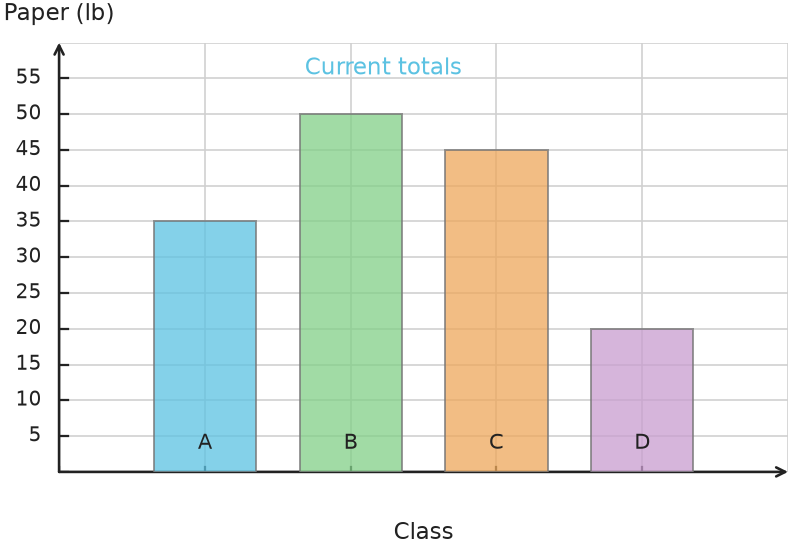
Figure for problem 535041

Hints

- Read each starting amount from the vertical scale. - Complete the changes in the order given and record each new amount. - When two amounts are combined and shared equally, add first and then divide by \(2\). - Check that the total amount of paper remains the same.

Solution

1. Read the starting amounts: Class A, \(35\,\text{lb}\); Class B, \(50\,\text{lb}\); Class C, \(45\,\text{lb}\); Class D, \(20\,\text{lb}\). 2. After Class C transfers \(10\,\text{lb}\), Class A has \(35 + 10 = 45\,\text{lb}\), and Class C has \(45 - 10 = 35\,\text{lb}\). 3. Classes B and D have \(50 + 20 = 70\,\text{lb}\) together. Dividing equally gives \(70 \div 2 = 35\,\text{lb}\) for each class. 4. The final amounts are Class A, \(45\,\text{lb}\), and Classes B, C, and D, \(35\,\text{lb}\) each. Class A has the greatest amount.

Answer

a) Class A: \(35\,\text{lb}\); Class B: \(50\,\text{lb}\); Class C: \(45\,\text{lb}\); Class D: \(20\,\text{lb}\) b) Class A: \(45\,\text{lb}\); Class B: \(35\,\text{lb}\); Class C: \(35\,\text{lb}\); Class D: \(35\,\text{lb}\) c) Class A

Multi-step problems with multiplication and division 404
A school surveyed \(100\) fourth-grade students about their favorite sports. The bar graph shows the results. a) How many students took the survey altogether? Verify the total using the graph. b) Which sport was chosen by exactly \(15\) more students than basketball? c) Is the statement true or false? Explain. “Exactly one-fourth of the students chose swimming or gymnastics.”
Figure for problem 535104

Hints

- Add all the bar values to verify the total. - Add \(15\) to the basketball value for part b). - Find one-fourth of the total and compare it with the combined swimming and gymnastics votes.

Solution

1. Add all five values: \(40 + 25 + 15 + 10 + 10 = 100\) students. 2. Basketball received \(25\) votes. A value \(15\) greater is \(25 + 15 = 40\), which is the soccer value. 3. Swimming and gymnastics received \(15 + 10 = 25\) votes. One-fourth of \(100\) is \(100 \div 4 = 25\). Therefore, the statement is true.

Answer

a) \(100\) students b) Soccer c) **True**, because swimming and gymnastics received \(25\) votes altogether, and \(100 \div 4 = 25\).
Multi-step problems with multiplication and division 405
A collector has blue stamps worth \(2\) cents each and green stamps worth \(3\) cents each. How much are all the stamps worth in dollars?
Figure for problem 537372

Hints

- Read both stamp counts from the labeled bars. - Find the value of each kind using its price per stamp. - Add the two values and convert cents to dollars.

Solution

1. Read the counts: \(30\) blue stamps and \(24\) green stamps. 2. The blue stamps are worth \(30\times2=60\) cents. 3. The green stamps are worth \(24\times3=72\) cents. 4. Together they are worth \(60+72=132\) cents, or \(\$1.32\).

Answer

The stamps are worth \(\$1.32\) altogether.
Multi-step problems with multiplication and division 406
A parking lot has \(6\) rows of \(11\) spaces. The chart counts reserved and occupied spaces; these are separate groups. How many spaces are neither reserved nor occupied?
Figure for problem 537380

Hints

- Find the total spaces from the number of rows and spaces per row. - Read the two unavailable-space counts from the chart. - Subtract both nonoverlapping groups from the overall total.

Solution

1. The lot has \(6\times11=66\) spaces. 2. There are \(8\) reserved spaces and \(17\) occupied spaces, a total of \(8+17=25\) unavailable spaces. 3. There are \(66-25=41\) spaces that are neither reserved nor occupied.

Answer

\(41\) spaces are neither reserved nor occupied.
Multi-step problems with multiplication and division 407
A school charging cabinet holds tablets. Three classes each need \(15\) charged tablets. Are there enough charged tablets? How many will remain?
Figure for problem 537383

Hints

- Read the charged-tablet total from the chart rather than adding both categories. - Find how many charged tablets the classes need altogether. - Check whether there are enough and then find any leftover.

Solution

1. The chart shows \(46\) charged tablets. 2. The classes need \(3\times15=45\) tablets. 3. Since \(46>45\), there are enough, with \(46-45=1\) charged tablet left.

Answer

Yes. There is enough for all three classes, and \(1\) charged tablet remains.
Multi-step problems with multiplication and division 408
In the stadium seating diagram, each dot represents \(10\) seats. If \(85\) seats are occupied, how many seats are still available?
Figure for problem 537416

Hints

- Use the array to count the dots efficiently. - Each dot stands for the same number of seats. - Compare the total capacity with the occupied-seat count.

Solution

1. The diagram has \(6\) rows of \(8\) dots, so it contains \(6\times8=48\) dots. 2. The total capacity is \(48\times10=480\) seats. 3. The number available is \(480-85=395\) seats.

Answer

\(395\) seats are still available.
Multi-step problems with multiplication and division 409
Each dot in the diagram represents one booklet in a reading project. Each booklet has \(24\) pages. Six students divide all the pages equally. How many pages does each student read?
Figure for problem 537419

Hints

- Use the diagram to determine the number of booklets. - Find the total number of pages before sharing them. - The final share must be equal for all six students.

Solution

1. Count the dots: there are \(35\) booklets. 2. The total number of pages is \(35\times24=35\times(20+4)=700+140=840\). 3. Dividing equally gives \(840\div6=140\) pages per student.

Answer

Each student reads \(140\) pages.
Multi-step problems with multiplication and division 410
Each dot in the warehouse diagram represents one pallet. Each pallet holds \(12\) cartons. If \(95\) cartons are shipped, how many cartons remain?
Figure for problem 537425

Hints

- Use the diagram to determine how many pallets there are. - Each pallet contains the same number of cartons. - Account for the shipment only after finding the full inventory.

Solution

1. Count the dots: there are \(56\) pallets. 2. The total number of cartons is \(56\times12=56\times(10+2)=560+112=672\). 3. After shipping \(95\) cartons, \(672-95=577\) cartons remain.

Answer

\(577\) cartons remain.
Multi-step problems with multiplication and division 411
In a school fun run, each dot in the array represents \(\$25\) raised. The event costs \(\$420\) to organize. How much money remains after the expenses are paid?
Figure for problem 537426

Hints

- Use the rows and columns to count the dots efficiently. - Four groups of \(\$25\) make \(\$100\). - Subtract the expenses from the amount raised.

Solution

1. The array has \(6\) rows of \(10\) dots, so it shows \(6 \times 10 = 60\) dots. 2. The total amount raised is \(60 \times \$25 = \$1500\). 3. After expenses, \(\$1500 - \$420 = \$1080\) remains.

Answer

\(\$1080\) remains after expenses.
Multi-step problems with multiplication and division 412
Each dot in the solar-array diagram represents one panel. Each panel contains \(18\) cells. After a hailstorm, \(27\) cells are damaged. How many cells still work?
Figure for problem 537427

Hints

- Use the diagram to determine the number of panels. - Find the total number of cells before accounting for damage. - Check that the final count is less than the original cell total.

Solution

1. Count the dots: there are \(45\) panels. 2. The total number of cells is \(45\times18=45\times(20-2)=900-90=810\). 3. Subtract the damaged cells: \(810-27=783\).

Answer

\(783\) cells still work.
Multi-step problems with multiplication and division 413
In the inventory diagram, each dot represents \(3\) tablets. All the tablets are divided equally among \(6\) classes. How many tablets does each class receive? Show a reasonable two-step calculation.
Figure for problem 537429

Hints

- Use the diagram to determine how many equal tablet groups are represented. - Keep track of what one dot represents. - Your two-step calculation should connect the diagram total to one class's share.

Solution

1. The diagram contains \(90\) dots, so it represents \(90\times3=270\) tablets. 2. Dividing equally among \(6\) classes gives \(270\div6=45\) tablets per class.

Answer

\(90\times3=270\), then \(270\div6=45\). Each class receives \(45\) tablets.
Multi-step problems with multiplication and division 414
Each row shows the trips planned for one school bus this week. Filled dots are trips that will run; unfilled dots are canceled trips. The school needs \(30\) trips for its field trips. Are enough trips still scheduled? How many extra trips are available?
Figure for problem 537440

Hints

- Each row belongs to one bus. Count the planned trips in all rows. - Use the unfilled dots to work out how many trips will run. - Compare that number with the trips the school needs.

Solution

1. The picture has \(5\) rows of \(8\) trips, so \(5\times8=40\) trips were planned. 2. Seven dots are unfilled, so \(40-7=33\) trips will run. 3. The school needs \(30\) trips. There are enough, with \(33-30=3\) extra trips.

Answer

Yes. There are \(3\) extra trips available.
Multi-step problems with multiplication and division 415
A mosaic uses four kinds of tiles: blue tiles cost \(\$2\) each, red tiles \(\$3\) each, green tiles \(\$4\) each, and yellow tiles \(\$5\) each. How much does the entire mosaic cost?
Figure for problem 537443

Hints

- Read the four tile counts from their labeled bars. - Multiply each count by that kind of tile's price. - Add the four costs after you have found them separately.

Solution

1. Read the chart: \(24\) blue, \(18\) red, \(12\) green and \(6\) yellow tiles. 2. Blue tiles cost \(24\times\$2=\$48\). 3. Red tiles cost \(18\times\$3=\$54\). 4. Green tiles cost \(12\times\$4=\$48\). 5. Yellow tiles cost \(6\times\$5=\$30\). 6. Add the costs: \(\$48+\$54+\$48+\$30=\$180\).

Answer

The mosaic costs \(\$180\).
Multi-step problems with multiplication and division 416
Six tables each have \(8\) seats. After everyone sits down, \(11\) seats are empty. Let \(s\) be the number of occupied seats. Which equation models the situation correctly? A. \(s=6 \times 8-11\) B. \(s=6 \times 8-(11-6)\) C. \(s=6 \times (11-8)\) Explain what the operations in each rejected equation would mean, then solve the correct equation.

Hints

- Interpret each intermediate quantity in words before calculating it. - The \(11\) empty seats refer to the whole seating arrangement, not to one table or to a difference between two givens. - A plausible numerical result is not enough; every operation must match an action or relationship in the story.

Solution

1. The total number of seats is \(6 \times 8=48\). 2. The \(11\) empty seats are removed from that total, so equation A models the story. 3. Equation B removes only \(11-6=5\) seats, which has no meaning in the situation. Equation C treats \(11-8\) as seats per table, which also has no meaning in the story. 4. Thus \(s=48-11=37\).

Answer

Equation A is correct: \(s=6\times8-11\), so \(s=37\). Equation B subtracts \(11-6=5\) from the total seats, but that \(5\) has no meaning in the situation. Equation C treats \(11-8=3\) as a number of occupied seats per table, which also does not match the situation.
Multi-step problems with multiplication and division 417
Nine buses carry \(36\) students each, and another \(47\) students arrive by car. Tiago claims that \(520\) students arrive altogether. First use a reasonable estimate to judge the claim. Then find the exact total and explain whether the claim is reasonable.

Hints

- Round the quantities to nearby friendly numbers before doing exact arithmetic. - Use the estimate only to judge the size of the claim. - Then compute the exact bus total and include the students arriving by car.

Solution

1. Estimate \(36\) as \(40\) and \(47\) as \(50\): \(9\times40+50=410\). A total near \(410\) makes \(520\) look too large. 2. The exact bus total is \(9\times36=324\). 3. The exact overall total is \(324+47=371\). 4. The claim of \(520\) is not reasonable and is not correct.

Answer

A reasonable estimate is about \(410\) students. The exact total is \(371\), so the claim of \(520\) is not reasonable.
Multi-step problems with multiplication and division 418
A theater has \(12\) rows with \(24\) seats in each row. During a performance, \(5\) seats are empty. Let \(o\) be the number of occupied seats. Two students propose these equations: \(o=12 \times 24-5\) \(o=12 \times (24-5)\) Which equation matches the situation? Explain the error in the other equation, then find \(o\).

Hints

- Decide whether the \(5\) empty seats belong to each row or to the theater as a whole. - Both equations have positive intermediate values, so judge them by meaning rather than by whether a calculation looks possible. - Interpret the parentheses in words.

Solution

1. The theater has \(12 \times 24=288\) seats altogether. 2. The \(5\) empty seats are removed once from the theater total, so \(o=12 \times 24-5\) is correct. 3. The other equation subtracts \(5\) seats from every row, as if each of the \(12\) rows had \(5\) empty seats. 4. The occupied-seat count is \(288-5=283\).

Answer

The correct equation is \(o=12 \times 24-5\). The other equation incorrectly removes \(5\) seats from every row. Thus \(o=283\).
Multi-step problems with multiplication and division 419
A school supply drive collects \(28\) cases with \(42\) notebooks in each case, plus \(115\) loose notebooks. Before finding the exact total, choose the most reasonable estimate from \(1000\), \(1300\), and \(1600\). Show a rounded-number estimate that supports your choice. Then find the exact total and explain whether your estimate was reasonable.

Hints

- Round the two factors to nearby tens before multiplying. - Round the loose-notebook count to a nearby hundred for the estimate. - After finding the exact total, compare it with your estimate.

Solution

1. Round \(28\) to \(30\), \(42\) to \(40\), and \(115\) to about \(100\). This gives \(30\times40+100=1300\), so \(1300\) is the best estimate. 2. The exact case total is \(28\times42=1176\). 3. Add the loose notebooks: \(1176+115=1291\). 4. The exact total \(1291\) is only \(9\) away from \(1300\), so the estimate is reasonable.

Answer

The most reasonable estimate is \(1300\), because \(30\times40+100=1300\). The exact total is \(28\times42+115=1291\), which is only \(9\) away from the estimate, so \(1300\) is reasonable.
Multi-step problems with multiplication and division 420
A pool concession stand sells orders of fries at these prices: <table> <tr><th>Number of orders</th><th>Price</th></tr> <tr><td>\(1\) order</td><td>\(\$3\)</td></tr> <tr><td>\(2\) orders</td><td>\(\$5\)</td></tr> <tr><td>\(4\) orders</td><td>\(\$9\)</td></tr> </table> a) What are the different ways to buy exactly \(3\) orders, and what does each way cost? b) What is the least expensive way to buy exactly \(5\) orders? Show your work. c) How much do you save by buying the \(4\)-order deal instead of four single orders?

Hints

- Build the requested number of orders from the choices in the table. - There may be more than one way to make the same number of orders. - Find and compare the total cost of each combination. - Subtract the deal price from the cost of four single orders to find the savings.

Solution

1. For \(3\) orders, three single orders cost \(3 \times 3 = 9\) dollars. One \(2\)-order deal plus one single order costs \(5 + 3 = 8\) dollars. 2. For \(5\) orders, a \(4\)-order deal plus one single order costs \(9 + 3 = 12\) dollars. Two \(2\)-order deals plus one single order cost \(5 + 5 + 3 = 13\) dollars. One \(2\)-order deal plus three single orders costs \(5 + 3 + 3 + 3 = 14\) dollars. Five single orders cost \(5 \times 3 = 15\) dollars. Therefore, the least expensive price is \(\$12\). 3. Four single orders cost \(4 \times 3 = 12\) dollars. The \(4\)-order deal costs \(9\) dollars, so the savings are \(12 - 9 = 3\) dollars.

Answer

a) Three single orders cost \(\$9\). One \(2\)-order deal plus one single order costs \(\$8\). b) The least expensive price is \(\$12\), using the \(4\)-order deal plus one single order. c) You save \(\$3\).
Multi-step problems with multiplication and division 421
A fair sells raffle tickets at these prices: <table> <tr><th>Number of tickets</th><th>Price</th></tr> <tr><td>\(1\) ticket</td><td>\(\$2\)</td></tr> <tr><td>\(4\) tickets</td><td>\(\$7\)</td></tr> <tr><td>\(6\) tickets</td><td>\(\$10\)</td></tr> <tr><td>\(10\) tickets</td><td>\(\$15\)</td></tr> </table> a) Find the least expensive way to buy exactly \(14\) tickets. b) Lucas wants exactly \(11\) tickets. What is the least amount he must pay? c) Compare two ways to buy \(12\) tickets: two \(6\)-ticket packages or three \(4\)-ticket packages. Which costs less?

Hints

- Start with the larger packages, but make sure the total number is exact. - Compare the cost of buying tickets separately with the package prices. - Test different combinations and add their prices. - For part c), calculate each total separately before comparing.

Solution

1. Fourteen single tickets would cost \(14 \times 2 = 28\) dollars. Compared with single-ticket prices, a \(4\)-ticket package saves \(\$1\), a \(6\)-ticket package saves \(\$2\), and a \(10\)-ticket package saves \(\$5\). For exactly \(14\) tickets, the greatest possible savings are \(\$6\), using \(10 + 4\) tickets. The cost is \(28 - 6 = 22\) dollars. 2. Eleven single tickets would cost \(11 \times 2 = 22\) dollars. The greatest possible savings are \(\$5\), using one \(10\)-ticket package and one single ticket. The cost is \(22 - 5 = 17\) dollars. 3. Two \(6\)-ticket packages cost \(2 \times 10 = 20\) dollars. Three \(4\)-ticket packages cost \(3 \times 7 = 21\) dollars. The first way costs \(1\) dollar less.

Answer

a) \(\$22\), using \(10 + 4\) tickets b) \(\$17\), using \(10 + 1\) tickets c) Two \(6\)-ticket packages cost less by \(\$1\).
Multi-step problems with multiplication and division 422
A large archive has \(4\) sections. Each section has \(12\) aisles. Each aisle has \(15\) filing cabinets. Each cabinet has \(6\) drawers, and each drawer contains \(8\) file folders. How many file folders are in the archive altogether?

Hints

- Find the number of objects at one level before moving to the next level. - Determine the total number of cabinets before finding the drawers. - Multiply the number of drawers by the folders in each drawer. - Check that each step uses the total from the previous level.

Solution

1. Find the total number of aisles: \(4\times 12=48\). 2. Find the total number of filing cabinets: \(48\times 15=720\). 3. Find the total number of drawers: \(720\times 6=4320\). 4. Find the total number of file folders: \(4320\times 8=34{,}560\).

Answer

The archive contains \(34{,}560\) file folders.
Multi-step problems with multiplication and division 423
A historic train has first-class cars with \(40\) seats and coach cars with \(70\) seats. The train must have exactly \(400\) seats, and \(3\) first-class cars are already planned. Every passenger car is \(72\,\text{ft}\) long, and the locomotive is \(50\,\text{ft}\) long. a) How many coach cars are needed? b) What is the total length of the train, including the locomotive?

Hints

- Find the number of seats already provided by the first-class cars. - Subtract to find how many seats are still needed. - Find how many groups of \(70\) seats make the remaining number of seats. - Include every passenger car and the locomotive in the total length.

Solution

1. The first-class cars provide \(3 \times 40 = 120\) seats. 2. The number of seats still needed is \(400 - 120 = 280\). 3. Since \(4 \times 70 = 280\), the train needs \(4\) coach cars. 4. The train has \(3 + 4 = 7\) passenger cars. 5. The passenger cars are \(7 \times 72\,\text{ft} = 504\,\text{ft}\) long in all. 6. Including the locomotive, the train is \(504\,\text{ft} + 50\,\text{ft} = 554\,\text{ft}\) long.

Answer

a) The train needs \(4\) coach cars. b) The train is \(554\,\text{ft}\) long.
Multi-step problems with multiplication and division 424
A school fair prepares \(400\) raffle tickets. During the first hour, exactly one-fourth of all the tickets are sold. During the second hour, \(35\) fewer tickets are sold than during the first hour. During the third hour, twice as many tickets are sold as during the second hour. How many tickets remain after the three hours?

Hints

- Find the number of tickets sold during each hour in order. - What operation finds one-fourth of the starting number? - After finding all three hourly amounts, how can you find the total number sold? - How can you find what remains from the starting number?

Solution

1. Find the number sold during the first hour: \(\frac{1}{4} \times 400 = 100\). 2. Find the number sold during the second hour: \(100 - 35 = 65\). 3. Find the number sold during the third hour: \(2 \times 65 = 130\). 4. Find the total number sold: \(100 + 65 + 130 = 295\). 5. Subtract from the starting number: \(400 - 295 = 105\).

Answer

There are \(105\) raffle tickets remaining.
Multi-step problems with multiplication and division 425
Two packages of construction paper contain \(80\) sheets and \(48\) sheets. One-eighth of the sheets is removed from each package to make a display. How many sheets remain in the two packages altogether? Solve the problem in two different ways.

Hints

- Try finding the number of sheets remaining in each package separately. - Could you instead begin by finding the total number of sheets in both packages? - What happens if you combine the removed sheets before subtracting? - How many sheets are one-eighth of \(80\)? How many are one-eighth of \(48\)?

Solution

Method 1: 1. In the first package, \(80 - (\frac{1}{8} \times 80) = 80 - 10 = 70\) sheets remain. 2. In the second package, \(48 - (\frac{1}{8} \times 48) = 48 - 6 = 42\) sheets remain. 3. Add the remaining sheets: \(70 + 42 = 112\). Method 2: 1. Find the total number of sheets: \(80 + 48 = 128\). 2. One-eighth of all the sheets is removed: \(\frac{1}{8} \times 128 = 16\). 3. Subtract the removed sheets: \(128 - 16 = 112\).

Answer

There are \(112\) sheets of construction paper remaining altogether.
Multi-step problems with multiplication and division 426
Three friends collect equal-sized bags of acorns for a wildlife center. Leo collects \(4\) bags, Mia collects \(5\) bags, and Tom collects \(3\) bags. They receive a total reward of \(\$60\), divided according to the number of bags each person collected. a) How much money does each friend receive? b) Mia says, “I would receive less if we split the money equally among the three of us.” Is she correct? Support your answer with a calculation.

Hints

- Find the total number of bags and use multiplication to find the reward per bag. - Use each friend’s number of bags to find that person’s share. - For part b, compare Mia’s share with one-third of the total reward.

Solution

1. The friends collected \(4 + 5 + 3 = 12\) bags. 2. Since \(12 \times \$5 = \$60\), the reward is \(\$5\) per bag. 3. Leo receives \(4 \times \$5 = \$20\), Mia receives \(5 \times \$5 = \$25\), and Tom receives \(3 \times \$5 = \$15\). 4. An equal three-way split gives each friend \(\$60 \div 3 = \$20\). 5. Mia would receive \(\$25 - \$20 = \$5\) less under an equal split, so she is correct.

Answer

a) Leo receives \(\$20\), Mia receives \(\$25\), and Tom receives \(\$15\). b) Yes. An equal split would give Mia \(\$20\), which is \(\$5\) less than \(\$25\).
Multi-step problems with multiplication and division 427
A school festival orders juice. Each case of apple juice contains \(6\) bottles, and each case of orange juice contains \(10\) bottles. The order includes \(3\) cases of apple juice and \(2\) cases of orange juice. The total bill is \(\$76\), and every bottle has the same price. a) How many bottles were ordered? b) How much does one bottle cost? c) What is the total cost of the apple juice, and what is the total cost of the orange juice?

Hints

- Find the number of bottles of each kind first. - Use multiplication to find the price per bottle that makes the total bill. - Multiply the price per bottle by each kind’s bottle count.

Solution

1. The apple juice order contains \(3 \times 6 = 18\) bottles. 2. The orange juice order contains \(2 \times 10 = 20\) bottles. 3. The total number of bottles is \(18 + 20 = 38\). 4. Since \(38 \times \$2 = \$76\), one bottle costs \(\$2\). 5. The apple juice costs \(18 \times \$2 = \$36\), and the orange juice costs \(20 \times \$2 = \$40\).

Answer

a) \(38\) bottles were ordered. b) One bottle costs \(\$2\). c) The apple juice costs \(\$36\), and the orange juice costs \(\$40\).
Multi-step problems with multiplication and division 428
An elementary school receives \(240\) new nonfiction books for its library. During the first \(5\) days, volunteers shelve \(24\) books each day. After that, they shelve \(30\) books each day. How many days does it take to shelve all the books?

Hints

- How many books are shelved during the first phase? - How many books remain after the first \(5\) days? - Use the faster daily rate to find the remaining number of days. - Add the days from both phases.

Solution

1. Find the number shelved during the first \(5\) days: \(5 \times 24 = 120\) books. 2. Find the number remaining: \(240 - 120 = 120\) books. 3. Find the additional days needed: \(120 \div 30 = 4\) days. 4. Add the two time periods: \(5 + 4 = 9\) days.

Answer

It takes \(9\) days to shelve all the books.
Multi-step problems with multiplication and division 429
Lukas has an \(18\,\text{ft}\) rope. He wants to cut it into jump ropes that are each \(6\,\text{ft}\) long. Each cut takes \(15\) seconds. How long will it take him to cut the rope into all the pieces?

Hints

- Find how many pieces the rope will make. - Does the final piece require another cut? - Sketch the rope and mark each place where a cut is needed.

Solution

1. Find the number of pieces: \(18 \div 6 = 3\) pieces. 2. To make \(3\) pieces from one rope, Lukas needs \(3 - 1 = 2\) cuts. 3. Find the total cutting time: \(2 \times 15 = 30\) seconds.

Answer

It will take Lukas \(30\) seconds.
Multi-step problems with multiplication and division 430
Lucas has saved \(\$600\). He spends exactly one-half of his money on a new bicycle. A helmet costs one-fifth of his total savings. He spends the rest on a bike rack and lock set. How much more does the bicycle cost than the rack and lock set?

Hints

- Find the amount spent on each item in order. - Both fractions refer to the original \(\$600\). - Which two costs must you compare to find the difference?

Solution

1. Find the bicycle cost: \(\frac{1}{2} \times \$600 = \$300\). 2. Find the helmet cost: \(\frac{1}{5} \times \$600 = \$120\). 3. Find the total spent on the bicycle and helmet: \(\$300 + \$120 = \$420\). 4. Find the rack and lock set cost: \(\$600 - \$420 = \$180\). 5. Find the difference: \(\$300 - \$180 = \$120\).

Answer

The bicycle costs \(\$120\) more than the rack and lock set.
Multi-step problems with multiplication and division 431
A bakery uses \(156\,\text{lb}\) of wheat flour, \(98\,\text{lb}\) of rye flour, and \(45\,\text{lb}\) of spelt flour in one week. The next week, it uses twice as much wheat flour, three times as much rye flour, and four times as much spelt flour. How many more pounds of flour does the bakery use in the second week?

Hints

- Find the total flour used in the first week. - Use each multiplier to find the second week's amounts. - Add the second week's amounts and subtract the first week's total.

Solution

1. Find the first week's total: \(156\,\text{lb} + 98\,\text{lb} + 45\,\text{lb} = 299\,\text{lb}\). 2. Find the second week's amounts: \(156\,\text{lb} \times 2 = 312\,\text{lb}\), \(98\,\text{lb} \times 3 = 294\,\text{lb}\), and \(45\,\text{lb} \times 4 = 180\,\text{lb}\). 3. Find the second week's total: \(312\,\text{lb} + 294\,\text{lb} + 180\,\text{lb} = 786\,\text{lb}\). 4. Find the increase: \(786\,\text{lb} - 299\,\text{lb} = 487\,\text{lb}\).

Answer

The bakery uses \(487\,\text{lb}\) more flour in the second week.
Multi-step problems with multiplication and division 432
A construction company is paving a public plaza in three sections. The first section requires \(4320\) paving stones. The second section requires four times as many stones as the first. The third section requires exactly one-half as many stones as the second. Are \(25{,}000\) ordered stones enough for the entire plaza? Find how many stones will be left over or how many more are needed.

Hints

- Find the number needed for each section in order. - How many stones are needed for the entire project? - Compare the total need with the number ordered.

Solution

1. Find the stones needed for the second section: \(4 \times 4320 = 17{,}280\). 2. Find the stones needed for the third section: \(\frac{1}{2} \times 17{,}280 = 8640\). 3. Find the total number needed: \(4320 + 17{,}280 + 8640 = 30{,}240\). 4. Since \(30{,}240 > 25{,}000\), the order is not enough. 5. Find the shortage: \(30{,}240 - 25{,}000 = 5240\).

Answer

No. The order is short by \(5240\) paving stones.
Multi-step problems with multiplication and division 433
A fruit warehouse distributes \(4800\,\text{lb}\) of apples: - One-half of the apples goes to grocery stores. - One-fourth is pressed for apple juice. - One-eighth is used for applesauce. - The remaining apples are donated to a farm. How many pounds of apples does the farm receive? Compare this amount with the amount used for applesauce. What do you notice? Explain.

Hints

- First find the number of pounds used for the first three purposes. - How much remains from the total of \(4800\,\text{lb}\)? - How many eighths are equal to one-half and one-fourth? - What do the three given fractions add to?

Solution

1. Find the amount sent to grocery stores: \(\frac{1}{2} \times 4800\,\text{lb} = 2400\,\text{lb}\). 2. Find the amount used for juice: \(\frac{1}{4} \times 4800\,\text{lb} = 1200\,\text{lb}\). 3. Find the amount used for applesauce: \(\frac{1}{8} \times 4800\,\text{lb} = 600\,\text{lb}\). 4. Add the assigned amounts: \(2400\,\text{lb} + 1200\,\text{lb} + 600\,\text{lb} = 4200\,\text{lb}\). 5. Find the amount donated: \(4800\,\text{lb} - 4200\,\text{lb} = 600\,\text{lb}\). 6. The donated amount equals the applesauce amount. This is because \(\frac{1}{2} + \frac{1}{4} + \frac{1}{8} = \frac{4}{8} + \frac{2}{8} + \frac{1}{8} = \frac{7}{8}\), leaving \(\frac{1}{8}\).

Answer

The farm receives \(600\,\text{lb}\) of apples. This is the same amount used for applesauce because the assigned fractions total \(\frac{7}{8}\), leaving another \(\frac{1}{8}\).
Multi-step problems with multiplication and division 434
The Parker family is saving for a trip to an amusement park. Each month, the parents put \(\$35\) into a savings jar, and each of the two children adds \(\$5\). In June and December, the grandparents add an extra \(\$50\). During the year, the family takes \(\$20\) from the jar three times for ice cream. How much money is in the jar after one year?

Hints

- Use \(12\) months for the monthly deposits. - Remember that both children contribute each month. - Add all deposits before subtracting the withdrawals.

Solution

1. The parents contribute \(12\times\$35=\$420\). 2. The two children contribute \(12\times2\times\$5=\$120\). 3. The grandparents contribute \(2\times\$50=\$100\). 4. Total deposits are \(\$420+\$120+\$100=\$640\). 5. The family removes \(3\times\$20=\$60\). 6. The final amount is \(\$640-\$60=\$580\).

Answer

\(\$580\)
Multi-step problems with multiplication and division 435
Jordan wants to buy a bicycle that costs \(\$320\). Jordan has already saved \(\$45\) and receives \(\$15\) each month. Jordan also receives \(\$60\) for a birthday and \(\$30\) for a winter holiday, but spends \(\$4\) on candy each month. After one year, is there enough money for the bicycle? If not, how much more is needed? If so, how much remains?

Hints

- Include the starting savings, monthly income, and gifts. - Subtract the total monthly spending for the year. - Compare the final savings with the bicycle price.

Solution

1. Monthly income for the year is \(12\times\$15=\$180\). 2. The two gifts total \(\$60+\$30=\$90\). 3. Yearly spending is \(12\times\$4=\$48\). 4. The amount saved after one year is \(\$45+\$180+\$90-\$48=\$267\). 5. Since \(\$267<\$320\), more money is needed. The shortage is \(\$320-\$267=\$53\).

Answer

No. Jordan needs \(\$53\) more.
Multi-step problems with multiplication and division 436
A wildlife park receives \(4800\,\text{lb}\) of hay for one week. The elephant habitat uses one-half of the hay. The zebra habitat uses one-fifth of the total amount. The remaining hay is for the ponies. How many more pounds of hay does the elephant habitat use than the ponies?

Hints

- First find how much hay each animal group receives. - What operations represent one-half and one-fifth of a quantity? - The final question asks for a difference, not only the remaining amount.

Solution

1. Find the hay used by the elephant habitat: \(\frac{1}{2} \times 4800\,\text{lb} = 2400\,\text{lb}\). 2. Find the hay used by the zebra habitat: \(\frac{1}{5} \times 4800\,\text{lb} = 960\,\text{lb}\). 3. Find the hay used by the first two habitats: \(2400\,\text{lb} + 960\,\text{lb} = 3360\,\text{lb}\). 4. Find the hay for the ponies: \(4800\,\text{lb} - 3360\,\text{lb} = 1440\,\text{lb}\). 5. Find the difference: \(2400\,\text{lb} - 1440\,\text{lb} = 960\,\text{lb}\).

Answer

The elephant habitat uses \(960\,\text{lb}\) more hay than the ponies.
Multi-step problems with multiplication and division 437
A school garden harvests \(80\,\text{lb}\) of apples. On Monday, one-fourth of the apples is pressed for juice. On Tuesday, one-fifth of the apples that remain is made into applesauce. On Wednesday, one-half of the apples then remaining is donated for a school celebration. How many pounds of apples remain at the end?

Hints

- Break the problem into one day at a time. - After each step, record how many pounds remain. - Check whether each fraction refers to the original amount or to the amount remaining. - A table or diagram may help you track the changing amount.

Solution

1. On Monday, \(\frac{1}{4} \times 80\,\text{lb} = 20\,\text{lb}\) is used, leaving \(80\,\text{lb} - 20\,\text{lb} = 60\,\text{lb}\). 2. On Tuesday, \(\frac{1}{5} \times 60\,\text{lb} = 12\,\text{lb}\) is used, leaving \(60\,\text{lb} - 12\,\text{lb} = 48\,\text{lb}\). 3. On Wednesday, \(\frac{1}{2} \times 48\,\text{lb} = 24\,\text{lb}\) is donated, leaving \(48\,\text{lb} - 24\,\text{lb} = 24\,\text{lb}\).

Answer

\(24\,\text{lb}\) of apples remain.
Multi-step problems with multiplication and division 438
A hiker plans to walk an \(18\)-mile trail from Maple Point to Lakeview. After walking for a while, the hiker realizes that a water bottle was dropped, walks back to find it, and then continues to Lakeview. The hiker walks \(22\,\text{miles}\) altogether. a) How many extra miles does the hiker walk compared with the direct route? b) The hiker notices the missing bottle after walking exactly \(8\,\text{miles}\) from Maple Point. How far from Maple Point is the bottle found?

Hints

- Compare the actual distance with the direct trail distance first. - The same backtracked section contributes to the trip twice: once backward and once when retraced forward. - Use the turnaround location only after determining the one-way backtrack distance.

Solution

1. The extra distance is \(22-18=4\,\text{miles}\). 2. The search section is walked once backward and once forward, so the one-way backtrack is \(4\div2=2\,\text{miles}\). 3. The hiker turns around at mile \(8\) and walks back \(2\) miles, so the bottle is \(8-2=6\,\text{miles}\) from Maple Point.

Answer

a) The hiker walks \(4\,\text{miles}\) extra. b) The bottle is found \(6\,\text{miles}\) from Maple Point.
Multi-step problems with multiplication and division 439
A print shop must print \(720\) posters. During the first hour, one-sixth of all the posters are printed. During the second hour, \(55\) more posters are printed than during the first hour. The remaining posters are printed during the third hour. During which hour are the most posters printed? Find the number printed during each hour.

Hints

- Find the number printed during each hour in order. - How can you find the fraction printed during the first hour? - After finding the first two hourly amounts, how can you find the third? - Compare all three results.

Solution

1. Find the first-hour amount: \(\frac{1}{6} \times 720 = 120\). 2. Find the second-hour amount: \(120 + 55 = 175\). 3. Find the total for the first two hours: \(120 + 175 = 295\). 4. Find the third-hour amount: \(720 - 295 = 425\). 5. Since \(425 > 175 > 120\), the most posters are printed during the third hour.

Answer

The first hour has \(120\) posters, the second hour has \(175\), and the third hour has \(425\). The most posters are printed during the third hour.
Multi-step problems with multiplication and division 440
A sporting-goods manufacturer makes \(6420\) basketballs and \(9150\) soccer balls. The same amount of material used for \(6\) soccer balls could make \(5\) basketballs. An employee says, “If we had used all the material only for basketballs, we could have made more than \(14{,}000\) basketballs.” Is the employee correct? Support your answer with calculations.

Hints

- First group the soccer balls in sets of \(6\). - Convert those groups to the equivalent number of basketballs. - Add that amount to the basketballs already produced. - Compare the result with \(14{,}000\).

Solution

1. The \(9150\) soccer balls form \(9150\div 6=1525\) groups of \(6\). 2. That material could make \(1525\times 5=7625\) basketballs. 3. The total possible number of basketballs is \(6420+7625=14{,}045\). 4. Since \(14{,}045>14{,}000\), the employee is correct.

Answer

Yes. The available material could have produced \(14{,}045\) basketballs.
Multi-step problems with multiplication and division 441
A school club has \(\$500\). It buys \(8\) shirts for \(\$27\) each and \(5\) hats for \(\$18\) each. Let \(m\) be the money left after those purchases. Write one equation for \(m\), solve it, and decide whether the club can also pay a \(\$200\) event fee. If not, find the shortfall.

Hints

- Represent both purchase costs in the same equation before finding the remainder. - Keep the meaning of \(m\) fixed as “money left after the purchases.” - After solving for \(m\), compare it with the separate event fee.

Solution

1. The shirt cost is \(8\times\$27=\$216\). 2. The hat cost is \(5\times\$18=\$90\). 3. One equation is \(m=500-8\times27-5\times18\). 4. Thus \(m=500-216-90=194\), so the club cannot pay the \(\$200\) fee. 5. The shortfall is \(\$200-\$194=\$6\).

Answer

\(m=500-8\times27-5\times18\), so \(m=194\). The club is \(\$6\) short of the \(\$200\) event fee.
Multi-step problems with multiplication and division 442
A school-supply store sells notebooks for \(80\) cents and matching covers for \(35\) cents. A teacher buys the same number of notebooks and covers. She pays with three \(\$10\) bills and receives \(\$2.40\) in change. How many notebooks does she buy?

Hints

- Determine the amount actually spent and express it in cents. - Find the cost of one notebook-and-cover pair. - Use convenient groups such as ten pairs and then refine the remaining amount rather than multiplying a three-digit number by a two-digit number directly.

Solution

1. The teacher spends \(\$30.00-\$2.40=\$27.60\), or \(2760\) cents. 2. One notebook-and-cover pair costs \(80+35=115\) cents. 3. Ten pairs cost \(1150\) cents, so twenty pairs cost \(2 \times 1150=2300\) cents. 4. The remaining amount is \(2760-2300=460\) cents. Since \(4 \times 115=460\), four more pairs use the remainder. 5. The teacher buys \(20+4=24\) pairs, so she buys \(24\) notebooks.

Answer

The teacher buys \(24\) notebooks.

All problems may be used, copied and printed free of charge for school and tutoring, including paid tutoring. Commercial adaptations as well as publication or redistribution on the internet are not permitted.

