Aimathic
Login | English | Deutsch

Grade 7 math worksheets

Build your own math worksheets from 35,000+ problems for grades 3 to 12, from fractions to AP Calculus. Every problem comes with step-by-step solutions.

Add and subtract integers

Learning goals

  • Adds integers with like and unlike signs.
  • Subtracts integers.
  • Rewrites integer subtraction as adding the opposite.
  • Explains signed integer addition and subtraction on a number line.
  • Evaluates integer sums and differences containing brackets.
  • Uses signed integer changes to find an initial or final value.

Click problems to add them to your worksheet.

Add and subtract integers 1
Evaluate. a) \(-14-19\) b) \(22-(-11)\) c) \(-35-(-15)\) d) \(8-23\)

Hints

- Rewrite subtraction as adding the opposite. - Decide the sign before calculating. - Picture the movement on a number line.

Solution

1. \(-14-19=-33\). 2. Subtracting a negative is adding its opposite: \(22-(-11)=22+11=33\). 3. \(-35-(-15)=-35+15=-20\). 4. \(8-23=-15\).

Answer

a) \(-33\) b) \(33\) c) \(-20\) d) \(-15\)
Add and subtract integers 2
A submarine is at \(-150\,\text{m}\) relative to sea level and then descends another \(75\,\text{m}\). Write an integer addition equation and find its new position.

Hints

- Positions below sea level are negative. - Descending makes the position more negative. - Represent the change as a signed number.

Solution

1. The starting position is \(-150\,\text{m}\). 2. Descending \(75\,\text{m}\) is represented by adding \(-75\). 3. \(-150+(-75)=-225\), so the new position is \(-225\,\text{m}\).

Answer

\(-150+(-75)=-225\). The submarine is at \(-225\,\text{m}\).
Add and subtract integers 3
A weather station records a temperature of \(-9\,^\circ\text{F}\) one winter morning. During the morning, the temperature rises by \(14\,^\circ\text{F}\). What temperature does the station now show?

Hints

- Picture a thermometer as a vertical number line. - Which direction represents an increase in temperature? - First determine how far it is from \(-9\) to \(0\).

Solution

1. Represent the increase by adding a positive number: \(-9+14\). 2. Calculate: \(-9+14=5\), so the temperature is \(5\,^\circ\text{F}\).

Answer

The station now shows \(5\,^\circ\text{F}\).
Add and subtract integers 4
Mr. Weber's checking account has a balance of \(-\$180\). He deposits \(\$250\) in cash. What is the new account balance?

Hints

- A negative account balance represents money owed to the bank. - What happens to the amount owed when money is deposited? - Will the account still have a negative balance after the deposit?

Solution

1. Add the deposit to the current balance: \(-180+250\). 2. Calculate: \(-180+250=70\).

Answer

The new account balance is \(\$70\).
Add and subtract integers 5
A type of plastic loses its flexibility and becomes brittle at \(-35\,^\circ\text{C}\). A new material mixture raises this threshold by \(12\) degrees. At what temperature does the new plastic become brittle?

Hints

- Picture the temperatures on a thermometer or number line. - Does raising a temperature threshold make the value greater or less? - Which direction do you move on the number line when a temperature increases?

Solution

1. The original threshold is \(-35\,^\circ\text{C}\). 2. Raising the threshold by \(12\) degrees means adding \(12\): \(-35+12=-23\).

Answer

The new plastic becomes brittle at \(-23\,^\circ\text{C}\).
Add and subtract integers 6
A hiker begins a climb in a valley where the temperature is \(4\,^\circ\text{F}\). By the time the hiker reaches a mountain shelter, the temperature has dropped a total of \(15\) degrees. What is the temperature at the shelter?

Hints

- Decide whether the final temperature should be positive or negative. - You are subtracting a number greater than the starting value. - A thermometer sketch can help you cross zero.

Solution

1. A drop of \(15\) degrees means subtracting \(15\) from the initial temperature. 2. Calculate: \(4-15=-11\), so the temperature is \(-11\,^\circ\text{F}\).

Answer

The temperature at the shelter is \(-11\,^\circ\text{F}\).
Add and subtract integers 7
What number is \(58\) greater than \(-33\)? Write and evaluate an equation.

Hints

- Increasing a number means moving right on a number line. - Translate “greater than” into addition. - Check whether the result should be positive or negative.

Solution

1. “\(58\) greater than” means add \(58\) to \(-33\). 2. \(-33+58=25\).

Answer

\(-33+58=25\)
Add and subtract integers 8
During a winter night, the temperature drops to \(-12\,^\circ\text{C}\). By noon the next day, the temperature has risen to \(7\,^\circ\text{C}\). By how many degrees Celsius did the temperature increase?

Hints

- Picture the temperatures on a number line. - Find the distance from the negative temperature to zero. - Find the distance from zero to the positive temperature. - Which operation finds the change from an initial value to a final value?

Solution

1. The initial temperature is \(-12\,^\circ\text{C}\). 2. The final temperature is \(7\,^\circ\text{C}\). 3. Subtract the initial temperature from the final temperature: \(7-(-12)=7+12=19\).

Answer

The temperature increased by \(19\,^\circ\text{C}\).
Add and subtract integers 9
Rearrange and group the terms to create convenient multiples of \(100\). Write the regrouped expression, then evaluate. \(-250 + 68 + 145 - 50 + 32 - 45\)

Hints

- Keep the sign attached to each term when rearranging. - Look for pairs that combine to exact hundreds. - Show the regrouping before the final total.

Solution

1. Regroup as \((-250-50)+(68+32)+(145-45)\). 2. The groups are \(-300\), \(100\), and \(100\). 3. The total is \(-100\).

Answer

\((-250-50)+(68+32)+(145-45)=-300+100+100=-100\)
Add and subtract integers 10
Complete each statement about how the result of a subtraction changes. a) If the first number increases by \(14\) and the number being subtracted stays the same, the result \(\square\) by \(\square\). b) If the first number stays the same and the number being subtracted decreases by \(9\), the result \(\square\) by \(\square\). c) If both numbers increase by \(20\), what happens to the result?

Hints

- Try changing one number at a time in a simple subtraction example. - What happens when you subtract less? - If you move both numbers equally on a number line, does the gap change?

Solution

1. Increasing the first number by \(14\) increases the difference by \(14\). 2. Decreasing the number being subtracted by \(9\) means subtracting \(9\) less, so the difference increases by \(9\). 3. Adding \(20\) to both numbers does not change the difference: \((a+20)-(b+20)=a-b\).

Answer

a) Increases by \(14\). b) Increases by \(9\). c) The result stays the same.
Add and subtract integers 11
Ms. Meyer has \(\$150\) in her checking account. A debit of \(\$215\) is then posted for a new desk. Explain why the new balance must be negative, and calculate the balance.

Hints

- What happens when more money is withdrawn than the account contains? - Compare the two amounts. Which is greater? - How can you represent the debit when calculating the new balance?

Solution

1. The debit is greater than the current balance because \(215>150\), so the account becomes overdrawn and the new balance is negative. 2. Subtract the debit from the balance: \(150-215=-65\).

Answer

The new balance is negative because the debit is greater than the amount in the account. \(\$150-\$215=-\$65\), so the new balance is \(-\$65\).
Add and subtract integers 12
At \(6{:}00\) p.m. on a winter day, the temperature is \(4\,^\circ\text{F}\). By midnight, it drops \(7\,^\circ\text{F}\). During the early morning, it drops another \(2\,^\circ\text{F}\). What is the temperature in the morning?

Hints

- Represent each change on a number line. - Which direction do you move when the temperature drops? - Calculate the first drop, then use that result as the starting value for the second drop.

Solution

1. Find the temperature at midnight: \(4-7=-3\), so it is \(-3\,^\circ\text{F}\). 2. Subtract the second drop: \(-3-2=-5\), so it is \(-5\,^\circ\text{F}\).

Answer

The temperature in the morning is \(-5\,^\circ\text{F}\).
Add and subtract integers 13
For each sum, give a sign prediction and a brief rule or magnitude comparison that supports it. Then calculate the exact sum. a) \(-14+25\) b) \(18+(-30)\) c) \(-22+(-18)\) d) \(-45+45\)

Hints

- Separate the sign decision from the magnitude calculation. - With unlike signs, compare absolute values. - Opposites have equal magnitude and opposite signs.

Solution

1. a) The signs differ and \(25>14\), so predict positive; the sum is \(11\). 2. b) The signs differ and \(30>18\), so predict negative; the sum is \(-12\). 3. c) Both addends are negative, so predict negative; the sum is \(-40\). 4. d) The addends are opposites, so predict zero; the sum is \(0\).

Answer

a) positive because \(25>14\); \(11\) b) negative because \(30>18\); \(-12\) c) negative because both addends are negative; \(-40\) d) zero because the addends are opposites; \(0\)
Add and subtract integers 14
Find the integer that makes each equation true. a) \(-12+\square=5\) b) \(\square+(-8)=-20\) c) \(15+\square=0\) d) \(\square+10=-3\)

Hints

- Think of moving from the known addend to the sum on a number line. - Use subtraction to find a missing addend. - A number and its opposite add to zero.

Solution

1. In part a), the missing addend is \(5-(-12)=17\). 2. In part b), the missing addend is \(-20-(-8)=-12\). 3. In part c), the missing addend is the opposite of \(15\), so it is \(-15\). 4. In part d), the missing addend is \(-3-10=-13\).

Answer

a) \(17\) b) \(-12\) c) \(-15\) d) \(-13\)
Add and subtract integers 15
Replace each box with \(<\), \(>\), or \(=\). For each part, give the sign rule or magnitude comparison that lets you decide without finding the exact sum. a) \(-35+40\mathbin{\square}0\) b) \(-12+(-15)\mathbin{\square}0\) c) \(25+(-25)\mathbin{\square}0\) d) \(-50+30\mathbin{\square}0\)

Hints

- Do not compute the sums; use signs and absolute values. - For unlike signs, the larger magnitude determines the sign. - Equal opposite magnitudes produce zero.

Solution

1. a) The positive addend has greater magnitude, so the sum is greater than \(0\). 2. b) Both addends are negative, so the sum is less than \(0\). 3. c) The addends are opposites, so the sum equals \(0\). 4. d) The negative addend has greater magnitude, so the sum is less than \(0\).

Answer

a) \(>\) — \(40>35\) b) \(<\) — both addends are negative c) \(=\) — the addends are opposites d) \(<\) — \(50>30\) and the larger magnitude is negative
Add and subtract integers 16
Find each sum. a) \(-38+92\) b) \(54+(-117)\) c) \(-256+(-144)\) d) \(-1025+375\)

Hints

- First identify whether the signs are alike or different. - With unlike signs, compare absolute values. - With two negative addends, add the absolute values and keep the negative sign.

Solution

1. For unlike signs, subtract absolute values and use the sign of the addend with the greater absolute value. 2. \(-38+92=54\). 3. \(54+(-117)=-(117-54)=-63\). 4. \(-256+(-144)=-(256+144)=-400\). 5. \(-1025+375=-(1025-375)=-650\).

Answer

a) \(54\) b) \(-63\) c) \(-400\) d) \(-650\)
Add and subtract integers 17
Evaluate \(-120+450+(-380)\) from left to right. Report the intermediate sum after the first addition and the final sum.

Hints

- The stated order requires you to combine the first two terms first. - Keep the sign of the third term when adding it to the intermediate result.

Solution

1. First, \(-120+450=330\). 2. Then \(330+(-380)=-50\).

Answer

Intermediate sum: \(330\) Final sum: \(-50\)
Add and subtract integers 18
Compare the values of Expressions A and B. Which is greater? Expression A: \(-1500+850\) Expression B: \(2100+(-2800)\)

Hints

- Evaluate each expression separately. - Compare the two negative results on a number line. - Among negative numbers, the value closer to zero is greater.

Solution

1. Expression A is \(-1500+850=-650\). 2. Expression B is \(2100+(-2800)=-700\). 3. Since \(-650>-700\), Expression A is greater.

Answer

Expression A is greater because \(-650>-700\).
Add and subtract integers 19
A research submarine is \(450\,\text{m}\) below sea level. It rises \(185\,\text{m}\) to take a measurement. How far below sea level is the submarine after it rises?

Hints

- Represent positions below sea level with negative numbers. - When the submarine rises, does its position become greater or less? - Express the final negative position as a depth below sea level.

Solution

1. Represent the initial position as \(-450\,\text{m}\). 2. Rising \(185\,\text{m}\) means adding \(185\): \(-450+185=-265\). 3. A position of \(-265\,\text{m}\) is \(265\,\text{m}\) below sea level.

Answer

The submarine is \(265\,\text{m}\) below sea level.
Add and subtract integers 20
Choose \(+\) or \(-\) for each box to make the equation true. a) \((\mathbin{\square}17)+13=30\) b) \(-24+(\mathbin{\square}16)=-40\) c) \(35+(\mathbin{\square}50)=-15\) d) \((\mathbin{\square}12)+(-28)=-16\)

Hints

- Check whether the result must increase or decrease from the known addend. - Compare the absolute values when the signs differ. - Substitute each possible sign and test the equation.

Solution

1. \(17+13=30\), so part a) needs \(+\). 2. \(-24+(-16)=-40\), so part b) needs \(-\). 3. \(35+(-50)=-15\), so part c) needs \(-\). 4. \(12+(-28)=-16\), so part d) needs \(+\).

Answer

a) \(+\) b) \(-\) c) \(-\) d) \(+\)
Add and subtract integers 21
Choose the missing sign in each equation. a) \(-42+12=\mathbin{\square}30\) b) \(15+(-45)=\mathbin{\square}30\) c) \((\mathbin{\square}60)+(-25)=35\) d) \(-11+(\mathbin{\square}11)=-22\)

Hints

- Identify whether the missing sign belongs to an addend or the result. - For unlike signs, subtract the absolute values. - Test the completed equation.

Solution

1. \(-42+12=-30\), so part a) needs \(-\). 2. \(15+(-45)=-30\), so part b) needs \(-\). 3. \(60+(-25)=35\), so part c) needs \(+\). 4. \(-11+(-11)=-22\), so part d) needs \(-\).

Answer

a) \(-\) b) \(-\) c) \(+\) d) \(-\)
Add and subtract integers 22
For each sum, state the predicted sign and the rule or magnitude comparison that determines it. Then calculate the exact value. a) \(-415+625\) b) \(-874+(-126)\) c) \(2500+(-3750)\) d) \(-999+1001\)

Hints

- Decide the sign using sign rules and absolute values before reporting the exact sum. - With unlike signs, compare magnitudes. - With like negative signs, the sum remains negative.

Solution

1. a) Unlike signs with \(625>415\) give a positive result: \(210\). 2. b) Two negative addends give a negative result: \(-1000\). 3. c) Unlike signs with \(3750>2500\) give a negative result: \(-1250\). 4. d) Unlike signs with \(1001>999\) give a positive result: \(2\).

Answer

a) positive because \(625>415\); \(210\) b) negative because both addends are negative; \(-1000\) c) negative because \(3750>2500\); \(-1250\) d) positive because \(1001>999\); \(2\)
Add and subtract integers 23
Evaluate each sum from left to right. For each part, report the intermediate sum after the first addition and then the final sum. a) \(-120+250+(-80)\) b) \(500+(-750)+250\)

Hints

- Follow the stated order rather than regrouping. - Keep the intermediate value visible before using the final term.

Solution

1. a) \(-120+250=130\), then \(130-80=50\). 2. b) \(500-750=-250\), then \(-250+250=0\).

Answer

a) Intermediate: \(130\); final: \(50\) b) Intermediate: \(-250\); final: \(0\)
Add and subtract integers 24
Evaluate both sides and replace each box with \(<\), \(>\), or \(=\). a) \(-45+20\mathbin{\square}-30+5\) b) \(100+(-150)\mathbin{\square}-80+20\) c) \(-12+(-13)\mathbin{\square}5+(-30)\)

Hints

- Evaluate the left and right expressions separately. - Compare negative results carefully. - Among two negative values, the one closer to zero is greater.

Solution

1. In part a), both sides equal \(-25\), so use \(=\). 2. In part b), the left side is \(-50\) and the right side is \(-60\), so use \(>\). 3. In part c), both sides equal \(-25\), so use \(=\).

Answer

a) \(=\) b) \(>\) c) \(=\)
Add and subtract integers 25
Find the integer \(z\) that makes each equation true. a) \(50+z=-10\) b) \(z+(-120)=-200\) c) \(-15+25+z=0\)

Hints

- Use subtraction to find a missing addend. - Simplify known addends first. - A number and its opposite sum to zero.

Solution

1. In part a), \(z=-10-50=-60\). 2. In part b), \(z=-200-(-120)=-80\). 3. In part c), \(-15+25=10\), so \(10+z=0\) and \(z=-10\).

Answer

a) \(z=-60\) b) \(z=-80\) c) \(z=-10\)
Add and subtract integers 26
A frozen-food warehouse has several storage zones. Zone A is kept at \(-18\,^\circ\text{C}\). Zone B is \(7\) degrees colder than Zone A. Zone C is \(12\) degrees warmer than Zone B. What are the temperatures in Zones B and C?

Hints

- Find the temperature in Zone B first. - How do “colder” and “warmer” translate into operations? - Check the sign of your intermediate result before completing the second calculation.

Solution

1. Zone B is \(7\) degrees colder than Zone A, so \(-18-7=-25\). Zone B is \(-25\,^\circ\text{C}\). 2. Zone C is \(12\) degrees warmer than Zone B, so \(-25+12=-13\). Zone C is \(-13\,^\circ\text{C}\).

Answer

Zone B is \(-25\,^\circ\text{C}\), and Zone C is \(-13\,^\circ\text{C}\).
Add and subtract integers 27
Insert \(+\) or \(-\) in each circle to make the equation true. a) \((\bigcirc 75)+(-25)=-100\) b) \((\bigcirc 120)+(+80)=-40\) c) \((+15)+(\bigcirc 50)=+65\) d) \((\bigcirc 9)+(+21)=+12\)

Hints

- Test whether each unknown number must be positive or negative. - Think about movement to the left or right on a number line. - Adding a negative number moves the value left.

Solution

1. In a), \(-75+(-25)=-100\), so the sign is \(-\). 2. In b), \(-120+80=-40\), so the sign is \(-\). 3. In c), \(15+50=65\), so the sign is \(+\). 4. In d), \(-9+21=12\), so the sign is \(-\).

Answer

a) \(-\) b) \(-\) c) \(+\) d) \(-\)
Add and subtract integers 28
Find the missing addend in each equation. a) \(15+\square=8\) b) \(15+\square=-2\) c) \(15+\square=0\) d) \(15+\square=16\)

Hints

- Decide whether the missing addend moves the value left or right on a number line. - Use subtraction to find a missing addend. - Substitute your answer to check each equation.

Solution

1. In each equation \(15+x=s\), calculate \(x=s-15\). 2. The results are \(8-15=-7\), \(-2-15=-17\), \(0-15=-15\), and \(16-15=1\).

Answer

a) \(-7\) b) \(-17\) c) \(-15\) d) \(1\)
Add and subtract integers 29
For each equation \(a+x=s\), find \(x\). a) \(-7+x=-15\) b) \(-7+x=4\) c) \(-7+x=-7\) d) \(-7+x=20\)

Hints

- Find a missing addend by subtracting the known addend from the sum. - Subtracting \(-7\) is the same as adding \(7\). - Check each result in the original equation.

Solution

1. Use \(x=s-a=s-(-7)=s+7\). 2. The values are \(-15+7=-8\), \(4+7=11\), \(-7+7=0\), and \(20+7=27\).

Answer

a) \(-8\) b) \(11\) c) \(0\) d) \(27\)
Add and subtract integers 30
Find the missing addend. a) What number added to \(10\) gives \(-5\)? b) What number added to \(-20\) gives \(0\)? c) What number added to \(-4\) gives \(-12\)? d) What number added to \(0\) gives \(-8\)?

Hints

- Write an addition equation for each question. - Use subtraction to find the unknown addend. - Opposites add to zero.

Solution

1. \(10+x=-5\), so \(x=-15\). 2. \(-20+x=0\), so \(x=20\). 3. \(-4+x=-12\), so \(x=-8\). 4. \(0+x=-8\), so \(x=-8\).

Answer

a) \(-15\) b) \(20\) c) \(-8\) d) \(-8\)
Add and subtract integers 31
Evaluate \(154+(-289)+45\).

Hints

- Combine the positive addends first. - Compare the absolute values of the remaining terms. - The term with the greater absolute value determines the sign.

Solution

1. Combine the positive addends: \(154+45=199\). 2. Then \(199+(-289)=-(289-199)=-90\).

Answer

\(-90\)
Add and subtract integers 32
Evaluate \(-72+[148+(-205)]\).

Hints

- Evaluate the bracketed expression first. - Use the rule for adding integers with unlike signs. - Then add the two negative values.

Solution

1. Evaluate inside the brackets: \(148+(-205)=-57\). 2. Then \(-72+(-57)=-(72+57)=-129\).

Answer

\(-129\)
Add and subtract integers 33
Evaluate \(-120+55+(-80)+145\).

Hints

- Regroup addends to make convenient sums. - Combine negative and positive terms separately. - Opposites add to zero.

Solution

1. Group like-signed terms: \([-120+(-80)]+[55+145]\). 2. The negative terms total \(-200\), and the positive terms total \(200\). 3. Therefore, \(-200+200=0\).

Answer

\(0\)
Add and subtract integers 34
Which choice is closest to the value of \(-748+102+(-251)\)? A) \(-1100\) B) \(-900\) C) \(-400\) D) \(-650\)

Hints

- Round to convenient hundreds or fifties. - Combine the negative terms first. - Compare your estimate with the choices.

Solution

1. Round the terms to \(-750\), \(100\), and \(-250\). 2. The estimated sum is \(-750+100-250=-900\). 3. The exact value is \(-897\), confirming that \(-900\) is closest.

Answer

B) \(-900\)
Add and subtract integers 35
Decide whether each statement is true or false. Justify with an example or counterexample. a) The sum of two negative numbers is always positive. b) Adding the opposite of \(0\) to any number leaves the number unchanged.

Hints

- Test the first claim with two specific negative integers. - Find the opposite of zero. - One counterexample disproves an “always” claim.

Solution

1. Statement a) is false. For example, \(-3+(-5)=-8\), which is negative. 2. Statement b) is true. The opposite of \(0\) is \(0\), and \(a+0=a\) for every number \(a\).

Answer

a) False; for example, \(-3+(-5)=-8\). b) True; the opposite of \(0\) is \(0\), and adding \(0\) does not change a number.
Add and subtract integers 36
Find the missing addend. a) \(-520+\square=180\) b) \(75+\square=-25\)

Hints

- Decide whether the movement is left or right on a number line. - Determine whether the move crosses zero. - Subtract the starting value from the target value.

Solution

1. In part a), the move from \(-520\) to \(180\) is \(520+180=700\), so the missing addend is \(700\). 2. In part b), the move from \(75\) to \(-25\) is \(-(75+25)=-100\), so the missing addend is \(-100\).

Answer

a) \(700\) b) \(-100\)
Add and subtract integers 37
Find \(x\). a) \(x+(-150)=-200\) b) \(x+300=50\)

Hints

- Undo the added number to find the starting value. - Adding a negative number can be undone by adding its opposite. - Check each solution in the original equation.

Solution

1. In part a), add \(150\) to both sides: \(x=-200+150=-50\). 2. In part b), subtract \(300\) from both sides: \(x=50-300=-250\).

Answer

a) \(x=-50\) b) \(x=-250\)
Add and subtract integers 38
Find \(x\). a) \(-12+x=-12\) b) \(44+x=0\)

Hints

- Which addend leaves a number unchanged? - Which addend makes a sum of zero? - Use the additive identity and additive inverse.

Solution

1. In part a), adding \(0\) leaves \(-12\) unchanged, so \(x=0\). 2. In part b), the number that adds to \(44\) to make zero is its opposite, so \(x=-44\).

Answer

a) \(x=0\) b) \(x=-44\)
Add and subtract integers 39
For each pair, find \(s=a+b\), then decide whether \(s>a\). a) \(a=12\), \(b=-5\) b) \(a=-6\), \(b=-4\) c) \(a=-9\), \(b=10\)

Hints

- Calculate each sum first. - Compare the result with the first addend. - Consider how a positive or negative second addend changes the first.

Solution

1. a) \(12+(-5)=7\), and \(7>12\) is false. 2. b) \(-6+(-4)=-10\), and \(-10>-6\) is false. 3. c) \(-9+10=1\), and \(1>-9\) is true.

Answer

a) \(s=7\); no b) \(s=-10\); no c) \(s=1\); yes
Add and subtract integers 40
On a winter afternoon, the temperature drops by \(9\,^\circ\text{F}\). That evening, the thermometer reads \(-5\,^\circ\text{F}\). What was the temperature before the drop?

Hints

- Was it warmer or colder before the temperature dropped? - Sketch the situation on a number line or thermometer. - Starting with the final value, use the inverse of the temperature change.

Solution

1. Let the initial temperature be the value that becomes \(-5\,^\circ\text{F}\) after a decrease of \(9\) degrees. 2. Undo the decrease by adding \(9\): \(-5+9=4\), so the initial temperature was \(4\,^\circ\text{F}\).

Answer

The temperature before the drop was \(4\,^\circ\text{F}\).
Add and subtract integers 41
Mr. Weber checks his banking app. A credit of \(\$125\) has been added, and his current balance is \(-\$240\). What was his balance immediately before the credit?

Hints

- What effect does a credit have on an account balance? - Which inverse operation undoes the credit? - Remember that the current balance is already negative.

Solution

1. The credit increased the account balance by \(\$125\). 2. Undo the credit by subtracting \(125\) from the current balance: \(-240-125=-365\).

Answer

The balance before the credit was \(-\$365\).
Add and subtract integers 42
A remotely operated underwater vehicle descends \(150\,\text{m}\) from its initial position. It ends at \(-620\,\text{m}\), where sea level is \(0\,\text{m}\). What was the vehicle's position before it descended?

Hints

- Treat sea level as \(0\); positions below it are negative. - Descending makes the position less, or more negative. - To find the earlier position, reverse the descent.

Solution

1. The final position is \(-620\,\text{m}\). 2. Undo the \(150\,\text{m}\) descent by adding \(150\): \(-620+150=-470\). 3. Check: \(-470-150=-620\).

Answer

The vehicle's initial position was \(-470\,\text{m}\), or \(470\,\text{m}\) below sea level.
Add and subtract integers 43
Rewrite each subtraction as addition of the opposite, and then evaluate. a) \(45-17\) b) \(-32-(-58)\) c) \(12-(-88)\) d) \(-74-26\)

Hints

- Subtracting a number means adding its opposite. - Change the operation and the sign of the second number together. - Then use integer addition rules.

Solution

1. \(45-17=45+(-17)=28\). 2. \(-32-(-58)=-32+58=26\). 3. \(12-(-88)=12+88=100\). 4. \(-74-26=-74+(-26)=-100\).

Answer

a) \(45+(-17)=28\) b) \(-32+58=26\) c) \(12+88=100\) d) \(-74+(-26)=-100\)
Add and subtract integers 44
Complete each equation by rewriting subtraction as addition of the opposite. a) \(-120-85=-120+(\square)=\square\) b) \(215-(-45)=215+(\square)=\square\) c) \(-63-(-163)=-63+(\square)=\square\) d) \(19-50=19+(\square)=\square\)

Hints

- Replace subtraction with addition. - Use the opposite of the number after the subtraction sign. - Evaluate the resulting sum.

Solution

1. \(-120-85=-120+(-85)=-205\). 2. \(215-(-45)=215+45=260\). 3. \(-63-(-163)=-63+163=100\). 4. \(19-50=19+(-50)=-31\).

Answer

a) \(-120+(-85)=-205\) b) \(215+45=260\) c) \(-63+163=100\) d) \(19+(-50)=-31\)
Add and subtract integers 45
Rewrite each expression as a sum, evaluate it, and decide which value is greater. Expression A: \(-240-160\) Expression B: \(-240-(-160)\)

Hints

- Rewrite each subtraction as adding the opposite. - Evaluate both expressions separately. - The negative value closer to zero is greater.

Solution

1. Expression A becomes \(-240+(-160)=-400\). 2. Expression B becomes \(-240+160=-80\). 3. Since \(-80>-400\), Expression B is greater.

Answer

Expression A equals \(-400\). Expression B equals \(-80\). Expression B is greater.
Add and subtract integers 46
Order the expressions by value. Which expressions have equal values? 1. \(3-8\) 2. \(-2-3\) 3. \(12-4\) 4. \(-2-(-10)\) 5. \(0-5\) 6. \(15-7\)

Hints

- Rewrite subtraction as adding the opposite. - Evaluate each expression separately. - Group expressions with equal results.

Solution

1. Evaluate each expression: 1, 2, and 5 give \(-5\); 3, 4, and 6 give \(8\). 2. The expressions numbered 1, 2, and 5 have the same value. The expressions numbered 3, 4, and 6 have the same value. 3. Since \(-5<8\), the first group comes before the second group.

Answer

From least to greatest: expressions 1, 2, and 5 (all \(-5\)); then expressions 3, 4, and 6 (all \(8\)). Expressions in each group have equal values.
Add and subtract integers 47
Evaluate both sides and replace each box with \(<\), \(>\), or \(=\). a) \(-8-2\mathbin{\square}-8-(-2)\) b) \(5-5\mathbin{\square}-3-(-3)\) c) \(-12-4\mathbin{\square}-10-10\)

Hints

- Evaluate each side separately. - Subtracting a negative is adding a positive. - Compare negative values on a number line.

Solution

1. In a), the values are \(-10\) and \(-6\), so \(-10<-6\). 2. In b), both values are \(0\), so they are equal. 3. In c), the values are \(-16\) and \(-20\), so \(-16>-20\).

Answer

a) \(<\) b) \(=\) c) \(>\)
Add and subtract integers 48
Evaluate both sides and replace each box with \(<\), \(>\), or \(=\). a) \(-58-22\mathbin{\square}-90+10\) b) \(72+(-84)\mathbin{\square}-5-(-7)\) c) \(-200+150\mathbin{\square}-10-45\)

Hints

- Evaluate left and right sides separately. - Rewrite subtraction of a negative before calculating. - The negative value closer to zero is greater.

Solution

1. In a), both sides equal \(-80\), so use \(=\). 2. In b), the left side is \(-12\) and the right side is \(2\), so use \(<\). 3. In c), the left side is \(-50\) and the right side is \(-55\), so use \(>\).

Answer

a) \(=\) b) \(<\) c) \(>\)
Add and subtract integers 49
Insert \(+\) or \(-\) in each box to make the equation true. a) \((\square14)+(-26)=-40\) b) \((-55)-(\square25)=-30\) c) \((+12)+(\square18)=-6\)

Hints

- Determine whether each unknown number must be positive or negative. - Subtracting a negative number increases the value. - Substitute each possible sign and verify the equation.

Solution

1. In a), \(-14+(-26)=-40\), so the sign is \(-\). 2. In b), \(-55-(-25)=-30\), so the sign is \(-\). 3. In c), \(12+(-18)=-6\), so the sign is \(-\).

Answer

a) \(-\) b) \(-\) c) \(-\)
Add and subtract integers 50
A research submarine is \(85\,\text{m}\) below sea level. It descends another \(40\,\text{m}\). Give its new position relative to sea level as an integer.

Hints

- How do you represent a position below sea level with a signed number? - Does descending make the position greater or less? - Is the submarine moving closer to or farther from sea level?

Solution

1. Represent the initial position as \(-85\). 2. A descent of \(40\,\text{m}\) means subtracting \(40\): \(-85-40=-125\).

Answer

The new position is \(-125\), or \(125\,\text{m}\) below sea level.
Add and subtract integers 51
Evaluate each difference. First rewrite the subtraction as addition of the opposite. a) \((-410)-(+590)\) b) \((+1200)-(-800)\) c) \((-33)-(-33)\) d) \((-75)-(+25)\)

Hints

- To subtract a number, add its opposite. - Pay attention to what happens when a number is subtracted from itself. - Subtracting a positive number from a negative number makes the result more negative.

Solution

1. \((-410)-(+590)=(-410)+(-590)=-1000\). 2. \((+1200)-(-800)=(+1200)+(+800)=2000\). 3. \((-33)-(-33)=(-33)+(+33)=0\). 4. \((-75)-(+25)=(-75)+(-25)=-100\).

Answer

a) \((-410)+(-590)=-1000\) b) \((+1200)+(+800)=2000\) c) \((-33)+(+33)=0\) d) \((-75)+(-25)=-100\)
Add and subtract integers 52
For each value of \(x\), evaluate \((-150)-x\). First rewrite the subtraction as addition. a) \(x=50\) b) \(x=-50\) c) \(x=150\) d) \(x=-200\)

Hints

- Substitute each signed value for \(x\). - To subtract a number, add its opposite. - The result can be positive when a negative number is subtracted.

Solution

1. For \(x=50\), \((-150)-50=(-150)+(-50)=-200\). 2. For \(x=-50\), \((-150)-(-50)=(-150)+50=-100\). 3. For \(x=150\), \((-150)-150=(-150)+(-150)=-300\). 4. For \(x=-200\), \((-150)-(-200)=(-150)+200=50\).

Answer

a) \((-150)+(-50)=-200\) b) \((-150)+50=-100\) c) \((-150)+(-150)=-300\) d) \((-150)+200=50\)
Add and subtract integers 53
Ms. Meyer's checking account balance was \(-\$45\) yesterday. Today, two more debits were posted: a \(\$30\) bill and a \(\$25\) shipping charge. What is her current balance?

Hints

- Do debits increase or decrease an account balance? - On a number line, which direction represents a debit? - Apply the two debits one at a time.

Solution

1. After the first debit, the balance is \(-45-30=-75\). 2. After the second debit, the balance is \(-75-25=-100\).

Answer

Her current balance is \(-\$100\).
Add and subtract integers 54
Find each value. a) Find the sum of \(-42\) and \(-18\). b) Find the difference of \(-25\) and \(35\), with \(-25\) as the starting number.

Hints

- A sum uses addition, while a difference uses subtraction. - Pay close attention to the signs of both numbers. - A number line can help you check the direction of each operation.

Solution

1. In a), \(-42+(-18)=-60\). 2. In b), \(-25-35=-60\).

Answer

a) \(-60\) b) \(-60\)
Add and subtract integers 55
Decide whether each statement is true or false. a) The sum of \(-15\) and \(15\) is \(0\). b) The difference of \(-40\) and \(-10\) is \(-50\). c) The sum of \(-9\) and \(-11\) is \(-20\).

Hints

- Write an expression for each statement. - Subtracting a negative number is the same as adding its opposite. - Compare each calculated value with the value in the statement.

Solution

1. In a), \(-15+15=0\), so the statement is true. 2. In b), \(-40-(-10)=-30\), not \(-50\), so the statement is false. 3. In c), \(-9+(-11)=-20\), so the statement is true.

Answer

a) True b) False c) True
Add and subtract integers 56
A number plus \(-67\) equals \(25\). What is the number?

Hints

- Write an equation with a variable. - Undo the added negative number. - Check the result in the original equation.

Solution

1. Write \(x+(-67)=25\). 2. Undo adding \(-67\) by adding \(67\): \(x=25+67=92\).

Answer

\(92\)
Add and subtract integers 57
Evaluate \((-45)-(-18)+(-32)\).

Hints

- Subtracting a negative number is the same as adding a positive number. - Work from left to right. - At each step, decide whether the value should increase or decrease.

Solution

1. Rewrite the subtraction: \(-45-(-18)=-45+18=-27\). 2. Then add the last term: \(-27+(-32)=-59\).

Answer

\(-59\)
Add and subtract integers 58
Which subtraction expressions have a value of \(-24\)? Write all corresponding letters. A) \(16-40\) B) \(-12-13\) C) \(-30-(-7)\) D) \(0-(-24)\) E) \(-10-14\) F) \(-48-(-24)\)

Hints

- Rewrite subtraction of a negative as addition. - Evaluate each expression separately, even if several results are negative. - Check that each result equals the target value exactly.

Solution

1. A: \(16-40=-24\). 2. B: \(-12-13=-25\). 3. C: \(-30-(-7)=-30+7=-23\). 4. D: \(0-(-24)=24\). 5. E: \(-10-14=-24\). 6. F: \(-48-(-24)=-48+24=-24\).

Answer

A, E, and F
Add and subtract integers 59
First rewrite each expression without parentheses using simplified notation. Then evaluate. a) \((+56)+(-14)\) b) \((-33)-(-17)\) c) \((-120)+(-80)\) d) \((+200)-(+45)\)

Hints

- Distinguish the operation sign from the sign attached to a number. - Adding a negative is subtraction, and subtracting a negative is addition. - A number line can help you check each result.

Solution

1. In a), \(56-14=42\). 2. In b), \(-33+17=-16\). 3. In c), \(-120-80=-200\). 4. In d), \(200-45=155\).

Answer

a) \(56-14=42\) b) \(-33+17=-16\) c) \(-120-80=-200\) d) \(200-45=155\)
Add and subtract integers 60
Rewrite the expression as a sum. Then show an equivalent rearrangement or grouping that makes the calculation efficient before evaluating. \(-140+512-(-40)\)

Hints

- Rewrite subtraction of a negative number as addition of its opposite. - Keep the signs attached to the addends when changing their order. - Look for a pair that is simpler to combine before adding the remaining term.

Solution

1. Rewrite subtraction of a negative as addition: \(-140+512+40\). 2. Rearrange and group: \((-140+40)+512\). 3. Evaluate: \(-100+512=412\).

Answer

Sum form: \(-140+512+40\) One valid efficient regrouping: \((-140+40)+512\) Value: \(412\)
Add and subtract integers 61
Rewrite the expression as a sum. Then show an equivalent rearrangement or grouping that makes the calculation efficient before evaluating. \(385-119+615\)

Hints

- Rewrite subtraction as addition of the opposite. - Keep each sign attached to its addend when rearranging. - Look for a pair whose sum is especially convenient before using the remaining addend.

Solution

1. Rewrite subtraction as addition of the opposite: \(385+(-119)+615\). 2. Rearrange and group: \((385+615)+(-119)\). 3. Evaluate: \(1000-119=881\).

Answer

Sum form: \(385+(-119)+615\) One valid efficient regrouping: \((385+615)+(-119)\) Value: \(881\)
Add and subtract integers 62
Evaluate the expressions. Then group the expressions that have equal values. a) \(24-37\) b) \(37-24\) c) \(-(37-24)\) d) \(-24+37\) e) \(-24-(-37)\) f) \(-37+24\)

Hints

- Evaluate each expression separately. - A negative sign outside parentheses takes the opposite of the parenthetical value. - Subtracting a negative number is the same as adding a positive number.

Solution

1. The values are: a) \(-13\), b) \(13\), c) \(-13\), d) \(13\), e) \(13\), and f) \(-13\). 2. Therefore, a), c), and f) have value \(-13\), while b), d), and e) have value \(13\).

Answer

Value \(-13\): a), c), f) Value \(13\): b), d), e)
Add and subtract integers 63
Rewrite without parentheses using simplified notation, and then evaluate: \((-432)-(-218)\).

Hints

- What number would undo subtracting a negative amount? - Check whether your rewritten expression is greater or smaller than \(-432\). - Compare distances from zero to decide the sign of the result.

Solution

1. Rewrite the subtraction: \(-432+218\). 2. The difference between the absolute values is \(432-218=214\). 3. Since \(432\) has the greater absolute value and is negative, the result is \(-214\).

Answer

\(-432+218=-214\)
Add and subtract integers 64
Rewrite without parentheses using simplified notation, and then evaluate: \((+675)+(-280)-(+145)\).

Hints

- Rewrite each signed number without parentheses. - You may add the two amounts being subtracted before subtracting their total. - Keep careful track of each operation sign.

Solution

1. Rewrite the expression as \(675-280-145\). 2. Evaluate: \(675-280=395\), and \(395-145=250\).

Answer

\(675-280-145=250\)
Add and subtract integers 65
Rewrite each expression as a sum by replacing subtraction with addition of the opposite. Then evaluate. a) \(-215-(-45)-30\) b) \(-128-72+100\)

Hints

- To subtract a number, add its opposite. - The opposite of a positive number is negative, and the opposite of a negative number is positive. - Group addends with the same sign when that makes the calculation easier.

Solution

1. In a), \((-215)+45+(-30)=-170-30=-200\). 2. In b), \((-128)+(-72)+100=-200+100=-100\).

Answer

a) \((-215)+45+(-30)=-200\) b) \((-128)+(-72)+100=-100\)
Add and subtract integers 66
Rewrite each expression using addition only, and then evaluate. a) \(440-600-(-160)\) b) \(-19-(-81)-100\)

Hints

- Rewrite each subtraction as addition of the opposite. - A subtraction sign before a positive number becomes addition of a negative number. - Opposites add to zero.

Solution

1. In a), \(440+(-600)+160=-160+160=0\). 2. In b), \((-19)+81+(-100)=62-100=-38\).

Answer

a) \(440+(-600)+160=0\) b) \((-19)+81+(-100)=-38\)
Add and subtract integers 67
Evaluate \(48+(52-315)\).

Hints

- Use the order of operations and evaluate the parentheses first. - Adding a negative number is the same as subtracting its absolute value. - Keep track of the sign of the intermediate result.

Solution

1. Evaluate inside the parentheses: \(52-315=-263\). 2. Add the result: \(48+(-263)=-215\).

Answer

\(-215\)
Add and subtract integers 68
Which expressions have equal values? Group expressions with the same value, and give that value. A: \(45-(-5)\) B: \(45+5\) C: \(45+(-5)\) D: \(45-5\) E: \(50-0\) F: \(50-10\)

Hints

- Evaluate each expression separately. - Pay close attention to addition or subtraction of a negative number. - Group the letters after comparing all results.

Solution

1. A, B, and E each have value \(50\): \(45-(-5)=50\), \(45+5=50\), and \(50-0=50\). 2. C, D, and F each have value \(40\): \(45+(-5)=40\), \(45-5=40\), and \(50-10=40\).

Answer

Value \(50\): A, B, E Value \(40\): C, D, F
Add and subtract integers 69
Evaluate each expression. a) \(-2500+100{,}500\) b) \(-340{,}000-12{,}500\) c) \(50{,}200+(-45{,}200)\) d) \(12{,}300-(-7700)\)

Hints

- Decide whether each result should be positive or negative before calculating. - Adding a negative is subtraction, and subtracting a negative is addition. - Align place values carefully when working with large integers.

Solution

1. In a), \(100{,}500-2500=98{,}000\). 2. In b), \(-340{,}000-12{,}500=-352{,}500\). 3. In c), \(50{,}200-45{,}200=5000\). 4. In d), \(12{,}300+7700=20{,}000\).

Answer

a) \(98{,}000\) b) \(-352{,}500\) c) \(5000\) d) \(20{,}000\)
Add and subtract integers 70
Consider the expression \((560 - 140) + (320 + 180)\). Without fully evaluating the new expression, determine how its value changes if each of the four numbers is increased by \(15\). Explain your reasoning from the structure of the expression.

Hints

- Analyze each set of parentheses separately. - What happens to a difference when both numbers increase by the same amount? - What happens to a sum when both addends increase by \(15\)?

Solution

1. In \(560 - 140\), increasing both numbers by \(15\) does not change the difference. 2. In \(320 + 180\), increasing both addends by \(15\) increases the sum by \(15 + 15 = 30\). 3. Therefore, the value of the entire expression increases by \(30\). The original value is \(920\), and the new value is \(950\).

Answer

The value increases by \(30\).
Add and subtract integers 71
Consider the expression \((1200 + 800) - (600 - 200)\). Determine how its value changes if each of the four numbers is increased by \(25\). Explain your reasoning from the structure of the expression.

Hints

- Determine how the first set of parentheses changes. - Determine how the second set of parentheses changes. - Use those two changes to determine the change in the entire expression.

Solution

1. Increasing both addends in \(1200 + 800\) by \(25\) increases that sum by \(50\). 2. Increasing both numbers in \(600 - 200\) by \(25\) leaves that difference unchanged. 3. Therefore, the value of the entire expression increases by \(50\). The original value is \(1600\), and the new value is \(1650\).

Answer

The value increases by \(50\).
Add and subtract integers 72
At an Arctic weather station, the outdoor temperature is \(-46\,^\circ\text{C}\) early in the morning. By noon, it has risen to \(-19\,^\circ\text{C}\). By how many degrees Celsius did the temperature increase?

Hints

- Picture the temperatures on a vertical number line. - Did the temperature increase or decrease? - How can you find the distance between the two values?

Solution

1. Subtract the initial temperature from the final temperature: \(-19-(-46)\). 2. Calculate: \(-19+46=27\).

Answer

The temperature increased by \(27\,^\circ\text{C}\).
Add and subtract integers 73
An unmanned research submarine is at \(-780\,\text{m}\) relative to sea level. It must rise to a maintenance station at \(-125\,\text{m}\). How many meters must the submarine rise?

Hints

- What does \(0\) represent in this situation? - Sketch the two positions on a vertical number line. - Which operation finds the change from the starting position to the ending position?

Solution

1. Find the change from the starting position to the ending position: \(-125-(-780)\). 2. Calculate: \(-125+780=655\).

Answer

The submarine must rise \(655\,\text{m}\).
Add and subtract integers 74
Solve for \(x\). a) \(x+85=42\) b) \(-14+x=36\) c) \(x-55=-19\) d) \(-72+x=-110\)

Hints

- Undo the operation applied to \(x\). - Subtract a known addend to find the missing one. - Check each solution by substitution.

Solution

1. In part a), \(x=42-85=-43\). 2. In part b), \(x=36-(-14)=50\). 3. In part c), \(x=-19+55=36\). 4. In part d), \(x=-110-(-72)=-38\).

Answer

a) \(x=-43\) b) \(x=50\) c) \(x=36\) d) \(x=-38\)
Add and subtract integers 75
Evaluate each expression. a) \(72-115+43\) b) \(-56+88-32\) c) \(105-(-45)-200\)

Hints

- Work from left to right. - Distinguish signs attached to numbers from operation signs. - Subtracting a negative number is the same as adding a positive number.

Solution

1. In a), \(72-115=-43\), and \(-43+43=0\). 2. In b), \(-56+88=32\), and \(32-32=0\). 3. In c), \(105-(-45)-200=105+45-200=-50\).

Answer

a) \(0\) b) \(0\) c) \(-50\)
Add and subtract integers 76
Evaluate \(88-(112-45)\).

Hints

- Use the order of operations. - Evaluate the parentheses first, and then subtract that result from \(88\).

Solution

1. Evaluate inside the parentheses: \(112-45=67\). 2. Subtract the result: \(88-67=21\).

Answer

\(21\)
Add and subtract integers 77
Evaluate \(-135-(62-140)\).

Hints

- Evaluate the parentheses first. - Subtracting a negative number becomes addition. - Compare the absolute values to determine the sign of the final sum.

Solution

1. Evaluate inside the parentheses: \(62-140=-78\). 2. Substitute the result: \(-135-(-78)=-135+78\). 3. Evaluate: \(-135+78=-57\).

Answer

\(-57\)
Add and subtract integers 78
Evaluate \(-135+48+35-18\) by regrouping efficiently.

Hints

- Look for pairs that make convenient tens or hundreds. - Keep each sign attached to its number when reordering. - Add the partial sums last.

Solution

1. Regroup as \((-135+35)+(48-18)\). 2. The partial sums are \(-100\) and \(30\). 3. Therefore, the value is \(-100+30=-70\).

Answer

\((-135+35)+(48-18)=-70\)
Add and subtract integers 79
Simplify the operation signs and signs attached to numbers, and then evaluate: \(-12-(-18)+(-25)\).

Hints

- What operation reverses subtracting a negative number? - Compare \(+(-25)\) with subtracting \(25\). - Check your sign changes before adding the numbers.

Solution

1. Rewrite the expression as \(-12+18-25\). 2. Evaluate: \(-12+18=6\), and \(6-25=-19\).

Answer

\(-12+18-25=-19\)
Add and subtract integers 80
Imagine moving on a number line. Subtracting a positive number means moving left. Write and evaluate the subtraction for each situation. a) Start at \(20\) and subtract \(55\). b) Start at \(-15\) and subtract \(30\).

Hints

- Subtracting a positive number moves left on a number line. - You can first move to zero and then count the remaining distance. - Starting negative and subtracting a positive number makes the result more negative.

Solution

1. In a), move \(55\) units left from \(20\): \(20-55=-35\). 2. In b), move \(30\) units left from \(-15\): \(-15-30=-45\).

Answer

a) \(20-55=-35\) b) \(-15-30=-45\)
Add and subtract integers 81
Evaluate each expression. a) \((-75)+(-25)\) b) \((-75)-(-25)\) c) \(75+(-25)\) d) \(75-(-25)\)

Hints

- Adding a negative number is the same as subtraction. - Subtracting a negative number is the same as addition. - Use a number line to check whether each value moves left or right.

Solution

1. In a), \(-75+(-25)=-100\). 2. In b), \(-75-(-25)=-75+25=-50\). 3. In c), \(75+(-25)=50\). 4. In d), \(75-(-25)=75+25=100\).

Answer

a) \(-100\) b) \(-50\) c) \(50\) d) \(100\)
Add and subtract integers 82
Find the missing value in each addition equation. a) \(-18+30=\square\) b) \(\square+(-12)=-20\) c) \(-45+\square=-15\)

Hints

- Write an addition equation for each part. - Use subtraction to find a missing addend. - Check each completed equation.

Solution

1. In a), \(-18+30=12\). 2. In b), \(A+(-12)=-20\), so \(A=-20-(-12)=-8\). 3. In c), \(-45+B=-15\), so \(B=-15-(-45)=30\).

Answer

a) \(12\) b) \(-8\) c) \(30\)
Add and subtract integers 83
Rewrite subtraction as addition of the opposite. Then use the commutative and associative properties to show a grouping that creates \(100\), and evaluate. \(47 - 19 + 53\)

Hints

- First express every operation as addition of a signed number. - Which two positive addends form a convenient benchmark number? - Show the property-based rewrite in the answer.

Solution

1. Rewrite: \(47+(-19)+53\). 2. Reorder and regroup: \((47+53)+(-19)\). 3. Evaluate: \(100-19=81\).

Answer

\(47+(-19)+53=(47+53)+(-19)=100-19=81\)
Add and subtract integers 84
A coastal research team measures heights above sea level as positive and depths below it as negative. a) Its submarine is at \(-250\,\text{m}\) and rises \(85\,\text{m}\). What is its new position? b) Its weather balloon is at \(+1850\,\text{m}\) and descends \(240\,\text{m}\). What is its new position? c) A research diver is at \(-15\,\text{m}\) and descends another \(10\,\text{m}\). What is the new position? d) A seabird is at \(+12\,\text{m}\), and a fish is at \(-8\,\text{m}\). What signed change takes you from the bird's position to the fish's position?

Hints

- A rise increases the signed position even when the starting position is negative. - A descent decreases the signed position. - For a signed change from one position to another, compare the ending position with the starting position.

Solution

1. The submarine rises, so its new position is \(-250+85=-165\,\text{m}\). 2. The weather balloon descends, so its new position is \(1850-240=1610\,\text{m}\). 3. The diver descends farther: \(-15-10=-25\,\text{m}\). 4. Subtract the starting position from the ending position: \(-8-(+12)=-20\,\text{m}\). The change is downward.

Answer

a) \(-165\,\text{m}\) b) \(1610\,\text{m}\) c) \(-25\,\text{m}\) d) \(-20\,\text{m}\)
Add and subtract integers 85
A parking garage labels street level as Level \(0\). Levels below street level are negative, and levels above street level are positive. a) A car is parked on Level \(-3\). Describe its location. b) A visitor parks on Level \(-1\) and takes the elevator up \(4\) levels. On which level does the visitor exit? c) Later, the visitor rides directly from that level to Level \(-2\). Represent the elevator's change in level with a signed number.

Hints

- Picture the levels on a vertical number line. - Moving up is a positive change, and moving down is a negative change. - Count the change from Level \(3\) through Level \(0\) to Level \(-2\).

Solution

1. Level \(-3\) is \(3\) levels below street level. 2. Moving up \(4\) levels gives \(-1+4=3\), so the visitor exits on Level \(3\). 3. The change from Level \(3\) to Level \(-2\) is \(-2-3=-5\), representing a trip down \(5\) levels.

Answer

a) The car is \(3\) levels below street level. b) The visitor exits on Level \(3\). c) The change is \(-5\), meaning \(5\) levels down.
Add and subtract integers 86
A class fund starts the month with some savings. During the month, it earns \(\$e\) from a bake sale and spends \(\$a\) on art supplies. a) Write an expression for the change in the fund balance. b) Find the change when \(e=54\) and \(a=38\). Explain the result. c) Find the change when \(e=25\) and \(a=42\). Compare the ending balance with the starting balance.

Hints

- Income adds to the fund, while spending removes money. - If spending is greater than income, the change is negative. - A positive value represents an increase; a negative value represents a decrease.

Solution

1. The change is income minus spending: \(e-a\). 2. For \(e=54\) and \(a=38\), \(54-38=16\). The balance increases by \(\$16\). 3. For \(e=25\) and \(a=42\), \(25-42=-17\). The balance ends \(\$17\) lower than it began.

Answer

a) \(e-a\) b) \(\$16\); the balance increases by \(\$16\). c) \(-\$17\); the ending balance is \(\$17\) less than the starting balance.
Add and subtract integers 87
A reservoir helps regulate a river. Each hour, \(z\,\text{m}^3\) of water flows into the reservoir, and \(a\,\text{m}^3\) flows out through the gates. a) Write an expression for the change in water volume after one hour. b) What does a value of \(0\) mean in this context? c) What does a negative value mean? d) Find the hourly change when \(z=1250\) and \(a=1310\).

Hints

- Think of a container with both an inlet and an outlet. - The level stays constant when inflow equals outflow. - The volume decreases when more water leaves than enters.

Solution

1. The net change is inflow minus outflow: \(z-a\). 2. If \(z-a=0\), inflow equals outflow, so the water volume stays constant. 3. If \(z-a<0\), outflow exceeds inflow, so the water volume decreases. 4. For \(z=1250\) and \(a=1310\), \(1250-1310=-60\). The volume decreases by \(60\,\text{m}^3\) per hour.

Answer

a) \(z-a\) b) The water volume remains constant. c) The reservoir's water volume is decreasing. d) \(-60\,\text{m}^3\) per hour
Add and subtract integers 88
Tim is saving for a skateboard that costs \(\$85\). He has already saved \(\$y\). a) Write an expression for the signed difference “price minus savings.” b) Evaluate the expression for \(y=62\) and for \(y=90\). Explain what each result means.

Hints

- Consider what happens when the savings exceed the price. - Start by imagining a specific savings amount below \(85\). - Interpret the sign of the result in the context.

Solution

1. The signed difference is \(85-y\). 2. For \(y=62\), \(85-62=23\). Tim still needs \(\$23\). 3. For \(y=90\), \(85-90=-5\). Tim has saved \(\$5\) more than the price.

Answer

a) \(85-y\) b) For \(y=62\): \(23\), so Tim needs \(\$23\) more. For \(y=90\): \(-5\), so Tim has \(\$5\) extra.
Add and subtract integers 89
A hiker is at an elevation of \(h\) feet. The destination lodge is at an elevation of \(4000\) feet. a) Write an expression for the signed elevation difference “destination elevation minus current elevation.” b) Evaluate the difference for \(h=3200\) and for \(h=4500\). Interpret each result as an uphill or downhill change.

Hints

- Picture elevation on a vertical number line. - A destination above the current elevation gives a positive difference. - A negative result indicates that the destination is below the current elevation.

Solution

1. The signed elevation difference is \(4000-h\). 2. For \(h=3200\), \(4000-3200=800\). The hiker must climb \(800\) feet. 3. For \(h=4500\), \(4000-4500=-500\). The hiker is \(500\) feet above the lodge and must descend \(500\) feet.

Answer

a) \(4000-h\) b) For \(h=3200\): \(800\) feet uphill. For \(h=4500\): \(-500\) feet, meaning \(500\) feet downhill.
Add and subtract integers 90
A bank account has a current balance of \(\$x\). A bill of \(\$y\) is withdrawn. a) Write an expression for the new account balance. b) Find the balance when \(x=125\) and \(y=40\). c) Find the balance when \(x=50\) and \(y=85\). Explain what a negative result means for the account holder.

Hints

- A withdrawal decreases the account balance. - Spending more than the current balance produces a negative result.

Solution

1. Subtract the withdrawal from the current balance: \(x-y\). 2. For \(x=125\) and \(y=40\), \(125-40=85\). 3. For \(x=50\) and \(y=85\), \(50-85=-35\). 4. A negative balance means the account is overdrawn by that amount.

Answer

a) \(x-y\) b) \(\$85\) c) \(-\$35\); the account is overdrawn by \(\$35\).
Add and subtract integers 91
A weather station records morning and noon temperatures. Calculate each temperature change as \(\text{noon temperature}-\text{morning temperature}\), and enter a positive number, a negative number, or zero in the table. <table> <thead> <tr> <th>Day</th> <th>Morning temperature</th> <th>Noon temperature</th> <th>Temperature change</th> </tr> </thead> <tbody> <tr> <td>Monday</td> <td>\(+2\,^\circ\text{C}\)</td> <td>\(-3\,^\circ\text{C}\)</td> <td></td> </tr> <tr> <td>Tuesday</td> <td>\(-5\,^\circ\text{C}\)</td> <td>\(+1\,^\circ\text{C}\)</td> <td></td> </tr> <tr> <td>Wednesday</td> <td>\(-4\,^\circ\text{C}\)</td> <td>\(-4\,^\circ\text{C}\)</td> <td></td> </tr> <tr> <td>Thursday</td> <td>\(0\,^\circ\text{C}\)</td> <td>\(-6\,^\circ\text{C}\)</td> <td></td> </tr> </tbody> </table>

Hints

- Decide whether each temperature became warmer or colder. - A decrease is represented by a negative change. - An increase is represented by a positive change. - No change is represented by zero.

Solution

1. Monday: \(-3-2=-5\,^\circ\text{C}\). 2. Tuesday: \(1-(-5)=+6\,^\circ\text{C}\). 3. Wednesday: \(-4-(-4)=0\,^\circ\text{C}\). 4. Thursday: \(-6-0=-6\,^\circ\text{C}\).

Answer

Monday: \(-5\,^\circ\text{C}\) Tuesday: \(+6\,^\circ\text{C}\) Wednesday: \(0\,^\circ\text{C}\) Thursday: \(-6\,^\circ\text{C}\)
Add and subtract integers 92
The number lines show integer jumps. Find the missing numbers in each part.
Figure for problem 531913

Hints

- A positive jump goes right, and a negative jump goes left. - To find a missing start, undo the jump from the ending value. - For multiple jumps, find each landing in order.

Solution

1. In a), \(-24+35=11\). 2. In b), the starting value satisfies \(x+(-42)=-15\), so \(x=-15-(-42)=27\). 3. In c), \(15+(-23)=-8\), and then \(-8+12=4\).

Answer

a) \(11\) b) \(27\) c) First value: \(-8\); second value: \(4\)
Add and subtract integers 93
The number lines show integer jumps. Find the number in the box in each part. a) Find the ending value. b) Find the starting value. c) Find the missing intermediate value.
Figure for problem 531915

Hints

- Positive jumps move right. - To find a missing start, subtract the jump from the ending value. - For multiple jumps, calculate the first landing before the next jump.

Solution

1. In a), \(-14+32=18\). 2. In b), the starting value satisfies \(x+45=15\), so \(x=15-45=-30\). 3. In c), \(-28+18=-10\). The check \(-10+22=12\) matches the shown ending value.

Answer

a) \(18\) b) \(-30\) c) \(-10\)
Add and subtract integers 94
Find the number in the box on each number line.
Figure for problem 531937

Hints

- Follow the direction and signed size of each jump. - Add the jump when the ending value is missing. - Subtract the jump when the starting value is missing.

Solution

1. In a), \(-15+(-18)=-33\). 2. In b), \(x+(-24)=-32\), so \(x=-32-(-24)=-8\). 3. In c), \(-45+60=15\). 4. In d), \(x+(-35)=-23\), so \(x=-23-(-35)=12\).

Answer

a) \(-33\) b) \(-8\) c) \(15\) d) \(12\)
Add and subtract integers 95
A school snack stand tracks its monthly finances. The bar chart shows the profit (positive values) or loss (negative values), in dollars, for the first six months of the year. a) Find the total profit or loss after the six months. b) Were there more months with a profit or more months with a loss?
Figure for problem 535045

Hints

- Treat profits as positive values and losses as negative values. - Use the zero line to tell whether each month shows a profit or a loss. - Count the bars above zero and compare that count with the bars below zero.

Solution

1. Read the monthly values from the chart: Jan. \(\$35\), Feb. \(-\$20\), Mar. \(\$55\), Apr. \(-\$45\), May \(\$90\), and Jun. \(\$35\). 2. For a), add the signed values: \(35-20+55-45+90+35=150\). The six-month total is a profit of \(\$150\). 3. For b), four months have positive values and two months have negative values, so there were more months with a profit.

Answer

a) A profit of \(\$150\) b) More months had a profit: \(4\) profit months and \(2\) loss months.
Add and subtract integers 96
Find each ending value on the number lines. Write an addition equation for each jump.
Figure for problem 535153

Hints

- Identify the starting value. - A rightward jump is positive, and a leftward jump is negative. - Add the signed jump to the start.

Solution

1. In a), \(15+(-22)=-7\). 2. In b), \(-12+18=6\). 3. In c), \(-10+(-15)=-25\).

Answer

a) \(15+(-22)=-7\) b) \(-12+18=6\) c) \(-10+(-15)=-25\)
Add and subtract integers 97
Find each missing value on the number lines.
Figure for problem 535169

Hints

- Add the jump when the ending value is unknown. - Use the inverse operation when the starting value is unknown. - Check the direction of each signed jump.

Solution

1. In a), \(-125+75=-50\). 2. In b), \(240+(-380)=-140\). 3. In c), \(x+(-150)=-400\), so \(x=-250\). 4. In d), \(x+220=50\), so \(x=-170\).

Answer

a) \(-50\) b) \(-140\) c) \(-250\) d) \(-170\)
Add and subtract integers 98
Find the missing ending value for each negative jump.
Figure for problem 535189

Hints

- Read the signed size printed on each jump. - A negative jump moves left from the displayed starting value. - Combine the starting value with the signed jump to find the landing.

Solution

1. a) \(20+(-45)=-25\). 2. b) \(12+(-30)=-18\). 3. c) \(5+(-15)=-10\).

Answer

a) \(-25\) b) \(-18\) c) \(-10\)
Add and subtract integers 99
Use the number line to find the missing ending value.
Figure for problem 535254

Hints

- Read the starting value and signed jump from the diagram. - Combine the signed jump with the start to locate the landing.

Solution

1. The diagram starts at \(-42\) and shows a jump of \(+65\). 2. \(-42+65=23\).

Answer

\(23\)
Add and subtract integers 100
The number line shows the peak elevation and the vertical distance from the base to the peak of an underwater mountain. How deep is the base of the mountain below sea level?
Figure for problem 535257

Hints

- Read the peak elevation and the mountain's vertical height from the number line. - The base is lower than the peak, so represent the change with subtraction. - Report depth as a positive distance below sea level.

Solution

1. The number line shows the peak at \(-50\,\text{m}\). 2. The base is \(2600\,\text{m}\) lower, so its elevation is \(-50-2600=-2650\,\text{m}\). 3. Therefore, the base is \(2650\,\text{m}\) below sea level.

Answer

The base is \(2650\,\text{m}\) below sea level.
Add and subtract integers 101
The number-line diagram shows Max’s starting bank account balance and a deposit. What is his new balance?
Figure for problem 535258

Hints

- Read the starting balance from the diagram. - A deposit is represented by a positive jump. - Combine the starting balance with the change shown by the jump.

Solution

1. The diagram shows a starting balance of \(-\$15\) and a positive change of \(\$40\). 2. Add the deposit: \(-15+40=25\).

Answer

His new balance is \(\$25\).
Add and subtract integers 102
The number line shows the change produced by subtracting \(-5\) from the displayed starting value. a) Find the missing ending value. b) Write the subtraction equation represented by the diagram. c) Explain why the move is to the right even though the operation is subtraction.
Figure for problem 554551

Hints

- Read the start and signed jump from the diagram. - Compare the diagram's positive jump with the effect of subtracting a negative number. - Your explanation should connect the subtraction expression to the direction shown.

Solution

1. The displayed start is \(-3\), and the diagram shows a jump of \(+5\). 2. Subtracting \(-5\) is equivalent to adding \(+5\), so \(-3-(-5)=-3+5=2\). 3. Adding a positive value moves right on the number line.

Answer

a) \(2\) b) \(-3-(-5)=2\) c) Subtracting \(-5\) is equivalent to adding \(5\), so the movement is to the right.
Add and subtract integers 103
Evaluate each expression. Pay attention to signs and grouping symbols. a) \(-18+42-(-15)\) b) \(125-(250-75)\) c) \(-15-[-40+(12-22)]\)

Hints

- Subtracting a negative is equivalent to adding its opposite. - Work from the innermost grouping symbols outward. - Simplify signs before doing the arithmetic when helpful.

Solution

1. For a), \(-18+42-(-15)=-18+42+15=39\). 2. For b), evaluate the parentheses first: \(250-75=175\). Then \(125-175=-50\). 3. For c), \(12-22=-10\), then \(-40+(-10)=-50\), and finally \(-15-(-50)=35\).

Answer

a) \(39\) b) \(-50\) c) \(35\)
Add and subtract integers 104
Compare the structure of expressions \(A\) and \(B\) before calculating. \(A=-15+(30-45)\) \(B=-15+30-45\) 1) Find the value of each expression. 2) What rule about removing parentheses is illustrated here? 3) How would \(B\) need to change if \(A\) were \(-15-(30-45)\) instead?

Hints

- Compare the signs inside the parentheses with the signs after the parentheses are removed. - Think about the difference between a plus sign and a minus sign before parentheses. - State the pattern in your own words.

Solution

1. \(A=-15+(-15)=-30\), and \(B=-15+30-45=-30\). 2. A plus sign before parentheses allows the parentheses to be removed without changing the signs inside. 3. With a minus sign before the parentheses, the signs inside change when the parentheses are removed: \(-15-30+45\).

Answer

1) \(A=-30\), \(B=-30\) 2) A plus sign before parentheses allows the parentheses to be removed without changing the signs inside. 3) \(-15-30+45\)
Add and subtract integers 105
Insert \(<\), \(>\), or \(=\) to make each statement true. For each part, justify the comparison using a rational-number rule or magnitude comparison without giving the exact value of the expression. a) \(-4.5+4.5\;\square\;0\) b) \(-123-(-122)\;\square\;0\) c) \(-\frac{2}{3}+\left(-\frac{1}{3}\right)\;\square\;0\) d) \(0.01-0.1\;\square\;0\)

Hints

- Use structural facts such as opposites and sign rules before doing arithmetic. - When signs differ, compare magnitudes. - Your explanation should establish the comparison with \(0\), not report an exact result.

Solution

1. Opposites sum to \(0\), so use \(=\). 2. Rewrite the expression as \(-123+122\). The negative magnitude is larger, so the result is less than \(0\). 3. A sum of two negative numbers is negative, so use \(<\). 4. The larger positive number is subtracted from the smaller, so the result is negative and use \(<\).

Answer

a) \(=\) — the addends are opposites b) \(<\) — \(-123+122\) has the larger magnitude on the negative term c) \(<\) — two negative addends have a negative sum d) \(<\) — \(0.1>0.01\), so the difference is negative
Add and subtract integers 106
Use all four number cards \(-4\), \(-2\), \(6\), and \(8\), along with addition and subtraction signs, to write an expression with a value of \(0\). You may use parentheses. Then write a different expression using the same four cards that has a value of \(12\).

Hints

- First consider how the absolute values \(4\), \(2\), \(6\), and \(8\) can combine to make each target. - Subtracting a negative number is the same as adding its opposite. - It may help to consider the positive and negative cards separately.

Solution

1. One expression with a value of \(0\) is \(8-6-(-2)+(-4)\). Evaluating gives \(8-6+2-4=0\). 2. One expression with a value of \(12\) is \(8+6-(-2)+(-4)\). Evaluating gives \(8+6+2-4=12\).

Answer

For \(0\): \(8-6-(-2)+(-4)=0\) For \(12\): \(8+6-(-2)+(-4)=12\)
Add and subtract integers 107
Insert an addition or subtraction sign in each blank to make the equation true. a) \(-7\;\square\;(-3)\;\square\;5=-9\) b) \(-7\;\square\;((-3)\;\square\;5)=1\)

Hints

- Test the four possible pairs of operation signs systematically. - In part b), evaluate the expression in parentheses first. - Decide whether the result must be greater than or less than the starting value \(-7\).

Solution

1. For a), using subtraction in both blanks gives \(-7-(-3)-5=-7+3-5=-9\). 2. For b), evaluate the parentheses first. Using subtraction in both blanks gives \(-7-((-3)-5)=-7-(-8)=1\).

Answer

a) \(-7-(-3)-5=-9\) b) \(-7-((-3)-5)=1\)
Add and subtract integers 108
Place exactly one pair of parentheses in \(40-20-10-5\). The parentheses must contain at least two numbers. a) Find the value without parentheses. b) Place the parentheses so the value does not change. c) Place the parentheses so the value is \(25\).

Hints

- Without parentheses, perform subtraction from left to right. - A minus sign before parentheses changes how the enclosed difference affects the result. - Test possible groups of consecutive numbers.

Solution

1. Without parentheses, calculate from left to right: \(40-20-10-5=5\). 2. One placement that keeps the value is \((40-20)-10-5=5\). Another is \((40-20-10)-5=5\). 3. To obtain \(25\), use \(40-(20-10)-5=25\).

Answer

a) \(5\) b) \((40-20)-10-5\) or \((40-20-10)-5\) c) \(40-(20-10)-5\)
Add and subtract integers 109
Consider the expression \(50-25-10-5\). Determine whether placing exactly one pair of parentheses can make the value \(40\). The parentheses must enclose at least two numbers. Justify your answer by evaluating every possible placement.

Hints

- Count all the ways one pair of parentheses can enclose consecutive numbers in a four-number expression. - Evaluate each possible placement carefully. - Remember to simplify the expression inside parentheses first.

Solution

1. Parentheses around the first two numbers give \((50-25)-10-5=10\). 2. Parentheses around the first three numbers give \((50-25-10)-5=10\). 3. Parentheses around the entire expression give \((50-25-10-5)=10\). 4. Parentheses around the second and third numbers give \(50-(25-10)-5=30\). 5. Parentheses around the second through fourth numbers give \(50-(25-10-5)=40\). 6. Parentheses around the third and fourth numbers give \(50-25-(10-5)=20\). 7. Therefore, it is possible. The required placement is \(50-(25-10-5)\).

Answer

Yes. The placement \(50-(25-10-5)\) gives \(40\).
Add and subtract integers 110
A subtraction expression is written as \(m-s=d\). Describe how \(d\) changes when both changes are made. a) Increase \(m\) by \(30\) and increase \(s\) by \(10\). b) Decrease \(m\) by \(15\) and increase \(s\) by \(15\). c) Increase \(m\) by \(12\) and decrease \(s\) by \(12\).

Hints

- Think about how changing \(m\) affects \(m-s\). - Increasing the number being subtracted lowers the result; decreasing it raises the result. - Combine the two changes to find how much \(d\) moves.

Solution

1. Rewrite: \((m+30)-(s+10)=m-s+20\). The difference increases by \(20\). 2. Rewrite: \((m-15)-(s+15)=m-s-30\). The difference decreases by \(30\). 3. Rewrite: \((m+12)-(s-12)=m-s+24\). The difference increases by \(24\).

Answer

a) The difference increases by \(20\). b) The difference decreases by \(30\). c) The difference increases by \(24\).
Add and subtract integers 111
In \(m-s=d\), the first number \(m\) is increased by \(10\). How must the number being subtracted, \(s\), change so that: a) The difference stays the same. b) The difference is \(15\) greater than before. c) The difference is \(5\) less than before.

Hints

- First find the effect of increasing \(m\) alone. - Subtracting a larger number makes the result smaller. - Work backward from each required change in the difference.

Solution

1. Increasing \(m\) by \(10\) first increases the difference by \(10\). To cancel that change, increase \(s\) by \(10\): \((m+10)-(s+10)=d\). 2. To make the total increase \(15\), decrease \(s\) by \(5\): \((m+10)-(s-5)=d+15\). 3. To make the final difference \(5\) less than before, increase \(s\) by \(15\): \((m+10)-(s+15)=d-5\).

Answer

a) Increase \(s\) by \(10\). b) Decrease \(s\) by \(5\). c) Increase \(s\) by \(15\).
Add and subtract integers 112
Start with \(300-120=180\). Decrease the first number by \(50\) and decrease the number being subtracted by \(30\). Use these changes to find the new difference. How much smaller or greater is it than the original difference?

Hints

- Consider what each change does to the subtraction result. - Subtracting less raises the result; starting with less lowers it. - Combine those effects before changing the original difference.

Solution

1. Decreasing the first number by \(50\) decreases the difference by \(50\). 2. Decreasing the number being subtracted by \(30\) increases the difference by \(30\). 3. The net change is \(-50+30=-20\), so the new difference is \(180-20=160\). 4. The new difference is \(20\) less than before.

Answer

The new difference is \(160\). It is \(20\) less than the original difference.
Add and subtract integers 113
In a subtraction, the first number increases by \(45\). How must the number being subtracted change so that the result is \(60\) greater than before?

Hints

- Think about the change caused by the first number alone. - Determine how much more the difference must rise. - Does subtracting a smaller or a larger number create that rise?

Solution

1. Increasing the first number by \(45\) increases the difference by \(45\). 2. The desired increase is \(60\), so another \(60-45=15\) is needed. 3. Decreasing the second number by \(15\) increases the difference by \(15\). Thus \((a+45)-(b-15)=a-b+60\).

Answer

The number being subtracted must decrease by \(15\).
Add and subtract integers 114
A subtraction has a difference of \(450\). Its first number increases by \(120\), and the number being subtracted increases by \(50\). By how much does the difference change, and what is its new value?

Hints

- Work out the effect of changing the first number. - If you subtract more, how does the result change? - Combine the two effects before updating the original difference.

Solution

1. Increasing the first number by \(120\) increases the difference by \(120\). 2. Increasing the number being subtracted by \(50\) decreases the difference by \(50\). 3. The net change is \(120-50=70\), so the difference increases by \(70\). 4. The new difference is \(450+70=520\).

Answer

The difference increases by \(70\), and its new value is \(520\).
Add and subtract integers 115
In a subtraction, the second number is \(2458\). It is \(1035\) less than the first number. a) Find the first number. b) Keep the first number unchanged. By how much must the second number decrease to make the difference \(150\) greater?

Hints

- Which number is larger, and by how much? - In part b), only the number being subtracted changes. How does that affect the difference? - Can you reason about the change without calculating a new subtraction?

Solution

1. The first number is \(2458+1035=3493\). 2. The difference increases by the same amount that the second number decreases, so the second number must decrease by \(150\).

Answer

a) \(3493\) b) Decrease the second number by \(150\).
Add and subtract integers 116
Three students evaluate \(1000 - 250 - 150 - 100\). - **Leo:** \(1000 - 250 = 750\), \(750 - 150 = 600\), \(600 - 100 = 500\). - **Mia:** \(250 + 150 + 100 = 500\), then \(1000 - 500 = 500\). - **Noah:** \(1000 - 250 = 750\), \(150 - 100 = 50\), then \(750 - 50 = 700\). Decide which methods are correct. Explain Noah’s error if his method is incorrect.

Hints

- Subtraction of several positive amounts can be rewritten by adding the amounts and subtracting their total. - Check whether each rewrite is equivalent to the original expression. - Compare \(-150 - 100\) with \(-(150 - 100)\).

Solution

1. Leo evaluates the subtraction from left to right and obtains \(500\), so his method is correct. 2. Mia combines all three amounts being subtracted: \(1000 - 250 - 150 - 100 = 1000 - (250 + 150 + 100) = 500\). Her method is also correct. 3. Noah replaces subtracting both \(150\) and \(100\) with subtracting their difference. However, \(-150 - 100\) is not equal to \(-(150 - 100)\). His result is incorrect.

Answer

Leo and Mia are correct. Noah is incorrect because he subtracts \(150 - 100\) instead of subtracting both \(150\) and \(100\).
Add and subtract integers 117
A magician says, “Start with my secret number. Add \(2450\), subtract \(1100\), and then add \(325\). The result is the least five-digit whole number.” Find the secret number.

Hints

- First identify the least five-digit whole number. - Work backward and use the inverse of each operation. - Keep the place values aligned when calculating.

Solution

1. The least five-digit whole number is \(10{,}000\). 2. Work backward and undo adding \(325\): \(10{,}000 - 325 = 9675\). 3. Undo subtracting \(1100\): \(9675 + 1100 = 10{,}775\). 4. Undo adding \(2450\): \(10{,}775 - 2450 = 8325\). 5. Check: \(8325 + 2450 - 1100 + 325 = 10{,}000\).

Answer

\(8325\)
Add and subtract integers 118
A research submersible is at \(-120\,\text{m}\), where sea level is \(0\,\text{m}\). It descends another \(150\,\text{m}\) to take a measurement, then rises \(40\,\text{m}\). What is the submersible's final position relative to sea level?

Hints

- Represent sea level with \(0\) on a number line. - How do descending and rising affect a signed number? - Break the motion into two calculations.

Solution

1. After descending, the position is \(-120-150=-270\), or \(-270\,\text{m}\). 2. After rising, the position is \(-270+40=-230\), or \(-230\,\text{m}\).

Answer

The submersible is at \(-230\,\text{m}\), which is \(230\,\text{m}\) below sea level.
Add and subtract integers 119
Choose signs for \(20\) and \(45\) to make each equation true. Write the completed equation. a) \((\mathbin{\square}20)+(\mathbin{\square}45)=65\) b) \((\mathbin{\square}20)+(\mathbin{\square}45)=-25\) c) \((\mathbin{\square}20)+(\mathbin{\square}45)=25\) d) \((\mathbin{\square}20)+(\mathbin{\square}45)=-65\)

Hints

- Decide whether the target uses the sum or difference of the absolute values. - Equal signs add absolute values; unlike signs subtract them. - The addend with the greater absolute value determines the sign of a nonzero sum.

Solution

1. To get \(65\), both addends are positive: \(20+45=65\). 2. To get \(-25\), the greater absolute value must be negative: \(20+(-45)=-25\). 3. To get \(25\), the greater absolute value must be positive: \(-20+45=25\). 4. To get \(-65\), both addends are negative: \(-20+(-45)=-65\).

Answer

a) \(20+45=65\) b) \(20+(-45)=-25\) c) \(-20+45=25\) d) \(-20+(-45)=-65\)
Add and subtract integers 120
Insert either \(+\) or \(-\) in each box to make the equation true. a) \((-18)\mathbin{\square}(-7)=-11\) b) \((+25)\mathbin{\square}(-5)=+30\) c) \((-40)\mathbin{\square}(+10)=-50\) d) \((+12)\mathbin{\square}(-12)=0\)

Hints

- Distinguish the operation sign between the numbers from the sign attached to each number. - Subtracting a negative number is the same as adding its opposite. - Test both operations and check the result.

Solution

1. In a), \(-18-(-7)=-11\), so the operation is subtraction. 2. In b), \(25-(-5)=30\), so the operation is subtraction. 3. In c), \(-40-(+10)=-50\), so the operation is subtraction. 4. In d), \(12+(-12)=0\), so the operation is addition.

Answer

a) \(-\) b) \(-\) c) \(-\) d) \(+\)
Add and subtract integers 121
Insert the missing signs so that each equation is true. a) \((\bigcirc100)+(\bigcirc40)+(-20)=-80\) b) \((+50)+(\bigcirc30)+(\bigcirc10)=+10\)

Hints

- Work through each sum from left to right. - Compare the starting total with the target total. - Combine the terms whose signs are already known before choosing the missing signs.

Solution

1. In a), \(-100+40-20=-80\), so the signs are \(-\) and \(+\). 2. In b), \(50-30-10=10\), so both signs are \(-\).

Answer

a) \((-100)+(+40)+(-20)=-80\) b) \((+50)+(-30)+(-10)=+10\)
Add and subtract integers 122
Estimate to decide which expression has the lesser value. Then calculate both values exactly. Expression 1: \(-3250+(-1780)\) Expression 2: \(-8410+3520\)

Hints

- Round each addend to the nearest thousand for the estimate. - Evaluate the expressions separately. - The negative value farther left is less.

Solution

1. Rounding to the nearest thousand gives about \(-3000+(-2000)=-5000\) for Expression 1 and \(-8000+4000=-4000\) for Expression 2, so Expression 1 should be less. 2. Exactly, Expression 1 is \(-3250-1780=-5030\). 3. Expression 2 is \(-8410+3520=-4890\). 4. Since \(-5030<-4890\), Expression 1 is less.

Answer

Expression 1 is less. Its exact value is \(-5030\), and Expression 2 equals \(-4890\).
Add and subtract integers 123
Estimate by rounding each addend to the nearest thousand, and then evaluate \(-4890+(-3120)+6950\) exactly.

Hints

- Round each number to the nearest thousand. - Add the two negative numbers first. - Check that the exact value is close to the estimate.

Solution

1. The estimate is \(-5000+(-3000)+7000=-1000\). 2. The exact sum of the first two addends is \(-4890+(-3120)=-8010\). 3. Then \(-8010+6950=-1060\).

Answer

Estimate: \(-1000\) Exact value: \(-1060\)
Add and subtract integers 124
Write an expression for each description and evaluate it. a) Find the difference of \(1500\) and \(850\), then subtract the opposite of \(150\). b) Add the absolute value of \(-75\) to the sum of \(-125\) and \(-200\).

Hints

- Evaluate the difference, sum, absolute value, and opposite separately. - Subtracting a negative is adding a positive. - Follow the order stated in each description.

Solution

1. In part a), \(1500-850=650\), and the opposite of \(150\) is \(-150\). Thus, \(650-(-150)=800\). 2. In part b), \(-125+(-200)=-325\), and \(|-75|=75\). Thus, \(-325+75=-250\).

Answer

a) \((1500-850)-(-150)=800\) b) \([-125+(-200)]+|-75|=-250\)
Add and subtract integers 125
Subtract the sum of \(-48\) and \(122\) from the difference of \(300\) and \(-50\). Write and evaluate the expression.

Hints

- Identify which quantity is being subtracted from which. - Evaluate the two grouped expressions separately. - Then subtract the second result from the first.

Solution

1. The difference is \(300-(-50)=350\). 2. The sum is \(-48+122=74\). 3. Subtracting the sum from the difference gives \(350-74=276\).

Answer

\([300-(-50)]-[-48+122]=276\)
Add and subtract integers 126
Match each sum to its exact result. Use estimation to find the pairs efficiently. Sums: a) \(-298+(-405)+(-102)\) b) \(-895+302+198\) c) \(512+(-251)+(-262)\) d) \(-1203+(-395)+(-102)\) Results: 1) \(-1\) 2) \(-1700\) 3) \(-805\) 4) \(-395\)

Hints

- Round to nearby hundreds. - Track the signs carefully. - Match each estimate before checking exactly.

Solution

1. Part a) is about \(-300-400-100=-800\), and exactly equals \(-805\), so it matches 3. 2. Part b) is about \(-900+300+200=-400\), and exactly equals \(-395\), so it matches 4. 3. Part c) is about \(500-250-250=0\), and exactly equals \(-1\), so it matches 1. 4. Part d) is about \(-1200-400-100=-1700\), and exactly equals \(-1700\), so it matches 2.

Answer

a) 3 b) 4 c) 1 d) 2
Add and subtract integers 127
Decide whether each statement is true or false. Briefly explain. a) Start with any number, add \(12\), and then add the opposite of the original number. The result is always \(12\). b) The sum of a negative number and its opposite is always positive.

Hints

- Represent the original number with a variable. - Group a number with its opposite. - Remember that zero is not positive.

Solution

1. For any number \(n\), \(n+12+(-n)=12+[n+(-n)]=12\), so a) is true. 2. A number and its opposite sum to \(0\), which is neither positive nor negative. Therefore, b) is false.

Answer

a) True; \(n+12+(-n)=12\). b) False; a number and its opposite sum to \(0\).
Add and subtract integers 128
Maya claims, “The sum of two negative integers is always less than either addend.” Test the claim using \(-7+(-3)\), and then explain whether it is always true.

Hints

- Calculate the example first. - Compare the sum with both addends. - Think about the direction of movement caused by adding a negative number.

Solution

1. \(-7+(-3)=-10\), and \(-10<-7\) and \(-10<-3\). 2. In general, adding a negative number moves left on a number line. Therefore, the sum of two negative integers lies to the left of each addend and is less than both.

Answer

The example gives \(-10\), which is less than both \(-7\) and \(-3\). The claim is always true because adding a negative integer decreases a number.
Add and subtract integers 129
Let \(a=-8\) in \(a+b=s\). Give one integer value of \(b\) for each condition. a) \(s<a\) b) \(s=a\) c) \(s>a\)

Hints

- A negative addend moves the sum left. - Zero leaves a value unchanged. - A positive addend moves the sum right.

Solution

1. To make the sum less than \(-8\), choose any negative integer, such as \(b=-2\), giving \(-10<-8\). 2. To leave the value unchanged, choose \(b=0\). 3. To make the sum greater than \(-8\), choose any positive integer, such as \(b=5\), giving \(-3>-8\).

Answer

a) One answer is \(b=-2\). b) \(b=0\) c) One answer is \(b=5\).
Add and subtract integers 130
Give one pair of integers with sum \(-32\) for each condition. a) Both addends are negative. b) The first addend is positive, and the second is negative. c) The first addend is negative, and the second is positive.

Hints

- For two negative addends, their absolute values must total \(32\). - With unlike signs, the negative addend must have the greater absolute value. - Many answers are possible.

Solution

1. Two negative addends can be \(-16\) and \(-16\), since \(-16+(-16)=-32\). 2. A positive first addend and negative second addend can be \(8\) and \(-40\), since \(8+(-40)=-32\). 3. A negative first addend and positive second addend can be \(-50\) and \(18\), since \(-50+18=-32\).

Answer

a) \(-16+(-16)=-32\) b) \(8+(-40)=-32\) c) \(-50+18=-32\)
Add and subtract integers 131
A submarine's net vertical change is \(-80\,\text{m}\), where positive changes mean upward movement and negative changes mean downward movement. Give one addition equation for each situation. a) The submarine descends during both stages. b) The submarine rises during the first stage and descends during the second stage.

Hints

- Represent downward movement with a negative change and upward movement with a positive change. - Choose the first change, then find the second change needed for a total of \(-80\,\text{m}\). - Many answers are possible.

Solution

1. Two downward changes can be \(-30\,\text{m}\) and \(-50\,\text{m}\), giving \(-30+(-50)=-80\). 2. An upward change followed by a larger downward change can be \(20\,\text{m}\) and \(-100\,\text{m}\), giving \(20+(-100)=-80\).

Answer

a) One example is \((-30\,\text{m})+(-50\,\text{m})=-80\,\text{m}\). b) One example is \(20\,\text{m}+(-100\,\text{m})=-80\,\text{m}\).
Add and subtract integers 132
Complete each equation so the sum is \(-50\). a) \(25+\square=-50\) b) \(-70+\square=-50\) c) \(\square+\square=-50\), using two identical addends.

Hints

- Use subtraction to find a missing addend. - Check the direction from the known value to \(-50\). - For equal addends, divide the target sum by \(2\).

Solution

1. In part a), the missing addend is \(-50-25=-75\). 2. In part b), the missing addend is \(-50-(-70)=20\). 3. Two equal addends must each be half of \(-50\), so each is \(-25\).

Answer

a) \(25+(-75)=-50\) b) \(-70+20=-50\) c) \(-25+(-25)=-50\)
Add and subtract integers 133
Complete the calculation chain \(-120\xrightarrow{+45}\square\xrightarrow{-30}\square\xrightarrow{-(-60)}\square\).

Hints

- Work from left to right. - Treat each arrow as a new operation. - Subtracting a negative is adding a positive.

Solution

1. \(-120+45=-75\). 2. \(-75-30=-105\). 3. \(-105-(-60)=-105+60=-45\).

Answer

The intermediate values are \(-75\) and \(-105\), and the final value is \(-45\).
Add and subtract integers 134
Each equation is missing both a sign attached to a number and an operation sign. Insert \(+\) or \(-\) to make each equation true. Find all possibilities. a) \((\square8)\mathbin{\bigcirc}(-12)=+20\) b) \((-25)\mathbin{\bigcirc}(\square15)=-10\) c) \((\square40)\mathbin{\bigcirc}(+60)=-20\)

Hints

- Test the possible sign and operation combinations systematically. - Keep the sign attached to the number separate from the operation sign. - Verify every combination that works so you find all solutions.

Solution

1. In a), the only solution is \((+8)-(-12)=20\). 2. In b), both \((-25)+(+15)=-10\) and \((-25)-(-15)=-10\) work. 3. In c), the only solution is \((+40)-(+60)=-20\).

Answer

a) \((+8)-(-12)=+20\) b) \((-25)+(+15)=-10\) or \((-25)-(-15)=-10\) c) \((+40)-(+60)=-20\)
Add and subtract integers 135
Complete the subtraction table. Each entry is the row value minus the column value. <table> <tr><th colspan="2" rowspan="2"></th><th colspan="4">Number being subtracted</th></tr> <tr><th>\(15\)</th><th>\(-10\)</th><th>\(-35\)</th><th>\(60\)</th></tr> <tr><th rowspan="3">Starting number</th><th>\(-20\)</th><td></td><td></td><td></td><td></td></tr> <tr><th>\(45\)</th><td></td><td></td><td></td><td></td></tr> <tr><th>\(-80\)</th><td></td><td></td><td></td><td></td></tr> </table>

Hints

- Subtracting a negative number is the same as adding its opposite. - Think about which direction subtraction moves on a number line. - A result can be negative when the number being subtracted is greater than the starting number. - Work through one row at a time.

Solution

1. For the row beginning with \(-20\): \(-20-15=-35\), \(-20-(-10)=-10\), \(-20-(-35)=15\), and \(-20-60=-80\). 2. For the row beginning with \(45\): \(45-15=30\), \(45-(-10)=55\), \(45-(-35)=80\), and \(45-60=-15\). 3. For the row beginning with \(-80\): \(-80-15=-95\), \(-80-(-10)=-70\), \(-80-(-35)=-45\), and \(-80-60=-140\).

Answer

<table> <tr><th colspan="2" rowspan="2"></th><th colspan="4">Number being subtracted</th></tr> <tr><th>\(15\)</th><th>\(-10\)</th><th>\(-35\)</th><th>\(60\)</th></tr> <tr><th rowspan="3">Starting number</th><th>\(-20\)</th><td>\(-35\)</td><td>\(-10\)</td><td>\(15\)</td><td>\(-80\)</td></tr> <tr><th>\(45\)</th><td>\(30\)</td><td>\(55\)</td><td>\(80\)</td><td>\(-15\)</td></tr> <tr><th>\(-80\)</th><td>\(-95\)</td><td>\(-70\)</td><td>\(-45\)</td><td>\(-140\)</td></tr> </table>
Add and subtract integers 136
Evaluate \((-128)-[(+52)+(-97)]\).

Hints

- Use the order of operations. - Evaluate the expression inside the brackets first. - Replace the bracketed expression with its value before continuing.

Solution

1. Evaluate inside the brackets: \(52+(-97)=-45\). 2. Substitute the result: \(-128-(-45)\). 3. Rewrite the subtraction and evaluate: \(-128+45=-83\).

Answer

\(-83\)
Add and subtract integers 137
Evaluate \([(-34)+(+86)]-[(-42)-(+58)]\) step by step.

Hints

- Break the expression into two smaller calculations. - Evaluate each bracketed expression separately. - Keep track of both intermediate results before the final subtraction. - Subtracting a negative number is the same as adding a positive number.

Solution

1. Evaluate the first bracketed expression: \(-34+86=52\). 2. Evaluate the second bracketed expression: \(-42-58=-100\). 3. Subtract the two results: \(52-(-100)=52+100=152\).

Answer

\(152\)
Add and subtract integers 138
Use the numbers \(-34\) and \(-16\). a) Find their sum. b) Subtract the sum from the opposite of \(50\). What is the result?

Hints

- A sum is the result of addition. - The opposite of a number is the same distance from zero on the other side. - Pay close attention to the signs and parentheses in part b).

Solution

1. The sum is \((-34)+(-16)=-50\). 2. The opposite of \(50\) is \(-50\). 3. Subtract the sum from that number: \(-50-(-50)=0\).

Answer

a) \(-50\) b) \(0\)
Add and subtract integers 139
Use the numbers \(12\) and \(-18\). First find their sum and their difference, in that order. Then subtract the difference from the sum. What is the final result?

Hints

- Find the sum and the difference separately. - Subtracting a negative number is the same as adding a positive number. - Read carefully to determine which value is subtracted from which.

Solution

1. The sum is \(12+(-18)=-6\). 2. The difference is \(12-(-18)=30\). 3. Subtract the difference from the sum: \(-6-30=-36\).

Answer

Sum: \(-6\) Difference: \(30\) Final result: \(-36\)
Add and subtract integers 140
On a cold January day, temperatures are recorded at two locations in the mountains. At noon, the mountain station is \(-11\,^\circ\text{F}\), and at night it is \(-24\,^\circ\text{F}\). In the valley, the temperature is \(4\,^\circ\text{F}\) at noon and \(-6\,^\circ\text{F}\) at night. a) For each location, by how many degrees Fahrenheit did the temperature decrease from noon to night? b) Find the temperature difference between the mountain station and the valley at noon and at night.

Hints

- Picture the temperatures on a vertical number line, like a thermometer. - A temperature difference is the distance between two values. - Notice whether both values are negative or whether the interval crosses zero. - To find the size of a decrease, subtract the lower final value from the higher initial value.

Solution

1. At the mountain station, the decrease is \(-11-(-24)=13\), so the temperature decreased by \(13\,^\circ\text{F}\). 2. In the valley, the decrease is \(4-(-6)=10\), so the temperature decreased by \(10\,^\circ\text{F}\). 3. At noon, the difference is \(4-(-11)=15\,^\circ\text{F}\). 4. At night, the difference is \(-6-(-24)=18\,^\circ\text{F}\).

Answer

a) Mountain station: \(13\,^\circ\text{F}\); valley: \(10\,^\circ\text{F}\) b) Noon: \(15\,^\circ\text{F}\); night: \(18\,^\circ\text{F}\)
Add and subtract integers 141
Complete the account table. In each row, an amount is withdrawn from the previous balance to produce the new balance. <table> <tr><th>Previous balance</th><th>Withdrawal</th><th>New balance</th></tr> <tr><td>\(\$12\)</td><td>\(\$20\)</td><td>(1)</td></tr> <tr><td>\(-\$8\)</td><td>\(\$15\)</td><td>(2)</td></tr> <tr><td>(3)</td><td>\(\$25\)</td><td>\(-\$10\)</td></tr> </table>

Hints

- A withdrawal decreases the balance. - Use an inverse operation to find a missing previous balance. - Pay close attention to the sign when the account already has a negative balance.

Solution

1. For (1), \(12-20=-8\), so the new balance is \(-\$8\). 2. For (2), \(-8-15=-23\), so the new balance is \(-\$23\). 3. For (3), let the previous balance be \(x\). Solve \(x-25=-10\), which gives \(x=15\).

Answer

(1) \(-\$8\) (2) \(-\$23\) (3) \(\$15\)
Add and subtract integers 142
Evaluate each difference, and then insert \(<\), \(>\), or \(=\) to make a true statement. a) \((-12)-8\mathbin{\square}-12\) b) \((-12)-(-8)\mathbin{\square}-12\) c) \(15-15\mathbin{\square}15\) d) \(15-(-15)\mathbin{\square}15\)

Hints

- Evaluate the expression on the left first. - Pay close attention when subtracting a negative number. - On a number line, the number farther right is greater.

Solution

1. In a), \(-12-8=-20\), and \(-20<-12\). 2. In b), \(-12-(-8)=-4\), and \(-4>-12\). 3. In c), \(15-15=0\), and \(0<15\). 4. In d), \(15-(-15)=30\), and \(30>15\).

Answer

a) \(<\) b) \(>\) c) \(<\) d) \(>\)
Add and subtract integers 143
Consider the two expressions. Expression \(A\): \((-40)-25\) Expression \(B\): \((-40)-(-25)\) Without calculating exact values, explain which expression is greater. Use what you know about subtracting integers and compare each result with \(-40\).

Hints

- Think about movement on a number line rather than calculating. - What happens when a positive number is subtracted? - What happens when a negative number is subtracted? - Compare both changes from the same starting value, \(-40\).

Solution

1. In Expression \(A\), a positive number is subtracted from \(-40\), so the result is less than \(-40\). 2. In Expression \(B\), a negative number is subtracted. This is equivalent to adding \(25\), so the result is greater than \(-40\). 3. Therefore, Expression \(B\) is greater.

Answer

Expression \(B\) is greater. Subtracting \(25\) makes \(-40\) smaller, while subtracting \(-25\) is the same as adding \(25\), which makes \(-40\) greater.
Add and subtract integers 144
Evaluate each expression with three numbers. First rewrite it without parentheses using simplified notation. a) \((-15)+(+25)-(-10)\) b) \((+40)-(+60)+(-20)\) c) \((-100)-(-30)-(+70)\)

Hints

- Rewrite all signed numbers before calculating. - Subtracting a negative number becomes addition. - After simplifying the notation, combine the numbers from left to right or in convenient groups.

Solution

1. In a), \(-15+25+10=20\). 2. In b), \(40-60-20=-40\). 3. In c), \(-100+30-70=-140\).

Answer

a) \(-15+25+10=20\) b) \(40-60-20=-40\) c) \(-100+30-70=-140\)
Add and subtract integers 145
Start at \(-50\) and perform these operations in order: 1. Subtract \(-30\). 2. Add \(-45\). 3. Subtract \(+15\). Write one expression with parentheses, simplify it, and find the final value.

Hints

- Translate each instruction into one operation in a single expression. - Subtracting a negative number becomes addition. - Perform the operations in order after simplifying the signs.

Solution

1. The expression is \(-50-(-30)+(-45)-(+15)\). 2. Simplify the signs: \(-50+30-45-15\). 3. Evaluate: \(-50+30=-20\), \(-20-45=-65\), and \(-65-15=-80\).

Answer

Expression: \(-50-(-30)+(-45)-(+15)\) Simplified: \(-50+30-45-15\) Final value: \(-80\)
Add and subtract integers 146
Rewrite the expression as a sum. Then show an equivalent rearrangement and grouping that creates convenient partial sums before finding the final value. \(-2650+1433-350+567\)

Hints

- Rewrite every subtraction as addition of the opposite. - Keep each sign attached to its term while rearranging. - Compare possible pairings and choose ones that make the arithmetic simpler.

Solution

1. Rewrite subtraction as addition of the opposite: \(-2650+1433+(-350)+567\). 2. Rearrange and group: \((-2650-350)+(1433+567)\). 3. Evaluate the groups: \(-3000+2000=-1000\).

Answer

Sum form: \(-2650+1433+(-350)+567\) One valid efficient regrouping: \((-2650-350)+(1433+567)\) Value: \(-1000\)
Add and subtract integers 147
Compare the values and insert \(<\), \(>\), or \(=\) in each box. a) \(18-30\mathbin{\square}-18+30\) b) \(-50-(-20)\mathbin{\square}-50+20\) c) \(45-(10+50)\mathbin{\square}45-10-50\) d) \(-(25-5)\mathbin{\square}-25-5\)

Hints

- Evaluate the left and right sides separately. - Pay close attention to a negative sign outside parentheses. - On a number line, the number farther right is greater.

Solution

1. In a), the values are \(-12\) and \(12\), so use \(<\). 2. In b), both sides equal \(-30\), so use \(=\). 3. In c), both sides equal \(-15\), so use \(=\). 4. In d), the values are \(-20\) and \(-30\), so use \(>\).

Answer

a) \(<\) b) \(=\) c) \(=\) d) \(>\)
Add and subtract integers 148
Three expressions have the same value. Which expression does not belong? Justify your choice by evaluating all four. A) \(-22+10-8\) B) \(-22+(8-10)\) C) \(10-(22+8)\) D) \(-(22-10)-8\)

Hints

- Evaluate each expression carefully using the order of operations. - Record the sign of each intermediate value. - Compare all four final values.

Solution

1. A has value \(-22+10-8=-20\). 2. B has value \(-22+(8-10)=-24\). 3. C has value \(10-(22+8)=-20\). 4. D has value \(-(22-10)-8=-20\). 5. Expression B is the only expression with a different value.

Answer

Expression B does not belong. Its value is \(-24\), while A, C, and D each have value \(-20\).
Add and subtract integers 149
Rewrite each expression as a sum, and then evaluate. a) \(25{,}000-60{,}000\) b) \(-10^4-5000\) c) \(8800-(-1200)\) d) \(-10^6-(-10^5)\)

Hints

- Write each power of ten as an ordinary number first. - Keep track of the zeros in large numbers. - To subtract a number, add its opposite.

Solution

1. In a), \(25{,}000+(-60{,}000)=-35{,}000\). 2. In b), \(-10^4=-10{,}000\), so \((-10{,}000)+(-5000)=-15{,}000\). 3. In c), \(8800+1200=10{,}000\). 4. In d), \(-10^6=-1{,}000{,}000\) and \(-(-10^5)=100{,}000\), so \(-1{,}000{,}000+100{,}000=-900{,}000\).

Answer

a) \(25{,}000+(-60{,}000)=-35{,}000\) b) \(-10^4+(-5000)=-15{,}000\) c) \(8800+1200=10{,}000\) d) \(-10^6+10^5=-900{,}000\)
Add and subtract integers 150
Mr. Schmidt pays a \(\$545\) bill from his checking account. Soon afterward, a credit of \(\$210\) is deposited. His balance is then exactly \(-\$185\). What was his account balance before these two transactions?

Hints

- Determine the combined effect of the two transactions. - You can also undo the transactions in reverse order, starting from the final balance. - A bill decreases the balance, while a credit increases it.

Solution

1. The net change is \(-545+210=-335\). 2. Let \(x\) be the initial balance. Then \(x-335=-185\). 3. Add \(335\) to both sides: \(x=-185+335=150\). 4. Check: \(150-545+210=-185\).

Answer

The account balance before the transactions was \(\$150\).
Add and subtract integers 151
An elevator in a parking garage first travels up \(5\) levels and then down \(8\) levels. It ends on Level \(-2\). On which level did the elevator start?

Hints

- Picture the garage levels as a vertical number line. - Combine the upward and downward movements into one net change. - Starting from the ending level, reverse the net change.

Solution

1. The total change is \(5-8=-3\), so the elevator ends \(3\) levels below where it started. 2. Let \(x\) be the starting level. Then \(x-3=-2\). 3. Add \(3\) to both sides: \(x=1\).

Answer

The elevator started on Level \(1\).
Add and subtract integers 152
First estimate by rounding each number to the nearest ten. Then evaluate efficiently by rearranging and grouping terms. \(48+63-28+36-76\)

Hints

- Look for numbers that combine to make convenient multiples of \(10\) or \(100\). - When rearranging, keep each number together with the sign before it. - Numbers with the same ones digit may be easy to subtract.

Solution

1. Estimate: \(50+60-30+40-80=40\). 2. Rearrange and group: \((48-28)+(63+36)-76\). 3. Evaluate: \(20+99-76=43\).

Answer

Estimate: \(40\) One efficient grouping: \((48-28)+(63+36)-76\) Exact value: \(43\)
Add and subtract integers 153
First make a reasonable estimate. Then evaluate efficiently by grouping positive and negative numbers. \(-135+420-66+580-293\)

Hints

- Group the terms with negative signs. - Look for pairs that combine to make convenient multiples of \(100\). - Then combine the positive total and the negative total.

Solution

1. Estimate by rounding to the nearest hundred: \(-100+400-100+600-300=500\). 2. Group the negative terms: \(-135-66=-201\). 3. Group the positive terms: \(420+580=1000\). 4. Combine the results: \(1000-201-293=506\).

Answer

Estimate: \(\approx 500\) One efficient grouping: \((420+580)+(-135-66-293)=1000-494=506\) Exact value: \(506\)
Add and subtract integers 154
Make a reasonable estimate, and then evaluate efficiently by rearranging or grouping terms. \(2750-438-1250+637-475\)

Hints

- Look for two large values that nearly cancel when subtracted. - Keep each number together with the sign before it when rearranging. - Group terms so that the intermediate values are easy to calculate.

Solution

1. Estimate by rounding to the nearest hundred: \(2800-400-1300+600-500=1200\). 2. Rearrange and group: \((2750-1250)+(637-438)-475\). 3. Evaluate: \(1500+199-475=1224\).

Answer

Estimate: \(\approx 1200\) One efficient grouping: \((2750-1250)+(637-438)-475\) Exact value: \(1224\)
Add and subtract integers 155
Rewrite without parentheses using simplified notation, and then evaluate: \(1000-(-450)+(-1250)-(+200)\).

Hints

- Replace each subtraction of a negative number with addition. - Group positive and negative terms separately. - Equal opposite amounts cancel to zero.

Solution

1. Rewrite the expression as \(1000+450-1250-200\). 2. Group the positive terms and the negative terms: \((1000+450)-(1250+200)\). 3. Both groups equal \(1450\), so the result is \(0\).

Answer

\(1000+450-1250-200=0\)
Add and subtract integers 156
Consider the expression \(-45+128-55+72\). a) Evaluate the expression efficiently by grouping terms. b) Replace the last number so that the expression has a value of \(0\). What should the new number be?

Hints

- Look for pairs that combine easily. - Keep track of the sign before each number. - Which number is still unknown after you set the total equal to zero?

Solution

1. For a), group convenient terms: \((-45-55)+(128+72)=-100+200=100\). 2. For b), the first three terms total \(-45+128-55=28\). 3. The new last number \(x\) must satisfy \(28+x=0\), so \(x=-28\).

Answer

a) \((-45-55)+(128+72)=100\) b) \(-28\)
Add and subtract integers 157
Consider the expression \(1250-3400+750-600\). a) Evaluate it efficiently by grouping terms. b) If \(-3400\) changes to \(+3400\), by how much does the result change? What is the new result? Explain without repeating the entire calculation.

Hints

- Look for positive and negative terms that combine easily. - How far apart are a negative number and its positive opposite? - Use the result from a) instead of starting the whole sum again.

Solution

1. For a), group the positive terms: \((1250+750)-3400-600=2000-4000=-2000\). 2. Changing a term from \(-3400\) to \(+3400\) increases the sum by \(3400+3400=6800\). 3. The new result is \(-2000+6800=4800\).

Answer

a) \((1250+750)-(3400+600)=-2000\) b) Changing \(-3400\) to \(+3400\) increases the sum by \(3400-(-3400)=6800\), so the new result is \(-2000+6800=4800\).
Add and subtract integers 158
Evaluate each expression step by step. Follow the order of operations. a) \(26-[(41-55)+(82-14)]\) b) \([-18+(72-95)]-(31+29)\)

Hints

- Evaluate the innermost parentheses first. - Replace each set of parentheses with its value before continuing. - Keep careful track of signs in the final subtraction.

Solution

1. In a), \(41-55=-14\) and \(82-14=68\). Then \(-14+68=54\), so \(26-54=-28\). 2. In b), \(72-95=-23\). Then \(-18+(-23)=-41\), and \(31+29=60\). Finally, \(-41-60=-101\).

Answer

a) \(-28\) b) \(-101\)
Add and subtract integers 159
Evaluate each expression using the order of operations. a) \(-32-(74+26)+(-85+35)\) b) \((-94-126)-(-52+318)\)

Hints

- Evaluate each parenthetical expression first. - Pay close attention to subtraction between two grouped expressions. - Write down intermediate values to reduce sign errors.

Solution

1. In a), \(74+26=100\) and \(-85+35=-50\). Then \(-32-100+(-50)=-182\). 2. In b), \(-94-126=-220\) and \(-52+318=266\). Then \(-220-266=-486\).

Answer

a) \(-182\) b) \(-486\)
Add and subtract integers 160
Evaluate \(-240+115+(-60)+85\) efficiently. Name the properties used to regroup the addends.

Hints

- Look for pairs that make convenient hundreds. - Addition allows addends to be reordered and regrouped. - Combine the negative and positive partial sums last.

Solution

1. Use the commutative property to reorder and the associative property to regroup: \([-240+(-60)]+[115+85]\). 2. The partial sums are \(-300\) and \(200\). 3. Therefore, the value is \(-300+200=-100\).

Answer

The value is \(-100\). The commutative and associative properties of addition are used.
Add and subtract integers 161
Evaluate efficiently by rearranging and grouping terms: \(781-495-281+195-100\).

Hints

- Look for numbers with matching ending digits. - Keep each number together with its sign when rearranging. - Form groups that are easy to evaluate mentally.

Solution

1. Rewrite the expression as a sum: \(781+(-495)+(-281)+195+(-100)\). 2. Rearrange and group: \((781-281)+(-495+195)-100\). 3. Evaluate: \(500-300-100=100\).

Answer

\((781-281)+(-495+195)-100=100\)
Add and subtract integers 162
Evaluate \((12-45)-(150+5)\).

Hints

- Evaluate the two parenthetical expressions separately. - In the final step, a positive number is being subtracted from a negative number.

Solution

1. Evaluate the first parentheses: \(12-45=-33\). 2. Evaluate the second parentheses: \(150+5=155\). 3. Subtract the results: \(-33-155=-188\).

Answer

\(-188\)
Add and subtract integers 163
Evaluate \(-(240-1240)-65\).

Hints

- Evaluate the difference inside the parentheses first. - The negative sign outside the parentheses means take the opposite of the value inside. - Then subtract \(65\).

Solution

1. Evaluate inside the parentheses: \(240-1240=-1000\). 2. Take the opposite of the parenthetical value: \(-(-1000)=1000\). 3. Subtract \(65\): \(1000-65=935\).

Answer

\(935\)
Add and subtract integers 164
Consider the expression \((-15)+(-5)-(+12)-(-8)\). a) Evaluate the expression step by step. b) Add parentheses to form \((-15)+(-5)-((+12)-(-8))\). Evaluate the new expression and compare it with the result from part a).

Hints

- Evaluate parentheses before the rest of the expression. - A subtraction sign before a grouped expression affects the entire value of that group. - Evaluate the original and modified expressions separately before comparing them.

Solution

1. In a), \(-15-5-12+8=-24\). 2. In b), evaluate the new parentheses first: \(12-(-8)=20\). 3. Then \(-15-5-20=-40\). 4. The value changed from \(-24\) to \(-40\), so it decreased by \(16\).

Answer

a) \(-24\) b) \(-40\); the value is \(16\) less than the original value.
Add and subtract integers 165
During one level of a video game, Tim's score changes several times. He first earns \(120\) bonus points, then loses \(250\) points, and finally earns another \(40\) points. His score at the end of the level is \(-30\). What was Tim's score at the beginning of the level?

Hints

- Calculate the total change in the score. - You can work backward from the final score one change at a time. - Decide whether the beginning score must have been greater or less than the ending score.

Solution

1. Find the total change in the score: \(120-250+40=-90\). 2. Let \(x\) be the beginning score. Then \(x-90=-30\). 3. Add \(90\) to both sides: \(x=-30+90=60\).

Answer

Tim began the level with \(60\) points.
Add and subtract integers 166
Lena has four number cards: \(16\), \(8\), \(-8\), and \(24\). She may use addition, subtraction, and parentheses. Use all four cards exactly once in each expression. Write two expressions that each equal \(24\), using parentheses in at least one of them.

Hints

- Every card must appear once, so a single card cannot be the whole answer. - Look for parts that cancel each other or combine into convenient totals. - When subtracting a group in parentheses, pay attention to every sign inside it.

Solution

1. One expression is \(24+16-8+(-8)=24\): the last three terms combine to \(0\). 2. Another expression is \((24+16)-(8-(-8))=40-16=24\). 3. Each expression uses all four cards exactly once.

Answer

Two possible expressions are \(24+16-8+(-8)=24\) and \((24+16)-(8-(-8))=24\).
Add and subtract integers 167
At \(6{:}00\) a.m., the temperature is \(-4\,^\circ\text{F}\). It then rises \(7\,^\circ\text{F}\), falls \(2\,^\circ\text{F}\), rises \(3\,^\circ\text{F}\), falls \(8\,^\circ\text{F}\), and falls another \(5\,^\circ\text{F}\). Find the final temperature. Calculate efficiently.

Hints

- Group positive and negative changes. - Look for values that cancel. - Combine the remaining changes with the starting temperature.

Solution

1. The total is \(-4+7-2+3-8-5\). 2. Group \(7+3=10\) and \(-2-8=-10\), which cancel. 3. The remaining value is \(-4-5=-9\).

Answer

\(-9\,^\circ\text{F}\)
Add and subtract integers 168
A research submarine starts at \(-1250\,\text{m}\) relative to sea level. It rises \(450\,\text{m}\), descends \(200\,\text{m}\), rises \(800\,\text{m}\), and descends \(150\,\text{m}\). Find its new position. Calculate efficiently.

Hints

- Combine the upward changes. - Compare their total with the starting depth. - Then account for the remaining descents.

Solution

1. The total is \(-1250+450-200+800-150\). 2. The rises total \(450+800=1250\), which cancels the starting position. 3. The remaining changes are \(-200-150=-350\).

Answer

The submarine is at \(-350\,\text{m}\), or \(350\,\text{m}\) below sea level.
Add and subtract integers 169
A club account starts at \(-\$240\). During the quarter, it receives \(\$1550\) in dues, pays \(\$600\) in rent, spends \(\$760\) on equipment, receives a \(\$450\) donation, and pays \(\$300\) for an event. Find the new balance. Calculate efficiently.

Hints

- Group income and expenses. - Look for amounts that make convenient hundreds or thousands. - Combine all signed changes with the starting balance.

Solution

1. The balance is \(-240+1550-600-760+450-300\). 2. Group \(-240-760=-1000\), \(1550+450=2000\), and \(-600-300=-900\). 3. Then \(2000-1000-900=100\).

Answer

The new balance is \(\$100\).
Add and subtract integers 170
Let \(a=-45\), \(b=20\), and \(c=-30\). a) Write and evaluate an expression that subtracts \(c\) from the sum of \(a\) and \(b\). b) Write and evaluate an expression that subtracts the sum of \(a\) and \(b\) from \(c\). c) Compare the results. What general observation can you make?

Hints

- Write each expression with variables before substituting values. - Use parentheses around the sum that is subtracted as a group. - Compare the two results and their signs.

Solution

1. In a), \((a+b)-c=(-45+20)-(-30)=-25+30=5\). 2. In b), \(c-(a+b)=-30-(-45+20)=-30-(-25)=-5\). 3. The results are opposites. In general, reversing the order of a subtraction changes the sign of the difference.

Answer

a) \((-45+20)-(-30)=5\) b) \(-30-(-45+20)=-5\) c) The results are opposites. Reversing the order of a subtraction negates the difference.
Add and subtract integers 171
Which tasks have equal values? Sort the letters into the groups with values \(-25\) and \(-55\). (A) \(-40+15\) (B) \(-40-(-15)\) (C) Subtract \(15\) from \(-40\). (D) Add \(-15\) to \(-40\). (E) \(-40-15\) (F) Add \(15\) to \(-40\). (G) Subtract \(-15\) from \(-40\).

Hints

- Translate each verbal description into an expression. - Subtracting a negative number is the same as adding a positive number. - Evaluate each task before grouping the letters.

Solution

1. A, B, F, and G each equal \(-25\). 2. C, D, and E each equal \(-55\). 3. “Subtract \(x\) from \(y\)” means \(y-x\), while “add \(x\) to \(y\)” means \(y+x\).

Answer

Value \(-25\): A, B, F, G Value \(-55\): C, D, E
Add and subtract integers 172
Evaluate each expression. a) \(-12{,}450+5670\) b) \(34{,}200-(-8950)\) c) \(-7300-12{,}800\) d) \(10^4-100{,}000\)

Hints

- Distinguish signs attached to numbers from operation signs. - Subtracting a negative number becomes addition. - Evaluate the power of ten before subtracting.

Solution

1. In a), \(-12{,}450+5670=-6780\). 2. In b), \(34{,}200-(-8950)=34{,}200+8950=43{,}150\). 3. In c), \(-7300-12{,}800=-20{,}100\). 4. In d), \(10^4=10{,}000\), so \(10{,}000-100{,}000=-90{,}000\).

Answer

a) \(-6780\) b) \(43{,}150\) c) \(-20{,}100\) d) \(-90{,}000\)
Add and subtract integers 173
Insert \(<\), \(>\), or \(=\) to make each statement true. a) \(-3500+1200\mathbin{\square}-3500-1200\) b) \(-800-450\mathbin{\square}-800-(-450)\) c) \(15{,}000-25{,}000\mathbin{\square}-5000-6000\) d) \(-10^3+1\mathbin{\square}0\)

Hints

- Evaluate both sides separately. - For negative numbers, the value with the greater absolute value is smaller. - Compare the results on a number line.

Solution

1. In a), the values are \(-2300\) and \(-4700\), so use \(>\). 2. In b), the values are \(-1250\) and \(-350\), so use \(<\). 3. In c), the values are \(-10{,}000\) and \(-11{,}000\), so use \(>\). 4. In d), \(-10^3+1=-999\), so use \(<\).

Answer

a) \(>\) b) \(<\) c) \(>\) d) \(<\)
Add and subtract integers 174
Write an expression and evaluate it. From the sum of \(-412\) and \(187\), subtract the difference of \(-256\) and \(-58\).

Hints

- Translate “sum” and “difference” into operations. - Use parentheses to keep the two intermediate expressions separate. - The wording “from the sum, subtract the difference” determines the order.

Solution

1. The sum is \(-412+187=-225\). 2. The difference is \(-256-(-58)=-198\). 3. Subtract the results: \(-225-(-198)=-27\).

Answer

\((-412+187)-(-256-(-58))=-27\)
Add and subtract integers 175
Leon claims, “When I subtract a negative number from another negative number, the result is always negative.” Disprove his claim with two examples: 1. One example with a positive result. 2. One example with a result of \(0\). Evaluate both differences.

Hints

- Rewrite subtraction of a negative number as addition. - Try negative numbers with different absolute values. - A number minus itself equals zero.

Solution

1. For a positive result, the number being subtracted can have a greater absolute value than the starting number. For example, \((-2)-(-5)=3\). 2. For a result of zero, subtract a negative number from itself. For example, \((-8)-(-8)=0\). 3. Since neither result is negative, the examples disprove the claim.

Answer

Possible examples are: 1. \((-2)-(-5)=3\) 2. \((-8)-(-8)=0\)
Add and subtract integers 176
Consider \((-14)-(-20)\). a) Evaluate the difference. b) Explain why the result is positive even though both numbers in the expression are negative.

Hints

- Rewrite subtraction of a negative as addition. - Picture the calculation as movement on a number line. - Compare the absolute values of \(-14\) and \(20\).

Solution

1. Rewrite the subtraction: \((-14)-(-20)=-14+20\). 2. Evaluate: \(-14+20=6\). 3. The result is positive because adding \(20\) moves \(20\) units right from \(-14\), crossing zero and ending at \(6\).

Answer

a) \(6\) b) Subtracting \(-20\) is the same as adding \(20\). Since \(20>14\), the result is positive.
Add and subtract integers 177
Use the numbers \(-6\) and \(-10\). 1. Evaluate \((-6)-(-10)\). 2. Evaluate \((-10)-(-6)\). Compare the results. What do you notice about their signs?

Hints

- Rewrite each subtraction of a negative number as addition. - Compare both the signs and absolute values of the results. - Think about what happens when the order in a subtraction is reversed.

Solution

1. \((-6)-(-10)=-6+10=4\). 2. \((-10)-(-6)=-10+6=-4\). 3. The results have the same absolute value but opposite signs. Reversing the order of a subtraction negates the difference.

Answer

1. \(4\) 2. \(-4\) The results have equal absolute values and opposite signs.
Add and subtract integers 178
Write an expression for the description and evaluate it. Subtract \(-150\) from the sum of \(-65\) and \(38\).

Hints

- Translate “sum” into addition. - The wording “subtract \(-150\) from” determines the order. - Subtracting a negative number is the same as adding a positive number.

Solution

1. The expression is \((-65+38)-(-150)\). 2. The sum is \(-65+38=-27\). 3. Then \(-27-(-150)=-27+150=123\).

Answer

\((-65+38)-(-150)=123\)
Add and subtract integers 179
Write an expression for the description and evaluate it. Add the difference of \(16\) and \(-34\) to the difference of \(210\) and \(450\).

Hints

- Separate the description into two differences. - “The difference of \(a\) and \(b\)” means \(a-b\). - Evaluate each grouped difference before adding them.

Solution

1. The expression is \((210-450)+[16-(-34)]\). 2. The first difference is \(210-450=-240\). 3. The second difference is \(16-(-34)=50\). 4. Add the results: \(-240+50=-190\).

Answer

\((210-450)+[16-(-34)]=-190\)
Add and subtract integers 180
Rewrite the expression to make it easy to evaluate. Keep each operation sign with its number when you reorder the terms. \(864 + 257 - 364 + 43\)

Hints

- Look for two numbers with matching final digits that make an easy difference. - Look for two addends that make a multiple of \(100\). - When reordering, move each operation sign with the term that follows it.

Solution

1. Reorder the terms: \(864 - 364 + 257 + 43\). 2. Group convenient pairs: \((864 - 364) + (257 + 43)\). 3. Evaluate: \(500 + 300 = 800\).

Answer

\((864-364)+(257+43)=800\)
Add and subtract integers 181
Evaluate \(30-[(-12+25)-(8-15)]\).

Hints

- Work from the innermost grouping symbols outward. - Write each intermediate value to keep track of the signs. - Subtracting a negative number is the same as adding a positive number.

Solution

1. Evaluate the inner parentheses: \(-12+25=13\) and \(8-15=-7\). 2. Evaluate the brackets: \(13-(-7)=20\). 3. Complete the calculation: \(30-20=10\).

Answer

\(10\)
Add and subtract integers 182
Evaluate each expression using the order of operations. a) \(84-(112-250)\) b) \(-37+(-44+19)+60\) c) \(-(55-92)-(18+24)\)

Hints

- Evaluate parentheses first. - A negative sign outside parentheses takes the opposite of the parenthetical value. - Write each intermediate value before continuing.

Solution

1. In a), \(112-250=-138\), so \(84-(-138)=222\). 2. In b), \(-44+19=-25\), so \(-37-25+60=-2\). 3. In c), \(55-92=-37\) and \(18+24=42\), so \(-(-37)-42=-5\).

Answer

a) \(222\) b) \(-2\) c) \(-5\)
Add and subtract integers 183
Evaluate each expression with nested grouping symbols. a) \(15-[32-(14-50)]\) b) \(-21+[(-45+18)-(-12)]\)

Hints

- Work from the innermost grouping symbols outward. - Record each intermediate result. - Pay close attention when subtracting a negative value.

Solution

1. In a), \(14-50=-36\). Then \(32-(-36)=68\), and \(15-68=-53\). 2. In b), \(-45+18=-27\). Then \(-27-(-12)=-15\), and \(-21+(-15)=-36\).

Answer

a) \(-53\) b) \(-36\)
Add and subtract integers 184
Evaluate \(-35-(15-60)+(-20)\).

Hints

- Evaluate the parentheses first. - Subtracting a negative number becomes addition. - Work one operation at a time.

Solution

1. Evaluate inside the parentheses: \(15-60=-45\). 2. Substitute the result: \(-35-(-45)+(-20)\). 3. Evaluate: \(-35+45-20=-10\).

Answer

\(-10\)
Add and subtract integers 185
Evaluate \((120-250)+(85-(-15))\) step by step.

Hints

- Evaluate the two parenthetical expressions separately. - Subtracting a negative number becomes addition. - Add the two intermediate results with their signs.

Solution

1. Evaluate the first parentheses: \(120-250=-130\). 2. Evaluate the second parentheses: \(85-(-15)=100\). 3. Add the results: \(-130+100=-30\).

Answer

\(-30\)
Add and subtract integers 186
Evaluate \(15-[20+(5-15)]\) step by step.

Hints

- Evaluate the innermost parentheses first. - Keep the sign of the parenthetical result when adding it inside the brackets. - Finish with the subtraction outside the brackets.

Solution

1. Evaluate the inner parentheses: \(5-15=-10\). 2. Evaluate the brackets: \(20+(-10)=10\). 3. Complete the calculation: \(15-10=5\).

Answer

\(5\)
Add and subtract integers 187
Rewrite the expression to make it easy to evaluate. Keep each operation sign with its number when reordering the terms. \(45 - 17 + 55 - 83 + 12\)

Hints

- Group terms to create multiples of \(100\). - Keep each subtraction sign with the number that follows it. - Find the total of the positive terms and the total being subtracted.

Solution

1. Group the positive terms and the amounts being subtracted: \((45 + 55 + 12) - (17 + 83)\). 2. Evaluate the groups: \(112 - 100 = 12\).

Answer

\((45+55+12)-(17+83)=12\)
Add and subtract integers 188
A checking account begins with a balance of \(\$120\). During the morning, \(\$150\) is withdrawn for a purchase, and then another \(\$40\) is withdrawn at an ATM. Use subtraction expressions to find the balance after each withdrawal.

Hints

- A withdrawal decreases the balance. - Find the balance after the first transaction before applying the second. - Spending more money when the balance is already negative makes the balance more negative.

Solution

1. After the purchase, \(120-150=-30\), so the balance is \(-\$30\). 2. After the ATM withdrawal, \(-30-40=-70\), so the balance is \(-\$70\).

Answer

After the purchase: \(\$120-\$150=-\$30\) After the ATM withdrawal: \(-\$30-\$40=-\$70\)
Add and subtract integers 189
Use the numbers \(-12,7,-3,0,-8,2\). a) Order them from greatest to least. b) Which two different numbers give the smallest sum? Write the addition equation. c) Subtract the smallest number from the greatest number. Write the subtraction equation.

Hints

- Place the numbers in order before choosing which to use. - What happens when you add two negative numbers? - In c), keep the sign of the number you subtract.

Solution

1. In order: \(7>2>0>-3>-8>-12\). 2. The two smallest numbers give the least sum: \(-12+(-8)=-20\). 3. The greatest number is \(7\) and the smallest is \(-12\). Their difference is \(7-(-12)=19\).

Answer

a) \(7>2>0>-3>-8>-12\) b) \(-12+(-8)=-20\) c) \(7-(-12)=19\)
Add and subtract integers 190
Use the numbers \(-10,-1,6,-5,3\). Choose from this list for each part. a) Find two different numbers whose sum is \(5\). Write the equation. b) Find two different numbers whose difference is \(11\). Write the subtraction in the correct order. c) Which number makes \(-10+\square=-7\)? Check it by adding.

Hints

- In a), look for a positive number and a negative number that combine to the target. - In b), the order of subtraction matters. - For c), think of the movement needed to reach the given result.

Solution

1. The two numbers adding to \(5\) are \(6\) and \(-1\): \(6+(-1)=5\). 2. The ordered difference is \(6-(-5)=11\). 3. The missing addend is \(3\): \(-10+3=-7\).

Answer

a) \(6+(-1)=5\) b) \(6-(-5)=11\) c) \(3\), since \(-10+3=-7\)
Add and subtract integers 191
A diving robot begins at \(-45\,\text{m}\) relative to sea level and descends \(15\,\text{m}\) each minute. After how many whole minutes will it first be below \(-110\,\text{m}\)?

Hints

- Record the robot's position after each minute. - “Below \(-110\,\text{m}\)” means the position must be less than \(-110\). - How does each descent change the signed position?

Solution

1. Subtract \(15\) for each minute: after \(1\) minute the position is \(-60\,\text{m}\), after \(2\) minutes it is \(-75\,\text{m}\), after \(3\) minutes it is \(-90\,\text{m}\), and after \(4\) minutes it is \(-105\,\text{m}\). 2. After \(5\) minutes, the position is \(-105-15=-120\,\text{m}\). 3. Since \(-120<-110\) and the position after \(4\) minutes is not below \(-110\), the first such time is \(5\) minutes.

Answer

The robot will first be below \(-110\,\text{m}\) after \(5\) minutes.
Add and subtract integers 192
Estimate by rounding to the nearest ten. Then evaluate \(128-57-43+74-110\) exactly using efficient regrouping.

Hints

- Round each number to the nearest ten, keeping its sign. - Look for positive terms that combine into a convenient round number. - Which negative terms can be grouped without changing the value? - Compare the estimate with the exact result.

Solution

1. The estimate is \(130-60-40+70-110=-10\). 2. Regroup the exact expression as \((128+74)+(-57-43)-110\). 3. This gives \(202-100-110=-8\).

Answer

Estimate: approximately \(-10\). Exact: \((128+74)+(-57-43)-110=-8\).
Add and subtract integers 193
Evaluate \(-42+(18-50)+60\).

Hints

- Evaluate the parentheses first. - A positive sign before the parentheses leaves the result unchanged. - Then add from left to right.

Solution

1. Evaluate the parentheses: \(18-50=-32\). 2. Then \(-42+(-32)+60=-74+60=-14\).

Answer

\(-14\)
Add and subtract integers 194
Evaluate \(80-[-30-(25-45)]\).

Hints

- Work from the innermost grouping symbols outward. - Pay attention to every subtraction sign before a grouped value. - Subtracting a negative number becomes addition.

Solution

1. Evaluate the inner parentheses: \(25-45=-20\). 2. Evaluate the brackets: \(-30-(-20)=-10\). 3. Complete the calculation: \(80-(-10)=90\).

Answer

\(90\)
Add and subtract integers 195
Evaluate the four expressions, and then order their values from least to greatest. a) \(-110+(-40)\) b) \(-110-(-40)\) c) \(110+(-110)\) d) \(0-110\)

Hints

- Evaluate all four expressions first. - Among negative numbers, the value with the greater absolute value is smaller. - Use a number line to order the results.

Solution

1. The values are a) \(-150\), b) \(-70\), c) \(0\), and d) \(-110\). 2. From least to greatest, \(-150<-110<-70<0\). 3. The corresponding order is a), d), b), c).

Answer

a) \(-150\) b) \(-70\) c) \(0\) d) \(-110\) Order: \(-150<-110<-70<0\), or a), d), b), c)
Add and subtract integers 196
Rewrite the expression to make it easy to evaluate. Keep each subtraction sign with the number that follows it. \(154 + 78 - 54 - 28\)

Hints

- Look for pairs that make easy differences. - Keep each operation sign with its term when regrouping. - Add the two resulting differences.

Solution

1. Regroup as \((154 - 54) + (78 - 28)\). 2. Evaluate: \(100 + 50 = 150\).

Answer

\((154 - 54) + (78 - 28) = 150\)
Add and subtract integers 197
Evaluate \(-123+57+265-77+43-65\) efficiently using properties of addition.

Hints

- Look for pairs that make convenient hundreds. - Keep each sign attached to its number when reordering. - Use the commutative and associative properties of addition.

Solution

1. Reorder and regroup as \((-123-77)+(57+43)+(265-65)\). 2. The partial sums are \(-200\), \(100\), and \(200\). 3. Therefore, the value is \(-200+100+200=100\).

Answer

\((-123-77)+(57+43)+(265-65)=-200+100+200=100\)
Add and subtract integers 198
Add the difference of \(45\) and \(120\) to the sum of \(-33\) and \(-17\).

Hints

- Translate “difference” and “sum” into operations. - Write the full expression with parentheses. - Evaluate each grouped part first.

Solution

1. The difference is \(45-120=-75\). 2. The sum is \(-33+(-17)=-50\). 3. Adding the results gives \(-75+(-50)=-125\).

Answer

\(-125\)
Add and subtract integers 199
Subtract the sum of \(-215\) and \(90\) from the opposite of \(45\).

Hints

- First find the opposite of \(45\). - The wording “subtract the sum from” determines the order. - Subtracting a negative number is the same as adding a positive number.

Solution

1. The opposite of \(45\) is \(-45\). 2. The sum is \(-215+90=-125\). 3. Subtract the sum: \(-45-(-125)=80\).

Answer

\(80\)
Add and subtract integers 200
Find the sum of \(-15\), \(42\), and \(-10\). Subtract that sum from the difference of \(-100\) and \(50\).

Hints

- Evaluate the sum and the difference separately. - The final subtraction is difference minus sum. - Subtracting a positive number from a negative number makes the result more negative.

Solution

1. The sum is \(-15+42+(-10)=17\). 2. The difference is \(-100-50=-150\). 3. Subtract the sum from the difference: \(-150-17=-167\).

Answer

\(-167\)
Add and subtract integers 201
Ms. Miller begins the week with \(\$85\) in her checking account. During the week, these transactions occur: 1. A \(\$120\) grocery purchase is debited. 2. A credit of \(\$50\) is deposited. 3. A \(\$30\) bill is paid. Calculate the balance after each transaction. What does the sign of the final balance mean?

Hints

- Apply the transactions in the order given. - Purchases and bill payments decrease the balance; credits increase it. - A positive balance represents available money, while a negative balance represents an overdraft.

Solution

1. After the grocery purchase, the balance is \(85-120=-35\), or \(-\$35\). 2. After the credit, the balance is \(-35+50=15\), or \(\$15\). 3. After the bill payment, the balance is \(15-30=-15\), or \(-\$15\). 4. The negative sign means the account is overdrawn by \(\$15\).

Answer

After the first transaction, the balance is \(-\$35\); after the second, it is \(\$15\); and after the third, it is \(-\$15\). The negative sign means the account is overdrawn by \(\$15\).
Add and subtract integers 202
A weather station records two temperature changes on each of three days. Find the final evening temperature for each day. 1. Monday begins at \(5\,^\circ\text{C}\). The temperature rises \(8\,^\circ\text{C}\), then falls \(10\,^\circ\text{C}\). 2. Tuesday begins at \(-3\,^\circ\text{C}\). The temperature rises \(6\,^\circ\text{C}\), then falls \(7\,^\circ\text{C}\). 3. Wednesday begins at \(-1\,^\circ\text{C}\). The temperature falls \(4\,^\circ\text{C}\), then rises \(5\,^\circ\text{C}\).

Hints

- Picture the temperatures on a vertical number line. - For each change, decide whether to move up or down. - Apply the changes in order from the starting temperature.

Solution

1. Monday: \(5+8-10=3\), so the final temperature is \(3\,^\circ\text{C}\). 2. Tuesday: \(-3+6-7=-4\), so the final temperature is \(-4\,^\circ\text{C}\). 3. Wednesday: \(-1-4+5=0\), so the final temperature is \(0\,^\circ\text{C}\).

Answer

1. \(3\,^\circ\text{C}\) 2. \(-4\,^\circ\text{C}\) 3. \(0\,^\circ\text{C}\)
Add and subtract integers 203
An elevator uses Level \(0\) for street level, positive numbers for levels above street level, and negative numbers for levels below street level. a) The elevator starts on Level \(2\), travels down \(5\) levels, and then travels up \(2\) levels. Where does it stop? b) The elevator is on Level \(-1\) and travels down \(3\) more levels. Where does it stop? c) The elevator is on Level \(-2\) and must travel to Level \(3\). How many levels must it travel upward?

Hints

- Picture the levels on a vertical number line. - Moving up increases the level number, and moving down decreases it. - In part c), find the distance from the starting level to the destination.

Solution

1. For part a), \(2-5+2=-1\), so the elevator stops on Level \(-1\). 2. For part b), \(-1-3=-4\), so the elevator stops on Level \(-4\). 3. For part c), the distance from \(-2\) to \(3\) is \(3-(-2)=5\), so the elevator must travel up \(5\) levels.

Answer

a) Level \(-1\) b) Level \(-4\) c) \(5\) levels upward
Add and subtract integers 204
A small snack stand records its daily revenue and expenses. The daily net is \(\text{revenue}-\text{expenses}\). A positive result is a profit, and a negative result is a loss. a) Calculate the daily net for each day. b) Find the total net for all four days. <table> <thead> <tr> <th>Day</th> <th>Revenue</th> <th>Expenses</th> <th>Daily net</th> </tr> </thead> <tbody> <tr> <td>Monday</td> <td>\(\$145\)</td> <td>\(\$162\)</td> <td></td> </tr> <tr> <td>Tuesday</td> <td>\(\$210\)</td> <td>\(\$185\)</td> <td></td> </tr> <tr> <td>Wednesday</td> <td>\(\$95\)</td> <td>\(\$130\)</td> <td></td> </tr> <tr> <td>Thursday</td> <td>\(\$178\)</td> <td>\(\$178\)</td> <td></td> </tr> </tbody> </table>

Hints

- What sign should the net have when expenses are greater than revenue? - Calculate the difference for each day first. - Then add all four signed daily results.

Solution

1. Monday: \(145-162=-17\), so the daily net is \(-\$17\). 2. Tuesday: \(210-185=25\), so the daily net is \(\$25\). 3. Wednesday: \(95-130=-35\), so the daily net is \(-\$35\). 4. Thursday: \(178-178=0\), so the daily net is \(\$0\). 5. The total net is \(-17+25-35+0=-27\), or \(-\$27\).

Answer

a) Monday: \(-\$17\); Tuesday: \(\$25\); Wednesday: \(-\$35\); Thursday: \(\$0\) b) The total net is \(-\$27\).
Add and subtract integers 205
At \(6{:}00\) a.m. on a winter day, the temperature is \(-6\,^\circ\text{F}\). a) By noon, the temperature rises \(11\,^\circ\text{F}\). What is the noon temperature? b) By late evening, the temperature drops \(8\,^\circ\text{F}\) from the noon value. What is the evening temperature? c) Find the difference between the highest and lowest of the morning, noon, and evening temperatures.

Hints

- Picture the temperatures on a vertical number line. - Translate “rises” and “drops” into operations. - To find the difference between the highest and lowest values, find their distance on the number line. - Compare all three temperatures before answering part c).

Solution

1. The noon temperature is \(-6+11=5\,^\circ\text{F}\). 2. The evening temperature is \(5-8=-3\,^\circ\text{F}\). 3. The highest temperature is \(5\,^\circ\text{F}\), and the lowest is \(-6\,^\circ\text{F}\). Their difference is \(5-(-6)=11\,^\circ\text{F}\).

Answer

a) \(5\,^\circ\text{F}\) b) \(-3\,^\circ\text{F}\) c) \(11\,^\circ\text{F}\)
Add and subtract integers 206
Julia and Tom compare their checking account balances. - Julia has \(\$12\), so her balance is \(+\$12\). - Tom's account is overdrawn by \(\$8\), so his balance is \(-\$8\). a) What is the difference between their current balances? b) Julia buys a book for \(\$15\). What is her new balance? c) Tom deposits \(\$10\). What is his new balance? d) After these changes, who has the greater balance, and what is the difference between the balances?

Hints

- A negative balance is less than a positive balance. - A purchase decreases a balance, while a deposit increases it. - A difference between balances is their distance on a number line. - Subtracting a negative number is equivalent to adding its opposite.

Solution

1. The initial difference is \(12-(-8)=20\), or \(\$20\). 2. Julia's new balance is \(12-15=-3\), or \(-\$3\). 3. Tom's new balance is \(-8+10=2\), or \(\$2\). 4. Since \(2>-3\), Tom has the greater balance. The new difference is \(2-(-3)=5\), or \(\$5\).

Answer

a) \(\$20\) b) \(-\$3\) c) \(\$2\) d) Tom has the greater balance, and the difference is \(\$5\).
Add and subtract integers 207
An elevator labels street level as \(0\), levels above it with positive integers, and parking levels below it with negative integers. A passenger enters on Level \(5\) and makes these trips in order: 1. Down \(7\) levels 2. Up \(3\) levels 3. Down \(4\) levels 4. Up \(2\) levels a) On which level does the passenger end? b) What is the lowest level reached during the entire trip? c) How many levels apart are the highest and lowest points of the trip?

Hints

- Record the current level after each move. - Moving down is a negative change, and moving up is a positive change. - Include the starting level when identifying the highest and lowest points. - Find the distance between the highest and lowest signed values.

Solution

1. Track each position: \(5-7=-2\), \(-2+3=1\), \(1-4=-3\), and \(-3+2=-1\). The final position is Level \(-1\). 2. The visited levels are \(5,-2,1,-3,-1\). The least value is \(-3\), so the lowest level reached is Level \(-3\). 3. The highest level is \(5\), and the lowest is \(-3\). Their distance is \(5-(-3)=8\) levels.

Answer

a) Level \(-1\) b) Level \(-3\) c) \(8\) levels
Add and subtract integers 208
Analyze each statement about subtracting rational numbers. a) Can \(x-y\) be greater than \(x\)? Explain or give an example. b) If \(a<0\) and \(b<0\), must \(a-b\) be negative? Give examples that show what can happen. c) If \(x<0\), is \(x-(-x)\) positive? Explain.

Hints

- Subtracting a negative number changes the result differently from subtracting a positive one. - In part b), try two negative numbers in both orders, and then try equal numbers. - In part c), first decide whether \(-x\) is positive or negative.

Solution

1. In a), subtracting a negative increases the value. For example, \(5-(-2)=7>5\). 2. In b), no. For example, \(-2-(-5)=3\) is positive, \(-5-(-2)=-3\) is negative, and \(-3-(-3)=0\). The sign depends on which negative number is farther from zero. 3. In c), \(-x\) is positive because \(x<0\). Subtracting this positive number makes the negative starting value even smaller. For example, \(-3-(-(-3))=-3-3=-6\). Thus the result is negative, not positive.

Answer

a) Yes. For example, \(5-(-2)=7>5\). b) No. For example, \(-2-(-5)=3\), \(-5-(-2)=-3\), and \(-3-(-3)=0\). c) No. When \(x<0\), \(-x>0\), so \(x-(-x)<0\).
Add and subtract integers 209
Find all three missing results. Show each calculation as an equation.
Figure for problem 531916

Hints

- What happens to a result when a negative number is subtracted? - Could either lower branch have a negative value? Check its signs. - Use the completed lower branches to check the final operation.

Solution

1. In the left branch, \(8-(-23)=31\). 2. In the right branch, \(-12+5=-7\). 3. At the top, \(31-(-7)=38\).

Answer

Left result: \(8-(-23)=31\) Right result: \(-12+5=-7\) Top result: \(31-(-7)=38\)
Add and subtract integers 210
The plot shows the temperature at a mountain weather station from \(6{:}00\) a.m. to \(4{:}00\) p.m. on a winter day. Three students wrote different expressions to determine the temperature at \(4{:}00\) p.m. Lucas: \(-3-1+2+3+4+2+0-1-3-4-2\) Clara: \(-3+(2+3+4+2)-(1+1+3+4+2)\) Jonas: \(-3-1+11-10\) a) Evaluate each expression. What temperature does each expression give for \(4{:}00\) p.m.? b) Explain how each student grouped or represented the hourly temperature changes shown in the plot.
Figure for problem 532186

Hints

- What does the initial \(-3\) in each expression represent on the plot? - Find the temperature change from one marked hour to the next. - Compare how the three expressions group the same signed changes.

Solution

1. Lucas's expression gives \(-3-1+2+3+4+2+0-1-3-4-2=-3\). 2. Clara's expression gives \(-3+(2+3+4+2)-(1+1+3+4+2)=-3+11-11=-3\). 3. Jonas's expression gives \(-3-1+11-10=-3\). Therefore, all three expressions give a final temperature of \(-3\,^{\circ}\text{C}\). 4. Lucas lists every hourly change in order. Clara groups all increases together and all decreases together. Jonas groups consecutive phases: an initial \(1\)-degree decrease, an \(11\)-degree increase, no change, and a final \(10\)-degree decrease.

Answer

a) Each expression equals \(-3\), so the temperature at \(4{:}00\) p.m. is \(-3\,^{\circ}\text{C}\). b) Lucas uses each hourly change. Clara groups positive changes and negative changes. Jonas combines consecutive changes into longer warming and cooling phases.
Add and subtract integers 211
The plot shows the air temperature measured at the same time on seven consecutive days at a mountain weather station. Two meteorologists summarize the week: Mr. Frost writes \(T_1=-4+2+3-1-3+2+3\). Ms. Degree writes \(T_2=(2+3+2+3)-(1+3)\). Evaluate both expressions and explain what information each result gives about the weather station.
Figure for problem 533192

Hints

- Start with the point for Day 1. - Relate positive and negative numbers to increases and decreases between marked days. - Compare \(T_1\) with the final plotted temperature and \(T_2\) with the overall change.

Solution

1. For \(T_1\), \(-4+2+3-1-3+2+3=2\). The expression starts with the Day 1 temperature and applies each daily change, so \(2\,^{\circ}\text{C}\) is the temperature on Day 7. 2. For \(T_2\), \((2+3+2+3)-(1+3)=10-4=6\). The first group is the total of all increases, and the second group is the total of all decreases. The result \(6\,^{\circ}\text{C}\) is the net temperature change from Day 1 to Day 7.

Answer

\(T_1=2\,^{\circ}\text{C}\); this is the temperature on Day 7. \(T_2=6\,^{\circ}\text{C}\); this is the net temperature change from Day 1 to Day 7.
Add and subtract integers 212
A hiking group is planning a route through the mountains. The bar graph shows the elevation of each stop in feet. a) Read the elevations of the six stops from the graph. b) Find the elevation change between each pair of consecutive stops. Use a negative sign for a descent. c) Find the sum of all the elevation changes from part b). d) A hiker says, “The finish is only \(300\,\text{ft}\) above the start, so we climb only \(300\,\text{ft}\) in all.” Explain why this statement is incorrect.
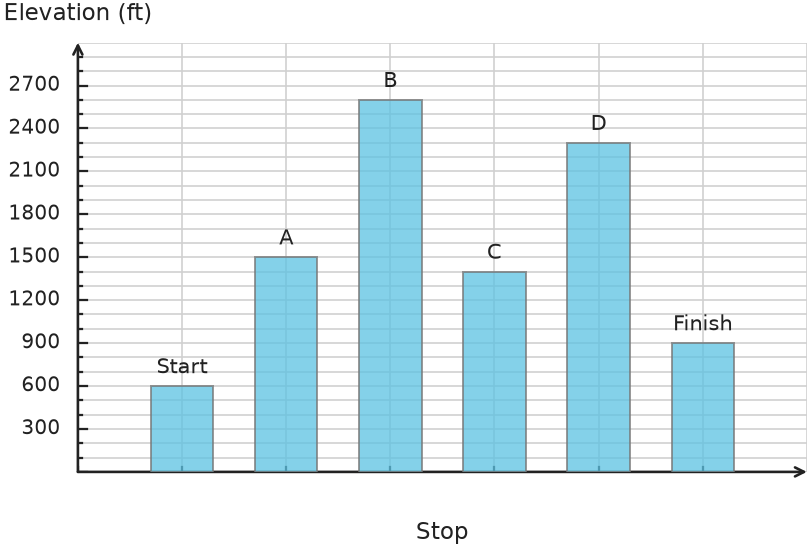
Figure for problem 535092

Hints

- Read each bar using the y-axis scale. - Subtract each elevation from the next elevation in route order. - Add the signed changes for the net change. - Add only positive changes to find total ascent. - Descents affect net change but not the amount already climbed.

Solution

1. The elevations are Start, \(600\,\text{ft}\); A, \(1500\,\text{ft}\); B, \(2600\,\text{ft}\); C, \(1400\,\text{ft}\); D, \(2300\,\text{ft}\); Finish, \(900\,\text{ft}\). 2. The consecutive changes are \(1500-600=+900\,\text{ft}\), \(2600-1500=+1100\,\text{ft}\), \(1400-2600=-1200\,\text{ft}\), \(2300-1400=+900\,\text{ft}\), and \(900-2300=-1400\,\text{ft}\). 3. Their sum is \(900+1100-1200+900-1400=300\,\text{ft}\), which is the net change from start to finish. 4. Total climbing includes only the positive changes: \(900+1100+900=2900\,\text{ft}\). Descents reduce the net change but do not erase the climbing already completed.

Answer

a) Start: \(600\,\text{ft}\); A: \(1500\,\text{ft}\); B: \(2600\,\text{ft}\); C: \(1400\,\text{ft}\); D: \(2300\,\text{ft}\); Finish: \(900\,\text{ft}\) b) \(+900\,\text{ft}\), \(+1100\,\text{ft}\), \(-1200\,\text{ft}\), \(+900\,\text{ft}\), \(-1400\,\text{ft}\) c) \(+300\,\text{ft}\) d) The route includes \(2900\,\text{ft}\) of total ascent. The \(300\,\text{ft}\) value is only the net elevation change.

Add and subtract integers 213
Find each missing starting number for the subtraction shown on the number line.
Figure for problem 535154

Hints

- Work backward from the ending value. - Undo a leftward jump by adding its length. - Check each answer by performing the subtraction from left to right.

Solution

1. In a), solve \(x-35=-10\). The starting number is \(-10+35=25\). 2. In b), solve \(x-60=-20\). The starting number is \(-20+60=40\). 3. In c), solve \(x-15=-45\). The starting number is \(-45+15=-30\).

Answer

a) \(25\) b) \(40\) c) \(-30\)
Add and subtract integers 214
Complete each chain of jumps on the number line. Find every value in a box.
Figure for problem 535170

Hints

- Work one jump at a time. - Use a known middle value to work both forward and backward. - When reversing a jump, use the opposite operation.

Solution

1. In a), \(-50+120=70\), and \(70+(-90)=-20\). 2. In b), \(x+(-40)=10\), so \(x=50\). Then \(10+60=70\). 3. In c), the middle value satisfies \(y+(-70)=-60\), so \(y=10\). The starting value satisfies \(x+30=10\), so \(x=-20\).

Answer

a) \(70\) and \(-20\) b) \(50\) and \(70\) c) \(-20\) and \(10\)
Add and subtract integers 215
Each brick in the number wall is the sum of the two bricks directly below it. Find all three missing numbers. Show how you found the missing number in the bottom row.
Figure for problem 535187

Hints

- Can a negative number and a positive number have a positive sum? - Test a possible bottom number by adding it to its neighbor. - Check each higher brick against the two numbers supporting it.

Solution

1. The first brick in the middle row gives \(-15+x=9\), so the missing bottom number is \(x=9-(-15)=24\). 2. The other middle brick is \(24+7=31\). 3. The top brick is \(9+31=40\).

Answer

Bottom row: \(24\), since \(9-(-15)=24\) Middle row: \(31\) Top: \(40\)
Add and subtract integers 216
Use the number line to find the missing starting value.
Figure for problem 535255

Hints

- Read the signed jump and endpoint from the diagram. - Undo the jump to recover the starting value.

Solution

1. The diagram shows an unknown start, a jump of \(-50\), and ending value \(-12\). 2. Solve \(x+(-50)=-12\), giving \(x=38\).

Answer

\(38\)
Add and subtract integers 217
Use the number line to find the missing intermediate and ending values.
Figure for problem 535256

Hints

- Read the start and each signed jump directly from the diagram. - Find the first landing before applying the second jump.

Solution

1. The diagram starts at \(-15\) and first jumps \(+25\), landing at \(10\). 2. From \(10\), the next jump is \(-40\), landing at \(-30\).

Answer

Intermediate value: \(10\) Ending value: \(-30\)
Add and subtract integers 218
The number-line diagram shows a temperature in the morning, its change by noon, and its change from noon to evening. What is the evening temperature?
Figure for problem 535259

Hints

- Read the starting temperature and both signed jumps from the diagram. - Follow the jumps in order from morning to noon to evening. - A positive jump raises the temperature and a negative jump lowers it.

Solution

1. The diagram shows a morning temperature of \(-8\,^\circ\text{F}\) and a rise of \(15\,^\circ\text{F}\). By noon, \(-8+15=7\), so the temperature is \(7\,^\circ\text{F}\). 2. The next jump is \(-4\,^\circ\text{F}\), so by evening \(7-4=3\). The evening temperature is \(3\,^\circ\text{F}\).

Answer

\(3\,^\circ\text{F}\)
Add and subtract integers 219
The number line shows a temperature change from the previous evening to the morning low. Find the previous evening's temperature.
Figure for problem 535276

Hints

- Read the endpoint and signed jump from the number line. - Work backward from the morning low by reversing the displayed change. - Check that applying the displayed change to your answer reaches the shown endpoint.

Solution

1. Let the starting temperature be \(x\). The number line shows a fall of \(15\,^{\circ}\text{F}\) to \(-6\,^{\circ}\text{F}\), so \(x-15=-6\). 2. Add \(15\) to both sides: \(x=-6+15=9\). 3. The previous evening's temperature was \(9\,^{\circ}\text{F}\).

Answer

\(9\,^{\circ}\text{F}\)
Add and subtract integers 220
Decide whether each claim is true or false. Explain. a) If you add twice the opposite of a number to the original number, the result is the opposite of the original number. b) Two different integers can have the same opposite.

Hints

- Represent the original number with a variable. - Pair one copy of the number with one copy of its opposite. - Think of opposites as reflections across zero.

Solution

1. Let the number be \(n\). Then \(n+2(-n)=n-2n=-n\), so a) is true. 2. Every integer has exactly one opposite. If two integers had the same opposite, taking the opposite again would show that the integers are equal. Therefore, b) is false.

Answer

a) True; \(n+2(-n)=-n\). b) False; each integer has exactly one opposite.
Add and subtract integers 221
Write one subtraction expression with a value of \(-35\) for each condition. a) Both numbers are positive integers. b) The starting number is a negative integer, and the number being subtracted is a positive integer. c) Both numbers are negative integers.

Hints

- For part a), the number being subtracted must be greater than the starting number. - Rewrite subtraction of a negative number as addition. - Choose one number first, and then determine what must be subtracted to reach \(-35\).

Solution

1. For a), the number being subtracted must be \(35\) greater than the starting number. One example is \(10-45=-35\). 2. For b), choose a negative starting number and a positive number whose distances from zero total \(35\). One example is \(-20-15=-35\). 3. For c), subtracting a negative adds its opposite. One example is \(-50-(-15)=-35\).

Answer

Possible answers are: a) \(10-45=-35\) b) \(-20-15=-35\) c) \(-50-(-15)=-35\)
Add and subtract integers 222
Simon claims, “When I subtract one integer from another integer, the result is always less than the first integer.” Is Simon correct? Use at least two integer examples to justify your answer.

Hints

- Test a positive number, zero, and a negative number as the number being subtracted. - Subtracting a negative number is the same as adding its opposite. - One counterexample is enough to disprove an “always” statement, but provide two examples as requested.

Solution

1. Simon’s claim is not true for every integer being subtracted. 2. Subtracting a negative number makes the result greater. For example, \(5-(-3)=8\), and \(8>5\). 3. Subtracting zero leaves the first number unchanged. For example, \(5-0=5\). 4. The result is less than the first integer only when a positive integer is subtracted.

Answer

No. For example, \(5-(-3)=8\), which is greater than \(5\), and \(5-0=5\), which is equal to \(5\). The result is less than the first integer only when a positive integer is subtracted.
Add and subtract integers 223
Consider the expressions: (I) \((-48)-(-122)\) (II) \((-210)-(+90)\) a) Rewrite each subtraction as addition and evaluate. b) What number must be subtracted from each answer in part a) to get \(10\)? c) For each answer in part a), what number must be subtracted to get its opposite?

Hints

- To subtract a number, add its opposite. - The opposite of a number has the same distance from zero and the opposite sign. - For parts b) and c), write an equation in the form \(\text{starting value}-x=\text{target value}\).

Solution

1. In a), (I) is \((-48)+122=74\), and (II) is \((-210)+(-90)=-300\). 2. In b), solve \(74-x=10\) to get \(x=64\). Solve \(-300-x=10\) to get \(x=-310\). 3. In c), the opposite of \(74\) is \(-74\). Solving \(74-x=-74\) gives \(x=148\). The opposite of \(-300\) is \(300\). Solving \(-300-x=300\) gives \(x=-600\).

Answer

a) (I) \(74\); (II) \(-300\) b) (I) \(64\); (II) \(-310\) c) (I) \(148\); (II) \(-600\)
Add and subtract integers 224
Consider the expressions: (I) \((-15)-(+85)\) (II) \((+40)-(+110)\) a) Rewrite each subtraction as addition and evaluate. b) What number must be subtracted from the value of (I) to get the value of (II)? c) What number must be subtracted from the value of (II) to get the opposite of the value of (I)?

Hints

- Evaluate both expressions before answering parts b) and c). - Find the opposite of the value of Expression (I). - Represent the missing number in each subtraction with a variable.

Solution

1. In a), (I) is \((-15)+(-85)=-100\), and (II) is \(40+(-110)=-70\). 2. In b), solve \(-100-x=-70\). This gives \(x=-30\). 3. In c), the opposite of \(-100\) is \(100\). Solve \(-70-y=100\) to get \(y=-170\).

Answer

a) (I) \(-100\); (II) \(-70\) b) \(-30\) c) \(-170\)
Add and subtract integers 225
Place the signs \(+\) and \(-\) and the digits \(4\), \(5\), \(8\), and \(9\) in the boxes so that every digit and sign is used exactly once. \(\square\square\square+\square\square\square\) Find an arrangement that makes the sum a) as large as possible, b) as small as possible.

Hints

- The sum contains one positive and one negative two-digit number. - To maximize the result, maximize the positive number and minimize the absolute value of the negative number. - To minimize the result, reverse that strategy.

Solution

1. The two terms must be one positive two-digit number and one negative two-digit number. 2. To maximize the sum, make the positive number as large as possible while keeping the negative number’s absolute value as small as possible: \((+98)+(-45)=53\). 3. To minimize the sum, reverse the signs: \((-98)+(+45)=-53\).

Answer

a) \((+98)+(-45)=53\) b) \((-98)+(+45)=-53\)
Add and subtract integers 226
Place the signs \(+\) and \(-\) and the digits \(1\), \(2\), \(3\), and \(4\) in the boxes so that every symbol is used exactly once. \(\square\square\square+\square\square\square\) Which arrangement gives a result closest to \(0\)? Give the expression and its value.

Hints

- Divide the four digits into two pairs systematically. - Form two-digit numbers from each pair and compare their absolute values. - The sum is closest to zero when those absolute values are as close as possible.

Solution

1. The expression is the sum of one positive and one negative two-digit number, so its distance from zero is the difference between their absolute values. 2. Check the possible digit pairings. The closest pair is \(31\) and \(24\), whose difference is \(7\). 3. Therefore, \((+31)+(-24)=7\) or \((-31)+(+24)=-7\). Both results are \(7\) units from zero.

Answer

\((+31)+(-24)=7\) or \((-31)+(+24)=-7\)
Add and subtract integers 227
Evaluate each expression one set of parentheses at a time. a) \(145-(34+156-20)-(55+45)\) b) \(-(-760+140)-[(24-110)+480]\)

Hints

- Evaluate the innermost parentheses first. - A negative sign outside parentheses changes the sign of the value inside. - Check the sign of every intermediate result.

Solution

1. In a), \(34+156-20=170\) and \(55+45=100\). Then \(145-170-100=-125\). 2. In b), \(-760+140=-620\), so \(-(-620)=620\). Also, \(24-110=-86\), and \(-86+480=394\). Therefore, \(620-394=226\).

Answer

a) \(-125\) b) \(226\)
Add and subtract integers 228
Consider the expression \(12-(+8)-(-15)+(-5)\). a) Evaluate the expression. b) Add one pair of parentheses so that the expression has a value of \(-6\). Write the modified expression and verify its value.

Hints

- A subtraction sign before parentheses subtracts the value of the entire group. - Try grouping two or three consecutive terms. - The new result must be less than the original result.

Solution

1. In a), \(12-8+15-5=14\). 2. For b), group the last three signed terms: \(12-((+8)-(-15)+(-5))\). 3. The grouped expression has value \(8+15-5=18\). 4. Therefore, \(12-18=-6\).

Answer

a) \(14\) b) \(12-((+8)-(-15)+(-5))=-6\)
Add and subtract integers 229
Consider the expression \(-40-(-10)-(+20)+(-5)\). a) Evaluate the expression. b) Add one pair of parentheses in two different ways so that each new expression has a value different from the value in part a). Write both new expressions and their values.

Hints

- The new parentheses must enclose at least one operation to affect the value. - Parentheses following a subtraction sign are especially likely to change the result. - Try several placements and evaluate each modified expression.

Solution

1. In a), \(-40+10-20-5=-55\). 2. One possible new expression is \(-40-((-10)-(+20))+(-5)\). Its value is \(-40-(-30)-5=-15\). 3. Another possible new expression is \(-40-(-10)-((+20)+(-5))\). Its value is \(-40+10-15=-45\). 4. Both values differ from \(-55\).

Answer

a) \(-55\) b) Possible answers: \(-40-((-10)-(+20))+(-5)=-15\) \(-40-(-10)-((+20)+(-5))=-45\)
Add and subtract integers 230
Consider the expression \(2500 - [750 - (150 - 50)]\). First evaluate the expression. Then determine how its value changes if each of the four numbers is increased by \(10\). Explain why.

Hints

- Evaluate the expression from the innermost grouping outward. - Track how each inner difference changes before considering the outer subtraction. - Recall what happens when both numbers in a subtraction increase by the same amount.

Solution

1. Evaluate from the innermost grouping outward: \(150 - 50 = 100\), \(750 - 100 = 650\), and \(2500 - 650 = 1850\). 2. Increasing both numbers in \(150 - 50\) by \(10\) leaves that difference unchanged. 3. The value of \(750 - (150 - 50)\) increases by \(10\), because only its first number has a net increase. 4. In the outer subtraction, both the first number and the value being subtracted increase by \(10\). Therefore, the final difference remains \(1850\).

Answer

The original value is \(1850\), and it remains unchanged.
Add and subtract integers 231
Write an expression with grouping symbols for the description, and then evaluate it. From the opposite of the sum of \(-315\) and \(105\), subtract the difference of \(45\) and \(-82\).

Hints

- The opposite of a number has the same absolute value and the opposite sign. - Use grouping symbols to separate the sum and the difference. - Evaluate the grouped expressions before the final subtraction.

Solution

1. The sum is \(-315+105=-210\), so its opposite is \(210\). 2. The difference is \(45-(-82)=127\). 3. The expression is \(-[(-315)+105]-[45-(-82)]\). 4. Evaluate: \(210-127=83\).

Answer

\(-[(-315)+105]-[45-(-82)]=83\)

All problems may be used, copied and printed free of charge for school and tutoring, including paid tutoring. Commercial adaptations as well as publication or redistribution on the internet are not permitted.