Aimathic
Login | English | Deutsch

Free math worksheets

Build your own math worksheets from 28,000 problems for grades 3 to 12, from fractions to calculus. Every problem includes step-by-step solutions.

Experimental design

Click problems to add them to your worksheet.

54656212
A student tests two soil mixtures by growing one plant in each mixture. The plant in Mixture A grows taller. Explain why this experiment lacks adequate replication and how to improve it.

Hints

- Count how many experimental units receive each treatment. - Ask whether natural variation can be separated from the treatment effect. - Add enough units and a fair assignment process to the redesign.

Solution

1. Each treatment is applied to only one experimental unit. 2. Any observed difference could be caused by natural plant-to-plant variation rather than the soil mixture. 3. The experiment should assign many similar plants to each mixture, using random assignment and otherwise comparable growing conditions.

Answer

There is no replication within treatments because only one plant receives each mixture. Use multiple plants per mixture, randomly assign plants to mixtures, and keep other growing conditions comparable.
54656712
A food scientist studies two oven temperatures and three baking times. Every combination of temperature and time is assigned at random to several batches of crackers. How many treatments are there, and what does one treatment represent?

Hints

- Identify the factors and count the levels of each. - A treatment is not a single factor level when more than one factor is imposed. - List a few combinations to see the structure.

Solution

1. Temperature has \(2\) levels and baking time has \(3\) levels. 2. Treatments are combinations of factor levels. 3. The number of treatments is \(2\cdot3=6\). 4. One treatment is one specific temperature paired with one specific baking time.

Answer

There are \(6\) treatments. Each treatment is one combination of an oven temperature and a baking time.
54658212
A vision scientist compares two screen-font settings. Each participant reads passages under both settings, with the order randomly chosen for each participant. Reading speed is recorded after each passage. Identify the design and the main advantage of using each participant under both settings.

Hints

- Determine whether participants receive one treatment or both. - Identify what serves as the match. - Think about a major source of variability removed by comparing within a person.

Solution

1. Each participant receives both treatments, with randomized order. 2. This is a matched pairs design in which each participant serves as their own control. 3. Person-to-person differences in reading speed are controlled because the treatment comparison is made within each participant.

Answer

It is a matched pairs design. Having each participant use both settings controls individual differences in baseline reading speed and can make the comparison more precise.
54658712
A laboratory compares two storage temperatures for photographic film. All film rolls come from one production batch, receive the same exposure, and are developed with the same process. The rolls are randomly assigned to the two temperatures. Which design principle is illustrated by keeping the other conditions the same, and why is it important?

Hints

- Identify conditions that are not treatments but could affect the response. - Notice that these conditions are kept the same for every unit. - Explain how that strengthens the treatment comparison.

Solution

1. Holding batch, exposure, and development conditions constant is direct control. 2. These conditions are possible extraneous sources of variation in image quality. 3. Direct control prevents systematic differences in those conditions from competing with the temperature explanation.

Answer

The principle is direct control. Keeping batch, exposure, and development conditions constant reduces extraneous variation and helps isolate the effect of storage temperature.
54659712
In a device trial, participants do not know whether they receive the new device or a look-alike inactive device. The technicians who interact with participants know the assignments. Is the study single-blind or double-blind, and what bias can remain?

Hints

- List every group that knows the assignments. - Use the masking label based on both participants and interacting researchers. - Consider how informed technicians could influence outcomes.

Solution

1. Participants are unaware of treatment assignments. 2. Interacting technicians know the assignments. 3. Therefore, the study is single-blind, or single-masked. 4. Technicians may communicate expectations or assess outcomes differently, so researcher-related bias can remain.

Answer

The study is single-blind because only participants are unaware of the assignments. Technician behavior or evaluation may still differ by treatment and bias the responses.
54660212
Describe a valid random-assignment procedure for assigning \(48\) participants equally to Treatment A and Treatment B using a random number generator.

Hints

- Give every participant a unique label. - Randomly choose the required number for one treatment without repeats. - Use the unselected participants for the other treatment. - Verify that the group sizes are equal.

Solution

1. Label participants \(01\) through \(48\). 2. Use a random number generator to select \(24\) distinct labels without replacement. 3. Assign those participants to Treatment A and assign the remaining \(24\) participants to Treatment B. 4. This gives every participant a random treatment assignment and equal group sizes.

Answer

Label the participants \(01\) through \(48\), randomly select \(24\) distinct labels for Treatment A, and assign the other \(24\) participants to Treatment B.
54665212
A materials laboratory has \(75\) test specimens and three coating treatments. Describe a completely randomized design with equal treatment group sizes.

Hints

- Divide the experimental units equally among the treatments. - Use chance rather than researcher choice for assignment. - Hold non-treatment test conditions constant. - Record one common response.

Solution

1. Label the \(75\) specimens. 2. Randomly assign \(25\) distinct specimens to each of the three coatings. 3. Apply treatments under otherwise controlled conditions. 4. Measure the same response for every specimen and compare the treatment groups.

Answer

Randomly assign \(25\) specimens to each coating treatment, keep other test conditions constant, and measure the same response for all specimens.
54672212
A study compares two reading interventions. The researcher can block participants either by baseline reading score or by eye color before random assignment. Which blocking variable is more appropriate, and why?

Hints

- Ask which characteristic is measured before treatment. - Compare how strongly each proposed characteristic could predict the response. - Choose the variable that would make units within a block more similar on the outcome.

Solution

1. A useful blocking variable is measured before treatment and is strongly related to the response. 2. Baseline reading score is likely related to reading improvement or final reading performance. 3. Eye color has no plausible instructional relationship to the response. 4. Participants should be grouped by similar baseline reading scores, then randomly assigned to interventions within each block.

Answer

Block by baseline reading score because it is a pre-treatment variable likely related to the response. Eye color is not a useful source of response variation for this study.
54673712
In a medication experiment, active and placebo tablets look identical, but the bottles are labeled “active treatment” and “placebo.” Participants receive the bottles directly. Explain why the intended masking fails and describe how to preserve masking.

Hints

- Check every source of information a participant sees, not only the tablets. - Ask whether any label reveals the assigned condition. - Replace descriptive labels with a code that is unavailable to people who should be masked.

Solution

1. The bottle labels reveal treatment assignment to participants, so identical tablet appearance does not mask them. 2. Knowing the assignment can change reported symptoms or behavior through expectations. 3. Bottles should use neutral coded labels prepared by someone not involved in outcome measurement. 4. The treatment code should remain concealed from participants and relevant research staff until data collection is complete.

Answer

Masking fails because the bottle labels disclose the assignment. Use identical neutrally coded containers and keep the code hidden from participants and outcome assessors until the study is finished.
54653712
A teacher wants to compare two online review formats before a final exam. Students are first grouped into blocks according to their previous test score: below the median or at least the median. Within each block, students are randomly assigned to one of the two formats. Identify the experimental design and explain the purpose of blocking.

Hints

- Identify what happens before the treatment assignment. - Check whether random assignment occurs within groups. - Think about why prior performance could affect the response.

Solution

1. Students are grouped by a variable expected to affect the final-exam score. 2. Treatments are randomly assigned within each group. 3. The design is a randomized block design. Blocking separates variation associated with previous performance from the treatment comparison.

Answer

It is a randomized block design. Blocking by previous test score helps control variation in final-exam performance related to prior achievement, allowing a more precise comparison of the two review formats.
54654212
Each participant in a study tastes the same sparkling water twice, once from a plain can and once from a can labeled “premium.” The order of the two presentations is randomized for every participant, and the participant rates each taste. Identify the design and explain why randomizing the order matters.

Hints

- Notice how many treatments each participant receives. - Identify what is paired in the design. - Consider how receiving one condition first could affect the response.

Solution

1. Each participant receives both treatments, so each participant serves as their own control. 2. This is a matched pairs design. 3. Randomizing the order helps prevent an order effect from being confounded with the label treatment.

Answer

It is a matched pairs design. Randomizing presentation order helps keep fatigue, adaptation, or first-taste effects from systematically favoring one label condition.
54654712
A clinic tests a new topical cream against an inactive cream that looks and feels identical. Participants are randomly assigned to a cream. Neither participants nor the clinicians who rate skin improvement know which cream each participant receives. Identify the control treatment and the masking level, and explain what each feature helps control.

Hints

- Determine whether one treatment has an active ingredient. - Identify exactly who does and does not know the assignments. - Connect each design feature to a possible source of altered responses or ratings.

Solution

1. The inactive cream is the placebo control treatment. 2. Neither participants nor interacting evaluators know the assignments, so the experiment is double-blind, or double-masked. 3. The placebo helps separate the treatment effect from expectations, while double masking reduces response and evaluator bias.

Answer

The inactive cream is the placebo control, and the study is double-blind. The placebo controls for expectation effects, and double masking reduces bias from participants' and clinicians' knowledge of treatment assignments.
54655212
An agriculture class has thirty-six genetically similar seedlings. It randomly assigns twelve seedlings to each of three fertilizer treatments and grows all seedlings under the same light, water, and temperature conditions. At the end, it records each plant's dry mass. Identify the experimental units, treatments, response variable, and design.

Hints

- Find what receives a treatment. - Separate the imposed condition from the measured outcome. - Determine whether units were grouped before random assignment. - Notice which other conditions were held constant.

Solution

1. The experimental units are the thirty-six seedlings. 2. The treatments are the three fertilizer conditions. 3. The response variable is final dry mass. 4. Treatments are assigned completely at random, so this is a completely randomized design. 5. Keeping environmental conditions constant is direct control.

Answer

Experimental units: the thirty-six seedlings. Treatments: the three fertilizers. Response variable: final dry mass. Design: a completely randomized design, with light, water, and temperature directly controlled.
54657212
A greenhouse has benches near the windows and benches near the interior aisle. A researcher compares three watering schedules. Explain how to use bench location in a randomized block design and why blocking is useful.

Hints

- Identify a source of response variation unrelated to the treatment. - Group units that are similar with respect to that source. - Make sure every treatment appears within every group.

Solution

1. Bench location may affect plant growth because light conditions differ. 2. Form blocks based on location, such as window and interior benches. 3. Randomly assign all three watering schedules within each block. 4. Blocking separates variation due to location from variation used to compare watering schedules.

Answer

Create blocks based on bench location and randomly assign each watering schedule to plants within every block. This controls location-related light variation and makes the watering comparison more precise.
54659212
A road-surface study compares two sealants on twenty matched pairs of similar road sections. Within each pair, one section is randomly assigned Sealant A and the other Sealant B. Identify the design and explain what the matching accomplishes.

Hints

- Identify how experimental units are grouped before assignment. - Check the number of treatments. - Think about road characteristics that could affect the response apart from sealant type.

Solution

1. The experiment has two treatments and road sections are paired on relevant characteristics. 2. Treatments are randomly assigned within each pair. 3. This is a matched pairs design. 4. Matching controls variation in traffic, pavement age, or condition that could affect wear.

Answer

It is a matched pairs design. Pairing similar road sections controls important preexisting differences, so wear can be compared within pairs with less extraneous variation.
54661212
A rehabilitation study compares three exercise programs for patients with mild, moderate, or severe baseline mobility limitations. Describe a randomized block design that uses baseline limitation level.

Hints

- Use the baseline characteristic that is expected to affect improvement. - Ensure every treatment appears in every block. - Randomize only after the blocks are formed. - Measure the same response for all patients.

Solution

1. Form three blocks based on mild, moderate, and severe baseline limitation. 2. Within each block, randomly assign patients to all three exercise programs. 3. Measure the same mobility response after treatment. 4. This design controls baseline severity while allowing program comparisons within severity levels.

Answer

Create blocks for mild, moderate, and severe baseline limitation. Randomly assign patients within each block to each of the three programs, then compare the common mobility response while accounting for the blocks.
54663712
A factory tests two break schedules for workers on day, evening, and night shifts. Describe a randomized block design that accounts for shift.

Hints

- Identify a preexisting group that may affect the response. - Ensure both treatments occur within every group. - Randomize after forming the groups.

Solution

1. Treat each shift as a block because productivity and fatigue may differ by shift. 2. Within each shift, randomly assign workers to the two break schedules. 3. Measure the same productivity or fatigue response for all workers. 4. Compare schedules within shifts and combine the evidence across blocks.

Answer

Form blocks by day, evening, and night shift. Randomly assign workers within each shift to each break schedule, then compare the common response while accounting for shift.
54664212
A company tests a new safety checklist against its current checklist. Explain why the current checklist can serve as a control treatment and why using no checklist may be a poor comparison.

Hints

- Identify the decision the company actually needs to make. - Compare the new option with what would normally occur. - Consider both relevance and ethics when choosing a control.

Solution

1. The current checklist represents the existing standard practice. 2. Comparing the new checklist with current practice isolates improvement over what workers would otherwise receive. 3. A no-checklist group changes both checklist content and the presence of any checklist, making the comparison less relevant and possibly unethical.

Answer

The current checklist is an appropriate active control because it represents standard practice. A no-checklist condition would not answer whether the new checklist improves on current practice and could reduce safety.
54665712
A study compares two physical-therapy routines. Participants and therapists know which routine is used, but an evaluator who measures range of motion does not. Explain what is masked and what source of bias this feature reduces.

Hints

- List who knows the treatment assignment. - Identify who records the response variable. - Connect masking to the judgment most directly affected.

Solution

1. The outcome evaluator is unaware of treatment assignments. 2. Participants and treating therapists are not masked. 3. Masking the evaluator reduces the chance that knowledge of treatment influences measurement or scoring. 4. It does not eliminate expectation effects among participants or therapists.

Answer

The outcome evaluator is masked. This reduces evaluator measurement bias, although participant and therapist expectations can still affect the response.
54666212
A farm compares a new pest-control method with its standard method on many randomly assigned field plots. Explain the roles of comparison, random assignment, and replication in this experiment.

Hints

- Identify what the new method is compared against. - Explain why treatment assignment should use chance. - Explain why one plot per method would be inadequate.

Solution

1. Comparison with the standard method provides a control benchmark. 2. Random assignment reduces systematic differences between treatment groups. 3. Replication across many plots reveals treatment effects despite natural plot-to-plot variation. 4. Together these principles support a causal comparison.

Answer

The standard method supplies a comparison group, random assignment reduces confounding, and replication across many plots helps separate treatment effects from natural variation.
54666712
A researcher compares two study methods. Baseline reading skill is strongly related to the response. Should the researcher use a completely randomized design or block by baseline reading skill? Justify the choice.

Hints

- Identify a pre-treatment variable strongly connected to the outcome. - Decide whether grouping similar units can reduce unexplained variation. - Ensure random assignment remains within each group.

Solution

1. Baseline reading skill is an important source of extraneous response variation. 2. Forming blocks of students with similar baseline skill separates that variation. 3. Randomly assign both study methods within every block. 4. A randomized block design should give a more precise comparison than complete randomization.

Answer

Use a randomized block design based on baseline reading skill, then randomly assign both study methods within each block. Blocking controls a strong predictor of the response.
54667212
A school compares a new algebra lesson with its current algebra lesson. Explain why an active control using the current lesson is more appropriate than giving the control group no instruction.

Hints

- Identify the real-world alternative to adopting the new lesson. - Ask what a no-instruction group would change besides lesson type. - Consider whether withholding the usual service is appropriate.

Solution

1. The relevant decision is whether the new lesson improves on current instruction. 2. The current lesson provides a fair standard-practice comparison. 3. No instruction would combine the effect of lesson content with the effect of receiving instruction at all. 4. Withholding instruction may also be educationally inappropriate.

Answer

Use the current lesson as the active control. It directly tests whether the new lesson improves on standard instruction and avoids the confounding and ethical problems of withholding instruction.
54668712
A clinic compares two appointment reminder scripts. As patients arrive for check-in, the first patient receives Script A, the second receives Script B, and the assignments continue alternating. Explain why this is not random assignment and describe one way arrival order could confound the comparison.

Hints

- Decide whether chance determines each patient's treatment. - Look for a characteristic that may change across the arrival sequence. - Ask whether that characteristic could also affect the response to the reminder.

Solution

1. Alternating assignments follow a predictable rule and do not use chance, so the treatment assignment is not random. 2. Arrival order may be related to appointment time, work schedule, transportation access, or patient type. 3. If one script is systematically given to patients arriving in different time slots or circumstances, the script effect cannot be separated from the arrival-order difference. 4. A valid redesign would use a random mechanism to assign each patient, while keeping treatment counts reasonably balanced.

Answer

Alternation is not random because the next assignment is predetermined. Arrival order could be associated with patient characteristics or appointment times, making those factors confounded with the script. The clinic should assign scripts with a random mechanism.
54670212
A rehabilitation study compares a gentle exercise routine with a high-intensity routine. Participants can tell which routine they perform, but the clinician who measures joint mobility does not know each participant's assignment. Describe the masking that is possible and the bias it is intended to reduce.

Hints

- Identify who can recognize the treatment from direct experience. - Identify who records the response and whether that person knows the assignment. - Consider whose expectations could influence the measurement process.

Solution

1. Participants cannot be masked because the treatments feel noticeably different. 2. The outcome assessor is masked to treatment assignment. 3. Assessor masking reduces the chance that expectations about the routines influence how joint mobility is measured or recorded. 4. The study is not fully double-masked because participants know their treatment.

Answer

The outcome assessor is masked, but participants are not. This partial masking helps prevent the clinician's expectations from affecting mobility measurements, although it cannot remove participant expectation effects.
54673212
A pain-relief experiment randomly assigns participants to a medication, an identical-looking placebo, or no pill. Use the displayed mean decreases in pain rating to estimate the placebo effect and the medication effect beyond the placebo response.
Figure for problem 546732

Hints

- Read the mean decrease represented by each bar. - Identify which comparison isolates the response to receiving an inactive pill. - Use the placebo group as the comparison for the active medication.

Solution

1. The placebo effect is the mean response to placebo minus the mean response to no pill: \(3-1=2\) points. 2. The medication effect beyond the placebo response is the medication mean response minus the placebo mean response: \(8-3=5\) points.

Answer

Placebo effect: \(2\) points. Medication effect beyond placebo: \(5\) points.
54674212
Forty participants are independently assigned to Treatment A or Treatment B by a fair coin flip. The result is \(23\) participants in A and \(17\) in B. A student says the assignment was not random because the group sizes are unequal. Evaluate the claim and describe a method that would guarantee equal group sizes.

Hints

- Separate randomness from balance. - Ask whether a chance process can produce unequal outcomes in a finite number of trials. - Use a random procedure with a fixed number of labels for each treatment when exact balance is required.

Solution

1. Independent fair coin flips are a valid random-assignment mechanism. 2. Random assignment does not guarantee equal group sizes, so a split of \(23\) to \(17\) can occur by chance. 3. To guarantee equal sizes, prepare \(20\) A labels and \(20\) B labels, shuffle them thoroughly, and assign one label to each participant without replacement.

Answer

The assignment is random despite the unequal group sizes. Equal sizes are not guaranteed by independent coin flips. To force two groups of \(20\), randomly distribute \(20\) A labels and \(20\) B labels without replacement.
54675612
Participants are placed into groups of four with similar baseline blood pressure. Within each group, two participants are randomly assigned to Treatment A and two to Treatment B. Is this a matched-pairs design? Identify the design and explain.

Hints

- Count the number of experimental units in each group. - Check whether random assignment occurs inside the groups. - Compare the group size with the defining structure of matched pairs.

Solution

1. The groups are formed using a pre-treatment variable related to the response. 2. Treatments are randomly assigned within each group, so the study uses a randomized block design. 3. It is not a matched-pairs design because each block contains four participants rather than a pair, and two units receive each treatment.

Answer

This is a randomized block design with baseline blood pressure as the blocking variable. It is not matched pairs because each block contains four participants, not two matched units.
54676112
A community program has limited capacity to offer a job-search workshop immediately. Eligible applicants are randomly assigned either to begin the workshop now or to a wait-list that receives the workshop after eight weeks. Explain how the wait-list functions as a control group and what comparison should be made before the delayed group begins.

Hints

- Identify when the delayed group has not yet received the treatment. - Choose a measurement time when the treatment conditions still differ. - Use random assignment to interpret the group difference at that time.

Solution

1. During the first eight weeks, the wait-list group represents what happens without immediate access to the workshop. 2. Random assignment makes the immediate and delayed groups comparable at the start. 3. The response should be compared between groups at the end of eight weeks, before the wait-list group receives the workshop. 4. That comparison estimates the causal effect of immediate workshop access over the eight-week period.

Answer

The wait-list is the control group during the first eight weeks because it does not yet receive the treatment. Compare the groups' outcomes at eight weeks, before the wait-list begins the workshop, to estimate the effect of immediate access.
54676612
A factory matches machines into pairs with similar workload. Within every pair, the older machine is assigned Lubricant A and the newer machine is assigned Lubricant B. The researcher calls this a matched-pairs experiment. Identify the flaw and correct it.

Hints

- Separate the quality of the matching from the treatment-assignment rule. - Ask whether chance determines which member of a pair receives each treatment. - Identify the characteristic that is linked perfectly to treatment in the current plan.

Solution

1. The pairing is useful because machines in each pair have similar workload. 2. Treatment assignment within a pair is not random; machine age determines the lubricant. 3. Any lubricant difference may be confounded with age because A always goes to the older machine. 4. Within each pair, use a random mechanism to decide which machine receives A and assign B to the other machine.

Answer

The design lacks random assignment within pairs, so lubricant is confounded with machine age. Randomly assign Lubricant A to one machine in each pair and Lubricant B to the other.
54678112
In a randomized fitness experiment, coaches know which participants received the new program and give those participants more encouragement during testing. Explain how this behavior threatens the experiment and describe a control.

Hints

- List what differs between groups besides the assigned program. - Ask whether that extra difference could affect the response. - Hold the interaction constant or prevent the tester from knowing treatment assignments.

Solution

1. Coach encouragement varies with treatment assignment and can affect test performance. 2. The observed response difference may reflect both the fitness program and unequal encouragement. 3. Use a scripted testing protocol with the same interaction for every participant and, when possible, mask testing staff to treatment assignment. 4. Automated or independent outcome measurement can further reduce the influence of coach expectations.

Answer

Unequal encouragement is an extraneous treatment-linked difference that can inflate the apparent effect of the new program. Standardize the testing interaction and mask or separate outcome assessors from treatment information.
54680512
A farm has four soil zones, each divided into six plots. Three irrigation treatments are randomly assigned within each soil zone, with each treatment assigned to \(2\) plots in every zone. Identify the blocks, experimental units, and number of replications for each treatment.

Hints

- Identify the groups formed before the treatments are assigned. - Determine the smallest objects that independently receive an irrigation treatment. - Multiply the number of plots receiving one treatment in each soil zone by the number of soil zones.

Solution

1. The plots are grouped by soil zone before treatments are assigned, so the \(4\) soil zones are the blocks. 2. The irrigation treatments are assigned to individual plots, so the \(24\) plots are the experimental units. 3. Each treatment is assigned to \(2\) plots in each of the \(4\) soil zones, so each treatment has \(4\cdot 2=8\) replications overall.

Answer

Blocks: the \(4\) soil zones. Experimental units: the \(24\) individual plots. Replication: \(2\) plots per treatment in each soil zone, or \(8\) plots per treatment overall.
54681012
A museum introduces new directional signs. It records the average time visitors spend looking for exhibits during the week before installation and again during the week after installation. The average time decreases. Identify the main weakness in this design and describe a stronger experiment.

Hints

- Consider what could change from one week to the next besides the signs. - Ask what comparison would isolate the effect of the new signs. - Think about how comparable units could receive different conditions during the same period.

Solution

1. The before-and-after comparison has no concurrent control group, so any other change between the two weeks could explain the decrease. 2. A stronger design uses comparable visitor periods or museum sections as experimental units. 3. Randomly assign the new signs to some units and keep the existing signs in the others, then compare search times during the same time period.

Answer

The main weakness is the lack of a concurrent control group, so the sign change is confounded with other differences between the two weeks. A stronger experiment would randomly assign comparable periods or sections to use either the new signs or the existing signs and compare search times concurrently.
54682512
The display gives the factor levels for an experiment on proofreading accuracy. Describe a completely randomized experiment using \(160\) volunteers, identify the treatment combinations, and explain how the design can assess whether the effect of music depends on notification status.
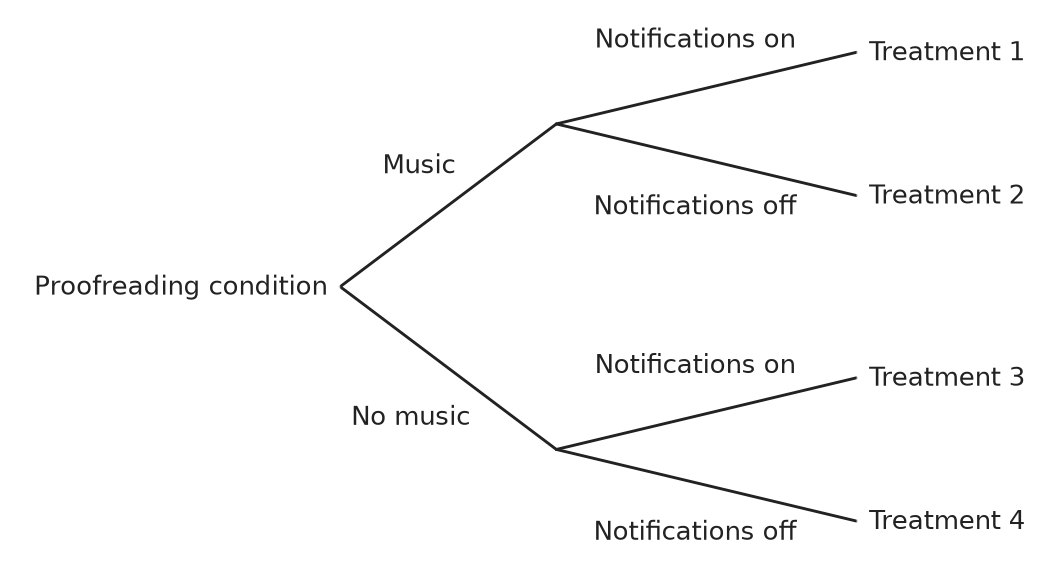
Figure for problem 546825

Hints

- Trace one branch for each combination of factor levels. - Make sure chance determines which treatment combination each volunteer receives. - Compare music effects separately when notifications are on and when they are off to assess interaction.

Solution

1. The two factors are music status and notification status, each with two levels. 2. The four treatments are music with notifications, music without notifications, no music with notifications, and no music without notifications. 3. Randomly assign \(40\) volunteers to each treatment, give everyone comparable proofreading tasks under controlled conditions, and compare accuracy across the four groups. 4. The four-group design permits study of each factor and whether their effects differ across levels of the other factor.

Answer

Randomly assign \(40\) volunteers to each treatment: music with notifications, music without notifications, no music with notifications, and no music without notifications. Keep the proofreading task and other conditions the same, then compare accuracy across the four groups.
54682712
In a randomized experiment on a new hydration mix, the treatment drink has a strong citrus taste while the placebo is plain water. Athletes and coaches know which drink each athlete receives. Explain two threats created by this design and describe a better control condition.

Hints

- Ask who can infer the assigned condition before the outcome is measured. - Consider how expectations could change behavior as well as reports. - Think about which sensory features a convincing comparison drink must match.

Solution

1. Athletes’ expectations can influence effort or self-reported symptoms because the treatment is recognizable. 2. Coaches may treat or encourage athletes differently when they know the assignment. 3. A better placebo should match the treatment drink in appearance, taste, and packaging but omit the active ingredient. 4. Codes can conceal assignments from athletes, coaches, and outcome assessors when feasible.

Answer

The recognizable drinks allow participant expectation and coach behavior to differ by treatment. Use a placebo matched in taste, appearance, and packaging, and conceal the assignment from participants, coaches, and assessors when possible.
54683012
A clinic prepares envelopes containing treatment assignments in random order. The envelopes are thin enough that staff can see the assignment when held to a light, and staff choose which envelope to hand each patient. Explain why the intended random assignment may fail and describe a correction.

Hints

- Ask whether anyone can know the next assignment before a patient enters the study. - Consider how that knowledge could affect which patient receives which condition. - Think about a procedure that prevents prediction and choice of assignments.

Solution

1. Staff can learn upcoming assignments before enrolling a patient. 2. Choosing envelopes based on patient characteristics can create systematic differences between treatment groups, defeating random assignment. 3. Use opaque, sealed, sequentially numbered envelopes or a centralized computer assignment that cannot be known or changed in advance.

Answer

The assignment can be manipulated because staff can see and choose the treatment in advance, so the groups may not be randomly formed. Use concealed, tamper-resistant sequential assignments or a centralized randomization system.
54655712
A bakery tests two display signs. Sign A is used every weekday morning, and Sign B is used every weekend afternoon. Sales are higher with Sign B. Explain why the experiment is confounded and describe one improved design.

Hints

- List everything that changes at the same time as the sign. - Identify an alternative explanation for the sales difference. - Redesign the study so each sign is used under comparable conditions. - Include random assignment in the improved plan.

Solution

1. Sign type is completely linked to day and time. 2. Customer traffic and buying patterns may differ between weekday mornings and weekend afternoons. 3. Therefore, sign effect cannot be separated from day-and-time effects. 4. An improved design randomly assigns the signs across comparable time periods, with both signs used in each relevant block such as day type.

Answer

The sign treatment is confounded with day and time, so higher sales cannot be attributed to Sign B. One improvement is to block comparable selling periods by day type and randomly assign both signs within each block.
54657712
A pain-management study randomly assigns participants to an active treatment, an inactive placebo, or no treatment. Explain how the three groups allow researchers to distinguish the active treatment effect from the placebo effect.

Hints

- Decide what differs between the placebo and no-treatment groups. - Decide what differs between the active and placebo groups. - Use the separate comparisons to isolate different sources of change.

Solution

1. Comparing the placebo group with the no-treatment group estimates the placebo effect. 2. Comparing the active-treatment group with the placebo group isolates the effect of the active component beyond expectations. 3. Random assignment helps make the groups comparable before treatment.

Answer

The placebo-versus-no-treatment comparison measures the placebo effect, while the active-treatment-versus-placebo comparison measures the active treatment's effect beyond expectations. Random assignment supports these causal comparisons.
54660712
Researchers want to know whether repeated exposure to dangerously loud sound causes permanent hearing loss. Explain why randomly assigning people to harmful sound exposure is unethical and describe an ethical observational alternative.

Hints

- Evaluate the risk imposed by the proposed treatment. - Replace assigned exposure with naturally occurring variation. - Identify additional variables that should be recorded. - Adjust the type of conclusion to match the new design.

Solution

1. Deliberately imposing a potentially harmful exposure violates ethical standards. 2. A randomized experiment should not be conducted. 3. Researchers could compare naturally occurring exposure histories and hearing outcomes while measuring plausible confounding variables. 4. The observational study could identify association but would have weaker causal evidence.

Answer

Random assignment is unethical because the treatment could cause permanent harm. An ethical alternative is to observe people with different naturally occurring exposure levels, record hearing outcomes and potential confounders, and interpret the result as association rather than definitive causation.
54661712
In an experiment comparing two tutoring programs, all students in Program A meet in the morning with Tutor Lee, and all students in Program B meet in the afternoon with Tutor Gomez. Identify the confounding and explain why randomizing students only within those fixed sessions would not solve it.

Hints

- List every condition that changes with the program label. - Ask whether the proposed randomization changes those linked conditions. - Redesign so the treatment varies within tutor and time categories.

Solution

1. Program is completely linked with time of day and tutor. 2. Any difference in outcomes could be caused by the program, tutor, time, or a combination. 3. Randomizing students between the existing sessions would randomize participants but would not separate program from tutor and time. 4. Both programs must be used across tutors and times, with treatment assignment randomized within appropriate blocks.

Answer

Program, tutor, and time of day are confounded. Simply randomizing students into the two fixed sessions does not separate those effects. Use both programs with each tutor and time block, with random assignment within blocks.
54662212
A scientist applies Treatment A to one aquarium and Treatment B to one other aquarium. She measures ten fish in each aquarium and claims there are ten experimental units per treatment. Explain the error.

Hints

- Identify the smallest unit independently assigned a treatment. - Distinguish repeated measurements from independent treatment assignments. - Count treatment replications at the assignment level.

Solution

1. The treatment is assigned to whole aquariums, not independently to individual fish. 2. Therefore, the aquariums are the experimental units. 3. Measuring ten fish per aquarium gives repeated measurements within each unit, not replication of treatment assignment. 4. With one aquarium per treatment, treatment is confounded with aquarium and there is no true replication.

Answer

The experimental units are the two aquariums because treatment is assigned at the aquarium level. The fish are subsamples, so there is only one experimental unit per treatment and no valid replication.
54662712
In a crossover experiment, each participant receives Beverage A for one week and Beverage B for one week in random order. The effect of a beverage may last several days after use stops. Identify the design threat and describe one improvement.

Hints

- Ask whether the first treatment can affect the later response. - Consider what could separate the two treatment periods. - Keep random order, but add a feature that addresses lingering effects.

Solution

1. A lingering effect from the first beverage can influence the response during the second period. 2. This is a carryover effect that can confound the second-period treatment response. 3. Add a sufficiently long washout period between treatments and keep the order randomized. 4. If washout is not possible, use separate randomly assigned groups instead of a crossover.

Answer

The study is threatened by carryover from the first beverage. Include an adequate washout period between treatment weeks, or use a parallel completely randomized design if carryover cannot be removed.
54663212
After randomly assigning participants to two treatments, researchers notice that one group has a somewhat higher average baseline score. A student claims random assignment failed. Explain why this conclusion is not necessarily correct and what random assignment actually guarantees.

Hints

- Distinguish a long-run property from a guarantee for one assignment. - Ask whether the assignment mechanism used chance correctly. - Explain why chance groups can still differ somewhat.

Solution

1. Random assignment does not guarantee identical groups on every observed characteristic. 2. Chance imbalances can occur in a particular randomization. 3. Random assignment uses chance rather than researcher choice and makes treatment groups comparable on average across repeated random assignments. 4. It reduces systematic confounding and supports causal inference when the experiment is otherwise well designed.

Answer

A baseline difference can occur by chance, so it does not prove random assignment failed. Random assignment prevents systematic selection into treatments and balances extraneous variables in the long run, not perfectly in every experiment.
54664712
A company assigns entire work teams, not individual employees, to one of two collaboration tools. It then measures each employee's output. What are the experimental units, and why does the number of employees not equal the number of independent treatment assignments?

Hints

- Identify the smallest unit that can receive a different treatment independently. - Separate the assignment level from the measurement level. - Consider dependence among people sharing one treatment setting.

Solution

1. Treatment is assigned to work teams. 2. Therefore, teams are the experimental units. 3. Employees within the same team share one assignment and may have correlated outcomes. 4. Individual employee measurements are subsamples within experimental units, not independent replications of assignment.

Answer

The work teams are the experimental units. Employees within a team receive the same treatment, so their measurements do not represent separate random assignments or independent treatment replications.
54667712
A manufacturer compares two adhesives using components produced in four different batches. Describe a randomized block design using production batch and explain why it is preferable to assigning one adhesive to each whole batch.

Hints

- Identify a manufacturing source of preexisting variation. - Ensure both treatments occur within every level of that source. - Explain what would be inseparable if whole batches received only one treatment.

Solution

1. Production batch may affect bond strength, so batches should be blocks. 2. Within each batch, randomly assign components to both adhesives. 3. This permits adhesive comparisons within every batch. 4. Assigning one adhesive to each whole batch would confound adhesive with batch.

Answer

Treat each production batch as a block and randomly assign both adhesives to components within every batch. This controls batch variation and avoids confounding adhesive with batch.
54668212
A coatings laboratory cuts each of \(18\) metal panels into two equal test sections. On each panel, one section is randomly assigned Paint A and the other section receives Paint B. Adhesion strength is measured on both sections. Identify the experimental units, the blocks, and the design.

Hints

- Find the smallest objects that receive treatments independently. - Look for pairs created to control a shared source of variation. - Check whether both treatments occur within every pair.

Solution

1. A treatment is applied separately to each test section, so the experimental units are the \(36\) panel sections. 2. The two sections cut from the same original panel form a block because they share the panel's material and preparation. 3. Each block contains two units and both treatments, with the assignment randomized within the block, so the design is matched pairs.

Answer

The experimental units are the \(36\) panel sections. The \(18\) original panels are the blocks, with the two sections from each panel forming a pair. The experiment uses a matched-pairs design.
54669212
A laboratory pairs specimens with similar initial hardness. Within each pair, it randomly assigns one specimen to Method A and the other to Method B. However, Technician 1 applies every Method A treatment, while Technician 2 applies every Method B treatment. Identify the design flaw and describe a correction.

Hints

- List every feature that changes when the treatment changes. - Ask whether the response difference could be attributed to more than one changing feature. - Revise the plan so the extra feature is held constant or represented under both treatments.

Solution

1. Treatment method is completely linked to technician, so any difference in response could be caused by the method, the technician, or both. 2. Blocking by initial hardness does not remove this confounding because technician still varies only with treatment. 3. A correction is to have each technician apply both methods, with treatment assignments randomized within technician and hardness blocks, or to use one standardized automated application process for both methods.

Answer

Technician is confounded with treatment because each technician applies only one method. The study should arrange for each technician to apply both methods under randomized assignments, or keep the applicator identical for both treatments.
54669712
After an experiment is complete, a researcher notices that participants with similar response values can be grouped together. The researcher proposes calling those groups blocks and reanalyzing the treatment comparison as a randomized block design. Explain why this is not a valid use of blocking.

Hints

- Determine when blocks must be formed relative to treatment assignment. - Ask whether the grouping variable could already have been affected by treatment. - Check whether treatments were actually randomized within the proposed groups.

Solution

1. Blocks must be formed before treatment assignment using a pre-treatment variable related to the response. 2. Grouping units by the response after the experiment uses outcome information that treatment may already have affected. 3. The original treatment assignments were not randomized within those post hoc groups, so the study did not use a randomized block design. 4. A future experiment could block on an appropriate baseline measurement and then randomize treatments within each block.

Answer

The proposed groups are not valid blocks because they are formed after treatment using the response itself. A randomized block design requires blocks based on pre-treatment characteristics and random assignment within each block before outcomes are observed.
54670712
A researcher compares two keyboard layouts using typing speed as the response. Room noise can be kept the same for everyone, but participants' baseline typing skill varies widely. Explain which source of variation should be handled by direct control and which should be handled by blocking, and describe the design.

Hints

- Decide which condition can realistically be held identical for all units. - Identify the pre-treatment characteristic that cannot be equalized but is related to the response. - Use random assignment after forming groups that are similar on that characteristic.

Solution

1. Room noise can be held at the same level for all participants, so it should be handled by direct control. 2. Baseline typing skill cannot be made identical, but it is related to typing speed, so participants should be grouped into skill blocks. 3. Within each block, participants should be randomly assigned to the two keyboard layouts. 4. This separates variation due to baseline skill while preventing room noise from varying across experimental units.

Answer

Keep room noise constant by direct control. Form blocks of participants with similar baseline typing skill, then randomly assign the two keyboard layouts within each block.
54671212
A field experiment assigns two fertilizer treatments at random to adjacent garden plots. Heavy rain can carry fertilizer from one plot into the next. Explain why this threatens the treatment comparison and give one design improvement.

Hints

- Ask whether each plot receives only its assigned condition. - Consider how a neighboring plot could alter the measured response. - Look for a layout change that prevents treatments from crossing between units.

Solution

1. Runoff allows the treatment assigned to one plot to affect the response of a neighboring plot. 2. The control and treatment conditions are no longer kept separate, so the observed difference may be diluted or distorted. 3. The design can be improved by adding untreated buffer space between plots, using physical barriers, or randomizing treatments to larger separated plots that reduce spillover.

Answer

Fertilizer spillover causes interference between experimental units, so one plot's response may depend on neighboring treatments. Use buffer zones, barriers, or sufficiently separated treatment plots to keep the treatments isolated.
54671712
A researcher randomly labels morning and evening appointment slots as Treatment A or Treatment B. Participants then choose whichever open appointment time they prefer. The researcher claims the treatments were randomly assigned to participants. Explain the flaw and describe a valid assignment procedure.

Hints

- Follow the sequence from slot labeling to participant choice. - Ask who ultimately determines which treatment a participant receives. - Separate treatment assignment from scheduling preference in the redesign.

Solution

1. Time slots were randomized, but participants selected their own slots. 2. Because treatment is tied to slot, participant preferences determine treatment assignment indirectly. 3. Morning and evening participants may differ in work schedules, sleep patterns, or other characteristics related to the response, creating potential confounding. 4. The researcher should first enroll participants and then randomly assign each participant to a treatment, while scheduling treatment delivery so both treatments occur across relevant times.

Answer

Participants were not randomly assigned because choosing a time slot also determined treatment. Randomly assign enrolled participants to treatments directly, and distribute both treatments across appointment times so time is not confounded with treatment.
54672712
A multicenter trial is designed to block patients by hospital and randomly assign both treatments within every hospital. At one hospital, an implementation error sends every enrolled patient to Treatment A. Explain what is lost at that hospital and how the mistake affects the design.

Hints

- Recall why each block should contain every treatment being compared. - Ask what comparison remains possible when a block contains only one treatment. - Identify which block characteristic becomes linked to the treatment.

Solution

1. Blocking by hospital is intended to compare treatments within the same hospital while controlling hospital-to-hospital differences. 2. With no Treatment B patients at the affected hospital, there is no within-hospital treatment comparison there. 3. Treatment A is completely linked to that hospital's patients, so the hospital effect and treatment contribution cannot be separated within that block. 4. The trial no longer follows the intended randomized block design for that hospital, and the error must be addressed in analysis and reporting rather than treated as a valid block.

Answer

The affected hospital provides no within-block comparison because it contains only Treatment A. Hospital characteristics and Treatment A are inseparable there, so that block does not implement the planned randomized block design.
54674712
A company randomly assigns employees either to its current scheduling system or to a new system that includes both redesigned software and a training workshop. Productivity is higher in the new-system group. Explain what causal conclusion is supported and why the separate effects of software and training cannot be determined.

Hints

- List every feature that changes between the two assigned groups. - Ask whether any group isolates just one changed feature. - Design additional treatment combinations that vary the components separately.

Solution

1. Random assignment supports a causal conclusion about the combined treatment package. 2. The new group differs from the control group in two linked components: software and training. 3. Because no group receives only the software or only the training, the effects of those components are confounded within the treatment package. 4. A factorial design with current or new software crossed with no workshop or workshop would separate the component effects.

Answer

The combined package of redesigned software plus training causes higher productivity relative to the current system. The study cannot determine whether the software, the training, or their combination produced the improvement. Separate treatment combinations are needed.
54675112
A trial randomly assigns applicants to two training programs. After assignment, the researchers remove everyone with a low baseline score, but the removal is carried out by staff members who know each person's assigned program. Explain why eligibility screening should have occurred before random assignment.

Hints

- Follow the order of screening and assignment. - Ask whether knowing treatment labels could affect who remains in each group. - Move decisions about eligibility to a stage where treatment assignment cannot influence them.

Solution

1. Removing participants after assignment can change the composition of the treatment groups. 2. Because staff know the assignments, conscious or unconscious differences in applying the exclusion rule could create unequal groups. 3. The comparability created by random assignment may be weakened. 4. Eligibility criteria should be defined and applied before treatment assignment, or applied after assignment by masked staff using an objective rule established in advance.

Answer

Post-assignment screening by unmasked staff can selectively alter the groups and undermine randomization. Apply objective eligibility criteria before random assignment, or use a preplanned rule applied without knowledge of assignment.
54677112
A study randomly assigns participants either to weekly small-group stress-management sessions or to no meetings. The session group reports lower stress. Explain why the amount of attention is a possible alternative explanation and describe an attention-control group.

Hints

- List every experience that differs between the two groups. - Identify a difference other than the intended program content. - Design a comparison group that matches time and attention while omitting the active content.

Solution

1. The treatment group receives both the stress-management content and regular group attention. 2. The control group receives neither component, so the effects of content and attention cannot be separated. 3. An attention-control group could meet for the same amount of time with the same group format but discuss neutral topics unrelated to stress management. 4. Comparing the treatment group with that control better isolates the effect of the program content.

Answer

The lower stress could result partly from regular attention or group contact rather than the specific program. Use a control group that meets equally often in the same format for neutral activities, without the stress-management content.
54677612
A trial compares an oral medication with an injected medication. Because participants can tell whether they receive a pill or an injection, describe a double-dummy design that can mask the treatment assignment.

Hints

- Make the visible treatment experience the same for both groups. - Ensure each participant receives one active treatment and one inactive counterpart. - Keep the active component hidden through coded, matching delivery forms.

Solution

1. Every participant should receive both a pill and an injection. 2. One group receives the active oral medication and a placebo injection. 3. The other group receives a placebo pill and the active injected medication. 4. The active and placebo versions of each delivery form should look and feel as similar as safely possible, and treatment codes should be concealed from participants and outcome assessors.

Answer

Give every participant both delivery forms. Group 1 receives the active pill plus a placebo injection; Group 2 receives a placebo pill plus the active injection. Use concealed codes so participants and assessors do not know which component is active.
54678612
In a randomized experiment, participants and outcome assessors are masked, but the analyst receives groups labeled “new treatment” and “control” before deciding which observations to exclude and which outcome summary to report. Explain the risk and describe a stronger procedure.

Hints

- Identify which decisions remain subjective after data collection. - Ask whether knowing the preferred group could influence those decisions. - Move decisions earlier or hide treatment identities until the planned analysis is finished.

Solution

1. Knowing the treatment labels can influence discretionary exclusions or the choice of a favorable outcome summary. 2. Such analysis decisions can systematically favor the expected treatment result even though assignment was randomized. 3. Define exclusion rules and the primary outcome before examining treatment differences. 4. When possible, give the analyst neutral group codes and reveal the treatment identities only after the planned analysis is complete.

Answer

Unmasked analysis can introduce treatment-favoring decisions after the data are seen. Predefine exclusions and outcomes, and analyze neutrally coded groups before revealing which code is the new treatment.
54679012
A company wants to compare two collaboration protocols. Employees work in permanent teams and constantly share procedures with teammates. Explain why assigning different protocols to individuals within the same team may cause contamination and propose a better randomization unit.

Hints

- Ask whether participants can keep their assigned procedures separate. - Identify the natural group within which information is shared. - Choose an assignment unit that keeps each treatment condition intact.

Solution

1. Teammates assigned different protocols can exchange instructions and influence one another's behavior. 2. Individual treatment conditions may therefore mix, reducing the intended contrast. 3. Randomly assigning whole teams to protocols can reduce contamination because all members of a team use the same protocol. 4. The team then becomes the experimental unit, and replication is based on the number of independently assigned teams.

Answer

Individual assignments within teams may contaminate each other through shared procedures. Randomly assign entire teams to protocols; teams, not employees, are then the experimental units.
54679512
In a materials experiment, specimens are randomly assigned to Treatment A or Treatment B. All A specimens are measured first, followed by all B specimens. The testing instrument tends to drift downward during the day. Explain the confounding and give a correction.

Hints

- List what changes from the beginning to the end of the measurement session. - Compare that sequence with the treatment order. - Break the link by mixing treatment groups throughout the measurement process.

Solution

1. Treatment is linked to measurement time because every A response is measured earlier than every B response. 2. Instrument drift can create a treatment difference even if the treatments have the same true effect. 3. Random assignment of treatment to specimens does not remove bias introduced later by a fixed measurement order. 4. Randomize or interleave the measurement order across treatment groups and recalibrate the instrument on a planned schedule.

Answer

Treatment is confounded with measurement time and instrument drift. Randomize or alternate the measurement order across treatments and use scheduled calibration checks.
54680012
A researcher proposes that each student complete two semester-long algebra courses, one using Method A and one using Method B, with the order randomized, and then compare final mastery under the two methods. Explain why a within-student matched-pairs design is inappropriate for this outcome.

Hints

- Ask whether the effect of the first treatment can wear off before the second. - Consider whether the same response can be measured independently twice. - Choose a design in which each student receives only one lasting instructional treatment.

Solution

1. Learning from the first semester is lasting and changes the student's knowledge before the second treatment. 2. The response under the second method cannot be separated from knowledge gained under the first method. 3. Randomizing order does not remove this permanent carryover. 4. A better design randomly assigns comparable students to one method for the same course period, possibly using baseline achievement blocks.

Answer

The first course permanently changes the student's algebra knowledge, so the second response is contaminated by prior learning. Use parallel treatment groups, with random assignment and optional blocking by baseline achievement.
54680712
Participants are randomly assigned to two memory-training programs. Baseline memory scores were recorded, but the groups happened to have similar baseline means. A student says only change scores may be compared and that final scores cannot be used. Evaluate the claim.

Hints

- Ask what random assignment accomplishes before outcomes are measured. - Distinguish a valid analysis choice from a required analysis choice. - Consider when the response definition should be selected.

Solution

1. Random assignment makes a comparison of final outcomes a valid way to estimate the treatment effect. 2. Comparing change scores is also possible when baseline and final scores are available. 3. Similar baseline means do not make final-score comparison invalid, and random assignment does not require using only one of these response definitions. 4. The primary outcome and analysis should be chosen in advance rather than selected after seeing which comparison is more favorable.

Answer

The claim is false. Random assignment permits a comparison of final scores, and a comparison of change scores is another possible preplanned analysis. The study should specify its primary response and analysis before examining treatment results.
54681512
A company compares two website checkout designs by randomly assigning shoppers to the designs. After every \(200\) shoppers, the analyst checks which design has the higher conversion rate and plans to stop the experiment as soon as the difference looks convincing. Explain why this stopping rule is problematic and state a better design decision.

Hints

- Consider what happens when the same random comparison is examined many times. - Ask whether the stopping decision was fixed before any responses were seen. - Think about how the design could prevent analysts from waiting for a favorable fluctuation.

Solution

1. Repeatedly checking and stopping only when a favorable difference appears makes chance fluctuations more likely to be reported as a treatment effect. 2. The stopping decision depends on the observed responses rather than on a rule set before data collection. 3. A better design specifies the sample size or a valid sequential stopping rule in advance and follows it regardless of interim direction.

Answer

The data-dependent stopping rule can exaggerate chance differences and increase the risk of a false treatment conclusion. The company should predefine the sample size or use a valid sequential rule chosen before observing the results.
54682012
Participants are randomly assigned to one of two six-week training programs. After two weeks, anyone who is dissatisfied may switch programs. At the end, the researcher compares participants according to the program they completed. Explain why this analysis weakens the experiment and give a better approach.

Hints

- Track when chance determined a participant’s group and when personal choice entered. - Ask whether the final groups still have the composition created at the start. - Consider which grouping keeps the original randomization intact.

Solution

1. Switching depends on participants’ experiences and preferences, so the completed-program groups are partly self-selected. 2. Comparing those groups no longer preserves the balance created by random assignment. 3. A better analysis compares participants according to their original random assignments; the design may also restrict switching or record it as an additional outcome.

Answer

The completed-program groups are not fully randomized because switching is self-selected. The primary comparison should use the original assigned groups so that the benefit of random assignment is preserved.

All problems may be used, copied and printed free of charge for school and tutoring, including paid tutoring. Commercial adaptations as well as publication or redistribution on the internet are not permitted.