Aimathic
Login | English | Deutsch

Free Math Worksheets

Build your own math worksheets from 21,000 problems for grades 3 to 12, from fractions to calculus. Every problem includes step-by-step solutions.

Newton's method

Click problems to add them to your worksheet.

52268712
Use Newton's method to approximate the zero of \(f(x) = x^3 + 2x - 5\). Start with \(x_0 = 1\) and perform two iterations. Round \(x_1\) and \(x_2\) to four decimal places.

Hints

- Recall the general iteration rule for Newton's method. - Determine which derivative is needed in the formula. - Evaluate the function and its derivative at the current approximation before substituting. - Keep full precision until the final rounding step.

Solution

1. Differentiate the function: \(f'(x) = 3x^2 + 2\). 2. For the first iteration, \(f(1) = 1^3 + 2 \cdot 1 - 5 = -2\) and \(f'(1) = 3 \cdot 1^2 + 2 = 5\). Therefore, \(x_1 = 1 - \frac{-2}{5} = 1.4\). 3. For the second iteration, \(f(1.4) = 1.4^3 + 2 \cdot 1.4 - 5 = 0.544\) and \(f'(1.4) = 3 \cdot 1.4^2 + 2 = 7.88\). 4. Thus, \(x_2 = 1.4 - \frac{0.544}{7.88} \approx 1.330964\). 5. Rounded to four decimal places, \(x_1 = 1.4000\) and \(x_2 \approx 1.3310\).

Answer

\(x_1 = 1.4000\) \(x_2 \approx 1.3310\)
52268812
Consider the equation \(x^3 - 3x^2 + 1 = 0\). One solution is near \(x_0 = 3\). Use Newton's method to calculate the next two approximations, \(x_1\) and \(x_2\). Give both results as fractions in simplest form.

Hints

- Use the Newton iteration \(x_{n+1} = x_n - \frac{f(x_n)}{f'(x_n)}\). - Keep all values as fractions so the result remains exact. - When dividing by a fraction, multiply by its reciprocal. - Check whether each final fraction can be reduced.

Solution

1. Let \(f(x) = x^3 - 3x^2 + 1\). Then \(f'(x) = 3x^2 - 6x\). 2. At \(x_0 = 3\), \(f(3) = 1\) and \(f'(3) = 9\). Therefore, \(x_1 = 3 - \frac{1}{9} = \frac{26}{9}\). 3. Evaluate the function at \(x_1\): \(f\left(\frac{26}{9}\right) = \frac{53}{729}\). 4. Evaluate the derivative at \(x_1\): \(f'\left(\frac{26}{9}\right) = \frac{208}{27}\). 5. Apply the Newton update again: \(x_2 = \frac{26}{9} - \frac{\frac{53}{729}}{\frac{208}{27}} = \frac{26}{9} - \frac{53}{5616} = \frac{16171}{5616}\). 6. The numerator and denominator have no common factor, so the fraction is in simplest form.

Answer

\(x_1 = \frac{26}{9}\) \(x_2 = \frac{16171}{5616}\)
52269512
The function \(f(x) = x^3 + x^2 + x - 5\) has exactly one real zero. Starting with \(x_0 = 1\), carry out the first two iterations of Newton's method. Give the values of \(x_1\) and \(x_2\).

Hints

- Write the general iteration formula for Newton's method. - Find the derivative needed in the formula. - Use the value of \(x_1\) as the input for the second iteration. - Keep intermediate values as fractions or retain enough decimal precision.

Solution

1. Differentiate: \(f'(x) = 3x^2 + 2x + 1\). 2. At \(x_0 = 1\), \(f(1) = -2\) and \(f'(1) = 6\). Therefore, \(x_1 = 1 - \frac{-2}{6} = \frac{4}{3} \approx 1.3333\). 3. At \(x_1 = \frac{4}{3}\), \(f\left(\frac{4}{3}\right) = \frac{13}{27}\) and \(f'\left(\frac{4}{3}\right) = 9\). 4. The second approximation is \(x_2 = \frac{4}{3} - \frac{\frac{13}{27}}{9} = \frac{311}{243} \approx 1.2798\).

Answer

\(x_1 \approx 1.3333\); \(x_2 \approx 1.2798\)
52269612
Let \(f(x) = 0.5x^3 + x - 4\). The function has exactly one real zero. Starting with \(x_0 = 2\), use Newton's method to find \(x_1\) and \(x_2\).

Hints

- First find the derivative of the function. - For the first iteration, evaluate \(f(x_0)\) and \(f'(x_0)\). - Use your value of \(x_1\) as the starting value for the second iteration. - Evaluate the function at each new approximation to check that the residual is getting closer to zero.

Solution

1. Differentiate the function: \(f'(x) = 1.5x^2 + 1\). 2. At \(x_0 = 2\), \(f(2) = 0.5 \cdot 2^3 + 2 - 4 = 2\) and \(f'(2) = 1.5 \cdot 2^2 + 1 = 7\). Thus, \(x_1 = 2 - \frac{2}{7} = \frac{12}{7} \approx 1.7143\). 3. At \(x_1 = \frac{12}{7}\), \(f\left(\frac{12}{7}\right) = \frac{80}{343}\) and \(f'\left(\frac{12}{7}\right) = \frac{265}{49}\). 4. Therefore, \(x_2 = \frac{12}{7} - \frac{\frac{80}{343}}{\frac{265}{49}} = \frac{12}{7} - \frac{16}{371} = \frac{620}{371} \approx 1.6712\).

Answer

\(x_1 \approx 1.7143\); \(x_2 \approx 1.6712\)
52270712
The function \(f(x) = x^4 + 2x - 5\) has a positive zero. Starting with \(x_0 = 1\), perform two iterations of Newton's method to approximate this zero. Round the intermediate approximation and the final approximation to four decimal places.

Hints

- Begin by writing the Newton iteration formula. - Differentiate the function before substituting values. - Carefully place \(f(x_n)\) and \(f'(x_n)\) in the correct parts of the fraction. - Use a calculator for the powers, but record the main intermediate values.

Solution

1. Differentiate: \(f'(x) = 4x^3 + 2\). 2. At \(x_0 = 1\), \(f(1) = -2\) and \(f'(1) = 6\). Hence, \(x_1 = 1 - \frac{-2}{6} = \frac{4}{3} \approx 1.3333\). 3. At \(x_1 = \frac{4}{3}\), \(f\left(\frac{4}{3}\right) = \frac{67}{81}\) and \(f'\left(\frac{4}{3}\right) = \frac{310}{27}\). 4. The second approximation is \(x_2 = \frac{4}{3} - \frac{\frac{67}{81}}{\frac{310}{27}} = \frac{391}{310} \approx 1.2613\).

Answer

\(x_1 \approx 1.3333\) \(x_2 \approx 1.2613\)
52270812
The equation \(x^3 - 4x + 1 = 0\) has a solution near \(x = 2\). Use Newton's method with \(x_0 = 2\) to approximate that solution. Perform two iterations and give the intermediate values and final result to four decimal places.

Hints

- Think about how Newton's method uses the tangent line to improve an estimate of a zero. - Check the derivative before each substitution. - Use each new approximation as the input for the next iteration. - Follow the requested rounding only after retaining enough precision in the calculation.

Solution

1. Define \(f(x) = x^3 - 4x + 1\). Its derivative is \(f'(x) = 3x^2 - 4\). 2. At \(x_0 = 2\), \(f(2) = 1.0000\) and \(f'(2) = 8.0000\). Therefore, \(x_1 = 2 - \frac{1}{8} = 1.8750\). 3. At \(x_1 = 1.8750\), \(f(1.8750) = 0.091796875\) and \(f'(1.8750) = 6.546875\). 4. Thus, \(x_2 = 1.8750 - \frac{0.091796875}{6.546875} \approx 1.8610\).

Answer

\(x_1 = 1.8750\) \(x_2 \approx 1.8610\)
52908512
Use Newton's method to find the real zero of \(f(x)=x^3+2x^2-7\). Start with \(x_0=1.5\) and continue until the first three decimal places no longer change. Round the final result to three decimal places.

Hints

- Find the first derivative of the polynomial. - Write Newton's update for this function. - Use each new approximation as the input for the next iteration. - Keep more than three decimal places during the calculations.

Solution

1. Differentiate: \(f'(x)=3x^2+4x\). 2. The Newton iteration is \(x_{n+1}=x_n-\frac{x_n^3+2x_n^2-7}{3x_n^2+4x_n}\). 3. Starting with \(x_0=1.5\), the successive approximations are \(x_1\approx1.431372549\), \(x_2\approx1.428821161\), and \(x_3\approx1.428817702\). 4. The approximations \(x_2\) and \(x_3\) both round to \(1.429\), so the first three decimal places have stabilized.

Answer

The real zero is \(x\approx1.429\).
52908612
Use Newton's method to approximate the zero of \(f(x)=x^4-5x+1\) in the interval \([1, 2]\). Start with \(x_0=1.5\) and round the final result to three decimal places.

Hints

- Find the first derivative and substitute it into Newton's formula. - Begin with the given value \(x_0=1.5\). - Continue until consecutive approximations agree to three decimal places.

Solution

1. Differentiate: \(f'(x)=4x^3-5\). 2. Newton's iteration is \(x_{n+1}=x_n-\frac{x_n^4-5x_n+1}{4x_n^3-5}\). 3. Starting with \(x_0=1.5\), the iterations are \(x_1\approx1.669117647\), \(x_2\approx1.638533856\), \(x_3\approx1.637307703\), and \(x_4\approx1.637305775\). 4. The values stabilize to three decimal places at \(1.637\).

Answer

The zero in \([1, 2]\) is \(x\approx1.637\).
52908912
Use Newton's method with \(x_0=0.5\) to approximate a solution of \(x^3-3x^2+1=0\). Give the result to two decimal places.

Hints

- Write the equation in the form \(f(x)=0\). - Use the first derivative in Newton's formula. - Carry out the iterations in order and keep the intermediate values. - Stop when consecutive values round to the same hundredth.

Solution

1. Let \(f(x)=x^3-3x^2+1\). Then \(f'(x)=3x^2-6x\). 2. Apply \(x_{n+1}=x_n-\frac{f(x_n)}{f'(x_n)}\) beginning with \(x_0=0.5\). 3. The successive approximations are \(x_1=\frac{2}{3}\approx0.666667\), \(x_2\approx0.652778\), and \(x_3\approx0.652704\). 4. The last two values agree to two decimal places, so the solution is approximately \(0.65\).

Answer

\(x\approx0.65\)
52909412
Let \(f(x)=x^3\). We want the point on the graph with \(x>0\) that is closest to \(P(5, 0)\). Minimizing the squared distance leads to the equation \(3x^5+x-5=0\). Use Newton's method with \(x_0=1\) to perform two iterations. Give the resulting approximation to three decimal places.

Hints

- Use the given equation as the function whose zero you need. - Differentiate that function for Newton's update. - Keep several decimal places during the first and second iterations.

Solution

1. Let \(h(x)=3x^5+x-5\). Then \(h'(x)=15x^4+1\). 2. At \(x_0=1\), \(h(1)=-1\) and \(h'(1)=16\). Therefore, \(x_1=1-\frac{-1}{16}=1.0625\). 3. At \(x_1=1.0625\), \(h(1.0625)\approx0.124743\) and \(h'(1.0625)\approx20.116440\). 4. Thus, \(x_2=1.0625-\frac{0.124743}{20.116440}\approx1.056299\). 5. To three decimal places, the closest point occurs at \(x\approx1.056\).

Answer

After two iterations, \(x_2\approx1.056\).
53434212
The graph of \(f(x)=0.5x^2-4.5\) and a tangent line are shown. The tangent illustrates the first step of Newton’s method for approximating the positive zero. a) Identify the starting value \(x_0\) used in the graph, and estimate the first approximation \(x_1\) from the tangent’s x-intercept. b) Check the estimate by calculating \(x_1\) with Newton’s formula.
Figure for problem 534342

Hints

- The starting value is the x-coordinate of the point where the tangent touches the curve. - The tangent’s x-intercept is the next approximation. - Use \(x_{n+1}=x_n-\frac{f(x_n)}{f^{\prime}(x_n)}\).

Solution

1. The tangent touches the graph at \(x_0=4\), so the starting value is \(4\). 2. The tangent crosses the x-axis at about \(x_1\approx3.1\). 3. Since \(f^{\prime}(x)=x\), \(f(4)=0.5\cdot4^2-4.5=3.5\) and \(f^{\prime}(4)=4\). 4. Newton’s formula gives \(x_1=x_0-\frac{f(x_0)}{f^{\prime}(x_0)}=4-\frac{3.5}{4}=3.125\), which agrees with the graphical estimate.

Answer

a) \(x_0=4\) and \(x_1\approx3.1\) b) \(x_1=4-\frac{3.5}{4}=3.125\)
53434312
The graph shows \(f(x)=x^3-4x+1\). Newton's method will be used to approximate the positive zero approached from \(x_0=2.5\). a) Visualize the tangent at \(x_0=2.5\). Estimate where it crosses the x-axis and state an approximate value for \(x_1\). b) Calculate the exact value of \(x_1\) using the derivative.
Figure for problem 534343

Hints

- Imagine the tangent line at \(x=2.5\) and follow it to its x-intercept. - For the calculation, use the function value and derivative at \(x=2.5\).

Solution

1. At \(x_0=2.5\), \(f(2.5)=6.625\). The tangent crosses the x-axis slightly to the right of \(x=2\). 2. Differentiate: \(f'(x)=3x^2-4\), so \(f'(2.5)=14.75\). 3. Apply Newton's formula: \(x_1=2.5-\frac{6.625}{14.75}=\frac{5}{2}-\frac{53}{118}=\frac{121}{59}\approx2.0508\). 4. This agrees with the graphical estimate.

Answer

a) The tangent crosses the x-axis at approximately \(2.05\). b) \(x_1=\frac{121}{59}\approx2.051\)
53438112
The graph of \(f(x)=0.25x^3-x+1\) is shown. a) Use one Newton iteration with \(x_0=-3\) to approximate the negative zero. b) Interpret the value of \(x_1\) geometrically on the graph.
Figure for problem 534381

Hints

- Recall the Newton iteration formula. - Identify the role of the first derivative in the formula. - Think about how a tangent line is constructed at a point on a graph. - Determine where that tangent crosses the x-axis.

Solution

1. Differentiate: \(f'(x)=0.75x^2-1\). 2. At \(x_0=-3\), \(f(-3)=-2.75\) and \(f'(-3)=5.75\). 3. Apply Newton's formula: \(x_1=-3-\frac{-2.75}{5.75}=-3+\frac{11}{23}=-\frac{58}{23}\approx-2.52\). 4. Geometrically, \(x_1\) is the x-coordinate where the tangent to the graph at \((-3, -2.75)\) intersects the x-axis.

Answer

a) \(x_1=-\frac{58}{23}\approx-2.52\) b) \(x_1\) is the x-coordinate of the x-intercept of the tangent line at \(x_0=-3\).
52270312
Mia set up Newton's method in a spreadsheet to approximate a zero, as shown below. Column A contains the iteration index \(n\). <table> <tr> <td></td> <td>A</td> <td>B</td> <td>C</td> <td>D</td> <td>E</td> <td>F</td> </tr> <tr> <td>1</td> <td>0</td> <td>4</td> <td>`=0.5*B1^2-4`</td> <td>`=B1`</td> <td>`=C1/D1`</td> <td>`=B1-E1`</td> </tr> <tr> <td>2</td> <td>`=A1+1`</td> <td>`=F1`</td> <td></td> <td></td> <td></td> <td></td> </tr> </table> 1. Identify the function \(f(x)\) whose zero Mia is approximating and state the initial value \(x_0\). 2. Explain what the calculations in cells E1 and F1 represent in Newton's method. 3. Calculate the value displayed in cell B2 after the spreadsheet formulas run.

Hints

- Read the formula in C1 and replace the cell reference B1 with \(x\). - Compare the spreadsheet formulas with the Newton iteration \(x_{n+1} = x_n - \frac{f(x_n)}{f'(x_n)}\). - The initial value is the first number used in the calculation. - To determine B2, evaluate the formulas in the first row in order.

Solution

1. The formula in C1 is based on \(0.5x^2 - 4\), so \(f(x) = 0.5x^2 - 4\). Cell B1 gives the initial value \(x_0 = 4\). 2. Cell E1 calculates the correction term \(\frac{f(x_n)}{f'(x_n)}\). Cell F1 subtracts that correction from the current approximation to produce \(x_{n+1} = x_n - \frac{f(x_n)}{f'(x_n)}\). 3. With \(x_0 = 4\), C1 gives \(f(4) = 0.5 \cdot 4^2 - 4 = 4\), and D1 gives \(f'(4) = 4\). Therefore, E1 is \(4 \div 4 = 1\), F1 is \(4 - 1 = 3\), and B2 displays \(3\).

Answer

1. \(f(x) = 0.5x^2 - 4\); \(x_0 = 4\) 2. E1 calculates \(\frac{f(x_n)}{f'(x_n)}\); F1 calculates the next approximation \(x_{n+1}\). 3. Cell B2 displays \(3\).
52270412
A student wants to approximate a zero of \(f(x) = x^3 - 2x - 5\) by using Newton's method in a spreadsheet. The student chooses \(x_0 = 2\). 1. Find the first derivative \(f'(x)\). 2. Write the formulas for cells C1, D1, and E1 if cell B1 contains the current approximation. Cell C1 should calculate \(f(x_n)\), cell D1 should calculate \(f'(x_n)\), and cell E1 should calculate \(x_{n+1}\). 3. Calculate the first two approximations, \(x_1\) and \(x_2\).

Hints

- Use the power rule to differentiate the polynomial. - Newton's update is \(x_{n+1} = x_n - \frac{f(x_n)}{f'(x_n)}\). - Use your value of \(x_1\) as the input for the second iteration. - In each spreadsheet formula, use the cell reference B1 in place of \(x\).

Solution

1. Differentiate the polynomial: \(f'(x) = 3x^2 - 2\). 2. The spreadsheet formulas are C1: `=B1^3-2*B1-5`; D1: `=3*B1^2-2`; E1: `=B1-C1/D1`. 3. At \(x_0 = 2\), \(f(2) = -1\) and \(f'(2) = 10\). Thus, \(x_1 = 2 - \frac{-1}{10} = 2.1\). 4. At \(x_1 = 2.1\), \(f(2.1) = 0.061\) and \(f'(2.1) = 11.23\). Therefore, \(x_2 = 2.1 - \frac{0.061}{11.23} \approx 2.09457\).

Answer

1. \(f'(x) = 3x^2 - 2\) 2. C1: `=B1^3-2*B1-5`; D1: `=3*B1^2-2`; E1: `=B1-C1/D1` 3. \(x_1 = 2.1\); \(x_2 \approx 2.09457\)
52270912
Let \(f(x) = x^3 + 5x - 8\). a) Show that the graph of \(f\) crosses the x-axis exactly once. b) Use Newton's method with \(x_0 = 1\) to find the x-coordinate of the intercept to four decimal places.

Hints

- Use function values with opposite signs to establish existence of a zero. - Examine the first derivative to determine whether the function is monotonic. - Write the Newton iteration for this specific function. - Continue until the requested decimal places stop changing.

Solution

1. Since \(f\) is a polynomial, it is continuous. Also, \(f(1) = -2\) and \(f(2) = 10\), so the Intermediate Value Theorem guarantees at least one zero in \((1, 2)\). 2. The derivative is \(f'(x) = 3x^2 + 5\), which is positive for every real \(x\). Therefore, \(f\) is strictly increasing and can have at most one zero. Together, these facts show that the zero is unique. 3. Apply \(x_{n+1} = x_n - \frac{x_n^3 + 5x_n - 8}{3x_n^2 + 5}\): \(x_1 = 1.25\), \(x_2 \approx 1.2290323\), \(x_3 \approx 1.2288603\), and \(x_4 \approx 1.2288602\). 4. The last two approximations agree to four decimal places, so the zero is \(x \approx 1.2289\).

Answer

a) A sign change from \(f(1) = -2\) to \(f(2) = 10\) proves existence, and \(f'(x) = 3x^2 + 5 > 0\) for all \(x\) proves uniqueness. b) \(x \approx 1.2289\)
52271012
Consider \(g(x) = x^4 + 3x - 2\). a) Explain why \(g\) has exactly one zero in \([0, 1]\). b) Choose a suitable initial value in the interval and use Newton's method to approximate the zero to four decimal places.

Hints

- Determine the signs of the function values at the interval endpoints. - Use the derivative to analyze whether the function can cross the x-axis more than once in the interval. - Select a simple starting value inside \([0, 1]\). - Keep more precision in the iterations than the final answer requires.

Solution

1. The function is continuous, with \(g(0) = -2\) and \(g(1) = 2\). The Intermediate Value Theorem therefore guarantees at least one zero in \([0, 1]\). 2. Since \(g'(x) = 4x^3 + 3 > 0\) for every \(x \in [0, 1]\), the function is strictly increasing on the interval. Thus, the zero is unique. 3. Choose \(x_0 = 0.5\). Using \(x_{n+1} = x_n - \frac{x_n^4 + 3x_n - 2}{4x_n^3 + 3}\) gives \(x_1 = 0.625\), \(x_2 \approx 0.6180624\), \(x_3 \approx 0.6180340\), and \(x_4 \approx 0.6180340\). 4. Therefore, the zero is \(x \approx 0.6180\) to four decimal places.

Answer

a) The sign change between \(g(0) = -2\) and \(g(1) = 2\) proves existence. Because \(g'(x) = 4x^3 + 3 > 0\) on \([0, 1]\), \(g\) is strictly increasing there, so the zero is unique. b) Using \(x_0 = 0.5\), the zero is \(x \approx 0.6180\).
52272112
Let \(f(x)=0.25x^4-x^3+5x\). Use Newton's method, starting with \(x_0=2.5\), to find the value \(x^*\) in \([2, 3]\) where the graph has slope \(2\). Give the result to two decimal places.

Hints

- Express the slope using the first derivative. - Rewrite the slope condition as an equation equal to zero. - Use Newton's method for the resulting equation. - Keep the approximation inside the given interval.

Solution

1. Differentiate: \(f'(x)=x^3-3x^2+5\). 2. Set the slope equal to \(2\): \(x^3-3x^2+5=2\), so solve \(F(x)=x^3-3x^2+3=0\). 3. Using Newton's method with \(x_0=2.5\), \(F'(x)=3x^2-6x\). 4. The first two approximations are \(x_1=2.5-\frac{-0.125}{3.75}\approx2.5333\) and \(x_2\approx2.5321\). 5. Therefore, \(x^*\approx2.53\).

Answer

\(x^*\approx2.53\)
52272312
The graphs of \(g(x)=x^3+x\) and \(h(x)=6-x\) intersect at exactly one x-coordinate \(x^*\). Starting with \(x_0=1.5\), perform two Newton iterations to approximate \(x^*\).

Hints

- Create a function whose zero occurs when \(g(x)=h(x)\). - Find the derivative of the difference function. - Apply Newton's update twice. - Use the first approximation as the input for the second step.

Solution

1. Define the difference function \(F(x)=g(x)-h(x)=x^3+2x-6\). Its zero gives the intersection x-coordinate. 2. Differentiate: \(F'(x)=3x^2+2\). 3. At \(x_0=1.5\), \(F(1.5)=0.375\) and \(F'(1.5)=8.75\). Thus, \(x_1=1.5-\frac{0.375}{8.75}\approx1.457142857\). 4. At \(x_1\), \(F(x_1)\approx0.00818659\) and \(F'(x_1)\approx8.36979592\). Therefore, \(x_2\approx1.456164746\).

Answer

After two iterations, \(x^*\approx1.4562\).
52272612
Let \(g(x)=\frac{1}{2}x^4-x^3+2x^2-x\). The function has exactly one local minimum. Use Newton's method with \(x_0=0\) to perform two iterations and approximate the x-coordinate of the minimum.

Hints

- Critical points occur where the first derivative equals zero. - Apply Newton's method to the first derivative, not to the original function. - Differentiate the function twice before writing the iteration formula. - Keep exact fractions during the iterations when possible.

Solution

1. A local minimum occurs where \(g'(x)=0\). Differentiate: \(g'(x)=2x^3-3x^2+4x-1\) and \(g''(x)=6x^2-6x+4=6(x-0.5)^2+2.5>0\). Thus, \(g'\) is strictly increasing, and its unique zero gives the minimum. 2. Apply Newton's formula to \(g'\): \(x_{n+1}=x_n-\frac{g'(x_n)}{g''(x_n)}\). 3. With \(x_0=0\), \(g'(0)=-1\) and \(g''(0)=4\), so \(x_1=0-\frac{-1}{4}=0.25\). 4. At \(x_1=0.25\), \(g'(0.25)=-\frac{5}{32}\) and \(g''(0.25)=\frac{23}{8}\). 5. Therefore, \(x_2=0.25-\frac{-\frac{5}{32}}{\frac{23}{8}}=\frac{7}{23}\approx0.3043\).

Answer

After two iterations, the local minimum occurs at approximately \(x\approx0.304\).
52272912
Let \(f(x)=x^3+2x+3\) and \(g(x)=x^2-2\). The graphs of the two functions intersect at exactly one point. Use Newton's method with \(x_0=-1\) to approximate the x-coordinate of the intersection to three decimal places.

Hints

- The graphs intersect where their function values are equal. - Rewrite the intersection equation as one function equal to zero. - Differentiate that difference function for Newton's formula. - Continue until the requested decimal places no longer change.

Solution

1. Define the difference function \(h(x)=f(x)-g(x)=x^3-x^2+2x+5\). An intersection occurs where \(h(x)=0\). 2. Differentiate: \(h'(x)=3x^2-2x+2\). 3. Starting with \(x_0=-1\), apply \(x_{n+1}=x_n-\frac{h(x_n)}{h'(x_n)}\). This gives \(x_1\approx-1.142857\), \(x_2\approx-1.132552\), \(x_3\approx-1.132494\), and \(x_4\approx-1.132494\). 4. The approximations have stabilized to three decimal places, so the intersection x-coordinate is \(x\approx-1.132\).

Answer

The x-coordinate of the intersection is \(x\approx-1.132\).
52274712
Newton's method can be used to approximate the fourth root of a positive number \(a\) by applying the method to \(f(x) = x^4 - a\). a) Starting from \(x_{n+1} = x_n - \frac{f(x_n)}{f'(x_n)}\), derive the iteration rule \(x_{n+1} = \frac{1}{4}\left(3x_n + \frac{a}{x_n^3}\right)\). b) For \(a = 100\) and \(x_0 = 3\), calculate \(x_1\) and \(x_2\). Round each value to four decimal places. c) Check the accuracy of \(x_2\) by comparing \(x_2^4\) with \(100\).

Hints

- Find the derivative of \(x^4-a\). - Put the terms in Newton's formula over a common denominator. - Keep unrounded values during the iterations. - A fourth root of \(a\) is a zero of \(x^4-a\).

Solution

1. Differentiate \(f(x) = x^4-a\): \(f'(x) = 4x^3\). 2. Substitute into Newton's formula: \(x_{n+1} = x_n - \frac{x_n^4-a}{4x_n^3}\). 3. Combine the terms: \(x_{n+1} = \frac{4x_n^4-(x_n^4-a)}{4x_n^3} = \frac{3x_n^4+a}{4x_n^3} = \frac{1}{4}\left(3x_n+\frac{a}{x_n^3}\right)\). 4. For \(a=100\) and \(x_0=3\), \(x_1 = \frac{1}{4}\left(9+\frac{100}{27}\right) \approx 3.1759259\), so \(x_1 \approx 3.1759\). 5. Using the unrounded value of \(x_1\), \(x_2 = \frac{1}{4}\left(3x_1+\frac{100}{x_1^3}\right) \approx 3.1623654\), so \(x_2 \approx 3.1624\). 6. The unrounded second approximation gives \(x_2^4 \approx 100.0111\). Using the rounded value gives \(3.1624^4 \approx 100.0155\), which differs from \(100\) by about \(0.0155\).

Answer

a) \(x_{n+1} = \frac{1}{4}\left(3x_n + \frac{a}{x_n^3}\right)\) b) \(x_1 \approx 3.1759\); \(x_2 \approx 3.1624\) c) \(3.1624^4 \approx 100.0155\), so the error is about \(0.0155\).
52888212
A cylindrical tank has radius \(3\,\text{dm}\). Because its bottom is curved, the volume \(V\), in cubic decimeters, at a water depth \(h\), in decimeters, is modeled by \(V(h)=0.5h^3+9\pi h\). The tank must hold exactly \(120\,\text{L}\) of water. Starting with \(h_0=3\), use two iterations of Newton's method to approximate the required water depth. Round each approximation to three decimal places.

Hints

- Use \(1\,\text{L}=1\,\text{dm}^3\). - Rewrite the volume condition as an equation of the form \(f(h)=0\). - Apply Newton's update to the current value of \(h\). - Evaluate both the function and its first derivative at each approximation.

Solution

1. Since \(120\,\text{L}=120\,\text{dm}^3\), solve \(f(h)=0.5h^3+9\pi h-120=0\). 2. Differentiate: \(f'(h)=1.5h^2+9\pi\). 3. At \(h_0=3\), \(f(3)=13.5+27\pi-120\approx-21.677\) and \(f'(3)=13.5+9\pi\approx41.774\). Thus, \(h_1=3-\frac{f(3)}{f'(3)}\approx3.518907\), so \(h_1\approx3.519\). 4. Using the unrounded value of \(h_1\), \(h_2=h_1-\frac{f(h_1)}{f'(h_1)}\approx3.491552\), so \(h_2\approx3.492\). 5. The required water depth is approximately \(3.492\,\text{dm}\).

Answer

\(h_1\approx3.519\) \(h_2\approx3.492\) The required water depth is approximately \(3.492\,\text{dm}\).
52908312
To approximate the cube root of a positive number \(a\), apply Newton's method to \(f(x)=x^3-a\). a) Starting from the general Newton iteration, derive a simplified recursion formula for approximating \(\sqrt[3]{a}\). b) Use your formula to calculate \(x_2\) and \(x_3\) for \(\sqrt[3]{26}\), beginning with \(x_1=3\).

Hints

- Differentiate \(x^3-a\). - Put the terms in the Newton update over a common denominator. - Substitute \(a=26\) and \(x_1=3\) into the formula one step at a time. - Keep \(x_2\) as an exact fraction, or retain enough decimal places, before calculating \(x_3\).

Solution

1. Differentiate \(f(x)=x^3-a\): \(f'(x)=3x^2\). 2. Substitute into Newton's method: \(x_{n+1}=x_n-\frac{x_n^3-a}{3x_n^2}\). 3. Simplify: \(x_{n+1}=\frac{3x_n^3-(x_n^3-a)}{3x_n^2}=\frac{2x_n^3+a}{3x_n^2}=\frac{1}{3}\left(2x_n+\frac{a}{x_n^2}\right)\). 4. For \(a=26\) and \(x_1=3\), \(x_2=\frac{1}{3}\left(6+\frac{26}{9}\right)=\frac{80}{27}\approx2.962963\). 5. Using \(x_2=\frac{80}{27}\), \(x_3=\frac{1}{3}\left(2x_2+\frac{26}{x_2^2}\right)\approx2.962496\).

Answer

a) \(x_{n+1}=\frac{1}{3}\left(2x_n+\frac{a}{x_n^2}\right)\) b) \(x_2=\frac{80}{27}\approx2.9630\); \(x_3\approx2.9625\)
52909012
Let \(f(x)=x^4\) and \(g(x)=2x+5\). Use Newton's method to approximate the positive x-coordinate where their graphs intersect. Give the result to two decimal places.

Hints

- Create a difference function whose zeros correspond to intersections. - Check simple values to choose a starting point near the positive zero. - Apply Newton's update repeatedly until the hundredths place is stable. - Make sure the iteration approaches the intersection with \(x>0\).

Solution

1. Define \(h(x)=f(x)-g(x)=x^4-2x-5\). An intersection occurs where \(h(x)=0\). 2. Differentiate: \(h'(x)=4x^3-2\). 3. Since \(h(1)=-6\) and \(h(2)=7\), the positive zero lies between \(1\) and \(2\). Choose \(x_0=1.5\). 4. Newton's method gives \(x_1\approx1.755435\), \(x_2\approx1.705272\), \(x_3\approx1.702713\), and \(x_4\approx1.702706\). 5. Therefore, the positive intersection x-coordinate is \(x\approx1.70\).

Answer

\(x\approx1.70\)
52909312
A rectangular water tank has interior dimensions \(4\,\text{ft}\), \(5\,\text{ft}\), and \(10\,\text{ft}\). Each dimension will be increased by the same length \(x\) feet so that the new capacity is exactly three times the original capacity. 1. Write a function \(V(x)\) for the volume of the enlarged tank. 2. Show that finding \(x\) leads to \(x^3+19x^2+110x-400=0\). 3. Use Newton's method with \(x_0=2\) to find the required increase to two decimal places.

Hints

- Use the volume formula for a rectangular prism. - Triple the original volume to determine the target volume. - Expand the product and move all terms to one side. - Use the derivative of the resulting polynomial in Newton's formula.

Solution

1. The original volume is \(4\cdot5\cdot10=200\,\text{ft}^3\), so the target volume is \(600\,\text{ft}^3\). The enlarged volume is \(V(x)=(4+x)(5+x)(10+x)\). 2. Expanding gives \(V(x)=x^3+19x^2+110x+200\). Setting this equal to \(600\) gives \(x^3+19x^2+110x-400=0\). 3. Let \(f(x)=x^3+19x^2+110x-400\), so \(f'(x)=3x^2+38x+110\). Starting with \(x_0=2\), Newton's method gives \(x_1\approx2.484848\), \(x_2\approx2.457977\), and \(x_3\approx2.457891\). 4. Therefore, each dimension must be increased by approximately \(2.46\,\text{ft}\).

Answer

1. \(V(x)=(4+x)(5+x)(10+x)\) 2. \(V(x)=600\) simplifies to \(x^3+19x^2+110x-400=0\). 3. \(x\approx2.46\,\text{ft}\)
52909712
Use Newton's method to approximate a solution of \(x^3+3x=5\) to two decimal places. Choose a suitable initial value.

Hints

- Test simple values to locate an interval containing the solution. - Rewrite the equation with zero on one side. - Newton's iteration uses both the function and its first derivative. - Repeat the process until the requested decimal places stop changing.

Solution

1. Rewrite the equation as \(f(x)=x^3+3x-5=0\), with \(f'(x)=3x^2+3\). 2. Since \(f(1)=-1\) and \(f(2)=9\), a zero lies in \((1, 2)\). Choose \(x_0=1\). 3. Newton's method gives \(x_1\approx1.166666667\), \(x_2\approx1.154248366\), and \(x_3\approx1.154171498\). 4. The last two approximations both round to \(1.15\), so the required solution is \(x\approx1.15\).

Answer

\(x\approx1.15\)
52910312
Let \(f(x)=x^3+4x^2-10\). Use Newton's method to approximate its zero in \([1, 2]\). a) Starting with \(x_1=1\), calculate \(x_2\) and \(x_3\). b) Starting with \(x_1=2\), calculate \(x_2\) and \(x_3\). c) Compare the two values of \(x_3\). Which initial value approaches a stable solution faster?

Hints

- Write Newton's iteration for the given function. - Use the first derivative at the current approximation. - Keep enough precision in intermediate values. - Compare each result with the stabilized value.

Solution

1. Differentiate: \(f'(x)=3x^2+8x\). 2. From \(x_1=1\), \(x_2=1-\frac{-5}{11}=\frac{16}{11}\approx1.4545\), and \(x_3\approx1.3689\). 3. From \(x_1=2\), \(x_2=2-\frac{14}{28}=1.5\), and \(x_3=1.5-\frac{2.375}{18.75}\approx1.3733\). 4. The zero is approximately \(1.36523\). After two iterations, the result from \(x_1=1\) is closer, so that initial value converges slightly faster in this comparison.

Answer

a) \(x_2\approx1.4545\); \(x_3\approx1.3689\) b) \(x_2=1.5\); \(x_3\approx1.3733\) c) The initial value \(x_1=1\) is closer after two iterations.
52922912
Let \(f(x)=x^3-2x+2\). a) Use a sign change to show that \(f\) has at least one zero in \([-2, -1]\). b) Starting with \(x_0=0\), calculate the first three Newton approximations \(x_1\), \(x_2\), and \(x_3\). c) Describe the pattern and explain it using the tangent-line interpretation of Newton's method.

Hints

- Use opposite signs at the interval endpoints. - Apply Newton's formula one step at a time. - Sketch the tangent lines at the repeated values. - Consider what happens when an approximation repeats.

Solution

1. Since \(f(-2)=-2\), \(f(-1)=3\), and \(f\) is continuous, the Intermediate Value Theorem guarantees a zero in \((-2, -1)\). 2. Differentiate: \(f'(x)=3x^2-2\). 3. From \(x_0=0\), \(x_1=0-\frac{2}{-2}=1\). 4. From \(x_1=1\), \(x_2=1-\frac{1}{1}=0\). 5. From \(x_2=0\), \(x_3=1\). 6. The iteration alternates between \(0\) and \(1\). The tangent at \(x=0\) meets the x-axis at \(x=1\), and the tangent at \(x=1\) meets it at \(x=0\). Newton's method is trapped in a two-cycle instead of approaching the zero near \(-1.7693\).

Answer

a) \(f(-2)=-2\) and \(f(-1)=3\), so a zero lies in \([-2, -1]\). b) \(x_1=1\); \(x_2=0\); \(x_3=1\) c) The sequence cycles between \(0\) and \(1\), so it does not converge to the actual zero.
53256612
The graph of \(f(x)=x^3-3x+1\) is shown. Use Newton's method to approximate the greatest of its three zeros. a) Starting with \(x_0=2\), calculate \(x_1\) and \(x_2\). Show the intermediate calculations and give each result as a fraction in simplest form and as a decimal rounded to three places. b) Explain algebraically, using \(f'\), and graphically why \(x_0=1\) cannot be used as an initial value. c) An initial value just greater than \(1\), such as \(x_0=1.1\), sends the first approximation far to the right of the actual zero. Explain this behavior from the shape of the graph.
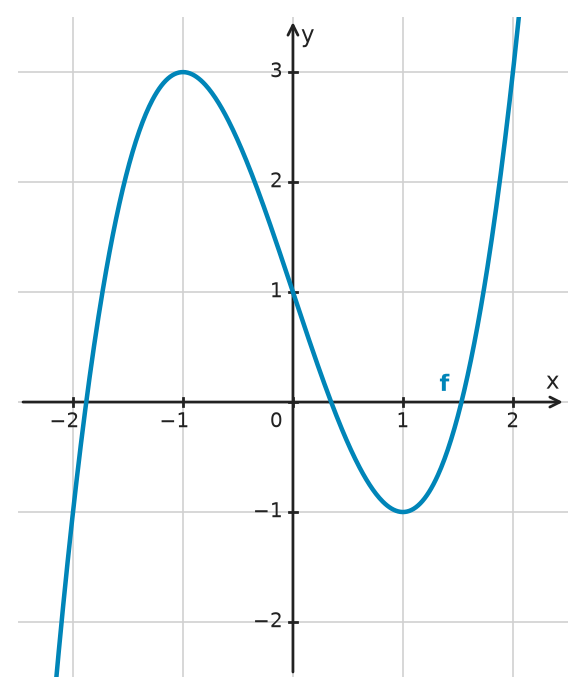
Figure for problem 532566

Hints

- Write the Newton update and identify the function and derivative values needed. - Relate the derivative to the slope of the tangent line. - Examine the graph at \(x=1\). - Visualize the tangent at \(x=1.1\) and where it meets the x-axis.

Solution

1. Differentiate: \(f'(x)=3x^2-3\). 2. At \(x_0=2\), \(f(2)=3\) and \(f'(2)=9\). Thus, \(x_1=2-\frac{3}{9}=\frac{5}{3}\approx1.667\). 3. At \(x_1=\frac{5}{3}\), \(f\left(\frac{5}{3}\right)=\frac{17}{27}\) and \(f'\left(\frac{5}{3}\right)=\frac{16}{3}\). Therefore, \(x_2=\frac{5}{3}-\frac{\frac{17}{27}}{\frac{16}{3}}=\frac{223}{144}\approx1.549\). 4. At \(x_0=1\), \(f'(1)=0\), so Newton's formula would divide by zero. On the graph, \(x=1\) is a local minimum with a horizontal tangent, and that tangent does not intersect the x-axis. 5. Near \(x=1\), the tangent slope is small. At \(x_0=1.1\), \(f(1.1)=-0.969\) and \(f'(1.1)=0.63\), giving \(x_1\approx2.638\). Because the tangent is nearly horizontal and begins below the x-axis, its x-intercept lies far to the right.

Answer

a) \(x_1=\frac{5}{3}\approx1.667\); \(x_2=\frac{223}{144}\approx1.549\) b) \(f'(1)=0\), so Newton's formula is undefined. Graphically, the tangent at the local minimum is horizontal and does not meet the x-axis. c) Just to the right of the minimum, the tangent is almost horizontal. Its x-intercept is therefore far to the right of the nearby zero.

53257112
The figure shows the graph of a function \(f\), defined for all real numbers, and the tangent line \(t\) at \(x_0=3\). Newton's method will be used to approximate a zero of \(f\). a) Use the figure to determine the first approximation \(x_1\). Briefly explain the graphical procedure. b) For \(f(x)=\frac{1}{6}x^3-\frac{2}{3}x^2+\frac{3}{2}x-1\), calculate \(f(x_1)\) and \(f'(x_1)\). c) Use your results from part b) and \(x_{n+1}=x_n-\frac{f(x_n)}{f'(x_n)}\) to calculate \(x_2\).
Figure for problem 532571

Hints

- The next Newton approximation is where the current tangent meets the x-axis. - Read the x-intercept of tangent line \(t\) from the graph. - Substitute \(x_1\) into both the function and its first derivative. - Use those two values in Newton's formula.

Solution

1. The tangent at \(x_0=3\) meets the x-axis at \(x=2\). Therefore, \(x_1=2\). Graphically, each Newton approximation is the x-intercept of the tangent at the previous approximation. 2. Evaluate the function: \(f(2)=\frac{1}{6}\cdot8-\frac{2}{3}\cdot4+\frac{3}{2}\cdot2-1=\frac{2}{3}\). 3. Differentiate: \(f'(x)=\frac{1}{2}x^2-\frac{4}{3}x+\frac{3}{2}\). Thus, \(f'(2)=2-\frac{8}{3}+\frac{3}{2}=\frac{5}{6}\). 4. Apply Newton's formula: \(x_2=2-\frac{\frac{2}{3}}{\frac{5}{6}}=2-\frac{4}{5}=1.2\).

Answer

a) \(x_1=2\); it is the x-intercept of the tangent at \(x_0=3\). b) \(f(2)=\frac{2}{3}\) and \(f'(2)=\frac{5}{6}\) c) \(x_2=1.2\)
53257312
The graph of \(f(x)=0.1x^3-1.2x+1\) is shown. Use Newton's method to investigate its zeros. a) Starting with \(x_0=1\), calculate \(x_1\) as a fraction in simplest form and as a decimal rounded to two places. b) Explain algebraically and graphically why \(x_0=2\) causes Newton's method to fail. c) Starting with \(x_0=-1.5\), calculate \(x_1\). Which of the three zeros does the iteration approach, and why?
Figure for problem 532573

Hints

- Write the general Newton update. - Relate a zero derivative to the tangent line. - Find the x-intercept of the tangent at \(x_0=-1.5\). - Use the graph to see which zero lies in the path of later iterations.

Solution

1. Differentiate: \(f'(x)=0.3x^2-1.2\). 2. At \(x_0=1\), \(f(1)=-0.1\) and \(f'(1)=-0.9\). Thus, \(x_1=1-\frac{-0.1}{-0.9}=\frac{8}{9}\approx0.89\). 3. At \(x_0=2\), \(f'(2)=0\), so the Newton update is undefined. The graph has a local minimum with a horizontal tangent at that point. 4. At \(x_0=-1.5\), \(f(-1.5)=2.4625\) and \(f'(-1.5)=-0.525\). Therefore, \(x_1=-1.5-\frac{2.4625}{-0.525}=\frac{67}{21}\approx3.19\). 5. This first approximation lies to the right of the right-hand zero near \(2.93\). Subsequent tangent intercepts approach that zero from the right.

Answer

a) \(x_1=\frac{8}{9}\approx0.89\) b) \(f'(2)=0\), so the update divides by zero; the tangent is horizontal. c) \(x_1=\frac{67}{21}\approx3.19\). The iteration approaches the right-hand zero near \(2.93\).
53433812
The graph of \(f(x)=0.2x^3-x+0.5\) is shown. a) Estimate the three zeros from the graph. b) To refine the greatest zero, calculate one Newton iteration starting with \(x_0=2.0\). c) Explain why some points in the domain cannot be used as initial values for Newton's method. Find these points for \(f\) and round them to two decimal places.
Figure for problem 534338

Hints

- Look for the points where the graph crosses the x-axis. - Use the general Newton iteration. - Consider what happens when the tangent line is horizontal. - Identify which expression in Newton's formula cannot equal zero.

Solution

1. Reading from the graph gives approximate zeros of \(-2.5\), \(0.5\), and \(1.9\). 2. Differentiate: \(f'(x)=0.6x^2-1\). 3. At \(x_0=2\), \(f(2)=0.1\) and \(f'(2)=1.4\). Therefore, \(x_1=2-\frac{0.1}{1.4}=2-\frac{1}{14}\approx1.929\). 4. An initial value where \(f'(x)=0\) makes Newton's formula undefined because it requires division by the derivative. 5. Solve \(0.6x^2-1=0\): \(x^2=\frac{5}{3}\), so \(x=\pm\sqrt{\frac{5}{3}}\approx\pm1.29\).

Answer

a) The zeros are approximately \(-2.5\), \(0.5\), and \(1.9\). b) \(x_1\approx1.929\) c) The inadmissible initial values are \(x\approx-1.29\) and \(x\approx1.29\), where \(f'(x)=0\).
53433912
The figure shows the graph of \(g(x)=0.5x^3-2x+1\). Use Newton's method to investigate its positive zeros. The iteration rule is \(x_{n+1}=x_n-\frac{g(x_n)}{g'(x_n)}\). a) Starting with \(x_0=2\), calculate \(x_1\). b) Starting with \(x_0=0\), perform one iteration. What is \(x_1\), and is it closer to the corresponding zero shown on the graph? c) Explain the geometric meaning of the line whose x-intercept gives \(x_{n+1}\). Use this interpretation to explain why Newton's method can make a large jump when the starting value is very close to a local minimum or maximum.
Figure for problem 534339

Hints

- Substitute each starting value into the function and its derivative. - Compare the new value in part b) with the nearby x-intercept on the graph. - The derivative gives the slope of the tangent line. - Consider what happens in Newton's fraction when the denominator is close to zero.

Solution

1. Differentiate: \(g'(x)=1.5x^2-2\). 2. For \(x_0=2\), \(g(2)=1\) and \(g'(2)=4\). Therefore, \(x_1=2-\frac{1}{4}=1.75\). 3. For \(x_0=0\), \(g(0)=1\) and \(g'(0)=-2\). Therefore, \(x_1=0-\frac{1}{-2}=0.5\). The corresponding zero is approximately \(0.539\), so \(0.5\) is closer to it than \(0\). 4. The line is the tangent to the graph at \((x_n,g(x_n))\). Near a local extremum, the tangent slope is close to zero. An almost horizontal tangent may meet the x-axis far away, producing a large change from \(x_n\) to \(x_{n+1}\).

Answer

a) \(x_1=1.75\) b) \(x_1=0.5\), which is closer to the corresponding zero at approximately \(0.539\). c) The line is the tangent at \((x_n,g(x_n))\). Near an extremum, its slope can be close to zero, so its x-intercept can be far from \(x_n\).
53434112
Consider \(f(x)=0.25x^4-2x^2+2\). a) Use Newton's method with \(x_0=3\) to approximate the greatest positive zero to two decimal places. b) Investigate what happens when \(x_0=0\). Explain your observation using the tangent line shown by the graph.
Figure for problem 534341

Hints

- Apply Newton's formula one step at a time and retain enough decimal places. - Determine the tangent slope at \(x=0\). - Continue until consecutive approximations agree to two decimal places.

Solution

1. Differentiate: \(f'(x)=x^3-4x\). 2. Beginning with \(x_0=3\), Newton's method gives \(x_1\approx2.716666667\), \(x_2\approx2.623389823\), \(x_3\approx2.613241522\), and \(x_4\approx2.613125945\). 3. The last two approximations round to \(2.61\), so the greatest positive zero is approximately \(2.61\). 4. If \(x_0=0\), then \(f'(0)=0\), so the Newton update is undefined. Graphically, the tangent at \((0, 2)\) is horizontal and does not intersect the x-axis.

Answer

a) The greatest positive zero is \(x\approx2.61\). b) At \(x_0=0\), \(f'(0)=0\), so Newton's method would divide by zero. The tangent there is horizontal and does not meet the x-axis.
53434612
Let \(h(x)=x^2-4x+5\). A student tries to find a zero with Newton's method, beginning with \(x_0=3\). a) Calculate \(x_1\). b) Show algebraically why the attempt to calculate \(x_2\) fails. c) Explain the failure geometrically using the graph of \(h\).
Figure for problem 534346

Hints

- Identify what cannot equal zero in the denominator of Newton's formula. - Locate the point reached after the first step. - Interpret a tangent slope of zero on the graph.

Solution

1. Differentiate: \(h'(x)=2x-4\). 2. The first approximation is \(x_1=3-\frac{h(3)}{h'(3)}=3-\frac{2}{2}=2\). 3. The next step requires \(h'(2)\), but \(h'(2)=0\). Therefore, the update is undefined because it would divide by zero. 4. Geometrically, \(x=2\) is the vertex of the parabola. The tangent there is horizontal and never intersects the x-axis. Also, \(h(x)=(x-2)^2+1>0\), so the function has no real zero.

Answer

a) \(x_1=2\) b) Because \(h'(2)=0\), the formula for \(x_2\) is undefined. c) The tangent at the vertex is horizontal and does not meet the x-axis; the parabola has no real zero.
53435112
The graph of \(f(x)=\frac{1}{3}x^3-3x+1\) is shown. Newton's method will be used to find the greatest of the three zeros. a) Use the graph and tangent-line behavior to explain why an initial value near \(x=1.7\) is a poor choice for finding the rightmost zero. b) Starting with \(x_0=2.5\), calculate \(x_1\). Round to three decimal places.
Figure for problem 534351

Hints

- Examine the tangent when the graph is nearly flat. - Consider where an almost horizontal tangent meets the x-axis. - Evaluate both the function and its derivative at \(x_0=2.5\).

Solution

1. Differentiate: \(f'(x)=x^2-3\). The positive critical point is \(x=\sqrt{3}\approx1.732\), where the graph has a local minimum. 2. Near \(x=1.7\), the derivative is close to zero, so the tangent is nearly horizontal. Its x-intercept can be far from the starting point, causing the iteration to overshoot or move toward a different zero. 3. At \(x_0=2.5\), \(f(2.5)=\frac{125}{24}-\frac{15}{2}+1=-\frac{31}{24}\approx-1.2917\), and \(f'(2.5)=3.25\). 4. Therefore, \(x_1=2.5-\frac{-\frac{31}{24}}{3.25}\approx2.897\).

Answer

a) Near \(x=1.7\), the tangent is almost horizontal, so its x-intercept may lie far away and miss the intended zero. b) \(x_1\approx2.897\)
53435612
A terrain profile is modeled by \(f(x)=0.25x^4-2x^2+0.5x+1\). The greatest positive zero represents the farthest point to the right where the terrain reaches elevation \(0\). a) Starting with \(x_0=3\), perform two iterations of Newton's method. Round \(x_1\) and \(x_2\) to three decimal places. b) The graph of \(f\) is shown. Give one value in \([-3, 3]\) that is unsuitable as an initial value, and explain why using the geometric meaning of Newton's method.
Figure for problem 534356

Hints

- Write the Newton update before substituting values. - Identify the role of the first derivative in the denominator. - On the graph, look for a local maximum or minimum. - Newton's method uses the x-intercept of the tangent line.

Solution

1. Differentiate: \(f'(x)=x^3-4x+0.5\). 2. At \(x_0=3\), \(f(3)=4.75\) and \(f'(3)=15.5\). Therefore, \(x_1=3-\frac{4.75}{15.5}\approx2.693548\), so \(x_1\approx2.694\). 3. Using the unrounded value of \(x_1\), \(f(x_1)\approx0.995861\) and \(f'(x_1)\approx9.268047\). Thus, \(x_2\approx2.586097\), so \(x_2\approx2.586\). 4. A point where \(f'(x)=0\) has a horizontal tangent, so the Newton update is undefined. For example, \(x\approx0.125\) is unsuitable because it is a visible local maximum and \(f'(0.125)\approx0\).

Answer

a) \(x_1\approx2.694\); \(x_2\approx2.586\) b) One unsuitable initial value is \(x\approx0.125\). The tangent is horizontal there, so Newton's formula would divide by zero.
52271712
Let \(f(x)=\frac{1}{8}x^4+\frac{3}{2}x^2+5x\). 1. Use the second derivative and the end behavior of \(f'\) to show that \(f\) has exactly one critical point. 2. Use Newton's method with \(x_0=-1\) to approximate the x-coordinate of this critical point to three decimal places.

Hints

- Use the sign of the second derivative to determine how the first derivative changes. - A continuous strictly increasing function can cross zero at most once. - Check the end behavior of the first derivative. - Apply Newton's method to the first derivative, because a critical point occurs where \(f'(x)=0\).

Solution

1. The first derivative is \(f'(x)=\frac{1}{2}x^3+3x+5\), and the second derivative is \(f''(x)=\frac{3}{2}x^2+3\). 2. Since \(f''(x)\geq3>0\) for every real \(x\), \(f'\) is strictly increasing. Also, \(f'(x)\to-\infty\) as \(x\to-\infty\), and \(f'(x)\to\infty\) as \(x\to\infty\). Therefore, \(f'\) has exactly one zero, so \(f\) has exactly one critical point. Because \(f''>0\), it is a minimum. 3. Apply Newton's method to \(f'(x)=0\): \(x_{n+1}=x_n-\frac{f'(x_n)}{f''(x_n)}\). 4. Starting with \(x_0=-1\), the approximations are \(x_1=-\frac{4}{3}\approx-1.3333\), \(x_2\approx-1.3007\), and \(x_3\approx-1.3003\). 5. The critical point occurs at \(x\approx-1.300\).

Answer

1. Since \(f''(x)>0\), the function \(f'\) is strictly increasing from \(-\infty\) to \(\infty\), so it has exactly one zero. 2. The unique critical point occurs at \(x\approx-1.300\), and it is a minimum.
52274812
To approximate the reciprocal of a nonzero number \(b\) without using division in the iteration, apply Newton's method to \(f(x) = \frac{1}{x}-b\). a) Show that the resulting iteration rule is \(x_{n+1} = x_n(2-bx_n)\). b) For \(b=13\) and \(x_0=0.1\), calculate \(x_1\), \(x_2\), and \(x_3\). c) For \(b=13\), calculate the first three iterations when \(x_0=0.2\). Explain why this initial value is unsuitable.

Hints

- Rewrite \(\frac{1}{x}\) as \(x^{-1}\) before differentiating. - Simplify the complex fraction by multiplying by the reciprocal of its denominator. - In part b), evaluate one iteration at a time and track the sign of \(2-bx_n\). - A sequence that moves farther from the target is diverging.

Solution

1. Differentiate \(f(x)=x^{-1}-b\): \(f'(x)=-x^{-2}=-\frac{1}{x^2}\). 2. Apply Newton's method: \(x_{n+1}=x_n-\frac{\frac{1}{x_n}-b}{-\frac{1}{x_n^2}} = x_n+\left(\frac{1}{x_n}-b\right)x_n^2\). 3. Simplify: \(x_{n+1}=x_n+x_n-bx_n^2=x_n(2-bx_n)\). 4. With \(b=13\) and \(x_0=0.1\), \(x_1=0.1(2-13\cdot0.1)=0.07\), \(x_2=0.07(2-13\cdot0.07)=0.0763\), and \(x_3=0.0763(2-13\cdot0.0763)=0.07691803\). 5. With \(x_0=0.2\), the iterations are \(x_1=-0.12\), \(x_2=-0.4272\), and \(x_3=-3.22689792\). Their magnitudes increase instead of approaching \(\frac{1}{13}\), so the sequence diverges. In fact, a positive initial value must satisfy \(0<x_0<\frac{2}{13}\) for this iteration to converge to \(\frac{1}{13}\).

Answer

a) \(x_{n+1}=x_n(2-bx_n)\) b) \(x_1=0.07\); \(x_2=0.0763\); \(x_3=0.07691803\) c) \(x_1=-0.12\), \(x_2=-0.4272\), and \(x_3\approx-3.2269\). The values move away from \(\frac{1}{13}\), so \(x_0=0.2\) is unsuitable.
52909212
Consider \(g(x)=x^4-2x^3-2\). 1. Explain why \(g\) has at least one zero in \([2, 3]\). 2. Starting with \(x_0=2\), perform two Newton iterations to approximate this zero. 3. Starting with \(x_0=2\), perform two Newton iterations to approximate a zero of \(g''\).

Hints

- Use continuity and the signs of the endpoint values for part 1. - Newton's method for \(g(x)=0\) requires the first derivative of \(g\). - For part 3, treat the second derivative as the function whose zero you are finding. - Avoid rounding intermediate values too early.

Solution

1. The polynomial \(g\) is continuous. Also, \(g(2)=-2\) and \(g(3)=25\). Because the endpoint values have opposite signs, the Intermediate Value Theorem guarantees at least one zero in \([2, 3]\). 2. Differentiate: \(g'(x)=4x^3-6x^2\). Starting with \(x_0=2\), the first iteration gives \(x_1=2-\frac{-2}{8}=2.25\). The second gives \(x_2=2.25-\frac{\frac{217}{256}}{\frac{243}{16}}=\frac{8531}{3888}\approx2.1942\). 3. Let \(h(x)=g''(x)=12x^2-12x\), so \(h'(x)=24x-12\). Starting with \(x_0=2\), Newton's method gives \(x_1=\frac{4}{3}\approx1.3333\) and \(x_2=\frac{16}{15}\approx1.0667\).

Answer

1. Since \(g\) is continuous, \(g(2)<0\), and \(g(3)>0\), the Intermediate Value Theorem guarantees a zero in \([2, 3]\). 2. \(x_1=2.25\); \(x_2=\frac{8531}{3888}\approx2.1942\) 3. \(x_1=\frac{4}{3}\approx1.3333\); \(x_2=\frac{16}{15}\approx1.0667\)
52910412
Consider \(x^3-3x+1=0\). a) Use Newton's method to find the next approximation \(x_2\) from each initial value \(x_1=0.9\) and \(x_1=1.1\). b) Explain geometrically why these nearby initial values send the iteration to very different regions. c) Explain why \(x=1\) is unsuitable as an initial value.

Hints

- Picture the graph near a local minimum. - Compare the tangent directions on the two sides of the minimum. - Relate the derivative to the tangent slope. - Check the denominator of Newton's formula.

Solution

1. Let \(f(x)=x^3-3x+1\), so \(f'(x)=3x^2-3\). 2. At \(x_1=0.9\), \(f(0.9)=-0.971\) and \(f'(0.9)=-0.57\). Thus, \(x_2=0.9-\frac{-0.971}{-0.57}\approx-0.8035\). 3. At \(x_1=1.1\), \(f(1.1)=-0.969\) and \(f'(1.1)=0.63\). Thus, \(x_2=1.1-\frac{-0.969}{0.63}\approx2.6381\). 4. The graph has a local minimum at \(x=1\). Just left of the minimum, the tangent slope is negative, so its x-intercept lies to the left. Just right of the minimum, the slope is positive, so its x-intercept lies far to the right. 5. At \(x=1\), \(f'(1)=0\). The tangent is horizontal, so Newton's formula is undefined.

Answer

a) From \(x_1=0.9\), \(x_2\approx-0.8035\). From \(x_1=1.1\), \(x_2\approx2.6381\). b) The initial values lie on opposite sides of a local minimum, where the tangent slopes have opposite signs. c) \(f'(1)=0\), so the Newton update would divide by zero.
52923012
Consider \(f(x)=x^3-3x^2+1\). a) Explain algebraically why \(x_0=2\) is unsuitable as an initial value for Newton's method. b) Starting with \(x_0=2.1\), calculate \(x_1\) and round to two decimal places. c) The three zeros are approximately \(-0.53\), \(0.65\), and \(2.88\). Compare \(x_1\) with these zeros and explain the convergence problem illustrated by this example.

Hints

- Check the denominator of Newton's formula at \(x=2\). - Relate a zero derivative to a horizontal tangent. - Calculate the function and derivative values separately before updating. - Consider where an almost horizontal tangent meets the x-axis.

Solution

1. Differentiate: \(f'(x)=3x^2-6x\). 2. At \(x_0=2\), \(f'(2)=0\), so Newton's formula is undefined. Geometrically, the tangent at the local minimum is horizontal. 3. At \(x_0=2.1\), \(f(2.1)=-2.969\) and \(f'(2.1)=0.63\). Therefore, \(x_1=2.1-\frac{-2.969}{0.63}\approx6.8127\), so \(x_1\approx6.81\). 4. The small tangent slope near the local minimum produces an x-intercept far from the starting point and from every zero. This is an example of Newton's method overshooting when the derivative is close to zero.

Answer

a) \(f'(2)=0\), so the Newton update would divide by zero. b) \(x_1\approx6.81\) c) The first approximation lies far beyond all three zeros because the tangent slope at \(x_0=2.1\) is very small.
53242912
The graph of \(f(x)=x^3-3x^2+2\) is shown. Newton's method uses \(x_{n+1}=x_n-\frac{f(x_n)}{f'(x_n)}\). a) Find the two initial values for which the first Newton step is undefined. Explain the failure using the graph. b) Use \(x_0=3\). 1. Calculate \(x_1\) and \(x_2\) as fractions in simplest form and as decimals rounded to four places. 2. Use the graph to identify which zero the iteration approaches. c) A student claims that every initial value between the critical points \(x=0\) and \(x=2\) converges to the middle zero \(x=1\). Calculate one Newton step from \(x_0=1.8\) and from \(x_0=0.2\), and explain why these examples disprove the claim.
Figure for problem 532429

Hints

- Use the derivative to locate horizontal tangents. - Interpret each Newton update as the x-intercept of a tangent line. - Keep fractions exact during the two iterations from \(x_0=3\). - A first step across a critical point can send later iterations to a different zero.

Solution

1. Differentiate: \(f'(x)=3x^2-6x=3x(x-2)\). The derivative is zero at \(x_0=0\) and \(x_0=2\), so the Newton update is undefined. These are the local maximum and minimum, where the graph has horizontal tangents. 2. From \(x_0=3\), \(f(3)=2\) and \(f'(3)=9\). Thus, \(x_1=3-\frac{2}{9}=\frac{25}{9}\approx2.7778\). 3. At \(x_1=\frac{25}{9}\), \(f(x_1)=\frac{208}{729}\) and \(f'(x_1)=\frac{175}{27}\). Therefore, \(x_2=\frac{25}{9}-\frac{\frac{208}{729}}{\frac{175}{27}}=\frac{12917}{4725}\approx2.7338\). 4. The values remain to the right of \(2\) and approach the right-hand zero \(1+\sqrt{3}\approx2.7321\). 5. From \(x_0=1.8\), \(x_1=1.8-\frac{-1.888}{-1.08}=\frac{7}{135}\approx0.0519\). Further iterations approach the right-hand zero. 6. From \(x_0=0.2\), \(x_1=0.2-\frac{1.888}{-1.08}=\frac{263}{135}\approx1.9481\). Further iterations approach the left-hand zero \(1-\sqrt{3}\approx-0.7321\). Therefore, neither initial value approaches the middle zero.

Answer

a) \(x_0=0\) and \(x_0=2\); the tangents are horizontal there. b) 1. \(x_1=\frac{25}{9}\approx2.7778\); \(x_2=\frac{12917}{4725}\approx2.7338\) 2. The iteration approaches \(1+\sqrt{3}\approx2.7321\). c) From \(x_0=1.8\), \(x_1=\frac{7}{135}\approx0.0519\) and the sequence approaches the right-hand zero. From \(x_0=0.2\), \(x_1=\frac{263}{135}\approx1.9481\) and the sequence approaches the left-hand zero.
53400612
Newton's method does not converge for every initial value. Consider \(f(x)=x^3-5x\). a) Starting with \(x_1=1\), calculate \(x_2\) and \(x_3\), and interpret the result. b) Use the graph to explain the iteration behavior in terms of the tangent lines at \(x=1\) and \(x=-1\). c) Find the positive zero exactly and give a reasonable initial value \(x_1>2\) for approximating it. Briefly justify your choice.
Figure for problem 534006

Hints

- Apply Newton's update successively. - Track whether a previously used value reappears. - Relate each tangent line to its x-intercept. - Factor the polynomial to find the exact zeros. - Choose an initial value on the same monotonic branch as the target zero.

Solution

1. Differentiate: \(f'(x)=3x^2-5\). 2. At \(x_1=1\), \(f(1)=-4\) and \(f'(1)=-2\), so \(x_2=1-\frac{-4}{-2}=-1\). 3. At \(x_2=-1\), \(f(-1)=4\) and \(f'(-1)=-2\), so \(x_3=-1-\frac{4}{-2}=1\). The iteration is trapped in a two-cycle between \(1\) and \(-1\). 4. Graphically, the tangent at \((1, -4)\) intersects the x-axis at \(-1\), and the tangent at \((-1, 4)\) intersects it at \(1\). 5. Factoring gives \(x(x^2-5)=0\), so the positive zero is \(\sqrt{5}\approx2.236\). An initial value such as \(x_1=3\) is reasonable because it lies to the right of the positive zero and away from the nearby critical point.

Answer

a) \(x_2=-1\); \(x_3=1\). The iteration cycles and does not converge. b) The tangent at \(x=1\) has x-intercept \(-1\), and the tangent at \(x=-1\) has x-intercept \(1\), producing the cycle. c) The positive zero is \(\sqrt{5}\). A reasonable initial value is \(x_1=3\).
53435712
To locate a critical point of a fourth-degree function \(f\), consider its first derivative \(f'(x)=x^3-3x^2+1\). a) Use two iterations of Newton's method with \(x_0=3\) to approximate the zero of \(f'\) in \([2, 3]\). b) The graph shows \(f'\) and \(f''\). Use the graph of \(f''\) to explain why \(x=2\) cannot be an initial value when applying Newton's method to find a zero of \(f'\).
Figure for problem 534357

Hints

- Treat \(f'\) as the function whose zero is being found, and use \(f''\) as its derivative. - Distinguish carefully between the two graphs. - The value of \(f''\) gives the slope of the graph of \(f'\). - Check what happens when the denominator of the Newton update is zero.

Solution

1. Let \(g(x)=f'(x)=x^3-3x^2+1\). Its derivative is \(g'(x)=f''(x)=3x^2-6x\). 2. At \(x_0=3\), \(g(3)=1\) and \(g'(3)=9\). Thus, \(x_1=3-\frac{1}{9}=\frac{26}{9}\approx2.889\). 3. Using \(x_1=\frac{26}{9}\), \(g(x_1)=\frac{53}{729}\) and \(g'(x_1)=\frac{208}{27}\). Therefore, \(x_2=\frac{26}{9}-\frac{\frac{53}{729}}{\frac{208}{27}}=\frac{16171}{5616}\approx2.879\). 4. At \(x=2\), \(f''(2)=0\). Therefore, the graph of \(f'\) has a horizontal tangent there, and the Newton update for finding a zero of \(f'\) would divide by zero.

Answer

a) \(x_1\approx2.889\); \(x_2\approx2.879\) b) \(f''(2)=0\), so the graph of \(f'\) has a horizontal tangent at \(x=2\). Newton's formula is undefined there.

All problems may be used, copied and printed free of charge for school and tutoring, including paid tutoring. Commercial adaptations as well as publication or redistribution on the internet are not permitted.