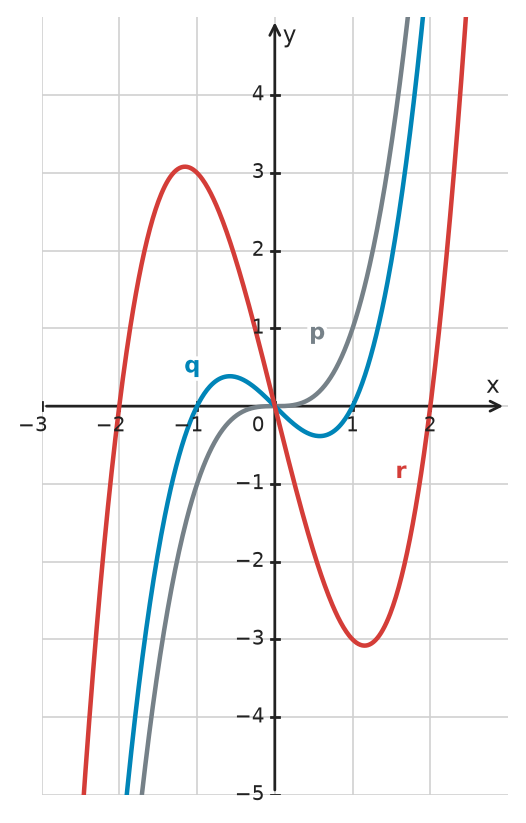
Consider the family of functions \(f_a(x)=x^3-ax\), where \(a\ge0\). The figure shows three graphs from the family, labeled p, q, and r.
a) Find the value of \(a\) for each graph. Justify your matches using the zeros.
b) State the symmetry shared by all graphs and verify it algebraically.
c) For \(a>0\), find the coordinates of the local maximum and local minimum in terms of \(a\).
d) For which values of \(a\ge0\) does \(f_a\) have exactly three distinct real zeros?
e) Using your derivative results, give a text-only graph blueprint for the two structurally different cases \(a=0\) and \(a>0\). For each case, state end behavior, monotonicity, local extrema, and the inflection-point x-coordinate in left-to-right order.
Hints
- Factor the function to find its zeros.
- Compare \(f_a(-x)\) with \(f_a(x)\).
- Use the first and second derivatives to locate and classify extrema.
- Determine when \(\pm\sqrt{a}\) are distinct from zero.
- For the final blueprint, distinguish the degenerate case \(a=0\) from \(a>0\); the derivative has a different zero structure in those two cases.
Solution
1. Factor \(f_a(x)=x(x^2-a)\). Graph p has only the zero \(x=0\), so \(a=0\). Graph q has zeros \(-1, 0, 1\), so \(a=1\). Graph r has zeros \(-2, 0, 2\), so \(a=4\).
2. Since \(f_a(-x)=-f_a(x)\), every graph is symmetric about the origin.
3. The first derivative is \(f_a'(x)=3x^2-a\), so the critical numbers are \(x=\pm\sqrt{\frac{a}{3}}\). The second derivative is \(f_a''(x)=6x\).
4. The local maximum is \(\left(-\sqrt{\frac{a}{3}}, \frac{2a}{3}\sqrt{\frac{a}{3}}\right)\), and the local minimum is \(\left(\sqrt{\frac{a}{3}}, -\frac{2a}{3}\sqrt{\frac{a}{3}}\right)\).
5. The zeros are \(0\) and \(\pm\sqrt{a}\). They are three distinct real numbers exactly when \(a>0\).
6. For \(a=0\), \(f_0(x)=x^3\): it is increasing on \(\mathbb{R}\), has no local extremum, has a stationary inflection point at \((0,0)\), and runs from \(-\infty\) to \(\infty\).
7. For \(a>0\), the graph increases on \(( -\infty,-\sqrt{a/3})\), decreases on \((-\sqrt{a/3},\sqrt{a/3})\), and increases on \((\sqrt{a/3},\infty)\). It has the local maximum and minimum from part c, a nonstationary inflection point at \((0,0)\), and the same cubic end behavior.
Answer
a) p: \(a=0\); q: \(a=1\); r: \(a=4\)
b) Symmetric about the origin
c) Local maximum: \(\left(-\sqrt{\frac{a}{3}}, \frac{2a}{3}\sqrt{\frac{a}{3}}\right)\); local minimum: \(\left(\sqrt{\frac{a}{3}}, -\frac{2a}{3}\sqrt{\frac{a}{3}}\right)\)
d) \(a>0\)
e) \(a=0\): increasing on \(\mathbb{R}\), no extrema, stationary inflection at \((0,0)\), cubic end behavior. For \(a>0\): increase → local maximum at \(x=-\sqrt{a/3}\) → decrease through the inflection at \(x=0\) → local minimum at \(x=\sqrt{a/3}\) → increase, with left end down and right end up.


